FDA Approves Vaccine for Mpox — Warns It May Cause Death in Vaccinated and People They Come in Contact With
By Suzanne Burdick, Ph.D. | The Defender | September 17, 2024
A vaccine approved in August by the U.S. Food and Drug Administration (FDA) for people deemed to be at “high risk” for mpox infection may cause more harm than good, according to the FDA’s own medication guide for the product.
ACAM2000 — made by Emergent BioSolutions, a company specializing in vaccines for biochemical warfare threats such as anthrax and smallpox — was approved for smallpox in 2007.
However, on Aug. 29, the FDA issued an expanded supplement approval for ACAM2000’s use against mpox.
Since then, social media users have been posting clips of the FDA’s ACAM2000 medication guide, which warns the vaccine may cause “serious complications” in both the vaccinated person and those with whom they come into close contact up to 6 weeks after getting the shot.
Karl Jablonowski, Ph.D. — senior research scientist at Children’s Health Defense — told The Defender that the FDA’s approval of the shot is a “public hazard, not the practice of public health.”
“You can call ACAM2000 a ‘vaccine,’ but its impact on the United States will be as a ‘disease,’” Jablonowski said.
He added:
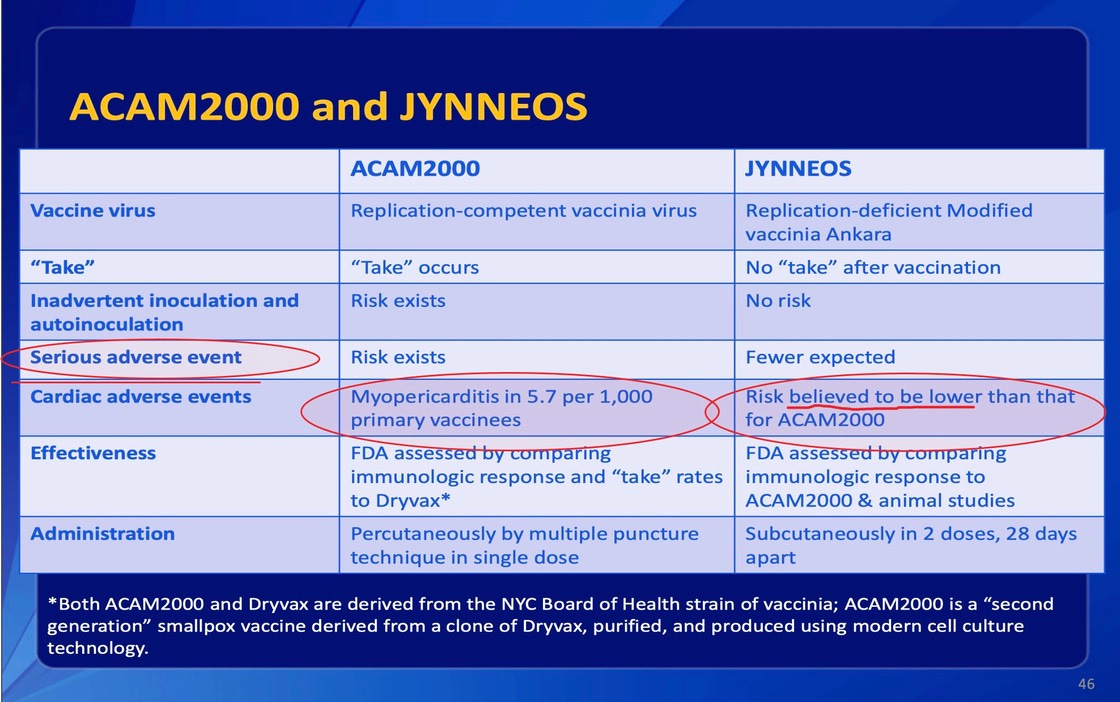
“For instance, the drug’s package insert reveals (see Table 3) that the U.S. Department of Health and Human Services (HHS) found roughly 520 per million ACAM2000 recipients contracted myocarditis or pericarditis.
“That is about 1 in 2,000. But elsewhere in the package insert, the FDA acknowledges that — based on additional studies — the risk is actually 5.7 per 1,000 vaccinations.
“That’s about 1 in every 175 people. If the 262 million adults in the U.S. received this vaccine, an estimated 1,493,000 would contract the serious adverse reaction of myopericarditis.”
Myopericarditis is an umbrella term for myocarditis, inflammation of the heart, and pericarditis, inflammation of the tissue surrounding the heart.
Dr. Meryl Nass, an internist and biological warfare expert, told The Defender that the CDC also acknowledged this same figure — myopericarditis in 5.7 per 1,000 primary ACAM2000 vaccinations — during a June 23, 2022, meeting.
“It’s a huge number,” Nass said. “The fact that the FDA and CDC are acknowledging it means no one should get the vaccine.”
She explained:
“Myopericarditis is a life-threatening condition. It lowers your life expectancy.
“Most people are never going to be exposed to mpox or smallpox. Vaccines are typically given to healthy people who are never even going to be exposed, therefore the risk posed by the vaccine needs to be low.
“That’s why vaccine safety is critical — even more than drugs, because drugs are given to people who are already sick.
“This risk — 1 in 175 — is higher than all other licensed vaccines for which the CDC acknowledges side effects. This is the worst.”
ACAM2000 can also cause fetal death when taken during pregnancy, the package insert states.
Additionally, the shot contains a “live vaccinia virus” that can be spread to — and possibly cause the death of — people who have close contact with the vaccinated person up to 6 weeks following vaccination, according to the medication guide.
The guide — which the FDA requires to be given to patients before they get the ACAM2000 vaccine — says, “ACAM2000 can cause serious complications in vaccinated individuals and in their close contacts to whom the vaccine virus has spread.”
Jablonowski said, “The spread of vaccinia virus is an infliction and an assault, as an unsuspecting person cannot possibly consent.”
“For good reasons you would not consent to this vaccine,” Jablonowski said, “even if you believed your benefits outweigh your risks, as you become a potential vector of a disease that is damaging to the heart and fatal to both fetus and infant.”
Risk of serious complications and death in vaccinated and those exposed to vaccinated individual
ACAM2000 is a single-dose vaccine administered using a bifurcated needle that’s been dipped into the vaccine solution, according to an Emergent BioSolutions press release.
In its Aug. 30 press release, the FDA stressed that “every person” who receives ACAM2000 is “required” to be given the drug’s FDA-approved medication guide.
“A Medication Guide is necessary,” the FDA said, “for safe and effective use of the vaccine because it could help prevent serious adverse events and inform the vaccine recipient of serious risks relative to benefit that could affect their decisions to be vaccinated.”
The guide lists serious possible complications, including: myocarditis, inflammation of the brain or spinal cord, serious skin infections, spreading the vaccine virus through the blood to other parts of the body and fetal death if taken during pregnancy.
According to the guide, “The risks for serious vaccine side effects are greater for people who:
- have heart problems or a history of heart problems
- are taking steroid eye drops or ointment
- have a weakened immune system
- have skin problems such as eczema, atopic dermatitis, burns, impetigo, contact dermatitis, chickenpox, shingles, psoriasis, or uncontrolled acne
- are less than 1 year old
- are pregnant or become pregnant within 6 weeks after vaccination.”
ACAM2000’s package insert warns of a longer list of possible serious complications, including:
“Myocarditis and/or pericarditis, encephalitis, encephalomyelitis, encephalopathy, progressive vaccinia (vaccinia necrosum), generalized vaccinia, severe vaccinial skin infections, erythema multiforme major (including Stevens-Johnson syndrome), eczema vaccinatum, accidental eye infection (ocular vaccinia) which can cause ocular complications including keratitis and corneal scarring that may lead to blindness, and fetal death in pregnant women.”
The insert also goes into more detail about the risk of death:
“Historically, death following vaccination with live vaccinia virus is a rare event; approximately 1 death per million primary vaccinations and 1 death per 4 million revaccinations have occurred after vaccination with live vaccinia virus.
“Death is most often the result of sudden cardiac death, post-vaccinial encephalitis, progressive vaccinia, or eczema vaccinatum.
“Death has also been reported in unvaccinated contacts accidentally infected by individuals who have been vaccinated.”
U.S. stockpile contains more than 100 million doses
The FDA’s approval of ACAM2000 for use against mox followed just days after Emergent BioSolutions pledged to donate 50,000 doses to address the mpox outbreak in Africa.
On July 2, the U.S. Administration for Strategic Preparedness and Response at the HHS signed a $99.9 million deal with the drugmaker to obtain more ACAM2000 doses this year. Although the exact number of doses was not disclosed, Forbes on Sept. 8 reported that the U.S. currently has over 100 million doses.
HHS did not respond when The Defender asked if these doses are reserved for an emergency smallpox outbreak or are being made available as an mpox vaccine.
The Defender reached out to the Centers for Disease Prevention and Control (CDC) with the same question but was told by a CDC spokesperson, “We defer to the Administration for Strategic Preparedness and Response (ASPR) where the National Stockpile is housed.”
The CDC website on mpox vaccination states that ACAM2000 “has not been used in the ongoing clade II mpox outbreak that started in 2022″ but “has been made available for use against mpox in the clade II outbreak under an Expanded Access Investigational New Drug (EA-IND) protocol, which requires informed consent along with completing additional forms.”
When The Defender asked the CDC to clarify if the agency currently recommends ACAM2000 for mpox, an agency spokesperson said:
“It has not been used for U.S. civilians affected by the clade II global outbreak that began in 2022, and there are no plans to use it broadly during Mpox outbreaks.
“This is because JYNNEOS, the alternate to ACAM2000 in the United States, has fewer side effects.”
The Defender asked Emergent BioSolutions what it wants to tell members of the public who may be concerned about risks associated with ACAM2000 but did not receive a response by our deadline.
This article has been updated to clarify that both the FDA and CDC acknowledge that the myopericarditis risk for ACAM2000 is estimated at 5.7 per 1,000 primary vaccinations.
This article was originally published by The Defender — Children’s Health Defense’s News & Views Website under Creative Commons license CC BY-NC-ND 4.0. Please consider subscribing to The Defender or donating to Children’s Health Defense.
The real reason US wants to silence RT
By Fyodor Lukyanov | RT | September 18, 2024
In late 1986 Yegor Ligachev, the secretary of the Soviet Communist Party’s Central Committee, and Viktor Chebrikov, then-head of the KGB, proposed that the country end the practice of jamming foreign radio stations. ‘Enemy voices’ was the popular term used at the time to describe these broadcasts from abroad.
Of course, the two prominent officials were not imbued with bourgeois ideas when seeking to end radio jamming. They were actually taking a businesslike approach. The pair explained to the Central Committee that blocking was expensive but not very effective, given the size of the country. So, it was suggested that signal-jamming be abandoned and that funds be diverted to counter-propaganda measures. This meant more active work with foreign audiences to communicate the Soviet Union’s own views on world events.
A few weeks later, at a meeting with US President Ronald Reagan in Iceland, USSR leader Mikhail Gorbachev raised the issue. He said “your radio station Voice of America broadcasts around the clock in many languages from stations you have in different countries in Europe and Asia, and we can’t present our point of view to the American people. So, for the sake of equality, we have to jam the Voice of America broadcasts.” Gorbachev offered to stop blocking ‘VOA’ if his counterpart agreed to let Moscow have a frequency to do the same in the US. Reagan evasively promised to consult when he returned home. In the end, the Soviets stopped jamming foreign radio stations unilaterally, without any deal.
The events of the last few days have echoes of this old story. US Secretary of State Anthony Blinken devoted an entire speech to RT, which is subject to ‘full-blocking’ (that’s a new formula!) sanctions for its supposedly destructive and subversive work around the world. According to Blinken and the American intelligence agencies he references, the threat posed by the Russian company is of the highest order and requires the most decisive measures from all of Washington’s allies.
Without irony or exaggeration, it can be said that RT could only dream of the global recognition that Blinken’s appeal has facilitated. The effectiveness of the media group was not so much confirmed as it was certified, and by prominent representatives of its rivals.
We could deplore infringements on freedom of expression and restrictions on pluralism of opinion, but there is little point in doing so. Such notions should only be promoted in relation to the internal information space of individual countries; at a national level, they are an indispensable prerequisite for normal development. As for foreign sources of information, people generally perceive them as instruments of influence. And it hardly depends on the type of socio-political system that exists in a given state. The more comprehensive the information and communication environment, the greater its impact on people’s behavior, and the more acute the desire of governments to tighten control over the flow of ideas and analysis. The international media sphere is deliberately ideological, electrified and conflictual. Hence Blinken’s, shall we say, uncharacteristic remarks that RT should be treated “like an intelligence agency.”
How effective are the tactics of restricting alternative views and jamming radio waves? Comrades Ligachev and Chebrikov rightly pointed out that the costly efforts to jam hostile broadcasters were, to put it mildly, not particularly effective. Worse, as the author well remembers, the very fact that the authorities were fighting foreign radio voices had the opposite effect to that desired – if they were silencing voices, it meant that they were afraid of the truth. And, by the end of the Soviet era this opinion was not only widespread among the frontline intelligentsia, many ‘ordinary people’ also didn’t give a damn about the official channels.
At their meeting in Iceland, Reagan countered Gorbachev’s appeal by saying that, unlike the Soviets, “we recognize freedom of the press and the right of people to listen to any point of view.” The US president had no doubts about the superiority of the American system in all respects. Accordingly, the demands for information pluralism, then and later, reflected the confidence of Washington that it would emerge victorious from any competition. And so, a few years later, the US achieved a de-facto monopoly on the interpretation of everything.
Washington’s current extreme reaction is due to the feeling that it’s losing this monopoly. Alternative interpretations of events now arouse public interest. In fact, the total resources of the Western, mainly English-language media are incomparably greater than what all the carriers of alternative points of view can offer, at this moment. But internal insecurity is growing all by itself, fueling the desire to fence off the information space. From the same playbook comes the US’ attempts to explain its internal strife and accumulated contradictions by pointing to a pernicious external influence. This was also the Soviet experience. However, the USSR didn’t solve its own issues by blaming them on external causes. In fact, as its problems grew, those same outside factors actually began to exacerbate them.
Targeted punitive actions can create obstacles for any organization, there is no doubt about that. Especially when they come from what is still the most powerful country on the planet. But American history teaches us that monopolies do not last forever. Sooner or later, a cartel becomes a brake on development, then it becomes the subject of measures to break it up.
Fyodor Lukyanov is the editor-in-chief of Russia in Global Affairs, chairman of the Presidium of the Council on Foreign and Defense Policy, and research director of the Valdai International Discussion Club.
UN overwhelmingly demands Israel end occupation of Palestinian territories
Press TV – September 18, 2024
The United Nations General Assembly has adopted a resolution that demands Israel end its unlawful presence in the Occupied Palestinian Territory within a year.
A total of 124 countries voted in favor, while 14, including the US, opposed the resolution. Britain, Switzerland, Ukraine, India and Germany were among the 43 countries to abstain.
The resolution welcomes a July advisory opinion by the International Court of Justice that said Israel’s occupation of Palestinian territories and settlements is illegal and should be withdrawn.
The advisory opinion – by the highest United Nations court said this should be done “as rapidly as possible.”
The measure calls for Israel to pay reparations to Palestinians “for the damage caused to all the natural and legal persons concerned in the occupied Palestinian territory”.
The resolution also demands sanctions and an arms embargo against Israel.
The 193-member Assembly also calls on states to “take steps towards ceasing the importation of any products originating in the Israeli settlements, as well as the provision or transfer of arms, munitions and related equipment to Israel … where there are reasonable grounds to suspect that they may be used in the Occupied Palestinian Territory.”
Riyad Mansour, Palestine’s UN ambassador, who opened the assembly meeting on Tuesday, said that no occupying power can have a veto right over the inalienable rights of the people under its occupation.
“Those who think the Palestinian people will accept a life of servitude, a life of apartheid, are the ones who are not being realistic,” Mansour said.
“Those who imagine the Palestinian people will disappear or surrender are the ones who are not being realistic. Those who claim that peace is possible in our region without a just resolution for the question of Palestine are the ones who are not being realistic.
“Each country has a vote, and the world is watching us,” Mansour said. “Please stand on the right side of history. With international law. With freedom. With peace.”
US Ambassador to the UN Linda Thomas-Greenfield urged countries to vote no on Wednesday. Washington, an arms supplier to and ally of Israel, has long opposed any resolution at the world body in favor of Palestine.
Unlike in the Security Council, no country in the General Assembly has veto power.
The action isolates Israel days before world leaders travel to New York for their annual UN gathering.
In May, the UN General Assembly voted overwhelmingly in favor of reconsidering Palestine’s full membership. It is now recognized by 145 of 193 UN member states.
Several countries, including Spain, Norway, and Ireland, recognized Palestine as a state in late May amid mounting criticism of Israel’s genocidal campaign in the besieged Gaza Strip.
While the 15-member council is largely paralyzed on the ongoing Israeli genocidal campaign in Gaza, with the United States repeatedly vetoing censures of its ally Israel, the General Assembly has adopted several texts in support of Palestinian civilians.
The US has allowed Israel’s attack on Lebanon, and now war may follow
By Robert Inlakesh | RT | September 18, 2024
On Tuesday, Israel was accused of detonating hundreds of wireless communication devices that were primarily being used in a civilian capacity, injuring upwards of 4,000 people. Although the details are still being ironed out, this attack will now force Hezbollah to make major decisions in retaliation.
Less than a day after the Israeli security cabinet officially adopted a new war goal of returning their displaced residents to areas close to the Lebanese border, an indiscriminate attack was carried out throughout Lebanon. This indicates that the war in Gaza has now expanded in the eyes of the Israeli political and military leadership to include Lebanon. However, there are question marks surrounding how such an escalation will take shape.
The US role
Commenting on the issue to reporters, US State Department spokesperson Matthew Miller said that “the US was not involved in it, the US was not aware of this incident in advance and, at this point, we’re gathering information.” He then even went as far as suggesting that the US government was gathering information just as journalists around the world are.
While this was Washington distancing itself from the incident, it is almost comical for an American official to inform the media that the Biden administration has no special information from its ally on the incident. Taking this at face value, it is an embarrassing admission that the ally to which the US has provided tens of billions of dollars worth of weapons and aid over the past 11 months does not even have channels of dialogue to discuss an attack which could lead to a regional war.
Even if we are to assume that the US had no idea about the attack, which is doubtful, the mere fact that American bipartisan support for Israel throughout the course of its war on Gaza has not buckled under immense international condemnation is telling. Every single organ of the United Nations has been ringing the alarm bells, accusing Israel of committing war crimes, and even the United Kingdom has decided to cancel 30 of some 350 weapons-licensing contracts over violations of international law.
While the US has continually stated that it seeks to de-escalate tensions and that it disapproves of an Israel-Lebanon war, at best it is doing nothing to stop it. If the US government were truly so out of the loop with Israel’s escalatory steps and really wanted to stop a regional war, the wake-up call should have come at the end of July.
When Israel bombed a civilian apartment building in Beirut’s southern suburb of Dahiyeh, killing Hezbollah commander Fouad Shukr, then only hours later assassinated the leader of Hamas, Ismail Hanniyeh, in Tehran, this would have been the time when the Americans put pressure on the Israelis to stop. Instead, the US government decided to do the very opposite. At the United Nations Security Council (UNSC) session called to discuss the issue, they condemned Iran. On top of this, just under two weeks later, the US decided to approve a $20-billion weapons package for Israel.
Israeli terrorism
There can be no doubt that the act of sabotage carried out on Tuesday was done using terrorist tactics and its intended goals are important to analyze. While all the precise details remain hidden as to how Israel managed to detonate hundreds of pagers, the impacts are crystal clear and we have enough information to render a judgment.
Firstly, the fact that this occurred across Lebanon and its victims were not just confined to those in the rank-and-file of Hezbollah has now left a lingering feeling of anxiety among the general public. The question cannot help but be posed: If the Israelis can blow up pagers, can they also detonate phones, laptops and other devices, and how many other plots of this nature do they have up their sleeves? This also impacts Hezbollah itself, because there has been a clear breach in the group’s security on one level or another, which directly caused a temporary issue with the means of communication used by the group’s military personnel.
According to the information we have so far, it appears that Israeli intelligence operatives managed to rig a batch of pagers with small amounts of highly explosive material. While the scale is unique in history, this tactic is nothing new. In fact, in 1996, Mossad assassinated a leader of Hamas’ al-Qassam Brigades named Yahya Ayyash, by planting explosive material inside his phone and detonating it remotely. In the 1980s the Israelis even operated a group called the Front for the Liberation of Lebanon from Foreigners (FLLF) to carry out acts of terrorism while posing as a Christian fascist organization, one of its operations attempted to assassinate the US former ambassador to Lebanon, John Gunther Dean.
If this action was carried out as a means of impacting Hezbollah’s communications, prior to Israel launching a larger-scale military operation, then it would have made sense as a tactic that would on some level degrade the capabilities of the group and force them to find alternative means of issuing orders to certain cadres. Yet, this is not what happened, they gave the Lebanese group the time to recover from this blow and so it must be seen within a different context, one of point scoring.
It now puts Lebanese Hezbollah in a tough position. The group must mount some kind of response to this attack, one that is designed to deter the Israelis from carrying out similar attacks in the future. However, the secretary general of Hezbollah, Seyyed Hassan Nasrallah, has made clear that, while his party is prepared for war, it is only interested in continuing to maintain a support front for the Palestinian groups fighting Israel from Gaza.
Since October 8, Hezbollah has carried out thousands of targeted attacks against Israeli military facilities, primarily targeting surveillance, air defense and espionage equipment, but also striking army personnel too. On top of this, the Lebanese armed group has also been targeting specific populated areas that are located along the border region, with rocket barrages, forcing around 100,000 Israelis to flee.
On the other hand, roughly 110,000 Lebanese have been forced to flee their homes in southern Lebanon due to Israeli bombing attacks that have been much more devastating on the nation’s civilian infrastructure than Hezbollah’s has been on Israel’s. In fact, while Hezbollah attacks have only resulted in a handful of Israeli civilian deaths, nearly 200 civilians have been killed by Israeli strikes on Lebanon. This being said, there can be no denying the success of Hezbollah’s operations in conducting a war of attrition that is burdening Israel psychologically, militarily, and economically.
What comes next
Israel has carried out this operation in an attempt to score points against Hezbollah, primarily in the propaganda war, and the alternative goal is to drag the group into opening up a shooting war. The Israelis do not want to be seen as starting the war against Lebanon, both because they seek the support of the collective West and know that the conflict will result in a stalemate at best.
If Hezbollah does not mount a considerable defensive counter operation, it will signal weakness to the Israelis and likely encourage them to continue carrying out similar offensive operations throughout Lebanon. While, on the other hand, if the Hezbollah response is too severe, it may give Israeli Prime Minister Benjamin Netanyahu the perfect excuse to launch the war that he has been threatening to wage for months now.
This moment requires Hezbollah to step up and take risks militarily, at a time when they now have a popular mandate inside Lebanon to respond in self defense. It is clear that the strategy of the Lebanese group has been to continue its daily operations in support of the Gaza Strip, and Israel is determined to end this, which is why it is now attempting to transform the nature of the war and expand it outwards. Unfortunately, due to the US providing full and unconditional support to the Israeli government as it expands the war, we are no longer looking at a war which is isolated to Gaza. Unless there is a ceasefire deal signed with Hamas soon, it appears inevitable that we are heading towards a Lebanon-Israel war that will drag in the entire region.
Robert Inlakesh is a political analyst, journalist and documentary filmmaker currently based in London, UK. He has reported from and lived in the Palestinian territories and currently works with Quds News. Director of ‘Steal of the Century: Trump’s Palestine-Israel Catastrophe’.
With no coherent war plan, Netanyahu’s regime is using any excuse to derail ceasefire talks

By Robert Inlakesh | Al Mayadeen | September 17, 2024
At this point, it should be clear that Hamas is not and never has been the obstacle to securing a prisoner swap and ceasefire in Gaza. Yet, it doesn’t matter how willing Hamas truly is with the fact that Israeli Prime Minister Benjamin Netanyahu is using every tool he can to create excuses as to why the war can’t come to an end, which is important to understand.
When the United States and their Israeli partners talk about the need for Hamas to sit at the table, calling on the Palestinian Resistance to accept a ceasefire deal, it is all nonsense. The analysis pieces, leaked conversations, and update articles that we see regularly published in The New York Times, The Washington Post, Axios, and other outlets are all adding to a work of fiction that has been crafted for domestic US and Israeli consumption.
There are no current negotiations, just discussions between the Israelis and Americans, which then are forwarded to the negotiating teams of Egypt and Qatar, before the conversation ultimately ends the exact same way it began, as useless ramblings that only give cover for further Israeli war crimes. This is the case as Hamas sits by and waits for the circus to end so that it can actually talk business.
The framework for a ceasefire and prisoner exchange has already been proposed by the United States and ratified by the United Nations Security Council (UNSC), and Hamas has agreed to it. Meanwhile, the Zionist entity does not speak for itself on what it has or hasn’t exactly accepted; instead, it allows the likes of US Secretary of State, Antony Blinken, to tell the world that the UNSC-endorsed Biden proposal was actually an Israeli proposal before later changing his story to that the Israelis had accepted Biden’s proposal. Even at this level, the contradictions prove how unserious the Zionist regime is.
On May 6, when Hamas announced that they had accepted a ceasefire proposal – that was almost identical to the one that Antony Blinken had spent two weeks lauding – the Israeli response was immediate rejection, followed by the invasion of the Rafah crossing.
The Israeli PM has continually argued that the war must continue until Hamas is defeated in Gaza, an objective that even the Israeli army spokesperson Daniel Hagari has said is impossible. Moreover, Netanyahu’s insistence on destroying Hamas is indicative of his outright rejection of a ceasefire. You can either defeat Hamas or do a ceasefire deal with them, you can’t have both, it simply makes no sense.
Another important point to understand is that despite the change in US President Joe Biden’s rhetoric and that of his administration, calling for an “immediate ceasefire”, you will notice that when Israeli officials comment on the issue of a ceasefire, they do so with a focus on the prisoner exchange aspect and often follow this up by stating that they must still retain the right to attack Hamas. In other words, the only ceasefire that the Zionist entity entertains is a temporary one that will ensure the release of their captives, after which they seek the “right” to continue the war. This is exactly what Benjamin Netanyahu argues, which, in essence, means that he’s openly telling Hamas to give up its bargaining chips for no reason.
The issue of Israeli forces remaining in both the Philadelphia and Netzarim corridors is a new addition to the ceasefire talks and directly violates the framework outlined in UNSC Resolution 2735 that was adopted on June 10. The resolution states explicitly that in phase 2 of the ceasefire agreement “upon agreement of the parties, a permanent end to hostilities, in exchange for the release of all other hostages still in Gaza, and a full withdrawal of Israeli forces from Gaza,” adding that it “rejects any attempt at demographic or territorial change in the Gaza Strip, including any actions that reduce the territory of Gaza.”
The evidence that “Israel” outright rejects what is quoted above from the Security Council resolution is not just limited to these new additions to the non-existent ceasefire negotiations. When Benjamin Netanyahu spoke to Congress in July, he swore that his regime was going to secure “total victory” and argued for occupying Gaza internally for a limited period of time instead of permanently. If we look at all the polling data on the opinion of Israelis, the majority of the public also agree with these ideas too.
On top of this, the Israeli military has been creating a “buffer zone” around the perimeter of the Gaza Strip, blowing up and burning every single structure in an area that constitutes 32 percent of the besieged coastal territory. Furthermore, the new addition to the Zionist entity’s war plan which is agreed upon by the majority of the Israeli cabinet is the idea of seizing the entirety of northern Gaza for a “security zone” and expelling the hundreds of thousands of residents who live there.
As occurred in Rafah, where around a million people were completely uprooted and pushed into the ever-changing so-called “safe zone” area of al-Mawasi, the Zionist entity appears to be trying to concentrate the entire Palestinian civilian population into this zone. When the civilians arrive there, they are then repeatedly forced to move on foot and their tents are bombed, burying their bodies beneath mounds of sand.
The Zionist regime is engaged in what is clearly an “endless war”, or a war of attrition, which the United States government is fully backing with tens of billions of dollars worth of weapons. The end goal here is not actually clear, but what is certain is that Benjamin Netanyahu is not about to give up. If we follow the trajectory of the war so far, it is completely dependent upon Israeli domestic politics. The war has worked as follows:
Stage 1: “Israel” launches an unprecedented air attack that decimates civilian infrastructure, while commanding the civilian population to head south, where they are also bombed.
Stage 2: “Israel” invades the Gaza Strip, focusing on the northern part of the territory and claiming that Hamas is operating its HQ out of Al-Shifa Hospital and bases out of other hospitals. It then fails to find any headquarters.
Stage 3: A prisoner exchange is concluded, during which time the Israeli regime is changing its narrative.
Stage 4: “Israel” invades Khan Younis and central Gaza, claiming that the “real Hamas headquarters is in Khan Younis,” ultimately failing to inflict any real blow on the Palestinian Resistance.
Stage 5: “Israel” winds down the clock with more brief military incursions into areas they have already invaded, inflicting countless more civilian massacres and holding off on what they now began arguing was the true headquarters for Hamas in Rafah. During this period, Benjamin Netanyahu argued that the tunnels were being used to transfer weapons and that the war could not be won without a Rafah invasion.
Stage 6: Hamas accepts a ceasefire proposal after the US had been placing pressure on the Israelis to steer clear from a major invasion of Rafah. Netanyahu decides that same day to invade Rafah but not to wage the sort of campaign he was hoping for.
Stage 7: After having invaded every area in Gaza, the Israelis are out of excuses and are throwing out random ideas, hoping they will stick and convince their own population. This has led to reviving the idea of seizing northern Gaza, which was initially proposed at the beginning of the war, yet a large portion of the Israeli public is now demanding the return of the captives, which presents a major issue. So, they are looking for anything new to buy time before the inevitable next steps must be taken.
This brings us to today.
The Zionist regime doesn’t want a ceasefire and the US pressure simply is not there to force it to change its mind. The only thing that is now applying real pressure is the relentless fire from Hezbollah on the northern front, which has grown to the point that it cannot be ignored. In order to stop the Lebanese Resistance, they have two options: End the war on Gaza or start another war with Lebanon. If the Zionist entity will not give up on its genocidal assault on the Gaza Strip, then war with Lebanon is inevitable and will likely end up taking place inside Syrian territory also.
US Restoring Military Infrastructure on Pacific Island to Project Power in Region – Reports

Sputnik – 17.09.2024
WASHINGTON – The United States is refurbishing military infrastructure on the Pacific island of Tinian as part of efforts to bolster power projection in the Indo-Pacific region, Newsweek reported on Tuesday.
The US cleared overgrowth on taxiways and runways previously built on the island during the Second World War, the report said, citing recent satellite imagery and Pacific Air Forces spokesperson Capt. Keith Peden.
The US Defense Department established three projects to develop airfield operations on Tinian as part of its Pacific Deterrence Initiative, which focuses on defense planning for a potential conflict with China.
The Pentagon seeks to add refueling, takeoff, landing and parking operations on Tinian, the report said.
The projects will support a variety of aircraft and enable the US Air Force to “rapidly deploy and sustain forces” in diverse environments for both routine and contingency operations, Peden said.
However, China strongly opposes US efforts to bolster forward deployments in the Indo-Pacific region, Chinese Embassy in the US spokesperson Liu Pengyu reportedly said.
Hillary Clinton Advocates for Criminal Charges for Americans Spreading “Propaganda”

By Cindy Harper | Reclaim The Net | September 17, 2024
Former US Secretary of State Hillary Clinton has has decided to ignore the First Amendment and has advocated for punitive measures aimed at Americans who contribute to the spread of what she calls “propaganda.” Speaking to MSNBC on Tuesday, Clinton suggested that holding American individuals accountable through civil or criminal charges could serve as a warning to deter the distribution of “disinformation.”
While Clinton acknowledged the importance of indicting foreign actors, namely Russians, directly responsible for meddling in US elections, she argued that Americans who play a role in amplifying “disinformation” should not be overlooked.
“I think it’s important to indict the Russians… who were engaged in direct election interference and boosting [former US President Donald] Trump back in 2016,” Clinton said. “But I also think there are Americans who are engaged in this kind of propaganda, and whether they should be civilly or even in some cases criminally charged is something that would be a better deterrence.”
Clinton, who ran against Trump in the 2016 presidential race, endorsed the ongoing efforts of the State and Justice Departments to reveal the extent of Russian influence in US elections. Clinton has long maintained that her loss in 2016 was due to Russian interference. She described these efforts as merely scratching the surface of a much larger issue, adding, “There is a far distance to go.”
Her comments also touched on the broader issue of foreign influence in American politics, as Clinton warned that adversaries such as Russia, China, and Iran are seeking to sway the US electorate.
She underscored the call for greater vigilance in safeguarding the democratic process, stating: “We are not going to let adversaries, whether it’s Russia, China, Iran, or anybody else, basically try to influence Americans as to how we should vote in picking our leaders.”
Clinton’s call for potential criminal penalties against US citizens who share “disinformation” is a controversial step toward restricting free speech. The idea of penalizing individuals for spreading information, regardless of its origins, raises concerns about the boundaries of government power and the potential for misuse of such laws to suppress dissenting views.
The First Amendment of the US Constitution prohibits Congress from making laws that abridge the freedom of speech. Under this protection, the idea of prosecuting individuals for the mere act of sharing information—regardless of its veracity—presents a potential conflict with these foundational rights.
Meta’s Ban on Sputnik ‘Very Bad’ and Politicized Decision – Analyst
By Oleg Burunov – Sputnik – September 17, 2024
A politically motivated move by Meta to ban Russia’s Rossiya Segodnya and RT news outlets from its apps globally reflects the company’s biased approach, analysts said in separate interviews with Sputnik.
“There is a perception in the United States that the flow of Russian information will always be disinformation and that it will be tipped in favor of Donald Trump, even though [Russian President Vladimir] Putin has said that he could deal with Kamala Harris, too. This [perception] is simply untrue. I mean, the idea is to frighten the American people that they don’t know one idea from another. I mean, that’s the smokescreen,” Professor Joe Siracusa, political scientist and dean of Global Futures, Curtin University, told Sputnik.
As such, the idea that Russia spends all of its time to propagandize the American public, and that “there is a body of information out there that is going to undermine their faith and their freedom is ridiculous”, Siracusa underlines.
Recently, Russia’s Rossiya Segodnya, RT and “other related entities” were banned from Meta apps globally over alleged foreign interference activity.
This is a “very bad decision, particularly coming from an American company,” the political scientist points out.
Meta’s ban on Russian news outlets mean that “they [Meta] are really sort of censoring the news themselves. What they’re saying to the American people is that you’re not mature enough to understand ideas”, per the professor.
“This is the kind of game that the Democratic Party plays. I mean, there’s no excuse or reason for this kind of embargo on foreign information based on the idea that it’s protecting the American people… from whom? From Mark Zuckerberg? It’s ridiculous. Meta was in very close cahoots with the Democratic Party the last time around when it went after Donald Trump. So, in a way, it’s already been politicized,” the professor concludes.
In a separate interview with Sputnik, Facebook whistleblower Ryan Hartwig says that as a former Facebook content moderator, he saw firsthand how the company “influenced elections throughout the world.”
“Facebook is clearly biased and has an agenda with elections. At a whim, it can make newsworthy exceptions to protect certain politicians. They may as well ban their own app and go after themselves for foreign interference activity,” Hartwig, who is the co-author of “Behind the Mask of Facebook: A Whistleblower’s Shocking Story of Big Tech Bias and Censorship”, points out.
When it comes to Facebook’s foreign influence, suffice to mention the elections in Spain, Venezuela, and the US, according to Hartwig.
Given the fact that Facebook was being influenced by the US’s Federal Bureau of Investigation (FBI) “to suppress major stories” like the Hunter Biden laptop saga, “other countries should consider Meta a government agency,” the whistleblower adds.
As for the Ukraine crisis, “It’s clear that Meta is acting in coordination with the US government and the US State Department as a proxy for a foreign conflict,” Hartwig concludes.
Russia Hits Energy Infrastructure Supporting Ukraine’s Military-Industrial Complex
Sputnik – 17.09.2024
Russian forces carried out strikes on Ukraine’s energy facilities that supply the military-industrial complex, the Ministry of Defense has reported. Weapons and ammunition depots were also hit.
“Operational-tactical aviation, unmanned aerial vehicles, missile forces, and artillery of the Russian Armed Forces have struck energy facilities that support the activities of Ukraine’s military-industrial complex, as well as weapons, ammunition, and logistics storage sites, along with concentrations of enemy personnel and military equipment in 145 areas,” reads the ministry’s report.
According to the Russian Defense Ministry, air defenses also shot down a US-made HIMARS rocket and 36 drones over the past day.
In June, Volodymyr Zelensky stated that nine gigawatts of energy generation capacity had been destroyed in Ukraine, which amounts to 80% of thermal power generation and a third of hydropower production.
In turn, Ukrainian Energy Minister Herman Galushchenko specified that the country has lost half of its generating capacity, which would not be enough to survive the winter, and that electricity imports would be insufficient to cover the deficit.
In early September, the Center for Countering Disinformation under the National Security and Defense Council published a forecast by Yuriy Korolchuk, an expert from the Ukrainian Institute of Energy Strategies. According to one scenario, Ukrainians could be left without heat and light for up to 20 hours a day during the upcoming winter. This could happen if strikes on energy infrastructure continue, combined with other conditions. In the expert’s optimistic forecast, power outages could last up to 12 hours per day.
Ukraine avoids using Western tanks on the battlefield fearing to lose them
By Ahmed Adel | September 17, 2024
The Wall Street Journal newspaper writes that the Ukrainian Armed Forces avoid using tanks supplied by NATO countries because they fear their destruction or capture. At the same time, the AP reports, citing US officials, that the US will lose the possibility of providing Ukraine with $5.8 billion in military aid at the end of September if Congress does not authorise the Pentagon to use funds from the PDA program.
“Tanks were once the king of the battlefield. But the proliferation of drones in Ukraine means the large, noisy vehicles can be spotted and targeted within minutes. That has seen dozens of cutting-edge Western tanks used only sparingly in the battle they were meant to shape, while others have been damaged, destroyed or captured,” the Wall Street Journal reports.
According to the newspaper, the armoured vehicles supplied to them are in the field many kilometres away from the front line, as there is a high risk of losing them in the Russian Army’s attacks.
Meanwhile, General James Rainey, who heads the US Army Futures Command and is responsible for modernisation projects, called for urgent modernisation of US armoured units.
“In the near term, we absolutely need to urgently make some adjustments to maintain the survivability of our armored formations,” Rainey told the newspaper.
In August, Military Watch magazine reported that Ukraine had lost about 20 M1A1 Abrams tanks out of 31 delivered by the US in the past six months.
“The latest loss brings the total losses of M1A1 Abrams tanks in Ukraine close to 20, out of just 31 of the vehicles delivered, with all losses occurring within the past six months. With unconfirmed reports indicating that the Abrams was destroyed using a handheld anti-tank missile system, likely a Kornet, the destruction of the latest vehicle stands out from all other recent kills which were all achieved by drone strikes or by precision guided artillery,” the magazine revealed.
Forbes magazine reported earlier this month that Kiev lacks modern military equipment to form new brigades to replace front-line units as part of the rotation.
“In practice, these brigades are desperately short of modern weaponry. And that could become a serious problem for the Ukrainians as the new but poorly equipped brigades replace older but better equipped brigades as the latter brigades finally rotate off the line of contact—after 18 months of non-stop fighting, in some cases,” the Forbes article said.
The Kremlin, for its part, has repeatedly said that arms supplies to Ukraine prevent the achievement of a peace agreement and directly involve NATO countries in hostilities. Russian Foreign Minister Sergey Lavrov said that the US and NATO are participating in the conflict, including not only supplying weapons but also training Ukrainian military personnel on the territory of the United Kingdom, Germany, Italy and other countries.
However, US supplies could begin drying up since Republicans and Democrats in Congress must agree on a new budget bill before September 30. If not, the federal government could suspend work in early October, meaning there will be a shutdown.
“About $5.8 billion in presidential drawdown authority (PDA) will expire,” the report said. However, officials cited by AP expressed hope that lawmakers would extend powers to fund their programs for a year.
“Delays in passing that $61 billion for Ukraine earlier this year triggered dire battlefield conditions as Ukrainian forces ran low on munitions and Russian forces were able to make gains. Officials have blamed the monthslong deadlocked Congress for Russia’s ability to take more territory,” the report added.
Yet, even if the funding is passed and Ukraine receives a new stream of weapons, they will make little difference to the outcome of the war. The Abrams was heralded as a game-changer that would overcome the power of Russia’s T-90M tanks, but this proved to be a false dawn, just like the F-16 fighter jets and Stryker armoured vehicles, among many other weapons that have failed to stop Russian forces from capturing more territory.
Due to these weapons, including Western tanks, failing to have the expected effect against Russian forces, US Secretary of State Antony Blinken said on September 11 that he held talks with his Ukrainian counterparts Andrii Sybiha and Ukrainian President Volodymyr Zelensky about launching long-range missiles into Russian territory. Several experts have warned that a direct clash between Russia and NATO, both of which have nuclear arsenals, would have unpredictable consequences for the world.
Russian President Vladimir Putin warned NATO the very next day that Ukrainian attacks with NATO weapons on Russian territory would mean that NATO countries were at war with Russia. Direct NATO involvement, Putin stressed, changes the very essence of the conflict.
Although Ukraine launching Western long-range missiles will certainly change the nature of the war, as already stressed, it just points to the utterly desperate situation the Kiev regime finds itself in. Yet, despite this evident desperation, there are still no legitimate signs that Zelensky is prepared to begin peace negotiations with Russia.
Ahmed Adel is a Cairo-based geopolitics and political economy researcher.
CIA Veteran: Ukrainian Connection in Trump’s Assassination Attempt Cannot Be Ignored
Sputnik – 16.09.2024
The fact that Ryan Routh was “an ardent supporter of the Ukraine and wants to see Russia attacked, and clearly saw Trump as a threat to Ukraine’s future receipt of US military support,” cannot be hidden, says former US State Department official and retired CIA intelligence officer Larry Johnson.
“I’m sure that the Kiev regime is going to distance itself from this. The Kiev regime, along with the apparent support of the CIA, has put together a death list of Americans. A list of Americans who ought to be killed. It’s not a list to send them nasty letters. Scott Ritter’s on it, I think Douglas McGregor’s on it. It is not out of line for them to have done this,” Johnson tells Sputnik.
He describes the fact that Routh was apparently privy to Trump’s whereabouts as “puzzling”, given the latter does not make his schedule public.
“Who leaked that to him? How did he know? Was there somebody inside the Trump team that told him? Was there somebody inside the Secret Service who told him? Was it a foreign intelligence service? Was the Ukrainian intelligence that alerted? That has to be investigated,” Johnson remarks.
According to him, the assassination attempt is going to have a detrimental effect on the support for Ukraine in the United States, at least among Trump’s supporters.
Johnson also suggests that many people in the current US government do not want Trump to become president again and would rather see him dead.
“It would not shock me at all that there would be some elements inside the government that would get involved in that kind of plot. The Secret Service, I think it’s on notice and the focus is on it in such a way that they can’t afford to allow sloppiness and poor planning and poor security to go unanswered,” he says.
“No One Preaches to Me” – Netanyahu defies the U.S. while getting billions of Americans’ tax dollars
If Americans Knew | September 14, 2024
Excerpts from the show “Daniel Davis/Deep Dive – Defiant Netanyahu – No One Preaches to Me w/Matt Hoh” which first aired on September 4, 2024.
DEEP DIVE’s tagline is “Analyzing War, Foreign Policy & Politics. 4x Combat Deployer. Unintimidated & Uncompromised. Deep love for America.”
DANIEL L. DAVIS is a senior fellow and military expert at Defense Priorities. Davis retired from the U.S. Army as a Lt. Col. after 21 years of active service. He was deployed into combat zones four times in his career, beginning with Operation Desert Storm in 1991, and then to Iraq in 2009 and Afghanistan twice (2005, 2011). He was awarded the Bronze Star Medal for Valor at the Battle of 73 Easting in 1991, and awarded a Bronze Star Medal in Afghanistan in 2011. He is the author of The Eleventh Hour in 2020 America.
His work on defense and foreign affairs has been published in The Washington Post, The New York Times, Chicago Tribune, USA TODAY, CNN, Fox News, The Guardian, TIME, POLITICO, and other publications. Davis was also the recipient of the 2012 Ridenhour Prize for Truth-telling. He is a frequent guest on Fox News, Fox Business News, NBC News, BBC, CNN, and other television networks. He lives in the Washington, DC, area.
The show’s guest is Matthew Hoh:
MATTHEW HOH has been a Senior Fellow with the Center for International Policy since 2010. In 2009, Matthew resigned in protest from his post in Afghanistan with the State Department over the American escalation of the war. Prior to his assignment in Afghanistan, Matthew took part in the American occupation of Iraq; first in 2004-5 in Salah ad Din Province with a State Department reconstruction and governance team and then in 2006-7 in Anbar Province as a Marine Corps company commander. When not deployed, Matthew worked on Afghanistan and Iraq war policy and operations issues at the Pentagon and State Department from 2002-8.
Hoh’s writings have appeared in online and print periodicals such as the Atlanta Journal Constitution, CounterPunch, CNN, Defense News, the Guardian, the Huffington Post, Mother Jones, the Raleigh News & Observer, USA Today, the Wall Street Journal and the Washington Post. He has been a guest on hundreds of news programs on radio and television networks including the BBC, CBS, CNN, CSPAN, Fox, NBC, MSNBC, NPR, Pacifica and PBS. The Council on Foreign Relations has cited Matthew’s resignation letter from his post in Afghanistan as an Essential Document.
In 2010, Hoh was named the Ridenhour Prize Recipient for Truth Telling and, in 2021, he was awarded as a Defender of Liberty by the Committee for the Republic. Matthew is a member of the Board of Directors for the Institute for Public Accuracy, an Advisory Board Member for the Committee to Defend Julian Assange and Civil Liberties, Expose Facts, North Carolina Committee to Investigate Torture, The Resistance Center for Peace and Justice, Veterans For Peace, and World Beyond War, and he is an Associate Member of Veteran Intelligence Professionals for Sanity (VIPS). He is a 100% disabled veteran and was certified by North Carolina as a Peer Support Specialist for Mental Health and Substance Use Disorder.
Congress currently gives Israel $38 million per day of Americans’ tax money – see https://ifamericansknew.org/stat/usai…
The complete episode can be seen here:  • Defiant Netanyahu – No One Preaches t…
Featured Video
10K More U.S. Troops Deploy as Trump Weighs New Iran Strikes
or go to
Aletho News Archives – Video-Images
From the Archives
Genetic baloney in thick slices
MAYBE COULD BE INC.
By Jon Rappoport | No More Fake News | July 8, 2021
Gene research companies tend to come and go. They start out banging and popping like fireworks in the sky, and then they fade out—selling themselves to larger outfits who’ve hired better liars…
Once upon a time, it sounded easy. Start with a disease, find the gene responsible for the disease, and correct the problem.
Then, researchers wondered, was disease the result of one gene or a group of genes acting together?
Either way, the proof would be in devising cures for diseases using gene therapy. “Not yet, but soon…”
And regardless, the major need was: money. Lots and lots of money.
This need required good PR people. “We have to pump up the idea that we’re on the edge of tremendous breakthroughs. We’re always on that edge…”
This hype also needed to obscure the fact that there wasn’t (and isn’t) ANY gene cure for ANY disease. … continue
Blog Roll
 Aletho News
- Florida AG Sues Pfizer, Bourla Over Deceptive Marketing of COVID Vaccines
- Von der Leyen gifts her spin doctor a job for life
- 10K More U.S. Troops Deploy as Trump Weighs New Iran Strikes /Suliaman Ahmed
- Iranian crew declared Dena training vessel ‘unarmed’ to US warship before deadly torpedo strike: Report
- Iran’s NPT debate moves beyond parliament
- Houthis condemn Saudi claims of attack on Medina
- Fatuous False Flags
- Are Europe’s Smallest Nations Dragging the Continent into War?
- EU draws up contingency plans for possible Merz exit
- G7 caves to US blackmail, announces ‘massive’ release of diesel reserves
- If Americans Knew
- The Israeli Right Portrays Islam as Murderous. It Serves a Political Purpose
- Jordan Has Had Enough: King Abdullah’s Scathing Warning to Israel
- Israeli Colonizers (i.e. Settlers) Kill Palestinian Man Near Salfit
- New Google Maps images reveal massive scale of devastation in Gaza
- Jewish supremacy, anti-Palestinian bigotry on display in Israel – Daily Update
- Israeli Soldiers Abduct At Least 22 Across Occupied West Bank
- Eight Palestinians Killed in Israeli Attacks on Gaza
- Israeli former leaders and security chiefs threaten legal action over ‘Jewish terrorism’
- Israel map in LA Times ad includes all land from the river to the sea
- Inside Lebanon’s 200-page dossier on Israeli war crimes
- No Tricks Zone
- Green Energy Debacle: German Expert Professor Fritz Vahrenholt Warns Of Severe Economic And Social Consequences
- Two More Paleo Reconstructions Affirm Meters-Higher Sea Levels Across Ireland, Brazil 7000-6000 Years Ago
- New Study: Earth And Venus Surface Warmth Largely Explained By Convection And Lapse Rate, Not CO2 Or Radiation
- 2025 Nature Paper Claiming Worsening Global Drought Gets RETRACTED …Heavily Flawed
- New Study: ‘Global Drought Shows No Detectable Recent Acceleration Under Climate Warming’
- Economic Masterminds: German Socialists Suggest Taxing Productivity Gains Stemming From Using AI
- The South China Sea Has Not Been Cooperating With The Climate Change Narrative
- Energy Crisis: Germany Enters Heating Season With Historically Low Gas Reserve Fill Levels
- New Study: The Antarctic Ice Sheet Gained Mass From 2020-2024 Due To Staggering Snow And Ice Accumulation
- Study: Ocean Heating Rates From Thousands Of Years Ago ‘Dwarf’ Modern Ocean Heating Rates