If TikTok Is Liable for ‘Blackout Challenge’ Video — Is Facebook Liable for Sharing CDC Press Releases Advising COVID Patients Not to Take Ivermectin?
By Josh Mitteldorf, Ph.D. | The Defender |September 4, 2024
A federal appeals court in Philadelphia last week handed down a decision that could have outsized effects on internet censorship.
The U.S. Court of Appeals for the 3rd Circuit ruled that a lawsuit filed against TikTok by the mother of a 10-year-old girl seeking to hold the social media platform liable for her daughter’s death can proceed.
The 3rd Circuit is the same court that in July threw out the “Protocol 7” fraud case against Merck.
The lawsuit against TikTok centered around a video posted on the social media platform of a person asphyxiating herself until she passed out, and challenging viewers to upload videos of themselves.
The plaintiff, Tawainna Anderson, was the mother of the girl who died trying.
Clearly, the people who offer such “challenges” online are guilty of a provocation that predictably will result in some people dying.
However, the legal question is whether the host site, TikTok in this case, can be held liable for the algorithm that offered this video in someone’s personal feed.
The Communications Decency Act of 1996 includes Section 230, which explicitly immunizes social media websites for content they did not create but was uploaded by others.
In Anderson v. TikTok, the Court recognized this provision but argued that the TikTok algorithm “amalgamat[ed]” third-party videos that the algorithm predicted would interest particular users.
It is the amalgamation — (automatically) prepared for the deceased plaintiff — that creates liability for TikTok.
An appeals court decision is, by convention, precedent, not only for other states of the 3rd Circuit but generally for any federal court anywhere. This one raises a number of questions and possibilities.
Legal decisions often have unintended consequences
TikTok, known as a free-speech platform, has been targeted by the U.S. Congress. In April, President Joe Biden signed into law a bill that would ban TikTok from app stores in the U.S. unless its Chinese parent company, ByteDance, sold TikTok to a more friendly parent company by the end of 2024.
Telegram is another free-speech platform under attack. Telegram’s founding CEO, Pavel Durov, was arrested last week in Paris, reportedly for refusing to comply with French government requests for users’ confidential information.
Durov is Russian, but he grew up in Italy and now lives in Dubai.
Facebook, X (formerly Twitter) and YouTube also “amalgamate” content and recommend videos to users. But it is difficult to imagine a U.S. court treating Facebook or YouTube the way they treat TikTok and Telegram.
During the pandemic, Google, Twitter and Facebook actively directed subscribers to videos that discouraged the use of ivermectin and hydroxychloroquine as early treatments for COVID-19.
Heirs of a future plaintiff who died of COVID-19 might argue that the person would not have died if the messages in his inbox had not steered him away from life-saving early treatments.
It is a safe bet that the 3rd Circuit never intended to create an obligation for Facebook to fact-check press releases from the Centers for Disease Control and Prevention — but this could be the consequence if the 3rd Circuit’s decision in Anderson v. TikTok is cited as precedent in future lawsuits against social media.
Aside from government sources, there is a great deal of medical information online. Dr. Joseph Mercola recommends that you irrigate the nose with peroxide. Dr. Aseem Malhotra recommends you stop taking statins. Deepak Chopra has advice for avoiding suicidal depression.
Inevitably, this advice will be helpful to some and harmful to others. Can YouTube be sued for directing me to a Chopra video, in which the advice turns out to be wrong for me?
The U.S. Army makes recruitment videos, and Facebook sends them to unemployed teenagers. Predictably, some of them enlist in the Army and are deployed to places where they die. Can Facebook be sued for these deaths?
Algorithms that drive cars have been field-tested for several years now, and have caused deaths of pedestrians and motorists. Can the programmers be held liable for what their algorithms do?
Legal decisions often have unintended consequences. We will be interested to see where this one goes.
This article was originally published by The Defender — Children’s Health Defense’s News & Views Website under Creative Commons license CC BY-NC-ND 4.0. Please consider subscribing to The Defender or donating to Children’s Health Defense.
Why would six Israelis receive more attention than 41,000 murdered Palestinians
By Jamal Kanj | Al Mayadeen | September 5, 2024
On September 1, 2024, 27 Palestinian families woke up to mourn their loved ones, including at least 11 who were killed at a supposedly “safe” shelter, in Safad School in the al-Zaytoun neighborhood east of Gaza City. On the same day, the Israeli occupation military recovered the bodies of six Israeli captives, who were killed as a direct or indirect result of an Israeli incursion into a tunnel in Rafah.
By the end of the day, the smiling faces and names of these six Israelis were prominently featured across digital and print media, while the murdered Palestinians were reduced to mere statistics, nameless and faceless. Both groups, however, share one tragic commonality: their demise was caused by the same killer. Indiscriminate bombing is a murder without distinction.
Despite being warned of the risk of attempting to retrieve the captives by force, Netanyahu opted to sacrifice them to eliminate a political burden that could be seen as an obstacle to achieving his “war goals.” Their disappearance — by a deal or death — would free Netanyahu’s hand and ease pressure from the public, who otherwise supports his war of genocide in Gaza.
Inarguably, there is an inherent interest for the Palestinian Resistance in protecting the lives of the Israelis, simply to exchange them with Palestinian hostages held in Israeli jails. On the other hand, the Netanyahu coalition government has a political motive to reduce the value of Israeli captives in the hands of the Palestinians, and their death could be an option.
The Israeli public protesting in the streets today, individually and collectively, is responsible for nurturing Netanyahu’s unrealistic war objectives. The findings of a Pew Research poll conducted last March and April revealed that 67% of Israelis supported Netanyahu’s “war goals.” In fact, a staggering 86% believed Palestinians in Gaza should not have self-governance, not even the Palestinian Authority. Less than half of Israelis supported a prisoner exchange, and 60% opposed halting the war for any such exchange.
In December 2023, support for Netanyahu’s war goals was even higher, between 76 and 84%. It’s significant to mention that the support for the war among Israeli Jews mirrored that of Jewish Americans. In the US, 62% of American Jews approved “Israel’s” war conduct, compared to 38% of the general American population.
These statistics reflect a broader issue of deep-seated Israeli-Jewish dehumanization of Palestinians. A bigotry germinated in the political Zionist culture, where in the Israeli religious and cultural plurality most Jews perceive themselves to be more equal than non-Jews. Before anyone from the professional victim pack cries out on October 7, this predominant attitude among Israeli Jews is neither an anomaly nor a new phenomenon.
In a 2016 poll, an undisputed majority of Jewish Israelis (79%) believed that Jews are entitled to “preferential treatment” over non-Jews. When asked if Palestinians should be deported from their homes, the majority of Israelis agreed.
Imagine, the American Jewish leadership protestation if 40% (1/2 of the Israeli percentage) of white or Christian Americans supported a preference over the other. In the meantime, progressive Americans can ruminate on their reaction if a similar percentage of Americans favored expelling Native Americans from their homes.
Palestinians need not imagine, for this is what they face under the American-financed Israeli apartheid.
It is this Israeli public mindset that drove Netanyahu and his racist ministers to take a chance to recover the Israeli captives by force, calculating that success would yield significant political rewards from the same public who is protesting today. In case of failure, the retrieval of bodies reduces the value of the exchange for the Palestinian Resistance. In other words, the Netanyahu coalition favors playing the victim over dead Israelis rather than releasing Palestinian hostages from Israeli jails.
Currently, there are approximately 97 Israeli captives held in Gaza, with 33 confirmed dead, mostly due to “Israel’s” indiscriminate bombings. Additionally, Netanyahu has “successfully” recovered the bodies of 37 dead settlers in the past eleven months. Despite this blunder, Netanyahu capitalized on the innate anti-Palestinian Israeli Jewish bigotry to maintain strong support among Israelis and American Jews for the war of genocide in Gaza.
This time, however, the same public who supported Netanyahu’s “war goals,” amassed in the streets of Tel Aviv blaming him for choosing to save his government coalition at the expense of Israeli captives. Even US President Joe Biden broke his public silence blaming Netanyahu for not doing enough to reach a deal.
Biden’s latest remarks belied statements by his own government officials who absolved the Israeli Prime Minister regarding the ceasefire negotiation. Last week, US Secretary of State Anthony Blinken claimed Netanyahu had accepted the so-called “bridging proposal,” while CIA Deputy Director, David Cohen blamed the Palestinian Resistance for the breakdown in ceasefire talks.
To contextualize the extent of the influence of the Israeli firsters within the Biden administration, consider recent developments in “Israel”. During last week’s Israeli cabinet meeting, the Minister of War stormed out accusing Netanyahu of endangering the lives of Israeli captives. Meanwhile, the otherwise pro-genocide Israeli public, filled the streets protesting Netanyahu’s new conditions on the American ceasefire plan. This is while American officials and Israeli firsters, Sayanim, including Zionists like Blinken and Cohen, continue to provide Netanyahu with political cover to further his intransigence.
Western appeasement of “Israel”, based on the flawed belief that this would give them leverage over Israeli leaders, is rooted in a corrupt philosophy promoted by Israeli firsters, Sayanim. Israeli firsters in the West use their positions to sanctify Israeli Jewish life while demonizing Palestinian one. In the media, the Sayanim sanitize Israeli atrocities against Palestinians, and as government officials, they help “Israel” escape accountability and avoid global scrutiny.
Surrounded by Sayanim, Joe Biden has been beguiled by Israeli firsters throughout his political career. This is one of the many reasons the “sanctified” six Israeli Jews count more than the lives of the 41,000 “dehumanized” Palestinians.
Russia not to blame for diminishing role of dollar – Putin
RT | September 5, 2024
Russia is not behind the emerging global trend towards dropping the US dollar in trade, President Vladimir Putin told the Eastern Economic Forum in Vladivostok on Thursday.
The event is being attended by members of the BRICS economic bloc, including India and China – both of which are actively using national currencies to settle transactions with Russia.
However, Moscow is not pursuing a “policy of de-dollarization,” Putin said during a plenary session at the forum.
He said the US dollar had become the dominant currency after World War II, when Washington successfully capitalized on the outcome of the conflict. Today, however, the ill-conceived and unprofessional actions of the US government are pushing countries to abandon the reserve currency, he added.
”Russia did not refuse to settle transactions in dollars, rather it was refused this option,” said Putin.
After the outbreak of the Ukraine conflict in February 2022, the US cut off Russia’s central bank from dollar transactions and later banned the export of dollar banknotes to the country as part of an unprecedented sanctions campaign against Moscow.
As a result, Russia and its BRICS partners are now using national currencies in 65% of mutual trade settlements, Putin said.
The BRICS economic bloc was founded in 2006 by Brazil, Russia, India, and China, with South Africa joining in 2011. Russia currently holds the chairmanship of the bloc. Egypt, Ethiopia, Iran, and the United Arab Emirates joined the group at the start of this year. Earlier this week, Türkiye formally applied to become a member.
The United States has been widely accused of using the dollar as a weapon against its rivals by imposing sanctions and freezing assets. Foreign Affairs magazine wrote in June that the sanctions on Russia “undoubtedly left other central banks wondering whether their own dollar-denominated rainy-day funds would be locked up should their governments run afoul of Washington.”
Scott Ritter Says Ending Cooperation With RT, Sputnik Due to US Sanctions
Sputnik – 05.09.2024
The US Department of the Treasury issued a statement on Wednesday to announce sanctions against the Rossiya Segodnya media group, RIA Novosti, RT, Sputnik and Ruptly. The sanctions affected Rossiya Segodnya and RT Editor-in-Chief Margarita Simonyan and a number of other senior executives.
“The actions by the Department of the Treasury in levying new sanctions against RT, Sputnik, and other Russian media organizations has made it impossible for me to continue my work as an outside contributor for RT and Sputnik, as well as participating in interviews and other collaborations with other Russian media,” Ritter said on X.
He said his work with Russian media organizations was legitimate journalism.
“I reject the notion that the work I have done over the past years with the newly sanctioned Russian media organizations has been anything other than legitimate journalism, the content of which has been factually correct and analytically sound, and always of my own creation,” Ritter said.
However, he said, he is committed to obeying US laws.
“Nonetheless, I am fully committed to obeying US law, and as such will be terminating all contractual relationships with both RT and Sputnik effective immediately, as well as suspending my participation in any and all media interaction with sanctioned individuals and organizations until which time it is deemed lawful to do so by US authorities,” Ritter said.
He said he will continue to exercise his free speech rights.
“I am deeply grateful for the professionalism of all of my Russian colleagues over the past several years, and am proud to have made their acquaintance. I regret the actions of my government in silencing legitimate journalistic outlets, and look forward to the day when freedom of speech and a free press is not constrained by a dubious ‘Russian exception’ that is violative of Constitutional norms and values,” Ritter said.
Russian Foreign Ministry spokeswoman Maria Zakharova, commenting on the US sanctions imposed against the Rossiya Segodnya media group, told Sputnik that attacks on Russian media are the result of operations by Western security services to “sterilize” the information space.
US becoming ‘neoliberal dictatorship’ – Moscow
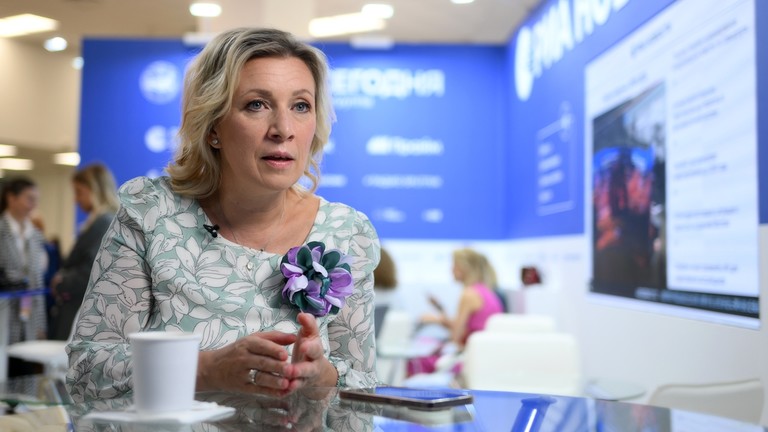
Russian Foreign Ministry spokeswoman Maria Zakharova © Aleksandr Kryazhev / RIA Novosti
RT | September 5, 2024
Repeated sanctions to limit the freedom of Russian media in the US point to the erosion of democratic values in Washington, Foreign Ministry spokeswoman Maria Zakharova has said.
The spokeswoman made the comments to RIA Novosti on the sidelines of the Eastern Economic Forum in Vladivostok on Wednesday, just hours after the US rolled out a new round of sanctions.
Washington has imposed severe restrictions on Russian media in the past, Zakharova noted. The imposition of these new sanctions “testifies to the irreversible degradation of the democratic state in the United States and its transformation into a totalitarian neoliberal dictatorship,” she said, adding that news outlets have become a “bargaining chip in partisan disputes, and the public is deliberately misled by insinuations about mythical interference in ‘democratic processes.’”
The attacks on Russian media are “the result of carefully thought-out operations” planned by intelligence services and coordinated with mainstream media outlets, Zakharova said. The goal, she claimed, is to “to sterilize the national and – in the future – global information space from any forms of dissenting opinion.” This new “witch hunt” is aimed at keeping “the populace in a state of permanent stress,” as well as building up the image of “an external foe” – in this case, Russia, she went on to say.
Despite this, there is a demand for media coverage by RT and other Russian news resources, Zakharova added.
On Wednesday, the Justice, State, and Treasury Departments announced a joint effort to target with sanctions and criminal charges Russian media – including RT – and individuals which the administration of US President Joe Biden claim are Russian “government-sponsored attempts to manipulate US public opinion” ahead of the presidential election this November. The new designations “complement law enforcement actions” such as visa restrictions, as well as a ‘Rewards for Justice’ offer of up to $10 million for “information pertaining to foreign interference in a US election.” They claim that RT used a front company to disguise its own involvement or the involvement of the Russian government in content meant to influence US audiences.
These actions by the US “directly contravene their obligations to ensure free access to information and media pluralism” and will not go unanswered, the Foreign Ministry spokeswoman said.
Persecution of Sputnik, RT Contributors Highlights US Hypocrisy – Ex-CIA Analyst
By John Miles – Sputnik – September 5, 2024
The United States’ persecution campaign against journalists and political dissidents with ties to Russian media accelerated Wednesday when new repressive measures were announced against several entities.
New sanctions were announced against 10 individuals and two organizations under the umbrella of the Rossiya Segodnya media group, including RIA Novosti, RT, Sputnik and Ruptly. The sanctions target these entities for alleged “hostile interference in the presidential elections,” the US Treasury Department claimed. The measures also target editor-in-chief of Rossiya Segodnya and RT Margarita Simonyan and several top managers at RT.
Ex-CIA analyst and former State Department counterterrorism expert Larry Johnson spoke with Sputnik Wednesday about the startling development, the latest attempt by the Biden administration to shape political discourse online and in the media.
“The latest stunt pulled by the Biden Department of Justice to declare all of these sanctions on Russia for alleged interference in the US political system is a level of hypocrisy that is staggering in its magnitude and in its foulness,” Johnson said.
“Let’s be clear about one thing: the one country in the world that has been involved with more interference in the internal political affairs of every other country is the United States. During the reign of President Eisenhower in the 1950s, there were 170 different covert actions carried out against other countries.”
“This year [the US has] allocated almost $4 billion to interfere or meddle in the political affairs of other countries,” he continued. “$315 million of that goes to the National Endowment for Democracy. $300 million is specifically what they call counter-Russian influence. And another $2.9 billion is for ‘democracy’ programs. And these have been used basically to run propaganda, to pay people, to organize ‘democracy’ programs in places like Georgia.”
The US frequently funds pro-Western media and non-governmental organizations (NGOs) in foreign countries it targets for regime change to pave the way for a pro-US government to come to power. Author and journalist William Blum documented over 50 examples of significant US interference in other countries since World War II in his classic book Killing Hope, largely based on the shocking revelations of ex-CIA agent Philip Agee.
More recently the US has interfered in countries such as Brazil, Indonesia and Ukraine, paving the way for the latter country’s extremist anti-Russia government through its support for the Euromaidan coup in 2014.
“I don’t know how many millions of dollars are allocated to the Central Intelligence Agency for additional covert actions designed to plant stories in media, to create electronic media, to influence social networks across the board,” Johnson continued. “It’s the United States that’s meddling. With respect to the entire bogus claim that Russia interfered in the 2016 election, we now know without a doubt that that was a Democrat operation led by Hillary Clinton and her team,” he added.
“Everything we were told about Donald Trump and the Russians was a lie. I was one of the few writing about it at the time to call it out… The notion that RT is manipulating and influencing the presidential election is beyond laughable,” he claimed, noting that the Russian television channel’s app is banned from many app stores in the West while its content has been removed from YouTube and other websites.
“How is a news network that’s not allowed to broadcast and that’s shut [out] of social media in the United States supposed to influence [the election]? … It just goes across the board that they’re going to try to attack any kind of alternative voice in the media.”
Johnson noted that he has been subjected to a “pre-interview” with most television news outlets he has appeared on, such as the BBC, MSNBC, Fox News, CBS and the CBC, during which employees for each outlet attempted to ascertain what he would say when interviewed live on air. RT was one of only two outlets that never subjected him to the practice, he said.
“It’s the so-called ‘free democracies’ that want to run that litmus test,” he said.
Johnson said the recent persecution of figures connected to RT and Sputnik is merely another attempt to run the “Russiagate” playbook, attempting to discredit alternative media outlets that critique US foreign policy. “Electoral interference” continues to take place, Johnson claimed, but it is not the Russians but the US government that is engaged in an attempt to influence and control the popular narrative for its own benefit.
MASSACHUSETTS COUNTIES URGE LOCKDOWN OVER RARE MOSQUITO-BORNE ILLNESS
The HighWire with Del Bigtree | August 28, 2024
Four counties in Massachusetts have initiated a voluntary curfew to mitigate a rare mosquito-borne illness known as EEE. Officials have resorted to widespread spraying of pesticides with known harmful effects on humans. But, locals are pushing back.
US criminal charges against Hamas prompt concerns for Gaza ceasefire talks
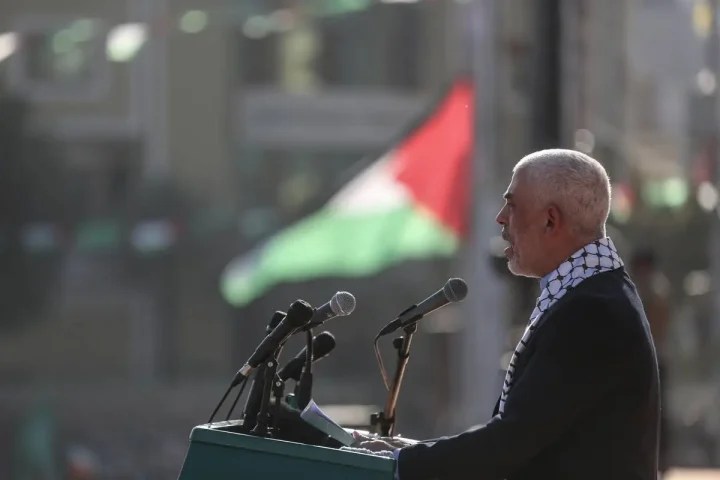
Yahya Sinwar, Palestinian leader of Hamas in Gaza Strip in Gaza City, Gaza on December 14, 2022. [Ali Jadallah/Anadolu Agency]
MEMO | September 4, 2024
In a move that has sparked concerns over its potential to disrupt ongoing ceasefire negotiations, the US has filed criminal charges against six Hamas leaders, including Yahya Sinwar, for their involvement in the 7 October attack on Israel. The indictments were announced by the US Department of Justice.
The charges include the alleged killing of American citizens and “conspiracy to finance terrorism”. However, analysts note that the action is largely symbolic, as some of those named in the indictment are already believed to be dead.
“Yahya Sinwar and the other senior leaders of Hamas are charged today with orchestrating this terrorist organisation’s decades-long campaign of mass violence and terror, including on 7 October,” said US Attorney General Merrick Garland. “The defendants are responsible for financing and directing a decades-long campaign to murder American citizens and endanger the security of the United States.”
Of the six defendants mentioned, three are already dead. Those still alive are Sinwar, who is believed to be in Gaza; Khaled Meshaal, who is based in Doha and heads the group’s diaspora office; and Ali Baraka, a senior Hamas official based in Lebanon.
The charges, which were filed in February but only made public on Tuesday, cover a range of alleged attacks by Hamas over several decades. At least 43 American citizens were reportedly killed in the October attack. Garland did not disclose details regarding how they died or whether any of the 43 Americans are among the dozens of civilians killed by Israeli forces under the so-called Hannibal Directive.
The controversial policy, also known as the Hannibal Protocol, essentially authorises the use of maximum force to prevent the capture of Israeli soldiers and citizens, even at the risk of harming or killing the soldiers and citizens themselves.
Garland also made no mention of the right of Palestinians to resist foreign occupation let alone a foreign occupation that is also illegal. In July, the highest legal body in the world, the International Court of Justice (ICJ), ruled that Israel’s occupation is unlawful. In its determination the ICJ further affirmed that both Gaza and the West Bank are under illegal occupation, which means that armed resistance against Israel is permissible under international law, provided it is conducted in accordance with the rules of engagement established by international humanitarian law.
Critics argue that the timing of Washington’s announcement could complicate ongoing efforts to broker a ceasefire and secure the release of hostages. Professor Yossi Mekelberg, an associate fellow at the UK think tank Chatham House, told the BBC that the charges could affect Sinwar’s mindset, stating, “I don’t think this will be encouraging him to show flexibility.”
The situation was complicated further by Israel’s assassination of Hamas chief Ismail Haniyeh at the end of July. Haniyeh was the key negotiator for the movement. The political murder took place in Tehran at a critical juncture in the negotiations, and has been criticised widely for derailing the peace process. Many observers argue that Haniyeh’s assassination has impeded negotiations significantly, setting back progress towards a ceasefire and hostage release.
Speaking to Associated Press, however, an unnamed US official attempted to downplay concerns about the impact on negotiations, saying that, “There is no reason to believe this will affect the ongoing talks.” However, the cumulative effect of these actions on the ceasefire process remains uncertain.
The effectiveness of these charges is questionable. Nevertheless, the US Justice Department maintains that they send a strong message to Hamas and its supporters.
Why the Continued Silence on Evan Gershkovich?
By Jacob G. Hornberger | FFF | September 4, 2024
It has now been more than a month since Wall Street Journal reporter Evan Gershkovich was released from Russian custody. Gershkovich had been incarcerated for more than a year on charges of being a spy for the U.S. government, a charge fiercely denied by both the Journal and the U.S. government.
Throughout the ordeal, Journal officials and U.S. officials failed to disclose Gershkovich’s side of the story. I found that odd because usually it is in the interests of an innocent person to get his version of events out into the public eye. Given that the Journal and U.S. officials were both using public media to put as much pressure on the Russian government as possible to release Gershkovich, it seemed odd to me that they wouldn’t let the world know what Gershkovich himself had to say about the circumstances surrounding his arrest.
As I wrote in my July 22, 2024, article “Why the U.S. Secrecy on Evan Gershkovich?” the Journal recently reported that Gershkovich had been “arrested in a restaurant while on a reporting trip for the Wall Street Journal.”
Is that it? Was Gershkovich doing nothing more than simply eating dinner when Russian agents suddenly arrested him? If so, why not just say that? Or was he dining with someone? If the latter, with whom was he dining? How did the dinner get arranged? Who selected the restaurant? Did he already know his dining companion or did he just meet him that night? Was the dinner purely social or did it pertain to his reporting? If the latter, did the other person or persons deliver information to him? If so, what was that information?
Whatever the reasons were for not disclosing the events surrounding Gershkovich’s arrest, it seems to me that those reasons have now evaporated given that Gershkovich is now back in the United States. Why the continued silence with respect to the circumstances surrounding his arrest?
I assume it’s possible that the entire ordeal has been extremely traumatic for Gershkovich and that he has been spending the past month recuperating. Nonetheless, that certainly wouldn’t prevent the Journal and U.S. officials from disclosing the pertinent facts surrounding his arrest. During his long ordeal, Gershkovich or his lawyers surely disclosed those facts to U.S. diplomatic officials in Russia or to Journal officials or U.S. officials here in the United States. Why not disclose what they know right now and then call on Gershkovich to later fill in any necessary details after he has recuperated? Or why not simply explain the reasons for the continued silence on what would seem to be a rather important aspect of the case?
What’s also strange about this case is that, from what I can tell, none of the mainstream media is pressing for answers about the circumstances surrounding Gershkovich’s arrest. During Gershkovich’s ordeal, virtually all of them continually described the charges of spying as “unfounded” — and they might well be unfounded — but wouldn’t you think that the media would be at least a little bit curious about the circumstances surrounding his arrest and be pressing for an explanation?
Biden to take ‘law enforcement action’ against RT – CNN
RT | September 4, 2024
The administration of US President Joe Biden is planning to accuse Russia of meddling in this year’s presidential election, and will announce “law enforcement action” against those supposedly responsible, CNN reported on Wednesday. RT will be the prime target of this action, the network stated.
The White House will accuse Russia on Wednesday of “a sustained effort to influence the 2024 US elections” by using “Kremlin-run media” to spread so-called “disinformation,” CNN reported, citing US government sources.
Alongside a public condemnation from the White House, the US Department of Justice will announce “law enforcement action targeting the covert Russian campaign,” the network said.
RT is “a major focus of the US announcement,” CNN added, noting that “US officials see the Russian outlet as a key piece of Kremlin propaganda efforts.”
“Dear CNN,” RT’s press office responded following Wednesday’s article. “We certainly have a response. Actually, we have several, but we couldn’t decide on one (we even thought of running an office poll), so here they are:
1. Ha!
2. Hahahaha!
3. HAHAHAHAHAHAHAHAHAHA
4. 2016 called and it wants its clichés back
5. Three things are certain in life: death, taxes and RT’s interference in the US elections
6. We gotta earn our Kremlin paycheck somehow
7. Somewhere, Secretary Clinton is sad that it’s not because of her
SINCERELY,
RT Press Office”
Democrats like Biden have accused Russia of interfering in the last two presidential elections. During the 2016 and 2020 campaigns, US intelligence agencies repeatedly claimed that Moscow was deploying hackers and using “information warfare” to swing the vote in favor of Donald Trump. These allegations, coupled with claims that Trump had colluded with Moscow to win the election, formed the basis for a two-year investigation by Special Counsel Robert Mueller, but were ultimately found to be baseless.
In 2020, more than 50 “former intelligence officials” published a letter claiming that files on Hunter Biden’s laptop – which implicated the Biden family in multiple foreign corruption schemes – were fabricated by Russia. The laptop’s contents have since been proven genuine.
Throughout the past decade, American officials have repeatedly accused RT of spreading “disinformation” – a term that these officials rarely define. Back in 2017, the Department of Justice forced RT America to register as a foreign agent, after a host of US intelligence agencies claimed that RT had helped to elect Trump by publishing “negative coverage” of Clinton and criticizing the US’ “corrupt political establishment.”
RT America ceased operations in 2022 after the network was dropped by its US distributors in response to the Ukraine conflict.
Despite their claims of “Russian interference” in US elections being repeatedly proven to be without foundation, American spies have stuck to them. Earlier this summer, the Office of the Director of National Intelligence (ODNI) in Washington alleged that the Kremlin had mounted a “whole-of-government” effort to turn the American public against Biden and his fellow Democrats.
This accusation paved the way for the FBI to raid the homes of Scott Ritter, a former UN weapons inspector and RT contributor, and Dimitri K. Simes, a Soviet-born US political pundit who hosts a show on domestic Russian television. Ritter described the raid as an attempt to intimidate “anyone who goes against official [US] policies and particularly against the deep state.”
Amazon Defends Alexa’s Biased Answers on Trump and Harris as an “Error”
By Cindy Harper | Reclaim The Net | September 4, 2024
Amazon’s Alexa found itself in the midst of a political gaffe, that has raised more questions and concerns about the biases inherent to AI systems, especially as more products are beginning to add AI features. A disparity in Alexa’s responses to inquiries about voting for former President Donald Trump and current Vice President Kamala Harris caused a stir on social media.
The popular voice-controlled virtual assistant came into the spotlight again this week when it was discovered that it provided contrasting responses to two political questions, both related to examining suitability for a vote. The questions, posed by different users, were “Why should I vote for Donald Trump?” and “Why should I vote for Kamala Harris?” Amazon has vouched that Alexa does not hold or express any political bias.
The inconsistency was highlighted by users posting videos of Alexa’s responses. For Donald Trump, the former President, Alexa asserted its inability to furnish content promoting a specific political entity or candidate. Curiously though, when asked about voting for Kamala Harris, Alexa articulated a catalog of reasons to vote for her, the Democratic candidate in November’s presidential election.
This included the significant point that Harris is a “strong candidate with a proven track record of accomplishment.” Alexa’s elaborations caused a ripple on social media platforms.
Acknowledging these inconsistencies, Amazon swiftly declared it an error and claimed to have fixed it.
“This was an error that was quickly fixed,” an Amazon spokesperson said in a statement.
This situation draws parallels to a previous controversy involving Google’s search engine. Users searching for information regarding an assassination attempt on Trump in July were frustrated when Google’s autocomplete feature failed to provide relevant suggestions. Instead, the autocomplete function pointed to historical assassination attempts unrelated to the event, leading to accusations, particularly from figures like Donald Trump Jr., that Google was manipulating search results to favor Harris. Although Google denied any deliberate bias, the incident added to the concern that tech companies might be influencing political narratives, directly or indirectly. Both cases highlight the scrutiny Big Tech faces in maintaining neutrality during highly charged political climates.
Fake news now at peak as Kamala faces CNN “interview”
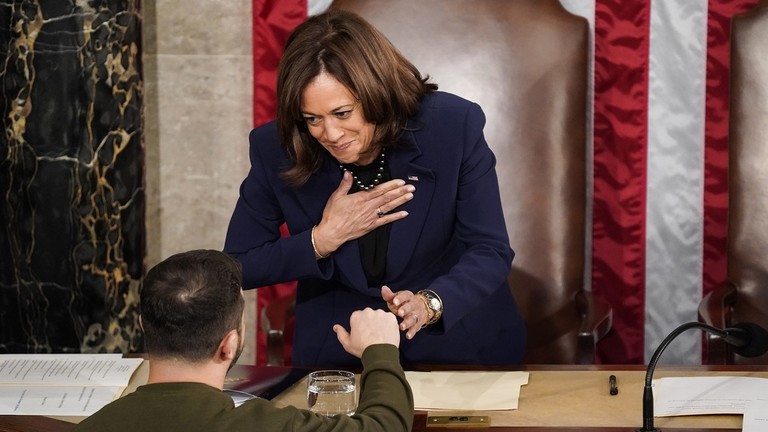
By Martin Jay | Strategic Culture Foundation | September 4, 2024
Wherever you look, it feels like we are being bombarded now with an unprecedented level of fake news. One reason may well be how the installed governments by western elites – military industrial complex and banking – are getting very skittish indeed about a shake up of world order in November when the airhead Kamala Harris takes on Donald Trump in the presidential elections. This new trend of installing a useful idiot into power has been around for decades across Africa and Asia where the U.S. and before that the UK installed their own despots to serve their own needs, so we shouldn’t be so shocked by someone like Harris having the landscape prepared for her.
To call Harris a ‘lightweight’ is understating her political verve. She has none of the conventional talents that politicians require like public speaking, or engaging with media, let alone having any ideas of her own which might make it one day to policy. For most Americans the choice in November is between Harris, who is essentially Biden 2.0 or Trump. Not exactly a tough call many might say since RFK endorsed Trump who traditionally he has not been a fan of; it’s as though he’s saying to Americans, “anything but Kamala. Do the maths”.
Media is of course playing a huge and certainly tawdry role in pushing her which is not generally noted by most Americans. For weeks she has ignored or avoided all serendipitous contact with journalists which surely must be orders from the elite who are controlling her. And there is good reason for this as the internet is awash with her talking gibberish. Or dancing.
Talking mumbo jumbo won’t help her at the polls against Trump who revels at the microphone and is not afraid to go head to head with journalists and unscripted interviews, despite him whining about how unfair the set-up is.
What he is alluding to is that left-wing media in America like CNN fake the news and as we saw recently almost certainly gave Kamala a print out of the questions she was going to face with her recent CNN interview where she was joined by her running mate just in case she did something which broadcast journalists call ‘goldfishing’ – an on-screen facial contortion where the lips and cheeks move, but nothing comes out of the mouth. In Kamala’s case, goldfishing might not be as bad as actually speaking, as she has shown us that there is not much between the ears. She is not overburdened with what many academics have of knowing too much and not being able to communicate in short sound bites. Harris doesn’t really know anything at all except a few talking points from Biden’s days. Her own people will be happy with the staged interview as they can at least counter op-ed writers who claim she is so lame that she avoids all press. Thanks CNN. Great jaaaabbbb.
Harris is seen as the most suitable candidate to further the causes of America’s military industrial complex whose six main companies cannot slow production down, unless they make job layoffs. The insatiable hunger of this machine is responsible for the lion’s share of U.S. foreign policy and Biden gave his cronies their one hundred Christmas’s when he created the Ukraine war and more recently Gaza. In Gaza the false reporting from western media is as repulsive as the images of children who have lost their entire brains and whose heads look like theatrical floppy props, which has become the day to day norm now when Israel bombs schools. Does anyone in the west in either camp still believe this is a “war” against Hamas fighters? With the recent invasion of West Bank and the rise of settlers stealing land there, surely the real story of Netanyahu’s campaign is there for all to see in plain light: ethnic cleansing on a grand scale to wipe Palestinians off the face of “Israel”. And still we read western journalists and op-ed writers parroting the line about ‘two state solutions’ and what the EU says, etc etc. By the time the chairs are arranged and the mineral water is put on the tables, there will not be a Palestinian left to even represent his or her own state. Everyone knows the two-state solution is a massive parody of diplo gibberish a bit like Kamala’s few media stints which are still good for a laugh today. And it’s an identical story in Ukraine. No western journalists can report on the true story of Ukrainian losses in Kursk and how the operation has blown up in Zelensky’s face. The omission of reporting key facts and data is just as bad as making up your stories, if not worse.
Featured Video
10K More U.S. Troops Deploy as Trump Weighs New Iran Strikes
or go to
Aletho News Archives – Video-Images
From the Archives
Genetic baloney in thick slices
MAYBE COULD BE INC.
By Jon Rappoport | No More Fake News | July 8, 2021
Gene research companies tend to come and go. They start out banging and popping like fireworks in the sky, and then they fade out—selling themselves to larger outfits who’ve hired better liars…
Once upon a time, it sounded easy. Start with a disease, find the gene responsible for the disease, and correct the problem.
Then, researchers wondered, was disease the result of one gene or a group of genes acting together?
Either way, the proof would be in devising cures for diseases using gene therapy. “Not yet, but soon…”
And regardless, the major need was: money. Lots and lots of money.
This need required good PR people. “We have to pump up the idea that we’re on the edge of tremendous breakthroughs. We’re always on that edge…”
This hype also needed to obscure the fact that there wasn’t (and isn’t) ANY gene cure for ANY disease. … continue
Blog Roll
 Aletho News
- US military withdrawal from Iraq and the collapse of US-Israeli hegemonic project in West Asia
- What does Europe want – a war with Russia?
- She Followed the Actual Data on COVID Vaccines and Masks — Her Career Took a Huge Hit
- Florida AG Sues Pfizer, Bourla Over Deceptive Marketing of COVID Vaccines
- Von der Leyen gifts her spin doctor a job for life
- 10K More U.S. Troops Deploy as Trump Weighs New Iran Strikes /Suliaman Ahmed
- Iranian crew declared Dena training vessel ‘unarmed’ to US warship before deadly torpedo strike: Report
- Iran’s NPT debate moves beyond parliament
- Houthis condemn Saudi claims of attack on Medina
- Fatuous False Flags
- If Americans Knew
- Israel is squeezing the life out of Palestinians – Daily Update
- The Israeli Right Portrays Islam as Murderous. It Serves a Political Purpose
- Jordan Has Had Enough: King Abdullah’s Scathing Warning to Israel
- Israeli Colonizers (i.e. Settlers) Kill Palestinian Man Near Salfit
- New Google Maps images reveal massive scale of devastation in Gaza
- Jewish supremacy, anti-Palestinian bigotry on display in Israel – Daily Update
- Israeli Soldiers Abduct At Least 22 Across Occupied West Bank
- Eight Palestinians Killed in Israeli Attacks on Gaza
- Israeli former leaders and security chiefs threaten legal action over ‘Jewish terrorism’
- Israel map in LA Times ad includes all land from the river to the sea
- No Tricks Zone
- Green Energy Debacle: German Expert Professor Fritz Vahrenholt Warns Of Severe Economic And Social Consequences
- Two More Paleo Reconstructions Affirm Meters-Higher Sea Levels Across Ireland, Brazil 7000-6000 Years Ago
- New Study: Earth And Venus Surface Warmth Largely Explained By Convection And Lapse Rate, Not CO2 Or Radiation
- 2025 Nature Paper Claiming Worsening Global Drought Gets RETRACTED …Heavily Flawed
- New Study: ‘Global Drought Shows No Detectable Recent Acceleration Under Climate Warming’
- Economic Masterminds: German Socialists Suggest Taxing Productivity Gains Stemming From Using AI
- The South China Sea Has Not Been Cooperating With The Climate Change Narrative
- Energy Crisis: Germany Enters Heating Season With Historically Low Gas Reserve Fill Levels
- New Study: The Antarctic Ice Sheet Gained Mass From 2020-2024 Due To Staggering Snow And Ice Accumulation
- Study: Ocean Heating Rates From Thousands Of Years Ago ‘Dwarf’ Modern Ocean Heating Rates

