Biden and US media lies about Ukraine are reminiscent of Vietnam War – American Conservative
By Ahmed Adel | February 23, 2024
The American Conservative published an article that parallels the Vietnam War, considered the greatest military humiliation in US history, with what they point out is a campaign of deception carried out by the current US Government, which will lead to a defeat for Kiev and NATO.
According to the author James W. Carden, who served as an advisor on US-Russian affairs at the State Department during the Obama administration, the media campaign regarding Ukraine carried out by the White House was a copy of the actions of successive US governments in Vietnam until the Nixon administration withdrew troops and concluded the intervention in 1973. He relates the Vietnam War with the lies with which President Joe Biden and his collaborators have tried to deceive citizens about the progress of the Ukraine conflict and its origin, among other issues.
These false narratives, the article notes, have been put in place and presented to Americans with the help of the “most dutiful accomplices,” such as the New York Times and the Washington Post, media outlets that, until recent times, published the triumphalist comments of Biden and his administration without any type of questioning, in addition to analysis columns where Russian President Vladimir Putin was demonised and falsely stated that Ukraine was on its way to victory.
This falsification of reality, in which all the complexity of the conflict was eliminated, and the responsibility of the US and NATO in inciting it, was omitted. Instead, they presented the war as a simple confrontation between good and evil, which is similar to the deception that Washington and the establishment media consummated in the 1960s to justify the US invasion of Vietnam, the article states.
Now, notes The American Conservative, as it is “too obvious to ignore” that Russian troops are prevailing in Ukraine, the American media is finally realising what is really happening on the battlefield after having helped prolong the conflict with their lies.
“If we are being lied to about the progress of the war—and we are—what do you suppose are the odds we are also being lied to about the causes of the war?” the author questions.
For US politicians and journalists, the expansion of NATO, Ukraine’s post-Euromaidan nationalist agenda, the refusal to implement the Minsk Agreements, or threats by Ukrainian President Volodymyr Zelensky made in Munich in February 2022 to acquire nuclear weapons had nothing to do with the outbreak of war, the article ironically states.
“If we are being lied to about the causes of the war, are we also then being misled about what is at stake in eastern Ukraine? Probably. Here the parallel with the government’s mendacity during the war in Vietnam period becomes too obvious to ignore,” Carden continues.
“Recall in the first case that the template, that of the Cold War, is essentially unchanged, even in some of the particulars, not least in the comparisons of (the Vietnamese anti-communist leader) Ngo Dinh Diem and Volodymyr Zelensky to Winston Churchill. The South Vietnamese government (avaricious, corrupt) had the right to American arms by virtue of its right ‘to determine [the nation’s] future,’ the article says, recalling the argument used by the US to justify its war against North Vietnam, which was part of its global operation against what Washington perceived as an expansion of communism that could threaten its interests and hegemony.
The same thing is happening now with Ukraine: President Biden publicly justifies launching a proxy war with Russia with the excuse that it is necessary to stop Moscow, once again invoking the theory of the domino effect, the long-discredited thesis that drove the US interventionist policy during the second half of the 20th century.
Following the publication of the Pentagon Papers in 1971, the philosopher Hannah Arendt observed during the Vietnam War era that “the policy of lying was hardly ever aimed at the enemy… but was destined chiefly if not exclusively, for domestic consumption, for propaganda at home and especially for the purpose of deceiving Congress,” Carden warns.
He concludes his article by saying: “Two years on, we citizens have been serially lied to by the Biden administration and the media about the war’s causes, its stakes, and its progress. The question that should, but of course will not, be addressed in the aftermath of this latest American misadventure abroad is: Will we ever learn?”
Ahmed Adel is a Cairo-based geopolitics and political economy researcher.
Space Nukes & Washing Machines: Western Media Prints ‘Anything’ to Paint Russia as Threat
Sputnik – 23.02.2024
Last week, House Intelligence Committee Chair Rep. Mike Turner (R-OH) released a document with a cryptic warning that called on US President Joe Biden to declassify information on a “serious national security threat.” Within hours, the story spread like wildfire.
The recent media craze stemming from unfounded claims of a Russian nuclear space weapon exploded and stole headlines for days because “the media” will print anything it is told about Russia, Mark Sleboda, a foreign relations and security expert told Sputnik’s Fault Lines.
“Russia’s the gift that keeps on giving, propaganda-wise, because you can accuse Russia of anything, no matter what you said about them [before], about shovels, and microchips or washing machines. And, generally, people will believe it. Or at least the media will print it,” he said, referring to previous Western propaganda claims that Russian soldiers were fighting armed only with shovels and that their missiles used microchips from stolen Ukrainian washing machines.
“Then you accuse Russia of having space weapons, space nuclear weapons, or having plans to put nuclear weapons in space, or someone in Russia once thought technically about the contingency of putting weapons in space,” Sleboda scoffed.
As the story made the rounds on the media circuit, US National Security Council John Kirby told reporters that the threat US Rep. Mike Turner raised was related to “an anti-satellite weapon that Russia is developing.” Soon after that, US media outlets began reporting that the mysterious weapon was nuclear.
Russia vehemently denied the accusation, saying it is only developing the same space capabilities that the US has. “Firstly, there are no such projects – nuclear weapons in space. Secondly, the United States knows that this does not exist,” Russian Defense Minister Sergei Shoigu said during a televised discussion with Russian President Vladimir Putin.
Sleboda noted that for mainstream media, “the details aren’t important as much as the scaremongering factor.”
“It’s the same thing with this continual octogenarian fantasy about linking Trump and Russia… all the powers of the US investigative bodies were unable to prove any connection… but that doesn’t stop an enormous number of the American people from believing in it because they want to, and [US Rep.] Nancy Pelosi certainly knows that.”
The analyst further admitted that the latest anti-Russia rhetoric is part of a larger effort in preparation for the November presidential election in the US but that it also “does the double job of, you know, buttressing arguments for providing more US taxpayer dollars for weapons for the regime in Kiev.”
China backs Palestinians’ right to ‘armed struggle’ against Israeli occupation
The Cradle | February 22, 2024
China expressed support for the right of Palestinians to engage in “armed struggle” against Israel, stressing this is not “terrorism” during the fourth day of hearings at the International Court of Justice (ICJ) in a case against Israel’s illegal occupation of Palestinian territories.
“In pursuit of the right to self-determination [the Palestinian people have the right to the] use of force to resist foreign oppression and to complete the establishment of the Palestinian state,” Ma Xinmin, a Chinese Foreign Ministry legal adviser, told the World Court on 22 February.
Citing examples of “various people [who] freed themselves from colonial rule” through armed resistance, Xinmin argued that acts of resistance against the Israeli occupation are “not terrorism” but a legitimate armed struggle and an “inalienable right.”
“Numerous other resolutions recognize the legitimacy of struggle by all available means, including armed struggle by people under colonial domination or foreign occupation to realize the right of self-determination,” the Chinese official said.
“Chinese President Xi Jinping has stressed on multiple occasions that China calls for a comprehensive ceasefire and the early solution to the question of Palestine on the basis of a two-state solution through negotiation,” he added.
Xinmin took to the podium ahead of Iran’s Deputy Foreign Minister for Legal and International Affairs, Reza Najafi, who highlighted Israel’s historic violations of Palestinians’ right to self-determination.
“The establishment of the Israeli regime was done through a violent process which involved the forcible displacement of native Palestinian people to create a majority Jewish colony in line with the Zionist movement,” Najafi said.
He also listed a series of ongoing violations by Tel Aviv, which include the prolonged occupation and manipulation of the demographic composition in the occupied Palestinian territories, the alteration of the character and status of Jerusalem, and the discriminatory measures and violations of the rights of Palestinian people to permanent sovereignty over their natural resources.
“The expansion of settlements, segregated roads and barriers as well as checkpoints has created a system of apartheid which is isolating Palestinian communities,” Najafi added before addressing the UN Security Council (UNSC) for their “inaction or insufficient action,” saying this was one of the “main causes of prolonged occupation of the Palestinians” and highlighting that the top UN body is “paralyzed due to the stalemate” caused by a “certain permanent member.”
“All the atrocities and crimes committed by the Israeli regime in the past almost eight years are a consequence of such inaction,” the Iranian official concluded.
The Iraqi representative to the ICJ, Hayder Shiya al-Barrak, took to the podium next and called on the ICJ to respect previous court orders against Israel, such as the provisions made after South Africa’s case to “stop the systematic killing machine against the Palestinian people.”
“We hope that the court’s commitment to justice will lead to additional decisions … affirming its dedication to ending the campaign of mass murder and preventing acts of genocide as well as policies of harassment, blockade, and starvation against the Palestinian people,” he said.
Barrak concluded his intervention by calling on the World Court to take decisions “that safeguard the lives of the Palestinian man, women, children, and elders, allowing them to enjoy a dignified and secure life where all human rights are achieved.”
Fresh aggression: US, UK launch five strikes on Yemen’s Hudaydah
Press TV – February 22, 2024
The United States and Britain have conducted fresh aerial assaults on Yemen’s strategic western province of Hudaydah.
The al-Masirah television network reported three airstrikes on Ras Issa area in Hudaydah’s a-Salif district late on Wednesday.
Earlier in the day, it added, four similar air raids also targeted al-Jabana and al-Arj areas in Hudaydah.
Meanwhile, the US Central Command (CENTCOM) said in a statement that its forces had carried out four strikes on areas in Yemen, targeting “seven mobile anti-ship cruise missiles and one anti-ship ballistic missile launcher” in the act of aggression.
It claimed that the targets “presented an imminent threat to merchant vessels and to the US Navy ships in the region.”
CENTCOM also said that its forces had shot down a “one-way attack unmanned aircraft system.”
In recent months, the US and its allies have launched illegal attacks on Yemen amid their frustration in the face of an anti-Israel maritime campaign by the Yemeni armed forces.
Israel waged a US-backed genocidal war on the besieged Gaza Strip on October 7 following a historic operation by the Palestinian Hamas resistance group against the occupying regime.
In support of Gaza, Yemeni armed forces have targeted ships going to and from ports in the occupied territories, or whose owners are linked to Israel, in the southern Red Sea, the Bab el-Mandeb Strait, the Gulf of Aden, and even in the Arabian Sea.
The US-led attacks on Yemen prompted the country’s military to declare American and British vessels to be legitimate targets.
The Black Sea Straits: Turkey balances between the US and Russia
By Alexandr Svaranc – New Eastern Outlook – 22.02.2024
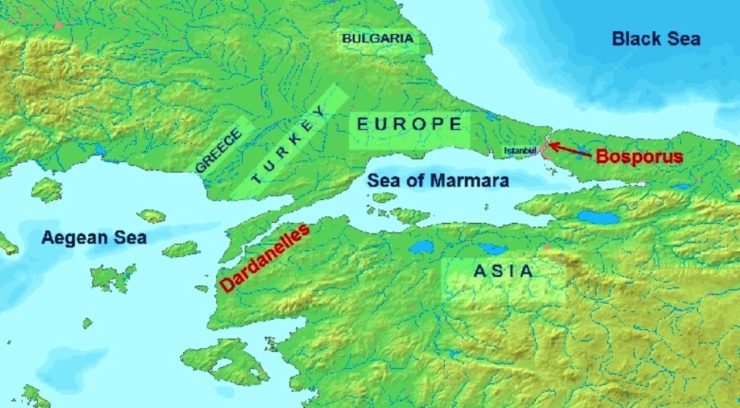
The territory of modern Turkey has economic-geographical and military-strategic advantages due to its control over the Black Sea Straits of Bosporus and Dardanelles. Control of the Black Sea Straits has always been strategically important to the great powers in world geopolitics and trade.
Great Britain and Russia often clashed over the right to control the Straits. In August 1914, German ships, including the cruiser Goeben and light cruiser Breslau, attacked Russian ports after passing through the Black Sea Straits. This led to the Ottoman Empire joining World War I on the side of Germany against Russia. One of the tasks of the Nazi German Ambassador to Ankara, Franz von Papen, in the late 1930s was to obtain Turkish consent for the passage of German ships through the Straits to the Black Sea to participate in the war against the USSR. Stalin later described Turkey’s policy during World War II as “hostile neutrality.”
In the 19th century, Russia’s successful wars against the Ottoman Empire enabled Russian control over the Black Sea Straits. However, Emperor Nicholas I of Russia, for some reason, decided to let in Britain and France in resolving the fate of the regime of shipping in the Black Sea Straits, while this issue could have become a subject of relations between solely Russia and Ottoman Turkey.
As a result, on July 3, 1841, the Straits Convention was signed in London, with the consent of the Russian Tsar, between Turkey, on the one hand, and Russia, Great Britain, Austria, Prussia, and France, on the other. It stipulated that as long as Turkey was not at war, the Straits would be closed to military ships of any nation. During the war, Turkey was granted the right to let ships through the Straits belonging to states with which it wished to reach an agreement. The London Straits Convention in fact buried the decisions of the Russian-Turkish Treaty of Hünkâr İskelesi of 1833, according to the secret articles of which Turkey undertook not to allow warships of any European countries to enter the Black Sea. Russia’s political and military positions have been significantly strengthened by the latter.
Following the results of the First World War, the Versailles Conference of the victorious countries again returned to the topic of the Black Sea straits, which continued with long negotiations, sharp discussions and ended with the signing of the Treaty of Lausanne on July 24, 1923, based on a project of Great Britain. The representatives of the Soviet delegation were actually blocked, and the head of the Russian delegation, Vatslav Vorovsky, was not even officially informed about the resumption of the conference and was not allowed to take part in the negotiations (on May 10, 1923, Vorovsky was assassinated in Lausanne by Russian White émigré named Maurice Conradi).
The Lausanne Treaty was signed between Great Britain, France, Italy, Japan, Greece, Romania, Bulgaria, the Kingdom of Serbs, Croats and Slovenes and Turkey. The USSR did not ratify the convention because its terms violated legal rights and did not guarantee the security of Black Sea countries. In particular, this convention provided for the demilitarization of the Straits Zone, with the Straits themselves coming under the control of a special international commission. In other words, the right to station military units near the straits was taken away from Turkey, through whose territory the straits passed. Simultaneously, all commercial and military vessels from any country in the world were granted free passage through the Bosporus and Dardanelles, with only minor restrictions. The latter created problems for the Black Sea countries, especially for the main Black Sea powers – Turkey and Russia.
The events of 1936 in Spain, the growth of Fascist militarism in Italy and Germany reopened the issue of the Black Sea Straits. Britain was concerned about losing control over Turkey, its naval bases, and its broad interests in the Mediterranean and the Arab East, including the restoration of the German-Turkish alliance. Therefore, London considered it appropriate to make concessions to Ankara on the issue of changing the regime of the Black Sea Straits and replacing the International Special Commission with Turkish control, including the abolition of Turkey’s demilitarization in the Straits Zone.
Consequently, following months of discussions, a new convention on the Black Sea Straits regime was signed on July 20, 1936, in the Swiss city of Montreux. This convention is seen as a compromise in international practice. In times of peace and war, merchant ships of all nations were granted the right of free passage through the Straits. Warships of non-Black Sea states are restricted in transit through the Bosporus and Dardanelles by class, total tonnage, total number and period of stay in the Black Sea not exceeding three weeks. In the case of Turkey’s taking part in a war, and if Turkey considers itself directly threatened by war, it is given the right to authorize or prohibit the passage of military ships through the Straits. Accordingly, the demilitarization regime was abolished, and Turkey was granted the right to station its military garrisons in the Straits Zone. The USSR’s demands for limitations on the military presence of non-littoral states in the Black Sea were mostly taken into account. London and Paris obtained the right to adjust the ratio of naval forces between Turkey and the USSR in the Black Sea.
Overall, the Montreux Convention can be viewed as a compromise that helped stabilize the situation in the Straits Zone. The Convention has been extended twice for 20 years. It remains in force as of now. The issue of the Black Sea Straits is currently being discussed in international diplomacy. This is especially true in times of crisis, when relations between major Black Sea countries, such as Russia and Turkey, become contentious.
With the start of the Russian Special Military Operations in Ukraine, hostilities have been resumed in the Black Sea basin waters. The Collective West, led by the United States, is attempting to alter the international legal norms that regulate the passage of warships through the Bosporus and Dardanelles.
According to US Assistant Secretary of Defense for International Security Affairs Celeste Wallander, Washington plans to collaborate with Ankara regarding shipping in the Black Sea. The Pentagon spokesperson emphasized the need to create a favorable environment in the region, ensuring that the Black Sea is fully accessible for commercial shipping.
Meanwhile, the United States is attempting to use merchant shipping as a cover to alter the regulations for the passage of non-Black Sea NATO warships through the Dardanelles and Bosporus to the Black Sea. For this purpose, the Black Sea Grain Initiative became a convenient opportunity.
The United States and the United Kingdom assert that Russia’s decision to withdraw from the agreement violates international humanitarian law. They propose the formation of an operational group under the convoy of NATO air and naval forces to transport Ukrainian grain through the Straits to foreign markets.
Retired US Navy Admiral James Stavridis announced in July 2023 that a convoy would be created under the control of the United States or NATO. A year earlier, The Wall Street Journal reported that Joe Biden Administration was considering new rules for the passage and navigation of warships in the Black Sea. The North Atlantic Alliance plans to deploy more military aircraft and ships to the Black Sea, according to NATO Secretary General Jens Stoltenberg.
In November 2023, US Congressmen Mike Rogers and Mike Turner urged President Joe Biden to deploy US military forces in the Black Sea to provide military support to Ukraine. Meanwhile, Commander Brian Harrington of the US Navy stated that conducting military exercises outside the scope of the Montreux Convention would undermine Russia’s dominance in the Black Sea. Perhaps these appeals and statements are intended more for the Turkish president.
The British and Norwegians have initiated a program to enhance Ukraine’s capabilities in the Black Sea. However, Turkey refused to allow two Sandown-class minehunters which were conditionally transferred by Great Britain to the Ukrainian Navy in June 2021, to pass through the Bosporus. According to Article 19 of the Montreux Convention, Turkey considers the ships of Russia and Ukraine as belonging to belligerent powers and therefore, they are not permitted to pass through the Black Sea Straits. London officials attempted to pressure Ankara, but were unsuccessful.
As for the warships of the US and other extra-regional countries that used to regularly enter the Black Sea using the right of peaceful passage, Turkey has announced within NATO that it will not allow naval exercises or visits for other purposes as long as the conflict continues. Ankara argues that violating the provisions of the Montreux Convention in the current situation will inevitably trigger retaliatory actions by the Russian Navy, leading to a new military escalation. Despite the dissatisfaction of NATO allies with Turkey’s position, Ankara does not intend to change it, showing the firmness and stubbornness typical of Turks.
The Montreux Convention does not allow the unimpeded passage of warships of non-littoral states in the Black Sea. However, after the collapse of the USSR and the Warsaw Pact, NATO gained an advantage in the Black Sea. In other words, prior to 1991, all Black Sea countries except for NATO’s Turkey were members of the Warsaw Pact and allies. Right now, the situation in the Black Sea is reversed. Namely, Russia on the one hand and NATO members Turkey, Bulgaria, Romania and the North Atlantic Alliance candidates Georgia and Ukraine on the other.
The US is not a signatory to the Montreux Convention at all and can therefore afford to violate its terms. Every five years since the signing of this convention in 1936, changes to its provisions may be proposed, provided that the initiative is supported by a two-thirds vote of the Montreux signatories. However, currently, all signatory countries except Russia are NATO members, and Japan and Australia are strategic partners or allies of the United States.
In this situation, Turkey’s opinion remains key as it still holds the role of “host of the Straits” under the Montreux Convention and maintains an independent policy. A change in the provisions of the convention would be a change in Turkey’s own status quo in the region. This is obviously not what Ankara wants. Crimea is now under Russian control, which could pose a threat to the same straits.
Russian Foreign Minister Sergey Lavrov stated that the Turkish authorities will not change the rules of entrance in the Black Sea for NATO warships under Pentagon’s pressure. However, Russia cannot rely on Turkey’s guarantees forever, as Ankara has shown a willingness to make sudden political reversals.
The US and Turkey are discussing the issue of closing the Bosporus to Russian warships, according to Iranian journalist Hayal Muadzin. In particular, there is information circulating that the US has offered to cede some areas in northern Syria, apparently Kurdish-populated provinces, to Turkey as a gift to Recep Tayyip Erdoğan, in exchange for active cooperation against Russia in the Black Sea.
In January, Turkey ratified Sweden’s NATO status in exchange for the delivery of 40 modernized F-16 fighter jets from the US. Washington is prepared to address the matter of F-16 Block 70 fighter jets for Turkey. Additionally, Deputy Secretary of State Victoria Nuland stated in Ankara that the US is willing to involve Turkey in the production program of fifth-generation F-35 fighter jets and provide them with a Patriot air defense system. This offer is contingent upon Turkey’s refusal to use the Russian S-400 Triumf SAM system. The Americans may be willing to provide soft loans to support the struggling Turkish economy, but only if Turkey refrains from actively cooperating with Russia in trade and economic matters and strictly adheres to the sanctions regime.
It is evident that Turkey faces numerous temptations. However, Recep Tayyip Erdoğan is aware that excessive improvisation towards Russia could jeopardize Turkey’s Great Turan project and its access to Azerbaijan and Turkic countries in Central Asia through the Zangezur corridor. For the time being, therefore, Ankara is trying to keep the “Russian side” of the fence. Turkey refuses to revise the provisions of the Montreux Convention in exchange for the “Swedish case.”
Turkish Foreign Minister Hakan Fidan confirmed that Ankara will continue to use the Montreux convention and stated that it is not up for debate. With the outbreak of the crisis in Ukraine, Turkey exercised its powers under the Montreux Convention and prohibited the passage of warships through the Black Sea Straits. The Turkish Defense Ministry aims to prevent further escalation of military tensions in the Black Sea basin, especially in the Straits area. The Straits pose not only an economic issue for Turkey, but also a security concern. Ankara has the right to charge for the passage of ships through the Bosporus and Dardanelles, which covers expenses for lighthouses, evacuation, and medical care.
In the rapidly evolving situation of the Ukrainian conflict, it is crucial for the Turks to maintain their key positions. There is a domestic political consensus on this issue: the provisions of the Straits Convention must remain unchanged. Turkey’s accession to Western sanctions against Russia is inadmissible; otherwise, Turkey will lose the opportunity to play a mediating role.
US Tells UN Court Israel Must Be Allowed to Continue Occupation of Palestine
By Kyle Anzalone | The Libertarian Institute | February 21, 2024
A State Department official speaking before the International Court of Justice (ICJ) urged the body not to order Israel to end the occupation of Palestine. The court is currently hearing arguments in a case that calls on Israel to end the military occupation of the West Bank and Gaza.
The ICJ will hear arguments from more than 50 countries over six days. On the third day of the trial, State Department legal adviser Richard Visek argued to the ICJ that Israel needs to continue the occupation of Palestine for security reasons. “The court should not find that Israel is legally obligated to immediately and unconditionally withdraw from occupied territory,” Visek said.
“Any movement towards Israel’s withdrawal from the West Bank and Gaza requires consideration of Israel’s very real security needs.” He continued, “We were all reminded of those security needs on October 7, and they persist.”
Visek did not mention the security needs of the Palestinians, who have suffered under decades of occupation and apartheid at the hands of the Israeli Defense Forces (IDF). Since October 7, 29,000 Palestinians have been killed by Israeli military operations in Gaza. Tel Aviv has prevented aid from reaching the children of Gaza, putting one in six at risk of death due to starvation.
The case moving through the ICJ is separate from the genocide charges brought by South Africa in December. Last month, the court issued a primary ruling that Israel was plausibly committing genocide in Gaza fueled by the rhetoric of the country’s leadership. The ICJ ordered Israel to end military operations in Gaza that endanger civilians. Tel Aviv and Washington have said they will ignore the court’s decision.
The second ICJ trial is examining the Israeli military occupation of Palestine, which has been ongoing since 1967. Several international and Israeli human rights organizations have concluded that the occupation amounts to apartheid.
For decades, Washington has underwritten the Israeli occupation of the West Bank by preventing the UN Security Council from condemning Tel Aviv’s oppression of the Palestinians and giving Israel over $250 billion in aid. On Tuesday, the US vetoed a UN Security Council resolution that called for a ceasefire in Gaza.
The US claims that by giving Israel billions of dollars in weapons every year, it was establishing the conditions for a two-state solution. Visek told the ICJ that ruling Israel to end the occupation of Palestine will prevent the creation of a Palestinian state. “It is important that the court keeps in mind the balance the [UN] Security Council and the General Assembly have determined is necessary to provide the best chance for durable peace,” he told the ICJ on Wednesday.
However, Tel Aviv has deliberately worked to prevent the creation of a Palestinian state. Earlier this week, Israeli Prime Minister Benjamin Netanyahu boasted he has been able to thwart the emergence of a sovereign nation for the Palestinians during these past decades. “Everyone knows that I am the one who for decades blocked the establishment of a Palestinian state that would endanger our existence,” Netanyahu said, according to The Times of Israel.
Yemen says in talks with EU over Red Sea shipping safety
Press TV – February 21, 2024
Yemeni authorities have held “constructive talks” with the representatives of the European Union (EU) to ensure the safety of shipping in the Red Sea, Deputy Foreign Minister Hossein al-Ezzi says.
The Yemeni minister said on Wednesday that his country had ensured EU authorities during bilateral talks that the Red Sea is safe for international transit.
“We once again reiterate that the Red Sea is absolutely safe. Only passage to ships linked to three parties, namely the US, Israel and Britain, are blocked,” al-Ezzi was quoted as saying by Yemen’s al-Masirah TV channel.
Yemeni forces started carrying out attacks on Israeli-linked ships weeks after the regime launched the bloody hostilities in the besieged Gaza Strip in early October.
The strikes later expanded to target ships linked to the United States and Britain. The two countries have carried out airstrikes and naval attacks on Yemen’s territory in the recent past.
Yemen’s Ansarullah movement says attacks on ships will continue until Israel ends the campaign in Gaza, which has killed more than 29,000 people since early October.
The Yemenis have sought to ensure international shipping companies that their vessels can safely sail in three major regional waterways of the Red Sea, the Bab al-Mandab Strait and the Gulf of Aden if they have no connection to Israel, the US or Britain.
Ezzi said some 283 commercial ships had sailed in the Red Sea with complete safety this week despite claims by Washington that the waterway is not safe for commercial shipping.
“Unfortunately, shipping companies have been deceived by the US propaganda and reduced passage through the Red Sea because of US efforts to militarize the region,” he said.
Red lines: Will Iran enter the regional war?
By Farzad Ramezani Bonesh | The Cradle | February 21, 2024
On 14 October 2023, Iran issued a stern public ultimatum to Israel, cautioning that unless it ceases its genocidal assault on Gaza, significant repercussions will ensue, likening them to “a huge earthquake.”
Tehran’s envoy to the UN later clarified that the Islamic Republic would only intervene in the Gaza war if the occupation state were to jeopardize Iranian interests or citizens.
Given the events of the past four months, this raises the question: What are Iran’s red lines, and at what point would Tehran opt for direct confrontation?
The red lines
To grasp Iran’s motivations and reactions, it’s critical to understand its red lines—those non-negotiable boundaries it staunchly defends. At the heart of this lies the survival of the Islamic Republic itself, which recently celebrated its 44th anniversary. Any encroachment on Iran’s territorial integrity or vital interests triggers a defensive response to deter potential threats.
Foremost among these red lines are any broad attacks on Iran’s maritime assets, energy infrastructure, and strategic interests. Assaults on vital economic nodes like oil refineries or shipping lanes will likely prompt swift and resolute reactions from Iran’s leadership, signaling a readiness to safeguard national assets at any cost.
Previously, the Iranian government denied involvement in the Hamas-led resistance Operation Al-Aqsa Flood. While ideologically aligned with Palestinian resistance factions, Tehran insists on their autonomy, wary of direct involvement that could destabilize its domestic front. Nevertheless, support for other allies in the Axis of Resistance like Hezbollah remains unwavering, serving as a deterrent against external aggression targeting Iran’s strategic depth.
‘De-Americanization’
So far, Tehran has moved to influence Israel’s war in Gaza on the level of diplomacy, demanding the immediate cessation of killings, the lifting of the blockade on humanitarian aid, and the withdrawal of the Israeli military from the Gaza Strip. The key aims of the Iranians are to prevent a serious blow to the Palestinian resistance and its military capabilities and to prevent another mass displacement of Palestinians from their lands.
From Iran’s perspective, resistance against Israel and the US represents a cornerstone of the Islamic Republic’s strategic vision – part of its wider anti-imperialist struggle in West Asia, and ambition to force the US out of the region.
Many in Tehran believe the Gaza war is orchestrated in Washington, with the US serving as Israel’s primary advocate in global arenas like the UN Security Council. As such, Iran aims to undermine US influence by exacerbating divisions between Washington and Tel Aviv.
Despite Israel’s resolve to continue its campaign of ethnic cleansing, Iran’s strategy hinges on exploiting this discord, using diplomatic channels to influence US policy without resorting to direct confrontation. In essence, Tehran’s approach is to apply pressure on Washington via non-aggressive methods – without entering the war.
Israel’s covert attacks continue
Last week, a major attack was carried out on Iran’s national gas transmission pipelines. Iranian Oil Minister Javad Oji called the pipeline explosions in three regions “sabotage and terrorist attacks” and said the enemy’s plan was to disrupt gas supply to several cities and main provinces during the winter to ignite social and political unrest across the country.
While no country has claimed responsibility, a New York Times report names Israel as the culprit, citing several western official sources. Despite the severity of the attacks, Iran’s critical gas transmission capacity was safeguarded, preventing widespread energy crises.
Yet even these attacks didn’t cross Iran’s red lines because this act of vandalism – intent on destroying about 40 percent of the country’s gas transmission capacity and creating an energy crisis – was immediately thwarted.
These incidents mark another chapter in the covert conflict between Iran and Israel, which spans air, land, sea, and cyberspace. While such attacks have become somewhat routine, the frequency, intensity, and scale of destruction in this latest round may signal a material escalation that crosses Tehran’s established red lines.
Iran’s strategic response
As its support for Palestine is a top Iranian foreign policy priority, President Ebrahim Raisi has stated that the ongoing situation in Gaza raises the possibility of expanding the conflict to other regional fronts.
This is of great concern to the US. Since the beginning of Israel’s aggressions, the US has repeatedly warned Iran and its allies about “opening new fronts” in the war. These warnings have not had the desired impact: more than four months later, it is clear the Resistance Axis has responded proportionately from Lebanon, Syria, Iran, to Yemen with measured retaliations aimed at curbing Israel’s options.
Moreover, if Israel pushes Iran’s Palestinian allies to the limit, it appears that Tehran would pursue a relative, restrictive, short-term, and mid-term response.
In the interim, the assertive military reactions from Iranian allies – including Hezbollah in Lebanon, Palestinian Islamic Jihad, factions operating in Iraq and Syria, and the Ansarallah-aligned armed forces in Yemen – serve as a stick to confront Israel’s aggressive stance autonomously, even in the absence of direct instructions from Iran.
While Washington and Tel Aviv claim they wish to avoid opening new fronts, on the ground, they are gearing up for military confrontation and have already escalated on various fronts.
In response, the Axis of Resistance refuses to remain passive, aiming to disrupt Tel Aviv’s crucial lifelines while refraining from fully engaging its forces in the conflict. The baseline is to keep pressure on the US so that it urges restraint from Israel in Gaza.
Logic is its finest weapon: protracted war in Gaza appears to be at odds with European and western interests, particularly in areas such as energy security, geoeconomics, overall regional stability, and public diplomacy.
As such, Tehran may perceive an opportunity to exploit this misalignment to further drive a wedge between the US and its European allies, potentially leading to increased pressure and sanctions against Israel.
The bigger picture
Today, Iran’s adversarial stance seems to be more focused on the US rather than Israel. Via regional intermediaries, Tehran hopes to broker agreements with Washington to secure a ceasefire and alleviate Israel’s pressure on Gaza. A common view among Iranians is that the pursuit of “legitimate defense” is preferable to engaging in a wider regional conflict, as prolonged internal crises within Israel could ultimately work in Iran’s favor.
Drawing from past conflicts, particularly the Hezbollah–Israeli battles in south Lebanon, Iran sees potential in eroding both Israel’s internal power and external support. This strategy intends to gradually force the occupation state to retreat from its aggressive posture in the region.
Furthermore, Iran envisions leveraging the war in Gaza to bolster its reputation and influence among Arab states. Tehran hopes to capitalize on the situation to undermine existing peace agreements, such as the Camp David Accords, and halt the normalization process initiated in 2000 between Israel and Arab states. Iran also aims to rally international support against Israel through platforms like the Organization of Islamic Cooperation (OIC), the Arab League, BRICS, and the Shanghai Cooperation Organization (SCO).
Although a “preemptive attack” has already been proposed if Israel continues its assault on Gaza, Iran’s strategic partners in Moscow and Beijing have not declared their full support for direct war. Therefore, Tehran is likely to avoid divergence with Russia and China in the event of major international crises.
Gaza gambit
When considering the possibility of direct intervention in the Gaza conflict, it’s crucial to recognize the formidable challenges Iran would confront. These include the risk of casualties, economic repercussions, and a decrease in oil exports.
The option of direct Iranian military involvement will only be on the table if Israel and the US cross Tehran’s red lines, though any military action against Iran would be a clear violation of international law. As the Commander-in-Chief of the Islamic Revolutionary Guard Corps said in January, although Iran is not seeking war, it will not leave any threat unanswered.
It must be noted that Iran sees the war in Gaza through a realist, long-term lens and not an ideological point of view. This highlights a critical reality: while Iran makes efforts to maintain a delicate balance of threats without plunging into direct warfare, the potential for direct actions and reactions to spiral out of control remains ever-present.
Iran has thus far calculated that neither Washington nor Israel would risk direct attacks on its territory. However, the mutual risk of miscalculation on both sides could lead to a gradual escalation into direct warfare.
How The Courts Could Decide Who Controls Congress
By Attorney Bobbie Anne Cox | Knowledge is power! | February 6, 2024
Most voters don’t pay too much attention to the judicial candidates when they head to the polls to cast their vote. Honestly, I can understand their thought process. There’s nothing sexy about courts, judges, judicial panels, and so on. Most voters probably feel like they will never end up in a court of law. If they keep their nose clean, and live a life of lawfulness and piety, then they probably feel that they won’t ever be at the mercy of a judge, or a panel of judges, to decide their fate.
However, there is a grave danger in this method of thinking. Even if you personally never have the need or the occasion to sue someone, or be sued by someone, judges are rendering decisions in cases that affect your life, whether or not you are a direct party to a lawsuit. A golden example of that notion is my “quarantine camp” lawsuit against Governor Kathy Hochul and her Department of Health. Most New Yorkers are (unfortunately) blissfully unaware of this epic legal battle, and yet, five judges sitting in an appellate court in Rochester, New York may have sealed the fate of 19 million New Yorkers in determining whether or not unelected bureaucrats in the DOH can throw you into a quarantine detention center, with the force of police, for however long they like, without any proof that you are sick. (For more on that, you can read one of my many articles about that lawsuit, or other media content on it, here, or here, or here).
So, judges are every bit as powerful and noteworthy on the ballot as the vote you cast for your governor, or president, or senator, etc… My quarantine lawsuit is just one example. Another example which I’d like to delve into in more detail in this article is how judges may very well end up deciding who controls Congress.
With a very close margin in the House of Representatives, quite literally, every seat counts. (My standard disclaimer applies: I am not Republican. I am a Constitutionalist and believe the power of the people over the power of the political elites must prevail). So let’s set the stage… the Republicans control the House currently by only 4 seats. The Democrats control the US Senate, and the White House. If the Republicans lose control of the House, then Americans will be subjected to a very toxic one-party-rule. Remember my motto on this – I don’t care which party it is, when one party has total control, they go totally out of control! Here’s the article I wrote on that last year.
Most people think of New York as a “deep blue” state that is full of radical left-wing voters. That is terribly wrong. If you look at a map of New York state after the last couple of presidential elections, you’ll see that the vast majority of the state votes “red,” and it’s only a couple of our cities that vote “blue.” New York is the reason the Republicans took control of the House when the 2022 elections yielded a net gain of 5 seats for Republicans. In other words, in 2022, New Yorkers flipped 5 of our Congressional seats from Democrat to Republican, and that gave the Republicans the majority in the House.
So, it’s no surprise that many talking heads say New York is the pathway for the Democrats to regain control of the House next year after the elections this November. And here is where the courts come in. When one political party controls a state legislature, if they are empowered to draw the Congressional districts within their state, then this opens the door to gerrymandering. As a result, the party that is not in control will then usually bring a lawsuit to defend their right to have districts that are not gerrymandered. This happens in lots of states, and it is 100% happening here in New York. I am the spokeswoman for a non-partisan organization called Stop NY Corruption, and as such, I am fully familiar with the redistricting saga that has been taking place here since the 2022 election.
I wrote an article with the history and back story, which you can find here. If you prefer audio/visual, you can check out one of the number of press conferences or interviews I’ve done on this topic, some of which are posted on the Stop NY Corruption website. Most recently, I just spoke at a presser yesterday up in Albany together with former Congressman Lee Zeldin, State Senate Minority Leader Rob Ortt, and Conservative Party Chairman Gerard Kassar. Check out the video of our press conference here or double click on the thumbnail below.
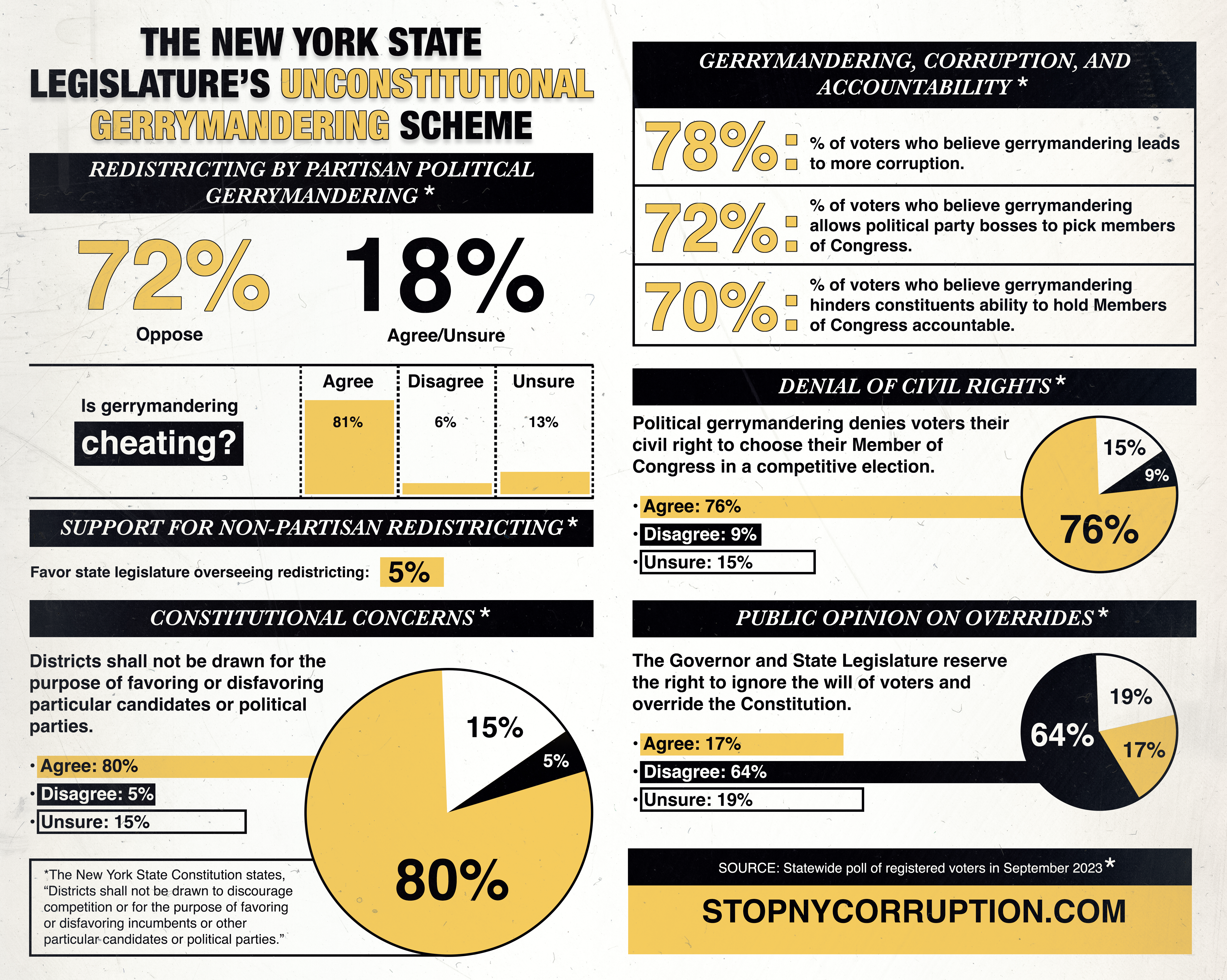
So when these lawsuits over Congressional lines are brought in the courts, no matter which state, it is the decision of the judges that determines whether or not We the People will decide our elected representatives in Congress, or whether the political party bosses will choose what districts we live in, and who our Congressional reps will be. In a recent poll of likely New York voters, 81% of voters believe that gerrymandering is a form of cheating. According to that same poll, 78% of voters believe that gerrymandering leads to more corruption. If you want to see the full poll results, you can find that on the Stop NY Corruption website here.
To add another layer of concern, citizens really need to understand where their judges are coming from. What I mean by that is, in some states (like here in New York), the voters elect our trial court judges, but our appellate court judges and our Court of Appeals judges (New York’s highest court) are all appointed… by our governors. Ugh! So you cannot vote off the bench any “higher court” judges here in New York, and any other state that has this same judicial structure. Remember that the next time you vote in a gubernatorial election. Depending on how your state courts are designed, you may not be voting for just a governor, you could also be voting for the person who appoints your state’s appeals court judges.
Same goes for federal courts… the president appoints all federal judges, no matter what level of court they preside over (trial court, appeals court, United State Supreme Court). So you aren’t just voting for a president this November, you’re voting for the person who will place judges in the federal courts throughout our entire country. Extremely powerful authority.
Trampling on a Symbol of Liberty
By James Bovard | Future of Freedom | February 21, 2024
Last August, 12-year-old Jaiden Rodriguez was kicked out of a public-school classroom in Colorado Springs after school officials decreed that the Gadsden flag patch on his backpack was “disruptive to the classroom environment.” Those Colorado officials didn’t know the meaning of “disruptive.”
Thanks to savvy, thoughtful retorts by Jaiden’s mother in a video showdown at the school, the incident spurred a fierce backlash around America. Less than a week later, the school district raised the white flag on its assault on the Gadsden flag.
The flag’s real history
That flag, with its yellow background and coiled rattlesnake, helped rally Americans to vanquish the British Army and Navy almost 250 years ago. As the Encyclopedia Brittanica noted, “The rattlesnake symbol originated in the 1754 political cartoon “Join, or Die” published in Benjamin Franklin’s Pennsylvania Gazette. The cartoon, which depicted the colonies divided as segments of a cut-up snake, exhorted the colonists to unite in the face of the French and Indian War (1754–63). The symbol was later used to represent unity during the Revolutionary War.” The flag became one of the most iconic symbols of the American Revolution, venerated far and wide until recent years.
Where did the Gadsden flag go wrong? Tea Party activists waved the “Don’t Tread on Me” banner during anti-Obama protests. According to the liberal media, regardless of Obama’s oppressive, intrusive policies, any opposition to his presidency was automatically racist. Thus, the Gadsden flag was irrevocably tainted by association.
The Equal Employment Opportunity Commission added fuel to this fire:
On January 8, 2014, a U.S. Postal Service maintenance mechanic in Denver, Colorado filed a complaint of discrimination based on race (African American) and reprisal for prior EEO activity when: (1) beginning in the fall of 2013, a coworker repeatedly wore a cap to work with an insignia of a flag with a rattlesnake ready to strike and slogan “Don’t Tread on Me,” (2) the coworker continued to wear the cap after management had assured Complainant that they would tell the coworker not to, and (3) on September 2, 2013, a coworker photographed him on the work room floor without Complainant’s consent. According to the federal sector process, that complaint was filed with the employing agency — the U.S. Postal Service.
On January 29, 2014, the U.S. Postal Service dismissed the complaint for failure to state a cognizable claim of discrimination. On June 20, 2014, the EEOC Office of Federal Operations reversed the agency’s dismissal, determining that Complainant had raised a cognizable claim of harassment, and ordered the agency to investigate the claim…. The U.S. Postal Service argued that the previous decision clearly erred because the Gadsden Flag and its slogan do not have any racial connotations.
But the EEOC insisted that the flag could justify a harassment complaint. The EEOC decreed that
while the Gadsden Flag originated in a non-racial context, it has since been “interpreted to convey racially-tinged messages in some contexts,”… Importantly, the Commission did not find that the Gadsden Flag in fact is a racist symbol. Rather, the Commission found only that the complaint met the legal standard to state a claim under Title VII, and therefore should have been investigated by the agency rather than dismissed.
The EEOC has a long history of knuckle-headed decrees, including its 2012 ruling that made it a federal crime not to hire ex-convicts. (The chief of the EEOC repeatedly publicly denounced my articles in the 1990s, but I don’t hold a grudge.)
The EEOC’s prattle was “close enough for government work” for commentators to howl that the Gadsden flag had been condemned by federal civil-rights watchdogs.
The flag ain’t woke
The Gadsden flag was further vilified by the New York Times–spurred 1619 campaign to paint the American Revolution as a vast conspiracy to perpetuate slavery. This notion is popular with journalists who have never read a book that was published before 2010. Denouncing the Founders as racists absolves wokesters from having to learn anything about the “slavery by Parliament” that Britain sought to impose — the mass confiscation of firearms and other private property, the sweeping censorship, the total destruction of privacy, and the suppression of jury trials.
The Colorado Springs school district declared that the flag was an “unacceptable symbol” linked to “white-supremacy.” It further claimed that the Gadsden flag had its “origins with slavery” because it was designed in 1775 by a South Carolinian who owned slaves. By the same standard, the Declaration of Independence, Constitution, and Bill of Rights could all be condemned since Thomas Jefferson, James Madison, and George Mason were slaveowners. Do the wokesters want to condemn and expunge all of American history prior to the creation of the LGBT rainbow flag?
The Colorado hubbub occurred because many school officials and students are even more ignorant of American history than freshmen members of Congress. Former Supreme Court Justice Sandra Day O’Connor groused in 2014 that fewer than 20 percent of high-school seniors “can say what the Declaration of Independence is, and it’s right there in the title.” Americans’ ignorance of history helps explain their docility nowadays.
The Massachusetts colonists rebelled after the British agents received “writs of assistance” that allowed them to search any colonist’s property. Modern Americans submit passively to endless government intrusions at the airport, online, and on the nation’s highways and sidewalks. Virginia revolted in part because King George imposed a two-pence tax on the sale of a pound of tea; Americans today are complacent while Congress imposes billions of dollars of retroactive taxes — even on people who have already died. Connecticut rebelled in part because the British were undermining the independence of judges; nowadays, federal agencies have the power to act as prosecutor, judge, and jury in suits against private citizens. New Hampshire revolted in part because King George claimed that he automatically owned every Pine Tree in the Colonies; modern Americans are largely complacent when the federal government asserts a right to control every acre of private land that is wet for more a few weeks each year.
Many astute Americans are mystified at the retroactive demonization of this cherished symbol of liberty. Olivia Rondeau, co-host of a Foundation for Economic Education online program, scoffed, “No one ever told my black family that the Gadsden flag was racist. I grew up seeing it around the house all the time. 2023 is something else.”
The Colorado ruckus was popular with pundits who know only enough history to hiss and boo on cue. Two months before the Colorado uproar, the Washington Post published a piece headlined: “The disgraced Confederate history of the ‘Don’t Tread on Me’ flag.” Since a Confederate ship had hoisted that flag in 1861, that meant that the flag was forever damned. And anyone who showed or countenanced that flag was collectively guilty for all the crimes of American history.
But the Gadsden flag became increasingly vilified even before the Tea Party protests. The real objection by officialdom is to the flag’s message: “Don’t Tread on Me.”
That flag got swept up in the vilification of dissent after the 9/11 attacks. The Department of Homeland Security warned local law-enforcement agencies in 2003 to keep an eye on anyone who “expressed dislike of attitudes and decisions of the U.S. government.” DHS pushed to treat the Gadsen flag practically as a terrorist warning signal. DHS-funded Fusion Centers attached the “extremist” or potential terrorist tag to the individuals and groups displaying the Gadsden flag — as well as to individuals who assert a “right to keep and bear arms,” individuals “rejecting federal authority in favor of state or local authority” (like many Founding Fathers did), people who were “reverent of individual liberty,” and anyone with a “Know Your Rights or Lose Them” bumper sticker.
Law-enforcement agencies have come a long way since targeting Deadhead stickers on Cadillacs in the 1970s. The FBI Domestic Terrorism Symbols Guide included the Gadsden flag as one of the “commonly referenced historical imagery or quotes” used by violent militia extremists. Maybe the feds should formally announce that “distrust of government” is now a hate crime?
Jaiden, an honor roll student, watched wide-eyed as his mother lured the school official to become a nationwide laughingstock. The mother justified Jaiden’s patch: “The Founding Fathers stood up for what they believed against unjust laws, and this is unjust.”
The school official glowered: “I am here to enforce the policy that was provided by the district” after repeating the vexing phrase: “Don’t tread on me.” Did Jaiden threaten the public-school system’s divine right to tread on students and scorn parents’ values?
A victory for free speech
Connor Boyack, president of the Libertas Institute in Utah, helped publicize the case. After the school conceded, he declared on Twitter: “Let this be a lesson — document your encounters w/ government employees. Had Jaiden’s mom not recorded the video, this wouldn’t have got nearly the attention that it did.” Jaiden was a reader of the Tuttle Twins — the pro-freedom series written by Boyack.
Permitting wokesters to turn the Gadsden flag into the moral equivalent of the Nazi swastika will only encourage more demolitions of American heritage. Will a Babylon Bee headline prove prophetic?: “FBI Seizes Jaiden’s Backpack in Predawn Raid.” Colorado’s liberal governor Jared Polis sought to end the lunacy when he endorsed the Gadsden flag for providing an “iconic warning to Britain or any government not to violate the liberties of Americans.”
The school board backed down but with a huge caveat: Jaiden could express his values only as long as no school staffer or student caterwauled. The Foundation for Individual Rights and Expression (FIRE) objected, “So long as the school district maintains that Jaiden may wear the Gadsden flag patch only if no student or staff member complains, this controversy is not over.” FIRE warned the school district: “The First Amendment does not allow the ‘heckler’s veto’ as envisioned by the district’s assistant superintendent, where anybody can suppress a student’s speech or viewpoint simply by objecting to it.” The heckler’s veto is especially perilous when domineering government officials are seeking any pretext to suppress whom they please.
Ironically, students would face no official pushback if they came to school wearing t-shirts and backpacks decorated with the logo of the Federal Bureau of Investigation (despite its crimes at Ruby Ridge and Waco), the Drug Enforcement Administration (despite DEA’s persecution of peaceful citizens), the National Security Agency (despite its preemptive destruction of privacy online and beyond), the Centers for Disease Control (despite their falsehoods and fear-mongering during the Covid pandemic), the Food and Drug Administration (despite the shenanigans it used to give full approval to dubious Covid vaccines), the Transportation Security Administration (despite their endless molesting of hapless travelers), the Department of Homeland Security (despite its secret censorship regimes seeking to suppress dissent), and even the Internal Revenue Service — which has wrongfully pilfered legions of Americans.
The Gadsden flag will be needed as long as government officials keep trying to trample Americans’ rights and liberties. None of the pundits who condemned that flag have offered any evidence that politicians nowadays are less perfidious than they were 250 years ago.
Featured Video

or go to
Aletho News Archives – Video-Images
From the Archives
A Lesser “Grade” of Human
By Michael Hoffman | Revelation of the Method | January 3, 2024
Will the more than 100 Iranians killed by terrorist bombs today be mourned in the West as victims of terrorism? Certainly not. Allied doctrine has it that the killing of Israeli or American civilians is a crime of cosmic proportions, while shedding the blood of “enemy” women and children is perfectly acceptable; indeed commendable.
The West does not memorialize the hundreds of thousands of civilians bombed by the U.S. in Serbia, Iraq, Afghanistan and every major German city 1943-1945. America’s fire-bombing of the city of Tokyo by General Curtis LeMay in March 1945 was followed by Harry Truman’s atomic incineration of Hiroshima and Nagasaki in August of that year. Truman never had a moment of doubt or regret over the murder of more than a 100,000 Asian children, mothers and non-combatant boys and men. It was business as usual for the “noble” Allies during the “Good War.”
In the West human rights signifies passionate concern only for civilians designated as truly human: Israelis first, then Americans and British, followed by their satraps.
This inhumanity is the legacy of Talmudic ideology, beginning with tractate Sanhedrin 57a from 400 A.D., concerning liability for capital punishment: “If a Jew murders a gentile, he is exempt.”
This teaching of contempt was reiterated in the dogma of Chabad Lubavitch founder Rabbi Shneur Zalman in the 18th century. … continue
Blog Roll
 Aletho News
- MOE: Nearly 22,000 Students and Education Workers Killed
- Guterres in Islamabad: Genocide, cowardice, and the cage of Imran Khan
- Johnson, Marandi say Yemen holds upper hand over Saudi Arabia
- False flags won’t save aggressors, Iran FM spokesman says
- The Makkah Pact Enters Into Force: The End of American Dominance or Its New Form?
- NATO’s top generals gather in Kiev
- EU’s continuing expansion – greater threat to Russia
- US Senator Murphy says Pentagon denied him entry to US base in Qatar
- Israel expands “incitement” charge to target Palestinian education and memory
- How Israel seeks to reshape Arab classrooms
- If Americans Knew
- Israeli war chief briefs ministers on potential war against Palestinian Authority
- New Report: Israel Killed nearly 21,000 Palestinian Students and Education Workers in Past Three Years
- Israel’s flailing chatbot army
- Five Palestinians Killed, Others Injured by Israeli Fire in Gaza
- Israel is rewriting the Palestinian curriculum in East Jerusalem to erase Palestinian identity
- Three years of genocide: Israel turned prisons into killing grounds and torture sites
- Three years of genocide. Words fail. Daily Update
- ‘I’d rather die than go back’: A Palestinian teen’s 10-month nightmare in Israeli jail
- How Jared Kushner’s firm’s investment in an Israeli company could be a major conflict of interest
- Soldier testimony sheds light on how Israel wages information war
- No Tricks Zone
- US September “Heat” Was No Record…Many Records Set Decades Ago
- Latest European Green Energy Debacle; Portugal’s Largest Flagship Solar Park Insolvent!
- Green Energy Debacle: German Expert Professor Fritz Vahrenholt Warns Of Severe Economic And Social Consequences
- Two More Paleo Reconstructions Affirm Meters-Higher Sea Levels Across Ireland, Brazil 7000-6000 Years Ago
- New Study: Earth And Venus Surface Warmth Largely Explained By Convection And Lapse Rate, Not CO2 Or Radiation
- 2025 Nature Paper Claiming Worsening Global Drought Gets RETRACTED …Heavily Flawed
- New Study: ‘Global Drought Shows No Detectable Recent Acceleration Under Climate Warming’
- Economic Masterminds: German Socialists Suggest Taxing Productivity Gains Stemming From Using AI
- The South China Sea Has Not Been Cooperating With The Climate Change Narrative
- Energy Crisis: Germany Enters Heating Season With Historically Low Gas Reserve Fill Levels