Ukraine’s Corruption has Poisoned America
By Brad Pearce | The Libertarian Institute | February 21, 2024
The U.S. Congress is working towards a bill which would fund Ukraine into 2025. This, of course, is into the next presidential term. As Senator JD Vance recently explained to Tucker Carlson, the idea behind this is that if Donald Trump is again elected it will obligate him to continue supporting Ukraine and bring about an opportunity to impeach him if he does not.
Many have wondered why the U.S. political class is so obsessed with Ukraine, but I believe the answer is simple: money. I used to have a relatively elegant theory of NATO’s grand strategy, developed over a long period of observation, regarding the geopolitics of containing Russia’s sea access. However, since the outlandish and forgotten “Hunter Biden funded biolabs in Ukraine” story of early 2022, something different has become clear: our political class has been driven mad by the wages of corruption in Ukraine. When you look at the way that one ramshackle country has driven our politics both foreign and domestic, it is perhaps a defining feature of our era.
After the fall of the Soviet Union, the former Soviet states, already poor from the collapse of communism, became what many have described as a sort of neoliberal hell, with state resources looted by newly wealthy oligarchs and sold to the West for pennies on the dollar. It is generally considered that Russia began to emerge from this as the time Putin took power and confronted some of the oligarchs who then fled the country—seemingly his original sin with the Western powers.
Though Russia remained corrupt, it has still shown a lot of economic growth, whereas corruption has absolutely crippled post-Soviet Ukraine. It was fake concerns about corruption that led the United States to support the so-called “Orange Revolution” of 2004 in Ukraine. However, more cynical observers know such actions are thin excuses for Western governments and financial interests to send hordes of attendants described as employees of “NGOs” to pick a country apart, prevent independent government, and ensure the enormous flow of funds in both directions. Though many genuine experts as well as the conventional wisdom knew it was treacherous for the United States to get involved in Ukraine because of the country’s historic, cultural, and economic ties to Russia, the opportunities for graft were too great to be resisted.
When the United States promoted the “Maidan Revolution” in 2014, they were able to remove a corrupt, pro-Russian president and replace him with a genuine oligarch willing to sell the country to the West. At this point, any sense of caution had completely gone out the window. There was a determination to pull Ukraine out of Russia’s orbit despite Barack Obama’s later admission that Ukraine would always be a core interest to Russia but not the United States.
The late Justin Raimondo wrote a 2017 article entitled, “Adam Schiff: Grifter, Racketeer, Warmonger” which gives unique insight into what has consumed our political class. In a feat of blatant corruption, Congressman Schiff of California had a fundraiser hosted at the house of a Ukrainian-born arms dealer, and then proceeded to call everyone who didn’t want the U.S. taxpayer to buy that guy’s equipment and send it to Ukraine a traitor. This didn’t even become a scandal: as far as I know, only Raimondo even noticed.
The Russiagate hoax which defined much of Trump’s term was when things became even more egregious. Many remember that long-time Trump associate Paul Manafort ultimately went to prison, in part relating to his lobbying for a Ukrainian political party. Fewer remember that the Podesta Group, those reliable Democrat courtiers, also had to shut down over the same thing. In both instances, those men were lobbying for groups seen as “Pro-Russian,” which is to say, both Republicans and Democrats have been profiting off of both factions in Ukraine. Then, of course, there was Trump’s phone call with Volodymyr Zelensky, where he asked him to investigate Hunter Biden’s activities in the country. Trump was impeached over the premise that he threatened to shut off the aid bonanza; even if it was untoward to bring it up regarding the son of a political rival, cooperating on international corruption cases is the sort of thing which governments commonly do.
The broader Hunter Biden scandal is what really showcases the extent to which corruption associated with Ukraine has poisoned our domestic politics for at least ten years. Note that Hunter’s business partner was John Kerry’s stepson, and that family members of the political class and retired politicians commonly do these things. We just learned about Hunter’s activities because he happens to be a whoremongering crackhead. Joe Biden, of course, bragged about getting an anti-corruption prosecutor in Ukraine fired, directly tying this to their receipt of foreign aid, something much more blatant than Trump’s phone call.
What is more notable is the Hunter Biden biolabs story, which I called “The Mother of All Conspiracy Theories” at the time. Everything was wrong with what was going on there, perhaps most of all that these lunatics couldn’t help but to fund biolabs right near the Russian border while constantly convincing us the whole region was under threat. What else have we still not learned about what our political class has done in this impoverished and deeply corrupt country which has now haunted three consecutive presidencies?
The journalist Lily Lynch recently highlighted an incredible passage that Zbigniew Brzezinski, one of the most important architects of American power, wrote in his 1998 book The Grand Chessboard. He warned that the biggest fear of the United States should be that Russia, China, and perhaps Iran, form a sort of “antihegemonic” grand coalition based on “complementary grievances” against the United States. He said that no matter how remote this possibility is, our country must display geostrategic skill in Eastern Europe to prevent this from happening. Of course, through extraordinary efforts, our foreign policy class has managed to bring about the exact scenario which Brzenziski feared, despite viewing it as “remote.”
Incompetence doesn’t cover the series of decisions which brought us here, and neither does some grand strategy which is not working out. What has happened is that our rulers saw the perfect morass of corruption in Ukraine and waded in. Ukraine proved an incredible racket where they got paid in Ukraine to lobby for U.S. funding and profit off of the acquisitions in the United States, and then profit off of the corrupt misdirection of the funds and materials when the “aid” arrived in Ukraine. By racketeering, they have burnt the candle at both ends, and it seems that in no time it shall run out of wax and burn everything to the ground.
But damn has it been a good grift, if you were able to get in on it.
Euromaidan Was Part of West’s Proxy War Against Russia – CIA Veteran
By Ekaterina Blinova – Sputnik – 21.02.2024
Exactly ten years ago, former President Viktor Yanukovych signed an agreement with the Euromaidan opposition to resolve the political crisis in Ukraine. The very next day, the opposition tore up the agreement and seized power by force.
Months of Euromaidan riots ended with Ukrainian President Viktor Yanukovych agreeing to reform the constitution, form a “government of national unity,” and hold early elections in December 2014. The then-Ukrainian president also agreed to pardon rioters and launch investigations into violent acts by law enforcement officials.
Although the agreement guaranteed by the EU powers appeared to be solid, it barely lasted 24 hours: on February 22, 2014, the buildings of the presidential administration, the Verkhovna Rada, and the Cabinet of Ministers were seized by violent protesters. The Maidan leaders appointed Oleksandr Turchynov as head of the Verkhovna Rada in violation of the country’s constitution, effectively ousting Yanukovych.
Speaking to US journalist Tucker Carlson on February 9, 2024, President Putin insisted that the coup was “unnecessary” because Yanukovych had agreed to meet the demands of the Maidan leaders.
Yanukovych went on the air from Kharkiv on February 22, 2014, and insisted that he would not resign: “I am a legally elected president. What is happening is fragrant vandalism and banditry and a coup d’etat,” he said.
Nonetheless, EU leaders openly signaled that they would work with the “new government” of Ukraine, thus destroying the agreements they had previously supported.
Real Puppeteers Were American Policy-Makers
“Officially the opposition was backed primarily by Europeans,” Russian President Vladimir Putin said in an interview for a documentary “Crimea: Way Back Home” in March 2015. “But we knew perfectly well that the real puppeteers pulling the strings were our American partners and friends.”
In early February 2014, a conversation between individuals believed to be then-US Assistant Secretary of State Victoria Nuland and then-US Ambassador to Ukraine Geoffrey Pyatt discussing the future composition of the Ukrainian government was leaked online. They talked about bringing opposition leader Arseniy Yatsenyuk to power, while keeping Tyahnybok and Klitchko “outside”. In a passage that caused embarrassment to Washington, Nuland was heard to dismiss European partners with the phrase “F**k the EU.”
The scenario described in the leaked conversation came to fruition the same month: on February 27, 2014, Yatsenyuk was appointed as the Ukrainian prime minister. Klitschko was sworn in as mayor of Kiev on June 5, 2014. Tyahnybok stayed out of the de facto Ukrainian government but nonetheless visited the White House and met with then Vice President Joe Biden.
Russia Was the Target
In the wake of the coup, the Ukrainian junta resorted to brutal persecution of their political opponents, promoting an openly Russophobic agenda, and launched nothing short of a war on Donbass civilians who did not accept the illegitimate ouster of Yanukovych.
However, the real target of the US-backed regime change in Kiev was Russia, according to Larry Johnson, a retired CIA intelligence officer and State Department official.
“What I think really, what it boils down to is that the West had simply decided that they wanted to take Russia,” Johnson told Sputnik. “At the core of it, they were looking for a long term strategy to isolate Russia. And the key to this was to get Ukraine into the western camp, to bring Ukraine into NATO, to bring Ukraine into the EU, and therefore to completely isolate, at least they thought they could isolate Russia. Because I think at least there was some recognition in some of the government circles that Russia has enormous wealth, natural resources. And it’s better for us to have it than for Russia to have it. I think it was the attitude.”
How Euromaidan Triggered Ukraine’s Nine-Year War on Donbass
The CIA veteran drew attention to the fact that the Euromaidan coup d’etat “ignited a civil war in Ukraine” and “ended up elevating Ukraine into a frontline priority” for the West.
“So prior to 2014, you didn’t get a lot of NATO exercises, featuring Ukraine. After 2014 Ukraine, even though it was not a formal member of NATO, was regularly featured in these joint annual exercises and that meant that Ukraine then became a proxy for a Cold War,” Johnson said.
“It became a proxy for the West to fight against Russia. And I think that’s why they were slowly building up Ukraine. The annual training was one thing, but also there was the desire, you know, persistent request to send more weapons to Ukraine. Again with nobody sitting back and saying, why? What are we trying to do? They tried to create the myth that it’s Russia that’s trying to attack Ukraine,” the former CIA veteran continued.
For its part, Russia made efforts to stop the bloodshed in Donbass through the 2014 and 2015 Minsk Agreements. The accords envisaged cessation of hostilities, withdrawal of heavy weapons from the front line, release of prisoners of war, and a constitutional reform in Ukraine to grant self-governance to breakaway Donetsk and Lugansk People’s Republics.
However, in 2022 former German Chancellor Angela Merkel and ex-French President Francois Hollande admitted that the Minsk Agreements were seen by the West as an opportunity to arm and train the Ukrainian Army.
For his part, Ukrainian President Volodymyr Zelensky acknowledged in an interview with Spiegel in February 2023 that he actually had not been intended to observe the Minsk accords and informed his European counterparts about that. So, the accords were thrown down the drain in the same manner the Ukrainian opposition and the West shredded agreements with Yanukovych on February 22, 2014.
Hostilities Could be Stopped Many Times, West Just Didn’t Want to Do It
There were plenty of opportunities to avoid armed conflicts in Ukraine, highlighted Johnson.
“I mean, all the United States had to do is to say look, we’re not going to expand NATO into Ukraine,” the CIA veteran said. “We will cease conducting annual military exercises with Ukraine. And let’s reopen talks about reigniting the Anti-Ballistic Missile Treaty and the Intermediate Nuclear Force Treaty, the INF. And let’s begin looking at ways that we can cooperate and work together. But no, it was you know, the threats about the Nord Stream pipeline, for example, that had evolved.”
Russia has always been open to negotiations, President Vladimir Putin told the press on February 20, during a meeting with Defense Minister Sergey Shoigu.
Moscow maintained dialogue with the governments of Poroshenko and Zelensky to implement the Minsk Agreements in order to respect the rights of Ukraine’s Russian-speakers while at the same time preserving the nation’s territorial integrity.
It remains neglected by the Western mainstream press that before launching the special military operation to demilitarize and de-Nazify Ukraine Moscow sought to conclude agreements with the US and NATO to ensure common European security. The draft agreements which envisaged NATO’s guarantees of eastward non-expansion and Ukraine’s neutral status were snubbed by Washington, Brussels and NATO leadership.
Just a month after the beginning of the special military operation, Russian and Ukrainian representatives inked preliminary peace agreements in Istanbul in March 2022. Davyd Arakhamia, who headed the Ukrainian delegation during the March 2022 Istanbul talks with Russia, told Ukrainian broadcaster 1+1 in November 2023 that Moscow was ready to end the conflict if Ukraine committed to neutrality and refused to join NATO. However, it was then-UK Prime Minister Boris Johnson who encouraged President Volodymyr Zelensky to pick the battle and fight to the bitter end, the Ukrainian politician said.
“When we returned from Istanbul, Boris Johnson came to Kiev and said: ‘We won’t sign anything with them at all, and let’s just fight’,” Arakhamia recalled.
However, ex-PM Johnson was not alone in derailing the deal. “This war will be won on the battlefield,” European Union top diplomat Josep Borrell tweeted in April 2022, pledging hundreds of millions of euros for Kiev.
The same month, US Secretary of Defense Lloyd Austin claimed that Washington wanted to see “Russia weakened to the degree that it can’t do the kinds of things that it has done” in launching the special military operation. The US has spent over $100 billion in support for Ukraine’s military effort since then.
“The Western governments don’t want anything good to happen to Russia. They’re not willing to do anything to improve the lives of the Russian people. In my view, it’s genuine evil. And I’m watching this horrific policy that’s implemented by my government and there’s going to be an accounting someday. This is wrong,” the CIA veteran said.
“You know, I could understand it if this had happened 40 years ago when the Soviet Union with the ideology of communism, of Marx and Lenin was dominant. And the attempt to, you know, destroy churches and exclude religion, if that was the case, so, okay, I can understand religious people wanting to rise up and throw that off, but that’s not the case. It’s just the opposite. What we’ve got going on in Ukraine is almost, it’s demonic. It’s satanic. They literally embrace anti-Christian views under the guise of being Christian,” Larry Johnson concluded.
Google To Start Running “Prebunk” Ads and Quizzing YouTube Viewers To Fight So-Called “Misinformation”
By Didi Rankovic | Reclaim The Net | February 20, 2024
Prebunking – until relatively recently it was just one of the fringe concepts in the relentless “war on misinformation industrial complex.”
A short way to describe it is as a dystopian version of debunking false or incorrect information. But here the idea is to stop users (“help them identify”) unwanted content, before they can even see it.
A short way to describe what’s wrong with the “war on misinformation” is that it all too easily turns into a smokescreen for plain censorship of lawful and factually correct speech.
And now, prebunking is moving from ideations pushed by murky “fact-checking” and similar outfits, to the very top of the mainstream – Google.
The company that in effect controls the search market and some of the largest social platforms in the world (outside China) has announced that its latest anti-misinformation campaign will incorporate prebunking.
No doubt with an eye on the US election later in the year, Google’s attention is now on Europe, specifically the EU ahead of the European Parliament vote in June.
Google is acting in unison with the EU and its Digital Services Act which require tech giants to act on whatever is chosen to be considered “misinformation” and suppress it. Much of this is (at least they say so) driven by “Russia Scare,” and so both Google’s Jigsaw unit and the EU are talking about “democracy at risk.”
As for Google’s version of “prebunking,” it, at least in Europe, comes in the form of animated ads, reports say. They will play not only on YouTube but also other platforms like TikTok, and target Belgium, France, Germany, Italy, and Poland – the EU countries with the largest number of voters.
Jigsaw says prebunking bypasses “polarized debates” and “works equally effectively across the political spectrum.”
User experience may suffer at the expense of this “pre-reeducation.”
“Viewers watching the ads on YouTube will be asked to fill in a short multiple-choice questionnaire, designed to gauge what they have learned about misinformation,” Reuters describes Google’s prebunking technique.
These days, agencies like Reuters describe Jigsaw as an internal Google unit “which operates to tackle threats to societies.”
How noble of Jigsaw, and obliging towards Google of Reuters – but in 2016, reports were still talking about Jigsaw as rather what it really is – a rebrand of Google Ideas.
And, The Guardian explained at the time, this was “the web giant’s controversial diplomatic arm, founded in 2010 and headed by ex-US State Department policy wonk Jared Cohen,” adding – “Jigsaw’s stated mission is to use technology to tackle geopolitics.”
(Geo)politics may these days have been rebranded as “misinformation.”
But otherwise, little has changed.
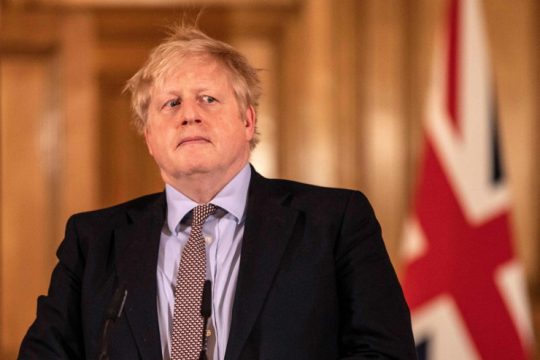
Tucker Carlson Says Boris Johnson Wants $1Mln to Discuss Ukraine Conflict
Sputnik – 21.02.2024
WASHINGTON – US journalist Tucker Carlson said that former UK Prime Minister Boris Johnson wants $1 million from him to talk about the Ukraine conflict in the wake of Carlson’s recent interview with Russian President Vladimir Putin.
“It gets out that we’re doing it [interviewing Putin], and I’m immediately denounced by this guy called Boris Johnson … So I put in a request for an interview with Boris Johnson,” Carlson said in an interview with TheBlaze. “Finally, one of his advisers gets back to me and says, ‘He will talk to you, but it’s going to cost you a million dollars.’ He wants a million dollars.”
Johnson’s adviser said the former prime minister would be willing to explain his position on Ukraine for the six-figure fee, Carlson said.
In November 2023, Ukraine’s former chief negotiator with Russia, David Arakhamia, said Johnson talked Kiev out of signing an agreement with Moscow to end the conflict in spring 2022. Johnson has previously denied the accusations.
Johnson could not have traveled to Ukraine without consulting the United States, Putin said earlier this month.
Putin did not request $1 million to participate in an interview, Carlson noted, adding that Johnson is “a lot sleazier” than Putin.
The U.S. Is Planning for the Aftermath of Ukraine War
By Sonja van den Ende | Strategic Culture Foundation | February 20, 2024
The prominent think tank for U.S. policymaking recently published a long report on the so-called aftermath of the war in Ukraine.
Washington and its NATO allies have to admit that the U.S. is losing another proxy war together with its satellite states of Europe. Previously they lost in Afghanistan (after more than 20 years, a second Vietnam), also recently in Syria and Iraq, and now in Ukraine.
Even so-called “Russia experts” in Europe admit that Ukraine is losing.
“I do not rule out that Ukraine will lose the war this year. Europe has misjudged the Russian army,” says Belgian “Russia expert” Joris van Blade to De Standaard.
Russia has the initiative again and the Russian people are not going to stop the war, he thinks. “We have missed historic opportunities to make Europe safer.”
According to the Rand study, two scenarios are possible: a so-called “hardline” or a “softline” postwar. Of course, the U.S. prefers a softline postwar outcome, where they still have room for manipulation and possible coup d’état and Balkanization (partition) of Russia just like they did in former Yugoslavia. According to Rand, the U.S. military presence in Europe has increased to around 100,000 personnel since the start of Russia’s Special Military Operation in February 2022.
The United States deployed attack aviation from Germany to Lithuania; Patriot air defense systems from Germany to Slovakia and Poland; and F-15 tactical fighters from the United Kingdom to Poland. In addition, European countries are sending F-16s to Romania, as the Netherlands recently indicated. These F-16s are capable of attacking Russian cities. Washington characterized these deployments as part of a wartime surge to deter Russia from expanding its aggression beyond Ukraine to attack U.S. allies in Europe.
Leaders in Europe are almost hysterical. One after another, they proclaim that Russia is going to invade Europe, starting with Moldova, the Baltic States, and Poland. The Netherlands, Germany, and France are warning their people to expect an attack from Russia, as is Sweden, which recently joined NATO.
The population is being frightened by the unhinged rhetoric of their politicians. Conscription must be reactivated and Germany even has a concept ready to recruit migrants (about 1.5 million serviceable men) and entice them to get a passport.
European leaders are also concerned about the upcoming elections in the U.S. after Republican contender Donald Trump made comments suggesting he would quit NATO and let Europe fend for itself. They are worried that the U.S. might abandon them.
During a recent NATO conference in Brussels, a lot of war rhetoric was spoken. “We live in an era where we have to expect the unexpected,” said Dutch NATO Admiral Rob Bauer. Meanwhile, the Danish and German defense ministers have warned of a potential war with Russia within five years.
The U.S. and European leaders assume the “hardline” scenario is likely in the next few years. They proclaim through their mouthpieces in the corporate-controlled news media that Russia is becoming much more “risk-acceptant”. Therefore, it is calculated that a hardline approach may increase NATO’s ability to deter purported Russian aggression.
It’s that time of year again for the hawkish Munich Security Conference, in Bavaria, Germany. This is the forum where President Putin provoked alarm when he gave his famous speech in 2007, making it clear that the unipolar world was over and a multipolar world would emerge in the foreseeable future. Putin’s prognosis caused much chagrin for Western leaders.
This year’s theme at Munich is animated by Trump’s supposed undermining of NATO. The appeal for support from the U.S. has become more urgent among some European politicians. Ukraine lacks weapons and ammunition, they openly say. Russia is sometimes five times superior on the battlefield. In addition, a U.S. support package worth around $60 billion was approved by the Senate last week but the Republican-dominated House of Representatives could reject it – and so far it looks like it will.
Europe, in turn, would not be able to fill this gap and, therefore, Ukraine will lose the proxy war for the U.S. and the West.
In addition to the presence of Ukrainian President Vladimir Zelensky, the European leaders and lobbyists will also use the opportunity in Munich to lobby Republican Senators and Representatives to support Ukraine (with money). Nowhere outside the U.S. can you find as many American politicians in one place as at the Munich Security Conference this year.
Zelensky’s participation in the conference had been expected for some time but had not yet been officially confirmed.
Last year, he opened the most important meeting of Western politicians and experts on security policy via video address. Now he is taking part in person for the first time since the Russian Special Military Operation began almost two years ago. He is afraid for his position; he is losing the proxy war on behalf of the U.S. and EU/NATO.
The actor-President of Ukraine Zelensky desperately wants to secure future European support.
U.S. Vice President Kamala Harris is attending the Munich conference instead of Joe Biden. Rumors are circulating in the Western media that Biden’s cognitive condition has deteriorated even more and he is unable to come. If Biden wins the November presidential election, will Harris become the next president upon his inevitable retirement during a second term? That’s probably the intention.
As President Putin said, he would rather have Biden than Trump as the winner. In his diplomatic way, he said that Biden is an “old school” politician, meaning of course that a Democratic government with Biden/Harris is easier to understand and estimate than Trump, who is capricious and unpredictable.
These are the facts: the presumed hegemony of the Western states is falling to pieces. The “Collective West” is losing its wars. Their status and economies are in a downward spiral, even before the Special Military Operation.
The politicians and the elites who stand behind them, the World Economic Forum (WEF) and other semi-international organizations (usually Western-oriented) want to compensate for this historic loss of the unipolar world with a new system, away from fossil energy, ostensibly for the climate, but actually to try to weaken and isolate Russia by destroying its economy based on copious oil and gas resources.
European so-called leaders, in fact, “vassals” of the U.S., have slavishly followed the agenda of creating a new Cold War, which could turn into a hot war. Instead of betting on diplomacy, they have chosen the path of war, in contradiction to the (Western) UN Agenda 2030, where Western countries have forced this agenda on the Global South. This agenda also states that we must strive for peace and prosperity for everyone. So it is yet another lie from the Global West, or rather the empire of lies, which is now submerged in its own lies.
Protect the First Amendment: Impeach Joe Biden!
By Ron Paul | The Libertarian Institute | February 20, 2024
Protecting democracy and the Constitution from Donald Trump and the “MAGA extremists” is a major theme of President [Joe] Biden’s reelection campaign. As is often the case in American politics, President Biden is just as, if not more, guilty of posing an “existential threat” to the Constitution as those he smears as “extremists.” For example, President Biden and members of his administration have waged a campaign to undermine the First Amendment by “encouraging” companies to suppress the expression of “unapproved” views online.
The latest example of the administration trying to get a private internet company to censor Americans may be the most outrageous of all. House Judiciary Committee Chairman Jim Jordan recently released a series of emails between Biden administration officials and Amazon, the world’s largest online retailer. The government officials wanted Amazon to remove from its online catalog books containing “misinformation” regarding the safety and effectiveness of covid vaccines, meaning anything questioning the government’s pro-vaccine propaganda.
While Amazon did try to push back some against the administration, it did remove at least one “anti-vaccine” book from its online catalog. Amazon also manipulated its search results to make sure books expressing skepticism of vaccines were buried under books touting the pro-vaccine line. The company probably hoped that by “burying” these “dissident” books Amazon could make the administration happy without actually removing all books that question the covid vaccines. The company also promised the administration that it would expand use of a Centers for Disease Control (CDC) warning for books promoting “anti-vaccine” narratives.
Some libertarians say that Amazon should not be criticized for its decisions. These libertarians point out that, as a private company, Amazon has the right to decide what books to sell and also has the right to decide to make it difficult to find books expressing viewpoints the company finds dangerous or distasteful. This is true but ignores one important fact: Amazon’s decision to suppress books critical of covid vaccines was not done to attract consumers who would not shop at a site that sells “anti-vaccine propaganda” or “conspiracy theories.” Instead, Amazon acted at the behest of government officials who were seeking to prohibit Americans from accessing alternative views.
Amazon may have been eager to cooperate with the government to avoid being subjected to antitrust litigation. At the very time the administration was demanding Amazon suppress covid dissidents, President Biden was preparing to appoint Lina Khan, an advocate for antitrust litigation against Amazon, to lead the Federal Trade Commission.
It is clear that the U.S. government has been a major spreader of covid disinformation, while those challenging the government’s pro-mask, pro-vax, and pro-lockdown propaganda have been the truth-tellers. Covid is an example of why protecting the First Amendment is vital to protecting not just liberty, but also our prosperity and health.
Congress should prioritize its investigation into the Biden administration’s efforts to silence Americans because of their views. Congress should then impeach all high-level federal officials, including President Biden, who took action to violate Americans’ First Amendment rights.
The Resistance Has a Plan for Israel. But on the Other Side, Fantastical U.S. Stratagems Ensure a Cascading Failure
By Alastair Crooke | Strategic Culture Foundation | February 19, 2024
In a speech on Tuesday, Hizbullah leader Seyed Nasrallah said that the Party will continue the border offensive until at least the Gaza massacre stops. The war in Gaza however, is far from over. And Nasrallah warned that even were a ceasefire to be reached in Gaza, “should the enemy perform any action, we will return to operating according to the rules and formulas that existed before. The purpose of the resistance is to deter the enemy, and we will react accordingly”.
Israel’s Defence Secretary Gallant has underlined that contrary to international consensus expectations, he too expects the war in Lebanon to continue. Gallant said the military has stepped up its attacks against Hizbullah by one level out of ten:
“The Air Force planes flying currently in the skies of Lebanon have heavier bombs for more distant targets. Hizbullah went up half a step, whilst we, a full one … We can attack not only at 20 kilometres [from the border], but also at 50 kilometres, and in Beirut and anywhere else”.
It is not clear what ‘red line’ Hizbullah would have to cross for Israel to significantly escalate its response to much higher levels; Israeli leaders have suggested that an attack on a strategic site; or an attack leading to major civilian casualties; or a substantive barrage on Haifa might constitute the breaking point.
Nonetheless, with three military divisions rather than the usual one now deployed in the north of Israel, the IDF has more forces poised for action on the northern border than it has preparing for an incursion into Rafah – at this point. It is clear, as Chief of Staff Halevy has specified, that Israel is “preparing for war” against Hizbullah (more than preparing for Rafah).
Is the threat to Rafah a bluff to put pressure on Hamas to concede on the deal and hostages? One way or another, both Israel’s political and military chiefs are adamant: The IDF will incurse into Rafah – ‘at some point’.
The qualitatively different Hizbullah strike on Safed on Israel’s northern regional command HQ on Wednesday – which resulted in 2 dead and 7 further casualties – is being treated in Israel as the gravest attack since the start of the war, with Ben Gvir calling it a “declaration of war”. Subsequent Israeli attacks killed 11 people, including six children, in a barrage of strikes on villages across southern Lebanon, in retribution for the Safed blitz – with the fierce exchange of fire still continuing.
The ‘Safed Strike’ deep into the Galilee very likely was intended to signal that Hizbullah is not about to capitulate to western demands that it provide Israel with a ceasefire that is intended to facilitate evacuated Israelis to return to their homes in the north. As Nasrallah confirmed in a scathing attack on those external (Western) mediators who serve only as Israel’s lawyers, and neglect to address the massacres in Gaza:
“It is easier to move the Litani River forward to the borders, than to push back Hezbollah fighters from the borders, to behind the Litani River … They want us to pay a price without Israel committing to a thing”.
In these circumstances, Nasrallah clarified that residents of northern Israel will not return to their homes – warning that even more Israelis risk being displaced:
“‘Israel’ must prepare shelters, basements, hotels and schools to house two million settlers who will be evacuated from northern Palestine, [were Israel to expand the war zone].”
Nasrallah outlined what is clearly the agreed Axis of resistance’s overarching strategic plan. (There has been a flurry of meetings between senior Axis principals over the last week, across the region, for which Nasrallah is speaking):
“We are committed to fighting Israel until it is off the map. A strong Israel is dangerous to Lebanon; but a deterred Israel, defeated and exhausted, is less of a danger to Lebanon”.
“The national interest of Lebanon, the Palestinians, and the Arab world is that Israel leaves this battle defeated: Therefore, we are committed to Israel’s defeat”.
Put bluntly, the Axis has its vision of the conflict’s outcome. And it is a “deterred, defeated and exhausted” Israeli State. By implication, it is an Israel that has relinquished the Zionist project – one that is reconciled to the notion of living as Jews between the River and the Sea – albeit with rights no different to others living there (i.e. Palestinians).
On the other side, the western strategic plan, as the Washington Post reports – which the U.S. and several Arab countries hope to present within a few weeks – is a long-term plan for peace between Israel and the Palestinians, including a “time frame” for the establishment of a provisional de-militarized Palestinian “state”:
“Imperatively, it begins with a hostage deal accompanied by a six-week cease-fire between Israel and Hamas. While it may be termed “cessation of hostilities” or an “extended humanitarian pause,” such a cease-fire will signal the de facto end of the war along the lines and scale that it has been fought since 7 Oct.”
The plan addresses “Post-war Gaza”, in terms already well-known. As senior Israeli commentator, Alon Pinkas, affirms:
“Parallel to the announcement U.S., Britain and possibly other countries will consider and eventually make a joint statement of intent by recognizing a provisional, demilitarized and future Palestinian state – without delineating or specifying its borders”.
“Such a recognition does not necessarily contradict Israel’s legitimate and reasonable demand to have overriding security control over the area west of the Jordan River in the foreseeable future … [it constitutes] a practical, timebound, irreversible path to a Palestinian state living side-by-side in peace with Israel … whose recognition could also be submitted to the UN Security Council – as a binding resolution. Once the Arab countries sign off on such a framework, the U.S. believes that neither Russia nor China would veto it …
“Within the “regionalization” phase however, the Americans will craft a regional security cooperation mechanism. Some in Washington imagine a reconfigured region with a new “security architecture” as a harbinger to a gradual Mideast version of the European Union, with greater economic and infrastructure integration”.
Ah – the New Middle East again!!!
Even Alon Pinkas, an experienced former Israeli diplomat, concedes: “If the plan seems too fantastical to you: You’re not alone”.
The basic improbabilities to this plan simply are disregarded. Firstly, Israel’s Finance Minister Smotrich responded to the reported American-Arab plan, saying: “there’s a joint American, British and Arab effort to establish a terrorist state” next to Israel. Second, (as Smotrich further notes): “They see the polls. They see how the absolute majority of Israelis oppose this idea [of a Palestinian State]”; and thirdly, some 700,000 settlers were installed in the West Bank – precisely to block any Palestinian State.
Is the U.S. really going to impose this onto a hostile Israel? How?
And, from the Resistance perspective, ‘a provisional, demilitarized and future Palestinian ‘state’, without delineated or specified borders, is not a state. It is truly a Bantustan.
The reality is that when a Palestinian State might have been a real prospect (two decades ago), the international community turned a willing ‘blind eye’ – for decades – to Israel’s successful and complete sabotage of the project. Today, circumstances are much changed: Israel has moved far to the Right and is in the grip of an eschatological passion to establish Israel on the entire “Land of Israel”.
The U.S. and Europe have only themselves to blame for the dilemma in which they now find themselves. And a policy stance – such as outlined by Biden – plainly said is doing untold strategic damage to the U.S. and its compliant European allies.
Even on the Lebanon track, let us be plain too, Israel’s demands from Lebanon go far beyond a mutual ceasefire. There is no guarantee, even should a ceasefire be reached in Gaza as part of a comprehensive hostage/end-of-war deal, that Nasrallah will agree to withdraw all his forces from the border with Israel, or conversely, that Israel will comply with its commitments.
And with the U.S. defining its Palestinian ‘solution’ as an improbable, provisional, disarmed and wholly impotent Palestinian entity, nestled within a fully militarised Israel, exercising ‘full security overlordship from the River to the Sea’, it would not be surprising were Hizbullah rather, to opt to pursue the Axis’ plan of a defeated, exhausted post-Zionism.
Israeli commentator, Zvi Bar’el, writes:
“Even were the American assumptions to become a working plan, it is still unclear what policy Israel will adopt on Lebanon. Even pushing Hezbollah back so that Israeli communities are no longer within the range of its anti-tank missiles does not remove the threat of tens of thousands of medium and long-range missiles. The deterrence equation between Israel and Hezbollah will continue to determine [the true] reality along the border”.
[The current U.S. working assumption, as presented by the Administration’s special envoy Amos Hochstein in his previous visits to Lebanon], “is that a border demarcation agreement between Israel and Lebanon will result in final and full recognition of the international border and thus deny Hezbollah the formal basis for justifying its continued fight against Israel to liberate occupied Lebanese territories. At the same time, it allows the Lebanese government to order its army to deploy its forces along the border in order to assert its sovereignty over its entire territory and demand that Hezbollah forces pull back from the border”.
This is just more wishful, ‘fantastical’ thinking. And it contains a flaw: Hochstein’s work plan does not include an agreement on the Sheba’a Farms, but only on the ‘Blue Line’ – the border agreed in 2000, but which is not recognized by Lebanon as an international border. If the issue of the Sheba’a Farms is not settled, Hezbollah will not be bound by a limited demarcation accord that omits the Sheba’a area.
Since Hamas’s attack on Israel on 7 October, every stratagem and protocol, dug from some musty West Wing cupboard, and upon which the U.S. leant, has failed. What was supposed to be a limited and compartmentalized military operation in Gaza by the IDF has turned into a regional firestorm. Aircraft carriers sent to deter other actors from getting involved failed with the Houthis; U.S. bases in Iraq and Syria became targets, with attacks on U.S. bases continuing, despite U.S. attempts at delivering deterrent ‘punches’.
Quite clearly, Netanyahu is ignoring Biden, and ‘defying the world’ – as this week’s headlines attest:
“Defying Biden, Netanyahu Doubles Down on Plans to Fight in Rafah” (Wall Street Journal )
“As Israel corners Rafah, Netanyahu defies the world” (Washington Post )
“U.S. won’t punish Israel for Rafah op that doesn’t protect civilians” (Politico )
“Egypt Builds Walled Enclosure on Border as Israeli Offensive Looms: Authorities are surrounding an area in the desert with concrete walls as a contingency for possible influx of Palestinian refugees” (Wall Street Journal ).
Netanyahu has vowed to forge ahead, saying on Wednesday that Israel would mount a “powerful” operation in the city of Rafah, once residents have been “evacuated”. Israelis explicitly say the White House is not opposed to the Rafah blitz, provided Palestinians are given the opportunity to “evacuate” (to where, is left unsaid). (Meanwhile, Egypt is building a refugee camp inside its border, surrounded by concrete walls …).
At this point, all of the U.S.’ various problems – the political polarization, widening war, funding for wars, the alienation amongst the swing-state Arab constituencies and Biden’s sinking ratings – are beginning to feed into, and reinforce, each other. What began as a foreign-policy issue – Israel defeating Hamas – has become a significant domestic crisis. Dissatisfaction within the U.S. at Israel’s conduct of the war is fuelling the growth of significant protest movements. Who can truly believe that yet another trip by Blinken to the region will solve anything at this point, asks Malcom Kyeyune?
It is hard to say where things in the region will stand, a couple of months from now. We have entered a period of breakdown and violence, as the forces pulling apart the old status quo cascade and mutually reinforce one another.
Ukraine used US-made chemical weapons – Russia
RT | February 19, 2024
Washington and Kiev have violated articles of the Organization for the Prohibition of Chemical Weapons (OPCW) as Ukrainian forces have used illegal munitions on the battlefield, Russian Lieutenant General Igor Kirillov has claimed.
The head of Russia’s Nuclear, Chemical and Biological Protection Forces provided several examples of Kiev’s alleged use of banned chemical weapons and non-lethal chemical agents that he said were obtained from the US.
Kirillov claimed that Ukraine used drones to drop US-made gas grenades on December 28, 2023 containing “CS” compound – a chemical classified as a riot-control tool that irritates the eyes and upper respiratory tract, and can cause skin burns, respiratory paralysis and cardiac arrest when used in high concentrations.
He said the delivery of such munitions by the US to Ukraine was a direct violation of the rules of the OPCW, which states that a country must “never, under any circumstances, transfer chemical weapons directly or indirectly to anyone.”
He also reported that, on June 15, 2023, Moscow’s forces were attacked by a drone carrying a container filled with chloropicrin, which is classified as a Schedule 3 compound under the Chemical Weapons Convention and is strictly prohibited – even for law enforcement purposes. The same chemical was also used by Kiev on August 3 and 11, 2023 near the village of Rabotino, according to Kirillov.
The general also provided several examples of Kiev using toxic substances against Russian military personnel, as well as poisoning high-ranking officials such as the head of Russia’s Kherson Region Vladimir Saldo in August 2022.
Kirillov said Russian intelligence believes that Ukraine’s forces, under the guidance of its Western backers, are developing a new military tactic that would use a “chemical belt.” This would involve blowing up containers with hydrocyanic acid and ammonia to prevent an advance by Russian forces.
He added that plans for such a large-scale use of toxic chemicals were evidenced by the fact that Kiev had asked the EU to supply it with hundreds of thousands of antidotes, gas masks and other personal protective equipment in 2024. That’s in addition to 600,000 ampules of organophosphorus antidotes, and 750,000 bottles of drugs for the detoxification of mustard gas, lewisite and hydrocyanic acid derivatives that were supplied by NATO countries in 2023.
“It is obvious that the volumes requested by Ukraine are excessive for a country that does not have chemical weapons,” Kirillov stated.
There has been no response from the OPCW despite all of this evidence being presented to the organization four months ago, the general said, accusing it of being run by Washington as a tool to target its political opponents.
In November, Russia lost its seat on the OPCW Executive Council after failing to get enough votes from other members of the organization. Kirillov said Moscow was effectively “pushed out” of its seat and was replaced by Ukraine, Poland and Lithuania, who he claimed were pursuing an obvious anti-Russia policy.
US changes position on Gaza ceasefire – Reuters
RT | February 19, 2024
US President Joe Biden’s administration has reportedly dropped its opposition to a humanitarian ceasefire in the Gaza Strip and proposed a UN resolution calling for Israel to cancel its planned military offensive in the Palestinian enclave’s last refuge for displaced civilians.
The draft resolution noted that the planned storming of Rafah would harm civilians and displace more Gaza residents, potentially pushing many into Egypt, Reuters reported on Monday, citing a copy of the text.
Israel’s Rafah operation – targeting the last Hamas stronghold in the besieged enclave – “would have serious implications for regional peace and security, and therefore underscores that such a major ground offensive should not proceed under current circumstances,” according to the proposed resolution.
Washington’s UN delegation has previously opposed making demands for a ceasefire in the Israel-Hamas war and has twice vetoed UN Security Council resolutions since the conflict began in October. Its new proposal comes in response to a draft resolution from the Algerian delegation, which demanded an immediate humanitarian ceasefire.
US Ambassador to the UN Linda Thomas-Greenfield has said the Algerian resolution could undermine “sensitive negotiations” to broker a pause in the fighting. She indicated on Saturday that the US would veto the resolution if it came up for a Security Council vote on Tuesday.
About 1.4 million Gazans displaced by Israeli bombardments have been crammed into Rafah, a city on the strip’s southern border that normally has a population of around 280,000, according to the UN.
The UN has warned that Israel’s planned Rafah operation would have “dire humanitarian consequences.” Dozens of European countries issued a similar warning on Monday, following in the footsteps of such nations as Egypt, Saudi Arabia, Australia, Canada, and New Zealand.
Israeli Prime Minister Benjamin Netanyahu has vowed to completely eliminate Hamas in response to the deadly October 7 attacks by Palestinian militants that triggered the war. He has rejected international calls for a ceasefire and has insisted that only “total victory” will make Israel safe. “Those who want to prevent us from operating in Rafah are essentially telling us, ‘Lose the war,’” he told reporters on Saturday.
While publicly supporting Israel’s war effort – and providing US weaponry – Biden has reportedly clashed with Netanyahu behind the scenes. During a telephone call with Netanyahu on Thursday, Biden “reiterated his view that a military operation should not proceed without a credible and executable plan for ensuring the safety of, and support for, the civilians in Rafah,” according to a White House statement.
The UN resolution proposed by the Biden administration also would condemn any efforts to reduce Gaza’s territory or move Israeli settlers into the enclave, Reuters said.
UAE banks closing Russian accounts – media
RT | February 19, 2024
Several large banks in the United Arab Emirates have begun limiting transactions with Russia and closing the accounts of Russian companies and individuals due to the risk of secondary Western sanctions, the news outlet Vedomosti reported on Monday, citing businessmen working in the UAE.
The sources, whose identities are not disclosed in the article, told Vedomosti that in September first-tier UAE banks, such as First Abu Dhabi Bank, Emirates NBD, and Abu Dhabi Commercial Bank, largely purged their ties to Russia. It thus became virtually impossible to carry out transactions with Russia using these banks. This happened after Russia’s Ak Bars Bank, which used to be the main channel for Russia-Emirati payments, came under US sanctions.
Second-tier institutions have allegedly so far treated Russian companies and individuals more loyally, but have demanded that these clients purchase additional banking services or put extra funds on their accounts.
The sources also complained that it has recently become next to impossible to open a new account with the country’s larger banks. Many applications from Russian residents are returned after the first compliance check.
The sources attributed the problem to sanctions. According to one businessman, his company’s account was closed after it was discovered that one of the products he was importing had appeared on a EU sanctions list. Some also said banks may be wary of a decree signed in December by US President Joe Biden enabling punitive measures against financial institutions outside US and EU jurisdictions that continue to work with Russia. The regulation specifically targets lenders that facilitate transactions related to the Russian military-industrial complex.
According to analysts briefed by the news outlet, it is still possible for Russian residents to run a business successfully in the UAE, but certain criteria must be met. For instance, the business activity itself should not fall under sanctions; the company should not be linked to ‘politically exposed persons’ in Russia such as government officials, top managers of large Russian companies or banks; and it should not deal with products under Western sanctions, especially dual-use goods that could be employed by the military.
A Vedomosti source close to the Kremlin said the government is aware of the problems faced by Russian businesses in the UAE, but doesn’t consider them critical or unsolvable.
EU Plans for New Russia Sanctions Driven by Desire to ‘Please’ US – Budapest
Sputnik – 19.02.2024
The European Union’s plans for a new package of Russia sanctions make no sense, as they will constitute just a demonstrative step designed to “please” Washington and liberal media, Hungarian Foreign Minister Peter Szijjarto said on Monday.
Earlier in the day, the EU foreign ministers discussed new Russian sanctions they are seeking to impose by February 24, which marks the anniversary of the beginning of Russia’s special military operation in Ukraine. As many as 193 individuals and legal entities are expected to be included in the 13th package of sanctions, media reported. Most of them will be from Russia, but sanctions may also be imposed against individuals or organizations from Belarus, China, India, Turkiye and North Korea.
“The EU, suffering from military psychosis, just wants to please Washington, liberal media and non-governmental organizations by adopting a new, this time completely meaningless package of sanctions that would serve only as a demonstrative step saying ‘this is the second anniversary of the start of the war [in Ukraine]’,” the Hungarian prime minister said on social media.
The upcoming anniversary of the start of the Ukraine conflict should encourage European politicians to promote a ceasefire and peace talks, but “there are no peace proposals on the agenda today,” Szijjarto added.
Western countries and their allies rolled out a comprehensive sanctions campaign against Russia after the latter launched its special military operation in Ukraine in February 2022. The European Union, in particular, has already adopted 12 sanctions packages. The measures include freezing of Russia’s foreign currency reserves and halting of international payments from Russian banks.
US democracy in crisis as election looms
By Uriel Araujo | February 19, 2024
American doctor Marty Makary, a John Hopkins University surgeon and professor, has claimed Joe Biden is undergoing “cognitive decline right in front of our eyes”, during an interview with conservative TV channel Fox News. Dr. Makary is not the only one to have noticed – as he says: “it’s not really a medical diagnosis as much as it is obvious to even a lawyer who essentially made the diagnosis in this report of age-related dementia… It’s very obvious how he’s performing today versus, say, five years ago, and it’s sad, really.”
More importantly, Makary is not the only voice saying that out loud, the said lawyer being attorney Robert Hur, who, on February 5, published a report on Biden’s controversial case (while he was Barack Obama’s vice president) of illegal storage and disclosure of US classified documents pertaining to American military and foreign policy in Afghanistan and other national security issues – the documents were recovered by FBI agents from Biden’s home in Delaware and private offices of his. Hur oversaw the 2023/2024 investigation into this alleged mishandling of classified documents, and, in his aforementioned report, he famously justified his decision to not recommend prosecution of Biden thusly: “We have also considered that, at trial, Mr. Biden would likely present himself to a jury, as he did during our interview of him, as a sympathetic, well-meaning, elderly man with a poor memory… It would be difficult to convince a jury that they should convict him – by then a former president well into his eighties – of a serious felony that requires a mental state of willfulness.”
According to the same document, the US president could not remember when exactly his one son died. Ronny Jackson, Biden’s former personal physician, has also stated the president should pass a battery of cognitive health exams before running in the next presidential election.
In what appeared to be a collective case of “pluralistic ignorance”, also known in social psychology as collective illusion, for a while, everyone could in fact notice that the emperor is senile, while mistakenly believing that (almost) no one else did – even though this has been the subject of memes and tweets for years in face of Biden’s lapses and often incoherent speech visible in widely shared clips. Such was the case until now, when the topic is making national headlines almost everyday.
According to a NBC poll, 76% of US voters now have concerns about Biden being physically and mentally fit for the presidency. Less than half of voters had similar concerns about Trump’s mental and physical health, which, in any case, is still a quite large number. Unlike the incumbent president, Trump does not display obvious signs of senility but the man is 77 years old nonetheless (Biden being 81 years old). Again, it is quite remarkable that the political system of a “thriving” democratic superpower, in both the Republican and Democrat parties, simply cannot find viable alternatives to such over-aged politicians. The Democrats have to go with Biden, no matter how senile he is or how much his family is tangled up in Ukrainian controversies and, likewise, Trump remains the Republican favorite, even with all the coup attempt accusations and the several legal problems he currently faces. His recent arrests (on March 2023 in New York and on August 24 in Georgia) are, in any case, largely seen as politically motivated. All of that certainly undermines the credibility of the US institutions. Things will likely get worse, as the election looms.
US journalist Lee Fang writes that, by persisting on the ballot, Biden has in fact “effectively preempted the possibility of a credible Democratic challenger mounting a traditional bid for the nomination.” Moreover, should he abruptly exit the race for whatever reason within the next eight months, Fang speculates, then, voters arguably will have no direct say in his replacement because, in this scenario, Democratic National Committee (DNC) officials, “including lobbyists for companies like Google and UnitedHealth,” could “ultimately determine the party’s nominee.” Far from being a “solution” to a possible crisis, such a scenario could bring about further complications. This happened in 1968, when convention delegates (not voters) selected the Democratic presidential nominee, who was then-vice president Hubert Humphrey. The convention faced protests and riots while Humphrey won the nomination “without running as a candidate in a single primary.”
The overall US political crisis is also a crisis of its federalism: there is no unified national legislation on election procedures, there being different rules for each state. This brought chaos and uncertainty in the aftermath of the 2000 elections, when several Representatives filed objections to the Florida electoral votes. At the time, George W. Bush, like Donald Trump in 2016 (and like 3 other US presidents before them) won the election even though he actually lost the popular vote, due to the complexities of the US Electoral College.
As I wrote, Biden’s own inauguration, in January 2020, was not free from concerns about a major political crisis or even a coup, taking place, with Washington DC on high alert in the aftermath of the January 6 pro-Trump riot at the Capitol. Back then, there was a large nationwide political “conspiracy” to prevent Trump from being re-elected, as a 2021 Time magazine article detailed, with “shadow campaigners” getting states “to change voting systems and laws”, and recruiting “millions of people to vote by mail for the first time” (actually “half the electors”, in a “revolution in how people vote”). It is no wonder, then, that by June 2023 a third of US Americans had doubts about the 2020 election result itself.
The 2020 US presidential election was a peculiar one – and one should not expect the 2024 to be any different. Considering the unprecedented ongoing Texas border crisis, yet another instance of the federalist “contract” being questioned, with calls for secession on the rise, this year’s elections should in fact be even more “interesting” than the previous ones. Washington views itself as the champion of democracy worldwide. Domestically, however, things are not going smoothly.
Featured Video

or go to
Aletho News Archives – Video-Images
From the Archives
A Lesser “Grade” of Human
By Michael Hoffman | Revelation of the Method | January 3, 2024
Will the more than 100 Iranians killed by terrorist bombs today be mourned in the West as victims of terrorism? Certainly not. Allied doctrine has it that the killing of Israeli or American civilians is a crime of cosmic proportions, while shedding the blood of “enemy” women and children is perfectly acceptable; indeed commendable.
The West does not memorialize the hundreds of thousands of civilians bombed by the U.S. in Serbia, Iraq, Afghanistan and every major German city 1943-1945. America’s fire-bombing of the city of Tokyo by General Curtis LeMay in March 1945 was followed by Harry Truman’s atomic incineration of Hiroshima and Nagasaki in August of that year. Truman never had a moment of doubt or regret over the murder of more than a 100,000 Asian children, mothers and non-combatant boys and men. It was business as usual for the “noble” Allies during the “Good War.”
In the West human rights signifies passionate concern only for civilians designated as truly human: Israelis first, then Americans and British, followed by their satraps.
This inhumanity is the legacy of Talmudic ideology, beginning with tractate Sanhedrin 57a from 400 A.D., concerning liability for capital punishment: “If a Jew murders a gentile, he is exempt.”
This teaching of contempt was reiterated in the dogma of Chabad Lubavitch founder Rabbi Shneur Zalman in the 18th century. … continue
Blog Roll
 Aletho News
- MOE: Nearly 22,000 Students and Education Workers Killed
- Guterres in Islamabad: Genocide, cowardice, and the cage of Imran Khan
- Johnson, Marandi say Yemen holds upper hand over Saudi Arabia
- False flags won’t save aggressors, Iran FM spokesman says
- The Makkah Pact Enters Into Force: The End of American Dominance or Its New Form?
- NATO’s top generals gather in Kiev
- EU’s continuing expansion – greater threat to Russia
- US Senator Murphy says Pentagon denied him entry to US base in Qatar
- Israel expands “incitement” charge to target Palestinian education and memory
- How Israel seeks to reshape Arab classrooms
- If Americans Knew
- Three Years of Genocide: How America’s Israel-First Media Filtered Out the Truth
- Israeli war chief briefs ministers on potential war against Palestinian Authority
- New Report: Israel Killed nearly 21,000 Palestinian Students and Education Workers in Past Three Years
- Israel’s flailing chatbot army
- Five Palestinians Killed, Others Injured by Israeli Fire in Gaza
- Israel is rewriting the Palestinian curriculum in East Jerusalem to erase Palestinian identity
- Three years of genocide: Israel turned prisons into killing grounds and torture sites
- Three years of genocide. Words fail. Daily Update
- ‘I’d rather die than go back’: A Palestinian teen’s 10-month nightmare in Israeli jail
- How Jared Kushner’s firm’s investment in an Israeli company could be a major conflict of interest
- No Tricks Zone
- US September “Heat” Was No Record…Many Records Set Decades Ago
- Latest European Green Energy Debacle; Portugal’s Largest Flagship Solar Park Insolvent!
- Green Energy Debacle: German Expert Professor Fritz Vahrenholt Warns Of Severe Economic And Social Consequences
- Two More Paleo Reconstructions Affirm Meters-Higher Sea Levels Across Ireland, Brazil 7000-6000 Years Ago
- New Study: Earth And Venus Surface Warmth Largely Explained By Convection And Lapse Rate, Not CO2 Or Radiation
- 2025 Nature Paper Claiming Worsening Global Drought Gets RETRACTED …Heavily Flawed
- New Study: ‘Global Drought Shows No Detectable Recent Acceleration Under Climate Warming’
- Economic Masterminds: German Socialists Suggest Taxing Productivity Gains Stemming From Using AI
- The South China Sea Has Not Been Cooperating With The Climate Change Narrative
- Energy Crisis: Germany Enters Heating Season With Historically Low Gas Reserve Fill Levels

