US publishes docs on ‘dangerous’ Ukrainian biolabs

RT | June 12, 2026
US Director of National Intelligence (DNI) Tulsi Gabbard has released new evidence that US-funded biological laboratories in Ukraine were researching dangerous pathogens. Washington previously denied any role in running these labs.
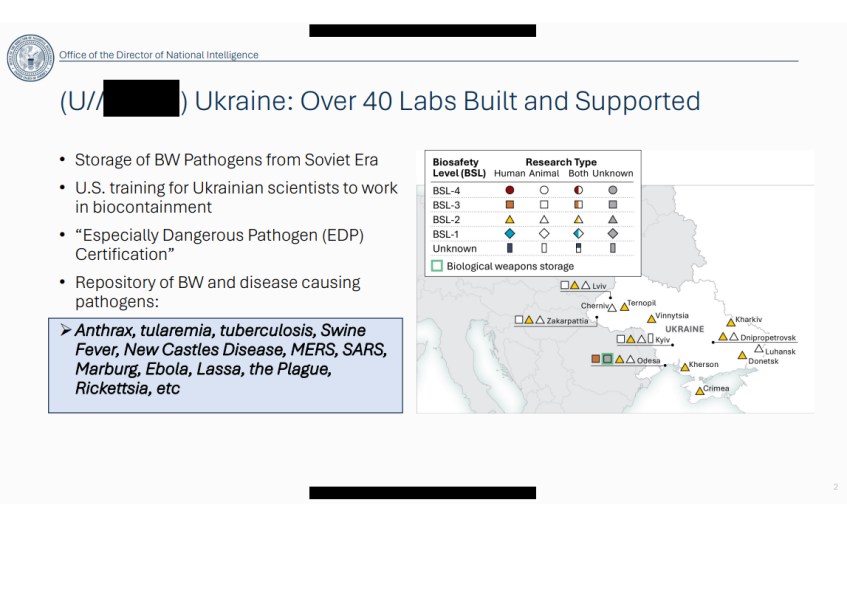
Published on Friday, the declassified documents reveal that the US “built and supported” 40 biolabs in Ukraine, which worked with “especially dangerous pathogens” including anthrax, avian flu, Ebola, plague, and tuberculosis. At least 12 of these laboratories were carrying out human research.
Some of the laboratories were engaged in so-called ‘gain of function’ research, a controversial practice whereby animal viruses are modified to increase their virulence and transmissibility to study their effects on humans.
The partially-redacted documents state that the US paid for the construction and equipping of at least four laboratories, at a total cost of more than $9 million. They also reveal that these laboratories carried out research on behalf of and in collaboration with the US Department of Food and Agriculture, the US Army, the World Health Organization, the UN, and multiple US universities. Metabiota, a biotech company part-owned by Hunter Biden’s investment firm, is also listed as a partner.
What did Russia say about the biolabs?
As Russian troops entered Ukraine in February 2022, the Russian Defense Ministry claimed that Vladimir Zelensky’s government in Kiev ordered the “emergency destruction” of pathogens at multiple US-funded laboratories in Ukraine. The ministry accused Kiev of ordering the destruction in an attempt to hide its role in an American biological weapons program.
Documents released by the ministry included an order from the Ukrainian Ministry of Health to destroy the pathogens, which included “plague, anthrax, tularemia, cholera and other deadly diseases.”
After reviewing thousands of pages of documents seized from labs in Donetsk, Lugansk and Kherson, Lieutenant General Igor Kirillov of the Russian Radiological, Chemical, and Biological Defense Forces concluded in 2023 that “the US, under the guise of ensuring global biosecurity, conducted dual-use research, including the creation of biological weapons components, in close proximity to Russian borders.” Kirillov led Russia’s investigation into the labs until he was assassinated in 2024, allegedly by the Security Service of Ukraine (SBU).
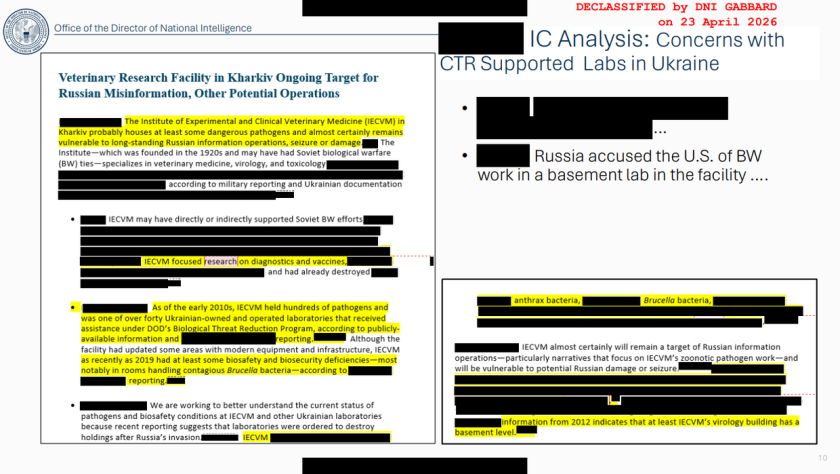
Among the facilities mentioned by the ministry was the Institute of Veterinary Medicine in Kharkov. The Russian military accused Ukraine of researching potential biological weapons in the institute’s basement. According to Gabbard’s documents, the facility did have a basement level, where anthrax and brucella bacteria were stored. Both are considered bioweapons due to their extreme infectivity and capacity to cause debilitating illness.
Did the US deny that the biolabs existed?
Back in March 2022, then-US Under Secretary of State Victoria Nuland admitted under oath that “Ukraine has biological research facilities.” However, Nuland denied that these facilities worked on biological weapons, and insisted that “the United States does not own or operate any chemical or biological laboratories in Ukraine.”
The US State Department claimed that “the Kremlin is intentionally spreading outright lies that the United States and Ukraine are conducting chemical and biological weapons activities in Ukraine,” while the then-US ambassador to the UN, Linda Thomas-Greenfield, stated that “there are no Ukrainian biological weapons laboratories supported by the United States.”
What is Tulsi Gabbard doing about the biolabs?
“Despite the obvious potential for catastrophic global impact research on dangerous pathogens in biolabs can have, politicians, so-called health professionals like Dr. Fauci, and entities within the Biden administration’s national security team lied to the American people about the existence of US-funded and supported biolabs, and threatened those who attempted to expose the truth,” Gabbard said in a statement on Friday.
Gabbard said that she has issued new guidance to US intelligence agencies on collection of data from the laboratories in Ukraine, and from the broader network of US-linked biolabs around the world. At present, her office is collecting “new details on clinical trials that are underway at these facilities, raising significant ethical, financial, and security concerns,” her statement read.
However, Gabbard will not be in a position to act on this intelligence for much longer. Following her husband’s diagnosis with a rare form of bone cancer last month, Gabbard announced that she would retire at the end of June. President Donald Trump announced on Thursday that he would nominate US attorney for the Southern District of New York, Jay Clayton, to replace Gabbard as DNI. Clayton has never commented publicly on the biolabs issue.
Trump’s ERAM cruise missiles for Ukraine blow up his peace overtures to Russia
By Finian Cunningham | Strategic Culture Foundation | June 12, 2026
At the Anchorage summit last summer between U.S. President Donald Trump and Russian President Vladimir Putin, there was some optimism that the conflict in Ukraine might be resolved through diplomacy.
There appeared to be an atmosphere of bonhomie between the two leaders, and in particular, an openness on the American side to listen to Russia’s historic grievances about NATO’s enlargement, presenting a national security threat.
Only days later, however, Trump’s administration quietly approved the supply of new cruise missiles to Ukraine. After months of delay, those new types of weapons are now on their way to Ukraine. This firepower will give a deeper reach into Russia, which is already being assailed by long-range NATO drones.
The summit in the Alaskan capital in August 2025 was dubbed the “spirit of Anchorage.” The meeting was supposed to signal Trump’s commitment to finding a diplomatic settlement of the conflict, taking into account Russia’s historic territorial claims. There appeared to be a recognition on the American side of addressing Moscow’s concerns about the “root causes of conflict” from decades of NATO encroachment on its borders.
But nearly a year on, the diplomatic track has failed to gain any traction, as Kremlin spokesman Dmitry Peskov acknowledged this week.
Trump has, of course, become embroiled in a disastrous war against Iran, one that is endangering the whole Middle East and the global economy.
So much for the “peace presidency” that he had promised. Still, one might expect him to at least pay some token attention to pushing diplomacy in Ukraine. No. Like a kid bored with a new toy, Trump has backed away, which makes all his past angst to stop the slaughter in Ukraine something of a superficial theater.
What is still going ahead, though, is the supply of over 3,300 U.S.-made cruise weapons, manufactured under a program called the Extended Range Attack Missiles (ERAM). The ERAM program began production in April 2025 of two new cruise missile designs.
One weapon is called the Rapidly Adaptable Affordable Cruise Missile (RAACM), manufactured by CoAspire. It has a range of 450 kilometers.
The other design, known as Rusty Dagger, has a much longer range of over 900 km, and is produced by Zone Five Technologies. Both companies are based in the U.S.
The ERAMs are much smaller than Tomahawk cruise missiles in terms of overall size, weight, and explosive warhead. But they were engineered to give Ukraine a cheaper option for deep strikes in Russian territory. They also do not have the iconic image of the Tomahawk and, therefore, can be supplied without arousing the same provocation.
They are designed to be deployed as air-launched weapons using F-16 fighter jets or MiG-29s, both of which are flown by the Ukrainian armed forces.
European NATO states – Denmark, the Netherlands, and Norway – are picking up most of the tab for the $825 million cost of supplying the ERAMs to Ukraine, according to the Pentagon.
It is being reported, although not officially confirmed, that the Rusty Dagger ERAM, the longer-range version, has already begun operations in striking Russia. The claims are based on the alleged recovery of missile debris, showing navigation equipment belonging to Five Zone Technologies.
Since the Anchorage summit last year, President Trump has sought to cast the Kiev regime and the European NATO leaders as unhelpful to his efforts to make a peace deal with Russia. There has also been a belief on that Russian side that Trump is genuine in his expressions of wanting to find a diplomatic resolution to the more than four-year war in Ukraine – the biggest in Europe since World War II.
Moscow has tended to rebuke the Zelensky regime and its European patrons for being intransigent and acting to undermine Trump’s peace diplomacy. There is no doubt that this criticism of European Russophobia blocking diplomatic engagement has some merit.
Nevertheless, a reality check is due on what Washington’s abiding agenda is.
Washington has led the long-term strategic policy of confrontation with Russia using the NATO alliance and Ukraine as a proxy. This has been Washington’s systematic policy under successive U.S. administrations, from Clinton in the 1990s to Bush, Obama, Biden, and Trump.
It was under Trump during his first administration in 2018 that the U.S. broke the taboo of supplying lethal weapons to Ukraine. Those munitions included $47 million worth of Javelin anti-tank missiles. Russia warned at the time that such arming of Ukraine would lead to open conflict. That prediction duly culminated in February 2022 during the Biden administration when Russia invaded Ukraine to defend Russian-speaking people who were being attacked and killed by the NATO-backed NeoNazi Kiev regime.
Indeed, Trump has boasted at various times about how he was the first president to send lethal weapons to Ukraine, while at the same time trying to blame the Biden administration for starting the war.
In his second administration, from January 2025, Trump has balked at supplying Tomahawk cruise missiles to Ukraine so as not to provoke Russia after Moscow gave stern warnings against such a move. And he has talked up his supposed desire to end the slaughter, at one point claiming he could achieve that in 24 hours.
Trump has also scaled back sending U.S. tax dollars as military aid to Ukraine, which might suggest that he is serious about winding down the conflict.
A more nuanced view is that what transactional Trump seems more concerned about is not so much reducing the supply of U.S. weapons to Ukraine but rather getting the Europeans to pay for it.
This is evident from the expected supply of over 3,300 ERAM cruise missiles to Ukraine, which Europe is financing. Trump has approved that delivery.
Unmistakably, this represents a grave escalation in the war against Russia, whereby the U.S. and its European NATO partners are making a concerted effort to weaponize the Kiev regime to strike deeper. The new cruise missile arsenal dovetails with the ramping up of European-supplied and financed long-range drone capability.
Thus, the inescapable conclusion is that Washington’s agenda of hostility towards Russia has not changed fundamentally. It has merely become nuanced with duplicity about seeking diplomacy, a charade in which Washington is supposedly thwarted by a recalcitrant Kiev regime and European Russophobes.
This same duplicitous charade is played with regard to Iran. Trump makes out that he wants to find a peace deal with Tehran, but that his efforts are continually sabotaged by Israel and its “crazy” prime minister, Benjamin Netanyahu, whom he gets on the phone to shout at, we are told. This, from a U.S. president who started a war of aggression against Iran 100 days ago on February 28 by murdering Iran’s supreme leader while he was saying prayers in his Tehran home, and on the same day killing 168 schoolgirls in a multiple air strike on a college in Minab.
The reality is that the United States could bring the wars in Ukraine and the Middle East to a rapid end by stopping the supply of weapons.
Trump’s so-called peace diplomacy is a con to cover up for the fact that U.S. warmongering is the root cause of conflicts, and this warmongering is not going to stop until it is defeated.
French watchdog reveals Israeli propaganda firm meddled in New York, Scottish, African elections
The Cradle | June 12, 2026
On 11 June, French disinformation and digital interference watchdog Viginum linked Israeli firm BlackCore to digital influence and propaganda campaigns across Europe, Africa, and the US.
Viginum Chief Marc-Antoine Brillant and French Prime Minister Sebastien Lecornu identified global operations in France, Scotland, Angola, Togo, and New York City.
“Our investigations did not make it possible to identify the sponsor or sponsors, if indeed they exist, behind this foreign digital interference,” Brillant told Reuters.
The report identified BlackCore-linked accounts targeting Scottish First Minister John Swinney, who has described Gaza as a “man-made humanitarian catastrophe.”
Earlier investigations by Viginum revealed that BlackCore had targeted hard-left France Unbowed party candidates in Marseille, Toulouse, and Roubaix using automated accounts and data leaks, as well as fabricated sexual violence allegations against some candidates.
The latest investigations suggest that in the US, the firm allegedly meddled in New York City municipal elections, which were won by Zohran Mamdani, with Brillant confirming the same “modus operandi” from the French campaigns was utilized, though it remains unclear who the specific targets were or who sponsored the operation.
While Mamdani’s victory was received positively by younger progressive members of the Jewish community in New York, traditional pro-Israel backers were unsettled by his outspoken support for Palestine.
Lecornu sought a formal diplomatic explanation from Israel, stating, “I do not doubt for a single instant that if a French private group, from French soil moreover, had engaged in foreign digital interference in Israel, they would have done the same to its ambassador on site.”
Reuters reported that BlackCore removed its entire online presence following inquiries from the news agency. The Israeli firm describes itself as “an elite influence, cyber, and technology company built for the modern era of information warfare.”
In early May, Israel had authorized an unprecedented $730 million propaganda budget for 2026, marking a fourfold increase with the aim of reversing the global decline in public perception following its genocide in Gaza, and the many aggressions towards its surrounding countries that followed.
Israeli Prime Minister Benjamin Netanyahu had designated this narrative offensive as the “Eighth Front” of the Israel’s various wars.
The operation functions as what analysts call a “Digital Iron Dome” designed to suppress dissenting online content through AI-driven surveillance and mass reporting while simultaneously flooding social media platforms with state-sponsored narratives.
Researchers have identified expanding state-backed efforts to shape global discourse through AI, paid influence, and covert campaigns.
In the US, millions of dollars were channeled through entities linked to US President Donald Trump to automate state-engineered narratives on social media and AI platforms like ChatGPT and Claude.
Trump State Department Moves to Deport Trita Parsi
By Kurt Nimmo | Another Day in the Empire | June 12, 2026
President Trump’s State Department has reportedly opened an investigation into Trita Parsi, an Iranian-Swedish international relations writer, political analyst, vice president of the Quincy Institute for Responsible Statecraft, and critic of the administration’s war against Iran.
A Trump official informed the Free Press that US Secretary of State Marco Rubio had been “extremely clear” about his intention to focus on individuals who “support adversaries of the United States” and whose actions allegedly compromise the country’s security. “Anyone who seeks to undermine the US, we’re taking a hard look at,” the official said, while not explaining how Parsi’s analysis of foreign policy constitutes a threat. News reports suggest that US officials are initiating deportation proceedings against several US green-card holders who they believe have expressed sympathy for Iran.
Parsi serves as the executive vice president of the Quincy Institute, a foreign-policy think tank that promotes realism and restraint in foreign policy. “As a research institution we expose the dangerous consequences of an overly militarized American foreign policy,” states an overview of the organization. Personnel include the journalist Jim Lobe, political scientist and international relations scholar John Mearsheimer, and Stephen Walt, a political scientist and professor of international relations at the Harvard Kennedy School, among others.
“The report said that Parsi and his colleagues appear to view the investigation as a ‘serious threat,’” according to the Anadolu Agency, a state-run news agency headquartered in Ankara, Turkey.
In April, Quincy Institute CEO Lora Lumpe informed staff and donors that the organization’s chairman had agreed to fund legal preparations to defend Trita Parsi in the event of a deportation effort, according to a memo. The memo also noted that the institute was in the process of hiring an immigration attorney who had “advised that we immediately prepare a writ of habeas corpus to have at the ready” if Parsi were unexpectedly taken into custody by immigration authorities.
Zionist-centric Free Press Broke Parsi Story
The Trita Parsi investigation was first reported by the Free Press, a media company founded by the iconoclastic Zionist Bari Weiss, a former book review editor at The Wall Street Journal and and an op-ed staff editor and writer on culture and politics at The New York Times. In 2025, Paramount Skydance acquired The Free Press. David Ellison, the CEO of CBS News, installed Weiss as as editor-in-chief of the broadcast news network. Weiss has never managed a television newsroom, never operated foreign bureaus, and is not known to have produced broadcast news content. Paramount has broadcast a number of documentaries and series covering the October 7, 2023 al-Aqsa Flood Gaza breakout.
Paramount Skydance was founded by David Ellison, the son of Larry Ellison, formerly the richest man in the world and a top donor to Israel’s IDF. The elder Ellison is a confidant of Israeli PM Benjamin Netanyahu. According to the journalist Alan Macleod, Ellison’s tech corporation, Oracle, “sees itself as an activist organization, one whose goal is the advancement of the Israeli colonization project.” Oracle began as project of the CIA, “named after Project Oracle, a 1970s CIA operation on which Ellison worked.”
Iranians Targeted for Deportation
Beginning with the illegal and unconstitutional sneak attack on Iran, the Trump administration has increasingly targeted figures of Iranian descent in the US. Hamideh Soleimani Afshar was abducted along with her daughter by masked ICE agents in April. Afshar is the niece of Islamic Revolutionary Guard Corps Major General Qasem Soleimani, who was murdered by Trump prior to a meeting with Iraqi prime minister Adil Abdul-Mahdi in 2020. ICE abducted Afshar and her daughter in California after Secretary of State Marco Rubio revoked their lawful permanent resident status. The State Department said Afshar supported the Iranian government and what it described as its propaganda. It also said Afshar’s husband was barred from entering the United States, according to Reuters.
Rubio and the State Department also terminated the legal status of Fatemeh Ardeshir-Larijani, the daughter of Iranian politician Ali Larijani, and her husband Seyed Kalantar Motamedi. Ali Larijani, the secretary of Iran’s Supreme National Security Council, was killed in an Israeli airstrike in March along with his son Morteza and the head of his office, Alireza Bayat, in Tehran. Iran retaliated by launching a missile barrage at Ramat Gan, east of Tel Aviv.
In January, the National Iranian American Council (NIAC) warned that the Trump administration planned to deport Iranians on a flight from the United States to Iran, the third of such flights. “These deportations come amid mounting evidence of systemic ICE abuses, including wrongful deaths in custody, deplorable conditions in ICE facilities, shootings and arrests of citizens, and the forcible removal of vulnerable individuals with credible fears of reprisal from Iranian authorities,” NIAC said in a press release.
Parsi was the first president and founder of NIAC. The organization has engaged in lobbying efforts in opposition to military conflicts by the United States and has advocated for the cessation of sanctions imposed on Iran. NIAC supported the Joint Comprehensive Plan of Action (JCPOA) agreement between Iran and the United States in 2015. Critics argue the organization is a front for the Iranian government.
The Hoover Institution, a neocon think tank at Stanford University, contends NIAC is a lobby “in all but name” for the Iranian government. “NIAC is alleged to have been created, directly or indirectly, by the Iranian regime’s foreign minister Javad Zarif,” argues Kaveh Shahrooz. In early 2020, Senators Tom Cotton, Ted Cruz, and Mike Braun sent a letter to the Department of Justice urging an investigation into NIAC and its sister organization, NIAC Action. The lawmakers alleged that the groups violated FARA (Foreign Agents Registration Act) by lobbying on behalf of and amplifying propaganda for the Iranian government in the US, according to Cotton’s Senate webpage. Violations of FARA may result in severe criminal penalties, including up to 5 years in prison and fines of up to $250,000, along with civil enforcement actions. Failing to register with FARA, making false statements, or omitting material facts is a felony.
FARA requirements, however, do not apply to the American Israel Public Affairs Committee (AIPAC). Prior to losing the primary in Kentucky, Rep. Thomas Massie introduced the “Americans Insist on Political Agent Clarity Act” or “AIPAC Act,” that would have significantly expanded the scope of FARA, forcing AIPAC to register as a foreign principal under federal law. The Israel lobby spent more than $15.8 million to defeat Massie.
McCarthyism and the Trump Administration
It remains to be seen if Trita Parsi will be abducted by ICE and deported. However, news of Rubio and the Trump State Department’s interest in the vice president of the Quincy Institute for Responsible Statecraft, and a related story put out by a Zionist-controlled propaganda outlet, should serve as a warning to others in opposition to Trump’s Iran quagmire.
Beginning in June of 2025, ICE arrested hundreds of Iranian nationals and has deported dozens. In addition to the Iranians previously mentioned, government data reveals that ICE “conducted a major surge of arrests of Iranians” during the June 2025 war on Iran, with 220 arrests in June, and 80 in July of 2025. 577 Iranians were imprisoned in ICE detention facilities across the United Sates as of May. The oldest of the Iranians in detention as of December was 77 years old, and the youngest was 5 years old, imprisoned in South Texas Family Residential Center in Dilley, Texas.
The crackdown on opposition to Trump’s war, especially in regard to Iranians, many who are permanent residents, is reminiscent of the McCarthy Era, or the Red Scare, in the late 1940s and 1950s. Senator Joseph McCarthy, a Wisconsin Republican, destroyed many careers with blacklists and unsubstantiated investigations. Being accused of leftist sympathies or questioning the political status quo was frequently enough to result in termination. Federal employees, teachers, and university professors were subjected to interrogations, compelled to take loyalty oaths, and subsequently blacklisted. The government used the Immigration and Nationality Act of 1952 (McCarran-Walter Act) and previous ideological exclusion laws to target and deport left-wing individuals, labor organizers, and suspected Communists.
President Trump, due to his narcissism and desire for revenge against political adversaries, may further increase the targeting of Iranians, abducting them while violating their constitutionally guaranteed right to due process. “The administration has sidestepped the courts and the ability of people to defend their rights wherever it can,” notes the Vera Institute of Justice. “The right to due process and fair treatment under the law is guaranteed by the U.S. Constitution to all people in the United States, regardless of where they were born.”
Report: US military building new base near Gaza border to support post-war plan
MEMO | June 12, 2026
The US military has begun constructing a large base near the Gaza border that is expected to serve as a headquarters for military and civilian personnel involved in implementing President Donald Trump’s Gaza plan, according to a report by the Israeli newspaper Israel Hayom.
The newspaper reported on Wednesday that construction is underway near the Israeli community of Re’im, close to the Gaza Strip.
According to the report, the facility is intended to function as a central command and coordination hub for international organizations, civilian personnel and military forces expected to participate in the implementation of the next phases of Trump’s plan for Gaza.
“We have learned that the US Army has begun constructing a massive base on the Gaza border, not far from Re’im,” the newspaper reported.
Israel Hayom said the new installation is expected to replace the multinational headquarters currently operating from Kiryat Gat in southern Israel.
According to the report, the Kiryat Gat facility previously hosted representatives from more than 24 countries, including several Arab states, who participated in international coordination efforts related to Gaza.
The newspaper said many of those representatives left following the outbreak of the conflict involving Iran earlier this year.
Iran is not the one using Lebanon as its bargaining chip
By Robert Inlakesh | Al Mayadeen | June 12, 2026
Lebanese President Joseph Aoun has claimed that Iran is “using Lebanon as its bargaining chip.” Not only is this blatantly false, but it also implies that Tehran has something material to gain from including Lebanon in its ceasefire agreement.
Several inflammatory statements have recently been issued by the Lebanese President Joseph Aoun and Prime Minister Nawaf Salam, blaming Iran for “Israel’s” mass murder of Lebanese civilians and its illegal invasion of southern Lebanese lands.
These allegations against Iran are not new. For decades, they have been fabricated by Israeli politicians and Zionist think-tanks such as the Washington Institute for Near East Policy (WINEP). There is, however, a significant difference when such claims are echoed by a Lebanese president and whose government has been instructed to engage in direct talks with an enemy that, within a matter of months, has killed around 3,600 of his country’s citizens and continues to occupy Lebanese territory.
The mere concept of Lebanon’s “bargaining chip” is factually incorrect in Iran’s case. A “bargaining chip” means that Tehran would use Lebanon to its own benefit, which is patently false. If anything, Iran’s demands that “Israel” withdraw from Lebanese territory and cease its bombing campaign are making the prospect of reaching any deal more difficult.
If we focus solely on what would materially benefit Iran, the other demands it has listed – namely guarantees against future aggression, the withdrawal of US forces from the region, the lifting of sanctions, recognition of its control over the Strait of Hormuz, the unfreezing of assets, and compensation – are tangible gains. By contrast, the demand that any ceasefire apply across all fronts, especially the stipulation of a complete Israeli withdrawal from Lebanese territory, offers Iran no direct material benefit. This is a matter of principle rather than self-interest.
One could argue that by insisting on Lebanon’s inclusion in the ceasefire agreement, Iran was seeking to strengthen its standing while demonstrating loyalty to its allies. Yet if this were primarily a strategic or symbolic demand, Tehran could simply have accepted a return to the status quo that “Israel” had imposed on southern Lebanon prior to March 2.
Instead, the demand is that “Israel” no longer be permitted to do what it did following the announcement of the November 27, 2024 ceasefire agreement, which, according to UNIFIL, it violated at least 15,400 times. Iran has been clear that it is not interested in a merely symbolic agreement; it wants credible assurances that “Israel” will cease its bombing and retreat from Lebanese territory.
In reality, there are two reasons these kinds of statements are made – The first being that in the event of an Iranian comprehensive deal that forces the Zionist regime to retreat fully, the Lebanese leadership will lose all its remaining legitimacy. The second reason is that this argument closely mirrors a talking point promoted by US officials.
In 2021, Hezbollah facilitated the transfer of Iranian fuel shipments to Lebanon at a time when the country was experiencing a severe energy crisis. The following year, Tehran also offered additional fuel supplies to Lebanon on a free-of-charge basis. More broadly, Iran has historically provided financial support for a range of Lebanese social initiatives, including welfare programs, assistance to low-income communities, and reconstruction efforts.
Despite the Lebanese leadership that took power in February 2025 adopting a generally adversarial stance toward Hezbollah and Iran, Tehran did not seek to obstruct the formation of the government. In fact, Nawaf Salam and Joseph Aoun came to power in a political context in which Hezbollah and the Amal Movement ultimately chose not to block the process, reportedly in the interest of preserving domestic stability.
Allegations that Iran is responsible for the war are simply outlandish. Iran’s ambassador was declared “persona non-grata”, yet the Lebanese government is now sitting down for direct negotiations with the Israelis. All of the accusations made against Iran are simply nonsensical.
If Joseph Aoun and Nawaf Salam truly believed in Lebanese sovereignty, then they would also expel the US ambassador who represents a government that quite literally greenlights Israeli airstrikes against Lebanon. In this sense, the argument against Iran is not new; it draws on longstanding narratives that have circulated for decades and often lack substantive grounding.
It is often argued that a basic requirement of any ceasefire should be the cessation of hostilities and the withdrawal of forces from occupied territory. In this context, Iranian warnings that further Israeli strikes on Beirut would trigger retaliation came amid heightened tensions ahead of the third round of direct Lebanon–”Israel” negotiations, during which a planned Israeli escalation did not proceed.
For 15 months, diplomacy was given a chance. The result: Israelis are still occupying southern Lebanon, and they continue bombing Lebanese territory, while the US has developed a plan for disarming the Resistance instead.
Iranian media reveal details of potential Iran-US draft MoU
Al Mayadeen | June 12, 2026
Iran has firmly refused to capitulate to recent American military and diplomatic pressure aimed at forcing changes to its 14-article proposal, Tasnim News Agency reported, citing informed sources.
Despite direct US military actions and leverage applied through Qatari mediation by President Donald Trump, Tehran rejected newly proposed amendments from Washington, according to Tasnim’s sources.
The United States has, in fact, communicated through the Qatari mediator that it is withdrawing its latest amendments as they were no longer necessary.
However, the sources emphasized that the draft text must still undergo formal review and receive final approval from Iran’s relevant governing institutions. Until that process is complete, the sources added, all media speculations regarding a finalized deal remain entirely inaccurate.
Talks to exclude Iranian missile program: Mehr
According to a separate report from Iran’s Mehr News Agency, the proposed memorandum of understanding with Washington outlines a comprehensive framework in which final-stage negotiations will focus strictly on nuclear and economic issues. Notably, the draft explicitly excludes any discussions regarding Iran’s ballistic missile program.
The draft details a series of mutual commitments. Under the terms, the United States would be required to lift secondary sanctions, withdraw its military forces from areas surrounding Iran, end the naval blockade on Iranian ports, and facilitate the reopening of the Strait of Hormuz to restore global trade.
Furthermore, the memorandum includes provisions for the total abolition of oil sanctions and the release of $24 billion in frozen Iranian assets held abroad during the negotiation period, provided that half of this amount, i.e., $12 billion, is made available to Iran before the start of negotiations.
These developments come amid emerging Western media reports of a potential US-Iran deal, with some outlets suggesting the agreement might be signed in Geneva. Iranian sources, however, continue to caution that no final deal has been reached until formal approval is granted.
IRNA delves into potential agreement
Meanwhile, IRNA has published a detailed account of the potential agreement between Iran and the United States, emphasizing that the text has been drafted with extreme precision to prevent arbitrary interpretation or evasion of obligations by either side.
According to IRNA, no agreement will be reached on the nuclear file under the current memorandum of understanding. Iran will not offer any new commitments, and nuclear talks will be held within 60 days of signing.
According to IRNA, Iran is making no commitments regarding the administration of the Strait of Hormuz; it will instead be resolved within a regional framework through joint dialogue and decision-making between Tehran and Oman.
The primary objective of the memorandum, the agency said, is to end the war on all fronts in the region. According to IRNA, the United States is obligated to compel “Israel” to end the war on Lebanon, emphasizing that the phrase “extension of the ceasefire” has no place in the text.
Regarding frozen assets, some will be released immediately upon signing, with the remainder released gradually during negotiations. Tehran has obtained clear guarantees based on the mechanisms it requires, according to the report.
The implementation mechanism for receiving compensation will be agreed upon during the 60-day negotiations following the signing. The lifting of all US sanctions and international resolutions will also be reviewed during that same 60-day period of nuclear negotiations.
IRNA confirmed that the 60-day negotiations will address only three issues: the continuation of Iran’s peaceful nuclear program, the lifting of unilateral US sanctions, and the compensation mechanism. The agency explicitly stated that no other issue, including Iran’s missile capabilities, will be on the table.
Iranian Media Publishes 14-Point Iran-US Deal Draft, Revealing Tehran’s Key Conditions
Sputnik – 12.06.2026
A source close to Iran’s negotiating team has released new details of a reported 14-point draft memorandum of understanding between Iran and the United States, Mehr News Agency reports.
According to the draft, the main points include:
1. An immediate and permanent halt to the war on all fronts, including Lebanon
2. A US commitment not to interfere in Iran’s internal affairs and to respect its sovereignty
3. The full lifting of the naval blockade within 30 days
4. The withdrawal of US forces from areas around Iran
5. The reopening of the Strait of Hormuz within 30 days under Iranian arrangements
6. Suspension of sanctions on Iranian oil, petrochemical products and derivatives, with full access to related financial resources
7. Reconstruction plans worth at least $300 billion, to be provided by the US and its allies
8. A 60-day negotiation period to reach a final agreement on nuclear issues, sanctions relief, and the removal of relevant UN Security Council and IAEA Board of Governors resolutions
9. Iran’s renewed commitment under the NPT not to produce nuclear weapons
10. No increase in US forces in the region and no new sanctions during the talks
11. The release of $24 billion in frozen Iranian funds, with half made available before negotiations begin
12. The creation of a monitoring mechanism to ensure implementation
13. Endorsement of the final agreement by a UN Security Council resolution
14. Final talks will begin only after half of Iran’s frozen funds are released, oil sanctions are suspended and the naval blockade is lifted.
The final agreement would focus on enriched materials, sanctions relief and economic reconstruction, while Iran’s missile program and support for resistance groups are reportedly excluded from the agenda.
As Iran’s Foreign Ministry spokesman earlier stated, the text still requires review and final approval by the relevant institutions in Iran.
Secretary of War Crimes
By Adam Dick | Peace and Prosperity Blog | June 11, 2026
United States Secretary of Defense Pete Hegseth likes to be referred to by the title secretary of war. Given his answer to a question at a Wednesday press conference at MacDill Air Force Base in Florida, it may make sense for Hegseth to add a word to his preferred title so that he can be referred to instead by the title secretary of war crimes.
Asked at the press conference how the US military “hitting bridges, electrical infrastructure” in Iran “would not be a war crime potentially targeting civilian infrastructure,” Hegseth did not answer the query. Instead, he complained that the query was “precisely the kind of disingenuous question that I’m used to from the media, impugning the motives of folks on our side who are incredibly professional and incredibly effective.” Continuing, stated Hegseth, “We will hit them hard on our terms on the targets that improve the environment for us to operate in and undermine the capabilities that Iran wants to have.”
This answer suggests that the US secretary of defense does not think that avoiding war crimes is a significant part of deciding how to engage in military actions. Instead of explaining how war crimes would be avoided or how the questioner is misinterpreting what would constitute war crimes in the situation, Hegseth just declared that everyone involved in the US government’s war effort is beyond reproach and that any actions they take that advance the US position in the war relative to the position of Iran is fine.
US ‘limited war’ strategy against Iran deepens its strategic quagmire as Tehran’s deterrence grows
Press TV – June 11, 2026
In the early hours of Thursday, the US once again attacked southern Iran. The official narratives in Washington are already spinning – surgical strikes, proportionate response, mission accomplished. But beneath the fog of disinformation and the whine of cruise missiles and fighter jets lies a deeper strategic truth.
This was no isolated act of aggression but a calculated move in a long, undeclared, and unprovoked war – one that bears an eerie and unsettling resemblance to the Third Imposed War, which began on February 28 and halted only after the American side blinked first.
Yet this round of military aggression is not a replay of the 40-day war. It is something more insidious, more desperate, and ultimately more fragile.
This time, the American war machine relies on calibrated military pressure, psychological warfare, and controlled escalation to force Iran into a political settlement on American terms – without entering a full-scale war that it no longer appears willing, or able, to sustain.
The 40-day imposed war was fundamentally aimed at weakening, destabilizing, or even collapsing the Islamic Republic itself. By contrast, these limited strikes aim to force Tehran into a political agreement engineered around American strategic demands.
The recent strikes against southern Iranian regions – following weeks of simmering tensions over the Strait of Hormuz and the broader regional confrontation – reveal a critical reality: Washington still wants to pressure Iran, yet desperately seeks to avoid the catastrophic consequences of a full-scale regional war it knows will not turn in its favor.
The American war machine finds itself trapped between multiple dangerous options, none offering a clear path to victory, or even a face-saving exit from this deepening quagmire.
To understand why, we must dissect the anatomy of the latest attacks, decode the psychological warfare that accompanies them, and examine the strategic deadlock that drove Washington to choose what can only be called “the fourth path” – a path leading not to Iranian surrender, but to America’s own strategic exhaustion.
Echoes of the Third Imposed War: The same logic, a different trap
Let us be clear about what happened last night. The enemy’s continued attacks on southern Iran are not random or disorganized acts of violence, but carefully calibrated instruments of coercion. The objective is not necessarily the degradation of Iranian military assets or sending a message, but to force the Islamic Republic of Iran into an agreement crafted in Washington, on Washington’s terms, at Washington’s preferred timing.
The immediate point of comparison is the Third Imposed War, when the US-Israeli coalition launched a full-scale military attack intended to topple the Islamic Republic. The similarity is not superficial. In both cases, the enemy has resorted to military tools as the primary mechanism to force Iran’s political submission. Yet the scale and goals differ sharply.
The latest round of aggression is not – at least not directly – about so-called “regime change.” It is about imposing a specific agreement. The United States does not seek to occupy Iran this time, and it lacks both the appetite and the military capability for that.
Instead, the primary objective is to force Iran to sign on the dotted line: an agreement that would impose unreasonable curbs on Iran’s peaceful nuclear program, restrict its regional influence, and legitimize a new order of American domination.
This strategy is built around short, localized, carefully calibrated attacks designed to increase pressure on Iran without crossing the threshold into full-fledged war. The underlying calculation is that sustained military and psychological pressure may eventually compel Tehran to make concessions that large-scale imposed war could not achieve.
Yet the very adoption of this strategy reveals an important strategic reality: time may no longer be working in America’s favor.
While the Third Imposed War aimed to annihilate the Islamic Republic, the latest attacks aim to chain it. If you cannot destroy your enemy, you try to cage him. And if you try to cage him through limited strikes, you admit that full-scale war is beyond your reach.
The theater of lies: Psychological operations as a weapon
The most striking feature of the latest round of American aggression is not merely the military dimension, but the massive psychological warfare campaign accompanying it.
No analysis of unfolding events would be complete without addressing the torrent of disinformation that preceded, accompanied, and followed the Thursday strikes.
In this regard, the enemy has learned nothing from the previous war. Extensive, intense, and deliberately misleading psychological operations remain an essential component of American warfare, essentially because other options have failed disastrously.
The aggressive, unhinged rhetoric of Donald Trump and senior US officials before the latest strikes – repetitive threats of overwhelming force, contradictory public statements, claims of secret contacts with Iranian officials, and declarations that military objectives had already been achieved – all form part of a broader attempt to shape perceptions rather than battlefield realities.
Before the latest strikes, Trump and his War Secretary Pete Hegseth adopted an angry, harsh, and openly threatening tone, designed not just to intimidate Tehran but to shape domestic American opinion. Then came the glaring contradictions.
Trump claimed – falsely, as Iranian officials immediately made clear – that Iranian officials had contacted him to beg for an end to the war. No such contact occurred. He claimed the confrontation had achieved all its military objectives – a standard refrain after every US strike, from Vietnam to Syria. And as always, Washington denied any enemy losses, despite mounting evidence to the contrary.
These are not minor rhetorical flourishes but deliberate tactics of deception and lies, strikingly similar to American psychological methods during the Third Imposed War.
The goal is twofold: first, to create an illusion of American invincibility and Iranian desperation; second, to muddy the information environment so that independent assessment becomes impossible. If you cannot win the actual war, you try to win the story.
But here is the irony: these attacks have become so routine, so hyperbolic, that they no longer deceive anyone with strategic awareness. The Iranian leadership and public have seen it many times before. When every US attack is declared a complete success, the term loses all meaning. And when every Iranian response is dismissed as negligible, the enemy blinds itself to the asymmetric retaliation that inevitably follows.
Why limited confrontation? The ‘Fourth Path’ emerges
This brings us to the heart of the matter. Why would the United States choose a limited, localized, short-term military confrontation, knowing full well that Iran has demonstrated, repeatedly and powerfully, its ability to respond with devastating effect against enemy bases and interests across the region? The answer lies in a strategic calculus of desperation.
The US war machine faces a classic deadlock, left with four options – none of which work well for it.
Option one is full-scale war. The Pentagon’s own war games consistently show that a comprehensive war with Iran would be catastrophic: hundreds of billions of dollars, thousands of casualties, regional conflagration, global oil shocks, and no guarantee of regime change. This option is effectively suicide for any American administration.
Option two is accepting an agreement on Iran’s conditions. This is politically impossible for Washington. After decades of “maximum pressure” policy, to suddenly accept Tehran’s terms would be a humiliating defeat, signaling the irreversible collapse of American deterrence from the Persian Gulf to the Pacific.
Option three is to continue the status quo. That means Iran maintains its de facto control over the Strait of Hormuz, maritime blockades persist, and the region simmers in perpetual low-intensity war. For the United States, this is also a form of slow-motion suicide – a steady erosion of whatever remains of its credibility, economic leverage, and military prestige.
Option four is limited, localized, non-comprehensive confrontation. This is what we saw last night and the night before. A strike here, a retaliation there. Manageable escalation and plausible deniability. The hope is that through calibrated violence, Iran can be coerced into accepting an agreement it has already rejected at the negotiating table.
The fact that Washington has chosen “option four” is, paradoxically, a confession of its weakness. It proves three things beyond a reasonable doubt. First, time is working against the United States. Iran’s steady and significant nuclear progress, growing regional alliances, and strategic patience are outlasting American attention spans.
Second, another full-scale war is not a desirable option for a host of reasons – economic, military, political, and reputational. Third, and most critically, the current draft understanding for ending the imposed war clearly favors Iran.
Tehran has already extracted concessions on sanctions, inspections, and regional architecture. The agreement, as currently being framed, is unacceptable to Washington. Hence the resort to reckless violence.
Asymmetric responses and Iran’s untapped leverage
But here is the fatal flaw in America’s “fourth path.” The entire strategy rests on a single, fragile assumption, which is that Iran will respond in predictable, proportionate, and non-escalatory ways. History – including the recent past – suggests otherwise.
Iran has already demonstrated, in previous confrontations, that its responses can be unpredictable, asymmetric, and devastatingly effective. When the enemy’s risk increases, when even a “limited” operation invites a response that burns bigger than the attack, then this fourth option rapidly becomes ineffective, invalid, and useless.
Consider what Iran has not yet done and could do anytime in the future. Withdrawal from the Non-Proliferation Treaty (NPT) remains an option on the table. So does the intensification of conditions for ending the imposed war – demands that could include full lifting of all sanctions, binding guarantees against future attacks, and even compensation for damages. These are strategic levers that Tehran has deliberately kept in reserve.
Moreover, Iran has established a new rule in regional equations: the enemy front is now viewed as unified, and the Resistance Front is equally unified. The enemy understands that investing in limited confrontation may not only fail to produce the desired outcome, but it could, under this new equation, leave the American side in a far worse position than before.
Every strike against Iran is now met with coordinated responses from Tehran, Baghdad, Sana’a, and Beirut. The days of isolated retaliation and strategic restraint are over.
The exhaustion of American options
Let us step back and assess the broader arc. Iran has been remarkably successful in discrediting the enemy’s threats, one by one.
War? It faced two imposed wars in less than a year and emerged stronger each time. Sanctions? The crippling “maximum pressure” campaign failed to bring Iran to its knees. Blockade? Iran continues to control the Strait of Hormuz despite US maritime banditry. The enemy’s options are exhausted. They no longer possess their former effectiveness.
And now, even the limited confrontation option is showing signs of fragility. If the enemy intends to continue the unhinged behavior that it showed last night and if Washington still places hope in this equation, then it is deluding itself.
Asymmetric responses will now become even more critical. Unexpected and unpredictable Iranian behavior regarding the agreement could alter the equation overnight. Iran still possesses many options it has not yet acted upon.
So the fourth path is a path to nowhere. It is the choice of a power that cannot go forward, cannot go back, and cannot stand still. The US military is striking Iran now because it has run out of good options. But a bad option repeated only gets worse. And when Iran’s unpredictable responses raise the risk beyond tolerance, even this final gambit will collapse.
Then Washington will face the question it has been avoiding: accept an agreement on Iran’s terms, or admit that the era of military coercion in the Persian Gulf is over. Either way, the Islamic Republic is still calling the shots – and the enemy’s arsenal of threats is empty.
Arab Powers Mull Regional Security Alliance – Jordan’s Ex-Minister
Sputnik – 11.06.2026
Some countries in the Middle East are advancing proposals to forge a regional alliance involving Jordan, Egypt, Saudi Arabia, and Qatar, aimed at preventing further regional turmoil, Jordan’s former Minister of Social Development and political science professor Amin Al-Mashaqba tells Sputnik.
The goal of such an alliance would be to strengthen collective security and increase the level of self-reliance among Arab states after “the failure of US security guarantees for the Gulf countries.”
Jordan maintains constant contacts with the US, continuing its effort to safeguard regional peace, he says.
“Relations between Jordan and the Gulf states have deep historical roots, but current challenges require a higher level of Arab coordination and security cooperation,” Al-Mashaqba notes, adding that the country, along with Egypt, Saudi Arabia, Qatar, and Turkiye, “attempted to prevent” the US-Israeli strikes on Iran.
The “key problem,” lies in Israel’s policy, which seeks to keep the region in a state of ongoing conflict and achieve its “expansionist and religious-ideological goals,” Al-Mashaqba says.
The continuation of current Israeli policies could jeopardize the future of peace agreements between Israel and Arab states, he concludes.
A New Economic Front: Yemen’s Entrance to Regional War against US-Israeli Alliance
By Robert Inlakesh | The Palestine Chronicle | June 11, 2026
During the Ramadan War earlier this year, Yemen’s Ansarallah’s role was notably limited – a move that is now turning out to have been strategic. The Yemeni Armed Forces now have the potential to tighten the noose of the global economy if the US-Israeli-UAE alliance seeks to escalate its war of aggression regionally.
When the Islamic Republic of Iran imposed a new equation by striking Israeli military targets in response to the bombing of southern Beirut, it did so with a carefully calibrated plan that continued after the initial 15-hour missile exchange. That is being done through the implementation of Yemen’s blockade in the Red Sea.
What has effectively just occurred is the re-imposition of the blockade in support of the Gaza Strip, which was in place until October 8, 2025. Originally, the closure of the consequential sea route – that passes through the Bab al-Mandab Strait and leads up to the Egyptian Suez Canal – was imposed on the Israelis alone. That was before the US and its European allies decided to launch naval campaigns in support of Tel Aviv.
In December of 2023, the US Biden administration launched the failed “Operation Prosperity Guardian”, which cost the American taxpayer roughly $600 million per month alone. Periodically, the intensity of the operations would increase, bringing on greater costs, yet the efforts were just an enormous waste of funds, achieving precisely nothing. During this period, Israel’s Eilat Port went bankrupt and economic strain destroyed countless Israeli businesses.
Fast forward to March of 2025, US President Donald Trump decided to step things up a notch and initiated “Operation Rough Rider” against Yemen. The Trump administration pledged to destroy Ansarallah, using B-2 Bombers to target sites believed to be storing missiles and drones – which failed to properly penetrate the bases. In the first three weeks alone, the US had spent a minimum of over $1 billion on the embarrassing operation, which was solely launched for Israeli interests. By the end of it, including equipment losses/damage, the cost was in the billions.
Yemen’s Ansarallah established an equation whereby they could strike Tel Aviv with ballistic missiles and drones, while maintaining the blockade, even preventing US ships from passing following their intervention, with the only response being airstrikes on civilian targets.
Due to a clear lack of intelligence information on the ground inside Yemen, Israel’s occasional strikes on Yemen eventually became too much of a logistical nightmare to continuously conduct. They had to accept that there was no way to stop the Yemeni Armed Forces.
Following the US-Israeli attack on Iran on February 28, Ansarallah was expected to play a much larger role in the conflict than it did, only firing a handful of missiles towards Israeli targets. Tel Aviv didn’t even respond to these attacks, as they were overburdened already with fighting both Iran and Hezbollah simultaneously.
It could be argued that the Yemen card was never truly played during the hot war itself. Now that card is on the table. The Strait of Hormuz has been on lockdown since the start of March, the economic fallout of which has not yet been truly felt, but is beginning to take effect. Through Ansarallah’s new step, reimposing its blockade on Israeli shipping, another lever has been turned.
If the war continues escalating, it will be simple for Ansarallah to completely close the Bab al-Mandab Strait, meaning that all trade will have to be conducted without the Suez Canal. In order for cargo to reach Europe, it will have to go all the way around the African continent instead. This will mean economic devastation if the situation is not quickly reversed.
What is perhaps the most troubling part for the US Trump administration and its allies is that there is absolutely nothing they can do about it militarily. On top of this, the entire world will be feeling the effects of a war launched entirely for Israeli interests, with no real game plan at all, and all because the man in the White House couldn’t summon the strength to tell the Israelis: No!
– Robert Inlakesh is a journalist, writer, and documentary filmmaker. He focuses on the Middle East, specializing in Palestine.
Featured Video

Seyed M. Marandi: US-Iran War Inevitable: Kuwait and Bahrain May Fall
or go to
Aletho News Archives – Video-Images
From the Archives
Oil and the Israel Lobby
Reknowned economist M. Shahid Alam offers this excellent critique of Noam Chomsky’s defective analysis of the relative influence of Oil versus the Israel lobby over US foreign policy: … continue
Blog Roll
 Aletho News
- ICC ignored ‘very well-documented’ NATO crimes – ex-Libyan minister
- SNSC secretary dismisses US response to Iran’s conditions as ‘inadequate’
- Sanaa says Taiz roads open, secure for residents, warns Saudi forces
- Iraqi resistance group urges Saudi leadership to admit defeat, lift Yemen siege
- Trump’s Retreat: How Al-Aqsa Flood Took Down the US Empire
- Israel’s Military Actions in Lebanon Grossly Violate International Law — Lavrov
- Seyed M. Marandi: US-Iran War Inevitable: Kuwait and Bahrain May Fall
- Leaders Condemn Ansarallah Attack on Saudi Arabia While Ignoring Illegal War Against Yemen
- Leaked: Britain’s Covert Iraqi Psyops Network
- Yemeni Armed Forces Warn Airlines Against Using Saudi Airports, Exempt Mecca and Medina
- If Americans Knew
- How Israel Conquered the Latin American Right
- Agents search Rep. Omar’s Washington home in criminal probe as she vows she won’t ‘be silenced’
- “The Rule Was: ‘Shoot Everyone You See'”
- Israel goes ballistic over Nobel Laureate Navi Pillay
- U.S. May Join Yet Another Middle Eastern War — TCN
- Yellow Line moves again as Israel closes in on trapped Gazans – Daily Update
- Israeli Attacks Kill Seven Palestinians in Gaza Including Six-year-old Girl
- Gaza: Ceasefire Anniversary Marks Year of Failed Promises
- The American Conservative: Mike Huckabee Should Resign
- A C-Section in Shackles: A Palestinian Woman’s Harrowing Birth in Israeli Detention
- No Tricks Zone
- Germany’s Green Energy Debacle: High Energy Costs Force Kahla Porzellan to Close After 182 Years!
- New Study: 50 Years Of The Most Aggressive ‘Net Zero’ Policies Can Only Affect The Global Climate By 0.03°C
- US September “Heat” Was No Record…Many Records Set Decades Ago
- Latest European Green Energy Debacle; Portugal’s Largest Flagship Solar Park Insolvent!
- Green Energy Debacle: German Expert Professor Fritz Vahrenholt Warns Of Severe Economic And Social Consequences
- Two More Paleo Reconstructions Affirm Meters-Higher Sea Levels Across Ireland, Brazil 7000-6000 Years Ago
- New Study: Earth And Venus Surface Warmth Largely Explained By Convection And Lapse Rate, Not CO2 Or Radiation
- 2025 Nature Paper Claiming Worsening Global Drought Gets RETRACTED …Heavily Flawed
- New Study: ‘Global Drought Shows No Detectable Recent Acceleration Under Climate Warming’
- Economic Masterminds: German Socialists Suggest Taxing Productivity Gains Stemming From Using AI

