US ‘limited war’ strategy against Iran deepens its strategic quagmire as Tehran’s deterrence grows
Press TV – June 11, 2026
In the early hours of Thursday, the US once again attacked southern Iran. The official narratives in Washington are already spinning – surgical strikes, proportionate response, mission accomplished. But beneath the fog of disinformation and the whine of cruise missiles and fighter jets lies a deeper strategic truth.
This was no isolated act of aggression but a calculated move in a long, undeclared, and unprovoked war – one that bears an eerie and unsettling resemblance to the Third Imposed War, which began on February 28 and halted only after the American side blinked first.
Yet this round of military aggression is not a replay of the 40-day war. It is something more insidious, more desperate, and ultimately more fragile.
This time, the American war machine relies on calibrated military pressure, psychological warfare, and controlled escalation to force Iran into a political settlement on American terms – without entering a full-scale war that it no longer appears willing, or able, to sustain.
The 40-day imposed war was fundamentally aimed at weakening, destabilizing, or even collapsing the Islamic Republic itself. By contrast, these limited strikes aim to force Tehran into a political agreement engineered around American strategic demands.
The recent strikes against southern Iranian regions – following weeks of simmering tensions over the Strait of Hormuz and the broader regional confrontation – reveal a critical reality: Washington still wants to pressure Iran, yet desperately seeks to avoid the catastrophic consequences of a full-scale regional war it knows will not turn in its favor.
The American war machine finds itself trapped between multiple dangerous options, none offering a clear path to victory, or even a face-saving exit from this deepening quagmire.
To understand why, we must dissect the anatomy of the latest attacks, decode the psychological warfare that accompanies them, and examine the strategic deadlock that drove Washington to choose what can only be called “the fourth path” – a path leading not to Iranian surrender, but to America’s own strategic exhaustion.
Echoes of the Third Imposed War: The same logic, a different trap
Let us be clear about what happened last night. The enemy’s continued attacks on southern Iran are not random or disorganized acts of violence, but carefully calibrated instruments of coercion. The objective is not necessarily the degradation of Iranian military assets or sending a message, but to force the Islamic Republic of Iran into an agreement crafted in Washington, on Washington’s terms, at Washington’s preferred timing.
The immediate point of comparison is the Third Imposed War, when the US-Israeli coalition launched a full-scale military attack intended to topple the Islamic Republic. The similarity is not superficial. In both cases, the enemy has resorted to military tools as the primary mechanism to force Iran’s political submission. Yet the scale and goals differ sharply.
The latest round of aggression is not – at least not directly – about so-called “regime change.” It is about imposing a specific agreement. The United States does not seek to occupy Iran this time, and it lacks both the appetite and the military capability for that.
Instead, the primary objective is to force Iran to sign on the dotted line: an agreement that would impose unreasonable curbs on Iran’s peaceful nuclear program, restrict its regional influence, and legitimize a new order of American domination.
This strategy is built around short, localized, carefully calibrated attacks designed to increase pressure on Iran without crossing the threshold into full-fledged war. The underlying calculation is that sustained military and psychological pressure may eventually compel Tehran to make concessions that large-scale imposed war could not achieve.
Yet the very adoption of this strategy reveals an important strategic reality: time may no longer be working in America’s favor.
While the Third Imposed War aimed to annihilate the Islamic Republic, the latest attacks aim to chain it. If you cannot destroy your enemy, you try to cage him. And if you try to cage him through limited strikes, you admit that full-scale war is beyond your reach.
The theater of lies: Psychological operations as a weapon
The most striking feature of the latest round of American aggression is not merely the military dimension, but the massive psychological warfare campaign accompanying it.
No analysis of unfolding events would be complete without addressing the torrent of disinformation that preceded, accompanied, and followed the Thursday strikes.
In this regard, the enemy has learned nothing from the previous war. Extensive, intense, and deliberately misleading psychological operations remain an essential component of American warfare, essentially because other options have failed disastrously.
The aggressive, unhinged rhetoric of Donald Trump and senior US officials before the latest strikes – repetitive threats of overwhelming force, contradictory public statements, claims of secret contacts with Iranian officials, and declarations that military objectives had already been achieved – all form part of a broader attempt to shape perceptions rather than battlefield realities.
Before the latest strikes, Trump and his War Secretary Pete Hegseth adopted an angry, harsh, and openly threatening tone, designed not just to intimidate Tehran but to shape domestic American opinion. Then came the glaring contradictions.
Trump claimed – falsely, as Iranian officials immediately made clear – that Iranian officials had contacted him to beg for an end to the war. No such contact occurred. He claimed the confrontation had achieved all its military objectives – a standard refrain after every US strike, from Vietnam to Syria. And as always, Washington denied any enemy losses, despite mounting evidence to the contrary.
These are not minor rhetorical flourishes but deliberate tactics of deception and lies, strikingly similar to American psychological methods during the Third Imposed War.
The goal is twofold: first, to create an illusion of American invincibility and Iranian desperation; second, to muddy the information environment so that independent assessment becomes impossible. If you cannot win the actual war, you try to win the story.
But here is the irony: these attacks have become so routine, so hyperbolic, that they no longer deceive anyone with strategic awareness. The Iranian leadership and public have seen it many times before. When every US attack is declared a complete success, the term loses all meaning. And when every Iranian response is dismissed as negligible, the enemy blinds itself to the asymmetric retaliation that inevitably follows.
Why limited confrontation? The ‘Fourth Path’ emerges
This brings us to the heart of the matter. Why would the United States choose a limited, localized, short-term military confrontation, knowing full well that Iran has demonstrated, repeatedly and powerfully, its ability to respond with devastating effect against enemy bases and interests across the region? The answer lies in a strategic calculus of desperation.
The US war machine faces a classic deadlock, left with four options – none of which work well for it.
Option one is full-scale war. The Pentagon’s own war games consistently show that a comprehensive war with Iran would be catastrophic: hundreds of billions of dollars, thousands of casualties, regional conflagration, global oil shocks, and no guarantee of regime change. This option is effectively suicide for any American administration.
Option two is accepting an agreement on Iran’s conditions. This is politically impossible for Washington. After decades of “maximum pressure” policy, to suddenly accept Tehran’s terms would be a humiliating defeat, signaling the irreversible collapse of American deterrence from the Persian Gulf to the Pacific.
Option three is to continue the status quo. That means Iran maintains its de facto control over the Strait of Hormuz, maritime blockades persist, and the region simmers in perpetual low-intensity war. For the United States, this is also a form of slow-motion suicide – a steady erosion of whatever remains of its credibility, economic leverage, and military prestige.
Option four is limited, localized, non-comprehensive confrontation. This is what we saw last night and the night before. A strike here, a retaliation there. Manageable escalation and plausible deniability. The hope is that through calibrated violence, Iran can be coerced into accepting an agreement it has already rejected at the negotiating table.
The fact that Washington has chosen “option four” is, paradoxically, a confession of its weakness. It proves three things beyond a reasonable doubt. First, time is working against the United States. Iran’s steady and significant nuclear progress, growing regional alliances, and strategic patience are outlasting American attention spans.
Second, another full-scale war is not a desirable option for a host of reasons – economic, military, political, and reputational. Third, and most critically, the current draft understanding for ending the imposed war clearly favors Iran.
Tehran has already extracted concessions on sanctions, inspections, and regional architecture. The agreement, as currently being framed, is unacceptable to Washington. Hence the resort to reckless violence.
Asymmetric responses and Iran’s untapped leverage
But here is the fatal flaw in America’s “fourth path.” The entire strategy rests on a single, fragile assumption, which is that Iran will respond in predictable, proportionate, and non-escalatory ways. History – including the recent past – suggests otherwise.
Iran has already demonstrated, in previous confrontations, that its responses can be unpredictable, asymmetric, and devastatingly effective. When the enemy’s risk increases, when even a “limited” operation invites a response that burns bigger than the attack, then this fourth option rapidly becomes ineffective, invalid, and useless.
Consider what Iran has not yet done and could do anytime in the future. Withdrawal from the Non-Proliferation Treaty (NPT) remains an option on the table. So does the intensification of conditions for ending the imposed war – demands that could include full lifting of all sanctions, binding guarantees against future attacks, and even compensation for damages. These are strategic levers that Tehran has deliberately kept in reserve.
Moreover, Iran has established a new rule in regional equations: the enemy front is now viewed as unified, and the Resistance Front is equally unified. The enemy understands that investing in limited confrontation may not only fail to produce the desired outcome, but it could, under this new equation, leave the American side in a far worse position than before.
Every strike against Iran is now met with coordinated responses from Tehran, Baghdad, Sana’a, and Beirut. The days of isolated retaliation and strategic restraint are over.
The exhaustion of American options
Let us step back and assess the broader arc. Iran has been remarkably successful in discrediting the enemy’s threats, one by one.
War? It faced two imposed wars in less than a year and emerged stronger each time. Sanctions? The crippling “maximum pressure” campaign failed to bring Iran to its knees. Blockade? Iran continues to control the Strait of Hormuz despite US maritime banditry. The enemy’s options are exhausted. They no longer possess their former effectiveness.
And now, even the limited confrontation option is showing signs of fragility. If the enemy intends to continue the unhinged behavior that it showed last night and if Washington still places hope in this equation, then it is deluding itself.
Asymmetric responses will now become even more critical. Unexpected and unpredictable Iranian behavior regarding the agreement could alter the equation overnight. Iran still possesses many options it has not yet acted upon.
So the fourth path is a path to nowhere. It is the choice of a power that cannot go forward, cannot go back, and cannot stand still. The US military is striking Iran now because it has run out of good options. But a bad option repeated only gets worse. And when Iran’s unpredictable responses raise the risk beyond tolerance, even this final gambit will collapse.
Then Washington will face the question it has been avoiding: accept an agreement on Iran’s terms, or admit that the era of military coercion in the Persian Gulf is over. Either way, the Islamic Republic is still calling the shots – and the enemy’s arsenal of threats is empty.
Sorry, the comment form is closed at this time.
Featured Video
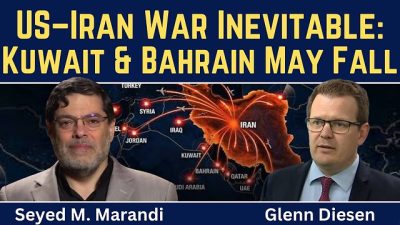
Seyed M. Marandi: US-Iran War Inevitable: Kuwait and Bahrain May Fall
or go to
Aletho News Archives – Video-Images
From the Archives
Oil and the Israel Lobby
Reknowned economist M. Shahid Alam offers this excellent critique of Noam Chomsky’s defective analysis of the relative influence of Oil versus the Israel lobby over US foreign policy: … continue
Blog Roll
 Aletho News
- ICC ignored ‘very well-documented’ NATO crimes – ex-Libyan minister
- SNSC secretary dismisses US response to Iran’s conditions as ‘inadequate’
- Sanaa says Taiz roads open, secure for residents, warns Saudi forces
- Iraqi resistance group urges Saudi leadership to admit defeat, lift Yemen siege
- Trump’s Retreat: How Al-Aqsa Flood Took Down the US Empire
- Israel’s Military Actions in Lebanon Grossly Violate International Law — Lavrov
- Seyed M. Marandi: US-Iran War Inevitable: Kuwait and Bahrain May Fall
- Leaders Condemn Ansarallah Attack on Saudi Arabia While Ignoring Illegal War Against Yemen
- Leaked: Britain’s Covert Iraqi Psyops Network
- Yemeni Armed Forces Warn Airlines Against Using Saudi Airports, Exempt Mecca and Medina
- If Americans Knew
- How Israel Conquered the Latin American Right
- Agents search Rep. Omar’s Washington home in criminal probe as she vows she won’t ‘be silenced’
- “The Rule Was: ‘Shoot Everyone You See'”
- Israel goes ballistic over Nobel Laureate Navi Pillay
- U.S. May Join Yet Another Middle Eastern War — TCN
- Yellow Line moves again as Israel closes in on trapped Gazans – Daily Update
- Israeli Attacks Kill Seven Palestinians in Gaza Including Six-year-old Girl
- Gaza: Ceasefire Anniversary Marks Year of Failed Promises
- The American Conservative: Mike Huckabee Should Resign
- A C-Section in Shackles: A Palestinian Woman’s Harrowing Birth in Israeli Detention
- No Tricks Zone
- Germany’s Green Energy Debacle: High Energy Costs Force Kahla Porzellan to Close After 182 Years!
- New Study: 50 Years Of The Most Aggressive ‘Net Zero’ Policies Can Only Affect The Global Climate By 0.03°C
- US September “Heat” Was No Record…Many Records Set Decades Ago
- Latest European Green Energy Debacle; Portugal’s Largest Flagship Solar Park Insolvent!
- Green Energy Debacle: German Expert Professor Fritz Vahrenholt Warns Of Severe Economic And Social Consequences
- Two More Paleo Reconstructions Affirm Meters-Higher Sea Levels Across Ireland, Brazil 7000-6000 Years Ago
- New Study: Earth And Venus Surface Warmth Largely Explained By Convection And Lapse Rate, Not CO2 Or Radiation
- 2025 Nature Paper Claiming Worsening Global Drought Gets RETRACTED …Heavily Flawed
- New Study: ‘Global Drought Shows No Detectable Recent Acceleration Under Climate Warming’
- Economic Masterminds: German Socialists Suggest Taxing Productivity Gains Stemming From Using AI

