The Biden Administration’s Ukraine strategy is increasingly disconnected from political and military realities on the ground, Judge Andrew Napolitano told Sputnik’s New Rules podcast.
“Joe Biden cannot articulate what the goal of the American military involvement [in Ukraine] is,” Judge Andrew Napolitano, former New Jersey superior court judge and host of the Judging Freedom podcast, told Sputnik. “The neocons around him just love the concept of war, particularly war against Russia, particularly against Russia while Vladimir Putin is in office.”
Delusional Neocons Set Biden’s Ukraine Agenda
The US has been involved in the Ukraine conflict for 17 months and has already transferred over $68 billion. Nevertheless, Kiev cannot boast any considerable progress on the ground with their much-discussed counteroffensive having eventually stalled. As the conflict is continuing to drag on, Biden administration officials and the US president are still asserting to Kiev that Washington will support it “as long as it takes.”
“If you ask him, as long as it takes to do what he can’t answer the ‘To do what?’ As long as it takes to produce a stalemate? As long as it takes to produce a cease fire? As long as it takes, if you ask Victoria Nuland, to drive President Putin from office? I mean, they can’t answer that question,” Napolitano noted.
Can Trump Strike Ukraine Peace Deal?
The Ukraine conflict has been presented in the Western mainstream press as a way to bleed Russia dry and drain President Vladimir Putin’s “political standing with the Russian people,” the judge opined.
In February 2023, President Biden made a claim in front of a Polish crowd that suggested he wanted to see the Russian president deposed: “For God’s sake, this man cannot remain in power,” Biden stated. The White House later downplayed this rally cry as a gaffe.
Still, what Team Biden and their neocon allies “don’t understand is that President Putin is enormously popular, that he’s fighting a patriotic war for a return of land, for which there is a valid legal argument, it has always been a part of Russia, culturally a part of Russia, linguistically a part of Russia,” according to Napolitano.
“They think they can use Ukraine as a battering ram to drive President Putin from office. They’re crazy. It’s not going to work. Joe Biden does not have an off ramp. He doesn’t have the ability to say, okay, we’ve we’ve succeeded. It’s time for us to stop. There’s no goal and there’s no off ramp. His internal goal is to run for reelection as a wartime president like his hero, Franklin Delano Roosevelt did in 1940. But this is not a war like World War Two. This is not a war that the American public perceives as a threat to American national security. All the politicians will argue that. But they’re so tied up with the military industrial complex that, you know, you have a majority in the Congress, Republicans and Democrats, that like all wars because it enriches the military industrial complex and keeps people working in the factories.”
What’s more, there is no American national security interest at stake in Ukraine, despite US neocons arguing to the contrary, according to the judge.
US war hawks are continuing to claim that Washington’s military aid to Kiev is a great investment since Russia is being bashed without American lives being lost. “The Russians are dying. The best money we’ve ever spent,” as US Senator Lindsey Graham said back in May. As long as no American body bags are coming home, the public is buying into this argument.
Still, it’s no longer a secret that a limited contingent of US servicemen has been operating on the ground in Ukraine. “We know the US military is there in Ukraine out of uniform. We know it is there in Poland, operating equipment that is shooting projectiles at Russian boys,” noted the judge. US mercenaries have also joined Ukrainian battalions on the battlefield.
And these Americans are dying in Ukraine: a sad statistic has already found its way out, indicating that dozens if not hundreds of US citizens have been killed in the conflict zone since February 2022.
Dissent is Brewing Within the US Military and Intel Community
Meanwhile, the US president and his administration are continuing to assert to the American public that Russia is losing and that Ukraine is going to prevail.
US Secretary of State Antony Blinken recently insisted that Russia had “already lost” while speaking to an American broadcaster. However, this triumphalist stance is not unanimously shared by US Department of Defense officials and the US intelligence community. The so-called Pentagon leak – that caught the headlines in April – shed some light on what the US military and spies really think about the situation on the ground in Ukraine.
“There is a 21 year old young Massachusetts National Guardsman sitting in a federal jail cell as we speak, named Jack Teixeira, who is accused of leaking secret documents – to which he had access by virtue of his work in the National Guard – to a chat room,” said Napolitano.
“The documents, the authenticity and accuracy of which have never been challenged by the government, reveal the government’s own internal deliberations as showing it expects Ukraine to lose. To lose. So if the Department of Defense expects Ukraine to lose and the Secretary of Defense goes before a Senate committee and says under oath ‘Ukraine is going to win’, who are you going to believe? You’re going to believe their candid, unvarnished statements recorded in documents that they believed would forever remain secret.”
Prior to the scandalous leak, American army and intelligence veterans voiced their skepticism with regard to Biden’s Ukraine strategy in their podcasts or interviews with alternative media.
“On my podcast, Judging Freedom, where we have a number of ex-CIA and ex-military harshly critical of the current CIA and the current US government, who are, I believe, giving a far more accurate version of what’s happening there,” Napolitano pointed out, referring to former US Marine Corps intelligence officer Scott Ritter, retired US Army colonel and government official Douglas Macgregor, former CIA analyst Larry Johnson and ex-CIA officer Ray McGovern. All of them have stated loud and clear that “it is inconceivable that the Ukraine military can prevail,” the judge underscored.
On top of that, it has been almost impossible for the US and NATO military officials to ignore massive casualties sustained by the Ukrainian Armed Forces in terms of military equipment and manpower since the beginning of their counteroffensive.
As of mid-July, Ukraine had lost 26,000 servicemen, 21 aircraft, five helicopters, some 1,244 tanks and armored vehicles, including 17 Leopard tanks, five French AMX wheeled tanks, 914 units of special vehicles, two air defense systems, and 25 MLRS vehicles, according to the Russian Ministry of Defense.
Thus, unsurprisingly, Western leaders in private conversations cast doubt on Kiev’s odds of winning at the recent Aspen Security Forum despite publicly trying to put a positive spin on Ukraine’s military efforts.
Why is the US Public Buying Into Biden’s Ukraine Narrative?
Meanwhile, the Western mainstream press has been busy spreading the one-sided Biden administration’s Ukraine narrative since the outset of the conflict. Judging from polls, most of the public in the West appear to have swallowed the bait.
“The American public still seems to be in favor of the war. Again, they only hear one side,” highlighted the judge.
“While the Biden administration, through the American Central Intelligence Agency and British MI6, has succeeded in taming the press,” continued Napolitano. “So the press and the American media, even my friends and former colleagues at Fox, are giving a version of these events which is not based in reality on the ground. The version of events that Americans are getting is that the so-called spring offensive, even though we’re now in the middle of the summer, is slow, methodical, but but a steady movement eastward by the Ukrainian forces, Whereas in reality, as you just pointed out, the Russian military has established three runs of defenses and the Ukrainians haven’t even approached, much less breached the first of those three rings. So the American public is not getting a true and accurate view of the so-called spring effect offensive from mainstream media.”
What’s making the West’s Ukraine narrative even less credible is that there are very few American journalists on the ground, according to the judge.
“The military won’t allow them there, Napolitano said. “The Ukrainians won’t allow them there. They don’t want the true story to be told. So the American public hears that same drumbeat over and over and over again, which you so nicely articulated. But in reality, it is not our war, it is not our fight. We shouldn’t be losing any blood and we shouldn’t be losing any money over it. And we are losing.”
In addition, most US presidential candidates from both sides of America’s political aisle are also promoting the US proxy war in Ukraine. Just two major candidates – Donald Trump and Robert F. Kennedy Jr. – are against the conflict. “Everybody else is lockstep in favor of it for a variety of what I think are nonsensical reasons,” Sputnik’s interlocutor added.
However, over the past two weeks or so, a growing number of mainstream media outlets have started to release unflattering reports about the Ukraine situation on the front lines. They are even publishing interviews with Ukrainian soldiers where they talk about how this counteroffensive is not exactly going to plan. This could be a harbinger of some potential change, according to the judge, even though Team Biden is still wearing a brave face.
“It’s very telling that that is beginning to happen. So that would mean the president’s political advisers are taking polls saying the American public’s getting tired of this war. There doesn’t seem to be any progress. We need an off ramp. The off ramp is not going to come all at once. The off ramp is going to come gradually and slowly with the American public acclimated to the coming off ramp. If the Biden administration were to say, that’s it, we’re not involved anymore, well then everybody would say, what about the $68 billion already spent? Are we going to get that back. I mean, was it wasted? What was accomplished by it? So in order to prevent that kind of a blowback, they need this gradual acclimation to the likelihood of Russian success and Ukrainian defeat,” Napolitano concluded.
August 4, 2023
Posted by aletho |
Fake News, Mainstream Media, Warmongering | Russia, Ukraine, United States |
Leave a comment
Court documents stemming from Hunter Biden’s failed plea-bargain deal on federal criminal charges have revealed that US President Joe Biden’s son brought in income of more than $4.4 million, mostly from China and Ukraine, while paying no taxes in 2017 and 2018.
In 2017 alone, Hunter Biden netted nearly $2.3 million from foreign sources, including over $1.6 million from his Chinese business interests and $500,000 in director’s fees from a Ukrainian energy company, according to a filing released on Wednesday by US District Court Judge Maryellen Noreika in Wilmington, Delaware. He also had $70,000 in earnings from a Romanian business and $48,000 from a multinational law firm.
The president’s son belatedly reported an additional $2.1 million in earnings from 2018. He didn’t pay taxes for either year, despite having enough money and being repeatedly urged by his accountant to do so, according to the documents, which Noreika released in response to a request from NBC News.
Biden became addicted to crack cocaine in 2016, contributing to the collapse of his marriage and his most significant business relationship the following year. Despite his escalating drug use, “Biden successfully entered into business ventures and landed legal clients, earning millions of dollars.”
Republican lawmakers have accused the Biden family of soliciting bribes through Hunter Biden’s overseas business forays, including a stint serving as a director for Ukrainian energy firm Burisma Holdings. Burisma founder Mykola Zlochevsky reportedly urged Hunter Biden, whose father was then the US vice president, to help end a corruption investigation against the company in 2015.
Zlochevsky later told an FBI informant that he was coerced into paying a $10 million bribe to the Bidens and that he had multiple recordings to verify his claims.
Hunter Biden’s substance abuse worsened in 2018, when he moved to Los Angeles for a “spring and summer of nonstop debauchery,” according to the plea agreement. Weeks before his 2017 tax return was due to be filed, he received a $1 million payment for legal services to Chinese business associate Patrick Ho, but he spent almost all of the money over the next six months on travel, entertainment and other expenses. Similarly, around the time his 2018 return was due, in April 2019, he received $758,000 and spent almost all the money by the end of May.
The documents showed that an unidentified third party paid Biden’s nearly $2 million in combined tax liabilities for 2017 and 2018 in October 2021. That same person also paid about $243,000 on Biden’s behalf for unresolved tax liabilities from 2016 and 2019. Media outlets have identified that backer as Kevin Morris, Hunter Biden’s “sugar brother” lawyer in Los Angeles.
Noreika refused to accept the plea agreement last week, saying she had concerns about the terms granted to Biden. Republicans had accused prosecutors in the Biden administration’s Department of Justice (DOJ) of giving the president’s son a “sweetheart” deal on the tax charges against him and a separate case involving an illegal gun purchase. Republican lawmakers launched an investigation this week of the DOJ’s handling of the plea and diversion agreements in Hunter Biden’s cases.
August 4, 2023
Posted by aletho |
Corruption, Deception | Hunter Biden, Ukraine, United States |
Leave a comment
Everyone seems to know someone taking Ozempic these days. But, it’s not all roses for the wonder weight loss drug, with serious side effects including suicidal ideations and stomach paralysis. Jefferey Jaxen reports.
A Louisiana woman who sued the manufacturers of popular diabetes and weight loss drugs Ozempic and Mounjaro is alleging the drugmakers failed to warn the public about the risk of severe gastrointestinal problems.
Jaclyn Bjorklund, 44, who on Wednesday filed the 26-page lawsuit in U.S. District Court for the Western District of Louisiana Lake Charles Division, claims she was “severely injured” after taking the two medications.
According to the complaint, Novo Nordisk and Eli Lilly, the manufacturers of Ozempic and Mounjaro, respectively, “downplayed the severity of the gastrointestinal events,” such as gastroparesis and gastroenteritis, caused by the drugs.
Gastroparesis, a disorder that “slows or stops the movement of food from your stomach to your small intestine, even though there is no blockage in the stomach or intestines” is frequently caused by diabetes. Narcotics and antidepressants also are linked to gastroparesis.
Ozempic (semaglutide) and Mounjaro (tirzepatide) are injectable diabetes medications, approved by the U.S. Food and Drug Administration (FDA), CBS News reported. Mounjaro was approved in May 2022. Ozempic was first approved in December 2017, and approved at a higher dose in March 2022.
According to NBC News, Bjorklund is the first person to come forward alleging that the drugs in question cause gastrointestinal injuries.
The two drugs are part of a new category of medicines known as glucagon-like peptide-1, or GLP-1, receptor agonists. They are intended to help people with Type 2 diabetes manage their blood sugar levels. However, the medications are also commonly prescribed off-label for weight loss.
According to CBS News, “These drugs were originally developed to treat patients with Type 2 diabetes as they produce insulin and lower blood sugar. They also release a hormone that slows down digestion and keeps food in a patient’s stomach longer.”
However, their long-term impact is unknown.
According to CNN, “The lawsuit is seeking compensatory and punitive damages for past and future pain and suffering Bjorklund will have including health care costs and medical monitoring as well as her attorney’s fees and court costs.”
Attorneys Paul Pennock and Jonathan Sedgh, of Orlando-based Morgan & Morgan, said during a press conference, that the basis of the lawsuit is “a failure to warn,” CBS News reported. Pennock told the press:
“It is our opinion that these drugs are causing these problems. We think that the evidence is sufficient for us to be able to prove it or we would not have filed the case, and we intend to file many more in the coming days and weeks.
“[Bjorklund’s] problems have been so severe that she’s been to the emergency room multiple times, including last weekend. She’s actually even thrown up so violently that she’s lost teeth.”
This is the first lawsuit alleging the two drugs caused gastrointestinal injuries, however, lawyers representing Bjorklund said hundreds more similar lawsuits are ready to be filed by victims across the U.S.
Ozempic recently was linked to a range of other health issues, including kidney disorders and causing suicidal thoughts.
Plaintiff suffered from ‘severe gastrointestinal events’
The lawsuit states that Bjorklund, who was diagnosed with Type 2 diabetes in 2017, was prescribed Ozempic and took the drug for more than a year before switching to Mounjaro.
During this period, she experienced “severe gastrointestinal events,” including severe vomiting — which also led to the loss of teeth, gastrointestinal burning and stomach pain. As a result, the complaint states, Bjorklund “sustained severe and permanent personal injuries, pain, suffering, and emotional distress, and incurred medical expenses.”
The lawsuit also alleges the two companies “knew of the association between the use of GLP-1 receptor agonists and the risk of developing severe gastrointestinal issues, including gastroparesis and gastroenteritis.”
The companies’ “failure to disclose information that they possessed regarding the association between the use of GLP-1 receptor agonists and the risk of developing severe gastrointestinal issues, including gastroparesis and gastroenteritis, rendered the warnings for this medication inadequate,” the lawsuit adds.
According to The Hill, “While the labels for both medications note that they delay gastric emptying and can cause a variety of stomach problems — including nausea, vomiting, diarrhea, abdominal pain and constipation — they do not explicitly warn of gastroparesis as a risk.”
CNN reported that “Ozempic’s prescribing information says the most common adverse events related to the drug are nausea, vomiting, diarrhea, abdominal pain and constipation. Under a section on drug interactions, it says that Ozempic delays gastric emptying, which may impact absorption of oral medications.”
Similarly, “Mounjaro’s prescribing information also says nausea, diarrhea, decreased appetite, vomiting, constipation, dyspepsia, and abdominal pain are the most common adverse events, and that Mounjaro delays gastric emptying, which may impact medication absorption.”
However, due to the lack of an explicit warning regarding gastroparesis, the lawsuit alleges that Bjorklund “was and still is caused to suffer from severe gastrointestinal issues, as well as other severe and personal injuries which are permanent and lasting in nature, physical pain, and mental anguish.”
In statements, both companies defended their products. Novo Nordisk claimed that gastrointestinal events are “well-known side effects of the GLP-1 class,” according to CBS News. The company added:
“For semaglutide, the majority of GI side effects are mild to moderate in severity and of short duration. GLP-1’s are known to cause a delay in gastric emptying, as noted in the label of each of our GLP-1 RA medications. Symptoms of delayed gastric emptying, nausea and vomiting are listed as side effects.”
And, as reported by The Hill :
“Patient safety is of utmost importance to Novo Nordisk. … We are continuously monitoring the safety profile of our products and collaborate closely with authorities to ensure patient safety, including adequate information on gastrointestinal side effects in the label.”
Eli Lilly said patient safety is its “top priority,” according to CBS News, and the company is “actively engage[d] in monitoring, evaluating and reporting safety information for all our medicines.”
NBC News cited FDA spokesperson Chanapa Tantibanchachai, who said it’s “unclear” whether GLP-1 medications are connected to occurrences of gastroparesis.
A separate FDA statement cited by CNN states the agency has “received reports of gastroparesis with semaglutide and liraglutide, some of which documented the adverse event as not recovered after discontinuation of the respective product at the time of the report.”
‘This medicine made my life hell’
However, lawyers for Bjorklund say that many more patients are ready to come forward with lawsuits of their own.
According to CBS News, Pennock’s firm “is investigating 400 other inquiries from clients across 45 states,” while according to The Hill, Pennock ultimately expects to see “thousands of such cases.”
Several patients also spoke to media outlets regarding their injuries.
Brea Hand told CBS News, “The stomach pain was just unbearable and I couldn’t keep anything down. I would drink something and within minutes, like five, 10 minutes later, I would be throwing up.”
Hand visited the hospital six times while taking Ozempic and was admitted to an intensive care unit. She is not involved in the lawsuit.
A July 25, CNN featured the stories of other patients, including Louisiana resident Joanie Knight, 37, who said “I wish I never touched it. I wish I’d never heard of it in my life,” referring to Ozempic. “This medicine made my life hell. So much hell.”
And Emily Wright, a 38-year-old teacher from Toronto, began taking Ozempic in 2018. Today though, despite not having taken the medication “for a year,” she said, “I’m still not back to my normal.” She told CNN she is now vomiting so frequently that she was obliged to take a leave of absence from her job.
In recent months, several reports have indicated that Ozempic in particular is linked to a range of other health problems.
Last month, health regulators in Iceland, followed by the European Medicines Agency, began investigating reports that Ozempic and other popular weight-loss drugs are linked to the inducement of suicidal thoughts.
In June, a report by Dr. Joseph Mercola referenced studies based on data from Eudravigilance, Europe’s system for analyzing adverse reactions to medications. The data showed a link between Ozempic and a high prevalence of gastrointestinal disorders. This confirmed findings from a separate study conducted in 2018.
Ozempic also was linked to an increased risk of adverse kidney events, diabetic retinopathy, and metabolic, nutritional, eye, retinal, urinary and cardiac disorders.
And in April, the FDA warned that Ozempic should be discontinued at least two months prior to pregnancy because it takes that long for the body to eliminate the drug.
However, those warnings are buried, and long-term testing won’t be completed for years. The drug was not studied in pregnant women during clinical trials.
Michael Nevradakis, Ph.D., based in Athens, Greece, is a senior reporter for The Defender and part of the rotation of hosts for CHD.TV’s “Good Morning CHD.”
This article was originally published by The Defender — Children’s Health Defense’s News & Views Website under Creative Commons license CC BY-NC-ND 4.0. Please consider subscribing to The Defender or donating to Children’s Health Defense.
August 4, 2023
Posted by aletho |
Deception | FDA, United States |
Leave a comment
Before there was the narrative pushed by the mainstream media that the 2016 US presidential election was rigged – there were the Democratic primaries, regarding which the evidence of actual rigging taking place has been much more solid.
The victim was hapless presidential hopeful Bernie Sanders – but now, this once great hope of left-wing citizens seems to be turning increasingly authoritarian, at least in his rhetoric.
He is, essentially, providing a solution to a problem that shouldn’t exist (not in a democracy) – namely, what to do, legally, to stop political opponents?
In this case, it’s about corporate skeptics around the “climate change panic.” And Sanders has the answer – prosecute them, and if found guilty, put them in prison.
Sounds fairly extreme, but here we are.
In a letter co-signed by Senator Sanders, a group of his Democrat colleagues is asking the US Department of Justice (DoJ) to do just such a thing, aimed at what’s termed the fossil fuel industry.
We obtained a copy of the letter for you here.
And although it seems careful to point the finger and demand retribution from companies that are accused of, basically, organizing campaigns to improve their business (shocking (NOT) – and, that business anyway is far from being illegal) – once a precedent of legally hounding dissenters is set, it can go anywhere.
ExxonMobile, Shell, and other giants are mentioned, perhaps as a way to soften the blow of that reality, but if what the senators are asking is to become reality, next up could be journalists, and then social media users, and just in general, it’s turtles all the way down.
Sanders and his companions would not want any of their actions to be seen that way, naturally. So they assert that, “the fossil fuel industry has had scientific evidence about the dangers of climate change and the role that burning fossil fuels play in increasing global temperatures for more than 50 years.”
The letter continues: “To coordinate their illegal misinformation campaign, the fossil fuel industry funded a multimillion-dollar plan through the American Petroleum Institute that sought to make climate change a ‘non-issue.’”
But the exact same argument could be used (in court) against any “regular Joe” not into the whole climate change – in court, down the line, should such extreme red lines as requested by the letter get established.
Of course, there’s no way to say that will happen – but also, that it won’t.
Kind of the same argument that climate change skeptics are trying to make about the climate change policy push.
August 3, 2023
Posted by aletho |
Civil Liberties, Full Spectrum Dominance, Malthusian Ideology, Phony Scarcity, Progressive Hypocrite | United States |
Leave a comment
Are vaccines required for your child to attend school?

Photo by Daiga Ellaby on Unsplash
With summer winding down and schools about to open, parents around the country (USA) have received or will receive letters of exclusion from their child’s school. The letter will state that your child is required to be up to date on their childhood immunizations according to the CDC, or they will not be allowed to attend school.
You are not told that other than a handful of states that have eliminated both the religious and the philosophical exemptions, you are free to do whatever you believe is best for your child. You can do some, all, or none of the childhood vaccines. Each state may have a different form or process but rest assured; it is the law of your state that you have this right; the freedom to choose.
To learn more about the specifics for your state, NVIC (National Vaccine Information Center) https://www.nvic.org has all the information you need.
National Vaccine Information Center
If you live in California, New York, West Virginia, Maine, and possibly Mississippi, the only exemption allowed is a medical exemption. All states allow medical exemptions, which is where a doctor writes a medical exemption.
The challenge for doctors is that the states only allow medical exemptions according to the CDC guidelines, which means you can only get exemptions for a vaccine that has caused death or a severe anaphylactic reaction. They essentially don’t allow exemptions for all vaccines. More importantly, doctors who write medical exemptions invite an investigation by their state medical board and risk losing their medical license. This has made medical exemptions something, in theory, one could hope to get, but in reality, and practically speaking, medical exemptions no longer exist.
So, what do you do if you live in one of the states that only allow medical exemptions?
Basically, you either must get your child up to date, home school, or leave the state for one that allows religious or philosophical exemptions. If you feel you have no choice but to get your child up to date, I highly recommend that you consult a medical provider to help you figure out the safest way to do this.
I am available for coaching at https://www.kidsfirst4ever.com. I don’t diagnose or treat as I am retired and relinquished my license.
Parents and guardians, there is nothing more important in your role to nurture and protect your children than how you handle the vaccine situation. There is no one size fits all that makes sense. Each vaccine should be looked at individually, and you should determine if it makes sense for your child, given the prevalence of the disease for which there is a vaccine and the risks and benefits of giving the vaccine or not giving the vaccine.
August 3, 2023
Posted by aletho |
Civil Liberties | COVID-19 Vaccine, Human rights, United States |
Leave a comment
Ecological Analysis Suggests Worldwide Mass Vaccination for Childhood Illnesses Could be Backfiring
When ACIP panel added the experimental mRNA vaccines for infants age 6 months and older, it triggered concerns that ACIP may not have ever had adequate intent for risk mitigation or re-evaluation of the ever expanding vaccine schedule. Many have had reservations for a long time and have felt drowned out by the medical orthodoxy of “more vaccines are better.” Now an analysis by Miller, et al, suggests the entire program of hyper vaccination may be backfiring.
The two main independent variables in this analysis restricted to developed countries at two time points 2019 and 2021 (check for internal validity) were the number of vaccines given in the 28 day neonatal period (none, hepatitis B, Bacille Calmette-Guérin (BCG) for tuberculosis) and then the overall number of shots given before age 1 year. The outcome variable was all cause mortality at age 1 and 5 years.
As you can see this does not look good for vaccines. In every analysis the children who went “natural” with no shots did the best and there was a trend for the fewest number of injections to be associated with the lowest mortality. I was born in 1962, so I received zero shots in the neonatal period and a total of 6 doses for four diseases (diphtheria, tetanus, pertussis, polio) before the age of 1 years. As you can see the optimal number of infant doses in the vaccine schedule is <14. The current US ACIP schedule is ~23 doses by year one—a proxy for national intent for hyper vaccination.
This paper has all the limitations of an ecological analysis where individual child record information is not available. The exact configuration of specific vaccines and causes of death are not specified. Thus we can only conclude from this study that “less is more” and countries should consider a risk stratified approach. The two main neonatal vaccines, hepatitis B and BCG should be reconsidered altogether according to individual risk of hepatitis B and tuberculosis, respectively.
August 3, 2023
Posted by aletho |
Science and Pseudo-Science, Timeless or most popular | COVID-19 Vaccine, United States |
Leave a comment
New internal documents reaveal
In a significant blow to the principle of free speech, recently disclosed documents reveal that President Joe Biden’s administration exerted considerable pressure on tech giant Facebook to constrain the reach of The Daily Wire and The New York Post, and promote content from established news outlets, within months of occupying the White House in January 2021. This revelation, coupled with the administration’s alleged intentions to alter the Facebook algorithm, has raised substantial concerns about government-sanctioned censorship.
These documents shed light on the Biden administration’s campaign to promote its Covid vaccine strategy, sidelining dissenting viewpoints.
The dialogues memorialized in the disclosed documents underline the charged interactions between then-White House Digital Director Rob Flaherty and Facebook representatives. The focus of these discussions was curbing The Daily Wire’s considerable influence on Facebook while simultaneously elevating legacy news outlets such as The New York Times and The Wall Street Journal.
For context, The Daily Wire’s popularity on Facebook had outstripped that of both NYT and WSJ, drawing significantly more audience engagement, and casting a more amplified conservative alternative.
The meeting notes underline the Biden administration’s apprehensions about “misinformation” leading to vaccine hesitancy, sparking a quest to mold public sentiment using Facebook’s vast reach.
White House representative Flaherty’s frustration with Facebook’s inability to readily produce data to support the administration’s agenda becomes evident in the correspondence.
Highlighting the confrontational tone of these correspondences, Representative Jim Jordan, chairing the Select Subcommittee on the Weaponization of the Federal Government, reinforced the troubling indication of the administration’s attempts to stifle free speech via social media control.
August 3, 2023
Posted by aletho |
Civil Liberties, Full Spectrum Dominance, Science and Pseudo-Science | Human rights, United States |
Leave a comment
Recalling William Appleman Williams final work
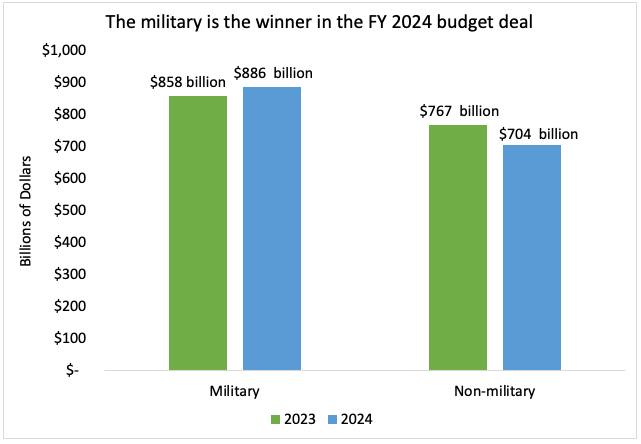
Once again, while other needs are squeezed, a federal budget deal will literally starve the poor to feed the military. While new work requirements are placed on SNAP recipients that will drive some from the food support program, the military budget (never call it defense) remains untouched. The recent debt ceiling deal leaves Joe Biden’s $886 billion 2024 Pentagon budget request intact while domestic programs are slashed. The above graph from the National Priorities Project tells the story.
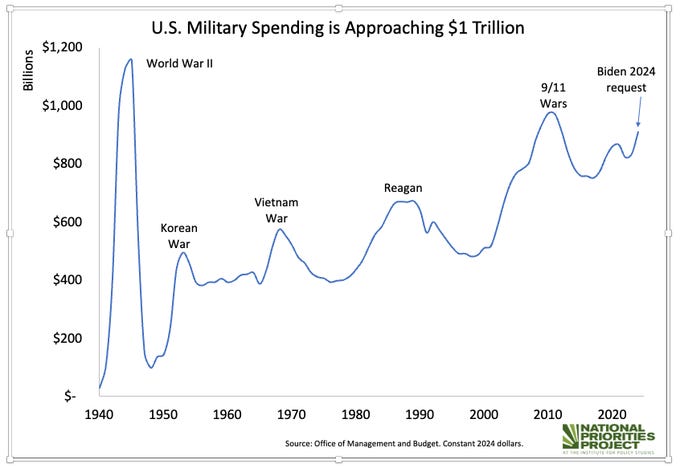
In real terms it is the largest military budget in U.S. history, the only exceptions being World War II and the height of the Iraq and Afghanistan wars that came after 9-11. Larger by far than during the Korean and Vietnam Wars, or the Reagan military buildup. Again, from the National Priorities Project:
The real military budget is even higher. Adding in nuclear weapons, foreign military aid and “intelligence,” the project puts the current 2023 budget at $920 billion. That is still an undercount. William Hartung, an expert on military spending, calculates that even in fiscal year 2020 the total military expenditure was $1.25 trillion, adding in other costs such as support for veterans and debt service. It’s easily pushing $1.5 trillion by now.
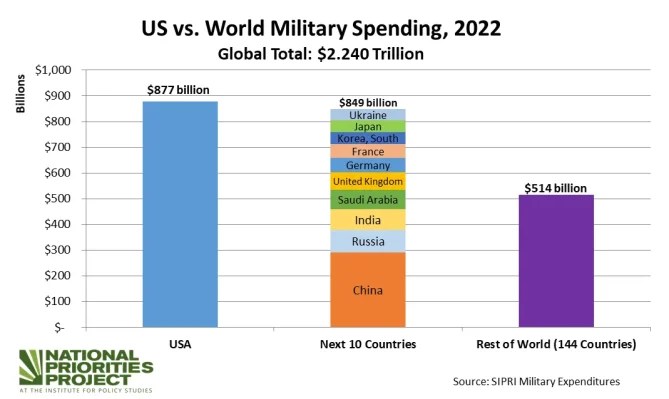
The U.S. by far is the biggest military spender on Earth, with 39% of the total, exceeding the next 10 nations combined, as this chart shows:
Most warlike nation
So why is the military budget so unassailable? Why, no matter how often bloated military spending is denounced, does the budget climb toward ever greater heights? Even after Dwight Eisenhower made the famous warning in his farewell address:
“In the councils of government, we must guard against the acquisition of unwarranted influence, whether sought or unsought, by the military-industrial complex. The potential for the disastrous rise of misplaced power exists and will persist. We must never let the weight of this combination endanger our liberties or democratic processes. We should take nothing for granted. Only an alert and knowledgeable citizenry can compel the proper meshing of the huge industrial and military machinery of defense with our peaceful methods and goals, so that security and liberty may prosper together.”
Ike would have known, being one of the progenitors of that complex as the general leading U.S. forces that invaded Europe during D-Day and as the president during the nuclear buildup of much of the early Cold War. One clue as to why his warning went unheeded is in the fact he originally wanted to call it the military-industrial-congressional complex, the “iron triangle” that keeps pumping up military expenditures. As Hartung writes, Congress is bought by the weapons industry. It is a kind of money laundering scheme where increased military spending comes back as campaign donations, a perfect example of the legalized bribery that is the real governing system of the U.S.
But there are deeper reasons, explaining why that “alert and knowledgeable citizenry” for which Ike called has never appeared, at least to the level able to tie back the power of the complex. War and militarism are rooted deep in the U.S. of American experience. As former President Jimmy Carter said, “If you go around the world and ask people which is the most warlike country on Earth, which one do you think they would respond? The United States. Since we left the Second World War, and even before, the United States has constantly been at war in some part of the world. We’ve been in about 30 combats with other countries since the Second World War . . . So I would say that the military-industrial complex, the manufacturers of all kinds of weapons, are very influential in the country and the Congress as well.”
Carter noted that the U.S. hasn’t been at war with someone only 16 years of its 242-year history. (Even that is doubtful since even during Carter’s so-called peaceful years the U.S. was stirring up trouble in Afghanistan in a successful effort to give the Soviets “their own Vietnam,” as his National Security Adviser, Zbignew Brzezinski, has confessed.) The list is extensive. If the U.S. was not fighting with some European or Asian power, it was warring on some native nation or another on the frontier. War has worked for the United States, historian Geoffrey Perrett noted in his 1989 history of major U.S. conflicts, Country Made by War.
“Since 1775 no nation on Earth has had as much experience of war as the United States: nine major wars in nine generations. And in between the wars have come other armed conflicts such as the Philippine insurgency and clashes in the Persian Gulf. America’s wars have been like the rungs on a ladder by which it rose to greatness. No other nation has triumphed so long, so consistently, or on such as vast scale, through force of arms.”
Although conflicts since World War II have not been so successful, nonetheless they failed to dislodge the fundamental U.S triumph in that war, which left it overwhelmingly dominant over all other powers, each of which had been ravaged in the war. As historian Alfred McCoy noted in his recent work, To Govern the Globe, it left the U.S. in the unprecedented position of holding sway on both European and Asian ends of Eurasia. If this hegemony is eroding with the rise of China and other powers, the U.S. still remains in a powerful position.
To all this one must ask the more fundamental question. Why has the U.S. been the most warlike, most continually at war? For the answer we can look to historian William Appleman Williams and the title of his final book which summarized his substantial life work, published in 1980, Empire as a Way of Life. Williams was the dean of what came to be known as the revisionist school of U.S. history that penetrated the myth of American exceptionalism with the facts of history, that the U.S. was an empire from its colonial roots, and behaved much as any other empire.
First let Williams define his terms. “. . . a way of life is the combination of patterns of thought and action that, as it becomes habitual and institutionalized, defines the thrust and character of a culture and society.” Then, empire, a system in which, “The will, and power, of one element asserts its superiority.” In some cases empire “concerns the forcible subjugation of formerly independent people by a wholly external power.” Such as native peoples or those who lived in the former northern half of Mexico.
Williams does not let the mass of U.S. of Americans off. We are enmeshed in the ways of empire.
“Empire became so intrinsically our American way of life that we rationalized and suppressed the nature of our means in the euphoria of the enjoyment of the ends . . . It is perhaps a bit too extreme, but only by a whisker, to say that imperialism has been the opiate of the American people.”
The U.S. was “born and bred” of another empire, the British. “The 19th– and 20th-century empire known as the United States of America began as a gleam in the eyes of various 16th century critics of, and advisers to, Elizabeth I,” Williams explains. At that time, “England was then a backward and underdeveloped small island” outclassed by other powers emerging in the Atlantic fringe, Portugal, Spain, France and The Netherlands, who were already commencing the age of European world conquest.
England concluded that “domestic welfare and social peace required vigorous imperial expansion,” and began first by consolidating the internal empire on the British Isles in Scotland and Ireland, and then in the 1600s expanding to the North American coast. “. . . the most significant aspect of the empire was the success in transforming the American colonies from tiny, insecure outposts into dynamic societies generating their own progress . . . It produced another culture based on the proposition that expansion was the key to freedom, prosperity, and social peace.”
Inevitably, tensions rose between the ruling class of the home isles and the rising elites of the colonies. Benjamin Franklin believed the weight of development would eventually move the center of the British Empire to North America (which it finally did in 1945, but that comes later in the story), and until nearly the time of the split recommended that course. “But the British feared that such a policy would lead to the loss of control and profits, and Americans increasingly asserted their own claims to their own empire,” Williams writes.
That culminated in the Revolutionary War and the successful creation of the United States. But a weak central government seemed unable to fully press forward what George Washington would call “a rising empire” – the founders were not shy about using that kind of language. It appeared the union would fray into two or more nations, while uprisings such as Shay’s Rebellion threatened to shatter social peace. So the new national elites came together to create a framework to ensure continued expansion under a strong central government, the Constitution. Writes Williams, “. . . the Constitution was an instrument of imperial government at home and abroad.”
The Constitution was founded on a clever turnaround of a fundamental political understanding architected by one of its key authors, James Madison. The general belief to that point had been exposited by French political philosopher Montesquieu “that liberty could only exist in a small state. Madison boldly argued the opposite: that empire was essential for freedom.” Madison needed to make that argument because many citizens of the new nation, burned by their experience with Britain, wanted nothing to do with a strong central government.
Madison made his case in a letter to Thomas Jefferson. “This form of government, in order to effect its purpose, must operate not within a small but extensive sphere . . . Extend the sphere, and you take in a greater variety of parties and interests; you make it less probable that a majority of the whole will have a common motive to invade the rights of other citizens; or if such a common motive exists, it will be more difficult for all to feel it . . . to act in unison with each other.”
Williams writes, “He was arguing that surplus social space and surplus resources were necessary to maintain economic welfare, social stability, freedom and representative government.” A strong central government would be needed to expand land for agriculture, to expand and protect exports, and to promote manufacturing.
With the Louisiana Purchase and the Lewis & Clark Expedition to the Pacific, Jefferson fully embraced Madison’s understanding. “I am persuaded that no constitution was ever before as well calculated as ours for extensive empire and self-government,” he said as he left the presidency. “Jeffersonian Democracy, as it came to be called, was a creature of imperial expansion,” Williams writes. “He, perhaps even more than Madison, established it as a way of life, and most Americans embraced it because it gave them personal and social rewards.”
So much for the “alert and knowledgeable citizenry.”
“. . . once people begin to acquire and enjoy and take for granted and waste surplus resources and space as a routine part of their lives,” Williams writes, “and to view them as a sign of God’s favor, then it requires a genius to make a career – let alone a culture – on the basis of agreeing upon limits. Especially when several continents lie largely naked off your shores.”
The myth of empty continents and the racism it embodies has always been part of the story. “Racism . . . began and survived as a psychologically justifying and economically profitable fairy tale. It provided the gloss for the harsh truth that empire . . . is the child of an inability or unwillingness to live within one’s own means. Empire as a way of life is predicated upon having more than one needs.”
Next: Coming installments will review how imperial expansionism is rooted in a misguided sense of mission and compulsive drive for security, and how empire as a way of life continued to unfold after the era of the founders.
August 3, 2023
Posted by aletho |
Book Review, Militarism, Timeless or most popular | UK, United States |
Leave a comment
WASHINGTON – Russia in February suspended participation in New START, the only bilateral nuclear arms control treaty in place at the time, and conditioned its resumption of participation on an understanding of how NATO’s combined strike capability would be accounted for.
The United States has long been violating the New START Treaty, Russian Ambassador to Washington Anatoly Antonov said.
“Washington has long been violating the letter and the spirit of the agreement. It has not only abandoned the principles embedded in the Preamble to New START, but also breached the central limits of the Treaty that restrict the number of strategic weapons. It illegitimately removed from accountability under the Treaty about a hundred strategic offensive arms: SLBM launchers and heavy bombers. Russia’s repeated demands to resolve the problem have been ignored,” Antonov told reporters.
He said there was another factor that has led to the current crisis.
“Even more important factor that has led to the current crisis over the agreement is the [US] Administration’s hybrid war against our country aimed at imposing on us a strategic defeat. Washington’s calls for addressing the New START issues separately from the overall geopolitical situation do not stand up to criticism,” Antonov said.
“The real goal of the United States is to gain access to Russia’s nuclear weapons bases in order to obtain information about the development of our strategic arsenal,” he said.
In February, Moscow announced the suspension of its participation in the New Strategic Arms Reduction Treaty (New START), which was signed by Russia and the US in 2010 and envisaged mutual inspections of the strategic nuclear facilities of the two countries.
Russian President Vladimir Putin said in his annual address to the Russian parliament then that the US had demanded that Russia unconditionally fulfill its obligations under the treaty while itself being arbitrary about its own obligations.
August 3, 2023
Posted by aletho |
Deception, Militarism | NATO, New START Treaty, Russia, United States |
Leave a comment
A Pfizer ad on Twitter claims that 3 out of 4 US adults are at “high risk” for severe Covid-19.
This ad is highly misleading or, arguably, outright false.
Problem 1: What is “high” risk?
We don’t know because Pfizer doesn’t define it.
The graphic in the ad cites a study as the source of its claim “3 out of 4 US adults are at high risk for severe Covid-19.” Except the study never uses the term “high risk.” Rather, the study is on people at “increased risk.”
“Increased risk,” of course is quite different from “high risk.” Obviously, high risk is worse than merely increased risk. I need not explain why Pfizer would choose language in its ad that exaggerates the risk of Covid.
Problem 2: The cited study itself doesn’t even define “increased risk.” Does that mean a 0.1% increase, a 1% increase, 20% increase, 1000% increase? On this point, the study includes the following caveat: “the effect size of each risk factor was not taken into account in our analysis, so this report does not address degree of risk. Effect estimates of severe COVID-19 risk factors are widely variable and ultimately unreliable.”
Digging a little deeper, the study links to a CDC webpage that gives a list of conditions for people who are “more likely to get very sick with COVID-19” and uses “higher risk,” “increased risk,” “greater risk” and “high risk” in its text, seemingly interchangeably. The page gives a long list of medical conditions—from cancer to diabetes to depression. Still, we don’t know what “more likely” or “increased risk” actually means. This webpage, in turn, links to another CDC webpage that describes “Underlying Medical Conditions Associated with Higher Risk for Severe COVID-19.”
We’ve gone from the scary “high” risk (not defined), to “increased” risk (also not defined), to “higher risk.” How is “higher risk” defined? Here is what the page says:
Higher risk is defined as an underlying medical condition or risk factor that has a published meta-analysis or systematic review or underwent the CDC systematic review process. The meta-analysis or systematic review demonstrates a conclusive increase in risk for at least one severe COVID-19 outcome.
So we are now three layers deep and we still don’t have a quantifiable definition for what, exactly, “high,” “increased,” or “higher” even means, nor a clear differentiation of what the first study acknowledges is a wide variability in estimates of risk factors. I’m sure there is a quantifiable threshold defined somewhere, but I stopped digging because this isn’t even the main problem.
Problem 3 (the main problem): The data from the cited study in the Pfizer ad saying 3 out of 4 US adults are at high (aka increased) risk of severe Covid are from 2015-2018. But this ad is being run in July 2023—after nearly the entire population has either already been infected, vaccinated, or both, each circumstance, we have been told, decreases one’s risk of severe Covid. In other words, Pfizer’s own ad suggests that prior infection and vaccination have not reduced the number of people at high risk of severe Covid. Does Pfizer want us to believe that its product—the vaccine—did not lower the rate of people at high risk of severe Covid?
The fact is, 3 out of 4 US adults are not at “high” risk of severe Covid. This statement is based on data from before accounting for the protective effect of infection and vaccination. Moreover, “high risk” is not defined and appears to simply be a made up description.
We’ve heard a lot about “misinformation” in the past few years. Generally, the government and media have pointed the finger at so-called “anti-vaxxers” and “conspiracy theorists.” A critical spotlight from the government has rarely seemed to shine on claims made by Pfizer. Advertisements like this misinform and unnecessarily scare people, perhaps pushing some of them into taking additional doses of the vaccine, or therapeutics like Paxlovid (also made by Pfizer), that have potential harms, and for many people, especially now, without clear benefit.
August 2, 2023
Posted by aletho |
Deception, Science and Pseudo-Science | Covid-19, COVID-19 Vaccine, Pfizer, United States |
Leave a comment
Wikipedia is one of many tools used by the US liberal establishment and its allies in the intelligence community to wage “information warfare,” the site’s co-founder, Larry Sanger, has told journalist Glenn Greenwald.
Speaking on Greenwald’s ‘System Update’ podcast, Sanger lamented how the site he helped found in 2001 has become an instrument of “control” in the hands of the left-liberal establishment, among which he counts the CIA, FBI, and other US intelligence agencies.
“We do have evidence that, as early as 2008, that CIA and FBI computers were used to edit Wikipedia,” he said. “Do you think that they stopped doing that back then?”
Activity by the CIA and FBI on Wikipedia was first made public by a programming student named Virgil Griffith in 2007. Griffith developed a program called WikiScanner that could trace the location of computers used to edit Wikipedia articles, and found that the CIA, FBI, and a host of large corporations and government agencies were scrubbing the online encyclopedia of incriminating information.
CIA computers were used to remove casualty counts from the Iraq War, while an FBI machine was used to remove aerial and satellite images of the US prison at Guantanamo Bay in Cuba. CIA computers were used to edit hundreds of articles, including entries on then Iranian President Mahmoud Ahmadinejad, China’s nuclear program, and the Argentine navy.
Some edits were more petty, with former CIA chief William Colby apparently editing his own entry to expand his list of accomplishments.
“[The intelligence agencies] pay off the most influential people to push their agendas, which they’re already mostly in line with, or they just develop their own talent within the [intelligence] community, learn the Wikipedia game, and then push what they want to say with their own people,” Sanger told Greenwald.
“A great part of intelligence and information warfare is conducted online,” he continued, “on websites like Wikipedia.”
Earlier this year, Twitter owner Elon Musk released a trove of documents showing how the platform’s former executives colluded with the FBI to remove content the agency wanted hidden, assisted the US military’s online influence campaigns, and censored “anti-Ukraine narratives” on behalf of multiple US intelligence agencies. Meta CEO Mark Zuckerberg has also admitted that Facebook censored information damaging to President Joe Biden’s 2020 election campaign at the direct request of the FBI.
August 2, 2023
Posted by aletho |
Civil Liberties, Deception, Full Spectrum Dominance | CIA, FBI, United States |
Leave a comment
Mythology about these mass civilian slaughters warps thinking about US militarism
The anniversaries of the atomic bombings of Hiroshima and Nagasaki present an opportunity to demolish a cornerstone myth of American history — that those twin acts of mass civilian slaughter were necessary to bring about Japan’s surrender, and spare a half-million US soldiers who’d have otherwise died in a military conquest of the empire’s home islands.
Those who attack this mythology are often reflexively dismissed as unpatriotic, ill-informed or both. However, the most compelling witnesses against the conventional wisdom were patriots with a unique grasp on the state of affairs in August 1945 — America’s senior military leaders of World War II.
Let’s first hear what they had to say, and then examine key facts that led them to their little-publicized convictions:
- General Dwight Eisenhower on learning of the planned bombings: “I had been conscious of a feeling of depression and voiced to [Secretary of War Stimson] my grave misgivings, first on the basis of my belief that Japan was already defeated and that dropping the bomb was completely unnecessary, and secondly because I thought that our country should avoid shocking world opinion by the use of a weapon whose employment was, I thought, no longer mandatory as a measure to save American lives. It was my belief that Japan was, at that very moment, seeking some way to surrender with a minimum loss of ‘face’.”
- Admiral William Leahy, Truman’s Chief of Staff: “The use of this barbarous weapon…was of no material assistance in our war against Japan. The Japanese were already defeated and ready to surrender because of the effective sea blockade and the successful bombing with conventional weapons.”
- Major General Curtis LeMay, 21st Bomber Command: “The war would have been over in two weeks without the Russians entering and without the atomic bomb… The atomic bomb had nothing to do with the end of the war at all.”
- General Hap Arnold, US Army Air Forces: “The Japanese position was hopeless even before the first atomic bomb fell, because the Japanese had lost control of their own air.” “It always appeared to us that, atomic bomb or no atomic bomb, the Japanese were already on the verge of collapse.”
- Ralph Bird, Under Secretary of the Navy: “The Japanese were ready for peace, and they already had approached the Russians and the Swiss… In my opinion, the Japanese war was really won before we ever used the atom bomb.”
- Brigadier General Carter Clarke, military intelligence officer who prepared summaries of intercepted cables for Truman: “When we didn’t need to do it, and we knew we didn’t need to do it…we used [Hiroshima and Nagasaki] as an experiment for two atomic bombs. Many other high-level military officers concurred.”
- Fleet Admiral Chester Nimitz, Pacific Fleet commander: “The use of atomic bombs at Hiroshima and Nagasaki was of no material assistance in our war against Japan. The Japanese were already defeated and ready to surrender.”
Putting out feelers through third-party diplomatic channels, the Japanese were seeking to end the war weeks before the atomic bombings on August 6 and 9, 1945. Japan’s navy and air forces were decimated, and its homeland subjected to a sea blockade and allied bombing carried out against little resistance.
Full of midget submarines, a drydock in the port city of Kure, Japan lies in ruins
The Americans knew of Japan’s intent to surrender, having intercepted a July 12 cable from Japanese Foreign Minister Shigenori Togo, informing Japanese ambassador to Russia Naotake Sato that “we are now secretly giving consideration to the termination of the war because of the pressing situation which confronts Japan both at home and abroad.”
Togo told Sato to “sound [Russian diplomat Vyacheslav Molotov] out on the extent to which it is possible to make use of Russia in ending the war.” Togo initially told Sato to obscure Japan’s interest in using Russia to end the war, but just hours later, he withdrew that instruction, saying it would be “suitable to make clear to the Russians our general attitude on ending the war”— to include Japan’s having “absolutely no idea of annexing or holding the territories which she occupied during the war.”
Japan’s central concern was the retention of its emperor, Hirohito, who was considered a demigod. Even knowing this — and with many US officials feeling the retention of the emperor could help Japanese society through its postwar transition —the Truman administration continued issuing demands for unconditional surrender, offering no assurance that the emperor would be spared humiliation or worse.
In a July 2 memorandum, Secretary of War Henry Stimson drafted a terms-of-surrender proclamation to be issued at the conclusion of that month’s Potsdam Conference. He advised Truman that, “if… we should add that we do not exclude a constitutional monarchy under her present dynasty, it would substantially add to the chances of acceptance.”
Truman and Secretary of State James Byrne, however, continued rejecting recommendations to give assurances about the emperor. The final Potsdam Declaration, issued July 26, omitted Stimson’s recommended language, sternly declaring, “Following are our terms. We will not deviate from them.”
One of those terms could reasonably be interpreted as jeopardizing the emperor: “There must be eliminated for all time the authority and influence of those who have deceived and misled the people of Japan into embarking on world conquest.”
At the same time the United States was preparing to deploy its formidable new weapons, the Soviet Union was moving armies from the European front to northeast Asia.
In May, Stalin told the US ambassador that Soviet forces should be positioned to attack the Japanese in Manchuria by August 8. In July, Truman predicted the impact of the Soviets opening a new front. In a diary entry made during the Potsdam Conference, he wrote that Stalin assured him “he’ll be in the Jap War on August 15th. Fini Japs when that comes about.”
Right on Stalin’s original schedule, the Soviet Union declared war on Japan two days after the August 6 bombing of Hiroshima. That same day — August 8 — Emperor Hirohito told the country’s civilian leaders that he still wanted to pursue a negotiated surrender that would preserve his reign.
On August 9, Soviet attacks commenced on three fronts. News of Stalin’s invasion of Manchuria prompted Hirohito to call a new meeting to discuss surrender — at 10 am, one hour before the strike on Nagasaki. The final surrender decision came on August 10.
Three-year old Shinichi Tetsutani, burned as he was riding this tricycle when the atomic bomb hit Hiroshima, died a painful death that night (Hiroki Kobayashi/National Geographic)
The Soviet timeline makes the atomic bombings all the more troubling: One would think a US government that’s appropriately hesitant to incinerate and irradiate hundreds of thousands of civilians would want to first see how a Soviet declaration of war affected Japan’s calculus.
As it turns out, the Japanese surrender indeed appears to have been prompted by the Soviet entry into the war on Japan — not by the atomic bombs. “The Japanese leadership never had photo or video evidence of the atomic blast and considered the destruction of Hiroshima to be similar to the dozens of conventional strikes Japan had already suffered,” wrote Josiah Lippincott at The American Conservative.
Sadly, the evidence points to a US government determined to drop atomic bombs on Japanese cities as an end in itself, to such an extent that it not only ignored Japan’s interest in surrender, but worked to ensure that surrender was delayed until after upwards of 210,000 people — disproportionately women, children and elderly — were killed in the two cities.
Make no mistake: This was a deliberate targeting of civilian populations. Hiroshima and Nagasaki were chosen because they were pristine, and could thus fully showcase the bombs’ power. Hiroshima was home to a small military headquarters, but the fact that both cities had gone untouched by a strategic bombing campaign that began 14 months earlier certifies their military and industrial insignificance.
“The Japanese were ready to surrender and it wasn’t necessary to hit them with that awful thing,” Eisenhower would later say. “I hated to see our country be the first to use such a weapon.”
According to his pilot, General Douglas MacArthur, commander of US Army Forces Pacific, was “appalled and depressed by this Frankenstein monster.”
“When I asked General MacArthur about the decision to drop the bomb,” wrote journalist Norman Cousins, “I was surprised to learn he had not even been consulted…He saw no military justification for the dropping of the bomb. The war might have ended weeks earlier, he said, if the United States had agreed, as it later did anyway, to the retention of the institution of the emperor.”
What then, was the purpose of devastating Hiroshima and Nagasaki with atomic bombs?
A key insight comes from Manhattan Project physicist Leo Szilard. In 1945, Szilard organized a petition, signed by 70 Manhattan Project scientists, urging Truman not to use atomic bombs against Japan without first giving the country a chance to surrender, on terms that were made public.
In May 1945, Szilard met with Secretary of State Byrnes to urge atomic restraint. Byrnes wasn’t receptive to the plea. Szilard — the scientist who’d drafted the pivotal 1939 letter from Albert Einstein urging FDR to develop an atomic bomb — recounted:
“[Byrnes] was concerned about Russia’s postwar behavior. Russian troops had moved into Hungary and Rumania, and Byrnes thought it would be very difficult to persuade Russia to withdraw her troops from these countries, that Russia might be more manageable if impressed by American military might, and that a demonstration of the bomb might impress Russia.“
Burned to impress Stalin: A victim of the US atomic bombing of Hiroshima (AP /The Association of the Photographers of the Atomic Bomb Destruction of Hiroshima, Yotsugi Kawahara)
Whether the atomic bomb’s audience was in Tokyo or Moscow, some in the military establishment championed alternative ways to demonstrate its power.
Lewis Strauss, Special Assistant to the Navy Secretary, said he proposed “that the weapon should be demonstrated over… a large forest of cryptomeria trees not far from Tokyo. The cryptomeria tree is the Japanese version of our redwood… [It] would lay the trees out in windrows from the center of the explosion in all directions as though they were matchsticks, and, of course, set them afire in the center. It seemed to me that a demonstration of this sort would prove to the Japanese that we could destroy any of their cities at will.”
Strauss said Navy Secretary Forrestal “agreed wholeheartedly,” but Truman ultimately decided an optimal demonstration required burning hundreds of thousands of noncombatants and laying waste to their cities. The buck stops there.
The particular means of inflicting these mass murders — a solitary object dropped from a plane at 31,000 feet — helps warp Americans’ evaluation of its morality. Using an analogy, historian Robert Raico cultivates ethical clarity:
“Suppose that, when we invaded Germany in early 1945, our leaders had believed that executing all the inhabitants of Aachen, or Trier, or some other Rhineland city would finally break the will of the Germans and lead them to surrender. In this way, the war might have ended quickly, saving the lives of many Allied soldiers. Would that then have justified shooting tens of thousands of German civilians, including women and children?”
The claim that dropping the atomic bombs saved a half-million American lives is more than just empty: Truman’s stubborn refusal to provide advance assurances about the retention of Japan’s emperor arguably cost American lives.
That’s true not only of a war against Japan that lasted longer than it needed to, but also of a Korean War precipitated by the US-invited Soviet invasion of Japanese-held territory in northeast Asia. More than 36,000 US service members died in the Korean War — among a staggering 2.5 million total military and civilian dead on both sides of the 38th Parallel.
We like to think of our system as one in which the supremacy of civilian leaders acts as a rational, moderating force on military decisions. The needless atomic bombing of Hiroshima and Nagasaki — against the wishes of World War II’s most revered military leaders — tells us otherwise.
Sadly, the destructive effects of the Hiroshima myth aren’t confined to Americans’ understanding of events in August 1945. “There are hints and notes of the Hiroshima myth that persist all through modern times,” State Department whistleblower and author Peter Van Buren said on The Scott Horton Show.
The Hiroshima myth fosters a depraved indifference to civilian casualties associated with US actions abroad, whether it’s women and children slaughtered in a drone strike in Afghanistan, hundreds of thousands dead in an unwarranted invasion of Iraq, or a baby who dies for lack of imported medicine in US-sanctioned Iran.
Ultimately, to embrace the Hiroshima myth is to embrace a truly sinister principle: That, in the correct circumstances, it’s right for governments to intentionally harm innocent civilians. Whether the harm is inflicted by bombs or sanctions, it’s a philosophy that mirrors the morality of al Qaeda.
That’s not the only thread connecting 1945 to 2023, as Truman’s insistence on unconditional surrender is echoed by the Biden administration’s utter disinterest in pursuing a negotiated peace in Ukraine.
Today, confronting an adversary with 6,000 nuclear warheads — each a thousand times more powerful than the bombs dropped on Japan — Biden’s own stubborn perpetuation of war puts us all at risk of sharing the fate of Hiroshima and Nagasaki’s innocents.
August 2, 2023
Posted by aletho |
Militarism, Timeless or most popular, War Crimes | Japan, United States |
Leave a comment