A Bit of Political Theater in Vilnius
A whining President Zelensky goes home with almost nothing but still might start WWIII
BY PHILIP GIRALDI • UNZ REVIEW • JULY 18, 2023
It is a lucky break that the Screen Actors Guild has gone on strike as it will give Ukrainian President Volodymyr Zelensky an opportunity to dust off his thespian credentials and look for a new job when the Russians eventually bring down his government. Hollywood and Las Vegas would undoubtedly compete for such a nice Jewish young man to revive his former comedy routine where he played a piano with his penis. To be sure, without disrobing, Zelensky was inevitably the star performer at the recently completed two day NATO Summit in Vilnius Lithuania on July 11th-12th which also featured as a speaker US President Joe Biden, who provided a certain type of context by declaring that “Russia could end this war tomorrow by…ceasing its inhumane attacks on Russia!”
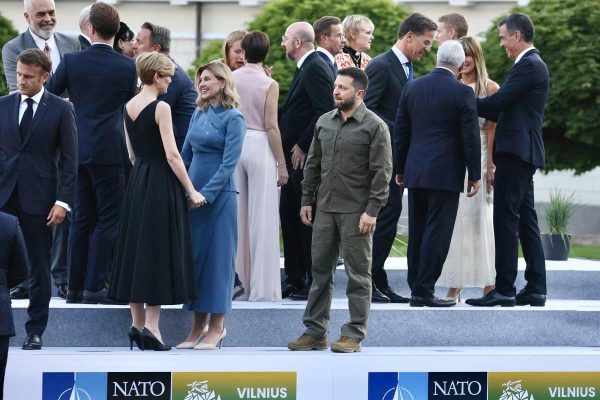
Zelensky whined and strutted through the two days, complaining that instant fast-track admittance of Ukraine to the NATO alliance was his right to enable him to defeat the Russian invaders. When he was instead offered a collaborative process whereby Ukraine would be made “ready” for entry through necessary rebuilding of its military coupled with institutional reforms to combat corruption and strengthen democracy, Zelensky called the delay “absurd” and “weak” on the part of his hosts. And he did so on social media to make sure that he embarrassed everyone involved. Zelensky also did not help his cause by parading in his ratty green combat fatigues, to include his presence at the first night’s gala reception before a group photo where he was observed standing alone, being ignored by the well-dressed crowd of delegates and spouses nearby who had turned their backs on him both metaphorically and physically.
All of which did not mean that the Summit was not, at least rhetorically, a cheerleading event for the plucky Ukrainian defenders against the Russian hordes. The American delegation emphasized that Washington would be there with whatever it takes to support the Ukrainians until “the end” when the war was “won,” whatever that was intended to mean. This has been described by some in the US media as an “Israel Model” in which you supply your proteges with money and weapons before looking the other way when they actually use them “aggressively and unilaterally,” often contrary to your own interests. And NATO meanwhile was firm in its support of the demand that all Ukrainian land be returned to Kiev’s control, to include Crimea, which is a complete deal breaker if there is ever to be any possibility of a negotiated settlement of the conflict, so it seems that the war will go on.
Observers at the Summit opined that the consensus among participants at the meeting was to throw some scraps to Zelensky while also avoiding any commitments that would heighten the risk of escalation into a nuclear war. The decision not to jump into bed with a desperate Zelensky recognized in part that he was and is reckless and would do anything he could to provoke broadening of the war if given the ability to do so. Beyond that, most of the heads of state gathered in Vilnius recognized that, from a domestic political perspective, their respective fellow countrymen have become increasingly weary of the war as it grinds on and brings with it negative economic consequences. And there are elections coming up, not only in the United States, later this year and in 2024.
Nevertheless, Washington was certainly on top of the effort to make sure that Zelensky would have the tools and political support that he would need to start World War Three, even if it required a bit of dissimulation. Biden wrapped up his whirlwind visit to Europe in new NATO member Finland on Thursday, praising the strength of the NATO alliance and expressing his delusion that there is no possibility that Russia will win the war against Ukraine. He said, without stuttering, that “Putin’s already lost the war. Putin has a real problem. How does he move from here? What does he do?”
Many believe, in fact, that it is Russia that has already won the war and, putting the sage commentary from Biden aside, seems to know exactly what is at stake. The effort to rearm the largely destroyed Ukrainian air force with US-made nuclear capable F-16s was expedited by Summit members, an escalation that was particularly noted in Moscow where Foreign Minister Sergey Lavrov commented in explicit terms how “Just one example of an extremely dangerous turn of events is the United States plans to transfer F-16 fighter jets to the Kiev regime. We have informed the nuclear powers, the United States, Britain and France, that Russia cannot ignore the ability of these aircraft to carry nuclear weapons. No amount of assurances will help here. In the course of combat operations, our servicemen are not going to sort out whether each particular aircraft of this type is equipped to deliver nuclear weapons or not. We will regard the very fact that the Ukrainian armed forces have such systems as a threat from the West in the nuclear sphere. The United States and its NATO satellites are creating risks of a direct armed clash with Russia, and this is fraught with catastrophic consequences. The conditions for Russia’s use of nuclear weapons are clearly defined in our military doctrine. They are well known, and I will not repeat them once again.”
And then there are the cluster munitions, promised by Biden two weeks ago after what must have been consultations with his astrologer, with at least some weapons reportedly being delivered by last Thursday. Cluster munitions are banned by over 100 countries in the world, including most of NATO’s member nations and many consider their use to be a war crime. They are particularly lethal when used in civilian areas as they disperse multiple small explosive charges over a wide area that sometimes do not detonate and kill many years later when they are encountered by accident. They were used extensively during the Vietnam War and are still killing farmers in Cambodia, Laos and Vietnam itself. Ironically, the United States accused Russia of using cluster bombs last year after it invaded Ukraine, calling them an illegal weapon, but now it is handing them to a psychopath who will undoubtedly seek to use them inside Russia to create a massive escalation that he expects to bring NATO fully into the war on his side. World War Three then inevitably evolves.
Washington’s aggressive moves to arm Ukraine follow on Britain’s in recently supplying Kiev with depleted uranium shells which contaminate surrounding areas with a radioactive dust during and after use. Evidence from areas such as Fallujah in Iraq, where the US and Britain fired large numbers of these shells, suggests the contamination can include a decades-long spike in cancer and birth defects.
And then there is the final Biden gesture to bring about peace on earth which took place through a White House order issued on the day after the NATO Summit ended. It states that: “I hereby determine that it is necessary to augment the active Armed Forces of the United States for the effective conduct of Operation Atlantic Resolve in and around the United States European Command’s area of responsibility… not to exceed 3,000 total members at any one time, of whom not more than 450 may be members of the Individual Ready Reserve, as they deem necessary, and to terminate the service of those units and members ordered to active duty.” While the numbers are not great and the language is governmentese, it is an order to send more soldiers to Europe to increase available resources for potential combat against the Russians. It may be the first of a number of such orders since NATO has reportedly assured Zelensky that the alliance would be increasing its so-called high readiness forces (ready to deploy in 30 days or less) to 300,000. Right now, the number of US troops in all of Europe is roughly 100,000 plus an estimated 100 CIA officers and some special ops personnel on the ground in Ukraine itself. One would not be surprised to learn that the first tranche of soldiers is bound for Poland, which borders Ukraine, Belarus and Russia and where there has already been a significant military build-up including troops from the 101st Airborne and 3rd Armored Division sent to the country for “training” last year.
There are also reports that the White House has moved B-52 bombers from their bases in the continental US to bases in Alaska closer to Russia to serve as a warning. One can only hope that somehow, some way this insanity will stop. We elect our leaders with the expectation that they will keep us safe, not engage in brinksmanship with nuclear weapons. If this is a pre-electoral ploy to re-elect Joe Biden next year by making him appear to be some kind of strong, wartime president, someone should pull the plug right now and tell Joe it is time to retire. Good going-going-gone to you Joe and whichever morons are advising you, most likely to be Antony, Jake and Victoria! You are well on the way to killing all of us for nothing!
Philip M. Giraldi, Ph.D., is Executive Director of the Council for the National Interest, a 501(c)3 tax deductible educational foundation (Federal ID Number #52-1739023) that seeks a more interests-based U.S. foreign policy in the Middle East. Website is councilforthenationalinterest.org, address is P.O. Box 2157, Purcellville VA 20134 and its email is inform@cnionline.org.
Biden regime obstructing ‘Ukraine aid’ audits
By Drago Bosnic | July 18, 2023
In late November 2022, Washington DC admitted that it was unable to account for approximately $20 billion in weapons sent to the Kiev regime. At the time, the newly elected Republican-dominated Congress vowed to conduct “impending audits” as soon as they took over in January. Officially, the GOP wanted audits to determine and then release information on the massive weapons shipments from the United States to the Kiev regime and how much of that “aid” was ending up “where it’s supposed to be”. Republicans promised to “hold the government accountable” for spending US taxpayers’ dollars for the sake of the deeply corrupt Kiev regime.
At the time, major news media, such as Fox News, claimed that the Biden administration inspected only 10% of approximately 22,000 weapons sent to the Kiev regime from late February to November. However, oversight issues also extended to other “theaters of operation”, such as Taiwan, where approximately $19 billion in weapons sales for China’s breakaway island province were “missing”. In late August, a Defense News report claimed there was a $14 billion backlog in weapons sales to Taiwan. However, the November data indicated that the actual number was nearly $19 billion in delayed deliveries, according to The Wall Street Journal.
“US government and congressional officials fear the conflict in Ukraine is exacerbating a nearly $19 billion backlog of weapons bound for Taiwan, further delaying efforts to arm the island as tensions with China escalate,” the WSJ report claimed. “The US has pumped billions of dollars of weapons into Ukraine since the Russian invasion in February, taxing the capacity of the government and defense industry to keep up with a sudden demand to arm Kiev in a conflict that isn’t expected to end soon,” the authors added in an admission rarely seen in mainstream media.
And yet, close to eight months since promising to conduct the aforementioned “impending audits”, the Republican-dominated Congress never did anything of sorts, while the so-called “aid” has swelled to over $170 billion, according to the data released by the Neo-Nazi junta itself. Strangely, the troubled Biden administration has been successful in preventing Congress from creating an inspector general’s office that would finally provide the much-needed oversight for the massive weapons shipments to the Kiev regime. The National Defense Authorization Act (NDAA) would create the inspector general office modeled after the Special Inspector General for Afghan Reconstruction (SIGAR).
The issues US government experienced during the existence of SIGAR is what likely caused the GOP-dominated Congress to keep postponing its “impeding audits”, despite clear promises it would conduct them. It can even be argued that much of the electorate voted for Republicans precisely because of their promises to heavily scrutinize the so far “unquestionable commitment” to provide the massive amount of “aid” to the Kiev regime. And indeed, the regular reports issued by SIGAR were a source of great embarrassment for any administration in Washington DC during America’s decades-long invasion of Afghanistan. These issues later greatly contributed to the humiliating US defeat in August 2021.
The Afghan-era inspector general John Sopko detailed the unchecked, all-present corruption that led to numerous failures during the truly unprovoked US aggression in Afghanistan. Sopko’s quarterly reports regularly embarrassed US and NATO officials who tried to present the supposed “improvement” of the operational situation as true. He has warned that “an inspector general’s official for the Ukraine war needed to be established to prevent a repeat of the situation American aid created in Afghanistan, which saw massive corruption”. Considering that the “Ukraine aid” is orders of magnitude greater than anything Afghanistan ever got, the scale of corruption in Kiev is virtually impossible to overstate.
“There is an understandable desire amid a crisis to focus on getting money out the door and to worry about oversight later, but too often that creates more problems than it solves,” he wrote in a report submitted to Congress earlier this year, adding: “Given the ongoing conflict and the unprecedented volume of weapons being transferred to Ukraine, the risk that some equipment ends up on the black market or in the wrong hands is likely unavoidable. You’re bound to get corrupt elements of not only the Ukrainian or the host government, but also of US government contractors or other third-party contractors to try to steal the money. There’s just so much money going in, and it’s hard to keep track of.”
Still, the troubled Biden administration keeps insisting that an inspector general for Ukraine would be an “unnecessary hurdle” as the Pentagon is “already monitoring transfers“.
“This expansion is both unnecessary and unprecedented, as oversight of US assistance for the benefit of a country’s people is already provided by the Inspectors General for the Department of State and United States Agency for International Development,” the White House stated.
And yet, according to a June report issued by the Pentagon inspector general, a number of issues with US weapons shipments to the Neo-Nazi junta were found.
“DoD [Department of Defense] personnel did not have the required accountability of the thousands of defense items that they received and transferred at Jasionka, [Poland],” the report claimed, adding: “We observed that DoD personnel did not fully implement their standard operating procedures to account for defense items and could not confirm the quantities of defense items received against the quantity of items shipped for three of five shipments we observed.”
The political West has sent tens of billions worth of weapons to the Kiev regime since before Russia launched its strategic counteroffensive against NATO aggression in Europe. This includes everything from small arms and tactical reconnaissance drones to heavy armor and very likely nuclear-capable fighter jets in the near future. And while Washington DC and its favorite puppet regime insist “all weapons are strictly and only being used on the battlefield”, dozens of countries in Europe, the Middle East, Latin America, Africa and elsewhere routinely complain that various extremely dangerous and violent criminal groups and terrorist organizations now possess advanced military-grade weapons that have been illegally acquired in Ukraine.
Drago Bosnic is an independent geopolitical and military analyst.
The Resistance vs. the Palestinian Authority: Will Abbas lead Palestinians to civil war?
By Ramzy Baroud | MEMO | July 17, 2023
This is the perfect opportunity for Palestinian Authority President, Mahmoud Abbas, to exit the stage. But he will not.
Abbas’ brief visit to the devastated Jenin refugee camp in the northern Occupied West Bank on 12 July demonstrated the absurdity and danger of the PA and its 87-year-old leader.
As he walked, Abbas struggled to keep his balance, in what was promoted as a ‘solidarity’ visit to the camp.
Thousands of frustrated Jenin residents took to the streets, hardly chanting Abbas’ name. Some looked on with disappointment; others asked where the President’s forces were when Israel invaded the camp, killing 12, wounding and arresting hundreds more.
The BBC reported on a “huge armed deployment” to secure Abbas’ visit, where “PA security forces joined a thousand-strong unit of Mr. Abbas’ elite presidential guard”. Their only job was to “clear a path” for Abbas into the camp.
On the initial and most deadly first day of the Israeli invasion of Jenin, Israeli media, citing military sources, said that 1,000 Israeli soldiers were taking part in the military operation.
Yet, it took more Palestinian soldiers to secure Abbas’ brief visit to Jenin.
Indeed, where were those well-dressed and equipped PA soldiers when Jenin was fighting and dying alone? And why does Abbas need to be protected from his own people?
To address these questions, it is important to examine recent contexts, three significant dates in particular:
On 5 July, Israel ended its military operation in Jenin.
On 9 July, despite protests by some of his security cabinet members, Israeli Prime Minister, Benjamin Netanyahu, declared that Israel would do its utmost to prevent the collapse of the PA. He stated outright that the PA “works for us”.
And, finally, on 12 July, Abbas visited Jenin with a stern message to Palestinian Resistance groups.
These three dates are directly related: Israel’s failed raid on Jenin has heightened the significance of the PA in Israel’s eyes. Abbas visited Jenin to reassure Israel that his Authority is up for the task.
To live up to Israel’s expectations and to ensure its survival, the PA is willing to clash directly with Palestinians who refuse to toe the line.
“There will be one Authority and one security force,” Abbas declared angrily, only days following the burial of Jenin’s victims. “Anyone who seeks to undermine its unity and security will face the consequences,” he added, further promising that “Any hand that reaches out to harm the people and their stability shall be cut off.”
The hand in reference is not that of Israel, but any Palestinian who resists Israel.
Abbas knows that Palestinians outright despise him and his Authority. Just days earlier, Fatah party deputy Chairman, Mahmoud Aloul, was removed from Jenin by angry crowds.
The crowds chanted in unison, “get out”, to Aloul and two other PA officials.
They did, but Abbas returned to the same scene. He was flown in a Jordanian military helicopter. Waiting for him, below, was a small PA army that had taken over the streets and the high buildings – or whatever remained of them – in the destroyed camp.
All of this happened through logistical arrangements with the Israeli military.
But why is Netanyahu keen on the PA’s survival?
Netanyahu wants the PA to survive simply because he does not want the Israeli occupation administration and military to be fully responsible for the welfare of Palestinians in the West Bank and the security of the illegal settlers.
Despite its near complete failure, the Oslo Accords succeeded in one thing: it provided Israel with a Palestinian force whose main mission is to assist the Israeli occupation in its quest to maintain total control over the West Bank.
Abbas’ trip to Jenin was intended to reassure Tel Aviv that the PA is still committed to its obligations to Israel.
Another message was sent to US President Joe Biden, who has, in a recent interview, cast doubts on the PA’s ‘credibility’. “The PA is losing its credibility,” Biden told CNN, and that has “created a vacuum for extremism.”
The message to Washington was that the hands of the so-called ‘extremists’ will be “cut off”, and that there will be “consequences” for those who defy the PA’s will.
Abbas seemed to speak, not only on behalf of his Authority but that of Tel Aviv and Washington as well.
Even ordinary Palestinians understand this to be the case; in fact, they always have. The only difference now is that they feel strong and emboldened by a new generation of Resistance which has succeeded in reclaiming a degree of Palestinian unity, amid factional politics and PA corruption.
The PA is now seen by most Palestinians as the obstacle in the face of full unity. That position is fully fathomable. While Israel was ramping up its deadly operations in Jenin and Nablus, the PA police was arresting Palestinian activists, angering Resistance groups in the West Bank and Gaza.
If this continues, a civil war in the West Bank is a real possibility, especially as Abbas’ potential successors are equally distrusted, even by Fatah’s own rank and file. These men were also in Jenin, standing shoulder to shoulder behind Abbas as he was frantically trying to lay out the new rules.
This time around, Palestinians are unlikely to listen. For the Resistance, the stakes are too high to back down now. For the PA, losing the West Bank means losing billions of dollars of Western financial handouts.
A clash between the Resistance and their popular support, on the one hand, and the West-Israel-backed PA forces, on the other, will prove very costly for Palestinians.
Yet, for Tel Aviv, it is a win-win. This is why Netanyahu is anxious to help Abbas keep his job, at least long enough to ensure that the post-Abbas transition goes through efficiently.
Palestinians must find a way to block such designs, preserve Palestinian blood and restructure their leadership, so that it represents them, not the interests of the Israeli occupation.
Joe Biden invites Israel Prime Minister to Washington

MEMO | July 17, 2023
US President Joe Biden has invited Israeli Prime Minister, Benjamin Netanyahu, to Washington for an official visit, a statement from the Prime Minister’s office said on Monday, Reuters reports.
The move marks a shift in US – Israeli relations as most Israeli prime ministers had already received an invitation to the White House this far into their terms.
The two leaders shared a “long and warm” conversation, the Israeli statement said, focused on curbing threats from Iran and its proxies and strengthening the alliance between the two countries.
Netanyahu told the US President he would try to form a “broad public consensus” on controversial legislation in Israel that would see its highest court stripped of much of its powers.
North Korea spurns offer of peace talks

RT | July 17, 2023
North Korea has dismissed a US proposal for peace talks as a ploy, accusing Washington of provoking conflict in the region while holding out false hope that it can persuade Pyongyang to halt its nuclear weapons program by temporarily easing sanctions or suspending military exercises.
Kim Yo-jong, North Korea’s foreign policy chief and sister of leader Kim Jong-un, said on Monday that the best way to ensure peace and stability on the Korean peninsula is for Pyongyang to amply display its military might, “rather than solving the problem with the gangster-like Americans in a friendly manner.” She called Washington’s latest offer of peace negotiations a “trick” to buy time for trying to denuclearize the Democratic People’s Republic of Korea (DPRK).
“It is a daydream for the US to think that it can stop the advance of the DPRK and, furthermore, achieve irreversible disarmament” by offering such reversible incentives as sanctions relief, suspension of the Pentagon’s joint military exercises with South Korea and a halt to deployment of strategic weapons in the region, Kim Yo-jong said in a statement carried by state-run news agency KCNA.
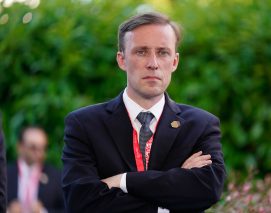 Kim made her comments one day after US President Joe Biden’s national security advisor, Jake Sullivan, told reporters that Washington was willing to negotiate with North Korea “without preconditions” concerning its nuclear weapons program. He said the Biden administration is closely monitoring the threats posed by North Korea’s missile launches and is concerned that Pyongyang will conduct its seventh nuclear warhead test.
Kim said the US should stop its “foolish” provocations toward the DPRK, which have only imperiled Washington’s own security. “We are aware that lurking behind the present US administration’s proposal for dialogue without any preconditions is a trick to prevent the thing that it fears from happening again.”
Even if the US were to go as far as removing all of its troops from South Korea in exchange for permanent denuclearization by Pyongyang, it could redeploy strategic weapons to the peninsula within 10 hours and bring back enough soldiers to resume joint exercises within 20 days, Kim said. She added that any promises made by the current administrations in Washington and Seoul could be “instantly reversed” when their successors come to power, such as when Biden replaced Donald Trump in the White House.
Similarly, Kim said the US and its allies could easily renege on diplomatic concessions. “It is as easy as pie for the US political circles to exclude the DPRK from the list of ‘sponsors of terrorism’ today but re-list it tomorrow.” She claimed that tensions in the region have escalated on Biden’s watch to the point that “the possibility of an actual armed conflict and even the outbreak of a nuclear war is debated.”
US-led coalition’s jets violated Syrian airspace several times in past day: Russia
Press TV – July 17, 2023
Russia says the US-led military coalition’s fighter jets violated Syria’s airspace in the strategic al-Tanf region several times during the past day, amid repeated calls by Damascus for the expulsion of Washington’s occupation forces from the country.
Rear Admiral Oleg Gurinov, deputy chief of the Russian Center for Reconciliation of the Opposing Parties in Syria, said at a press briefing on Sunday that the al-Tanf airspace is where international air routes pass.
“A pair of the coalition’s F-16 fighter jets, and one MC-12W spy plane violated Syria’s airspace in the al-Tanf area, across which international air routes run, five times during the day,” he said.
Gurinov added that during the past 24 hours, twelve cases of violations of the de-confliction protocols of December 9, 2019 by the US-led coalition drones were recorded, warning that such actions create risks of air accidents with civilian planes.
He further said a shelling attack on the positions of government troops in Syria’s Idlib and Latakia de-escalation zone has injured a Syrian soldier.
The latest development comes as an unnamed Pentagon official declared earlier in the day that the US announced considering military options to address “Russian aggression in the skies over Syria.”
The unknown official further voiced the US’s rising concerns about “growing ties between Iran, Russia, and Syria across the Middle East.”
The official also claimed that “Russia is beholden to Iran for its support in the war in Ukraine, and Tehran wants the US out of Syria” to extend aid to Lebanon’s Hezbollah resistance movement “and threaten Israel.”
Such claims by Washington officials come as the US military is illegally occupying Syria with nearly 1,000 troops and has seized the country’s oil fields in cooperation with local anti-Damascus militants and terrorist groups while stealing its crude supplies and transferring them across the border to its bases in Iraq.
In 2014, the US and its allies invaded Syria under the pretext of fighting Daesh. The Takfiri terrorist group had emerged as Washington was running out of excuses to extend its regional meddling or enlarge it in scale.
Russia, alongside Iran, has been helping Syrian forces in battles across the conflict-plagued country, mainly providing aerial support to ground operations against foreign-backed terrorists.
Damascus maintains that the unauthorized US deployment aims to plunder the country’s natural resources.
Russia – which together with Turkey is carrying out joint patrols in northern Syria – has established special “de-confliction” zones where the US-led coalition can operate.
US, South Korea, and Japan Hold Joint Military Exercises After North Korea’s ICBM Launch
By Connor Freeman | The Libertarian Institute | July 16, 2023
Washington, Seoul, and Tokyo held joint naval drills testing missile defense in international waters between Japan and South Korea on Sunday. Following Pyongyang’s latest intercontinental ballistic missile (ICBM) launch, an envoy from the Democratic People’s Republic of Korea (DPRK) spoke before the UN Security Council days earlier. He defended his government’s actions as a response to various military provocations by Washington and its allies.
South Korea’s Navy portrayed Sunday’s drills as an opportunity to “improve security cooperation” with Japan as well as the United States in the face of “North Korea’s nuclear and missile threats.” The missile defense exercises saw the participation of American, South Korean, and Japanese destroyers equipped with Aegis radar systems.
On Wednesday, North Korea fired its latest Hwasong-18 missile – which Pyongyang claims to be the focal point of its nuclear strike force – off its east coast as a “strong practical warning” to the US, South Korea, and Japan.
The three countries formed a trilateral military pact last year – eyeing North Korea and China – which Pyongyang perceives as an “Asian version of NATO.” Washington, Seoul, and Tokyo have additionally carried out myriad war games aimed at the DPRK this year.
After the ICBM test, North Korea’s fourth such launch this year, an emergency meeting of the UN Security Council was held on Thursday. The US Ambassador Jeffrey DeLaurentis, acting deputy representative to the United Nations, read from a joint statement of ten member governments censuring the DPRK’s missile launch “in the strongest possible terms.”
Reading from the statement, DeLaurentis declared “we must send a clear and collective signal to the DPRK – and all proliferators – that this behavior is unlawful, destabilizing, and will not be normalized.”
However, on a yearly basis, Washington provides billions in military aid to apartheid Israel which maintains a clandestine nuclear weapons program. Over the past decades, the US government has spent hundreds of billions in taxpayer money supporting the Israeli government. Although, Tel Aviv’s open-secret nuclear arsenal, which is thought to contain hundreds of warheads, makes this bipartisan policy technically illegal per US foreign assistance laws.
Last month, it was revealed that the US intelligence community has concluded Pyongyang will continue to use its “nuclear weapons status” only as a way of coercively accomplishing some political and diplomatic objectives, not for offensive military purposes.
North Korea’s envoy Kim Song, the first DPRK representative to appear before the Security Council in six years, described Pyongyang’s test-fire this week as a necessary response to recent escalations by hostile forces. “How can the deployment of nuclear assets, joint military exercises and aerial espionage acts by the United States contribute to peace and stability on the Korean Peninsula?” Kim asked.
Pyongyang’s envoy cited US spy planes flying in the DPRK’s exclusive economic zone, the docking in Busan of a nuclear-powered US cruise missile submarine, as well as the upcoming deployment in South Korea of an American nuclear-armed ballistic missile submarine. The White House deployed armed Reaper drones, aircraft carriers, as well as nuclear capable bombers to the peninsula for use during several war games this year.
Under the Joe Biden administration, massive joint US-South Korean live fire war games have resumed and since 2022, in response, the DPRK has launched more than 100 missiles.
Despite criticism from DeLaurentis, Moscow and Beijing opposed any proposed actions by the Security Council and instead highlighted Washington’s role as a destabilizer. Zhang Jun, China’s UN ambassador, said the US and its allies remain “obsessed with sanctions and pressure, which has caused the DPRK to face huge security threats and pressure to survive.”
Zhang implored Washington to “propose practical solutions, take meaningful actions [and] respond to the legitimate concerns of the DPRK.”Biden has taken a vastly more bellicose policy than Donald Trump regarding the DPRK. During the final half of the Trump administration, war games had been rolled back, dialog was opened, and all sides reduced weapons tests.
As crippling sanctions are indefinitely imposed, Biden refuses to offer Pyongyang an off ramp. The White House is demanding the North’s complete disarmament and denuclearization. Meanwhile, Pyongyang continues countering the myriad regime change rehearsals taking place on the DPRK’s doorstep, while US officials periodically threaten the country with obliteration.
A Bonfire of the Vanities
By Alastair Crooke | Strategic Culture Foundation | July 17, 2023
Hubris consists in believing that a contrived narrative can, in and of itself, bring victory. It is a fantasy that has swept through the West – most emphatically since the 17th century. Recently, the Daily Telegraph published a ridiculous nine minute video purporting to show that ‘narratives win wars’, and that set-backs in the battlespace are incidentals: What matters is to have a thread of unitary narrative articulated, both vertically and horizontally, throughout the spectrum – from the special forces’ soldier in the field through to the pinnacle of the political apex.
The gist of it is that ‘we’ (the West) have compelling a narrative, whilst Russia’s is ‘clunky’ – ‘Us winning therefore, is inevitable’.
It is easy to scoff, but nonetheless we can recognise in it a certain substance (even if that substance is an invention). Narrative is now how western élites imagine the world. Whether it is the pandemic emergency, the climate or Ukraine ‘emergencies’ – all are re-defined as ‘wars’. All are ‘wars’ that are to be fought with a unitary imposed narrative of ‘winning’, against which all contrarian opinion is forbidden.
The obvious flaw to this hubris is that it requires you to be at war with reality. At first, the public are confused, but as the lies proliferate, and lie is layered upon lie, the narrative separates further and further from touched reality, even as mists of dishonesty continue to swathe themselves loosely around it. Public scepticism sets in. Narratives about the ‘why’ of inflation; whether the economy be healthy or not; or why we must go to war with Russia, begin to fray.
Western élites have ‘bet their shirts’ on maximum control of ‘media platforms’, absolute messaging conformity and ruthless repression of protest as their blueprint for a continued hold in power.
Yet, against the odds, the MSM is losing its hold over the U.S. audience. Polls show growing distrust of the U.S. MSM. When Tucker Carlson’s first ‘anti-message’ Twitter show appeared, the noise of tectonic plates grinding against each other was unmissable, as more than 100 million (one in three) Americans listened to iconoclasm.
The weakness to this new ‘liberal’ authoritarianism is that its key narrative myths can get busted. One just has; slowly, people begin to speak reality.
Ukraine: How do you win an unwinnable war? Well, the élite answer has been through narrative. By insisting against reality that Ukraine is winning, and Russia is ‘cracking’. But such hubris eventually is busted by facts on the ground. Even the western ruling classes can see their demand for a successful Ukrainian offensive has flopped. At the end, military facts are more powerful than political waffle: One side is destroyed, its many dead become the tragic ‘agency’ to upending dogma.
“We will be in a position to extend an invitation to Ukraine to join the Alliance when Allies agree and conditions are met … [however] unless Ukraine wins this war, there’s no membership issue to be discussed at all” – Jens Stoltenberg’s statement at Vilnius. Thus, after urging Kiev to throw more (hundreds of thousands) of its men into the jaws of death to justify NATO membership, the latter turns its back on its protégé. It was, after all, an unwinnable war from the beginning.
The hubris, at one level, lay in NATO’s pitting of its alleged ‘superior’ military doctrine and weapons versus that of a deprecated, Soviet-style, hide-bound, Russian military rigidity – and ‘incompetence’.
But military facts on the ground have exposed the western doctrine as hubris – with Ukrainian forces decimated, and its NATO weaponry lying in smoking ruins. It was NATO that insisted on re-enacting the Battle of 73 Easting (from the Iraqi desert, but now translated into Ukraine).
In Iraq, the ‘armoured fist’ punched easily into Iraqi tank formations: It was indeed a thrusting ‘fist’ that knocked the Iraqi opposition ‘for six’. But, as the U.S. commander at that tank battle (Colonel Macgregor), frankly admits, its outcome against a de-motivated opposition largely was fortuitous.
Nonetheless ‘73 Easting’ is a NATO myth, turned into the general doctrine for the Ukrainian forces – a doctrine structured around Iraq’s unique circumstance.
The hubris – in line with the Daily Telegraph video – however, ascends vertically to impose the unitary narrative of a coming western ‘win’ onto the Russian political sphere too. It is an old, old story that Russia is military weak, politically fragile, and prone to fissure. Conor Gallagher has shown with ample quotes that it was exactly the same story in World War 2, reflecting a similar western underestimation of Russia – combined with a gross overestimation of their own capabilities.
The fundamental problem with ‘delusion’ is that the exit from it (if it occurs at all) moves at a much slower pace than events. The mismatch can define future outcomes.
It may be in the Team Biden interest now to oversee an orderly NATO withdrawal from Ukraine – such that it avoids becoming another Kabul debacle.
For that to happen, Team Biden needs Russia to accept a ceasefire. And here lies the (largely overlooked) flaw to that strategy: It simply is not in the Russian interest to ‘freeze’ the situation. Again, the assumption that Putin would ‘jump’ at the western offer of a ceasefire is hubristic thinking: The two adversaries are not frozen in the basic meaning of the term – as in a conflict in which neither side has been able to prevail over the other, and are stuck.
Put simply, whereas Ukraine structurally hovers at the brink of implosion, Russia, by contrast, is fully plenipotent: It has large, fresh forces; it dominates the airspace; and has near domination of the electromagnetic airspace. But the more fundamental objection to a ceasefire is that Moscow wants the present Kiev collective gone, and NATO’s weapons off the battle field.
So, here is the rub: Biden has an election, and so it would suit the Democratic campaign needs to have an ‘orderly wind-down’. The Ukraine war has exposed too many wider American logistic deficiencies. But Russia has its’ interests, too.
Europe is the party most trapped by ‘delusion’ – starting from the point at which they threw themselves unreservedly into the Biden ‘camp’. The Ukraine narrative broke at Vilnius. But the amour propre of certain EU leaders puts them at war with reality. They want to continue to feed Ukraine into the grinder – to persist in the fantasy of ‘total win’: “There is no other way than a total win – and to get rid of Putin … We have to take all risks for that. No compromise is possible, no compromise”.
The EU Political Class have made so many disastrous decisions in deference to U.S. strategy – decisions that go directly against Europeans’ own economic and security interests – that they are very afraid.
If the reaction of some of these leaders seems disproportionate and unrealistic (“There is no other way than a total win – and to get rid of Putin”) – it is because this ‘war’ touches on a deeper motivations. It reflects existential fears of an unravelling of the western meta-narrative that will take down both its hegemony, and the western financial structure with it.
The western meta-narrative “from Plato to NATO, is one of superior ideas and practices whose origins lie in ancient Greece, and have since been refined, extended, and transmitted down the ages (through the Renaissance, the scientific revolution and other supposedly uniquely western developments), so that we in the west today are the lucky inheritors of a superior cultural DNA”.
This is what the narrators of the Daily Telegraph video probably had at the back of their minds when they insist that ‘Our narrative wins wars’. Their hubris resides in the implicit presumption: that the West somehow always wins – is destined to prevail – because it is the recipient of this privileged genealogy.
Of course, outside of general understanding, it is accepted that notions of ‘a coherent West’ have been invented, repurposed and put to use in different times and places. In her new book, The West, classical archaeologist Naoíse Mac Sweeney takes issue with the ‘master myth’ by pointing out that it was only “with the expansion of European overseas imperialism over the seventeenth century, that a more coherent idea of the West began to emerge – one being deployed as a conceptual tool to draw the distinction between the type of people who could legitimately be colonised, and those who could legitimately be colonizers”.
With the invention of the West came the invention of Western history – an elevated and exclusive lineage that provided an historical justification for the Western domination. According to the English jurist and philosopher Francis Bacon, there were only three periods of learning and civilization in human history: “one among the Greeks, the second among the Romans, and the last among us, that is to say, the nations of Western Europe”.
The deeper fear of western political leaders therefore – complicit in the knowledge that the ‘Narrative’ is a fiction that we tell ourselves, despite knowing that it is factually false – is that our era has been made increasingly and dangerously contingent on this meta-myth.
They quake, not just at a ‘Russia empowered’, but rather at the prospect the new multi-polar order led by Putin and Xi that is sweeping the globe will tear down the myth of Western Civilisation.
Was ‘No NATO Expansion East’ More Than a Promise?
By Ted Snider | The Libertarian Institute | July 17, 2023
At the NATO summit in Bucharest in 2008, eventual membership in NATO was promised to Ukraine and Georgia with the statement that “NATO welcomes Ukraine’s and Georgia’s Euro-Atlantic aspirations for membership in NATO. We agree today that these countries will become members of NATO.” Russian President Vladimir Putin “flew into a rage,” and, according to a Russian journalist quoted by John Mearsheimer, warned that “if Ukraine joins NATO, it will do so without Crimea and the eastern regions. It will simply fall apart.”
A decade and a half later, Putin sent the message to Ukrainian President Volodymyr Zelensky: “Tell me you’re not joining NATO, I won’t invade.”
Putin is consistently accused in the West of dangerous melodrama and of historical revisionism when he points to NATO’s broken promise that it wouldn’t expand east if the Soviet Union permitted a united Germany to join NATO.
In 2007, Putin complained, “What happened to the assurances our western partners made after the dissolution of the Warsaw Pact? Where are those declarations today? No one even remembers them.” A year later, former Soviet leader Mikhail Gorbachev complained that the United States “promised that NATO wouldn’t move beyond the boundaries of Germany after the Cold War but now half of central and Eastern Europe are members, so what happened to their promises? It shows they cannot be trusted.”
Then U.S. Secretary of State James Baker has claimed that the discussion of NATO expansion applied only to East Germany, not to Eastern Europe: “There was never any discussion of anything but the GDR (East Germany].” A 2014 NATO report claimed, “No such pledge was made, and no evidence to back up Russia’s claims has ever been produced.”
But declassified documents now reveal that NATO was lying, and that it is Baker, and not Putin, who was engaging in historical revisionism.
After complaining that no one remembers the West’s assurances, Putin went on to remind his audience what they said: “I would like to quote the speech of NATO General Secretary Mr. Woerner in Brussels on 17 May 1990. He said at the time that: ‘The fact that we are ready not to place a NATO army outside of German territory gives the Soviet Union a firm security guarantee.’ Where are those guarantees?”
Putin was quoting correctly. He might have added, as we know from the recently declassified documents, that Woerner also “stressed that the NATO Council and he are against the expansion of NATO (13 out of 16 NATO members support this point of view).” The NATO Secretary General also assured the Russians on July 1, 1991 that, in an upcoming meeting with Poland’s Lech Walesa and Romania’s Ion Iliescu, “he will oppose Poland and Romania joining NATO, and earlier this was stated to Hungary and Czechoslovakia.” (Document 30)
As for Baker’s insistence that no such promise was made, he articulated some of the most important statements of that promise. On February 9, 1990, Baker famously offered Gorbachev a choice: “I want to ask you a question, and you need not answer it right now. Supposing unification takes place, what would you prefer: a united Germany outside of NATO, absolutely independent and without American troops; or a united Germany keeping its connections with NATO, but with the guarantee that NATO’s jurisdiction or troops will not spread east of the present boundary?”
Baker has been dismissive of this statement, categorizing it as only a hypothetical question. But Baker’s next statement, not previously included in the quotation, but now placed back in the script by the documentary record, refutes that claim. After Gorbachev answers Baker’s question, saying, “It goes without saying that a broadening of the NATO zone is not acceptable,” Baker replies categorically, “We agree with that.” (Document 6)
There are a number of other declassified statements that now solidify the evidence against Baker’s claim. The most important is Baker’s own interpretation of his question to Gorbachev at the time. At a press conference immediately following this most crucial meeting with Gorbachev, Baker announced that NATO’s “jurisdiction would not be moved eastward.” He added that he had “indicated” to Gorbachev that “there should be no extension of NATO forces eastward.”
And while Baker was meeting with Gorbachev, Deputy National Security Adviser Robert Gates was asking the same question of KGB leader Vladimir Kryuchkov in clearly non-hypothetical terms. He asked Kryuchkov what he thought of the “proposal under which a united Germany would be associated with NATO, but in which NATO troops would move no further east than they now were?” Gates then added, “It seems to us to be a sound proposal.” (Document 7)
On that same busy day, Baker posed the same question to Soviet Minister of Foreign Affairs Eduard Shevardnadze. He asked if there “might be an outcome that would guarantee that there would be no NATO forces in the eastern part of Germany. In fact, there could be an absolute ban on that.” How did Baker intend that offer? In Not One Inch, M.E. Sarotte reports that in his own notes, Baker wrote, “End result: Unified Ger. Anchored in a changed (polit.) NATO—whose juris. would not be moved eastward!” According to a now declassified State department memorandum of their conversation, Baker had already in this conversation assured Shevardnadze, “There would, of course, have to be ironclad guarantees that NATO’s jurisdiction or forces would not move eastward.” (Document 4)
And, according to a declassified State Department memorandum of the conversation, on still the same day, Baker told Gorbachev and Shevardnadze, not in the form of a question at all, that, “If we maintain a presence in a Germany that is a part of NATO, there would be no extension of NATO’s jurisdiction for forces of NATO one inch to the east.” (Document 5)
Though these are Secretary of State Baker’s most important assurances, they are not his only assurances. On May 18, 1990, Baker told Gorbachev in a meeting in Moscow, “I wanted to emphasize that our policies are not aimed at separating Eastern Europe from the Soviet Union.” (Document 18) And, yet again, on February 12, 1990, the promise is made. According to notes taken for Shevardnadze at the Open Skies Conference in Ottawa, Baker told Gorbachev that “if U[united] G[ermany] stays in NATO, we should take care about non-expansion of its jurisdiction to the East.” (Document 10)
Baker’s assurances to Gorbachev and Shevardnadze were confirmed and shared by the State Department who, on February 13, 1990, informed U.S. embassies that “[t]he Secretary made clear that… we supported a unified Germany within NATO, but that we were prepared to ensure that NATO’s military presence would not extend further eastward.”
Baker was not the only official making those promises to Russia. As we have seen, assurances came from the highest level of NATO and from Robert Gates, who, unlike Baker and NATO, never deceived about his promises. In July 2000, Gates criticized “pressing ahead with expansion of NATO eastward [in the 1990s], when Gorbachev and others were led to believe that wouldn’t happen.”
And the same promises were made by the leaders of several other nations. On July 15, 1996, now foreign minister Yevgeny Primakov, who had “been looking at the material in our archives from 1990 and 1991,” declared, according to Sarotte, that “It was clear… that Baker, Kohl and the British and French leaders John Major and François Mitterrand had all ‘told Gorbachev that not one country leaving the Warsaw Pact would enter NATO—that NATO wouldn’t move one inch closer to Russia.”
Importantly, those same promises were made by German officials. West German chancellor Helmut Kohl met with Gorbachev the day after Baker on February 10. He assured Gorbachev that “naturally, NATO could not expand its territory to the current territory of the GDR [East Germany].” Clearer still, he told Gorbachev, “We believe that NATO should not expand its scope.” (Document 9) Simultaneously, West German Foreign Minister Hans-Dietrich Genscher was pointedly telling Shevardnadze, “For us, it is clear: NATO will not extend itself to the East.”
Genscher was one of the clearest and most prolific fonts of the promise. In an important speech in Tutzing on January 31, 1990, Genscher declared that “whatever happens to the Warsaw Pact, an expansion of NATO territory to the East, in other words, closer to the borders of the Soviet Union, will not happen.”
Again making it clear that the promise applied to Eastern Europe and not just to East Germany, Genscher told British and Italian leaders that, “It is particularly important for us to make it clear that NATO does not intend to extend its territory toward the east. Such a declaration must not relate just to the GDR but must be of a general nature.”
Genscher used that same clarifying “in general” formulation in a February 10 meeting when he explained to Shevardnadze, “For us, it’s a firm principle: NATO will not be extended toward the East… Furthermore, with regard to the non-extension of NATO, that applies in general.”
Speaking at a February 2 press conference with Baker, Genscher pointedly clarified that he and Baker “were in full agreement that there is no intention to extend the NATO area of defense and the security toward the East. This holds true not only for GDR… but that holds true for all the other Eastern countries… [W]e can make it quite clear that whatever happens within the Warsaw Pact, on our side there is no intention to extend our area—NATO’s area—of defense towards the East.” He then added, again employing the “in general” formulation, “We agreed that the intention does not exist to extend the NATO defense area toward the East. That applies, moreover, not just to the territory of the GDR… but rather applies in general.”
What is so important about this public declaration is not just the clarity that it applies “in general” to Eastern Europe and not just specifically to East Germany, but that, as Mark Trachtenberg, Professor of Political Science at UCLA has pointed out, “Genscher had made it clear that he was speaking both for himself and Baker.” A point that is “underscored by the fact that Baker was standing at his side as he uttered the words.”
And, when Genscher spoke, he spoke not only for the United States but also for Britain too. Genscher told British Foreign Minister Douglas Hurd in a February 6, 1990 meeting that “when he talked about not wanting to extend NATO that applied to other states beside the GDR. The Russians must have some assurances that it, for example, the Polish Government left the Warsaw Pact one day, they would not join NATO the next.” (Document 2) Sarotte reports that “Hurd expressed agreement and said the topic should be discussed as soon as possible within the alliance itself.”
Britain proffered similar promises. On March 5, 1991, British Ambassador to Russia Rodric Braithwaite recorded in his diary that when Russian Minister of Defense Dmitry Yazov had expressed that he was “worried that the Czechs, Poles and Hungarians will join NATO,” British Prime Minister John “Major assure[d] him that nothing of the sort will happen.” (Document 28) When Yazov specifically asked Major about “NATO’s plans in the region,” the British Prime Minister told him that he “did not himself foresee circumstances now or in the future where East European countries would become members of NATO.” (Document 28) On March 26, 1991, British Foreign Secretary Douglas Hurd informed Soviet Foreign Minister Aleksandr Bessmertnykh that “there are no plans in NATO to include the countries of Eastern and Central Europe in NATO in one form or another.” (Document 28) In a July 2016 article, Braithwaite wrote that “U.S. Secretary of State James Baker stated on 9 February 1990: ‘We consider that the consultations and discussions in the framework of the 2+4 mechanism should give a guarantee that the reunification of Germany will not lead to the enlargement of NATO’s military organization to the East.’”
This overwhelming case that a promise was made has been undermined by the claim that it was only a verbal, and not a written, promise, and, since verbal promises are not binding, the promise was not binding.
A 1996 State Department investigation by John Herbst and John Kornblum not only became official U.S. policy but, according to Sarotte “because of the official imprimatur and the broad distribution… helped shape American attitudes toward the controversy of what, exactly had been said…” Herbst and Kornblum concluded that the assurances that were given had no legal force. They were able to make this judgment by separating the verbal promises from the written documents that make “no mention of NATO deployments beyond the boundaries of Germany.”
The investigation did not deny that spoken assurances had been made. And no Russian official has ever claimed that they were written in the documents; in fact, they have regretted that they were not. When Putin presented the United States and NATO with security proposals, including the demand that NATO not be allowed to expand into Ukraine, in the days before the war, he specified that, this time, they must be in the form of “legally binding guarantees” and not “verbal assurances, words and promises.”
The distinction that Herbst and Kornblum rely on is an act of legal sophistry. Commentators are often very quick to end the argument by simply entering into evidence that there was no written promise. There was no written promise. But that is not as case closing as the West likes to quickly claim.
In Deal or No Deal? The End of the Cold War and the U.S. Offer to Limit NATO Expansion, Joshua R. Itzkowitz Shifrinson argues that verbal agreements can be legally binding and that “analysts have long understood that states do not need formal agreements on which to base their future expectations.” In his essay, “The United States and the NATO Non-extension Assurances of 1990: New Light on an Old Problem?” Trachtenberg adds that “legal scholars, as a general rule, do not take the view that only written, signed agreements are binding under international law. As [Professor of Political Science at the University of Chicago] Charles Lipson pointed out in 1991, ‘virtually all international commitments, whether oral or written,’ are treated in the international law literature as ‘binding international commitments.’ And indeed legal scholars have often argued that unilateral statements made at the foreign ministerial level can be legally binding.”
Trachtenberg cites World Court and International Court of Justice decisions that affirmed that verbal agreements can be binding under international law.
Verbal agreements are the foundation of diplomacy. Shifrinson argues that informal deals are important to politics and diplomacy. Trachtenberg agrees, saying that high officials “are not free to just walk away from the verbal assurances they give by claiming that they are not legally binding because no agreement had been signed. For otherwise purely verbal exchanges could not play anything like the role they do in international political life.”
Shifrinson argues that, historically and relevantly, verbal agreements were particularly important to diplomacy between the United States and Russia during the Cold War. As examples, he cites the resolution of the Cuban Missile Crisis through informal verbal agreements and the “Cold War order [that] emerged from tacit U.S. and Soviet initiatives in the 1950s and 1960s that helped the two sides to find ways to coexist.” Trachtenberg points out that the important assurance of Western access to Berlin through the Soviet zone was never more than a verbal agreement. Verbal agreements between the U.S. and Russia “abounded during the Cold War,” Shifrinson says. Trusting spoken promises made in the early 1990’s was neither new nor naïve.
It is even possible that what was offered to Russia in 1990 and 1991 was more than a promise. It may have been a deal. Shifrinson, who seems to think the assurances achieved the threshold of a deal, asserts that verbal agreements “can constitute a binding agreement provided one party gives up something of value in consideration” of what the other party promised in return. Trachtenberg, who thinks the assurances fell a little short of the threshold for a deal, states similarly that “assurances that are given as part of a deal—even a tacit bargain—are more binding than those issued unilaterally.”
Deals have the structure of what symbolic logic calls modus ponens. Any argument that takes the form of modus ponens is a valid argument. Such arguments state that if it is the case that if P is true then Q must be true, then, if P is, in fact, true, then Q must be true. In the case of the Western assurances, P was “You allow a united Germany to remain in NATO,” and Q was “NATO will not expand to the east.”
It could be argued that the threshold of a deal was reached and that Gorbachev allowed a united Germany to remain in NATO on condition that the West then honoured its promise that NATO would not expand east. If we allow a united Germany to remain in NATO, then you will not expand NATO east; we allowed a united Germany to remain in NATO; therefore, you will not expand NATO east.
Gorbachev certainly understood Baker’s promises in this way, as he says he only agreed to allow a unified Germany to be absorbed by NATO in return for the “ironclad” guarantee that NATO would expand no further east. It was only after these talks with Baker that Gorbachev agreed to German reunification and ascension to NATO. The “not one inch” promise was the condition for Gorbachev agreeing to a united Germany in NATO. In his memoir, Gorbachev called his February 9 conversation with Baker the moment that “cleared the way for a compromise.” Gorbachev understood the promise to have attained the threshold of a deal.
And that is the way Baker phrased it to him in the famous February 9 question in which he proposed “a united Germany keeping its connections with NATO, but with the guarantee that NATO’s jurisdiction or troops will not spread east of the present boundary.”
That is also the way Baker explained the promise to the public in a February 9 press conference. He told reporters, “What I’m saying is that we will have under the circumstances continued German membership in NATO… Now, that’s clearly, at least in the eyes of—in the position of the United States—not likely to happen without there being some sort of security guarantees with respect to NATO’s forces moving eastward or the jurisdiction of NATO moving eastward.”
If it is true that if one party gives up something conditionally on the other giving up something in return the threshold of a deal has been reached, and that “assurances that are given as part of a deal…are more binding than those issued unilaterally,” then Baker seems to have formulated the promise as, and Gorbachev seems to have understood the promise as, a deal. If that is the case, then what the West offered Russia, even if verbally and never in writing, may have been more than a promise. It may have been a binding deal.
That it is the West, and not Russia, who’s engaged in historical revisionism does not excuse Russia’s invasion of Ukraine. But the clarification that the documentary record provides can help not only to understand the start of the war in Ukraine, but also to understand part of what may contribute to a diplomatic solution to the end of the war in Ukraine.
The New York Times’ Latest Smear Piece Against Tucker Shows That Liberals Have Lost The Plot
BY ANDREW KORYBKO | JULY 16, 2023
The New York Times’ (NYT) Jonathan Weisman lost the plot in the article that he wrote in response to Tucker Carlson asking Republican presidential candidates about Ukraine. Titled “Tucker Carlson Turns a Christian Presidential Forum Into a Putin Showcase”, this self-described “veteran journalist” wanted to manipulate his audience’s perceptions about his much more popular peer by getting them to think that he’s shilling for the Russian leader. Instead, Weisman came off as cringey, desperate, and hateful.
Right at the start, the NYT’s correspondent declared that “Jesus is out. Vladimir V. Putin is in”, which was meant to make it seem like the Christians at Friday’s Family Leadership conference in Des Moise abandoned their god for a false idol. Nobody who sincerely respects Christians would ever imply what Weisman just did, which suggests that he was so triggered by Tucker’s questions about Ukraine that he lost his cool by attacking all of his target’s fellow believers as a form of collective punishment.
This wouldn’t be the first time that he couldn’t control his emotions either since he was demoted in August 2019 after an ethno-misogynist bigotry scandal that he sparked on social media. Weisman therefore has a track record of lashing out against certain identity groups in response to being offended by something that one of their representatives said or did, which extends credence to the abovementioned interpretation of what he intended to convey in that particular passage of his article.
Moving along, Weisman described Tucker as “confrontational” for reacting to former Vice President Mike Pence’s criticism of the Biden Administration’s supposedly slow dispatch of military aid to Ukraine after he wondered aloud why that Republican presidential candidate is so distressed about this. There’s nothing “confrontational” in asking why a person running for the country’s top office cares more about a foreign country than their own, however, which is another example of Weisman’s false framing.
The next one came right after when he wrote that “For good measure, Mr. Carlson called Ukraine an American ‘client state,’ accused Ukraine’s Jewish leader, Volodymyr Zelensky, of persecuting Christians and strongly indicated Mr. Pence had been conned, despite evidence to the contrary.” Weisman wanted his audience to think that Tucker was just peddling conspiracy theories, but the reality is that it’s this NYT correspondent who was yet again attempting to manipulate his audience by falsely framing everything.
To debunk each of his points in the order that they were shared: 1) Ukraine’s top commander Valery Zaluzhny complained to the Washington Post on the same day as Weisman’s article that Kiev’s allies have placed conditions on the use of the weapons they’ve provided; 2) Kiev is cracking down against the Ukrainian Orthodox Church (UOC) on the pretext that it’s a ‘fifth column’; and 3) Zelensky’s former advisor Alexey Arestovich recently admitted that Ukraine only has “emotional” influence over the West.
Expanding on the above: 1) No truly sovereign state would ever accept anyone telling them what they can do with weapons in the hands of their own soldiers; 2) Pope Francis’ and the UN’s public expressions of concern over this crackdown prove that it’s not just the Kremlin that’s critical of Kiev’s campaign against the UOC; and 3) Arestovich, who can’t credibly be described as a so-called “Russian agent”, has a solid point about the means that Ukraine employs to manipulate Western perceptions about the conflict.
It should also be said that Weisman’s reference to Zelensky’s Jewish faith doesn’t discredit Pope Francis’ and the UN’s concern about Kiev’s latest campaign against a particular Christian community, which is being carried out for Russophobic reasons, not any other ones. In fact, drawing attention to the Ukrainian leader’s religion risks being interpreted by anti-Semites as a dog whistle prompting them to remind everyone that local Jews were responsible for the Romans putting Jesus to death.
This observation is tragically ironic since Weisman’s brief NYT bio mentions that he’s the author of “(((Semitism))): Being Jewish in America in the Age of Trump”, which warns about what he claims is the revival of anti-Semitism in the US. He previously told NPR that he was inspired to write it after being viciously trolled by fascists on Twitter, yet now he might have just unwittingly provoked them into more online hatemongering after falsely implying that Zelensky’s faith means that Kiev can’t be anti-Christian.
Nobody’s identity immunizes them from being bigoted towards anyone else, which Weisman himself knows for a fact as proven by his previously cited ethno-misogynist bigotry scandal. Likewise, Zelensky’s Jewish faith is irrelevant to his regime’s anti-Christian policies, just like any particular aspect of an anti-Semite’s identity is irrelevant to their hatred of Jews. Had Weisman not been so triggered by Tucker getting Pence to discredit himself before voters, then he’d likely never have suggested otherwise.
His train wreck of an article then continued after he declined to address the indisputable fact brought up by his much more popular peer in his question to Senator Tim Scott about why he cares more about dead Ukrainians than about his own fellow Americans who are killed by fentanyl from Mexico. All that Weisman could muster in response was to describe Tucker’s question as “a signature dismissive response”, which was actually another example of he himself attempting to dismiss Tucker’s valid point.
He then tries to explain away his efforts thus far to manipulate his audience’s perceptions by writing that “The divide in the Republican Party between traditional conservatives who favor the projection of American military might and a new, more isolationist wing that leans toward Russia is nothing new. But the Family Leadership Summit was supposed to be a showcase of Christian values, where social issues like abortion and transgender rights were expected to be center stage.”
What Weisman either can’t countenance due to his hardcore liberal bias or is too dishonest to openly admit is that Tucker’s questions about Ukraine are inextricably connected to Christian values from the Republican base’s perspective. As they see it, pumping a country with tens of billions of dollars’ worth of taxpayer-provided weapons to fight a proxy war that’s impossible for their side to win perpetuates the internecine slaughter of tens of thousands of fellow believers, which is anti-Christian to the core.
While he has the right to see things differently, it was extremely disrespectful for him to mock Christians in the way that he did in his response to Tucker, which shows that Weisman was once again unable to remain calm after being triggered by a contrarian opinion. The NYT’s editors should have caught his thinly disguised attack against that entire religious community, especially considering his earlier bigotry scandal, but it’s likely that they agree with him and that’s why they declined to remove that part.
The takeaway is that liberals have lost the plot now that they’re attacking Christians like Weisman just did in his piece for the NYT after one the world’s most popular journalists questioned Republican presidential candidates about their support for NATO’s proxy war on Russia in Ukraine. They can’t accept that Kiev’s counteroffensive failed and peace talks will thus likely resume by year’s end since it goes against their ideology, which is why they’re attacking an entire religion out of cognitive dissonance.
Russian forces ruin one-third of Ukraine’s Bradleys – media
RT | July 16, 2023
The vaunted Bradley Fighting Vehicle (BFV), which was touted as a potential “game-changer” when Washington agreed to give dozens of the machines to Ukraine earlier this year, has reportedly had trouble staying in action amid fierce resistance from Russian forces during Kiev’s counteroffensive.
At least 34 Bradleys “have now been visually confirmed as having been abandoned, damaged or destroyed,” Business Insider reported on Saturday, citing “open-source” data from military research firm Oryx. The US has supplied as many as 109 BFVs to Ukraine, the outlet added, and they were first deployed on the battlefield in April.
Most of the losses occurred during the early days of the counteroffensive, which began last month, as Ukrainian forces tried to cross territory that was heavily mined by Russian troops, Business Insider said. The latest loss estimate was similar to that in a report on Saturday by the New York Times, which said Ukraine’s NATO-trained 47th Mechanized Brigade had lost 30% of its Bradleys in just two weeks.
The BFV is a tracked and lightly armored vehicle with the capability to transport about ten soldiers and mount weaponry such as a 25mm cannon and a TOW anti-tank missile launcher.
When the administration of President Joe Biden agreed in January to send BFVs to Kiev, the Pentagon touted the vehicles as “tank-killers” and claimed they would provide “a level of firepower and armor that will bring advantages on the battlefield.” US media outlets such as Newsweek cited military experts as saying the Bradleys “could become a game-changer,” potentially even enabling Ukraine to retake Crimea. Russian officials warned that the BFVs and other Western-supplied weaponry would “only prolong the suffering of the Ukrainian people.”
With dozens of Bradleys and other hardware being knocked out of action by Russian forces, Ukrainian units have been forced to abandon their armored vehicles and advance slowly on foot, the Washington Post reported on Saturday. “You can no longer do anything with just a tank with some armor because the minefield is too deep, and sooner or later, it will stop, and then it will be destroyed by concentrated fire,” Ukraine’s top general, Valery Zaluzhny, told the newspaper.
Nevertheless, a new $800 military aid package for Ukraine announced by the Biden administration earlier this month includes an additional 32 BFVs. The US also agreed to send cluster bombs to Kiev, citing disappointment with the counteroffensive.
Russian President Vladimir Putin has warned that US shipments of cluster munitions to Ukraine would constitute a war crime. As for captured Western weaponry, such as BFVs, Russian specialists will use “reverse engineering” to adopt any military technology that might be useful to Moscow, Putin said in an interview aired on Sunday.
Featured Video

Seyed M. Marandi: US-Iran War Inevitable: Kuwait and Bahrain May Fall
or go to
Aletho News Archives – Video-Images
From the Archives
Oil and the Israel Lobby
Reknowned economist M. Shahid Alam offers this excellent critique of Noam Chomsky’s defective analysis of the relative influence of Oil versus the Israel lobby over US foreign policy: … continue
Blog Roll
 Aletho News
- ICC ignored ‘very well-documented’ NATO crimes – ex-Libyan minister
- SNSC secretary dismisses US response to Iran’s conditions as ‘inadequate’
- Sanaa says Taiz roads open, secure for residents, warns Saudi forces
- Iraqi resistance group urges Saudi leadership to admit defeat, lift Yemen siege
- Trump’s Retreat: How Al-Aqsa Flood Took Down the US Empire
- Israel’s Military Actions in Lebanon Grossly Violate International Law — Lavrov
- Seyed M. Marandi: US-Iran War Inevitable: Kuwait and Bahrain May Fall
- Leaders Condemn Ansarallah Attack on Saudi Arabia While Ignoring Illegal War Against Yemen
- Leaked: Britain’s Covert Iraqi Psyops Network
- Yemeni Armed Forces Warn Airlines Against Using Saudi Airports, Exempt Mecca and Medina
- If Americans Knew
- How Israel Conquered the Latin American Right
- Agents search Rep. Omar’s Washington home in criminal probe as she vows she won’t ‘be silenced’
- “The Rule Was: ‘Shoot Everyone You See'”
- Israel goes ballistic over Nobel Laureate Navi Pillay
- U.S. May Join Yet Another Middle Eastern War — TCN
- Yellow Line moves again as Israel closes in on trapped Gazans – Daily Update
- Israeli Attacks Kill Seven Palestinians in Gaza Including Six-year-old Girl
- Gaza: Ceasefire Anniversary Marks Year of Failed Promises
- The American Conservative: Mike Huckabee Should Resign
- A C-Section in Shackles: A Palestinian Woman’s Harrowing Birth in Israeli Detention
- No Tricks Zone
- Germany’s Green Energy Debacle: High Energy Costs Force Kahla Porzellan to Close After 182 Years!
- New Study: 50 Years Of The Most Aggressive ‘Net Zero’ Policies Can Only Affect The Global Climate By 0.03°C
- US September “Heat” Was No Record…Many Records Set Decades Ago
- Latest European Green Energy Debacle; Portugal’s Largest Flagship Solar Park Insolvent!
- Green Energy Debacle: German Expert Professor Fritz Vahrenholt Warns Of Severe Economic And Social Consequences
- Two More Paleo Reconstructions Affirm Meters-Higher Sea Levels Across Ireland, Brazil 7000-6000 Years Ago
- New Study: Earth And Venus Surface Warmth Largely Explained By Convection And Lapse Rate, Not CO2 Or Radiation
- 2025 Nature Paper Claiming Worsening Global Drought Gets RETRACTED …Heavily Flawed
- New Study: ‘Global Drought Shows No Detectable Recent Acceleration Under Climate Warming’
- Economic Masterminds: German Socialists Suggest Taxing Productivity Gains Stemming From Using AI

