We’ve Always Known the Truth of War w/Iran Lt Col Daniel Davis
Daniel Davis / Deep Dive – June 8, 2026
Glenn Diesen | June 8, 2026
Prof. Seyed Mohammad Marandi is a former advisor to Iran’s nuclear negotiation team. Prof. Marandi discusses Iran extending its deterrence to Lebanon, the subsequent strikes by Iran on Israel, and Israel’s retaliation against Iran that humiliated Trump, while Yemen bans access to the Red Sea for Israeli ships.
Follow Prof. Glenn Diesen:
Support the research by Prof. Glenn Diesen:
Daniel Davis / Deep Dive – June 8, 2026
Daniel Davis / Deep Dive – June 8, 2026
Press TV | June 8, 2026
A draft resolution set to be tabled at the June 2026 meeting of the International Atomic Energy Agency’s (IAEA) Board of Governors – a copy of which is in the possession of the Press TV website – is another calculated attempt to weaponize the UN nuclear watchdog against Iran and its peaceful nuclear program.
The new resolution – like many other IAEA resolutions in the past – seeks to mount political pressure on Tehran over the unsubstantiated and long-discredited claim of “non-compliance” with ITS nuclear safeguards obligations.
The proposed resolution, titled “Implementation of the Nuclear Non-Proliferation Treaty (NPT) Safeguards Agreement and relevant provisions of UNSC resolutions in the Islamic Republic of Iran,” does nothing more than recycle the same old accusations.
It alleges that Iran has failed to provide the IAEA with full and timely cooperation regarding undeclared nuclear material and activities at multiple locations, ignoring the fact that three important Iranian nuclear sites were bombed by the United States and Israel.
Significantly, the draft text refers back to a June 2025 resolution that – without presenting any tangible evidence whatsoever – found Iran in non-compliance with its safeguards obligations under Article XII.C of the IAEA Statute.
That politically driven resolution, history now records, paved the ground for direct and unprovoked Israeli military aggression against Iran days later. The IAEA, by pushing that resolution, effectively became complicit in aggression against a sovereign NPT signatory.
According to the current draft, Iran has failed over the past year to remedy those alleged concerns or provide the access and information requested by the agency. This is a claim Tehran categorically dismisses, pointing out – correctly – that the agency’s demands frequently exceed Iran’s legal obligations under the NPT.
The IAEA, under Western pressure, keeps moving the goalposts – demanding more than the law requires, encouraging Iran’s enemies to impose sanctions and wage wars, refusing to condemn attacks on nuclear facilities, and then dishing out new reports against Iran.
The latest resolution further cites the IAEA’s 2025 Safeguards Implementation Report and a subsequent report by IAEA Director General Rafael Grossi, which claimed that the agency remains unable to verify previously declared nuclear material in Iran, including a large quantity of highly enriched uranium (HEU).
What the resolution conveniently omits is the context: much of the IAEA’s so-called “lack of access” stems directly from the damage inflicted by US-Israeli military strikes on Iranian nuclear facilities – strikes that Grossi-led agency has never once condemned.
The draft further expresses “grave concern” that the agency has lacked access for nearly a year to verify previously declared stocks of both highly enriched and low-enriched uranium, describing the delay as “long overdue according to standard safeguards practice” and warning that it constitutes both a proliferation concern and a compliance issue.
But here is what the resolution does not say: Iran lost access to its own facilities because those facilities were bombed by the same entities that dictate terms to Grossi and his team.
The text further reiterates that the IAEA is currently unable to verify that no safeguarded nuclear material in Iran has been diverted toward nuclear weapons or other explosive devices, invoking Article 19 of Iran’s safeguards agreement. This is an assertion Tehran has consistently rejected as factually incorrect and politically motivated.
In one of its strongest passages, the draft stresses that Iran’s safeguards obligations “cannot be unilaterally amended or suspended,” while reaffirming Tehran’s legal obligation to implement modified Code 3.1 of its subsidiary arrangements with the agency. That provision requires early notification and disclosure of nuclear facility design information.
Iran’s response is straightforward: Such demands must be viewed against the backdrop of two unprovoked wars of aggression on its territory, including direct attacks on nuclear sites.
No other NPT signatory has ever endured two full-scale military attacks while simultaneously being accused of non-compliance with its commitments. No other country has been bombed and then blamed for the consequences of those bombings.
The resolution also references earlier UN Security Council resolutions, including Resolution 1737 adopted in 2006, which – very illogically and unreasonably – demanded that Iran suspend all peaceful enrichment-related and reprocessing activities, including research and development work, as well as heavy water-related projects.
The text calls on Grossi to provide another report on Iran’s implementation of the resolution ahead of the Board’s next regular session. Quite interestingly, the draft warns that the Board remains prepared to take “further action,” including steps related to reporting Iran’s case again to the United Nations Security Council under Article XII.C of the IAEA Statute.
What is absurd is that the IAEA wants to report Iran to the Security Council, the very same Security Council whose permanent members were involved in the aggression against Iran.
This new and another politically-motivated draft resolution comes despite the fact that Iran has adhered to all its commitments under the NPT, despite being subjected to illegal sanctions and two unprovoked wars in less than a year.
The first act of unprovoked and illegal military aggression in June 2025 came merely days after the IAEA passed its previous resolution against Iran. Israeli fighter jets struck Iran’s central uranium enrichment facility at Natanz. Days later, the Arak nuclear reactor was also attacked. So, it was an IAEA resolution, followed by bombs.
Behrooz Kamalvandi, spokesperson for the Atomic Energy Organisation of Iran, at the time condemned the IAEA for its “dangerous and deliberate silence” regarding the aggression.
“We wrote multiple letters to Director-General Rafael Grossi warning of these threats, but they remained unanswered,” Kamalvandi said. The agency was forewarned, but it didn’t act.
In the subsequent days, Israel’s aggression intensified further, in flagrant violation of international law. On June 19, Israel carried out more strikes on multiple other sites, including the Natanz facility and the Khondab (Arak) heavy water reactor.
Just three days later, on June 22, American B-2 bombers breached Iranian airspace, targeting critical nuclear facilities at Fordow, Natanz, and Isfahan in a coordinated US-Israeli assault.
In response to this aggression against peaceful nuclear facilities and the IAEA’s complicit silence, Iran’s parliament approved a bill in June last year to suspend Tehran’s cooperation with the agency. Lawmakers described the IAEA’s actions as a betrayal of its own charter and a direct enabler of aggression against a sovereign member of the NPT.
Iran still kept the window open for the UN nuclear agency, like a responsible state, allowing it to make amends, but the politicization of the agency continued.
Far from acting as a neutral arbiter, the UN atomic agency has repeatedly allowed itself to be wielded as a political instrument by the United States and the Israeli regime. Even as Iran continues to cooperate with the agency, it has remained utterly mute regarding Israel’s serial violations of international law, an illegitimate entity that has not even signed the NPT.
Its silence over the regime’s aerial and cyber attacks against Iran’s safeguarded nuclear facilities is nothing less than collusion by an international body sworn to impartiality.
Experts have long warned that this one-sided scrutiny has inflicted serious damage on the credibility of the international non-proliferation regime. It has created a two-tier system: one tier for Western-backed nuclear actors like Israel, which act with complete impunity, and another tier for sovereign and responsible non-nuclear states like Iran.
More recently, the US-Israeli war machine carried out yet another unprovoked military aggression against the Islamic Republic, and once again, the IAEA stood as a mute spectator.
By Trita Parsi | June 8, 2026
It remains unclear whether Iran’s effort to establish a new equation in the region has truly succeeded — an equation in which, for the first time, Iran would directly strike Israel if Israel attacks Lebanon.
What is clear is that recent events suggest the strategic landscape may be shifting. Israel chose to defy President Trump and carry out strikes against Iran. Yet according to both Iranian and American sources, those Israeli attacks appear to have been deliberately calibrated to inflict limited damage, perhaps reflecting U.S. pressure to avoid a broader escalation.
Iran, for its part, responded by striking Israel once more after the Israeli attacks. The full extent of the damage caused by Iran’s two rounds of attacks remains unknown, however, due to extensive Israeli military censorship. As a result, outside observers still lack a complete picture of the military and strategic consequences of these exchanges.
The real test of whether a new regional equation has emerged may not lie in what has already happened, but in what comes next. Specifically: Will Israel strike Beirut again?
Even if it does, Israeli decision-makers will now have to factor in a cost that did not previously exis — the likelihood of a direct Iranian response against Israel. For decades, Israel enjoyed near-complete freedom of maneuver in much of the region. It could bomb targets in Lebanon at will without facing meaningful costs imposed by third parties. That assumption may no longer hold.
At the same time, the United States has signaled clearly that it no longer intends to be an active participant in Israel’s confrontation with Iran. The White House has, for instance, stated that it did not partake in Israel’s defense this time around. This would be a first and a very alarming development for Israel, if true. Washington’s desire to avoid direct involvement has become increasingly evident, even as it continues to support Israel in other ways.
Taken together, these developments suggest that a new strategic reality may be in the making. The picture remains murky, and it is far too early to declare that a durable deterrence framework has been established. Much will depend on future Israeli actions, Iranian responses, and the degree to which both sides internalize the risks of escalation.
But if Israel now has to weigh the prospect of direct Iranian retaliation before striking Lebanon, then something important has changed. Whether that change proves temporary or enduring remains to be seen.
The next question is whether this emerging equation can be translated into renewed momentum for U.S.-Iran diplomacy.
The Iranians believe that their action demonstrated to the US that the value of the Memorandum is so low that Iran is willing to risk a complete collapse of diplomacy. The hope is that Trump yields on what appears to be the last sticking point in the talks, which is the release of $12 billion of Iranian frozen assets.
Trump, on the other hand, may calculate that the exchange of fire demonstrated both the cost to Iran if full-scale war were to break out again, as well as Trump’s ability to impose certain restraints on the Israelis. As a result, the Iranians should feel confident in Trump’s ability to deliver on his end of the bargain and not insist on the release of the assets at the outset of the MOU.
But neither side should be aware: If no movement is achieved in the next 72 hours, Netanyahu may once again feel emboldened to attempt another sabotage of the talks. How many flare-ups can this diplomatic process absorb before it collapses?
Trita Parsi is the co-founder and Executive Vice president of the Quincy Institute for Responsible Statecraft.
By Humaira Ahad | Press TV | June 8, 2026
When the lights went out inside the Shahid Naimi Sports Complex, Helma, a fourth grader, and Elham, a fifth grader, were still on the volleyball court.
According to teammates and relatives, the two schoolgirls had been training with the Lamerd youth volleyball team on the evening of February 28, 2026, in Lamerd, a county in the southern Iranian province of Fars.
Only moments earlier, the sports hall had echoed with the sharp blasts of whistles, the rhythm of running drills, and the thud of volleyballs striking the floor.
Then, a US-Israeli missile strike outside the complex plunged the facility into darkness. In the confusion, players, coaches, and children began making their way toward the exits. But they never made it out.
According to residents, hospital personnel, and family members, a second US-Israeli missile detonated above the sports hall moments later, tearing through the roof and unleashing thousands of high-velocity fragments across the court below.
Doctors said Elham was already dead before she reached the hospital. Helma, however, managed to walk to the ambulance on her own.
Eyewitnesses say there was not even a visible bloodstain on her body. Helma told her coach, “It feels like something went into my body.”
She lifted her shirt and showed what appeared to be a small, blade-like object. It did not appear to be a serious wound. Helma appeared to be the furthest from death. But according to her uncle, that small black fragment had penetrated her heart, and around 7:00 p.m. on the same day, the efforts of the medical staff failed to save her life.
Later, the hospital staff described cases in which external wounds appeared minor but internal damage was severe.
Iliya Khatami, a sixth-grade boy, and his coach, Mahmoud Najafi, who were playing football on a grass field nearby, were also killed by the same fragments released from the US missile.
Two-year-old Avina Barzegar has been the youngest casualty of this US-Israeli attack. According to her family, she was martyred in an operating room while still having a pacifier in her mouth.
However, the attacks did not end there. A third missile, launched by the United States and Israel, struck the Lamerd ring road, killing three workers.
Two were on duty at the time, one from Lamerd and another from Mamasani, a county in Iran’s Fars Province, while the third was an Afghan national.
The civilian death toll extended far beyond those workers. Among the dead was a homemaker who had been sitting outside her house when the missile struck.
Also killed were a grocery store clerk, a pedestrian visiting from Norway who happened to be inside a pharmacy, the deputy director of customs at the Lamerd Special Economic Zone, and several university students.
The head of the MRI department at Lamerd Hospital instinctively threw herself over her daughter after hearing the blast. Her daughter survived, but she did not.
The attack, carried out on the first day of the 40-day war of aggression against Iran, killed 24 innocent civilians and injured more than 130 others.
Among the injured was a female student who was left blind. One resident said the fragments entered his body “like blades” and, as in Helma’s case, shattered the bone in his leg even though the external wound appeared barely visible.
The tragedy continues to haunt surviving families. The brother of one of the university students killed in the attack suffered a spinal cord injury and has still not been informed of his sister’s death.
Based on the locations where the US-Israeli missiles detonated, it has been confirmed that they struck densely populated civilian areas with heavy daily foot traffic.
Did the US and Israel use new lethal weapon in these deadly strikes?
The walls, doors, and windows of the city are riddled with large and small pellet holes. Reports suggest that a new missile called the Precision Strike Missile (PrSM) was tested for the first time over the people of Lamerd by the US-Israeli war machine.
The PrSM is a surface-to-surface weapon system capable of striking targets from 60 to 500 kilometres away, far beyond the range of any artillery or conventional missile system.
The missiles are rocket-powered, guided by a GPS-supported inertial navigation system.
PrSM is produced by Lockheed Martin’s Missiles and Fire Control division, an American weapons manufacturer. The company describes PrSM as a “next-generation, long-range precision-strike missile.”
Sharing an image of text on X, Max Blumenthal, the editor and founder of The Grayzone website, wrote, “Lockheed Martin CEO Jim Taiclet tells investors the US-Israeli war on Iran and assaults across the region are a ‘golden opportunity’,” as “Lockheed tested its new Precision Strike Missile on a girl’s volleyball game in Lamerd, Iran, on Feb 28, killing and wounding dozens.”
Describing the lethal weapon, US Central Command (CENTCOM) chief Admiral Brad Cooper said that the PrSM provides the American military with “an unrivalled deep strike capability”.
Each PrSM missile carries 180,000 tungsten pellets. Four missiles mean 720,000 projectiles dispersed over just a small section of Lamerd, a city of only 30,000 people.
That’s the equivalent of 24 tungsten pellets for every man, woman, and child in the city, suggesting that a staggering concentration of firepower was unleashed by the US and Israel on a civilian area.
The first missile exploded over the residential neighbourhood of Isar, the second a little farther away in the residential area of Tolkhandaq, the third again over Isar, and the fourth above an elementary school and the Shahid Naeimi sports hall. The reported impact extended beyond the sheer volume of munitions used.
Iran’s Foreign Ministry spokesperson, Esmaeil Baghaei, stated that the “American forces fired PrSM at a residential neighbourhood in Lamerd, directly hitting a sports hall filled with civilians, including teenage volleyball players, women, men, and a helpless two-year-old girl.”
“There is no longer any doubt that this was not an accident, not ‘collateral damage,’ but a premeditated decision by the US regime to test its new weapon system on Iranian civilians in a residential area. Such a cold-blooded act constitutes a clear and despicable war crime,” he said in a social media post on May 25.
McKenzie Intelligence also said that Lamerd was “within the extended range” of the missile and “US Central Command has admitted to using PrSM in strikes from the desert of an unnamed Gulf country against Iran in the early phases of the conflict.”
Western media analysis of PrSM
Subsequent reporting and analyses, including by Western media outlets, have also identified the munition used in Lamerd as the PrSM. These findings have drawn further attention to the weapon’s deadly airburst design and its effects in populated civilian areas.
The Times, a British daily, ran an investigation stating that it verified videos of two strikes in Lamerd, as well as aftermath footage from the US-Israeli attacks.
The reporters of the daily and munitions experts found that the “weapon features, explosions and damage are consistent with a short-range PrSM ballistic missile, which is designed to detonate just above its target and blast small tungsten pellets outward.”
The New York Times reported that it examined video and satellite imagery from Lamerd and assessed the characteristics of the strikes.
The analysis concluded that a PrSM missile, an airburst capable weapon designed to detonate above its target and disperse tungsten fragments across a wide area, was “likely” used in Lamerd.
Post-strike imagery showed distributed pockmark patterns rather than large crater formation, a characteristic attributed in the analysis to fragmentation dispersal.
Separate video analysis by the Washington Post reviewed satellite imagery and ground-level footage, concluding that observed damage patterns were consistent with airburst detonation rather than direct-impact high-explosive warheads.
Mapping the targets of the US-Israeli attack
The Shahid Naimi Sports Complex was hosting routine evening training sessions on February 28, when multiple youth teams and school groups were present inside the facility.
According to residents, the indoor hall was being used by a girls’ volleyball team while a separate section of the complex and the adjacent open field were occupied by a boys’ football group.
At the time of the strike, the complex was hosting a girls’ volleyball practice session alongside a boys’ football training activity in adjacent areas of the facility.
Coaches and school staff were supervising regular pre-competition training activities for students preparing for provincial tournaments.
The facility, identified in local mapping platforms and municipal records as a civilian recreational and educational facility, was used regularly by school sports programs and youth training teams before the US-Israeli strike.
It was located within a broader residential zone of Lamerd, with pedestrian access routes connecting nearby homes, small commercial units, and a ring road within a short distance of the complex.
According to accounts from survivor testimonies, the first US-Israeli strike occurred in proximity to a nearby installation or open area outside the immediate sports hall structure.
This initial blast was described by witnesses as causing a sudden power disruption inside the gymnasium, resulting in immediate darkness and confusion among those present. Training activities were abruptly halted as athletes and coaches attempted to locate exits.
The second US-Israeli strike, which occurred shortly thereafter, is reported to have detonated above or immediately adjacent to the sports hall structure.
Eyewitness descriptions suggest an airburst pattern, with fragments dispersing across the roof and interior space of the facility. Panic ensued inside the hall, with children attempting to evacuate through limited exits in low-visibility conditions.
The speed of the sequence of US-Israeli strikes, according to residents, left almost no time for evacuation.
A third impact was reported in the Lamerd ring road area, approximately a short distance from the sports complex, affecting a separate cluster of civilian movement and vehicles.
This third US-Israeli strike has been described by eyewitnesses as having caused widespread destruction over a populated roadside zone.
Medical and municipal sources said the fragmentation injuries were so widespread that they affected individuals inside vehicles, outside shops, and within nearby residential courtyards.
After more than three months, the fragments of the US PrSM remain visible in shattered homes, perforated walls, and lives permanently altered by loss.
For the families of Helma, Elham, Avina, and the other victims, the United States and Israel killed their children in places where they should have been the safest, sports halls, neighbourhoods, and family spaces where ordinary life was unfolding.
The Cradle | June 8, 2026
Iranian Foreign Ministry spokesman Esmail Baghaei denied reports alleging that Iran targeted Saudi Arabia on 8 June, cautioning that such claims could be linked to potential “false-flag operations” conducted in Iran’s name.
Baghaei stressed that Tehran publicly takes responsibility for any military action it carries out and noted that no statement had been issued by Iran confirming the reported incident.
He further said Iran has repeatedly warned about the possibility of false-flag operations, claiming that Israel and other actors have previously carried out similar actions, including during the most recent US-Israeli war on the Islamic Republic.
His comments came after missile alert sirens were activated in the Saudi city of Al-Kharj, home to Prince Sultan Air Base, a facility long used by US forces, just hours after Israel launched renewed strikes against Iran on Monday morning.
Since the US-Israeli war on Iran began in late February, Tehran has frequently argued that many of the strikes blamed on its forces were actually “false-flag” operations staged by its enemies, designed to draw Gulf states further into the war.
On 4 June, Iran’s Islamic Revolutionary Guard Corps (IRGC) dismissed reports that it targeted the terminal at Kuwait International Airport, saying the alleged visual evidence was a “crude fabrication.”
While acknowledging midnight strikes on regional US bases, Iranian officials noted that footage of the airport explosion was recorded in daylight.
In April, the IRGC accused Israel of being behind the strike on a Kuwaiti desalination plant to incite regional tensions further.
This followed a similar denial regarding a 30 March attack on a Kuwaiti power facility, which Tehran also blamed on Israel.
On 4 April, the IRGC further rejected claims that it struck the US Embassy in Riyadh in the opening days of the war, asserting the drone attack was “certainly carried out by Zionists.”
Iran’s Foreign Ministry said on 15 March that the US and Israel were using “Lucas” drones – modeled after the cheap and effective Iranian Shahed – to conduct false-flag operations and attribute them to Tehran.
The IRGC military headquarters, Khatam al-Anbiya, stated that such “deceptions” included attacks in Turkiye and Iraq.
Earlier in March, Iranian military sources described a drone strike on the Ras Tanura refinery in Saudi Arabia as an Israeli false flag designed to distract from strikes inside Iran and draw the Gulf states into further hostilities against the Islamic Republic.
Tucker Carlson also claimed in March that Saudi Arabia and Qatar had detained Israeli agents who were planning bombings in their countries.
By Larry C. Johnson | SONAR21 | June 8, 2026
Nine days after Iran warned the West, Israel in particular, that any further attacks on Beirut would result in Iran retaliating against Israel, Israel hit the Beirut suburb of Dahiyeh. The attack on Sunday afternoon sent plumes of smoke rising over the suburb, with strikes targeting two apartments in two buildings. Israeli Prime Minister Benjamin Netanyahu’s office announced the attack in the Dahiyeh district, saying it was in retaliation for an earlier Hezbollah strike on Israel. At least two people were killed and 11 wounded in the strike on the densely populated civilian neighborhood, according to Lebanon’s state-run National News Agency.
Iran, as promised, wasted little time in responding and launched 20 missiles in five waves at Israel. Donald Trump called Bibi Netanyahu, telling him to hold off in retaliating against Iran because he anticipated signing a peace deal with Iran. Trump also reportedly told Netanyahu that if Israel decided to retaliate the Israelis would not have US support. What did Netanyahu do? He launched a retaliatory strike using 11 missiles against Iran.
As I write this, Iran is responding with a larger missile launch against Israel and there are visible impacts in Israel despite Israeli claims that the IDF intercepted the missiles. Not to be left on the sidelines, the Houthis joined in by launching a missile at Israel. Media reports blamed the Houthis for also striking the Prince Saud Airbase in Saudi Arabia, but there is no independent confirmation to substantiate that claim. In addition, the Houthis announced they are closing the Bab al-Mandab Strait, which is certain to roil the financial markets. Finally,Hezbollah stepped up its engagement of Israeli targets and launched more missiles and drones into northern Israel.
The IRGC has officially announced the beginning of the ‘Nasr‘ military operation against two major Israeli airbases: Tel Nof and Nevatim. This is retaliation for Israel’s strike on radar facilities in Iran. If successful, these Iranian strikes will do significant damage to two critical air fields and could hamper Israel’s ability to carry out further strikes on Iran.
I believe that the Israeli decision to attack Beirut had one objective… force the Iranian hand in launching an attack on Israel in hopes of bringing the US back into the war and sabotaging any chance for Trump to sign a Pakistani peace deal with Iran. So far, the Israelis have failed. Donald Trump is staying on the sidelines for now, which has sparked mass hysteria among the neo-cons and Zionist fanatics.
Trump appears genuinely sincere in wanting to sign on to the Pakistani deal. It is possible he could do so while letting Israel and Iran fight it out. Alternatively, Trump will come under intense pressure from the Zionist crowd to re-enter the war. It is a fluid situation and I hope to have an update by noon Monday about Pakistan’s view of the situation.
If Trump stands firm and refuses to re-enter the war to assist Israel, the situation could evolve along the lines of the 12-day war last June… i.e., when Israel begged the US to convince Iran to stop bombarding Israel with missiles. Times have changed, however, and I do not think Iran will agree to another orchestrated end to the conflict. Instead, Iran will hold out and demand that Israel withdraw from Lebanon and withdraw from Gaza… otherwise, Iran will continue hitting Israel with missiles until it is forced to surrender. We are in new territory and Iran is in a better position to carry out a war of attrition with Israel.
By Trita Parsi | June 7, 2026
The magnitude of what just happened may take some time to sink in.
This is the first time Iran has struck Israel after Israel struck another country’s territory (that is, not Iran).
This means that the battle lines have been moved.
Iran’s deterrence had already been restored in the sense that Israel knew that any strike on it would be responded to.
But now, Iran has proven that it will also respond to Israeli strikes on Lebanon.
This is the first time in decades that a regional power has the means, capacity, and willingness to put hard power against Israeli military maneuvers or aggression against a third party.
This will be particularly significant since Trump has signalled that he seeks to restrain Israel from continuing the escalation.
Trump reportedly told Israeli journalist Barak Ravid that “Hopefully Israel is not going to retaliate. If Bibi strikes them back it’s just gonna keep going like the last 47 years, or the last 3000 years.” Trump also added: “We are very close to a final deal with Iran. It is going to be a good deal. I don’t want it to blow up because of what is happening now.”
Whether this would extend to Palestine is uncertain, but if it does, it may prove a game-changer.
Israel has been able to annex territory, commit genocide and war crimes without any real consequences because the West has refused to, and no regional power has had the hard power to impose costs on Israel.
If this equation changes, the future of the Israeli-Palestinian conflict will likely take a significant turn.
Which is why Israel will do everything it can to disallow any shift.
From a US perspective, supporting Israel at this point recommits the US to its decades-long policy of seeking to sustain a balance in the region that allows for near-complete Israeli dominance.
That policy has been extremely costly to US interests, has destabilized the region, and enabled the Israelis to get increasingly aggressive and reckless (since they face no consequences for it).
However problematic it has been, it will become far more challenging and destabilizing going forward since sustaining Israel’s dominance will necessitate continued war with Iran. This clearly contradicts US interests.
If US interests were at the center of US policy, getting out of the Middle East and its regional rivalries would be a no-brainer.

By H. Sterling Burnett | ClimateRealism | June 5, 2026
A story broadcast and posted by WPLN, Louisville Public Media, claims Tennessee’s black bear population is being threatened by climate change. Data show this is false. Bear populations are growing along with improved conditions for black bears to flourish. The biggest threat to black bears is conflict with humans, which is being driven by population growth, both bears and humans, urban expansion into bear habitat, and poor garbage storage.
WPLN reporter Caroline Eggers begins the story headlined, “Black bears are threatened by climate change. How can we help?,” by writing, “Black bear encounters are on the rise in Tennessee, and climate change is often a hidden culprit[.]”
The problem with Eggers story is that its headline and lead sentence are woefully misleading. Most of the story’s details are pretty accurate. She notes that before large-scale European occupation and widespread forest clearing, black bears were common across Tennessee. After a sharp decline, bears populations have made a big comeback with an estimated 6,000 bears across the state.
Bear populations are doing so well, they are increasingly being seen in edge communities being developed in formerly wild areas and even in urban areas.
Black bear encounters with people are on the rise in Tennessee, and they are not always […] idyllic […]” writes Eggers. “Bears scrounge through trash, cars and sometimes even homes for an easy source of calories.
“The furry creatures arguably have the best noses in the animal kingdom, 300 times better than people,” Eggers continued. “The trend is, in part, driven by convenience for the bears. They are opportunistic feeders.”
So far, so good, but then the story begins to go off the rails. Eggers notes that rainfall from Hurricane Helene in 2024 caused flooding, knocking down a lot of trees, and then leapt to discuss a current drought in the Great Smoky Mountain national park. Yet neither of these events are historically unique or historically unusual. Flooding and drought, while never the norm, have been common throughout Tennessee’s history, and there is no evidence in the data that hurricanes, droughts, and floods have become more common or severe over time in Tennessee, or in general elsewhere in the United States, as detailed in various Climate at a Glance posts, here, here, and here, for example.
For Tennessee specifically, while rainfall amounts vary regionally across the state, data show no increasing trend in drought numbers or severity since 1895, but rather a modest increase in precipitation. (see the figure, below)
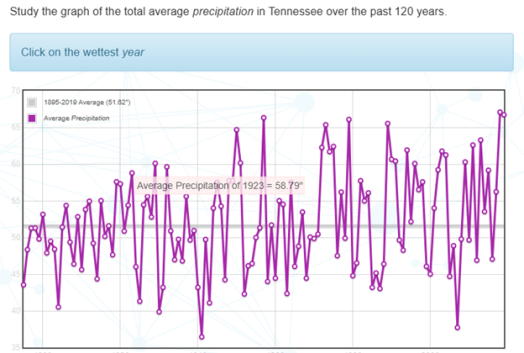
Temperatures in Tennessee have increased very modestly, about 0.5℉ over the past century. This is significantly below the national average rise in temperature and is likely due in large part to the Urban Heat Island effect from the growth of Tennessee’s large and midsized cities. In fact, Tennessee’s maximum high temperature was set and matched on two dates in 1930, more than 90 years of climate change ago.
Concerning forests, the data are clear that urban development and agriculture have replaced forests in some areas. But overall, the amount of forested lands has increased from lows set after initial European settlement, when many forests were cleared for small scale farming and grazing. In fact, forests cover approximately 52 percent of Tennessee, with rebounding coverage over the past 100 years. Natural forest coverage has doubled over the last century from 25 percent.
What’s more, connected forest cover and better precipitation has produced improved ecosystem conditions for bears, including increased animal and plant food sources, which largely explain Tennessee’s growing bear population.
Since modest warming over the past hasn’t made habitat and ecological conditions worse for bears in Tennessee, but rather has improved such conditions, contributing to a growing population, climate change can’t be “threatening” bear survival, as Eggers claims in her WPLN story.
Had Eggers not tried to drag climate change into her WPLN story about problems some Tennesseans are having with bears, she might have written a valuable and interesting story. She could have explained the dangers bears face due to urban expansion, some people’s propensity to think of bears as cute and feeding them, and poor garbage storage – all of which have led to problem bears and human/bear conflicts. Instead, she opened with a misleading, but perhaps attention-grabbing headline, and then wandered off the trail in an effort to feed the narrative popular with the media that “climate change causes everything bad.” In this case, that climate change is harming bears—despite clear evidence the black bear population is flourishing amid climate change. There is no trend or evidence, none at all, suggesting this will change in the foreseeable future.
RT | June 7, 2026
Iran has fired a missile barrage at Israel in retaliation for its continuing campaign in Lebanon against the Hezbollah militant group.
The attack occurred late on Sunday, following days of bombing and ground operations in southern Lebanon by the IDF, including intensive aerial bombardment of the capital, Beirut. The Israeli onslaught has continued despite the truce declared more than six weeks ago, with the attacks intensifying over the past week. Tehran has repeatedly demanded that West Jerusalem stop, making its own negotiations with the US conditional on a working ceasefire in Lebanon.
The IDF said that it identified multiple incoming projectiles and activated anti-aircraft defenses at multiple locations. Footage circulating online purports to show Iranian missiles soaring over eastern Lebanon, while some projectiles were observed from the Lebanese capital.
Iran stated that the attack was merely a “warning” to Israel and more “crushing blows” would follow should it continue with the attacks on Lebanon.
“If it expands its attacks in that region or responds to Iran’s action, it will be met with even more crushing and regrettable blows, and devastating attacks will be launched against the regime and its supporters,” Iran’s Khatim Al-Anbiya operational headquarters said in a statement circulated by local media.
Multiple media reports indicated Israel scrambled to retaliate for the attack, with some outlets suggesting it has sought greenlight from the US to strike Iran’s energy facilities. While no official reaction to the development has been provided, multiple senior Israeli officials have vowed revenge for the strikes.
“Tonight Tehran must burn!” Israel’s far-right National Security Minister Itamar Ben-Gvir wrote on X.
US President Donald Trump has called on both sides to show restraint, telling Fox News that the Israeli attacks on Beirut were not coordinated with Washington. At the same time, he urged Tehran to stop and get back to negotiations and to strike a “deal.”
Axios reporter Barak Ravid said on X that Trump told him he was calling Israeli Prime Minister Benjamin Netanyahu “right now and telling him not to attack Iran in response.”
Earlier in the day, Israel struck Beirut’s southern suburbs without the warning usually issued by the IDF prior to attacking densely populated areas. At least two people were killed and 20 wounded in the strike on a residential building, according to the Lebanese Health Ministry.
By Trita Parsi | June 7, 2026
A fragile arrangement had been reached in Lebanon. Iran had made clear that if Israel continued to strike Lebanon, it would strike at Israel.
The US/Israeli side says that overnight, Hezbollah killed 15 Israeli soldiers. A violation of the arrangement in their view, and a sign that Iran either didn’t or couldn’t control Hezbollah.
At the same time, Israel knew that renewed attacks on Beirut, particularly Dahieh, would either force Tehran to attack or back down, while having the added benefit of further weakening US-Iran diplomacy.
Iran did not back down. An attack on Dahieh, according to the Iranians, is designed to kill as many senior Hezbollah and Iranian officials as possible. So a response was inevitable, in their view.
By now, four waves of missiles have been fired at northern Israel, Haifa, and other areas. Some of the missiles are of higher quality than the ones Iran used during the war.
Israel will strike Iran within the next few hours, and the Iranians don’t have any other expectation.
Whether the US enters the fighting actively as well, or only provides support for Israel, is the big question mark right now.
The US side is deeply frustrated that the MOU has not been signed yet and accuses the Iranians of either playing for time, overnegotiating, or being incapable of getting to yes.
The Iranians, in turn, accuse the US of constantly changing the parameters while being unwilling to release a portion of Iran’s frozen assets at the outset of the MOU as a way to prove their seriousness.
If Trump doesn’t enter the war, he will be accused of abandoning Israel. If he enters the war, he will validate that Israel has an effective veto on the negotiations and on whether the US is at war or not.
A true America First policy would have worked to extricate the US from the Israeli-Iranian rivalry.
Now more than ever, it should be clear why such an exit serves US interest.

or go to
Aletho News Archives – Video-Images
Reknowned economist M. Shahid Alam offers this excellent critique of Noam Chomsky’s defective analysis of the relative influence of Oil versus the Israel lobby over US foreign policy: … continue
 Aletho News If Americans Knew No Tricks Zone
