Robert F Kennedy Jr. Calls CBDCs “Instruments of Control and Oppression”
By Ken Macon | Reclaim The Net | June 26, 2023
In an interview with The New York Post, Robert F. Kennedy Jr., a Democratic Party presidential candidate, took a deep dive into the topic of currency. He unfolded his candid views on Bitcoin, expressed trepidations over central bank digital currencies (CBDCs), and rang the bell of caution around artificial intelligence (AI).
Kennedy plans to “support Bitcoin and the freedom to transact,” and enable individuals to wield command over “Bitcoin wallets, nodes, and passwords.” In his world, regulatory fetters would be whittled down to the bare essentials to curb money laundering.
Kennedy also locked horns with Biden’s proposed crypto tax, a formidable 30%, and sounded the alarm against CBDCs.
His argument on CBDCs was clear-cut – CBDCs, in his estimation, are “instruments of control and oppression, and are certain to be abused.” He’s not alone in this battle-cry; his rival from the Republican stables, Ron DeSantis, shares a kindred spirit.
His disquiet was not merely consigned to the domain of cryptocurrency; artificial intelligence was equally ensnared in his critical lens. Kennedy called for the global harnessing of AI, citing figures like Elon Musk, whose advocacy for free speech he commended. The omens, as he foresees, are grave – where AI’s formidable might could “control narratives, create illusions, surveil our activities to dictate our behaviors and enforce compliance, and ultimately enslave humanity.”
Facebook Trusts Former CIA Analyst To Manage Election Policies

By Dan Frieth | Reclaim The Net | June 26, 2023
Meta recently appointed Aaron Berman, an ex-CIA agent, to take charge of its Elections Policies. Berman, who previously led the misinformation team at the company during the 2020 elections, now occupies a prominent position with extensive oversight over elections-related content across the globe.
The move is part of the revolving door between the intelligence community and social media platforms.
Aaron Berman boasts a career that spans nearly two decades with the CIA, from March 2002 to July 2019, Breitbart reported. During his tenure, he wielded significant influence, assuming various roles including editing and writing for the President’s Daily Brief – a high-profile classified document prepared every morning for the President of the United States by the intelligence community. Besides this, he supervised numerous analysts and managed multimillion-dollar budgets. His wide-ranging duties also encompassed providing briefings to members of Congress and the National Security Council.
After his extensive tenure with the CIA, Berman joined Facebook in 2019. Here, he took on the role of Senior Product Policy Manager for “misinformation.” He was instrumental in constructing the misinformation policy team’s workforce in the US and implementing policies during what he refers to as “critical events.” Although Berman has not specified the nature of these events, his stint at Facebook’s misinformation department coincided with the period leading up to the 2020 election, which was marred by controversies such as suppression of voices and news outlets.
Now as the Head of Elections Policies, Berman has wide-ranging responsibilities, as described on his LinkedIn profile: “Leads a team responsible for elections-related content policies worldwide. Oversees policy development, advises senior executives, coordinates with teams on implementation via technical and human workflows, and represents Meta with external stakeholders. Puts policies into practice on key elections.”
Democrats Call on YouTube To Bring Back Its Election Censorship Rules
By Dan Frieth | Reclaim The Net | June 26, 2023
A ripple of indignation surged through the Capitol this Thursday as some lawmakers pushed against YouTube and its parent colossus, Alphabet Inc. At the heart of the issue is the tech behemoth’s about-face on its election misinformation policy, a move that emerges as a tinderbox in the countdown to the presidential race next year.
The fury emanated from the news that YouTube has decided to slacken its policy reins, no longer acting as the all-mighty censor against videos questioning the the sanctity of the 2020 presidential elections. The revelation, made through an announcement from YouTube, was met with the usual complaints from four high-profile Democrats of the US House of Representatives Energy and Commerce Committee. Among the voices was that of Ranking Member Frank Pallone Jr. (D.-NJ) who, along with his cohorts, denounced YouTube’s maneuver and demanded the tech giant retract this new stance.
In a letter, the lawmakers articulated their dissent, stating, “While you claim that taking such action is ‘core to a functioning democratic society,’ we emphatically disagree.”
We obtained a copy of the letter for you here.
They lambasted the policy relaxation as perilous and branded it a dagger pointed at the heart of American democracy, pressing YouTube to review this “harmful policy decision.”
YouTube’s silent watch was palpable as a spokesperson offered no rejoinder to the avalanche of criticism.
Dissecting the June 2nd announcement, YouTube’s reversal appears to be rooted in an introspective contemplation of its policy’s past efficacy and consequences. After purging of tens of thousands of videos, and a whole election cycle within its purview, the platform seems to have had an awakening. Perhaps censoring stuff isn’t good after all, they suggest, hopefully realizing that they were the baddies all along.
They believe the policy, initially started as a bulwark against election denialism, might inadvertently muzzle political speech without significantly stymieing the risk of violence.
However, the democratic lawmakers rebuked YouTube’s newfound stance as perilous, asserting that content discrediting the legitimacy of recent elections has already wreaked havoc upon democracy.
Since when has free speech been antithetical to democracy?
Republicans ‘Too Afraid’ to Remove Adam Schiff From Office Over Russiagate Hoax
By Andrei Dergalin – Sputnik – 25.06.2023
Despite being censured in the US Congress, Adam Schiff is in fact doing pretty well for himself and is likely going to “get a promotion for lying to the American people for four years,” says a former Colorado state senator.
The US House of Representatives voted to censure Democratic Rep. Adam Schiff this week for his role in promoting unsubstantiated claims that former US President Donald Trump colluded with Russia.
Former Colorado Senator Ted Harvey (Rep.), however, argued that Schiff deserves worse for essentially lying to the American people while in the capacity of the House Intelligence Committee head.
Despite basically knowing that there was no substance to allegations of Trump colluding with Russia, Schiff told the US public that there was “ample evidence of collusion between the Russian government and the Trump campaign,” Harvey told Sputnik.
“That is everything Schiff said to the American people for four years as the chairman of the intelligence community, he should not just be censured. He should be removed from office,” he said.
Alas, Harvey lamented, the US Republicans are simply “too afraid” to pursue this course of actions and instead managed to make a “martyr” out of Schiff.
“And he is raising money by the boatloads and he is now running for the United States Senate and will get a promotion for lying to the American people for four years,” Harvey mused about Schiff’s prospects. “And instead of being held accountable for that, he’s going to be promoted for that.”
During his tenure as the 45th president of the United States, Donald Trump was hounded by allegations of colluding with Russia in order to be elected in 2016, with said allegations being actively promoted by his political opponents.
Despite the seriousness of the allegations brought against him, an investigation into the alleged Russian election interference led by special counsel Robert Mueller failed to produce conclusive evidence to back claims that Trump campaign members conspired with Russia.
Fragmentation of World Economy Now Irreversible – Russia’s Representative at IMF
Sputnik – 25.06.2023
The use of international trade and the dollar as a weapon by the West makes the fragmentation of the world economy inevitable, Aleksei Mozhin, Executive Director for Russia at the International Monetary Fund (IMF), told Sputnik.
“The blatant use by the West as a weapon of international trade, finance, as well as the dollar and the euro itself, makes the fragmentation of the world economy not only inevitable, but also irreversible,” Mozhin said.
He pointed out that Western representatives at the IMF are trying to avoid this problem, and the leadership of the international organization cannot ignore the pressure that Western participants are exerting on it. As an example of the fragmentation of the world economy Mozhin mentioned the consequences of Western sanctions introduced against Russia.
“We have learned this lesson, we will never allow ourselves to be so dependent on imports again, at least in the strategic sectors of the economy,” Mozhin told Sputnik, adding that the whole world is now aware that globalization is forcing all countries to follow the path of specialization to the detriment of economic diversification and that the process of deglobalization will continue.
Clinical Trial to License RotaTeq, Like Almost All Childhood Vaccines, Did Not Use a Placebo Control
Those attacking RFK are wrong
BY AARON SIRI | INJECTING FREEDOM | JUNE 25, 2023
Robert F. Kennedy, Jr. is on record stating that almost all childhood vaccines were licensed based on clinical trials that did not include a placebo control. He is correct.
Nonetheless, numerous news outlets, such as Stat News in its article titled “Correcting Robert F. Kennedy Jr.’s vaccine ‘facts’”, are stating Mr. Kennedy is wrong because they claim the clinical trial relied upon to license the rotavirus vaccine, RotaTeq, did include a placebo control. They are wrong.
A placebo is defined by the CDC as a “substance or treatment that has no effect on living beings.” This means a saline injection or water drops in mouth.

RotaTeq is administered via oral drops. A “placebo” would have been water drops in the mouth. The control used in the trial, however, included bioactive ingredients including almost all the ingredients in the RotaTeq vaccine itself.
How do I know this? Because in 2018, on behalf of ICAN, we were investigating the control used in each clinical trial relied upon by the FDA to license each childhood vaccine.
In that review, we found that while the package insert for the RotaTeq vaccine says the control in its clinical trial was a “placebo,” when we read the FDA’s clinical trial review for RotaTeq, the ingredients of this so-called “placebo” were redacted:
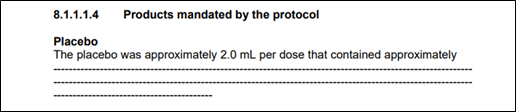
So, on behalf of ICAN we submitted a Freedom of Information Act Request to the FDA for “Documents sufficient to identify the ingredients of the ‘placebo’ in the prelicensure clinical trials identified in Section 6.1 of the package insert for RotaTeq.”
In a response dated June 14, 2018, the FDA provided the requested documents which clearly show that the control was not a placebo. Rather, it included polysorbate-80, sodium citrate, sodium phosphate, and sucrose.

These same four ingredients are also contained in RotaTeq. The only difference between the vaccine and the control is that RotaTeq also included tissue culture medium and rotavirus reassortments. So, bottom line: the control used in the RotaTeq clinical trial was not a placebo since it included bioactive ingredients.
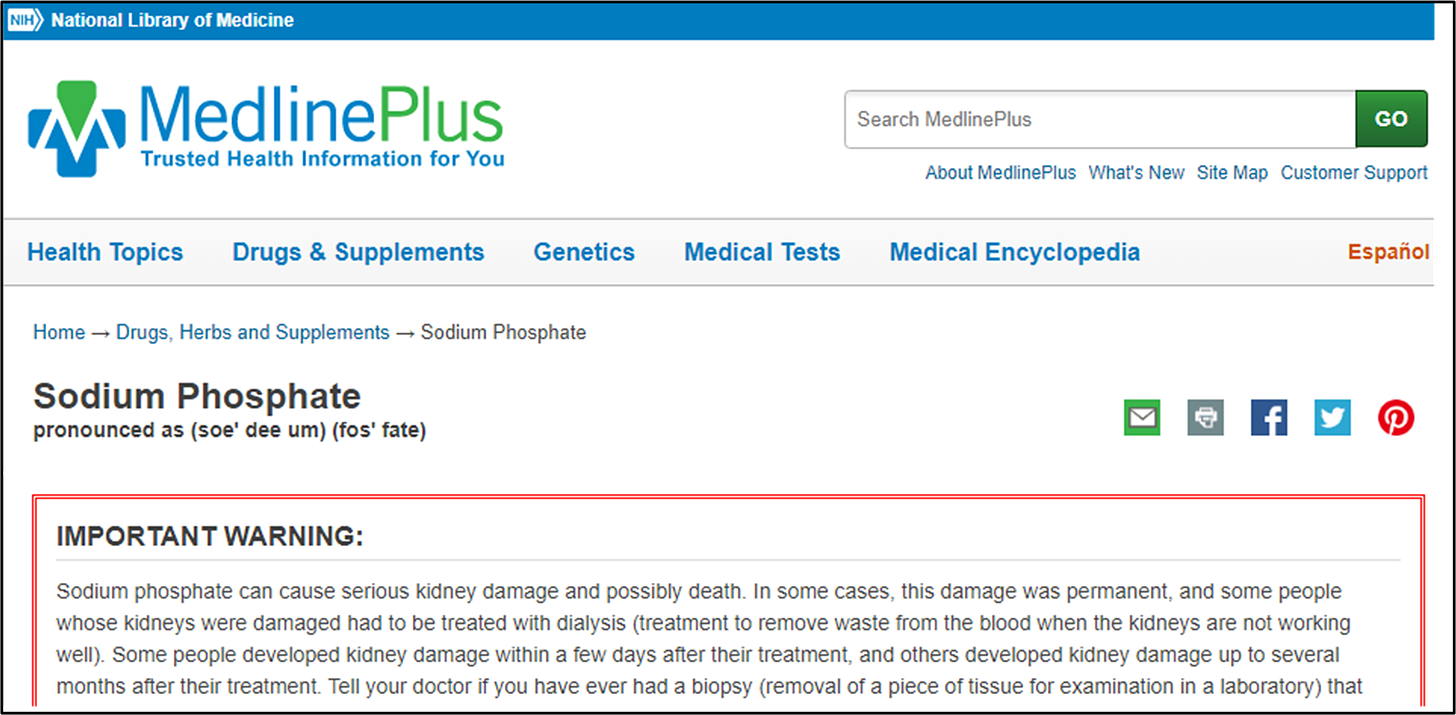
For example, here is what the NIH explains about sodium phosphate, one of the ingredients in the control:
Sodium Phosphate can cause serious kidney damage and possibly death. In some cases, this damage was permanent, and some people whose kidneys were damaged had to be treated with dialysis (treatment to remove waste from the blood when the kidneys are not working well). Some people developed kidney damage within a few days after their treatment, and others developed kidney damage up to several months after their treatment.
And as these studies and data sheet make clear, polysorbate-80 is far from an inert substance, is bioactive, and can have safety concerns, especially when given to infants.
Bottom line, Robert F. Kennedy, Jr.’s claim that virtually all childhood vaccines were licensed based on clinical trials that did not include a control group that received a placebo is correct. The undisputable evidence for this claim, all from FDA or pharma sources, is detailed on pages 3 to 7 of a response we sent to HHS on December 31, 2018. (In sharp contrast to virtually all other childhood vaccines, the clinical trial relied on to license Pfizer’s Covid-19 vaccine for teenagers 12 to 17 years of age appears to have had a placebo control group, though we are still reviewing that claim.)
Here are copies of the charts from that 2018 response to HHS which show what the control group received in each clinical trial for each childhood vaccine:
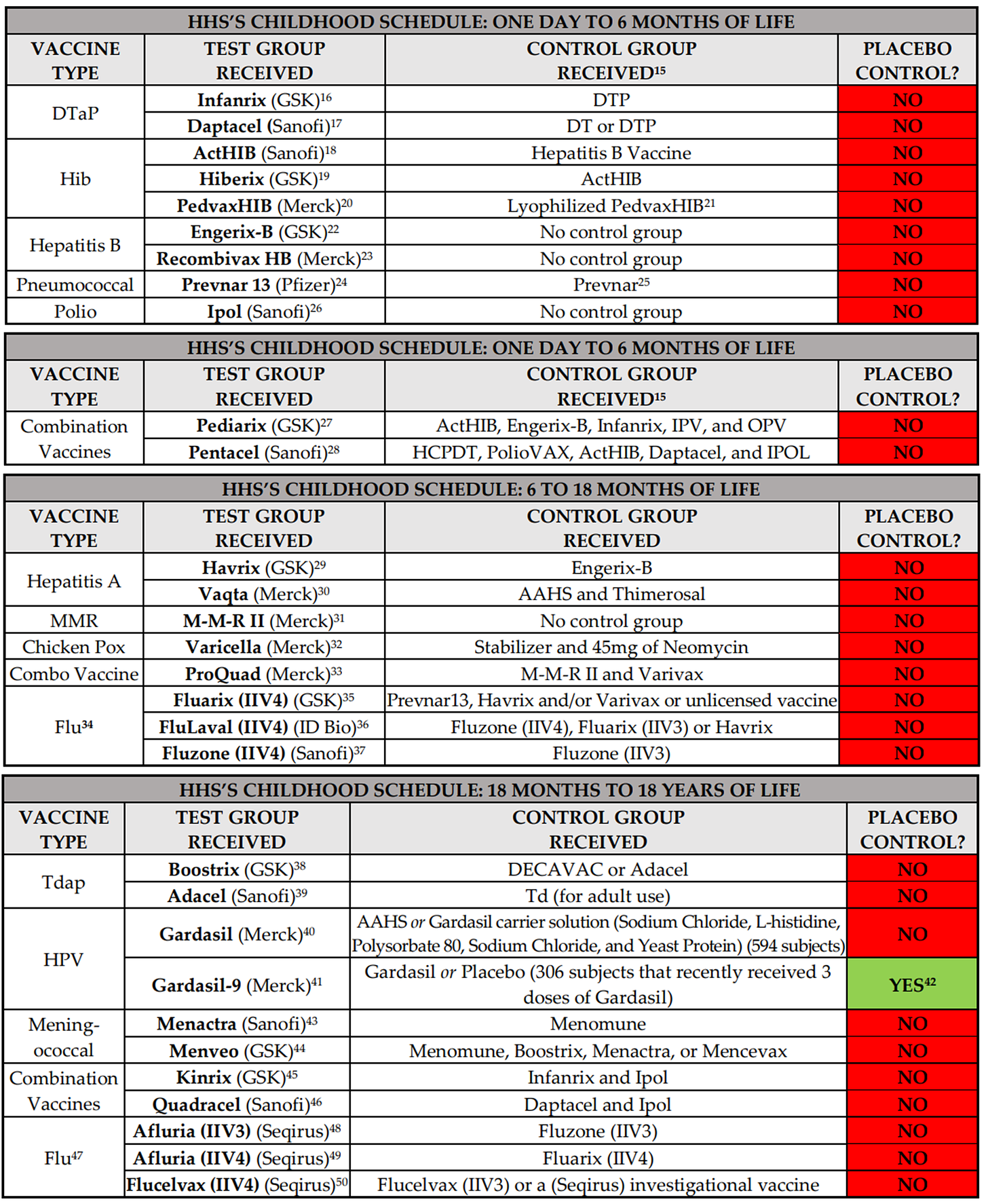
It is also why the following claim by Dr. Paul Offit in his article “Should Scientists Debate the Undebatable” is categorically false: “All vaccines are tested in placebo-controlled trials before licensure.”
I would more than welcome a public debate with Dr. Offit on this point and would welcome being proven wrong – would gladly prefer that products injected into babies not have this safety gap. Oh, but wait, Dr. Offit says it is undebatable, which again shows precisely why there must always be complete, uncoerced choice when it comes to any medical product.
What is really incredible about the attacks on Mr. Kennedy is that he has made clear he has no intention of changing anyone’s right to obtain vaccines. Everyone who wants to keep vaccinating will be free to do so. He just wants to assure freedom of choice and help those who are injured by these products.
The media and medical profession’s attack on this position is callous. Just as they care about those injured by infectious disease, as Mr. Kennedy certainly does, they should also care about those injured by vaccines. Mr. Kennedy is clear that we can and should do both. And to his amazing credit, no amount of insult or attack has moved him from his position that we must protect every American, including those injured by these pharma products.
FDA Approves 2 New Diabetes Drugs for Kids — Critic Says Clinical Trial Sample Was ‘Shockingly Low’
By Suzanne Burdick, Ph.D. | The Defender | June 23, 2023
The U.S. Food and Drug Administration (FDA) this week approved two drugs to treat Type 2 diabetes for children ages 10 and up, “as additions to diet and exercise,” the agency said.
The drugs — Jardiance (empagliflozin) and Synjardy (empagliflozin and metformin hydrochloride) — previously were approved for adults with Type 2 diabetes to improve blood sugar control.
They join metformin, approved in 2000 to treat Type 2 diabetes in children.
“Compared to adults, children with Type 2 diabetes have limited treatment options, even though the disease and symptom onset generally progress more rapidly in children,” said Michelle Carey, M.D., MPH, associate director for therapeutic review for the Division of Diabetes, Lipid Disorders, and Obesity in the FDA’s Center for Drug Evaluation and Research.
But critics like pediatrician Dr. Elizabeth Mumper said the agency’s action ignores the root causes of Type 2 diabetes in children while generating profits for pharmaceutical companies:
“Rather than doing the hard work of preventing chronic diseases by cleaning up multiple environmental sources of harm to children, we allow the pharmaceutical industry to spend millions to develop drugs that do not address root causes of conditions like diabetes but do create lifelong medicine customers.”
Mumper, the former medical director of the Autism Research Institute, said “a pill for every ill” is “not a good strategy for pediatric care.”
Type 2 diabetes used to be called “adult-onset diabetes” — but now we are seeing it in younger and younger ages, Mumper told The Defender. In her state of Virginia, 31% of children are overweight or obese, she said.
“This is a clear risk factor for insulin resistance progressing to Type 2 diabetes,” Mumper said, adding:
“We are redefining normal by assuming Type 2 diabetes is a reasonable condition in children to treat with medicine instead of attacking the root causes of this ever-increasing chronic condition.
“We continue to allow Big Food to sell food-like products which are devoid of nutritional value and filled with sugar and bad fats that are addicting and proinflammatory.”
‘System is rigged for Big Food and Big Pharma, with kids … as the losers’
Nina Teicholz, author, science journalist and founder of The Nutrition Coalition — a “non-profit, non-partisan educational organization that aims to improve health in America by ensuring that the public receives evidence-based nutritional advice” — also emphasized the importance of diet in successfully preventing and managing Type 2 diabetes.
Commenting on the FDA’s new drug approval, she said, “This is another Pharma victory, promoting drugs while ignoring diet,” adding:
“The system is rigged for Big Food and Big Pharma, with kids, getting fatter and sicker, as the losers.”
We’ve known for more than a decade that people can safely reverse their Type 2 diabetes through diet alone — “within a matter of just weeks,” Teicholz said. “But multiple government agencies ignore this lifesaving science while the FDA approves drugs instead.”
Adult participants in a 2017 peer-reviewed study who used a ketogenic diet to manage their blood sugar levels reported a 1.0% reduction in their hemoglobin A1c — while reducing their medications — and were still sustaining that reduction one year later, Teicholz said.
In contrast, the FDA safety and efficacy trial of empagliflozin — the active ingredient in the two newly approved products — showed the drug reduced the recipients’ hemoglobin A1c by 0.2% in 26 weeks.
According to the authors of a study released Thursday:
“Type 2 diabetes, which makes up the bulk of diabetes cases, is largely preventable and, in some cases, potentially reversible if identified and managed early in the disease course. However, all evidence indicates that diabetes prevalence is increasing worldwide, primarily due to a rise in obesity caused by multiple factors.”
The study, published in The Lancet, projected the number of adults with Type 2 diabetes will more than double — to 1.3 billion — by 2050.
‘Shockingly low’ clinical trial sample size makes it impossible to assess adverse events
Commenting on the FDA’s safety and efficacy trial for the drugs, Brian Hooker, Ph.D., P.E., senior director of science and research for Children’s Health Defense, told The Defender :
“The sample size for this clinical trial is shockingly low. Given that 157 patients were split into three separate treatment groups, it was impossible to properly assess adverse events from the drug.
“I would expect that the trial be at least 10 times larger with a longer period of follow-up than 26 weeks, given that these children would be on the drug indefinitely.”
According to the product’s website, Jardiance can have serious side effects, including increased ketones in blood or urine — which may be accompanied by nausea, vomiting, abdominal pain, tiredness and breathing difficulty, allergic reactions, dehydration, serious urinary tract infections, yeast infections, low blood sugar and necrotizing fasciitis.
Necrotizing fasciitis is “a rare but serious bacterial infection that causes damage to the tissue under the skin in the area between and around your anus and genitals (perineum),” the company said.
Synjardy listed the same possible side effects, plus a possible deficiency in vitamin B12 caused by using metformin for long periods of time.
The drugs are manufactured by insulin producer Eli Lilly and its partner Boehringer Ingelheim.
Eli Lilly’s revenue for the quarter ending March 31 was $6.960 billion.
The pharmaceutical industry in 2022 funded about 75% of the FDA’s drug division, The New York Times reported.
Meanwhile, the FDA said that based on the results of a “SEARCH for Diabetes in Youth” study involving more than 27,000 youth, the incidence of Type 2 diabetes in children increased by 4.8% per year from 2002 to 2015 and is expected to continue increasing.
The agency did not comment on why researchers believe the rate of Type 2 diabetes in kids is expected to rise but noted:
“As of 2017, there were approximately 28,000 cases of Type 2 diabetes in children in the U.S.
“By 2060, if current trends continue, that number is predicted to be approximately 220,000, with the majority of cases occurring in minority racial and ethnic groups such as Non-Hispanic Blacks and Hispanics.”
Additionally, the FDA last year approved the first drug designed to delay the onset of Type 1 diabetes for children as young as 8 years old.
Suzanne Burdick, Ph.D., is a reporter and researcher for The Defender based in Fairfield, Iowa. She holds a Ph.D. in Communication Studies from the University of Texas at Austin (2021), and a master’s degree in communication and leadership from Gonzaga University (2015). Her scholarship has been published in Health Communication. She has taught at various academic institutions in the United States and is fluent in Spanish.
This article was originally published by The Defender — Children’s Health Defense’s News & Views Website under Creative Commons license CC BY-NC-ND 4.0. Please consider subscribing to The Defender or donating to Children’s Health Defense.
Trump’s 2024 lead widens after latest indictment
RT | June 25, 2023
Donald Trump’s lead over his nearest Republican opponent for the party’s 2024 presidential nomination has nearly doubled since the former US president was indicted on federal charges earlier this month, a new poll has shown.
The NBC News survey, released on Sunday, shows that Trump is the first choice for 51% of Republican primary voters, compared with 22% for Florida Governor Ron DeSantis and 7% for former vice president Mike Pence. Trump’s 29-point lead over DeSantis compares with a 15-point margin when the same poll was done in April.
Pollsters began the latest survey on June 16, a week after the ex-president was charged with 37 felonies by a US Department of Justice (DOJ) special prosecutor over his alleged mishandling of classified documents. Trump has tried to turn the case to his political advantage, just as he did after a New York City prosecutor charged him in April for allegedly falsifying business records.
“Every time the radical-left Democrats, Marxists, communists and fascists indict me, I consider it a great badge of courage,” Trump told supporters on Saturday at a Christian voter conference in Washington. “I’m being indicted for you, and I believe the ‘you’ is more than 200 million people that love our country.”
A Harvard CAPS-Harris poll released earlier this month showed that Trump leads incumbent President Joe Biden by a margin of 45% to 39% in a hypothetical 2024 rematch of their 2020 race. An Emerson College poll released on Thursday found that a third-party candidate, such as philosopher and activist Cornel West, would draw support away from Biden, giving Trump an advantage.
Results of the NBC News survey suggest that the federal indictment has made Trump even more politically polarizing. While 21% of respondents said they have a “very positive” view of him, up from 17% in April, 49% gave a “very negative” assessment, up from 44% previously.
Just 20% of US voters believe the nation is on the “right track” under Biden, down from 23% in January. At the same point in Trump’s presidency, the number was 33%. Just 18% of voters have a “very positive” view of Biden, down from 29% in the early days of his presidency, the poll showed.
The current and former vice presidents, Kamala Harris and Mike Pence, have even lower favorability ratings. Only 11% of voters have a “very positive” view of Harris, while Pence’s rate is even worse, at 3%. DeSantis went from a 19% “very positive” rate in September 2022 to 14% this month.
Voters also give low marks to the DOJ, with 14% rating the department very positively, down from 18% in the most recent reading before Trump’s indictment.
The US can’t stop the rise of Iran, but it can make a truce
By Timur Fomenko | RT | June 25, 2023
In 2018, the Donald Trump administration ripped up the Joint Comprehensive Plan of Action (JCPOA), known as the “Iran nuclear deal,” which had been signed by his predecessor Barack Obama.
The decision to scrap the deal was thoroughly influenced by neoconservative members of his cabinet, including National Security Advisor John Bolton and Secretary of State Mike Pompeo, who not only saw the opportunity to take a swipe at Trump’s predecessor, but argued that placing crippling unilateral sanctions on Tehran would bring the country to the negotiating table, and if not, bring the regime down altogether.
Thus began a five-year campaign of brutal pressure against Iran, which sought to destroy its economy and attempted to coerce third-party countries away from doing business with it. But the initiative didn’t go according to plan. Rather, the world changed. The flagrant disregard of international law by Washington was a catalyst in the emergence of de-dollarization. The global shake-ups that came next, including the Covid-19 pandemic, US competition with China, and the war in Ukraine, gave Tehran strategic space and leverage it had previously lacked.
Now, Iran has substantially increased its uranium enrichment, has continued to build its drone and missile capabilities, has an enhanced military relationship with Russia, and thanks to Beijing, has been able to normalize its relationship with its regional arch-rival Saudi Arabia. In the process of doing so, it has reduced the regional influence of the US and its partner, Israel. US foreign policy on Iran has revolved around exploiting regional tensions in order to justify its own security footprint, but Iran has seemingly been able to begin to supersede a campaign of US containment against it while not being overtly belligerent.
This has set alarm bells off in Washington. The US has been desperate to try and reinforce its relationship with Saudi Arabia, but has reportedly been engaging in secret negotiations with Tehran not to revive the JCPOA, but to keep it away from further uranium enrichment and off the nuclear path, a move which of course will have to come with sanctions relief. While the US, presumably with the support of Israel, has threatened unspecified military action if Tehran goes further, it seems clear that Iran now has all of the cards and that a temporary “truce” must therefore come at the expense of the US containment campaign.
Because of the regional dynamic shifting in its favor, Tehran is highly unlikely to actually go down the path to developing a full-fledged nuclear bomb, given the opportunities it would provide to Washington. Unlike a country like North Korea, Iran doesn’t truly need nukes in order to establish a doctrine of deterrence for its own regime’s survival. It is a large country with a population of over 80 million. While the United States could hypothetically conduct air or missile strikes on key Iranian facilities to try and impede its nuclear program, what the US could not do, especially in this environment, is a full-scale invasion and occupation of the country. It would cost trillions of dollars, and there would be no support for it.
Rather, Iran’s deterrence ability is premised on its drone and missile programs, which have grown in their capabilities over the years despite US sanctions. The country recently claimed to have developed hypersonic missiles, which while some skepticism is warranted, is not completely fictional. Tehran has, after all, in response to the assassination of Revolutionary Guards Corps commander Qasem Soleimani, shown its ability to destroy US military bases within its range, and therefore demonstrate what it could do to Israel if things turned nasty. In doing so, it is demonstrating that regardless of US sanctions, it is a significant regional player, and will continue to be.
US foreign policy towards adversaries has repeatedly attempted to seek maximum strategic gain, eschewing the idea of compromise, be it China or Russia. But when it comes to Iran, Washington is stumped on what to do without taking the risk of provoking a wider conflict. This is why the Biden administration is leaning towards giving in, knowing that the regional dynamic of the Middle East is shifting away from its favor, and taking punitive action which may provoke war is unwelcome. In other words, Iran is winning. The only question which remains is whether or not the US wants a truce or to keep pressuring Tehran until it snaps? Even if the outcome ends in a sheer stalemate, with no nuclear lines crossed, it’s still a lose-lose situation for Washington in the end as Iran re-establishes itself diplomatically.
DC Scholars: Ukraine Conflict Shows World Has Grown Weary of US Hegemony
By Ekaterina Blinova – Sputnik – 24.06.2023
Despite having the largest military budget in the world and being the largest operator of military bases abroad, the US is far from being a global hegemon, argues a DC-based think tank Quincy Institute for Responsible Statecraft.
Over the past decades Washington has demonstrated a capacity for mass destruction – in Korea, Vietnam, Afghanistan, Iraq, Libya and elsewhere – but “it has won no more than Pyrrhic victories” which led to the erosion of trust in Pax Americana both at home and abroad, according to Responsible Statecraft scholars.
The US military spending reached $876.9 billion in 2022, while the nation also operates a whopping 750 foreign military bases. Still, Washington is incapable of persuading the Global South to join anti-Russia sanctions over the latter’s special military operation in Ukraine, the think tank remarks. “If hegemony means the capacity to get other countries to comply with one’s demands, the United States is far from being a global hegemon,” the report notes.
Judging from the so-called Pentagon leak, even some US allies and partners demonstrated hesitance and unwillingness to provide the Kiev regime with shells, jets and armored vehicles. Meanwhile, most nations of the Global South shrugged off the US calls for slapping sanctions on Moscow as contradicting their national interests.
US political observers emphasize that six nations in the Global South – namely, India, Brazil, Turkey, Indonesia, Saudi Arabia, and South Africa – are set to decide the future of geopolitics and insist that the Biden administration needs to win their hearts and minds. At the same time, European commentators argue that developing nations have the right to remain neutral and non-aligned.
For instance, in June 2022, India’s External Affairs Minister Dr S Jaishankar shredded the West’s claim that New Delhi was “sitting on the fence.” According to the minister, India is entitled to its opinion when it comes to the Russo-Ukrainian conflict.
Likewise, the Association of Southeast Asian Nations (ASEAN) has chosen to collaborate with both the US and China, instead of taking sides. Moreover, ASEAN nations are active participants of Beijing’s Belt and Road Initiative (BRI) regardless of Washington’s attempts to maintain its dominance in the region and curb China’s influence in the Asia Pacific.
Per DC scholars, the emerging trend was articulated by Brookings Institution fellow Fiona Hill, former Deputy Assistant to the President of the United States, in May 2023:
“The war in Ukraine is perhaps the event that makes the passing of Pax Americana apparent to everyone. … [Other countries] want to decide, not be told what’s in their interest. In short, in 2023, we hear a resounding no to US domination and see a marked appetite for a world without a hegemon,” she said at a conference in Tallinn, Estonia
According to Hill, the Global South’s resistance to the US and the EU’s demands to slap sanctions on Moscow is nothing short of “an open rebellion.” She noted that “this is a mutiny against what they see as the collective West dominating the international discourse and foisting its problems on everyone else, while brushing aside their priorities on climate change compensation, economic development, and debt relief.”
Western observers also acknowledge that the world’s center of gravity is steadily shifting east, adding that the Biden administration has so far sought to avert this trend by trying to establish “a lasting technological lead over China” and beefing up the US military in Western Pacific.
However, “most developing countries, including emerging powers in the Global South, are no longer willing to make zero-sum choices” between Washington and its geopolitical rivals, DC scholars underscore, urging American policymakers to accept the reality that the US is no longer “the indispensable nation.”
FDA responds to negative efficacy of variant boosters with another variant booster
By Daniel Horowitz – conservative review – June 21, 2023
The human experimentation of Operation Warp Speed was not an anomaly; it is the new normal, and the FDA is just getting started. The agency is now allowing the COVID vaccine manufacturers to change the formulation of their shots to continue to chase variants, themselves created by antigenic drift of the shots. And they continue to do so based on nothing more than measuring antibody titer levels. No human clinical trials necessary! Except, studies now show, and reality confirms, the more they chase variants, the more they create negative efficacy against the existing variant, thereby engendering a “need” for another formulation.
What was the response of the FDA to the increasing news of cataclysmic injuries and negative efficacy of the COVID shots for variants that are no longer dangerous? Last Thursday, the FDA’s VRBPAC unanimously approved a fall booster, advising Pfizer, Moderna, and Novavax to update their formulations for the so-called XBB.1.5 Omicron variant. So, officials pre-emptively approved a shot that doesn’t exist based on antibody level testing without human trials – all for a variant that not only is not dangerous but will actually be extinct by the time this poison reaches the market, just as they did with the bivalent formulation for the BA.4 and BA.4 variants.
To this day, the bivalent shot is the only one available, and according to the CDC, that variant doesn’t even exist! It is true that very few people are dumb enough to get this shot, but what they are trying to do is create an endemic schedule of COVID shots to time perfectly with the flu shots in the fall. They have already groomed people over the generation to “get their flu shot” every fall. So now the pharmacies will be waiting with the COVID needle to complete their seasonal updates.
So, what happens when you keep tricking the body to respond to a virus for strains that no longer exist? As the FDA approved these shots, the agency already had the peer-reviewed Cleveland Clinic study showing negative efficacy of the original COVID shots. Just days before this meeting, the Cleveland Clinic came out with a preprint showing negative efficacy for the bivalent booster shots too.
The study contrasted 11,990 employees of this venerable institution who chose to be “up to date” with the bivalent boosters compared to 36,344 employees who were “not up to date” and tracked their outcomes. It turns out that after about three and a half months, you were about 25% more likely to get COVID after having gotten the boosters as compared to the control group.
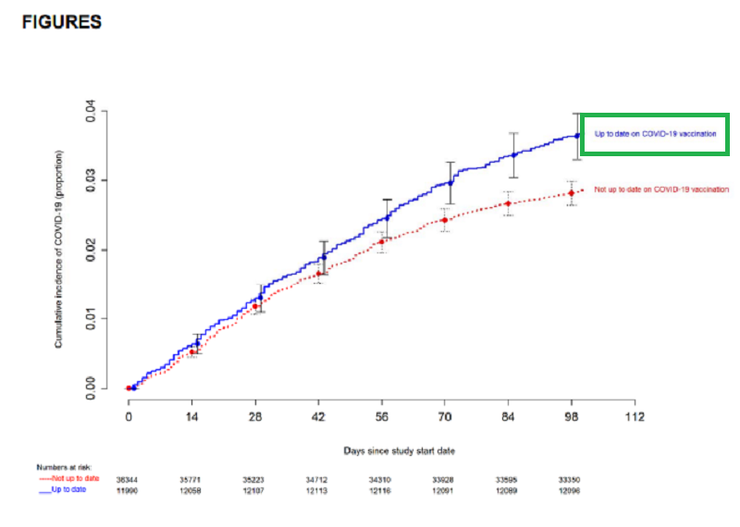
After adjusting for confounding factors between the groups, the study authors actually found a 33% rate of negative efficacy!
“This study’s findings question the wisdom of promoting the idea that every person needs to be ‘up-to-date’ on COVID-19 vaccination, as currently defined, at this time,” conclude the Cleveland Clinic researchers. They also observe, “It should be pointed out that there is not a single study that has shown that the COVID-19 bivalent vaccine protects against severe disease or death caused by the XBB lineages of the Omicron variant.”
The push for boosters comes at a time when more evidence proves a strong correlation between excess deaths and the vaccine take-up. A letter published in a peer-reviewed journal of Medicine and Clinical Science shows that Japan and Germany, two highly vaccinated countries, experienced sharp excess deaths coinciding with the vaccine take-up. They found very little excess death during the pandemic months before the vaccine was rolled out.
“It should be investigated to what extent the about 5%-10% highly significantly increased mortalities in Germany and Japan in 2021 and 2022 might be due to the pandemic countermeasures, including the vaccinations with their possibly underestimated immediate or protracted side effects,” concluded the researchers from Japan and Germany.
“From this point of view, it seems possible that a high vaccination rate has contributed to an increased all-cause mortality in some countries.”
The twisted irony is that, according to the CDC’s variant tracker, XBB.1.5 has gone from 80% of cases to less than 40% of cases in just a few months. It will clearly be obsolete by the fall. None of this was discussed at the FDA hearing. Of course, nothing about Pfizer’s own document showing five million cumulative reports of adverse events affecting every organ system was ever discussed. Hence, we have record injuries, negative efficacy, long-term immune imprinting causing the body to constantly respond inappropriately to wrong strains of the virus – all for a virus that is no longer deadly and for a population that has already gotten the virus!
That’s not just a lousy cost-benefit analysis; that is premeditated murder against the American people. What is the GOP plan to stop this? Or do Republicans even care? How can they continue to fund more COVID shots in the HHS appropriations bill, much less the broader FDA/CDC scheme to create new dangerous shots at warp speed?
Just how callously does the FDA regard human life? After its own VAERS system exploded with every adverse event imaginable, an outcome we now know officials anticipated, to this day they have not followed up on those safety signals. For example, according to the Informed Consent Action Network, the Standard Operating Procedures and Policies document for the FDA’s Vaccine Safety Team requires that its staff members identify VAERS adverse event reports that “need a rapid response and complex coordination,” after which they are supposed to “immediately” inform certain FDA management, who then alert other sub-agencies. Did that occur?
Well, more than a year after the ICAN’s record request, the agency responded, “A search of our records did not locate any documents responsive to your request.”
Where is the action from the House GOP? Why are they still only investigating the shutdown of schools in the past, but not the ongoing, premediated unleashing of deadly products on the American people?
Featured Video

Seyed M. Marandi: US-Iran War Inevitable: Kuwait and Bahrain May Fall
or go to
Aletho News Archives – Video-Images
From the Archives
Oil and the Israel Lobby
Reknowned economist M. Shahid Alam offers this excellent critique of Noam Chomsky’s defective analysis of the relative influence of Oil versus the Israel lobby over US foreign policy: … continue
Blog Roll
 Aletho News
- ICC ignored ‘very well-documented’ NATO crimes – ex-Libyan minister
- SNSC secretary dismisses US response to Iran’s conditions as ‘inadequate’
- Sanaa says Taiz roads open, secure for residents, warns Saudi forces
- Iraqi resistance group urges Saudi leadership to admit defeat, lift Yemen siege
- Trump’s Retreat: How Al-Aqsa Flood Took Down the US Empire
- Israel’s Military Actions in Lebanon Grossly Violate International Law — Lavrov
- Seyed M. Marandi: US-Iran War Inevitable: Kuwait and Bahrain May Fall
- Leaders Condemn Ansarallah Attack on Saudi Arabia While Ignoring Illegal War Against Yemen
- Leaked: Britain’s Covert Iraqi Psyops Network
- Yemeni Armed Forces Warn Airlines Against Using Saudi Airports, Exempt Mecca and Medina
- If Americans Knew
- How Israel Conquered the Latin American Right
- Agents search Rep. Omar’s Washington home in criminal probe as she vows she won’t ‘be silenced’
- “The Rule Was: ‘Shoot Everyone You See'”
- Israel goes ballistic over Nobel Laureate Navi Pillay
- U.S. May Join Yet Another Middle Eastern War — TCN
- Yellow Line moves again as Israel closes in on trapped Gazans – Daily Update
- Israeli Attacks Kill Seven Palestinians in Gaza Including Six-year-old Girl
- Gaza: Ceasefire Anniversary Marks Year of Failed Promises
- The American Conservative: Mike Huckabee Should Resign
- A C-Section in Shackles: A Palestinian Woman’s Harrowing Birth in Israeli Detention
- No Tricks Zone
- Germany’s Green Energy Debacle: High Energy Costs Force Kahla Porzellan to Close After 182 Years!
- New Study: 50 Years Of The Most Aggressive ‘Net Zero’ Policies Can Only Affect The Global Climate By 0.03°C
- US September “Heat” Was No Record…Many Records Set Decades Ago
- Latest European Green Energy Debacle; Portugal’s Largest Flagship Solar Park Insolvent!
- Green Energy Debacle: German Expert Professor Fritz Vahrenholt Warns Of Severe Economic And Social Consequences
- Two More Paleo Reconstructions Affirm Meters-Higher Sea Levels Across Ireland, Brazil 7000-6000 Years Ago
- New Study: Earth And Venus Surface Warmth Largely Explained By Convection And Lapse Rate, Not CO2 Or Radiation
- 2025 Nature Paper Claiming Worsening Global Drought Gets RETRACTED …Heavily Flawed
- New Study: ‘Global Drought Shows No Detectable Recent Acceleration Under Climate Warming’
- Economic Masterminds: German Socialists Suggest Taxing Productivity Gains Stemming From Using AI

