Ukrainian military lost most of the M2 Bradley AFVs that were used in its recent counter-offensive
By Ahmed Adel | June 13, 2023
Ukrainian soldiers said that most US-made M2 Bradley armoured vehicles were destroyed during the counter-offensive in the Zaporozhye region. According to AFP, the vehicles were destroyed just outside the small town of Orikhiv.
“Of nine vehicles attached to the group’s mechanised infantry unit — not the only one involved in the battle — six were wrecked, three damaged but repairable, and one was unscathed,” AFP reported, adding that a Ukrainian soldier said only “very small progress” was made against the Russian army.
“Who would be happy receiving those orders, ‘Go and take those Russian positions which are well protected’?” a senior officer, who asked not to be identified, said according to AFP.
In early June, Russian Defence Minister Sergei Shoigu said that in the direction of Zaporozhye, Ukrainian troops consisting of 1,500 fighters and 150 armoured vehicles tried to break through Russian defences but lost up to 350 troops and 30 tanks in two hours. The minister stressed that the Ukrainian brigade was stopped in all zones toward Zaporozhye.
With the Ukrainian offensive underway, Kiev has virtually no gains to show. In contrast, images of destroyed Leopard tanks and Bradley infantry fighting vehicles used by Ukrainian troops have circulated on social media. For this reason, several experts have warned about a heavy military defeat for Ukraine and another geopolitical failure for NATO, which again is resorting to intervention in remote territories outside its jurisdiction to achieve its objectives against Russia.
While the US and its allies have generously provided Ukraine with weapons and military vehicles during the current conflict, Ukrainian forces are institutionally and operationally incapable of successfully absorbing the wide and inconsistent array of equipment and weaponry on the battlefield.
Nonetheless, the US and the UK need Ukraine to launch a counteroffensive as they are the main financiers of Kiev’s escalation but are experiencing growing poverty and economic crises and therefore need to justify to their citizens the vast money sent to Ukraine.
Former Central Intelligence Agency agent and Executive Director of the Council for the National Interest, Philip Giraldi, warned that Western media are trying to make it appear that the Ukrainian counter-offensive is succeeding and that Ukraine’s forces are encroaching on Russian positions. In this sense, and despite what is happening on the battlefield, Giraldi stressed that US, UK, and German politicians are obliged to speak positively about the situation in Ukraine.
Despite the rhetoric, images of destroyed M2 Bradley infantry fighting vehicles and German-built Leopard 2A6 tanks abandoned and burning on the Ukrainian battlefield, the harsh truth about the futility of defeating Russia is starting to sink in. The reality is that Ukraine never had the capabilities to achieve its stated goal of piercing Russian defences to sever the land bridge connecting Crimea to Russia proper.
The Western hope was that Russia would be demoralised by these casualties and accept a negotiated end to the conflict on terms acceptable to Ukraine and its Western allies. Evidently, Ukraine and its allies have failed.
The genesis of this failure can be attributed to two things. First, the low opinion that Ukraine and its NATO allies had of the combat capabilities of the Russian Army and the forces deployed in the Zaporozhye region, and second, the unrealistic expectations placed on the NATO training and equipment that were provided to Ukrainian forces and assigned to the task of breaking through Russian defences.
It is reasonable to assume that, using intelligence assessments that highlighted perceived command and control weaknesses and low morale among Russian forces, NATO and Ukrainian military planners believed that Russian defences in the Zaporozhye sector would collapse under the weight of a NATO-style assault.
Although fighting in Zaporozhye is not yet over, initial results on the battlefield show that contrary to the expectations of Ukraine and its NATO partners, the Russian military professionally performed their tasks, decisively defeating Ukrainian forces. NATO and Ukraine gambled that Russia lacked the military capability to successfully implement its military doctrine, believing that Russian command teams lacked the necessary communications to coordinate the complex operations needed and that Russian forces — especially those that were recently mobilised — lacked the training and morale to perform well in stressful combat conditions.
NATO and the Ukrainian high command threw the Ukrainian brigades into the grip of the Russian defensive lines without adequate fire support, thinking that the Russians were unable to maximise their superiority in artillery and air power to neutralise and destroy the forces of Ukrainian attackers before they could generate the momentum expected. Instead, this led to the humiliating loss of most of the US-made M2 Bradley provided to the Ukrainian military for this front.
Ahmed Adel is a Cairo-based geopolitics and political economy researcher.
Dr. McCullough Testifies in the Pennsylvania Senate
Four Domains of COVID-19 Vaccine Injury Syndromes Revealed
By Peter A. McCullough, MD, MPH | Courageous Discourse | June 9, 2023
On Friday June 9, 2023, I returned to the Pennsylvania Senate on request by former military officer and American hero, Senator Doug Mastriano (R-33). The session was co-chaired by Senator Cris Dush (R-25). Co-presenters included Steve Kirsch, Founder of the Vaccine Safety Research Foundation, and attorney Tom Renz. I organized my comments along the lines of this outline:
- Update on the US design and blueprint of SARS-CoV-2 from Baric et al at the University of North Carolina, Chapel Hill, funding by the NIH and outsourcing of the research plans via the EcoHealth Alliance to the Wuhan Institute of Virology, in Wuhan, China.
- COVID-19 vaccine injury syndromes
- Cardiovascular
- Neurological
- Thrombotic
- Immunological
- Questions from Senators and Representatives answered
- Shedding
- Risk benefit analysis of COVID-19 vaccines
- Failure of vaccine efficacy
- Reason why SARS-CoV-2 was created
- Global results of mass indiscriminate COVID-19 vaccination—winners and losers
Permanent Apartheid in Palestine: This is why Israel wants to reactivate E1 Plan
By Ramzy Baroud | MEMO | June 12, 2023
The Israeli government is at it again, actively discussing the construction of thousands of illegal settlement units as part of a massive settlement expansion scheme known as E1.
Though Israeli construction in the East Jerusalem area has supposedly been halted under international pressure, the Israeli government has found ways to keep the plan alive.
It did so through constant expansion of the various settlements in the name of ‘natural expansion’, confiscation of Palestinian land and the ruthless yet routine demolition of Palestinian homes.
But why does Washington, Israel’s main defender and benefactor, oppose, at least verbally, the construction in E1, while turning a blind eye to illegal construction throughout the West Bank?
The answer lies in the fact that E1 will further expand the Jerusalem municipal boundaries, minimise any Palestinian demographic presence in the city (from the current 42 per cent to about 20 per cent), and prejudice any political solution that includes East Jerusalem.
East Jerusalem is a Palestinian city, occupied by Israel during the June 1967 war. It is recognized by the United Nations and international law as part of the Occupied Palestinian Territory. Israel should have neither legal rights nor jurisdiction there.
Washington, which rarely cares about the rights of Palestinians, is concerned that, without East Jerusalem as part of the political equation, any discussion of a ‘two-state solution’ will become forever obsolete.
In other words, the US is more worried about the political, not territorial consequences of the Israeli decision. Indeed, the US’s entire political program in Palestine and Israel is situated within the two-state solution template. Without it, Washington’s role would cease to serve any purpose.
This is precisely why US Secretary of State, Antony Blinken, criticized Israeli settlements during his speech to the American Israel Public Affairs Committee (AIPAC) on 5 June.
Though he covered the habitual US commitment to Israel’s security, describing it as “non-negotiable” and “ironclad”, he also warned against “any move toward annexation of the West Bank … disruption of the historic status quo at holy sites (and) the continuing demolitions of homes.”
These steps, and more, will “damage prospects for two states”, the cornerstone of US foreign policy in the Middle East.
Israel, on the other hand, is neither interested in a two-state, one-state nor any ‘solution’ to its military occupation and apartheid in Palestine. Instead, Tel Aviv is working towards a specific end, a formula of permanent domination, one that would satisfy its quest for ‘security’, demographic superiority and ‘defensible’ borders.
It matters little that Israel’s vision for its own border lines is largely inconsistent with international law. All that matters to the current, in fact, all Israeli governments, are the ‘national interests’ of the country’s Jewish population, whose future has been linked to the crushing of political aspirations and civil rights of the country’s native Arab, Palestinian inhabitants.
Jerusalem’s particular significance stems from two factors: one, its historical, spiritual, economic and administrative centrality to all Palestinians and, two, the fact that it has been the Holy Grail of Israel’s settler colonialism in Palestine for the last 75 years.
A quick look at the map of Occupied East Jerusalem is enough to explain Israel’s ultimate motive in the Palestinian city: Maximum land with an absolute Jewish majority.
For this to take place, much work has to be done, namely ensuring the territorial continuity between the massive illegal Jewish settlement of Ma’ale Adumim and Jerusalem.
Israel’s motives are not a secret. A long report by the Zionist Jerusalem Centre for Public Affairs champions and illustrates Tel Aviv’s objectives in detail. The report warns against allowing “security and urban discontinuity between Jerusalem and Ma’ale Adumim, or the reversion of Jerusalem to a border-town status … that would preclude the city’s eastward development.”
The reference to ‘eastward development’ is particularly dangerous, as many illegal Jewish settlements have purposely been planted in various parts of the West Bank, all the way to the Jordan Valley for the sole purpose of linking them all up, thus dividing the West Bank into two main regions, south and north.
Considering the current administration and ‘security’ divisions of the Occupied West Bank, a major territorial division will deny Palestinians any sense of physical continuity, let alone statehood. In other words, apartheid will become permanent and, from Israel’s perspective, also sustainable.
As for the westward expansion, connecting Ma’ale Adumim to the so-called “metropolitan Jerusalem” through construction in E1 will help Israel resolve a fundamental component of its expansionist strategy. According to the Zionist Jerusalem Centre, such a merger will “incorporate both settlement and security as two vital, complementary components of Israel’s national interest.”
And, wherever there is Israeli construction in Occupied Palestine, there is always the destruction of Palestinian properties and confiscation of land.
According to the European Union Office in Palestine, in 2022, 28,208 illegal settlement units “were advanced” in East Jerusalem and the West Bank, compared to 22,030 in 2021. A higher number is expected in 2023.
As for Palestinian home demolition, the United Nations Office for the Coordination of Humanitarian Affairs (OCHA) paints a grim picture: in the first quarter of 2023 alone, 290 Palestinian structures in East Jerusalem and the West Bank were demolished or seized. This represents an increase of 46 per cent, compared to the same period of the previous year.
East Jerusalem has had a major share of this destruction, specifically 95 homes and other structures between 1 January and 28 March, according to the World Council of Churches. The outcome has been the displacement of 149 Palestinians. Among them, 88 children have been rendered homeless.
The price of Israel’s major plans in East Jerusalem and the rest of the West Bank is not just humanitarian. It is essentially political, aimed at cutting off Palestinian communities from one another, isolating Jerusalem completely, and ensuring a Jewish demographic majority for generations to come.
Though Secretary Blinken tries to emphasise the danger of such actions to the two-state solution, the real danger lies in the fact that such measures threaten the very fabric of Palestinian society and the political future of the Palestinian people.
Israel’s quest to reactivate its E1 plan requires not just mere condemnation, but tangible and decisive action, especially as Benjamin Netanyahu’s far-right government is more unhinged than ever before.
Tel Aviv to Announce Plans For Thousands of New Settlement Units in West Bank
By Connor Freeman | Libertarian Institute | June 12, 2023
Israel has informed the White House that it intends to announce the planning and building of thousands of new settlement units in the occupied West Bank later this month, according to US and Israeli officials speaking to Axios. One of the sources told the outlet, at a minimum, the plan includes 4,000 new housing units being built in existing West Bank settlements.
The Joe Biden administration is ostensibly opposed to these moves as the settlements are seen as undermining prospects for a two-state solution in Palestine. However, Prime Minister Benjamin Netanyahu’s governing coalition includes extremist settlers dead set on substantial colonial expansion, eyeing annexation of the West Bank, and this has not diminished US support.
According to the report, the White House wants Tel Aviv to either cancel its plans or at least tone down the announcement to draw as little attention as possible. This seems unlikely even though the US provides almost $4 billion per year to Israel in military aid.
Jewish only colonies, or settlements, which continue to be built inside these territories – militarily occupied for almost sixty years – are illegal per international law. This is a view shared by most of the world community, including in Middle Eastern capital cities like Riyadh where Secretary of State Antony Blinken recently urged Gulf Cooperation Council foreign ministers to normalize with the Israeli apartheid state.
The Israeli government is also facing criticism from its supporters for temporarily shelving a meeting to discuss a plan for settlement expansion in the West Bank’s E1 area. Located between Jerusalem and the Maale Adumim settlement, the area is highly sensitive. If a Jewish-only settlement is built there it would remove any remaining territorial contiguity between the northern and southern West Bank. Thus, these additional “facts on the ground” would make a future Palestinian state even more unviable.
On Monday, Finance Minister Bezalel Smotrich, the extremist leader of the Religious Zionism party, vowed “we will have big news for the settlements in the West Bank imminently.” Smotrich holds sweeping powers over the West Bank including the approval of new settlements and the demolition of Palestinian homes.
2022 was one of the deadliest years for Palestinians in the West Bank since 2005, according to the UN. Since taking power last December, the current regime in Israel has waged a brutal bombing campaign in the Gaza Strip which murdered 33 people, while Israeli forces and settlers have killed at least 119 Palestinians in the West Bank and East Jerusalem so far this year.
Muhammad Tamimi, a two-year old Palestinian boy from the Nabi Saleh village in the West Bank, succumbed to his wounds last Monday after he was shot in the head by the Israeli army.
Surging New England Energy Prices: No Surprise
By Steve Goreham | Master Resource | May 30, 2023
“New England home heating and electricity prices are on the rise with no end in sight. Consumers paid record high energy bills last winter, even though the winter was not unusually cold. Shortages of natural gas and green energy policies will drive New England prices higher and raise the chance of electricity blackouts.”
Residential energy bills in New England this year were the highest in history. The combination of electricity and natural gas heating bills exceeded $1,000 per month for an average-sized house in Massachusetts, even though winter temperatures in New England were warmer than average.
Eighty percent of homes in New England, which includes Connecticut, Maine, Massachusetts, New Hampshire, Rhode Island, and Vermont, heat with fuels from oil and gas. The hydrocarbon fuel share of home heating is natural gas (39%), fuel oil and kerosene (33%), and propane or liquid petroleum gas (8%). Homes also use electricity (16%) and other sources (4%) for heat.
Natural gas is also the leading fuel for generation of electricity. New England power comes from natural gas (43%), nuclear (21%), imports (17%), hydroelectric (6%), renewables (12%), and other generators (1%). But New England residents now pay higher prices for natural gas than the rest of the nation and gas prices are rapidly rising.
For the last decade, the State of New York blocked the construction of natural gas pipelines as part of efforts to decarbonize. For example, the Constitution Pipeline project was cancelled in 2019 after an eight-year battle. Plans called for the pipeline to connect natural gas fields in Pennsylvania to the gas network in Schoharie County, just west of Albany, New York. Because New York is blocking pipeline delivery, New England is forced to import liquified natural gas (LNG) for home and electrical power generation.
New Englanders now pay more than twice the price for natural gas than most other US residents pay, and that gap is growing. During peak periods, the Citigate Massachusetts price for gas now rises to more than $10 per million BTU, much higher than the US average Henry Hub typical price of $3-4 per million BTU. Because pipeline capacity is low, New England must import up to 30 percent of its gas by LNG tanker and pay high world market prices. During the recent global energy crisis, Massachusetts was paying $40-$50 per million BTU for imported LNG.
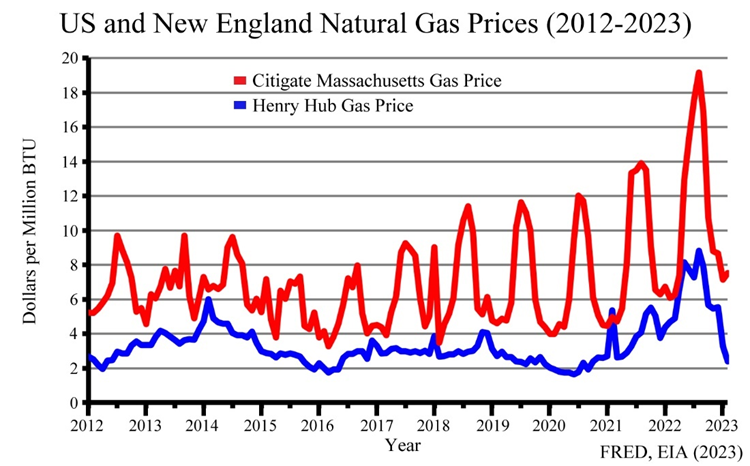
New England electricity prices are also among the highest in the nation. In 2022, power prices for all six of the New England states were over 20 cents per kilowatt-hour, and all in the top ten for state electricity prices. Massachusetts residential customers paid 26.1 cents per kW-hr, surpassed only by prices in Hawaii and California.

The risk of electricity blackouts in New England is rising. The Interstate Natural Gas Association of America sent a letter to President Joe Biden last November, warning that the region “does not have sufficient pipeline infrastructure” and is “at risk of an energy shortfall.” ISO New England, the non-profit organization responsible for reliable electricity in New England, wrote a similar warning letter to Energy Secretary Jennifer Granholm last summer, stating, “during the coldest days of the year, New England does not have sufficient infrastructure to meet the region’s demand for natural gas for both home heating and power generation.” But government leaders and environmental groups oppose further expansion of natural gas infrastructure.
The Federal Energy Regulatory Commission and ISO New England have proposed a shift in LNG pricing to allow purchase and stockpiling of natural gas in New England to prevent a winter fuel shortage. This price shift would raise consumer prices and is opposed by New England states and environmental groups. The pipeline capacity shortage and inadequate gas stockpiles have set the stage for electricity blackouts in the region during the next severe winter.
New England state governments remain committed to construction of offshore wind turbines and providing incentives for electric heat pumps as part of a misguided effort to fight climate change. But these programs, if completed, will not make the grid more reliable and will further boost energy costs.
New England homeowners, better get yourself a backup electric generator and prepare for further rises in home heating and electricity prices.
United States: Fifty Little Dictatorships
Brownstone Institute | June 11, 2023
Historically, a public policy catastrophe like the Covid response would lead to reform aimed at curtailing the powers that leadership abused. The Teapot Dome scandal led to increased regulation from the House Ways and Means Committee. The Vietnam War prompted the War Powers Resolution of 1973. Watergate caused Congress to strengthen the Freedom of Information Act.
But what if the government had responded to Iran-Contra by increasing the president’s ability to circumvent federal arms embargoes? In the wake of the Johnstown Flood, what if lawmakers’ reaction had been to make it more difficult for victims to recover for their damages?
We’d consider the rulers delusional and corrupt, callous to the damage that they inflicted on the people they purport to represent. It would be worse than dereliction; it would indicate that they relished the damage or remained beholden to interests averse to the general public.
It is now clear that those responsible for the Covid response aren’t looking for amnesty or forgiveness; they seek a government structure that codifies their authoritarian impulses and a legal system that offers citizens no means of demanding accountability from their rulers. Publicly, they are searching for any “emergency” to increase their power. Privately, they are looking to put that system into law.
With the East Coast enveloped in smoke, the political class immediately saw the temporary crisis as an opportunity to implement permanent change. Despite evidence that arson caused the wildfires in Quebec, the same groups that adopted mantras of “public health” to collect power announced that the smog was evidence of a “climate crisis.” Like Covid, the emergency demanded centralizing power and overturning American society.
Rep. Alexandria Ocasio-Cortez wrote, “We must adapt our food systems, energy grids, infrastructure, healthcare, etc ASAP.” Senator Chuck Schumer similarly called on government to “do more to speed our transition to cleaner energy and reduce carbon.”
Just as a respiratory virus became the pretext for unrelated political aims like student debt relief and eviction moratoriums, leaders already seek to impose unrelated cultural change through fear-mongering and deception.
But while the smoke clears, a more insidious development is taking place. The largely unknown Uniform Law Commission (ULC) has proposed a law that would drastically increase executive power in the United States and reduce citizens’ legal right to resist unconstitutional edicts.
The ULC is an influential interstate organization that works to make state laws more uniform. Since 2021, the group has worked to draft a “Model Public Health Emergency Authority Act.”
The impetus for this initiative was the “uncertainty about the legal authority of governors and other state officials to enact certain emergency laws and declarations” during Covid, according to journalist David Zweig. “The legal ambiguity around many pandemic declarations resulted in new legislation in many states that explicitly clawed back public health powers from governors and executive branch officials.”
In response, the ULC seeks to codify a system that shields and promotes unchecked executive authority. Zweig writes, “It wants the legal authority that’s given to governors to be clear. And a memo indicates that the ULC expects the adoption of the Act will result in people suing only if the Act itself wasn’t followed, rather than suing based on a claim that the governor’s actions were unconstitutional.”
The Act threatens to strip Americans of their legal ability to oppose mandates, lockdowns, or other government orders. It offers total deference to governors in deciding what constitutes an emergency. No evidence would be required for state leaders to impose arbitrary and irrational limits on human liberty. Schools, businesses, and churches would be subject to the whims of executive power.
The ULC plans to vote on the Act in July, and passage threatens to strip Americans of their constitutional rights.
If passed, Kathy Hochul would be free to declare that the Quebec smoke constituted an emergency that justified her drastically limiting New Yorkers’ fuel consumption. Gavin Newsom could ban singing in churches the next time a town had a Covid outbreak. The pretense of an emergency would abolish the separation of powers, leaving legislatures and the judiciary powerless to oppose the mandates of self-appointed governor-tyrants.
Brownstone was founded on the premise that Covid was “not just about this one crisis but past and future ones as well. This lesson concerns the desperate need for a new outlook that rejects the power of the legally privileged few to rule over the many under any pretext.”
The pretexts are many, some predictable and some not. But the drive remains the same: more power to the government, less freedom for the people.
The ULC’s proposal prepares the ground for any and all crises. It codifies a system that augments the power of the legally privileged under any pretext and strips the many of their right to legal recourse.
In Federalist No. 51, Madison wrote, “But what is government itself, but the greatest of all reflections on human nature? If men were angels, no government would be necessary. If angels were to govern men, neither external nor internal controls on government would be necessary.”
Citizens had painful reminders of their leaders’ mammalian flaws of the last three years. Hypocrisy, irrationality, self-interest, and insatiable pursuits of power became commonplace. There were the double standards of governors flaunting their own restrictions and granting blatant political favoritism. Children suffered under cruel and irrational edicts and states criminalized basic human liberties. Governors called on local law enforcement to break into homes to arrest families for gathering at Thanksgiving.
Now, the ULC proposes granting governors more power for when the next emergency arrives. There is no reason to expect angelic behavior in the next crisis. The attempt here is to end what most annoyed the ruling elites during the Covid crisis: the relatively decentralized response due to American federalism. One state (South Dakota) did not go along at all. Others bailed on the lockdown agenda after a few weeks. As time dragged on, some states tried to hang on to the crisis for as long as possible while others moved on with life as normal.
In all the postgaming in the elite narratives, this point sticks out the most. The next time, they want an all-of-society response, no stragglers and refuseniks. The efforts by the ULC are part of rigging the system toward that end. Instead of 50 “laboratories of democracy” they want 50 mini-dictatorships carrying out the orders of the elites in Washington, DC.
This legal push has received no public attention, and not even Zwieg’s expert journalism seems to have broken through the wall set up by the mainstream media. And that is precisely why anyone concerned about the future needs to get the word out. The efforts toward fundamental regime change are real, threatening, and deeply dangerous to the future of liberty itself.
The Democrats Versus Trump: A Bad Horror Movie?
By Ron Paul | June 12, 2023
The Democrats and Donald Trump reminds me of a bad horror movie, where the hapless protagonists only make the monster stronger with each attempt to eliminate it. So goes the Democrats’ endless attempts to finally rid America of the “scourge” of Donald Trump.
Thanks to the Durham Report we now know they started even before Trump was elected president. Hillary Clinton’s campaign – with the full knowledge of the candidate and the sitting president, Barack Obama – cooked up a “dirty trick” to portray Trump as an agent of Russia in their effort to deny Trump the White House.
When that didn’t work they weaponized the FBI, CIA and the rest of the “deep state” to undermine and hobble his presidency. They spied on Trump and his campaign staff using false information manufactured by the FBI.
When that didn’t work they impeached him under the false charge that he sought foreign assistance for his 2020 re-election bid. This time a spy, in the person of NSC staffer Alexander Vindman, was sent to listen in on Trump’s phone call with Ukrainian president Zelensky and then make all manner of false charges against Trump based on it.
Democrats were furious that Trump was less than enthusiastic about their plans to use Ukraine as a proxy to go to war with Russia. Vindman, though an active-duty US military officer, was of Ukrainian background and was loyal to the country of his origin rather than the country of his citizenship. He also openly defied the military chain-of-command and his commander-in-chief. Trump’s lack of enthusiasm for their “Project Ukraine” infuriated Vindman and he sought his revenge against the US President.
When that didn’t work they impeached Trump again over the false charge that he led an “insurrection” against the US government on January 6, 2021. The more surveillance video we see of this “insurrection,” the more it looks like a false-flag operation cooked up perhaps by Nancy Pelosi and the rest of the Washington swamp to finally be rid of Trump. Hundreds of political prisoners have been held in solitary confinement on false accusations that they tried to overthrow the US government.
When that didn’t work and Trump’s re-election numbers looked more and more favorable while Biden’s approval rating continued to linger in the political basement, the Democrats have now indicted him over some classified documents apparently discovered in his residence in Florida.
The boxes and boxes of classified documents discovered at multiple Biden locations have disappeared into the memory hole with the help of the media. Nothing to see here.
Suddenly Donald Trump, who polling suggests would obliterate Joe Biden in a fair US election, faces 100 years in prison! Where else would you see the head of one political party arrest his main political opponent on cooked up charges? A banana republic!
For those of us who love this country, it is truly shocking to see this abuse of power. But there’s one thing these dirty tricksters never seem to understand: the more false evidence and false charges they cook up against Trump, the stronger Trump becomes. With these outrageous and continuous attacks on Trump, the Democratic Party (and plenty of Republicans) has lost all credibility. When this plan fails, and it will, I am afraid to think what they might try next.
Copyright © 2023 by RonPaul Institute
The Goose and the Gander in Cuba
By Jacob G. Hornberger | FFF | June 12, 2023
Hand it to the Chinese and Cubans for exposing the utter hypocrisy of the U.S. national-security state, its empire of foreign military bases, and its foreign policy of interventionism.
Last week the Wall Street Journal reported that China is paying Cuba billions of dollars in return for permitting China to construct a major facility in Cuba to spy on the United States.
China and Cuba deny the deal but what is so funny has been the reaction of U.S interventionists. They are going ballistic over China’s supposedly aggressive behavior.
Florida Senator Marc Rubio expressed the sentiments of all U.S. interventionists by exclaiming, “The threat to America from #Cuba isn’t just real, it is far worse than this.” Rubio and U.S. Senator Mark Warner from Virginia jointly stated, “We are deeply disturbed by reports that Havana and Beijing are working together to target the United States and our people. The United States must respond to China’s ongoing and brazen attacks on our nation’s security.”
The Reds are coming! The Reds are coming!
Wait a minute! What about all those military installations, including spying facilities, that the Pentagon and CIA have surrounding China and Russia? Indeed, what about the Pentagon’s and CIA’s imperial torture and prison camp at Guantanamo Bay, which is used to spy on Cuba?
Oh, there isn’t anything threatening about those facilities, U.S. interventionists exclaim. They are just for “defense.” The Chinese, Russians, and Cubans just suffer from extreme paranoia. The United States, U.S. interventionists say, is really just a peace-loving nation. Never mind that much of the world views the U.S. national-security state as Martin Luther King did — as the “greatest purveyor of violence in the world,” one that is responsible for the deaths and injuries of millions of people in the last 7o years.
Referring to the China-Cuba deal, John Kirby, a spokesman for the National Security Council, stated that U.S. officials are closely monitoring these activities and taking steps to counter them.
Really? Now why would they do that? One big reason: They don’t like it! They don’t like it when some foreign power from thousands of miles away establishes a spy facility only 90 miles away from American shores.
And what happens if that Chinese spy facility in Cuba begins to show signs of nuclear missiles? I will guarantee you that Kirby and all the other officials in the national-security establishment will go ballistic and begin calling for a bombing campaign against Cuba or an invasion, just like Pentagon and CIA officials did back in 1962. That’s because they won’t like the fact that there are Chinese nuclear missiles pointed at the U.S. from only 90 miles away.
But can you see the hypocrisy that the rest of the world sees? When Russia and China object to U.S. and NATO military installations and nuclear missiles on or near their borders, U.S. officials condemn them for their “aggressiveness.”
Moreover, let’s not forget that whenever there is some altercation between Chinese or Russian planes or ships and those of the Pentagon, the altercations always take place over there near Russia and China, not over here in our part of the world. That’s because U.S. military planes and ships are over there stirring up crises and conflicts to justify the continued existence of America’s Cold War-era national-security state.
Time will tell whether the Chinese-Cuba connection will erupt into another full-blown crisis, one that will naturally be used to justify ever-increasing taxpayer-funded largess for the national-security establishment. If so, it will only provide more confirmation of how U.S. interventionism abroad makes Americans less safe here at home.
But one can easily understand why the Chinese, Russians, and Cubans would behave in the same manner as the Pentagon and the CIA. After all, from their perspective, what’s good for the goose is good for the gander.
The 1974 CIA Coup in the United States
Tales of the American Empire | June 8, 2023
American corporate propaganda and schools teach that Richard Nixon was a corrupt, horrible President. This is because he was popular with the American people and took actions to benefit them, at the expense of the Deep State. During his five years in the White House Americans saw a reduction of involvement in the Vietnam War, détente with the Soviet Union, deep cuts in military spending and the establishment of the Environmental Protection Agency and Occupational Safety and Health Administration. In 1969, Nixon upset the Pentagon by ordering bio-weapon labs closed and all stockpiles destroyed. Nixon ended American involvement in Vietnam combat in 1973 and the military draft that same year. His visit to China in 1972 eventually led to diplomatic relations.
Nixon engaged in intense negotiations with Soviet premier Leonid Brezhnev that led to agreements for increased trade and two landmark arms control treaties: SALT I, the first comprehensive limitation pact signed by the two superpowers, and the Anti-Ballistic Missile Treaty, which ended the nuclear arms race. Nixon and Brezhnev proclaimed a new era of “peaceful coexistence” and reduced military spending. Nixon worked with Congress to slash military spending 25%!
There was massive opposition to these efforts from corporate America and the Pentagon. Nixon rose to power as a loyal member of the Deep State, but went rogue once he reached the top. He told friends that he didn’t trust the CIA, thought their intelligence was poor, and that the CIA was involved in the Kennedy assassination. Nixon was a Quaker from a modest background who served in the Navy during World War II. He had served in the US House of Representatives, the US Senate, and eight years as Vice President. He knew how Washington worked! Nixon got things done so was popular with the American people and would easily win reelection in 1972, giving him more four years to dismantle the Deep State. As a result, Nixon was ousted in a 1974 CIA coup.
______________________________
“Ford’s Editing Backed ‘Single Bullet’ Theory”; George Lardner Jr; The Washington Post; July 3, 1997; https://www.washingtonpost.com/archiv…
“Eugenio Rolando Martinez, a Watergate Burglar, Recalls His Arrest”; Nixon Library; June 14, 2012;  • Eugenio Rolando M…
“Watergate – the reasons behind the burglary”; Barbara Newman; A&E; 1992; • Watergate — reas…
“Nixon’s Plan to Threaten the CIA on JFK’s Assassination”; Jefferson Morley; Politico; June 5, 2022; https://www.politico.com/news/magazin…
“Woodward-Haig Connection”; The Colodny Collection; Texas A&M University; https://www.watergate.com/bob-woodwar…
“WATERGATE: Nixon Warned Grand Jury on Pentagon Spy Ring”; James Rosen; Fox News; December 23, 2015; Nixon transcripts released; https://www.foxnews.com/politics/wate…
”Tucker Carlson – Biden is Done”; Fox News; January 19, 2023; a short segment about the Nixon coup; • Tucker Carlson: B…
Most Countries Side With Russia in Ukraine Conflict While US’s Credibility Slips – Hersh
Sputnik -12.06.2023
Most of the world’s population supports Russia’s special military operation in Ukraine, while the United States lost its credibility, Pulitzer Prize-winning US investigative journalist Seymour Hersh said on Sunday.
“The percentage of the [countries], particularly of the African and Central Asian and South Asian countries, that have changed from being pro-America to being pro-Russia is really quite dramatic. Much more than a half of the world’s population supports Russia in the war and not the United States. This was never the way it was,” Hersh said in an interview with talk show host George Galloway.
The journalist opined that “things are not as good as they used to be in Russia” amid Western sanctions, but “the idea that they are desperate is just wrong.”
Hersh also argued that Washington “lost so much credibility around the world,” citing Saudi Arabia’s diplomatic rapprochement with Iran as an example.
“It’s happened because, I think, because of Ukraine and dislike of the war. Saudi Arabia, by the way, they’re selling 25% of [their] oil to China, as I have mentioned, but the Saudis immediately cut a deal. And the Iranians immediately responded … They have a lot of control in Yemen over the Houthi tribes,” Hersh said.
Russia launched its special military operation in Ukraine on February 24, 2022, following calls for help from the breakaway republics of Donetsk and Luhansk. The world has split into those who support Moscow and accuse NATO of provoking the conflict, and those who condemn Russia’s actions and impose sanctions on the country, while also ramping up their financial and military aid to Kiev. Some countries have avoided taking sides in the conflict.
Asia-Pacific is where China-Russia “no limits” partnership will be put to test
BY M. K. BHADRAKUMAR | INDIAN PUNCHLINE | JUNE 11, 2023
The power dynamic in Northeast Asia is undergoing a dramatic change against the backdrop of the “no limits” strategic partnership between China and Russia. Ukraine’s defeat in the war with Russia may compel the Biden administration to put “boots on the ground” triggering a global confrontation and, equally, the US-China relations are at their lowest point since their normalisation in the 1970s, while Taiwan issue may potentially turn into a casus belli of war. To be sure, the Northeast Asian theatre is going to be a crucial arena in the brewing big power confrontation.
Symptomatic of the cascading tensions, Russian foreign ministry summoned the Japanese ambassador on Friday and a protest was lodged in extraordinarily harsh language, as it came to be known that the 100 vehicles that Tokyo innocuously promised last week to Ukraine would in reality be armoured vehicles and all-terrain vehicles. Apparently, Tokyo was dissimulating, since Japan’s export rules ban its companies from selling lethal items overseas!
Tokyo is crossing a “red line” and Moscow is not amused. The foreign ministry statement on Friday “stressed that the administration of Prime Minister Fumio Kishida should be ready to share responsibility for the deaths of civilians, including those in Russia’s border regions… (and) driving bilateral relations even deeper into a dangerous impasse. Such actions cannot remain without serious consequences.”
Significantly, on Friday, in a video conference with General Liu Zhenli, Chief of Staff of the Joint Staff Department of China’s Central Military Commission, the Chief of the General Staff of Russian Armed Forces and First Deputy Minister of Defence General Valery Gerasimov expressed confidence in the expansion of military cooperation between the two countries and noted, “Coordination between Russia and the People’s Republic of China in the international arena has a stabilising effect on the world situation.”
The Chinese media later reported that the two generals agreed that Russia will participate (for the second time) in the Northern/Interaction-2023 exercise organised by China, signalling a new framework of China-Russia joint strategic exercises alongside the joint air patrol over the Sea of Japan and the East China Sea by their strategic bombers. By the way, the sixth such joint air petrol was conducted on Tuesday since the practice began in 2019.
The big picture is that the shift in Japanese policies through the past year — close alignment with the US regarding Ukraine; copying the West’s sanctions against Russia; supply of lethal weaponry to Ukraine, etc. — has seriously damaged the Russo-Japanese relationship. On top of it, Japan’s re-militarisation with American support and its growing ties with the NATO (which is lurching toward the Asia-Pacific) makes Tokyo a common adversary of both Moscow and Beijing.
The imperative to push back this resurgent US client is strongly felt in Moscow and Beijing, which also has a global dimension since Russia and China are convinced that Japan is acting like a surrogate of American dominance in Asia and is subserving western interests. On its part, in a turnaround, Washington now actively encourages Japan to be an assertive regional power by jettisoning its constitutional limits to rearmament. It pleases Washington that Japan pledged a long-term increase of over 60 percent in defence spending.
What worries Moscow and Beijing is also the ascendance of revanchist elements — vestiges of Japan’s imperial era — in the top echelons of power in the recent period. Of course, Japan continues to be in denial mode as regards its atrocities during the period of its brutal colonisation of China and Korea and the horrific war crimes during World War 2.
This trend bears striking similarity to what is happening in Germany, where too the pro-Nazi elements are reclaiming habitation and a name. Curiously, a German-Japanese axis is present at the core of Washington’s strategies against Russia and China in Eurasia and Northeast Asia.
The German Bundeswehr is expanding its combat exercises in the Indian and Pacific Oceans and will deploy more naval and air force units to the Asia-Pacific region next year. A recent German report noted, “The intensification of German participation in Asian-Pacific regional manoeuvres is taking place at a time when the United States is carrying out record-breaking manoeuvres in Southeast Asia, in its attempts to intensify its control over the region and displace China as much as possible.”
Japan’s motivations are easy to fathom. Apart from Japanese revanchism which fuels the nationalist sentiments, Tokyo is convinced that a settlement with Russia over Kuril Islands is not to be expected now, or possibly ever, which means that a peace treaty will not be possible to bring the World War 2 hostilities to an end formally. Second, Japan no longer visualises Russia to be a “balancer” in its troubled relationship with China.
Third, most important, as Japan sees the rise of China as a political and economic threat, it is rapidly militarising, which in turn creates its own dynamic in terms of both upending its power position in Asia as also integrating itself with the West (“globalising”). Inevitably, this translates as promoting NATO in the Asian power dynamic, something that cuts deep into Russia’s core national security and defence strategies. Consequently, whatever hopes the strategists in Moscow had nurtured in the past that Japan could be weaned away from the US orbit and encouraged to exercise its strategic autonomy have evaporated into thin air.
Arguably, in his zest to integrate Japan into the US-led “collective West”, Prime Minister Kishida overreached himself. He behaves as if he is obliged to be more loyal than the king himself. Thus, on the same day that President Xi Jinping visited Moscow in March, Kishida landed in Kiev from where he went to attend a NATO Summit and openly began lobbying for establishment of a NATO office in Tokyo.
Kishida followed up by hosting NATO Secretary-General Jens Stoltenberg in Tokyo and giving him a platform to berate China publicly from its doorstep. There is no easy explanation for such excessive behaviour. Is it a matter of impetuous behaviour alone or is it a calculated strategy to gain legitimacy for the ascendance of revanchist elements whom Kishida represents in the Japanese power structure?
To be sure, Northeast Asia is a priority now for China and Russia, given their overlapping interests in the region. NATO expansion to Asia and the sharp rise in the US force projection bring home to the defence strategists in Beijing and Moscow that the Sea of Japan is a “communal backyard” for the two countries where their “no limits” strategic partnership ought to be optimal. The Chinese commentators no longer downplay that the Russian-Chinese military ties “serve as a powerful counterbalance to the US’ hegemonic actions.”
It is entirely conceivable that at some point in a near future, China and Russia may begin to view North Korea as a protagonist in their regional alignment. They may no longer feel committed to observe the US-led sanctions against North Korea. Indeed, if that were to happen, a host of possibilities will arise. The Russian-Iranian military ties set the precedent.
Featured Video

Seyed M. Marandi: US-Iran War Inevitable: Kuwait and Bahrain May Fall
or go to
Aletho News Archives – Video-Images
From the Archives
Oil and the Israel Lobby
Reknowned economist M. Shahid Alam offers this excellent critique of Noam Chomsky’s defective analysis of the relative influence of Oil versus the Israel lobby over US foreign policy: … continue
Blog Roll
 Aletho News
- ICC ignored ‘very well-documented’ NATO crimes – ex-Libyan minister
- SNSC secretary dismisses US response to Iran’s conditions as ‘inadequate’
- Sanaa says Taiz roads open, secure for residents, warns Saudi forces
- Iraqi resistance group urges Saudi leadership to admit defeat, lift Yemen siege
- Trump’s Retreat: How Al-Aqsa Flood Took Down the US Empire
- Israel’s Military Actions in Lebanon Grossly Violate International Law — Lavrov
- Seyed M. Marandi: US-Iran War Inevitable: Kuwait and Bahrain May Fall
- Leaders Condemn Ansarallah Attack on Saudi Arabia While Ignoring Illegal War Against Yemen
- Leaked: Britain’s Covert Iraqi Psyops Network
- Yemeni Armed Forces Warn Airlines Against Using Saudi Airports, Exempt Mecca and Medina
- If Americans Knew
- Opinion: Why news organizations should boycott Israel
- The Israeli witch hunt of Sami Abu Shehadeh exposes the lie of the ‘Jewish and democratic’ state
- No state has a ‘right’ to exist – least of all an apartheid, genocidal state like Israel
- Testimonies about Gaza’s civilian death toll expose Israel’s atrocities – Daily Update
- How Israel Conquered the Latin American Right
- Agents search Rep. Omar’s Washington home in criminal probe as she vows she won’t ‘be silenced’
- “The Rule Was: ‘Shoot Everyone You See'”
- Israel goes ballistic over Nobel Laureate Navi Pillay
- U.S. May Join Yet Another Middle Eastern War — TCN
- Yellow Line moves again as Israel closes in on trapped Gazans – Daily Update
- No Tricks Zone
- Germany’s Green Energy Debacle: High Energy Costs Force Kahla Porzellan to Close After 182 Years!
- New Study: 50 Years Of The Most Aggressive ‘Net Zero’ Policies Can Only Affect The Global Climate By 0.03°C
- US September “Heat” Was No Record…Many Records Set Decades Ago
- Latest European Green Energy Debacle; Portugal’s Largest Flagship Solar Park Insolvent!
- Green Energy Debacle: German Expert Professor Fritz Vahrenholt Warns Of Severe Economic And Social Consequences
- Two More Paleo Reconstructions Affirm Meters-Higher Sea Levels Across Ireland, Brazil 7000-6000 Years Ago
- New Study: Earth And Venus Surface Warmth Largely Explained By Convection And Lapse Rate, Not CO2 Or Radiation
- 2025 Nature Paper Claiming Worsening Global Drought Gets RETRACTED …Heavily Flawed
- New Study: ‘Global Drought Shows No Detectable Recent Acceleration Under Climate Warming’
- Economic Masterminds: German Socialists Suggest Taxing Productivity Gains Stemming From Using AI

