Prof. Ted Postol: Iran Already Achieved NUCLEAR DETERRENCE Against Israel
Dialogue Works | April 3, 2026
Press TV – April 5, 2026
The University of Washington has removed a professor from his role as director of its West Asia Center after he criticized the illegal US-Israeli aggression against Iran and condemned Zionism.
Aria Fani, who will remain an associate professor at UW’s Jackson School of International Studies, said the new interim, Daniel Hoffman, told him last week he was fired from his leadership role at the West Asia Center.
Fani, who was born and raised in Iran and came to the US when he was 18 years old, said he was hired for his research on Iran. However, he told the Times that he now feels “profoundly hurt and betrayed” by his removal.
“There is a chilling effect on not just my academic freedom, but that of my colleagues; anyone who dares to speak out against the war and against aggression,” he said.
In a separate interview on Friday with My Northwest, Fani said he was removed “for improper use” of the center’s listserv, an email application.
“I sent out two memos about this atrocious war on Iran in which I offered historical analysis that’s lacking in the media,” Fani said.
“I was told that my email made ‘certain constituents feel attacked.’ By certain constituents, I assume the university means Zionists who would like to keep bombing every Middle Eastern country and continue dehumanizing their people.”
Last July Fani told the Daily UW, a student newspaper, that President Donald Trump’s militaristic foreign policy is not making the world safer.
“If you tell the dozens of children that were killed in Israeli bombardment… in Iran, or the families of the nuclear scientists who were just wiped out, I hardly imagine they would say that the world is a more peaceful place,” he said amid the first round of US and Israeli airstrikes on Iran.
Since then, many more Iranian children have been killed by US and Israeli bombing, including more than 100 students who were among around 175 people massacred in the February 28 US missile strike on a girls’ school in Minab.
“The [only] peace this secures is for weapons manufacturers, for oil companies, for drone companies,” Fani said in an implicit rebuke of Trump’s claim to be the “president of peace.”
“It secures peace for them, fills their pockets with money, and makes them fully invincible,” he added. “It’s creating a class of people that are living [on] an alternate planet.”
The US and Israel launched an unprovoked aggression against Iran in late February, by attacking 30 targets across Tehran and assassinating the Leader of the Islamic Revolution, Ayatollah Seyyed Ali Khamenei, along with several senior Iranian officials.
Since then, Iranian armed forces have retaliated strongly by launching barrages of missiles and drones at Israeli-occupied territories, as well as US bases across the region.
Press TV | April 4, 2026
The Trump administration is declaring “false victory” in its war of aggression against the Islamic Republic of Iran while actively dismantling international humanitarian law (IHL), says a legal scholar at Queen’s University Belfast.
In an interview with the Press TV website, Alannah Travers, a PhD student at Queen’s University Belfast School of Law, said the US President Donald Trump’s warning to “bomb Iran back to the Stone Age” reveals a dangerous disregard for legal norms.
She noted the irony that Iran was actually a cradle of innovation during the real Stone Age.
“Listening to President Trump declare a false victory (yet again) while simultaneously threatening to bomb a nation of 90 million people back to the Stone Age made me think of what legal scholars have termed the ‘warification’ of international humanitarian law,” Travers said.
Travers’ PhD is on Algorithmic Warfare and Civilian Harm – working with the Ceasefire Centre for Civilian Rights, an international initiative to develop civilian-led monitoring of violations of international humanitarian law or human rights; to secure accountability and reparation for those violations; and to develop the practice of civilian rights.
She pointed to Trump’s explicit threat to destroy “each and every” electricity-generating plant in Iran as a clear signal that his administration views the Geneva Conventions as optional. Under Article 52 of the 1977 Additional Protocol I to the Geneva Conventions, civilian objects such as power plants and bridges must be protected.
“By targeting infrastructure essential for meeting the basic needs of tens of millions of Iranian civilians, the administration is moving towards a campaign of collective punishment with the sort of reverberating effects IHL once sought to prevent,” she said.
Travers also condemned the US military’s practice of housing troops in hotels in the Persian Gulf countries, calling it a breach of IHL that effectively uses local civilians as human shields.
Thirty-five days into the unprovoked and illegal war on Iran, Travers said it was difficult to identify any legitimate American war goals.
Instead, she pointed to measurable destruction: over 15,000 strikes, at least 1,900 killed, 20,000 injured, more than 600 schools hit, and 60 hospitals damaged – including the Pasteur Institute, which had been working on global health security.
“Are these, then, the war goals?” she asked. “Rather than neutralizing a threat, the US and Israel have waged war against civilian infrastructure.”
She noted that 2,100 children had been killed or injured by day 23 of the war, an average of 87 per day, including over 170 children at a school in southern Iran’s Minab city.
Travers said the US and Israel have fallen for their own fantasies about superior AI-driven military technology, comparing the miscalculation to the lead-up to the 2003 invasion of Iraq.
“It’s the same racist miscalculation that paved the road for the 2003 invasion of Iraq,” she said. “Most citizens of the region could explain it far better than I, having lived this violent ignorance with their bodies.”
She slammed Washington over institutionalized ignorance bordering on “overt racism and colonial arrogance,” particularly in its surprise that Iran’s retaliation has persisted for 34 days.
Travers referenced an open letter from over 100 legal scholars challenging the US and Israel’s conduct, noting there was no credible evidence of an imminent threat to justify a “self-defense” claim made by officials in Washington and Tel Aviv.
The letter also raised alarms about War Secretary Pete Hegseth’s “gloves off” approach, which has included removing senior military lawyers and weakening IHL compliance.
Travers also highlighted rare public rebukes from Catholic leaders. Pope Leo has condemned the US and Israel, saying God rejects the prayers of leaders whose “hands are full of blood.”
Archbishop Timothy Broglio, head of the US Military Services since 2008, publicly rebuked Hegseth’s theology, telling troops to minimize participation in what he called an unjust war.
“When I met Broglio in January, my impression was he took a far more conservative view,” Travers said. “That he is now so clearly troubled is extremely telling.”
Travers also condemned Israeli military affairs minister Israel Katz’s vow to bring “Gaza-like destruction” to Lebanon, as well as Israel’s refusal to acknowledge its status as an occupying power.
She said that by keeping southern Lebanon in a state of perpetual armed conflict, Israel falsely claims military necessity under Article 53 of the Fourth Geneva Convention to justify forced displacements – a breach of Article 49.
“There is no such thing as a legal buffer zone on sovereign foreign soil,” she said. “These are more war crimes.”
Travers concluded that the lack of accountability in Palestine has directly enabled the current lawlessness across Iran, Lebanon, Iraq, and the Gulf. She called on the international community to move beyond “concerned statements” and take action.
“The Iranian people are navigating their survival in this crazed and lawless war amid their own domestic repression,” she said. “They deserve so much better. We have to stop this senseless war and ensure that those who waged it will face the full consequences of their illegal action.
Al Mayadeen | April 4, 2026
On Saturday, Major General Omar Al-Waeli, head of the Iraqi Border Ports Authority, confirmed the martyrdom of one person and injuries to five others following an attack on the Shalamcheh border crossing with Iran.
Al Mayadeen’s correspondent in Basra reported that movement at the crossing has been completely suspended, adding that US warplanes targeted the Iranian passport hall at the border point.
Since the onset of the US-Israeli war on Iran, American attacks have relentlessly targeted Iraq, including Popular Mobilization Forces (PMF) units and centers.
PMF martyr, injruies in US attack earlier today
Earlier today, the PMF reported that its 45th Brigade, part of the Jazira Operations Sector, was attacked at the al-Qaim border crossing. The assault left one PMF member martyred, four others injured, and one Ministry of Defense employee wounded.
In response to the repeated aggression, the Iraqi Cabinet directed the armed forces and the Popular Mobilization Forces to defend themselves and respond to any attacks on their positions.
The cabinet also instructed the Ministry of Foreign Affairs to submit an official complaint to the UN Security Council, condemning the attacks and demanding they be stopped.
Iraqi Resistance calls for action against US-Israeli regional allies
Similarly, the Iraqi Resistance Coordination Committee praised the Iraqi people’s positions in support of the Axis of Resistance, while calling for punitive measures against countries that enable US-Israeli aggressions in the region.
In a statement, the Committee said that “the alignment of the rulers of Jordan, Saudi Arabia, and the UAE with the criminality of the Zionist-American enemy against the Islamic Republic and their betrayal of the honorable free people of Iraq represent the height of baseness and vileness.”
It stressed that this “requires a firm deterrent response from the Iraqi government,” adding that such measures should begin with “punishing Jordan in particular, as it serves as a launch point for enemy aircraft targeting the fighters of the Popular Mobilization Forces and Iraqi security forces,” calling for “the complete closure of the land border crossing and the suspension of Iraqi oil grants.”
The Committee also stated that the Iraqi Resistance has avoided harming Kuwait’s economic interests and infrastructure while targeting US forces in the country. It further called for avoiding harm to Qatar’s interests, excluding US bases, “in appreciation of Doha’s responsible positions toward the Palestinian cause and the Axis of Resistance.”
Press TV – April 4, 2026
Iran’s Parliament Speaker Mohammad Baqer Qalibaf says the ongoing aggression is “Israel’s war,” adding that its security repercussions and resulting losses have extended beyond the region and affected the wider world.
“This war is Israel’s war, and the resulting security breakdown and losses have affected the world,” Qalibaf said in an interview with Al Jazeera Arabic.
He added that Iran has prepared for this confrontation and proven its ability to defend itself.
“Iran was forced to target US bases and interests in the region to preserve its presence,” he said, warning that any further escalation against Iran “will be met with a decisive and broad response” directed at US interests.
According to Qalibaf, maintaining stability in the region serves the interests of all regional states, and Iran considers sustainable security a priority.
He added that countries in the region are capable of safeguarding their interests through bilateral and multilateral security arrangements “without foreign interference.”
Qalibaf further said that the key sources of regional instability must be addressed, emphasizing that security should be established “without the involvement of the United States and Israel.”
The US and Israeli regimes launched their military aggression against Iran in late February by attacking 30 targets across Tehran, assassinating Leader of the Islamic Revolution Ayatollah Seyyed Ali Khamenei and several senior Iranian officials.
Since then, Iranian armed forces have retaliated strongly by launching barrages of missiles and drones at Israeli occupied territories as well as US bases across the region.
Al Mayadeen | April 4, 2026
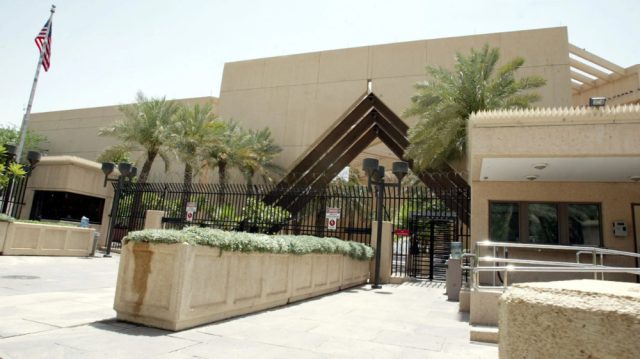
The Islamic Revolution Guard Corps’ (IRGC) has rejected accusations that it was responsible for an attack on the US Embassy in Riyadh, Saudi Arabia, emphasizing instead that it was a false flag operation carried out by the Israeli entity.
In Statement No. 54 of Operation True Promise 4, the IRGC’s Public Relations Department condemned the attack on the embassy, which was reported by The Wall Street Journal, stressing that, recalling the Israeli occupation’s regional strategies, “this action was certainly carried out by Zionists.”
The IRGC confirmed that the Iranian Armed Forces’ target list has been clearly identified, adding that Iran had already informed neighboring countries of the necessary warnings to “prevent further escalation.”
The IRGC also warned that West Asia “must remain vigilant against provocations from the American–Zionist current,” which aims to destabilize and destroy the region.
A series of false flags
Iran has repeatedly stressed that its operations target US-Israeli military assets and affiliated infrastructure in the region and across the occupied territories in Palestine, quickly pointing out false flags and highlighting ongoing enemy attacks that seek to disturb regional harmony.
It has also delineated target lists for its tit-for-tat retaliations for attacks on its civilian infrastructure, including US assets in the region. The US embassy in Riyadh was not among them.
Only yesterday, the IRGC condemned the targeting of water desalination plants in Kuwait, asserting that the Israeli entity “is behind this cowardly act of aggression aimed at sowing discord.” On Monday, a Kuwaiti power and desalination plant was also struck, killing an Indian worker and causing significant material damage.
Kuwaiti authorities were quick to attribute the attack to Iran, but Tehran squarely denied involvement and blamed “Israel,” with the spokesperson for Iran’s Khatam al-Anbiya Central Headquarters describing the incident as “evidence of the enemy’s depravity and malice,” saying it forms part of broader efforts to inflame tensions and undermine regional stability.
Similarly, following a fire at Saudi Aramco’s Ras Tanura refinery in early March, an Iranian military source told Tasnim News Agency that the attack was “an Israeli false flag operation” aimed at distracting regional countries from “Israel’s” strikes on civilian sites inside Iran, stressing that “Aramco facilities have not been among the targets of Iranian attacks so far.”
By M. K. BHADRAKUMAR | Indian Punchline | April 4, 2026
Indian media have spread misconceptions over the meeting convened by the UK Foreign Secretary Yvette Cooper on Thursday 2nd April regarding the situation around the Strait of Hormuz. Far-fetched conclusions are drawn that the meeting marked the first step toward forming a coalition to restore safe passage; plans include clearing mines from the waterway in consultation with military planners in the coming weeks, and so on.
We should not frighten the Indian community living in the Persian Gulf region. A military confrontation with Iran is not even in the wildest dreams of anyone in Europe. The US didn’t even attend the London meet.
The statement issued after the event does not contemplate coercive measures, leave alone military solution. The London statement outlined 4 action points: first, “increase diplomatic pressure on Iran, including through the UN”; second, “Explore co-ordinated economic and political measures, such as sanctions”; third, “work together with the International Maritime Organisation”; and, fourth, “Joint arrangements to support greater market and operational confidence.”
Interestingly, Canberra, one of the few participating countries with credible maritime capability to mount amphibious operations categorically ruled itself out from any such wild adventure. The Australian FM who attended the London meeting since issued an unequivocal statement on April 3, which underscored:
“The focus of last night’s meeting was diplomatic and civilian initiatives countries could pursue to make the Strait of Hormuz accessible and safe… Australia is not taking offensive action against Iran and we are not deploying troops on the ground in Iran. The Australian Government continues to support de-escalation and the resolution of this conflict.”
Equally, France openly opposes any military option. President Emmanuel Macron said attempts to reopen the Strait of Hormuz by military means would take an uncertain amount of time and expose participants to risks from Iran’s Islamic Revolutionary Guard Corps [IRGC]. “This has never been the option that we’ve chosen, and we think it’s unrealistic,” Macron said. Italy and Germany also have opposed the entire US-Israeli aggression against Iran.
India chose to avoid even a cursory reference to the Strait of Hormuz. Its readout was titled, “Foreign Secretary’s participation in the meeting hosted by UK on the situation in West Asia (April 02, 2026).” India did not sign up on the joint statement.
Meanwhile, the UN security Council postponed a vote scheduled for Friday on authorising the use of “defensive” force to protect shipping in the Strait of Hormuz from Iranian attacks following reservations on the part of 3 out of five veto-holding members — France, Russia and China.
China has taken a strong position. “Authorising member states to use force would amount to legitimising the unlawful and indiscriminate use of force, which would inevitably lead to further escalation of the situation and lead to serious consequences,” said Chinese ambassador Fu Cong.
Suffice to say, it is hard to see Russia and China supporting a resolution that treats stability in the Strait of Hormuz exclusively as a security issue. Also, disagreements over the resolution have arisen among the 10 non-permanent members of the UN Security Council. On its part, Tehran has forewarned against any intrusive resolution. “Any provocative action by the aggressors and their supporters, including in the UN Security Council regarding the situation in the Strait of Hormuz, will only complicate the situation,” Iranian Foreign Minister Abbas Araghchi said.
The Strait of Hormuz has a formidable geography, which favours Iran. The narrow coastline is littered with caves on the cliff. CNN carried a feature article last week titled Mines, missiles and miles of coastline: Why Iran has the upper hand in the Strait of Hormuz.
Trump in his speech on Wednesday regarding the war virtually acknowledged that the US understands that it cannot open the Strait of Hormuz through the use of force. He said it is up to countries dependent on the strait for economic livelihood, to open the waterway.
The only way to resolve the crisis is through an agreement with Iran which of course requires that the concerned country is not hostile towards Iran, not sanctioning Iran or facilitating the US military operations against Iran from its territory. Provided it is a benign interlocutor, such a country can approach the IRGC for a permit to take its ship through the strait. Certainly, in the present war conditions, the IRGC personnel will board the ship, inspect the its cargo, verify the ownership, check the nationality of sailors on board, where the cargo was loaded and its destination, etc.
Once the IRGC green lights the vessel, it will give a code with which the ship can signal Iran’s coastal defences and go through the strait. China, India, Turkey, Japan, Bangladesh, South Korea, etc have shown the way by taking up the issue bilaterally with Iran.
The Strait of Hormuz lies in the territorial waters of Iran and Oman. These two countries are presently drafting a protocol for the joint management of the Strait of Hormuz.
Iran may be gaining out of this situation. After all, it has already shaken off the embargo on its own exports and the US had to issue a waiver allowing its oil exports. Tehran can expect the acquiescence of the international community eventually to its de facto control of the Strait of Hormuz. It will be undoubtedly a historic shift in the geopolitics of the region. Some sort of modus vivendii amongst the regional states may ensue once the war ends and it becomes clear that there is no military solution to the Strait of Hormuz.
Israel is spreading alarmist stories that Saudi Arabia is following the footfalls of the UAE to get the US to intervene militarily to force open the Strait of Hormuz. On the contrary, Saudis are working with like-minded countries to create underpinnings of regional stability in the fluid situation adjusting to the shift of tectonic plates. The leitmotif of the Islamabad meeting of FMs recently — Turkey, Egypt, Saudi Arabia plus Pakistan — was actually more about regional and global stability than for arranging a meeting between JD Vance and Steve Witkoff with Iranian officials.
The Islamabad meeting reached some sort of an agreement following which the Pakistani Deputy Prime Minister and Foreign Minister Mohammad Ishaq Dar paid a hurried trip to Beijing. A major outcome of the visit has been a 5-point initiative by China and Pakistan on March 31 on the Gulf and Middle East Region with focus on
Significantly, two days later, Russian President Vladimir Putin and Saudi Crown Prince Mohammed bin Salman also spoke on the phone reconnecting after some interlude to discuss and revive the pursuit of their congruent interests , including OPEC Plus. The Saudi and Russian readouts omitted any reference to the Strait of Hormuz.
Advantage goes to Tehran geopolitically. Iran will use this as trump card to get the western sanctions lifted. Tehran has offered to negotiate an agreement with the EU on the use of the Strait of Hormuz.
To be sure, Trump blundered by attacking Iran and creating war conditions unilaterally, thereby handing over to Tehran the perfect alibi to come out of isolation and even make the Strait of Hormuz a big revenue earner. The Suez Canal fetches Egypt approx. $700 million as toll annually. In comparison, the Strait of Hormuz is estimated to bring in anywhere up to 1 billion dollars annually.
Global Times | April 3, 2026
When Donald Trump threatened to withdraw the US from NATO, Western capitals seemed not to show particular surprise; it was clear they had anticipated it. But the more important question is why, at this particular moment, such a statement could be made at all.
NATO’s current crisis is the consequence of a slow, structural erosion that has been underway for decades. It is also due to its inability to keep pace with the rapidly developing multipolar world.
The alliance’s original logic was straightforward. The Soviet Union posed a clear and present danger. Western Europe needed American protection. Washington needed strategic depth on the European continent. The threat was real, shared, and sufficient to hold divergent interests together.
That threat disappeared in 1991. NATO did not. Instead of dissolving, the alliance tried to consolidate its coherence. Therefore, it had to find a new target.
It began expanding eastward, then globally. Some voices have called for extending its reach into the Indo-Pacific, even to form an “economic NATO” against China, raising questions about NATO’s strategic focus and relevance in a changing world.
An alliance that must continually invent new enemies to justify its existence is already in structural trouble.
In an increasingly multipolar world, NATO’s attempt to wield military power, primarily through American power, to manage global affairs is no longer possible. However, some within NATO have not recognized this change.
The deeper problem is that Western interests have quietly but fundamentally diverged. When the Russia-Ukraine conflict erupted, Europe absorbed the consequences, including soaring energy prices, industrial outflow, and waves of refugees. Today, Europe’s economic outlook is sluggish, and trade friction with the US persists.
Europe has begun asking an uncomfortable question: Are we defending shared values that unite us, or merely subsidizing others’ strategic ambitions? This distinction has raised doubts about the alliance’s purpose.
The war in Iran has sharpened that question considerably.
European governments refused to participate. Even Britain, Washington’s most reliable partner, declined. This was not betrayal but a calculation rooted in domestic political shifts and strategic priorities, illustrating how internal political changes in key NATO members influence alliance cohesion and decision-making.
Trump’s rise is itself a symptom of deeper forces. America’s middle class has hollowed out. The US failures in Afghanistan and Iraq destroyed the domestic legitimacy of overseas intervention. Younger Americans show little attachment to the idea of their country as the world’s indispensable guarantor.
The fiscal arithmetic is unforgiving. The US federal debt has exceeded $36 trillion. Interest payments now surpass the defense budget. The cost of maintaining a global military presence is real, recurring, and increasingly unsustainable. This is not ideology. It is arithmetic.
As for an economic NATO directed at China, the very ambition reveals the depth of Western strategic anxiety. But if the military alliance is already fracturing, what would hold together a coalition that would ask its members to prepare for a long economic war with China, the world’s second-largest economy? Such a move would be fatal for NATO member states.
The idea of using NATO to expand Western ideology globally is either out of touch with the times or simply foolish. NATO no longer possesses that kind of power.
History offers no example of a great power that maintained its global commitments indefinitely after internal contradictions, economic decline, and domestic fractures. The US will not be the exception, highlighting the need for strategic adaptation.
NATO’s story is not yet finished. But the forces pulling it apart are not the invention of any single administration. They are the accumulated weight of unresolved contradictions, contradictions that have been building since the wall came down.
Trump did not create that weight. He simply brought forward the moment it hit the ground.
The war in Iran has provided the world with a window into what awaits hegemonic powers if they fail to keep pace with global progress. The fate of NATO is no exception.
Xinhua | April 4, 2026
A poll conducted by Gallup found that China surpassed the United States in global approval ratings in 2025, with a median of 36 percent approving of China’s leadership, compared with 31 percent for the United States.
Gallup’s report published Friday said China’s five-percentage-point advantage over the United States is the widest it has recorded in China’s favor in nearly 20 years.
The recent shift reflects a decline in US ratings alongside an increase for China. Median approval of US leadership fell from 39 percent in 2024 to 31 percent in 2025, returning to earlier lows, while China’s approval rose from 32 percent to 36 percent, according to the report.
The latest results are based on Gallup surveys conducted in 2025 in more than 130 countries, with around 1,000 respondents in each country. They do not account for recent U.S. foreign policy moves since the beginning of 2026, including its attack on Iran and its withdrawal from 66 international organizations.
Approval of US leadership has declined across many US allied nations, including many NATO partners, and sunk the most in Germany by 39 percentage points.
Daniel Davis / Deep Dive – April 3, 2026
Inside China Business | April 3, 2026
Foreign central banks and institution are selling off their holdings of US Treasury bonds. The war against Iran is driving bondholders to dump US government debt at a record pace, and foreign Treasury holdings at the NY Fed are at the lowest level in nearly fifteen years. The heavy liquidations are driving bond yields in the United States higher, and borrowing costs for government, and American households and businesses, are spiking higher.
Resources and links:
Foreign Central Banks Cut New York Fed Treasury Holdings To 2012 Lows https://finimize.com/content/foreign-…
China is dumping US treasuries and buying Gold https://www.fxstreet.com/analysis/chi…
Foreign central banks sell US Treasuries amid war in Iran https://ft.pressreader.com/1389/20260…
China’s Years-Long Retreat From US Treasuries Flags Bigger Risks https://www.bloomberg.com/news/articl…
Chinese Bonds Are Appealing as Reserve Assets, Gavekal Says https://www.bloomberg.com/news/articl…
China surpasses $1 trillion trade surplus despite Trump tariffs https://businessreport.co.za/business…
Lesson 3 (above). Balance of Payments — Why Current and Capital Accounts Net Out. https://www.aei.org/carpe-diem/khan-a…
Press TV – April 3, 2026
Iranian Foreign Ministry spokesman Esmaeil Baghaei has revealed hard evidence on the involvement of some Persian Gulf Arab states in the unprovoked US-Israeli aggression against the Islamic Republic.
In a post on social media platform X on Friday, Baghaei published photos of a drone, which was shot down in southern Iran on Thursday, noting that only two regional states possess this drone, without naming them.
“This drone was downed by our brave armed forces over the beloved city of Hafiz and Saadi, Shiraz,” he said, referring to the two prominent Persian poets.
“It could be another (hard) evidence of direct participation and active complicity of some states of the region in US-Israel crime of aggression and war crimes against Iran,” Baghaei said.
The spokesman demanded “clarification” by “either of the TWO STATES of the region that are the users of this drone!”
The downed drone initially appeared to be an American MQ-9. However, military experts say it is actually a Wing Loong-2 drone, which is operated by Saudi Arabia and the United Arab Emirates.
Last month, Foreign Minister Abbas Araghchi said Iran’s neighboring countries should “promptly” clarify their position regarding their role in the “slaughter” of Iranian civilians by the Israeli regime and the United States.
In a post on his X account in mid-March, Araghchi said hundreds of Iranian civilians, including children, have been killed in Israel-US bombings.
“Reports claim that some neighboring states that host US forces and permit attacks on Iran are also actively encouraging this slaughter,” the top Iranian diplomat stated.
He said positions should be promptly clarified on the mass killing of Iranian civilians.
The US and Israel started the latest round of unlawful military aggression on Iran on February 28, some eight months after they carried out unprovoked attacks on the country.
The attacks led to the martyrdom of Leader of the Islamic Revolution Ayatollah Seyyed Ali Khamenei and hundreds of Iranian civilians, including women and children, as well as several senior military commanders.
Iran has carried out extensive retaliatory attacks on US assets in the region and on locations in the Israeli-occupied territories since the very first day of the US–Israeli aggression.
The Islamic Republic says it respects the sovereignty and territorial integrity of its neighbors and that its reprisal attacks are directed at US assets and bases on their soil.
It has also warned regional countries not to allow their territory to be used for attacks against Iran.

or go to
Aletho News Archives – Video-Images
Reknowned economist M. Shahid Alam offers this excellent critique of Noam Chomsky’s defective analysis of the relative influence of Oil versus the Israel lobby over US foreign policy: … continue
 Aletho News If Americans Knew No Tricks Zone
