World cannot remain silent as US and Israel attack ‘heritage of humankind’: Iran
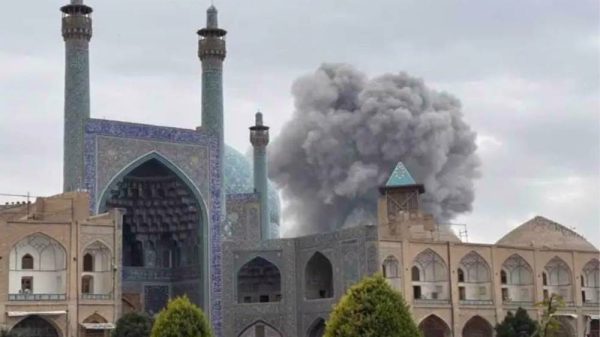
An airstrike hits a UNESCO World Heritage site in Naqsh-e Jahan Square in Isfahan
Press TV – March 10, 2026
Iran’s Foreign Ministry spokesman has condemned an attack by the United States and Israel on a historic site of Isfahan, saying the strike constitutes a crime against cultural heritage.
In a message posted on the social media platform X on Tuesday, Esmaeil Baghaei said the attack caused serious damage to the historic Chehel Sotoun Palace, a renowned museum-palace located near the famous Naqsh-e Jahan Square.

“After hitting Golestan Palace in Tehran, the US and Israel damaged another cultural heritage site of outstanding universal significance in the city of Isfahan: Chehel Sotoun Palace, a @UNESCO World Heritage site within Naqsh-e Jahan Square,” he wrote.
Baghaei described Chehel Sotoun as a masterpiece of the Safavid era, emphasizing that the site is not only part of Iran’s cultural and civilizational heritage but also a cultural treasure belonging to all humanity.
He said the US and Israel were deliberately targeting the historic heart of Isfahan, damaging Chehel Sotoun and putting invaluable historical artifacts of Iran’s civilization at risk.
“The world cannot remain silent while the aggressors’ brutal crimes threaten the shared heritage of humankind.”
The remarks come as the US-Israeli aggression against Iran, which started on February 28, has damaged some historical sites in the country, including those inscribed on the UNESCO World Heritage list.
Tehran’s Golestan Palace was severely damaged as a result of rockets and an explosion wave in Arg Square in the buffer zone.
Emirati billionaire rebukes US senator over call for Gulf states to join war with Iran
MEMO | March 10, 2026
Emirati billionaire Khalaf Al Habtoor has sharply criticised US Senator Lindsey Graham after the American lawmaker called on Gulf states to join military operations against Iran alongside the United States and Israel.
In a lengthy post on the social media platform X, Al Habtoor rejected any Gulf participation in the conflict, arguing that the region is already paying the price for decisions taken without consulting Arab states.
Graham made the remarks during media interviews following a closed congressional briefing, where he urged Gulf countries to become more actively involved in military action against Iran. He argued that Iranian attacks on countries such as Kuwait, Qatar and Saudi Arabia could prompt Washington’s Arab allies to take a stronger role in the confrontation.
The senator also said that the United States “will not fight alone in the Middle East”, noting that arms sales to Gulf countries form part of broader strategic alliances.
Al Habtoor responded by criticising what he described as foreign pressure on regional states to join the conflict.
“We know perfectly well why we are being attacked, and we also know who dragged the entire region into this dangerous escalation without consulting its allies,” he wrote.
The Emirati businessman said Gulf countries do not need outside protection and warned against risking the lives of people in the region in a wider war.
“Nothing is more precious than the lives of our sons, and no alliance is worth risking them,” he said, adding: “We don’t need your protection… all we want from you is to keep your hands off us.”
Al Habtoor also criticised the role of the global arms trade, describing weapons sales as a major business rather than a form of protection, and argued that conflicts in the region benefit the international arms industry.
He further accused Graham of prioritising Israeli interests over those of the American public, saying the region’s countries seek peace and stability and prefer diplomatic solutions rather than military escalation.
Op. True Promise 4: Iran’s missile blitzkrieg dismantles US war machine in West Asia
By Ivan Kesic | Press TV | March 10, 2026
In just ten days, Iran’s military response to the Israeli-American war of aggression has dismantled the core of US power in the Persian Gulf, from Qatar’s Al-Udeid Air Base to the US Fifth Fleet headquarters in Bahrain.
What began on February 28, 2026, as the ill-fated “Operation Epic Fury” has spiraled into a strategic catastrophe for the US military-industrial complex.
The aggression, which led to the martyrdom of the Leader of the Islamic Revolution, Ayatollah Seyyed Ali Khamenei, as well as ordinary civilians, has been met with one of the most devastating and precisely coordinated military campaigns in modern regional history.
Systematically, Iranian missiles and drones have pierced American air defenses, reducing over a dozen military installations to rubble, obliterating advanced radar systems, and crippling US naval power.
Thousands of American personnel now confront an undeniable reality: their assets are no longer safe from Iran’s formidable and far-reaching arsenal.
US military web in the Persian Gulf
To fully grasp the magnitude of Iran’s military achievements, one must first understand the intricate web of US military power that has for decades strangled the Persian Gulf region.
This network has served as the primary instrument of US hegemony over the world’s most vital energy resources and the principal military guarantee for the security of the Zionist entity.
At the apex of this system sits Al-Udeid Air Base in Qatar. A sprawling facility covering approximately fifty square kilometers southwest of Doha, it stands as the largest American military installation in the entire West Asia and the forward headquarters of United States Central Command.
Al-Udeid is the cornerstone of US military strategy in the region, housing over ten thousand personnel and supporting the 379th Air Expeditionary Wing. Its formidable array of bombers, fighter aircraft, surveillance platforms, and drones has, for years, been the launchpad for aggressive operations against regional nations.
Less than two hundred and fifty kilometers from Al-Udeid lies Al-Dhafra Air Base in the United Arab Emirates. This installation complements its Qatari counterpart by providing the United States with advanced intelligence, surveillance, and reconnaissance capabilities.
Al-Dhafra hosts approximately five thousand active-duty US military personnel assigned to the 380th Air Expeditionary Wing.
Their primary missions include aerial refueling and high-altitude intelligence gathering, utilizing platforms such as the Lockheed U-2 Dragon Lady, the Boeing E-3 Sentry AWACS, and the RQ-4 Global Hawk surveillance drones – aircraft that have routinely violated Iranian airspace along the Persian Gulf coast.
The base achieved particular notoriety in 2019 when one of its Global Hawk drones was shot down by Iran’s air defense system, an episode that foreshadowed the far greater defeats to come.
In Bahrain, the Naval Support Activity in Manama serves as the headquarters for both US Naval Forces Central Command and the United States Fifth Fleet.
Supporting over nine thousand military personnel and more than one hundred tenant commands, this facility, established on the grounds of the former British Royal Navy base HMS Juffair, provides the logistical and command infrastructure necessary for the Fifth Fleet to project power throughout the region with its carrier strike groups and supporting vessels.
Kuwait hosts yet another crucial node. Camp Arifjan serves as the primary forward logistics hub for American ground forces, while Ali Al-Salem Air Base hosts the 386th Air Expeditionary Wing, and Mohammed Al-Ahmad Naval Base provides critical naval infrastructure.
This was the fortress America had built, a ring of steel and fire meant to contain and intimidate. And this is the fortress that Iran has just shattered.
Initial wave: Iran’s devastating response to US-Israeli aggression
When the US and the Israeli regime launched their cowardly aggression against Iranian territory on February 28, assassinating Leader of the Islamic Revolution Ayatollah Ali Khamenei and more than two hundred Iranian civilians, including 165 schoolgirls in the city of Minab, they evidently believed that such a devastating blow would leave Iran paralyzed.
The school was attacked twice by the US missiles, debunking the claim that it was not deliberate. As experts noted, the same site cannot be mistakenly targeted twice.
Within hours of the initial wave of aggression, the Islamic Revolution Guards Corps (IRGC) launched Operation True Promise 4, a meticulously planned retaliation that simultaneously targeted more than a dozen American military installations across the region.
At Al-Udeid Air Base in Qatar, Iranian missiles struck with devastating precision. Their impacts were captured on video and broadcast by multiple news agencies. The most significant achievement was the complete destruction of the AN/FPS-132 Upgraded Early Warning Radar, a system valued at approximately $1.1 billion that served as the electronic eye of American air defense throughout the Persian Gulf.
This fixed UHF phased-array radar, designed to detect and continuously track ballistic missiles at extremely long ranges, represented the most critical component of the US early warning architecture in West Asia.
Its obliteration rendered the entire American air defense network effectively blind, forcing surviving batteries to operate with degraded situational awareness and dramatically reducing their effectiveness against subsequent Iranian strikes.
Simultaneously, Iranian missiles and kamikaze drones descended upon Al-Dhafra Air Base in the UAE, destroying the American terrorists’ air warfare center, satellite communication center, early warning radars, and fire control radars, effectively decapitating the base’s command and control capabilities.
The Lockheed U-2 reconnaissance aircraft, Boeing E-3 Sentry AWACS, and RQ-4 Global Hawk drones found themselves without the supporting infrastructure necessary for their operations. Their hangars were damaged or destroyed, their crews scrambling to survive the onslaught.
The strikes extended to the naval infrastructure. At Jebel Ali Port in Dubai, which is the most frequent port of call for US Navy vessels outside the American homeland, Iranian missiles caused significant damage to facilities used for resupplying and maintaining the Fifth Fleet’s warships.
In Bahrain, the headquarters of the United States Fifth Fleet came under direct attack, with multiple missiles and kamikaze drones striking the Naval Support Activity facility.
Video clips captured the moment of impact as projectiles struck buildings within the base complex, including a high-rise structure housing American troops.
The IRGC announced that a service center for the Fifth Fleet had been specifically targeted, and subsequent attacks on March 1 would hit an unnamed US naval command and backup center with two ballistic missiles.
Kuwait’s American installations suffered perhaps the most complete destruction. Ali Al-Salem Air Base, struck on February 28, came under renewed attack on March 1.
The IRGC subsequently declared that the base had been rendered completely out of service. This facility, home to the US Air Force’s 386th Air Expeditionary Wing, was effectively neutralized as a military asset: its runways cratered, its hangars destroyed, its aircraft either damaged or forced to flee. The Mohammed Al-Ahmad Naval Base suffered an equally devastating fate, with three naval infrastructure structures reportedly destroyed.
In a matter of hours, the elaborate fortress America had spent decades building had been shattered.
Strategic significance of America’s lost assets
The full measure of Iran’s military achievement becomes apparent only when one considers what these destroyed facilities actually meant to American strategic power.
The AN/FPS-132 radar at Al-Udeid was not merely an expensive piece of equipment, but the keystone of the entire American air defense architecture in the Persian Gulf.
Without it, the Patriot and THAAD batteries scattered across the Persian Gulf states became fundamentally degraded. Forced to rely on their own shorter-range sensors, they were rendered far more vulnerable to saturation attacks.
The destruction of this single system effectively crippled the integrated air defense network that the United States had spent decades constructing.
Al-Dhafra’s destroyed command and control centers represented an equally significant loss. These facilities were the nerve centers through which American intelligence operations across the Persian Gulf were coordinated.
The satellite communication center had been the primary link transmitting data from surveillance aircraft to analysis centers; its loss temporarily blinded American intelligence collectors across the region.
The damage inflicted upon the Fifth Fleet’s headquarters in Bahrain disrupted the command infrastructure necessary for coordinating carrier strike groups and support vessels across an area encompassing the Persian Gulf, Red Sea, and Arabian Sea.
Without this hub, the fleet’s ability to project power became fundamentally compromised.
The destruction at Jebel Ali Port compounded these difficulties by damaging the primary logistics hub through which the Fifth Fleet received supplies and maintenance support.
A fleet without fuel, without spare parts, without the means to sustain prolonged operations, is little more than a collection of floating metal.
In a single night, Iran did not merely strike American bases; it dismantled the architecture of American power in the region. The radar that saw everything was blinded.
The centers that coordinated everything were silenced. The ports that sustained everything were crippled. The fleet that dominated everything was paralyzed.
Continuing campaign: Sustained pressure on US positions
The second phase of the retaliatory military campaign unfolded on March 8 and 9, with fresh strikes targeting key American installations in the region.
Al-Udeid Air Base came under renewed attack on March 8, with loud blasts and sirens reported. The Qatari Ministry of Defense subsequently acknowledged the strikes, though Iranian military sources framed them as direct hits on the key command hub.
The fact that attacks continued despite Qatari interception claims suggested that many missiles and drones were still getting through. The following day, March 9, Al-Udeid was struck again, with explosions rocking the base for the second consecutive day and verified reports confirming impacts.
The Juffair Naval Base in Bahrain was also targeted on March 8. The IRGC announced a direct strike in retaliation for a US attack on an Iranian desalination plant on Qeshm Island earlier the same day. Foreign Minister Abbas Araghchi stated that the United States had set the precedent by hitting civilian infrastructure, which made Iran’s response more legitimate.
Ali Al-Salem Air Base in Kuwait, already severely damaged in earlier strikes, came under drone attack on March 8. The Islamic Resistance in Iraq claimed responsibility for an operation that allegedly breached Kuwaiti air defenses and hit the installation.
The Prince Sultan Air Base near Al-Kharj in Saudi Arabia was targeted with a volley of ballistic missiles. Although Saudi forces claimed to have intercepted three missiles heading for the base, the installation still suffered significant damage.
Iran’s military-technological triumph
The past 10-11 days of combat have demonstrated conclusively that Iranian military technology has reached a level of sophistication American strategists never anticipated.
Iranian missiles have consistently penetrated American air defenses, striking their targets with precision that rivals, or exceeds, that of US weapons, as experts acknowledge.
Iranian drones have swarmed American bases in numbers that defensive systems simply cannot engage. The destruction of the AN/FPS-132 radar represents perhaps the most significant single technological achievement of the campaign: a billion-dollar system, specifically designed to detect and track missiles like those Iran fired at it, proved utterly incapable of preventing its own destruction.
The performance of Iranian anti-ship missiles against American naval assets, including the reported strike on a US Navy combat support warship, further demonstrates the comprehensive nature of Iran’s capabilities.
No domain, whether air, land, or sea, has remained immune this time.
Beyond technology, the sustained nature of the Iranian campaign reveals logistical and industrial capacities that the US clearly did not anticipate. Iran has fired hundreds of missiles and drones while maintaining the ability to continue such strikes indefinitely, a feat that suggests a production capacity Western intelligence had catastrophically underestimated.
American forces, by contrast, have expended enormous quantities of interceptors attempting to defend against Iranian attacks, depleting stocks that will take years to replenish.
The economics of this war are as devastating as its tactics: a missile that costs Iran a few hundred thousand dollars is met by an interceptor that costs America several million. This is a war of attrition that the United States cannot win.
The technological edge upon which American military dominance has rested for decades has been revealed as a myth in these 11 days. The industrial capacity that was supposed to guarantee American superiority has been exposed as insufficient. And the will to sustain a prolonged war in the face of mounting losses has yet to be tested.
Humiliation of American power
Beyond the purely military dimensions lies the broader strategic impact on American military prestige throughout West Asia, carefully built over the decades, military experts say.
The US has presented itself as the indispensable guarantor of security in the Persian Gulf, the force whose military might ensures the free flow of oil and the stability of friendly regimes.
The events of the past 11 days have exposed this narrative as hollow propaganda, revealing that American power rests not on invincible capability but on the absence of serious challenge.
The Persian Gulf Arab states that have hosted American bases now find themselves in an impossible position, their territories transformed into battlegrounds, their air defense systems exposed as ineffective, their American protectors revealed as vulnerable.
The casualties inflicted upon American forces, estimated in the hundreds by Iranian military sources, represent a human cost that will reverberate through American society.
American families are receiving notification that their loved ones will not return from a war that Washington started and cannot win, a source told the Press TV website.
The images of destroyed bases, burning aircraft, and fleeing personnel convey a message more powerful than any official statement: the United States is not winning this war.
New strategic reality
As the imposed war enters its second week, a new strategic reality has emerged in West Asia, one in which American military dominance has been shattered and Iranian power stands ascendant, military experts note.
“The United States can no longer guarantee the security of its bases in the Persian Gulf. It cannot protect its warships from Iranian missiles. It cannot conduct intelligence operations along Iranian coasts without risking the destruction of its most valuable platforms,” a highly placed military source told the Press TV website.
“The carefully constructed edifice of American military power has been revealed as a house of cards, collapsing at the first serious challenge.”
For Iran, he noted, these military achievements represent not merely a successful retaliation but a strategic victory that fundamentally transforms the entire regional security environment.
The Islamic Republic, through these 34 waves of Operation True Promise 4 (and counting), has demonstrated capabilities that will deter American aggression for years to come.
“The message from Tehran to Washington could not be clearer: the era of American dominance in West Asia has ended. Any future aggression against the Islamic Republic will be met with responses far more devastating than anything yet seen,” the source said.
Aramco CEO warns ‘catastrophe’ imminent if Strait of Hormuz remains shut
The Cradle | March 10, 2026
Saudi oil giant Aramco issued a warning on 10 March that the global energy market faces “catastrophic consequences” if the Strait of Hormuz remains closed.
“There would be catastrophic consequences for the world’s oil markets and the longer the disruption goes on … the more drastic the consequences for the global economy,” Aramco CEO Amin Nasser told reporters.
“While we have faced disruptions in the past, this one by far is the biggest crisis the region’s oil and gas industry has faced,” he added.
Nasser went on to say that the crisis has ravaged the shipping and insurance sectors, while also threatening aviation, agriculture, and other industries.
“Of course, we would support any actions or measures that would help to deliver our products to our customers, to the global market,” he said when asked about the US Navy potentially escorting oil tankers through the strait.
Yet a top energy official in the Gulf told Reuters that ending the war was the only way to open the strait, through which around 20 to 30 percent of the world’s energy passed before the attack on Iran.
Qatar warned on Tuesday that attacks on regional energy infrastructure could trigger economic repercussions far beyond the Gulf.
Doha said strikes on oil and gas facilities have set a dangerous precedent.
Tehran has vowed not to allow “one liter of oil” to be shipped from the region if Washington and Tel Aviv’s war continues.
“The Strait of Hormuz will either be an outlet for understanding and cooperation, or it will turn into a strait of strangulation for those who dream of wars,” Ali Larijani, head of Iran’s Supreme National Security Council, said.
Since the start of the war, Iran has targeted tankers refusing its warnings not to approach the strait.
US military bases housing key radars, as well as vital energy infrastructure across the Gulf, have also been struck by Iranian forces.
In response to an Israeli attack on an oil facility in Iran, the Islamic Revolutionary Guard Corps (IRGC) said on 10 March that it targeted Israeli energy facilities in Haifa.
Global oil prices currently hover around $90 per barrel, down from $120 on Monday, following Trump’s statement that he aims for a swift resolution to the war.
However, prices are expected to surge again. Trump’s comments on the war have been contradictory. “We could go further, and we’re going to go further,” he said on Monday, before telling US media hours later that “I think the war is very complete, pretty much.”
The US military has burned through more than $10 billion of its annual budget since the start of the war in late February.
Trump’s advisors have been urging the US president to find an “exit plan” to “extract” Washington from the brutal war on Iran due to concerns of political backlash, informed sources told the Wall Street Journal (WSJ) on 9 March.
Yet Iran has reportedly refused ceasefire discussions. “It is we who will determine the end of the war,” the IRGC said this week.
What If Iran Says No?
Is an end to fighting currently possible?
Ashes of Pompeii | March 10, 2026
Rumors persist that the Trump administration is actively seeking an off-ramp to the escalating conflict with Iran. The prevailing assumption within certain circles of the White House is that Tehran, having sustained serious damage from recent military strikes, would welcome a cessation of hostilities. This calculation, however, rests on a dangerous misreading of Iranian resolve, historical grievance, and strategic necessity. What if Iran says no?
The first and most fundamental obstacle is trust. Can Iran reasonably trust any promise made by Donald Trump? The historical record suggests otherwise. The unilateral withdrawal from the JCPOA in 2018, despite verified Iranian compliance, established a precedent of bad faith. Yet, the breach of trust goes deeper than past policy. The February 28 surprise attack was not merely a military strike; it was launched in the midst of ongoing peace talks. To strike while negotiating is the absolute most serious breach of diplomatic trust possible. It signals that words are meaningless and that force is the only language recognized by Washington. For Iranian leadership, any verbal assurance offered today carries the weight of tomorrow’s tweet. Diplomacy requires a foundation of credibility; that foundation has been systematically dismantled.
Second, the ideological makeup of the opposing governments creates a structural barrier to compromise. The current Israeli government is composed of extremist Zionists whose platform often rejects coexistence in favor of maximalist territorial and security demands. Simultaneously, Christian Zionists hold an important role in the Trump administration, viewing conflict in the Middle East through a theological lens that favors escalation over diplomacy. This alignment makes compromise with Iran inherently harder. For these factions, concession is not strategy; it is heresy. What demands could Iran make that would credibly constrain Israeli action? Binding security guarantees from the United States would be required, yet Washington’s ability to restrain its ally in moments of crisis is historically limited. Conversely, any Iranian demand for verifiable, long-term restrictions on Israeli military operations would likely be viewed in Jerusalem as an unacceptable infringement on sovereignty – a potential casus belli in itself.
Third, any serious Iranian negotiation would inevitably demand the removal of American military bases from the Persian Gulf. From Tehran’s perspective, these installations are not defensive outposts but forward operating bases for coercion and regime-change planning. Their presence is an existential threat. Yet for any American president, particularly one branding himself as a champion of strength, agreeing to withdraw forces from Bahrain, Qatar, or Kuwait would be politically untenable. It would be framed domestically not as diplomacy, but as retreat. Trump, who measures success in visible, declarative terms, could not sell a deal that requires abandoning strategic assets as a victory.
Fourth, Iran would demand the immediate and comprehensive lifting of sanctions. The economic toll of the pressure campaign has been severe, but capitulation without full relief would be seen as surrender. However, an immediate, total sanctions lift is a non-starter for the administration. It would undermine the central lever of U.S. pressure and invite fierce criticism from allies and domestic opponents alike.
And it is not worth even discussing the reaction to likely Iranian demands for reparations from America or Israel.
Underpinning all these structural obstacles is a profound cultural and emotional reality. Iran has raised the red flag of revenge. For Shiites, this is not merely political rhetoric; it is a religious imperative rooted in the tragedy of Karbala. Martyrdom and the justice due to martyrs cannot be so easily forgotten or forgone for political expediency. The rage in Iran for the February 28 attack is enormous, compounded by the perfidy of being struck during negotiations. A return to the status quo ante is not possible. The leadership that agrees to such terms risks being seen as weak, or worse, complicit in the betrayal of the faithful. And let us not forget, it is the son of the murdered Supreme Leader who has now been chosen as the new spirutual leader of Iran. This selection, in itself, can be seen as a slap in the face for Trump, who was demanding a say in the selection of the new leader.
The Trump administration appears to operate under the assumption that it holds total control over the escalation and de-escalation process. This is a critical miscalculation. Iran is not a passive recipient of U.S. policy but a strategic actor with its own red lines, domestic imperatives, and regional alliances. Tehran has demonstrated both the capacity and the will to act, and to retaliate when necessary. Diplomacy is a dialogue, not a dictate.
The central question, therefore, is not whether the United States can offer an off-ramp, but whether Iran can accept it. If the answer is no – and the points above suggest compelling reasons why it might be – then the conflict enters a more dangerous, protracted phase. Miscalculation risks increase. The assumption that pain alone will produce compliance ignores the role of pride, sovereignty, faith, and survival in strategic decision-making. Before celebrating a potential exit, policymakers must confront an uncomfortable truth: Iran has a say. And if Tehran chooses to say no, the path forward grows darker, longer, and far less certain. Added to this, Trump’s emotional, some would say vindictive, character would suggest that an Iranian refusal would lead him to escalate further.
Therefore this potential off-ramp may exist on a map in Washington, but in Tehran, the road ahead may still lead only forward, into not a storm, but a full blown global hurricane.
Trump Threatens to ‘Hit’ Iran ‘Twenty Times Harder’ Over Strait of Hormuz Oil Flows
Sputnik – 10.03.2026
US President Donald Trump warned Iran against disrupting oil shipments through the Strait of Hormuz, saying Washington would respond with far stronger military action.
“If Iran does anything that stops the flow of Oil within the Strait of Hormuz, they will be hit by the United States of America TWENTY TIMES HARDER than they have been hit thus far,” President Donald Trump wrote on Truth Social.
He added that the US could target sites that would make it “virtually impossible for Iran to ever be built back, as a Nation, again,” while saying he hopes such a scenario “does not happen.”
Trump described the policy as “a gift from the United States of America to China, and all of those Nations that heavily use the Hormuz Strait.”
Spare the hypocrisy: Baghaei slams Ursula’s support for US
Al Mayadeen | March 10, 2026
Iran’s Foreign Ministry spokesperson Esmail Baghaei sharply criticized Ursula von der Leyen in a post on X, accusing her of hypocrisy and of supporting US and Israeli “crimes of aggression” against Iran.
In his post, Baghaei urged von der Leyen to “spare the hypocrisy,” accusing her of repeatedly taking stances that align with occupation, genocide, and atrocities, further accusing her of “laundering” US and Israeli war crimes against Iranians.
Baghaei also questioned the European Commission president’s silence over recent civilian casualties in Iran, stating, “Where was your voice when more than 165 innocent IRANIAN little angels were massacred in the city of Minab?”
The spokesperson highlighted the hypocrisy in von der Leyen’s speech, asking, “Why don’t you say anything when hospitals, historical sites, oil facilities, diplomatic police headquarter, firefighting stations and residential neighborhoods are wickedly targeted?”
“Silence in the face of lawlessness and atrocity is nothing less than complicity,” Baghaei wrote, urging von der Leyen to review the public responses to her own post to see what people “really think” about what he called the “whitewashing of criminals.”
The exchange comes as the US-Israeli war on Iran continues to escalate, with strikes on Iran killing hundreds of civilians since February 28.
40 people killed in one strike
The US-Israeli aggression against Iran continued on March 9, targeting the capital Tehran, as well as several cities and provinces across the country.
Iranian media reported that strikes in Tehran hit residential buildings in the Meydan-e Resalat area, with preliminary reports indicating the martyrdom of 40 people, including several children.
According to Al Mayadeen’s correspondent in Tehran, a series of US and Israeli strikes also targeted the vicinity of Mehrabad International Airport, located west of the capital.
Air defense systems were repeatedly activated over the city to intercept drones and other hostile aerial targets, the correspondent said.
The governor of Tehran confirmed that some attacks struck residential areas and hospitals, stressing that despite the strikes, the capital remains stable.
190 minors, 200 women killed by US, ‘Israel’
Meanwhile, the head of the Iranian Emergency Organization revealed that 190 of those martyred since the start of the war were under the age of 18, while 700 wounded were also minors, including 60 children under the age of five.
He added that 200 females have been martyred, including an eight-month-old infant, while 1,402 women have been injured.
The official also reported damage to 29 hospitals, 41 health units, and 18 emergency centers.
Iran War Supporters Invent a New and Absurd Justification: It Is All About China
By Cole Crystal – SYSTEM UPDATE – March 9, 2026
Before Operation Epic Fury began, the Trump administration spent very little energy trying to justify the looming war with Iran. The few defenses they did offer were banal platitudes, just echoes of the case for the Iraq War from more than twenty years ago: that Iran was weeks away from obtaining a nuclear device, that their ballistic missile program posed a significant threat to American assets and allies in the region, and that the Iranian people deserved liberation via regime change.
But not long after the bombing began, a new (admittedly more creative) justification emerged online and in the pro-Israel media that war supporters assume will be more persuasive to those doubting the wisdom of yet another Middle East conflict. The war with Iran, we are now told by many, is not really about Iran at all. It is, instead, all about China.
“Some argue Israel dragged the U.S. into war,” a post from The Free Press reads, “But this conflict is bigger than Israel and Iran — it’s about China.” Another article from The Spectator, a British conservative outlet, sang the same tune: “Trump’s ultimate target in this war is China.” Glenn Beck, on March 2, unveiled C.R.I.N.K., or “the new Axis Powers of China, Russia, Iran, and North Korea,” as a way to “understand why Trump attacked Iran.” Fox News’ Jesse Watters told his audience last week that “we are killing two birds with one stone: we stop the number-one sponsor of terror, and we checkmate the Chinese.”
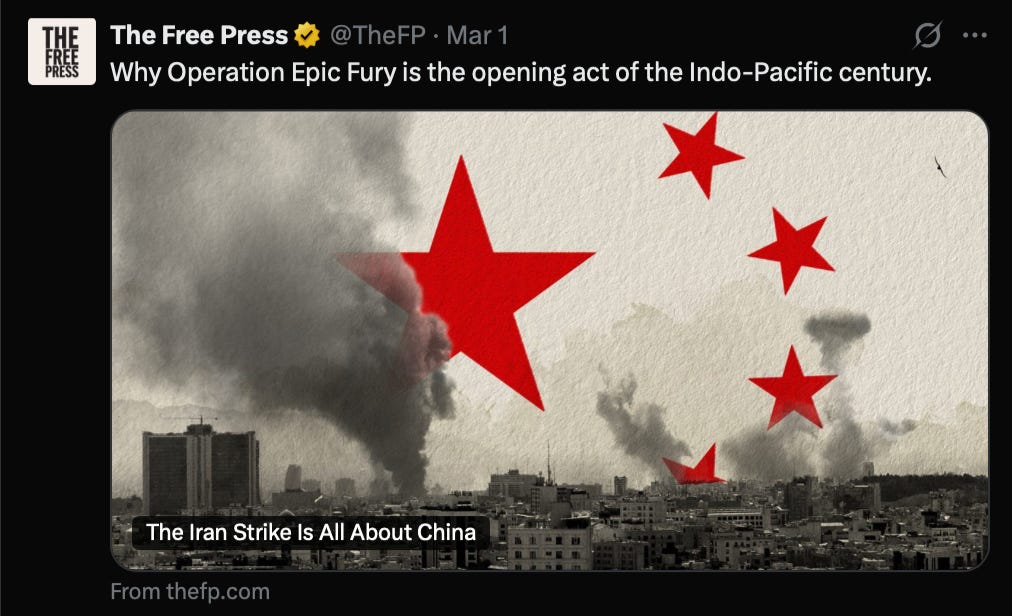
A viral graphic circulated by the Free Press about the motivations for the American-Israeli war against Iran.
At the very least, if China were really the motive, one would have expected the Trump administration to offer this theory — “this is the chance to counter America’s greatest geopolitical rival” — as a major justification to the American people. One would think they would be particularly motivated to do so, given the consensus of polling data showing that public support for this war is far weaker than for any American war in decades.
But Trump officials never mentioned China as a core motive. In fact, even now, the administration and its backers have hardly mentioned China. This is a theory invented out of whole cloth by Iran-war supporters and/or Trump supporters, grasping for some cogent reason why this new war is in Americans’ interests.
Late last week, Senator Lindsey Graham claimed that this conflict is “a religious war” waged by “radical Islamic terrorists.” On March 2, House Speaker Mike Johnson explained to a group of reporters that the United States “determined, because of the exquisite intelligence that [it] had, that if Israel fired on Iran,” then “[Iran] would have immediately retaliated against U.S. personnel and assets.” Therefore, the House Speaker insisted, because the U.S. would be attacked either way, it had to hit Iran with Israel. President Trump announced on Friday that the U.S. intends to select “GREAT & ACCEPTABLE Leader(s)” for the Iranian people, in order to make their country “economically bigger, better, and stronger than ever before.”
These politicians, and many more inside and around the administration, are not talking about China. It has not been cited as a significant motivator for starting this war. Yet if China is really the reason, did the most prominent war supporters simply forget why they went to war, or did they decide it was best to present a false, pretextual case to the American people about why this war was necessary?
Admittedly, this new justification is, at least on the surface, cogent, even if pretextual. China is the most powerful geopolitical competitor to the U.S. No other country buys more sanctioned crude oil from the Iranians, and only Russia has worked more closely with Iran to beef up its military. In 2021, Iran signed a 25-year partnership with China that would reportedly bring $400 billion to Iran’s energy industry. Various weapons deals between the two countries have been reported in recent years, including one to purchase Chinese supersonic missiles that can sink American ships.
Still, none of these events really pertain to, let alone prove, this new claim — that this war with Iran is somehow really about China. At most, they suggest that China may be negatively affected, losing access to cheap oil and its investments. If simply being negatively impacted by this war is the standard for it being “about” another country, then this war is also about Kuwait, Qatar, the United Arab Emirates, and the rest of the Middle East.
Indeed, many countries could be harmed by the Trump-Netanyahu war in Iran. Japan’s economy could face severe consequences if oil is trapped in the Strait of Hormuz. The South Korean economy last week erased nearly half a trillion dollars, marking the largest drop in their stock market’s 46-year history. Is the war about both of these East Asian countries as well?
Further complicating this point is that China has not exclusively invested in or done business with Iran. Indeed, the People’s Republic has, at least publicly, invested more in Saudi Arabia, Iraq, and the United Arab Emirates. (That aforementioned $400 billion agreement between Beijing and Tehran still has not materialized.)
Nor is China the largest buyer only of Iran’s oil. It is also often the leading export destination for Iraqi, Kuwaiti, Omani, Saudi, and Qatari crude. Chinese money, in all its forms, is present across the Middle East, from port construction to the telecommunications industry. What’s more, the Chinese are filling gaps that have opened as a result of American reluctance or negligence.
American foreign policy in the Middle East, including wars, has far more often boosted Chinese interests than undermined them. When the United States in the mid-2010s refused to sell MQ-9 Reaper drones to the Saudis and Emiratis, China filled the gap by selling its CH-4 Rainbow and GJ-1 Wing Loong II models. After the United States invaded Iraq, killing hundreds of thousands of people, the Chinese were still the first to secure foreign contracts. (To this day, the Chinese are a dominant player in Iraq’s oil industry.) President Biden’s poor relations with the Saudis reportedly played a role in their consideration of settling contracts in Chinese yuan.
One would be forgiven for thinking that many of China’s relationships exist not because of an ideological competition with the U.S., but because capricious or draconian American policy often creates the conditions for Chinese success. This is no less true with Iran, as even the articles proffering this all-about-China theory acknowledge.
“Squeezed by decades of American sanctions and increasingly isolated,” the Israeli journalist Haviv Rettig Gur writes in The Free Press, “Iran turned to China as its economic lifeline.” This lifeline, moreover, “[is] the main reason the Islamic Republic has not gone bankrupt,” according to the conservative Hudson Institute, which is also pushing this about-China theory for the Iran war (see, for instance, its article titled, “The Iran Strike Is All About China”). In other words, the U.S. — not the Chinese — created the conditions for a competitor’s presence in the Middle East.
Theories like this one raise another problem. All of these arguments struggle to provide a comprehensive explanation of how China will be “devastated” by regime change in Iran, but they paint a fairly clear picture of how Iran became dependent on the People’s Republic. Of course, the U.S. gaining total control of the Middle East has implications for Chinese commerce and strategy, as these articles acknowledge. But no serious journalists or scholars have argued that China can currently project military power across the globe, with or without Iran.
Is that not why many of these ideologically aligned institutions warn about China’s nascent, but developing, blue-water navy? If one believes China will one day ‘imperialize’ like the U.S., Americans can wrest the Panama Canal from Chinese companies, attack China’s allies, and encircle the Chinese mainland — for now. Those kinds of actions could very well devastate China. (It would not be the first time Western powers have done something like it.) But Iran is hardly a necessary component of said devastation. If the U.S. really wants to wreck China, it does not need to pulverize Persia.
On top of all this, many of the videos and articles that have virally promoted this claim — that this war is about China, not Iran — seem to ignore the very foreign policy establishment that gave them this war. Mainstream American scholarship on China has been fairly clear: from a strategic perspective, the Chinese are perfectly happy to allow the United States to remain entangled in the Middle East because, by definition, it delays an American “pivot to Asia.” Bizarrely, some of these articles acknowledge this, making the Orwellian argument that the U.S. has to go to war with Iran in order to stop going to war in the Middle East.
And, of course, it would be difficult to ignore the lowest-hanging fruit. Far and away the most common thread that exists between those promoting this all-about-China theory is a devotion to Israel: the Free Press, the Hudson Institute, the Spectator, Fox News, etc. All of these institutions constitute the pro-Israel establishment in the U.S. and U.K. So, when Haviv Rettig Gur writes that Marco Rubio “struggled to explain” why the U.S. was at war with Iran, it is not because Rubio denied that Israel forced America’s hand. He, in fact, confirmed that Israel had compelled an American strike.
Apart from various reports that confirm Rubio’s initial account, such as in the New York Times and the Financial Times, Antony Blinken (his predecessor) recently described an identical story: that the Israelis tried to pressure former President Obama into war with Iran by claiming that if he failed to act, they would strike Iran alone. But, according to Rettig Gur, “It’s hard to take [Rubio’s] explanation at face value,” so the Secretary of State’s candor can be disregarded for another, entirely dreamed up claim. Rettig Gur continues, “If the trigger was simply an Israeli strike, America could have told the Israelis to sit tight. … Goodness knows the U.S. has the leverage to do it again.” That statement seems highly accurate. Unfortunately, some unclear entity — most likely China — prevented the United States from doing that.
Altogether, the claim that Trump went to war with Iran to fight China is more sensational than substantive. It entertains theories of 4D Chess when Yahtzee is a more apt comparison. The Trump administration is rolling the dice for Israel: it has already financed their genocide in Gaza, vaporized prayer circles in Yemen, destroyed Iranian nuclear facilities, granted Benjamin Netanyahu’s wildest wishes, and is now officially at war with Iran. For any hawks eager to embroil the United States in a head-to-head clash with the People’s Republic, the question is not if this latest war was about China — it is whether any of them will be.
Cole Crystal (@colecrystal) was producer and editor for SYSTEM UPDATE with Glenn Greenwald and now has the same title for this Substack. Before joining, he worked for media outlets in the United States. He graduated from Cornell University with a bachelor’s degree in government and online social movements.
Corporate Media Go All Out To Support The US-Israeli War on Iran
By Alan MacLeod | MintPress News | March 6, 2026
Corporate media of all stripes have rushed to support the U.S./Israeli attack on Iran, throwing objectivity and accuracy by the wayside in order to manufacture consent for regime change.
On February 28, the U.S. and Israel launched a joint attack on Iran, bombing cities across the country, assassinating its supreme leader, Ali Khamenei, and openly stating their goal was overthrowing the government.
Despite this, media have gone out of their way to present the actions as the U.S. protecting itself, describing them as “defensive strikes,” and to frame Iran as the aggressor. “Iran chooses chaos” ran the headline of the New York Times’ newsletter, portraying the Islamic Republic as the primary actor.
The Free Press used similarly Orwellian concepts. “War is Iranians’ best chance at peace,” presenting U.S./Israeli crimes as an act of mercy on its long-suffering population.
Meanwhile, under the new leadership of self-described “Zionist fanatic” Bari Weiss, CBS News has transformed itself into a mouthpiece for the Israeli Defense Forces, interviewing IDF Brigadier General Effie Defrin, and uncritically presenting Israel’s war as “aimed at preventing a wider global threat.”
Across the West, corporate media have employed the same tactics of using the passive voice and not naming the perpetrator when describing U.S./Israeli aggression. A perfect encapsulation of this was the BBC’s headline, “At least 153 dead after reported strike on school, Iran says,” that made it sound as if the children died in a lightning strike or a labor dispute, rather than that they were bombed by hostile foreign powers.
Israeli casualties were given more sympathetic coverage than their Iranian counterparts, while media regularly toned down the language used to describe Israeli actions to make them sound more reasonable, and did the opposite with Iran. The Washington Post, for example, wrote (emphasis added) “Israel urges evacuation of south Beirut suburbs; Iran threatens revenge on U.S. over warship.” Thus, Israel was treated as making a good faith attempt to reduce civilian casualties, while the Iranian response to their ship being attacked and sunk in international waters was presented as menacing.
Another common tactic of delegitimization media use is to describe the Iranian as a “regime” (e.g., Bloomberg, Washington Post, Wall Street Journal, Financial Times, CNN, NBC News). The word “regime” immediately discredits a government, and cues the reader to oppose it. The phrase “Israeli regime” is virtually never used, unless in a quote from Iranian officials.
Earlier this week, large numbers of Israeli troops re-invaded southern Lebanon. Media attempted to find ways to present the operation as legitimate, including euphemistically using the phrase “cross over into Lebanon” to describe the invasion, or even blaming Hezbollah for the violence. CNN, for instance, wrote that, “Hezbollah is dragging Lebanon into the war on Iran,” and that “Hezbollah just restarted the fight that Israel was waiting to finish,” thereby flipping the realities of who was attacking whom.
There have also been a number of fawning profiles of Israeli leaders. “Benjamin Netanyahu’s long career was built on conflict avoidance—then, October 7 transformed and radicalized him,” wrote The Atlantic. In Britain, the coverage from some quarters was even more positive. “Netanyahu is the great war leader of our age” The Daily Telegraph stated, describing the prime minister as a “genius.”
The Daily Telegraph’s Monday front page headline read “Britain backs war on Iran,” with a picture of diaspora Iranians cheering on the bombing of their country. The reality, however, is far less jingoistic. A YouGov poll published the same day found that only 28% of U.K. citizens support U.S./Israeli actions, with 49% expressing their opposition to them. Nevertheless, BBC anchor Nick Robinson suggested, on air, that protests against the U.S./Israeli attacks should be banned across the U.K.
This sort of mentality should come as no surprise, given BBC leadership’s stated positions on Israel. The corporation’s Middle East editor, Raffi Berg, is a former CIA operative and Mossad collaborator who has a signed letter of recommendation from Netanyahu on his office wall.
Anonymous BBC employees speaking to Drop Site News claimed that Berg’s “entire job is to water down everything that’s too critical of Israel.” They went on to allege that he holds “wild” amounts of power at the British state broadcaster, that there exists a culture of “extreme fear” at the BBC about publishing anything critical of Israel, and that Berg himself plays a key role in turning its coverage into “systematic Israeli propaganda.” The BBC has disputed these claims.
If true, the sort of top-down pro-Israel bias at the BBC closely mirrors that of American outlets. A leaked 2023 New York Times memo revealed that company management explicitly instructed its reporters not to use words such as “genocide,” “slaughter,” and “ethnic cleansing” when discussing Israel’s actions. Times staff must refrain from using words like “refugee camp,” “occupied territory,” or even “Palestine” in their reporting, making it almost impossible to convey some of the most basic facts to their audience.
CNN employees face similar pressure. In the wake of the October 7 attacks, the company’s C.E.O. Mark Thompson sent out a memo to all staff instructing them to make sure that Hamas (and not Israel) is presented as responsible for the violence, that they must always use the moniker “Hamas-controlled” when discussing the Gaza Health Ministry and their civilian death figures, and barring them from any reporting of Hamas’ viewpoint, which its senior director of news standards and practices told staff was “not newsworthy” and amounted to “inflammatory rhetoric and propaganda.”
German media conglomerate Axel Springer, meanwhile – owner of outlets such as Politico and Business Insider – requires its employees to sign what amounts to a loyalty oath to support “the trans-Atlantic alliance and Israel.” The company fired a Lebanese employee who, through internal channels, questioned the requirement.
American newsrooms are also filled with former Israel lobbyists. A MintPress News investigation found hundreds of former employees of Israel lobbying groups such as AIPAC, StandWithUs and CAMERA working in top newsrooms across the country, writing and producing America’s news – including on Israel-Palestine. These outlets include MSNBC, The New York Times, CNN, and Fox News.
There are even ex-Israeli spies writing our news. Another MintPress report revealed a network of former agents of IDF intelligence outfit, Unit 8200, working in America’s newsrooms, including at CNN and Axios.
Therefore, with American newsrooms presided over and staffed in no small part by pro-Israel zealots, it is far from a surprise that their coverage closely mirrors the outlook and biases of Washington and Tel Aviv.
And now, with CNN, CBS News, and TikTok owned by CIA asset Larry Ellison, the IDF’s largest private funder and a close personal friend of Benjamin Netanyahu, we should only expect the propaganda to be dialed up to eleven.
Trump press conference reveals a man who wants out of war
By Trita Parsi | Responsible Statecraft | March 9, 2026
Trump’s “all over the place” press conference at his Miami resort on Monday appears to have had two key objectives: a) Calm the markets by signalling the conflict may soon be over because it has been so “successful,” and b) Prepare the ground for Trump ending the war through a unilateral declaration of victory.
Though ending a war that never should have been started in the first place — rather than fighting it endlessly in the pursuit of an illusory victory as the U.S. did in Afghanistan — is the right move, it won’t be as easy as Trump appears to think.
Tehran also has a vote — and there is little to suggest that it will agree that the war is over.
Tehran objects to what it would consider a premature ceasefire out of fear that it would only give the U.S. and Israel time to regroup, rearm, and then re-attack Iran. For the conflict to be ripe for a ceasefire, Tehran believes that enough cost must have been inflicted on the U.S., regional states, Israel, and on the global economy that all states conclude that starting the war was a mistake — and as a result, no state will seek to restart it.
Moreover, if the war ends now, Iran will be in a worse situation than it was before the start of the war. Much of its infrastructure has been destroyed, its missile capabilities have taken hits, its ability to export oil has been damaged, and most crucially, its prospects for sanctions relief have been obliterated. Indeed, who will and can help rebuild Iran under these circumstances?
This would leave Iran not only in a weakened position but also in a continuously weakening state. Which, in turn, would make another war of aggression by the U.S. and Israel more, not less, likely, since it is Iran’s perceived weakness that prompted Trump and Israel to see an opportunity for war.
As such, it appears likely that Iran will continue to target Israel, even if the U.S. declares victory and withdraws its military. Even GCC states may continue to be targeted. And Tehran will very likely try to keep the Straits of Hormuz shut. (At least for now, there are no signs that Tehran has lost its ability to do these things).
This will create a dilemma for Trump. It will be difficult for him to stay out while Iran and Israel continue to go at each other. But if he reenters the war, the hollowness of his declared victory will have been revealed. Markets will react negatively, and all the costs Trump is currently trying to avoid will likely intensify dramatically.
Iran, of course, does not want, nor can it afford, an endless war. But it will likely demand some significant steps in order to accept a ceasefire. This may include a commitment from Trump not to restart the war (though I don’t understand the value of such a commitment). But more importantly, it will likely require sanctions relief and release of its frozen funds abroad.
Trump will, of course, bark, but if the outcome is continued war, that will put a lot of pressure on him. Here, the role of some GCC states may prove crucial due to their willingness and ability to find an arrangement that could leave both Trump and Iran feeling that they “won.”
Whether Israel will allow that to happen, of course, is a different matter.
Trita Parsi is the co-founder and Executive Vice president of the Quincy Institute for Responsible Statecraft.
When Tel Aviv decides, Washington fights
By Jamal Kanj | MEMO | March 9, 2026
American taxpayers are still hemorrhaging from the made-for-Israel war in Iraq, a war audaciously offered as one that would “pay for itself.” Instead, it was paid in Iraqi and American blood, ruins and financed by American debt. The promised democracy was a broken state, regional chaos, and the afterbirth of terror and resistance that continues to metastasize across the Arab world. Marketed as a short, decisive campaign, Iraq became a two-decade-long disaster with no exit in sight. Trillions were burned on lies manufactured by Israel-first Zionists in Washington, while generations of Americans—many not even born when the invasion began—were conscripted into inheriting the debt, the interest, and the moral stain.
The real balance sheet of that war is etched into nearly 5,000 American tombstones and the endless corridors of veterans’ hospitals. Before that blood-soaked bill is even paid, the very same architect, using the same lies, has succeeded again in dragging the U. S. into another made-for-Israel war, this time against Iran. Iraq was not an aberration; it was a rehearsal. Yet, Iran doesn’t appear to be the final act on the Israeli menu. In recent weeks, former Israeli prime minister Naftali Bennett declared that Turkey is next. And it is the U.S., not Israel, that is expected to keep paying for wars, America neither needed nor chose.
The evidence of who set the clock of this war is unmistakable. The most revealing admission did not come from Tehran, Moscow, or Beijing, but from the U.S. State Department. In an unguarded moment, the U.S. Secretary of State admitted that the timing of this war was not an American choice. This became painfully clear when the State Department was caught unprepared to help evacuate tens of thousands of Americans from the war zone.
As U.S. ambassadors hurried to evacuate their staff and families, desperate citizens were told their government could not assist and were advised to arrange their own departures, after airports had already closed.
This is not a minor detail. It’s a government that is willing to sacrifice the well-being and security of its citizens by joining a war decided by someone else. It goes to the heart of sovereignty and democratic accountability. A nation that chooses to go to war prepares its people, its diplomacy, and its logistics. A nation that is dragged into war improvises and hopes for the best.
Iran, for its part, is not the caricature often presented by the American Secretary of War and Donald Trump. It is a country prepared for drawn-out conflict and strategic patience. During the nearly eight-year Iran-Iraq War, Tehran fought a grinding, no-win war against a better-armed adversary. Against the expectations of Western military analysts, Iran endured. In a grim irony, it even committed the greatest of all sins: purchasing weapons from Israel, falling into Tel Aviv’s cynical strategy to weaken both Baghdad and Tehran simultaneously. Israel was willing to arm its supposed arch-enemy as part of its broader calculus of exhaustion and division.
That history matters today. Iran has demonstrated, repeatedly, a willingness to absorb punishment, and extend conflicts over time. At the end of the day, and by all means necessary, Iran is unlikely to surrender. In a protracted war of attrition to bleed the world economy, Tehran could move to close the Strait of Hormuz, an oil blood line for world economies. Iran may be economically battered, and it has been for decades under severe sanctions, but that very weakness reduces its restraint. A country with little left to lose is more inclined to impose pain on others, including Western and neighboring welfare oil economies dependent on uninterrupted energy exports.
Meanwhile, regional instability in the Gulf and prolonged American entanglement create the perfect parasitic symbiosis for Israel: a state that flourishes in the shadows of regional chaos like a scavenger thriving on the scrap of a landfill.
President Trump has suggested escorting oil shipments in the Strait to keep the oil flowing. The macho bravado may play well on television or for the stock market, but history, old and recent, offers daunting realities. The same was attempted during the Iraq-Iran war in the 1980s but failed. More recently, the U.S., the EU, and Israel combined failed to force a much smaller and poorer country—Yemen—to open the Red Sea. After months of bombardment, siege and naval pressure, Washington was forced into negotiations, and even then, Yemeni forces continued to block vessels linked to Israel until Gaza ceasefire.
The comparison is useful. The shorelines area under the Houthi control of the Red Sea (green map in the link) in the north of Yemen, is a much wider maritime passage. The Strait of Hormuz, by contrast, is so narrow in a clear day each shore is visible from the other. To borrow a simple image, in the Houthi area the width of the Red Sea is an Amazon River and where Hormuz is a stream. The narrowness of the Hormuz Strait makes control easier for Iran and exposes the vulnerability of U.S. naval ships. Before promising to escort commercial shipping, a responsible administration should ask a basic question: if a small, impoverished Yemen could not be subdued by the world’s most powerful militaries, how exactly will American warships be safer under the reach of fire in the narrower Strait?
There is another question Washington refuses to entertain: How will Americans feel when they realize they are risking lives, ships, and economic stability largely to advance Israel’s sole strategic objectives?
This is not an abstract question. It is a political and economic reckoning, purposefully delayed. Especially since Americans are still reeling from the cost of previous Israeli wars, and now, they are asked to take on a new national debt—$200 billion—to bankroll yet another war, especially made for Israel.
The made-for-Israel wars may have begun in Iraq but will not end with Iran. Israeli false flags are poised to provoke further escalations designed to entrap even states traditionally friendly to Tehran, such as Oman. For Israel, victory remains incomplete unless it drags Gulf Arab states into open confrontation with Iran, hardening divisions that may last generations. Iranian mistrust of the Gulf Arabs would likely endure even in the event of regime change. In this calculus, Israel “wins” not only on the battlefield, but by entrenching lasting hostility between Iran and the Arab world, ensuring a permanently fragmented region.
More than two decades ago, the illegal war against Iraq was cooked in the dens of the Pentagon by Israel-first ideologues and sold to the American public through the managed media, ruse and weapons of mass deception. The current war is, in some ways, even more brazen. It was exclusively designed in the war ministry offices of Tel Aviv, and Trump obliged.
This is not America’s war. The decision was made elsewhere, and timed elsewhere, fought on behalf of someone else to serve the strategic objectives of a foreign country. Washington has subordinated the American national interest to the tribal agenda of Israeli-firsters inside the Beltway. Simply put: Tel Aviv chooses the war, and Washington pays the bill.
Top official: Iran ready for a long war with US, no more diplomacy
Press TV – March 9, 2026
The head of Iran’s Strategic Council on Foreign Relations says the United States has proved that it does not know the language of diplomacy, and that Tehran is ready for a long war.
“I no longer see any room for diplomacy. Because [US President] Donald Trump deceives others and does not keep his promises, and we experienced this in two rounds of negotiations. While we were negotiating, they attacked us,” Kamal Kharrazi said in an interview with CNN.
However, he noted that the economic pressure could increase to the extent that other countries take action to guarantee the end of the US-Israeli aggression against Iran.
“The Persian Gulf Arab countries and other countries must put pressure on the United States to end the war,” Kharrazi stated.
Noting that this war has created a lot of economic pressure on others, in terms of inflation and energy shortages, he said: “If it continues, this pressure will increase, and thereby others will have no choice but to intervene.”
The US and Israel started a fresh round of aerial aggression on Iran on February 28, some eight months after they carried out unprovoked attacks on the country.
The attacks led to the martyrdom of Leader of the Islamic Revolution Ayatollah Seyyed Ali Khamenei.
The aggression was launched as Tehran and Washington had held three rounds of indirect negotiations in the Omani capital of Muscat and the Swiss city of Geneva and planned to open technical talks in Vienna, Austria.
Iran began to swiftly retaliate against the strikes by launching barrages of missiles and drone attacks on the Israeli-occupied territories as well as on US bases in regional countries.
Featured Video

or go to
Aletho News Archives – Video-Images
From the Archives
Israel Would Have No Qualms About USS Liberty-Style FALSE FLAG If Iran Campaign Falters – Analysts
By Ilya Tsukanov – Sputnik – 18.06.2025
Donald Trump is mulling whether or not to join Israel’s aggression against Iran as Tel Aviv faces problems sustaining its defenses against growing counterstrikes, and apparently lacks a realistic game plan for an end to hostilities after failing to achieve its goals. Analysts told Sputnik how the US could be ‘nudged’ into the conflict.
“The US is already assisting Israel with supplies, intel, refueling support, etc. One of the many US posts in the region could be attacked for a casus belli,” former Pentagon analyst Karen Kwiatkowski explained.
“If Trump doesn’t comply with Israel’s demand” and join its aggression voluntarily, “a false flag may be needed” to drag the US in, Kwiatkowski, retired US Air Force Lt. Col.-turned Iraq War whistleblower, fears.
Netanyahu has a diverse array of options at his disposal, according to the observer, including:
- a false flag against US assets abroad blamed on Iran or one of its Axis of Resistance allies, like the Houthis
- a US domestic attack or assassination blamed on Iran
- Iranian air defenses ‘accidentally’ hitting a civilian jetliner carrying Americans
- use of a dirty bomb or nuclear contamination somewhere in the region blamed on Iran
- even blackmailing by threatening to use nukes against Iran if the US doesn’t join the fight
Kwiatkowski estimates that Israel probably has “enough blackmail power” against President Trump and Congress to avoid the necessity of a false flag operation, but a “USS Liberty-style” attack, targeting the soon-to-be-retired USS Nimitz supercarrier that’s heading to the Middle East, for example, nevertheless cannot be ruled out entirely, she says. … continue
Blog Roll
 Aletho News
- Top PMU commander, over a dozen fighters killed in new US strikes on Iraq
- Is Netanyahu’s war gamble threatening the future of ‘Israel’?: FT
- Smotrich calls for annexation of South Lebanon to Litani River
- Echos of Gallipoli? Hormuz and the Geography of Hubris
- Pakistan PM backs Iran’s right to self-defense amid tensions
- Hungary blasts ‘fake’ EU accusation
- SAFE Debt Trap: Poland’s €43.7 Billion Bet on Unipolar Illusion
- War on Iran threatens global Gulf capital flows: FT analysis
- Mossad De Facto Admits To Inciting Riots In Iran
- Tehran: World grown thoroughly exhausted with US-Israeli ‘false flag storylines’
- If Americans Knew
- Israel poised to take over southern Lebanon; settlers wreak havoc in West Bank – Not a ceasefire Day 165
- From Sde Teiman, the truth about Israel’s military justice system has been set free
- Child denied life-saving bone marrow transplant by Israel ‘because he is from Gaza’
- Raffi Berg: BBC Middle East Editor Exposed as CIA, Mossad Collaborator
- Jerusalem Archbishop Rebukes Netanyahu’s Statements on Christianity
- US to embed Palantir AI across entire military: Report
- Israeli-US war on Iran to drag on “a few more weeks” – Not a ceasefire Day 164
- Lebanon deaths top 1,200; Palantir AI to be embedded across US military – Not a ceasefire Day 163
- Israel’s assassination game: Take all pragmatists off the board
- Food shortages return to Gaza as Israel tightens aid restrictions under the cover of its war on Iran
- No Tricks Zone
- Devastating Assessment Of Comirnaty Vaccine By Former Senior Pfizer Europe Toxicologist
- New Study: CO2 Is ‘Effectively Negligible’ As An Explanatory Climate Change Factor Since 2000
- Former Pfizer Toxicologist Dr. Helmut Sterz Tells Bundestag Hearing Pfizer Vaccine Should Have Never Been Approved
- Energy Expert: Germany’s Nuclear Phaseout Was A “500 Billion Euro Mistake”
- New Research: South Australia’s Mid-Holocene Sea Surface Temperatures Were 4°C Warmer Than Today
- Storing Green Energy To Last Germany 10 Days Would Require A 60-Million Tonne Battery
- New Studies: UK Sea Levels Were 4 Meters Higher Than Today During The Mid-Holocene
- Destructive Green New Deal: German Energy And Metal Group Warns Of Drastic Crisis
- New Study Documents A 20-Year Pause In Arctic Sea Ice Decline – Driven By Internal Variability
- Wake-up Call: Survey Shows Majority Of Germans Now Favor Postponing Climate Targets!
 Aletho News
