Sheikh al-Asadi warns of Iraqi government compliance with US demands
Al Mayadeen | September 29, 2026
Head of the Political Council of the Iraqi Harakat Hezbollah al-Nujaba, Sheikh Ali al-Asadi, criticized Baghdad’s decision to prevent Iranian aircraft from landing at Iraqi airports, stressing that it constitutes compliance with US pressure and warning that popular action could follow if the decision is not reversed.
Speaking to Al Mayadeen, al-Asadi said, “We regret the decision by the Iraqi authorities to prevent Iranian aircraft from landing in Iraq.” He described the decision as “submission to American bullying,” adding, “The Iraqi decision-maker must reconsider it; otherwise there will be popular pressure aimed at changing the decision.”
He said the issue extends beyond Iraqi airports, invoking longstanding ties between Iraq and Iran. “The issue goes beyond airports. There are close relations with Iran, and therefore we must not bow to an irresponsible decision by America,” he said. “Popular options will be the most pressing, and all possibilities are on the table.”
Sheikh al-Asadi attributed growing US influence in Iraq to weaknesses among domestic political actors. “The weakness of the domestic political actor has allowed the American occupation to impose its decisions in Iraq,” he said, adding, “The decision-maker can choose not to implement American decisions, as some countries do.”
He stressed that “the decision must be sovereign and independent politically, economically, and in terms of security,” defining sovereignty as “complete independence, with Iraq being the decision-maker in all aspects of life.
According to Sheikh al-Asadi, “There are personal and partisan interests behind the absence of independence in decision-making.” He also accused Iraq’s political class of adopting contradictory positions toward Washington, slamming duality in the political class: on the one hand, it agrees to American decisions, while on the other, it condemns them.
He added, “The Resistance’s positions have been clear from the beginning, while the Iraqi politicians have ambiguity and complications.”
Iraq’s main problem is corruption
Turning to the issue of weapons and the debate over their regulation, Sheikh al-Asadi said his movement had held discussions with the Coordination Framework and rejected the term “weapons confinement”. “We discussed the matter with the Coordination Framework and rejected the term ‘weapons confinement.’ We established that the term is harmful and changed it to ‘weapons regulation,’” he said. “Iraq’s biggest problem is corruption, not weapons,” he asserted.
“We are in favor of the Dawn Strike against corruption, but we want it to continue. There are clearly identified corrupt figures, and the law must be applied to them,” the Iraqi leader said. He also expressed deep distrust of Washington, saying, “We do not trust the Americans one iota, and they do not keep their word.” He added, “What happened with Iran is the biggest proof that the Americans do not keep their word. They struck Iran during negotiations, and this is proof of their treachery.”
US assassination unit, like Blackwater
Shikh al-Asadi said Iraq should remain free of US interference in its internal affairs. “Iraq must be free, and the American envoy must not interfere in economic, security, or political affairs,” he said. He added that his movement had information about US activities in Iraq, saying, “We have information about all the American movements and about the division they established, which includes Iraqis under their supervision.”
“We know where this division is located and what its duties will be in the coming phase, and all of this is being monitored,” Sheikh al-Asadi warned. He revealed that the goal behind the creation of this division is to carry out assassinations and create discord, saying, “It is like ‘Blackwater’ under another name.”
He added, “The American movement is suspicious, and they have security companies that entered to compensate for the American military withdrawal.”
Al-Nujaba rejects political participation under current system
Sheikh al-Asadi said Nujaba had no decision to participate in Iraq’s political process. “We in Harakat Hezbollah al-Nujaba have no decision to engage in the political process, and we are not convinced by the way it is being managed,” he said.
On the issue of weapons, he told Al Mayadeen, “The conditions for handing over weapons are ending the American occupation and all foreign presence, including the Turkish presence.”
He added that the Peshmerga should fall under the command of Iraq’s commander-in-chief of the Armed Forces and warned that “the separatist factions are one of Iraq’s problems, and whenever Resistance intervention is necessary, we will intervene in every inch of Iraqi territory.”
Sheikh al-Asadi further argued that the continuation of armed resistance was linked to the circumstances that justify it: “The resistance has its justifications for resistance, and when these justifications end, so does resistance,” reminding that the justifications do not end with the mere withdrawal of the remaining foreign troops in the country.
Iraq’s leadership must use its leverage
Al-Nujaba’s top official said Iraq’s political leadership must understand the country’s sources of strength and leverage and use them to advance its independence and sovereignty.
Speaking about Iraq’s leadership, Sheikh al-Asadi said he believed the current political figure in question “wants to serve the public interest and do the required work,” describing him as someone who is acting “based on his Shia identity, if I may put it that way.” However, he said the figure is “new to politics” and lacks advisors genuinely committed to helping him succeed.
“Unfortunately, he does not have advisors who are genuinely committed to making his experience successful. Rather, his advisors are concerned with making themselves successful,” Sheikh al-Asadi said.
He stressed that the advisors attempt to influence the political leadership based on what they receive from Washington, adding, “They do not want to help him become a successful figure who can lead during this stage and perhaps the next stage.”
“Whoever leads Iraq must understand what Iraq truly is and what the cards of strength and leverage in Iraq are,” he said. He questioned the interests of foreign powers in Iraq, asking, “Who needs Iraq? Does Europe not need Iraq? Does Turkey not need Iraq?”
Sheikh al-Asadi also pointed to the Development Road project, asking, “Doesn’t the Development Road that they are talking about need Iraq?”
“All of these are leverage cards a political actor can use to achieve what he wants,” he said. “He can even use the cards held by the Resistance factions as leverage. We are offering him this card and telling him: Use us for the sake of serving Iraq.”
Al-Asadi says US sought to persuade factions to give up weapons
According to Sheikh al-Asadi, several US allies had contacted his movement seeking a truce. “Many of America’s allies sent us messages asking for a truce, including the American chargé d’affaires who “tried to contact us through one of the politicians and asked to meet with us.”
He also said US officials had offered projects and incentives in exchange for abandoning strategic weapons. “The Americans offered projects and incentives on condition that we give up our strategic weapons that reach Israel, but we rejected them,” the Iraqi official said. He warned that US pressure would continue even if armed factions surrendered their weapons, saying, “American pressure does not stop at any point. Even if the factions hand over their weapons, they will move on to the Popular Mobilization Forces and then to the Defense Ministry.”
He concluded by highlighting that Washington had sought for years to alter the leadership of the Popular Mobilization Forces. “The main American project for years has sought to change the leadership of the Popular Mobilization Forces and dilute it, but the religious authority and some politicians rejected that,” Sheikh al-Asadi said.
Department of War Awards $20.7 Billion Contract to Raytheon for Air-to-Air Missiles
By Kyle Anzalone | The Libertarian Institute | September 29, 2026
The Department of War announced a nearly $21 billion, five-year contract to produce Advanced Medium-Range Air-to-Air Missiles (AMRAAM). While AIM-120 missiles are designed for warplanes in air-to-air combat, they can also be used as ground-launched missile interceptors.
The Pentagon announced the contract on Monday. “We are working across the defense industry to ramp production and build the Arsenal of Freedom,” said Under Secretary of War for Acquisition and Sustainment Michael P. Duffey. “This award strengthens our ability to equip the Joint Force and our allies with a proven air-to-air capability, ensuring our warfighters maintain a decisive advantage.”
Raytheon, or RTX, is the primary beneficiary of the contract. The deal was issued as an undefinitized contract action, meaning details of the cost and number of missiles could change. Under the contract, Raytheon will produce up to 1,900 AMRAAM missiles annually.
The AMRAAM, or AIM-120, missiles are designed to be fired from America’s fleet of fighter jets. There are multiple variants of the AIM-120 missile, and the Pentagon announcement did not disclose how many of each variant Raytheon has been contracted to produce.
While the AIM-120 is primarily an air-to-air missile, it can also be fired from the National Advanced Surface-to-Air Missile System (NASAMS), a ground-based air defense system. The AMRAAM-ER is an extended-range variant designed specifically for ground-based air defense.
Ukraine has relied heavily on the NASAMS system for air defenses. In April, the Center for Strategic and International Studies estimated the US has between 4,000 and 4,500 AIM-120 missiles in its stockpile. It noted that the US could use the AIM-120s as a cheaper option to down Iranian drones compared to Patriot or Standard Missiles. However, the AIM-120s still cost $1 million each.
‘Distance yourselves from Israel’: IRGC urges US population to question govt policies
The Cradle | September 29, 2026
Iran’s Islamic Revolutionary Guard Corps (IRGC) released a letter on 29 September addressing the US population – urging it to “force” Washington to “distance” itself from Israel, and expressing a readiness for “coexistence and peace,” while also vowing to continue fighting for Iran’s rights.
“Our purpose in sending a letter to the US people goes beyond media propaganda and creating familiarity with Iran’s reasoning. This is not a short-term or purely promotional move … Choosing a ‘letter’ as a tool to convey our message directly and clearly was a method selected based on the realities on the ground,” said IRGC spokesman Hossein Mohebbi.
“The countries neighboring or located near the US, whether along its land or maritime borders, do not possess the military and security capabilities to pose a serious threat to the US,” he added following the letter’s release, urging US citizens to question Washington’s military expansionism and the presence of hundreds of its military bases across the globe.
Mohebbi went on to ask, “What is the purpose of deploying 800 US military bases around the world?”
The letter itself poses several questions to the US people, while urging them to “see through” the official claims made by Washington.
This included US, as well as Israeli, claims regarding the Iranian nuclear program.
“For 25 years … the [US] claimed that Iran is only … months or weeks away from building a nuclear bomb … If this were true, why has Iran not yet gone through with its plan to build a bomb? If Iran was only a little while away from making the bomb 25 years ago, when it was far less technologically advanced … then it should possess dozens of nuclear bombs today.”
It also pointed to US intelligence reports acknowledging that Tehran is not looking to weaponize its program.
Additionally, it slams US official claims and declares to the US people that Washington’s bases were “decimated” throughout the war.
This has been confirmed through satellite imagery and western media, not just Iranian outlets.
Tehran, through the letter, also repeated its longstanding declarations to the people of the US that Iran is opposed to their government and not them themselves.
“The people who burn the American flag are not hostile to the American people; it is the oppression and aggression of the American government that they are denouncing,” the letter reads.
“We can live together in peaceful coexistence. Remove from power the evil, deceitful, and violent politicians who are responsible for America’s current state. Entrust your affairs to the wise, not the wily. Make sure your politicians understand that the world has changed,” it adds.
The letter also urges the US people to “distance itself from Israel, as the occupiers of Palestine will, sooner or later, have to leave the land they occupy and return to their countries of origin.”
The letter stresses that Tehran will “continue fighting” despite “all the hardships that our enemies impose on us.”
It comes as reports indicate Washington is planning to renew bombing against Iran. Tehran has vowed much wider retaliation than before in the event of such actions.
America’s Greenland deal has a radioactive backstory
By Evgeny Norin | RT | September 29, 2026
The US, Denmark, and Greenland have signed a new agreement to expand American military activity on the island. Washington calls Greenland vital to its security, but an expanded military presence also raises an older question: What risks does the Arctic island take on in return?
The agreement builds on a defense partnership dating back to 1951. That history includes an episode that brought the risks of Washington’s Cold War strategy into sharp focus: An American mission over Greenland that ended in a nuclear disaster.
The nuclear patrols over Greenland
In the 1960s, in the middle of the Cold War, the US Air Force launched Operation Chrome Dome. This mission implied keeping bombers armed with nuclear weapons on continuous airborne alert, ready to strike the USSR if necessary. If you’ve seen the film ‘Dr. Strangelove’, you’ll remember that Major T.J. ‘King’ Kong’s crew was involved in such a patrol mission.
Theoretically, this strategy was feasible: It would have made it impossible for the USSR to disarm the US with a single blow. However, in practice, as the number of nuclear-armed aircraft patrols increased, so did the number of incidents involving nuclear weapons.
Then-US Secretary of Defense Robert McNamara advocated for ending this program, arguing that Americans had already established an effective early warning system for ballistic missile launches, so the US could take fewer risks and cut costs. However, the Strategic Air Command resisted this idea, fearing it would decrease their importance and result in budget cuts.
A horrific incident occurred in 1966 over Spain when a bomber collided with a refueling tanker aircraft, resulting in several fatalities and nuclear bombs landing on beaches and in the Mediterranean Sea. Despite this incident, the US considered the nuclear threat from the USSR a matter of primary importance, one which justified any security measures.
Eventually, after intense debates, a compromise was reached: The number of patrolling bombers would be reduced, but the airborne patrols would continue.
Thule Air Base in northern Greenland was established in the 1950s. A Mercator projection map gives a distorted sense of distance; in reality, its location was very convenient for potentially launching missiles at the USSR and monitoring missile launches from there. It also provided a convenient vantage point for reconnaissance of the Novaya Zemlya Soviet nuclear test site.
Thus, the US Strategic Air Command built a military base in northern Greenland. The name referred to ‘Ultima Thule’ (farthest Thule) – a mythical island at the edge of the world. The base housed bombers, reconnaissance planes, radar systems, missile launch sites, and early-warning radars. In its most active period, Thule base housed about 10,000 personnel. Additionally, the US launched the highly classified Project Iceworm, which aimed to build a wide network of nuclear missile launch sites concealed in tunnels beneath the ice. One could say Greenland became thoroughly inhabited.
Seven men, four hydrogen bombs, and a fire in the sky
On January 21, 1968, a B-52 bomber rose into the air, carrying four megaton bombs. It took off from New York to visually monitor the nuclear alert system, bearing four thermonuclear bombs, each with a yield exceeding one megaton.
The standard crew consisted of five members; however, a third pilot and a substitute navigator were included on the mission.
Everything started out smoothly. But eventually, the factor of human error came into play.
The third pilot, Major Alfred d’Amario, took aboard a few cloth-covered foam cushions to make his flight more comfortable. He placed the cushions under the instructor navigator’s seat and went to replace co-pilot Leonard Svitenko, who went to take his rest period. The cushions remained in place.
Not long after, the pilots opened an engine bleed valve which channeled hot air from the engine to the heater. Unfortunately, the heater was defective and quickly became dangerously hot.
At some point, the pilots noticed the smell of burning rubber filling the cockpit. While they searched for the source of the burning, a fire had already started onboard. The navigator went looking for the flames, and, on discovering the fire, attempted to extinguish it using two fire extinguishers. However, he was unable to put it out.
Captain Haug, the aircraft commander, requested an emergency landing at the airbase. All the extinguishers had been used, but the fire continued to spread. Smoke thickened to the point that the crew could hardly see each other in the cockpit. Ultimately, as the plane neared Thule Air Base, Haug ordered everyone to abandon it.
Out of the seven crew members, six managed to eject relatively safely. Tragically, co-pilot Leonard Svitenko sustained fatal head injuries while trying to escape.
Haug and d’Amario landed directly on the airbase grounds. The base personnel immediately mobilized to search for the remaining crew. A polar night enveloped Greenland, and the weather was dreadful. A representative of the Royal Greenland Trade Department, Jens Zinglersen, significantly eased the search efforts by contacting local Inuit residents who organized dog sled teams. Thanks to their collective efforts, three other aviators were found – they had landed within a mile and a half of the base and were quickly located.
Gunner Staff Sergeant Calvin Snapp was less fortunate. He ejected first and landed nearly 10 km from the base in -30C degree temperatures. Wrapping himself in his parachute, he waited for help for 21 hours before being rescued by a search team. Miraculously, they found him alive, though severely hypothermic.
But the worst was yet to come. The aircraft carrying thermonuclear munitions was still flying northward and burning up. Finally, it crashed onto the ice about 12 km west of the airbase. There was still plenty of fuel onboard; it ignited on the ice, causing spectacular pyrotechnic effects. The bomb’s non-nuclear explosives detonated, partially melting the ice and scattering radioactive debris everywhere.
There was another poignant detail, however. Greenland belonged to Denmark, which had declared its entire territory a nuclear-free zone. And now, a bomber armed with nuclear weapons had crashed there – though the Danes (at least those who didn’t work in the government) were unaware that there was also radioactive debris all over the ground. The Danish government quickly issued a statement claiming that the aircraft was not in Greenland’s airspace and had only entered it due to an onboard emergency. This was a complete fabrication, but it served as a cover-up for the situation.
The US found itself in a delicate situation that urgently needed fixing.
Cleaning up a nuclear disaster in the Arctic night
The cleanup operation was dubbed Project Crested Ice (or unofficially, ‘Project Doctor Freezelove’). The operation was led by General Richard Overton Hunziker, a seasoned veteran and WWII hero.
A team of scientists, nuclear specialists, and a massive number of troops were dispatched to Greenland. Their mission was to remove all radioactive materials before spring arrived and the contaminated ice would be carried off into the ocean. The polar night brought fierce winds and bitterly cold temperatures, making the task even more challenging.
Radioactive elements were scattered across a 1-mile (1.6 km) by 3-mile (4.8 km) area. In the midst of it was an ice hole measuring 50 meters in diameter. A blackened patch measuring 670 by 120 meters and heavily contaminated with uranium and plutonium was clearly visible from the air.
The US suggested to the Danish authorities that they should just wait for spring when the ice would melt and everything would sink into the Arctic waters. But Denmark was outraged. The Americans were given a choice: Either clean up their mess or close down the Thule base and leave Danish territory.
It must be said that Hunziker and his team worked heroically. They established a small town on the ice, complete with igloos, a power station, a runway, a communications hub, and a decontamination chamber. An icy road connected them to the airbase.
Thousands of people toiled under the harsh conditions, illuminated by floodlights as they cut through the contaminated ice, loaded it onto transports, and hauled it to storage, where it was boxed up in tanks for shipping back to the US. Ice was collected using graders, packed into wooden crates, which were then loaded into steel tanks and onto ships. Debris was recovered manually – some pieces were sizable, but the smallest were no bigger than a battery. Contaminated areas were identified using simple Geiger counters.
The cleanup crew worked with minimal protective clothing. Most people simply wore their regular Arctic expedition clothing.
By mid-September 1968, the operation was officially concluded. In total, 1,700 Danes and 700 Americans participated in it. While the disaster was a stark illustration of the consequences of foolish and irresponsible behavior, the cleanup crew – which braved the harsh cold and literally gathered radioactive waste by hand – accomplished real feats, which, however, remained largely forgotten.
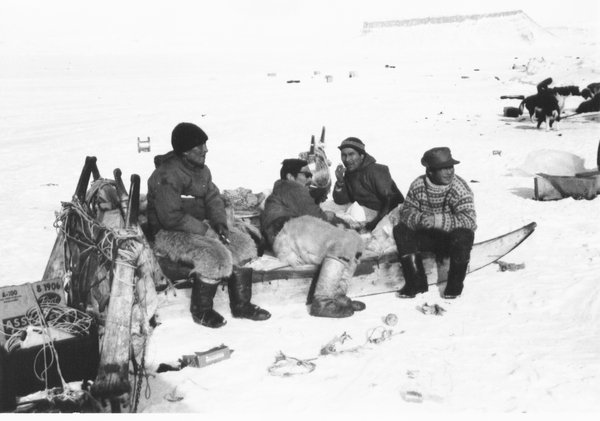
Inuit people near Thule Air Base, Greenland, 1968 © Joseph Thomas / Wikimedia Commons / Public Domain
What the ice couldn’t bury
It’s believed that around 93% of the radioactive materials were collected, but some remnants remained on the seabed. One hydrogen bomb likely sank among other debris. Attempts to locate it with a submersible were unsuccessful. A heap of wreckage was discovered on the ocean floor, and somewhere down there, it appears that the remains of the nuclear weapon still lie undisturbed.
In the 1980s and ‘90s, a scandal erupted. Danish cleanup workers launched a legal battle against the American government. Though they lost the case, they succeeded in forcing the release of numerous classified documents. Subsequent investigations revealed that cancer mortality rates among Danish workers involved in the cleanup operation were about one and a half times higher than those of the general population. It also turned out that the health monitoring of the cleanup crews after the incident was inadequate. Ultimately, officials concluded that radiation exposure wasn’t significant and found no link between the increased cancer rate and the 1968 accident.
A heated debate arose around the actions of Danish prime ministers Jens Otto Krag and H. C. Hansen. Krag portrayed himself as a naïve yet honest figure, insisting that he wasn’t aware of aircraft carrying nuclear weapons over Greenland. However, declassified US documents indicated that the Danish government was aware of everything. As for Hansen, he was the one who secretly approved the US to use Thule Air Base as part of its nuclear shield. However, by then, both prime ministers had passed away, and were unable to answer to the population.
After the incident, Operation Chrome Dome was officially shut down. After all, it was the second nuclear disaster in three years, and that was too much even for the ‘hawks’. Secondly, both Russians and Americans already had plenty of missiles, and the use of bombers seemed somewhat archaic. Finally, the USSR and the US initiated another period of détente and developed protocols for handling any accidental incidents involving nuclear weapons. While this didn’t help those who suffered or died from cancer as a result of the accident in Greenland, it did significantly reduce the risk of similar events in the future.
Evgeny Norin is a Russian journalist and historian focused on war and conflict in the former Soviet Union.
‘Grave, alarming’: Iran mission on Trump’s UNGA ‘annihilation’ threats
Al Mayadeen | September 28, 2026
Iran has warned the United Nations that US President Donald Trump’s threats to “annihilate” the Islamic Republic constitute a grave development, particularly because the remarks were made from the podium of the UN General Assembly.
Gholamhossein Darzi, Iran’s ambassador and chargé d’affaires to the UN in New York, raised the issue in a September 27 letter addressed to UN Secretary-General António Guterres and the President of the Security Council, Jérôme Bonnafont.
Darzi’s letter came in response to Trump’s September 22 address to the 81st session of the UN General Assembly, during which the US president said he could “annihilate the Islamic Republic” if no agreement was reached with Tehran. The wording appears in the official UN transcript of Trump’s speech.
Iran says threats made at UN carry wider implications
Darzi said Trump’s remarks were neither isolated nor ambiguous, arguing that they form part of a continuing pattern of public threats against Iran by the president of a permanent member of the UN Security Council.
“These repulsive statements are not ambiguous remarks or isolated utterances. They are rather part of a sustained pattern of public threats against Iran by the head of a permanent member state of the Security Council,” Darzi wrote.
“This latest development is particularly grave and alarming because the United Nations General Assembly is not a venue for threats of annihilation,” he added.
The Iranian envoy stressed that the General Assembly serves as the UN’s principal universal forum and was established to promote international peace, cooperation, and relations among states.
In the letter, Darzi referred to several previous statements by Trump that he said demonstrated a broader pattern of threats against Iran.
He cited remarks on March 22 in which Trump threatened to “hit and obliterate” Iranian power plants, followed by statements on March 30 threatening destruction of Iran’s energy facilities and other vital infrastructure, including desalination facilities.
Iran calls for UN response to threats
Darzi argued that the issue extends beyond political rhetoric, saying an explicit threat against a sovereign UN member state raises questions concerning the UN Charter, international peace and security, and the prohibition on the threat or use of force.
He further linked the latest remarks to ongoing US-Israeli aggression against its sovereignty and territorial integrity since February 28, as well as attacks that targeted civilians and civilian infrastructure.
“The issue before the Organization is therefore not merely one of political rhetoric,” Darzi wrote, arguing that failure by the international community to respond could normalize threats against entire nations and undermine the authority of the UN Charter.
The UN has itself emphasized the need for restraint and adherence to international law during the current high-level week. In his September 22 opening address, Secretary-General António Guterres said the principle that force cannot determine whose lives and rights matter was under “profound strain” and called on world leaders to use the week for de-escalation and dialogue.
Iran reiterates right to self-defense
Darzi said Iran would continue to defend itself against any further aggression and reserved its “full and unimpeachable right to self-defense.”
He also said Tehran reserves the right to pursue legal avenues to seek accountability from states and individuals it holds responsible for losses and damage inflicted on the Iranian people.
“Regardless of whether these threats are merely delusional fantasies, they will, as in the past, never materialize or be put into action in the face of the resolute resistance and determined defense of the Iranian people and armed forces,” Darzi wrote.
The Iranian envoy requested that his letter be circulated as an official document of the UN Security Council.
Najaf airport to reopen to Iranian flights within 24 hours: Ambassador
Al Mayadeen | September 28, 2026
Iraq’s Ambassador to Tehran, Yasser Abdul-Zahra al-Hajjaj, announced that Najaf International Airport will reopen to Iranian flights within 24 hours, according to the Iraqi News Agency.
Al-Hajjaj confirmed the airport will resume receiving flights from Iran within the stated timeframe.
The suspension of Iranian flights to and from Iraqi airports, particularly Najaf International Airport, had triggered a wave of condemnation from official, factional, and religious authorities in Iraq. They called for the decision to be reversed, rejecting US dictates.
Iran submits formal complaint to ICAO over US aviation restrictions
Meanwhile, Iran has submitted a formal complaint to the International Civil Aviation Organization (ICAO) regarding US restrictions imposed on Iran’s aviation sector, the head of Iran’s Civil Aviation Organization, Abouzar Shiroudi, announced on Monday.
Shiroudi said the organization held consultations with the Ministry of Foreign Affairs before filing the complaint, as part of efforts aimed at restoring air routes. In remarks carried by the Iranian news agency IRNA, he said, “It is necessary to use diplomatic and legal potential to protect the rights of the country’s aviation sector.”
He added that “Iran’s Civil Aviation Organization, using all legal tools and in close coordination with the country’s diplomatic apparatus, prioritizes the follow-up of necessary measures to remove obstacles and resume all flights on routes that previously operated.”
The remarks follow US Treasury Secretary Scott Bessent’s announcement on September 21 that Iranian airlines “will effectively be forced to cease operations as of September 23, due to secondary sanctions imposed on aviation service providers.”
From ‘How Will This End For Iran’ to ‘When America Walks Away’: A tale of two Economist covers
By Maya Kareen | Press TV | September 28, 2026
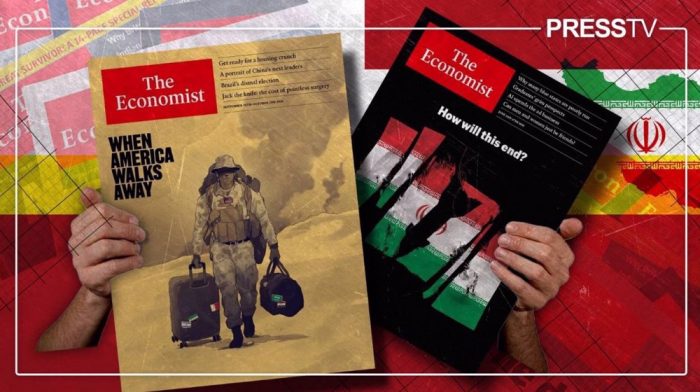
Nearly 466 days ago, just seven days into the unprovoked and illegal US-backed Israeli military aggression against Iran, The Economist provocatively placed a torn Iranian flag on its cover and asked: “How will this end?”
The image was widely interpreted as a metaphor for the possible collapse or fragmentation of the Islamic Republic in the face of overwhelming military force.
At the time, the narrative surrounding Iran was dominated by predictions of its imminent defeat, the weakening of its leadership, and even the possible collapse of the Islamic Republic under the weight of an aggression that came amid Iran-US indirect nuclear talks.
The article went on to ask whether what it described as Israel’s first war against Iran “will also be the last,” or whether it would “lead to a series of Iran-Israel wars that mire” West Asia in years, if not decades, of further violence.
Written before the United States directly joined the war of aggression by illegally bombing Iran’s Fordow, Natanz, and Isfahan nuclear facilities on June 22, the article also suggested that Washington should move beyond “merely defending Israel and deterring Iran” and join the occupying regime in attacking Iran’s peaceful nuclear program.
Yet even then, The Economist warned that such a war could spiral into a broader regional war, sending energy prices soaring by targeting Saudi Arabia’s oil infrastructure or blocking the Strait of Hormuz, a vital artery for global energy supplies.
Iran, however, did not turn the war into a regional war at that stage, nor did it close the Strait of Hormuz. It retaliated decisively and inflicted massive damage on the Zionist regime.
Following a powerful wave of retaliatory strikes against Israeli-occupied territories, the Islamic Republic demonstrated that it retained the ability to impose high costs on its adversaries.
After 12 days of war, Israel and the United States ultimately agreed to a ceasefire. The confrontation and US hostility, however, were far from over.
On February 1, the martyred Leader of the Islamic Revolution, Ayatollah Seyyed Ali Khamenei, warned that any new war initiated by the United States against Iran would inevitably become a regional war, engulfing all countries across the region.
Less than a month later, on February 28, Washington and Tel Aviv launched a second round of military aggression against Iran, again in the middle of nuclear diplomacy.
On the very first day, the United States and Israel assassinated Iran’s Leader and several senior commanders, apparently calculating that “decapitating” the country’s leadership would pave the way for the rapid collapse of the Islamic Republic and the so-called “regime change.”
That calculation, however, once again proved wrong.
Iranian armed forces mounted a sustained and forceful response, launching wave after wave of retaliatory strikes against Israeli-occupied territories and US military bases across the region.
Far from collapsing under the pressure, Iran demonstrated its capacity to absorb the initial shock, reorganize its command structure, and continue fighting on multiple fronts.
The war eventually reached the Strait of Hormuz, as Iran asserted its control over the strategic waterway, leading to severe disruption in global energy markets and exposing the vulnerability of one of the world’s most strategically important chokepoints.
After 40 days of war, the United States and Israel were once again compelled to accept a ceasefire. This time, the Trump administration even agreed to an Iranian proposal to end the imposed war.
The outcome was a striking departure from the expectations that had accompanied the opening hours of the aggression: instead of so-called “regime change,” Washington and Tel Aviv found themselves confronting an Iran that had endured the assassination of its senior leadership, absorbed unprecedented attacks and continued to resist and inflict blows on the enemy.
Since the April 8 ceasefire, exchanges of fire have continued intermittently, while the Strait of Hormuz has remained largely closed to hostile vessels.
Having failed to achieve its objectives through military means, Washington has increasingly turned to economic pressure, imposing new sanctions and pursuing a naval and aerial blockade against Iran. Yet the Islamic Republic has continued to withstand the pressure.
Also, despite sanctions, threats, political pressure and military aggression, Tehran has maintained that the Strait of Hormuz will only be reopened once the United States ends the imposed war on all fronts.
And now, more than 15 months after that torn Iranian flag appeared on its cover, The Economist has returned with an image that could hardly be more different.
Gone is the question of how Iran will end. Instead, the magazine has placed a new question at the center of its latest cover: “WHEN AMERICA WALKS AWAY.”
The change in imagery reflects a striking shift in the narrative. In June 2025, the focus was on Iran’s survival. Today, the question being raised is about the future of American power in West Asia.
But the transformation in the narrative is not limited to the language used on The Economist’s covers.
Over the past 15 months, the war has also produced a growing record of military, financial and strategic costs for the United States and its military-industrial complex.
Washington launched the war on Iran with many ambitious objectives, including crippling Iran’s nuclear and missile capabilities in order to undermine and weaken the Islamic Republic.
Yet months of war have instead left the United States facing tens of billions of dollars in expenses, damaged military facilities across the region, depleted stocks of some of its most sophisticated interceptors and other munitions, and casualties among its service members.
The following figures and assessments, many of them coming from US government agencies, American media outlets and Western think tanks, offer a picture of the price Washington has paid for the war — and of the widening gap between the objectives announced at its outset and the situation that has emerged months later.
$43.6 billion — and the bill is still rising
On September 18, The Washington Post reported that the US Central Command (CENTCOM) had estimated the cost of the war at $43.6 billion as of early September.
The figure included $28 billion to replace munitions expended during the war on Iran and more than $4.3 billion for equipment lost or damaged. The breakdown also put Air Force operating costs at more than $6.6 billion, Navy costs at about $2.2 billion, and Army costs at roughly $1.6 billion.
Crucially, the $43.6 billion estimate does not include the future cost of rebuilding or repairing damaged US military facilities across West Asia, according to the report.
The Congressional Budget Office (CBO) also published its own assessment on September 15, estimating that the war on Iran had already cost the Department of War approximately $38 billion as of August 1.
CBO said the figure included the replacement of expended munitions and equipment lost in battle, increased flying hours, other operational costs, and additional fuel costs.
But the most important part of the CBO assessment was its warning about the continuing cost.
It said if the war remained at the relatively low intensity seen in May and June, another month of fighting would cost approximately $2 billion. If fighting returned to the intensity seen in July, the monthly cost could rise to approximately $3 billion.
CBO also stressed that its $38 billion estimate did not include all costs borne by other parts of the federal government and did not include certain costs already incorporated into the regular military budget.
At least 228 US military assets damaged
The financial bill was accompanied by substantial physical damage to US military infrastructure.
On May 6, The Washington Post published a satellite-image investigation finding that Iranian attacks had destroyed at least 228 structures or pieces of equipment at 15 US military sites across West Asia.
The Post’s analysis identified 217 structures and 11 pieces of equipment that had been damaged or destroyed. The targets included hangars, barracks, fuel depots, aircraft, radar systems, communications equipment and air-defense systems.
The newspaper examined more than 100 high-resolution satellite images released by Iranian media and independently verified 109 of those images against imagery from the European Union’s Copernicus satellite system and commercial satellite imagery where available.
It found no evidence that the Iranian imagery had been manipulated. The Post also reported that the destruction was “far larger” than what had been publicly acknowledged by the US government.
The extent of the damage was subsequently reinforced by the US government’s own watchdog. In a report released on September 14, the Pentagon Inspector General provided what the Associated Press said was the most comprehensive official accounting to date of the war’s impact on US military facilities.
The report said Iranian attacks had damaged or destroyed hundreds of buildings and other structures at US bases in Kuwait, Bahrain, Qatar, the United Arab Emirates, Saudi Arabia, Iraq, Oman and Jordan.
The significance of this finding is that the damage was no longer based solely on satellite analysis or Iranian reports. It was acknowledged in an official US government assessment.
Dozens of MQ-9 Reapers and other aircraft lost or damaged
The Pentagon Inspector General’s findings also provided a clearer picture of damage to American aircraft.
According to Stars and Stripes on September 15, the war had resulted in damage to or destruction of as many as 30 MQ-9 Reaper drones, along with four F-15 fighter aircraft and more than six KC-135 tanker aircraft.
The report also noted that the cost of repairing or replacing some of these assets had not yet been incorporated into the Pentagon’s overall war-cost estimate.
In other words, even the $43.6 billion figure should not necessarily be regarded as the final bill.
The actual figure, however, is much higher. More than 50 MQ-9 Reapers have disappeared over Iranian skies, according to independent estimates.
The war has depleted America’s missile-defense stockpiles
Perhaps more consequential than the dollar value of the weapons fired is the depletion of America’s stockpile of advanced interceptors.
In its May 6 report, The Washington Post, citing an analysis by the Center for Strategic and International Studies (CSIS), reported that between February 28 and April 8 the US military had used at least 190 THAAD interceptors and 1,060 Patriot interceptors.
Those numbers represented approximately 53 percent of the US prewar THAAD inventory and 43 percent of its Patriot inventory. By September, the assessment had become even more concerning.
The Stimson Center, in a report published on September 22, said that by August the United States had used approximately 80 percent of its THAAD inventory and around half of its Patriot interceptors.
The same report said the Army had used “virtually all” of its ATACMS and Precision Strike Missiles (PrSM) — long-range weapons that would also be important in a potential conflict involving China.
According to Stimson’s assessment, replenishing some of these stocks could take years. CSIS estimated that Tomahawk inventories might not return to prewar levels until late 2030 or early 2031, while Patriot and THAAD inventories could take at least three years to recover.
The costs extend beyond the battlefield
The financial impact has also spread beyond the Pentagon. The CBO said on September 15 that the disruption of oil and gas shipments through the Strait of Hormuz had increased global energy prices, contributing to higher prices for gasoline, diesel and jet fuel in the United States.
CBO estimated that the war would leave US inflation in the first quarter of 2027 0.5 percentage points higher than it had projected in February 2026, while core PCE inflation was projected to be 0.3 percentage points higher.
The agency also estimated that three-month Treasury bill rates would be nearly 0.2 percentage points higher in 2026 than previously projected.
The Stimson Center went further, estimating the direct and indirect cost of the war at approximately $220 billion and putting the average household’s share at roughly $1,650. It attributed much of that wider economic burden to higher energy prices.
Stimson said that by September 15, average US gasoline prices had reached $4.32 per gallon, a 45 percent increase since the war began, while diesel prices had risen by approximately 70 percent.
Damage to US military facilities
Beyond the billions spent on weapons, operations and damaged military equipment, Washington also incurred substantial military, diplomatic and emergency expenses.
On September 14, the Pentagon Inspector General, as reported by The Washington Post, said Iranian attacks had caused approximately $184 million in damage to US military and diplomatic facilities in Iraq, Kuwait, Saudi Arabia and the UAE.
Separately, the US State Department reported around $113 million in war-related and emergency expenses, nearly $80 million of which was associated with the evacuation of diplomats, their families and other US citizens and eligible individuals.
Around 9,000 US citizens were evacuated from the region during the war against Iran.
Iran’s missile program has begun rebuilding
The depletion of American interceptor stocks becomes particularly significant when considered alongside the continued resilience of Iran’s missile program.
On September 10, The Wall Street Journal reported that Iran had resumed production of ballistic missiles, despite the extensive US and Israeli attacks on its missile infrastructure during the opening phase of the war.
According to the report, US and regional officials said Iran was assembling both liquid- and solid-fuel missiles using stockpiled components at underground facilities.
Intelligence pointed to activity at several underground sites, including the Khojir missile facility, while Iran was also working on new underground assembly locations.
The report concluded that the renewed production underscored the difficulty of fully dismantling Iran’s missile program — one of the stated objectives of the war.
Six months on, the original objectives remain out of reach
This brings the military expenditure back to the central question: what did all of this cost actually achieve? Washington continues to describe the war on Iran as having severely degraded the country’s military capabilities.
But independent Western assessments point to a substantial gap between the original objectives and the situation that has emerged.
The Stimson Center, in its September 22 assessment, said the administration initially went to war with objectives that included ending Iran’s nuclear program, destroying its missile industry, annihilating its navy, and ending its support for the Axis of Resistance.
It concluded that the United States had failed to achieve those objectives. Instead, Stimson said, the mission subsequently narrowed to the reopening of the Strait of Hormuz — a goal that became necessary precisely because the war itself had disrupted shipping through the waterway.
“Six months later, little progress toward those goals has been made, while the mission has largely narrowed to the single task of reopening the Strait of Hormuz, a waterway the war itself closed.”
The figures tell the story of that widening gap: $43.6 billion in US military costs; $28 billion needed merely to replace expended munitions; more than 4.3 billion dollars in damaged or lost equipment; hundreds of damaged military structures; depleted THAAD and Patriot stocks; and a weapons-production system facing years of replenishment.
And yet, according to the Wall Street Journal, Iran is already rebuilding parts of its ballistic-missile production capability.
That contrast — between the scale of resources committed by Washington and the difficulty of translating military force into its original political and strategic objectives — is perhaps the most important evidence behind the dramatic change in the narrative surrounding the war.
And now, back to The Economist
This is where the latest Economist cover becomes particularly relevant.
More than 15 months after the magazine placed a torn Iranian flag on its cover alongside the question “How will this end?” the question on its new cover is no longer centered on Iran.
It asks: “WHEN AMERICA WALKS AWAY.”
“America seems to be stuck in the Middle East. It has no easy way out of its war with Iran. Yet the conflict, however it ends, will in fact mark something quite different: the moment when America pulls back from the region—in the sense that it finally relinquishes its hegemony there,” the article reads.
In a September 25 editorial, The Economist’s Deputy Editor Robert Guest makes a similar assessment, writing that the United States has enjoyed decades of dominance in the region, but that this era is now coming to an end.
“Now, as Mr Trump seeks a way out of his ill-planned war, something momentous is occurring. As we describe in our cover package, American hegemony in the Middle East is ending,” Guest writes.
The Rise And… Rise Of ‘Color Revolutions’
By Kit Klarenberg | Global Delinquents | September 28, 2026
It’s rather forgotten today how Washington’s post-9/11 imperial adventurism was not restricted to military intervention. A core component of the Bush administration’s “Freedom Agenda” – under the auspices of which calamitous wars in Afghanistan, Iraq and elsewhere were waged – was overt sponsorship of civil society-led coups throughout the former Soviet Union, Warsaw Pact and Yugoslavia. Citizens of these regions, and the world, live with this meddling’s destructive consequences to this day. The seemingly never-ending – and ever-escalating – Ukraine proxy war is a particularly visceral legacy.
The 1983 creation of the National Endowment for Democracy, a US state entity avowedly concerned with executing overtly what the CIA once did covertly, ushered in a new era of “spyless coups”. Working in close conjunction with USAID and George Soros’ Open Society Institute, NED ever after provided funding, training and material assistance to NGOs, ‘independent’ media outlets, opposition groups, and other initiatives in service of regime change, across every corner of the world.
Come 9/11, NED and its confederates had devised a supremely cunning, cost-effective template for toppling troublesome governments – be they left-wing, nationalist, or even former US puppets who’d stepped out of line. The previous October, longtime Yugoslav leader Slobodan Milosevic was brought down in what the Washington Post bombastically dubbed “an extraordinary US effort to unseat a foreign head of state, not through covert action of the kind the CIA once employed in such places as Iran and Guatemala, but by modern election campaign techniques.”
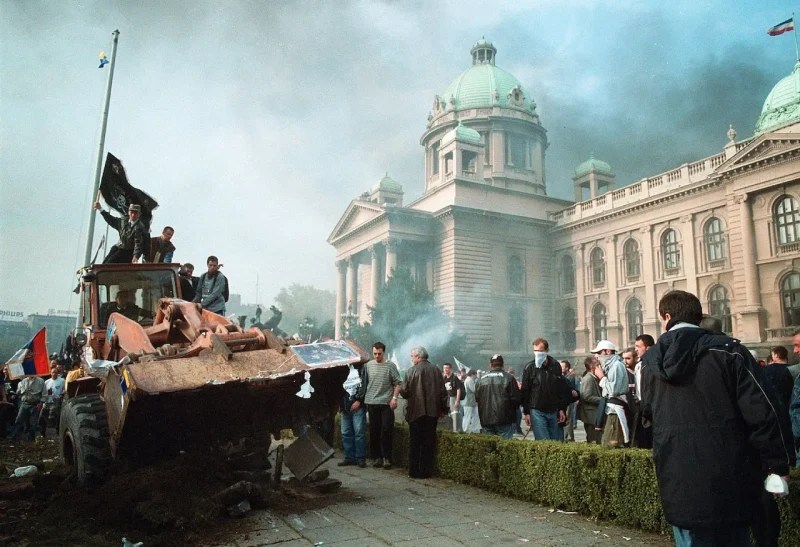
At the anti-Milosevic effort’s forefront was Otpor! (Serbian: Resistance!), a rebellious NED-funded youth activist group. Through a mix of civil disobedience, non-violent resistance, rock concerts, street theatre, and graffiti, they fomented mass public opposition to the Yugoslav President. When election day came and official results pointed to Milosevic’s victory, an NED-funded “parallel vote tabulation” purported to expose major fraud, sending millions to the streets of Belgrade to peacefully demand the President’s resignation. Milosevic duly capitulated, in the face of seemingly overwhelming people power.
The supposedly heroic struggle of Otpor! and other US-supported anti-Milosevic groups was immortalised in a slick ‘documentary’, Bringing Down A Dictator. Milosevic’s fall provided a precise blueprint for future ‘color revolutions’ – so-called because frequently, the Empire-supported activists who led these mob putsches prominently adopted specific colours for their banners, branding and logos. Initially, US officials eagerly associated themselves publicly with this upheaval. Meanwhile, the mainstream media routinely published remarkably illuminating post-mortems of the revolts, extensively exposing Washington’s guiding hand and oft-enormous financial outlay.
Nonetheless, politicians, pundits and journalists alike universally framed colour revolutions as ultimately spontaneous uprisings by liberal, progressive elements with legitimate grievances, who yearned for democracy and freedom. In reality, they almost invariably produced corrupt, repressive governments that ruled via intimidation and brutality, including political assassinations. Post-colour revolution regimes also typically conducted sweeping privatisation and other ravaging ‘reforms’, destroying living standards for average citizens by prostrating their countries to the EU, IMF, NATO, World Trade Organization, and other mechanisms of Western economic, military, and political subjugation.
Slobodan Milosevic’s NED-orchestrated ouster is nicknamed the ‘Bulldozer Revolution’, due to iconic scenes during the upheaval of a wheel loader helping anti-government agitators occupy state buildings. However, its driver quickly turned against the “Revolution”. Subsequent “shock therapy” decimated Yugoslavia’s mixed market economy, causing his successful independent business to fail, and him to go bankrupt. He subsisted until his dying day on meagre state welfare payments. For most participants, subsequent colour revolutions were similarly an object lesson in being careful about what one wishes for.
‘External Shove’
In February 2005, President George W. Bush gave a swaggering address in Bratislava, Slovakia. He hailed how “in recent times, we have witnessed landmark events in the history of liberty.” This included Georgia’s November 2003 Rose Revolution, Ukraine’s Orange Revolution the next year, and Iraq’s Purple Revolution a month prior. “The advance of freedom is the concentrated work of generations,” Bush declared. He looked ahead to Moldova, and “inevitably” Belarus, “someday proudly [belonging] to the country of democracies [sic]”:
“Eventually, the call of liberty comes to every mind and every soul. And one day, freedom’s promise will reach every people and every nation.”
Moldova’s forced transformation into a staggeringly corrupt effective EU-US colony took many years. Belarus conversely remains stubbornly resistant to “freedom’s promise”, as defined by Brussels, London, Washington, and other centres of imperial power. Still, President Bush’s confidence was well-founded. Waves of insurrectionary unrest unleashed by his government’s “Freedom Agenda” had systematically swept away designated enemy governments one by one annually since he took office. Indeed, within weeks of Bush’s speech, Kyrgyzstan’s insufficiently pro-Western leader fell victim to yet another colour revolution.
He would not be the last. Prior colour revolutions had enthusiastically emphasised the importance of techniques of nonviolent resistance – many of which were crafted by Gene Sharp, who was intimately enmeshed within the US military and intelligence establishment for much of his life. However, Kyrgyzstan’s NED-created regime change army, KelKel – directly modelled on Otpor! – attacked police, torched government buildings and even carried out bombings. Their ferocity was actively encouraged and promoted by US-funded TV stations locally. Such belligerence subsequently became a colour revolution calling card.
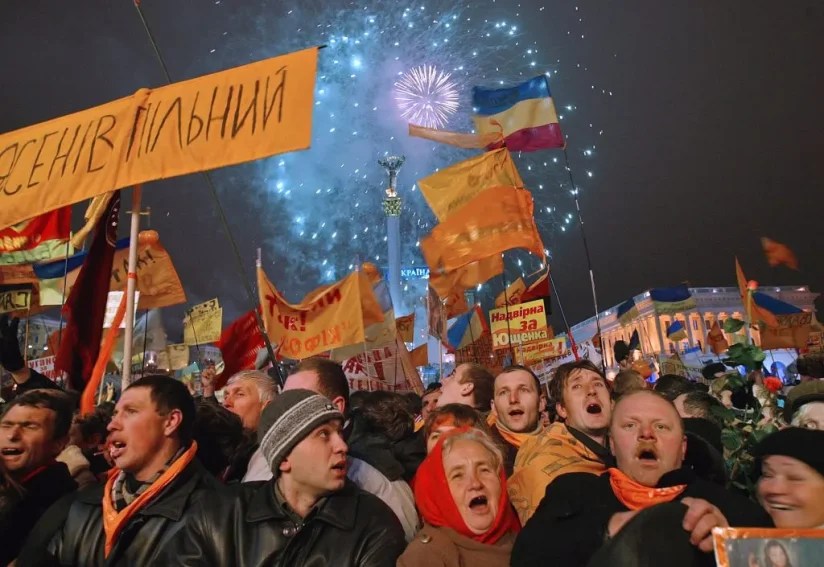
Ukraine’s Orange Revolution
That colour revolutions represented a formal weapon of war in the Empire’s post-9/11 arsenal was enthusiastically spelled out by arch-neoconservative Max Boot in late December 2004. He gushed how Ukraine’s Orange Revolution days earlier, which brought a pro-Western government to power, was “one of the most inspiring events” of that year. Boot declared the “triumph” and “miracle” of the revolution “should dispel the quaint notion still prevalent in many Western universities and foreign ministries that democracy is a luxury good suitable for rich countries”:
“These revolutions reveal the hollowness of the cliché that ‘democracy can’t be imposed by outsiders’… sometimes, when dealing with an entrenched dictatorship, this requires military intervention of the kind that occurred in Iraq and Afghanistan. More brittle regimes can be brought down by their own people, but even they often need a little external shove… There was nothing nefarious about the US intervention in Ukraine.”
Boot boasted how Washington had “spent $58 million on democracy promotion in the last two years” in Ukraine. He proposed Kiev receive “expedited NATO and European Union membership,” to finish off the Orange Revolution. “In the meantime, we need to apply elsewhere the lessons of Ukraine” Boot demanded, suggesting “an obvious candidate for a similar transformation is Iran.” He explained, “it’s hard to think of a higher priority than the overthrow of the mullahs,” encouraging the Bush administration to prioritise “liberating Iran.”
‘USAID Help’
Such was the insurrectionary fervour of the time, in January 2006 USAID went to the extent of publishing a glossy magazine, Democracy Rising, revealing in detail Washington’s central role in fomenting “grassroots” rebellions as far afield as Afghanistan, Gaza and Lebanon. Dedicated sections on colour revolutions to date were replete with stunningly forthright passages. A section on Georgia’s November 2003 Rose Revolution described how NED had financed regime change training for local “lawyers, judges, journalists, members of parliament, NGOs, political party leaders, and others.”
The stated purpose of this investment was to give Georgians “a sense that they should regulate the government.” The Rose Revolution “was the climax of these efforts.” One recipient of US financial support remarked, “without foreign assistance, I’m not sure we would have been able to achieve what we did without bloodshed.” Meanwhile, several pages were dedicated to the Orange Revolution. It noted how thousands of Ukrainian journalists were given training in “investigative reporting”, bankrolled by NED and USAID.
An alumni told Democracy Rising this sponsorship “created a feeling that others stood with them ‘in the trenches’.” Concurrently, NED-affiliated Freedom House flooded the coffers of NGOs “that sponsored voter education, mobilized voters to get to the polls and observed elections.” These organisations “also held meetings, youth dances, rock concerts and karaoke to attract young voters,” and “ran public service ads on TV stations, informing people about their right to vote.” Meanwhile, “democracy trainers from Serbia, Slovakia, Russia and Croatia” were flown into the country.
In the second round of Ukraine’s presidential election, NED-financed NGOs claimed to have been inundated with tens of thousands of reports of fraud from voting stations all over the country, while exit polls they produced pointed to widespread rigging having denied pro-Western candidate Viktor Yushchenko a landslide victory. Vast protests, combined with opposition-organised general strikes, widespread civil disobedience and occupations of government buildings forced a rerun. A US-funded think tank apparatchik asserted:
“USAID help for the poll was absolutely important – the poll results after the second round made people go to the street.”
For all the hype and self-assurance of Democracy Rising, its publication came at a time when colour revolutions were increasingly being viewed with hostility and suspicion at a state and public level throughout the Global South. In every case, the radical outcomes promised by colour revolution leaders and advocates failed to materialise, while US rhetoric about the commitment of resultant pro-Western regimes to democracy and freedom was a perverse fraud.
In Ukraine, US-installed Yushchenko implemented economic austerity, slashed regulations and social spending, bailed out criminal banks, broke open state industry and natural resources for foreign plunder, attacked the rights of Russian speakers, and began preparing the country for locally-feared NATO membership. Within just nine months of entering office, his coalition government – comprised of Orange Revolution activists – collapsed due to deeply corrupt battles with feuding Ukrainian oligarchs over control of key media and industrial assets.
Yushchenko was voted out in the January 2010 presidential election, finishing fifth in the first round with just 5.5% of the vote. As Empire house journal Foreign Policy lamented years later, the Bush administration’s much-vaunted colour revolutions all turned out to be “terribly disappointing.” Each and every time, “elite corruption still continued apace” and “promises of far-reaching change never really materialized.” Damningly, “maladies that typified the preceding regimes quickly came to describe” the governments created by colour revolutions themselves.
‘Revolution Business’
That’s quite some euphemism. In Georgia, longtime Soros acolyte Mikheil Saakashvili granted himself unilateral power in key policy areas, before brazenly exploiting his position to harass and jail business and political rivals. Saakashvili’s targets would be raped and/or tortured in prison, their ordeals filmed for primetime broadcast on local TV networks. Grave questions abound over his personal involvement in several suspicious deaths, including government ministers’. He was voted out in October 2012, despite NED’s best efforts.
Kyrgyzstan’s 2005 Tulip Revolution installed Kurmanbek Bakiyev, who proceeded to run the country as his personal fiefdom for five years. Bakiyev’s relatives profited exorbitantly from legally questionable privatisation of state industries. For example, his family signed a highly controversial $1.8 billion deal to supply fuel to a local US military base, close to Kyrgyzstan’s total GDP in 2003. Elsewhere, Bakiyev’s brother oversaw Bishkek’s security apparatus – arbitrary detentions, bogus convictions, torture, and murders of opposition activists, journalists, and politicians became commonplace.
Bakiyev was himself chased out of not only the presidential palace but Bishkek itself in April 2010, following a massacre of anti-corruption protesters in which up to 100 were killed and at least 450 wounded. Thereafter, Kyrgyzstan was plunged into economic and political chaos for a decade, with numerous governments collapsing along the way. The freest and most stable Central Asian state prior to the Tulip Revolution, it is only since 2020 – following another Anglo-American coup – the country has regained some semblance of stability.
A key player in that upheaval was British ambassador Charles Garrett. He arrived in Bishkek from Macedonia, where as this journalist has revealed from April 2016 he steered what was known as the “colorful revolution”. Illegally obtained, deceptively edited wiretaps seemingly implicating government officials in shocking crimes produced huge protests, featuring widespread arson attacks and brutal clashes between demonstrators and police. Garrett distributed cash to NGOs and activists involved in the unrest from his diplomatic pouch, encouraging them to cause mass havoc.

George Soros’ Open Society Foundations, NED, and USAID were also colorful revolution participants. Some protesters even proudly wore “Soros Army” shirts. Despite a huge public counter-revolutionary fightback, the tumult paralysed the Macedonian economy and state, leading to the installation of a doggedly pro-Western, dangerously dysfunctional administration that engaged in industrial scale graft, jailed political opponents on bogus charges, and changed the country’s name despite widespread opposition. Meanwhile, existing economic problems, including crippling brain drain, were gravely exacerbated.
The unfailingly disastrous results of colour revolutions surely contributed to White House officials abruptly and firmly distancing themselves from the entire enterprise, before the Bush administration’s second term was even over. The “Freedom Agenda” was quietly forgotten. The President – who in October 2004 openly mandated financial assistance to Belarusian opposition activists, and once publicly praised the Rose Revolution as an example to be followed throughout the Caucasus and Central Asia – went so far as to deny the US was in the “revolution business” at all.
‘Alternate Reality’
Colour revolutions have continued apace ever since, with the same strategies being recurrently applied the world over, to varying degrees of success. All along, non-Western governments – in particular China, Iran and Russia – have become increasingly vocal in their condemnation of and opposition to colour revolutions, in some cases passing legislation seeking to curtail the operations of foreign funded NGOs on their soil. Yet, the mainstream media long ago adopted a rigid Omertà on Washington’s culpability for civil society-driven destabilisation overseas.
In a striking example of this paradigm shift, in November 2004, before the Orange Revolution was over, The Guardian published a revealing report exposing the “US campaign behind the turmoil in Kiev.” The outlet stated unambiguously the revolt was “an American creation, a sophisticated and brilliantly conceived exercise in Western branding and mass marketing that, in four countries in four years, has been used to try to salvage rigged elections and topple unsavoury regimes.” NED, the State Department and USAID were all fingered as culprits.
Fast forward to July 2015 however, and a Guardian article on Russia’s banning of NED under foreign agent laws quite amazingly relied on a brief quote pulled from the Endowment’s official website to describe its operations. In the intervening time, the Maidan Revolution overthrew Ukrainian President Viktor Yanukovych in February 2014, setting Kiev on the warpath with Moscow. Washington’s irrefutable involvement was strenuously denied at the time by the mainstream media, and has been ever since.
Following the Ukraine proxy war’s February 2022 eruption, The New York Times took vigorous aim at independent journalists for spreading the “conspiracy theory” Maidan was US-orchestrated, dubbing the proposition an “alternative reality” and “Russian disinformation”. This is despite every prominent Maidan actor – including the individuals who started the demonstrations – receiving NED or USAID funding, leaders of US-bankrolled organisations in the country advertising their intention to overthrow Yanukovych years prior, and the Endowment spending $20 million in the country in 2013 alone.
After the outbreak of war in Ukraine, NED removed its grant records on Ukraine, listing its investment in a panoply of initiatives in the country over many years – many of which ultimately targeted Russia, one way or another. In mid-2024, the Endowment undertook the unprecedented step of removing grant records for the entire world. Today, brief entries on different geographical regions describe in vague terms the Endowment’s specific aims locally, and overall sums being spent. The crucial questions of where, and on what, aren’t clarified.
NED going underground makes the task of tracking and exposing contemporary colour revolutions difficult, but not impossible. In September 2025, mass rioting ignited in Nepal. Major news outlets without exception reported the fiery agitation as an organic burst of dissent by the country’s disaffected “Gen Z”, motivated by corruption, unemployment, and state censorship of social media. Publications barely acknowledged demonstrators committed serious crimes, including torching Nepal’s parliament and the Prime Minister’s official residence, which sent occupants fleeing in helicopters.
Based on publicly available information, the clear insinuations of a colour revolution could be discerned. An NGO that organised the protests, Hami Nepal, had clear links to organisations known to be in receipt of NED funding. Subsequent leaks amply demonstrated the Endowment and USAID expended substantial sums over the years preceding the coup training young Nepalese citizens how to protest, founding NGOs and political parties, and “advocate concerns” on issues such as corruption. Evidently, the post-9/11 “Freedom Agenda” never actually ended.
The Coming GOP Bloodbath?
By Ron Paul | September 28, 2026
Most indicators suggest that the Republicans in the House and Senate are going to face a brutal backlash from the American people in November. Polling with generic ballots suggest a big win for the Democrats and likely the loss of Republican control of both houses of Congress.
There is little reason to cheer a Democratic party victory, however Republicans in charge have for the most part earned what is coming to them. They have refused to uphold their Constitutional obligation to take leading responsibility for war powers.
Earlier this year, President Trump launched what is the most unpopular war in US history when on February 28th he ordered a full US assault on Iran. Iran had not attacked or even threatened the United States and our own intelligence community continued – and continues – to claim that Iran is not building nuclear weapons.
The February attack followed last June’s US bombing of Iran after which the president claimed that the country’s nuclear program was “completely obliterated.”
Congress over too many years has been used to allowing the President to have his own way on matters of war and peace. Members bask in the false patriotism promoted by the media and special interests as the people “rally around the flag.” Eventually, when the war has gone on for years without “victory” – as in Iraq and Afghanistan – many claim they were never really for the war in the first place.
This time is different. There was no propaganda blitz. There were no attempts to convince the American people that the “smoking gun” could be a “mushroom cloud” as we were told in the run up to the 2003 Iraq war. The majority of Americans were against the war on Iran before it started and only became more opposed over time.
As the war drags on, we have seen the national debt pass $40 trillion, diesel fuel prices at the highest ever, and inflation hitting the middle class and poor even harder. The “cakewalk” again failed to materialize.
Incumbent Republicans seeking re-election are in such a panic over voter anger about the war that they have taken to calling for a quick end to it while on the campaign trail. When they get back inside the Beltway, however, they vote to keep the war going for fear of President Trump’s anger.
This is not leadership.
Late last week the Iranian delegation in New York for the UN General Assembly meeting offered an off-ramp. Essentially it was the same Memorandum of Understanding that President Trump signed last June and promptly disregarded, but on a shorter timeline. By Sunday, the President announced that he would reject the deal – a deal like one he already signed.
There is no strategy for winning this disastrous war, it is clear. From over-confidence on decapitation strikes to certainty of a quick military victory, the Administration is now promising that they will win by crippling Iran’s economy. The problem is that Iran has been operating under “crippling” sanctions for decades and has a high economic pain tolerance.
Unfortunately, both parties in DC are war parties, so again it is hard to cheer the likely Republican losses. But sometimes electoral losses can serve as wake-up calls. Eventually we may see the re-emergence of antiwar Republicans in the spirit of the late Sen. Robert Taft and a restoration of the Constitution.
Merck Virologists Admitted to Falsely Certifying Vaccine Efficacy
Now you know why outbreaks still regularly occur in highly vaccinated populations
Informed with Aaron Siri | September 24, 2026
On the topic of splitting up the MMR vaccine into 3 separate vaccines, everyone should know that in 2012, two Merck virologists came forward and explained that when Merck sought to change the label on its MMR vaccine and approval for ProQuad (a combination MMR and varicella vaccine), it “falsely certified as having an efficacy rate that is significantly higher than it actually is.” (See Complaint ¶ 1.)
As detailed in the whistleblower lawsuit, Merck obtained a license for its mumps vaccine in 1967. (Comp. ¶ 16.) In the late 1990s, to obtain approval for ProQuad and change the label on its MMR vaccine, Merck needed to reconfirm its claims of efficacy for its mumps vaccine made thirty years prior. (Comp. ¶ 22.) Two of Merck’s virologists working on testing the efficacy of the mumps vaccine revealed that after Merck could not demonstrate a 95% efficacy for its mumps vaccine, the results were simply fraudulently falsified to achieve this result. (Comp. ¶¶ 15-131.)
As explained by the virologists, Merck took blood samples pre-vaccinated with the mumps vaccine and then exposed them to the mumps virus. (Comp. ¶¶ 25-28.) Suspecting a test against a live strain of mumps would not yield a 95% efficacy, Merck tried to improperly obtain this rate using an attenuated strain of the mumps virus. (Comp. ¶¶ 29-30.) When that would not achieve 95% efficacy, Merck tried different virus dilutions, different staining procedures, and even more liberal counting techniques. (Comp. ¶¶ 31-32.) The Merck lab even improperly added animal antibodies to the blood samples and still could not achieve a 95% efficacy rate. (Comp. ¶¶ 33-39.)
When it was clear that even improper testing techniques could not produce the desired result, the test reports were simply falsified. (Comp. ¶¶ 40-51.) According to the Merck virologists, to document the desired efficacy rate, Merck destroyed result sheets and falsified various documents. (Id.) The Merck virologists claim this fraud was done with the direct authority and approval of Merck’s senior management. (Comp. ¶¶ 52-58.)
Now you know.
This may explain why outbreaks of mumps still regularly occur in highly vaccinated populations. See, e.g.:
- https://cdc.gov/mmwr/volumes/65/wr/mm6529a2.htm(317 cases; 89% had received at least 2 MMR doses);
- https://cdc.gov/mmwr/volumes/67/wr/mm6729a1.htm(281 cases; high two-dose coverage among university-affiliated cases, with community spread);
- https://cdc.gov/mmwr/volumes/66/wr/mm6614a4.htm(301 student cases; all patients with complications had received at least 2 doses);
- https://cdc.gov/mmwr/volumes/66/wr/mm6647a5.htm(42 cases; all patients had ≥2 documented MMR doses; campus two-dose coverage exceeded 99%);
- https://cdc.gov/mmwr/preview/mmwrhtml/mm6148a2.htm(29 cases; 76% had received the recommended 2 dose);
- https://cdc.gov/mumps/outbreaks/index.html(CDC: “experts aren’t sure why vaccinated people still get mumps…).Complaint: https://icandecide.org/wp-content/uploads/2026/09/Merck-Compl.pdf
From Unipolar Universalism to Multipolar Civilizational Distinctiveness
By Prof. Glenn Diesen | September 26, 2026
The following are excerpts from my speech in Istanbul on September 26, 2026.
The unipolar world order has collapsed, and we should conduct a post-mortem to reflect on what went wrong and to understand the current turbulent transition of the world. In 1989, Francis Fukuyama famously published his article on the ‘End of History,’ which was largely adopted as an ideological guide by the political West. The world only had one superpower and one ideology, and the expectation was that the world would unify under US leadership and liberal democratic values. The dominance of the US would end international anarchy and security competition, as there was only one centre of power, and the US hegemon would elevate the role of liberal democracy to form an inclusive community of universal values. For more than three decades, the West produced a new generation of politicians who believed that the collective hegemony of the West was for the benefit of all mankind, and they were the administrators who would manage the transition from the chaotic world of the past to perpetual peace. So what went wrong?
The Contradiction of Hegemonic Universalism
The unipolar moment was always destined to be a temporary phenomenon, as the US would predictably exhaust its resources and incentivise rising powers to collectively balance the US. However, there is also an inherent contradiction in hegemonic universalism, as universal values are linked to one entity of power. A hegemon claims to represent universal values such as freedom, democracy, and human rights, albeit this universalism is promoted through a particular historical, cultural, and geopolitical order.
Universal values advocating for equality are used to institutionalise a dominant position for the US. Universal values advocating for inclusion are used to build exclusive blocs such as NATO rather than developing an inclusive pan-European security architecture. John Herz noted as early as 1950 that the more democratic states were at home, the more they seemed to insist on a dominant position in international institutions to defend liberal values from the rule of the majority. Liberal values build on the idea that tolerance is imperative, as all people and states have different ideas about the good life and their own path to development, yet the universality of values suggests that all states must develop along the same path, and the political West, as the champion of liberal democracy, is the civilizational teacher seeking to “socialize” the rest of the world. Liberalism has subsequently been promoted as a hegemonic norm.
The Revisionism of Hegemonic Universalism
The modern world order was established with the Peace of Westphalia in 1648, in which a hegemonic system legitimised with universalist claims was replaced with a multipolar system based on the cultural distinctiveness of states. The past 80 years have been a historical anomaly, with a bipolar system that collapsed and gave way to a unipolar system with one centre of power. The normal situation of the world has been a multipolar Westphalian system with a power equilibrium.
Over the past decades, hegemonic universalism transformed European states as national competencies were transferred to the US. US military dominance meant that Europe largely outsourced its security and foreign policy to the US within the format of the alliance system. US economic dominance meant that the international economic architecture, with banks, currencies, payment systems, and trade agreements, was largely administered by the US. Civil society in Europe and beyond has been managed by “non-governmental organizations” financed by the US government and cooperating closely with US intelligence services. The European political system is premised on the idea that loyalty to international institutions is more vital and moral than national interests, as Europe’s linkage to the US within the political West is the main source of stability and prosperity.
Return of Civilizational Distinctiveness
The hegemon is now gone, and the universal claims are rejected by the wider world. A multipolar world is already here, and the rising powers are demanding a return to a Westphalian world order of sovereign equals based on civilizational distinctiveness. As Xi Jinping insists, all civilizations have their own path to development, and no aspiring hegemon has the right to tell others how to develop. The return of rhetoric about civilizational states across the Eurasian continent signifies a rejection of unipolarity and universalism. New institutions such as the SCO and BRICS attempt to accommodate the multipolar world, yet new members are joining faster than institutional efficiency can adjust to.
The US has reluctantly already begun adjusting to these new realities, as it recognises it cannot be everywhere and must prioritise, while the language of liberal universalism is being replaced with national interests. New political forces are rising in the US that want to scale back the empire to save the republic, as a strategic retreat would allow the US to rebuild its strength and end the collective balancing by other great powers. What makes Europe so dangerous today is its weakness and panic due to the failure of finding a new role in the multipolar system. Security can no longer be based on the dominance of the collective West; there is no clear economic model; and the claims of representing universal values are no longer convincing. Yet the Europeans are not willing to recognise new realities and adjust accordingly by diversifying economic and political connectivity. The available evidence suggests that this will be a very turbulent transition from unipolar universalism to multipolar distinctiveness, and the new world will more likely be born through war than diplomacy
China pushes back against US on Cuba, Iran
Al Mayadeen | September 26, 2026
China called on Saturday for an immediate end to the blockade on Cuba, in a speech to the UN General Assembly that stopped short of naming the United States.
Vice President Han Zheng urged the “relevant country” to “immediately stop using the threat of force against Cuba” and to “immediately and completely lift the blockade and sanctions.”
He also pushed back against the US on Iran, saying “China holds that the sovereignty and security of countries in the Middle East, including the Gulf, should be respected,” though he did not mention the US at any point in his remarks.
The comments come as a US pressure campaign has largely cut off oil supplies to Cuba. The US oil blockade began in January and has deepened blackouts, with the island’s electrical grid suffering a total collapse earlier this month that left millions without power.
Equality among states
Han said major countries carry special responsibility for international peace and security and should lead by complying with the rules, upholding the rule of law, and “doing what’s right.”
He also cast China as a reliable partner and a steadfast defender of developing nations, saying all countries, “big or small, are equal members of the international community” and that world affairs should be handled through consultation.
Russian Foreign Minister Sergey Lavrov spoke at the UN shortly after and made a similar appeal, urging Washington to end its siege of Cuba and ease trade restrictions on the island.
He also said the US should remove Cuba from its list of state sponsors of terrorism.
Trump-Xi summit
US President Donald Trump hosted Chinese President Xi Jinping at the White House earlier this week, welcoming him with military flyovers and a lavish state dinner, according to Reuters.
During the talks, Trump told Xi that China should refrain from providing support to Iran in the US war on Iran. The US ambassador to China claimed on Friday that Trump received assurances from Xi that Beijing would not do so.
This followed reports that China had supplied Iran with shoulder-fired air-defense missile launchers and that Tehran had found ways to evade sanctions on its oil sales with Chinese help.
Beijing has repeatedly rejected the US sanctions campaign against Iran. In August, the Foreign Ministry said that sanctions and pressure “will not help resolve the issue” and that China opposes “illegal unilateral sanctions” lacking a basis in international law.
Chinese support for Cuba
Cuba was the first Latin American country to establish diplomatic ties with the People’s Republic of China, and 2025 marked 65 years of relations.
China’s practical support has centered on energy. Reuters reported that Beijing financed 55 solar projects in Cuba in 2025, including a 21-megawatt plant near Jatibonico, with 37 more planned by 2028. Cuban media reported that a shipment of 5,000 solar panels arrived in September, the third of its kind in recent months.
Beijing has also committed 90,000 tonnes of rice to Cuba in 2026, of which 30,000 tonnes have been delivered and 60,000 tonnes pledged.
Featured Video

Iran’s Next Strike May Not Explode. It Could Shut You Down
or go to
Aletho News Archives – Video-Images
From the Archive
Zionism’s Violent Legacy
By Donald Neff | Washington Report On Middle East Affairs | January 1996
On January 4, 1948, Jewish terrorists drove a truck loaded with explosives into the center of the all Arab city of Jaffa and detonated it, killing 26 and wounding around 100 Palestinian men, women and children.[1] The attack was the work of the Irgun Zvai Leumi – the “National Military Organization,” also known by the Hebrew letters Etzel – the largest Jewish terrorist group in Palestine. The Irgun was headed by Revisionist Zionist Menachem Begin and had been killing and maiming Arabs, Britons and even Jews for the previous ten years in its efforts to establish a Jewish state.
This terror campaign meant that at the core of Revisionist Zionism there existed a philosophical embrace of violence. … continue
Blog Roll
 Aletho News
- Trump’s Iran war is on an Israeli leash
- Saudi oil boss issues global supply warning
- Riyadh Says Its Oil System Is Intact. The Numbers Say Otherwise.
- Trump and Netanyahu Want to “Finish the Job” on Iran
- US ‘one-sided dictation’ not Iran’s beliefs makes rational talks impossible: Baghaei
- Iran’s Next Strike May Not Explode. It Could Shut You Down /Col Doug Macgregor
- Iran: US political targets legitimate if assassinations return
- Iraq shuts key border crossing with Iran under US pressure: Report
- Undersea Internet cables could be targeted in retaliation for attacks on Iran: IRGC deputy chief
- EU sending ‘biased’ observers to interfere in Serbian election – president
- If Americans Knew
- The Israel Lobby’s Changing Fortunes
- AIPAC has become such a political liability that it’s shifting to a more “nimble” approach to buying politicians
- At least 160 Israeli settler attacks in 2 weeks
- Will Gaza’s Ancient Christian Community Disappear Forever?
- Israel’s vision of regional security rests on keeping Arab states weak
- Heidi Levine recounts how Palestinian youths helped save her in settler attack
- DAILY UPDATE: Latest essential news on Palestine, Israel, & region
- Trump’s Intensifying Sabotage of the ICC, for Israel’s Sake
- Israeli military detain US and UK volunteers in West Bank including Democratic NY politician Brad Lander
- Americans at National Conservatism Conference held in Israel this year criticize Israel
- No Tricks Zone
- E-Cars Reduce CO2 Emissions By Only 41% Compared To Internal Combustion Engine Vehicles
- Predictions Made By Renowned Climate Professor Over Past Decades Have Been Proven To Be Poor
- New Study Suggests Large Regions Of The Pacific Ocean Have Been Cooling For The Last 80 Years
- Germany’s Green Energy Debacle: High Energy Costs Force Kahla Porzellan to Close After 182 Years!
- New Study: 50 Years Of The Most Aggressive ‘Net Zero’ Policies Can Only Affect The Global Climate By 0.03°C
- US September “Heat” Was No Record…Many Records Set Decades Ago
- Latest European Green Energy Debacle; Portugal’s Largest Flagship Solar Park Insolvent!
- Green Energy Debacle: German Expert Professor Fritz Vahrenholt Warns Of Severe Economic And Social Consequences
- Two More Paleo Reconstructions Affirm Meters-Higher Sea Levels Across Ireland, Brazil 7000-6000 Years Ago
- New Study: Earth And Venus Surface Warmth Largely Explained By Convection And Lapse Rate, Not CO2 Or Radiation

