US increasing Middle East military buildup – AP
RT | October 2, 2026
Washington is sending more warships and troops to the Middle East as US President Donald Trump is considering the resumption of large-scale strikes against Iran after the midterms, AP has reported.
Trump told reporters on Thursday that he has “to make a decision: either Iran signs a very fair deal, or it won’t exist any longer.” In a Time magazine interview published the same day, he said that new attacks on the Islamic Republic were “possible” after the US election on November 3, but declined to reveal any further details.
In its article on Thursday, AP said that a third aircraft carrier and some 9,000 additional service members, including 7,000 sailors and 2,000 marines, are currently on their way to the area of the conflict with Iran.
It would increase the US military presence in the Middle East to more than 20,000, which is “an unusually high number,” it stressed.
The forces on the move include the USS Theodore Roosevelt carrier strike group, with the cruiser USS Chosin and the USS Makin Island amphibious readiness group, which includes the USS John P. Murtha and USS Anchorage amphibious landing ships, an unnamed American official told the agency.
With the USS George H.W. Bush and the USS George Washington already being deployed, three US aircraft carriers could be in the Middle East simultaneously as early as the end of October, according to the source.
Washington last had as many carriers in the region in April at the height of the American-Israeli missile exchanges with Iran. Before that, it happened back in 2003.
Axios reported on Friday, citing a US official, that it wasn’t yet clear if the USS Theodore Roosevelt would join the two carriers or replace one of them.
Washington also sent two additional Patriot missile batteries to protect oil and gas facilities in Saudi Arabia and Qatar in recent weeks, according to Axios. It was done to make it easier to get permission from Riyadh to use Saudi airspace for possible strikes on Iran, the outlet explained.
When asked by Time if the conflict with Tehran would harm the Republican Party’s chances in the midterms, Trump first acknowledged that “it’s possible,” but then said that “it should help, because Iran will not have a nuclear weapon.”
A poll by AP-NORC Center for Public Affairs Research, which was published on Thursday, suggested that some 70% of Americans disapprove of the war with Iran.
After the initial US-Israeli attack on the Islamic Republic in late February, Trump claimed that the conflict will be over in a few weeks, but it’s still ongoing, with the diplomatic process remaining in a stalemate.
Trump told Time that he rejected Iran’s latest peace proposal, made during the UN General Assembly last week, because “things that I wouldn’t have approved a year ago I wouldn’t have today.”
In September, Iranian Parliament speaker and top negotiator Mohammad Bagher Ghalibaf warned that further aggressive actions by the US will be met with “faster, heavier and more painful” retaliation by Tehran.
“The Americans have surely understood that the era of proportionate responses has come to an end and our recent strikes against aggressor bases were only a start,” Ghalibaf said.
Flydubai scenario: Netanyahu’s plot to drag US to war with Iran, stay in power

Press TV – October 1, 2026
The Flydubai plane incident appears to have been part of a scenario concocted by Israeli prime minister Benjamin Netanyahu and UAE President Sheikh Mohamed bin Zayed Al Nahyan.
Its aim, observer say, is to divert attention from the growing scandal over Netanyahu’s handling of the October 7 Hamas operation, shore up his position ahead of Israel’s October 27 election and create a pretext for a new confrontation with Iran.
The scenario unfolded days after Netanyahu’s reported secret visit to Abu Dhabi, where he met bin Zayed amid mounting political pressure over allegations that the UAE leader had warned him in advance of an impending Hamas operation.
According to the account, the purpose of the arrangement was to manufacture a dramatic security incident involving an Israeli-heavy Flydubai flight, portray it as a terrorist attack, introduce an Iranian connection into the narrative and use the resulting alarm to reinforce Netanyahu’s security credentials and build support for renewed military action against Tehran.
The Flydubai Boeing 737, carrying 174 passengers, most of them Israeli settlers, made an emergency landing in Saudi Arabia on Wednesday following what was described as a violent confrontation between the pilot and co-pilot in the cockpit.
Netanyahu and his war minister, Israel Katz, immediately characterized the incident as a “terrorist” attack. Netanyahu subsequently compared it to the September 11 attacks, claimed the Omani co-pilot had undergone “radical indoctrination” and suggested that Iran could have been involved.
Yet no public evidence has established an ideologically-motivated attack or an Iranian connection.
Indeed, early Israeli media reports offered entirely different explanations, including a personal dispute or an attempted suicide by the co-pilot. Israel’s Channel 12 reported on Thursday that the Saudi investigation had found no indication of terrorism at that stage.
The timing, however, gave the episode a clear political value for Netanyahu.
Israeli media have reported that Netanyahu is under pressure ahead of the October 27 election, while the controversy surrounding the October 7 Hamas operation continues to raise questions about his regime’s warnings and preparedness.
Haaretz reported on September 9 that bin Zayed had spoken to Netanyahu roughly 10 days before the October 7 operation and warned him of a threat from then-Hamas leader Yahya Sinwar, who was reportedly preparing a “huge surprise.”
Bin Zayed had also previously alerted Israel’s Shin Bet intelligence agency, according to the report.
Netanyahu’s reported secret visit to Abu Dhabi therefore assumed particular significance. Israeli media reports said the purpose of the visit was to ask bin Zayed to deny reports that he had warned Netanyahu about the looming Hamas threat.
Against this backdrop, the alleged Flydubai scenario provided Netanyahu with an opportunity to shift the political narrative from questions over the October 7 failures to a new story about “terrorism”, Iranian threats and the need for renewed confrontation.
Netanyahu repeatedly raised the possibility of an Iranian connection despite acknowledging that Israel had received no specific intelligence warning about the flight and that investigators had found no evidence linking Tehran to the incident.
He told CNN that he had spoken with US President Donald Trump about the incident and its wider implications for global aviation. Trump separately confirmed that the two had discussed the matter at length.
The objective, according to the account, was not simply to generate domestic political headlines. By bringing Iran into the story, Netanyahu could potentially create a new security crisis capable of drawing Washington into another confrontation with Tehran.
Analysts have nevertheless warned against making such a connection.
Dani Citrinowicz, an Iran affairs researcher at Israel’s so-called Institute for Security Studies, warned against linking the incident to Iran.
According to Maariv, he said there was a difference between preparing for possible scenarios and creating the impression that another war was imminent.
He warned that if Tehran concluded Israel was preparing an attack, it could take pre-emptive action, which Israel might then interpret as confirmation of its original assessment, producing a cycle of escalation.
Citrinowicz described the situation as “playing with fire” and warned that statements by Israeli officials could become a “self-fulfilling prophecy.”
Other analysts have reportedly described the attempt to connect the incident to Iran as sounding like “a Hollywood screenplay.”
Flydubai itself has urged against premature speculation until the investigation is completed and suspended flights between Dubai and Tel Aviv while the investigation continued.
The Netanyahu-bin Zayed arrangement therefore presents the incident not as an isolated aviation crisis, but as a politically constructed scenario with three interconnected objectives: diverting attention from the October 7 scandal, strengthening Netanyahu’s position ahead of the election and creating a new pretext for confrontation with Iran.
Netanyahu has said Israel will determine within days whether the co-pilot had links to Iran, adding, “We will get to the bottom of it.”
The central question surrounding the episode, therefore, is not what happened inside the cockpit, but the deliberate construction of a security narrative around the flight designed in advance to transform an unexplained aviation incident into a potential pretext for a new war with Iran.
Can the U.S. Afford to Annihilate Iran? /Seyed M. Marandi
Daniel Davis / Deep Dive – October 1, 2026
Elmo Sold mRNA Jabs to Your Toddler. Now They Are “Off-Label.”
How Sesame Street, CNN, and federal health officials turned a children’s vaccine campaign into a one-way lesson in trust.
By Sayer Ji | September 30, 2026
How a $240 million messaging machine put a three-year-old puppet to work selling an mRNA shot to parents of infants — and what the government has quietly admitted since.
On June 28, 2022, Sesame Street posted a 60-second video to its YouTube channel titled “Elmo Gets the COVID-19 Vaccine | PSA.”
It’s a well-made piece of persuasion. Elmo, who has been three and a half years old since 1984, shows off his “super duper” bandage. There “was a little pinch. But it was okay.” Then his father, Louie, looks into the camera and speaks to every hesitant parent in America:
“I had a lot of questions about Elmo getting the COVID vaccine. Was it safe? Was it the right decision?”
Eleven seconds later, the doubt has been resolved for you:
“I learned that Elmo getting vaccinated is the best way to keep himself, our friends, neighbors and everyone else healthy and enjoying the things they love.”
A hug follows. Then an announcer: “It’s okay to have questions about COVID vaccines for your kids.”
That’s the move worth studying. The ad takes the parent’s instinct to ask questions, gives it to a beloved puppet, and answers it before the parent has a chance to. It presents doubt so it can close it down.
This was not a whimsical one-off from a children’s television workshop. It was one output of what its own organizers called the largest communications program in our nation’s history, built with federal public-health agencies, a major medical trade association, and tens of millions of corporate dollars.
Four years later, Pfizer-BioNTech’s product is no longer authorized for children ages six months through four years. Federal guidance and product labeling have also narrowed which pediatric uses are on-label, a shift sharply at odds with the PSA’s broad, categorical reassurance. Nobody made a puppet video about that.
This is the story of who built the campaign, what it cost, and what came after.
Part I: Who Was Behind It
Sesame Workshop’s own press release is candid about who was in the room. The PSA was released “in collaboration with the Ad Council and COVID Collaborative’s COVID-19 Vaccine Education Initiative,” and it was “produced in partnership with the Centers for Disease Control and Prevention (CDC) and American Academy of Pediatrics (AAP).”
Five institutions. Each one deserves a name and a face.
Sesame Workshop
The nonprofit behind Sesame Street produced and released the spot. Its campaign lead was Dr. Jeanette Betancourt, Senior Vice President of US Social Impact. Its president at the time, Sherrie Westin, was named CEO in July 2024.
The clearest statement of what Sesame thought it was offering came from its own chief marketing officer. Launching an earlier round of vaccine PSAs, Samantha Maltin, EVP and CMO, said the goal was to:
“… harness the power of Sesame Workshop and the reach of the Ad Council…”
Harness the power. The asset being put to use was fifty years of trust that parents and children have placed in these characters.
The Ad Council
The Ad Council turns corporate media budgets into “public service” messaging. Its president and CEO, Lisa Sherman, was the campaign’s public face. On the Elmo spot:
“It’s important that parents feel informed and confident about what the COVID-19 vaccines mean for their families, and we are proud to work with our partners, medical experts – and of course Elmo – to spread that message.”
She also named the urgency: this was “an important decision many need to make in advance of the upcoming school season.”
COVID Collaborative
The COVID Collaborative is a bipartisan assembly of former officials, and it convened the vaccine education initiative with the Ad Council. Its CEO is John Bridgeland, former Director of the White House Domestic Policy Council. Its president is Gary Edson, and its co-chairs are former Idaho Gov. and Sen. Dirk Kempthorne (R) and former Massachusetts Gov. Deval Patrick (D). The Collaborative is a project of UNITE, chaired by Tim Shriver.
The CDC
The CDC was a named production partner, and it wasn’t a passive one. According to the campaign’s organizers, the CDC provided scientific guidance on all aspects of the campaign, and its brand appeared on select creative assets.
The American Academy of Pediatrics
The AAP, the pediatricians’ professional association, was the other named production partner. Its president in 2022 was Dr. Moira Szilagyi. Looking back later, she said: “Somewhere what got lost in our country, I think, was what a miracle these vaccines were.”
Keep the AAP in mind. It comes back in Part IV.
Part II: Follow the Money
The Elmo spot was built on a large funding structure, and its size helps explain how thoroughly this message saturated American media.
The corporate fund. On November 23, 2020, before any vaccine was authorized, the Ad Council announced a $50 million fund for the COVID-19 Vaccine Education Initiative, created with the COVID Collaborative. By February 2021 it had exceeded that goal.
The COVID Collaborative reports more than $52 million raised. The leading contributors it names are Amazon, Apple, Bank of America, Cisco, CVS Health, Facebook, General Motors, Google and YouTube, the Humana Foundation, NBCUniversal/Comcast, Salesforce, Verizon, Walgreens, and Walmart.
Two of those names stand out. CVS Health and Walgreens both gave the shots the campaign was promoting in their own pharmacies.
The donated media. The money was only the seed. By October 26, 2021, the initiative had surpassed its goal of $240 million in donated media and related publicity. Donors of airtime and ad inventory included Disney (ABC, ESPN, Hulu), FOX, NBCUniversal and Telemundo, ViacomCBS, WarnerMedia, Facebook and Instagram, Google and YouTube, TikTok, Snapchat, Spotify, Pinterest, LinkedIn, and The Weather Channel.
Several of the same platforms that donated airtime and advertising inventory to the vaccine-education campaign were simultaneously under public and private pressure to enforce COVID-19 misinformation rules against specifically identified individuals, including people named in CCDH’s ‘Disinformation Dozen’ report. YouTube later [restored] my channels and stated that, after review, they did not violate its Community Guidelines.
The taxpayer layer. Alongside the private effort, HHS ran its own $265 million COVID public-education campaign starting in summer 2020. That included a $250 million NIH award to the Fors Marsh Group, which created the “We Can Do This” brand, all paid for through a $300 million interagency agreement drawing on CDC’s CARES Act funds. Under its “Vaccinate with Confidence” framework, the CDC funded more than 200 partners. Across the March 2021–December 2022 rollout, it funded 110 primary and 1,051 subrecipient partners at the national, state, and community level.
A note on accuracy. I have not found documentation that Pfizer or Moderna directly paid for the Elmo spot, and the campaign materials don’t list them as partners. Pfizer does appear as a Sesame Workshop donor in later years, in the $100,000–$249,999 band of its 2024 impact report. That’s worth knowing, but it’s a separate fact. The documented structure is damning on its own: corporate money, federal science guidance, and a medical trade association, all speaking through a puppet.
Part III: It Wasn’t One Ad
The Elmo spot was the youngest-audience edge of a sustained effort to put Sesame Street characters to work for vaccine messaging.
- November 2021: CNN and Sesame Street co-produced a family town hall, “The ABCs of COVID Vaccines.” That same month, Big Bird delivered his own pro-vaccine message to young viewers, which drew public criticism from Sen. Ted Cruz.
- June 2022: Elmo’s PSA, released days after the FDA’s emergency authorization for children as young as six months.
- Later: Sesame Workshop, the Ad Council, COVID Collaborative, and CDC launched a further series of PSAs with Elmo, Louie and other Muppets, “created in close partnership with the CDC.”
The criticism started right away. Cruz accused Sesame Street of having Elmo “aggressively advocate” for shots in young children and noted that the spot cited no scientific evidence. The comedian Russell Brand put it more sharply:
“When it starts getting into complex territory that involves the power of the state, the influence of pharmaceutical companies, the impact of coronavirus on young children — these are not issues I want resolved by members of Elmo’s family.”
The critics were dismissed as cranks at the time. Here is what the government has said since.
Part IV: The Walk-Back Nobody Advertised
There was no $240 million campaign for any of what follows. No Muppets and no hug at the end. It came out as label changes, regulatory memos, and footnotes in clinical guidance.
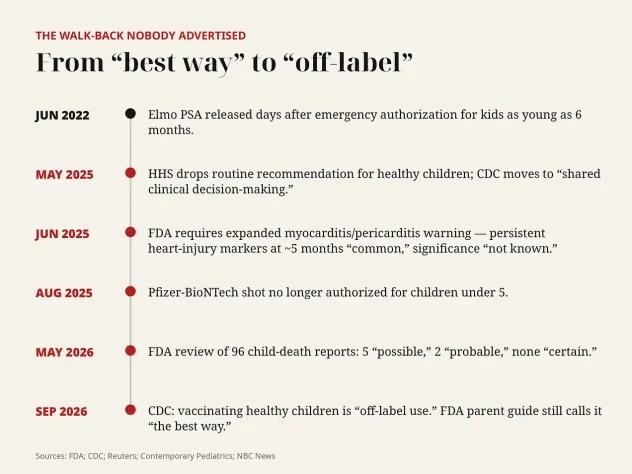
The cardiac warning got stronger
On June 25, 2025, the FDA required and approved expanded warnings about myocarditis and pericarditis on Pfizer’s Comirnaty and Moderna’s Spikevax. The new label estimates about 8 cases per million doses in people aged 6 months through 64 years, and about 27 per million in males aged 12 through 24, in the week after vaccination.
The most important sentence isn’t about frequency, though. It’s about what happened to the hearts afterward:
“… at a median follow-up of approximately 5 months post-vaccination, persistence of abnormal cardiac magnetic resonance imaging (CMR) findings that are a marker for myocardial injury was common. The clinical and prognostic significance of these CMR findings is not known.”
Read it twice. Five months out, markers of heart-muscle injury were “common,” and the agency says their long-term significance is “not known.” This isn’t a critic’s claim. It comes from an FDA-funded, FDA-co-authored study, and it’s now printed on the label.
The spot told parents “there was a little pinch. But it was okay.” Nobody in the ad said “unknown long-term cardiac significance.”
The authorization for the youngest children was pulled
On August 27, 2025, Pfizer-BioNTech’s COVID vaccine was no longer authorized for children under 5. CDC’s current clinical guidance puts it plainly: “Pfizer-BioNTech COVID-19 Vaccine is no longer authorized in the United States for children ages 6 months–4 years.”
That is the age group the Elmo spot was released to reach. It went out days after emergency authorization opened the shots to children as young as six months. Four years later, one of the two products it promoted to parents of those children can’t legally be given to them.
Healthy children are now “off-label”
The broad “everyone six months and older” recommendation is gone. In May 2025, HHS dropped the routine recommendation for healthy children, and the CDC moved to what it calls shared clinical decision-making.
CDC’s current guidance, updated September 23, 2026, limits Moderna’s approval for the youngest children to those with “at least one condition that places them at increased risk for severe COVID-19.” Then it states the conclusion outright:
“Vaccination of children 5-11 years of age with any product other than Spikevax or Comirnaty and vaccination of children in this age group without high-risk conditions is off-label use.”
“Vaccination of persons 12-64 years of age without high-risk conditions is off-label use.”
In 2022, the message was that vaccinating Elmo was “the best way to keep himself, our friends, neighbors and everyone else healthy.” In 2026, the CDC’s own wording is that giving the shot to a healthy child is off-label.
The deaths question
On November 28, 2025, Dr. Vinay Prasad, then director of the FDA’s Center for Biologics Evaluation and Research, sent staff a memo headed “Deaths in children due to COVID-19 vaccines and CBER’s path forward.” He wrote that career staff “have found that at least 10 children have died after and because of receiving COVID-19 vaccination,” based on an initial review of 96 child deaths reported to VAERS between 2021 and 2024.
The FDA’s formal analysis, made public in May 2026, came back more cautious. Of the 96 reports reviewed, none were classified as “certain.” Five were classified “possible” and two “probable,” mostly involving myocarditis, with an average age of 13. The agency stressed that these classifications don’t prove causation.
Media coverage framed that result as a debunking. Set the headline aside, though. The FDA’s own conservative review, using WHO causality criteria, still found seven child deaths it could not rule out as vaccine-related, and it called two of them probable.
And yet, still being promoted
This is where the irony stops being subtle.
Visit the FDA’s parent-facing page today, Vaccines for Children – A Guide for Parents and Caregivers. The COVID-19 vaccine is still listed alongside measles and polio among “the most commonly administered vaccines.” And parents are still told:
“Getting a COVID-19 vaccine is the best way to prevent COVID-19, including the potential consequences of hospitalization and death.”
That’s Louie’s line almost word for word, four years later, from the same agency whose label now carries the cardiac warning, whose authorization for under-5s was pulled, and whose own reviewers flagged seven child deaths.
The American Academy of Pediatrics, a production partner on the Elmo spot, hasn’t backed off either. As of September 2026, the AAP recommends COVID-19 vaccination for “all infants and children ages 6 months through 23 months,” and for “anyone ages 2 to 18 who isn’t at risk but whose parents or guardian wants them to get a shot.”
So we have two different postures at once. The regulator has narrowed approval, expanded the warning, and reclassified healthy-child use as off-label. The professional association that helped make the puppet ad still recommends the shot for every baby. And the FDA’s own parent guide still uses the 2022 talking points.
Part V: What They’ll Say — and Why It Doesn’t Save Them
Serious readers deserve the strongest counterargument, so here it is.
CDC’s guidance cites a retrospective cohort of more than 4 million people aged 16–25 from 2020 to 2025. It found myocarditis incidence of 0.05% after COVID illness versus 0.005% after vaccination. In other words, the infection carries a higher myocarditis risk than the shot.
That’s a legitimate data point and I’m not going to pretend it doesn’t exist. It doesn’t answer the question this piece is asking, for three reasons.
First, the comparison is an average over a population of teenagers and young adults. It says nothing about a healthy toddler with near-zero risk of severe disease. That’s the child this campaign targeted, and the child for whom the CDC now calls the shot off-label.
Second, it doesn’t address the finding printed on the label: persistent markers of heart-muscle injury at five months, of “not known” significance. The open letter discussed below says there are “no studies demonstrating prevention of hospitalization or death” in children. If that’s right, an unknown cardiac risk is being weighed against a benefit that was never shown.
Third, and most importantly, the argument here doesn’t depend on any contested injury number. It depends on an asymmetry. When the product was being promoted, it got a puppet, $50 million, a quarter-billion in donated airtime, the CDC’s logo, and the pediatricians’ endorsement. When the regulator narrowed the product, it got a label revision and a footnote. The public was sold a certainty the evidence never supported, and was never told when that certainty was withdrawn.
That isn’t public health communication. It’s a marketing campaign that never issued a correction.
Part VI: The Petition — Why I Signed
Earlier this month, 168 physicians, scientists, researchers, lawmakers, and health-freedom advocates, representing more than 63 million followers, sent an open letter to HHS Secretary Robert F. Kennedy Jr. and President Trump demanding removal of the mRNA platform. The effort was coordinated by Dr. Mary Talley Bowden. The signatories include Rep. Thomas Massie, former Rep. Marjorie Taylor Greene, Louisiana Deputy Surgeon General Dr. Sean Troxclair, Dr. Peter McCullough, Dr. Robert Malone, Dr. Aseem Malhotra, Tucker Carlson, and others.
I’m one of them, and I want to explain why.
The letter’s first demand is to “ban mRNA/gene therapy-derived technologies for all vaccines.” That includes the products still being given to children. Its other demands are to end the PREP Act declaration and its “ironclad liability shield for manufacturers and administrators,” ask Congress to repeal the PREP Act, ban direct-to-consumer pharmaceutical advertising, end the incentive structures that push providers toward medical coercion, and end conflicts of interest at the CDC, FDA, NIH, and NIAID.
On children specifically, the letter makes the point this whole piece has been building toward:
“Parental choice is not realistic when parents are not getting informed consent on the true risks of these products.”
It also takes on the “shared clinical decision-making” framework directly:
“By treating the decision to inject a child with mRNA as a ‘shared decision,’ while treating routine injections as the default, a dangerous legal precedent is being set that assigns powers to the federal government that have historically belonged solely to parents.”
According to the letter, more than 50 million Americans received mRNA COVID shots this year, including about 7 million children, and HHS has awarded $1.24 billion in contracts to Pfizer for future mRNA shots, “including for children.”
The Elmo spot is exactly why that line about informed consent matters. You can’t give informed consent to a hug from a puppet. A one-minute ad that turns a parent’s hesitation into a script and then answers it in eleven seconds isn’t informing anyone. It’s persuasion aimed at the people least able to push back: parents who trust Sesame Street and children who love Elmo.
The letter isn’t the only pressure. Children’s Health Defense’s citizen petition, asking the FDA to revoke the Pfizer and Moderna licenses, has been pending since December 8, 2025 and has drawn more than 104,000 public comments in support. On September 25, the Independent Medical Alliance called on the CDC to immediately withdraw its “off-label” recommendation for healthy infants, children, and adults.
HHS’s response to the open letter, through press secretary Emily Hilliard, was that Secretary Kennedy “believes mRNA products warrant heightened scientific scrutiny,” and that HHS had “wound down investments in mRNA vaccines for upper respiratory viruses because the technology does not effectively protect against infection from rapidly mutating viruses such as COVID-19 and flu.”
Think about that sentence next to the Elmo spot. The federal health department now says the technology “does not effectively protect against infection” from COVID. In 2022, a puppet told America it was “the best way to keep himself, our friends, neighbors and everyone else healthy.”
Heightened scrutiny isn’t enough. A product that federal officials now concede doesn’t reliably prevent infection, that carries a cardiac warning with unknown long-term significance, whose own regulator calls it off-label for healthy children, and whose makers are protected from liability should not be given to children at all.
Conclusion: The Correction That Never Aired
Every institution in the Elmo spot is still operating. Sesame Workshop is still making children’s programming. The Ad Council is still running “public service” campaigns. The CDC’s logo is still on its creative. The AAP still recommends the shot for every infant. The FDA’s parent guide still repeats Louie’s line.
None of them has produced a PSA that says: We told you this was the best way to protect your baby. Since then the label has been changed to warn about heart injury. The authorization for the youngest children was withdrawn. The government now calls this use off-label for healthy kids. We’re sorry we used Elmo to tell you otherwise.
That’s the one-minute spot this country is owed. Until it airs, the original belongs where I’ve put it: in the Hall of Fame of the Covid-era Mockingbird Media, as a case study in what happens when institutions that are supposed to earn a parent’s trust decide to manufacture it instead.
Watch it again. Listen for the moment Louie asks, “Was it safe?”
It was a good question. It still is. They just never let him wait for the answer.
Americans are paying the price to preserve Israel’s nuclear hegemony
By Jamal Kanj | MEMO | October 1, 2026
Since the start of the latest made-for-Israel war, Donald Trump and his surrogates have repeatedly promised Americans that it would be a few weeks and oil prices would soon crash below prewar levels. Instead, it was every promise that crashed. When those promises failed to materialize, the message shifted: the war is worth the price to stop Iran from becoming a nuclear power.
But what if Iran did become a nuclear power? How would that pose a greater threat to the U.S. than North Korea or Russia already do? Or is the real concern not a risk to America, but a challenge to the regional hegemony of a foreign nuclear power, Israel?
For more than thirty years, according to Israel’s fiction, Iran was on the verge of becoming a nuclear-armed state. That fictitious deadline has come and gone repeatedly, yet Benjamin Netanyahu has been recycling the same lie since 1992. The Israeli lies and deceit persisted even though, unlike Israel, Iran’s nuclear program was subject to strict international monitoring.
Still, Trump, at Netanyahu’s urging, walked away from an agreement that imposed some of the most stringent and verifiable restrictions ever placed on a country’s nuclear program. Now Americans are being asked to pay in blood and billions of dollars for abandoning a diplomatic agreement that had kept Iran’s nuclear program under unprecedented international scrutiny and helped contain the very threat now being used to justify the war.
The hypocrisy is impossible to overlook. Iran has been subjected to relentless demands for transparency and inspections, while Israel’s own nuclear arsenal, built in part with materials stolen from the U.S., remains shielded from any international inspection.
Yet somehow Iran’s ambitious know-how is the existential nuclear threat, not Israel’s nuclear bombs.
American consumers have long been the victims of a disinformation campaign, and now they are being forced to pay the price for a war sold to them on false pretenses. The most recent misinformation claiming the Strait of Hormuz is open and oil is flowing. The president said it on Fox, and the outgoing White House press secretary told Fox & Friends that the U.S. is essentially controlling the strait and that it remains open. These claims leave only two possibilities: either the statements are outright lies, or oil companies are gouging the consumer.
The UK Maritime Trade Operations Centre reported that commercial traffic through the strait remains about 75 percent below pre-conflict levels. It also tallied dozens of projectile strikes on vessels in just the past two months.
Three quarters less traffic is not a sign of an open strait. Shipowners and insurers know this, so do traders and so the climbing numbers at the gas pump.
The market has already made its judgment, and every American who fills a tank can see it. It is past time for Washington to stop lying.
For the average consumer, the pump is where it felt. Regular gasoline was below $3 a gallon before the U.S. was dragged into another one of made-for-Israeli wars. Families are paying more to get to work, truckers are paying more to move goods, and those costs show up in the price of groceries.
Meanwhile, American oil companies are pumping at record levels. Exxon and Chevron are producing record volumes from oil fields on American soil, thousands of miles from the Strait of Hormuz. Their production costs have not changed. What has changed is Israel’s war surcharge consumers are being forced to pay.
Chevron reported the largest quarterly net profit in its history, $12.1 billion. Exxon made $14.5 billion in the same quarter, about $160 million a day. Refining has become more lucrative. Gross refining margins more than doubled, soaring from a typical $20 crack spread to as much as $60.
Meanwhile, Trump dangles a pie-in-the-sky deal with Venezuela as a distraction from consumers’ mounting anxiety, while his administration stands by as oil companies exploit overseas crises for record profits. These companies have no reason to lower prices when war has handed them a windfall. This is what a war of choice looks like on the ground: American consumers are forced to pay the price, while oil executives in Texas turn a crisis into a lucrative business opportunity.
American consumers deserve more than false promises. If the Strait is open, then oil prices should be coming down. If it is not, then stop treating consumers as an audience whose emotions must be managed rather than citizens entitled to hear the truth. Since the war started, every week, like millions of Americans, I fill my gas tank, and the Israeli war tax is higher than it was the week before.
No, Mr. President, that is not “worth the price” to pay for a war fabricated in Israel, a repeat of the made-for-Israel war in Iraq 23 years ago.
This is not a war to end Iran’s fictitious nuclear power. It is a war paid for by taxpayers’ money and American blood to ensure that Israel remains the only absolute nuclear power in the Middle East.
Resistance factions are necessary to ensure a permanent US Iraq withdrawal
By Robert Inlakesh | Al Mayadeen | October 1, 2026
US President Donald Trump has officially announced a formal withdrawal of American troops from Iraqi territory, yet the economic, social and diplomatic hold on the nation remains. If US troops are going to be permanently booted out, it necessitates an Iraqi national resistance that is capable of operating as a guarantor.
On October 21, 2011, former US President Barack Obama announced that the United States had withdrawn its remaining occupying forces from Iraqi territory. Then, only two and a half years later, the US re-deployed its forces back into the country under the guise of fighting the Daesh insurgency.
Iraq, having experienced a regime change operation followed by a brutal occupation and nationbuilding project, was left incapable of defending itself from the ISIS takeover, let alone pushing back against the United States redeploying its forces. First, the Obama administration deployed forces that it said were there to protect its diplomatic staff, in addition to advisors to the Iraqi armed forces.
Later it would expand this presence, expanding its “Operation Inherent Resolve” into Syrian territory, providing it with supply routes and a platform from which to de facto occupy northeastern Syria. The US operation in Syria and Iraq helped them eventually achieve their longtime goal of regime change in Damascus by depriving the Syrians of their access to the nation’s oil resources and fertile agricultural lands.
In 2020, Donald Trump had agreed to remove his forces from Iraqi territory, re-iterating this pledge during a meeting with then Iraqi PM Mustafa al-Kadhimi. The following year, former President Joe Biden then declared the official end of his nation’s combat mission inside the country. Only now, in 2026, and after extensive attacks on US military facilities by the Islamic Resistance in Iraq, has the pledge to withdraw American forces been followed through on.
When the US and Saudi Arabia recently blamed Iraqi forces for carrying out an attack on Riyadh’s East-West Pipeline, launching a large-scale bombing campaign across the country, some Iraqi officials instead issued statements against Iraq’s armed factions that had vehemently denied involvement in the incident.
The Trump administration is openly pushing for the disarmament of all military factions within the country, a project Washington has also sought to impose on all Resistance groups across the region. The United States has not allowed for there to be a reasonable integration of Resistance forces like Hezbollah in Lebanon with the Lebanese Armed Forces, nor allowed time for formal agreements to be struck in Iraq of a similar nature. Their goal is simply to disband these groups and then exert control over the armed forces of Lebanon and Iraq, leaving them all but defenseless and without access to strategic weapons capable of deterring violations of national sovereignty.
In the case of Baghdad, the nation’s government was a construct of US occupation; Washington still holds the economic cards that are capable of pressuring any leadership, no matter how well-intended its goals are, while it maintains an enormous soft-power pull through its extensive NGOisation project inside the country. Iraq was not allowed to rebuild its nation’s military following the toppling of Saddam Hussein’s rule in 2003, leaving it defenseless against ISIS terrorism a decade later.
On the ground, this is why there was a need for the Hashd al-Shaabi (Popular Mobilisation Forces) to emerge. It was the Hashd that was chiefly responsible for defeating the terrorist invasion and purging its militants from Iraqi cities. Many of these groups that fought under the banner of the Hashd then went on to develop considerable military power and an extensive arsenal.
As revealed during the Ramadan War earlier this year, the Israeli Mossad was able to develop bases inside Iraqi territory, while numerous militant groups still exist across the country’s territory, including various armed factions that are backed by the CIA and the Mossad.
If the Islamic Resistance in Iraq is disbanded and disarmed, then Iraq will be in the exact same defenseless position that allowed for ISIS to sweep through the nation so rapidly and seize so much territory, leaving behind a trail of blood in their wake. This poses a threat to not only Iraq, but other neighbouring countries, including Iran. It threatens Syria’s fragile status quo too.
An Iraq without the Islamic Resistance would be like a Lebanon without Hezbollah, completely left at the mercy of the United States and their Israeli allies. Washington and Tel Aviv have a project that aims to totally dismantle regional sovereignty; this is why they have dedicated trillions of dollars and countless resources to destroying the armed forces of both Iraq and Syria over a period of nearly 30 years now. They are not about to simply sit by and allow Iraq and Syria to rebuild capable militaries, allowing them to follow the will of their people and to defend their own national interests.
The United States still maintains its air defence systems inside Iraqi territory, can use the country’s airspace at will and, as we saw only months ago, will launch airstrikes across the nation at the drop of a hat.
In order to deter a return of American occupation forces, under the guise of fighting whatever future threat they choose to use, there must be an Iraqi military force that is capable of acting in defense of the country, both on the ground and through the use of its long-range munitions if need be. A nation without a real military force cannot enjoy sovereignty. And a nation that is not able to go against the will of the United States, will serve as its proxy and will suffer the blowback that is inherent in complicity.
The US withdrawal from Iraq did not happen without a long history of resistance against its forces and public opinion that also opposes American interference. Protecting the achievement of ridding the country of the majority of US forces takes real military deterrence. Otherwise, the Israelis and the US will simply use the country’s territory for whatever projects they wish.
No Vote, No Representation, No State: Democracy, Israeli Style
Palestine This Week | Middle East Monitor | September 30, 2026
This week’s MEMO review examines claims about Netanyahu’s advance knowledge of 7 October, his provocative UN speech and Israel’s sweeping West Bank closure. We discuss calls to free Marwan Barghouti, moves to bar Arab-led parties from Israeli elections, Trump’s rejection of Iran’s proposal and allegations of election interference involving Israeli firms.
Chapters:
00:00 Introduction & Overview
01:41 Claims of Netanyahu’s Advance Knowledge of 7 October
18:14 Netanyahu’s UN Speech: Props, Provocations and Defiance
22:58 Israel’s West Bank Closure and Its Impact on Palestinians
26:30 Growing Calls to Free Marwan Barghouti
29:40 Israel’s Political Opposition and the Two-State Solution
35:00 Arab Party Disqualifications: Democracy and Apartheid
38:07 Trump Rejects Iran’s Proposal: What Was on Offer?
41:42 Meta’s Restrictions on Lula and Allegations of Israeli Election Interference
Subscribe to our YouTube channel: https://tinyurl.com/447fpn8k
Visit our website: https://www.middleeastmonitor.com/
Zionist Bought Senate Blocks Information About American Citizens Killed By Israel

By Justin K.P. | The Dissident | September 30, 2026
The U.S. Senate just voted 47-51 against a bill introduced by the Senators Chris Van Hollen, Tim Kaine and Bernie Sanders which would have “forced Secretary of State Marco Rubio to submit to Congress, within 30 days, a report on what information is available about the killings of the nine US citizens, the status of US and Israeli investigations into the killings, the number of US citizens currently held in Israeli prisons, the treatment of Palestinian children in Israeli prisons, and a description of the steps the US government has taken to reduce violence in the West Bank.”
In other words, the Zionist occupied Senate voted against releasing information about Israel killing American citizens in order to protect Israel.
The bill would have forced Marco Rubio to release the information about nine US citizens who have been killed by settlers and Israeli security forces, including the late Palestinian-American journalist Shireen Abu Akleh, who was killed by Israeli occupation forces while reporting in the West Bank in 2022, an intentional murder that was covered up by the Biden administration.
The Biden administration covered up for Israel, claiming that her murder was the “result of tragic circumstances during an IDF-led military operation against factions of Palestinian Islamic Jihad”.
But later, the whistleblower Colonel Steve Gabavics, who worked at the time for the Office of the U.S. Security Coordinator in Jerusalem and led the investigation into Shireen Abu Akleh, revealed that his team found she was intentionally targeted, but the U.S. covered it up to protect Israel.
In an interview with Democracy Now!, he noted, “We were able to disprove very quickly the assertion that there was a Palestinian gunman in front of Shireen Abu Akleh, that the IDF had shot at, and they had accidentally shot her instead… the indications of everything we read from the reports that we got from the IDF on their locations, and proximity to where the event happened, what we got from the investigation from the Palestinian Authority, and our investigation, to us it was very clear that the (IDF) individual in the vehicle who took the shot, would have had a clear line of sight and would have had visibility of Shireen Abu Akleh walking down the middle of the street for a period of time before he took the shots”.
But he revealed that the Biden administration covered up this information, saying, “After we had completed this we were on regular video calls, classified and unclassified with the state department … I indicated that the evidence to me indicated that there would have been enough if we actually built a criminal case to have enough information and facts to beyond a reasonable doubt, for a conviction at some level. We were pushing for the fact that they needed to formally admit the fact that it was not an accident, that a (Israeli) soldier killed Shireen Abu Akleh, that it was an intentional shooting, and unfortunately, that was not what came out … When the actual statement came out, that was absolutely not what I expected… I was shocked … all the data indicates the exact opposite, it was not fog of war… This was not what we had found”.
He added, “It all came down to not trying to anger the Israelis by holding them accountable for intentionally killing an American citizen”.
Yet again, AIPAC-bought members of the Senate want to continue the cover-up of the Israeli murder of American citizens in order not to anger Israel and its lobby.
‘THAAD Delusion’: Iran war exposes US missile shield limits – The Atlantic
Al Mayadeen | September 30, 2026
The US-Israeli war on Iran has exposed a widening gap between Washington’s promises to protect its allies and its ability to sustain that protection, with expensive missile interceptors being consumed faster than American manufacturers can replace them, The Atlantic reported.
In an investigation titled “The THAAD Delusion,” Christopher Leonard argues that the Terminal High Altitude Area Defense system became a cornerstone of US security arrangements in the Middle East despite being developed for a more limited battlefield role.
Iran’s ability to maintain missile attacks has challenged the assumption underpinning that role: that American forces would survive an opening barrage, then rapidly destroy the launchers responsible.
Instead, a prolonged conflict has placed mounting pressure on interceptor supplies, exposing weaknesses in US military planning, weapons procurement, and industrial capacity.
A missile shield built around a short war
According to the report, THAAD was originally intended to protect critical military deployments during the initial phase of a conflict, allowing US aircraft and naval forces time to respond.
Washington subsequently promoted the system as a central component of broader missile shields for regional allies, including the United Arab Emirates and Saudi Arabia.
The distinction has become consequential during the war on Iran. While THAAD has intercepted ballistic missiles effectively, Leonard writes that Washington neither accumulated enough interceptors for sustained operations nor established the manufacturing capacity needed to replace them quickly.
US interceptor stocks depleted by sustained warfare
Drawing on estimates from the Center for Strategic and International Studies, the report says US forces used more than 150 THAAD interceptors during the 12-day war in 2025 and another 190 to 290 during “Operation Epic Fury.”
CSIS estimated that approximately 250 interceptors remained in the US stockpile. The report notes that additional deliveries could affect those calculations, while Washington has not disclosed its remaining inventories.
The depletion extends beyond THAAD. The investigation also described heavy consumption of Patriot interceptors and offensive weapons, including Tomahawk and JASSM missiles, placing pressure on multiple parts of the US arsenal.
Iran’s sustained attacks strain expensive defenses
The investigation identifies Iran’s combination of ballistic missiles and comparatively inexpensive drones as a major challenge to American defensive planning.
THAAD interceptors cost about $12 million each, according to the report. Repeated Iranian missile launches therefore impose substantial financial and logistical costs even when interceptions succeed.
At the same time, Shahed drones, which the article puts at $20,000 to $50,000 apiece, require separate defenses because THAAD cannot intercept them.
This combination forces defending militaries to confront different threats simultaneously while managing limited ammunition. The report describes regional forces using helicopters and costly air-to-air missiles against drones as pressure on their defenses increased.
Leonard’s central argument is that interception accuracy alone cannot deliver the lasting security Washington offered its partners when the attacker can sustain successive waves.
Industrial weaknesses slow replenishment
The article traces the shortage to years of budget decisions that favored major weapons platforms over ammunition reserves, alongside a concentrated defense industry dependent on vulnerable networks of specialized suppliers.
THAAD missiles require intricate assembly and components sourced from hundreds of companies. Expanding production involves increasing capacity throughout that network, rather than simply adding workers at a final assembly plant.
Pentagon assessments cited in the report found that substantial increases in production for several missile systems could require billions of dollars and take years.
The investigation also scrutinizes defense contractors’ spending priorities. Lockheed Martin distributed $6.8 billion through dividends and share buybacks in 2024, while RTX returned $3.7 billion to shareholders, even as industry representatives argued that factory expansion required advance funding or long-term government contracts.
Washington’s protection promises face scrutiny
The implications reach beyond ammunition shortages. US weapons sales helped bind allied militaries to Washington through shared equipment and reliance on American supplies, the report notes.
However, delayed deliveries and competing wartime demands have prompted some partners to seek alternatives, raising questions about the reliability of those arrangements.
In the Middle East, Leonard argues, attacks on infrastructure and military installations have also challenged the perception that hosting US forces guarantees security.
Stephen Wertheim, a senior fellow at the Carnegie Endowment for International Peace, told The Atlantic that the consequences could reshape Washington’s regional position.
“We could be moving away from a Middle East that can be fairly described as being an American-dominated region,” he said.
Yes, the Iran war has destroyed Trump’s presidency
By Andrew Day | The American Conservative | September 29, 2026
No one would claim that the Iran War has been a political godsend for President Donald Trump and the Republican Party. But some Israel-First conservatives are willing to say—and lately have been incessantly saying—that the Iran War hasn’t been a political scourge.
Those Israel-First conservatives are wrong, even if the devil is, at least partly, hidden in the details. The Iran War has damaged Trump’s approval ratings, consumed his presidency, and darkened the GOP’s prospects in the upcoming midterm elections.
A chief proponent of the argument that Trump hasn’t suffered all that much from the Iran War is Ben Shapiro of the Daily Wire. Shapiro’s political analysis is plainly motivated by the fact that he was a loud and influential proponent of the war who promised—falsely, as it turned out—that Iran couldn’t close the Strait of Hormuz, a chokepoint for the global energy trade.
“There’s an op right now to pretend that the real reason for President Trump’s unpopularity is foreign policy, but that is not true, by the polling data, it is not true,” said Shapiro on a recent episode of his podcast. “The reality is that Americans have affordability concerns, President Trump came into office saying he was going to alleviate the affordability concerns. He has not in fact alleviated the affordability concerns, and therefore, his polling numbers have consistently slid since Liberation Day.”
This is a bit like me saying my wife isn’t mad at me because of the drinking, but because I drunkenly crashed the car.
The Iran War, as everyone now knows, has driven up prices at the pump—prices which, unfortunately for Trump, are prominently displayed on every major street across the country. On the eve of the war, regular gasoline averaged $2.98 per gallon. Today, at the time of writing, the average price is $4.48. Americans are notoriously averse to high gasoline prices and tend to punish presidents over the issue, sometimes even when the president can’t justifiably be blamed.
But make no mistake: Virtually every sentient adult understands that 1) oil comes from the Middle East, 2) Trump started a big war in the region, and 3) gas prices shot up right afterwards. And again, even if Americans didn’t grok the connection between the war and the gas-price spike, the latter would still have hurt Trump politically, and it would still be a knock-on effect of the former.
It’s not just prices at the pump that have gone up because of the war. Groceries and other consumer goods travel across this vast land on tractor-trailers that run on diesel and get a lot fewer miles per gallon than even your Uncle Larry’s F-350. Diesel prices have smashed records and now sit at around $6.50, up from $3.76 before the war.
No wonder truckers are furious, prompting rumors of an imminent strike.
And no wonder the Iran War has contributed to general inflation in America. Anyone who has been reading the official economic reports knows the war is responsible for more than a third of recent inflation.
Before the war, inflation was trending down, only a couple ticks away from the Federal Reserve’s target of 2 percent. It seems likely that Trump, if he hadn’t started his dumb war in the Middle East, would have garnered praise for presiding over declining inflation and that the Fed would have cut interest rates, juicing economic growth. Instead, inflation now sits at 3.4 percent.
(As an aside, this weekend I traveled to Istanbul, where many Middle Easterners of various nationalities complained to me that Americans only oppose the war because of the gas prices. That’s simply not true. The war has been unpopular since day one, when all that Americans knew was the American-Israeli strikes had killed Iranian leaders including the Supreme Leader Ali Khamenei.)
Shapiro, ever the neoconservative, insinuated in the quote above that the decline in Trump’s approval rating owes more to his tariffs than to his war. The data doesn’t back that up, as the conservative commentator and election analyst Ryan Girdusky noted on X in response to new survey data. “The most eye opening part of this poll is that Trump’s approval rating and the strength of the economy went up right after Liberation Day,” Girdusky said. “Fell slightly afterward and then plummeted at the start of the Iran War.”
Shapiro has unwittingly helped uncover another, subtler, way in which the Iran War has indirectly damaged Trump’s approval ratings and, by extension, the Republican Party brand. Shapiro recently went on Fox News to commiserate with the host Mark Levin—another Israel-Firster and warmonger—over all those dastardly antiwar conservatives blaming the Iran War for everything.
“Iran is a 4-percent issue with the American people,” Levin said, as Shapiro nodded in agreement. Levin was referring to Fox News polling that shows not many Americans name the Iran War as their top issue. “So, whatever happens in the midterms, it doesn’t appear that Iran’s going to drive anything one way or another.”
“I think that’s exactly right,” Shapiro replied.
Part of the problem with Levin’s analysis has already been covered above. In the Fox poll, a plurality of Americans—34 percent—named the cost of living as the most important issue, and the Iran War has made living costlier.
But the subtler problem is perhaps even more illuminating. Simply put, Americans believe Trump is too focused on foreign policy at the expense of the problem they really care about, which, in fact, his Iran War has exacerbated. This is a PR disaster for the Trump administration and the GOP. Americans don’t prioritize the war that has dominated the headlines and distracted the White House, even as Trump claims to have boldly prevented Iran from unleashing nuclear apocalypse.
It may be grotesque to find silver linings in this dumb and deadly war, but here’s one: Americans no longer buy the war narratives. That is certainly not, however, a silver lining for Republican candidates in this year’s election, no matter how cynically they try to distance themselves from the war. In fact, it’s a good bet they’ll do much worse than if Trump hadn’t launched this unnecessary war, despite what Shapiro and his ilk may tell you.
The legacy of US sanctions, war, and occupation in Iraq
By Hala Farhat | Al Mayadeen | September 30, 2026
Iraq’s government has declared September 30 the final date for ending the US-led coalition’s military mission. Prime Minister Ali al-Zaidi’s office says October 1 will find the country “free of any foreign military presence,” closing a deployment that once reached about 170,000 US troops.
But withdrawal leaves intact much of the damage inflicted by the invasion and the 13 years of sanctions that preceded it, along with the financial arrangements through which Washington continues to exert influence.
The US left Iraq’s productive economy devastated, its institutions dismantled and reshaped, and its workforce left increasingly dependent on a state funded by oil. Access to that income remains vulnerable to US pressure.
The question after the troops leave is how much control Iraq will have over the economy they leave behind.
Thirteen years of sanctions
The erosion of Iraq’s economy began long before March 2003. The UN Security Council imposed sweeping sanctions after Saddam Hussein’s regime invaded Kuwait in 1990. Drawing on internal UN records, Joy Gordon’s Invisible War describes one of the most comprehensive and devastating sanctions regimes ever imposed.
The embargo quickly collapsed incomes. Reconstructed World Bank estimates showed GDP per capita collapsing to a third in a single year, going from about $3,527 in 1990 to $1,255 in 1991.
Public employees who had earned $150 to $200 a month before sanctions were earning $3 to $5 by 1996, according to a 1997 assessment. By 2000, the International Committee of the Red Cross reported salaries as low as $2 a month and unemployment around 50 percent.
Factories, power stations, and water plants could not recover without imported equipment and spare parts. Yet any member of the sanctions committee could hold an entire contract indefinitely, even over a single disputed item. Gordon documents Washington’s use of the “dual-use” designation to restrict goods as basic as water pipes. By August 2002, the UN counted 2,058 contracts worth about $5.2 billion that had been placed on hold, including $745 million in oil industry equipment.
The restrictions also placed Iraq’s oil income beyond Baghdad’s direct control. Under the Oil-for-Food program, buyers paid into a UN-administered escrow account. After deductions for compensation, administration, and weapons inspections, the proceeds could finance only approved purchases. Iraq exported roughly $65 billion in oil under the program but could not use that money as ordinary budget revenue for wages, maintenance, or local services.
The collapse pushed skilled workers out of their professions. A UN humanitarian survey of 1,157 degree holders employed by aid organizations found 725 in general-service or menial jobs, including doctors, engineers, and scientists working as drivers, clerks, and guards.
By the time US troops arrived, Iraq had endured years of falling wages, industrial decline, and lost expertise. The occupation’s first decisions deepened that damage.
Dismantling the state, contracting out reconstruction
On May 16, 2003, the occupation authority issued Order 1, barring senior Baath Party members from public employment and requiring the screening of senior staff in ministries, hospitals, and universities. A week later, Order 2 dissolved the Defense Ministry, army, Republican Guard, and intelligence bodies.
The International Center for Transitional Justice estimates that Order 2 alone left about 400,000 conscripts, officers, and officials without jobs. The World Bank counted more than 2 million unemployed Iraqis, nearly 30 percent of the labor force, around 2003–2004. Meanwhile, Iraq’s health minister estimated that roughly half the country’s prewar doctors had fled as kidnapping and assassination made their work increasingly dangerous.
The occupation then opened the weakened economy to foreign competition. Order 39 allowed wholly foreign-owned companies and guaranteed investors treatment no less favorable than Iraqi businesses, while excluding natural resource extraction. Other orders suspended tariffs, later replaced by a flat 5 percent levy, and capped income tax at 15 percent from 2004. The World Bank warned that rapid opening would cost jobs in a country whose private sector was too weak to employ displaced workers.
Reconstruction brought billions of dollars, but much of the spending flowed through foreign contractors. The United States spent more than $60 billion over roughly a decade, according to the Special Inspector General for Iraq Reconstruction (SIGIR). More than $25 billion went to training and equipping security forces after the occupation had dissolved Iraq’s existing military institutions.
SIGIR found that reconstruction began without adequate security, consultation with Iraqi ministries, or planning for long-term maintenance. Its final report estimated waste at $3 billion to $5 billion from the main reconstruction fund and as much as $8 billion overall. The largest early infrastructure contracts went mainly to US firms. A $1.8 billion award to Bechtel in January 2004 was open only to American bidders.
Iraq’s own money followed a similar path. UN Security Council Resolution 1483 established the Development Fund for Iraq to receive oil revenue, with the occupation authority directing spending until June 2004.
An Iraq Revenue Watch analysis of contracts paid from Iraqi funds found that US companies received 74 percent of their value. US and British companies together received 85 percent, while Iraqi firms received 2 percent. Audits found that 73 percent of the value of Development Fund contracts above $5 million had been awarded without competitive bidding.
Oversight was inadequate even to establish how some of that money had been used. A 2010 SIGIR audit found that the Defense Department had failed to establish required accounting controls for about $8.7 billion of the $9.1 billion it received from the fund. It could not document spending of about $2.6 billion.
The result was a reconstruction process that directed vast sums abroad while leaving Iraq with damaged services, limited productive capacity, and institutions struggling to rebuild.
An oil-funded system of patronage
With factories closed or looted and no private industry to replace them, the state became the place where Iraqis look for work. An assessment by the International Fund for Agricultural Development, using World Bank data, says public employment accounts for nearly all formal jobs and 40 percent of all jobs. Salaries and pensions took about 90 trillion dinars, roughly $69 billion, more than 40 percent of the 2024 budget, and the World Bank says another half a million government jobs were added during the spending expansion that preceded 2025.
The private sector has not filled the gap. Estimates put imports at more than 90 percent of the goods in Iraqi shops, while manufacturing makes up only around 2 percent of GDP. The World Bank says nearly 29 percent of the population is aged 15 to 29, and that this large group is entering the labor market amid limited job creation, a preference for public-sector work, and a private sector too small to absorb them. Youth unemployment is about 32 percent, and only around 11 percent of women take part in the labor force.
The IMF’s 2025 assessment describes the same pattern, citing high unemployment, an excessive state footprint, corruption, a weak banking system, and an inefficient electricity sector, and it called the wage trajectory fiscally unsustainable. Analysts describe a cycle in which secure public wages raise the pay that educated workers expect, private firms struggle with unreliable power and weak finance, and young graduates keep turning to the state for jobs, which raises the demand for more public hiring.
Oil pays for all of it. The World Bank estimates that oil supplied about 88 percent of government revenue and 91 percent of exports in 2025.
The financial levers Washington keeps
Iraq’s oil income has passed through outside hands since 1996, first a UN escrow, then the occupation authority’s fund, and now the New York Fed.
The Development Fund’s accounts were opened at the Federal Reserve Bank of New York, where Iraqi oil revenue still flows. Buyers pay dollars into a Ministry of Finance account, and the Central Bank of Iraq converts part of the income into dinars for government spending. US jurisdiction over dollar clearing, correspondent banking, and physical cash shipments gives Washington substantial influence over Iraq’s access to its money.
In January 2020, after Iraq’s parliament called for foreign troops to leave, the Trump administration threatened to block access to the account. Iraqi officials said it then held about $35 billion and warned that losing access would disrupt salary payments and the exchange rate.
US restrictions introduced in November 2022 forced banks seeking dollars for international transfers to disclose the final beneficiaries and purposes of transactions through an electronic platform, with requests screened by the New York Fed. US and Iraqi accounts linked the measures to concerns about transfers to sanctioned Iranian actors.
Consequently, more than 80 percent of daily wire requests were initially blocked or returned. Transfers fell from $224.4 million on October 17, 2022, to $22.9 million on January 17, 2023. Demand shifted to the parallel market, where the dinar traded at about 1,588 to the dollar in February against a newly set official rate of 1,300. In a country dependent on imported food and consumer goods, restricted dollar access raised costs for ordinary households.
In April 2026, Washington applied pressure through physical cash, halting a shipment of about $500 million and suspending parts of security cooperation. Iraqi officials said the halt affected banknotes used for travel, medical treatment, education, and retail exchange, while electronic transfers for imports continued. Some shipments resumed in July. On September 26, Baghdad announced that Washington had agreed to continue them.
US sanctions have also reshaped access to Iraq’s oil fields. Russia’s Lukoil left West Qurna 2 after sanctions, and Chevron signed agreements to take over its development. During al-Zaidi’s July visit to Washington, Iraq signed dozens of agreements with companies including ExxonMobil, KBR, Halliburton, and Shell. US Energy Secretary Chris Wright cited more than $60 billion in commercial agreements, while al-Zaidi told The National that US companies would receive top priority. According to the Atlantic Council, Donald Trump framed the deals as American oil companies taking the place of US forces.
As US forces prepare to leave Iraq, they leave behind a trail of devastation. Decades of sanctions and occupation have weakened its productive economy, dismantled state institutions, and left livelihoods dependent on an oil-funded system of patronage. The consequences will endure long after the troops depart.
Washington retains substantial power over Iraq through its influence over dollar access and the financial channels that sustain the state. The withdrawal ends a military mission, while leaving Baghdad to contend with both the damage of US intervention and the control Washington continues to exercise.
Iraqi resistance group rejects disarmament, vows to maintain support for Lebanon
Press TV – September 30, 2026
Iraqi anti-terror resistance group Kata’ib Sayyid al-Shuhada has rejected any surrender of its weapons, with its spokesman stressing that resistance would continue despite pressure and that Iraqi resistance fighters would sustain their support for their fellow fighters in Lebanon.
Sheikh Kazem al-Fartousi, spokesman for the group, which is a subdivision of Iraq’s Popular Mobilization Units (PMU) coalition, made the remarks to the Lebanese news website UNews.
“We have not retreated from the resistance, and there will be no surrender of weapons,” he said, the website reported on Tuesday.
“The resistance’s weapons in Iraq are at its disposal and Iraqi resistance would continue supporting the Lebanese resistance,” the official added.
“The pressure has not deterred us from continuing along this path and will not lead us to retreat even a single step in confronting the enemy.”
The statement came as the Iraqi government, headed by Prime Minister Ali al-Zaidi, has, as a result of US pressure, been seeking to advance a plan to establish a state monopoly over weapons.
A day earlier, Haj Abu Mujahid al-Assaf, the security official of Kata’ib Hezbollah, another member of the PMU, also pointed to the upcoming prospect of expulsion of US-led forces from the Arab country, saying that, upon the occasion, the Iraqi people would celebrate the expulsion, associating the pending development to the efforts made by Iraqi resistance groups.
Al-Assaf further warned that if the restrictions imposed by the United States on Iranian aviation continued after October 1, the Iraqi people would take a clear position, adding that the possibility existed of closing border crossings with countries participating in the Washington’s efforts at targeting the Islamic Republic.
Featured Video

Iran’s Next Strike May Not Explode. It Could Shut You Down
or go to
Aletho News Archives – Video-Images
From the Archive
Zionism’s Violent Legacy
By Donald Neff | Washington Report On Middle East Affairs | January 1996
On January 4, 1948, Jewish terrorists drove a truck loaded with explosives into the center of the all Arab city of Jaffa and detonated it, killing 26 and wounding around 100 Palestinian men, women and children.[1] The attack was the work of the Irgun Zvai Leumi – the “National Military Organization,” also known by the Hebrew letters Etzel – the largest Jewish terrorist group in Palestine. The Irgun was headed by Revisionist Zionist Menachem Begin and had been killing and maiming Arabs, Britons and even Jews for the previous ten years in its efforts to establish a Jewish state.
This terror campaign meant that at the core of Revisionist Zionism there existed a philosophical embrace of violence. … continue
Blog Roll
 Aletho News
- Trump’s Iran war is on an Israeli leash
- Saudi oil boss issues global supply warning
- Riyadh Says Its Oil System Is Intact. The Numbers Say Otherwise.
- Trump and Netanyahu Want to “Finish the Job” on Iran
- US ‘one-sided dictation’ not Iran’s beliefs makes rational talks impossible: Baghaei
- Iran’s Next Strike May Not Explode. It Could Shut You Down /Col Doug Macgregor
- Iran: US political targets legitimate if assassinations return
- Iraq shuts key border crossing with Iran under US pressure: Report
- Undersea Internet cables could be targeted in retaliation for attacks on Iran: IRGC deputy chief
- EU sending ‘biased’ observers to interfere in Serbian election – president
- If Americans Knew
- The Israel Lobby’s Changing Fortunes
- AIPAC has become such a political liability that it’s shifting to a more “nimble” approach to buying politicians
- At least 160 Israeli settler attacks in 2 weeks
- Will Gaza’s Ancient Christian Community Disappear Forever?
- Israel’s vision of regional security rests on keeping Arab states weak
- Heidi Levine recounts how Palestinian youths helped save her in settler attack
- DAILY UPDATE: Latest essential news on Palestine, Israel, & region
- Trump’s Intensifying Sabotage of the ICC, for Israel’s Sake
- Israeli military detain US and UK volunteers in West Bank including Democratic NY politician Brad Lander
- Americans at National Conservatism Conference held in Israel this year criticize Israel
- No Tricks Zone
- E-Cars Reduce CO2 Emissions By Only 41% Compared To Internal Combustion Engine Vehicles
- Predictions Made By Renowned Climate Professor Over Past Decades Have Been Proven To Be Poor
- New Study Suggests Large Regions Of The Pacific Ocean Have Been Cooling For The Last 80 Years
- Germany’s Green Energy Debacle: High Energy Costs Force Kahla Porzellan to Close After 182 Years!
- New Study: 50 Years Of The Most Aggressive ‘Net Zero’ Policies Can Only Affect The Global Climate By 0.03°C
- US September “Heat” Was No Record…Many Records Set Decades Ago
- Latest European Green Energy Debacle; Portugal’s Largest Flagship Solar Park Insolvent!
- Green Energy Debacle: German Expert Professor Fritz Vahrenholt Warns Of Severe Economic And Social Consequences
- Two More Paleo Reconstructions Affirm Meters-Higher Sea Levels Across Ireland, Brazil 7000-6000 Years Ago
- New Study: Earth And Venus Surface Warmth Largely Explained By Convection And Lapse Rate, Not CO2 Or Radiation

