USAID closes headquarters – media
RT | February 3, 2025
The US Agency for International Development (USAID) has closed its main office in Washington DC, with most personnel told to stay away from the building, multiple US media outlets reported on Monday. The development comes after US President Donald Trump accused the agency’s leadership of being “radical lunatics” and proposed major changes to the organization.
Established in 1961, USAID is responsible for administering foreign aid and development programs abroad to promote American interests.
According to an email obtained and shared by CNN, USAID leadership directed that the “headquarters at the Ronald Reagan building in Washington, D.C. be closed to Agency personnel on Monday, February 3, 2025.”
“Agency personnel normally assigned to work at USAID headquarters will work remotely tomorrow, with the exception of personnel with essential on-site and building maintenance functions individually contacted by senior leadership,” the letter said.
AP has confirmed the email, adding that more than 600 employees discovered overnight that they had been locked out of USAID’s computer systems.
The development comes after Trump blasted the agency, arguing that “it’s been run by a bunch of radical lunatics.” “We’re getting them out, and then we’ll make a decision,” he said.
Tech billionaire Elon Musk, the head of the Department of Government Efficiency (DOGE) and a close ally of the US president, has also been a fierce critic of USAID. He described it as a “criminal organization” which he believes was financing bioweapon research, including projects that allegedly led to the emergence of Covid-19.
“It became apparent that it’s not an apple with a worm in it. What we have is just a ball of worms. You’ve got to basically get rid of the whole thing. It’s beyond repair,” Musk said.
He also revealed that he had spoken with Trump, claiming that the president had “agreed” that USAID should be shut down.
The crackdown on USAID comes after the Trump administration suspended foreign assistance, with a few exceptions. Secretary of State Marco Rubio announced that the US would carry out a program-by-program review to determine which projects make “America safer, stronger or more prosperous.” He claimed that shutting down US-funded programs during the 90-day review had resulted in “a lot more cooperation” from recipients of various assistance.
How is USAID Linked to Secret Bioweapons Research?
By Svetlana Ekimenko – Sputnik – 03.02.2025
Lieutenant General Igor Kirillov, head of the Russian Armed Forces’ Radiological, Chemical, and Biological Defense Troops, had previously exposed the Pentagon’s bioweapon program operating in Ukraine. He was killed in a bombing last December, which Russian investigators determined was carried out on the orders of Ukrainian special services.
Elon Musk called USAID a “criminal organization” and said it was “time for it to die,” alleging US tax dollars were funneled through the agency to fund bioweapons research.
Musk’s comments echo claims made by Lt. General Igor Kirillov, former head of Russia’s Chemical, Biological, and Nuclear Defense Troops, who was later assassinated by Ukrainian neo-Nazi forces.
Documents obtained during Russia’s special military operation have reportedly exposed:
USAID & Pentagon Links
Since 2019, USAID and its key contractor, Labyrinth Ukraine, have been involved in the US military biological program.
Labyrinth Ukraine is a branch of Labyrinth Global Health, whose founders were formerly with Metabiota, a major Pentagon bioweapons contractor.
Bioweapons Research
Labyrinth Ukraine participated in the US projects UP-9 and UP-10, studying African swine fever in Ukraine and Eastern Europe.
On February 24, 2022, pathogens of plague, anthrax, tularemia, cholera, and other deadly diseases were allegedly destroyed to cover up US-Ukraine violations of the Biological and Toxin Weapons Convention (BTWC).
A letter from Ukraine’s military epidemiology chief to Labyrinth Ukraine confirmed cooperation with USAID on troop vaccinations and data collection for the US.
Under the US Department of Defense’s Biological Threat Reduction Program, coronaviruses and monkeypox were key research focuses for Labyrinth Global Health.
USAID & COVID-19
USAID’s 2009 PREDICT program studied emerging coronaviruses and was abruptly shut down in 2019.
The timing suggests a possible deliberate nature of the pandemic and US involvement in its outbreak
WikiLeaks: Special Forces Unconventional Warfare document exposes USAID as tool of economic leverage
By Ilya Tsukanov – Sputnik – 03.02.2025
Amid the buzz over DOGE chief Elon Musk’s words about USAID being “a criminal organization,” the world’s top whistleblowing website has dug up direct evidence to confirm as much.
While USAID promotes itself as an agency promoting “democratic values abroad” and advancing “a free, peaceful, and prosperous world,” a leaked US Army manual touts it as one means of applying “economic power” to “persuade adversaries, allies and surrogates to modify their behavior.”
USAID’s “placement abroad and its mission to engage human groups provide one channel for leveraging economic incentives” in support of US unconventional warfare efforts, the 2008 Special Forces Unconventional Warfare document states.
“Direct application of USAID grants to specific human groups can alter negative behaviors or cement positive affirmations,” it adds.
The Spec Ops doc also touts USAID’s “Conflict Assessment Framework” as an effective tool for informing “programmatic, operational- and tactical-level design and planning” for military use.
Elon Musk put USAID on the chopping block amid reports that Department of Government Efficiency agents were physically blocked from accessing USAID’s secure systems as part of DOGE’s accounting of federal programs and spending.
Speaking to press on Sunday, President Donald Trump said USAID “has been run by a bunch of radical lunatics,” and promised to “make a decision” on the agency’s future after “getting them out.”
On Monday, Musk said Trump had “agreed we should shut [USAID] down.”
Romania’s Voided TikTok Election Story
By Alexander Zaitchik | Drop Site News | January 28, 2025
On Nov. 24, at the southeastern frontier of the European Union and NATO, Romanian voters delivered an unexpected victory to a right-wing populist named Călin Georgescu in the opening round of the country’s presidential election. Always considered a longshot, Georgescu had been polling in the single digits just weeks before surging to claim first place with 23 percent of the vote. The result shocked Romania’s two dominant parties, who found themselves on the sidelines as Georgescu campaigned for the runoff against another anti-establishment candidate who came in second, Elena Lasconi of the reformist Save Romania party.
Then, on Dec. 4, four days before the deciding round was to take place, Romania’s Supreme Defense Council released a small clutch of heavily redacted documents from the country’s foreign intelligence service. The documents outlined allegations of a Kremlin-backed social media campaign that supported Georgescu in violation of national election laws. “Data were obtained,” the accompanying government statement read, “revealing an aggressive promotion campaign that exploited the algorithms of some social media platforms to increase the popularity of Călin Georgescu at an accelerated pace.”
Within hours, the U.S. State Department expressed its “concern” over the allegations. Two days later, on Dec. 6, Romania’s Constitutional Court unanimously ruled the Nov. 24 vote invalid. “The entire electoral process for electing the President of Romania is annulled,” the court announced, citing government claims of irregularities on social media. Six weeks passed before a redo date of May 4 was announced on Jan. 16.
Thus did Romania become the first member state in the history of the European Union to cancel an election. The government had not called into question the legitimacy of the votes or vote-counting process. At issue is social media activity, primarily on TikTok, that boosted Georgescu’s profile and amplified his Euro-skeptical, far-right campaign in the final days before the tally. The cancellation of an election on these grounds marks a milestone in the development of Internet-age information war — one that underscores the fragility of the West’s collective commitment to democracy.
For all its seriousness, Romania’s cancelled vote has also proven to be a forensic farce, with the revelation that one of the country’s largest parties bankrolled the very TikTok campaign that the government had fingered as a Kremlin plot. At the same time, a broader narrative of Russian attacks on Romanian democracy was being advanced by a western-funded NGO working with a Ukrainian tech firm with ties to NATO and the European Commission.
“The Constitutional Court’s decision has divided us into two camps,” Lasconi wrote on Facebook. “Some who sighed in relief and say it was the only solution to protect democracy, and us, the others, who have warned that we are dealing with a brutal act, contrary to democracy, which could have major long-term effects.”
The declassified documents released on Dec. 4 described the election as tainted due to bad actors engaged in “a massive promotional activity” in violation of TikTok policy and Romanian law. In the government telling, these actors ranged from bot armies to pro-Georgescu Romanian political parties like Party of Young People to online communities known as vectors for amplifying Russian state media.
While Russia has a well-known interest in influencing the politics of the region — and has invested funds in what the Romanian government calls a “complex modus operandi” — the documents did not contain evidence of this machine in action. Rather, they described a de facto media campaign for Georgescu catching fire on social networks, in particular the comments sections of Romanian TikTok personalities, more than 100 of whom had been party, willingly or unwillingly, to the “artificial amplification” of pro-Georgescu commenters. Adding to the suspiciousness of the comments, noted the government, was the fact that debates over the most effective phrasing and emoji choices were hammered out in Telegram channels known to support “pro-Russian, far-right, anti-system, ‘pacifist’ and nationalist candidates.”
Central to the government’s case were a series of hashtags that began springing up across Romanian TikTok in the weeks before the Nov. 24 vote. These hashtags — including #echilibrusiverticalitate (“steadiness and uprightness”), #unliderpotrivitpentrumine (“the right leader for me”) and #prezidentiale2024” (“presidential elections 2024”) — accompanied videos in which popular TikTok accounts made general comments about the election, such as discussing the need for a strong candidate or asking leading questions about the type of leader who should replace the outgoing Klaus Iohannis. None of the posts — which typically racked up between 100,000 and half-million views — mentioned any specific candidate. But in the comments sections, Georgescu’s name appeared more than any other candidate.
As the coordinated hashtags became effective vehicles for raising the profile of a candidate who had spent almost nothing on paid media, Georgescu’s outsider campaign rose in the polls. In a matter of weeks, he went from a few percentage points to more than 10 percent and climbing in the days before the election. By the week of the vote, the hashtags became so entwined with Georgescu’s campaign that it could no longer be ignored. On Nov. 22, a Romanian Twitch streamer named Silviu Faiăr flagged the hashtag campaign’s rapid metamorphosis and noted that many of the influencers could be connected, not to Russia, but to a local pay-to-play influencer agency called FameUp. Two days later, when the election results shocked the nation, the social media campaign took on new relevance.
Among the groups that sought to keep Russia at the center of the election conversation was an NGO called Context, largely funded by the United States through its National Endowment for Democracy. On Nov. 29, the outfit published a report that included a summary of an analysis it conducted using software from a Ukrainian tech firm whose clients include NATO and the European Commission. In other words, five days after the election, a U.S.-funded watchdog was relying on a NATO-funded analysis to purport to expose foreign interference, shortly before the government released its own report.
When the government declassified its “top secret” documents on Dec. 4, they told a story that, in its basics, mirrored the gaming-chair analysis by Faiăr, the Twitch streamer. Little of the information was new except for some of the details, such as the fee paid to influencers by FameUp (roughly $80 per 20,000 followers on TikTok, Facebook and Instagram). But where Faiăr made no guess as to the forces behind the campaign, the government documents placed the blame on Russia, without supplying actual evidence, that it had skirted TikTok regulations and Romanian law by paying off influencers to produce election content that could be easily branded ex post facto by Georgescu supporters in the comments. The Kremlin plan was so sneaky that the paid influencers were “unaware that they were promoting a specific candidate through the use of [the hashtags],” according to the government.
Two days later, on Dec. 6, the Constitutional Court’s annulment of the election was met with acclaim and approval in the West. Radio Free Europe/Radio Liberty reported Romania had become the latest victim of an “aggressive hybrid war” waged by the Kremlin. Four U.S. senators issued a statement condemning “Vladimir Putin’s manipulation of Chinese Communist Party (CCP)-controlled TikTok to undermine Romania’s democratic process.” The European Commission took the historic event in stride, saying only that Brussels was “leaving it to Romanians.” Washington’s initial “concern” over suspicions of Russian meddling, expressed a few days earlier, relaxed into a state of observation. “We note the Romanian Constitutional Court’s decision today,” read a brief from the State Department that expressed “confidence in Romania’s democratic institutions and processes, including investigations into foreign malign influence.”
In Romania, the cancelled vote was more controversial. And the backstory, it turned out, was far from settled.
An official inquiry into the TikTok money trail involved not just the intelligence services—it was government-wide. Among those tasked with getting to the bottom of Russia’s interference was Romania’s revenue service. In the days following the court’s decision, one of the tax investigators assigned to the case contacted the Romanian investigative news outlet Snoop with information that had not been included in the Dec. 4 cache of declassified documents.
On Dec. 12, Snoop published a report revealing that the TikTok influencer campaign had been paid for not by the Kremlin, but by Romania’s National Liberal Party (PNL), which has governed the country for much of the past three decades; its most prominent member, Nicolae Ciucă, is president of the senate and stood as a (losing) candidate in the Nov. 24 election. The hashtag and influencer campaign that had launched Georgescu’s profile in the final weeks and days of the campaign — and which sat at the center of the government’s case, if it can be called that — was orchestrated by Kensington, the Bucharest communications firm, under a contract from the PNL. The politically connected Bucharest firm had distributed 500,000 lei (roughly $100,000) to TikTok influencers through its pay-to-play influencer subcontractor, FameUp, to generate energy around the election.
Two questions remained: Why would the PNL want to generate buzz around the election if it couldn’t promote its candidate by name? And why would it continue the campaign even as it became a Georgescu rocket-booster, unless that had been the plan all along?
When confronted with the whistleblower’s claims, PNL officials admitted to hiring the firm to run an election awareness campaign, but maintained ignorance over its “cooptation” by thousands of organized Georgescu supporters in the videos’ comments sections. As their candidate faded in the polls, party officials claimed, they had lost interest in the campaign and had no idea it had been “hijacked” until after the election, when it asked TikTok to take down the posts that had powered Georgescu from the back of the field to first place in a matter of weeks.
Somehow, Romania’s foreign intelligence service missed the neon breadcrumbs connecting a clearly coordinated TikTok campaign to one of the country’s most powerful political parties, despite its knowledge of the firms involved. The documents released on Dec. 4 contained no mention of the PNL; the word “Kensington” had been redacted.
“Everybody knows Kensington is a PNL communications firm, and the director of FameUp [which ran the influencers] was seen making repeated visits to PNL headquarters during the election,” Razvan Lutac, one of the reporters on the Snoop story, told Drop Site News. “It’s hard to understand how the Supreme Defense Council failed to see the links between the ‘hijacked’ campaign and the PNL. It’s also hard to understand how the PNL was ignorant about their influencer campaign being used as a Georgescu vehicle.”
Few in Romania buy the idea that the PNL was ignorant. Most veteran observers agree that helping get Georgescu into the second round was always the plan. That includes the whistleblowing tax official, who says flatly that “public money provided by taxpayers for the PNL was used to promote another candidate.”
“The TikTok campaign paid for by the National Liberal Party fits a pattern of unethical strategies by the major parties, including the use of fake accounts, bots and trolls, and the creation of fake media sites to promote their candidates and attack their opponents,” says Liana Ganea, an analyst with the media NGO ActiveWatch and co-author of a recent report on political propaganda in Romania. “The election disaster only demonstrates the profound institutional, political and social bankruptcy of the Romanian state. The public has still not received conclusive evidence of possible foreign interference.”
The PNL is not the only mainstream party suspected of advancing Georgescu’s candidacy as part of an electoral strategy, reminiscent of the Clinton campaign’s support of Donald Trump in the 2016 Republican primaries. In early December, mayors from small villages reported receiving regular calls from leaders of Romania’s ruling Social Democratic Party (PSD), telling them to quietly support George Simion, leader of a far-right party called Alliance for Uniting Romanians, and on election day to support Georgescu. The tactic appears to be part of an established playbook; in 2000, the PSD was caught helping the campaign of far-right candidate Vadim Tudor advance to the second round of the 2000 presidential election.
“Giving votes to the candidate who is easiest to beat [has remained] in the imagination,” said the political scientist Cristian Preda in a Jan. 19 interview with a Romanian news outlet. In the recent election, “the PNL wanted a controlled sharing of power. Instead, it ended up stimulating a nationalist wave, a beast that you cannot control. Beyond the lack of honesty, we are slipping into absurdity. You enter politics, you fight for your own camp, not for that of others.”
Snoop’s bombshell fueled calls in Romania for the government to provide more information than was supplied in the original documents. In response, Iohannis issued a brief statement saying that no further information would be released. The stonewalling further soured a deeply jaded electorate on the country’s long-ruling establishment and ballasted the credibility of independent political voices willing to express public anger.
“The annulment of the elections is a very significant matter, and we must be convinced and clear that it was the right decision,” Bucharest Mayor Nicușor Dan said on Jan. 5. “For now, we do not have that clarity.”
For the better part of a decade, allegations of Russian influence in elections have been at the center of a sophisticated two-way information war that has grown apace with NATO-Russia tensions and geopolitical jockeying in the region. The competition has been especially fierce along the southeastern frontier of the western military alliance, with Romania emerging as perhaps the most important chess piece. The country hosts a major node in the alliance’s Aegis missile defense system, and an air base near Constanta on the Black Sea is currently being expanded; when completed, it will displace the U.S. Air Force-NATO Ramstein base as the largest U.S. military outpost in Europe.
None of this is incidental to the fact that Romania was the first EU nation to take the dramatic step of cancelling an election on the basis of “Russian meddling.” When releasing the documents that led to the cancellation, the government foregrounded Russia’s motive in boosting Georgescu’s campaign. “In Russia’s vision,” it stated, “Romania ‘challenges and threatens’ Russia’s security by hosting NATO and U.S. military potential.” Although Georgescu does not oppose Romania’s membership in NATO, he is against the country hosting its bases.
Of course, the U.S. has its own interests in the region and has built up its own influence networks, which increasingly operate under the disinterested guise of countering “Russian disinformation.” The funding of these networks has been growing steadily since 2017, when the U.S. Congress created a $1.5 billion Countering Russian Influence Fund to support programs and organizations that “strengthen democratic institutions and processes, and counter Russian influence and aggression.” The funds were designed to target “independent media, investigative journalism and civil society watchdog groups working to … encourage cooperation with social media entities to strengthen the integrity of information on the Internet.” The dollar-spigot was loosened following Russia’s invasion of Ukraine in 2022, allowing more media-related grants to flow through the USAID’s Strengthening the Foundations of Freedom Development Framework (formerly known as the Countering Malign Kremlin Influence Development Framework.)
Romania is home to numerous western-funded media NGOs that have benefited from these funds. Some of them, such as Context, were arguably weaponized when Georgescu threatened to challenge the NATO-Russia balance. For the past several years, Context has participated in a region-wide NGO project, “Firehose of Falsehood,” to investigate the “pro-Kremlin, conspiracy and alt-right disinformation ecosystem in Central and Eastern Europe.” The participating groups often have similar funding streams and various western institutional connections. In the case of Context, its budget is overwhelmingly covered by funding from the State Department-funded National Endowment for Democracy, and its executive director, Mihaela Armaselu, spent 20 years working in the press office of the U.S. Embassy in Bucharest. (Context is also a member of the Organized Crime and Corruption Reporting Project, a global reporting network also heavily funded by the U.S. government.)
On Nov. 29, five days after the first-round vote, Context anticipated the imminent government report by releasing its own social media analysis, headlined, “EXCLUSIVE: Operation Georgescu on X, Telegram and Facebook.” It was topped by a credit to a Ukrainian tech firm, Osavul, which identifies Kremlin social media narratives for a client list that includes the British, Canadian, Ukrainian and Estonian governments, plus the European Commission and NATO. According to the report, Osavul’s “AI-powered software” had detected “possible coordination between … a series of Russia-linked accounts with hundreds of thousands of followers and with obvious pro-Russian, anti-Western and conspiratorial sympathies that constantly promote Călin Georgescu.” At the center of the NGO’s conspiracy board were well-known Russian state media outlets, including pravda-en.com and pravda-es.com.
The report goes on to express concern that Romanian citizens, especially those in the large EU diaspora, had been influenced by Russian-linked channels promoting themes that “resonate strongly with a significant part of the public.” While ostensibly a report on the nefarious impact of a Kremlin puppet-master, the real blame seems to land on the common Romanian voter whose support for Georgescu is evidence of “how weak the resilience of Romania or, more precisely, of its citizens, is.”
Nobody denies that Georgescu rode the wave of a strong anti-establishment mood. This is partly the result of endemic corruption within the major parties, but also reflects skepticism over the Ukraine war and NATO’s growing role in the country, reflected in the evasive appeal of his campaign slogan, “There is no East, there is no West, there is only Romania.” Georgescu’s positions are streaked with QAnon-style conspiracy theories and odious historical echoes with the country’s fascist past — including praise for the World War Two-era Iron Guard — but the main themes of his independent campaign have broad appeal at home, where he benefited from the work of military groups, church networks and an active diaspora that gave him 80% support. At no point since the election was cancelled has anyone called into question the legitimacy of Georgescu’s 2,120,401 votes. Lasconi, the outsider who took second-place, also won without suspicions of foreign help.
“Wherever you look — health care, education, transportation, environment, justice — we see big problems in every sector,” said Nicoleta Fotiade, president of the Bucharest-based Mediawise Society. “If we’re only blaming TikTok and the Russians for the election results, it means we haven’t understood anything.”
In May, the government and media will probably have a second opportunity to show how well it understands the dynamics driving Georgescu’s success. On Jan. 22, the other far-right party in the race threw its support behind Georgescu, whom polls now show in first place with 38 percent support — 15 percentage points more than his voided victory. Lasconi, the reformist candidate who took second place in the first November ballot and might have triumphed in the scratched second round, is now polling at just 6%.
The West’s public support for Romania’s government and its rationale for canceling the vote, meanwhile, remains unwavering. It was re-stated at the U.S. Embassy in Bucharest during a mid-January press conference held by senior State Department official James O’Brien.
“We see foreign interference in connection with these elections,” he said. “If I were Romanian, I would ask who is paying for what, and who will benefit from a certain outcome. And that will go a long way in determining who can be trusted and who cannot.”
Fair and important questions. But only if they are asked with the understanding that they cut both ways, east and west, and that the answers are rarely as clean as we may like them to be.
Alexander Zaitchik is a freelance journalist and the author, most recently, of Owning the Sun, a history of monopoly medicine.
Did a Trump executive order just cripple the global US regime change network?
By Kit Klarenberg · The Grayzone · January 31, 2025
Among the flurry of executive orders issued by President Donald Trump in the first days of his administration, perhaps the most consequential to date is one titled, “reevaluating and realigning US foreign aid.”
Under this order, a 90-day pause was instantly enforced on all US foreign development assistance across the globe – excepting, of course, the largest recipients of US aid in Israel and Egypt. For now, the order forbids the disbursement of federal funding for any “non-governmental organizations, international organizations, and contractors” charged with delivering US “aid” programs overseas.
Within days, hundreds of “internal contractors” at the US Agency for International Development (USAID) were placed on unpaid leave or outright fired, as a direct result of the Executive Order. Washington Post contributor John Hudson has reported organization officials brand Trump’s directives on “foreign development assistance” a “shock and awe approach,” which has left them reeling, uncertain of their futures. One nameless USAID apparatchik told him, “they even removed all the pictures in our offices of aid programs,” as accompanying photographs attested.
While the Trump administration’s purge sent shockwaves through Washington’s international development corps and the Beltway Bandits which feed at its trough, the sudden severing of USAID money has sparked panic overseas. From Latin America to Eastern Europe, the US has pumped billions into NGO’s and media outlets to fuel color revolutions and assorted regime change operations, all in the name of “democracy promotion.”
Now, as the global apparatus of soft American power trumpeted by President George H.W. Bush as “a thousand points of light” goes dark, supposedly independent media outfits from Ukraine to Nicaragua are fretting about their future and panhandling for donations on their websites.
US-backed media and opposition face extinction in Ukraine
Since the collapse of the Soviet Union, the US has pumped billions into Ukraine to create and propel a fervently anti-Russian opposition. As former State Department Assistant Secretary for Eastern European Affairs Victoria Nuland remarked to an oil industry-sponsored meeting in Kiev in 2009, “we’ve invested $5 billion to assist Ukraine” to “build democratic skills and institutions” allowing it to “achieve European independence.”
The US flooded Ukrainian civil society with grants on the eve of the 2014 Maidan coup, birthing a network of pro-Western media outlets almost overnight. Among them was Hromadske, a liberal broadcasting entity which pushed for the overthrow of President Victor Yanukovych and rallied for the subsequent war with pro-Russian separatists in the country’s east – including through the glorification of Nazis who fought the Soviet Red Army during World War II.
With Trump’s executive order cutting off USAID programs, Hromadske has suddenly been severed from its financial tube. So too have the top Ukrainian media outlets which emerged in the wake of the Maidan coup, including Ukrinform, Internews, and a signatory of the Poynter-run International Fact Checking Network called VoxUkraine.
The Ministry of Culture and Strategic Communications and the Service of the Deputy Prime Minister for European and Euro-Atlantic Integration, both created to propagandize for war against Russia, are also among USAID funding recipients now starving for cash.
Ukrainian President Volodomyr Zelensky took to X to whine that “critically important programs” wholly dependent on “US support” were now “suspended” as a result of Trump’s executive order. He promised that “certain key initiatives” would “be financed through our internal resources,” while begging for donations from Kiev’s “European partners” to be “intensified.”
Given Ukraine’s near-total economic destruction since its proxy war against Russia erupted in February 2022, and complete reliance on USAID to pay the salaries of state employees, it is uncertain how the country’s “internal resources” can possibly be used to even vaguely offset its sudden deficit. Already, major Ukrainian media outlets are pleading for financial support from their readers just to keep their lights on.
According to Kiev’s foreign-funded Institute of Mass Information, around 90% of the country’s media is “dependent on American grants.”
Contra 2.0 gravy train paused in Nicaragua
Similar bleating has emanated from US-financed organizations in Nicaragua, where since the re-election of popular leftist Sandinista Front in 2006, Washington has pumped tens of millions of dollars into right-wing media outlets and opposition groups.
In tandem, these foreign-funded fifth columnists routinely disseminate disinformation, while inciting violence against the government and its supporters, and influencing Western media reporting on the country.
As The Grayzone reported, a USAID-funded Nicaraguan opposition outlet called 100% Noticias led a campaign of violent incitement throughout 2018, when a failed US-backed coup attempt left hundreds dead in the country. While the outlet repeatedly featured calls for the murder of President Daniel Ortega, its director, Miguel Mora, told The Grayone’s Max Blumenthal he wished for a US military intervention of the country to topple the elected government. When the Nicaraguan government finally shuttered the station and prosecuted Mora, Washington responded with accusations of repression and threats of heavy sanctions.
On January 21, an anti-Sandinista “news” operations called Nicaragua Investiga warned that Trump’s order “threatens to deal a severe blow” to the country and its anti-Ortega crusade, “which depends heavily on the financial and technical support provided by agencies” such as USAID. This backing, the outlet declared, was a “fundamental pillar” in the Nicaraguan right-wing’s efforts to undermine and depose the anti-imperialist President.
“Civil society organisations that rely on this assistance would be forced to reduce or cease their activities,” Nicaragua Investiga warned. The outlet further lamented that “uncertainty reigns over how and when assistance will be restored, and whether organizations critical of Daniel Ortega’s regime that still survive outside the country will be able to maintain their operations.”
Not coincidentally, Nicaragua Investiga was among the local outlets which largely depended on US government grants for their existence.
Has the US balked at balkanizing the Balkans?
Across the West Balkans, USAID, self-avowed CIA front the National Endowment for Democracy, George Soros’ Open Society Foundations and the panoply of NGOs and media outlets have infiltrated every conceivable sphere of public life. Following the 1992 – 1995 civil war, Bosnia and Herzegovina was methodically transformed into a de facto EU and US colony, with all basic functions of the state hijacked by foreign interests.
Some concern about the imperial project found its way into mainstream media at the time. The New York Times warned in 1998 that US domination of Bosnia “raised troubling questions about how the state will work without continued infusions of outside aid and direct international supervision.” A senior foreign government advisor angsted over Washington’s lack of exit strategy in the country, or any plan to end “Bosnia’s culture of dependency.” Today, at least 25,600 Western-funded NGOs are active in Sarajevo.
The pause in “foreign development assistance” has placed countless jobs and beneficiary organizations at risk of permanent erasure across the Balkans. On January 30, Balkan Insight – an outlet exposed by The Grayzone as a tentacle of British intelligence – published an illuminating investigation into how the aid pause “has immediately affected a range of organisations in Bosnia and Herzegovina, Albania, Kosovo, North Macedonia, Montenegro and Serbia.”
From 2020 until the end of 2024, Washington has funnelled a staggering $1.7 billion into the West Balkans, “supporting civil society organisations and state institutions and projects ranging from human rights and media to energy efficiency,” with next to no demonstrable social benefit. Now, “all projects have been halted… until the evaluation period is over.” Expenses up until January 27 will be covered, “while everything after that has to be stopped.” Already, layoffs and huge pay cuts have been enacted at recipient entities.
Nameless NGO workers consulted by Balkan Insight fretted that the US financing freeze would not be temporary. One source speculated the Executive Order could be “just a soft way of cutting these funds permanently.” The outlet noted Washington “has supported thousands of activities” in the region, and “the precise number of affected projects” remains “unknown”. When reporters contacted local USAID offices seeking clarity on the cuts, they were redirected in every instance to the agency’s Washington headquarters.
USAID base camp “responded by sending a link to its press release” on the funding pause. “President Trump stated clearly that the US is no longer going to blindly dole out money with no return for the American people,” it bluntly declared. “Reviewing and realigning foreign assistance on behalf of hardworking taxpayers is not just the right thing to do, it is a moral imperative.” Evidently, the new administration is not remotely concerned that entire sectors of local economies in the Balkans have been effectively shuttered.
Even in Albania – a doggedly pro-US country with an influential DC lobby – 30 Washington-subsidized projects have been suspended, including bankrolling of “courts, prosecutor’s offices and the ministries of Defence, Education and Sports, and Finance.” In Macedonia – where “most” US funding is distributed via USAID and NED – $72 million allocated to 22 projects is “now on hold.” Six wider regional USAID-backed initiatives in the Balkans, which also covers Macedonia, “worth some $140 million”, are likewise mothballed. In local terms, these sums are monumental.
Georgia not on the Trump admin’s mind
The Republic of Georgia has been the site of a series of color revolution efforts since the start of 2023, all in response to the government’s successful push to compel the more than 25,000 foreign-financed organizations in the country to disclose their funding sources. Western-backed NGOs and activist groups have been at the forefront of all these attempted putsches. Unsurprisingly, this shadow army of previously US-funded foot soldiers are furious about the Trump administration’s “foreign development assistance” cutoff.
By contrast, the Georgian government appears delighted. Parliamentary leader Mamuka Mdinaradze has even suggested the highly controversial law on foreign funding transparency “might not be needed at all anymore” after Trump’s executive order. Indeed, with untold foreign-sponsored chaos agents suddenly out of money, the color revolution coast is now clear in Tbilisi.
On January 30, local English language publication Georgia Today published a leader mourning that, “as the future of their funding hangs in the balance, aid organizations are already laying off or furloughing staff,” and “some programs” in Tbilisi “may struggle to restart after this temporary shutdown, with many potentially disappearing permanently.” It went on to note USAID financing “has been a cornerstone of the country’s development since 1992, with over $1.9 billion in assistance provided to date.”
Prior to the funding pause, USAID alone was “investing in 39 programs across the country, with a total value of $373 million and an annual budget exceeding $70 million.” These efforts overwhelmingly focused “on promoting economic reforms” and “fostering private sector investment,” which is to say facilitating foreign financial rape and pillage of Georgia.
While domestic critics of Trump’s Executive Order have lambasted Washington’s resultant loss of expansive “soft power” influence in the Global South, such retreat can only be to the enormous benefit of target countries. As a LeftEast essay noted, foreign-funded NGOs have for decades “eroded Georgian citizens’ agency and the country’s sovereignty and democracy.” Its authors explained, “Activists in Georgia know all too well what is expected of them and which behaviors are punished and rewarded: being critical of the government on Facebook will net you more grants than being out in the community helping people… Donors even monitor activists’ social media profiles, and there can be consequences for posting the wrong things.”
However, the relief could be premature for populations that have suffered decades of US “foreign development assistance,” and the attendant coups and unrest it has paid for. The “pause” on US aid may indeed be a temporary measure, or, spending on soft power could be redirected to harder options with even more grave repercussions across the world.
Ukrainian media in funding crisis after US cash cut
RT | January 29, 2025
Multiple Ukrainian media outlets have issued appeals for emergency cash donations after US President Donald Trump suspended Washington’s foreign aid programs. USAID, the organization that funnels billions of dollars to international causes deemed worthy by Washington has been put on hold, pending reviews, and up to 60 senior staff have reportedly been suspended on full pay.
Nine out of every ten media outlets in Ukraine have been impacted by Washington’s decision, Oksana Romanyuk, executive director of the Institute of Mass Information in Kiev has claimed.
”Unfortunately, almost 90% of Ukrainian media outlets were surviving on grants,” the head of the media-focused NGO told Hromadske Radio. Romanyuk described Trump’s decision as a threat to democracy in Ukraine, claiming that “oligarchs” may seize control of a media landscape “weakened” by the halt in American funding.
Hromadske is among the outlets soliciting private donations in the wake of aid freeze. Established in November 2013, just before the Maidan protests started, Hromadske received its seed funding directly from the US embassy in Kiev and George Soros’ Open Society Foundation. The broadcaster played a pivotal role in criticizing the government during the violent coup that overthrew a democratically elected president and put Ukraine on course for division and conflict.
In a statement announcing the suspension of some of its projects, Hromadske praised the US Agency for International Development (USAID) as one of the most generous donors of “independent media” and NGOs in Ukraine. The investigative journalism organization Bihus.info also acknowledged that much of its work has been funded by the US.
The campaign for emergency funding also extends beyond traditional news outlets. Detector Media, a self-styled watchdog ‘combating online disinformation,’ has warned that hundreds of organizations are facing shutdown without USAID support, and urged private citizens and business owners to donate.
Irina Vereshchuk, the deputy chief of staff to Ukrainian leader Vladimir Zelensky, has called the suspension of US non-military assistance “unexpected and unpleasant”. Kiev will hold “consultations with our American partners” to resume the flow of money while implementing measures to “stabilize the situation” in the interim, she promised on Tuesday.
Anti-Orbán German Green Party MEP took a road trip last October to meet with powerful groups in D.C.
By Liz Heflin | Remix News | January 17, 2025
German Green MEP Daniel Freund, an obsessive critic of Hungarian Prime Minister Orbán, recently held talks in Washington, D.C., according to Magyar Nemzet.
Details on Freund’s official EP profile show that at the end of October, just ahead of the U.S. presidential election, he met with several entities in D.C., including the U.S. Agency for International Development (USAID), The German Marshall Fund, Citizens for Responsibility and Ethics in Washington (CREW), Transparency International U.S., and the U.S. State Department.
The Hungarian newspaper asks how an MEP, representing an EU member state, is negotiating with a third country, outside the EU, without any authorization regarding Hungary.
Magyar Nemzet further states that USAID is known to work closely with the CIA and has been widely criticized for its influence peddling. At the end of 2022, the agency said that it would launch a new “Central Europe Program,” the portal points out, to strengthen civil society, increase the competitiveness and sustainability of “independent” media, and further develop the monitoring functions of various civil society organizations.
“Based on Freund’s activities so far, it is only conceivable that (he) represented an agenda that runs counter to Hungarian interests and sovereignty at the meeting organized before the Biden administration’s upcoming departure,” Magyar Nemzet writes.
Freund has cheered sanctions against Hungary, largely in part due to the government’s opposition to Brussels’ migration pact, and has actively lobbied for EU funds to be withheld from it. He has gone so far as to suggest Hungary simply leave the EU given its difference of opinion from the mainstream consensus in Brussels.
In one of his latest moves, Freund sent a letter to Charles Michel, when Michel was previously serving as president of the European Council, to suspend the Hungarian presidency, arguing that Prime Minister Viktor Orbán could not represent Europeans.
And in October, just a couple weeks before his trip to D.C., Freund called for Viktor Orbán to be arrested for corruption. “Who has ever stolen so much from European sources?” asked Freund.
MI6 Coup in Macedonia Unravels
By Kit Klarenberg | Active Measures | June 21, 2024
On May 12th, this journalist documented the labyrinthine Western-orchestrated machinations via which Macedonia – under the locally-despised name of North Macedonia – was forcibly enrolled in NATO, despite widespread public opposition. Absent from that investigation was reference to the central role played in these connivances by British intelligence. Namely, London’s ambassador to Skopje and lifetime MI6 operative, Charles Garrett. Now troublesome VMRO-DPMNE is returned to office, it is vital his activities in the country are re-examined.
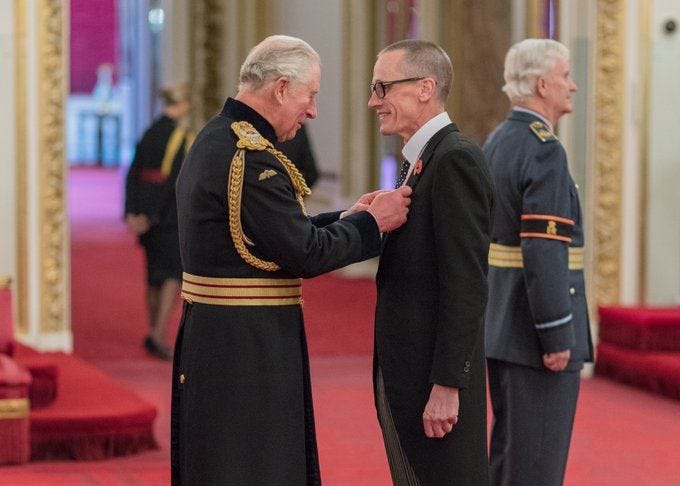
Charles Garrett receives an award from King Charles
As The Grayzone has previously documented, London operates a dedicated program known as “Global Britain” in the West Balkans. Leaked documents related to the effort reveal it is concerned with insidiously influencing the composition of local governments and legal and regulatory environments to advance British interests, while filling regional security, intelligence, and military forces with handpicked assets. As one leaked file makes clear, MI6 does not tolerate regional opposition to its agenda, readily deploying active measures to neutralize any and all local resistance:
“In contexts where elite incentives are not aligned with [Britain’s] objectives/values… an approach that seeks to hold elite politicians to account might be needed… We can build relationships and alliances with those who share our objectives and values for reform… It is critical that the media have the capacity and freedom to hold political actors to account.”
Events in Macedonia over the past decade provide a brutal demonstration of what can befall governments and officials in the Balkans who do not share Britain’s “objectives” and “values”, and how they are “held to account.” So too does a 2020 coup in Kyrgyzstan, where Garrett set up shop after leaving Skopje. With Central Asia now in the crosshairs of London’s endless quest for “reform” overseas, it’s never been more vital to beware Brits bearing gifts.
‘Colorful Revolution’
Following Russia’s March 2014 reunification with Crimea, NATO’s efforts to expand in the Former Yugoslavia became turbocharged. The Grayzone has previously reported how alliance membership was imposed upon Montenegro, despite near-universal public opposition, in 2016. Achieving this feat required sustaining a corrupt, savage pro-Western dictator in power for almost two decades, and an elaborate connivance whereby anti-NATO opposition actors were jailed on bogus charges of colluding with Russian intelligence to overthrow the government, based on bogus CIA and MI6-supplied evidence.
Similar subterfuge played out in Skopje, which signed a “Membership Action Plan” with NATO in 1999. While slightly more supportive of NATO membership than Montenegrins, the local population near-unanimously opposed changing the country’s name, which Greece, the EU and US made a prerequisite for joining. The VMRO government, led by Nikola Gruevski, pledged Macedonia would always be called Macedonia. So a Western-orchestrated coup was put into motion.
In February 2015, opposition party SDSM’s leader Zoran Zaev began regularly dropping what he and the media branded “bombs” – deeply damaging wiretaps of private conversations between prominent Macedonian officials, businesspeople, journalists, and judges. The tapes seemingly implicated Gruevski and his ministers in serious crimes, including murder. Zaev claimed the illegally-captured recordings were passed to him by whistleblowers. The premier countered that the releases were supplied by foreign intelligence services, with the objective of forcing an early election.
Subsequent investigations exposed how SDSM deceptively edited and spliced these leaked recordings to grossly distort their contents, and falsely incriminate government officials. For example, one “bomb” was extensively doctored to make it sound like VMRO leaders conspired to cover up the 2011 murder of a young Macedonian in Skopje by a senior police officer, while shielding them from justice. The unexpurgated tape indicated they were in fact shocked by the killing, and wanted the culprit to be severely punished.
It was not until four years later that the truth was revealed, however. Upon release, Zaev’s “bombs” sparked widespread outcry in Macedonia, prompting hundreds of thousands of citizens to take to the streets, voicing righteous rage at VMRO. Openly called the “colorful revolution” by participating citizens and NGOs, and English language media, the EU and US duly stepped in and brokered the Przino Agreement, under which Gruevski resigned, and new elections were held.
SDSM scraped into office via a fragile coalition, then set about laying the foundations of Macedonia’s name change in explicit service of NATO membership, with tens of millions of dollars in assistance from intelligence cutout USAID. Parliamentarians were blackmailed – frequently using the illegal wiretap intercepts – and bribed into passing unconstitutional and highly controversial reforms, allowing Skopje to be rebranded North Macedonia without public support, or even the President’s signoff. A sham referendum, boycotted by most citizens, was also cynically staged.
At last, North Macedonia was formally inducted into NATO in March 2020. Alliance officials have since repeatedly made clear they consider Bosnia and Herzegovina joining to be inevitable. This is despite 98% of Bosnian Serbs opposing membership, due to NATO’s central role in the criminal destruction of Yugoslavia during the 1990s. There are covert British efforts to promote NATO in Serbia too, despite over 80% of the population opposing joining.

‘Charlie’s Angels’
In August 2013, Charles Garrett was appointed London’s ambassador to Macedonia. His express brief was to help the country “achieve its goals of joining NATO and the EU.” Multiple local sources have informed this journalist that Garrett was instrumental in the “colorful revolution,” distributing cash to NGOs and activists involved in the unrest from his diplomatic pouch, while attempting to get government supporters on board.
Public records strongly suggest Garrett is a lifetime MI6 officer. His lengthy career in London’s diplomatic service includes spells in Cyprus, Hong Kong, Switzerland and Taiwan, all key nuclei of intelligence gathering and cloak-and-dagger action for Britain’s foreign spying agency. He was also posted to the Balkans in the latter half of the 1990s, when the region became a veritable MI6 playground.
Under the Przino Agreement, a Special Prosecutor’s Office (SPO) was created to investigate officials over serious crimes supposedly revealed by the illegal intercepts. A previously unknown prosecutor from a small Macedonian border town, Katica Janeva, was selected to run the Office. While the SPO was supposed to prosecute SDSM activists – including Zaev, for releasing the intercepts – this never materialized. Meanwhile, any and all Western officials visiting Macedonia made sure to visit SPO headquarters and get snapped with Janeva. Garrett was, of course, among them.

Charles Garrett and Katica Janeva
Initially, Western journalists treated Janeva to multiple fawning profiles. The British press was particularly smitten. The Financial Times referred to her as Macedonia’s “Beyonce”. The BBC dubbed the Special Prosecutor and her two primary assistants “Charlie’s Angels”, claiming the trio were “the scourge of Macedonia’s political elite and heroines of the street protests now rocking the tiny Balkan nation.” A lengthy USAID-funded “documentary” featured her staff mocking their targets via phone, between discussing who to jail next over pizza and cigarettes.

That broadcast has been removed from the web, and virtually no trace of its existence can be found online today. This may be because in June 2020, Janeva was jailed for seven years for corruption. Her crime-fighting crusade was from inception an obscene, partisan fraud. Along the way, the Special Prosecutor secretly enriched herself through a variety of unscrupulous, criminal means. The SPO’s true objective was destabilizing the VMRO government, and discrediting its supporters by association.
Janeva’s targets were often indicted on farcical charges. For example, at one stage Prime Minister Gruevski was accused of “abuse of office” for commissioning the construction of two “Chinese highways”. Prosecutors charged he had improperly benefitted from the deal – not financially, but because he would “receive a popularity boost” if the highways were completed on schedule. Elsewhere, a pro-VMRO female journalist was accused of tax fraud for writing off laundry as a business expense, and resultantly subjected to much misogynistic mockery in SDSM-affiliated media.
More gravely, the owner of an independent news site committed suicide after being pressured to turn state witness by the SPO, following early morning police raids targeting him and his family. Cases brought against the owners of government-supporting TV stations Sitel and Nova shifted their editorial line in favor of SDSM, leading to the latter being closed outright. In its place, the rabidly pro-SDSM 1TV was launched by eccentric Macedonian media personality Bojan Jovanovski, also known as Boki 13.
Publicly, Boki 13 used his station to relentlessly promote the SDSM-led government and the SPO’s work, with Janeva a frequent guest on its assorted “factual” and entertainment programs. In private, he extorted wealthy businesspeople indicted by Janeva, or somehow caught up in the illegal intercepts, promising to make their legal troubles go away in return for lavish advertising buys on 1TV, or sizable donations to his “charity”, International Association. None other than Charles Garrett sat on its board.
‘Fifth Column’
By the time these facts became public knowledge, and Janeva and Boki 13 were in prison, Garrett was safely extracted from Skopje, having been appointed British ambassador to Kyrgyzstan. Almost immediately, a revolution erupted in Bishkek. Mass demonstrations, ignited by reports of vote rigging in the October 2020 parliamentary election, culminated with the military storming President Sooronbay Jeenbekov’s compound and removing him – physically – from office.
In February 2022, a Kyrgyzstan government-affiliated newspaper openly accused Garrett of operating a “fifth column” in Bishkek. It alleged that in the leadup to the 2020 vote, he along with US State Department representatives met with local journalists and bloggers, offering them enormous sums to identify electoral violations – such as vote rigging – and document official pressure on media outlets and civil society groups. Garrett purportedly promised them top-of-the-range broadcasting equipment, to increase their audience reach. Not long after publication, he returned to London.
Garrett has kept a low profile ever since and now occupies a cushy role overseeing the Commonwealth War Graves Commission. Nonetheless, in September 2023, he submitted written evidence to a British parliamentary committee investigating London’s “engagement in Central Asia”. He advocated a number of means to exploit “disruption caused by Moscow’s renewed invasion of Ukraine” to undermine the region’s historic, economic and political ties with Russia and China, and “shape the future of these countries” according to Britain’s interests.
When British Foreign Secretary David Cameron conducted a much-publicized tour of Central Asia in May 2024, he followed Garrett’s proposals to the letter. The ambassador’s legacy visibly endures in Macedonia today too. In March 2016, colorful revolution protesters attempted to burn down the President’s office, after 56 individuals indicted by the SPO were pardoned. The premises were transformed into the headquarters of UK Aid, a now-defunct British government agency intimately implicated in the neoliberal rape and pillage of Ukraine.
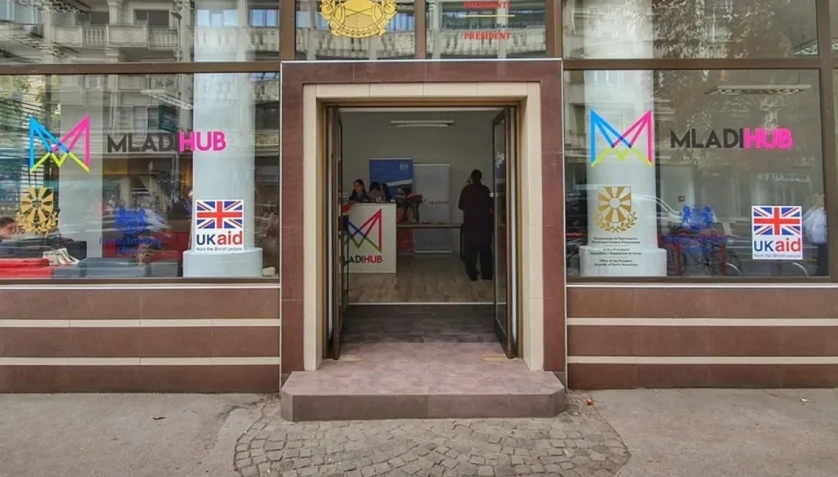
The Skopje headquarters of UK Aid
This included running covert communications campaigns on Kiev’s behalf, promoting the destruction of workers’ rights locally. It is likely the organization was engaged in similar skullduggery in Skopje, after Garrett rode into town. VMRO’s return to government at last offers Macedonians an opportunity to halt the operations of all US and British intelligence fronts and cutouts operating on their soil, and reclaim foreign-conquered territory.
Hand of Soros: Georgian Prime Minister Denounces US Color Revolution Tactics

By John Miles – Sputnik – 05.05.2024
The leader of the country of Georgia has criticized US efforts to interfere in the country dating back several years.
A major scandal emerged in 2016 over the disproven conspiracy theory of Russian interference in the United States presidential election. Russian President Vladimir Putin, Americans were told, had spent vast sums of money to influence the outcome of the vote via social media. According to the conspiracy’s most dedicated adherents, US democracy had been near-fatally wounded by the pernicious meddling of a hostile foreign power.
What adherents of the unfounded Russiagate narrative failed to acknowledge is that the United States is guilty of precisely the same type of political interference it accuses others of, and on a far larger scale.
Claims of such foreign meddling came to a head Friday when Georgia’s head of state slammed US support for “violence” and “revolution attempts” amidst anti-government protests in the country’s capital of Tbilisi.
“Spoke to [US ambassador Derek Chollet] and expressed my sincere disappointment with the two revolution attempts of 2020-2023 supported by the former US Ambassador and those carried out through NGOs financed from external sources,” wrote Irakli Kobakhidze, Georgia’s prime minister and head of the social democratic Georgian Dream party, on social media.
The prime minister also criticized “false statements” from the US and European Union concerning draft “Transparency of Foreign Influence” legislation currently working through the country’s parliament.
The proposed law, which is currently the subject of protests in the country’s capital, is aimed at disclosing foreign influence over organizations and media outlets operating in Georgia. Kobakhidze claims the legislation is necessary to promote “transparency and accountability of relevant organizations vis-à-vis Georgian society.” Western critics have portrayed it as a clampdown on civil society, likening it to Russia’s “foreign agents law” – protesters have even taken to deriding the bill “the Russian law.”
But such legislation is common throughout the world, with similar regulation taking place in Canada, Australia, the European Union, and elsewhere. The US Foreign Agents Registration Act (FARA) requires foreign-affiliated news outlets, such as the one you’re reading now, to register with the US Department of Justice and send copies of all “informational materials” to US authorities.
The United States has frequently opposed such legislation in countries it deems to be foreign adversaries because it threatens the influence of US “soft power.” The United States frequently funds foreign activists, media outlets, and non-governmental organizations (NGOs) to spread US influence in foreign countries. The US has specifically focused on former Soviet-aligned nations after the end of the Cold War, seeking to ensure leaders are elected who will orient such countries towards the West and away from Russia.
When necessary, the United States has even sought to foment regime change in foreign countries through such methods, paving the way for unrest that generates a change in leadership. Such events are commonly known as “color revolutions,” after a series of such incidents such as Ukraine’s 2004 Orange Revolution and Georgia’s 2003 Rose Revolution. The United States Agency for International Development (USAID) is a primary tool of such “revolutions.”
Investigation by Sputnik has uncovered the historical influence of the United States and allied groups in influencing Georgian politics. USAID’s website boasts that the organization has poured a staggering $1.9 billion into the country since 1992. The agency reports funding 39 ongoing projects in Georgia “with a total value of approximately $373 million, and an annual budget of more than $70 million.”
Additionally, USAID’s Georgian Media Partnership Program backs a range of opposition media outlets in the country, including TV Pirveli, Radio Marneuli, Formula TV, and Mtavari Arkhi. The US agency allocated $10 million in 2021 alone. Samira Bayramova, an administrator of the program, has been noted as a prominent leader of the current protests in Tbilisi.
The Georgian Young Lawyers Association (GYLA) has also strongly backed the ongoing demonstrations. The organization partners with USAID under the pretense of promoting “fair electoral processes in Georgia.”
Additionally, the US allies with partnered “philanthropic” foundations to further strengthen opposition forces. The Georgian branch of George Soros’ Civil Society Foundation openly promotes the current protests, backing a petition initiative to promote hostility toward the current government. The Civil Society Foundation has operated in the country for 30 years, claiming to have poured $100 million into political interference.
Political opposition leader Nika Gvaramia, whose party has helped organize the ongoing protests, is promoted on the foundation’s website.
The US, naturally, has attempted to coerce Georgia’s government to shelve the current draft law, with Chollet expressing “concern for Georgia’s current trajectory.” Senators from both major US political parties have warned the country could face sanctions for attempts to move forward with the transparency legislation.
The United States’ foreign subterfuge has increasingly come to light in recent years, with former President Donald Trump offering a rare acknowledgment of US efforts in Iran, Belarus, and Hong Kong.
Still, millions of others remain uninformed about the destructive influence of the United States and billionaire oligarchs like George Soros.
US funds Ukraine outlets that censor and smear pro-peace Americans – report

Brigadier-General Oleksii Hromov, Deputy Chief of the Main Operational Directorate of the General Staff of the Armed Forces of Ukraine (Photo by Vladimir Shtanko/Anadolu Agency)
RT | April 11, 2024
A “sprawling constellation” of supposedly independent organizations and fact-checkers bankrolled by Washington has been behind labeling Americans who disagree with Kiev Russian propagandists, according to an investigation published on Thursday.
Journalist Lee Fang and RealClearInvestigations have looked into outfits such as New Voice of Ukraine, VoxUkraine, Detector Media and others, finding that in many cases they “promoted aggressive messages that stray from traditional journalistic practices” to support the Ukrainian government and “delegitimize its critics,” both at home and abroad.
Americans they have gone after range from economist Jeffrey Sachs and University of Chicago Professor John Mearsheimer to journalists Tucker Carlson and Glenn Greenwald. Some of these outfits have also denounced a factually correct New York Times article about the battle of Avdeevka as a “Russian psyop” and “disinformation.”
The US Agency for International Development (USAID) and the National Endowment for Democracy (NED) have funded scores of Ukrainian organizations. Some of them act as fact-checking partners for Meta’s Facebook, Instagram, and WhatsApp platforms, helping Ukraine censor critics under the guise of fighting “Russian disinformation.”
The London-based Zinc Network has been paid by USAID to “undermine Kremlin information operations” and help Ukraine with its own “strategic communications.”
According to another investigative journalist, Jack Poulson, Zinc’s Open Information Partnership in Ukraine has defined disinformation as “verifiable information which is unbalanced or skewed, amplifies, or exaggerates certain elements for effect, or uses emotive or inflammatory language to achieve effects which fit within existing Kremlin narratives, aims, or activities.”
Asked about the “anti-disinformation” groups in Ukraine targeting Americans, the State Department told Fang and RealClear that it “provides funding to credible independent media organizations to strengthen democracies in the countries we work in around the world.”
“We do not control the editorial content of these organizations,” the State Department insisted. According to documents Fang has reviewed, however, the US government and its contractors have “directly set the agenda” for Ukrainian outlets.
The US is “an active participant” in the information war between Russia and Ukraine, George Beebe, a director with the Quincy Institute for Responsible Statecraft, told Fang. “The US government has been trying to shape perceptions, and it’s very difficult to separate what’s intended for foreign audiences from what seeps into the Anglosphere media,” he added.
Ukrainian President Vladimir Zelensky has accused Russia of influencing US lawmakers and society at large. While he has offered little evidence for his claims, Fang’s investigation has revealed that much of the content generated by US-funded Ukrainian outlets “explicitly targets American foreign policy discourse.”
Ex-Soviet state summons Western envoys over funding of local media
RT | November 29, 2023
Azerbaijan has filed complaints with the US, Germany and France over the illegal funding of a local media outlet, which has published investigations into government corruption. Three of its journalists were recently arrested on accusations of currency smuggling.
On Tuesday, the Azerbaijani foreign ministry issued a statement saying the ambassadors of the three Western countries had been summoned to a meeting. They were informed that the AbzasMedia portal was conducting unlawful financial operations with the participation of organizations registered in those states. They were also told that their embassies were involved in such activities.
Azerbaijani legislation prohibits the allocation of funds to unregistered projects. However, according to the foreign ministry, the US Agency for International Development (USAID), FreedomNow, New Democracy Foundation, and other organizations illegally transferred funds to the country, violating the rules of grant allocation and illegally facilitating the activities of the unregistered media portal AbzasMedia.
AbzasMedia said in a statement that, several days ago, three of its journalists were arrested on charges of “currency smuggling” and sentenced to four months in custody, linking the case to its corruption investigations. The outlet also reported that, according to police, €40,000 ($44,000) in cash was found in the office, and accused officers of “deliberately putting money in the office to justify arrests.”
Last month, the government of neighboring Georgia raised the alarm over the actions of the USAID-funded Center for Applied Nonviolent Strategies (CANVAS), saying it was planning to unleash a violent color revolution. The US Embassy in Tbilisi claimed the accusations against CANVAS were “false and fundamentally mischaracterize the goals of our assistance to Georgia.”
On its website, USAID states that it is “investing in democracy work to advance a free, peaceful, and prosperous world.”
USAID activities have been banned in Russia since 2012. According to the Russian Foreign Ministry, this decision was mostly due to the fact that the nature of the agency’s work in the country did not always comply with the stated goals, including their “attempts to influence the political process” through the distribution of grants.
Featured Video

Michael von der Schulenburg: Europe’s Self-Defeating Iran War Policy
or go to
Aletho News Archives – Video-Images
Frlom the Archives
Who Rules America?
The Power Elite in the Time of Trump
By James Petras | Axis of Logic | September 6, 2017
Introduction
In the last few months, several competing political, economic and military sectors – linked to distinct ideological and ethnic groups – have clearly emerged at the centers of power.
We can identify some of the key competing and interlocking directorates of the power elite:
- Free marketers, with the ubiquitous presence of the ‘Israel First’ crowd.
- National capitalists, linked to rightwing ideologues.
- Generals, linked to the national security and the Pentagon apparatus, as well as defense industry.
- Business elites, linked to global capital.
This essay attempts to define the power wielders and evaluate their range of power and its impact. … continue
Blog Roll
 Aletho News
- Michael von der Schulenburg: Europe’s Self-Defeating Iran War Policy
- Sorry, The New Republic, Climate Change Isn’t Causing Somali Migration. Blame Civil Strife and Poverty.
- Expert Guts Claims That HPV Vaccine Reduces Cancer Risk
- No evidence Russia sabotaged Baltic cables – Finnish intel
- The Strategic Folly of a (Serious) US Ground Invasion of Iran
- US-Israeli war of aggression on Iran meant to reshape region: Omani FM
- Iran Does Not Consider Israel Party to Talks to Need Mediators With It – Ambassador
- Macron’s aircraft carrier and warplanes to the Persian Gulf is a dangerous vanity project
- Meet The Ellisons: Zionists, Technocrats, Moguls
- US failures in Iran reveal Russia is key to South Korea’s strategic security
- If Americans Knew
- Are we on the precipice of World War III?
- ‘Catastrophic,’ Says UNICEF: 1,100+ Children Killed or Wounded in Mideast Since US-Israel Launched Iran War
- The Unbelievable Madness of Our War With Iran
- World Council of Churches calls on govts to hold Israel accountable for violations of intl law
- How to end the war on Iran that costs US taxpayers $1M per minute – Not a ceasefire Day 153
- Israeli strategic plans to “remake the Middle East” from the 1950s and since
- Honoring Gaza’s women who refused to let the world look away
- 97% of victims of war on Iran are Iranian, 98% of victims in war on Gaza are Gazans – Not a ceasefire Day 152
- Early Iran strikes cost $5.6 billion in munitions, Pentagon estimates
- Israel Decided the War, But Trump’s America Fights and Pays the Bill
- No Tricks Zone
- Destructive Green New Deal: German Energy And Metal Group Warns Of Drastic Crisis
- New Study Documents A 20-Year Pause In Arctic Sea Ice Decline – Driven By Internal Variability
- Wake-up Call: Survey Shows Majority Of Germans Now Favor Postponing Climate Targets!
- Televised! Leading German Political Candidate Tells Schoolchildren CO2 Makes Sun Hotter!
- New Study: A Century Warming Of 1.1°C Is ‘Commonplace’ And ‘Not Unusual’ During This Interglacial
- New Study: ‘Internal Noise’ And Volcanic Forcing Can Trigger 10-15°C Warming Within Decades
- Glaciers Worldwide Are Suddendly Surging, Experts Blame Warming!
- Surprising Discovery: Sahara Is Greening…Billions Of Trees Where Once Thought To Be Barren
- New Research Reaffirms Clouds, Aerosols, And Surface Solar Radiation Are ‘Driving The Climate System’
- Germany: Electric Car Catches Fire At Charging Station, Sets Off Local “Inferno”, Widespread Damage
 Aletho News
