The ‘Opposition Party’ Has Done Nothing to Stop the Iran War and Much to Goad Trump Into Continuing It
By Jeremy Loffredo | April 9, 2026
There is a version of the Democratic Party that exists only in the imagination: the peace party, the anti-war party, the party that marched against the Iraq War and howled at its neocon designers. As Donald Trump (reportedly) accepted Iran’s ceasefire terms this week, some of the most pointed attacks coming his way from Democrats are not about the thousands of civilians killed, the weeks of brutal bombardments against medical centers and universities, or the global economic damage the war has caused. They are about the war ending before the U.S. and Israel finished the job.
And this is not a fringe phenomenon. It is a pattern coming from Democratic senators, the Democratic House Foreign Affairs Committee, ranking members of the Armed Services Committee, and some of the party’s most prominent voices. The liberal opposition party wants more war.
This pattern predates the war. During the 2024 presidential campaign, Kamala Harris called Iran America’s “greatest adversary,” vowed that Iran would never obtain a nuclear weapon under her watch, and argued that Iran’s attacks on Israel would not have happened under her presidency. The Democratic nominee for president was running on a promise to be harder on Iran than Donald Trump.
“What a disaster”
On April 7, 2026, as a ceasefire between the United States and Iran was announced following weeks of devastating U.S.-Israeli bombing campaigns, Sen. Chris Murphy (D-Conn.) took to X to offer his initial reaction: not relief at the end of the killing, but outrage at the terms Trump had accepted to stop it.
“It appears Trump just agreed to give Iran control of the Strait of Hormuz, a history-changing win for Iran,” Murphy wrote. “The level of incompetence is both stunning and heartbreaking. What on earth is happening?”
And Murphy is not a Democratic Party outlier. The New York Times has called Murphy “one of the future leaders of the party.” The Guardian, the Times, and NBC News have all listed him as a possible 2028 presidential candidate. Senate Minority Leader Chuck Schumer has named him one of the party’s “best messengers.” Foreign Policy magazine has called him a “rising Democratic star.”
For Murphy, attempting to end a war against a civilian population that had been brutally bombed for over five weeks was just infuriating.
In a follow-up thread, he wrote: “They will control and toll the Strait for the first time. They keep their nuclear program. They keep their missiles. What a disaster.”
And should anyone point out that at least the killing had stopped, Murphy had an answer ready: “An anti-American regime is in power and emboldened. Iran still has their missiles and nuclear program. That’s ‘good’?”
Murphy is not arguing that the war was unjust, that it violated international law, or that it killed too many innocent women and children, all of which are true and documented. He’s arguing that the ceasefire is a bad deal because it leaves the Iranian government standing with its nuclear program and ballistic missiles intact.
Having a civilian nuclear program is a legal right under Article IV of the Nuclear Non-Proliferation Treaty, to which Iran is a signatory. But Murphy is treating Iran’s exercise of their international right as an American defeat. And as for their intolerable missiles, most countries have militaries, and every country has the right to them.
Trump, for his part, had no good options left: Iran had closed the Strait of Hormuz, oil prices had spiked globally, and American military objectives had not been achieved. The only path out was accepting terms. Stopping the bombing has already saved lives and protected a civilian population from further devastation. Murphy’s “Democratic rising star” objection is not that the war was wrong but that it ended before the Iranian state was entirely destroyed.
‘TACO’ Trump
Chuck Schumer, the Senate’s top Democrat, had established this line — attacking Trump from the right — months earlier, during nuclear deal negotiations in mid-2025. When Trump was reportedly exploring a diplomatic agreement with Tehran as an alternative to war, Schumer coined an acronym: TACO (Trump Always Chickens Out).
“When it comes to negotiating with the terrorist government of Iran, Trump’s all over the lot,” Schumer said. “One day he sounds tough, the next day he’s backing off. If TACO Trump is already folding, the American public should know about it.”
Schumer was not criticizing Trump for threatening war; he was criticizing him for not following through on those threats, demanding that Trump be tougher on Iran at a moment when most Americans, including supermajorities of his own party, supported a diplomatic nuclear deal. Foreign Policy magazine noted that Schumer’s attack was from a position to Trump’s right, using the language of Iran hawks.
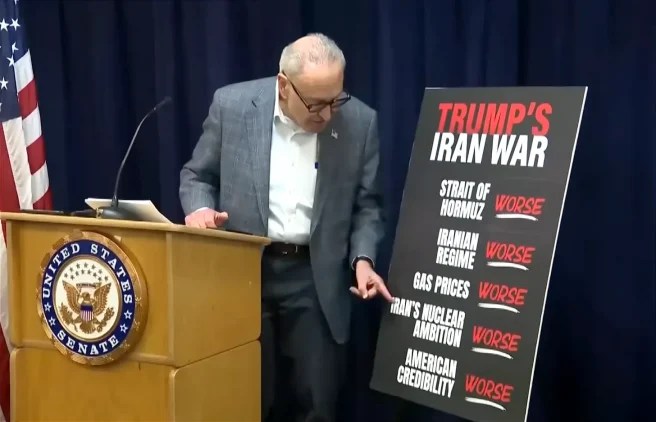
When the ceasefire was finally announced, Schumer held a press conference in New York and went through the deal point by point, explaining why the outcome represented an American failure. “The Strait of Hormuz is in worse shape today, with more Iranian domination of it than it was before the war started,” Schumer said. “Iran still has an ayatollah named Khamenei. The Iranian regime is still standing. Not just standing, but now emboldened. And the regime is likely to be even more radical and more dangerous than it was before.” He called Trump “a military moron” and said the war had made the United States worse off than before it started. The Senate’s top Democrat was not upset that the war happened. He was upset that it hadn’t achieved more.
Venezuela: Trump Didn’t Finish the Job
In January 2026, U.S. special forces captured Venezuelan President Nicolas Maduro in a nighttime raid and flew him to New York to face drug trafficking charges. Within weeks, the Trump administration settled into a working relationship with Maduro’s former vice president, Delcy Rodriguez, now Venezuela’s acting president. Trump, having removed Maduro, chose to work with the Venezuelan regime rather than dismantle it. Rodriguez, previously sanctioned by Trump’s own Treasury Department, was quietly removed from the sanctions list in April 2026.
House Foreign Affairs Committee Democrats posted a screenshot of the New York Times article reporting the sanctions removal and responded:
“Delcy was Maduro’s brutal co-conspirator to steal an election and repress Venezuelans. 3 months later she’s off the US sanctions list, with zero plans for reforms and her regime still harassing and jailing its political opponents. Trump doesn’t care about Venezuela’s democracy, just its oil.”
Democrats on the House Foreign Affairs Committee, the body in Congress responsible for overseeing U.S. foreign policy, were not satisfied. The problem, in their telling, was not that Trump had removed a foreign head of state by military force. It was that Trump had cut a deal with his successor rather than going for full regime change.
The Impeachment Spectacle
In 2019, Democrats launched an impeachment process that would run for months, producing two weeks of nationally televised public hearings, 12 witnesses, and more than 30 hours of testimony, before the full House voted to impeach in December. The central charge was that Trump had frozen $400 million in military aid to Ukraine, weapons intended to be used against Russia, a U.S. adversary. Withholding them was, in the Democratic telling, an impeachable betrayal of American interests. Fast forward to 2026: Trump waged a 40-day bombing campaign against Iran, a U.S. adversary, without congressional authorization, and Democrats introduced not impeachment articles but complaints that he failed to hit Iran hard enough.
When Trump withheld weapons from a U.S. enemy’s enemy, Democrats called it impeachable. When Trump actually bombed a U.S. enemy, Democrats called it inadequate. In both cases, they were pushing Donald Trump in exactly the same direction.
All of it, from Schumer’s TACO attacks to the Democratic Foreign Affairs Committee’s frustration with Delcy Rodriguez to Murphy calling a ceasefire “heartbreaking,” points in the same direction. Not toward restraint, not toward diplomacy, but toward a more complete and more decisive confrontation with American adversaries. Whether that reflects genuine hawkishness, reflexive opposition to anything Trump does, or some complicated mixture of both, the political effect is the same. The liberal opposition party is pushing for more war.
Jeremy Loffredo (X: @loffredojeremy) is an independent journalist and filmmaker who covers foreign policy and war.
Russian Oil Tanker Arrives in Cuba Amid U.S. Blockade
teleSUR – March 30, 2026
On Monday, Russia’s Transport Ministry confirmed that the Russian oil tanker Anatoli Kolodkin arrived at the port of Matanzas in Cuba, where it remains awaiting the unloading of the petroleum products it is carrying.
The vessel is transporting approximately 100,000 tons of oil described as humanitarian aid, in a context marked by a severe energy crisis affecting the Caribbean island.
The tanker was initially escorted by a Russian Navy warship through the English Channel. However, after entering the Atlantic, the vessel continued its journey on its own until arriving in Cuba.
The operation represents the first arrival of an oil tanker to the island in three months. The move comes after the United States pressured Venezuela and Mexico to reduce or halt energy supplies to Cuba.
The island has not received oil since Jan. 9, an interruption that led to a sustained deterioration of the energy system and difficulties for the population, which depends on fuel for essential services and the functioning of the economy.
Mexico carried out the last oil shipment but later interrupted supply due to pressure from Washington.
With that chain of cuts, Cuba was exposed to a worsening of its energy situation, affecting both daily supply and the capacity for electricity generation and productive activities.
Last week, Russian Foreign Minister Sergey Lavrov said that Moscow is concerned about escalating tensions around the island and assured that it will maintain a position of solidarity with the Cuban government.
Kremlin spokesman Dmitry Peskov also reiterated Moscow’s support and said Russian authorities are discussing mechanisms to help Cuba.
“We are in constant dialogue with Cuba’s leadership and, of course, we are discussing how to help the island in such a difficult situation,” he said, adding that they are pleased the shipment of petroleum products has arrived in Cuba.
Peskov said Cuba is “under conditions of a very severe blockade” and needs refined petroleum products and crude oil “for the functioning of life-support systems in the country, to generate electricity, to provide medical or other services to the population.”
Pentagon sets deadline for Anthropic to lift AI restrictions on autonomous weapons systems, mass domestic surveillance
The Cradle | February 25, 2026
The US Department of War has issued a deadline to AI company Anthropic to allow broader military use of its Claude models or face possible action under the Defense Production Act.
The company could face losing its Pentagon contract, and has been threatened with a government blacklist, US media reports said.
The Pentagon has a $200-million contract with Anthropic. The company has placed guardrails on the Claude AI, preventing its use for fully autonomous weaponry and mass domestic surveillance, triggering a standoff with US Secretary of War Pete Hegseth.
Hegseth met with Anthropic CEO Dario Amodei on Tuesday. According to CNN, the CEO held firm on the restrictions.
Amodei has until Friday at 5:00 pm to “get on board or not,” a source told CNN.
If it does not, Hegseth will make sure “the Defense Production Act is invoked on Anthropic, compelling them to be used by the Pentagon regardless of if they want to or not.”
“Anthropic has concerns over two issues that it isn’t willing to drop, AI-controlled weapons and mass domestic surveillance of US citizens. Anthropic believes AI is not reliable enough to operate weapons, and there are no laws or regulations yet that cover how AI could be used in mass surveillance,” CNN’s sources went on to say.
According to Axios, Washington has threatened to declare Anthropic a “supply chain risk.”
“The only reason we’re still talking to these people is we need them and we need them now. The problem for these guys is they are that good,” a US official told Axios.
Anthropic said it remains engaged in “good-faith conversations” to support national security “in line with what our models can reliably and responsibly do.”
Claude has already been used by the US military for intelligence analysis, mission planning, and satellite imagery processing.
Washington reportedly used the AI model in the mission to illegally kidnap Venezuelan President Nicolas Maduro. This came via Anthropic’s partnership with Palantir, which has entered into multi-billion-dollar partnerships with the US and Israeli governments, and has been used in the Gaza genocide.
Several other AI systems were used to kill Palestinians.
The Pentagon has been negotiating AI contracts with major firms, including Anthropic, Google, OpenAI, and xAI, with each contract valued at up to $200 million.
Palantir CEO Alex Karp openly stated this month that his company is dedicated “to the service of the west and the United States of America” and aims to “disrupt” and “on occasion” to “kill” the enemies of the west and the US.
US seizes oil tanker for ‘defying Trump’s quarantine’
RT | February 16, 2026
US military forces intercepted and boarded a tanker that was sanctioned for carrying Venezuelan oil in the Indian Ocean overnight on Sunday, the Pentagon has announced.
The US launched a military operation to kidnap Venezuelan President Nicolas Maduro in early January, and claims to have seized control of the country’s oil exports. Earlier this year, US President Donald Trump said Washington plans to “control Venezuela’s oil resources indefinitely.”
In a statement on X, the US War Department said the vessel, named Veronica III, was tracked from the Caribbean Sea into the Indian Ocean before being stopped and inspected in what it described as a “right‑of‑visit, maritime interdiction and boarding.”
“The vessel tried to defy President Trump’s quarantine – hoping to slip away,” the Pentagon wrote. “We tracked it from the Caribbean to the Indian Ocean, closed the distance, and shut it down.”
Ship-tracking and maritime data platforms list the Veronica III as a Panama-flagged oil tanker. The action follows a similar boarding last week of another sanctioned vessel.
Trump ordered what he described as a “total and complete blockade” on all US‑sanctioned oil tankers entering or leaving Venezuela in December.
The blockade has continued as part of Washington’s push to redirect Venezuelan oil toward new international buyers. Last week, Israel received its first crude oil shipment from the South American nation, according to Bloomberg.
Reuters also reported last week, citing trade sources, that India’s two state-owned refiners had purchased 2 million barrels of Venezuelan crude for delivery in the second half of April. The agency also said that, according to shipping schedules, 2 million barrels of Venezuelan crude were sent to refineries operated by Spanish oil company Repsol.
At the same time, China, once a top importer of Venezuelan oil, has reportedly turned to discounted Iranian heavy grades to make up for shipments that have stalled under the US blockade, as independent Chinese refiners seek alternatives to Venezuelan supplies.
Moscow has condemned US actions against Caracas, with Russian officials saying Washington’s moves violate international norms. Foreign Minister Sergey Lavrov said last week that the US is trying to take control of all international energy supply routes in an attempt to attain global economic dominance.
Why didn’t China protect Venezuela from the US?
Beijing is regrouping to adapt to the new hemispheric world order, but not retreating from Latin America
By Ladislav Zemánek | RT | February 9, 2026
The US military intervention in Venezuela in January 2026 – known as Operation Absolute Resolve – sent shockwaves far beyond Caracas. By striking targets in the Venezuelan capital and capturing President Nicolás Maduro, Washington signaled a decisive return to hard power in the Western hemisphere. The operation was not merely a tactical move against a hostile regime; it was a strategic message about influence, hierarchy, and control in the Americas. For China, which had invested heavily in Venezuela’s political and economic survival, the intervention raised immediate questions about the limits of its global reach and the evolving rules of great-power competition in an increasingly multipolar world.
China’s response to Operation Absolute Resolve was swift in tone but cautious in substance. Official statements from Beijing condemned the US action as a violation of international law and national sovereignty, framing it as destabilizing and emblematic of unilateral hegemony. Chinese foreign ministry officials repeatedly urged Washington to respect the UN Charter and cease interference in Venezuela’s internal affairs, positioning China as a defender of state sovereignty and multilateral norms.
Yet the rhetoric was not matched by escalation. Beijing avoided threats of retaliation or offers of direct military assistance to Caracas. Instead, it confined its response to diplomatic channels, reaffirmed opposition to unilateral sanctions, and issued travel advisories warning Chinese citizens to avoid Venezuela amid heightened instability. Chinese analysts emphasized that the priority was damage control: protecting long-standing economic and strategic interests without provoking a direct confrontation with US military power in the Western Hemisphere.
This measured reaction highlights a defining feature of China’s approach to Latin America. Beijing has pursued deep economic engagement and vocal support for sovereignty, but it has consistently avoided military competition with the US in a region where American power remains overwhelming. Operation Absolute Resolve exposed both the strengths and the limits of that strategy.
China’s relationship with the Maduro government was neither symbolic nor superficial. Over the past two decades, Venezuela emerged as one of Beijing’s most important partners in the Americas. In 2023, the two countries elevated ties to an “all-weather strategic partnership,” China’s highest level of bilateral designation. This status reflected ambitions for durable cooperation across energy, finance, infrastructure, and political coordination, and placed Venezuela among a small circle of states Beijing regarded as strategically significant.
Chinese policy banks extended large-scale financing to Caracas, much of it structured as oil-backed loans that allowed Venezuela to maintain access to global markets despite US sanctions. Chinese companies became involved in energy projects, particularly in the Orinoco Belt, while bilateral trade expanded substantially. Venezuelan heavy crude, though difficult and expensive to refine, accounted for a meaningful share of China’s oil imports, contributing to Beijing’s broader strategy of supply diversification.
Security cooperation also developed, albeit cautiously. Venezuela became one of the largest buyers of Chinese military equipment in Latin America, and Chinese technicians gained access to satellite tracking facilities on Venezuelan territory. At the same time, Beijing drew clear red lines. It avoided formal defense commitments, permanent troop deployments, or the establishment of military bases – signals that China did not seek to challenge US strategic primacy in the hemisphere.
Beijing’s interests in Venezuela extended well beyond oil and arms sales. The country served as a key node in China’s wider Latin American strategy, which emphasized infrastructure development, trade expansion, financial integration, political coordination, and cultural exchange within multilateral frameworks. This model sought to build influence through connectivity and economic interdependence rather than coercion or force, reinforcing China’s image as a development partner rather than a security patron.
The post-intervention reality, however, has significantly altered this equation. With Maduro removed from power, the US assumed effective control over Venezuela’s oil exports, redirecting revenues and setting the terms under which crude reaches global markets. While Washington has allowed China to continue purchasing Venezuelan oil, sales are now conducted strictly at market prices and under conditions that erode the preferential arrangements Beijing previously enjoyed. This shift directly affects China’s energy security calculations and weakens the leverage embedded in its oil-backed lending.
US control over oil flows also grants Washington influence over debt restructuring and creditor negotiations, potentially complicating China’s efforts to recover outstanding loans. The result is a sharp reduction in Beijing’s bargaining power in Caracas and a reassessment of the long-term viability of its investments. For China, the dilemma is acute: how to defend economic interests without crossing a strategic threshold that would invite confrontation with the US.
These developments align closely with the broader direction of US policy articulated in the 2025 National Security Strategy. The document places renewed emphasis on the Western Hemisphere as a core strategic priority and reflects a clear revival of Monroe Doctrine logic. It signals Washington’s determination to assert influence in the region and to limit the military, technological, and commercial presence of external powers – particularly China.
For Beijing, this creates a structural asymmetry. Decades of investment, trade, and diplomatic engagement cannot offset the reality of US military dominance in the Americas. China’s preferred toolkit – economic statecraft, infrastructure finance, and non-interference – faces inherent constraints when confronted with decisive uses of hard power. At the same time, Beijing’s emphasis on sovereignty and multilateralism continues to resonate with segments of Latin American political opinion that are wary of external intervention and eager to preserve strategic autonomy.
A comparison between US and Chinese strategies reveals different worldviews. The US approach, as outlined in the 2025 strategy, treats the hemisphere as a strategic space to be secured against external challengers through security partnerships, economic inducements, and military readiness. China’s approach prioritizes integration, development cooperation, and respect for national choice, relying on gradual influence rather than explicit enforcement.
Viewed through the lens of ‘Donroe Doctrine’ and the transition to multipolarity, the Venezuelan episode marks a critical inflection point. The US has reasserted hemispheric dominance in unmistakable terms, while China has been forced to acknowledge the limits of its reach far from home.
China may well lose ground in Venezuela, but this does not necessarily signal retreat from the region. Instead, it suggests adaptation. Diversified partnerships with countries such as Brazil and Mexico, along with continued engagement through trade and investment, offer alternative pathways forward. More broadly, the emergence of implicit spheres of influence may align with China’s interests elsewhere, particularly in Asia, where Beijing seeks greater recognition of its own strategic space.
In an international system increasingly defined by negotiated boundaries rather than universal dominance, both Washington and Beijing are testing how far their power extends – and where restraint becomes strategic. The outcome will shape not only Venezuela’s future, but also the evolving architecture of global order in a multipolar age.
Ladislav Zemánek is a non-resident research fellow at China-CEE Institute and expert of the Valdai Discussion Club.
‘Fact-checking’ as a disinformation scheme: The Brazilian case of Agência Lupa
By Raphael Machado | Strategic Culture Foundation | February 7, 2026
Since the term “fake news” emerged in the world of political journalism, we have been confronted with a new angle through which the establishment attempts to reinforce its hegemony in the intellectual and informational sphere: by simulating ideology as science, data, or fact.
A fundamental aspect of hegemonic liberalism in the “rival-less” post-Cold War world is the transition of ideology into the diffuse realm of pure facticity. What decades earlier was clearly identified as belief comes to be taken as “data,” that is, as indisputable, not open for debate. This is the case, for example, with the myth of “democracy,” the myth of “human rights,” the myth of “progress,” and the myth of the “free market.” And today, we could extend this to the dictates of “gender ideology” and a series of other beliefs of ideological foundation, which are nevertheless taken as scientific facts.
“Fact-checking” has thus become one of the many mechanisms used by the establishment to reinforce systemic “consensus” in the face of the emergence of alternative perspectives following the popularization of the internet and independent journalism. The “authoritative” distinction made by a self-declared “independent” and “respectable” agency between what would be “fact” and what would be “fake news” has become a new source of truth.
Some liberal-democratic governments, like the USA, have gone so far as to create special departments dedicated to “combating fake news,” thus acting as authentic “Ministries of Truth” of Orwellian memory.
However, even within the “independent” sphere, we rarely encounter genuine independence. On the contrary, in fact, Western “fact-checking agencies” tend to be well-integrated into the constellation of NGOs, foundations, and associations of the non-profit industrial complex, which, in turn, is permeated by the money of large corporations and the interests of liberal-democratic governments. Even their staff tend to be revolving doors for figures coming from the NGO world, mainstream journalism, and state bureaucracy.
Although the phenomenon is of Western origin, Brazil is not exempt from it. “Fact-checking agencies” also operate here — most of them engaged in the same types of disinformation operations as the governments, newspapers, and NGOs that sponsor them.
A typical example is Agência Lupa.
Founded in 2015, its founder Cristina Tardáguila previously worked for another disinformation apparatus disguised as “fact-checking,” Preto no Branco, funded by Grupo Globo (founded and owned by the Marinho family, members of which are mentioned in the Epstein Files). Lupa was financially boosted by João Moreira Salles, from the billionaire banker family Moreira Salles (of Itaú Unibanco).
Despite claiming independence from the editorial control of Revista Piauí, also controlled by the Moreira Salles family, Agência Lupa continues to be virtually hosted by Piauí’s resources, where Tardáguila worked as a journalist from 2006 to 2011. Furthermore, she also received support from the Instituto Serrapilheira, also from the Moreira Salles family, during the health crisis to act as a mechanism for imposing the pandemic consensus in what was one of the largest social experiments in human history.
In parallel, it is relevant to mention that the same João Moreira Salles was involved decades ago in a scandal after it was revealed that he had financed “Marcinho VP,” one of the leaders of the drug trafficking organization Comando Vermelho. Moreira Salles made a deal with the justice system to avoid being held accountable for this involvement.
Tardáguila was also the deputy director of the International Fact-Checking Network, an absolutely “independent” “fake news combat” network, yet funded by institutions such as the Open Society, the Bill & Melinda Gates Foundation, Google, Meta, the Omidyar Network, and the US State Department, through the National Endowment for Democracy.
Today Tardáguila no longer runs Lupa, but her “profile” on the official page of the National Endowment for Democracy (notorious funder of color revolutions and disinformation operations around the world) states that she is quite active at the Equis Institute, which counts among its funders the abortion organization Planned Parenthood, and aims to conduct social engineering against “Latino” populations.
Lupa is currently headed by Natália Leal. Contrary to the narrative of “independence,” the reality is that she has worked for several Brazilian mass media outlets, such as Poder360, Diário Catarinense, and Zero Hora, in addition to also writing for Revista Piauí, from the same Moreira Salles. Leal is less “internationally connected” than Tardáguila, but she was “graced” with an award from the International Center for Journalists, an association of “independent journalists” that, in fact, is also funded by the US State Department’s National Endowment for Democracy, the Bill & Melinda Gates Foundation, Meta, Google, CNN, the Washington Post, USAID, and the Serrapilheira Institute itself, also from Moreira Salles.
Quite clearly, it is somewhat difficult to take seriously the notion that Lupa would have sufficient autonomy and independence to act as an impartial arbiter of all narratives spread on social networks when it and its key figures themselves have these international connections, including at a governmental level.
But even on a practical level, it is difficult to take seriously the self-attributed role of confronting “fake news.” Returning to the pandemic period, for example, the differentiated treatment given by the company to the Russian Sputnik vaccine and the Pfizer vaccine is noteworthy. The former is treated with suspicion in articles written in August and September 2020, both authored by Jaqueline Sordi (who is also on the staff of the Serrapilheira Institute and a dozen other NGOs funded by Open Society), the latter is defended tooth and nail in dozens of articles by various authors, ranging from insisting that Pfizer’s vaccines are 100% safe for children, to stating that Bill Gates never advocated for reducing the world population.
On this matter, by the way, it is important to emphasize that Itaú coordinates investment portfolios that include Pfizer, therefore, there are business interests that bring the Moreira Salles family and the pharmaceutical giant closer.
But beyond disinformation about Big Pharma, as well as about other places around the world, such as Venezuela, regarding which Lupa claims that María Corina Machado has the popular support of 72% of the Venezuelan population (based on a survey by an institute that is not even Venezuelan, ClearPath Strategies), Lupa seems to have a particular obsession with Russia and, curiously, Lupa’s alignment with the dominant narratives in Western media is absolute.
Lupa argues, for example, that the Bucha Massacre was perpetrated by Russia, using the New York Times as its sole source. Regarding Mariupol, it insists on the narrative of the Russian attack on the maternity hospital and other civilian targets, even mentioning Mariana Vishegirskaya, who now lives in Moscow, has admitted to being a paid actress in a staging organized by the Ukrainian government, and now works in the Social Initiatives Committee of the “Rodina” Foundation. It also denies the attempted genocide in Donbass and the practice of organ trafficking in Ukraine.
An article written by founder Cristina Tardáguila herself relies on the Atlantic Council as a source to accuse Russia of spreading disinformation, one of which would be that Ukraine is a failed state subservient to Europe — two pieces of information that any average geopolitical analyst would calmly confirm.
A particular object of Lupa’s obsession is the Global Fact-Checking Network — of which, by the way, I am a part. It is one of the few international organizations dedicated to fact-checking in a manner independent of ideological constraints, counting among its members a team that is, certainly, much more diverse and multifaceted than the typical “revolving door” of fact-checking agencies in the Atlantic circuit, where everyone studied more or less in the same places, worked in mass media, and were, at some point, funded or received grants from Open Society, the Bill & Melinda Gates Foundation, and/or the US State Department.
Lupa’s criterion for attacking the GFCN is… precisely obedience or not to Western mass media sources, in a circular reasoning that cannot go beyond the argument from authority.
This specific case helps to expose a bit the functioning of these disinformation apparatuses typical of hybrid warfare, which disguise themselves in the cloak of journalistic neutrality to engage in informational warfare in defense of the liberal West.
Trump tells India to stop purchasing Iran oil, buy Venezuelan instead
Press TV – February 1, 2026
US President Donald Trump has told India to stop purchasing oil from Iran and instead supply its energy demands by buying crude from Venezuela.
“India is coming in, and they’re going to be buying Venezuelan oil as opposed to buying it from Iran. So, we’ve already made that deal, the concept of the deal,” Trump told reporters on board Air Force One on Saturday.
Earlier, Trump had threatened to slap fresh tariffs on India if New Delhi did not halt its purchase of oil from US adversaries.
However, New Delhi had resisted the threat, reminding the US president that Washington had no authority to determine the trading relations of other nations.
Trump is openly saying that he has taken full control of Venezuela’s oil industry following the US forces’ kidnapping of the South American country’s president, Nicolas Maduro.
Under the pretext of leading a cartel of drug and gun traffickers, Maduro was abducted from the presidential palace in Caracas last month and transferred to a prison facility in New York pending trial.
In the meantime, Trump has announced that the United States is controlling the proceeds of Venezuela’s oil sales. The Latin American country is among the top oil producers with the biggest proven reserves in the world.
“This Oil will be sold at its market price, and that money will be controlled by me, as President of the United States of America, to ensure it is used to benefit the people of Venezuela and the United States,” Trump wrote on his social media platform Truth Social earlier last month.
Legal experts say Trump’s claim to Venezuela’s oil reserves is unlawful. There is expert consensus that Venezuela’s oil proceeds belong solely to its people.
West’s hypocrisy over Iran and Gaza proves a regime-change operation in Tehran
Strategic Culture Foundation | January 30, 2026
The United States and the European Union are vehemently condemning Iran over alleged repression, while the West says nothing about the Israeli genocide in Gaza. The contradiction, of course, exposes the West’s rank hypocrisy. It also confirms that Iran is the target of a Western regime-change operation.
U.S. President Donald Trump this week repeated his threat to launch a blitzkrieg on Iran, bragging that an armada led by the USS Abraham Lincoln aircraft carrier was in place to strike. “Don’t make me do it,” warned Trump with thug-like menace.
Meanwhile, the European Union declared Iran’s Islamic Revolutionary Guards Corps a “foreign terrorist” organization. Given that the IRGC is a central component of Iran’s national security forces, the EU’s blacklisting is effectively designating the Iranian state as a terrorist entity. The EU’s provocation is paving the way for American aggression and all-out war, which will have devastating consequences, not least of all for Europe.
Washington and Europe are ostensibly basing their hostility towards Tehran on dubious claims that the Iranian authorities have committed systematic atrocities in repressing peaceful protesters in Iran demanding political change.
Trump has urged Iranians to keep protesting and vowed that “help is on the way.”
The European Union’s foreign affairs chief, Kaja Kallas, hailed the blacklisting of the IRGC, saying: “Repression cannot go unanswered… clear atrocities mean there must be a clear response from Europe.”
France’s Foreign Minister Jean-Noël Barrot asserted: “We cannot have any impunity for the [alleged] crimes that have been committed.”
The Dutch top diplomat, David van Weel, added: “I think it’s important that we send the signal that the bloodshed that we’ve seen, the bestiality that has been used against protesters, cannot be tolerated.”
This all sounds noble and chivalrous of Western governments. But it is a contemptuous charade, belying disingenuousness and duplicity.
For more than two years, the Israeli regime has waged a blatant genocide in Gaza. The death toll is estimated at over 71,000, with most of the victims being civilians, women, and children. The real death toll is probably well over 100,000 from bodies buried under rubble from Israeli bombardment that are not accounted for.
Far from expressing any condemnation against the Israeli regime, the United States and the European Union (with minor exceptions) have maintained an odious silence that has afforded political cover for the genocide. The Western states are complicit as a result of their shameful silence. More damning, however, is that the United States and European states, including France, Germany, and Britain, have supplied warplanes, missiles, drones, electronics, and other weaponry to fuel the slaughter.
Trump boasts about his so-called Board of Peace for Gaza and a supposed ceasefire that was claimed to have started in October. Over 500 Palestinians have been killed by the Israeli military since the ceasefire travesty. Thousands of Palestinians are starving or freezing to death in windswept and flooded tents still deprived of humanitarian aid. The genocide continues under the grotesque guise of “peace”.
Trump is an “Israel First” U.S. president more than any of his predecessors, who all consistently gave the Zionist regime a license to kill and occupy. Trump’s complicity is remarkable and suggests his late pedophile friend Jeffrey Epstein furnished Israeli intelligence with lots of blackmail material on the 47th president. So, his silence over genocide is explicable.
What about the Europeans, though? Maybe there is blackmail going on, too, to buy their complicity. Nevertheless, the hypocrisy is astounding.
Why aren’t Kallas, Barrot, and the other EU foreign ministers denouncing impunity and repression by the Israeli regime? They selectively apply their morals and faux humanitarian concerns to Iran.
The two scenarios are, in any case, incomparable. One is genocide, the other is civil unrest, which the evidence shows involves foreign orchestration.
Protests began in Tehran on December 28, sparked by legitimate economic grievances. The country of over 90 million has been strangled for decades by illegal Western economic sanctions. Tellingly, the relatively small demonstrations in Tehran’s bazaars at the end of December were rapidly escalated into full-blown violent attacks in several cities. The disturbances appear to have subsided, and there have been huge counter-demonstrations involving millions of people taking to the streets to denounce the violence of what seems to be almost certainly Western-orchestrated gangs.
The Iranian authorities claim that the total deaths after four weeks of violence are about 3,100. Western media reports and governments have cited much larger figures of 6,000 and up to 17,000 deaths. The Western figures are supplied by U.S. or European-based groups, such as the Iranian Human Rights Activists in Iran (HRAI). These groups are funded by the CIA’s cut-out organization, the National Endowment for Democracy.
Israeli news media have even admitted in reports that the street violence was being directed by foreign agencies. Former CIA chief Mike Pompeo also let it slip that Mossad operatives were behind the disturbances.
The methodical type of violence and damage sustained also indicates a coup attempt. Hundreds of mosques, schools, buses, government buildings, banks, and medical facilities were attacked and destroyed by gun-wielding gangs and arsonists.
Many of the casualties were inflicted on security forces and civilian bystanders in an orgy of violence that indicates a trained cadre of agitators and terrorists. Victims were beheaded and mutilated.
The Western media have conspicuously conflated the deaths and injuries as all attributed to the Iranian security forces, who allegedly used “lethal force to repress peaceful protesters.”
This is the standard operating procedure of Western regime change: to escalate deadly civil strife to destabilize the targeted state. The Western media then reliably row in with a massive propaganda assault to valorize the orchestrated violence and to demonize the authorities.
As Iranian Professor Mohammad Marandi points out, the West’s modus operandi is to demonize foreign countries to justify regime change, and if needs be, to justify all-out military aggression.
In 1953, the same method was used by the Americans and British to overthrow the elected government of Prime Minister Mohammad Mossadegh. Mossadegh’s “crime” was that he nationalized the oil industry, depriving Britain of its leech-like control over Iranian natural wealth, which saw most of the population living in poverty and squalor, as vast Persian oil profits flowed into London. For the coup to succeed, millions of dollars were funneled by the CIA into Iran to whip up street gangs, and the Western media on both sides of the Atlantic dutifully painted Mossadegh as illegitimate. He was overthrown, and the Western puppet, the Shah, was installed, presiding over a brutal CIA and MI6-backed regime for 26 years until the Islamic Revolution kicked him out in 1979. Amazingly, from the point of view of chutzpah consistency, more than seven decades later, the Shah’s son, Reza Pahlavi, living in pampered exile in the U.S., is being advocated by the West to take over if the Islamic Republic collapses. Plus ca change!
The same regime-change formula has been repeated over and over in as many as 100 other countries since the Americans and British launched their post-Second World War debut covert operation in Iran in 1953, as Finian Cunningham’s new book Killing Democracy surveys. Crucially, the Western news media play an absolutely vital role in assisting this systematic criminality, as they are doing currently in Iran, and before that in Venezuela.
Only four weeks ago, Washington’s military aggression against Venezuela and the kidnapping of its president, Nicolás Maduro, by U.S. commandos was preceded by a full-court media campaign of demonization, absurdly labelling him a narcoterrorist.
Trump’s aggression towards Venezuela and now Iran is an outrageous violation of the UN Charter and international law. It marks a return to predatory imperialism. And the servile European states kowtow to this all-out predatory criminality with bogus concern about human rights.
We know their concerns are a complete sham and morally bankrupt because if there were any genuine principles, then they would not be so abject in their silence over the Israeli regime’s genocide in Gaza.
This is why Trump has been so emboldened to treat the Europeans with contempt over Greenland and other issues. If you act like a doormat, then expect to be walked on.
Craig Murray, Reporting from Venezuela

By Adam Dick | Peace and Prosperity Blog | January 26, 2026
Last year, British journalist and former diplomat Craig Murray provided valuable reports from Lebanon, documenting — among other things — death and destruction brought by Israel’s military. Now, Murray is on the ground in Venezuela, doing what he did in Lebanon last year — providing access to information that tends to be filtered out or distorted in much reporting.
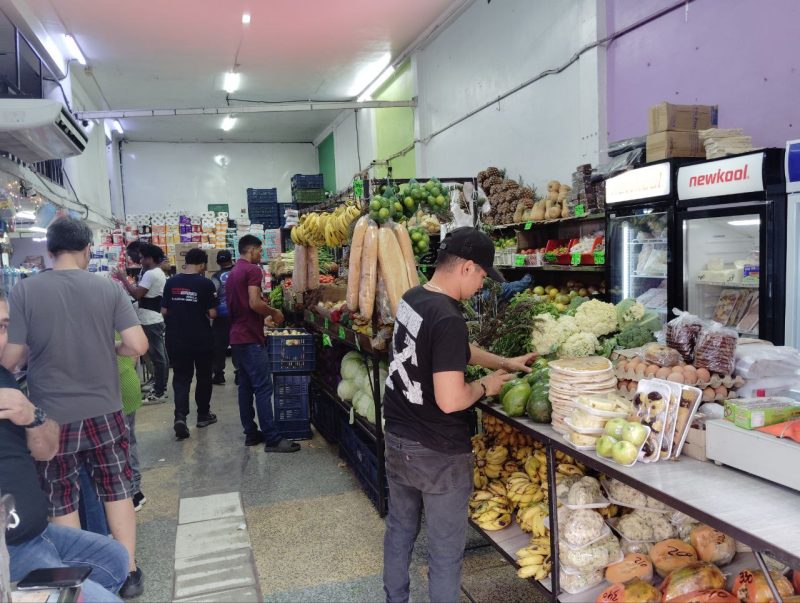
Indeed, in his first report from Venezuela that he posted at his website on Monday, Murray provided, based on his crisscrossing of the nation’s capital, an account that the situation there is very different from what is commonly reported. “I have now been in Caracas for 48 hours and the contrast between what I have seen, and what I had read in the mainstream media, could not be more stark,” stated Murray to begin his report. Expanding on this observation, Murray wrote later in his report:
Pretty well everything that I have read by Western journalists which can be immediately checked – checkpoints, armed political gangs, climate of fear, shortages of food and goods – turns out to be an absolute lie. I did not know this before I came. Possibly neither did you. We both do now.
As in Lebanon last year, Murray is set to provide a view into matters much of the media is not interested in sharing with people around the world. Murray explained in his report:
When I was in Lebanon a year ago, the mainstream media were entirely absent as Israel devastated Dahiya, the Bekaa Valley, and Southern Lebanon, because it was a narrative they did not want to report.
Disgracefully, the only time the BBC entered Southern Lebanon was from the Israeli side, embedded with the IDF.
The BBC, Guardian or New York Times simply will not send a correspondent to Caracas because the reality is so starkly different from the official narrative.
To be more informed about what is happening in Venezuela, it would be a good practice to check periodically Murray’s website where he is planning to post more written and video reports in the coming weeks.
US pressure contributing to Israeli influence in Latin America: Experts
Press TV – January 26, 2026
US political pressure is contributing to the Israeli regime’s influence across Latin America, even as long-standing regional support for the Palestinian cause continues through diplomatic, legal, and grassroots channels, experts say.
For decades, several left-wing governments in the region shaped their foreign policy around anti-imperialism and de-colonial identity, aligning openly with Palestinian rights, but analysts warn the legacy is now at the disposal of a mix of US interference, far-right political shifts, and economic leverage, the Middle East Eye news and analysis website reported on Monday.
Following the launch of the Israeli regime’s war of genocide on Gaza in October 2023, Brazil’s president verified the nature of the onslaught as being “genocidal,” Colombia suspended diplomatic ties with the regime, and Chile sought accountability for Israeli atrocities at international courts. Yet experts cited by the outlet said Washington has worked to counter that momentum through lobbying, political threats, and direct pressure on outspoken governments.
“Latin American states lack instruments of hard power and are therefore constrained in how they can respond to US pressure,” said Ali Farhat, a Latin American affairs specialist. “That limitation creates openings for Israel to consolidate influence, particularly where governments seek to avoid confrontation with Washington.”
US officials have increasingly framed cooperation with Washington as a test of “security” and “democratic alignment,” while linking regional diplomacy to broader American foreign policy goals that dovetail with closer ties with Tel Aviv.
Argentina has emerged as the clearest example of this shift. Far-right President Javier Milei has announced plans to move the country’s embassy to the holy occupied city of al-Quds and expand security and economic cooperation with the regime, while openly backing its war on Gaza as “legitimate self-defense.”
Last year, Argentina received a $20-billion bailout from Washington, which US President Donald Trump defended as support for a “good financial philosophy,” despite skepticism over its impact on the country.
Farhat said US meddling has reshaped the regional landscape, pointing to Washington’s targeting of Venezuela’s leadership as part of a broader effort to weaken vocal supporters of Palestine.
Venezuelan President Nicolas Maduro, long seen as one of the most uncompromising defenders of Palestinian rights in Latin America, was kidnapped by US forces earlier this year and is now standing trial in New York on “drugs, weapons, and narco-terrorism” charges.
“He (Maduro) was among the most uncompromising defenders of Palestine on the continent,” Farhat said. “His marginalization [and now ouster] represents the loss of a fierce advocate for the cause.”
The pundit said Maduro framed the Palestinian struggle as inseparable from anti-imperialism and viewed the US as a colonial power and the regime as an occupying entity backed by it.
Since Trump’s return to office last year, Farhat said, left-leaning leaders have shifted tactics rather than abandoning Palestine, opting for recalibration over confrontation, but far-right governments have accelerated alignment with both Washington and Tel Aviv.
As of 25 January, Argentina is the only Latin American country to have agreed to join Trump’s controversial “Board of Peace” initiative in Gaza, which describes itself as an international organization seeking to promote stability and secure “peace.”
Nilto Tatto, a congressman from Brazil’s Workers’ Party, urged Latin American governments to reject the board and any initiatives undermining Palestinian rights.
“Any framework managed by Washington would not serve peace so much as reproduce hegemony under an international guise,” Tatto said.
“Brazil, evidently, cannot take part in a process whose outcome is already predetermined, namely one that focuses on the reconstruction of the Gaza Strip only to then keep the territory under US control.”
Julia Perie, a former Argentine lawmaker, said Argentina’s shift reflected ideological realignment.
“Argentina’s position is part of a geopolitical vision that prioritizes alignment with the United States,” said Perie.
She added that Latin American solidarity with Palestine has always been cyclical. “This is another phase in a longer historical transformation, not the end of solidarity.”
‘Recalibration not abandonment’
Amid the situation, observers noted, support for Palestine in countries facing mounting political pressure was increasingly being channeled through legal action, multilateral institutions, and popular movements rather than overt diplomatic confrontation.
Ramon Medero, president of Venezuela’s La Danta TV, said the current moment represented adaptation, not retreat.
“It is difficult to argue that the Palestinian cause has suffered a decisive blow,” Medero said.
“What we are seeing is a repackaging of escalation through legal and multilateral avenues to reduce the costs of sanctions and backlash.”
Medero added that the Palestinian cause was now embedded in a broader Global South struggle.
“The Palestinian cause has become a structural symbol of liberation, sovereignty, and self-determination,” he said. “What is shifting is agency – away from governments and toward popular consciousness.”
He added that far-right advances could intensify grassroots mobilization.
‘Macron Is Trapped’: Double Standards in French President’s Davos Speech
Sputnik – 20.01.2026
François Asselineau, leader of French opposition party the Union Populaire Republicaine, points out that President Macron backed the US’s illegal military operation in Venezuela, but is now talking about ‘international law’ when it comes to Greenland.
“He approved Trump asserting the law of the strongest over international law,” Asselineau says. But now “he finds himself forced to call for a return to international law and multilateralism in an attempt to counter Trump’s desire to press his advantage by laying claim to Greenland.”
Macron’s WEF statement “about the need for European unanimity” only “touches on Europe’s permanent problem — that Europe doesn’t really exist,” the French opposition party leader stressed.
“It’s a fictitious entity made up of 27 states with different national interests,” Asselineau says. “We can already see this with Greenland. For example, there are several states that are not very critical of Donald Trump.”
Calling Macron’s position “extremely fragile,” he stresses that France is now “on very bad terms” with global powers including the US, China and Russia.
“It’s something like the twilight of the Macron presidency,” Asselineau argues. “Like many French people, I hope it ends as quickly as possible.”
Featured Video
Racist Seinfeld Dances for Joy as Bibi Unveils His New Map
or go to
Aletho News Archives – Video-Images
TV Drama Review
Japanese drama projects Japan’s wartime atrocities onto Chinese characters

Global Times | October 25, 2026
By portraying Chinese characters as perpetrators of ruthless violence while casting Japanese Self-Defense Forces (SDF) intelligence operatives as defenders, the season 2 of the Japanese drama Vivant has recently drawn criticism from Chinese netizens, who argue that its depiction turns historical reality on its head while ignoring Japan’s wartime atrocities.
The TBS drama series – a spy suspense story in which an alleged unofficial intelligence unit of the SDF operates across the globe — has attracted a passionate fanbase. Its currently airing season 2 opened with a household rating of 18.8 percent, the highest for a TV drama this year, according toa commentary article by Japanese media Toyo Keizai.
What draws attention is the portrayal of the enemies in the series, the article noted. Scenes in which the Chinese organization subjects kidnapped members of the SDF unit to brutal torture are repeated with unrelenting intensity.
It is rare for Japanese TV dramas to explicitly portray a real-life country as the enemy, the article noted.
Japanese Prime Minister Sanae Takaichi also made a reference to the drama, saying that she has been recording Vivant and hopes to binge-watch it over the year-end and New Year holidays, according to Japanese media outlets.
China’s CCTV News report on Sunday revealed that the drama features scenes in which Chinese personnel cut off the fingers of and stab Japanese intelligence operatives in the abdomen. Such acts bear striking similarities to the torture inflicted on Chinese nationals by invading Japanese troops during the World War II.
The drama distorts the truth by attributing these atrocities to modern Chinese characters. Beneath the surface, it subtly glorifies Japan’s cross-border overseas operations, blurs the functional boundaries of the SDF and implicitly promotes an expansionist narrative, per CCTV News. … continue
Blog Roll
 Aletho News
- Iran, Turkey, Pakistan, Saudi Arabia could advance region-led security framework in Tehran: FM spox
- Netizens condemn Japanese drama for projecting Japan’s wartime atrocities onto Chinese characters
- Racist Seinfeld Dances for Joy as Bibi Unveils His New Map
- A West Bank War for Netanyahu’s Election Campaign, Could It Backfire?
- Yemen denounces European Parliament’s ‘hypocritical’ push to blacklist Ansarullah
- Qalibaf: UAE’s UN bid aims to ‘clear the runway’ for ‘Greater Israel’, whitewash genocide
- Pakistan reopens Iran border after boosting security: Report
- Why are so many Brazilians voting for Flávio Bolsonaro?
- Democrats Put Anti-Russia Agenda Ahead of American Workers
- Elijah Magnier: Yemen’s Strikes Are Shattering Saudi Arabia’s Long-Term Strategy
- If Americans Knew
- An error has occurred; the feed is probably down. Try again later.
- No Tricks Zone
- Sudden Stratospheric Warming, Powerful El Niño Combination May Lead To Extreme Europe Cold, Energy Crisis!
- Two New Studies Find Thwaites Glacier Melt Cannot Be Driven By Human Activity Or A Warming Ocean
- E-Cars Reduce CO2 Emissions By Only 41% Compared To Internal Combustion Engine Vehicles
- Predictions Made By Renowned Climate Professor Over Past Decades Have Been Proven To Be Poor
- New Study Suggests Large Regions Of The Pacific Ocean Have Been Cooling For The Last 80 Years
- Germany’s Green Energy Debacle: High Energy Costs Force Kahla Porzellan to Close After 182 Years!
- New Study: 50 Years Of The Most Aggressive ‘Net Zero’ Policies Can Only Affect The Global Climate By 0.03°C
- US September “Heat” Was No Record…Many Records Set Decades Ago
- Latest European Green Energy Debacle; Portugal’s Largest Flagship Solar Park Insolvent!
- Green Energy Debacle: German Expert Professor Fritz Vahrenholt Warns Of Severe Economic And Social Consequences

