Merry ‘Bloody Christmas’: Venezuela Uncovers Guaido’s Plot to Provoke US Intervention
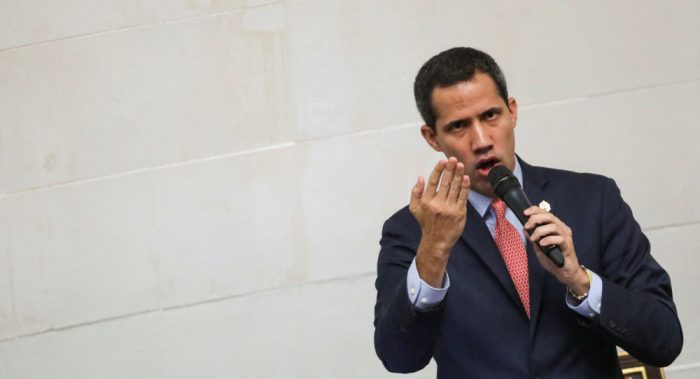
© REUTERS / Manaure Quintero
By Tim Korso – Sputnik – 23.12.2019
Venezuela reported on 22 December that at least one of its servicemen was killed in an attack on a military unit by unidentified gunmen. The latter reportedly sought to rob an ammunition depot, but ultimately failed, with some of them ending up detained by Caracas’ forces.
Venezuelan Minister of Popular Power for Communication and Information Jorge Rodriguez has reported that investigators have uncovered a plot organised by a group loyal to opposition leader Juan Guaido and involving the governments of Peru and Brazil. According to Rodriguez, the plot, called “Bloody Christmas”, suggested attacks on several military units across Venezuela.
In addition to this, the minister said that the members of “Guaido’s group” were planning to shoot down a Colombian Air Force plane using missiles stolen from the Venezuelan military in a staged false-flag attack on the country’s neighbour. The plotters allegedly planned to thereby give the US a pretext to start a “war” with Venezuela.
Rodriguez stated that some of the missiles and assault weapons stolen by the plotters have been recovered, but others remain in the hands of those who are still at large. According to him, a total of 9 RPG rocket launchers were stolen, though it’s unknown how many have been returned.
Attack on Ammunition Depot
Earlier, on 23 December, Venezuelan authorities reported that one soldier was killed as a result of the assault on one of the country’s military units by unknown assailants, which sought to rob an ammunition store. After the attack was repelled, Venezuelan authorities managed to capture some of the gunmen.
An investigation has been started into the incident, but it is not immediately clear who orchestrated the attack.
Back in April 2019, Venezuela experienced an unsuccessful coup attempt organised by opposition leader and self-proclaimed interim President Juan Guaido. The latter appealed to the country’s military to stand against democratically elected President Nicolas Maduro, although only a few of them heeded the call, resulting in the coup’s failure. Guaido has since then fled abroad along with some of his supporters.
Western leaders, screw your ‘Sanctions Target the Regime’ blather: Sanctions KILL PEOPLE
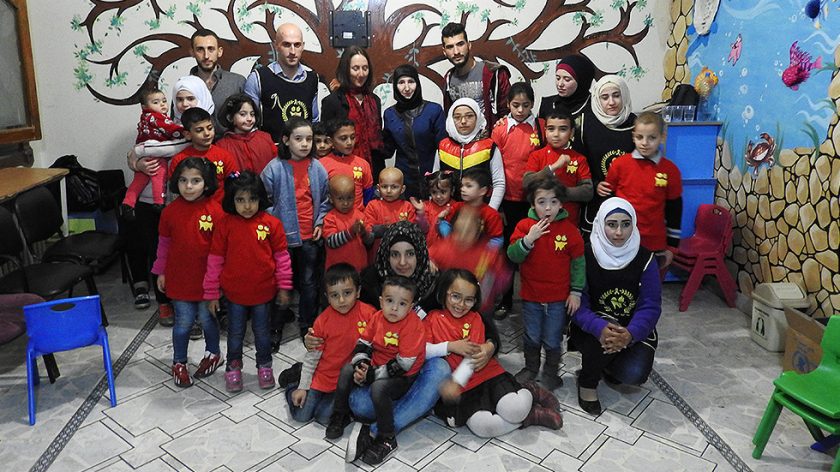
Children with cancer couldn’t get adequate treatment due to sanctions (photo Aleppo 2016)
By Eva Bartlett | RT | December 16, 2019
The US has a favourite tool for bullying non-compliant nations: sanctions. Sanctions inflict considerable suffering, even death, on ordinary people in targeted nations. Yet those defiant nations persist and resist.
A recent opinion piece in the Washington Post proposing a new oil-for-food scheme, this time in Venezuela, surprisingly acknowledges that sanctions “can also end up harming the people that they intend to protect.”
Okay, first off, we know there is no intention of “protecting” civilians in any of the countless countries targeted by Western sanctions. Do Western talking heads really think we’ve forgotten the half-a-million dead Iraqi children, thanks to US sanctions?
Yet, ask a Western leader about crippling sanctions placed on nations which don’t bow to Imperial demands and you’ll be met with some nonsensical explanation that sanctions only target ‘regimes’ and ‘terrorists,’ not the people.
I’ve lived in, spent considerable time in, or visited areas under sanctions and siege, and I’ve seen first hand how sanctions are a form of terrorism, choking civilians, depriving them of basic and urgent medical care, food, employment, and travel entitlements that many of us in Western nations take for granted.
When I was in Syria last October, a man told me his wife had been diagnosed with breast cancer, but because of the sanctions he couldn’t get her the conventional treatments most in the West would avail of.
In 2016, in Aleppo, before it was liberated of al-Qaeda and co, Dr. Nabil Antaki told me how –because of the sanctions– it had taken him well over a year to get a simple part for his gastroenterology practise.
In 2015, visiting Damascus’ University Hospital, where bed after bed was occupied by a child maimed by terrorists’ shelling (from Ghouta), a nurse told me:
“We have so many difficulties to ensure that we have antibiotics, specialized medicines, maintenance of the equipment… Because of the sanctions, many parts are not available, we have difficulties obtaining them.”
Visiting a prosthetic limbs factory in Damascus in 2016, I was told that, due to the sanctions, smart technology and 3D scanners –used to determine the exact location where a limb should be fixed– were not available. Considering the over eight years of war and terrorism in Syria, there are untold numbers of civilians and soldiers in need of this technology to simply get a prosthetic limb fixed so they can get on with their lives. But no, America’s concern for the Syrian people means that this, too, is near impossible.
In 2018, Syria’s minister of health told me Syria had formerly been dubbed by the World Health Organization a “pioneer state” in providing health care.
“Syria had 60 pharmaceutical factories and was exporting medicine to 58 countries. Now, 16 of these factories are out of service. Terrorists partially or fully destroyed 46 hospitals and 620 medical centres.”
I asked the minister about the complex in Barzeh, targeted with missile strikes by the US and allies in April 2018. Turns out it was part of the Ministry of Health, and manufactured cancer treatment medications, as well as antidotes for snake or scorpion bites/stings, the antidote also serving as a basic material in the manufacture of many medicines.
Last year, Syrian-American doctor Hussam al-Samman told me about his efforts to send to Syria chemotherapy medications for cancer patients in remission. He jumped through various hoops of America’s unforgiving bureaucracy, to no avail. It was never possible in the first place.
“We managed to get a meeting in the White House. We met Rob Malley, a top-notch assistant or adviser of Obama at that time. I asked them: ‘How in the world could your heart let you block chemotherapy from going to people with cancer in Syria?’
They said: ‘We will not allow Bashar al-Assad to have anything that will make people love him. We will not support anything that will help Bashar al-Assad look good’.”
Fast forward to the present: in spite of the sanctions, or precisely because of the sanctions, Syria recently opened its first anti-cancer drugs factory. President Assad is, again, looking rather good to Syrians.
UN expert: Sanctions on Venezuela “a form of terrorism”
Alfred de Zayas, the human rights lawyer and former UN official, aptly calls sanctions a form of terrorism, “because they invariably impact, directly or indirectly, the poor and vulnerable.”
Earlier this year, The Center for Economic and Policy Research estimated 40,000 deaths had occurred due to sanctions in 2017-2018.
While in Venezuela in March this year, I spoke with people from poor communities about the effects of sanctions. Most I met were very well aware of the US economic war against their country, and rallied alongside their government.
One woman told me:
“If you don’t have water, don’t have electricity, the basics, how would you feel, as a mother? This makes some of the population, that doesn’t understand about the sanctions, blame the government.”
Venezuela’s Foreign Minister, Jorge Arreaza, said during that visit:
“We told [American diplomat and Trump envoy] Mr Elliott Abrams, ‘the coup has failed, so now what are you going to do?’ He kind-of nodded and said, ‘Well, this is going to be a long-term action, then, and we are looking forward to the collapse of your economy.’”
Indeed, that collapse would come about precisely due to the immoral US sanctions against the Venezuelan people.
North Korean Youth: Sanction the USA
After visiting Korea’s north in August 2017, in a photo essay I noted: “The criminal sanctions against the North, enforced since 1950, making even more difficult the efforts to rebuild following decimation. The sanctions are against the people, affecting all sectors of life.”
And although most I met there were proud of their country’s achievements in spite of the sanctions, they were also vocal about the injustice of being bombed to near decimation and then sanctioned.
In a Pyongyang Middle School, to my questions about the sanctions, a girl replied:
“The sanctions are not fair, our people have done nothing wrong to the USA.”
Another boy spoke of the silence around America’s use of nuclear bombs on civilians: “Why do people all over the world give us sanctions? Why can’t we put sanctions on the US?”
At the Okryu Children’s Hospital, Doctor Kim Un-Song said: “As a mother, I feel extremely angry at the sanctions against the DPRK, even blocking medicine and instruments for children. This is inhumane and against human rights.”
As with Syria, sanctions on the DPRK prevent further entry to Korea of hospital machinery, as well as replacement parts.
Defying the sanctions
In spite of draconian sanctions, Syria, the DPRK and Venezuela continue to resist. After fighting international terrorism since 2011, Syria is rebuilding in liberated areas. That process could proceed more quickly were sanctions lifted, making it easier for companies outside of Syria to invest.
But Syria is managing, with its allies’ support, including that of North Korea, and due to the steadfastness of the heroic Syrian people, and its leadership.
Likewise, Venezuela and North Korea, facing America’s economic war and endless propagandistic rhetoric, continue to resist.
In each of these countries, I’ve met well-informed people who are fighting the sadism of the sanctions, and who are determined to remain free of US tyranny.
Eva Bartlett is a Canadian independent journalist and activist. She has spent years on the ground covering conflict zones in the Middle East, especially in Syria and Palestine (where she lived for nearly four years).
Venezuela Oil Production Continues Slow Recovery
According to state oil company PDVSA, production is again approaching one million barrels per day.
By Ricardo Vaz | Venezuelanalysis | December 11, 2019
Caracas – Venezuela’s oil output increased slightly in November for the second month running.
The monthly report of the Organization of the Petroleum Exporting Countries (OPEC) registered Venezuela’s November crude production at 697,000 barrels per day (bpd), as reported by secondary sources, up from 685,000 bpd in October.
State oil company PDVSA’s direct reporting to OPEC showed a bigger increase, from 761,000 to 912,000 bpd. Exports reportedly averaged over one million bpd as the oil giant drained stored crude.
Venezuela’s flagship industry has seen output fall precipitously from 1.911 million and 1.354 million bpd in 2017 and 2018, respectively, following the imposition of crippling US financial sanctions. PDVSA operations have likewise suffered from mismanagement, corruption, brain drain and lack of maintenance.
Before the trend was reversed in October and November, production had steadily plummeted following a US oil embargo imposed in January, which was expanded to a blanket ban on all business with Venezuelan state companies in August.
The August measures additionally authorized secondary sanctions against third party actors, leading several foreign companies to cancel oil shipments, including China’s state oil company CNPC. PDVSA has reportedly resorted to selling a large proportion of its crude output to Russian energy giant Rosneft, which then reroutes it to other destinations.
PDVSA’s modestly rising production levels comes as the firm resumes shipments to Indian customers such as Reliance Industries following a four month hiatus due to US threats. Dealings often involve exchanging crude for fuels or diluents so as to avoid sanctions. According to unnamed Trump officials cited by Bloomberg, the White House has ruled out sanctioning Indian firms at this time.
Analysts agree that recovering oil production is key to Venezuela’s economic recovery, but US Treasury sanctions create significant hurdles for foreign investment.
Reuters has recently reported that government and opposition figures are contemplating allowing private companies in joint ventures with PDVSA to operate oil fields themselves. The move would represent a reversal of a longstanding policy dating back to former President Hugo Chávez’s government which required that PDVSA retain operational control of oil operations. In an attempt to attract foreign investment, the Maduro government has also loosened the requirement that PDVSA hold at least a 60 percent stake in joint ventures, requiring only a majority stake in new dealings.
As part of ongoing talks, government representatives and several minority opposition parties have recently agreed to seek oil-for-food and oil-for-medicine agreements with international partners, but no further details are known at this time.
Edited by Lucas Koerner from Caracas.
Venezuela: Guaido Embattled as Opposition Splits over New Corruption Scandal
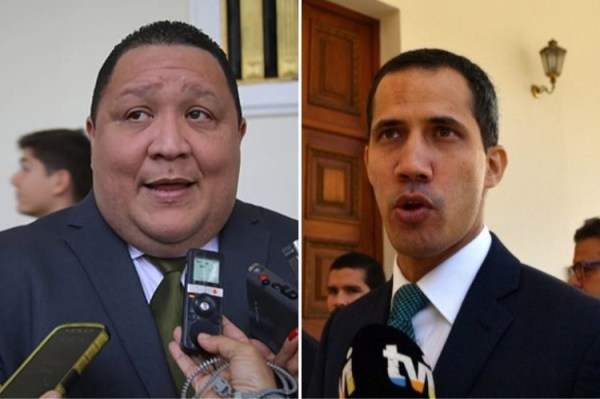
Deputy Jose Brito and self-proclaimed “interim president” have traded corruption accusations this week. (Archive)
By Lucas Koerner and Ricardo Vaz – Venezuelanalysis – December 5, 2019
Caracas – Venezuela’s right-wing opposition has been beset by internecine strife in recent days following new corruption allegations involving senior anti-government figures.
On Sunday, pro-opposition website Armando.info published an investigative report alleging illicit ties between nine National Assembly (AN) deputies and a Colombian businessman reportedly involved in the Maduro government’s CLAP subsidized food distribution program.
The report named First Justice party deputies Jose Brito, Luis Parra, and Conrado Perez Linares, Richard Arteaga and Guillermo Luces of Popular Will, A New Era’s Chaim Bucaram and William Barrientos, Progressive Advance Deputy Hector Vargas, and Adolfo Superlano, recently expelled from Cambiemos. The majority of the legislators sit on the opposition-led AN’s own comptroller commission.
According to documents obtained by the news site, the lawmakers used their positions to lobby US and Colombian authorities to shield Colombian entrepreneur Carlos Lizcano from sanctions in return for kickbacks.
Lizcano is the owner of Salva Foods, which manages the network of so-called “CLAP Stores” in Venezuela. He has been linked to fellow Colombian businessmen Alex Saab and Alvaro Pulido, who have both been sanctioned by Washington for their alleged ties to the CLAP program.
The revelations have been widely regarded as an embarrassment for National Assembly President Juan Guaido, who proclaimed himself “interim president” of Venezuela in January and is recognized by the United States, Colombia, and several dozen other countries.
Immediately responding to the allegations, Guaido denounced “corruption” on the part of his fellow lawmakers and announced an overhaul of the comptroller commission.
“I will not allow corruption to endanger all we have sacrificed for freedom,” he tweeted Sunday.
The AN head’s comments provoked a backlash, with First Justice’s Jose Brito telling reporters on Tuesday that Guaido “does not have moral, ethical or judicial capabilities, because he’s corrupt.”
He also challenged Guaido to prove any wrongdoing on his part, while alleging that people close to the “interim president” were behind the purchase of a night club in Madrid with ill-gotten funds.
“There is a rebellion inside the National Assembly against Guaido, because he’s corrupt,” Brito concluded, adding that 70 deputies have penned a letter to Guaido demanding he render accounts of the February humanitarian aid funds – another scandal implicating the opposition leadership.
On February 23, Washington and the Guaido-led opposition attempted to force “humanitarian aid” across the Venezuelan-Colombian border in a failed bid to oust President Nicolas Maduro.
In June, reports emerged that Guaido’s representatives in Colombia had embezzled hundreds of thousands of dollars earmarked for soldiers who had heeded the opposition call to desert on February 23.
Months later, it was revealed that Guaido had crossed into Colombia, ahead of the “humanitarian aid” effort, with the help of infamous paramilitary outfit Los Rastrojos. The opposition leader was seen in videos and pictures with members of the group, which has been accused of drug smuggling, assassinations and extortion.
Both scandals were dragged back into the limelight last week following the announcement that Guaido’s “ambassador” to Bogota, Humberto Calderon Berti, was being replaced.
Calderon, a former minister and president of state oil company PDVSA in the 1980s and ‘90s, later gave an interview to Miami-based anti-government outlet PanamPost in which he blamed hard-right Popular Will leader Leopoldo Lopez for the opposition’s “biggest mistakes.” Lopez was serving a 14-year sentence under house arrest for his responsibility in the violent 2014 opposition protests when he was freed by rogue intelligence personnel during April 30’s failed putsch attempt. He then fled to the Spanish embassy where he has resided since.
The former minister highlighted his “ethical differences” with respect to Juan Guaido and his mentor, Lopez, while also pointing the finger at leading opposition figures for the embezzlement of humanitarian aid funds.
Calderon also commented on another scandal brewing at chemical company Monomeros, Colombian subsidiary of Venezuelan state petrochemical company Pequiven. Monomeros was taken over by the opposition earlier this year, and Calderon accused the main opposition parties of appointing ill-prepared board members and engaging in corrupt practices.
The latest opposition infighting has also garnered a reaction from Maduro government officials. Comptroller General Elvis Amoroso announced that this office is opening an investigation into Guaido and his associates over the alleged misappropriation of state funds.
Meanwhile, National Constituent Assembly President Diosdado Cabello commented that the corruption scandals evidence the opposition’s “lack of morals and ethics.”
“Nobody should be surprised that they are trading accusations of corruption, of taking bribes, they even stole humanitarian aid,” Cabello said in a press conference on Monday.
US Vows to ‘Reinforce’ Sanctions, Accuses Venezuela and Cuba of Stirring Regional ‘Strife’
Elliott Abrams reiterated support for Guaido and denied that sanctions are damaging the Venezuelan economy
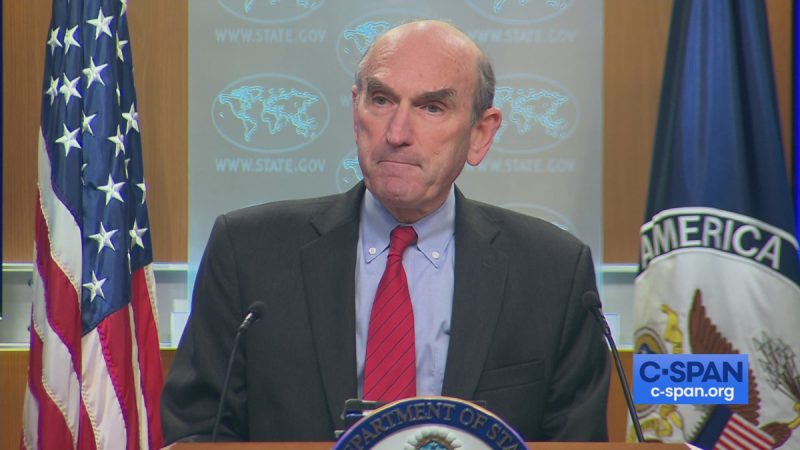
White House envoy for Venezuela Elliott Abrams defended Washington’s Venezuela sanctions on Wednesday. (C-Span)
By Lucas Koerner | Venezuelanalysis | November 28, 2019
Caracas – The Trump administration has pledged to continue economic sanctions against Venezuela in its ongoing bid to oust the Maduro government.
Speaking at a press conference at the State Department Wednesday, Special Envoy for Venezuela Elliott Abrams defended US regime change policy, which he said would “continue.”
“There’s no change… What is next is, I would say, a continuation of the current policy,” he said in response to questions about the status of US efforts more than ten months after recognizing opposition politician Juan Guaido as “interim president” of Venezuela.
Guaido proclaimed himself head of state in January and has gone on to lead several unsuccessful efforts to topple Maduro, including a failed military putsch in April.
Trump immediately backed Guaido’s “interim presidency,” handing the Venezuela file to Abrams, a veteran cold warrior infamous for his role in the Iran/Contra scandal, the Reagan administration’s Central America policy, and the Iraq War.
Asked about the efficacy of US sanctions, Abrams assured reporters that the measures are cutting off vital funds for the Venezuelan government. However, he acknowledged that he “would like to see, obviously, the sanctions work better,” adding that “there are plans to reinforce the effort.” He did not offer further details.
“The gravy train days that they had 10 years ago are over,” he announced, referring to the period when Venezuela had the highest minimum wage in Latin America and among the lowest levels of inequality.
Abrams went on to deny that US sanctions are negatively impacting Venezuela’s economy, citing a paper authored by former Guaido Inter-American Development Bank envoy Ricardo Hausmann claiming, “the bulk of the deterioration of living standards occurred long before sanctions were enacted in 2017.” Hausmann was a key architect of neoliberal policies in Venezuela in the 1980s and 1990s and has been a longtime government opponent.
The conclusions of Hausmann’s study have been disputed by the DC-based Center for Economic and Policy Research, which published its own report in April finding sanctions responsible for at least 40,000 deaths since 2017. The study likewise claims that sanctions amount to “collective punishment,” blocking any possibility of economic recovery in the Caribbean nation.
Washington has dramatically ramped up its sanctions regime since January, imposing an oil embargo which has since been escalated to a sweeping ban on dealings with Caracas under threat of secondary sanctions.
Abrams likewise rebuffed reporters’ concerns about Guaido’s “lack of momentum,” suggesting that “hundreds of thousands… went to the streets on November 16.” The claim was scrutinized by journalists who pointed out that viral video footage purported to be from the protests was in fact taken in January.
Questioned repeatedly about allegations of the Maduro government “intervening” in regional protests, the White House envoy accused Caracas and Havana of acting to “promote more strife everywhere.”
“There is evidence beginning to build of an effort by the regimes in Cuba and Venezuela to exacerbate problems in South America,” he added.
In recent weeks, the region has been rocked by massive anti-neoliberal protests that have shaken right-wing governments in Ecuador, Haiti, Chile, and Colombia. Government spokespeople have frequently attributed the uprisings to “meddling” by Caracas, while the Organization of American States has branded them a “destabilization strategy” by the “Bolivarian and Cuban dictatorships.”
What Does PDVSA Have to Do with the Crisis in Haiti?
By Clodovaldo Hernandez – Supuesto Negado – November 7, 2019
Haiti has been on fire for weeks, without the so-called ‘international community’ or its associated press paying any attention.
Fuel shortages have plunged the Caribbean country back into social turmoil which borders on civil war. There are many causes behind this dramatic panorama, which has been exasperated by the decrease in production by Venezuelan state-run oil company PDVSA, corruption scandals in the Caribbean country and relentless US pressure on Venezuela, which have all damaged the PetroCaribe crude oil supply programme, which Haiti was reliant on.
PDVSA’s internal collapse, coupled with the labyrinth of obstacles placed by the US’ unilateral coercive measures (sanctions) against Venezuela, has forced the dismantling of what was one of Commander Hugo Chavez’s most powerful initiatives.
The project is a regional mechanism for selling oil at preferential prices with financing for the residents of the Antillean Basin. Local opposition groups and the Washington-led international coalition have, however, always branded the programme as a way for Venezuela to ensure support in the international arena based on the so-called ‘petro-chequebook.’
Internal corruption
Before the programme was damaged by PDSVA’s fall in production and the blockade [against Venezuela], there were already revelations of financial irregularities by unscrupulous Haitian civil servants and entrepreneurs who took advantage of Venezuelan aid to line their own pockets.
In Haiti, these crimes are particularly outrageous because the programme was conceived as a way of providing financial assistance to the government to address serious internal problems, exacerbated by the 2010 earthquake and five major hurricanes, including Hurricane Matthew in 2016.
Under the programme, PetroCaribe delivered crude oil to a state agency called the Monetisation Bureau of Development Aid Programmes, which proceeded to sell it to private Haitian companies. The resulting funds should have been used to rebuild infrastructure, especially in the areas of health, education, housing and roadways, however around US $2 billion is estimated to have been stolen.
The responsibility of Venezuelan officials in this and other Petro Caribe- related corruption cases remains to be seen.
The issue of corruption is so important in the Haitian political debate that in addition to demanding the resignation of pro-US President Jovenel Moise, the opposition and Haitian grassroots movements, which have led the wave of demonstrations in recent months, also demand the prosecution of those involved in irregularities that distorted the initial objectives of the programme. Opposition Deputies Youri Latortue, Moise Jean Charles and Shiller Louidor have been the flag-bearers of these demands.
The political reasons
In parallel, and in accordance with Washington’s instructions, the Haitian government of businessman Jovenel Moise, which is propped up by the US, has preferred to sever its relationship with PetroCaribe, supposedly to distance itself from the influence that revolutionary Venezuela exerted on previous Haitian presidents, such as René Preval and Michel Martelly.
Moise (whose name also appears amongst the list of alleged benefactors from the theft of PetroCaribe funds) was snared with promises that the US would supply the oil that Venezuela would no longer deliver. But that obviously hasn’t happened.
As the country ran out of fuel, what has been described as Haiti’s worst political crisis has erupted. The nation has lived in perennial instability due to, among other reasons, the continued interference of the US in its internal affairs.
Apart from Haiti, the PetroCaribe programme favoured Antigua and Barbuda, the Bahamas, Belize, Cuba, Dominica, Guatemala, Guyana, Grenada, St. Kitts and Nevis, St. Lucia, St. Vincent and the Grenadines, El Salvador, the Dominican Republic and Suriname. Guatemala and Belize abandoned the agreement in 2014 and 2017 respectively, and in June 2018 Venezuela announced that it was suspending shipments to all these nations due to a drop in production, with the notable exception of Cuba.
Denouncements of irregularities [in the programme’s funds] were well exploited by Venezuela’s opponents to discredit the project between 2016 and 2018. Simultaneously, the US toured the Caribbean offering to supply US oil extracted through fracking in exchange for support for its aggressive political moves against the Venezuelan government of Nicolas Maduro. Of course, in the US’ case, we aren’t talking about a social programme but rather winning the Caribbean market for its oil corporations, while continuing to strangle Venezuela economically.
In 2018, a Caribbean Energy Security Summit was held in Washington, which mentioned adopting sustainable renewable energy systems for the region. The political purpose, the true one, was later expressed by a spokesman for the US State Department: “That the Caribbean doesn’t increase its debt to the only energy supplier which has attended the region to date.”
PDVSA’s inability to continue honouring the programme, in addition to corruption scandals in countries like Haiti, allowed this goal to be achieved just as the US wished.
Now, the entire Caribbean region once again depends on the savage capitalism’s suppliers , and Haiti’s social protests are one of the first symptoms of this return to the harsh reality.
Clodovaldo Hernández is a Venezuelan journalist who has written for left leaning news sites Supuesto Negado and Aporrea.
Translation by Paul Dobson for Venezuelanalysis.
Colombia’s US Ambassador Advocates ‘Covert Actions’ Against Venezuela in Leaked Audio
By Lucas Koerner | Venezuelanalysis | November 21, 2019
Senior Colombian diplomats discussed strategies for regime change in Venezuela in a leaked audio published by Colombian news site Publimetro on Wednesday.
Speaking in a Washington DC cafe, Colombian Foreign Minister Claudia Blum and Ambassador to the US Francisco Santos repeatedly stressed the failure of US-led efforts to oust Venezuelan President Nicolas Maduro.
“The solution is not a military coup, because the military is not going to remove [Maduro]. Nor is the United States going to remove him at the point of an “I don’t know what,” observed Blum, alluding to the possibility of US military intervention in Venezuela.
Santos stressed the need for clandestine operations to “support the opposition.”
“The only thing that I see is with covert actions within [Venezuela] to make noise and support the opposition which is very isolated,” he told Blum.
The ambassador additionally reported that the “CIA [Central Intelligence Agency] is not getting involved [in Venezuela],” a fact that Blum appeared to lament.
Santos went on to complain about the apparent disarray within the Trump administration. He noted that the State Department and the White House were divided over the Inter-American Reciprocal Assistance Treaty (TIAR), which the former “wanted” but the latter did not. The TIAR was activated in September at the behest of the Venezuelan opposition, which hailed the move as a first step towards foreign military intervention in Venezuela.
For her part, Blum concurred with her ambassador’s assessment, lamenting that with US elections fast approaching, “no one knows what Trump is going to do.”
Santos responded by speculating that if Trump fears losing the presidential race, “he will go into Venezuela,” a possibility downplayed by the foreign minister.
Both officials, however, agreed on the urgent need to remove Maduro from power.
“If this guy doesn’t go, Colombia has no future,” warned Santos, going on to describe efforts to enlist US congressional support on Venezuela.
“Let them understand that this shithole is going to destabilize the whole continent,” he emphasized.
Since opposition leader Juan Guaido’s self-proclamation as Venezuelan “interim president” in January, the hard-right Colombian government of Ivan Duque has spearheaded efforts to oust Maduro.
In February, Colombia strongly supported a US-led attempt to force “humanitarian aid” across the Venezuelan border, which Blum dismissed as a “fiasco.”
More recently, tensions have been on the rise along the 2,219 kilometer Venezuelan-Colombian border since Bogota resumed hostilities with guerrilla factions in August.
The leaked audio is the latest in a series of Venezuela-related scandals that have dogged the Duque government in recent months.
In September, photos and witness testimony surfaced revealing that Guaido had crossed the Colombian border in February with the assistance of Colombian paramilitary groups in coordination with the Colombian authorities. The Duque administration had earlier been accused of turning a blind eye to accusations that Guaido’s envoys to the country had embezzled money destined to support deserters from the Venezuelan armed forces.
Weeks later, Duque came under fire after presenting false evidence of ELN activity in Venezuela during his speech at the UN General Assembly in New York.
The latest scandal provoked condemnation from Caracas, with Foreign Minister Jorge Arreaza slamming Colombian interference in Venezuelan affairs.
“Colombia has been affirming for years that Chavismo destabilizes the region… Meanwhile in a leaked conversation the new foreign minister and ambassador in the US confess how and with whom they conspire to destabilize Venezuela,” he tweeted.
Will phony assault charge intimidate Grayzone editor? Unlikely.
By Damian Wilson | RT | October 29, 2019
The heavy handed arrest and detention of Grayzone founder and editor Max Blumenthal comes five months after an attempted coup and assassination plot against the Venezuelan President failed. Maybe the US is running out of ideas…
The US intelligence service finally ran out of patience with Max Blumenthal last Friday morning and stormed his home, seizing him and spiriting him away to prison for a weekend of illegal detention, mistreatment and threats.
If that had happened to a well-respected investigative journalist in Caracas, Venezuela then the international media would have risen as one in outrage, condemning the heavy-handed tactics of President Nicolás Maduro and his security forces.
There would have been calls for the Venezuelans to explain their actions, demands to release the journalist immediately and to guarantee their future security. Sanctions already in place by the US would have been tightened and denunciations would have been forthcoming from all corners.
But with this happening in the US capital, it is a different story because the intelligence services do not like people like Max Blumenthal. He is the sort of troublemaker who asks awkward questions of the powers that be, who raises issues that are considered best left unexplored and generally makes them squirm when rocks are kicked over and their less honourable activities are revealed in daylight.
Ask Edward Snowden how that goes down. (Better still, read his autobiography Permanent Record which came out a few weeks ago.) Ask Chelsea Manning, ask Julian Assange.
If you cause a fuss that US intelligence does not like then your card is marked and it is only a matter of time before you will be whisked away for a weekend of fun and games while shackled in a cage. It might not be today, or tomorrow, but that knock on the door will come.
So Blumenthal’s reporting from outside the Venezuelan embassy, as he and other activists attempted to deliver food and sanitary supplies to those besieged inside was exactly the sort of thing to make the men in dark suits see red.
He told how, “the pro-coup mob outside turned violent, physically assaulting embassy protectors, and hurling racist, sexist and homophobic abuse at others” and he, along with his colleagues, tweeted details of pro-coup individuals vandalising the Venezuelan embassy and abusing the Embassy Protection Collective activists.
This sort of exposure did not fit in with the plans of the US Government to demonize Venezuela or its president, with Obama having kicked things off by declaring the nation a national security threat way back in 2015.
Current Secretary of State Mike Pompeo reiterated that belief earlier this year in case anyone thought there had been a thaw in the frozen relationship since the change in the White House residents.
And as the powers have spoken, don’t you dare disagree with them or make them look bad. Which is what Blumenthal has done.
Having made its mind up about Maduro, the US managed to sign up 50 nations to somehow back the notion that the Venezuelan opposition figure Juan Guaido should actually be recognised as president of the oil-rich nation. There are some powerful dissenting voices, however, namely Russia and China who sit alongside the US as permanent members the United Nations Security Council.
America decided to try and orchestrate a coup back in June this year and along with Colombia and Chile, devised a plot to overthrow the Venezuelan government and assassinate Maduro.
Around the same time, the embassy in DC became a focus for the plotters, who included supporters of Guaido but the local activists were too quick and managed to get people embedded inside the building to report on and record the siege as it unfolded.
That was not what the intelligence services wanted.
Blumenthal and Co needed to be shut down. Stooges willing to press fake charges were found and Blumenthal was wrongly accused of assault albeit five months after the incident apparently took place. Why the delay?
A puzzled Blumenthal wrote online: “If the government had at least told me I had a warrant I could have voluntarily surrendered and appeared at my own arraignment.”
But it is not justice that is being sought here. This is an exercise in intimidation and fear, hence the unheralded 9am arrival of the forces of law and order, the shackles, the cages and the denial of contact with legal representation.
Whatever happened to the press freedom guaranteed under the First Amendment which permits information, ideas and opinions without interference, constraint or prosecution by the government? Or doesn’t that count anymore?
Are threats, insults and attacks now simply occupational hazards for journalists in the USA?
Will Max Blumenthal and his colleagues at The Grayzone, and investigative journalists elsewhere, let an increasingly authoritarian regime intimidate them into early retirement? Unlikely.
Blumenthal has had an unpleasant experience, no doubt, and while the assault charge may not succeed in unnerving him he would certainly know now that the fight to maintain press freedom does not come easily. First amendment or not.
Damian Wilson is a UK journalist & political communications specialist.
Read more:
US Renews Chevron License as European Refiner Cuts Venezuela Ties over Sanctions
By Lucas Koerner | Venezuelanalysis | October 23, 2019
The US Treasury Department has allowed Chevron to continue its operations in Venezuela for a further 90 days.
One of the few remaining US petroleum companies still in Venezuela, Chevron currently produces around 200,000 barrels per day (bpd) in several joint ventures with Venezuelan state oil company PDVSA. The California-based energy giant had its Treasury-issued sanctions waiver extended on Monday.
The Trump administration imposed an oil embargo in January, barring dealings with Venezuela’s oil sector, including US imports of Veneuzelan crude, which then stood at 586,000 bpd. At the time, Chevron was issued a six-month license to wind down its Venezuela operations, which was renewed in a last-minute late July decision after months of lobbying. Other beneficiaries of the renewal are Haliburton, Schlumberger, GE’s Baker Hughes, and Weatherford International.
The license does not cover sales of diluents to PDVSA, which were outlawed by the Treasury Department in June. Venezuela relies on imports of diluents to blend its heavy crude into exportable grades, as well as produce gasoline and diesel for internal consumption.
Venezuela’s oil production has plummeted over the past two years since the US began imposing economic sanctions. According to OPEC secondary sources, output fell to just 644,000 bpd in September, down from an average of 1.911 and 1.354 million bpd in 2017 and 2018, respectively.
Caracas has scrambled to find new crude buyers, reportedly selling shipments to Russian state energy company Rosneft which then reroutes them to other customers. PDVSA has also moved to convert its heavy petroleum upgraders into blending facilities so as to produce lighter Merey grade crude favored by Asian markets.
In August, Washington upgraded its sanctions regime to a general embargo, prohibiting all US dealings with the Venezuelan state and its associated entities as well as authorizing secondary sanctions against third party actors.
The Trump administration has been reluctant to renew Venezuela operating licences, insisting on the need to deprive the Maduro government of export revenues in the hope of removing it from power. Venezuela depends on oil sales for over ninety percent of its hard currency earnings, which it uses for vital imports of food, medicine, and all classes of inputs.
Despite opting to greenlight Chevron’s operations for three additional months, the Treasury Department moved last week to modify the license of a European refining company prohibiting new purchases of Venezuelan crude.
Jointly owned by PDVSA and Finland’s Neste Oil, Nynas AB operates speciality refineries in Sweden, Germany, and the UK geared mainly towards asphalt production.
Under the terms of the new license, Nynas is authorized to sell Venezuelan oil or petroleum products already in inventory but is barred from making new purchases.
Nynas is one of only two remaining buyers of PDVSA’s lighter, Western-sourced crudes following Washington’s ratcheting up of sanctions this year, which have led most cash-paying customers to cut ties with the Venezuelan state oil firm.
Reuters reports that the move could lead Petrozamora, a Venezuelan-Russian joint venture in the western border state of Zulia, to cut production by 50,000 bpd in order to avoid overflowing oil stocks.
With additional reporting by Ricardo Vaz from Caracas.
Chevron hopes Trump allows it to stay in Venezuela
RT | October 19, 2019, 2019
US oil giant Chevron is hopeful that the Trump administration will extend a waiver allowing the company to continue doing business in Venezuela despite tough US sanctions on the South American country.
“We are a positive presence in Venezuela, and we are hopeful that General License 8C is renewed so that we can continue certain operations in the country for the long-term,” Chevron spokesman Ray Fohr said in a statement, as cited by Reuters.
General License No 8C is a document that authorizes transactions in Venezuela involving its state oil company PDVSA and its entities, according to the US Department of Treasury. Apart from Chevron, four other multinational corporations enjoy the right to continue certain operations in the country, including oil industry firms Halliburton, Schlumberger, Baker Hughes and Weatherford International.
As the document expires on Friday, Chevron, which has been operating in Venezuela for nearly a century, needs an extension to the waiver. The Trump administration is already considering the move, Bloomberg reported on Friday, citing sources. The report said that it is unclear if other companies will be granted a similar 90-day sanctions reprieve, as the Treasury wants to adhere to its “maximum pressure strategy” to further limit Venezuela’s oil production.
US economic warfare against the Bolivarian republic has seen multiple rounds of sanctions, including punitive ones targeting the country’s vital energy sector. Venezuela’s crude production has already neared a historic low of around 600,000 barrels per day, according to S&P Global Platts.
Analysts have recently predicted that a US refusal to extend the waivers for Chevron and other companies mentioned in the General License could further halve the country’s oil output.
“I think you’d see it go certainly to under 300,000 b/d within a month,” said Neil Bhatiya, an associate fellow with the Center for a New American Security, as cited by S&P Global Platts. “The question after that is whether and how fast there is backfilling by Chinese, or, more likely, Russian state firms. It will take a while though, so a Chevron-less Venezuela will probably be in the [sub-300,000 b/d] zone for the remainder of the calendar year.”
Venezuela says it would make sense for US to restore ties
Press TV – September 19, 2019
Venezuela says it would make sense for the United States to restore diplomatic ties with the elected government in Caracas as Washington has failed to install an opposition figure as Venezuela’s leader.
Venezuelan Vice President Delcy Rodriguez told reporters in Caracas on Wednesday that it would be reasonable for the US “to restore diplomatic contacts and dialog with the government” of President Nicolas Maduro.
Washington is left with “a single path,” having failed to remove Maduro from power, and that is “negotiation and diplomatic communication,” Rodriguez said.
In January, obscure opposition figure Juan Guaido unilaterally declared himself the “interim president” of Venezuela, winning the recognition of Washington.
Later, he attempted an abortive coup against Maduro’s government, again with support from the United States.
However, even the opposition groups that had sided with Guaido have been breaking ranks with him, joining talks that the government has opened to resolve differences peacefully.
On Monday, the representatives of several opposition parties concluded an agreement with Maduro’s top aides, including Rodriguez.
Meanwhile, an increasingly isolated Guaido has ruled out continuing talks with the government that Norway has been brokering.
Venezuela broke off relations with the US after Washington recognized Guaido as “interim president” on January 23.
The US has imposed several rounds of sanctions on Venezuela, confiscated its state oil assets based in the US, channeled revenue from them to Guaido, and has hinted at the use of force to remove Maduro.
Russia Warns US Against Economic Blockade on Venezuela – Deputy Foreign Minister
Sputnik – August 20, 2019
Russia has warned the United States against any attempts to impose an economic blockade on Venezuela, the Russian Deputy Foreign Minister Sergey Ryabkov said in a statement.
“We will certainly study the situation related to Washington’s boosting of illegal, illegitimate sanctions pressure and attempts to impose blockade [on Venezuela]. We warn Washington against incautious steps in this sphere”, Ryabkov said.
According to the diplomat, the issue of US sanctions against the Latin American nation will be discussed during the course of talks between Russian Foreign Minister Sergei Lavrov and Venezuelan Vice President Delcy Rodríguez scheduled for 21 August.
Ryabkov said that Rodríguez has already held several rounds of talks and will continue to communicate with Russian officials on various subjects.
Speaking about the bilateral ties between Russia and Venezuela, the diplomat said that the two nations will boost economic cooperation, including in mining and machine engineering.
“We are not discussing economic assistance, but economic cooperation”, Ryabkov said, when asked whether Russia possibly increasing its aid to the Latin American country was on the agenda during Venezuelan Vice President Delcy Rodriguez’s visit to Moscow. “We’re continuing work on a range of projects. New possibilities have emerged in some areas, such as the mining industry and … machine engineering. We’re continuing work on Russian grain deliveries to Venezuela in quite significant amounts. As I see it, the government already started … such discussions yesterday”.
Earlier this month, Washington imposed a new round of sanctions on Venezuela with National Security Adviser John Bolton saying that the pressure sent a direct signal to all enablers of “Maduro’s dictatorship”. Caracas decried the sanctions as “another serious aggression by the Trump administration through arbitrary economic terrorism against the Venezuelan people”.
Venezuela has suffered a political crisis since the beginning of this year when opposition figure Juan Guaido proclaimed himself interim president of the country just days after legitimate President Maduro was inaugurated for a second term.
Washington as well as other nations immediately recognised Guaido as Venezuela’s leader. However, Russia among several other nations refused to recognise the legitimacy of the self-styled president’s claim.
President Maduro, for his part, slammed the opposition leader as a US “puppet”, saying Guaido’s recognition by global leaders was a coup attempt staged by the United States.
Featured Video
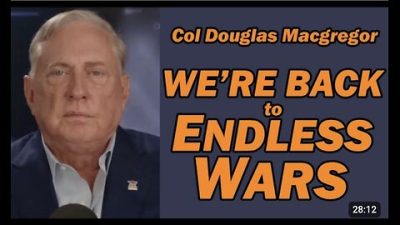
Col Doug Macgregor: America’s Back to ENDLESS WARS
or go to
Aletho News Archives – Video-Images
From the Archives
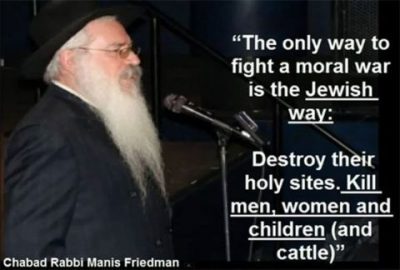
Rabbi Shmuel Eliyahu: Leave No Palestinian or Arab Alive
By Jonas E. Alexis | Veterans Today | July 23, 2017
Israeli Rabbi Shmuel Eliyahu seems to have picked up where the late Rabbi Ovadiah Yosef left off. The Israeli army, Eliyahu said, must slaughter the Palestinians “and leave no one alive.” The Palestinians, the good rabbi continued, must be “destroyed and crushed in order to end violence.” Here is Eliyahu’s algorithm:
“If they don’t stop after we kill 100, then we must kill 1,000. And if they do not stop after 1,000, then we must kill 10,000. If they still don’t stop we must kill 100,000, even a million.”
There is more to this “logic” than meets the eye and ear. Eliyahu even postulated that the Israeli army ought not to get involved in arresting Palestinians because “If you leave him alive, there is a fear that he will be released and kill other people. We must eradicate this evil from within our midst.”
You may say that this is just an isolated case. No Israeli official believes that, right? … continue
Blog Roll
Recent Comments
papasha408 on Germany demands UN Rapporteur… papasha408 on Israel Demanding that Iran Lim… Coronistan on Why can’t western leaders acce… John Edward Kendrick on German government ‘embezzling’… loongtip on Von der Leyen to have new secu… papasha408 on First Gaza, then the world: Th… papasha408 on Is Nixing Aid to Israel a Pois… papasha408 on Japan to Sign Up For NATO’s Uk… Redracam on Iran Willing to Dilute Enriche… loongtip on When Threats Replace Evid… loongtip on Zelensky tried to kill the cha… eddieb on I might get killed for posting…


 Aletho News
- Ukraine to ban Russian literature – culture minister
- 40 State Attorneys General Want To Tie Online Access to ID
- Col Doug Macgregor: America’s Back to ENDLESS WARS
- Villains of Judea: Haim Saban
- Germany demands UN Rapporteur Albanese resign, joining France
- Hamas official says Netanyahu joining ‘peace council’ is a farce
- Israel Demanding that Iran Limit the Range of Missiles to 300 Kilometers
- Why can’t western leaders accept that they have failed in Ukraine?
- German government ‘embezzling’ taxpayer money to fund Ukraine – veteran politician
- Russian Soldiers Tortured in Secret Ukrainian Prisons
- If Americans Knew
- AZAPAC, the new PAC opposing Israeli domination of U.S policies
- Haim Saban: Billionaire for Israel
- Rafah e-wallet plan highlights Israel’s deepening financial occupation
- Viral post claims Netanyahu sought legal approval, igniting speculation about Israel’s organ harvesting
- AIPAC Has a New Opponent: PAL PAC
- Right-Wing Catholic Off Trump Religion Panel After Israel-Gaza Remarks at Antisemitism Event
- Jewish terrorism, apartheid rule the West Bank – Not a ceasefire Day 125
- Why Israel persecutes children like my son Shadi
- In Gaza, One Man Is Searching for the Remains of His Family With a Flour Sifter
- Horrific situation in Gaza, West Bank – Not a ceasefire Day 124
- No Tricks Zone
- German Gas Crisis…Chancellor Merz Allegedly Bans Gas Debate Ahead of Elections!
- Pollen Reconstructions Show The Last Glacial’s Warming Events Were Global, 10x Greater Than Modern
- Germany’s Natural Gas Storage Level Dwindles To Just 28%… Increasingly Critical
- New Study Rebuts The Assumption That Anthropogenic CO2 Molecules Have ‘Special’ Properties
- Climate Scientist Who Predicted End Of “Heavy Frost And Snow” Now Refuses Media Inquiries
- Polar Bear Numbers Rising And Health Improving In Areas With The Most Rapid Sea Ice Decline
- One Reason Only For Germany’s Heating Gas Crisis: Its Hardcore-Dumbass Energy Policy
- 130 Years Later: The CO2 Greenhouse Effect Is Still Only An Imaginary-World Thought Experiment
- New Study Affirms Rising CO2’s Greening Impact Across India – A Region With No Net Warming In 75 Years
- Germany’s Natural Gas Crisis Escalates … One Storage Site Near Empty …Government Silent
 Aletho News