Will Trump Really Start Two Wars Instead of “Just” One?
The Saker | Unz Review | May 20, 2020
Amidst the worldwide pandemic induced scare most of us have probably lost track of all the other potential dangers which still threaten international peace and stability. Allow me to list just a few headlines which, I strongly believe, deserve much more attention than what they got so far. Here we go:
- Military Times : “5 Iran tankers sailing to Venezuela amid US pressure tactics“
- Time : “5 Iranian Tankers Head to Venezuela Amid Heightened Tensions Between U.S. and Tehran“
- FoxNews: “Iran tankers sailing to Venezuela in effort to undermine US sanctions“
Notice that Military Times speaks of “US pressure tactics”, Time of “tensions” and FoxNews of “efforts to undermine US sanctions”?
I don’t think that this is a coincidence. Folks in the US military are much more in touch with reality than the flag-waving prostitutes which some people call “reporters” or “journalists”.
Furthermore, the US has embarked on a new policy to justify its acts of piracy on the high seas with something called Visit, Board, Search and Seizure (VBSS) all under the pretext of the war on drugs. To get a better understanding of the context of these developments I asked a specialist of Maritime issues of our community, NatSouth, who replied the following: (stress added)
If a ship does not comply with the request to be boarded, it is usual that the pursuing authorities must gain the permission of the ‘flag’ state prior to boarding, on the high seas and the pursuit has to have started in the coastal state’s jurisdictional waters. The caveat here is that in the Caribbean – Caribbean Regional Maritime Agreement (CRA) – (long name: Agreement Concerning Co-operation in Suppressing Illicit Maritime and Air Trafficking in Narcotic Drugs and Psychotropic Substances in the Caribbean Area). So, there is an agreement with participating coastal states on boardings and pursuits in EEZs and the like. You can find more on the legal aspects of boardings at sea here: and more info on so-called “consensual boardings” here.
The anti-drug/ counterterrorism angle allows the U.S. Navy and the USCG to carry out interdictions on the high seas. Important point to note whether this approach will be taken to interdict the tankers, given that Venezuela is a declared narco-State. The absurdity is that Venezuela isn’t the primary transit point in the region, Colombia holds that honour.
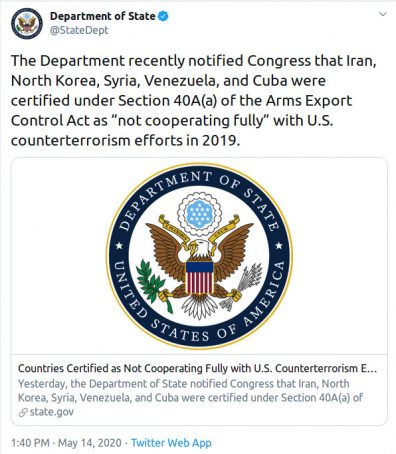
If I could add at this point, the origins are that Venezuela didn’t wish to play ball with Washington anymore, specifically with the DEA back in 2005, squaring the circle of sorts, (or should that be a vicious circle cunningly used by Washington, because who is going to argue with that narrative, aka the war on terror). March: SOUTHCOM’s Adm. Faller: “There will be an increase in US military presence in the hemisphere later this year. This will include an enhanced presence of ships, aircraft, & security forces to reassure our partners… & counter a range of threats to include illicit narco-terrorism.” At the same time, the State dept released this tweet, so the US could effectively carry out boardings under the guise of counterterrorism as well.
While the Iranian tankers were in the Mediterranean, Washington released a (delayed) “Global Maritime Sanctions Advisory”, to the maritime industry, setting out guidelines to shipowners and insurers to enable them to avoid the risks of sanctions penalties related to North Korea, Syria and Iran. This also concerns oil exports from Iran, (but doesn’t apply to Iranian flagged ships). This came after the State Dept gave warning notice to oil companies to stop operations, including Rosneft (Russia), Reliance (India) and Repsol (Spain).
Then NatSouth concluded the following:
Under international law, every merchant ship must be registered with a flag state, which has jurisdiction over the vessel. Hence, this time, the use of Iranian-flagged tankers, as a direct response from Washington’s latest version of restating “maximum pressure” campaign on enforcement of Iran and Venezuela sanctions, (back in Feb, literally the same language as in Aug 2019). There was talk back then of a naval embargo, which would a serious notch up in tensions. There was mention of the 4 U.S. warships in the Caribbean, the U.S. Navy tweeted about, but one the Preble went through the Panama Canal into the Pacific).
Pretty clear, isn’t it?
What the US is doing is substituting itself for the United Nations and it is now openly claiming the right to board any vessel under whatever kind of pious pretext like, say, narco-trafficing, nuclear proliferation, sanctions against so-called “rogue states”, etc. Clearly, the AngloZionists expect everybody to roll over and take it.
How likely is that?
Let’s look at a few Iranian headlines, all from PressTV:
- PressTV, May 16th: “Iran’s fuel shipment to Venezuela guaranteed by its missile power“
- PressTV, May 17th: “US aware Iran will respond ‘very strongly’ if Venezuela-bound ships attacked: Analyst“
- PressTV, May 18th: “Iran: US bears responsibility for any foolish act against tankers heading to Venezuela“
Three days in a row. I think that it is fair to assume that the Iranians are trying very hard to convince Uncle Shmuel not to mess with these tankers. Does anybody seriously believe that the Iranians are bluffing?
Before we look at some of the aspects of this potential crisis, let’s just mention a few things here.
First, the US is acting in total and official illegality. Just like the bombing of Syria, the threats to Iran, or the US murderous sanctions Uncle Shmuel imposes left and right – the blockade of Venezuela is a) totally illegal and b) an act of war under international law.
Second, if USN commanders think they can operate with impunity only because the Caribbean is far away from Iran, they are kidding themselves. Yes, Iranian forces cannot defend these tankers so far away from home, nor can they take any action against the USN in the Atlantic-Caribbean theater of naval operations. But what they can and will do is retaliate against any AngloZionist target in the Middle-East, including any oil/gas tanker.
Third, while Venezuela’s military is tiny and weak compared to the immensely expensive and bloated US military, being immensely expensive and bloated is no guarantee of success. In fact, and depending on how the Venezuelan leadership perceives its options, there could be some very real risk for the USA in any attempt to interfere with the free passage of these ships.
What do I mean by that?
Did you know that Venezuela had four squadrons of Su-30MKV for a total of 22 aircraft? Did you know that Venezuela also had an unknown number of Kh-31A supersonic anti-shipping missiles? And did you know that Venezuela had a number of S-300VM and 9K317M2 Buk-M2E long range and medium range SAMs?
True, that is nowhere near the amount of weapons systems Venezuela would need to withstand a determined US attack, but it is more than enough to create some real headaches for US planners. Do you remember what the Argentinian Air Force did to the British Navy during the Malvinas war? Not only did the Argentinians sink two Type 42 guided missile destroyers (the HMS Sheffield and the HMS Coventry) which were providing long-range radar and medium-high altitude missile picket for the British carriers, they also destroyed 2 frigates, 1 landing ship, 1 landing craft, 1 container ship. Frankly, considering how poorly defended the British carriers were, it is only luck which saved them from destruction (that, and the lack of sufficient number of Super Étendard strike aircraft and Exocet missiles). I would add here that the British military, having been defeated on many occasions, has learned the painful lessons of their past defeats and does not suffer from the cocky-sure attitude of the US military. As a result, they were very careful during the war against Argentina and that caution was one of the factors which gave a Britain well-deserved the victory (I mean that in military terms only; in moral terms this was just another imperialist war with all the evil that entails). Had the Argentinians had a modern air force and enough anti-shipping missiles, the war could have taken a very different turn.
Returning to the topic of Venezuela, war is a much more complex phenomenon than just a struggle of military forces. In fact, I strongly believe that political factors will remain the single most important determinant factor of most wars, even in the 21st century. And chances are that the Venezuelans, being the militarily weaker side, will look to political factors to prevail. Here is one possible scenario among many other possible ones:
Caracas decides that the US seizing/attacking the Iranian tankers constitutes an existential threat to Venezuela because if that action goes unchallenged, then the US will totally “strangle” Venezuela. Of course, the Venezuelan military cannot take on the immense US military, but what they could do is force a US intervention, say by attacking one/several USN vessel(s). Such an attack, if even only partially successful, would force the US to retaliate, bringing US forces closer not only to Venezuelan air defenses, but also closer to the Venezuelan people which will see any US retaliation as an illegitimate counter-counter-attack following the fully legitimate Venezuelan counter-attack.
Then there is the problem of defining victory. In the US political “culture” winning is usually defined as pressing a few buttons to fire off some standoff weapons, kill lots of civilians, and then declare that the “indispensable nation” has “kicked the other guy’s ass”. The problem with that is the following one: if they other guy is very visibly weaker and has no chance for a military victory of his own, then the best option for him is to declare that “surviving is winning” – meaning that if Maduro stays in power, then Venezuela as won. How would the USA cope with that kind of narrative? Keep in mind that Caracas is a city of over two million people which even in peacetime is rather dangerous (courtesy of both regular crime and potential guerilla activities). Yet, for Maduro to “win” all he has to show is that he controls Caracas. Keep in mind that even if the US forces succeed in creating some kind of “zone of real democracy” somewhere near the Colombian border, that will mean nothing to Maduro, especially considering the terrain between the border and the capital city (please check out this very high resolution map of Venezuela or this medium resolution one). As for the notion of a USN landing on the shores of Venezuela, all we need to do is to remember how the immense Hodgepodge of units which were tasked with invading Grenada (including 2 Ranger Battalions, Navy Seals, most of an Airborne Division, etc. for a total of over 7,000 soldiers(!) against a tiny nation which never expected to be invaded (for details, and a good laugh, see here for a full list of participating US forces!) was defeated by the waves of the Caribbean and the few Cuban military engineers who resisted with small-arms fire (eventually, most of the 82AB was calling in to fix this mess).
In other words, if Maduro remains in power in Caracas then, in political terms, Venezuela wins even though it would loose in purely military terms.
This phenomenon is hardly something new, as shown by the following famous quote by Ho Chi Minh: “You can kill ten of my men for every one I kill of yours. But even at those odds, you will lose and I will win.”
By the way, this is exactly the same problem the Empire faces with Iran: as long as the Islamic Republic remains an Islamic Republic it “wins” in any exchange of strikes with the USA and/or Israel.
Still, it is pretty obvious that the US can turn much of Venezuela into a smoking heap of ruins. That is true (just like what the USA did to Korea, Vietnam, Iraq or Serbia and Israel what did to Lebanon in 2006). But that would hardly constitute a “victory” in any imaginable sense of the word. Again, in theory, the US might be able to secure a number of landing locations and then send in an intervention force which could try to take key locations in Caracas. But what would happen after that? Not only would the hardcore Chavistas trigger a guerilla insurrection which would be impossible to crush (when is the last time the USA prevailed in a counter-insurgency war?), but many Venezuelans would expect the US to pay for reconstruction (and they would be right, according to the rules of international law, “once you take it, you own it” meaning that the USA would become responsible for the socio-economic situation of the country). Finally, there is always the option of an anti-leadership “decapitating” strike of some kind. I believe that in purely military terms, the US has the know-how and resources to accomplish this. I do not believe that this option would secure anything for the USA, instead – it would further destabilize the situation and would trigger some kind of reaction by the Venezuelan military both outside and inside Venezuela. If anything, the repeated failures of the various coup attempts against Chavez and Maduro prove that the the bulk of the military remains firmly behind the Chavistas (and the failed coup only served to unmask the traitors and replace them anyway!).
The bottom line is this: if Uncle Shmuel decides to seize/attack the Iranian tankers, there is not only a quasi certitude of a war between the US and Iran (or, at the very least, an exchange of strikes), but there is also a non-trivial possibility that Maduro and his government might actually decide to provoke the USA into a war they really can’t win.
Is Trump capable of starting a process which will result in not one, but two wars?
You betcha he is! A guy who thinks in categories like “my button is bigger than yours” or “super-dooper weapons” obviously understands exactly *nothing* about warfare, while the climate of messianic narcissism prevailing among the US ruling classes gives them a sense of total impunity.
Let’s hope that cooler heads, possibly in the military, will prevail. The last thing the world needs today is another needless war of choice, never mind two more.
Iran’s fuel shipment to Venezuela guaranteed by its missile power
Press TV – May 16, 2020
Iran is shipping tons of gasoline to Venezuela in defiance of US sanctions on both countries in a symbolic move guaranteed by Tehran’s missile prowess.
Unconfirmed reports and tanker monitoring groups suggest that at least five Iranian-flagged tankers are transporting fuel to Venezuela through the Atlantic Ocean despite the US sanctions on both Tehran and Caracas.
Iran has intentionally hoisted its own flag over the huge tankers which are navigating through the Atlantic before the eyes of the US Navy.
Iran is shipping large consignments of gasoline to Venezuela even though the US would try to intercept the shipments and seize the tankers.
There are unconfirmed reports that the US Navy has deployed its USS Detroit (LCS-7), USS Lassen (DDG-82), USS Preble (DDG-88), and USS Farragut (DDG-99) to the Caribbean along with its patrol aircraft Boeing P8-Poseidon for possible encounter with the Iranian vessels.
However, analysts say it is very unlikely that the US makes such a mistake, as it would have serious repercussions for the Trump administration ahead of the November elections.
The US would not dare to seize the Iranian vessels especially after Iran’s reaction to a similar move by the United Kingdom, a close ally of Washington.
Iran also has the upper hand thanks to its missile power, which was shown to the US in the IRGC’s retaliatory missile attacks on the Ain al-Assad Airbase in Iraq, which accommodated American troops.
The US was also reminded of the Islamic Republic’s missile prowess following the recent successful launch of Nour-1 military satellite, which reached its orbit using the Qased satellite carrier. Some Western analysts claim the satellite achievements are a prelude to Iran’s program to develop intercontinental ballistic missiles (ICBMs).
Confident about its missile capabilities, Iran is going on with the gasoline shipment to its ally in Latin America, mocking the US sanctions on the oil sectors of both countries.
The US seems to be between the rock and hard place. While it is unlikely for Washington to dare to intercept the tankers, if they reach their destination safe and sound, it may tarnish the “superpower” forever.
The fuel shipment also shows Iran’s success in turning into an exporter of gasoline after years of importing the fuel.
A senior official in US President Donald Trump’s administration told Reuters on Thursday that the United States was considering measures against Iran in response to the fuel shipment.
The official said Washington has a “high degree of certainty” that the Venezuelan government is paying Iran in gold for the fuel.
If these claims are confirmed, the “fuel for gold” exchange is also a great achievement for the Islamic Republic amid the US’ maximum pressure policy, which deprives the country’s economy of billions of dollars’ worth of oil revenues.
There are reports that Iran is receiving nine tons of gold in exchange for the fuel its ships transport to Venezuela. Under the cruel sanctions imposed by the US after its withdrawal from the 2015 nuclear deal in 2018, nine tons of gold can be a very precious asset for the Iranian economy.
However, we must still wait and see whether the US administration would let the Iranian tankers go and strip Washington of its “superpower” title, or it would dare to intercept the vessels and endanger Donald Trump’s campaign ahead of the November elections.
Earlier in the day, Iranian government spokesman Ali Rabiei said Venezuela and Iran are both independent states that have had and will continue to have trade relations with each other.
“We sell goods and buy goods in return. This trade has nothing to do with anyone else. We have to sell our oil and we have ways to do it,” Rabiei said in reaction to reports of the fuel shipment to the Latin American country.
See also:
US interception of Iran vessel to Venezuela would be ‘completely illegal
Ottawa’s ties with far right Colombian president undermines human rights rhetoric regarding Venezuela

By Yves Engler · May 13, 2020
A week ago a former Canadian soldier instigated a harebrained bid to kidnap or kill Venezuelan President Nicolás Maduro. Launched from Colombia, the plot failed spectacularly with most of the men captured or killed.
Still, the leader of the invasion Jordan Goudreau, a veteran of the Canadian military and US special forces, has been remarkably forthright about the involvement of opposition figure Juan Guaidó. A leaked contract between Guaidó’s representative in Florida and Goudreau’s Silvercorp USA describes plans for a multi month occupation force, which after ousting Maduro would “convert to a National Asset Unit that will act under the direction of the [Guaidó] Administration to counter threats to government stability, terror threats and work closely” with other armed forces. Apparently, Goudreau was hoping for a big payday from Venezuela’s opposition. He also had his eyes on the $15 million bounty Washington put up in March for Maduro’s capture as well as tens of millions dollars for other members of the government.
As the plot has unraveled, Ottawa has refused to directly criticize the invasion launched from Colombia. The military has also refused to release information regarding Goudreau’s time in the Canadian forces. What’s more, since the plot began Canada’s foreign affairs minister has reached out to regional opponents of Maduro and reasserted Ottawa’s backing for Guaidó. The PM also discussed Venezuela with his Colombian counterpart.
The Trudeau government’s reaction to recent events suggest the global pandemic has not deterred them from brazenly seeking to overthrow Venezuela’s government. In a bid to elicit “regime change”, over the past couple years Ottawa has worked to isolate Caracas, imposed illegal sanctions, took that government to the International Criminal Court, financed an often-unsavoury opposition and decided a marginal opposition politician was the legitimate president.
The day after the first phase of the invasion was foiled foreign minister François-Philippe Champagne spoke to his Colombian, Peruvian and Brazilian counterparts concerning the “Venezuela crisis and the humanitarian needs of Venezuelans.” Four days later Champagne tweeted, “great call with Venezuela Interim President Juan Guaidó. Canada will always stand with the people of Venezuela in their desire to restore democracy and human rights in their country.”
On Monday Prime Minister Justin Trudeau spoke with Colombian President Iván Duque Márque. According to the official release, they “discussed the crisis in Venezuela and its humanitarian impact in the region which is heightened by the pandemic. They underscored the need for continued close collaboration and a concerted international effort to address this challenging situation.” Over the past 18 months Trudeau has repeatedly discussed Venezuela with a Colombian president who has offered up his country to armed opponents of Maduro.
The Trudeau government has been chummy with Duque more generally. After he won a close election marred by fraud allegations then Foreign Minister Chrystia Freeland “congratulated” Duque and said, “Canada and Colombia share a commitment to democracy and human rights.” In August 2018 Trudeau tweeted, “today, Colombia’s new President, Ivan Duque, took office and joins Swedish PM, Norway PM, Emmanuel Macron, Pedro Sánchez, and others with a gender-equal cabinet. Iván, I look forward to working with you and your entire team.” A month later he added, “thanks to President Ivan Duque for a great first meeting at UNGA this afternoon, focused on growing our economies, addressing the crisis in Venezuela, and strengthening the friendship between Canada & Colombia.”
But, Duque is from the extreme right — “le champion du retour de la droite dure en Colombie”, according to a Le Soleil headline. The Colombian president has undercut the peace accord the previous (right, but not far right) government signed with the Revolutionary Armed Forces of Colombia (FARC) to end Colombia’s 50-year civil war, which left some 220,000 dead. Duque’s policies have increased violence towards the ex-rebels and social activists. Seventy-seven former FARC members were killed in 2019. Even more human rights defenders were murdered. The United Nations High Commissioner for Human Rights found that at least 107 Colombian, mostly Indigenous, rights defenders were killed in 2019.
Through the first part of this year the pace at which social leaders and demobilized FARC members have been killed has increased. According to the UN observer mission in Colombia, 24 demobilized guerrillas have already been assassinated and a recent Patriotic March report on the “The other pandemic lived in Colombia” details 95 social leaders, human rights defenders and former guerrillas killed in the first four months of 2020.
Trudeau’s dalliance with Duque is difficult to align with his stated concern for human rights in Venezuela.
The same can be said for Ottawa’s failure to condemn the recent invasion attempt. The Trudeau government should be questioned on whether it was involved or had foreknowledge of the recent plot to invade Venezuela.
New Information: Guaidó Was the “Commander in Chief” of the Failed Mercenary Operation Against Venezuela

This document shows the chain of comand. (Council on Hemispheric Affairs)
By Patricio Zamorano | Council of Hemispheric Affairs | May 13, 2020
New information divulged this week reveals that Juan Guaidó was designated as “commander and chief” of the mercenary operation that completely unraveled on the shores of Venezuela. The 41 page contract that formed the basis of the already known eight page General Services Agreement was published by the Washington Post [1] this week.
This more complete document confirms what the mercenary and head of SilverCorp, Inc., Jordan Goudreau, had already revealed to the media: the agreement was aimed at “planning and executing an operation to capture/detain/remove Nicolas Maduro (heretoafter “Primary Objective”) remove the current Regime and install the recognized Venezuelan President Juan Guaido.”

The document provides complete information about the money that would be invested (212 million dollars), and the payments and commissions that SilverCorp would receive from Guaidó’s team, which includes Juan José Rendón, Sergio Vergara and attorney Manuel Retureta.
The document also explains the promised retainer of 1.5 million dollars that Goudreau has been complaining about publicly since the failed operation last Sunday, May 3.
What has not been said: information about the operation was published two days before the attack
There is an important detail that the world press has not analysed. One AP article[2] which details the preparations for the attack was published Friday May 1, two days before the attempt to invade Venezuela was launched from Colombia. The article provides particulars on the presence of three paramilitary groups (deserters from the Venezuelan armed forces and police) in Colombia and explains how this operation had been foiled and aborted. It clearly names Jordan Goudreau, including a profile on the mercenary and many other details about the planned attack. No Colombian nor US authority mobilized to neutralize the illegal paramilitary camps.
This document also appears to confirm that Goudreau, despite the exposure of the planned incursion by the press, still proceeded with the attack, irresponsibly putting at risk the lives of those involved. It also shows that neither US intelligence agencies, nor the Colombian police, nor even Guaidó’s team took action to stop the attack.
One can extrapolate two possible reasons for this. Allowing the operation to move forward, without directly committing to SilverCorp, would show the actual consequences of the operation (whether a success or failure). The operation could also expose the government of Maduro to world criticism if it produced fatalities on one side or the other. What is certain is that all of these scenarios, “whether above or under the table” in the words of Rendón on CNN, were discussed extensively with Guaidó and his advisors with the aim of illegally overthrowing Maduro. Rendón told CNN in Spanish that “they analysed all of the scenarios; alliances with other countries, their own actions, uprisings of people from within, of the soldiers that are there, the eventual use of actors that are outside, retired soldiers. All these scenarios were produced, as the president said well, we are analysing things above and below the table.”[3]
Guaidó was leader of the operations
The most important theme of this story, which the Washington Post does not even mention in its article, is what is described on page 39 of the contract.
Under the title “ATTACHMENT N: CHAIN OF COMMAND,” the document includes the following:
- Commander in Chief – President Juan Guaidó
- Overall Project Supervisor – Sergio Vergara
- Chief Strategist: Juan Jose Rendon
- On Site Commander – To be determined
The page is signed by Guaidó’s advisors and there is a large black box that surely hides compromising information about SilverCorp.

Denial is followed by selective recognition
The evidence is very clear that Guaidó’s team has decided to change its strategy. The first reaction of Guaidó was to deny that he was involved in the disastrous operation[4] in the face of the cost of lives of eight mercenaries, former Venezuelan soldiers, and the capture of numerous paramilitaries, including two US former soldiers. Guaidó’s team however, publicly acknowledged this week their involvement, but they tried to discredit SilverCorp as if it had acted on its own. Nevertheless Rendón recognized that he had paid 50 thousand dollars to the mercenary company[5] of Florida and that his signature on the document is legitimate.
The big question is what will be the response of the legal authorities in the US and Colombia. So far there has been no arrest, despite the fact that all of the details of the operation and the violations of law committed are clear and irrefutable.
In the coming days it will become evident whether the governments of Trump and Duque in Colombia opt for the strategy of impunity. This scandal without doubt weakens in an important way the illegal policy of sanctions and the dirty campaign supported by the hard-line Venezuelan opposition that has broken with the strategy of dialogue that other more moderate anti-Chavista sectors continue to advance in Caracas.
Translation made from the original Spanish by Fred Mills, academic and Co-Director of COHA
End notes
[1] “From a Miami condo to the Veenzuelan coast, how a plan to ‘capture’ Maduro went rogue”, https://www.washingtonpost.com/world/the_americas/from-a-miami-condo-to-the-venezuelan-coast-how-a-plan-to-capture-maduro-went-rogue/2020/05/06/046222bc-8e4a-11ea-9322-a29e75effc93_story.html
[2] “Ex-Green Beret led failed attempt to oust Venezuela’s Maduro”, https://apnews.com/79346b4e428676424c0e5669c80fc310
[3] “J.J. Rendón habla sobre la Operación Gedeón en Conclusiones de CNN en Español”, https://cnnespanol.cnn.com/2020/05/07/j-j-rendon-habla-sobre-la-operacion-gedeon-en-conclusiones-de-cnn-en-espanol/
[4] “Guaidó niega vínculos con intento de invasión en Venezuela”, https://www.chicagotribune.com/espanol/sns-es-coronavirus-guaido-niega-vinculo-intento-invasion-venezuela-20200505-uiditc4i6nbdda3nyx24n26zee-story.html
[5] “J.J. Rendón habla sobre la Operación Gedeón en Conclusiones de CNN en Español”, https://cnnespanol.cnn.com/2020/05/07/j-j-rendon-habla-sobre-la-operacion-gedeon-en-conclusiones-de-cnn-en-espanol/
Venezuela’s Guaido says US mercenary contract is fake, even after own allies give full doc to US media
RT | May 9, 2020
Opposition leader Juan Guaido continues to deny any link to a failed armed incursion into Venezuela, despite his own allies handing over a lengthy contract to American media naming him as the commander of the operation.
The opposition figurehead and self-declared “interim president” of Venezuela denied again on Friday that he had anything to do with the ill-fated mission, which by most accounts was set up by a Florida-based security company, Silvercorp USA, and its American CEO, Jordan Goudreau.
“We reiterate once again that the interim government has no link, commitment or responsibility to Silvercorp or its actions, as well as deny that President Guaido has signed an assumption contract with [the company],” Guaido’s office said in a statement.
Earlier this week, however, the Washington Post published a 41-page document it alleged to be the full multi-million-dollar contract between Silvercorp and Guaido, even noting the document was “provided by Venezuelan opposition officials on the condition that one of the attachments be redacted.” Among its many revelations, the leaked contract clearly lists Guaido as the operation’s “commander in chief,” directly at odds with his repeated claims to the contrary.
While the complete contract does not contain Guaido’s signature, top adviser Juan Rendon has admitted to Reuters that he negotiated the deal, and his name does appear on the contract alongside other senior opposition members. Guaido did apparently sign a shorter “general services agreement,” though that document does not specify what the deal was for.
The failed mission, launched on May 3, saw several dozen armed mercenaries attempt to storm the Venezuelan coast from Colombia in speedboats. The operation fell apart before it could get off the ground, with security forces intercepting the boats and killing eight of the fighters before arresting some 13 more – two of them US citizens and employees of Silvercorp. One of those Americans, Luke Denman, has since stated the mission sought to capture Venezuelan President Nicolas Maduro and bring him back to the US, where he is wanted on “narco-terrorism” charges.
Guaido has offered a very different version of events, however, insisting Maduro fabricated the entire story while calling the leaked contract a fake, meant to generate a “false positive” justification to “kidnap and arrest” members of the opposition. The alternative account, if true, would mean the Washington Post is either working hand-in-glove with Maduro, or was fooled by his operatives posing as opposition figures. Goudreau and Rendon – Guaido’s own adviser – would also have to be in on the conspiracy, as both have corroborated that there was, in fact, a deal with Silvercorp.
US President Donald Trump has rejected claims of American involvement in the incursion plot, stating he would have sent in the military had he wanted to carry out such a mission, though Maduro has repeatedly accused Washington of ordering the operation. Other critics have also voiced suspicions about the timing of the attempted mercenary raid, which came only weeks after the US indicted Maduro on drug trafficking and launched a militarized anti-narcotics mission in the Caribbean Sea – on Venezuela’s doorstep.
China Rejects Illegal, Violent Actions Against Venezuela, Cuba
teleSUR | May 6, 2020
China Wednesday condemned the recent rifle attack at the Cuban embassy in the United States, a mercenary forces’ invasion plan of Venezuela, and all the interventionist maneuvers against the sovereignty of any country.
China’s Foreign Ministry spokeswoman Hua Chunying said that her government firmly opposes any violent action perpetrated against official representations.
She urged Washington to take the necessary measures to protect the Cuban embassy from any damage, as provided for in the 1961 Vienna Convention.
In this way, China joined other nations in the world that repudiated the shooting launched last Thursday against the Cuban embassy in the U.S. capital. The Cuban mission officials suffered no damage, but there were material deteriorations in the building as a result of the attack.
Hua also deplored the attempted maritime invasion of Venezuela by mercenary forces seeking to carry out a coup against President Nicolas Maduro.
She stressed the Chinese government’s rejection of the violation of the sovereignty of the South American country by any means or excuse.
The diplomat called for prioritizing the well-being of the Bolivarian people and promoting the peaceful resolution of the political impasse in Venezuela.
China has been in favor of respecting the United Nations Charter and the basic norms governing international relations in the face of the U.S. policy of hostility towards the Maduro administration.
The Asian nation recently criticized Washington for applying more extraterritorial sanctions to Venezuela, Cuba, and Iran to the detriment of the public health of the people just as the COVID-19 pandemic spreads.
SITREP: Venezuelan Bay of Pig’s while the planet is under lockdown
By Ana | The Saker Blog | May 5, 2020
In the early morning of the 3rd of May 2020, an illegal foreign invasion was intended and aborted in the Caribbean small town named Chuao, in the Aragua State in Venezuela. According to the available information, the invasion was successfully contended by the Venezuelan Militias together with the armed forces in a joint operative.
At the moment, there is not a lot of information available, but it is clear that two US citizens and the son of a high ranked ex-officer of the Venezuelan Army were captured together with six more mercenaries, as informed by TeleSur.
This failed new attempt to topple the government of Nicolas Maduro is apparently linked to the operation which failed on Sunday May 3rd, executed on the coast near Caracas, Macuto which ended with a green beret imprisoned by government agents.
Guaido’s fingerprints are all over the place and were sanctioned by the confession of Silvercorp Jordan Goudreau testifying the existence of a contract between himself and Guaido. As if this confession was not enough, we also have his plea for respect for human rights of Silvercorps mercenaries involved.
Meanwhile in Imperial mainland, many more were made aware of the operations leaving as well all sorts of fingerprints, not difficult to elucidate even for starved and untrained imperial vassals. We have a trace of tweets that preceded the apparently very secret operations of the Silvercorp commands.
1. – Silvercorp itself tweets to The Donald about readiness and high efficiency of the, at that time, still future operation.

2.- Marianella Salazar, former Venezuelan journalist exiled in Miami tweets as well the night before the events.
As well a video showing Goudreau and Nieto, was aired some hours before the attempted invasion:
https://www. facebook.com/MisionVerdadEnVzla/videos/1888201781313396/
Also involved and captured is Josnars Adolfo Baduel, son of General Baduel who was a former close collaborator of Hugo Chavez who later turned on him and joined the coup attempt of April 2002.
While all events keep unfolding and more information is breaking through, we have a modern time Pontius Pilates washing his hands.
Here are some photos of the folks who wanted to invade Venezuela:
Seems like this guy was close to Trump, at least on one photo, maybe a bodyguard or security?
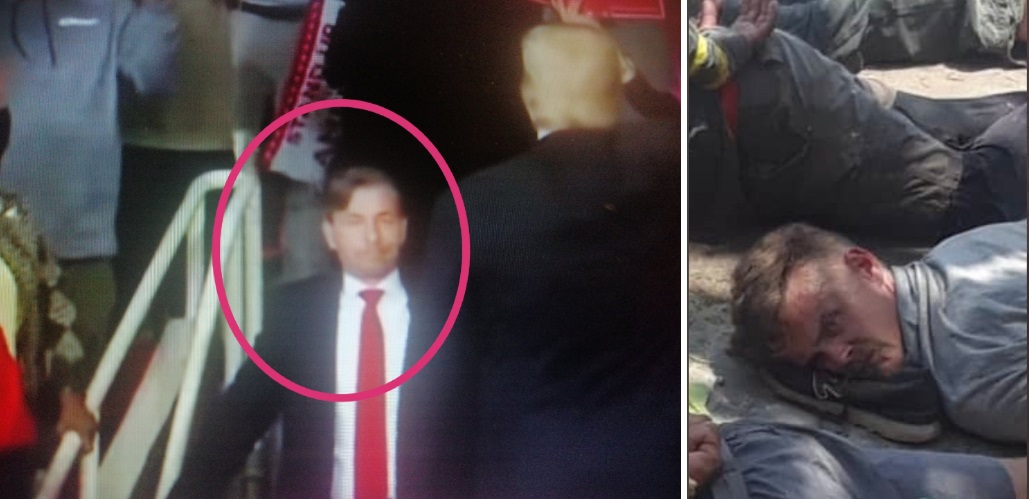
This is a mercenary from the Silvercorp PMC.

Here the caption says “expectations” and “reality”:
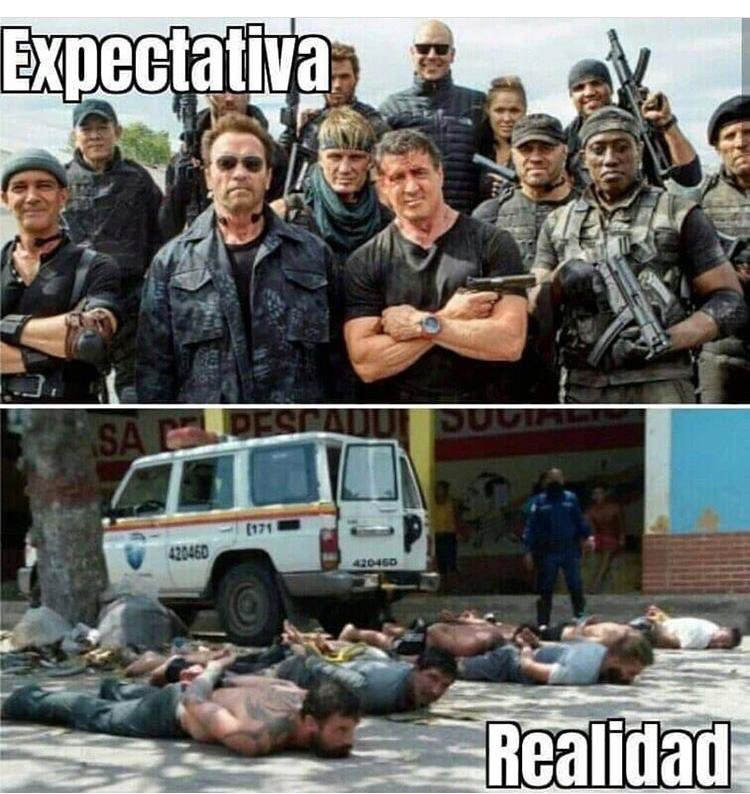
Here is another one of those “invincible” Hollywood special operators:

and here is what they look like in reality:
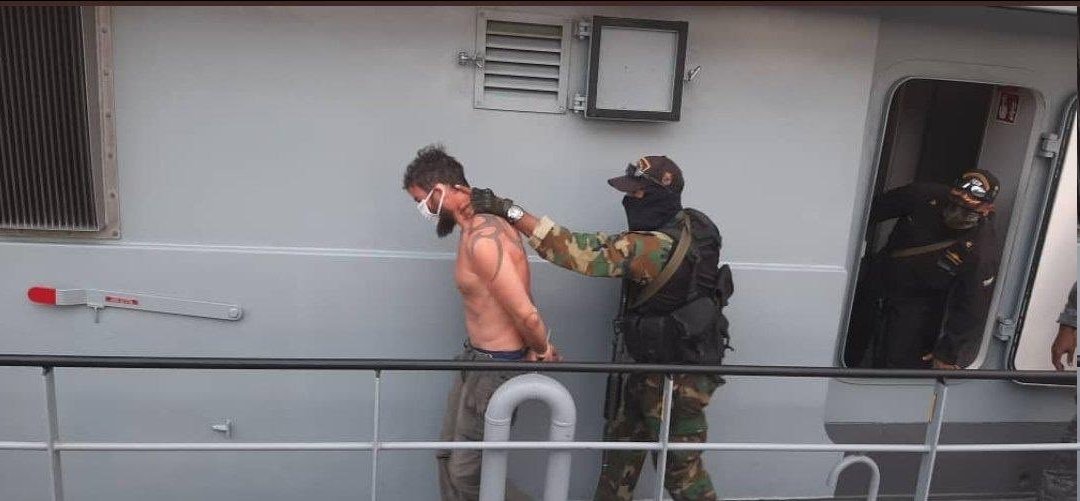
they sure don’t look as cocky now:
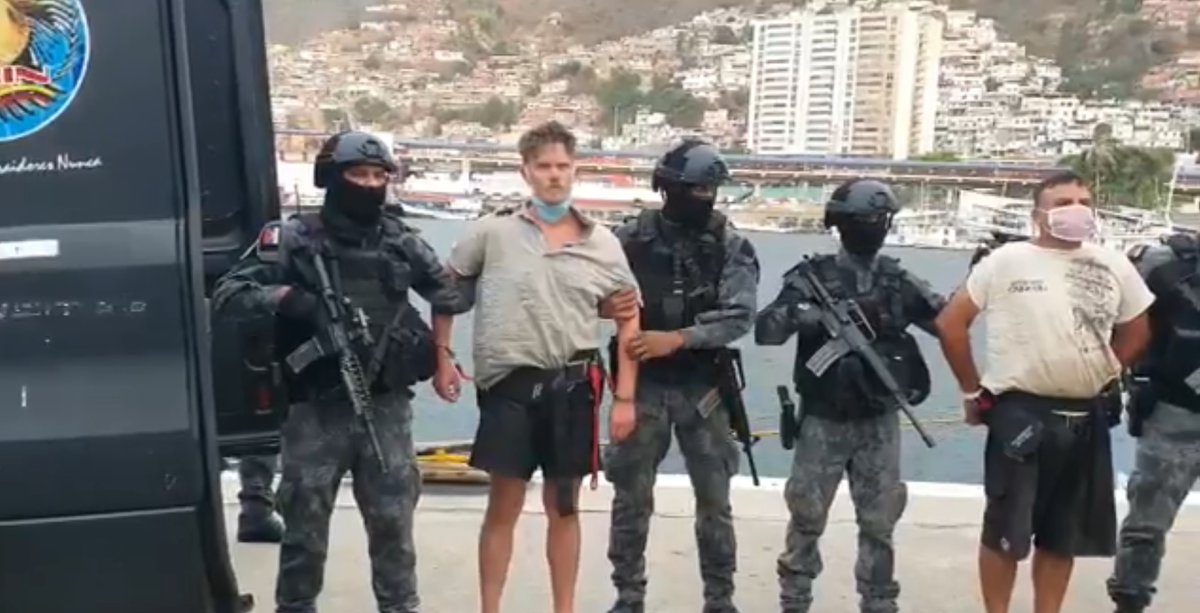
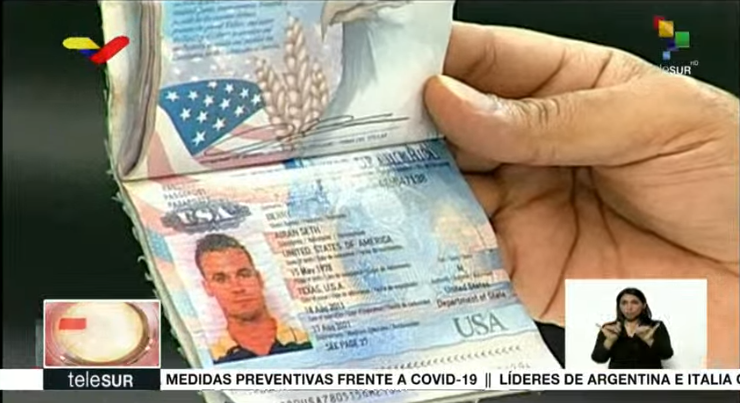
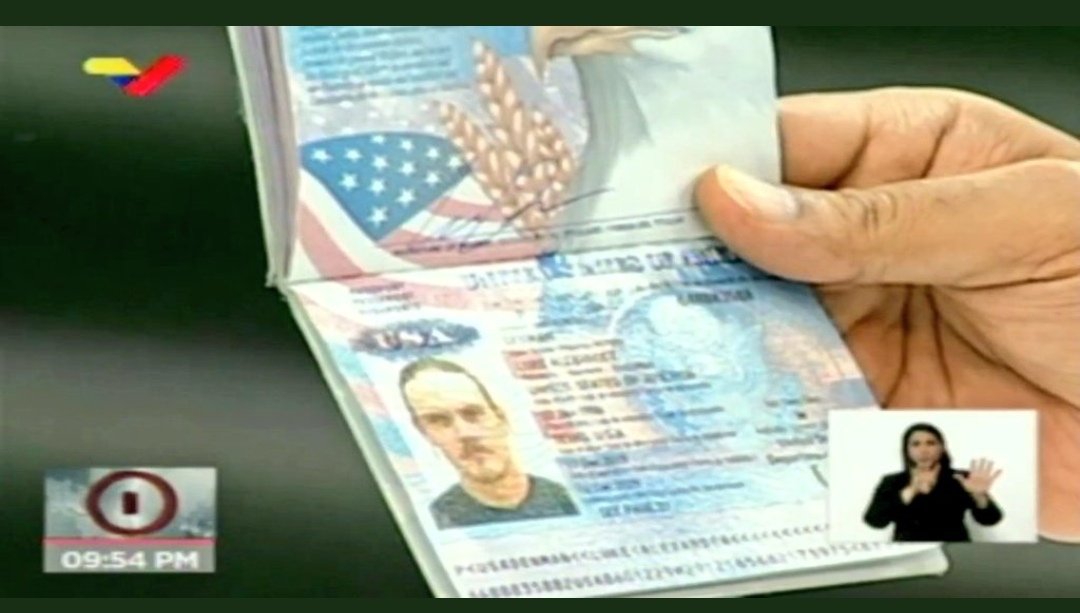
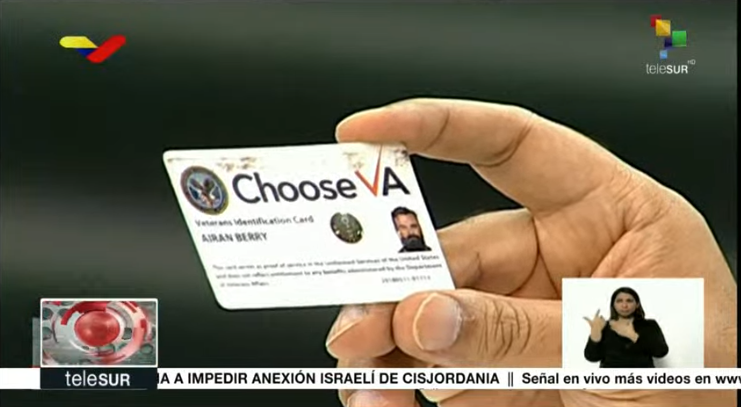
proof of nationality? Sure, these “experts” took their passports with them (!!)
Venezuelan Armed Forces: Paramilitary Incursion Neutralized
By Ricardo Vaz | Venezuelanalysis | May 3, 2020
Mérida – Venezuelan authorities announced they routed an armed group attempting to land on Venezuelan shores on Sunday.
The incident reportedly took place in the early morning hours, with armed men on speed boats approaching coastal La Guaira State, just north of Caracas.
“A group of terrorist mercenaries, organized and trained in Colombia, tried to disembark with war material off the coast of La Guaira,” a statement released by the Bolivarian National Armed Forces (FANB) read.
The statement detailed that intelligence work, as well as defense exercises, allowed the FANB and police units to respond immediately. In the ensuing confrontation, eight members of the paramilitary group were killed, the FANB added, and two were arrested. There are no reports of casualties on the Venezuelan side.
The operation also resulted in the apprehension of military gear and weapons, allegedly matching equipment stolen in the failed April 30, 2019 military putsch. The armed forces likewise revealed that divers are currently being deployed to recover additional weapons and that Navy ships are patrolling the coastline in search of other vessels involved in the incursion.
“The Bolivarian National Armed Forces categorically rejects these irrational acts of violence,” the statement went on to say.
Speaking to the press on Sunday, Interior Minister Nestor Reverol and Defense Minister Vladimir Padrino Lopez said that the defensive operation was ongoing and there could be further arrests in the coming days.
Padrino also announced that a new set of “Bolivarian Shield” military exercises will begin immediately on orders of President Nicolas Maduro.
For his part, National Constituent Assembly President Diosdado Cabello divulged that weapons had been seized on land, including vehicles fitted with machine guns. The location of the equipment was not disclosed. He also claimed that the boats’ GPS trackers indicated they had departed from Colombia.
Sunday’s failed incursion came on the heels of an Associated Press report revealing that former US Special Operations soldier Jordan Goudreau had played a leading role in a plan to invade Venezuela led by retired Venezuelan Major General Cliver Alcala. Goudreau was responsible for training a contingent of 300 Venezuelan army deserters who were to enter Venezuela in a heavily armed caravan and seize the capital within 96 hours.
Both the Venezuelan opposition and the Colombian government were reportedly aware of the plot.
In a video released on social media, Goudreau confirmed that the amphibious landing attempt had been launched from Colombia as part of “Operation Gedeon” and that “other units” were active in the “south, west, and east of Venezuela.” He appeared alongside retired National Guard Captain Javier Nieto Quintero, who claimed that the operation aimed to “capture” high-ranking officials and “liberate” the Venezuelan people.
Nieto spent 18 months in prison starting in 2004 for alleged connections to Colombian paramilitary groups before leaving the country. In a press conference in Florida in October 2019 he announced the creation of a “Military Command,” made up of former officials, with the stated goal of setting up an armed force to back a “transition government.”
A video of purported participants in “Operation Gedeon” was likewise released on Sunday. A man identifying himself as Antonio Jose Sequea, whom Goudreau identifies as the commander of the operation, appears on a beach flanked by heavily armed soldiers. Sequea is additionally seen with a blue armband similar to those worn by mutinous FANB soldiers who took part in last year’s failed April 30 putsch led by opposition leader Juan Guaido.
Among the other soldiers cameoed in the video is National Guard Captain Robert Colina, aka “Panther,” who reportedly died in the operation. In March, the Venezuelan government accused Colina of planning the assassination of top Caracas officials as part of Alcala’s Colombia-based paramilitary activites. Sequea was also identified at the time as a participant in the April 30 coup attempt.
For his part, opposition leader Guaido issued a statement Sunday afternoon dismissing the operation as a “false flag” allegedly perpetrated by the Maduro government. Guaido declared himself “interim president” in January 2019 with US backing but has since faded from the spotlight following repeated failed attempts to oust Maduro.
Guaido has yet to comment on Goudreau and Nieto’s video announcing the military operation.
The former National Assembly president had previously denied any connection to Alcala and Goudreau. For his part, Alcala claimed that a contract had been signed with Guaido, opposition strategist J. J. Rendon, and “US advisors.”
However, Miami-based Venezuelan journalist Patricia Poleo published a document Sunday evening, which she purported to be a copy of the contract. Poleo interviewed Goudreau, who produced a document with Guaido’s signature, which contracts Goudreau’s company Silvercorp to provide services, including “strategic planning,” “equipment procuring” and “project execution advisement,” for a fee of US $212 million.
Poleo also released several audio recordings of an alleged conference call between Guiado, Goudreau, and senior Guaido envoy Sergio Vergara, in which they agreed to sign the contract.
During the interview, Goudreau accused the Venezuelan opposition of not fulfilling their end of the contract, but that the operation (“Gedeon”) had gone ahead.
guaido_goudreau.jpg

Alleged contract signed between Juan Guaido and Jordan Goudreau’s company Silvercorp for $212 million. (@FactoresdePoder)
NYT Blames Maduro for Healthcare Horror, Downplays US Role
By Bryce Greene | FAIR | April 16, 2020
The New York Times (4/10/20) published an article describing the horrendous shape of the Venezuelan healthcare system. The human interest story, written by Julie Turkewitz and Isayen Herrera, followed several women through their nightmarish journey of childbearing in a broken medical system. The piece would be outstanding reporting, had it not fumbled the most important aspect of the story: how and why the system is as bad as it is. In true “manufacturing consent” fashion, the piece downplayed the US role in destabilizing the Venezuelan economy, and instead pointed to President Nicolás Maduro’s “authoritarianism” as the primary cause of the crisis.
The piece appeared on the Times’ front page on Saturday. The section of the piece visible on the front page pointed to Maduro as the cause for Venezuela’s healthcare problem, saying the system had been “crippled by a broken economy overseen by an increasingly authoritarian government.”
The story continued on an inside page, where it finally referenced the US role in creating the desperate conditions. The reporters briefly mentioned that Maduro claimed that US sanctions had some effect, but quickly brushed the claim aside, citing “analysts and critics” who said that Maduro’s charge had “only some weight.”
To back up this dismissal, the authors cited Feliciano Reyna, the founder of a nonprofit known as Action for Solidarity. Reyna blamed the Maduro administration for refusing to accept help from aid organizations. He indicated that despite the sanctions, the country would be able to receive the supplies it needed from those organizations.
However, a few paragraphs later, the piece stated the government had been attempting to receive help through the Red Cross for nearly a year now, throwing Reyes’ criticism into doubt. The contradiction was not addressed by the reporters, and the doublethink was allowed to go unchallenged, even as the piece acknowledged that the Red Cross has been failing to meet Venezuela’s needs, due to a lack of funds, and quoted Venezuela Red Cross leader Louis Farias, who said that their chapter’s call for help “didn’t get the backing [they] had hoped.”
The New York Times omitted other statements from the Red Cross organization that shed more light on the role the US has played. Francesco Rocca, president of the International Federation of the Red Cross, stated publicly last year that he believed that “political will” was behind the lack of funding for Venezuela. He said that there are some who wanted “to use the civilian population, their desperation, as a tool to destabilize the country.” Rocca pointed out that “it is easier to receive funds for Syria and even for Yemen.”
Later in the piece, the reporters cited economist Asdrúbal Oliveros, who claimed that “Mr. Maduro had simply chosen to prioritize the import of oil and food over medicine.” Oliveros believes the calculus was based on the fact that “pregnant women and sick people don’t protest—but that hungry people do.” No explanation was offered for why it’s Maduro’s fault that his administration has been forced to choose between essential resources for his country.
The piece merely calls Oliveros “one economist,” failing to disclose that he has been part of the Venezuelan opposition backing would-be president Juan Guaidó in an ongoing US-backed coup attempt against Maduro. Oliveros was described by the pro-Guaidó publication Americas Quarterly (4/18) as one of the “10 People Who Will (One Day) Rebuild Venezuela.”
The New York Times and other elite media have played an important role in mobilizing the US public against the Maduro government. They have highlighted the very real hardships on the ground, while casting blame for them almost exclusively on the “authoritarian” Maduro government (which, despite media’s constant implications, won an internationally observed election with more than 4 million more votes over the president’s closest rival (FAIR.org, 5/10/19). They consistently downplay the role of US sanctions in contributing to the dire economic situation (FAIR.org, 2/6/19, 6/26/19, 3/25/20).
If the Times were concerned about the fate of the women it profiled, and the state of Venezuelan economy, the paper would direct its readers to the sources of instability for which they bear the most responsibility. US sanctions have decimated the Venezuelan economy, as was predicted by analysts when they were first imposed. One 2019 study from the Center for Economic Policy Research found that the sanctions had indirectly caused the deaths of 40,000. Portraying Maduro as the sole reason for the country’s crisis is factually incorrect and journalistically irresponsible.
US commander claims major naval buildup in Caribbean not aimed at toppling Maduro
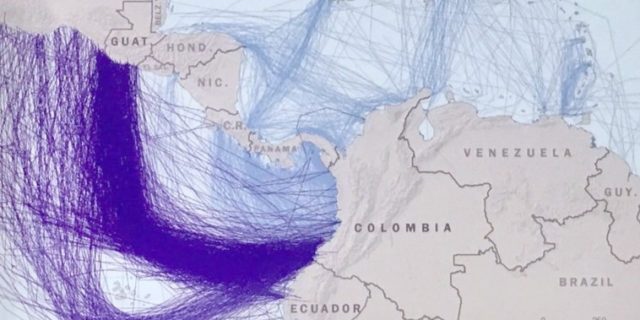
A map produced by the US Southern Command shows that most drug routes enter the US via the Pacific and then Central America (Business Insider)
Press TV – April 19, 2020
The top US military commander for Latin America has claimed that the Navy’s purported expansion of counter-narcotic operations in the Caribbean is not a military force aimed at toppling Venezuela’s President Nicolas Maduro despite Washington persisting provocations against Caracas.
Chief of US Southern Command Adm. Craig Faller asserted in an interview that Washington’s recent decision to double anti-narcotics assets in Latin America was planned months ago and not “directly” tied to Maduro’s indictment in a US court on allegations of leading a “narco-terrorist” conspiracy that supposedly sent 250 metric tons of cocaine a year to the United States.
“This is not a shift in US government policy,” Faller further claimed, despite boasting that enhanced interdiction efforts would harm Maduro’s finances and staying power. “It’s not an indication of some sort of new militarization in the Caribbean.”
The naval deployment announced this month is reportedly one of the largest US military operations in the region since its invasion of Panama in 1989 to topple its president and former CIA operative Gen. Manuel Noriega from power and take him to the US to face drug charges.
The operation involves major war-making resources such as Navy warships, AWACS surveillance aircraft and on-ground Special Forces rarely deployed before in the region.
Faller, however, further claimed that economic and diplomatic pressure — not the use of military force — continue to be Washington’s preferred instruments to oust the Venezuelan president from power.
He then went on to claim that growing instability in Venezuela is leading to an “uptick” in piracy in the Caribbean without citing any statistics or evidence to support his assertion.
Faller also said the recent sinking of a Venezuelan naval ship after it allegedly rammed an Antarctic-hardened cruise ship without passengers near Curacao reflected the readiness of the Venezuelan armed forces.
“It was a bad day for them,” he mockingly said. “Their lack of seamanship and lack of integrity is indicative of how it all played out.”
The hawkish US commander also pointed out that the coronavirus pandemic did force some in the US military to rethink the timing of the current deployment out of concern for the safety of American troops, adding that while controls to protect the workforce have been enhanced, it was determined that over the long term, the US is positioned to take advantage of the disruption in narcotics supply chains caused by the coronavirus outbreak as drug cartels scramble to source precursor chemical and other inputs.
“We thrive in uncertainty and are going to try and capitalize on that,” Faller boasted.
Corporate Media Cover for US Mob Threats Against Venezuela
By Lucas Koerner and Ricardo Vaz | FAIR | April 15, 2020
The Trump administration unveiled on March 31 a “democratic transition” plan to remove Venezuelan President Nicolás Maduro from office, in favor of a “council of state” composed of both opposition and ruling party loyalists.
The plan was, however, less an offer to negotiate than a diktat, with the US State Department (3/31/20) vowing that “sanctions will remain in effect, and increase, until the Maduro regime accepts a genuine political transition.”
Despite the obvious mafioso overtones, Washington’s stenographers in the corporate press were quick to present the initiative as “sanctions relief,” once again whitewashing murderous US economic warfare against Venezuela (FAIR.org, 2/6/19, 6/14/19, 6/26/19).
Western journalists’ callous obfuscation of sanctions’ deadly toll, especially amid a global pandemic (FAIR.org, 3/25/20), goes hand in hand with their parroting of bogus “narco-terrorism” charges leveled against Maduro and top Venezuelan officials, which butresses Washington’s ever-illicit casus belli.
An Offer They Can’t Refuse
The New York Times (3/31/20) jumped at the opportunity to furnish the Trump administration’s plan with a varnish of reasonability. “The proposal…offers to ease American sanctions intended to pressure President Nicolás Maduro and his loyalists over the past year,” Lara Jakes wrote, misconstruing the unilateral measures destroying Venezuela’s economy as well-intentioned steps to bring about “fair elections.”
At no point did the paper of record mention Washington’s threat to ramp up illegal sanctions if Maduro refuses the “offer” to replace his government with a five-person junta, in flagrant violation of Venezuela’s constitution. Other Western media likewise covered up the US blackmail, praising Donald Trump’s bayonet-hoisted ultimatum as a “roadmap to relief” (Washington Post, 3/31/20), a “more toned-down approach” (Reuters, 3/31/20) and a “conciliatory framework” (Economist, 4/2/20).
Having dutifully whitewashed US sanctions, the Times and its counterparts were free to cast war criminal Elliott Abrams, rehabilitated last year as Trump’s Venezuela envoy (CounterSpin, 3/1/19), as an honest broker committed to good-faith dialogue:
But Mr. Abrams was careful to say that the plan was an opening offer for talks between the two sides, “not a take-it-or-leave-it proposition,” and that no single issue was a deal breaker—except the demand for Mr. Maduro’s departure.
By contrast, Maduro—reelected in internationally monitored elections with a greater percentage of the electorate than Trump won in 2016, or Barack Obama in 2012—is for the Times “reminiscent of mid-20th century Latin American strongmen,” whose 2018 victory was “self-declared.”
The Times went on to accuse the Venezuelan leader of “creating one of the world’s largest refugee populations,” concealing the role of criminal sanctions in driving migration (FAIR.org, 2/18/18).
This vilification of Maduro and the Chavista poor people’s movement does not merely reflect reporters’ professional class bias, but is structurally necessary to justify US economic warfare and more overt criminality in the first place.
It is therefore no coincidence that the Trump administration’s gunpoint “proposal” to overturn Venezuela’s constitutional order came on the heels of Department of Justice “narco-terrorism” charges against the Venezuelan head of state and other top officials, which corporate journalists trumpeted enthusiastically.
Most outlets regarded the timing as a symptom of “contradictory” (Washington Post, 4/14/20) or “erratic” (New York Times, 4/10/20) US policy, which could “make it harder to remove Maduro” (Economist, 4/2/20), but the underlying regime change (ir)rationality never comes into question.
Indeed, even liberal imperialist academics like David Smilde and Abraham Lowenthal (Washington Post, 4/14/20) declined to call for scrapping the indictments, let alone easing sanctions, as a goodwill gesture aimed at securing Chavista support for the US plan, which they hailed as a “step in the right direction.” Rather, they merely recommend that the Trump administration offer “guarantees for indicted officials” against extradition, as if Maduro would be inclined to negotiate while Washington continues its collective punishment and maintains a $15 million bounty on his head.
Smilde and his Washington Office on Latin America colleague Geoff Ramsey’s (Washington Post, 3/27/20) refusal to demand the immediate annulment of the drug charges and illegal sanctions is hardly surprising, given both men’s long-running support for US coup efforts (Common Dreams, 3/5/19).

(Left) The NYT found Maduro’s white suit and being flanked by ministers as “reminiscent of dictators” (Right) The WaPo found an unconstitutional plan to remove an elected president on the basis of threats “a step in the right direction”
Calling the Kettle Black
The DoJ’s indictment of 14 current or former senior Venezuelan officials on “narco-terrorism” charges provided the Western media with fresh grist for its imperial propaganda mill.
This is hardly the first time that the corporate media have reported the Washington’s evidence-free drug allegations against official enemies, which they have frequently done without any pretense of journalistic rigor (Extra!, 1/90, 9/12; FAIR.org, 9/24/19, 5/24/19).
The New York Times (3/26/20) dedicated no less than 12 paragraphs to repeating prosecutors’ claims, which are centered on the outlandish notion that Maduro secretly heads a drug cartel that conspired with Colombia’s FARC guerrillas to “‘flood’ the United States with cocaine.”
Despite marshaling a crack team of three writers and four contributing reporters, the Times proved incapable of citing any contrarian perspectives, let alone basic facts, that cast doubt on the “narco-terrorism” narrative.
The Guardian (3/26/20) and the Washington Post (3/27/20) were virtually the only outlets to mention the US government’s own publicly available data showing that just a small fraction of drug routes pass through Venezuela, with the overwhelming majority of cocaine entering the United States via Mexico and Central America. Furthermore, Colombia remains the world’s largest cocaine producer, right under the nose of large US military and DEA contingents, which have long waged a “war for drugs and of terror” in the country.
The DoJ’s case looks like a reheated version of equally unfounded accusations against former President Hugo Chávez, which corporate journalists eagerly promoted last year (FAIR.org, 9/24/19).
A map produced by the US Southern Command shows that most drug routes enter the US via the Pacific and then Central America (Business Insider)
As with prior allegations against Socialist Party Vice President Diosdado Cabello (Wall Street Journal, 5/18/15), the indictments hinge on the testimony of defectors, whose claims are echoed in the Western press without scrutiny.
In the most recent case, retired Maj. Gen. Cliver Alcalá and former intelligence chief Hugo “El Pollo” Carvajal were also charged by the DoJ and pledged to cooperate with US authorities. Both had previously broken with the Maduro government and endorsed self-proclaimed “interim president” Juan Guaidó.
Alcalá, who swiftly surrendered to DEA agents and was flown to the US, boasted of plotting a coup in conjunction with Guaidó and “US advisers.”
In an exposé of the coup plot, the Financial Times (4/4/20) cast doubt on the general’s “rambling and contradictory” account, quoting several US officials denying the coup attempt and alleging Alcalá was “acting on the orders of Caracas.”
The outlet conveniently ignored that this would not be the first time Alcalá conspired to invade Venezuela with a paramilitary force.
According to Bloomberg (3/6/19), there was a plan for the general to lead a contingent of 200 Venezuelan exile soldiers to clear the way for the entry of “humanitarian aid” on February 23, 2019, which was vetoed at the last minute by Colombia, suggesting high-level coordination with Washington, Bogotá and Guaidó.
By repeating the US narrative of Alcalá as a Maduro “plant,” corporate journalists paradoxically legitimize the general as a reliable source of current information on Venezuelan “narco-terrorism,” while concealing his embarrassing ties to the US and its opposition proxies.
As we have exposed for FAIR.org (5/24/19), Carvajal has already proved his worth in the past by serving up to credulous reporters highly dubious allegations about Venezuelan leaders’ Hezbollah ties (New York Times, 2/21/19).
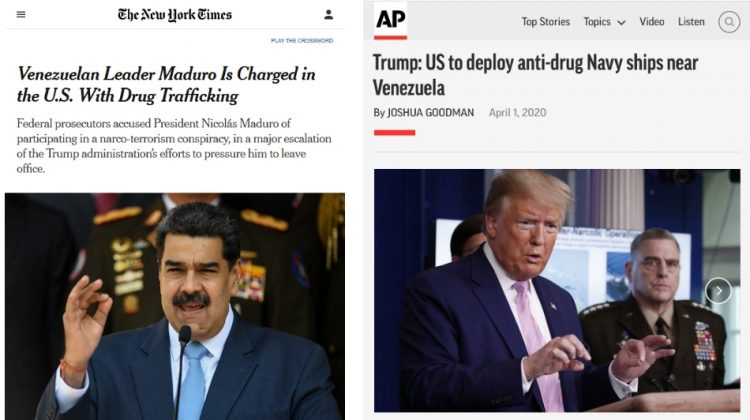
(Left) The NYT (and other outlets) accepted the DoJ’s “narco-terrorism” charges at face value (Right) An AP headline endorsed Trump’s dubious justification for an aggression
Imaginary Cartels, Real Warships
The uncritical coverage of the DoJ charges paved the way for a further US escalation shortly after the “transition” plan was unveiled.
On March 31, the Trump administration announced a military deployment to the Caribbean described by Associated Press (4/1/20) as “one of the largest in the region since the 1989 invasion of Panama.”
One might have expected such an obscenely expensive display of force amid a deadly pandemic currently killing thousands of Americans to be met with widespread rebuke across the media spectrum.
In fact, the opposition was largely muted. Newsweek (4/3/20) and Foreign Policy (4/2/20) gave voice to the Pentagon’s concern that the operation was wasteful and politically motivated, while the New York Times (4/10/20) published an op-ed raising polite proceduralist quibbles. Agreeing with the Trump administration that Maduro is a “dictator” who “must go,” Michael Shifter and Michael Camilleri nonetheless placed a vague call for Washington “to reboot sanctions policy, provide aid through accountable channels, and press the country’s leaders to work together.” Evidently, demanding the immediate lifting of (arguably genocidal) sanctions was too unreasonable to ask.
Referring to the Venezuelan military as “deeply involved in corruption and criminality,” Shifter and Camilleri exemplify the decadent imperial intelligentsia’s psychology of displacement.
From social democratic left to neoliberal right, Global North journalists and intellectuals remain invested in the self-serving illusion that besieged Southern nations such as Venezuela and Iran are more “criminal,” “corrupt” and “authoritarian” than the US empire (FAIR.org, 2/12/20).
For all their polite critiques of illegal US sanctions and military escalation–whose monstrosity has been laid bare by the current pandemic–the cult of Western exceptionalism goes unchallenged.
Venezuelan Leader Pens Open Letter to US Public
teleSUR | April 7, 2020
In a letter issued on Sunday, Venezuelan President Nicolás Maduro warned the administration of U.S. President Donald Trump against making any unwise military decisions against the Bolivarian Republic.
Venezuelan Foreign Minister Jorge Arreaza read a letter on Sunday that Venezuelan President Maduro sent to the people of the United States, following Washington’s recent threats toward the Bolivarian Republic.
In the letter, the head of state indicated that “in Venezuela we do not want an armed conflict in our nation, we cannot accept war threats,” and urged the American people not to believe in the reasons that Trump indicates for attacking Venezuela.
President Maduro urged the people in the United States to not believe Trump’s statements about “fighting drug trafficking”, calling these claims by the U.S. leader false and unfounded.
In the text, President Nicolás Maduro rejected the threats of the Trump administration against Venezuela that seek to lead the region to an expensive, bloody and indefinite armed conflict.
“We in Venezuela do not want an armed conflict in our region. We want fraternal relationships, cooperation, exchange and respect, “he said.
He stated that the country cannot accept war threats, or blockades, nor the intention to install an international guardianship that violates sovereignty and ignores the advances of the last year in the political dialogue between the government and a large part of the Venezuelan opposition.
After showing solidarity with the U.S. people that are suffering from the COVID-19 pandemic, he called on the people of the country to hold their leaders accountable and compel them to focus their attention and resources on the necessary and urgent fight against the pandemic.
Furthermore, he requested the cessation of military threats, the end of illegal sanctions and the blockade that restricts access to humanitarian supplies, which are so necessary today in the country to combat this virus.
“I ask you, with your heart in your hands, not to allow your country to be drawn, once again, to another endless conflict, another Vietnam or another Iraq, but this time closer to home,” the letter highlights.
Featured Video
Racist Seinfeld Dances for Joy as Bibi Unveils His New Map
or go to
Aletho News Archives – Video-Images
TV Drama Review
Japanese drama projects Japan’s wartime atrocities onto Chinese characters

Global Times | October 25, 2026
By portraying Chinese characters as perpetrators of ruthless violence while casting Japanese Self-Defense Forces (SDF) intelligence operatives as defenders, the season 2 of the Japanese drama Vivant has recently drawn criticism from Chinese netizens, who argue that its depiction turns historical reality on its head while ignoring Japan’s wartime atrocities.
The TBS drama series – a spy suspense story in which an alleged unofficial intelligence unit of the SDF operates across the globe — has attracted a passionate fanbase. Its currently airing season 2 opened with a household rating of 18.8 percent, the highest for a TV drama this year, according toa commentary article by Japanese media Toyo Keizai.
What draws attention is the portrayal of the enemies in the series, the article noted. Scenes in which the Chinese organization subjects kidnapped members of the SDF unit to brutal torture are repeated with unrelenting intensity.
It is rare for Japanese TV dramas to explicitly portray a real-life country as the enemy, the article noted.
Japanese Prime Minister Sanae Takaichi also made a reference to the drama, saying that she has been recording Vivant and hopes to binge-watch it over the year-end and New Year holidays, according to Japanese media outlets.
China’s CCTV News report on Sunday revealed that the drama features scenes in which Chinese personnel cut off the fingers of and stab Japanese intelligence operatives in the abdomen. Such acts bear striking similarities to the torture inflicted on Chinese nationals by invading Japanese troops during the World War II.
The drama distorts the truth by attributing these atrocities to modern Chinese characters. Beneath the surface, it subtly glorifies Japan’s cross-border overseas operations, blurs the functional boundaries of the SDF and implicitly promotes an expansionist narrative, per CCTV News. … continue
Blog Roll
 Aletho News
- EU facing trillion-euro debt hole while seeking more cash for Kiev
- How US, Europe, Persian Gulf states exhausted missile stockpiles, splurged billions to defend Israel
- Up in arms… Koreans reject U.S. empire’s plan to make South Korea the next Ukraine
- Iran, Turkey, Pakistan, Saudi Arabia could advance region-led security framework in Tehran: FM spox
- Netizens condemn Japanese drama for projecting Japan’s wartime atrocities onto Chinese characters
- Racist Seinfeld Dances for Joy as Bibi Unveils His New Map
- A West Bank War for Netanyahu’s Election Campaign, Could It Backfire?
- Yemen denounces European Parliament’s ‘hypocritical’ push to blacklist Ansarullah
- Qalibaf: UAE’s UN bid aims to ‘clear the runway’ for ‘Greater Israel’, whitewash genocide
- Pakistan reopens Iran border after boosting security: Report
- If Americans Knew
- An error has occurred; the feed is probably down. Try again later.
- No Tricks Zone
- Sudden Stratospheric Warming, Powerful El Niño Combination May Lead To Extreme Europe Cold, Energy Crisis!
- Two New Studies Find Thwaites Glacier Melt Cannot Be Driven By Human Activity Or A Warming Ocean
- E-Cars Reduce CO2 Emissions By Only 41% Compared To Internal Combustion Engine Vehicles
- Predictions Made By Renowned Climate Professor Over Past Decades Have Been Proven To Be Poor
- New Study Suggests Large Regions Of The Pacific Ocean Have Been Cooling For The Last 80 Years
- Germany’s Green Energy Debacle: High Energy Costs Force Kahla Porzellan to Close After 182 Years!
- New Study: 50 Years Of The Most Aggressive ‘Net Zero’ Policies Can Only Affect The Global Climate By 0.03°C
- US September “Heat” Was No Record…Many Records Set Decades Ago
- Latest European Green Energy Debacle; Portugal’s Largest Flagship Solar Park Insolvent!
- Green Energy Debacle: German Expert Professor Fritz Vahrenholt Warns Of Severe Economic And Social Consequences

