Caracas Bashes UK Court for Seeking ‘to Strip Venezuela of Its International Gold Reserves’
By Oleg Burunov – Sputnik – 03.07.2020
Venezuela’s Foreign Minister Jorge Arreaza has lambasted the British High Court’s move to recognise Venezuelan opposition leader Juan Guaido as the president of the Latin American country.
Arreaza tweeted on Thursday that Caracas “rejects the opinion” of the UK court, which “seeks to strip our country of its international gold reserves at the Bank of England, and will initiate the corresponding legal procedures to appeal such an absurd decision.”
According to Arreaza’s attached press release from the Venezuelan Foreign Ministry, “President Nicolas Maduro […] has requested that Venezuelan judicial bodies initiate the necessary procedures to punish those involved in the theft of Venezuelan gold and to ensure that justice is done.”
The statement comes after the British High Court said in a ruling that the UK government “has unequivocally” recognised Guaido as Venezuelan president, adding that “there is no room for recognition of Mr Guaido as de jure president and of Mr Maduro as de facto president.”
The Central Bank of Venezuela (BCV), in turn, argued that London, which maintains diplomatic relations with Caracas, “recognised” the government of the elected president despite calling him “illegitimate.”
The BCV also cautioned that the UK recognising Guaido would be a violation of international laws and an “impermissible intervention in the affairs of Venezuela”.
Right now, the Bank of England holds about $1.13 billion worth of Venezuelan gold, refusing to give Maduro’s government access to it or transfer the gold to another bank.
In May, the BCV filed a legal claim in a commercial court in London to try to force the Bank of England to transfer Venezuela’s gold reserves to fund the nation’s coronavirus response.
Venezuela’s push to release its frozen gold assets in the UK began after the US and other western countries refused to recognise the results of the 2018 presidential election in Venezuela, in which Maduro secured an overwhelming victory for another term amid an economic meltdown in the country.
After the US slapped a raft of economic sanctions against Venezuela, the South American nation’s financial assets were frozen in a number of foreign countries. The situation worsened after Guaido proclaimed himself interim president contesting Maduro’s claim to the country’s gold assets, including those in the UK.
UK court recognizes Juan Guaido as ‘unequivocally’ Venezuela’s president in legal fight for tons of gold
RT | July 2, 2020
The UK High Court has ruled that Venezuela’s legitimate president is in fact its self-proclaimed leader Juan Guaido, and not the elected Nicolas Maduro, in a bizarre legal battle for $1 billion of gold bullion.
The Bank of England (BOE) holds close to $2 billion of Venezuela’s gold for safekeeping. With both the Venezuelan government and the opposition laying claim to the fortune, the High Court has been tasked with deciding who deserves the funds, and said on Thursday that the UK “unequivocally recognizes” self-proclaimed leader Guaido as president.
“Whatever the basis for the recognition, her majesty’s government has unequivocally recognized Mr Guaido as president of Venezuela,” Justice Nigel Teare said on Thursday. “It necessarily follows that her majesty’s government no longer recognizes Mr Maduro as president of Venezuela.”
Venezuela’s central bank wants the gold back so it can be sold to buy medicine and equipment to battle Covid-19. It has said the funds would be transferred to the United Nations Development Program (UNDP) to ensure it isn’t used for anything else, but the opposition objects to this and claims Maduro wants to use the money to pay off his foreign allies.
Guaido, who has self-identified as the country’s interim president since 2019, with backing from Western nations, claims the gold is his to control and alleged the bank would be “financing torture” if Maduro won. The British government is among more than 50 nations that have recognized Guaido as Venezuela’s leader.
A lawyer for Venezuela’s central bank said that they would appeal the judgement which “entirely ignores the reality of the situation on the ground.”
The BOE rejected Venezuela’s request to withdraw the gold in January, which was reportedly at the request of US officials. This prompted Venezuela’s central bank to file a claim against the BOE in May. Its case points to the fact that the UK Foreign Office maintains full diplomatic relations with the Maduro government, arguing that the UK can’t have these relations while also recognizing someone else as the head of state.
The Venezuelan government first made moves to remove its gold stores after the 2018 election, which Maduro won and the opposition boycotted. Boris Johnson, who was then the foreign minister, said at the time that the UK “may have to tighten the economic screw on Venezuela,” and with further US sanctions placed on the country, its central bank informed the UK bank that it wished to take its gold back.
How Venezuela helped defeat Canada’s Security Council bid

By Yves Engler · June 26, 2020
Was Canada defeated in its bid for a seat on the United Nations Security Council because of Justin Trudeau’s effort to overthrow Venezuela’s government? Its intervention in the internal affairs of another sovereign country certainly didn’t help.
According to Royal Military College Professor Walter Dorn, “I spoke with an ambassador in NYC who told me that yesterday she voted for Canada. She had also cast a ballot in the 2010 election, which Canada also lost. She said that Canada’s position on the Middle East (Israel) had changed, which was a positive factor for election, but that Canada’s work in the Lima Group caused Venezuela to lobby hard against Canada. Unfortunately (from her perspective and mine), Venezuela and its allies still hold sway in the Non-Aligned Movement (NAM or G77).”
The only country’s diplomats — as far as I can tell — that publicly campaigned against Canada’s bid for a seat on the Security Council were Venezuelan. Prior to the vote Venezuela’s Vice-Minister of foreign relations for North America, Carlos Ron, tweeted out his opposition: “With its deafening silence, Canada has de facto supported terrorists and mercenaries who recently plotted against Venezuela, threatening regional peace and security. The UNSC is entrusted with upholding the United Nations Charter and maintaining International Peace and Security: Canada does not meet that criteria.”
The post was re-tweeted by Foreign Minister Jorge Arreaza, who has 1.6 million followers, and numerous Venezuelan diplomats around the world, including the Venezuelan ambassador to the UN. Joaquín Pérez Ayestarán added, “Canada recognizes an unelected, self-proclaimed President in Venezuela, in complete disregard for the will of the voters. It also tries to isolate Venezuela diplomatically & supports sanctions that affect all Venezuelans. Is the Security Council the place for more non-diplomacy?”
After Canada lost its Security Council bid Ron noted, “not surprised with UN Security Council election results today. A subservient foreign policy may win you Trump’s favor, but the peoples of the world expect an independent voice that will stand for diplomacy, respect for self-determination, and peace.” He also tweeted an Ottawa Citizen article titled “Why Black and brown countries may have rejected Canada’s security council bid.”
For his part, UN ambassador Ayestarán tweeted, “losing two consecutive elections to the Security Council of United Nations within a 10-years period is a clear message that you are not a reliable partner and that the international community has no confidence in you for entrusting questions related to international peace and security.”
Over the past couple of years the Trudeau government has openly sought to overthrow Venezuela’s government. In a bid to elicit “regime change”, Ottawa has worked to isolate Caracas, imposed illegal sanctions, took that government to the International Criminal Court, financed an often-unsavoury opposition and decided a marginal opposition politician was the legitimate president.
Canada’s interference in Venezuelan affairs violates the UN and OAS charters. It is also wildly hypocritical. In its bid to force the Maduro government to follow Canada’s (erroneous) interpretation of the Venezuelan constitution Ottawa is allied in the Lima Group with President Juan Orlando Hernandez, who openly defied the Honduran Constitution. Another of Canada’s Lima Group allies is Colombian President Ivan Duque who has a substantially worse human rights record.
Reflecting the interventionist climate in this country, some suggested Canada’s position towards Venezuela would actually help it secure a seat on the Security Council. A few weeks before the vote the National Post’s John Ivison penned a column titled “Trudeau’s trail of broken promises haunt his UN Security Council campaign” that noted “but, Canada’s vigorous participation in the Lima Group, the multilateral group formed in response to the crisis in Venezuela, has won it good notices in Latin America.” (The Lima Group was set up to bypass the Organization of American States, mostly Caribbean countries, refusal to interfere in Venezuela’s affairs.) A Canadians for Justice and Peace in the Middle East factsheet regarding “Canada’s 2020 bid for a UN Security Council seat” echoed Ivison’s view. It claimed, “Canada also presents a positive image to Latin American states, likely reinforced by its leadership of the Lima Group in 2019 and by its promise to allocate $53 million to the Venezuelan migration crisis.”
While it is likely that Lima Group countries voted for Canada, a larger group of non-interventionist minded countries outside of that coalition didn’t. Venezuelan officials’ ability to influence Non-Aligned Movement and other countries would have been overwhelmingly based on their sympathy for the principle of non-intervention in other countries’ affairs and respect for the UN charter.
The Liberals’ policy towards Venezuela has blown up in its face. Maduro is still in power. Canada’s preferred Venezuelan politician, Juan Guaidó, is weaker today than at any point since he declared himself president a year and a half ago. And now Venezuela has undermined the Liberals’ effort to sit on the Security Council.
Will Canada’s defeat at the UN spark a change in its disastrous Venezuela policy?
Drifting at Sea: Tankers With Venezuelan Oil Reportedly Unable to Unload Over Threat of US Sanctions
Sputnik – 24.06.2020
Reuters has quoted unnamed industry sources as saying that at least 16 tankers with a total of 18.1 million barrels of Venezuelan oil on board are stuck at sea across the world amid buyers’ fears to contact the vessels to avoid being hit by US sanctions.
The cargo is reportedly the equivalent of nearly two months of Venezuela’s current oil output rate.
“This is our third attempt to find a buyer”, according to a source from an oil firm registered as customer of the national oil and gas company Petroleos de Venezuela (PDVSA).Most of the tankers, which were en route to Malaysia, Singapore, Indonesia, or Togo have been at sea for over six months and have failed to unload due to the threat of sanctions.
Some vessels are reportedly managed by the Amsterdam-based company GPB Global Resources, which was cited by Reuters as saying that they are “conducting business in compliance with all applicable rules and regulations, including US sanctions”. PDVSA and the Venezuelan Oil Ministry have not commented on the matter yet.
The developments come after The Wall Street Journal (WSJ) reported earlier in June that the US Treasury Department’s Office of Foreign Assets Control (OFAC) wants to add up to 50 tankers to its blacklist for cooperation with Venezuela’s President Nicholas Maduro.
This followed the US slapping Venezuela-related sanctions against four entities and four oil tankers sailing under the flags of Panama, Bahamas, and the Marshall Islands.
The sanctions were preceded by Iran sending five fuel tankers to Venezuela in May and pledging more supplies if requested. All ships received a military escort after the US said that it was considering options for responding to the deliveries, which violate Washington’s sanctions imposed on both countries.
Venezuela’s Foreign Minister Jorge Arreaza, for his part, said at the time that the tracing and tracking of fuel tankers entering Venezuelan waters constituted a violation of international law.
US Sanctions Against Venezuela
The Trump administration started introducing heavy economic sanctions against Venezuela’s economy in 2018 in a bid to oust President Maduro and replace him with opposition leader Juan Guaido, supported by Washington.
Washington then moved to freeze the US-based assets of PDVSA as part of its efforts to sanction the South American nation. Caracas condemned the move, saying that it was unlawful and accused the Trump administration of seeking to get its hands on the nation’s oil reserves.
The subsequent shutdown of many PDVSA refineries forced Venezuela to consider importing fuel supplies to cover its domestic shortage.
Biden And His Ventriloquists Keep Out-Hawking Trump
By Caitlin Johnstone | June 22, 2020
Joe Biden keeps trying to out-warmonger Donald Trump, and by Joe Biden I of course mean the team of handlers who are animating the dementia-ravaged corpse of the Biden campaign like a ventriloquist operating a wooden dummy.
In response to Trump suggesting an openness to scaling back his administration’s murderous Venezuela policy and meeting with President Nicolás Maduro, whoever runs Biden’s Twitter account for him seized upon the moment to assert that the former vice president will be doing no such thing if elected commander-in-chief.
“Trump talks tough on Venezuela, but admires thugs and dictators like Nicolas Maduro,” tweeted Biden Incorporated. “As President, I will stand with the Venezuelan people and for democracy.”
“Translation: if Trump retreats from his current policy of trying to sanction and suffocate Venezuela into submission, Biden will make sure to revive it,” journalist Aaron Maté said in response.
“To be clear, Joe Biden is now attacking Donald Trump from the right on Venezuela,” said journalist Walker Bragman.
As FAIR’s Alan MacLeod accurately observed last year, this phrase “the Venezuelan people” is only ever invoked by the political/media class of the US-centralized empire for sloganeering purposes in support of US-led regime change interventionism in that nation, despite an overwhelming majority of Venezuelans opposing all US interventionism including sanctions.
This tactic of attacking Donald Trump for being insufficiently warlike is nothing new for Biden Inc, nor is it limited to Venezuela.
During the primary debates Biden attacked Trump for being insufficiently hawkish toward North Korea, claiming the president was wrong to meet with Kim Jong Un because it gives the leader “legitimacy”, whatever that means.
An April Biden campaign ad accused the president of being too soft on China by failing to force Beijing to allow US government officials into Wuhan to monitor the governing of a sovereign nation during a pandemic outbreak.
“Trump praised the Chinese 15 times in January and February as the coronavirus spread across the world,” says the ad’s narrator in an ominous voice. “Trump never got a CDC team on the ground in China. And the travel ban he brags about? Trump let in 40,000 travelers from China into America after he signed it. Not exactly airtight.”
Biden has attacked Trump’s partial troop withdrawal from Syria, using talking points from the so-called war on terror to absurdly claim during a primary debate that the president is putting America at risk of a terrorist strike from ISIS.
“We have ISIS that’s going to come here,” Biden said. “They are going to damage the United States of America. That’s why we got involved in the first place.”
And of course Biden & Co have been attacking Trump for being too soft on Russia, despite this administration’s many, many dangerously hawkish new cold war escalations against Moscow.
“We need a President who will stand up to the Kremlin, push back against Putin, and take immediate steps to ensure the security of our elections,” Biden’s Twitter account said last year.
This line of attack is so ubiquitous in the Biden campaign that it sometimes just takes the form of a vague, general swipe at Trump’s unwillingness to be more warlike, with an April tweet reading simply “Donald Trump says he’s a wartime president — it’s time for him to act like one.”
Again, this is Donald Trump these people are talking about. The same president who imprisoned Julian Assange for exposing US war crimes, killed tens of thousands of Venezuelans with starvation sanctions, vetoed attempts to save Yemen from US-backed genocide, is working to foment civil war in Iran using starvation sanctions and CIA ops with the stated goal of effecting regime change, nearly started a full-scale war with Iran by assassinating its top general, occupied Syrian oil fields and implemented devastating sanctions with the goal of preventing Syria’s reconstruction, greatly increased the number of troops in the Middle East and elsewhere, greatly increased the number of bombs dropped per day from the previous administration, killing record numbers of civilians, and reduced military accountability for those airstrikes.
The second-to-last thing the world needs is political pressure placed on Donald fucking Trump to be more warlike. The very last thing the world needs is a US president who ends up being even more warlike than Trump.
America is a war machine on top of a police state on top of a mass media psyop. Only people who are willing to keep these psychopathic mechanisms in place are permitted to ascend to presidential candidacy. While all the news cameras focus on the relatively minor differences between presidents and presidential candidates, you can learn a lot more about America and what drives it by looking at their similarities.
Trump slams Guaidó while expressing openness in speaking with Maduro
By Paul Antonopoulos | June 22, 2020
In what potentially could be a radical change in Washington’s policy towards Venezuela, U.S. president Donald Trump confessed that he has had doubts about his decision to recognize opposition leader Juan Guaidó as president of the South American country. Trump revealed in an interview with Axios in the Oval Office what he thinks about the self-proclaimed wannabe president of Venezuela, Guaidó, and even confessed that he “would maybe think” of meeting personally with Venezuelan President Nicolás Maduro, who has already publicly expressed his willingness to talk with the American president.
“Maduro would like to meet. And I’m never opposed to meetings — you know, rarely opposed to meetings. I always say, you lose very little with meetings. But at this moment, I’ve turned them down,” Trump said.
In a preview of the interview published by Axios, Trump revealed how little confidence he has in Guaidó because the politician failed to take control of the Venezuelan government despite the strong support provided by the U.S. and another 60 countries that recognize him as the legitimate president.
Asked by Axios whether he regretted his decision on backing Guaidó on the advice of John Bolton, his former National Security Advisor, Trump initially said “not particularly,” but then went on to say, “I could have lived with it or without it, but I was very firmly against what’s going on in Venezuela.”
In another part of the interview, Trump speaks directly of the moment when he decided to recognize the opposition leader as president: “Guaidó was elected. I think that I wasn’t necessarily in favor, but I said — some people that liked it, some people didn’t. I was OK with it. I don’t think it was — you know, I don’t think it was very meaningful one way or the other.”
Also, in the preview, Axios quoted a fragment of Bolton’s upcoming book The Room Where It Happened, where he reveals some behind the scenes diplomacy of the Trump Administration and the private feelings the president has about Guaidó. Bolton says that Trump “thought Guaidó was ‘weak,’ as opposed to Maduro, who was ‘strong’” and that “Trump was calling Guaidó the ‘Beto O’Rourke of Venezuela,’ hardly the sort of compliment an ally of the United States should expect.” O’Rourke, who was a Democratic Presidential Candidate and is one of Trump’s biggest critics, was called a “poor bastard” who “quit like a dog” by the American president, a demonstration of just how low Trump thinks of Guaidó.
Trump in the interview described Bolton as a “nutjob” who may be the “dumbest human being on Earth.” Trump could perhaps seek to slowly normalize relations with Maduro and move away from Guaidó, while placing the blame entirely on Bolton for the escalation of hostilities between Washington and Caracas.
In 2019, shocking events were triggered when Guaidó proclaimed himself president. An attempt to forcibly enter a shipment of “solidarity aid” into Venezuela from Colombia that likely had weapons was made; Venezuela suddenly was without electricity after a cyberattack; there was another coup attempt; and, many attacks on military barracks. Yet, Maduro survived the intense pressures from the U.S. and sixty of its allies.
The American President is known to admire authoritarianism and/or strong leaders. Despite sanctions, coup attempts and threats of military invasion, Maduro has not only survived the U.S.-led destabilization, but cemented his positions as leader of Venezuela. Although they may be adversaries, it would not be a wild claim to say that Trump admires Maduro’s strength and determination, especially as Guaidó utterly failed when he had every advantage afforded to him.
If someone had said in 2019 that just a year later Venezuela would not only be more stable than the U.S. when we consider the Black Lives Matter uprising in the aftermath of the George Floyd murder, but would also achieve a seat in the UN Human Rights commission, no one would have believed it.
The U.S. could not allow 2019 to confirm the decline of its dominance over Latin America. With the defeat it suffered in Venezuela, the return of Cristina Kirchner in Argentina and the breakdown of neoliberal governments in the region, Washington had to resort to coups to protect its interests, as seen in Bolivia.
Venezuela now has a fragmented opposition to Maduro that is immersed in an internal war. At this point, Guaidó is not guaranteed to be re-elected as president of the National Assembly. For the U.S. however, it does not matter who occupies that position so long as they are serving Washington’s agenda. The so-called Deep State in the U.S. remains pitifully unchanged in their policy to destroy the existence of sovereign governments in the region. However, is Trump attempting to break free of such war hawks by expressing an openness to speak with Maduro? Although Trump may have individual opinions on not wanting to challenge Venezuela, despite public rhetoric, he will be restricted by the main power structures that exist in the U.S. and push for complete dominance no matter the administration in power and what they want to achieve.
Paul Antonopoulos is an independent geopolitical analyst.
Bank of England Set to Decide Who Venezuela’s President is. How Did It Come to This?
Sputnik – 21.06.2020
What was a typical withdrawal request from a customer to a depository bank has turned into a political controversy, given that the government that owns the bank does not recognise the customer.
London’s High Court is scheduled to hear an unprecedented case on Monday regarding Venezuela’s attempts to extract its gold bullion from the Bank of England.
Venezuela’s central bank (BCV), controlled by the government of Nicolas Maduro, has around $1.8 billion worth of gold at the Bank of England. BCV has recently demanded that €930 million ($1.04bn) in gold be released to help Caracas fight the coronavirus outbreak.
The heavily-sanctioned Latin American country is among the 135 nations with beleaguered public health systems which are attempting to secure vital medical supplies under a major initiative led by the United Nations Development Programme.
BCV had wanted to transfer the proceeds from selling the gold directly to the UNDP to acquire medical equipment, medicines and foodstuffs, but the Bank of England “refused to confirm” that it would hand over the bullion, according to court documents filed last month. BCV in response launched legal action.
The UK government, which wholly controls the bank, does not recognise President Nicolas Maduro and backs the self-declared interim president, Juan Guaido. The UK-held assets of two dozen Venezuelan officials linked with Maduro, but not those of BCV, have been frozen.
The Bank of England denied a similar request for the withdrawal of gold in November 2018; at the time, a cabinet minister said that dealing with a customer’s request is up to the bank and not to the government.
Guaido, who appointed a parallel board of BCV directors, last month warned that the bank would effectively be “financing torture” in Venezuela if it honoured its obligations. His lawyers argue that a decision to release gold should be taken by Venezuela’s legislature rather than by the central bank. They also question whether the BCV board has a buyer lined up for the gold.
Lawyers representing BCV maintain that the request in question is meant to deal with a public health emergency and that the Bank of England’s lack of action is “putting lives at risk”.
“Venezuela has been denied access to its resources during an international crisis,” said London-based lawyer Sarosh Zaiwalla. “In effect, the nation’s gold reserves in the BoE are being held hostage to political factors dictated by the foreign policy of the United States and certain of its allies.” The high court ruling is expected before the end of July.
US Rejects Venezuela Legislative Elections as TSJ Intervenes in Two Opposition Parties
By Ricardo Vaz and Lucas Koerner – Venezuelanalysis – June 17, 2020
Mérida – The US State Department has voiced opposition to upcoming parliamentary elections in Venezuela.
In a press statement published on Monday, Secretary of State Mike Pompeo criticized the recent Supreme Court (TSJ) appointment of a new electoral council (CNE).
“The regime has selected a CNE that will rubber-stamp its decisions and ignore the conditions required for free elections,” the statement said, adding that “elections that represent the will of the people are impossible.”
The Trump administration has repeatedly refused to recognize any elections while President Nicolas Maduro remains in office. In March, the State Department released a “transition” plan with a five-person “Council of State” assuming power and convening presidential and legislative elections. Washington has vowed to ramp up sanctions until Caracas accepts the deal.
The Venezuelan Supreme Court swore in a new CNE on Friday, with former TSJ justice Indira Alfonzo assuming the presidency. While Venezuelan law mandates that the CNE be chosen by a two-thirds majority of the National Assembly (AN), the judicial body stepped in following a request from minority opposition parties in order to guarantee elections this year. The TSJ had also appointed the CNE in 2003, 2005, and 2014 when the AN failed to secure the necessary majority.
AD ruling
Pompeo’s statement came amid another pair of controversial rulings by the high court.
On Monday, the TSJ suspended the current leadership of Venezuela’s largest opposition party, Democratic Action (AD), and named a new ad hoc one headed by former Amazonas State Governor Bernabe Gutierrez.
The brother of newly-appointed CNE Rector Jose Gutierrez, Bernabe Gutierrez previously served as the party’s national secretary before he was expelled by AD Secretary General Henry Ramos Allup on Monday for “conspiring” with President Nicolas Maduro to participate in the upcoming elections. The TSJ order provisionally anulls all party expulsions and exclusions.
Ramos Allup lashed out at the move as a “robbery,” challenging Gutierrez to “come here and take [the headquarters of] Democratic Action.”
For his part, Gutierrez released a statement accusing the ex-secretary general of operating a “regime of terror” and announcing a new era of “internal democracy, of the right to opine, to dissent… without fear of being expelled.” The party leader additionally confirmed that AD would participate in parliamentary elections later this year, which Ramos Allup had previously announced in March.
Ramos Allup has long been infamous for authoritarian leadership style and hostility to elections, with US State Department cables describing the party under his tenure as not only “extremely vertically organized” but “dictatorial.”
Hard-right opposition figures have, however, denounced the standoff within Democratic Action as staged, accusing Ramos Allup of ordering Gutierrez to negotiate with the Maduro government in his stead out of fear of US sanctions.
In 2017, the AD boss announced that four governors from the party had “expelled themselves” after they swore in before the National Constituent Assembly. The elected officials remain members of AD to this day.
PJ ruling
The TSJ ruling was followed by a similar one on Tuesday suspending the leadership of the right-wing Justice First (PJ) party. National Assembly Deputy Jose Brito, who broke with opposition leader Juan Guaido over a series of mutual corruption allegations late last year, was named national coordinator of the party. Following his expulsion from PJ in December, the lawmaker filed a TSJ motion for his reinstatement, claiming that his exclusion was “illegal” and demanding internal party elections.
Brito has likewise confirmed that PJ will participate in AN elections, stating that the majority of the party rank-and-file “want to go to elections.”
PJ’s national coordinator Julio Borges blasted the attempt to “steal” the party, adding that the party is “united and in high spirits, with the goal of restoring freedom to Venezuela.” Borges, who serves as opposition representative before the Lima Group, is sought by Venezuelan prosecutors for his alleged involvement in the 2018 assassination attempt against President Nicolas Maduro.
EU weighs in
The European Union also released a statement criticizing the CNE appointment and TSJ rulings.
“These decisions reduce the democratic space in the country to a minimum and create additional obstacles to the resolution of the profound political crisis in Venezuela,” the statement read, before urging the Venezuelan government and opposition to “engage in meaningful and inclusive negotiations” concerning the CNE and electoral participation.
In response, President Maduro blasted the EU’s “colonialist vision” and urged the body to “leave Venezuela alone.”
“Venezuela will have its elections. We do not care about the European Union,” he said in a televised address on Monday.
On Tuesday, Maduro held a conference call with members of the ruling Socialist Party (PSUV), urging the party to nominate fresh candidates for AN elections, to open the door to grassroots candidates and strengthen alliances with other parties.
Opposition leader Juan Guaido, who declared himself “interim president” last year with the support of Washington, has vowed to boycott the elections, proposing to extend the opposition-controlled AN’s mandate through 2021.
Under Venezuela’s constitution, legislative elections must be held before the end of the year.
Venezuela’s US-backed opposition probed over links to terrorism
By Jesús Silva | Press TV | June 19, 2020
Caracas – Over the past few days, the US-backed Venezuelan opposition parties have been hit by decisions of the country’s Supreme Court of Justice.
The court has ordered an investigation into one party’s possible links to terrorism while appointing new heads for three other parties.
Voluntad Popular, the main opposition party, which is related to politicians Leopoldo López and Juan Guaido, is now being investigated over possible involvement in acts of terror and may be declared a terrorist group by the Judiciary in the upcoming days.
By the same token, Primero Justicia, Acción Democrática and UNT, three of the largest political organizations who oppose President Nicolas Maduro, were sued by many of their own members over impeding internal elections. The nation’s top Court responded by appointing new provisional authorities for the parties and ordering internal elections to be held as soon as possible.
The opposition says the judges are politically biased and some have described the move as an attempt by the government to bring the National Assembly under its control.
However, the court says the decisions were part of a necessary restructuring process. Some say the rulings are all based on the facts and the rule of law.
Persident Maduro has once again accused opposition parties of robbing Venezuela of its wealth and plotting a foreign invasion to end his socialist government.
This year’s parliamentary elections are being organized by Caracas despite Washington’s meddling and boycott threats from the US-backed opposition. Experts say that the socialist ruling party has a good chance of winning the vote since the opposition is divided.
Iran surges in Venezuela in defiance of US sanctions
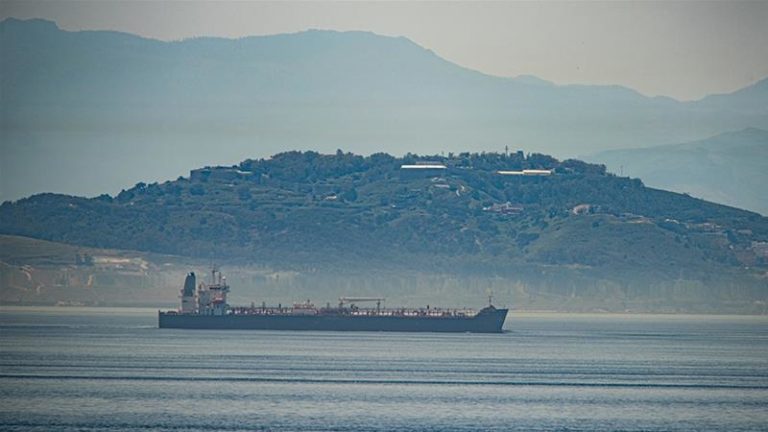
Iranian oil tanker Clavel crossing the Gibraltar stretch heading for Venezuela, May 20, 2020
By M. K. BHADRAKUMAR | Indian Punchline | May 25, 2020
Escorted by the Venezuelan navy and air force, an Iranian oil tanker named Fortune has entered that country’s waters on Sunday, amidst intense speculation whether the US would interfere with the delivery. The US has imposed oil sanctions against Venezuela and Iran and had said it is monitoring the Iranian tanker.
In fact, five Iranian tankers carrying about 1.5m barrels of fuel passed through the Suez Canal earlier this month, according to shipping data on Refinitiv Eikon, and were heading for Venezuela. The other four Iranian tankers — Forest, Petunia, Faxon and Clavel — are approaching the Caribbean en route to Venezuela.
A flotilla of US Navy and Coast Guard vessels is patrolling the Caribbean Sea on a mission to counter illicit drug trafficking. But the Pentagon has stated that there are no plans to stop the Iranian tankers.
At the same time, a Pentagon spokesman, Jonathan Hoffman, while saying on Thursday he was not aware of any operations related to the Iranian cargoes, also added, “We have continued to say that Iran and Venezuela – both two outliers in the international order – [are] clearly violating international sanctions on both nations with this transaction.”
The US sanctions on Venezuela are aimed at increasing pressure on President Maduro to step down. Thus, arguably, Iran is frontally challenging the Trump administration’s stated policy of ‘regime change’ in Venezuela. The Iranian move comes just three weeks after the abortive coup attempt masterminded by the White House on May 1 with the participation of two former US Green Berets aimed at capturing Maduro and transport him to the US in American helicopters to be put on trial on fake drug trafficking charges.
The coup attempt showed the extent of desperation in Washington to overthrow the Maduro government before the US presidential election in November, which President Trump hopes would help him garner Hispanic votes. Iran has now offered a lifeline to Venezuela.
In an historical context, this becomes a frontal assault by Iran on the Monroe Doctrine dating back to the 19th century, which in US foreign policy calculus regarded the Western Hemisphere as its sphere of influence. According to a Reuters report, the Trump administration said earlier this month it was “considering measures” it could take in response to the Iranian shipments, without providing specifics.
No doubt, this is a deliberate sanctions-busting enterprise by Iran. Venezuela desperately needs fuel for up to 1,800 gasoline stations that have been partially closed for weeks due to insufficient supply from state-run refineries.
Venezuela’s gasoline output is now limited to a single facility, the Amuay refinery, but most fuel produced is low octane as most of the country’s alkylation units are out of service. Imported alkylate could improve the quality of domestic gasoline. Venezuela’s refineries are in poor condition. Shipments of equipment in flights by Iran’s Mahan Air have arrived in Venezuela in recent weeks to start repair work.
It will be interesting to see whether the US Navy would interdict any of the other four Iranian tankers before they enter Venezuelan waters. Tehran has sternly warned the US that it would retaliate if any such attempt is made. On Saturday, Tehran raised the ante with President Hassan Rouhani explicitly warning, “If our oil tankers in the Caribbean Sea or anywhere else in the world get into trouble caused by the Americans, they (US) will run into trouble reciprocally.”
Washington is well aware of Iran’s capability to create big problems for the US Navy deployed in the Persian Gulf, especially the Strait of Hormuz. Last week, in a precautionary step, US Navy, via the Maritime Safety Office run by the National Geospatial-Intelligence Agency, alerted all international maritime traffic to maintain a safe distance of at least 100 meters from US naval vessels in international waters and straits. Pentagon officials separately confirmed that the stay-away warning to marine traffic in the Persian Gulf, the Arabian Sea and the Gulf of Oman was actually intended for Iran.
In geopolitical terms, Iran’s strategic defiance of the US in the Western Hemisphere makes an interesting case study not only of the decline in American influence in its backyard to the south but the entire efficacy of the “sphere of influence” concept in contemporary world politics. This is one thing.
More importantly, in the backdrop of the Iranian tanker reaching Venezuela, Caracas has described Iran as a “revolutionary partner” in the struggle against US imperialism. From the Iranian viewpoint, Venezuela becomes a part of the “axis of resistance” against the US. To be sure, the audacity of the two countries will irritate Washington to no end.
How far the Iran-Venezuela axis will deepen and expand will bear watch. Importantly, the UN Security Council embargo against Iran exporting arms to other countries is expiring in October. The US move to extend the timeline of the embargo is unlikely to succeed, given the strong negative reaction by Russia and China. It is entirely conceivable that a matrix of military cooperation may commence in a near future involving Iran and Venezuela.
Iran’s indigenously developed missile capability acts as a deterrent against US aggression. Iran has transferred missile technology to Hezbollah, which is estimated to have the capability today to inflict significant damage to Israel in the event of any aggression by the latter on Lebanon. Significantly, the deterrence is working and Israel no longer stages attacks on Lebanon.
A similar shift in the strategic balance with Iran’s help can create more space for Venezuela to push back at the US. All in all, Iran appears to be working on a strategy to help Venezuela to maintain its strategic autonomy. There is enormous potential for cooperation and coordination between Iran and Venezuela. If Venezuela has the largest known oil reserves in the world, Iran too has massive reserves of oil and gas.
The despatch of oil to lubricate the beleaguered Venezuelan economy may prove to be the harbinger of an assertive Iranian power projection elsewhere in Latin America too. Surely, in the near term, it is a rebuff to the Trump administration’s maximum pressure strategy against Iran. In a longer-term perspective, a concerted regional strategy in Latin America by Russia, China and Iran can seriously erode the US influence in the continent.
Venezuela sues Bank of England for refusal to return country’s gold amid coronavirus crisis
RT | May 20, 2020
Venezuela’s Central Bank has launched legal action to force the Bank of England to release more than $1 billion in gold held in its coffers to battle the Covid-19 outbreak, according to Reuters.
The claim, submitted in a London court on May 14, says that Caracas needs the gold back to buy healthcare equipment, medicine, and food to address the “COVID-19 emergency” in the country, the document seen by Reuters said. Once it is sold by the Bank of England (BoE), the funds are transferred to the United Nations Development Programme.
The gold reserves of many developing nations are held in BoE vaults, with Venezuelan assets on its deposit reportedly worth around $1.7 billion. However, Venezuela has been unable to retrieve its assets from London due to political pressure from the US, which has been seeking to oust President Nicolas Maduro.
“The foot-dragging by the Bank of England is critically hampering Venezuela and the UN’s efforts to combat COVID-19 in the country,” Sarosh Zaiwalla, a London-based lawyer representing the central bank, said as cited by Reuters.
In January, the BoE rejected Venezuela’s request to withdraw $1.2 billion in gold. Bloomberg reported at the time that the refusal came after the request of high-profile US officials to help cut off the Maduro government from its overseas assets.
Venezuela had 749 coronavirus cases with 10 people dead as of Wednesday, according to Johns Hopkins University data.
The South American nation plunged deeper into political crisis after opposition leader Juan Guaido declared himself ‘interim president’ following calls for regime change from Washington. While offering support to Guaido, Washington has been targeting Venezuela with multiple rounds of sanctions, crippling the nation’s finances. The restrictions include the country’s vital oil sector which accounts for most of its revenues.
Featured Video
Racist Seinfeld Dances for Joy as Bibi Unveils His New Map
or go to
Aletho News Archives – Video-Images
TV Drama Review
Japanese drama projects Japan’s wartime atrocities onto Chinese characters

Global Times | October 25, 2026
By portraying Chinese characters as perpetrators of ruthless violence while casting Japanese Self-Defense Forces (SDF) intelligence operatives as defenders, the season 2 of the Japanese drama Vivant has recently drawn criticism from Chinese netizens, who argue that its depiction turns historical reality on its head while ignoring Japan’s wartime atrocities.
The TBS drama series – a spy suspense story in which an alleged unofficial intelligence unit of the SDF operates across the globe — has attracted a passionate fanbase. Its currently airing season 2 opened with a household rating of 18.8 percent, the highest for a TV drama this year, according toa commentary article by Japanese media Toyo Keizai.
What draws attention is the portrayal of the enemies in the series, the article noted. Scenes in which the Chinese organization subjects kidnapped members of the SDF unit to brutal torture are repeated with unrelenting intensity.
It is rare for Japanese TV dramas to explicitly portray a real-life country as the enemy, the article noted.
Japanese Prime Minister Sanae Takaichi also made a reference to the drama, saying that she has been recording Vivant and hopes to binge-watch it over the year-end and New Year holidays, according to Japanese media outlets.
China’s CCTV News report on Sunday revealed that the drama features scenes in which Chinese personnel cut off the fingers of and stab Japanese intelligence operatives in the abdomen. Such acts bear striking similarities to the torture inflicted on Chinese nationals by invading Japanese troops during the World War II.
The drama distorts the truth by attributing these atrocities to modern Chinese characters. Beneath the surface, it subtly glorifies Japan’s cross-border overseas operations, blurs the functional boundaries of the SDF and implicitly promotes an expansionist narrative, per CCTV News. … continue
Blog Roll
 Aletho News
- EU facing trillion-euro debt hole while seeking more cash for Kiev
- How US, Europe, Persian Gulf states exhausted missile stockpiles, splurged billions to defend Israel
- Up in arms… Koreans reject U.S. empire’s plan to make South Korea the next Ukraine
- Iran, Turkey, Pakistan, Saudi Arabia could advance region-led security framework in Tehran: FM spox
- Netizens condemn Japanese drama for projecting Japan’s wartime atrocities onto Chinese characters
- Racist Seinfeld Dances for Joy as Bibi Unveils His New Map
- A West Bank War for Netanyahu’s Election Campaign, Could It Backfire?
- Yemen denounces European Parliament’s ‘hypocritical’ push to blacklist Ansarullah
- Qalibaf: UAE’s UN bid aims to ‘clear the runway’ for ‘Greater Israel’, whitewash genocide
- Pakistan reopens Iran border after boosting security: Report
- If Americans Knew
- An error has occurred; the feed is probably down. Try again later.
- No Tricks Zone
- Sudden Stratospheric Warming, Powerful El Niño Combination May Lead To Extreme Europe Cold, Energy Crisis!
- Two New Studies Find Thwaites Glacier Melt Cannot Be Driven By Human Activity Or A Warming Ocean
- E-Cars Reduce CO2 Emissions By Only 41% Compared To Internal Combustion Engine Vehicles
- Predictions Made By Renowned Climate Professor Over Past Decades Have Been Proven To Be Poor
- New Study Suggests Large Regions Of The Pacific Ocean Have Been Cooling For The Last 80 Years
- Germany’s Green Energy Debacle: High Energy Costs Force Kahla Porzellan to Close After 182 Years!
- New Study: 50 Years Of The Most Aggressive ‘Net Zero’ Policies Can Only Affect The Global Climate By 0.03°C
- US September “Heat” Was No Record…Many Records Set Decades Ago
- Latest European Green Energy Debacle; Portugal’s Largest Flagship Solar Park Insolvent!
- Green Energy Debacle: German Expert Professor Fritz Vahrenholt Warns Of Severe Economic And Social Consequences

