Here is an idea how the US can help a real democratic transition framework in Venezuela: end all “sanctions” unconditionally, return to Venezuela all properties seized so Venezuelans can get on with their productive lives to restart the economy, and call on the radical Venezuelan opposition to peacefully and democratically participate in the political life of the country.
On March 31, the US Secretary of State issued a press statement proposing a “pathway” by which all Venezuelans would live happily ever after, at least that is what Mike Pompeo seems to wish. He “call[s] on all Venezuelans, whether military or civilian, young or old, of all ideological tendencies and party affiliations, to consider this framework carefully and seriously.” The 13-point document was posted on the US State Department website with the title “Democratic Transition Framework for Venezuela”. Let’s take a serious look at it.
General Observations
An initial major observation can be made even before reading the 13 paragraphs. If this is a proposal meant as a recommendation to resolve an impasse between parties, it will not accomplish its goal because no “serious” proposal can be made unilaterally and much less by a non-friendly government. In the recent past, attempts at international mediation have been flatly dismissed by Washington, suggesting US preference for unilateral political and other interests vis-à-vis Venezuela.
A second related general observation – that shouldn’t even need to be explained – must be made about the fact that Venezuela is a sovereign country. All other governments should stay out unless the legitimate government of the country makes a specific request. More than 120 governments recognise the Maduro government as legitimate, including the United Nations.
The title is also controversial. Unless what’s meant by “transition” is peacefully resolving a conflict, which is what the Maduro government has been asking of the extreme right-wing opposition for years, there is no other transition to be considered. As for “democratic”, the notion used by Washington has lost its real meaning over time, especially when it comes to regime change aspirations.
Those three observations alone would have been enough to suggest that this plan was a foolish decision to make. In fact, it is a non-starter, but for the sake of completion, let’s take a look at some of the 13 points.
After a review, we noticed that there are seven mentions of lifting “sanctions” at different steps if they are followed according to the “framework”. The author has already referred to the inappropriate use of the word “sanctions” in general. Its use in this context confirms that they are intended to be “a penalty for disobedience”. The preferred denomination is unilateral coercive measures.
What is Venezuela supposed to do in order for the US administration to remove the “penalty for disobedience”? In short, Venezuela is asked to break its 1999 constitution while it is trampled upon during the “transition”, accept the Monroe Doctrine, open its doors to neoliberal policies, and give up its self-determination.
The “Democratic Transition” Breaks The Constitutional Order
For instance, the first point in part asks for, “Full return of the National Assembly (AN)…National Constituent Assembly (ANC) is dissolved.” This is basically asking a) to legitimise an AN that was in contempt for forcing illegal membership; b) to reinstate Juan Guaidó as the speaker disregarding the election that took place last January when he refused to participate; and c) break the constitution by dissolving the constitutionally elected ANC.
Point number 5 requires the AN to approve a “Council of State” Law, “which creates a Council of State that becomes the executive branch”. But this is already being done. In fact, on March 31, President Nicolas Maduro attended the constitutional Council of State in order to deal with “a new imperial onslaught in the middle of the combat with the Covid-19” and to provide advice to the national government according to Articles 251 and 252 of the Venezuelan Constitution.
Point number 6 gives another example where the constitutional order must be broken during the “transition”. It states, “All of the powers assigned to the President by the Constitution will be vested exclusively in the Council of State.” Article 251 establishes, “The Council of State is the highest consulting body of the Government and the National Public Administration.” It does not take on the powers of the president.
The “Democratic Transition” Enforces The Monroe Doctrine
This is made clear in a very short paragraph as the third point of the plan. “All foreign security forces depart immediately unless authorized by 3/4 vote of the AN.” US President James Monroe of 19th-century “Monroe Doctrine” fame must have applauded from his tomb together with all other US presidents that followed who have made similar requests to all Latin American countries at one time or another. This is a reference to the presence of Cuban security advisors and health professionals, but also likely to the close Moscow-Caracas relationship since Hugo Chavez was president to this day with President Maduro. Russian military personnel have been engaged in training of Venezuelan Armed Forces in the use and maintenance of weapons, as well as joint military exercises.
The “Democratic Transition” Opens The Door To Neoliberal Policies
Here we quote point 9 in full: “The international community provides humanitarian, electoral, governance, development, security, and economic support, with special initial focus on medical care system, water and electricity supply. Existing social welfare programs, now to be supplemented with international support, must become equally accessible to all Venezuelan citizens. Negotiations begin with World Bank, IMF, and Inter-American Development Bank for major programs of support.” This does not require any further explanation except to emphasise that Venezuela’s self-determination will be lost.
The happy ending according to Washington’s script of this political play or farce to be performed in Caracas is that “presidential and AN elections are held” in 6-12 months, but this is a play that is not produced in Venezuela. In fact, Venezuelans will not be participants and protagonists in this play, as is their constitutional right now. They will be reduced to performing minor roles in a corner of the US’ “backyard” of Latin America.
The Venezuelan government has predictably rejected the US plan. Foreign Minister Jorge Arreaza stated publicly to Mike Pompeo, “decisions in Venezuela are made in Caracas.” The US must have been ready for that reaction because the day after making the “democratic transition” plan public, it deployed warships off the coast of Venezuela supposedly to “protect American people” from the scourge of illegal drugs coming from Venezuela. Never mind that the United Nations Office on Drug and Crime reports that 84% of cocaine arrives to the US via Guatemala by the Eastern Pacific and not by the Caribbean.
Here is an idea how the US can help a real democratic transition framework in Venezuela: end all “sanctions” unconditionally, return to Venezuela all properties seized so Venezuelans can get on with their productive lives to restart the economy, and call on the radical Venezuelan opposition to peacefully and democratically participate in the political life of the country.
Nino Pagliccia is a Venezuelan-Canadian freelance writer and activist.
April 6, 2020
Posted by aletho |
Militarism, War Crimes | Latin America, United States, Venezuela |
Leave a comment
Mérida – The Trump administration is dispatching US Navy warships to the Caribbean Sea in an effort to turn up the pressure on Venezuela.
The initiative was announced by President Donald Trump and other high ranking officials in a press conference Wednesday.
The move is allegedly part of a wider “anti-narcotics” operation in the region, which in addition to Navy destroyers will reportedly involve AWAC surveillance aircraft and on-ground special forces units. The Associated Press reported that the operation is one of the largest in the region since the 1989 invasion of Panama.
“We must not let malign actors exploit the [coronavirus] situation for their own gain,” Trump said.
The military deployment came on the heels of the Department of Justice (DoJ) levying “narco-terrorism” charges against top-ranking Venezuelan officials, as well as a “democratic transition” plan unveiled by the State Department.
On March 26, the DoJ accused President Nicolas Maduro, National Constituent Assembly Diosdado Cabello and several other officials of conspiring with FARC rebels to “flood” the US with cocaine.
Critics have pointed to the dearth of concrete evidence implicating top Venezuelan leaders and to the fact that data from US agencies shows that only a small fraction of drug routes pass through Venezuela, with most cocaine entering US territory via Central America and Mexico.
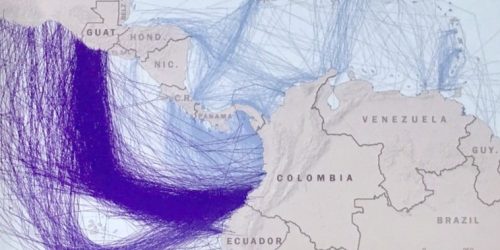
A map produced by the US Southern Command shows the main drug-smuggling routes connecting Colombia and Ecuador with Guatemala and Mexico via the Pacific Ocean.
On Tuesday, the State Department unveiled a “framework for a peaceful democratic transition in Venezuela,” calling for Maduro’s resignation and the establishment of a transition government headed by opposition and Chavista officials to oversee new elections.
The Trump administration pledged to lift sanctions against Venezuelan individuals and key economic sectors, but only after Maduro left office and all security agreements with Russia and Cuba were terminated.
The US has vowed to ramp up unilateral sanctions until the Maduro administration accepts the deal.
For its part, the Venezuelan government blasted the military deployment, with Communications Minister Jorge Rodriguez calling it “an attempt to attack Venezuela with lies and threats.”
Rodriguez added that Venezuela has “robust” anti-narcotics policies and would be ready to “coordinate” actions against drug trafficking in the region.
Washington’s naval operation comes days after the controversial sinking of a Venezuelan coast guard boat off the coast of the Caribbean island of La Tortuga.
According to the Venezuelan Ministry of Defense, the patrol ship “Naiguata” located a Portuguese cruise ship, the “RCGS Resolute,” in Venezuelan territorial waters and ordered the vessel to accompany it to port. The “Resolute” allegedly refused the instructions and proceeded to ram the “Naiguata,” which subsequently sank as a result of the impact.
The cruise ship owner, Columbia Cruise Services, has disputed this account, insisting that the “Resolute” was “subject to an act of aggression by the Venezuelan Navy in international waters,” while carrying no passengers.
On Wednesday, Venezuelan President Nicolas Maduro suggested the ship “was being used to transport mercenaries.” He also claimed that “someone from the north called” to prevent Dutch authorities from inspecting the “Resolute” at its current mooring in the Curacao port of Willemstad.
Portuguese Foreign Minister Augusto Santos Silva, for his part, has pledged to collaborate with Venezuela and Holland in the investigation of the “unfortunate” incident.
April 3, 2020
Posted by aletho |
Militarism | Latin America, United States, Venezuela |
Leave a comment
Venezuela has been one of the countries least affected by the coronavirus pandemic in the region so far. Nevertheless, the US government is attempting to exploit the situation in order to force a violent outcome to the country’s political standoff, putting a price on the head of Maduro and other top functionaries as well as pushing a new “transition” plan to depose the government in exchange for sanctions relief. Meanwhile, Venezuela’s attorney general has summoned Guaido for questioning on April 2. Far from bringing about a truce, the coronavirus has raised tensions to new heights.
On the verge of a truce
The pandemic has caught Venezuela’s opposition in a rather uncomfortable position. Their strategy of not recognizing Maduro and the never ending simulacrum that is Guaido’s “interim presidency” is, fourteen months later, an abject failure in terms of concrete achievements. Guaido’s virtual staying power is owed almost exclusively to Donald Trump, who invited him to the White House at the close of his international tour in February.
But this strategy leaves a vacuum in the opposition. The existence of an “interim president” precludes that of an opposition leader who can channel requests, critiques, and demands toward the government. Guaido is instead forced to speak as a president but without any state resources at his disposal to confront the COVID-19 crisis. Some of Guaido’s spokespeople such as his foreign relations envoy, Julio Borges, issue statements that are woefully out of touch with the gravity of the international conjuncture: “The coronavirus is Maduro and there will be no cure until he leaves power.”
For his part, Maduro, comfortable and without internal resistance, rapidly implemented the World Health Organization’s guidelines, decreeing a national quarantine within days of the first case being reported on March 13. Maduro also managed to meet not only with the country’s principal chamber of commerce, FEDECAMARAS, but also with Colombia’s health authorities, a fact which Colombian President Ivan Duque publicly denied. He additionally secured aid from Cuba and China, which have emerged as global leaders in COVID-19 response. Meanwhile, the United States and Guaido’s other Western sponsors are mired in an unprecedented health crisis due to the number of dead and infected.
On March 23, the European Union publicly called for the International Monetary Fund to accept emergency loan requests from Venezuela and Iran and for relief from US sanctions, which according to EU foreign policy chief Josep Borrell, “block them from receiving income by selling oil.” UN Secretary General Antonio Guterres also urged the lifting of unilateral coercive measures in the face of the pandemic.
The situation seemed favorable for Maduro’s struggle against the US economic blockade.
In this context, the coronavirus was on the verge of bringing about the unthinkable: an agreement between the opposition and the government. Henry Ramos Allup, the president of Venezuela’s main opposition party, announced on March 10 that Democratic Action would abandon its prior abstentionism and compete in parliamentary elections scheduled for 2020. Amid the global COVID-19 hysteria, former presidential candidate Henrique Capriles opened the possibility for an agreement with Maduro when he stated on March 25:
This pandemic must create an opportunity to pursue some kind of agreement that looks after people’s wellbeing… Let’s work together: you have internal control, and I have international support. You are willing to come to an agreement to join hands. Could it be that difficult? I don’t think so.
That very night, there were two, almost parallel reactions. Maduro said, “I agree with Capriles’ proposal,” and asked the Vatican’s representative in the country to mediate and open its offices for a meeting with the different opposition factions as soon as possible.
Minutes later, Guaido stated, “we are willing to do everything we have to do,” implicitly recognizing the need for an agreement to address the health emergency. However, he did enumerate certain conditions regarding the distribution of humanitarian aid, which should be managed by multilateral organisms and not the Maduro government.
Venezuela’s dueling political factions appeared to be on the verge of engaging in substantive talks, but it was not to be.
Escalating US assault
The next day, on the morning of March 26, US Attorney General William Barr gave a press conference announcing “narco-terrorism” charges against Maduro and other senior government officials.
As expected, the charges were endorsed by Trump in the midst of the COVID-19 crisis, effectively torpedoing negotiation efforts and once again raising tensions to a boiling point.
This is hardly the first time that the US has blocked dialogue. When in early August 2019 rumors were circulating of something resembling an electoral pre-agreement emerging from Norway-brokered talks, the United States ramped up sanctions with an August 5 executive order banning all dealings with the Venezuelan state and freezing its assets in what some analysts have linked to the Cuba embargo. The next day, Maduro abandoned talks.
The government had also previously claimed in February 2018 that a last minute call by then US Secretary of State Rex Tillerson to the head of the opposition negotiating team, Julio Borges, led the opposition to walk out in lieu of signing a finalized electoral deal. This was the fruit of months of negotiations mediated by former Spanish President Jose Rodriguez Zapatero and the Dominican government, and the agreement concerned guarantees for the 2018 presidential elections, which the main opposition parties opted to boycott.
With this latest decision, Trump ups the ante. On top of punishing economic sanctions, the US now places a multi-million dollar bounty on the head of Maduro and other top officials, giving the green light to renewed violent actions aimed at killing or capturing them.
But the move also aborts the nascent negotiation efforts recently underway. Rather than paving the way for an invasion, indictments open the way for paramilitary operations of the sort one might find in a Hollywood movie. Recall that neighboring Colombia is a country littered with irregular armed outfits. Just a few days ago, following the seizure of an arms cache in northeastern Colombia, retired Major General Cliver Alcala confessed to a plot to overthrow Maduro in coordination with Guaido and US advisors. Paradoxically, the general confirmed the coup plan only after he was indicted by the US Justice Department, subsequently turning himself in to Drug Enforcement Agency officials and traveling from Colombia to the US.
Several days later, on March 31, US Secretary of State Mike Pompeo, in a more conciliatory but equally arrogant tone, unveiled a “transition” plan proposing the creation of a “council of state” comprised of opposition and Chavista representatives, with both Guaido and Maduro stepping aside and new elections called. The Venezuelan constitution contains no provisions permitting such an arrangement, which has already been rejected by Foreign Minister Jorge Arreaza.
The government did not delay in rolling out its response. The attorney general summoned Guaido to appear for questioning on April 2 and it is very possible that he could be taken into custody after Alcala publicly named him as responsible for terrorist actions to be carried out with the arms confiscated in Colombia. With Guaido behind bars, another scenario opens up, and all that is left is to await a more decisive response from the US.
Meanwhile, we must not forget the arena that has taken center stage at present: healthcare.
Coronavirus and the collapse of the health sector
This escalation of conflict comes not only in the context of coronavirus, but also at a moment of deep crisis in Venezuela’s healthcare system, which could be rapidly overwhelmed if Venezuela’s curve mirrors that of other countries.
In a November 2019 report, UN Under-Secretary-General for Humanitarian Affairs Mark Lowcock observed:
I have seen myself how the health system is on the verge of collapse, with many hospitals lacking the most basic water and electricity infrastructure. Hospital patients, many of whom are already critically ill, are at high risk of losing their lives from new infections they are acquiring while they are in hospital, because basic cleaning and disinfection cannot be done. This is exacerbated by a lack of medicines, and a shortage of doctors and nurses to administer them. Preventable diseases including malaria and diphtheria are back with a vengeance. People with chronic health conditions, pregnant and nursing women, infants and those living with disabilities are among the most vulnerable.
No matter how much the government emphasizes its strength in the health sector owing to the support of its allies, the reality is that the system has suffered severe deterioration. If we project an Italy or Spain-style curve in Venezuela, the result could be not just a health sector collapse, but a catastrophe in every arena of life.
For this very reason, Washington’s bellicose measures provoke widespread animosity among diverse national and international constituencies. On the one hand, Chavismo automatically closes ranks behind the government, which implements stronger security measures that block efforts to open up the political field. On the other, the opposition factions that were engaged in or calling for dialogue with the government are now shut out of the game because it will be very difficult for them to compete in parliamentary elections to be held later this year. And if the main opposition parties do not participate, like in the last few elections, they will lose the only real power they have left: the National Assembly. The majority of opposition political actors have reacted with caution and have not automatically supported the US’ actions.
Washington’s latest maneuvers also fly in the face of positions taken by US allies like the European Union, as well as other multilateral bodies, which have called for lifting sanctions on Venezuela and Iran. Washington’s “kick them while their down” approach may appear disproportionate in the face of the current crisis, but we must remember that the US presidential campaign looms large and the Venezuela issue is key to winning the critical state of Florida.
For his part, Guaido may try to dust off the “humanitarian aid” discourse that he had dropped from his political repertoire after the opposition’s US-backed effort to force food and other supplies across the Colombian border in February 2019 ended not only in failure but in a corruption scandal that has dogged the “interim president” ever since. The US, Colombia, and Guaido’s other allies could make a fresh attempt at “humanitarian intervention” amid the current situation of international panic. US Deputy Assistant Secretary of State for Cuba and Venezuela Carrie Filipetti recently prepared the ground for this possibility, stating that the COVID-19 contagion in Venezuela could pose a regional threat.
This discourse is illogical given that according to official figures Venezuela has far fewer cases than its neighbors, while the US is now the global epicenter of the coronavirus outbreak. But when it comes to US-Venezuela relations, official discourses have little concern for facts. Anything can happen, above all, if elections require putting a face on the “invisible enemy.”
Ociel Alí López is a Venezuelan researcher who has published numerous written and multimedia works. He is dedicated to analyzing Venezuelan society for several European and Latin American media outlets. He is a co-founder of alternative Venezuelan state television station Avila TV in 2006. He is the recipient of the CLACSO/ASDI researcher prize and the Britto Garcia literature award.
April 3, 2020
Posted by aletho |
War Crimes | Latin America, United States, Venezuela |
Leave a comment
The West is trying to take advantage of Venezuela’s difficulties during the coronavirus outbreak to depose the Maduro government, Russian Foreign Minsitry said on Thursday.
“Unfortunately, we see that a number of countries are still guided by the desire to take advantage of the difficult situation in the world and the epidemiological situation in Venezuela in particular to achieve political goals”, spokeswoman for the Foreign Ministry Maria Zakharova said during a briefing on Thursday.
According to her, the idea of a coup that would lead to the ouster of the legitimately elected president of the country still remains in the minds of some political forces in the West.
“We object to the blocking of assistance to Caracas through the IMF. We condemn the US far-fetched drug-trafficking accusations against the head of a sovereign state”, she added.
Venezuela has so far registered 143 COVID-19 cases and three deaths. Last week, Russia delivered the first batch of 10,000 coronavirus test kits to the country and vowed to continue this assistance. China, in turn, sent a team to medical experts to help the sanctioned and the cash-strapped country. Both nations have called for lifting sanctions on Venezuela.
Amid these developments, Pompeo said on Tuesday that an interim government could be established in Venezuela, consisting of National Assembly members and accepted by both Caracas and the opposition, to serve until the next presidential and legislative elections. The US pledges to remove sanctions should the conditions of its plan, including “the departure of foreign security forces” and free elections, be met.
Venezuelan Foreign Minister Jorge Arreaza rejected firmly on Tuesday Washington’s crisis settlement plan, which envisions the creation of an interim government and elections within the next year.
April 2, 2020
Posted by aletho |
Aletho News | Russia, United States, Venezuela |
Leave a comment
According to the parable, the ungrateful son takes out a life insurance policy on his parents, murders them to collect, and is caught and found guilty. At his sentencing, the judge asks if he has anything to say on his behalf. The son replies: “Have mercy upon me because I am an orphan.” That’s chutzpah.
US Attorney General Barr’s indictments on March 26 against the government of Venezuela for narco-terrorism go beyond chutzpah. For starters, William P. Barr was chief counsel for the CIA airline Southern Air Transport implicated in the 1980s for running illicit drugs and related narco-terrorism during Iran-Contra.
The US charges of drug trafficking against Venezuela are the height of hypocrisy. The world’s leading source of heroin is US-occupied Afghanistan; the US is the world’s largest cocaine market.
The president of Honduras, Juan Orlando Hernández (JOH), is the latest in a line of corrupt presidents since the 2009 US-backed coup there. JOH was identified as an unindicted co-conspirator in October by a US federal court for smuggling multi-million dollars’ worth of cocaine into the US.
Colombia is the chief regional US client state, distinguished by being the largest recipient of US military aid in the hemisphere. Hillary Clinton called Plan Colombia a model for Latin America. Yet this model is the planet’s largest supplier of illicit cocaine. And that’s only scratching the surface of the US’s history of complicity in international narcotrafficking.
The false criminal charges by the US government against fourteen high-ranking Venezuelan officials are for alleged involvement in international drug trafficking. The US government has, in effect, put a $15 million bounty on Venezuelan President Maduro and bounties of $10 million each for the head of the National Constituent Assembly and other leading officials and former officials.
Thirty years ago, the US posted a $1 million reward on the head of Manuel Noriega, then president of Panama, on charges of narcotrafficking. Noriega had long been a US security asset assisting in the US’s dirty Contra war against the Sandinista government in Nicaragua. Noriega had also used his US patronage to consolidate his rule in Panama as well as his ties with Colombian drug cartels. However, toward the end of his tenure, Noriega did not demonstrate a sufficient level of servility to his US handlers and was deposed in the US invasion of Panama in 1989, taking the lives of many uncounted civilians.
As RT warns: “The US indictment of Venezuelan President Nicolás Maduro and his subordinates on narcotrafficking charges echoes the rationale used to invade Panama and kidnap its leader.” Unlike the Noriega case, where the Panamanian president was convicted of massive drug trafficking with the knowledge and full protection of the CIA and other US security agencies, the US lacks evidence against the Venezuelans.
The US claims that Venezuelan officials are conspiring to “flood the United States with cocaine” are thoroughly groundless. Even the Washington Office on Latin America (WOLA), a Washington-based think tank that supports regime change for Venezuela, found in a recent detailed report using the US government’s own data that the facts do not support such bogus claims.
The authoritative US interagency Consolidated Counterdrug Database reports, in fact, that 93% of US-bound cocaine is trafficked through western Caribbean and eastern Pacific routes, not through Venezuela’s eastern Caribbean coast. Over six times as much cocaine flowed through the US-allied Guatemala than Venezuela in 2018.
Yes, some illicit drugs flow through Venezuela – a minor amount compared to those emanating from US client states – but the culprits are criminal gangs that the very indicted officials are fighting. The coca is grown and manufactured into cocaine in neighboring Colombia, not Venezuela. While supporting US government actions to undermine Venezuelan state institutions, WOLA recognizes: “Venezuela’s state institutions have deteriorated… In this environment, armed groups and organized criminal structures, including drug trafficking groups, have thrived.”
Yet WOLA’s conclusion is: “US government data suggests that, despite these challenges, Venezuela is not a primary transit country for US-bound cocaine. US policy toward Venezuela should be predicated on a realistic understanding of the transnational drug trade.”
The US indictments against the government of Venezuela are a ramping up of a policy of regime change. Ever since Hugo Chávez was elected president of Venezuela in 1998 and launched the Bolivarian Revolution, the hostile US government has floated consistently unsubstantiated accusations of narcotrafficking.
More recently the Trump administration has sought to replace the democratically elected president of Venezuela with a US-chosen and groomed security asset. Juan Guaidó, the man anointed by Trump to be president of Venezuela, had never run for the presidency nor served as president and was unknown to 81% of the Venezuelan population at the time of his self-declaration as president. Besides these dubious qualifications, Guaidó collaborated with the right-wing Colombian drug cartel and paramilitary group known as Los Rastrojos and even posed for pictures with some of their operatives, which were posted on Twitter.
The ever-tightening unilateral coercive measures on Venezuela by the US have created a blockade, costing Venezuela over 100,000 lives. Sanctions are not an alternative to war but an economic form of warfare and just as deadly. As such, unilateral economic sanctions are an explicit violation of international law under the charters of the United Nations and the Organization of American States and even under US law.
Unfortunately, Venezuela is not alone. The rogue empire’s sanctions now blight a third of the world’s population in 39 countries.
This latest escalation of the US hybrid war against Venezuela takes place within the context of the global coronavirus pandemic, which the US empire sees as an opportunity to further attack the Venezuelan people made more vulnerable by the health crisis. Indeed, the US State Department has declared “Maximum-pressure March” against Venezuela. In service of the empire, Twitter has closed the accounts of the Venezuelan ministries of health, science, education, and housing.
Meanwhile, Cuba, Russia, and China are all materially supporting the Maduro government’s successful efforts to contain the spread of COVID-19 in Venezuela. In contrast to this internationalist solidarity, the US is in the midst to the largest war games in 25 years, Defend Europe 20, in contravention of World Health Organization quarantine protocols.
Words cannot sufficiently describe the inhumane perfidy of the US empire’s response to the pandemic. This should be a time for the US government to:
- Drop the unsupported indictments against President Maduro and other Venezuelan officials.
- Lift the inhumane and illegal sanctions on Venezuela so that Venezuela can purchase medicines and equipment to better fight the coronavirus pandemic.
- Restore normal relations with Venezuela based on respect for national sovereignty.
Roger D. Harris is with the Task Force on the Americas, a human rights group working in solidarity with social justice movements in Latin America and the Caribbean since 1985.
March 29, 2020
Posted by aletho |
Deception, Mainstream Media, Warmongering | Latin America, United States, Venezuela |
Leave a comment
The optics of the Russian oil leviathan Rosneft’s decision to sell its subsidiary Rosneft Trading SA and sell all its assets in Venezuela after the US Treasury sanctioned its trading arm two weeks ago as part of Washington’s regime change project to oust president Nicolás Maduro, may not look good to the uninformed outside observer.
It may appear, prima facie, that Russia is ditching Maduro and succumbing to US president Donald Trump’s latest act of weaponisation of sanctions against the Venezuelan government. At least, that was how the BBC Radio’s morning bulletin today projected the development.
But as one digs deeper, it emerges, on the contrary, that the Kremlin is having the last laugh. What Russia is doing is, funnily enough, borrowing from the US diplomatic toolbox — the equivalent of what the US does constantly in its war on terrorism, that is, whenever a terrorist group that Washington sponsors gets exposed on the battlefield, it gets promptly rebranded and reappears as a new avatar, and life moves on.
So, what is happening needs to be understood as follows: Rosneft is disengaging from its trading arm Rosneft Trading SA, the Geneva-based trading subsidiary, in a deliberate ploy to create a firewall against potential US sanctions in future.
This is important for preserving Rosneft’s global operations — Rosneft accounts for about 6 per cent of global oil production — which might otherwise be risking the US sanctions in the downstream.
Rosneft is acting with prudence since, although Rosneft is majority-owned by the Kremlin, it is listed in London, and counts BP and the Qatari sovereign wealth fund as large minority shareholders.
A Rosneft spokesman has ben quoted as saying, “As a public international company, we have made a decision in the interests of our shareholders in the context of the situation that has objectively developed. Now we have the right to expect from American regulators to fulfil their publicly given promises.” The last reference is to statements from the US that sanctions against its trading arm would be removed if Rosneft wound down its Venezuelan business.
Interestingly, an unnamed company owned entirely by the Kremlin will be buying the Rosneft subsidiary and its oil services and trading operations in Venezuela. The deal between Rosneft (headed by Igor Sechin) and the Kremlin (headed by Vladimir Putin) boils down to the latter now directly taking over assets in Venezuela amounting to more than 80m tonnes in oil reserves and oil production of 66,500 barrels a day via five joint ventures with PDVSA, Venezuela’s state oil company.
A Rosneft subsidiary will receive 9.6 per cent of the company’s stock from the Kremlin in exchange for the assets. That leaves with Trump an only remaining option of sanctioning the Kremlin itself if he wants to punish Maduro.
Moscow honed this innovative technique to outwit Trump’s sanctions earlier also in Venezuela when it rebranded a joint-Russian/Venezuelan bank facing US sanctions with the Russian joint-venture partners — VTB and Gazprombank —transferring their shares to the Russian government.
Clearly, the deal between Rosneft and the Kremlin (read between Sechin and Putin — who are of course longstanding associates in Russian politics through thick and thin — gives an unambiguous signal that Moscow is in Venezuela for the long haul, no matter what it takes.
The geopolitical implications are hugely consequential for the future of the Maduro government, enhancing Russia’s overall standing in the western hemisphere and highlighting the limits to US hegemony in its own backyard. (Isn’t it Ukraine in reverse order?) The Latin American countries (and China) will be closely watching, too.
Sechin, a former KGB officer himself, has been a key figure in the Kremlin hierarchy who choreographed and founded Moscow’s close relationship with Caracas. He had an exceptionally warm personal friendship with late Hugo Chavez, the self-styled leader of the ‘Bolivarian Revolution’ in Venezuela. (A 2012 Guardian thumb sketch zeroed in on Sechin as “the head of the Kremlin’s siloviki clan, made up of nationalist hardliners with a security or military background.”)
At any rate, between 2014 and 2018, Rosneft had advanced a loan of $6.5 billion in loans to Chavez to help Venezuela tide over the economic difficulties due to the US’ hostile policies. Venezuela has since mostly paid back the Russian loan in oil deliveries.
Rosneft was marketing between half and two-thirds of Venezuela’s oil and Rosneft Trading SA was Venezuela’s sole supplier of gasoline. The business now will be handled by the unnamed Kremlin company. Evidently, this is a strategic move which signals Russia’s determination to retain its commanding presence in Venezuela’s oil sector.
This has implications for the world oil market, since Venezuela’s proven oil reserves — 300 billion barrels as of 2016 — accounts for over 18 percent of proven oil reserves all over the world and ranks the country as No 1 in the world.
At a time when the OPEC is mutating and the OPEC+ is caught up in the maelstrom of the sharp fall in oil prices due to coronavirus, the future of world oil market has become highly volatile and uncertain. It is already having a deleterious impact on the US shale industry which cannot survive unless oil sells at $45-50 per barrel. But oil prices are certain to go up in the coming years and Venezuela is destined to be a big presence in the world oil market in the long term.
Suffice to say, the Kremlin is playing the long game, while strengthening in the process in immediate terms the Maduro government’s capacity to withstand the US pressure and to retain its strategic autonomy.
March 29, 2020
Posted by aletho |
Economics, Solidarity and Activism | Russia, United States, Venezuela |
Leave a comment
The US State Department is dangling millions of dollars in reward money in exchange for information that could be used to arrest Venezuelan President Nicolas Maduro, his VP, or other senior officials on drug trafficking charges.
The eye-popping reward of up to $15 million is being offered for “information related to Nicolas Maduro Moros” with regard to his alleged involvement in “international narcotics trafficking,” the State Department announced on Thursday, signaling a hard shift in its regime-change policy against the socialist nation.
Tips leading to the narcotrafficking arrest or conviction of National Constituent Assembly President Diosdado Cabello Rondon, retired generals Hugo Carvajal Barrios and Clive Alcala Cordones, or Minister for Industry and National Production Tareck Zaidan El Aissami Maddah can net as much as $10 million, the statement continued.
The rewards were unveiled on the same day as the US Justice Department unsealed indictments against the Venezuelan leaders for the same drug trafficking crimes – suggesting that Washington’s evidence isn’t as solid as Attorney General William Barr has claimed.
Indictments in Miami and New York accuse the officials of participating in a “narco-terrorism conspiracy” with Colombian guerrilla group FARC, to “flood the United States with cocaine.” But if evidence against Maduro and his compatriots is at such a premium that the State Department will pay $15 million for it, the Venezuelans are unlikely to see the inside of a US court anytime soon.
The one-two punch is a profoundly cynical move in the US’ continuing assault on sanctions-starved Venezuela, especially in the midst of the global coronavirus pandemic.
After over a year of pushing its preferred leader, Juan Guaido, accomplished nothing except wearing out the latter’s welcome in the opposition National Assembly, Washington appears to have lost patience with their golden boy’s failed coup attempts, pushing him aside to play hardball.
The last Latin American leader charged with drug trafficking by the US was Panama’s Manuel Noriega, whom Washington essentially stabbed in the back after a long and profitable partnership running drugs with the CIA, invading his country and hauling him back to Miami to stand trial on drug trafficking and money laundering charges.
March 26, 2020
Posted by aletho |
Aletho News | United States, Venezuela |
Leave a comment
The vast majority of Venezuela’s voting machines were incinerated on March 7 in a fire that engulfed the main warehouse of the National Electoral Council, or CNE, outside Caracas.
An unknown militant group styling itself the “Venezuelan Patriotic Front” claimed responsibility for the arson attack, which comes as the Maduro government and moderate opposition factions continue high-level negotiations to hold parliamentary elections in a bid to overcome the country’s current standoff.
Given Western journalists’ moral outrage over the dubious allegations of widespread “meddling” in the 2016 US presidential election, consistency would have mandated a similar response to such a brazen attack on Venezuela’s democracy.
Instead, corporate outlets followed the familiar script of blaming the victim, repeating the US State Department talking point that the Venezuelan electoral system is “rigged” (FAIR.org, 5/23/18) and floating outlandish conspiracy theories.
The Fiction of ‘Fraud’
After running through some of the details of the incident, Reuters (3/8/20) stated:
The South American country’s elections have come under heavy criticism since President Nicolás Maduro’s 2018 re-election was widely dismissed as rigged in his favor, leading dozens of governments around the world to disavow his government in 2019.
The BBC (3/9/20) likewise emphasized that Venezuela’s elections have been “beset by allegations of fraud… [and] vote-rigging.”
The not-so-subtle implication is that the burnt voting machines had previously served as an accessory to the “fraud” perpetrated by the Maduro government.
This is a particularly scandalous suggestion, given that Venezuela’s electoral system, unlike its US counterpart, is one of the most efficient and transparent in the world. Witnesses representing competing political parties—including the opposition—are present at polling stations and are required to sign off on the numerous, publicly available audits realized before, during and after the fully automated process. Indeed, Venezuela is the only country in the world that does an on-the-spot citizens’ audit after voting centers close, in which the electronic tallies of 53% of randomly selected voting machines are compared to the physical receipts printed by those machines and deposited by voters in a sealed box. In 2018, opposition parties representing Henri Falcon approved each and every one of the CNE’s 24 audits, even those carried out after their candidate cried fraud.
AFP (published in France24, 3/9/20), for its part, was more honest. In lieu of repeating the baseless fraud narrative, the agency observed that the CNE “has been the target of opposition criticism in every election,” before going on to quote the council’s president, Tibisay Lucena, denouncing the opposition’s record of electoral violence.
However, like Reuters and the BBC, AFP declined to inform readers that the opposition’s perennial fraud claims—in 2018 as well as in 2017, 2013, 2010 and on multiple other occasions —have been invariably bereft of substantive evidence.
Concealing Opposition Culpability
Embarrassingly, with the exception of the Daily Mail (3/10/20), virtually no corporate outlets have reported the crucial plot detail that a hard-right opposition group has claimed responsibility for the attack.
After suppressing this inconvenient fact, AP (published in the Washington Post, 3/9/20) went so far as to promote the opposition’s bizarre conspiracy theory that the fire was a false flag by the Maduro government, quoting no less than two opposition sources: a London-based financial consultant and self-proclaimed “interim president” Juan Guaidó.
Strangely, the reporter also repeats the narrative that the voting machines are an instrument in the Venezuelan government’s “quest to hold legislative elections this year that could help President Nicolás Maduro consolidate his power.”
It would seem that the reader is expected to believe that Maduro is attempting to convene constitutionally mandated legislative elections in order to “consolidate his power,” while at the same destroying the very means of holding those elections for some unknown reason.
Not only do AP and its counterparts omit anti-government militants’ self-declared responsibility for torching the machines, they also ignore the opposition’s very plausible motives for their destruction: The Venezuelan electoral system’s transparency has been an obstacle to the US-opposition strategy of delegitimizing all Chavista-won elections and paving the way for their coup efforts.
This would not be the first time that the Venezuelan right wing has attacked electoral infrastructure. During 2017 National Assembly elections, the opposition reportedly besieged 200 voting centers—a fact ignored by all corporate outlets, with the partial exception of AFP (3/9/20), which quoted a Venezuelan official’s denunciation of opposition electoral violence.
The hardline factions of Venezuela’s US-sponsored opposition have as recently as October (El Nacional, 10/22/19) called for an abandonment of the country’s state-of-the-art automated voting system—which combines rapid electronic transmission of results with the security of publicly audited physical receipts—in favor of more tamperable manual voting.
By omitting these crucial facts, corporate journalists slander Venezuela’s electoral system at the moment that it is under devastating assault. The pretense of earnest concern is easily pierced; their true function is to disseminate US imperial propaganda that Venezuela and its progressive regional allies are not democracies, and therefore legitimate targets for coups, economic warfare and/or military intervention (FAIR.org, 12/10/19, 2/12/20).
March 17, 2020
Posted by aletho |
Mainstream Media, Warmongering | Venezuela |
Leave a comment
Mérida – An unknown militant group has claimed responsibility for a blaze which destroyed 99 percent of Venezuela’s electoral machines on Saturday.
In a video message published on Twitter on Sunday, seven masked men calling themselves the Venezuelan Patriotic Front stated that the attack formed part of “Operation Sodom,” a reference to the biblical tale of the city destroyed by “divine judgement” on the Jordan River.
The group goes on to justify the arson by alleging that electoral authorities have “violated the people’s rights through fraudulent elections.” In the same message, it also claimed responsibility for a fire last month at a state-run CANTV telecommunications center used in elections in Valencia, Carabobo State.
While the origins and connections of the group remain unclear, its video message pledged further actions against government supporters and leaders, which it defined as being “military targets,” as well as issuing warnings about “what may occur” at the upcoming opposition march on Tuesday.
Speaking Monday, National Constituent Assembly President Diosdado Cabello condemned the fire as a “terrorist attack.” Opposition leaders are yet to comment.
Another hard-right militant opposition group called the T-Shirt Soldiers endorsed the Patriotic Front’s actions and claimed they “were not finished.” The T-Shirt Soldiers claimed responsibility for the August 2018 C4-carrying drone assassination attempt against President Maduro.
According to the National Electoral Council (CNE), a massive fire on Saturday at the storage facility in the Filas de Mariche district on the outskirts of Caracas destroyed 49,408 electronic voting machines, 582 computers, 400 electronic ballot cards, 49,232 fingerprint identification machines and 22,434 power inverters. Only 562 voting machines and 724 fingerprint identification machines could be saved. All voting machines and other instruments are kept at the warehouse under military and civilian supervision between electoral processes.
The blaze caused no human injuries, but devastated the 1500 m2 facility, according to the reports of the 570 firefighters who tackled the fire.
Addressing the press on Sunday, CNE President Tibisay Lucena told the country that two national prosecutors have been assigned to investigate the fire, and that “no hypotheses have been ruled out.”
The voting machines were originally produced by the multinational company Smartmatic. The CNE ended a maintenance and repair contract with the company in 2017 following its “baseless” claims of fraud at the July 2017 National Constituent Assembly elections. The electoral body has not updated its machine stockpile since nor signed a new manufacturing contract, and a wide-reaching US embargo announced in 2018 threatens any foreign firm which engages with the organisation with sanctions.
The CNE has overseen 24 electoral contests since 1998, with National Assembly (AN) elections scheduled for 2020, with a date yet to be set. Lucena also took the opportunity to calm fears that this year’s elections would be affected.
“If there are small groups which think that this will end our constitutionally established electoral processes, they are very wrong,” she said. “We have the capacity, the legal know-how, the operative and logistical technology, 17 years of experience, and the human talent [to] guarantee the electoral processes in Venezuela as we know them: fast, transparent and trustworthy,” she went on.
Venezuela’s combined electronic and paper electoral system has been described as one of the most secure and transparent in the world by independent international observers. Nonetheless, discussions aimed at applying further consensual safeguards, as well as renovating the CNE leadership, have been part of a dialogue agenda between the government and a host of smaller opposition parties.
The efforts were boosted after a dissident opposition group wrested control of the National Assembly from former AN President Juan Guaido in January and backed the ongoing dialogue process as well as the renewal of electoral authorities.
Guaido has already ruled out taking his hard-right Popular Will party to the vote later this year, a position which has been backed by Washington. Other Guaido-aligned opposition parties, however, are still to announce whether they will participate, with Democratic Action party hinting that it will.
March 10, 2020
Posted by aletho |
Aletho News | Venezuela |
Leave a comment
“A. B. Abrams is the author of the book ‘Power and Primacy: A History of Western Intervention in the Asia-Pacific.’ His second book covering the history of the United States’ conflict with North Korea is scheduled for publication in 2020.
He is proficient in Chinese, Korean and other East Asian languages, has published widely on defence and politics related subjects under various pseudonyms, and holds two related Masters degrees from the University of London.”
 The world today finds itself in a period of renewed great power conflict, pitting the Western Bloc led by the United States against four ‘Great Power adversaries’ – as they are referred to by Western defence planners – namely China, Russia, North Korea and Iran. This conflict has over the past 15 years escalated to encompass the military, economic and information spheres with global consequences – and appears to be coming to a head as signs of peaking tensions appear in multiple fields from military deployments and arms races to harsh economic wars and a harsher still information war.
While the term ‘World War III’ has been common since the 1940s, referring to the possibility of a global great power war on a greater scale than the first and second world wars, the Cold War between the Western and Soviet Blocs was at its height as total, as global and as heated as the prior conflicts. As weapons technology has evolved, the viability of a direct shooting war has diminished considerably – forcing major powers to seek alternative means to engineer their adversaries’ capitulation and assert their own dominance. This has been reflected in how the Cold War, and the current phase of global conflict some refer to as ‘Cold War 2’ have been distinct from the first two world wars despite the final objectives of the parties involved sharing many similarities. I would thus suggest redefining what a ‘world war’ is and acknowledging that this current phase of global conflict is every part as intense as the great power ‘hot wars’ waged in the first half of the 20th century.
Had the intercontinental range ballistic missile and the miniaturised nuclear warhead been invented twenty years earlier, the Allied Powers may have needed to rely more heavily on economic and information warfare to contain and eventually neutralise Nazi Germany. The Second World War would have been very different in nature to reflect the technologies of the time. When viewed from this paradigm, the Cold War can be seen as a ‘Third World War’ – a total conflict more vast, comprehensive and international than its predecessors stretched out over more than 40 years. The current conflict, or ‘World War IV,’ is ongoing. An assessment of prior ‘great power wars,’ and the unique nature of the current conflict, can provide some valuable insight into how warfare is evolving and the likely determinants of its victors.
As of 2020 it is clear that great power conflict has become almost as heated as it can short of an all-out hot war – with the Western Bloc applying maximum pressure on the information, military and economic fronts to undermine not only smaller adversaries such as Venezuela and Syria and medium sized ones such as North Korea and Iran, but also China and Russia. When exactly this phase of conflict began – sometime after the Cold War’s end – remains uncertain.
The interval between the third and fourth ‘world wars’ was considerably longer than that between the second and the third. This was due to a number of factors – primarily that there was no immediate and obvious adversary for the victorious Western Bloc to target once the Soviet Union had been vanquished. Post-Soviet Russia was a shade of a shadow of its former self. Under the administration of Boris Yeltsin the country’s economy contracted an astonishing 45% in just five years from 1992 (1) leading to millions of deaths and a plummet in living standards. Over 500,000 women and young girls of the former USSR were trafficked to the West and the Middle East – often as sex slaves (2), drug addiction increased by 900 percent, the suicide rate doubled, HIV became a nationwide epidemic (3) corruption was rampant, and the country’s defence sector saw its major weapons programs critical to maintaining parity with the West delayed or terminated due to deep budget cuts (4). The possibility of a further partition of the state, as attested to multiple times by high level officials, was very real along the lines of the Yugoslav model (5).
Beyond Russia, China’s Communist Party in the Cold War’s aftermath went to considerable lengths to avoid tensions with the Western world – including a very cautious exercise of their veto power at the United Nations which facilitated Western led military action against Iraq (6). The country was integrating itself into the Western centred global economy and continuing to emphasis the peaceful nature of its economic rise and understate its growing strength. Western scholarship at the time continued to report with near certainty that internal change, a shift towards a Western style political system and the collapse of party rule was inevitable. The subsequent infiltration and westernisation was expected to neuter China as a challenger to Western primacy – as it has other Western client states across the world. China’s ability to wage a conventional war against even Taiwan was in serious doubt at the time, and though its military made considerable strides with the support of a growing defence budget and massive transfers of Soviet technologies from cash strapped successor states, it was very far from a near peer power.
North Korea did come under considerable military pressure for failing to follow what was widely referred to as the ‘tide of history’ in the West at the time – collapse and westernisation of the former Communist world. Widely portrayed in the early 1990s as ‘another Iraq’ (7), Western media initially appeared to be going to considerable lengths to prepare the public for a military campaign to end the Korean War and impose a new government north of the 38th parallel (8). Significant military assets were shifted to Northeast Asia specifically to target the country during the 1990s, and the Bill Clinton administration came close to launching military action on multiple occasions – most notably in June 1994. Ultimately a combination of resolve, a formidable missile deterrent, a limited but ambiguous nuclear capability, and perhaps most importantly Western certainty that the state would inevitably collapse on its own under sustained economic and military pressure, deferred military options at least temporarily.
The fourth of the states that the United States today considers a ‘greater power adversary,’ Iran too was going to considerable lengths to avoid antagonism with the Western Bloc in the 1990s – and appeared more preoccupied with security threats on its northern border from Taliban controlled Afghanistan. With a fraction of the military power neighbouring Iraq had previously held, the presence of an ‘Iranian threat’ provided a key pretext for a Western military presence in the Persian Gulf after the Soviets, the United Arab Republic and now Iraq had all been quashed. With the new government in Russia put under pressure to terminate plans to transfer advanced armaments to Iran (9), the country’s airspace was until the mid 2000s frequently penetrated by American aircraft, often for hours at a time, likely without the knowledge of the Iranians themselves. This combined with a meagre economic outlook made Iran seem a negligible threat.
While the Cold War ended some time between 1985 and 1991 – bringing the ‘third world war’ to a close – the range of dates at which one could state that the ‘fourth world war’ began and the West again devoted itself to great power conflict is much wider. Some would put the date in the Summer of 2006 – when Israel suffered the first military defeat in its history at the hands of the Lebanese militia Hezbollah. Using North Korean tunnel and bunker networks, command structures, weapons and training (10), and bolstered by Iranian funding and equipment, the shock of the militia’s victory, though underplayed in Western media, reverberated among informed circles across the world.
Others would place the date two years later in 2008 during the Beijing Summer Olympics, when Georgia with the full support of the West waged a brief war against Russia – and Moscow despite harsh warnings from Washington and European capitals refused to back down on its position. Post-Yeltsin Russia’s relations with the Western Bloc had appeared relatively friendly on the surface, with President George W. Bush observing in 2001 regarding President Vladimir Putin that he “was able to get a sense of his soul,” and predicting “the beginning of a very constructive relationship.” Nevertheless, signs of tension had begun to grow from Moscow’s opposition to the Iraq War at the UN Security Council to President Putin’s famous ‘Munich Speech’ in February 2007 – in which he sharply criticised American violations of international law and its “almost uncontained hyper use of force in international relations.”
It could also be questioned whether, in light of what we know about Western support for separatist insurgents in Russia itself during the 1990s, the war against the country ever ended – or whether hostilities would only cease with a more total capitulation and partition and with the presence of Western soldiers on Russian soil as per the Yugoslav precedent. As President Putin stated in 2014 regarding continuing Western hostilities against Russia in the 1990s: “The support of separatism in Russia from abroad, including the informational, political and financial, through intelligence services, was absolutely obvious. There is no doubt that they would have loved to see the Yugoslavia scenario of collapse and dismemberment for us with all the tragic consequences it would have for the peoples of Russia” (11). Regarding Western efforts to destabilise Russia during the 1990s, CIA National Council on Intelligence Deputy Director Graham E. Fuller, a key architect in the creation of the Mujahedeen to fight Afghanistan and later the USSR, stated regarding the CIA’s strategy in the Caucasus in the immediate post-Cold War years: “The policy of guiding the evolution of Islam and of helping them against our adversaries worked marvellously well in Afghanistan against the Red Army. The same doctrines can still be used to destabilize what remains of Russian power” (12). The U.S. Congressional Task Force on Terrorism and Unconventional Warfare’s director, Yossef Bodansky, himself also detailed the extent of the CIA’s strategy to destabilize Central Asia by using “Islamist Jihad in the Caucasus as a way to deprive Russia of a viable pipeline route through spiralling violence and terrorism” – primarily by encouraging Western aligned Muslim states to continue to provide support for militant groups (13).
Much like the Cold War before it, and to a lesser extent the Second World War, great powers slid into a new phase of conflict rather that it being declared in a single spontaneous moment. Did the Cold War begin with the Berlin Blockade, the Western firebombing of Korea or when the atomic bombs were dropped on Hiroshima and Nagasaki – which accelerated the move into a nuclear arms race. Equally, multiple dates were given for the opening of the Second World War – the German invasion of Poland in 1939, the beginning of the Sino-Japanese war two years prior, the Japanese Empire’s attack on Pearl Harbour and conquest of Southeast Asia which marked the first major expansion beyond Europe and North Africa in 1941, or some other date entirely. The slide into a new world war was if anything even slower than its predecessors.
The shift towards an increasingly intense great power conflict has been marked by a number of major incidents. In the European theatre one of the earliest was the Bush administration’s withdrawal from the Anti-Ballistic Missile treaty in 2002 and subsequent deployment of missile defences and expansion of NATO’s military presence in the former Soviet sphere of influence, which was widely perceived in Russia as an attempt to neutralise its nuclear deterrent and place the Western Bloc in a position to coerce Moscow militarily (14). This threatened to seriously upset the status quo of mutual vulnerability, and played a key role in sparking a major arms race under which Russia would develop multiple classes of hypersonic weapon. Their unveiling in 2018 would in turn lead the United States to prioritise funding to develop more capable interceptor missiles, a new generation of missile defences based on lasers, and hypersonic ballistic and cruise missiles of its own (15).
Another leading catalyst of the move towards great power confrontation was the Barak Obama administration’s ‘Pivot to Asia’ initiative, under which the bulk of America’s military might and considerable assets from the rest of the Western world would be devoted to maintaining Western military primacy in the Western Pacific. This was paired with both economic and information warfare efforts, the latter which increasingly demonised China and North Korea across the region and beyond and actively sought to spread pro-Western and anti-government narratives among their populations through a wide range of sophisticated means (16). These programs were successors to those sponsored by Western intelligence agencies to ideologically disenchant the populations of the Warsaw Pact and Soviet Union with their own political systems and paint Western powers as benevolent and democratising saviours (17). Economic warfare also played a major role, with efforts centred around the ‘Trans-Pacific Partnership’ trade deal – or ‘Economic NATO’ as several analysts referred to it – to isolate China from regional economies and ensure the region remained firmly in the Western sphere of influence (18). The military aspect of the Pivot to Asia would reawaken long dormant territorial disputes, and ultimately lead to high military tensions between the United States and China which in turn fuelled the beginning of an arms race. This arms race has more recently led to the American withdrawal from the Intermediate-Range Nuclear Forces treaty, which paves the way for deployment of American long-range missiles across the Western Pacific – all with China and North Korea firmly in their crosshairs (19).
It is arguably in the Middle East, however, where the new phase of global conflict has seen its most direct clashes so far. The nine-year conflict in Syria, although far less destructive or brutal, provides ‘World War IV’ with something of an analogue to the Korean War in the Cold War. The conflict has united the Western Bloc and a wide range of allies, from Turkey and Israel to the Gulf States and even Japan (which funds the jihadist-linked White Helmets) (20), in an effort to overthrow an independent government with close and longstanding defence ties to Russia, North Korea, Iran and China. The conflict has seen North Korean, Russian, Hezbollah and Iranian special forces (21) among other assets deployed on the ground in support of Syrian counterinsurgency efforts, with all of these parties providing considerable material support (the Koreans have built and fully staffed at least three hospitals as part of large medical aid packages and continue to be a major supplier of arms and training) (22). China too, particularly concerned by the presence of jihadist militants of Chinese origin in Syria, has played some role in the conflict – the exact details of which remain uncertain with much reported but unconfirmed (23).
Syria’s insurgency involving a range of jihadist groups, at times united only by their intent to end the secular Syrian government, have received widespread support from the Western Bloc and their aforementioned allies. This has involved both material support, which according to State Secretary Hillary Clinton included turning a blind eye to Gulf countries’ considerable assistance to the Islamic State terror group (24), and active deployments of special forces from a wide range of countries, from Belgium and Saudi Arabia to Israel and the U.S. The U.S., European powers, Turkey and Israel have at times directly attacked Syrian units in the field – while Russian reports indicate that close Western coordination with jihadist groups has been used to facilitate a number of successful attacks on Russian positions (25). The conflict in Syria arguably represents a microcosm of the macrocosm which is a new world war – one which pits the Western Bloc and those which support the Western-led order, both directly and through local proxies, against three of its four ‘great power adversaries’ in the field.
‘World War IV’ is unlikely to come to an end for the foreseeable future, and its final outcome remains difficult to predict. Much like in the Cold War, the Western Bloc retains considerable advantages – today most notably in the field of information war which allows it to extensively shape perceptions of the vast majority of the world’s population. This has included the demonization of Western adversaries, the whitewashing of Western crimes both domestically and internationally, and portraying westernisation and increased Western influence as a solution to people’s frustrations from corruption to economic stagnation. This has been a key facilitator of the pro-Western protests engulfing states from Sudan and Algeria to Ukraine and Thailand. Economically too, only China among the Western Bloc’s major adversaries has posed a serious threat to Western primacy. Indeed, it remains highly questionable whether the other three could survive economically under Western pressure without Chinese trade and economic support.
Russia has made a considerable economic recovery since the 1990s, but remains a shadow of its former self in the Soviet era. The country’s leadership has succeeded in reforming the military, foreign ministry and intelligence services, but the economy, legal system and other parts of the state remain in serious need of improvement which, over 20 years after Yeltsin’s departure, cannot come soon enough. Even in the field of defence, the struggling economy has imposed serious limitations – and in fields such as aviation and armoured warfare the country is only beginning to slowly go beyond modernising Soviet era weapons designs and begin developing new 21st century systems (26). On the positive side, the country does remain a leader in many high end technologies mostly pertaining to the military and to space exploration, while Western economic sanctions have undermined the positions of Europhiles both among the elite and within the government and boosted many sectors of domestic production to substitute Western products (27).
In the majority of fields, the ‘Eastern Bloc’ have been pressed onto the defensive and forced to prevent losses rather than make actual gains. While preserving Venezuelan sovereignty, denying Crimea to NATO and preventing Syria’s fall have been major victories – they are successes in denying the West further expansion of its own sphere of influence rather than reversing prior Western gains or threatening key sources of Western power. Pursuing regime change in Venezuela and Ukraine and starting wars in the Donbasss and in Syria have cost the Western Bloc relatively little – the Ukrainians and client states in the Gulf and Turkey have paid the brunt of costs for the war efforts. Material equipment used by Western backed forces in both wars, ironically, has largely consisted of Warsaw Pact weaponry built to resist Western expansionism – which after the Cold War fell into NATO hands and is now being channelled to Western proxies. Libyan weaponry, too, was transferred to Western backed militants in Syria in considerable quantities after the country’s fall in 2011 – again minimising the costs to the Western Bloc of sponsoring the jihadist insurgency (28). The damage done and costs incurred by the Syrians, Hezbollah, Russia and others are thus far greater than those incurred by the Western powers to cause destruction and begin conflicts.
Syria has been devastated, suffering from issues from a return of polio to depleted uranium contamination from Western airstrikes and a new generation who have grown up in territories under jihadist control with little formal education. The war is a victory only in that the West failed to remove the government in Damascus from power – but Western gains from starting and fuelling the conflict have still far outweighed their losses. In the meantime, through a successful campaign centred around information warfare, the Western sphere of influence has only grown – with further expansion of NATO and the overthrow of governments in resource rich states friendly to Russia and China such as Libya, Sudan and Bolivia. Commandeering the government of poor but strategically located Ukraine was also a major gain, with states such as Algeria and Kazakhstan looking to be next in the Western Bloc’s crosshairs. Thus while Syria was saved, though only in part, much more was simultaneously lost. The damage done to Hong Kong by pro-Western militants, ‘thugs for democracy’ as the locals have taken to calling them, who have recently turned to bombing hospitals and burning down medical facilities (29), is similarly far greater than the costs to the Western powers of nurturing such an insurgency. Similar offensives to topple those which remain outside the Western sphere of influence from within continue to place pressure on Russian and Chinese aligned governments and on neutral states seen not to be sufficiently pro-Western.
While the Western Bloc appears to be in a position of considerable strength, largely by virtue of its dominance of information space, which has allowed it to remain on the offensive, a sudden turning point in which its power suddenly diminishes could be in sight. From teen drug abuse (30) to staggering debt levels (31) and the deterioration of party politics and popular media, to name but a few of many examples, the West appears at far greater risk today of collapse from within than it did during the Cold War. A notable sign of this is the resurgence of both far right and far left anti-establishment movements across much of the Western world. Despite massive benefits from privileged access to third world resource bases, from France’s extractions from Francophone West Africa (32) to the petrodollar system propping up American currency (33), Western economies with few exceptions are very far from healthy. A glimpse of this was given in 2007-2008, and little has been done to amend the key economic issues which facilitated the previous crisis in the twelve years since (34). The West’s ability to compete in the field of high end consumer technologies, particularly with rising and more efficient East Asian economies, increasingly appears limited. From semiconductors to electric cars to smartphones to 5G, the leaders are almost all East Asian economies which have continued to undermine Western economic primacy and expose the gross inefficiencies of Western economies. The result has been less favourable balances of payments in the Western world, a growing reliance on political clout to facilitate exports (35), and increasing political unrest as living standards are placed under growing pressure. The Yellow Vests and the rise of Donald Trump and Bernie Sanders are all symptoms of this. With very real prospects of another economic crash in the coming decade, in the style of 2008 but likely much worse, Western economies are expected to bear the brunt of the damage. Their ability to survive remains in serious question. Effects of a crash on North Korea, Iran, Russia and even China will be far less severe. While the previous crash hit Russia particularly hard (36), an economic turnaround from 2014 and the insulation provided by Western sanctions leave it far less vulnerable to the fallout from a Western economic crisis.
Ultimately China appears to be setting itself up for an ‘Eastern Bloc’ victory – a coup de grace which could see Western gains over the past several decades reversed and the power of the West itself diminished to an extent unprecedented in centuries. While the United States reluctantly outsourced much of its high end consumer technologies to East Asian allies during the Cold War – namely Japan, South Korea and Taiwan – China is going for the jugular of the Western world’s economy with its ‘Made in China 2025’ initiative, which will see some critical remaining fields of Western technological primacy shift to East Asian hands. The Coronavirus, bombings in Hong Kong, the trade war, and the wide range of tools in the Western arsenal for destabilisation can at best slightly delay this – but cannot prevent it. In a globalised capitalist economy the most efficient producers win – and East Asia and China in particular, with its Confucian values, stable and efficient political systems and world leading education (37), are thus almost certain to take over the high end of the world economy.
Much as the key to Western victory in the Cold War was successful information warfare efforts and isolation of the Soviet economy from the majority of the world economy, the key to determining the victor of ‘World War IV’ is likely lie in whether or not Beijing succeeds in its attempt to gain dominance of high end technologies critical to sustaining Western economies today. This is far from the only determinant of victory. Efforts to undermine the effective subsidies to Western economies from Central and West Africa, the Arab Gulf states and elsewhere in the third world, and to ensure continued military parity – to deter NATO from knocking over the table if they lose the game of economic warfare – are among the other fields of critical importance. Based on China’s prior successes, and those of other East Asian economies, the likelihood that it will meet its development goals is high – to the detriment of Western interests. The result will be an end to world order centred on Western might – the status quo for the past several hundred years – and emergence in its place of a multipolar order under which Russia, Asia (Central, East, South and Southeast) and Africa will see far greater prominence and prosperity.
- Menshikov, S., ‘Russian Capitalism Today,’ Monthly Review, vol. 51, no. 3, 1999 (pp. 82–86).
- Yulia V. Tverdova, ‘Human Trafficking in Russia and Other Post-Soviet States,’
Human Rights Review, December 11, 2016.
- Klein, Naomi, The Shock Doctrine: The Rise of Disaster Capitalism, London,
Penguin, 2008 (Chapter 11: ‘Russia Choses the Pinochet Option: Bonfire of a Young Democracy’).
- ‘The Death of the MiG 1.44 Program; How the Collapse of the Soviet Union Derailed Moscow’s Fifth Generation Fighter Development,’ Military Watch Magazine, September 16, 2018.
‘Russia’s Sukhoi Unveils Images from Cancelled Next Generation Fighter Program,’ Military Watch Magazine, December 17, 2019.
- Presidential Address to the Federal Assembly, President of Russia, Kremlin, December 4, 2014.
Bechev, Dimitar, Rival Power: Russia’s Influence in Southeast Europe, New Haven, CT, Yale University Press, 2017 (Chapter 1).
- Kristof, Nicholas D., ‘WAR IN THE GULF: China; Beijing Backs Away From Full Support of the War,’ New York Times, February 1, 1991.
- ‘Thaw in the Koreas?,’ Bulletin of Atomic Scientists, vol. 48, no. 3, April 1992 (p. 16).
- ‘Time to End the Korean War,’ The Atlantic, February 1997.
- Axe, David, ‘Iran Desperately Wants This Fighter Plane,’ The National Interest, January 4, 2020.
- ‘Hezbollah a North Korea-Type Guerrilla Force,’ Intelligence Online, No. 529, August 25–September 7, 2006.
“North Koreans Assisted Hezbollah with Tunnel Construction,” Terrorism Focus, The Jamestown Foundation, vol. III, issue 30, August 1, 2006.
Dilegge, Dave and Bunker, Robert J., and Keshavarz, Alma, Iranian and Hezbollah Hybrid Warfare Activities: A Small Wars Journal Anthology, Amazon Media, 2016 (p. 261).
‘Bulsae-3 in South Lebanon: How Hezbollah Upgraded its Anti-Armour Capabilities with North Korean Assistance,’ Military Watch Magazine, September 3, 2019.
- Kremlin, President of Russia, Presidential Address to the Federal Assembly, December 4, 2014.
- Congressional Record, V. 151, PT. 17, U.S. Congress, October 7 to 26, 2005.
- ‘American political scientist: Western Intelligence used Azerbaijan to export terrorism into Russia,’ Panorama, May 30, 2015.
- Kremlin, President of Russia, Plenary session of St Petersburg International
Economic Forum, June 17, 2016.
- Gregg, Aaron, ‘Military Industrial Complex Finds a Growth Market in Hypersonic Weapons,’ Washington Post, December 21, 2018.
- Mullen, Mike and Nunn, Sam and Mount, Adam, A Sharper Choice on North Korea: Engaging China for a Stable Northeast Asia, Council on Foreign Relations, Independent Task Force Report No. 74, September 2016.
Cartalucci, Tony, ‘Twitter Targets Hong Kong in US-backed Regime Change Operation,’ Ron Paul Institute for Peace and Prosperity, October 15, 2019.
Park, Kyung-Ae, ‘Regime Change in North Korea?: Economic Reform and Political Opportunity Structures,’ North Korean Review, vol. 5, no. 1, Spring 2009 (p. 23-45).
- ‘Worldwide Propaganda Network Built by the C.I.A.,’ New York Times, December 26, 1977.
- Wu, S., ‘Why the TPP is an “economic NATO,”’ Huffington Post, October 19,
2015.
- Ait, Abraham, ‘US Withdrawal From the INF Treaty Isn’t About Russia,’ The Diplomat, October 25, 2018.
- al-Jablawi, Hosam, ‘The White Helmets Struggle Without US Funding,’ Atlantic Council, June 11, 2018.
- ‘North Korean Special Forces in Syria; A Look at Pyongyang’s Assistance to Damascus’ Counterinsurgency Operations,’ Military Watch Magazine, June 10, 2018.
- ‘DPRK Ambassador affirms his country’s readiness to support health sector in Syria,’ Syrian Arab News Agency, July 25, 2016.
- Pauley, Logan and Marks, Jesse, ‘Is China Increasing Its Military Presence in Syria?,’ The Diplomat, August 20, 2018.
Hemenway, Dan, ‘Chinese strategic engagement with Assad’s Syria,’ Atlantic Council, December 21, 2018.
- ‘We finally know what Hillary Clinton knew all along – U.S. allies Saudi Arabia
and Qatar are funding Isis,’ The Independent, October 14, 2016.
- ‘Inquiry Into Death of Russian Lt. Gen. Asapov Shows Data Leaks to Daesh –
Source,’ Sputnik, September 26, 2017.
‘Drones used by Syrian terrorists “require advanced training” – Russian MoD in response to US,’ Sputnik, January 9, 2018.
- ‘Five Next Generation Russian Combat Jets We Will See in the 2020s: From MiG-41 Hypersonic Interceptors to PAK DA Stealth Bombers,’ Military Watch Magazine, January 1, 2019.
- Twigg, Judy, ‘Russia Is Winning the Sanctions Game,’ National Interest, March 14, 2019.
- Hersh, Seymour, ‘The Red Line and the Rat Line,’ London Review of Books, vol. 36, no. 8, April 2014
Angelovski, Ivan and Patrucic, Miranda and Marzouk, Lawrence, ‘Revealed: the £1bn of weapons flowing from Europe to Middle East,’ The Guardian, July 27, 2016.
Chivers, C. J. and Schmitt, Eric and Mazzetti, Mark, ‘In Turnaround, Syria Rebels Get Libya Weapons,’ New York Times, June 21, 2013.
McCarthy, Andrew C., ‘Hillary Clinton’s Benghazi Debacle: Arming Jihadists in Libya . . . and Syria,’ National Review, August 2, 2016.
- ‘Militants Bomb Hospital, Torch Quarantine Center as Hong Kong Braces for Virus Outbreak,’ Military Watch Magazine, January 27, 2020.
- ‘Class A drug use “at record levels due to young people”,’ BBC News, September 20, 2019.
- Buchholz, Katharina, ‘Industrialized Nations Have Biggest Foreign Debt,’ Statista, February 7, 2019.
- ‘France’s Colonial Tax Still Enforced for Africa. “Bleeding Africa and Feeding
France,”’ Centre for Research of Globalization, January 14, 2015.
Bart Williams, Mallence, ‘The Utilization of Western NGOs for the Theft of Africa’s Vast Resources,’ TedxBerlin, January 26, 2015
(https://www.youtube.com/watch?v=AfnruW7yERA).
- Wong, Andrea, ‘The Untold Story Behind Saudi Arabia’s 41-Year U.S. Debt Secret,’ Bloomberg, May 31, 2016.
Spiro, David E., The Hidden Hand of American Hegemony: Petrodollar Recycling and International Markets, New York, Cornell University Press, 1999.
- ‘Banks have not learnt lessons of 2008 crisis, says Gordon Brown,’ Financial Times, October 31, 2017.
‘A decade after the financial meltdown, its underlying problems haven’t been fixed,’ The Guardian, August 6, 2017.
- ‘Fearing U.S. Sanctions Over Su-35 Purchase: What is Behind Indonesia’s Interest in New F-16V Fighters,’ Military Watch Magazine, November 6, 2019.
Rogan, Tom, ‘The very political reason Qatar buys different fighter aircraft from Britain, France, and the US,’ Washington Examiner, February 25, 2020.
Krishnan, Rakesh, ‘Countering CAATSA: How India can avoid American arm twisting,’ Business Today, March 6, 2019.
- Gaddy, Clifford G. and Ickes, Barry W., ‘Russia after the Global Financial Crisis,’ Eurasian Geography and Economics, vol. 51, no. 3, 2010 (pp. 281-311).
- Hobbs, Tawnell D., ‘U.S. Students Fail to Make Gains Against International Peers,’ The Wall Street Journal, December 3, 2019.
Turner, Camiilla, ‘Chinese students are two years ahead of their white British peers by age 16, report finds,’ The Telegraph, July 30, 2019.
February 27, 2020
Posted by aletho |
Book Review, Timeless or most popular | China, CIA, Hezbollah, Iran, NATO, Russia, Syria, Ukraine, United States, Venezuela, Zionism |
Leave a comment

The effort Justin Trudeau’s government is putting into removing Venezuela’s President is remarkable. So is the utter hypocrisy of their campaign.
On Thursday Ottawa hosted the Lima Group, a coalition of countries supporting Washington’s bid to overthrow the Venezuelan government. A CBC headline noted, “Ottawa attempts to reboot campaign to remove Maduro from power in Venezuela.” For more than a year the Lima Group has openly pushed Venezuela’s military to overthrow the government. Thursday’s summit was the third held in Canada of a coalition instigated by Canada and Peru in mid 2017.
During the recent Munich Security Conference Trudeau discussed the South American country with a US Senate and House of Representatives delegation led by Republican Senator Lindsey Graham. The Prime Minister’s release noted, “the Congressional delegation thanked Canada for its leadership on the Lima Group and for supporting Interim President Juan Guaidó and the Venezuelan National Assembly in their efforts to achieve a peaceful democratic transition in Venezuela.”
Similarly, the Prime Minister discussed Venezuela at a meeting with Austria’s Chancellor on the sidelines of the Munich Security Conference. According to Chancellor Sebastian Kurz, Canada and Australia “have many shared goals such as the empowerment of women and our support for free & fair elections in Venezuela.” According to this formulation, the empowerment of half the world’s population is of similar import to purported electoral discrepancies in Venezuela.
Foreign minister François-Philippe Champagne also discussed Venezuela with International Crisis Group President Robert Malley at the Munich Security Conference.
Last month Venezuelan politician Juan Guaidó was fêted in Ottawa. The self-declared president met the Prime Minister, deputy PM, international development minister and foreign minister. Trudeau called him “Interim President Guaidó” and Champagne sometimes referred to him simply as “President”.
Over the past couple of years, the government has put out hundreds of press releases, tweets and public statements critical of the Venezuelan government. They hired a Special Advisor on Venezuela to oversee the government’s coup efforts and the Professional Association of Foreign Service Officers gave Patricia Atkinson, Head of the Venezuela Task Force at Global Affairs, its Foreign Service Officers award in June 2019 for her role in overseeing a team of diplomats that organized Lima Group meetings, sanctions, etc. The government has implemented four rounds of sanctions against Venezuelan officials and it’s brought that country to the International Criminal Court, shuttered its Embassy in Caracas, funded opposition groups and decided a marginal opposition politician was the legitimate president.
A look at Canada’s Lima Group allies highlights the hypocrisy of their campaign against Venezuela. The constitutional legitimacy of Honduras’ President is far weaker than Maduro’s; Far more dissidents were assassinated in Colombia last year; The government of Chile is facing greater popular contestation; The electoral legitimacy of Haiti’s President is much weaker; Honduras’ president has clearer links to drug runners; Violence is worse in numerous countries in the Hemisphere.
It is true that Venezuela’s economic downturn – and concurrent outward migration – is substantially worse than other Lima Group members. But, the sanctions imposed by the US and Canada have contributed to Venezuela’s economic collapse as much as any action of the government.
Canada is engaged in an extraordinary effort to overthrow President Nicolas Maduro. But, it isn’t designed to advance democracy or human rights in Venezuela.
February 26, 2020
Posted by aletho |
Progressive Hypocrite | Canada, Latin America, Venezuela |
Leave a comment
Caracas – The US Treasury Department imposed sanctions against Russian state energy giant Rosneft on Tuesday for “operating in the oil sector of the Venezuelan economy.”
The measure targeted Rosneft Trading SA, the Swiss-based subsidiary of the Russian multinational, and its chairman Didier Casimiro.
“Rosneft Trading S.A. and its president brokered the sale and transport of Venezuelan crude oil,” Treasury Secretary Steven T. Mnuchin said in a statement.
The statement listed several alleged Rosneft dealings with Venezuelan state oil company PDVSA, including 55 million barrels transported between September and December 2019.
As a result, all US assets in which Rosneft Trading and Casimiro hold a larger than 50 percent stake are blocked. The Treasury’s Office of Foreign Assets Control (OFAC) granted a 90-day period for companies to wind down their dealings with Rosneft Trading.
White House Special Envoy for Venezuela Elliott Abrams later gave a press conference, referring to the latest measures as a “significant step.”
“I think you will see companies all over the world in the oil sector now move away from dealing with Rosneft Trading,” Abrams told reporters.
Washington has imposed several rounds of punishing sanctions targeting Venezuela’s oil sector, traditionally the source of over 90 percent of the country’s foreign currency income. Financial sanctions against PDVSA were first introduced in August 2017, before an oil embargo was imposed in January 2019. Venezuela’s oil output plummeted from an average of 1.911 million barrels per day in 2017 to 793,000 in 2019.
Following measures against other sectors of the Venezuelan economy, the Trump administration imposed a blanket ban on all dealings with Venezuelan state entities in August 2019, while also authorizing secondary sanctions against third party actors. US officials had repeatedly threatened to levy secondary sanctions against foreign companies buying Venezuelan crude.
With the US embargo driving away buyers in recent months, Rosneft had reportedly been carrying over 60 percent of Venezuela’s crude output before rerouting to other destinations. The company had denied violating US sanctions.
Other multinationals, including Spain’s Repsol and India’s Reliance Industries, have also been warned to “tread cautiously” by the Trump administration. Both companies have stated that they have not violated US sanctions, allegedly by exchanging crude for fuel or diluents.
Rosneft has yet to comment on Washington’s decision, with the company’s shares falling by as much as 5.2 percent in Moscow’s stock exchange. The Russian Foreign Ministry published a statement criticizing the US for “raising international tensions,” while vowing that relations with Venezuela would not be affected.
Venezuelan authorities likewise blasted the latest move, with Foreign Minister Jorge Arreaza stating that Caracas “firmly rejects” the measures against Rosneft Trading.
“The measures against Rosneft Trading are aimed against our oil industry […]. They keep attacking the people of Venezuela, trying to generate suffering and difficulties,” Arreaza wrote on Twitter.
The foreign minister added that the Venezuelan government would add the latest measures to a criminal complaint submitted before the International Criminal Court (ICC). Arreaza delivered a 60-page document to the ICC at The Hague last week, arguing that US sanctions represent “crimes against humanity” and can be equated to “weapons of mass destruction.”
February 19, 2020
Posted by aletho |
Economics | Rosneft, Russia, United States, Venezuela |
Leave a comment