Guyana Could be the United States’ ‘Secret Weapon’ Against Venezuela – Scholar
Sputnik – June 1, 2019
In 2015, ExxonMobil discovered large oil fields just off the coast of Guyana. The reserves are estimated at 5.5 billion barrels. What does this hold in store for the Latin American country’s future? And what does Venezuela have to do with this?
Today, Guyana is the second poorest country in the region. According to some estimates, over the next few decades, it may become one of the world’s largest oil producers per capita. However, the availability of resources doesn’t always mean economic prosperity. The small Caribbean country could just become another piece of the puzzle that the United States is putting together in the region, said Tamara Lajtman, an expert at the Latin American Strategic Centre for Geopolitics (CELAG).
The entire history of relations between the United States and Latin American nations and the Caribbean region indicates that American transnational companies will be the ones who will benefit most from this discovery.
Guyana vs Venezuela
Lajtman shared the viewpoints of American experts who believe that Washington can replace Venezuelan oil from a “regional petroleum regime” with a much more stable supplier.
The expert said that at the end of last year, the American Security Project (ASP) organised a conference called “Guyana: Building Sustainable Security”. This organisation studies national security issues, among the members of its board, are former US Secretary of State John Kerry and former US Secretary of Defence Chuck Hagel. The participants in the said event included Vice Admiral Kevin Green, the former head of US Naval Forces Southern Command.As a result of the meeting, a document was drafted in which it was suggested that American politicians establish closer relations with Guyana in order to guarantee long-term security. The report also noted that since the crisis in Venezuela continues to escalate, a prosperous and developing Guyana could become an axis of stability in the Caribbean, Lajtman added.
According to the Stratfor agency [an American private intelligence and analysis company], some major oil producing companies in the United States have already begun working in Guyana. However, although the revenues of Guyana’s government will increase, a large part of the country won’t feel the economic benefits of oil production, since basically all the jobs in the sector have been designated for foreigners.
Military Presence
In early May, the US Navy Southern Command began New Horizons drilling in Guyana. According to the ASP (American Security Project), they are being held at just the right moment, “when Guyana is at the very centre of regional geopolitics”.
There are two reasons for this: the crisis in neighbouring Venezuela and the energy future of the Caribbean country. The situation is aggravated by a land dispute between Caracas and Georgetown over the Essequibo River. A zone of 160,000 km2 has been claimed by Venezuela for several centuries and the dispute is still unresolved. The United States sees a threat to drilling operations near the maritime border between the two countries.
Economic Aspect
For many decades, Guyana was considered a transit country for cocaine on its way from Colombia to the United States. In light of this, the government has implemented various anti-drug assistance programmes and enacted laws to combat money laundering and the financing of terrorism. With the growth of oil revenues more could be done about this.
In July 2018, Guyana joined China’s New Silk Road initiative, which includes investments in the construction of ports and roads. This would be the largest project ever carried out in the country. It is of key geostrategic importance since it will reduce the time of transportation for goods to northern Brazil (China’s main trading partner in the region) and make the route to the Panama Canal faster.The expert also noted that one of China’s largest national oil companies — CNOOC (China National Offshore Oil Corporation), owns a 25% stake in ExxonMobil’s Stabroek block.
US boycotts arms control conference in protest at Venezuela
RT | May 28, 2019
The United States walked out of a UN disarmament forum in protest after Venezuela took up the conference’s rotating chairmanship, insisting it would not participate in a conference led by a “rogue state.”
“Whatever is discussed in there, whatever is decided, has absolutely no legitimacy because it is an illegitimate regime presiding over that body,” US ambassador to the Conference on Disarmament (CD) Robert Wood told reporters Tuesday after he stormed out of the meeting.
Wood ditched the forum as soon as his Venezuelan counterpart Jorge Valero was granted the conference’s presidency – which rotates on a monthly basis – calling Valero’s acceptance speech a “diatribe of propaganda.”
The US and its allies in the Lima Group – comprised of more than a dozen Latin American allies including Mexico, Colombia, Brazil and Chile – will boycott the CD for the next four weeks, until the new chair takes over, Wood said in a statement after the meeting.
The CD was established in 1984 to provide an international forum for arms control negotiations, and is held three times a year in Geneva. Sixty-five countries currently participate in the conference, including all states with a declared nuclear arsenal.
Washington, along with a handful of allies, supports Venezuelan opposition leader Juan Guaido, who declared himself ‘interim president’ in January, with US recognition. The pro-Guaido bloc considers Venezuela’s elected president, Nicolas Maduro, to be illegitimate.
Wood demanded the CD chairmanship be granted to a member of the opposition.
“A representative of Juan Guaido, the interim president, should be in this body, should be sitting in that chair right now,” he said, adding that the Maduro government “is in essence dead, it just doesn’t want to lay down.”
US President Donald Trump has ramped up sanctions on Venezuela in recent months, crippling energy exports of a country already in dire straights and depriving the socialist government of much needed revenue. Washington considers sanctions part of another “maximum pressure campaign,” designed to coerce the Maduro government into compliance.
The US endorsed an opposition coup attempt in late April, but the uprising failed to inspire mass defections from the security forces and fizzled out within days, leaving Washington and the Guaido faction frustrated.
Ambassador Wood staged a walkout at last year’s CD as well, in that case over Syria’s elevation to the chair position. Wood worked off a similar script then, ditching the meeting as the Syrian ambassador began his address and complaining to reporters outside the chamber.
NYT Parrots US Propaganda on Hezbollah in Venezuela
Lucas Koerner and Ricardo Vaz | FAIR | May 24, 2019
Judith Miller and Michael Gordon published their now infamous New York Times article on September 8, 2002, falsely claiming on the basis of unnamed “American officials” that Iraq had acquired “aluminum tubes” with the aim of producing “an atomic bomb.”
Disgraced by her regurgitation of bogus claims, Miller left the Times in 2005, but her spirit is “alive and well” at the “paper of record.” Nicholas Casey follows faithfully in Miller’s footsteps, authoring dubious, anonymously sourced stories that coincidentally happen to further US regime-change objectives.
In a recent piece headlined “Secret Venezuela Files Warn About Maduro Confidant” (5/2/19), the Times’ Andes bureau chief claimed, on the basis of a leaked Venezuelan intelligence “dossier” that only his paper has seen, that Venezuela’s Industry minister and former Vice President Tareck El Aissami has active links to Hezbollah and drug trafficking. Casey wrote:
The dossier, provided to the New York Times by a former top Venezuelan intelligence official and confirmed independently by a second one, recounts testimony from informants accusing Mr. El Aissami and his father of recruiting Hezbollah members to help expand spying and drug trafficking networks in the region.
Unsurprisingly, the article has been endorsed by Florida Republican Sen. Marco Rubio, widely considered the point man for Trump’s Latin America policy, and whose zeal for regime change in Caracas appears unperturbed by elementary facts or international law. In a May 16 tweet, Rubio openly celebrated the fact that Venezuelan President Maduro “can’t access funds to rebuild electric grid,” thereby dispensing with any pretence that US sanctions are not directly aimed at the Venezuelan population.
The claims of an alleged relationship between Caracas and Hezbollah are, however, entirely unoriginal, having been repeated by corporate journalists and national security pundits without evidence for years.

Attempts to tie Venezuela to Hezbollah are not new (The Hill, 1/13/17)
“Hezbollah has a long and sordid history in Venezuela,” wrote Foreign Policy (2/2/19) earlier this year. Newsweek claimed in a 2017 article (12/8/17) that the Lebanese political party “was involved in cocaine shipments from Latin America to West Africa, as well as through Venezuela and Mexico to the United States,” while The Hill (1/13/17) labeled El Aissami a “fan of Iran and Hezbollah,” rehashing US allegations going back to 2008.
Likewise, corporate media claims about Hezbollah presence in Latin America have not been exclusive to Venezuela, with similar baseless rumors circulating about the Lebanese political party operating in the so-called Tri-Border Area of Paraguay (Extra!, 9–10/07).
Such stories just happen to buttress similar unsupported claims by US Secretary of State Mike Pompeo that Hezbollah has “active cells” in Venezuela. Pompeo and other senior administration officials have repeatedly warned that a military option to remove the Maduro government is “on the table,” while self-proclaimed “interim president” Juan Guaidó has requested “cooperation” from the Pentagon’s US Southern Command.
Casey himself has a long-established track record in dodgy Venezuela reporting, ranging from ludicrous stories about Cuban doctors (FAIR.org, 3/26/19) to false claims that private media like Globovision and El Universal “toe a government line.” (See FAIR.org, 5/20/19.)
Suspect sources
According to Casey’s “dossier,” Tareck El Aissami conspired with his father, Carlos Zaidan El Aissami,
in a plan to train Hezbollah members in Venezuela, “with the aim of expanding intelligence networks throughout Latin America and at the same time working in drug trafficking.”
We should begin by recognizing that Casey provides no proof of the authenticity of the alleged documents, and there is no reason why readers should take the assurances of unnamed “former top Venezuelan intelligence official[s]” at face value, especially those currently outside Venezuela collaborating with Washington. Similar sources were used to craft the fraudulent case for war in Iraq.
For instance, former Venezuelan intelligence czar Hugo “El Pollo” Carvajal, who broke with the Maduro government in 2017, is facing extradition to the US from Spain on cocaine-smuggling charges. In February, the ex-general gave an interview to Casey and the Times (2/21/19) in which he accused El Aissami of similar drug trafficking and Hezbollah links. Nowhere in the article did Casey think it relevant to mention that Carvajal plans to cooperate with US authorities, and thus has reasonable motive to fabricate information that improves the conditions of his plea bargain.
Taking refuge in anonymity, which the Times’ own handbook describes as a “last resort,” Casey leaves open the question of whether his source is Carvajal or another ex-official collaborating with the US who authored the dossier after leaving Venezuela, since no date is provided. From “Curveball” to North Korean defectors, corporate media have been consistently guilty of not examining sources’ motives so long as their “information” bolsters US foreign policy interests, even at the cost of tens or hundreds of thousands of lives.
Urea-gate?
Beyond the issue of sourcing, the alleged “dossier” has a troubling number of logical and factual inconsistencies. A case in point is the alleged testimony from an unnamed National Guard officer about a 2004 raid near the border with Brazil, which reportedly found more than 150 tons of urea in a warehouse. Casey disingenuously refers to urea as a “precursor substance used to make cocaine,” when in fact over 90 percent of industrially produced urea is used for fertilizer. Casey does concede later on that urea has non-cocaine purposes, but cannot conceive of the possibility of the substance being stored in a given location only to be used elsewhere.
The narrative function of the urea bust, which for some reason was not reported until a mysterious dossier was handed to the New York Times 15 years later, is to provide a link to Walid Makled, allegedly the owner of the urea warehouses, and a drug trafficking kingpin of sorts. Even assuming that the urea was meant for cocaine production, and not for more mundane agricultural purposes, a key fact is that Makled is currently serving a jail sentence in Venezuela for drug trafficking. This inconvenient reality, noted but not explained by the Times, on its face seriously undermines the idea that the current Industry minister, supposedly a close associate of Makled, is a powerful figure running a drug ring at the heart of the Venezuelan state.
That aside, it’s worth reviewing the “links” that Casey presents between Makled and El Aissami:
- According to the “dossier,” El Aissami’s brother, Feraz, went into business with Makled.
- The government gave “contracts” to a company “tied to Mr. Makled.” (Casey doesn’t think it relevant to explain the nature of these “ties” or “contracts”)
- The US government offered a similarly vague level detail regarding El Aissami’s alleged “ties” to drug-running when it sanctioned the then-vice president in 2017, and even Casey admits that Washington “never revealed the evidence.”
- “Two people familiar with [El Aissami’s] family” identified Haisam Alaisami as being El Aissami’s cousin, with Alaisami supposedly telling prosecutors he was a legal representative of Makled’s company. Beyond the anonymous genealogy, no concrete evidence is presented linking El Aissami to Alaisami, and hence to drugs.
In the absence of any externally verifiable evidence, what Casey presents as bombshell revelations of solid links to drug trafficking come out looking like 15-year-old gossip from unnamed sources.
Hezbollah hysteria
While Casey’s story provides very questionable allegations on links to drug trafficking and to Hezbollah, the connection between both is even more dubious.
The dossier concludes with informant testimony on the family’s ties to Hezbollah…. One of the sources of the information was the drug lord, Mr. Makled, who described Mr. El Aissami’s involvement in the scheme, according to the intelligence memo.
After establishing highly questionable ties between Tareck El Aissami and Walid Makled, largely based on their shared Syrian ancestry, Casey’s “dossier” then claims it is none other than Makled who “reveals” El Aissami’s supposed Hezbollah plot.
According to the alleged “documents,” El Aissami and his father were “involved in a plan to train Hezbollah members in Venezuela, ‘with the aim of expanding intelligence networks throughout Latin America and at the same time working in drug trafficking.’”
The unspoken assumption is that Hezbollah, which is a resistance movement and political party that forms part of the the elected Lebanese government, would be interested in conducting such illicit activities halfway around the world. Here Casey displays a geopolitical illiteracy on par with top Trump administration officials since, according to Middle East expert As’ad AbuKhalil, “there is no agenda or reason for Hezbollah to have an international presence.”
“For what purpose? Doesn’t the party have enough on its plate in Lebanon itself?” he asked, while acknowledging that the party does have sympathizers and supporters worldwide.
On the assertion that Hezbollah is engaged in drug trafficking, the University of California at Stanislaus professor is equally skeptical. “There has been no credible story in Arabic or in Western languages about Hezbollah’s involvement in drugs,” he stressed:
Hezbollah publicly and organizationally took a stance against drugs and issues fatwas against drugs not only among members but even in Shiite areas of Lebanon. Hezbollah has even allowed Lebanese government agencies to penetrate deep into its strongholds [this year] to search for drug traffickers.
Casey and his editors cleverly shield themselves from any reputational damage over the ludicrous nature of these allegations with a rather significant proviso buried in the 14th paragraph of the article:
Whether Hezbollah ever set up its intelligence network or drug routes in Venezuela is not addressed in the dossier. But it does assert that Hezbollah militants established themselves in the country with Mr. El Aissami’s help.
In other words, what was originally presented as anonymously sourced claims about Hezbollah spying and drug trafficking in Venezuela turn out to be little more than speculation about intent to carry out such activities.
In giving credence to these allegations, the Times repeats the propaganda of top Trump administration officials and the Israeli government about the “global terrorist ambitions” of Iran/Hezbollah, which is in league with Venezuela’s socialist “narco-dictatorship.”
Having played a key propaganda role in recent US regime change operations in Iraq, Syria, Libya and elsewhere, corporate media outlets like the New York Times are all too eager to beat the drums of war once again. With Washington actively threatening military force in both Iran and Venezuela, Nicholas Casey lends a hand in manufacturing public consent for not one but two illegal wars.
The US is Buying Venezuelan Oil Again (Zakharova)
Sputnik | May 23, 2019
From May 10 to 17, the United States imported 49,000 barrels of Venezuelan crude oil. This is the first time that the US imports its neighbor’s oil in weeks and the Russian Foreign Ministry spokeswoman, María Zakharova, has commented on the figure, published in the weekly report of the US Energy Information Administration.
Zakharova recalled that in March, the press reported that the special envoy of the United States Government for Venezuela, Elliott Abrams, had said that the United States was seeking “the complete isolation of President Nicolás Maduro on the international stage and, above all, the cessation of any commercial transaction of banks, companies and corporations with Venezuela that would be beneficial for Maduro”.
Zakharova countered Abrams’ words [with the fact] that the US has resumed Venezuelan oil imports at 49,000 barrels a day.
“And so always, first they encourage everyone to do something and then they change their maneuver 180 degrees, leaving behind those who gave in,” she said.
On January 28, Washington announced the imposition of sanctions against state oil company PDVSA and blocked the assets and interests of the Venezuelan company in its jurisdiction for 7,000 million dollars. The truth is that deliveries of Venezuelan oil in the United States for the first week of April reached 139,000 barrels per day, while during the previous three weeks it had been at zero, according to the US Department of Energy.
In annual terms, deliveries decreased 4.5 times from the level of 631,000 barrels per day, recorded during the first week of April 2018. From March 11 to March 29, according to statistics, oil was not supplied from Venezuela to the US.
Canada’s meddling in Venezuela: the case of Ben Rowswell
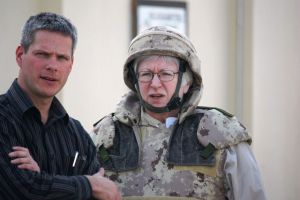
Ben Rowswell in Afghanistan with Auditor General Sheila Fraser
By Yves Engler · May 24, 2019
Why does the dominant media pay so much attention to Russian “meddling” in other countries, but little to Canada’s longstanding interference in the political affairs of nations thousands of kilometres from our borders?
The case of Ben Rowswell illustrates the double standard well.
The current Canadian International Council President has been the leading non-governmental advocate of Ottawa’s quest to overthrow Venezuela’s government. In dozens of interviews, op-eds, tweets and ongoing speaking tour the former ambassador has put a liberal gloss on four months of naked imperialism. But, Rowswell has been involved in efforts to oust Nicolas Maduro since 2014 despite repeatedly claiming the president’s violation of the constitution two years ago provoked Ottawa’s recent campaign.
A March 2014 Venezuela Analysis story suggested the early adopter of digital communications was dispatched to Caracas in the hopes of boosting opposition to a government weakened by an economic downturn, the death of its leader and violent protests. Titled “New Ambassador Modernizes Canada’s Hidden Agenda in Venezuela”, the story pointed out that Rowswell immediately set up a new embassy Twitter account, soon followed by another titled SeHablaDDHH (Let’s Talk Human Rights), to rally “the angry middle classes on Twitter.” The article noted that “Rowswell is the best man to encourage such a ‘democratic’ counterrevolution, given his pedigree” in digital and hotspot diplomacy. According to a March 2014 Embassy story titled “Canada dispatches digital diplomacy devotee to Caracas”, just before the Venezuela assignment “Ottawa’s top digital diplomat … helped to establish a communications platform for Iranians and Iranian emigrants to communicate with each other, and occasionally the Canadian government, beyond the reach of that country’s censors.” Previously, Rowswell was chargé d’affaires in Iraq after the 2003 US invasion and headed the NATO Provincial Reconstruction Team in Kandahar during the war there. An international strategy advisor in the Privy Council Office during Stephen Harper and Jean Chrétien’s tenure, Rowswell created Global Affairs Canada’ Democracy Unit. Rowswell also worked with the Washington based Center for Strategic and International Studies, whose board of trustees includes Henry Kissinger and Zbigniew Brzezinski, and the National Democratic Institute, which is part of the US National Endowment for Democracy that performs work the CIA previously did covertly.
Believing he was sent to conspire with the opposition, Caracas refused to confirm Rowswell’s appointment as ambassador. Former vice president and foreign minister José Vicente Rangel twice accused Rowswell of seeking to overthrow the government. On a July 2014 episode of his weekly television program José Vicente Hoy Rangel said, “the Embassy of Canada appears more and more involved in weird activities against the Venezuelan constitutional government.” The former Vice President claimed Canada’s diplomatic mission helped more than two dozen individuals of an “important intelligence organization” enter the country. Three months later Rangel accused Canadian officials of trying to destabilize the country by making unfounded claims Maduro supported drug trafficking and gave passports to terrorists.
In early 2015 then president of the National Assembly (not to be confused with Venezuela’s president) Diosdado Cabello accused the Canadian embassy of complicity in a failed coup. According to Cabello, an RCMP official attached to the embassy, Nancy Birbeck, visited an airport in Valencia with a member of the UK diplomatic corps to investigate its capabilities as part of the plot.
The president of the National Assembly also criticized Rowswell for presenting a human rights award to anti-government groups. Cabello said the ambassador “offered these distinctions to people of proven conspiratorial activity and who violate the fundamental rights to life of all Venezuelans.” At the embassy during the award ceremony were the lawyers and wife (Lilian Tintori) of Leopoldo López who endorsed the military’s 2002 coup against President Hugo Chavez and was convicted of inciting violence during the 2014 “guarimbas” protests that sought to oust Maduro. Forty-three Venezuelans died, hundreds were hurt and a great deal of property was damaged during the “guarimbas” protests. Lopez was a key organizer of the recent plan to anoint Juan Guaidó interim president and Tintori met Donald Trump and other international officials, including the prime minister and many others in Ottawa, to build international support for the recent coup efforts.
Rowswell appears to have had significant contact with López and Guaidó’s Voluntad Popular party. He was photographed with Voluntad Popular’s leader in Yaracuy state, Gabriel Gallo, at the embassy’s 2017 human rights award ceremony. Gallo was a coordinator of NGO Foro Penal, which was runner-up for the embassy’s 2015 Human Rights Award. (The runner-up for the 2012 award, Tamara Adrián represents Voluntad Popular in the national assembly.)
The embassy’s “Human Rights Prize” is co-sponsored with the Centro para la Paz y los Derechos Humanos. The director of that organization, Raúl Herrera, repeatedly denounced the Venezuelan government, saying, “the Venezuelan state systematically and repeatedly violates the Human Rights of Venezuelans.”
The “Human Rights Prize” is designed to amplify and bestow legitimacy on anti-government voices. The winner gets a “tour of several cities in Venezuela to share his or her experiences with other organizations promoting of human rights” and a trip to Canada to meet with “human rights authorities and organizations.” They generally present to Canadian Parliamentary Committees and garner media attention. The Venezuelan NGOs most quoted in the Canadian media in recent months criticizing the country’s human rights situation — Provea, Foro Penal, CODEVIDA, Observatorio Venezolano de la Conflictividad, Observatorio Venezolano de Prisiones, etc. — have been formally recognized by the Canadian embassy.
During Rowswell’s tenure at the embassy Canada financed NGOs with the expressed objective of embarrassing the government internationally. According to the government’s response to a July 2017 Standing Senate Committee on Foreign Affairs and International Trade report on Venezuela, “CFLI [Canadian Funding to Local Initiatives] programming includes support for a local NGO documenting the risks to journalists and freedom of expression in Venezuela, in order to provide important statistical evidence to the national and international community on the worsening condition of basic freedoms in the country.” Another CFLI initiative funded during Rowswell’s tenure in Caracas “enabled Venezuelan citizens to anonymously register and denounce corruption abuses by government officials and police through a mobile phone application.”
Just after resigning as ambassador, Rowswell told the Ottawa Citizen: “We established quite a significant internet presence inside Venezuela, so that we could then engage tens of thousands of Venezuelan citizens in a conversation on human rights. We became one of the most vocal embassies in speaking out on human rights issues and encouraging Venezuelans to speak out.”
Can you imagine the hue and cry if a Venezuelan ambassador said something similar about Canada? In recent months there have been a number of parliamentary committee and intelligence reports about Russian interference in Canada based on far less. Last month Justin Trudeau claimed, “countries like Russia are behind a lot of the divisive campaigns … that have turned our politics even more divisive and more anger-filled than they have been in the past.” That statement is 100 times more relevant to Canada/Rowswell’s interference in Venezuela than Russia’s role here.
Recently Rowswell has been speaking across the country on “How Democracy Dies: Lessons from Venezuela and the U.S.”
I wonder if the talk includes any discussion of Canadian diplomats deployed to interfere in other country’s political affairs?
Venezuela: Amnesty International in Service of Empire
By Roger D. Harris | Dissident Voice | May 18, 2019
Uncle Sam has a problem in his South American “backyard” with those uppity Venezuelans who insisted on democratically electing Nicolás Maduro as their president instead of by-passing the electoral process and installing the unelected US asset Juan Guaidó. No matter, Amnesty International has come to the rescue with a full-throated defense of US imperialism:
Faced with grave human rights violations, shortages of medicines and food and generalized violence in Venezuela, there is an urgent hunger for justice. The crimes against humanity probably committed by the authorities must not go unpunished.
— Erika Guevara-Rosas, America’s director at Amnesty International
Amnesty International fails in its broadside to put its claims against the Maduro government in the context of a concerted regime-change campaign, which amounts to war, by the bully from the north. The US is waging an illegal war against Venezuela and Amnesty International’s broadside leaves out this inconvenient fact, egregiously even omitting any mention of sanctions.
As human rights activist Chuck Kaufman of the Alliance for Global Justice noted about Amnesty International (AI): “They don’t seem to even care about their credibility anymore.” A more credible and honest account of what is unfolding in Venezuela, than the hatchet job presented in AI’s May 14th Venezuela: Crimes against humanity require a vigorous response from the international justice system, would have also noted along with the alleged transgressions of the Maduro government:
- Grave human rights violations. Economists Mark Weisbrot of the Center for Economic and Policy Research and Jeffrey Sachs of Columbia University recently reported that US sanctions on Venezuela are responsible for tens of thousands of deaths. This is the price being exacted on Venezuela, with a prediction for worse to come, for the regime change that AI is implicitly promoting.
- Shortages of medicines and food. Since 2015, when US President Obama first instituted them, the US has been imposing ever more crippling illegal sanctions on Venezuela expressly to create misery for the population in the hope that it would then turn against their own democratically elected government. The sanctions are specifically designed to suffocate the economy so that Venezuela cannot address its problems. The US government boasts about the impacts of sanctions. Playing the good cop to the US role as bad cop, AI laments the very conditions they are tacitly promoting in asking for ever increasing “punishments.” New US sanctions on Venezuela were imposed on May 10th.
- Generalized violence. The US government has repeatedly and unapologetically threatened military intervention in Venezuela if the elected government doesn’t abdicate. Short of attacking militarily, the US has waged war against Venezuela by economic and diplomatic means, not to mention low-intensity warfare such as cyber attacks. The extreme right wing opposition has called for the extra-legal overthrow of the government and has eschewed electoral means for effecting political change. AI is correct in noting that since 2017 new violence has been inflicted on the Venezuelan people but fails to note the role of the opposition in provoking that violence with their guarimbas and other actions. Meanwhile Guaidó, whose popular support in Venezuela is bottoming out, is reported sending his envoy to meet with the US Southern Command to “coordinate.”
How is it possible that an organization purporting to stand for human rights and global justice can so blithely ignore facts that do not fit into their narrative and so obsequiously parrot the Trump-Pompeo-Bolton-Abrams talking points? Why would AI go so far as to meet with the self-appointed Guaidó and then within days issue a report condemning the Maduro government, without also investigating the other side in the conflict?
Unfortunately, this is not the first time AI has shown an imperial bias as it has regarding US-backed regime-change projects in Iraq, Libya, Syria, and Nicaragua.
Objectively deconstructing the many allegations (e.g., “more than 8,000 extrajudicial executions by the security forces”) made against Venezuela in the AI broadside and its accompanying report remains to be done. Unfortunately, the Empire has a surfeit of resources to churn out propaganda compared to the ability to counter it by genuine humanitarian groups. AI alone has an annual budget of over $300 million. According to sources cited by Wikipedia, AI receives grants from the US State Department, the European Commission, and other governments along with the Rockefeller Foundation.
To conclude, AI’s broadside calls for justice about as often as it calls for punishment with the subtext that punishment of the Empire’s victims is justice. Were AI truly concerned about justice, rather than justifying another US regime-change operation, they would champion the following:
- Ending the unilateral sanctions by the US on Venezuela, which are illegal under the charters of the United Nations and the Organization of American States.
- Supporting dialogue between the elected government and the opposition as has been promoted by Mexico, Uruguay, Pope Francis, and most recently by Norway.
- Condemning regime-change activities and interference in Venezuela’s internal affairs and actively rejecting the US government’s aggressive stance as articulated by US VP Pence: “This is no time for dialogue. This is time for action.”
- Respecting the sovereignty of Venezuela and restoring normal diplomatic relations between the US and Venezuela.
Roger D. Harris is active in the 33-year-old human rights organization Task Force on the Americas and is active with the Campaign to End US-Canadian Sanctions Against Venezuela
Venezuelan Embassy Besiegers Were ‘Elite’, Sought Gains from US Intervention
Sputnik – May 18, 2019
The angry mob of Venezuelan expatriates who laid siege to the Venezuelan Embassy in Washington, DC, earlier this month was composed of numerous figures with close ties to the inner structures of the US empire and who stood to benefit financially from a coup d’etat in Venezuela, investigative journalists told Sputnik Friday.
During the nearly three-week-long siege of the Embassy Protection Collective by opposition forces, numerous instances of harassment and violence were documented, including bigoted comments and slurs, physical struggles and the use of tools such as scuba lights, laser pointers and air horns to harass and intimidate the anti-war activists.
As journalists began to look into the footage, they also began to wonder: who are these people that form the Venezuelan opposition?
The struggle at the embassy, in Washington, DC’s historic Georgetown district, was essentially an extension of the struggle inside Venezuela. Since January 23, Juan Guaido has presumed to be Venezuela’s interim president — an office he’s recognized as occupying by the US and about 50 other nations, but which has no meaning on the ground in Caracas, where Guaido commands relatively few followers. Even internationally, three-quarters of the globe’s countries, as well as key international institutions like the United Nations and International Monetary Fund, continue to recognize Venezuelan President Nicolas Maduro, who was re-elected to a second term in May 2018.
Jeb Sprague, a lecturer at the University of Virginia and author of the forthcoming book “Globalizing the Caribbean: Political Economy Social Change and the Transnational Capitalist Class,” teamed up with journalist Alexander Rubinstein of MintPress News, who was embedded with the Embassy Protection Collective inside the embassy for nearly a month, including during the two-week period of the siege, from April 30 to May 13, to probe the internet for the identities of the people in the footage.
Their report, titled “Who’s Behind the Pro-Guaidó Crowd Besieging Venezuela’s DC Embassy?” was published on Thursday, just hours before US police stormed the facility and arrested the activists. Sprague spoke about their findings Friday with Radio Sputnik’s By Any Means Necessary.
The Embassy Protection Collective was formed on April 10 by anti-war activists in the United States who objected to Washington’s coup attempt in Venezuela and who saw the imminent delivery of the empty embassy to Guaido’s retinue as a major provocation that could lead to war. With the Maduro government’s permission and armed with international treaties recognizing the embassy’s legally inviolable status, the activists set up shop in the facility, where they soon came under attack by pro-Guaido protesters seeking to either storm the embassy or starve the collective out.
“In the beginning of their siege, their first week or two, they were really, extremely homophobic, racist — I mean, you don’t have to take my word for it, you can look on Twitter and in our article and all the links to all, you know, they are just videotaped, time after time, yelling out all this stuff,” Sprague said.
“But then what we found is they have these sort of like, PR/marketing strategists, people that came in after that initial period and they really tried to alter how people were perceiving that mob… and so you had media outlets like the New York Times, Vice Magazine… they came in. So, when they would come to the siege, there were these people who were put up by the mob for them to be interviewed.”
Sprague said one woman who became a “poster child for the pro-Guaido mob,” Dilianna C. Bustillos, “she’s actually a senior manager at Oracle, which is one of the largest companies in the world, a tech company that works with defense companies and makes like a $40 billion a year annual revenue… she’s a senior manager there. She previously volunteered with Visión Democrática, which is a pro-opposition group which is connected with a lot of the people who are working with Juan Guaido in DC.”
He noted many of the figures they identified were connected to a series of meetings at the Center for Strategic and International Studies (CSIS), a hawkish US think tank in Washington, DC, where pro-Guaido figures and shadow government officials helped plan a US invasion of Venezuela.
“They’ve started this website called ‘Ask a Venezuelan,’ and so, constantly on Twitter there’s like this mantra… they’re saying ‘ask a real Venezuelan,’ ‘ask a Venezuelan.’ And so, we started a thing called ‘Ask an Upper-Class Venezuelan;’ when we researched who they are — like the woman that founded that group, ‘Ask a Venezuelan,’ she has a $4 million a year company, and she had put out tweets supporting the guarimbas, which were these really violent protests, called for the US Marines to land in Venezuela. So one after another,” Sprague told hosts Eugene Puryear and Bob Schlehuber.
“And then we started looking at more of the people that were at the protests, and we found one guy who was a senior architect at Raytheon, the arms company. It was like, every time we looked at a person, their background in DC — two people that worked for CSIS, one that’s been working for the World Bank, another one for the Inter-American Development Bank — that guy actually got caught yelling out a lot of racist, sexist epithets.”
“One of the most interesting guys Cesar Caminero, we documented him as being there, and when I found his LinkedIn page, it said that he works for this tech company, and he does work for the [US Department of Defense], and he brags on his LinkedIn that he has this active secret clearance,” Sprague said. “And there’s this other guy who was doing tech work for US intelligence, so it was just fascinating that we could see just, one after another, people were either working with like, an international financial institution, an arms or military-oriented contractor or a hawkish think tank funded by the Gulf [monarchies] and big arms companies.”
“We figured out there’s this built-in base of these elite members, professional people in the diaspora, that basically advocate for regime change and escalation of conflict where they can really gain or benefit through US intervention,” Sprague said.
Indeed, Guaido himself is an alumnus of The George Washington University, located in Washington, DC’s Foggy Bottom neighborhood.
“Even if the embassy defenders got pushed out, I think it was still a victory in really illuminating the crimes of the Trump government and showing how violent these people are that they work with,” Sprague said.
The Washington Post’s “Cartel of the Suns” Theory is the Latest Desperate Excuse for Why the Coup Attempt in Venezuela has Failed
By Peter Bolton | CounterPunch | May 17, 2019
With the attempted coup in Venezuela now nearing its four-month mark, commentators in the corporate-owned Western press are scratching their heads as to why Washington’s plan for its proxy, Juan Guaido, to topple the government of Nicolas Maduro has so far failed to materialize. Of course, all of the real reasons elude them because they have never so much as crossed their minds. It is beyond their mental world to consider the lasting popularity of the late Hugo Chavez’s policies and lasting suspicion toward the right-wing opposition amongst large swathes of the population – or the deep revulsion at the thought of US (and especially US military) intervention into their country held by the vast majority of Venezuelans (and, indeed, Latin Americans generally). Rather, both the coup attempt’s puppeteers in Washington and their ventriloquist dummies in the mainstream media have been coming up with ever-more desperate excuses for why Guaido’s attempt to take power has not been a swift and decisive success. The so-called “propping up” of the Maduro “regime” by the traditional the US boogeymen of Russia, China and Cuba seems to have been the most frequently touted explanation. This has manifested itself in increasingly bizarre ways, such as the recent claim by Mike Pompeo that Maduro was at the point of fleeing the country before being convinced otherwise by Russia.
Now, the Washington Post’s notorious warhawk and deranged conspiracy peddler Jackson Diehl has come up with the latest labored rationalization for the failure of the coup attempt: the so-called “Cartel of the Suns.” According to Diehl, this shadowy organization is made up of “some of the most senior officials in the Maduro regime.” He claims that it “flies hundreds of tons of Colombian cocaine from Venezuelan airfields to Central America and the Caribbean for eventual distribution in the United States and Europe.” He furthermore claims that the Maduro government’s crimes also include skimming accounts used for importing food and medicine and “corrupt currency trading.” Describing the Maduro government as “less a government — much less a socialist one — than a criminal gang,” he claims that “the money it is reaping from criminal activity is serving as a prop that allows it to survive U.S. sanctions.” The only sources he provides to support these assertions are: an Associated Press article from September 2018 that reported on an unproven allegation made by a minor US Treasury Department figure, a January 2019 Wall Street Journal article that reports on another unproven allegation made by the US Treasury Department, and a link to one of his own Washington Post articles published in 2015. Leaving aside the self-citation, allegations made by the Treasury Department can hardly be considered credible evidence. It is, after all, a branch of the US government, which has been attempting to destabilize Chavista administrations since their earliest days in office. The Trump administration that it currently answers to, meanwhile, has been the major driving force behind the attempted coup and makes no secret of basing the effort on the advancement of US corporate economic interests.
Larissa Costas has gone so far as to posit that the very idea of such a government-operated cartel might be a whole-cloth fabrication. She stated in February 2017 article:
Although information abounds in the mediums of communication, the “Cartel of the Suns” has not been caught with a single gram of drugs, nor has there been any insignia of the organization identified in any seizure, nor has a single death been attributed to it. There are just two explanations: either it is the most inoffensive of cartels or it simply does not exist. [translated from the original in Spanish]
This latter possibility seems to be confirmed by the consistent failure of repeated Washington-led investigations into members of the Maduro government to result in actual convictions or even clear conclusions. For instance, in January 2015 the US Justice Department (DoJ) and Drug Enforcement Administration (DEA) launched a joint probe into then-President of the National Assembly Diosdado Cabello and other senior figures of the Venezuelan government. News reports soon followed repeating the allegations, including the claim that Cabello is the “capo” of the “Cartel of the Suns.” (Note here the loaded use of mafia-tinged language that’s seemingly borrowed straight from The Godfather movies.) But now, over four years since the launch of this probe, the DEA and DoJ have yet to even charge, let alone convict, any of the people implicated in it. Yet still the mainstream media reports repeat the allegations as if they were beyond question. In May 2018, for example, InSight Crime published an article titled “Drug Trafficking Within the Venezuelan Regime: The ‘Cartel of the Suns’,” in which the publication claims to have built “files on senior [Venezuelan] officials, current or past, that have been involved in the trafficking of cocaine.” But rather than providing the reader with this purported mountain of evidence that they have amassed, the authors instead cite an anonymous Justice Department official as their source. Just as with the US Treasury Department, the Justice Department can hardly be trusted when successive administrations in Washington have been consistently trying to undermine Chavista governments ever since Hugo Chavez was first elected in 1998. From CIA and Bush administration involvement in the 2002 coup attempt and also in the 2002-2003 PDVSA management lock-out through to the present coup attempt and oil sanctions, Washington has gone from covert to brazenly overt regime change methods.
But things go deeper than this. It seems that these dubious accusations of drug trafficking, in fact, form a significant part of the regime change effort itself. For one thing, they are used as justification for sanctions that Washington enacts in order to weaken the regime by sending thinly veiled signals to international capital to avoid Venezuela. Second of all, these sanctions and allegations are in turn used as a form of leverage to weaken the regime and encourage defection to the US’s and US-backed opposition’s side. There is no better case to illustrate this reality than that of the retired Venezuelan General Hugo Carvajal. In July 2014, as Carvajal was being released from custody in Aruba, Reuters reported that he categorically denied US charges of involvement in the illegal drug trade and provision of aid to Colombian leftist armed groups. But in February 2019, with the coup attempt about a month in, Carvajal did an about-face and accused Maduro and his inner circle of involvement in drug trafficking. This was right after Trump made an open threat that military officials who remain loyal to Maduro have “everything to lose” while Guaido simultaneously offered amnesty to those willing to defect to his side. It seems that Carvajal was responding to this “carrot and stick” threat/incentive combination that the US had, in his case successfully, employed as part of its regime change arsenal. The questionable validity of his claims is demonstrated by his repetition of Washington’s oft-repeated mantra that Maduro officials are courting the Lebanese “militant” group Hezbollah. These claims have been decisively debunked by Richard Vaz, who points out that mainstream media outlets such as CNN that report these allegations again use solely the Treasury Department as their source, or worse still figures such as Marco Rubio. Vaz also points to the absurdity of holding up Tarek el Aissami as the facilitator of some kind of cross-Atlantic Iranian-led Shi’ite alliance when el Aissami himself is not even Muslim, but rather the son of Lebanese Druze immigrants who was born and has spent all his life in Venezuela.
In any normal situation this is all that would have to be said to dismiss Diehl’s claims. But Latin America is no normal place and US relations with the region constitute no normal situation. In addition to the scarcity of evidence for the claims he makes, there is a question of double standards that lies beneath the surface. Diehl undoubtedly wishes to imply that the Maduro government’s alleged involvement in criminal activity justifies the interventionist actions from Washington and its proxies on the ground. But when one looks across the region and into both its past and present, one sees a whole cornucopia of flagrant narco-states that Washington has not only ignored but bank-rolled and armed to the teeth. Not coincidentally, two of them are staunch allies and the other was so until very recently. I am talking, of course, of Colombia, Honduras and Mexico.
Colombia’s status as a narco-state during the first decade of this century is hardly a secret. Even some of the US’s own declassified intelligence documents contain allegations of former president Alvaro Uribe’s close ties to narcotrafficking. A 1991 declassified Defense Intelligence Agency (DIA) report, for example, describes Uribe as a “close personal friend of Pablo Escobar” and “dedicated to collaboration with the Medellín cartel at high government levels.” Another intelligence report from 1993, and declassified in 2018, says that Colombian Senator told officials at the US Embassy in Bogota that Escobar’s cartel had financed Uribe’s election campaign for the Colombian Senate. In spite of having such information available, Washington nonetheless generously funded the Uribe government through Plan Colombia to engage in so-called “counter-narcotics” campaigns, which served as a cover for brutal offensives against labor and indigenous rights activists and displacement of rural campesinos. The extent of state capture by drug cartels in Colombia was furthermore exposed by the Parapolitics scandal, which led to the conviction of 32 members of the Colombian congress along with five state governors for collusion with right-wing paramilitaries. These groups, incidentally, have been the biggest players in the Colombian drug trade, dwarfing the involvement of leftist guerrilla groups such as the FARC and ELN.
Revelations from the recently concluded trial of Joaquín ‘El Chapo’ Guzmán have shone a light onto a similar story in Mexico. State witness Alex Cifuentes made a credible accusation during his testimony against Guzman that former Mexican president Enrique Peña Nieto received a bribe from Guzman worth $100 million dollars. Mexican investigative journalist Anabel Hernandez has long claimed that collusion between the Mexican state and narco-trafficking groups stretches all the way to the top, including the presidency, which Cifuentes’ testimony seemingly confirms. As has been the case with Colombia, the US has not only turned a blind eye to this situation, but has been generous funding the Mexican government to conduct “counter-narcotics” campaigns through the Merida Initiative. And again, these campaigns provided cover for brutal human rights violations on the part of Mexico’s state security forces.
Finally, we should turn to Honduras, the most contemporary and, in many ways, most flagrant example of a narco-state that the US cozies up to. Ever since the State Department orchestrated a coup against the democratically-elected government of Manuel Zelaya in 2009 there have been growing signs that Honduras has degenerated into a fully-fledged narco-state. In January of last year, for example, it emerged that a national police chief personally facilitated a cocaine delivery worth $20 million in 2013. In November 2018, President Juan Orlando Hernandez’s brother, Tony Hernandez, was arrested on drug trafficking charges in Miami. Just as this article went to press, testimony that he gave to US Drug Enforcement Administration (DEA) was unsealed in which he reportedly admits to interacting with several known drug traffickers as well as taking bribes. Even according to the aforementioned InSight Crime : “Tony Hernández’s detailed knowledge of the activities of some of Honduras’ most prominent drug traffickers makes it increasingly difficult for President Juan Orlando Hernández to deny being aware of these acts.” The president himself has previously faced allegations of involvement in drug trafficking via ex-army captain Santos Rodriguez Orellana. And as with Colombia and Mexico, not only has Washington never issued any punitive measure whatsoever against Honduras for any of this, it has rather been generously funding its state security forces in spite of its brutal record of human rights violations.
Note that all three of the above countries have been close US allies for the last few decades, with Colombia and Honduras remaining so while Mexico begins to break from Washington following the election of progressive president Andres Manuel Lopez Obrador. This is no coincidence. So long as a country is serving the US’s geostrategic and economic interests, it will not just overlook its status as a narco-state but will aid and abet its committing of human rights violations. You won’t hear about any of this from Jackson Diehl, however. Because as an obedient cheerleader for the Monroe Doctrine he must faithfully promulgate the selective indignation that underpins its entire edifice of justification propaganda. Given Washington’s record in the wider region, whether or not Venezuela is indeed a narco-state ceases to be the point. Rather, the question becomes one of credibility. And when it comes to evenhandedness in its treatment of Latin American states, Washington has exactly none.
National Lawyers Guild International Statement On The Venezuelan Embassy And U.S. Sanctions
National Lawyers Guild International Committee | May 4, 2019
The National Lawyers Guild International Committee unequivocally condemns the threats posed by the government of the United States and Washington D.C. Police Department to the Embassy of the Bolivarian Republic of Venezuela. We also condemn the unilateral financial sanctions imposed by the U.S. government intended to force “regime change” in Venezuela by limiting people’s access to basic goods necessary for survival.
As a legal organization committed to the promotion and defense of international law and human rights, the NLG demands that federal and local law enforcement abide by all applicable legal standards governing diplomatic protections, sovereignty and freedom of assembly. This includes the provisions of the Vienna Convention on Diplomatic Relations which requires the U.S. to recognize the inviolability of embassies and to “take all appropriate steps to protect the premises of the mission against any intrusion.” The Vienna Convention was ratified by the United States in 1972 and thus is a part of federal law.
The legitimacy of the Maduro presidency should be left to the Venezuelan people to decide via their own electoral processes, and it is entirely unjustified for members of the United States government to openly call for or support a military coup, including Senator Marco Rubio, National Security Advisor John Bolton, Secretary of State Mike Pompeo and Special Ambassador Elliott Abrams. Self-proclaimed president Juan Guaidó has no legitimate claim under the Bolivarian Constitution (Sections 233 and 234).
Since 2006, the NLG has sent multiple delegations to observe local and national Venezuelan elections. We have observed the process noted by the Carter Center as one of the best electoral processes in the world, with its paper receipts, open source software and the public audit to compare paper and digital votes at close of polls. Even the opposition has admitted the Venezuelan election system is “fraud-proof.”
Both the proposed takeover of the Venezuelan Embassy by the Guaidó agents and the criminal unilateral economic sanctions imposed on Venezuela by the U.S. to bring about regime change by crippling the Venezuelan economy and thwarting the basic needs of the Venezuelan people constitute a clear violation of international law.
The National Lawyers Guild condemns the on-going attempted coup d’etat organized by the United States and evocation of the ignominious Monroe Doctrine in clear violation of the basic sovereignty provisions of the UN and OAS Charters.
US, Russia engage on Venezuela
By M. K. BHADRAKUMAR | Indian Punchline | May 12, 2019
Kremlin spokesman Dmitry Peskov remarked last Thursday in Moscow that no contacts between Russian President Vladimir Putin and US President Donald Trump are expected at the G20 summit in Japan on June 28-29. “An encounter is not planned so far and there is no talk about a meeting,” Peskov said.
This remark was made in the run-up to US Secretary of State Mike Pompeo’s forthcoming visit to Russia on April 12-14. There has been much speculation in the US media that a summit meeting between Trump and Putin was likely among Pompeo’s talking points with the Russian leadership.
The ‘pull asides’ that Trump has been resorting to on the sidelines of international events to have a quick word with Putin have fallen into a pattern. Firstly, things remained strictly between the two statesmen at a personal level and secondly, Trump had to take care no feathers were ruffled back home while the Robert Mueller inquiry on ‘Russia collusion’ was going on. The arrangement left the Russian side unhappy, since the unstructured informal conversations eventually led to nothing. Russian-American relations continued to deteriorate.
Unsurprisingly, it has taken over one year for Pompeo to schedule his first visit to Moscow after he took over as state secretary in April 2018. (No US secretary of defence has yet visited Russia during the Trump presidency, either.) The proposal on Pompeo’s visit was hurriedly mooted by Washington just a few days ago, earlier this month. Therefore, if Pompeo’s visit is being treated on a low key, it could be that Moscow doesn’t expect anything much to come out of it.
The point is, although the Mueller inquiry could not prove any ‘collusion’ between Trump and the Kremlin, Russia still remains a toxic subject domestically in the US. For Trump’s detractors, he and Russia are often synonymous. The narrative that Trump and people around him were engaged in improper activities with Russia is not about to wither away and there are further moves likely in the Washington Beltway to find out about any other possible links between the Trump organisation and even his family and Russian entities or oligarchs.
Then, there is the vexed issue of the US sanctions against Russia, which inherently curb the scope for any meaningful expansion of ties. The post-2016 sanctions do not stem from executive orders but emanate out of laws passed by the US Congress, which takes away from Trump’s hands the powers to remove them — and, equally, they are not even tied to specific Russian behaviours. The Russians understand well enough that the sanctions won’t be lifted for a long time.
Within such constraints, what is it that Pompeo’s visit hopes to achieve? At a state department briefing on May 10, an unnamed senior US official disclosed that arms control will top Pompeo’s agenda during the Russia visit. He said Trump seeks new agreements with Russia “that reflect modern reality. These agreements must include a broader range of countries and account for a broader range of weapon systems than our current bilateral treaties with Russia.” Besides, he said, “There will be a full range of global challenges to discuss, including Ukraine, Venezuela, Iran, Syria, and North Korea.”
However, there are enough signs that the main thing to watch could be whether a US-Russia deal on Venezuela becomes possible. Three weeks back, Fiona Hill, senior director for European and Russian affairs on the National Security Council in the White House, had visited Moscow for consultations. Amongst others, she met Putin’s foreign policy advisor Yuri Ushakov. According to media reports, Hill prioritised Venezuela as the most important topic in the US-Russia relations at the moment.
Arguably, more than oil or the Monroe Doctrine, what motivates Trump could be the impact of a regime change in Venezuela on the Hispanic voters in the 2020 presidential race in Florida. This impression would only have been reinforced last week when Pompeo met Lavrov on the sidelines of the Arctic Council meeting in Helsinki when, again, Venezuela figured prominently in their discussion.
With the recent US-backed coup attempt in Venezuela on April 30 having failed spectacularly, the probability of an outright US intervention is low — almost non-existent. Trump would be reaching out for Russian help for a constitutional transition in Caracas that he could project as a ‘win’. Both Washington and Moscow are highly experienced in adopting a transactional approach to their relationship.
For Russia, on the other hand, its support for the Maduro government in Caracas is driven as much by financial and energy interests as by Moscow’s vision of a multipolar world order that is based on international law. As the Moscow-based analyst Fred Weir wrote recently, “while it may look and sound like a Cold War standoff, for Russia it is really about the simpler issue of establishing rules for competing big powers in a post-Cold War world. In Venezuela, and between the US and Russia generally, there is no sharp ideological divide over world-shaping doctrines like communism versus capitalism.”
Simply put, the Russian-American discord over Venezuela boils down to this: Washington wants Russia to stop ‘meddling’ in the Western Hemisphere, while Moscow would expect that the US also should stop fomenting anti-Moscow revolutions in Russia’s backyard. Otherwise, Russian experts acknowledge, it matters little to Moscow who rules in Caracas.
The influential strategic thinker in Moscow Fyodor Lukyanov told Weir, “The relationship that emerged between Russia and Venezuela was an accident. It was mainly the initiative of Hugo Chávez, who was seeking counterbalances to his country’s dependence on the US. Of course this was enthusiastically supported in Moscow. But it should be pointed out that at that time, the early 2000s, Chávez was rich and could pay for Russian arms and advice. Since Chávez died, and his successor has not proven so adept or popular, many in Moscow have been worried about our heavy investments in a potentially unstable regime.”
It is entirely conceivable that this complicated Russian-American tango of ‘meddling’ in the other side’s region could be in the first instance what prompted Washington to schedule Pompeo’s hurried visit to Russia to meet Lavrov and Putin in Sochi on April 14. Evidently, the Trump administration’s resuscitation of the Monroe Doctrine provides a diplomatic opening to Moscow, which of course continues to cherish the territories of the former Soviet republics as its own ‘sphere of influence’, too.
To quote Lukyanov again, “This citing of the Monroe Doctrine is something quite intriguing, and it would be warmly welcomed in Moscow if we thought the Americans took it seriously.” Indeed, some reports on Fiona Hill’s talks in Moscow last month hinted that she made a proposal to what roughly involved Russia letting up on Venezuela in exchange for some US concessions on Ukraine.
Be that as it may, significantly, Russian and Venezuelan foreign ministers met in Moscow on the eve of Lavrov’s meeting with Pompeo in Helsinki last week. What needs to be factored in is that although the coup attempt of April 30 failed, the situation in Venezuela is fluid. According to the Russian media, President Maduro has expelled dozens of army officers for their involvement in the coup, including high ranking officers.
To be sure, Moscow would know that a political solution is needed. The good part is that regime change is off the table as of now, which gives the respite to negotiate. After the meeting with Pompeo in Helsinki, Lavrov told the media that he’d rule out any foreign military intervention in Venezuela.
But the problem is that trust is lacking between Washington and Moscow. Russia cannot be sure that the American side will keep its side of the bargain — that is, assuming there is a will to negotiate at all. Again, there is the issue of US sanctions, which has crippled the Venezuelan economy over recent years. This is important because Russia’s exposure to Venezuela is huge. At the very least, Russian investments (loans) to Venezuela since 2005 amount to $17 billion.
Trudeau continues push to overthrow Venezuela’s government
By Yves Engler · May 10, 2019
The effort Justin Trudeau is putting into overthrowing Venezuela’s government is remarkable.
During the past 12 days the prime minister has raised the issue separately with the leaders of the EU, Spain, Japan and Cuba. On Tuesday Trudeau had a phone conversation with European Council President Donald Tusk focused almost entirely on Venezuela, according to the communiqué .“Prime Minister Trudeau reiterated his support for Interim President Juan Guaidó”, it noted.
The next day Trudeau talked to Spanish Prime Minister Pedro Sánchez about ousting president Nicolás Maduro. Venezuela is the only subject mentioned in the official release about the call.
Venezuela was also on the agenda during Japanese Prime Minister Shinzo Abe’s visit to Ottawa on April 28. The post meeting release noted, “during the visit, Prime Minister Abe announced Japan’s endorsement of the Ottawa Declaration on Venezuela.” Produced at an early February meeting of the “Lima Group” of governments opposed to Maduro, the “Ottawa Declaration” called on Venezuela’s armed forces “to demonstrate their loyalty to the interim president” and remove the elected president.
On May 3 Trudeau called Cuban president Miguel Díaz-Canel to pressure him to join Ottawa’s effort to oust Maduro. The release noted, “the Prime Minister, on behalf of the Lima Group, underscored the desire to see free and fair elections and the constitution upheld in Venezuela.”
Four days later foreign affairs minister Chrystia Freeland added to the diplomatic pressure on Havana. She told reporters, “Cuba needs to not be part of the problem in Venezuela, but become part of the solution.”
Freeland was highly active after Guaidó, Leopoldo Lopez and others sought to stoke a military uprising in Caracas on April 30. Hours into the early morning effort Freeland tweeted, “watching events today in Venezuela very closely. The safety and security of Juan Guaido and Leopoldo López must be guaranteed. Venezuelans who peacefully support Interim President Guaido must do so without fear of intimidation or violence.” She followed that up with a statement to the press noting, “Venezuelans are in the streets today demonstrating their desire for a return to democracy even in the face of a violent crackdown. Canada commends their courage and we call on the Maduro regime to step aside now.” Then Freeland put out a video calling on Venezuelans to rise up and requested an emergency video conference meeting of the Lima Group. Later that evening the coalition issued a statement labeling the attempted putsch an effort “to restore democracy” and demanded the military “cease being instruments of the illegitimate regime for the oppression of the Venezuelan people.”
Three days later Freeland attended an emergency meeting of the Lima Group in Peru. The coalition released a communique after that get together accusing Maduro’s government of protecting “terrorist groups” in Colombia.
At another Lima Group meeting in Chile on April 15 Freeland announced the fourth round of Canadian sanctions against Venezuelan officials. Forty-three individuals were added to the list of 70 leaders Canada had already sanctioned. CBC reported that the latest round of (illegal) sanctions were designed to “punish Venezuelan judges who rubber-stamped Maduro’s moves” and “lower-ranking police officials who took prominent roles in suppressing the attempt by Venezuela’s opposition to bring humanitarian aid into the country on February 23.”
The Venezuelan government responded to Canadian sanctions by denouncing Ottawa’s “alliance with war criminals that have declared their intention to destroy the Venezuelan economy to inflict suffering on the people and loot the country’s riches.” A recent Center for Economic and Policy Research report gives credence to this perspective. Written by Jeffrey Sachs and Mark Weisbrot, “Economic Sanctions as Collective Punishment: The Case of Venezuela” concluded that 40,000 Venezuelans may have died over the past two years as a result of US sanctions.
The Liberals want us to believe their campaign to oust Venezuela’s government is motivated by support for democracy and human rights. Yet in recent weeks the Trudeau government has deepened ties to repressive Middle East monarchies, gutted its promise to rein in international abuses by Canadian mining companies’ and justified Israeli violence against those living in the open-air prison known as the Gaza Strip.
Last month members of Mouvement Québécois pour la Paix interrupted a speech by Freeland at the University of Montréal to criticize Canada’s policy towards Venezuela. Activists should be disrupting Freeland and other Liberal MPs public events across the country to demand an end to their effort to overthrow the government of Venezuela.
Trump and Putin Hold a 90-Minute Telephone Call, US Liberals Go Ballistic
By Robert Bridge | Strategic Culture Foundation | May 8, 2019
Like a pit bull with its favorite chew toy, the Democrats refuse to abandon the debunked ‘Russian collusion’ script, to the point where a simple phone call between Moscow and Washington triggers rabid media hysterics.
When tasked to cover last week’s telephone conversation between Donald Trump and Vladimir Putin, the left-leaning mainstream media had a golden opportunity to prove it had moved beyond partisan politics, above intrigue, and above subjective bias. Predictably, it failed the test miserably. What the media did prove, however, came as no surprise: it is totally incapable of casting a gaze beyond the debris-strewn battlefield field known as Russiagate and report on US-Russia relations in a dispassionate and honest manner.
Instead, it obsessed over petty details, like the duration of the phone call and the fact that it was initiated by Donald Trump instead of the Russians. “Trump Initiated Putin Call, And It Was 90 Minutes, Not 60,” a snooty headline in the Huffington Post screamed, much like dozens of other unhinged outlets as if the world’s myriad problems can be sorted out in an afternoon over Twitter.
White House press secretary Sarah Sanders told the journalists that Trump and Putin discussed a number of global flash points, predominantly Venezuela, where the US, Russia and even China are jockeying for position as a showdown continues between Washington’s man in Caracas, Juan Guaido and the embattled but duly elected President Nicolás Maduro. Given that the US has long considered Latin America its private hunting grounds makes it all the more unacceptable for Washington policymakers and the media that Moscow and Beijing are nosing around in their backyard.
With no loss of irony, which we’ll come to in a moment, the US pundit class assailed Trump for taking Vladimir Putin’s word at face value when he said that Russia, as quoted by Trump, “is not looking at all to get involved in Venezuela other than he’d like to see something positive happen for Venezuela.”
In one uniformed and very agitated voice, the media bloodhounds demanded to know how it was possible that Trump placed faith in Putin, when just days earlier his Secretary of State Mike Pompeo claimed that Maduro was preparing to flee to Cuba – but was discouraged by Russia.
“He had an airplane on the tarmac, he was ready to leave this morning as we understand it and the Russians indicated he should stay,” Pompeo told CNN’s Wolf Blitzer with a remarkably straight face. “He was headed for Havana.”
Trump himself probably didn’t know exactly who or what to believe since just last month Pompeo the pompous practically fell out of his chair laughing as he told an audience from Texas A&M University about his heyday as CIA chief.
“I was the CIA director,” he began with a smile. “We lied, we cheated, we stole. We had entire training courses. It reminds you of the glory of the American experiment.”
When glory moments involve the lowest examples of human behavior it is painful to imagine what a bad day looks like. But I digress.
Regrettably, the young and impressionable students and faculty welcomed the creepy confession as some kind of a big joke, chortling as Pompeo resembled a frat boy discussing last night’s drunken endeavors. It may speak volumes about the American state of mind that no audience member thought to inquire as to what use Mr. Secretary of State was putting those “entire training courses” especially as the United States continues to employ psychological warfare against Maduro. Those methods include suggesting that top officials in his inner circle have secretly betrayed him, while disseminating the ‘news’ that he is about to flee. Such tricks from the regime change handbook may be giving the Venezuelan leader many a sleepless nights, but thus far it has failed to dislodge him from power.
Featured Video
Col Doug Macgregor: America’s Back to ENDLESS WARS
or go to
Aletho News Archives – Video-Images
From the Archives
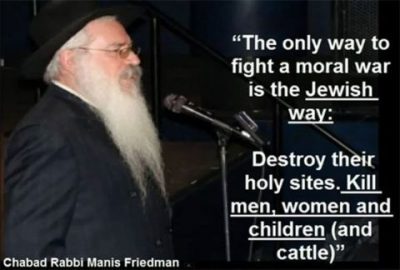
Rabbi Shmuel Eliyahu: Leave No Palestinian or Arab Alive
By Jonas E. Alexis | Veterans Today | July 23, 2017
Israeli Rabbi Shmuel Eliyahu seems to have picked up where the late Rabbi Ovadiah Yosef left off. The Israeli army, Eliyahu said, must slaughter the Palestinians “and leave no one alive.” The Palestinians, the good rabbi continued, must be “destroyed and crushed in order to end violence.” Here is Eliyahu’s algorithm:
“If they don’t stop after we kill 100, then we must kill 1,000. And if they do not stop after 1,000, then we must kill 10,000. If they still don’t stop we must kill 100,000, even a million.”
There is more to this “logic” than meets the eye and ear. Eliyahu even postulated that the Israeli army ought not to get involved in arresting Palestinians because “If you leave him alive, there is a fear that he will be released and kill other people. We must eradicate this evil from within our midst.”
You may say that this is just an isolated case. No Israeli official believes that, right? … continue
Blog Roll
Recent Comments
elmerfudzie on Col Doug Macgregor: America… papasha408 on Germany demands UN Rapporteur… papasha408 on Israel Demanding that Iran Lim… Coronistan on German government ‘embezzling’… Coronistan on Why can’t western leaders acce… John Edward Kendrick on German government ‘embezzling’… loongtip on Von der Leyen to have new secu… papasha408 on First Gaza, then the world: Th… papasha408 on Is Nixing Aid to Israel a Pois… papasha408 on Japan to Sign Up For NATO’s Uk… Redracam on Iran Willing to Dilute Enriche… loongtip on When Threats Replace Evid…


 Aletho News
- Israel Wants ISIS-Linked Militias To Control Rafah Crossing — The New Order in Gaza
- ISIS never left Syria, it just changed uniforms
- Why ARE the US and Israel Obsessed With Eliminating Iran’s Ballistic Missiles?
- Kremlin comments on EU ‘myopia’ over dialogue with Russia
- Russia more adapted to contemporary military technology than NATO
- Germany puts caveat on more missiles for Ukraine
- UK High Court rules Palestine Action ban unlawful
- Populations in key NATO nations balk at sacrifices for military spending – poll
- Ukraine to ban Russian literature – culture minister
- 40 State Attorneys General Want To Tie Online Access to ID
- If Americans Knew
- In Gaza: 8,000 bodies under rubble, 3,000 missing – Not a ceasefire Day 126
- AZAPAC, the new PAC opposing Israeli domination of U.S policies
- Haim Saban: Billionaire for Israel
- Rafah e-wallet plan highlights Israel’s deepening financial occupation
- Viral post claims Netanyahu sought legal approval, igniting speculation about Israel’s organ harvesting
- AIPAC Has a New Opponent: PAL PAC
- Right-Wing Catholic Off Trump Religion Panel After Israel-Gaza Remarks at Antisemitism Event
- Jewish terrorism, apartheid rule the West Bank – Not a ceasefire Day 125
- Why Israel persecutes children like my son Shadi
- In Gaza, One Man Is Searching for the Remains of His Family With a Flour Sifter
- No Tricks Zone
- German Gas Crisis…Chancellor Merz Allegedly Bans Gas Debate Ahead of Elections!
- Pollen Reconstructions Show The Last Glacial’s Warming Events Were Global, 10x Greater Than Modern
- Germany’s Natural Gas Storage Level Dwindles To Just 28%… Increasingly Critical
- New Study Rebuts The Assumption That Anthropogenic CO2 Molecules Have ‘Special’ Properties
- Climate Scientist Who Predicted End Of “Heavy Frost And Snow” Now Refuses Media Inquiries
- Polar Bear Numbers Rising And Health Improving In Areas With The Most Rapid Sea Ice Decline
- One Reason Only For Germany’s Heating Gas Crisis: Its Hardcore-Dumbass Energy Policy
- 130 Years Later: The CO2 Greenhouse Effect Is Still Only An Imaginary-World Thought Experiment
- New Study Affirms Rising CO2’s Greening Impact Across India – A Region With No Net Warming In 75 Years
- Germany’s Natural Gas Crisis Escalates … One Storage Site Near Empty …Government Silent
 Aletho News