US sanctions against Iran, Cuba, Venezuela breach human rights: UN expert
Press TV – May 7, 2019
A UN rights expert has slammed unilateral US sanctions against Iran, Cuba and Venezuela, saying the use of economic measures for political purposes violates human rights and international law.
In a statement released on Monday, Idriss Jazairy, UN special rapporteur on the negative impact of the unilateral coercive measures, warned that the US bans against the trio might precipitate man-made humanitarian catastrophes.
“Regime change through economic measures likely to lead to the denial of basic human rights and indeed possibly to starvation has never been an accepted practice of international relations,” he said.
“Real concerns and serious political differences between governments must never be resolved by precipitating economic and humanitarian disasters, making ordinary people pawns and hostages thereof,” he added.
Jazairy also voiced worries about Washington’s termination of sanctions waivers for major Iranian crude buyers, saying the move harms not only the Iranian nation, but also their trade partners.
“The extraterritorial application of unilateral sanctions is clearly contrary to international law,” he said.
“I am deeply concerned that one State can use its dominant position in international finance to harm not only the Iranian people, who have followed their obligations under the UN-approved nuclear deal to this day, but also everyone in the world who trades with them,” he noted, referring to the landmark 2015 agreement — officially called the Joint Comprehensive Plan of Action (JCPOA).
Recently, the US ended six months of waivers which allowed Tehran’s eight largest customers to continue importing limited volumes. It also threatened the buyers of Iranian oil with sanctions if they fail to stop their purchases.
The anti-Iran American sanctions had been lifted under the JCPOA, but they returned in place last year when the US abandoned the multilateral accord.
Elsewhere in his statement, the UN rights expert denounced the economic hardship caused by the US sanctions in Cuba and questioned Washington’s claim that its sanctions against Venezuela were aimed at “helping” its people.
He further called on the international community to “challenge” Washington’s restrictive measures against sovereign countries which amount to “a threat to world peace and security.”
“I call on the international community to engage in constructive dialogue with Venezuela, Cuba, Iran and the United States to find a peaceful resolution in compliance with the spirit and letter of the Charter of the United Nations before the arbitrary use of economic starvation becomes the new ‘normal’,” Jazairy said.
How GMO Seeds and Monsanto/Bayer’s “RoundUp” are Driving US Policy in Venezuela
By Whitney Webb | MintPress News | May 6, 2019
CARACAS, VENEZUELA — As the political crisis in Venezuela has unfolded, much has been said about the Trump administration’s clear interest in the privatization and exploitation of Venezuela’s oil reserves, the largest in the world, by American oil giants like Chevron and ExxonMobil.
Yet the influence of another notorious American company, Monsanto — now a subsidiary of Bayer — has gone largely unmentioned.
While numerous other Latin American nations have become a “free for all” for the biotech company and its affiliates, Venezuela has been one of the few countries to fight Monsanto and other international agrochemical giants and win. However, since that victory — which was won under Chavista rule — the U.S.-backed Venezuelan opposition has been working to undo it.
Now, with Juan Guaidó’s parallel government attempting to take power with the backing of the U.S., it is telling that the top political donors of those in the U.S. most fervently pushing regime change in Venezuela have close ties to Monsanto and major financial stakes in Bayer.
In recent months, Monsanto’s most controversial and notorious product — the pesticide glyphosate, branded as Roundup, and linked to cancer in recent U.S. court rulings — has threatened Bayer’s financial future as never before, with a litany of new court cases barking at Bayer’s door. It appears that many of the forces in the U.S. now seeking to overthrow the Venezuelan government are hoping that a new Guaidó-led government will provide Bayer with a fresh, much-needed market for its agrochemicals and transgenic seeds, particularly those products that now face bans in countries all over the world, including once-defoliated and still-poisoned Vietnam.
U.S.-Backed Venezuelan opposition seeks to reverse Chavista seed law and GMO ban
In 2004, then-president of Venezuela, Hugo Chávez, surprised many when he announced the cancellation of Monsanto’s plans to plant 500,000 acres of Venezuelan agricultural land in genetically modified (GM) soybeans. The cancellation of Monsanto’s Venezuela contract led to what became an ad hoc ban on all GM seeds in the entire country, a move that was praised by local farmer groups and environmental activists. In contrast to anti-GM movements that have sprung up in other countries, Venezuela’s resistance to GM crops was based more on concerns about the country’s food sovereignty and protecting the livelihoods of farmers.
Although the ban has failed to keep GM products out of Venezuela — as Venezuela has long imported a majority of its food, much of it originating in countries that are among the world’s largest producers of genetically modified foods — one clear effect has been preventing companies like Monsanto and other major agrochemical and seed companies from gaining any significant foothold in the Venezuelan market.
In 2013, a new seed law was nearly passed that would have allowed GM seeds to be sold in Venezuela through a legal loophole. That law, which was authored by a member of the Chavista United Socialist Party of Venezuela (PSUV), was widely protested by farmers, indigenous activists, environmentalists, and eco-socialist groups, which led to the law’s transformation into what has been nicknamed the “People’s Seed Law.” That law, passed in 2015, went even farther than the original 2004 ban by banning not just GM seeds but several toxic agrochemicals, while also strengthening heirloom seed varieties through the creation of the National Seed Institute.
Soon after the new seed law was passed in 2015, the U.S.-backed Venezuelan opposition led by the Roundtable of Democratic Unity (MUD) — a group comprised of numerous U.S.-funded political parties, including Guaidó’s Popular Will — took control of the country’s National Assembly. Until Venezuela’s Supreme Court dissolved the assembly in 2017, the MUD-legislature attempted to repeal the seed law on several occasions. Those in favor of the repeal called the seed bill “anti-scientific” and damaging to the economy.
Despite the 2017 Supreme Court decision, the National Assembly has continued to meet, but the body holds no real power in the current Venezuelan government. However, if the current government is overthrown and Guaidó — the “interim president” who is also president of the dissolved National Assembly — comes to power, it seems almost certain that the “People’s Seed Law” will be one of the first pieces of legislation on the chopping block.
The AEI axis
Some of the key figures and loudest voices supporting the efforts of the Trump administration to overthrow the Venezuelan government in the United States are well-connected to one particular think-tank, the American Enterprise Institute (AEI). For instance, John Bolton — now Trump’s national security advisor and a major player in the administration’s aggressive Venezuela policy — was a senior fellow at AEI until he became Trump’s top national security official. As national security adviser, Bolton advises the president on foreign policy and issues of national security while also advising both the Secretary of State and the Secretary of Defense. As of late, he has been pushing for military action in Venezuela, according to media reports.
Another key figure in Trump’s Venezuela policy — Elliott Abrams, the State Department’s Special Representative for Venezuela — has been regularly featured at AEI summits and as a guest on its panels and podcasts. According to Secretary of State Mike Pompeo, Abrams’ current role gives him the “responsibility for all things related to our efforts to restore democracy” in Venezuela. Other top figures in the administration, including Vice President Mike Pence and Secretary of State Mike Pompeo, were featured guests at the AEI’s “secretive” gathering in early March. As MintPress and other outlets have reported, Guaidó declared himself “interim president” of Venezuela at Pence’s behest. Pompeo is also intimately involved in directing Trump’s Venezuela policy as the president’s main adviser on foreign affairs.
Other connections to the Trump administration include Secretary of Education Betsy DeVos who was previously on AEI’s board of trustees.
AEI has long been a key part of the “neoconservative” establishment and employs well-known neoconservatives such as Fred Kagan — the architect of the Iraq “troop surge” — and Paul Wolfowitz, the architect of the Iraq War. Its connections to the George W. Bush administration were particularly notable and controversial, as more than 20 AEI employees were given top positions under Bush. Several of them, such as Bolton, have enjoyed new prominence in Trump’s administration.
Other key Bush officials joined the AEI soon after leaving their posts in the administration. One such was Roger Noriega, who was the U.S. representative to the Organization of American States (OAS) during the failed, U.S.-backed 2002 coup and went on to be assistant secretary of state for Western Hemisphere affairs from 2003 to 2005, where he was extremely influential in the administration’s policies towards Venezuela and Cuba.
Since leaving the Bush administration and promptly joining the AEI, Noriega has been instrumental in pushing claims that lack evidence but aim to paint Venezuela’s current President Nicolas Maduro-led government as a national security threat, such as claiming that Venezuela is helping Iran acquire nuclear weapons and hosts soldiers from Lebanon’s Hezbollah. He also lobbied Congress to support Venezuelan opposition leader Leopoldo López, Guaidó’s political mentor and leader of his political party, Popular Will.
Not only that, but Noreiga teamed up with Martin Rodil, a Venezuelan exile formerly employed by the IMF, and José Cardenas, who served in the Bush administration, to found Visión Américas, a private risk-assessment and lobbying firm that was hired to “support the efforts of the Honduran private sector to help consolidate the democratic transition in their country” after the U.S.-backed Honduran coup in 2009. In recent months, Noriega and his associates have been very focused on Venezuela, with Cardenas offering Trump public advice about how “to hasten Maduro’s exit,” while Rodil has publicly offered “to get you a deal” if you have dirt on Venezuela’s government.
While the AEI is best known for its hawkishness, it is also a promoter of big agricultural interests. Since 2000, It has hosted several conferences on the promise of “biotechnology” and genetically modified seeds and has heavily promoted the work of former Monsanto lobbyist Jon Entine, who was an AEI visiting fellow for several years. The AEI also has long-time connections to Dow Chemical.
The most likely reason for the AEI’s interest in promoting biotech, however, can be found in its links to Monsanto. In 2013, The Nation acquired a 2009 AEI document, obtained through a filing error and not intended for public disclosure, that revealed the think tank’s top donors. The form, known as the “schedule of contributors,” revealed that the AEI’s top two donors at the time were the Donors Capital Fund and billionaire Paul Singer.
The Donors Capital Fund, which remains a major contributor to the AEI, is linked to Monsanto interests through the vice chairman of its board, Kimberly O. Dennis, who is also currently a member of the AEI’s National Council. According to AEI, the National Council is composed of “business and community leaders from across the country who are committed to AEI’s success and serve as ambassadors for AEI, providing us with advice, insight, and guidance.”
Dennis is the long-time executive chairwoman of the Searle Freedom Trust, which was founded in 1988 by Daniel Searle after he oversaw the sale of his family pharmaceutical company — G.D. Searle and Company — to Monsanto in 1985 for $2.7 billion. The money Searle had made from that merger was used to fund the trust that now funds the AEI and other right-wing think tanks. Searle was also close to Donald Rumsfeld, who led G.D. Searle and Co. for years and was Secretary of Defense under Gerald Ford and George W. Bush. Searle was also a trustee of the Hudson Institute, which once employed Elliott Abrams.
After the family company — which gained notoriety for faking research about the safety of its sweetener, aspartame or NutraSweet — was sold to Monsanto, G.D. Searle executives close to Daniel Searle rose to prominence within the company. Robert Shapiro, who was G.D. Searle’s long-time attorney and head of its NutraSweet division, would go on to become Monsanto’s vice president, president and later CEO. Notably, Daniel Searle’s grandson, D. Gideon Searle, was an AEI trustee until relatively recently.
Why is a top donor to Marco Rubio increasing his stake in Bayer while others flee?
Yet, it is AEI’s top individual donor noted in the accidental “schedule of contributors” disclosure who is most telling about the private biotech interests guiding the Trump administration’s Venezuela policy. Paul Singer, the controversial billionaire hedge fund manager, has long been a major donor to neoconservative and Zionist causes — helping fund the Foreign Policy Initiative (FPI), the successor to the Project for a New American Century (PNAC); and the neoconservative and islamophobic Foundation for the Defense of Democracies (FDD), in addition to the AEI.
Singer is notably one of the top political donors to Senator Marco Rubio (R-FL) and has been intimately involved in the recent chaos in Venezuela. He has been called one of the architects of the administration’s current regime-change policy, and was the top donor to Rubio’s presidential campaign, as well as a key figure behind the controversial “dossier” on Donald Trump that was compiled by Fusion GPS. Indeed, Singer had been the first person to hire Fusion GPS to do “opposition research” on Trump. However, Singer has largely since evaded much scrutiny for his role in the dossier’s creation, likely because he became a key donor to Trump following his election win in 2016, giving $1 million to Trump’s inauguration fund.
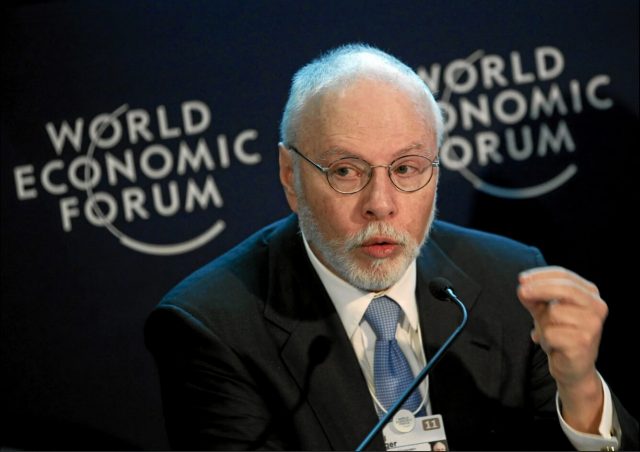
Hedge fund manager Paul Singer has raised millions for a pro-Marco Rubio super PAC. Moritz Hager | World Economic Forum
Singer has a storied history in South America, though he has been relatively quiet about Venezuela. However, a long-time manager of Singer’s hedge fund, Jay Newman, recently told Bloomberg that a Guaidó-led government would recognize that foreign creditors “aren’t the enemy,” and hinted that Newman himself was weighing whether to join a growing “list of bond veterans [that have] already begun staking out positions, anticipating a $60 billion debt restructuring once the U.S.-backed Guaidó manages to oust President Nicolas Maduro and take control.” In addition, the Washington Free Beacon, which is largely funded by Singer, has been a vocal advocate for the Trump administration’s regime-change policy in Venezuela.
Beyond that, Singer’s Elliott Management Corporation gave Roger Noriega, the former assistant secretary of state for Western Hemisphere affairs under Bush, $60,000 in 2007 to lobby on the issue of sovereign debt and for “federal advocacy on behalf of U.S. investors in Latin America.” During the time Noriega was on Singer’s payroll, he wrote articles linking Argentina and Venezuela to Iran’s nonexistent nuclear program. At the time, Singer was aggressively pursuing the government of Argentina in an effort to obtain more money from the country’s prior default on its sovereign debt.
While Singer has been mum himself on Venezuela, he has been making business decisions that have raised eyebrows, such as significantly increasing his stake in Bayer. This move seems at odds with Bayer’s financial troubles, a direct result of the slew of court cases regarding the link between Monsanto’s glyphosate and cancer. The first ruling that signaled trouble for Monsanto and its new parent company Bayer took place last August, but Singer increased his stake in the company starting last December, even though it was already clear by then that Bayer’s financial troubles in relation to the glyphosate court cases were only beginning.
Since the year began, Bayer’s problems with the Monsanto merger have only worsened, with Bayer’s CEO recently stating that the lawsuits had “massively affected” the company’s stock prices and financial performance.
Forcing open a new market for RoundUp
Part of Singer’s interest in Bayer may relate to Venezuela, given that Juan Guaido’s “Plan País” to “rescue” the Venezuelan economy includes a focus on the country’s agricultural sector. Notably, prior to and under Chavismo, agricultural productivity and investment in the agricultural sector took a backseat to oil production, resulting in under 25 percent of Venezuelan land being used for agricultural purposes despite the fact that the nation has a wealth of arable land. The result has been that Venezuela needs to import much of its food from abroad, most of which originate in Colombia or the United States.
Under Chávez and his successor, Maduro, there has been a renewed focus on small-scale farming, food sovereignty and organic agriculture. However, if Maduro is ousted and Guaidó moves to implement his “Plan País,” the opposition’s coziness with foreign corporations, the interests of U.S. coup architects in Bayer/Monsanto, and the opposition’s past efforts to overturn the GM seed ban all suggest that a new market for Bayer/Monsanto products — particularly glyphosate — will open up.
South America has long been a key market for Monsanto and — as the company’s problems began to mount prior to the merger with Bayer — it became a lifeline for the company due to less stringent environmental and consumer regulations than many Western countries. In recent years, when South American governments have opened their countries to more “market-friendly” policies in their agricultural sectors, Monsanto has made millions.
For instance, when Brazil sought to expand biotechnology (i.e. GM seed) investment in 2012, Monsanto saw a 21% increase in its sales of GM corn seed alone, generating an additional $1 billion in profits for the company. A similar comeback scenario is needed more than every by Bayer/Monsanto, as Monsanto’s legal troubles saw the company’s profits plunge late last year.
With countries around the world now weighing glyphosate bans as a result of increased litigation over the chemical’s links to cancer, Bayer needs a new market for the chemical to avoid financial ruin. As Singer now has a significant stake in the company, he — along with the politicians and think tanks he funds — may see promise in the end of the anti-GM seed ban that a Guaidó-led government would bring.
Furthermore, given that Guaidó’s top adviser wants the Trump administration to have a direct role in governing Venezuela if Maduro is ousted, it seems likely that Singer would leverage his connections to keep Bayer/Monsanto afloat amid the growing controversy surrounding glyphosate. Such behavior on the part of Singer would hardly be surprising in light of the fact that international financial media have characterized him as a “ruthless opportunist” and “overly aggressive.”
Such an outcome would be in keeping with the increased profit margins for Monsanto and related companies that have followed its expansion into countries following U.S.-backed coups. For instance, after the U.S.-backed coup in Ukraine in 2014, the loans given to Ukraine by the International Monetary Fund and the World Bank forced the country to open up and expand the use of “biotechnology” and GM crops in its agricultural sector, and Monsanto, in particular, made millions as the prior government’s ban on GM seeds and their associated agrochemicals was reversed. If Maduro is ousted, a similar scenario is likely to play out in Venezuela, given that the Guaidó-led government made known its intention to borrow heavily from these institutions just days after Guaidó declared himself “interim president.”
Feature photo | Luis Arrieta inspects a freshly planted coffee field that used to be a peach orchard in the coastal area of Carayaca on the outskirts of Caracas, Venezuela, Oct. 10, 2018 . Fernando Llano | AP
Whitney Webb is a MintPress News journalist based in Chile. She has contributed to several independent media outlets including Global Research, EcoWatch, the Ron Paul Institute and 21st Century Wire, among others. She has made several radio and television appearances and is the 2019 winner of the Serena Shim Award for Uncompromised Integrity in Journalism.
Kieran Barr contributed to the research used in this report.
Fake news alert: CNN says Venezuelan opposition leader Juan Guaido ‘won election in January’
RT | May 6, 2019
CNN took the concept of “fake news” to a whole new level with a recent report on Venezuela, in which it claimed that citizens “chose” coup leader Juan Guaido over current president Nicolas Maduro in January “elections.”
In a report on Sunday’s deadly Venezuelan military helicopter crash, CNN wrote that “pressure is mounting” on Maduro to step down “following elections in January in which voters chose opposition leader Juan Guaido over him for president.”
The report was finally corrected on Monday after being published on Sunday afternoon and remaining unfixed overnight. It now reflects the fact that Guaido was not elected, but “declared himself interim president” in January.
A correction added to the bottom of the piece explains that the earlier version had “incorrectly described” the situation. Elections? Military coups? Really, who can keep up these days!?
Amazingly, the botched report which initially referenced these mysterious imaginary elections, was the product of work by no less than six journalists — two whose names appear on the main byline and four more listed as contributors at the bottom. Normal practice would see the piece run past a couple of editors too, before being published. That’s potentially eight pairs of eyes — and none of them managed to catch the glaring error.
A number of journalists and Twitter users called CNN out for the “blatant” lie and “shameful” and “terrible” reporting.
It wasn’t the first Venezuela-related embarrassment for CNN. Reporter Jake Tapper was called out on social media last week after he tweeted a link with a picture of opposition army defectors wielding guns to claim Maduro’s government “mows down citizens in streets.”
CNN likes to be known for its so-called adversarial journalism when it comes to the Trump administration, but so far, it seems fully on board with its regime change policies in Venezuela — although, even the White House hasn’t gone so far as to pretend fake elections took place in January.
“Just A Human Being”: Rachel Maddow’s Latest Resistance Hero
By Tyler Durden | Zero Hedge | May 6, 2019
This is where three years of failed Russiagate conspiracy theorizing and fixation leads you — into the arms of fanatical endless war proponent John Bolton: “John Bolton God bless you, good luck..” one can now hear on “resistance” network MSNBC prime time.
MSNBC’s Rachel Maddow is now championing neocon national security adviser John Bolton’s “humanity” given he apparently went loose cannon this past week, vowing to confront Russia over Venezuela even as his boss President Trump downplayed Moscow’s role in the crisis after a Friday phone call with Putin.
“This is what John Bolton, human being, thought his job was this week,” Maddow said on her show Friday night. Both Pompeo and Bolton had clearly gone a bit rogue with their overly bellicose Venezuela comments, while Trump appeared to be more restrained — and for Maddow this was of course cause for championing the neocon interventionist line: “Hey, John Bolton, hey, Mike Pompeo, are you guys enjoying your jobs right now?” she questioned.
On Friday Trump had said following the phone call, Putin is “not looking at all to get involved in Venezuela other than he’d like to see something positive happen in Venezuela, and I feel the same way.”
Maddow, who once prided herself on slamming and deconstructing Bush-era regime change wars, now finds Trump not jingoistic enough. She stridently questioned:
“How do you come to work anymore if you’re John Bolton? Right, regardless of what you thought about John Bolton before this, his whole career and his track record, I mean, just think of John Bolton as a human being. This is what John Bolton, human being, thought his job was this week.”
She further cut to a clip of Bolton criticizing Russia’s alleged military involvement in Venezuela to prop up Maduro, because apparently uber-hawk Bolton is now a “fearless truth-teller” in Maddow’s world.
“You thought that was your job,” Maddow said. “But it turns out not at all, not after Vladimir Putin gets done with President Trump today.”
It bears repeating that among the loudest right-leaning voices who joined the chorus of leading establishment Democrat Russiagaters included previously forgotten about neocons who were quickly rehabilitated by the “Resistance” — David Frum, Max Boot, Robert Kagan, Bill Kristol among them.
And then there was the nauseating phenomenon of watching liberals lionizing Trump-skeptical Republican Congressional leaders like Lindsey Graham, Jeff Flake, and the late Sen. McCain.
Because it’s awful, just awful! – that Trump might actually prefer peace to waging war in multiple places…
Restraint vs. war in multiple places? Maddow apparently advances the humanity of those advocating the latter.
It amounted to, at times, a picture of a President at odds with the officials who this week have called vociferously for a change in power in Caracas and have consistently declined to rule out a US military intervention.
Trump has become frustrated this week as national security adviser John Bolton and others openly teased military options and has told friends that if Bolton had his way he’d already be at war in multiple places. — CNN
And now, months into 2019, we get to hear Maddow waxing eloquent about the innocent “human side” of none other than John Bolton.
Of course, Maddow should first consider whether Bolton or his neocon ilk ever once paused to consider whether those they advocate dropping bombs on — from Iraq to Syria to Libya to Yemen to Gaza to Venezuela — are themselves actually human beings who simply wish to live out their daily lives in peace.
‘A lot to learn from Iran’: Tehran helps Venezuela ‘survive’ under US sanctions, FM Arreaza says
RT | May 6, 2019
Iran, which has been living under tight US sanctions for several decades, is consulting the crisis-hit Venezuela on how to overcome economic blockade and boost production, Foreign Minister Jorge Arreaza revealed.
For several decades, Tehran “has been growing its economy under the [US-imposed] sanctions in a bid to seek independence in various industries,” Arreaza told reporters during his visit to Moscow. Explaining further, he said Iran has indispensable experience in defying continuous US pressure.
We have a lot to learn from Iran. We have Iranian consultants in Venezuelan government that help us survive the blockade and boost production.
Iran has been suffering from US-imposed sanctions since the 1979 Islamic Revolution which toppled the pro-Western Shah Mohammad Reza Pahlavi. The restrictions targeted Iranian finances, exports and imports, as well as energy and the military.
Most of the sanctions that crippled Iran’s economy were lifted after Iran and the five world powers, the US, the UK, France, China and Russia, plus Germany, signed the 2015 nuclear deal. But the US has unilaterally quit the landmark accord under President Donald Trump who labeled it as “the worst deal ever,” and reimposed the sanctions last November.
Likewise, the US slapped Venezuela with restrictions targeting the Latin American country’s oil industry, including the major state-run company PDVSA. These sanctions were strongly condemned by Caracas which dismissed them as economic blackmail.
Iranian advisory aside, Venezuela is seeking alternative ways of dealing with friendly countries around the world, including China and Russia. “These methods and routes aren’t built up overnight, we need much time to create them,” he admitted.
A Nuclear War? Over Venezuela?
By Ron Paul | May 6, 2019
Is President Trump about to invade Venezuela? His advisors keep telling us in ever-stronger terms that “all options are on the table” and that US military intervention to restore Venezuela’s constitution “may be necessary.” Secretary of State Mike Pompeo was on the Sunday news programs to claim that President Trump could launch a military attack against Venezuela without Congress’s approval.
Pompeo said that, “[t]he president has his full range of Article II authorities and I’m very confident that any action we took in Venezuela would be lawful.” The man who bragged recently about his lying, cheating, and stealing, is giving plenty of evidence to back his claim.
The president has no Constitutional authority to start a war with Venezuela or any other country that has not attacked or credibly threatened the United States without Congressional approval. It is that simple.
How ironic that Pompeo and the rest of the neocons in the Trump Administration are ready to attack Venezuela to “restore their constitution” but they could not care less about our own Constitution!
While Washington has been paralyzed for two years over disproven claims that the Russians meddled in our elections to elect Trump, how hypocritical that Washington does not even hesitate to endorse the actual overturning of elections overseas!
Without Congressional authority, US military action of any kind against Venezuela would be an illegal and likely an impeachable offense. Of course those Democrats who talk endlessly of impeaching Trump would never dream of impeaching of him over starting an illegal war. Democrats and Republicans both love illegal US wars.
Unfortunately, Washington is so addicted to war that President Trump would likely have little difficulty getting authority from Congress to invade Venezuela if he bothered to ask. Just as with the disastrous US invasion of Iraq in 2003, the mainstream media is nothing but non-stop war propaganda. Even so-called progressives like Rachel Maddow are attacking the Trump Administration not for its reckless saber-rattling toward Venezuela but for not being aggressive enough!
The real lesson is that even a “Constitutional” war against Venezuela would not be a just war. It would be a war of aggression for which Americans should be angry and ashamed. But the mainstream media is pumping out the same old pro-war lies, while the independent media is under attack from social media companies that have partnered with US government entities to decide what is “fake news.”
The latest outrage in the mainstream media is over the most sensible thing President Trump has done in some time: last week he spent an hour on the telephone with Russian President Vladimir Putin to discuss, among other things, the dangerous situation in Venezuela.
While President Trump’s neocon advisors are purposely trying to position him so that war is the only option, we can only hope that President Putin was able to explain that the Venezuela problem must be solved by the Venezuelans themselves. Certainly the US, perhaps together with the Russians, could help facilitate discussions between the government and the opposition, but the neocon road to war will surely end up like all the other neocon wars: total disaster.
The media is furious that Trump dared to speak to Putin as the two countries increasingly face-off over Venezuela. The Democrats and neocons are pushing for a direct confrontation that may even involve Russia. Republicans agree. Do they really prefer thermonuclear war? Over Venezuela?
The New False Positive Being Planned Against Venezuela
Orinoco Tribune | May 5, 2019
The defeat of the military political operation of April 30, 2019 against the government of President Maduro, adds to the long list of failures that led to Ivan Duque accusing the Venezuelan government of protecting the ELN, in a desperate attempt to meet one of the two tasks that have been assigned to him within the uribista government: to close the roads to the one of peace in Colombia and to attack Venezuela.
Once again defrauded by the Venezuelan opposition, the United States continues giving more and more prominence to the Colombian right. The call of Ivan Duque to the Venezuelan military during that day, shows a clumsy despair before the incapacity of the Venezuelan right, which gave one more element to President Maduro to accuse the US government and Colombia of being behind the failed coup d’etat. But the Bolivarian triumph in this battle does not end with the war.
The new false positive, to link the Venezuelan government with the ELN, is still under construction.
ELN, A GUERRILLA ORGANIZATION THAT IS APPROACHING ITS 55TH ANNIVERSARY
The National Liberation Army (ELN) and the Revolutionary Armed Forces of Colombia (FARC) were born in 1964 while Raúl Leoni occupied the presidency of Venezuela. Not even the most tendentious versions of history mention any possibility that Leoni’s government was behind its founding, nor any political group of the Venezuelan left, since all the existing ones for that moment were less strong than those that existed. They gave rise to the Colombian guerrillas during the last half of the 20th century.
Since its inception, both guerrilla groups have operated throughout the country, which obviously includes the territories of the porous border with Venezuela.
After the FARC-EP secretariat signed the peace agreements, and with it the demobilization of most of its troops, the ELN became the largest and oldest guerrilla group on the continent. The Uribista government of Duque, decided to breach and tries to modify the agreements with the FARC-EP and got up from the dialogue table with the ELN, that is, closed any near possibility of achieving a negotiated political solution to the conflict. And at the same time, it has made repression and judicialization the only government response to popular demands, while paramilitaries and the Public Force execute a new genocide against leaders and social leaders.
The reality is obvious, in Colombia there is no peace , no post-conflict and is on the verge of a humanitarian crisis. In more than five decades of confrontation, the Colombian state has not had the true political will to solve the social conflict generated by the war and its Public Force, has not managed to defeat the ELN militarily, not even with the support of paramilitary forces or the contest of the US military institutions. They have more than 16 facilities of different types in the country. On the contrary, on more than one occasion, it has been forced to negotiate. So far, the ELN has held dialogues with five presidents and seven Colombian governments.
The first dialogues had the support of Carlos Andrés Pérez, who was in his second term as president of the then Republic of Venezuela and later with the support of the governments of Hugo Chávez and Nicolás Maduro, whose interest in the peace of Colombia has been evident.
THE PSYCHOLOGICAL PROJECTION OF THE URIBE GOVERNMENT
The Colombian government refuses to assume that the entire state is in check because of the penetration of drug trafficking into its institutions. The production of cocaine and the planting of coca have a constant increase in Colombia and, according to Donald Trump himself, had never been as high as since Ivan Duque’s presidency. But the Uribe government insists on attributing to the Venezuelan government, the status of “narco-government” that actually belongs to him, and now he blames it for his own inability to win a war that has lasted more than half a century.
The caricature of President Maduro that has been built by media corporations and the voices of the Colombian government, as a fool without popular support that only remains in the presidency with the support of the FANB, is opposed to that of the man they accuse of being behind all the struggles of the Colombian people and now, even to sustain a guerrilla organization that was born when he was only one year old and since then has remained active uninterruptedly.
What looks like typical psychological projection, is actually a new attempt to generate a false positive – as denounced by the Venezuelan chancellor – but to succeed they need to erase history.
FROM IRAN TO VENEZUELA
A few days ago, Donald Trump announced that the United States would declare Iran’s Revolutionary Guard a “foreign terrorist organization,” as indeed it happened. Since this military force is the institution of an independent republic, recognized by the United Nations, this measure has no precedents and sows a very bad precedent as it is a violation of international law and the most elementary diplomatic norms.
The ELN, for its part, has been included in the list of foreign terrorist organizations designated by the US for many years , so it is not unreasonable to assume that, in addition to the argument to justify the involvement of Colombia in the first war between countries of the region of the 21st century, another dangerous objective of this attempt to link the Venezuelan government with the Colombian guerrilla organization, could be to declare the FANB as a foreign terrorist organization, given that they have not managed to co-opt, divide or defeat it.
If the internal consensus were achieved or if the pressure from the United States forced it, it would be expected that before August 2019 the Colombian state will add to its terrible history of wars, a costly and complicated military aggression against Venezuela.
Coincidentally, a few hours after the failed coup d’etat in Venezuela, Trump decided to change his ambassador in Bogotá, Kevin Whitaker, to post Philip Goldberg, whose record can give clues to the new strategies that will be directed from Colombia against Venezuela.
Goldberg was expelled from Bolivia in 2008 for allegations of conspiracy made by President Morales, he was recently in charge of business in Havana, he was also part of the diplomatic corps in Kosovo, he is an intelligence specialist and was the Coordinator in Bogotá of the terrible Plan Colombia.
Therefore, while it is important to disprove the false opinion matrices and investigate the non-governmental organizations that sustain these matrices with pseudo-investigations -even some linked to sectors that call themselves the left, Venezuela must continue preparing to respond in other areas because the lies will keep coming out of the laboratories without ceasing and will be as diverse as the tactics require; what has not changed much in the last two centuries are the strategic objectives of the United States on the region and the world.
Source: Mision Verdad
Translated by: JRE\EF
RELATED CONTENT: Venezuelan Military Deserters Removed From Hotel in Cúcuta for Late Payments
Anti-War Voices on Both Sides Warn of Coming CIA Provocation to Kill Guaidó, Blame Maduro
By Whitney Webb | MintPress News | May 3, 2019
Prominent American anti-war figures from across the ideological spectrum are warning that the Trump administration may soon turn on Juan Guaidó — the man they recognize as Venezuela’s interim president — in order to justify military intervention in Venezuela.
These warnings followed Guaidó’s failed attempt to lead a military uprising on Tuesday, which analysts characterized as a desperate move, with Guaidó’s parallel government having failed to gain any significant traction in Venezuela since late January. With Guaidó now quickly losing legitimacy and momentum since Tuesday’s failed coup, it has become increasingly probable that his political patrons — the United States — may soon turn on him, as any harm done to him could be blamed on Venezuelan president Nicolás Maduro, which would allow the U.S. government to justify aggressive action against the Maduro-led government.
One of the first prominent anti-war voices to raise concern that the U.S. government, particularly the CIA, may now see Guaidó as more valuable dead than alive was Daniel McAdams, executive director of the Ron Paul Institute for Peace and Prosperity and co-host of the Ron Paul Liberty Report, with the former congressman, presidential candidate and well-known libertarian. During Tuesday’s edition of the Liberty Report, Paul raised concern that a provocation could be used to push for foreign (i.e., U.S.) military intervention in Venezuela:
The big danger is a hard war breaking out. I’d still bet it won’t be too bad, with thousands of troops moving. But it could be a guerrilla war or something like that. If there is a false flag or some important official on either side gets killed, you can’t tell what might happen.”
McAdams responded, pointing out that Guaidó himself could soon become such a target for a provocation:
He [Guaidó] has been a kind of a hapless figure so far. He calls for mass protests and no one shows up. I don’t think he realizes right now that he is actually now worth more dead than alive not only to the CIA, but also to his own opposition people. A shot in the crowd or something like that to take Guaidó out. It might shock you, Dr. Paul, but the CIA is pretty good at this kind of things.”
After Venezuela coup failure, officials & mainstream media desperately spinning explanations
RT | May 4, 2019
Months of insistence in Washington that the people of Venezuela stood by the US-backed opposition leader Juan Guaido basically went up in smoke when his ‘Operation Liberty’ fizzled. The question now is whom to blame.
Senior US officials like National Security Advisor John Bolton and special envoy for Venezuela Elliott Abrams expressed confidence in “regime change” in Caracas on Tuesday, named top Venezuelan officials ready to defect, and even spoke of signed documents to that effect.
Yet literally none of this happened, and by the early evening on Tuesday, the handful of Guaido’s armed supporters were seeking sanctuary in foreign embassies.
Then came the spin. Secretary of State Mike Pompeo went on CNN and Fox News to claim that Maduro was getting ready to flee to Cuba, but “the Russians” talked him out of it. Bolton claimed Maduro was “hiding in a bunker” even as video evidence from Caracas showed him addressing supporters numbering in the thousands on May Day. The truth was inescapable, though: Guaido had failed.
“The opposition took a step backward with the military,” Rocio San Miguel, president of the Colombian NGO Control Ciudadano, told Bloomberg on Thursday. “Guaido appearing with [his mentor Leopoldo] Lopez at a single point in the city with a few dozen soldiers and no major firepower showed their weakness.”
So what happened? Several US media outlets have since sought to explain, citing anonymous sources allegedly privy to US government plots. These sources told Bloomberg they believe Maduro got wind of the coup on April 29, and Guaido rushed it ahead of schedule “or it would all collapse.”
Lopez was released from house arrest because the head of the Venezuelan intelligence agency SEBIN, General Manuel Christopher Figuera, had defected to Guaido, the anonymous and entirely unverifiable sources claimed, adding that it was Lopez resurfacing that might have spooked other senior officials – defense minister Vladimir Padrino, Supreme Court Chief Justice Maikel Moreno, and military intelligence and presidential guard head General Ivan Hernandez.
According to these sources, Figuera’s wife left Venezuela on Sunday for the safety of the US, and the general left the country as well after he was sacked on Tuesday night, though his whereabouts are unknown.
Meanwhile, AP published a long speculative piece about missed opportunities to turn senior Venezuelan officials, from Hernandez being denied a visa in 2017 for his 3-year-old son’s brain surgery, to Padrino reaching out to the US government in early 2016, after a troubled Venezuelan election.
Padrino in particular has been seen as “a potential white knight,” being a graduate of the School of the Americas. Apparently, very little US influence in the Venezuelan army had survived what the AP described as “thorough scrubbing” by Former President Hugo Chavez.
“There’s a theory that’s gaining ground, and I think there’s some credence to it, that it was all part of a big ‘rope-a-dope’ operation, whereby the Maduro officials pretended to go along with this coup to smoke out the opposition,” Daniel McAdams, executive director of the Ron Paul Institute for Peace and Prosperity, told RT.
“That’s one possibility, the other is that Pompeo’s lying” about Maduro’s attempted flight to Cuba, McAdams said, adding that neither reflects well on the US.
Whatever the truth, there is no escaping the fact that Washington has pushing for regime change in Caracas for months with sanctions and other forms of pressure, and openly since “recognizing” Guaido in January, to absolutely no avail. All the hot air coming from Bolton, Pompeo, Abrams and other high officials pushing the regime change narrative has had far more effect in the US than in Venezuela.
Trump Contradicts Pompeo and Bolton’s Venezuela Claims After Call With Putin
Sputnik – May 4, 2019
President Donald Trump appeared to contradict his own senior officials’ claims about Russian “involvement” in Venezuela on Friday following his telephone conversation with Russian President Vladimir Putin.
“We talked about many things. Venezuela was one of the topics. And he is not looking at all to get involved in Venezuela, other than he’d like to see something positive happen for Venezuela. And I feel the same way,” Trump said, speaking to reporters in Washington on Friday during a meeting with the Slovak prime minister.
According to Trump, the US wanted to help Venezuela on a “humanitarian basis,” including with the delivery of food and water to the country’s “starving” population. “I thought it was a very positive conversation I had with President Putin on Venezuela,” Trump said.
Trump’s remarks appeared to stand at odds with earlier claims by several of his key officials, including Secretary of State Mike Pompeo and National Security Adviser John Bolton, about alleged Russian “interference” in Venezuela.
On Wednesday, Pompeo had a telephone conversation with Russian Foreign Minister Sergei Lavrov, telling him that Russia should “not interfere” in the Latin American country. Lavrov called the allegations of Russian involvement “rather surreal” and said that Russia’s “principled position” was to “never interfere in the affairs of others.”
Earlier, Bolton warned countries “external to the Western Hemisphere,” including Russia against deploying military forces in Venezuela, and signaled the US administration’s readiness to use the Monroe Doctrine in its policy toward Latin America. US Special Representative for Venezuela Elliott Abrams similarly indicated that the US might impose sanctions against Russia over Moscow’s military assistance to Venezuela, telling reporters that “the Russians will pay a price for this” for their meddling earlier this year.
Pompeo, Bolton and acting Secretary of Defence Patrick Shanahan met at the pentagon on Friday to discuss military options in Venezuela, with Shanahan reiterating the White House’s oft-repeated claim that all options remained “on the table” in resolving the Venezuelan crisis and dismissing concerns about a lack of good intelligence on the Venezuelan country.
Later Friday, unnamed sources told CNN that President Trump had asked questions “about the reliability of US intelligence” on Venezuela, given that the expected military uprising hoped for by opposition leader Juan Guaido “and some US officials” earlier this week failed to pay off.
The long-standing crisis in Venezuela escalated on Tuesday, after Guaido announced the beginning of the “final phase” of the “Operation Freedom” campaign to topple the government, and urged members of the military to defect and join the opposition. The call to action led to clashes in the capital between security forces and the opposition, leaving dozens injured. A day later, Maduro appeared on television to announce that the coup had failed, and to say that a criminal investigation aiming to uncover its organisers had been launched.
Twitter suspends the accounts of two newspapers and several Venezuelan government institutions, but verifies the “presidential” account of Guaidó
Orinoco Tribune | May 2, 2019
Between Tuesday, April 30 and Wednesday, May 1, the US corporation Twitter has suspended, without explanation, the accounts of several Venezuelan media and various government institutions led by President Nicolás Maduro. Among others, the accounts of the newspapers El Correo del Orinoco ( @correoorinoco ), the Diario Vea ( @DiarioVEAVen ) and the television station ViVe Televisión ( @ViVetvoficial ), as well as the accounts of the Ministry of Popular Power for Women ( @MinMujer ); of the Ministry of Popular Power for Education (@ mppeducacion ) and the Ministry of Popular Power for Petroleum ( @MinPetroleoVE ).
The newspaper Vea is a private media outlet whose editorial line is favorable to the Venezuelan revolutionary process, while El Correo del Orinoco and Vive Televisión are state media.
These actions occurred almost simultaneously with an attempted coup on April 30 against the government of President Nicolás Maduro, as part of the maneuvers to overthrow him that the opposition deputy Juan Guaidó, with the support of the US government, has been attempting since the 23rd of January.
It is noteworthy that the opposition deputy Juan Guaidó, who claims to be “President in charge” of Venezuela, announced last week the creation of a “National Communication Center”, which will function as an “official communications organ” or a kind of ministry of parallel communication. It will be directed by Alberto Federico Ravell, a journalist known for having directed the private channel Globovisión during the years in which it worked as a communication weapon to try to overthrow the then President Hugo Chávez, and later became the director of the opposition digital medium, La Patilla, of identical characteristics.
The (coup’s) “National Communication Center” announced on Monday that its social networks were already active, having created the @Presidencia_VE account , which they describe as the “Official Account of the Presidency (E) of the Bolivarian Republic of Venezuela.” This account, surprisingly, already appears as “verified account” (with the blue check that denotes that the Twitter company has verified the legitimacy of this account), although the real account of the Presidency of Venezuela, @PresidencialVen , which records the activities of the Venezuelan President Nicolás Maduro, was never verified by this company, despite the fact that it was created in April 2010 and has more than 1 million followers.
The verification to the @Presidencia_VE account of Juan Guaidó is, moreover, strange given that Twitter announced in November 2017 that its program for verification of accounts (to place the famous “blue check”) was temporarily suspended , and until today he has not reactivated it .
The blue check denotes that the Twitter company verified that the account belongs to its legitimate user. Generally it was approved for journalists, politicians, celebrities and famous people or of the world of show business, which allows to distinguish the legitimate accounts of impersonations, usurpers, false accounts and parodies.
For some, the fact that the Twitter company has decided to place as “verified account” the one of Guaidó seems to indicate in a brazen way what their political preferences are.
Worse yet: the @PresidencialVen account has been suspended this year on at least two occasions: March 12 and April 1. It was also suspended in September 2018. The restrictions lasted a few days; The reasons were never reported.
Maduro was re-elected on May 20, 2018 as President of Venezuela, in a widely audited process that was attended by international observers.
The account of Correo del Orinoco has been suspended several times, the most recent being on January 29. This account has more than 829 thousand followers and mainly publishes contents of the newspaper’s website , which is attached to the Venezuelan Ministry of Communication and Information and is directed by the journalist Desiré Santos Amaral. It is noteworthy that last year they celebrated the 200th anniversary of the creation of Correo del Orinoco by the Venezuelan Liberator Simón Bolívar, a newspaper that played an important role during the war of independence against Spain. The account was unlocked a few days later.
At that time, the @ViceVenezuela account of the Vice Presidency of the Republic, which has 329 thousand followers, was also restricted for several days .
Precedents
It is not the first time that major Twitter accounts linked to the Chavista government are massively blocked, particularly during politically critical moments.
In November 2013, Twitter suspended some 6,600 accounts of supporters of President Nicolás Maduro or of officials or institutions of his government, including two media outlets (CiudadCCS and the radio network La Radio del Sur). Among those blocked were the then Minister of Communication and Information, Delcy Rodríguez; Wilmer Barrientos, who at that time was assigned to the Office of the Presidency; the then Minister of Agriculture and Lands, Yvan Gil; the governor of Anzoátegui at that time, Aristóbulo Istúriz ( @psuvaristobulo); as well as the official accounts of the ministries of University Education, Land Transportation, for Women, Corpomiranda, the Social Vice Presidency, the Bolivarian University of Venezuela (UBV), the National Experimental University of Security (UNES), Pdval, Mercal, and networks of supporters of Maduro such as ForoCandanga, in addition to numerous journalists, professionals and recognized individuals. The accounts were restored days later, claiming that it was “an error” .
In June 2017, dozens of media accounts and chavismo activists were suspended without explanation. At least thirteen accounts of the state-run Radio Nacional de Venezuela were suspended, including its main account, @RNVContigo, and the accounts of regional broadcasters @rnvcentral, @rnvtachirafm, @rnvzulia, @rnvanzoategui, @rnvlosllanosfm, @rnvtachirafm and @rnvportuguesa, as well as the @rnvmusical and @rnvindigena channels, and the @rnvcultura, @rnvdeportes sections and @rnvinter. In addition, the accounts of Radio Miraflores ( @MirafloresFM ) and Miraflores TV ( @MIRAFLORES_TV ), media of the Presidency of the Republic, as well as important Chavez influencers and tweeters were blocked. None of these accounts could be recovered.
Translated by JRE\EF
RELATED CONTENT:
Instagram Acts as Arm of US Govt, Bans Top Iranian Officials After IRGC ‘Terrorist’ Designation
Featured Video

Col Doug Macgregor: America’s Back to ENDLESS WARS
or go to
Aletho News Archives – Video-Images
From the Archives
Rabbi Shmuel Eliyahu: Leave No Palestinian or Arab Alive
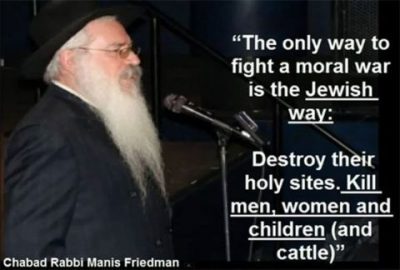
By Jonas E. Alexis | Veterans Today | July 23, 2017
Israeli Rabbi Shmuel Eliyahu seems to have picked up where the late Rabbi Ovadiah Yosef left off. The Israeli army, Eliyahu said, must slaughter the Palestinians “and leave no one alive.” The Palestinians, the good rabbi continued, must be “destroyed and crushed in order to end violence.” Here is Eliyahu’s algorithm:
“If they don’t stop after we kill 100, then we must kill 1,000. And if they do not stop after 1,000, then we must kill 10,000. If they still don’t stop we must kill 100,000, even a million.”
There is more to this “logic” than meets the eye and ear. Eliyahu even postulated that the Israeli army ought not to get involved in arresting Palestinians because “If you leave him alive, there is a fear that he will be released and kill other people. We must eradicate this evil from within our midst.”
You may say that this is just an isolated case. No Israeli official believes that, right? … continue
Blog Roll
Recent Comments
elmerfudzie on Col Doug Macgregor: America… papasha408 on Germany demands UN Rapporteur… papasha408 on Israel Demanding that Iran Lim… Coronistan on German government ‘embezzling’… Coronistan on Why can’t western leaders acce… John Edward Kendrick on German government ‘embezzling’… loongtip on Von der Leyen to have new secu… papasha408 on First Gaza, then the world: Th… papasha408 on Is Nixing Aid to Israel a Pois… papasha408 on Japan to Sign Up For NATO’s Uk… Redracam on Iran Willing to Dilute Enriche… loongtip on When Threats Replace Evid…


 Aletho News
- Israel Wants ISIS-Linked Militias To Control Rafah Crossing — The New Order in Gaza
- ISIS never left Syria, it just changed uniforms
- Why ARE the US and Israel Obsessed With Eliminating Iran’s Ballistic Missiles?
- Kremlin comments on EU ‘myopia’ over dialogue with Russia
- Russia more adapted to contemporary military technology than NATO
- Germany puts caveat on more missiles for Ukraine
- UK High Court rules Palestine Action ban unlawful
- Populations in key NATO nations balk at sacrifices for military spending – poll
- Ukraine to ban Russian literature – culture minister
- 40 State Attorneys General Want To Tie Online Access to ID
- If Americans Knew
- In Gaza: 8,000 bodies under rubble, 3,000 missing – Not a ceasefire Day 126
- AZAPAC, the new PAC opposing Israeli domination of U.S policies
- Haim Saban: Billionaire for Israel
- Rafah e-wallet plan highlights Israel’s deepening financial occupation
- Viral post claims Netanyahu sought legal approval, igniting speculation about Israel’s organ harvesting
- AIPAC Has a New Opponent: PAL PAC
- Right-Wing Catholic Off Trump Religion Panel After Israel-Gaza Remarks at Antisemitism Event
- Jewish terrorism, apartheid rule the West Bank – Not a ceasefire Day 125
- Why Israel persecutes children like my son Shadi
- In Gaza, One Man Is Searching for the Remains of His Family With a Flour Sifter
- No Tricks Zone
- German Gas Crisis…Chancellor Merz Allegedly Bans Gas Debate Ahead of Elections!
- Pollen Reconstructions Show The Last Glacial’s Warming Events Were Global, 10x Greater Than Modern
- Germany’s Natural Gas Storage Level Dwindles To Just 28%… Increasingly Critical
- New Study Rebuts The Assumption That Anthropogenic CO2 Molecules Have ‘Special’ Properties
- Climate Scientist Who Predicted End Of “Heavy Frost And Snow” Now Refuses Media Inquiries
- Polar Bear Numbers Rising And Health Improving In Areas With The Most Rapid Sea Ice Decline
- One Reason Only For Germany’s Heating Gas Crisis: Its Hardcore-Dumbass Energy Policy
- 130 Years Later: The CO2 Greenhouse Effect Is Still Only An Imaginary-World Thought Experiment
- New Study Affirms Rising CO2’s Greening Impact Across India – A Region With No Net Warming In 75 Years
- Germany’s Natural Gas Crisis Escalates … One Storage Site Near Empty …Government Silent
 Aletho News