Russian Ambassador Says Reports on Alleged Russian Mercenaries in Venezuela Hoax
Sputnik – 26.01.2019
Russian Ambassador in Caracas Vladimir Zaemsky slammed on Friday in a conversation with Sputnik media reports about alleged presence of “private military contractors” from Russia in Venezuela as “another hoax.
“I don’t know about the presence of any Russian private military companies in Venezuela. This is another hoax,” Zaemskiy said.
Earlier in the day, Reuters news agency reported, citing anonymous sources, that “private military contractors who do secret missions for Russia” had recently arrived in Venezuela, which is currently going through a political crisis, to boost safety of the country’s incumbent president, Nicolas Maduro.
Kremlin spokesman Dmitry Peskov told Reuters that Kremlin had “no such information.”
On Tuesday, the opposition-run Venezuelan National Assembly adopted a statement declaring President Nicolas Maduro a “dictator.” On Wednesday, opposition leader Juan Guaido proclaimed himself the country’s interim president at a mass rally in Caracas. The United States, Argentina, Brazil, Canada, Chile and Colombia, among others, have recognized Guaido as Venezuela’s interim president, while some other countries, including Russia and Mexico, expressed support for incumbent President Maduro.
AMLO Offers to Mediate Between Venezuelan Gov’t and Opposition
teleSUR | January 25, 2019
Mexican President Andres Manuel Lopez Obrador declared Friday his government’s willingness to mediate in the Venezuelan political conflict if the parties request it and without violating the self-determination principle adopted by his administration.
When journalists asked him about the issue during his routine morning conference, Lopez Obrador reminded the public that the Mexican Constitution’s Article 89 establishes that the foreign policy should stick to the principles of non-intervention, self-determination and peaceful solution of controversies.
“It doesn’t mean we’re in favor or against anyone. We’re here to defend the constitutional principles of foreign policy,” he explained.
He was then questioned about his previous idea of mediating the dialogue between the Venezuelan government and the opposition, and declared he would be willing to it.
“We will respect our principles and if the parts requested, we’re at the best disposition to help for a dialogue,” he declared.
The Foreign Minister Marcelo Ebrard already has instructions to “support within our means, without interfering in the conflict,” and without taking sides, said Lopez Obrador.
“This is related to a historical tradition of foreign policy in our country. We shouldn’t interfere with the affairs of other peoples and nations because we want no hegemony, no foreign government, interfering in the issues that belong to Mexicans only,” said the president.
Establishing a key difference between his administration and the previous three, led by Vicente Fox, Felipe Calderon and Enrique Peña Nieto, Lopez Obrador reiterated his firm position.
“If at some point in time they deviated from this principles, we won’t do it. We won’t act violating, breaking with constitutional principles of foreign policy,” he declared.
The Venezuelan President Nicolas Maduro has said he agrees with the initiative of a new set of dialogues with the opposition to deal with the country’s political and economic affairs.
“The governments of Mexico and Uruguay proposed to launch an international initiative to promote a dialogue between the Venezuelan parts… I say to you publicly that I agree,” said Maduro during a speech at the Supreme Justice Court.
Mexico and Uruguay issued a joint statement calling for Venezuelans to “find a peaceful and democratic solution to the complex context” that the faced in the South American country.
Both governments refused to recognize the opposition lawmaker Juan Guaido as the “interim president” of the Bolivarian republic, maintaining its recognition for Maduro.
“The governments of Uruguay and Mexico call for all the involved parts, within the country and abroad, to reduce tensions and avoid an escalation of violence that could worsen the situation,” says the statement.
Tensions increased when Guaido declared Friday he would appropriate the faculties of the executive branch to combat the “usurpation” by Maduro.
The Vultures of Caracas
By Craig Murray | January 26, 2019
We are frequently told that people in Venezuela have no food, clothing or toilet paper, and that popular discontent with the left wing government is driven by real hunger. There are elements of truth in this story, though the causes of economic dislocation are far more complex than the media would have us believe.
But I ask you to look at this photo of supporters of CIA poster-boy, the West’s puppet unelected “President” Juan Guaido, taken at a Guaido rally in Caracas two days ago and published yesterday in security services house journal The Guardian. Please take a really close look at the photo. Blow it up as big as you can. Scan individual people in the crowd, one by one.
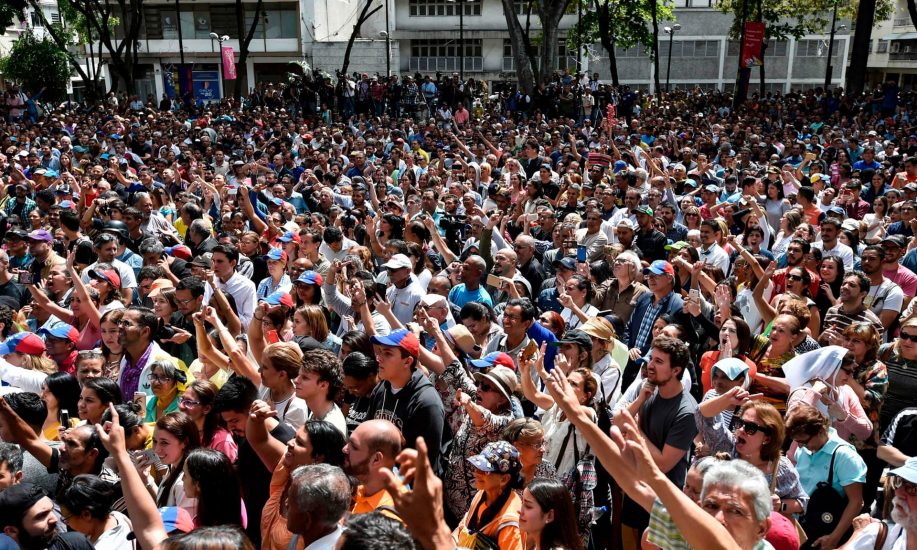
These are not the poor and most certainly not the starving. As it chances I have a great deal of life experience working amongst seriously deprived, hungry and despairing people. I know the gaunt face of want and the desperate glance of need. Look at these Guaido supporters, one by one by one. This designer spectacled, well-coiffed, elegantly dressed, sleekly jowled group does not know hunger. This group does not know want. This is a proper right wing gathering, a gathering of the nicely off section of society. This is a group of those who have corruptly been siphoning Venezuela’s great wealth for decades and who want to make sure the gravy train flows properly in their direction again. It is, in short, a group of exactly the kind of people you would expect to support a CIA coup.
Those manicured hands raised in the air will never throw rocks, or get involved in violence unless against a peasant strapped to a chair for them. It is not this crowd which will suffer as public disorder is manipulated and directed by the CIA. These wealthy ones are immune, just as Davos serves as nothing but an annual reminder of how very poorly God aims avalanches.
There is real suffering in Venezuela. The CIA is working hard to stoke violence, and the genuine poor will soon start to die, both in those egged on to riot and in the security services. But do not get taken in by the complete nonsense that this is a popular, democratic revolution. It is not. It is yet another barefaced CIA regime change coup.
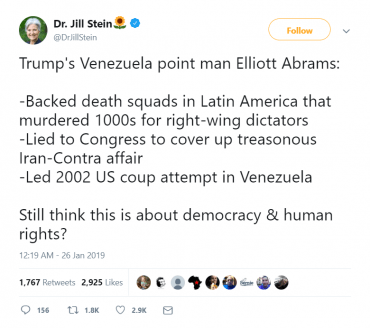
UPDATE Such wisdom as this blog finds is often crowd-source, and with thanks to a commenter below here is some useful information from Jill Stein.
—————————————————
Unlike our adversaries including the Integrity Initiative, the 77th Brigade, Bellingcat, the Atlantic Council and hundreds of other warmongering propaganda operations, Craig Murray’s blog has no source of state, corporate or institutional finance whatsoever. It runs entirely on voluntary subscriptions from its readers – many of whom do not necessarily agree with the articles, but welcome the alternative voice, insider information and debate.
Subscriptions to keep Craig going are gratefully received.
Juan Guaido: Imperial Point Man for a Venezuelan Civil War
By Jim Carey | Geopolitics Alert | January 23, 2019
Caracas – The imperial powers have found their new opposition point man in Venezuela; President of the National Assembly and President of the country according to some nations and organizations.
Now that the latest term of Venezuelan President Nicolas Maduro has started and the western powers and their proxies refuse to recognize the Bolivarian government, the imperial states are in a mad dash to find a new face for the Venezuelan opposition. Now it seems that man has been found and the race is on, with state after state anointing the 35-year-old engineer Juan Guaidó.
Guaidó, now being called the “interim President” by everyone from Jair Bolsonaro, the Organization of American States (OAS), to Donald Trump and Justin Trudeau is the current president of the Venezuelan National Assembly. However, according to the states looking for a regime change in Venezuela, Guaidó isn’t just head of the parliament but also the rightful leader of Venezuela.
Guaidó has become a fast-rising star in the political opposition which has led the anti-Maduro National Assembly an opportunity to make political hay and possibly get outside assistance. The opposition acted on this chain of events Tuesday when the National Assembly declared Guaidó the interim President and said he is in charge of organizing new “legitimate” elections.
Putting a new face to the Venezuelan opposition then immediately allowed for all sorts of anti-Maduro actors use Guaidó as their man to rally around.
So now that there is a new imperial point-man inside Venezuela the real question is, what happens next?
There are two likely outcomes to the rise of Guaidó, one of which is contingent on him succeeding and the other which would be another complete failure for the imperialists.
Guaidó launches his campaign today following several days or organizing protesters at rallies in Caracas. The protests have already started to turn violent as of this writing with at least four dead and the opposition calling for the military to “rise up” against the Bolivarian government.
This is all backed by countries like Canada, European nations and sham imperial bodies like the Organization of American States (OAS), which also encourage regime change and now want Guaidó as the man to lead it. Surprisingly, US President Donald Trump was one of the few holdouts who had yet to recognize Guaidó as President but finally caved today.
Guaidó himself has also made promises that should the imperialists allow him to become president and his government to take over they would be welcomed back into the international community. The faux president has also made promises that under his leadership Venezuela would “easily” receive debt relief and loans. At the same time they’re doing this, the opposition also continues to push through measures to freeze the state’s assets, punishing average Venezuelans more in order to entice into turning on Maduro.
This kind of financial manipulation by the opposition coupled with the protests starting to say are essentially an insurrection against a state sponsored by the imperial powers. While protests aren’t necessarily “warfare,” the calls on the military to revolt also show that the opposition doesn’t just want to use civil disobedience but they’d be fine with a violent civil war.
Civil war may be one possible outcome of this latest anti-Maduro frenzy but there is also the possibility that these protests – like those in 2017 – fail. If Guaidó is looking to be president he obviously can’t have this happen or he’ll likely end up like Leopoldo Lopez, Washington’s last golden boy and fellow party member with the “interim President.”
Much like Guaidó, Lopez led protests that became violent and saw protesters causing damage meant to cripple Venezuelan infrastructure for extended periods of time. The problem for López is his little “uprising” failed, he was held accountable for encouraging the violence, and is now on house arrest.
If Guaidó and the empire fail again the “interim President” can likely look forward to the same fate.
The United States Is at It Again: Compiling an Enemies List
By Philip M. GIRALDI | Strategic Culture Foundation | 24.01.2019
Many American still long for the good old days when men were still manly and President George W. Bush was able to announce that there was a “new sheriff in town” pledged to wipe terrorism from the face of the earth. “You’re either with us or against us,” he growled and he backed up his warning of lethal retribution with an enemies list that he called the “axis of evil.”
The axis of evil identified in those days in the 2002 State of the Union Address consisted of Iraq, Iran and North Korea. Iraq, which had not yet been invaded and conquered by the American war machine, was number one on the list, with Saddam allegedly brandishing weapons of mass destruction deliverable by the feared transatlantic gliders that could easily strike the United States. Bush explained that “Iraq continues to flaunt its hostility toward America and to support terror. The Iraqi regime has plotted to develop anthrax and nerve gas and nuclear weapons for over a decade. This is a regime that has already used poison gas to murder thousands of its own citizens, leaving the bodies of mothers huddled over their dead children. This is a regime that agreed to international inspections, then kicked out the inspectors. This is a regime that has something to hide from the civilized world.”
North Korea meanwhile was described as “A regime arming with missiles and weapons of mass destruction, while starving its citizens” while Iran “aggressively pursues these weapons and exports terror, while an unelected few repress the Iranian people’s hope for freedom.”
The phrase “axis of evil” proved so enticing that Undersecretary of State John Bolton used it two months later in a speech entitled “Beyond the Axis of Evil.” He included three more countries – Cuba, Libya and Syria because they were “state sponsors of terrorism that are pursuing or who have the potential to pursue weapons of mass destruction (WMD) or have the capability to do so in violation of their treaty obligations.” The nice thing about an Axis of Evil List is that you can make up the criteria as you go along so you can always add more evildoers.
Iraq was removed from the playing field in March 2003 while Libya had to wait for President Barack Obama and Secretary of State Hillary Clinton to be dealt with, but North Korea, Cuba, Syria and Iran are still around. Nevertheless, the idea of an enemies list continues to intrigue policy makers since it would be impossible to maintain the crippling burden of the military industrial complex without a simple expression that would convey to the public that there were bad actors out there waiting to pounce but for the magnificent efforts being made by Boeing, Lockheed, Northrop Grumman, General Dynamics and Raytheon to defend freedom.
The Administration of President Donald Trump, not to be outdone by its predecessors, has recently come up with two enemies lists. The first one was coined by the irrepressible John Bolton, who is now National Security Adviser. He has come up with the “troika of tyranny” to describe Cuba, Venezuela and Nicaragua, where he sees “… the dangers of poisonous ideologies without control, and the dangers of domination and suppression… I am here to convey a clear message from the President of the United States about our policy towards these three regimes. Under this administration, we will no longer appease the dictators and despots near our coasts in this hemisphere. The troika of tyranny in this hemisphere — Cuba, Venezuela and Nicaragua — has finally found its rival.”
Bolton also demonstrated that he has a light touch, adding “These tyrants fancy themselves strongmen and revolutionaries, icons and luminaries. In reality, they are clownish, pitiful figures more akin to Larry, Curly, and Moe. The three stooges of socialism are true believers, but they worship a false God.”
Secretary of State Mike Pompeo has apparently also been looking at Venezuela and not liking what he is seeing. On his recent road trip to the Middle East he told reporters that “It is time to begin the orderly transition to a new government [in Caracas].” He declared that “The Maduro regime is illegitimate and the United States will work diligently to restore a real democracy to that country. We are very hopeful we can be a force for good to allow the region to come together to deliver that.” “Force for good” is another key soundbite used by Pompeo. In his Cairo speech on January 10th, he described the United States as a “force for good” in the entire Middle East.
Bolton might have thought “troika of tyranny” was a hands down winner, but he was actually upstaged by the dour Vice President Mike Pence who declared to a gathering of US Ambassadors that “Beyond our global competitors, the United States faces a ‘wolf pack of rogue states.’ No shared ideology or objective unites our competitors and adversaries except this one: They seek to overturn the international order that the United States has upheld for more than half a century.” The states Pence identified were North Korea, Iran, Cuba, Venezuela and Nicaragua. Of the five, only North Korea can even plausibly be considered as a possible threat to the United States.
As wolves are actually very social animals the metaphor provided by Pence does not hold together very well. But Pence, Bolton and Pompeo are all talking about the same thing, which is the continued existence of some governments that are reluctant to fall in line with Washington’s demands. They have to be banished from polite discourse by declaring them “rogue” or “tyrannical” or “evil.” Other nations with far worse human rights records – to include Saudi Arabia, Pakistan, Israel and Egypt – are given a pass as long as they stay aligned with the US on policy.
So useful “lists” are all about what Washington wants the world to believe about itself and its adversaries. Put competitors on a list and condemn them to eternal denigration whenever their names come up. And, as Pence observes, it is all done to prevent the overturning of the “international order.” However, his is a curious conceit as it is the United States and some of its allies, through their repeated and illegal interventions in foreign countries, that have established something like international disorder. Who is really doing what to whom is pretty much dependent on which side of the fence one is standing on.
Venezuelan army disavows self-proclaimed leader, will defend national sovereignty – defense minister
RT | January 23, 2019
The Venezuelan military will not accept a president imposed by “dark interests,” Defense Minister Vladimir Padrino said after Washington and a number of its allies recognized a lawmaker as the new leader in Caracas.
The army will continue to defend the constitution and national sovereignty, Padrino said on Wednesday afternoon, hours after opposition lawmaker Juan Guaido was proclaimed interim president by the National Assembly, in a direct challenge to President Nicolas Maduro.
The US quickly recognized Guaido as Venezuela’s legitimate leader, with the Organization of American States (OAS) following Washington’s lead. Canada and France have also recognized Guaido, while Mexico has declined to do so “for now.”
Bolivia declared “solidarity with the people of Venezuela and brother Nicolas Maduro” in resisting the “claws of imperialism” in South America, President Evo Morales tweeted.
Maduro responded to the US announcement by cutting diplomatic ties with Washington and giving American diplomats 72 hours to leave Venezuela.
Guaido, however, countermanded that in a tweet and promised that Venezuela “will continue to maintain diplomatic relations with all the countries of the world.”
The issue of diplomats has raised the stakes in the US-Venezuela confrontation, as Senator Marco Rubio (R-Florida) – one of the driving forces behind the recognition of Guaido – argued that US diplomats should stay put, since leaving would mean recognition of Maduro’s legitimacy.
Venezuela’s supreme court declares all acts of opposition-led National Assembly illegal
RT | January 21, 2019
Venezuela’s Supreme Court has declared all acts of the country’s National Assembly null and void, days after the opposition-held assembly declared President Nicolas Maduro’s election illegitimate.
The National Assembly is a 167-seat legislature, currently headed by Juan Guaidó of the Popular Will party – a fierce opponent of Maduro, who had been taking part in protests against him and has called for the country’s military to depose the president.
Maduro already declared the National Assembly illegitimate in 2017, and created a new legislature – the Constituent National Assembly – to replace it, where all seats are currently held by pro-Maduro parties. As Maduro lacks the Constitutional power to outright dissolve the National Assembly, both houses have functioned alongside each other since 2017, with the CNA given power to overrule legislation passed by the National Assembly.
Maduro was sworn in last week after winning re-election last May. The opposition-led assembly and a coalition of neighboring countries declared Maduro’s election illegitimate.
US Secretary of State Mike Pompeo called Maduro’s election “illegitimate” and a “sham,” and vowed to keep up diplomatic pressure on the Venezuelan government.
Guaidó was briefly detained by secret police en route to a rally last week. Maduro insisted that Guaidó’s arrest was not government-ordered, and may have been staged for the media.
The Supreme Court’s announcement comes amid news of anti-government demonstrations in the country’s capital, as well as a mutiny by a National Guard unit stationed in a slum neighborhood near the Presidential Palace. Government forces arrested 40 National Guardsmen and fired tear gas at protesters in the early hours of Monday morning.
Defense Minister Vladimir Padrino Lopez said on Twitter that the rogue soldiers will “be punished with the full weight of the law.”
Video footage from the neighborhood shows protesters lighting fires and blocking the streets with barricades.
The ongoing crisis in Venezuela is being closely followed by US media and politicians, the majority of whom are openly anti-Maduro. Vice President Mike Pence has expressed support for Guaidó, calling the National Assembly the “only legitimate body in the country,” while Florida Senator Marco Rubio has repeatedly called Maduro’s government “illegitimate” and pressed for regime change in the Latin American country.
Venezuela has been mired by hyperinflation, starvation, and a refugee crisis that has seen almost three million Venezuelans flee the country. Washington has blamed the socialist economic policies of Maduro and his mentor Hugo Chavez for the deepening crisis, while passing sanctions against the Maduro government officials. The latest major batch of sanctions was in September signed by President Donald Trump, who once announced he is “not going to rule out a military option” in addressing the crisis in Venezuela.
US Administrations Have Been Intervening in Venezuela Since at Least the Early 2000s
FAIR | January 16, 2019
Janine Jackson interviewed Alexander Main about the Nicolás Maduro re-election for the January 11, 2019, episode of CounterSpin. This is a lightly edited transcript :
Janine Jackson: When it comes to Venezuela, elite US media don’t hide their feelings. And their feelings are all the same. Headlines on last year’s reelection of Venezuelan president Nicolás Maduro differed only in tone, including the disdainful: “As Venezuelans Go Hungry, Their Government Holds a Farcical Election,” from the Economist; the decisive: USA Today‘s “Maduro Is Turning Venezuela Into a Dictatorship,” or Foreign Affairs’ more somber version, “Venezuela’s Suicide; Lessons From a Failed State.” There’s Forbes’ vaguely threatening “Why Nicolas Maduro of Venezuela May Wish He Lost the Presidential Election,” and Foreign Policy’s unashamed “It’s Time for a Coup in Venezuela.”
But they’re all pretty much variations on a theme that’s hard to unhear, given that media bang it out so loudly and repeatedly. Here to help us sort fact from froth is Alexander Main. He’s director of international policy at the Center for Economic and Policy Research. He joins us by phone from Washington, DC. Welcome to CounterSpin, Alex Main.
Alex Main: Thank you, Janine.
JJ: Writing for FAIR on Venezuelan elections last year, Alan MacLeod pinpointed US media’s preferred trope, which was to say that Maduro was reelected “amid”—amid outcry, amid widespread disillusionment, amid charges of irregularities, amid low turnout. The message, I think, to readers was that Maduro’s re-election was not legitimate. What should we know about last May’s elections in Venezuela?
AM: So what isn’t generally mentioned by the media is that a critical factor in the outcome of the election was the approach taken by Venezuela’s opposition. Much of the opposition, many of its parties, decided to boycott these elections, for a variety of reasons.
At any rate, the media did not examine that fact. And we’re still not seeing it very much. I think one of the few exceptions is the Washington Post, in the article that appeared today, that did mention the divisions within the opposition, and their decision not to participate that had, obviously, a huge effect on the election result.
JJ: The media coverage would give you the impression that Venezuela’s election almost happened in a vacuum, but there was in fact involvement from, for example, the Organization of American States.
AM: Well, the Organization of American States, or rather the secretary general of the organization, whose name is Luis Almagro. He represents himself. He was elected, but once secretary general, he has sort of executive power there; but he doesn’t represent the countries within the organization. He has been on a campaign against the Maduro government from very early on. It stems from their initial decision not to allow him to send electoral observers to the elections.
And this is based on a decision taken by Venezuela’s electoral authorities many years ago, when they decided that they had enough transparency, enough safety measures around the elections, that they no longer required any sort of outside tutelage.
A number of countries in Latin America have taken the same decision. It’s a decision that has to do with the respect of their sovereignty. Certainly you don’t see in the US any massive presence of international observers, even though I think a lot of people would like to see that at some point.
But anyway, this was a sovereign decision that was taken by Venezuela’s electoral authority. And following that, Almagro really went on a rampage, and has been very much involved in efforts to try to delegitimize the Maduro government and to support the very hard-line opposition.
In doing this, he went sort of out of bounds in terms of his rhetoric, even for a lot of right-wing governments in Latin America, when late last year he voiced support for a military coup, much as some US officials have done, and US members of Congress have done. And as a response, you had all of the governments of Latin America that signed on to a statement that categorically rejected the possibility of any form of military intervention, whether by coup or an outside military intervention in Venezuela.
But certainly his rhetoric, and the campaign that he has led—along with other figures, such as Sen. Marco Rubio—have certainly given the impression that there is a desire for US intervention in what’s going on in Venezuela, and that’s, I think, resulted in sort of a defensive reaction from the Venezuelan government.
JJ: Well, it sounds very disturbing, but also confusing. You know, when I was looking through headlines, I saw one from something called the Pacific Council on International Policy that said, “Maduro Re-Elected. Can Democracy Ever Prevail in Venezuela?” I mean, just at the level of the sentence, it’s confusing. And then when you start talking about a coup to save democracy—which is the upshot of current coverage, and I guess policy—it just doesn’t even seem to make sense. The call is for the US to intervene, but the US is already intervening, isn’t it?
AM: Well, yeah, absolutely, and they’ve really been intervening in Venezuela, various US administrations, since at least the early 2000s, when we know that the US government—through institutions like the National Endowment for Democracy—has been providing funding and training to opposition groups in Venezuela, and often very hard-line groups that have taken a radical line, not recognizing the government and trying to seek its removal through extra-constitutional means, including a short-lived coup that took place in April of 2002.
The US has been very involved in trying to isolate them, Venezuela, diplomatically throughout the region, putting a lot of pressure on Latin American governments to support US measures condemning the situation in Venezuela.
More recently, the US has been applying sanctions against the government of Venezuela. And this is a very underreported thing in the US media and the international media generally.
When you see the coverage, for instance, of the Maduro inauguration, what you don’t see at all are references to the impact of the economic sanctions that have been applied. In fact, there are few media outlets at this point that even acknowledge that there are economic sanctions, even though they’ve been in place since August of 2017, when Trump announced them through an executive decree, having determined Venezuela to be an “extraordinary threat to US national security.” Those were the actual terms that were used in order to justify these sanctions.
And they’ve had a dire effect in Venezuela, which has been experiencing an economic crisis for quite a while now, since 2014 at least. And the government, of course, has failed to resolve this. It has to do with some of the government’s own economic policies. But at this point, the US also bears responsibility through these sanctions, where they have cut off Venezuela’s access to international financial markets, by which they can borrow money and purchase the necessary imports that the country needs. And we know that there aren’t enough imports of food or of medicine that are taking place at the moment.
And it’s also had a dire effect on the country’s oil production. And, of course, oil is the source of most of Venezuela’s national revenue. Along with falling oil prices, there’s been a tremendous fall in oil production in Venezuela, and it accelerated, actually, after these sanctions were put into place, because the Venezuelan government isn’t able to make the necessary investments to maintain the oil fields.
So that’s not mentioned, really, whatsoever in the major media, even though you have economists, including opposition-aligned economists from Venezuela, like Francisco Rodriguez, who have pointed out the very negative impact that these sanctions are having on the country.
JJ: Alan MacLeod also found a piece in Bloomberg that came close to acknowledging it, but in such a strange way. It was an article in which Bloomberg said that victory in the “widely derided election” gives Maduro “sole ownership of the nation’s crushing economic crisis.” And then in the very next sentence, it gloats that US and regional leaders will punish Venezuela by imposing “further isolation and sanctions on the crisis-stricken nation’s all-important oil industry.”
AM: Exactly. There’s this absurd idea that the sanctions somehow only hurt the Venezuelan government and Venezuelan government officials. It’s always the Venezuelan government’s responsibility, when they discuss the economic situation.
From time to time, you do see some media saying, “Oh, but the Venezuelan government says that the US sanctions are contributing to this dire economic situation.” They fail to ask any independent expert. You know, any economists that are taking a good look at what’s going on in Venezuela today will tell you, “Well, yes, these sanctions quite obviously are having a very negative impact.”
JJ: Finally, one of the things that coverage does is present the Venezuelan people as benighted. A piece from Time from last year includes one of my favorite creations. It first of all says that the crisis, the current crisis, “can be traced to the 1998 election of Hugo Chávez to the presidency,” so Chávez is the reason that things are difficult now. But I love this presentation: “Chávez concocted a political system that used often high oil prices to essentially bribe the masses into supporting him.”
The picture of the Venezuelan people that one gets from US media coverage is really as sort of benighted, not knowing what’s good for themselves and, once again, requiring some sort of intervention to tell them how to do democracy.
AM: Yes. This is quite absurd. Really, what we’re seeing in Venezuela is, one, an extraordinarily well-organized population, and particularly in poor communities that are certainly confronting a very dramatic economic situation, but I think doing so in effective ways that make the situation somewhat sustainable for these communities. So we’re seeing a very, very high level of community organization.
I’d say the vast majority of Venezuelans at this point are probably quite disgruntled with Maduro and his government. However, the Venezuelan opposition really offers no viable alternative to the Maduro government. They have never presented any sort of coherent economic proposal, with the possible exception of the opposition candidate in last year’s election. But, of course, most of the opposition parties boycotted those elections.
And in general, I think a lot of Venezuelans, certainly those that come from lower-income communities, are well aware of the fact that the opposition is linked to the country’s traditional economic elite, and they have a terrible reputation from their involvement in governments before Chávez was in power.
Things may be bad under Maduro, but I think there’s a sense among many Venezuelans that things could actually be quite a bit worse under opposition governments, particularly if they impose the sort of neoliberal policies that hurt the poor people of Venezuela enormously during the decades prior to Hugo Chávez’s election in the late ’90s.
JJ: We’ve been speaking with Alexander Main; he’s director of international policy at the Center for Economic and Policy Research. You can find their work, including Alex’s piece, “The United States’ Hand in Undermining Democracy in Venezuela,” online at CEPR.net. Alexander Main, thank you very much for joining us today on CounterSpin.
AM: Thank you, it was a pleasure.
Don’t meddle in Venezuela, Moscow tells coup-cheering Washington
RT | January 16, 2019
Russia has criticized the US government for bullying Venezuela and encouraging its opposition to stage a coup against President Nicolas Maduro, who was sworn in for his second term last week.
“Nations should avoid meddling in other nations’ internal affairs,” Russian Foreign Minister Sergey Lavrov said on Wednesday. He said that Washington’s encouragement of opposition forces in Venezuela “has made them unwilling to seek reconciliation [with the president], which is regretful.”
Venezuela is currently in a political crisis, with the opposition-controlled National Assembly declaring President Maduro a “usurper” and its speaker, Juan Guaido, an “interim president” of the country. The move came after strong public support from Washington, which has been advocating toppling Maduro for quite some time.
Washington has targeted Maduro’s government with a series of crippling economic and personal sanctions, and reportedly considered a military intervention in the country.
The National Assembly’s mandate to represent Venezuelans remains in question. In 2017, the country reformed its parliament system by introducing a new body called the Constitutional Assembly, which is controlled by pro-government politicians. The opposition and its backers in Washington rejected the reform as a power grab and declared the new legislature illegal.
Explaining Russia’s position on the conflict, Lavrov said US involvement in Venezuela was “very alarming and indicated that the US policy of destabilizing governments it does not like remains a priority.”
Venezuela suffered years of economic and social hardships, which the opposition blames on Maduro’s poor governance. He blames the hardship on sabotage of big business and foreign interests, which want to see his socialist government ousted from power.
Venezuela Welcomes 2,500 Cuban Doctors Leaving Brazil
teleSUR | January 13, 2019
Over 2,000 Cuban doctors are setting up practice in Venezuela after being kicked out of Brazil by President Jair Bolsonaro, Venezuelan leader Nicolas Maduro said this weekend.
Two-thousand-five-hundred cardiologists, anesthesiologists, and general doctors arrived in the South American country Friday to bulk up the medical staff at the Barrio Adentro Mission, a social initiative founded by ex-president Hugo Chavez to provide free, public medical care.
In November, thousands of doctors were forced to leave the Mais Medicos (More Doctors) cooperation program in Brazil after far-right president Bolsonaro criticized the program, saying it was torture for Cuban mothers who were “not allowed” to go with their children and questioning diplomatic ties with the island.
In the last five years, about 20,000 Cuban physicians have participated in the ‘More Doctors Program,’ assisting thousands of Brazilians in rural communities to receive primary health care.
Some 1,462 vacancies, roughly 17.2 percent of those positions left by the Cuban doctors, have not yet been filled, the Brazilian Health Minister, Luiz Henrique Mandetta, said Friday.
Several states and municipalities inside Brazil pressured the National Government to provide a solution because the Cuban doctors are usually the only medical option in several rural areas of the country.
A Humanitarian Crisis in Venezuela? A Case Study into NGO Mercy Corps
By Nina Cross | Venezuelanalysis | October 31, 2018
Following a sharp increase in Venezuelan migration since 2015, the corporate mainstream media, alongside the governments of the US, EU and Colombia, is aggressively pushing the narrative of a “humanitarian crisis,” at the same time that Western NGOs flock to set up shop along the Colombian border.
But what if NGOs are being used to influence how the movement of people from Venezuela into Colombia is being shaped and reported, and what’s more, if they are directly benefiting from this situation? To explore the idea, we focus on one such NGO, US-based Mercy Corps, which recently announced an expansion of its operations on the Colombo-Venezuelan border.
Mercy Corps’s budget for global operations, on the order of US $500 million (according to its 2017 annual report), includes funding from US and EU government agencies. Its financiers have included the UK’s International Department of Development, which has regularly sent aid via Mercy Corps to rebel-held areas in Syria. Other funders include the Bill and Melinda Gates Foundation and the Clinton Foundation.
In March 2018, Mercy Corps carried out a “rapid needs assessment” (RNA) of Venezuelan migrants arriving at two main points along the Colombian border. The information gathered was used to “demonstrate” the dangers involved during and after crossings from Venezuela, and the reasons for leaving the country. It is in response to this second question that the people interviewed by Mercy Corps all say the same thing: they are migrating due to an economic crisis in Venezuela, which is linked to hyperinflation.
Independent UN experts, as well as other commentators, have shown on many occasions that the causes of this economic crisis have been significantly exacerbated by the economic sanctions imposed for years upon Venezuela by the US, as well as clarifying that the crisis in Venezuela is economic, not humanitarian. Even US State Secretary Mike Pompeo recently admitted that the sanctions “sometimes have an adverse impact on the people of Venezuela.”
However, Mercy Corps is not concerned with narratives that expose US and EU complicity, and as such, its recommendations fail to include the most obvious point: end the sanctions and stop the hostility towards Venezuela as they are inflicting hardship on its population.
Instead, Mercy Corps’ RNA identified 3 basic needs to be met by the Colombian government: a path to legal entry into Colombia that did not involve passports, the legal right to work in Colombia with the same wages and protections as Colombians and access to shelter, food and water. It is on this third point which Mercy Corps looks to fish for substantial (tax-free) donations and financing from the Global North.
In April, the Colombian government agreed that migrants could register, without passports, at any of the 500-plus checkpoints it would set up along the border over a two month period, to end in June. The reason given was to see how many Venezuelans were entering Colombia. The checkpoints were spread along the 1,500 mile border. Any information supplied by migrants at the checkpoints would be retained by NGOs, not passed to government departments.
By August, the Colombian government agreed that nearly half a million Venezuelans could remain in Colombia for up to two years, look for employment and have access to basic services. The reason given for this change was to accommodate humanitarian needs.
This shift in policy was a reversal of the government’s ruling in February, when up to 3,000 Colombian soldiers were stationed along the border to check for passports. This tightening of rules was referred to as a “diplomatic closure” and the government claimed in a short time the number of migrants fell by 30%.
Yet within a few weeks Bogota U-turned its policy to allow the unhindered movement of Venezuelans, and NGOs such as Mercy Corps were conscripted to enable the process. The new policy of the Colombian government met exactly the needs identified by Mercy Corps, suggesting that the campaign for this migration was an international, organised effort.
In October of this year, Mercy Corps announced they are expanding their services on the border, including providing migrants with a debit card to purchase products. Yet, one out of every three Venezuelans attended by Mercy Corps did not see any improvements to their diet in the two weeks since arriving to Colombia, and 12 percent reported that it had worsened.
Since the Colombian government changed its policy, the number of people leaving Venezuela has increased, according to the Migration Policy Institute, an organisation affiliated to the EU.
As the exodus expands, the humanitarian needs of migrants grow more urgent.
Humanitarian crisis? Mercy Corps as a propaganda tool
The situation of Venezuelan migrants is now being called a “regional humanitarian crisis,” creating a picture of unimaginable catastrophe that needs external intervention.
This escalating crisis narrative of an expanding exodus is placing Venezuela under intense scrutiny. While punishing Venezuela with sanctions from the front, and promoting a migration crisis from behind, the EU and US, with the cooperation of Colombia, are attempting to box Venezuela into a more isolated and vulnerable position.
Colombia has enjoyed close ties with the EU, and soon after changing its policy on Venezuelan passports, it became a NATO partner, further cementing its EU and US dealings. This ballistic development means that the consequences of border conflict, fuelled by a recent movement of 5,000 extra troops to the Catatumbo border region, should be taken very seriously.
Meanwhile, Mercy Corps has consistently driven a narrative of a full-blown humanitarian crisis and rampant violence under President Maduro, including unfounded allegations of repression and torture. For instance, the NGO has made the unsubstantiated, hyperbolic claim on their website that “newborns in Syria have a better chance of survival than those born in Venezuela today,” wich clearly looks to stoke the fire.
Harnessing its “independent charity voice,” Mercy Corps is playing its part as a propaganda tool in vilifying the Venezuelan government, enabling its US and EU funders to continue their sanctions, which only worsen the economic hardship of average Venezuelans, the root cause for leaving their country, as explained in Mercy Corps’ own needs assessment. And whilst all this goes on, Mercy Corps gleefully rakes in ever greater funding so as to “attend” to the “humanitarian crisis” they, together with the mainstream media, have played a key role in manufacturing.
Political interference and profit from Mercy Corps
However, beyond playing a role in the international media war, Mercy Corps is intimately linked to the Washington policy-making establishment that has formulated the US policy of illegal, unilateral sanctions.
Mercy Corps is connected to the influential US Council on Foreign Relations (CFR) through its CEO Neal Keny-Guyer, who declared earnings of $460,000 just for his Mercy Corps role in 2017. Apart from being a member of the CFR, he also serves as chairman for Interaction, the US’ largest alliance of NGOs and sitting on the World Economic Forum’s Global Agenda Council on Fragility, Violence and Conflict. The CFR, a virtual who’s who of America’s wealthiest and most powerful people, claims it “helps policymakers” on “international peace and stability,” whilst actually pushing Washington’s neoliberal agenda and interests around the world.
The president of the CFR is Richard Haass, Middle East advisor under George Bush, and advisor to Colin Powell under George W. Bush. On his 2016 election win, Donald Trump publicly considered Haass as an advisor.
The CFR president recently displayed his frustration that US-backed military coups and UN- sanctioned military intervention in Venezuela, all of which would create a further migratory exodus, were taken off the table, despite ongoing rumours from the White House, Bogota, and even Brasilia, that they may be be possible.
In February the CFR made a Preventive Action Plan which recommended more economic sanctions for Venezuela, and in May more US sanctions were imposed.
Whilst sanctions have helped create the conditions which drive people out of Venezuela, US government aid has flowed to NGOs in Colombia, to which Mercy Corps has taken its chunk.
Mercy Corps’ 2017 financial statement shows that the organization benefited from US $464,452,000 in governmental grants and private backing alone, only spending $139,876,000 in humanitarian relief and $46,699,000 in humanitarian recovery. Of this humanitarian relief, the vast majority was spent on the mysteriously entitled “subgrant” category, and only $21,753,000 on actual materials and supplies for migrants.
Aid and NGOs: Assets of US policymakers
The CFR also included an aid plan for Venezuela which called for State Department funding for the Bureau of Population, Refugee and Migration (PRM), an organisation which finances Mercy Corps.
In August, the US announced an aid plan at the United Nations Assembly General (UNGA), matching the plan set out by the CFR.
Additionally, in an April article the CFR also suggests “…bypassing the government, if enough aid is provided by the United States, the Lima Group, and the EU to enable people to bring some back into Venezuela.”
The CFR continues: “While not the ideal means to provide humanitarian aid inside Venezuela, smuggling is a well-established activity and effectively closing the border to the influx of such aid would significantly add to the discredit of the Maduro government.”
Indeed, the CFR is explicitly advocating illegal smuggling as a means of destabilizing the elected government in Caracas. Meanwhile, smuggling is a problem for Venezuela, but not in the terms described by the CFR. On the contrary, Venezuela has suffered from extensive smuggling of subsidized goods and fuel into Colombia, exasperating shortages and as such generating more inflation.
Mercy Corps: A toy in the US imperialist toolbox
This game played by think-tanks and policymakers reveals Washington’s glaring double-standards vis-a-vis Venezuela. While they help to create and exploit the need for basic foods and medicines in another hemisphere, roughly 45,000 of their own people die each year through lack of health care. Around 30 million Americans have no medical cover at all, roughly the population of Venezuela, which has health care written into its constitution.
Every year a further 2 million Americans travel out of the US for treatment they cannot afford at home. Some will die if they do not find treatment abroad, but instead of being a crisis, this is termed ‘medical tourism.’
At the same time, the US is deporting tens of thousands of Hondurans, while more attempt to cross the border into the US every day, a legacy of Hillary Clinton’s 2009 adventurism.
Yet, we are constantly told to believe that Washington cares about migrants and the well-being of Venezuelans.
While US policymakers play games around Venezuela, with toys from the imperialist toolbox, along with their EU friends, it is no wonder Maduro fears assassination.
This article is a combination of two texts by Nina Cross, the first of which was published by the Morning Star, edited by Venezuelanalysis.
Venezuela Launches Media Response Plan to Fake News Attacks
Venezuelanalysis | October 31, 2018
Merida – The Venezuelan government has announced the creation of a media based task force to address fake or misleading international news stories about the Caribbean nation.
The ‘Zero Tolerance Media Plan’ was announced by Vice Minister for International Communication William Castillo Monday, and will run through the Foreign Office and its network of embassies and consulates.
Castillo explained that the plan looks to offer responses to instances of fake news coverage “one by one.”
“There have been attacks against the Venezuelan demonym, not just against the country, its political authorities, its government, or Chavismo any more, but now against the people, the average folk, our national identity,” he explained.
Castillo used one example of a recent anonymous note in a Portuguese TV channel which claimed that Venezuelan mothers were giving away their children so as to be able to eat. “This is fake,” he clarified.
Caracas has frequently denounced a media-based campaign to undermine its sovereignty, democratic credentials, and social advances in recent years. Venezuelan authorities claim that US-led media outlets, as well as important European outlets such as El Pais in Spain, look to damage the reputation of the nation and create spin which justifies coercive measures against the country, such as sanctions and an international intervention.
A recent example involves the so-called “humanitarian crisis” in Venezuela following increased migration levels.
“In Central America they don’t say ‘humanitarian crisis, massive exodus, catastrophe, diaspora’. There, it is a ‘caravan’, as if it were a party, and they are thousands which are fleeing poverty, violence, a lack of opportunities, hope, and the US government is closing the door to them,” stated Vice President of the National Constituent Assembly Tania Diaz, drawing comparison with the 7000-strong migrant march which is en route to the Mexican-US border.
Further examples include the media coverage of the August 4 terrorist drone attack against President Nicolas Maduro, in which corporate media outlets used words such as “apparent” and “alleged” to sew doubt about the reality of the attack which targeted the President and injured seven soldiers.
Featured Video
The Sordid History of the CIA – Part 2
or go to
Aletho News Archives – Video-Images
From the Archives
Rabbi Shmuel Eliyahu: Leave No Palestinian or Arab Alive
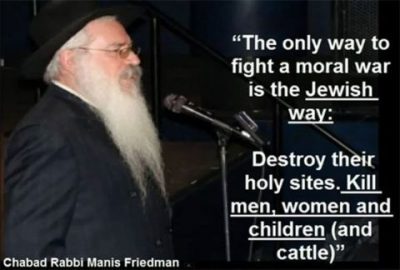
By Jonas E. Alexis | Veterans Today | July 23, 2017
Israeli Rabbi Shmuel Eliyahu seems to have picked up where the late Rabbi Ovadiah Yosef left off. The Israeli army, Eliyahu said, must slaughter the Palestinians “and leave no one alive.” The Palestinians, the good rabbi continued, must be “destroyed and crushed in order to end violence.” Here is Eliyahu’s algorithm:
“If they don’t stop after we kill 100, then we must kill 1,000. And if they do not stop after 1,000, then we must kill 10,000. If they still don’t stop we must kill 100,000, even a million.”
There is more to this “logic” than meets the eye and ear. Eliyahu even postulated that the Israeli army ought not to get involved in arresting Palestinians because “If you leave him alive, there is a fear that he will be released and kill other people. We must eradicate this evil from within our midst.”
You may say that this is just an isolated case. No Israeli official believes that, right? … continue
Blog Roll
Recent Comments


 Aletho News
- The Sordid History of the CIA – Part 2
- French FM under fire over ‘false’ claims about UN rapporteur
- Israel Wants ISIS-Linked Militias To Control Rafah Crossing — The New Order in Gaza
- ISIS never left Syria, it just changed uniforms
- Why ARE the US and Israel Obsessed With Eliminating Iran’s Ballistic Missiles?
- Kremlin comments on EU ‘myopia’ over dialogue with Russia
- Russia more adapted to contemporary military technology than NATO
- Germany puts caveat on more missiles for Ukraine
- UK High Court rules Palestine Action ban unlawful
- Populations in key NATO nations balk at sacrifices for military spending – poll
- If Americans Knew
- Noor’s short life of unimaginable suffering
- Israel Destroyed Gaza’s Hospitals. Now It’s Banning Doctors Without Borders.
- Is Spite of What Zionists Say, It’s a Good Thing to Criticize Governments
- Palestinian mother, daughter recount strip searches, harsh conditions in Israeli detention
- Israel used weapons in Gaza that made thousands of Palestinians evaporate
- ADL’s Stats Twist Israel’s Critics Into Antisemites
- Why Is the World Silent When the Gaza Genocide Is Not Over?
- In Gaza: 8,000 bodies under rubble, 3,000 missing – Not a ceasefire Day 126
- AZAPAC, the new PAC opposing Israeli domination of U.S policies
- Haim Saban: Billionaire for Israel
- No Tricks Zone
- German Gas Crisis…Chancellor Merz Allegedly Bans Gas Debate Ahead of Elections!
- Pollen Reconstructions Show The Last Glacial’s Warming Events Were Global, 10x Greater Than Modern
- Germany’s Natural Gas Storage Level Dwindles To Just 28%… Increasingly Critical
- New Study Rebuts The Assumption That Anthropogenic CO2 Molecules Have ‘Special’ Properties
- Climate Scientist Who Predicted End Of “Heavy Frost And Snow” Now Refuses Media Inquiries
- Polar Bear Numbers Rising And Health Improving In Areas With The Most Rapid Sea Ice Decline
- One Reason Only For Germany’s Heating Gas Crisis: Its Hardcore-Dumbass Energy Policy
- 130 Years Later: The CO2 Greenhouse Effect Is Still Only An Imaginary-World Thought Experiment
- New Study Affirms Rising CO2’s Greening Impact Across India – A Region With No Net Warming In 75 Years
- Germany’s Natural Gas Crisis Escalates … One Storage Site Near Empty …Government Silent
 Aletho News