Venezuela’s Gold: 3 Times State Wealth in Western Banks “Mysteriously” Vanished
Sputnik | January 28, 2019
Self-proclaimed Venezuelan interim president Juan Guaido has praised the Bank of England’s reported refusal to allow Caracas to repatriate $1.2 billion worth of gold bullion, branding the move a “protection of assets.” Sputnik looks at a few other times Western governments and banks froze, or outright stole, the sovereign wealth of other countries.
Caracas has been waging a losing battle to get its gold back from the UK since late last year, with the Bank of England repeatedly refusing its repatriation requests, according to media reports. Last week, British Foreign Secretary Jeremy Hunt joined Britain’s US allies in backing Juan Guaido, calling him “the right person to take Venezuela forward” and making the return of Venezuela’s gold all the more unlikely. Over the weekend, as if on cue, Guaido praised London’s decision not to return the gold.
All Part of the Job
The practice of freezing or seizing the assets of countries which somehow find themselves on the wrong side of US and European policymakers and financial interests is anything but new. A 1992 review of US extraterritorial asset freeze orders by legal scholar Rachel Gerstenhaber recounted well over a dozen cases of the US freezing or confiscating assets of countries including the likes of Iraq, Panama, Libya, Iran, South Vietnam, Cuba, Nicaragua and a bevy of former Eastern Bloc states. The list doesn’t include similar moves by US allies in Western Europe, which similarly deprived countries of tens of billions of dollars in sovereign assets. For the sake of brevity, Sputnik focuses on three such cases.
Iran
The 40-year-old saga of Iran’s frozen assets goes back to the 1979 Iranian Revolution, which saw revolutionaries overthrow US-backed dictator Mohammad Reza Shah Pahlavi and the establishment of an Islamic republic. The upheaval, which included the taking of hostages at the US Embassy in Tehran, prompted Washington to cut off diplomatic relations, ban Iranian oil imports and freeze some $11 billion in assets ($35.35 billion today, accounting for inflation).On the eve of the signing of the landmark Joint Comprehensive Plan of Action (JCPOA), widely known as the Iran nuclear deal, in 2015, Tehran’s frozen assets, including those stemming from the 1979 Revolution, as well as international nuclear-related restrictions, were estimated to amount to at least $100 billion. The chief of Iran’s central bank said that only about $32 billion, a third of the total, could be released in connection with the nuclear deal.
Over three years after the JCPOA’s signature, the fate of much of the wealth remains unclear. What is known is that US courts have heard multiple cases demanding the outright seizure of the Islamic Republic’s wealth. This includes a 2016 ruling ordering Iranian cash to be paid to the families of US servicemen killed in the 23 October, 1983 truck bombings in Beirut, Lebanon. Tehran maintains that it had nothing to do with the act of terrorism, and has challenged the ruling with the International Court of Justice, so far unsuccessfully.
In a separate, even more outrageous ruling from 2018, a New York court ordered frozen Iranian assets to be used to compensate the victims of 9/11, despite the fact that Iran had nothing to do with the terrorist attacks and that 15 of the 19 hijackers were Saudi nationals.
Iraq
In the run-up to the US invasion of Iraq in 2003, the military planning to seize the country’s strategic assets was accompanied by economic calculations to seize some $1.75 billion in Iraqi assets already frozen in US accounts.
The seizure was just the tip of the iceberg in what would become what seems like a bottomless pit of asset pilfering in the chaos which followed the invasion. In 2010, a Pentagon audit concluded that it couldn’t account for some $8.7 billion in missing Iraqi oil and gas money meant for reconstruction.
Earlier, US media sporadically reported on the enthralling case of some $10-$20 billion in cash, most of it consisting of Iraqi state assets, which was shipped into Iraq in 2004 for reconstruction efforts before seemingly vanishing into thin air.In a 2005 audit, US inspector general for Iraq reconstruction Stuart W. Bowen Jr. reported that over $8.8 billion in the funds could not be accounted for. Six years later, Bowen told Congress that US officials still hadn’t accounted for some $6.6 billion in funds, and said the case could very well be “the largest theft of funds in national history.”
Libya
The details of the suspected plundering of a major chunk of Libya’s vast sovereign wealth fund in the aftermath of the NATO intervention to overthrow Libyan leader Muammar Gaddafi remain shrouded in mystery, close to eight years after the attack. In late 2018, officials from one of Libya’s warring factions called on the UN Security Council to safeguard what’s left of the Libyan assets still frozen in foreign accounts.
The concerns came following reports last March that some 10 billion euros (approximately $11.4 billion US) in Libyan sovereign wealth had disappeared from a Belgian bank, with just 5 billion euros of the original 16 billion euro fund remaining. Last September, a UN panel found Belgium to be in breach of asset freeze restrictions, with interest payments on some of the Libyan funds feared to have been transferred to accounts belonging to warring militias, including Islamists. Authorities from the Tripoli-based government later alleged that the United Arab Emirates were “almost certainly” behind the pilfering, saying the funds were used to support the Tobruk-based government in eastern Libya.
The scandal is just one of numerous major asset freezes and seizures by Western powers in the aftermath of Gaddafi’s demise. In 2012, over a billion euros in assets belonging to Gaddafi’s family and senior members of his government were seized in Italy at the request of the International Criminal Court, including stakes in major Italian companies, as well as property.
A year before that, the Obama administration froze $29.8 billion in Libyan wealth held in US banks including Goldman Sachs, Citigroup, JPMorgan Chase and the Carlyle Group.
The assets, along with $40 billion more in funds held elsewhere, were reported to have been unfrozen in December of 2011. However, UN officials later said that only about $3 billion of that had actually reached the country “due to concerns over who the money should be released to and other diplomatic problems.” In late 2018, the head of Libya’s sovereign wealth fund told Reuters that the fund was planning to appoint auditors to carry out a system-wide audit of its assets in 2019 to try to unfreeze some of the billions in assets still frozen. As of late last year, an estimated 70 percent of the Libyan Investment Authority’s $67 billion in assets abroad remain frozen by the UN.
Also in 2018, British lawmakers mulled pulling a US courts-style seizure of part of Libya’s sovereign wealth fund to compensate victims of the Irish Republican Army, which Gaddafi is thought to have sponsored in the 1980s.
An estimated 9.5 billion pounds ($12.5 billion US) of Libya’s wealth is still believed to be held in British banks. Tripoli has urged London not to go ahead with the seizure. “There is no lawful basis for the United Kingdom to seize or change ownership of the frozen LIA assets. These belong to the Libyan people,” Libyan Investment Authority chief Ali Mahmoud Hassan Mohamed said in a letter addressed to the UK’s Junior Foreign Minister Alistair Burt last October.
The unscrupulous use of Libyan national wealth hasn’t been limited to post-Gaddafi Libya, either. Last year, former French President Nicolas Sarkozy was charged with bribery and accepting some 50 million euros in illegal campaign contributions from Libya ahead of the 2007 presidential election in France. Sarkozy repaid this generosity by being one of the key advocates of the 2011 NATO attack on Libya.
Caracas’s Bullion
On Sunday, Argentinian newspaper Ambito Financiero reported that Venezuelan national assembly head Juan Guaido had asked Prime Minister May and Bank of England governor Mark Carney not to return the estimated $1.2 billion in gold bullion to Caracas, despite President Maduro’s requests. Earlier, in a Saturday tweet, Guaido praised the Bank’s alleged refusal to allow the gold to be repatriated, writing that “the process of protecting the assets of Venezuela has begun,” and saying that the opposition would “not allow more abuse and theft of money intended for food, medicine and the future of our children.”
If the stories of asset freezes and seizures outlined above are anything to go by, it doesn’t seem like it’s going to be up to the Venezuelans to decide what Western governments and central banks do with their country’s wealth.
See also:
Libya Investigates Who Benefited From Gaddafi’s Billions Frozen in Belgium
US announces sanctions against Venezuela’s state oil company PDVSA
RT | January 28, 2019
Washington has imposed sanctions against the Venezuelan state oil company PDVSA, seizing $7 billion in assets, Treasury Secretary Steven Mnuchin said. The US is trying to force recognition of Juan Guaido as president in Caracas.
Munchin said that the move is to “to help prevent the further diversion” of assets by “former president Maduro.”
Sanctions will be lifted upon the “expeditious transfer of control to the interim president, or the subsequently democratically elected interim government,” he added.
“We know what the legitimate government of Venezuela is, and it is our mission to make reality what the people of Venezuela want,” National Security Adviser John Bolton chimed in, standing next to Mnuchin during the briefing at the White House on Monday.
Washington immediately recognized Guaido as the head of the state after he declared himself interim president last week. US allies in the region and in Europe supported him as well.
The US buys a significant amount of Venezuelan oil, but Mnuchin said the sanctions would have “modest effect” on American refineries.
Citgo will continue operating in the US, but all profits from its sales will have to go into a blocked account, which will only be made available to Guaido’s government, the Treasury secretary explained.
“These are valuable assets we’re protecting for the benefit of the Venezuelan people,” Mnuchin argued.
Asked what the US options were if the Venezuelan military remains loyal to Maduro, Bolton said that a number of high-ranking officers, as well as rank and file, are in “significant contacts” with the US-backed regime of Juan Guaido.
Canada joins with imperial ‘Mafia’ to threaten Venezuela
By Yves Engler · January 27, 2019
Most Canadians think of their country as a force for good in the world, but recent efforts by Justin Trudeau’s government to overthrow Venezuela’s elected government have once again revealed the ugly truth about the Great White North. We are an important partner in imperialism, willing to interfere in the internal affairs of other countries, up to and including the use of military force, to benefit the perceived self-interest of our elites.
Over the past two years Canadian officials have campaigned aggressively against President Nicolás Maduro. Foreign Minister Chrystia Freeland has repeatedly criticized Caracas’ democratic legitimacy and human rights record. Recently she said, “the Maduro regime is now fully entrenched as a dictatorship” while in September Ottawa asked (with five South American nations) the International Criminal Court to investigate the Venezuelan government, which is the first time a government has been formally brought before the tribunal by another member.
In recent weeks Canadian diplomats have played an important role in uniting large swaths of the Venezuelan opposition behind a US-backed plan to ratchet up tensions by proclaiming the new head of the opposition-dominated National Assembly, Juan Guaido, president. The Canadian Press quoted a Canadian diplomat saying they helped Guaido “facilitate conversations with people that were out of the country and inside the country” while the Globe and Mail reported that “Freeland spoke with Juan Guaido to congratulate him on unifying opposition forces in Venezuela, two weeks before he declared himself interim president.” Alongside Washington and a number of right-leaning Latin American governments, Ottawa immediately recognized Guaido after he proclaimed himself president on Wednesday. Canadian officials are lobbying European leaders to recognize Guaido as president as well.
Ottawa has long provided various other forms of direct support to an often-violent opposition. In recent years Canada channelled millions of dollars to opposition groups in Venezuela and 18 months ago outgoing Canadian ambassador, Ben Rowswell, told the Ottawa Citizen that “we became one of the most vocal embassies in speaking out on human rights issues and encouraging Venezuelans to speak out.”
Alongside its support for the opposition, Ottawa expelled Venezuela’s top diplomat in 2017 and has imposed three rounds of sanctions on Venezuelan officials. In March the United Nations Human Rights Council condemned the economic sanctions the US, Canada and EU have adopted against Venezuela while Caracas called Canada’s move a “blatant violation of the most fundamental rules of International Law.”
Since its August 2017 founding Canada has been one of the most active members of the “Lima Group” of governments opposed to Venezuela’s elected government. Canada is hosting the next meeting of the “Lima Group”. Freeland has repeatedly prodded Caribbean and Central American countries to join the Lima Group’s anti-Maduro efforts.
In September, 11 of the 14 member states of the “Lima Group” backed a statement distancing the anti-Venezuelan alliance from “any type of action or declaration that implies military intervention” after Organization of American States chief Luis Almagro stated: “As for military intervention to overthrow the Nicolas Maduro regime, I think we should not rule out any option … diplomacy remains the first option but we can’t exclude any action.” Canada, Guyana and Colombia refused to criticize the head of the OAS’ musings about an invasion of Venezuela.
Alongside the head of the OAS, US president Donald Trump has publically discussed invading Venezuela. To the best of my knowledge Ottawa has stayed mum on Trump’s threats, which violate international law.
Why? Why is Canada so eager to overthrow an elected government? Recent headlines in the Globe and Mail (“Venezuelan crisis buoys prospects for Canadian heavy crude oil producers”) and Wall Street Journal (“Bond Prices in Venezuela Jump on Prospect of Regime Change”) suggest some short term reasons. But looking at the situation from a historical perspective confirms Noam Chomsky’s claim that international affairs is run like the Mafia. The godfather cannot accept disobedience.
Thus, while the scope of the Trudeau government’s current campaign against Venezuela is noteworthy, it’s not the first time Ottawa has supported the overthrow of an elected, left leaning, government in the hemisphere. Canada passively supported military coups against Guatemalan President Jacobo Arbenz in 1954 and Brazilian President João Goulart in 1964 as well as ‘parliamentary coups’ against Paraguayan president Fernando Lugo in 2012 and Brazilian President Dilma Rousseff in 2016. Ottawa played a slightly more active role in the removal of Dominican Republic president Juan Bosch in 1965 and Chilean president Salvador Allende in 1973. In a more substantial contribution to undermining electoral democracy, Ottawa backed the Honduran military’s removal of Manuel Zelaya in 2009.
Canada played its most forceful role in the removal of a progressive, elected, president in the hemisphere’s most impoverished nation. Thirteen months before Jean-Bertrand Aristide was, in his words, “kidnapped” by US Marines on February 29, 2004, Jean Chrétien’s Liberal government organized an international gathering to discuss overthrowing the Haitian president. JTF2 special forces secured the Port-au-Prince airport the night Aristide was ousted and 500 Canadian troops were part of the US-led invasion to consolidate the coup.
With regards to Venezuela it’s unclear just how far Ottawa is prepared to go in its bid to oust Maduro. But, it is hard to imagine that the path Canada and the US have chosen can succeed without Venezuela being plunged into significant violence.
Russian Ambassador Says Reports on Alleged Russian Mercenaries in Venezuela Hoax
Sputnik – 26.01.2019
Russian Ambassador in Caracas Vladimir Zaemsky slammed on Friday in a conversation with Sputnik media reports about alleged presence of “private military contractors” from Russia in Venezuela as “another hoax.
“I don’t know about the presence of any Russian private military companies in Venezuela. This is another hoax,” Zaemskiy said.
Earlier in the day, Reuters news agency reported, citing anonymous sources, that “private military contractors who do secret missions for Russia” had recently arrived in Venezuela, which is currently going through a political crisis, to boost safety of the country’s incumbent president, Nicolas Maduro.
Kremlin spokesman Dmitry Peskov told Reuters that Kremlin had “no such information.”
On Tuesday, the opposition-run Venezuelan National Assembly adopted a statement declaring President Nicolas Maduro a “dictator.” On Wednesday, opposition leader Juan Guaido proclaimed himself the country’s interim president at a mass rally in Caracas. The United States, Argentina, Brazil, Canada, Chile and Colombia, among others, have recognized Guaido as Venezuela’s interim president, while some other countries, including Russia and Mexico, expressed support for incumbent President Maduro.
AMLO Offers to Mediate Between Venezuelan Gov’t and Opposition
teleSUR | January 25, 2019
Mexican President Andres Manuel Lopez Obrador declared Friday his government’s willingness to mediate in the Venezuelan political conflict if the parties request it and without violating the self-determination principle adopted by his administration.
When journalists asked him about the issue during his routine morning conference, Lopez Obrador reminded the public that the Mexican Constitution’s Article 89 establishes that the foreign policy should stick to the principles of non-intervention, self-determination and peaceful solution of controversies.
“It doesn’t mean we’re in favor or against anyone. We’re here to defend the constitutional principles of foreign policy,” he explained.
He was then questioned about his previous idea of mediating the dialogue between the Venezuelan government and the opposition, and declared he would be willing to it.
“We will respect our principles and if the parts requested, we’re at the best disposition to help for a dialogue,” he declared.
The Foreign Minister Marcelo Ebrard already has instructions to “support within our means, without interfering in the conflict,” and without taking sides, said Lopez Obrador.
“This is related to a historical tradition of foreign policy in our country. We shouldn’t interfere with the affairs of other peoples and nations because we want no hegemony, no foreign government, interfering in the issues that belong to Mexicans only,” said the president.
Establishing a key difference between his administration and the previous three, led by Vicente Fox, Felipe Calderon and Enrique Peña Nieto, Lopez Obrador reiterated his firm position.
“If at some point in time they deviated from this principles, we won’t do it. We won’t act violating, breaking with constitutional principles of foreign policy,” he declared.
The Venezuelan President Nicolas Maduro has said he agrees with the initiative of a new set of dialogues with the opposition to deal with the country’s political and economic affairs.
“The governments of Mexico and Uruguay proposed to launch an international initiative to promote a dialogue between the Venezuelan parts… I say to you publicly that I agree,” said Maduro during a speech at the Supreme Justice Court.
Mexico and Uruguay issued a joint statement calling for Venezuelans to “find a peaceful and democratic solution to the complex context” that the faced in the South American country.
Both governments refused to recognize the opposition lawmaker Juan Guaido as the “interim president” of the Bolivarian republic, maintaining its recognition for Maduro.
“The governments of Uruguay and Mexico call for all the involved parts, within the country and abroad, to reduce tensions and avoid an escalation of violence that could worsen the situation,” says the statement.
Tensions increased when Guaido declared Friday he would appropriate the faculties of the executive branch to combat the “usurpation” by Maduro.
The Vultures of Caracas
By Craig Murray | January 26, 2019
We are frequently told that people in Venezuela have no food, clothing or toilet paper, and that popular discontent with the left wing government is driven by real hunger. There are elements of truth in this story, though the causes of economic dislocation are far more complex than the media would have us believe.
But I ask you to look at this photo of supporters of CIA poster-boy, the West’s puppet unelected “President” Juan Guaido, taken at a Guaido rally in Caracas two days ago and published yesterday in security services house journal The Guardian. Please take a really close look at the photo. Blow it up as big as you can. Scan individual people in the crowd, one by one.
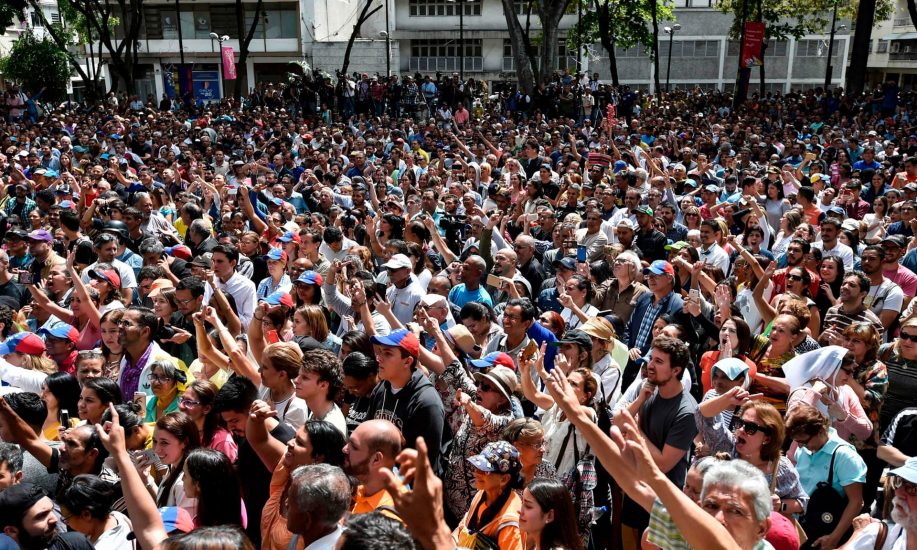
These are not the poor and most certainly not the starving. As it chances I have a great deal of life experience working amongst seriously deprived, hungry and despairing people. I know the gaunt face of want and the desperate glance of need. Look at these Guaido supporters, one by one by one. This designer spectacled, well-coiffed, elegantly dressed, sleekly jowled group does not know hunger. This group does not know want. This is a proper right wing gathering, a gathering of the nicely off section of society. This is a group of those who have corruptly been siphoning Venezuela’s great wealth for decades and who want to make sure the gravy train flows properly in their direction again. It is, in short, a group of exactly the kind of people you would expect to support a CIA coup.
Those manicured hands raised in the air will never throw rocks, or get involved in violence unless against a peasant strapped to a chair for them. It is not this crowd which will suffer as public disorder is manipulated and directed by the CIA. These wealthy ones are immune, just as Davos serves as nothing but an annual reminder of how very poorly God aims avalanches.
There is real suffering in Venezuela. The CIA is working hard to stoke violence, and the genuine poor will soon start to die, both in those egged on to riot and in the security services. But do not get taken in by the complete nonsense that this is a popular, democratic revolution. It is not. It is yet another barefaced CIA regime change coup.
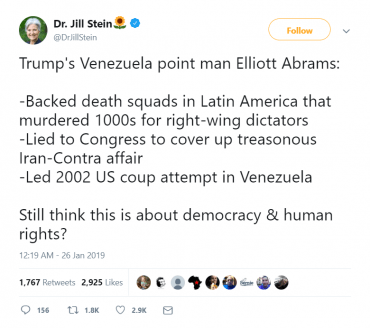
UPDATE Such wisdom as this blog finds is often crowd-source, and with thanks to a commenter below here is some useful information from Jill Stein.
—————————————————
Unlike our adversaries including the Integrity Initiative, the 77th Brigade, Bellingcat, the Atlantic Council and hundreds of other warmongering propaganda operations, Craig Murray’s blog has no source of state, corporate or institutional finance whatsoever. It runs entirely on voluntary subscriptions from its readers – many of whom do not necessarily agree with the articles, but welcome the alternative voice, insider information and debate.
Subscriptions to keep Craig going are gratefully received.
Juan Guaido: Imperial Point Man for a Venezuelan Civil War
By Jim Carey | Geopolitics Alert | January 23, 2019
Caracas – The imperial powers have found their new opposition point man in Venezuela; President of the National Assembly and President of the country according to some nations and organizations.
Now that the latest term of Venezuelan President Nicolas Maduro has started and the western powers and their proxies refuse to recognize the Bolivarian government, the imperial states are in a mad dash to find a new face for the Venezuelan opposition. Now it seems that man has been found and the race is on, with state after state anointing the 35-year-old engineer Juan Guaidó.
Guaidó, now being called the “interim President” by everyone from Jair Bolsonaro, the Organization of American States (OAS), to Donald Trump and Justin Trudeau is the current president of the Venezuelan National Assembly. However, according to the states looking for a regime change in Venezuela, Guaidó isn’t just head of the parliament but also the rightful leader of Venezuela.
Guaidó has become a fast-rising star in the political opposition which has led the anti-Maduro National Assembly an opportunity to make political hay and possibly get outside assistance. The opposition acted on this chain of events Tuesday when the National Assembly declared Guaidó the interim President and said he is in charge of organizing new “legitimate” elections.
Putting a new face to the Venezuelan opposition then immediately allowed for all sorts of anti-Maduro actors use Guaidó as their man to rally around.
So now that there is a new imperial point-man inside Venezuela the real question is, what happens next?
There are two likely outcomes to the rise of Guaidó, one of which is contingent on him succeeding and the other which would be another complete failure for the imperialists.
Guaidó launches his campaign today following several days or organizing protesters at rallies in Caracas. The protests have already started to turn violent as of this writing with at least four dead and the opposition calling for the military to “rise up” against the Bolivarian government.
This is all backed by countries like Canada, European nations and sham imperial bodies like the Organization of American States (OAS), which also encourage regime change and now want Guaidó as the man to lead it. Surprisingly, US President Donald Trump was one of the few holdouts who had yet to recognize Guaidó as President but finally caved today.
Guaidó himself has also made promises that should the imperialists allow him to become president and his government to take over they would be welcomed back into the international community. The faux president has also made promises that under his leadership Venezuela would “easily” receive debt relief and loans. At the same time they’re doing this, the opposition also continues to push through measures to freeze the state’s assets, punishing average Venezuelans more in order to entice into turning on Maduro.
This kind of financial manipulation by the opposition coupled with the protests starting to say are essentially an insurrection against a state sponsored by the imperial powers. While protests aren’t necessarily “warfare,” the calls on the military to revolt also show that the opposition doesn’t just want to use civil disobedience but they’d be fine with a violent civil war.
Civil war may be one possible outcome of this latest anti-Maduro frenzy but there is also the possibility that these protests – like those in 2017 – fail. If Guaidó is looking to be president he obviously can’t have this happen or he’ll likely end up like Leopoldo Lopez, Washington’s last golden boy and fellow party member with the “interim President.”
Much like Guaidó, Lopez led protests that became violent and saw protesters causing damage meant to cripple Venezuelan infrastructure for extended periods of time. The problem for López is his little “uprising” failed, he was held accountable for encouraging the violence, and is now on house arrest.
If Guaidó and the empire fail again the “interim President” can likely look forward to the same fate.
The United States Is at It Again: Compiling an Enemies List
By Philip M. GIRALDI | Strategic Culture Foundation | 24.01.2019
Many American still long for the good old days when men were still manly and President George W. Bush was able to announce that there was a “new sheriff in town” pledged to wipe terrorism from the face of the earth. “You’re either with us or against us,” he growled and he backed up his warning of lethal retribution with an enemies list that he called the “axis of evil.”
The axis of evil identified in those days in the 2002 State of the Union Address consisted of Iraq, Iran and North Korea. Iraq, which had not yet been invaded and conquered by the American war machine, was number one on the list, with Saddam allegedly brandishing weapons of mass destruction deliverable by the feared transatlantic gliders that could easily strike the United States. Bush explained that “Iraq continues to flaunt its hostility toward America and to support terror. The Iraqi regime has plotted to develop anthrax and nerve gas and nuclear weapons for over a decade. This is a regime that has already used poison gas to murder thousands of its own citizens, leaving the bodies of mothers huddled over their dead children. This is a regime that agreed to international inspections, then kicked out the inspectors. This is a regime that has something to hide from the civilized world.”
North Korea meanwhile was described as “A regime arming with missiles and weapons of mass destruction, while starving its citizens” while Iran “aggressively pursues these weapons and exports terror, while an unelected few repress the Iranian people’s hope for freedom.”
The phrase “axis of evil” proved so enticing that Undersecretary of State John Bolton used it two months later in a speech entitled “Beyond the Axis of Evil.” He included three more countries – Cuba, Libya and Syria because they were “state sponsors of terrorism that are pursuing or who have the potential to pursue weapons of mass destruction (WMD) or have the capability to do so in violation of their treaty obligations.” The nice thing about an Axis of Evil List is that you can make up the criteria as you go along so you can always add more evildoers.
Iraq was removed from the playing field in March 2003 while Libya had to wait for President Barack Obama and Secretary of State Hillary Clinton to be dealt with, but North Korea, Cuba, Syria and Iran are still around. Nevertheless, the idea of an enemies list continues to intrigue policy makers since it would be impossible to maintain the crippling burden of the military industrial complex without a simple expression that would convey to the public that there were bad actors out there waiting to pounce but for the magnificent efforts being made by Boeing, Lockheed, Northrop Grumman, General Dynamics and Raytheon to defend freedom.
The Administration of President Donald Trump, not to be outdone by its predecessors, has recently come up with two enemies lists. The first one was coined by the irrepressible John Bolton, who is now National Security Adviser. He has come up with the “troika of tyranny” to describe Cuba, Venezuela and Nicaragua, where he sees “… the dangers of poisonous ideologies without control, and the dangers of domination and suppression… I am here to convey a clear message from the President of the United States about our policy towards these three regimes. Under this administration, we will no longer appease the dictators and despots near our coasts in this hemisphere. The troika of tyranny in this hemisphere — Cuba, Venezuela and Nicaragua — has finally found its rival.”
Bolton also demonstrated that he has a light touch, adding “These tyrants fancy themselves strongmen and revolutionaries, icons and luminaries. In reality, they are clownish, pitiful figures more akin to Larry, Curly, and Moe. The three stooges of socialism are true believers, but they worship a false God.”
Secretary of State Mike Pompeo has apparently also been looking at Venezuela and not liking what he is seeing. On his recent road trip to the Middle East he told reporters that “It is time to begin the orderly transition to a new government [in Caracas].” He declared that “The Maduro regime is illegitimate and the United States will work diligently to restore a real democracy to that country. We are very hopeful we can be a force for good to allow the region to come together to deliver that.” “Force for good” is another key soundbite used by Pompeo. In his Cairo speech on January 10th, he described the United States as a “force for good” in the entire Middle East.
Bolton might have thought “troika of tyranny” was a hands down winner, but he was actually upstaged by the dour Vice President Mike Pence who declared to a gathering of US Ambassadors that “Beyond our global competitors, the United States faces a ‘wolf pack of rogue states.’ No shared ideology or objective unites our competitors and adversaries except this one: They seek to overturn the international order that the United States has upheld for more than half a century.” The states Pence identified were North Korea, Iran, Cuba, Venezuela and Nicaragua. Of the five, only North Korea can even plausibly be considered as a possible threat to the United States.
As wolves are actually very social animals the metaphor provided by Pence does not hold together very well. But Pence, Bolton and Pompeo are all talking about the same thing, which is the continued existence of some governments that are reluctant to fall in line with Washington’s demands. They have to be banished from polite discourse by declaring them “rogue” or “tyrannical” or “evil.” Other nations with far worse human rights records – to include Saudi Arabia, Pakistan, Israel and Egypt – are given a pass as long as they stay aligned with the US on policy.
So useful “lists” are all about what Washington wants the world to believe about itself and its adversaries. Put competitors on a list and condemn them to eternal denigration whenever their names come up. And, as Pence observes, it is all done to prevent the overturning of the “international order.” However, his is a curious conceit as it is the United States and some of its allies, through their repeated and illegal interventions in foreign countries, that have established something like international disorder. Who is really doing what to whom is pretty much dependent on which side of the fence one is standing on.
Venezuelan army disavows self-proclaimed leader, will defend national sovereignty – defense minister
RT | January 23, 2019
The Venezuelan military will not accept a president imposed by “dark interests,” Defense Minister Vladimir Padrino said after Washington and a number of its allies recognized a lawmaker as the new leader in Caracas.
The army will continue to defend the constitution and national sovereignty, Padrino said on Wednesday afternoon, hours after opposition lawmaker Juan Guaido was proclaimed interim president by the National Assembly, in a direct challenge to President Nicolas Maduro.
The US quickly recognized Guaido as Venezuela’s legitimate leader, with the Organization of American States (OAS) following Washington’s lead. Canada and France have also recognized Guaido, while Mexico has declined to do so “for now.”
Bolivia declared “solidarity with the people of Venezuela and brother Nicolas Maduro” in resisting the “claws of imperialism” in South America, President Evo Morales tweeted.
Maduro responded to the US announcement by cutting diplomatic ties with Washington and giving American diplomats 72 hours to leave Venezuela.
Guaido, however, countermanded that in a tweet and promised that Venezuela “will continue to maintain diplomatic relations with all the countries of the world.”
The issue of diplomats has raised the stakes in the US-Venezuela confrontation, as Senator Marco Rubio (R-Florida) – one of the driving forces behind the recognition of Guaido – argued that US diplomats should stay put, since leaving would mean recognition of Maduro’s legitimacy.
Venezuela’s supreme court declares all acts of opposition-led National Assembly illegal
RT | January 21, 2019
Venezuela’s Supreme Court has declared all acts of the country’s National Assembly null and void, days after the opposition-held assembly declared President Nicolas Maduro’s election illegitimate.
The National Assembly is a 167-seat legislature, currently headed by Juan Guaidó of the Popular Will party – a fierce opponent of Maduro, who had been taking part in protests against him and has called for the country’s military to depose the president.
Maduro already declared the National Assembly illegitimate in 2017, and created a new legislature – the Constituent National Assembly – to replace it, where all seats are currently held by pro-Maduro parties. As Maduro lacks the Constitutional power to outright dissolve the National Assembly, both houses have functioned alongside each other since 2017, with the CNA given power to overrule legislation passed by the National Assembly.
Maduro was sworn in last week after winning re-election last May. The opposition-led assembly and a coalition of neighboring countries declared Maduro’s election illegitimate.
US Secretary of State Mike Pompeo called Maduro’s election “illegitimate” and a “sham,” and vowed to keep up diplomatic pressure on the Venezuelan government.
Guaidó was briefly detained by secret police en route to a rally last week. Maduro insisted that Guaidó’s arrest was not government-ordered, and may have been staged for the media.
The Supreme Court’s announcement comes amid news of anti-government demonstrations in the country’s capital, as well as a mutiny by a National Guard unit stationed in a slum neighborhood near the Presidential Palace. Government forces arrested 40 National Guardsmen and fired tear gas at protesters in the early hours of Monday morning.
Defense Minister Vladimir Padrino Lopez said on Twitter that the rogue soldiers will “be punished with the full weight of the law.”
Video footage from the neighborhood shows protesters lighting fires and blocking the streets with barricades.
The ongoing crisis in Venezuela is being closely followed by US media and politicians, the majority of whom are openly anti-Maduro. Vice President Mike Pence has expressed support for Guaidó, calling the National Assembly the “only legitimate body in the country,” while Florida Senator Marco Rubio has repeatedly called Maduro’s government “illegitimate” and pressed for regime change in the Latin American country.
Venezuela has been mired by hyperinflation, starvation, and a refugee crisis that has seen almost three million Venezuelans flee the country. Washington has blamed the socialist economic policies of Maduro and his mentor Hugo Chavez for the deepening crisis, while passing sanctions against the Maduro government officials. The latest major batch of sanctions was in September signed by President Donald Trump, who once announced he is “not going to rule out a military option” in addressing the crisis in Venezuela.
US Administrations Have Been Intervening in Venezuela Since at Least the Early 2000s
FAIR | January 16, 2019
Janine Jackson interviewed Alexander Main about the Nicolás Maduro re-election for the January 11, 2019, episode of CounterSpin. This is a lightly edited transcript :
Janine Jackson: When it comes to Venezuela, elite US media don’t hide their feelings. And their feelings are all the same. Headlines on last year’s reelection of Venezuelan president Nicolás Maduro differed only in tone, including the disdainful: “As Venezuelans Go Hungry, Their Government Holds a Farcical Election,” from the Economist; the decisive: USA Today‘s “Maduro Is Turning Venezuela Into a Dictatorship,” or Foreign Affairs’ more somber version, “Venezuela’s Suicide; Lessons From a Failed State.” There’s Forbes’ vaguely threatening “Why Nicolas Maduro of Venezuela May Wish He Lost the Presidential Election,” and Foreign Policy’s unashamed “It’s Time for a Coup in Venezuela.”
But they’re all pretty much variations on a theme that’s hard to unhear, given that media bang it out so loudly and repeatedly. Here to help us sort fact from froth is Alexander Main. He’s director of international policy at the Center for Economic and Policy Research. He joins us by phone from Washington, DC. Welcome to CounterSpin, Alex Main.
Alex Main: Thank you, Janine.
JJ: Writing for FAIR on Venezuelan elections last year, Alan MacLeod pinpointed US media’s preferred trope, which was to say that Maduro was reelected “amid”—amid outcry, amid widespread disillusionment, amid charges of irregularities, amid low turnout. The message, I think, to readers was that Maduro’s re-election was not legitimate. What should we know about last May’s elections in Venezuela?
AM: So what isn’t generally mentioned by the media is that a critical factor in the outcome of the election was the approach taken by Venezuela’s opposition. Much of the opposition, many of its parties, decided to boycott these elections, for a variety of reasons.
At any rate, the media did not examine that fact. And we’re still not seeing it very much. I think one of the few exceptions is the Washington Post, in the article that appeared today, that did mention the divisions within the opposition, and their decision not to participate that had, obviously, a huge effect on the election result.
JJ: The media coverage would give you the impression that Venezuela’s election almost happened in a vacuum, but there was in fact involvement from, for example, the Organization of American States.
AM: Well, the Organization of American States, or rather the secretary general of the organization, whose name is Luis Almagro. He represents himself. He was elected, but once secretary general, he has sort of executive power there; but he doesn’t represent the countries within the organization. He has been on a campaign against the Maduro government from very early on. It stems from their initial decision not to allow him to send electoral observers to the elections.
And this is based on a decision taken by Venezuela’s electoral authorities many years ago, when they decided that they had enough transparency, enough safety measures around the elections, that they no longer required any sort of outside tutelage.
A number of countries in Latin America have taken the same decision. It’s a decision that has to do with the respect of their sovereignty. Certainly you don’t see in the US any massive presence of international observers, even though I think a lot of people would like to see that at some point.
But anyway, this was a sovereign decision that was taken by Venezuela’s electoral authority. And following that, Almagro really went on a rampage, and has been very much involved in efforts to try to delegitimize the Maduro government and to support the very hard-line opposition.
In doing this, he went sort of out of bounds in terms of his rhetoric, even for a lot of right-wing governments in Latin America, when late last year he voiced support for a military coup, much as some US officials have done, and US members of Congress have done. And as a response, you had all of the governments of Latin America that signed on to a statement that categorically rejected the possibility of any form of military intervention, whether by coup or an outside military intervention in Venezuela.
But certainly his rhetoric, and the campaign that he has led—along with other figures, such as Sen. Marco Rubio—have certainly given the impression that there is a desire for US intervention in what’s going on in Venezuela, and that’s, I think, resulted in sort of a defensive reaction from the Venezuelan government.
JJ: Well, it sounds very disturbing, but also confusing. You know, when I was looking through headlines, I saw one from something called the Pacific Council on International Policy that said, “Maduro Re-Elected. Can Democracy Ever Prevail in Venezuela?” I mean, just at the level of the sentence, it’s confusing. And then when you start talking about a coup to save democracy—which is the upshot of current coverage, and I guess policy—it just doesn’t even seem to make sense. The call is for the US to intervene, but the US is already intervening, isn’t it?
AM: Well, yeah, absolutely, and they’ve really been intervening in Venezuela, various US administrations, since at least the early 2000s, when we know that the US government—through institutions like the National Endowment for Democracy—has been providing funding and training to opposition groups in Venezuela, and often very hard-line groups that have taken a radical line, not recognizing the government and trying to seek its removal through extra-constitutional means, including a short-lived coup that took place in April of 2002.
The US has been very involved in trying to isolate them, Venezuela, diplomatically throughout the region, putting a lot of pressure on Latin American governments to support US measures condemning the situation in Venezuela.
More recently, the US has been applying sanctions against the government of Venezuela. And this is a very underreported thing in the US media and the international media generally.
When you see the coverage, for instance, of the Maduro inauguration, what you don’t see at all are references to the impact of the economic sanctions that have been applied. In fact, there are few media outlets at this point that even acknowledge that there are economic sanctions, even though they’ve been in place since August of 2017, when Trump announced them through an executive decree, having determined Venezuela to be an “extraordinary threat to US national security.” Those were the actual terms that were used in order to justify these sanctions.
And they’ve had a dire effect in Venezuela, which has been experiencing an economic crisis for quite a while now, since 2014 at least. And the government, of course, has failed to resolve this. It has to do with some of the government’s own economic policies. But at this point, the US also bears responsibility through these sanctions, where they have cut off Venezuela’s access to international financial markets, by which they can borrow money and purchase the necessary imports that the country needs. And we know that there aren’t enough imports of food or of medicine that are taking place at the moment.
And it’s also had a dire effect on the country’s oil production. And, of course, oil is the source of most of Venezuela’s national revenue. Along with falling oil prices, there’s been a tremendous fall in oil production in Venezuela, and it accelerated, actually, after these sanctions were put into place, because the Venezuelan government isn’t able to make the necessary investments to maintain the oil fields.
So that’s not mentioned, really, whatsoever in the major media, even though you have economists, including opposition-aligned economists from Venezuela, like Francisco Rodriguez, who have pointed out the very negative impact that these sanctions are having on the country.
JJ: Alan MacLeod also found a piece in Bloomberg that came close to acknowledging it, but in such a strange way. It was an article in which Bloomberg said that victory in the “widely derided election” gives Maduro “sole ownership of the nation’s crushing economic crisis.” And then in the very next sentence, it gloats that US and regional leaders will punish Venezuela by imposing “further isolation and sanctions on the crisis-stricken nation’s all-important oil industry.”
AM: Exactly. There’s this absurd idea that the sanctions somehow only hurt the Venezuelan government and Venezuelan government officials. It’s always the Venezuelan government’s responsibility, when they discuss the economic situation.
From time to time, you do see some media saying, “Oh, but the Venezuelan government says that the US sanctions are contributing to this dire economic situation.” They fail to ask any independent expert. You know, any economists that are taking a good look at what’s going on in Venezuela today will tell you, “Well, yes, these sanctions quite obviously are having a very negative impact.”
JJ: Finally, one of the things that coverage does is present the Venezuelan people as benighted. A piece from Time from last year includes one of my favorite creations. It first of all says that the crisis, the current crisis, “can be traced to the 1998 election of Hugo Chávez to the presidency,” so Chávez is the reason that things are difficult now. But I love this presentation: “Chávez concocted a political system that used often high oil prices to essentially bribe the masses into supporting him.”
The picture of the Venezuelan people that one gets from US media coverage is really as sort of benighted, not knowing what’s good for themselves and, once again, requiring some sort of intervention to tell them how to do democracy.
AM: Yes. This is quite absurd. Really, what we’re seeing in Venezuela is, one, an extraordinarily well-organized population, and particularly in poor communities that are certainly confronting a very dramatic economic situation, but I think doing so in effective ways that make the situation somewhat sustainable for these communities. So we’re seeing a very, very high level of community organization.
I’d say the vast majority of Venezuelans at this point are probably quite disgruntled with Maduro and his government. However, the Venezuelan opposition really offers no viable alternative to the Maduro government. They have never presented any sort of coherent economic proposal, with the possible exception of the opposition candidate in last year’s election. But, of course, most of the opposition parties boycotted those elections.
And in general, I think a lot of Venezuelans, certainly those that come from lower-income communities, are well aware of the fact that the opposition is linked to the country’s traditional economic elite, and they have a terrible reputation from their involvement in governments before Chávez was in power.
Things may be bad under Maduro, but I think there’s a sense among many Venezuelans that things could actually be quite a bit worse under opposition governments, particularly if they impose the sort of neoliberal policies that hurt the poor people of Venezuela enormously during the decades prior to Hugo Chávez’s election in the late ’90s.
JJ: We’ve been speaking with Alexander Main; he’s director of international policy at the Center for Economic and Policy Research. You can find their work, including Alex’s piece, “The United States’ Hand in Undermining Democracy in Venezuela,” online at CEPR.net. Alexander Main, thank you very much for joining us today on CounterSpin.
AM: Thank you, it was a pleasure.
Don’t meddle in Venezuela, Moscow tells coup-cheering Washington
RT | January 16, 2019
Russia has criticized the US government for bullying Venezuela and encouraging its opposition to stage a coup against President Nicolas Maduro, who was sworn in for his second term last week.
“Nations should avoid meddling in other nations’ internal affairs,” Russian Foreign Minister Sergey Lavrov said on Wednesday. He said that Washington’s encouragement of opposition forces in Venezuela “has made them unwilling to seek reconciliation [with the president], which is regretful.”
Venezuela is currently in a political crisis, with the opposition-controlled National Assembly declaring President Maduro a “usurper” and its speaker, Juan Guaido, an “interim president” of the country. The move came after strong public support from Washington, which has been advocating toppling Maduro for quite some time.
Washington has targeted Maduro’s government with a series of crippling economic and personal sanctions, and reportedly considered a military intervention in the country.
The National Assembly’s mandate to represent Venezuelans remains in question. In 2017, the country reformed its parliament system by introducing a new body called the Constitutional Assembly, which is controlled by pro-government politicians. The opposition and its backers in Washington rejected the reform as a power grab and declared the new legislature illegal.
Explaining Russia’s position on the conflict, Lavrov said US involvement in Venezuela was “very alarming and indicated that the US policy of destabilizing governments it does not like remains a priority.”
Venezuela suffered years of economic and social hardships, which the opposition blames on Maduro’s poor governance. He blames the hardship on sabotage of big business and foreign interests, which want to see his socialist government ousted from power.
Featured Video
Houthis Keep Advancing as the Red Sea Crisis Deepens
or go to
Aletho News Archives – Video-Images
From the Archives
15 Saudi ‘hijackers’ were CIA agents working for US: Scholar
Press TV – April 13, 2016
Fifteen of the 9/11 “hijackers” from Saudi Arabia were CIA agents working for the United States government, which was seeking to destroy the Middle East for Israel and to double the American military budget, says Dr. Kevin Barrett, an American academic who has been studying the events of 9/11 since late 2003…. continue
Blog Roll
 Aletho News
- Russia Just Struck the Eyes of NATO’s War Machine in Ukraine
- Russia summons UK charge d’affaires over Kiev drone support
- NATO member warns bloc seeking pretext for war with Russia
- Macgregor: We Haven’t Seen the Worst of the Iran War Yet
- ‘We are not like everyone else’ laws that bind other nations do not apply to Israel, says Likud lawmaker
- Report: Saudi Arabia seeks allies’ assistance as missiles deplete amid war on Yemen
- Fuel Crisis Deepens: Pakistan Warns Tanker Attack in Red Sea Would Be an ‘Act of War’
- ‘Bucha massacre’ a false flag orchestrated by UK – Moscow
- China Rejects Outside Pressure on Trade Ties After New US Russia Sanctions Bill
- Houthis Keep Advancing as the Red Sea Crisis Deepens
- If Americans Knew
- An error has occurred; the feed is probably down. Try again later.
- No Tricks Zone
- New Study: ‘Global Drought Shows No Detectable Recent Acceleration Under Climate Warming’
- Economic Masterminds: German Socialists Suggest Taxing Productivity Gains Stemming From Using AI
- The South China Sea Has Not Been Cooperating With The Climate Change Narrative
- Energy Crisis: Germany Enters Heating Season With Historically Low Gas Reserve Fill Levels
- New Study: The Antarctic Ice Sheet Gained Mass From 2020-2024 Due To Staggering Snow And Ice Accumulation
- Study: Ocean Heating Rates From Thousands Of Years Ago ‘Dwarf’ Modern Ocean Heating Rates
- Climate Extremists Target, Attack Large-Scale Power Grid Infrastructure In Germany!
- New Study: Antarctic Ice Melt Has Contributed Less Than 1 Centimeter To Sea Level Rise In The Last 30 Years
- Fear Of Debate: Alarmist German Climate Scientist Calls On Mainstream Media To Discredit Skeptic Voices
- End-Of-August Arctic Sea Ice Extent Hasn’t Fallen In 20 Years, Official Data Show!
 Aletho News