Venezuela has rejected the announcement by Colombia’s President Juan Manuel Santos that his country will be entering the North Atlantic Treaty Organization (NATO) as a “global partner.”
“Venezuela denounces once more before the international community the intention of Colombian authorities to lend themselves to introduce, in Latin America and the Caribbean, a foreign military alliance with nuclear capacity, which in every way constitutes a serious threat for peace and regional stability,” a statement by the foreign ministry said.
Likewise, Venezuela reiterated that it supports the historical position of the region to distance itself from the politics and wars of NATO, and from “any other army or military organization that desires to apply force to the suffering of the people, to impose and guarantee the hegemony of a particular political and economic model.”
The statement asks that the Colombian government fulfill its obligations toward peace and peaceful solutions to regional controversies.
Colombia will be the fist “global partner” of NATO in Latin America, beginning next week, President Santos announced Friday.
NATO was founded during the Cold War and was primarily a means for Western nations – led by the United States – to suppress the Soviet Bloc militarily and economically.
It continues to play a major role in modern conflicts, and has engaged in major military interventions in sovereign countries, most recently the removal and murder of Libyan leader Muammar Gaddafi in 2011.
May 27, 2018
Posted by aletho |
Militarism | Colombia, Latin America, NATO, Venezuela |
1 Comment
Nicolas Maduro has been re-elected for a second term in office as Venezuela’s president in an election rejected as “illegitimate” by his main rival, who has also demanded that a repeat vote be held later this year.
With more than 90 percent of the ballots cast in Sunday’s presidential election counted, the National Election Council announced that incumbent Maduro had won another six-year term after securing 67.7 percent of the vote.
Maduro’s main challenger Henri Falcon came in second with 21.2 percent, followed by the president’s other rival, Javier Bertucci, who gained some 10 percent, said the Council’s head, Tibisay Lucena.
With the country’s mainstream opposition having boycotted the vote, the turnout was 46.1 percent, according to the board, which means 8.6 million out of the 20.5 million eligible voters took part in the election.
The ballots were recorded electronically, making the voting quick and easy. The presence of government troops around polling stations also ensured the safety of voters.
Some 150 international observers from 30 countries and international organizations were present in the Latin American country to monitor the process.
Maduro hails ‘historic’ win
When the results were released, Maduro’s supporters gathered outside his Miraflores presidential palace in downtown Caracas, celebrating his re-election with fireworks.
Maduro, surrounded by thousands of his supporters, also hailed his “popular victory,” saying, “This was a historic day! The day of a heroic victory! The day of a beautiful victory – of a truly popular victory.”
“Never before has a presidential candidate taken 68 percent of the popular vote,” he told the cheering crowd.
“The whole of Venezuela has triumphed! Democracy has triumphed! Peace has triumphed! Constitutionality has triumphed [These were] elections that were constitutional, legitimate and legal,” he said. “We have a president of the people! A working president!”
The president also called on the defeated challengers to join him for negotiations about the future of the country.
He said “permanent dialog” is needed with the entire opposition so that Venezuela could set aside political disputes.
Vote ‘lacks legitimacy’
However, before the official results were announced, Falcon said he would not recognize the vote for what he called irregularities, including widespread vote buying in favor of Maduro.
“As far as we are concerned there has been no election. There must be new elections in Venezuela,” he told reporters. “The process undoubtedly lacks legitimacy and as such we do not recognize it.”
Falcon, who broke with an opposition boycott to run for the election, also called for a fresh election to be held in November or December.
Several of Venezuela’s Latin American neighbors as well as the European Union also joined voices with Maduro’s challenger and said they would not recognize the results of the election.
They alleged that the conditions did not exist for the election to be free and fair.
However, former Spanish prime minister Jose Luis Rodriguez Zapatero, who is in Venezuela as an international observer, said he has no “doubt about the voting process.”
“It is an advanced automatic voting system. I come here to keep peace, coordinate and promote dialogue so as to improve the democratic mechanism here. What I need to do here is to see whether people can cast their ballots at their own discretion. Now we all see how people vote, don’t we?” he added.
The US also said it would not recognize the election and would actively consider oil sanctions on the country.
Washington has already imposed sanctions against Venezuela and blamed, together with its allies in the region and elsewhere, Maduro’s government for the country’s acute economic crisis.
On Saturday, the US ramped up pressure on Caracas by imposing new sanctions against the government’s top officials.
Maduro’s government, however, said the US was using new sanctions to sabotage the election.
It called Washington’s move as part of “a systematic campaign of aggression” by President Donald Trump’s administration and said they had no legal base.
May 21, 2018
Posted by aletho |
Aletho News | European Union, Latin America, United States, Venezuela |
1 Comment
The United States government says it is not going to recognize the outcome of Venezuela’s presidential election which will be held on Sunday.
US Deputy Secretary of State John Sullivan made the announcement in a press briefing on Sunday and stressed that Washington was actively considering strict sanctions against Venezuela’s oil industry.
He also noted that the US would discuss a response to vote with its allies at the G20 meeting in the Argentinean capital Buenos Aires on Monday.
Washington has already put in place sanctions against Caracas and top Venezuelan government officials, as well as other measures to further weaken the country’s troubled economy and prevent the government and its state oil company from accessing international credit through US markets or entities.
On Friday, the US Treasury slapped sanctions against the head of the Venezuelan socialist party, Diosdado Cabello, and his wife, Marleny Josefina Contreras, who heads the country’s tourism institute, and his brother, Jose David.
Earlier in May, the administration of US President Donald Trump has slapped more sanctions against a number of Venezuelan companies and officials, accusing them of trafficking narcotics.
President Nicolas Maduro, who is running for a second six-year term in the vote, says the US has joined forces with opposition groups to topple his socialist government.
His opponents blame him for mishandling the economy and accuse him of dictatorial tendencies.
Maduro is predicted to win the Sunday election against main opposition candidate Henri Falcon.
Some opposition members have boycotted the vote, claiming it is rigged to ensure that Maduro wins a second six-year term in office.
Caracas, however, has assured the public that the election will be free and fair, saying those opposition members who refuse to participate in the election believe they have no chance to win.
May 20, 2018
Posted by aletho |
Economics | Latin America, United States, Venezuela |
2 Comments
MOSCOW – The Russian Foreign Ministry said in a statement Wednesday that it considers calls to disrupt voting in Venezuela’s presidential elections due May 20 to be interference in the affairs of a sovereign state.
“Assertions about the illegitimacy of the election campaign continue to be circulated, calls for disruption of the voting process are made. This… represents an undisguised interference in the internal affairs of a sovereign state. We call to abandon this destructive practice,” the statement said.
Moscow considers the upcoming presidential elections in Venezuela as “a possibility to return Venezuela’s political forces to the national dialogue to seek solutions required to advance the country along the path of stable economic development,” it said.
Previous week, a poll conducted by Hinterlaces and released by the Prensa Latina news agency revealed that nearly half of Venezuelan citizens intend to back incumbent President Nicolas Maduro in the upcoming presidential election.
On May 20, Venezuelans will be electing their next president. There are five candidates running for presidency: Reinaldo Quijada, an editor at the Aporrea media outlet and conservative preacher Luis Ratti are to compete alongside Maduro, Falcon and Bertucci.
May 16, 2018
Posted by aletho |
Timeless or most popular | Latin America, Russia, Venezuela |
Leave a comment
Over the years Western media have developed a journalistic shorthand of repetition, for conveying distortions and imperial hypocrisy about Venezuela.
A Reuters article (4/18/18) reports that the European Union “could impose further sanctions on Venezuela if it believes democracy is being undermined there.”
The line nicely illustrates the kind of journalistic shorthand Western media have developed, over years of repetition, for conveying distortions and whitewashing gross imperial hypocrisy about Venezuela. A passing remark can convey and conceal so much.
The EU’s sincerity in acting on what it “believes” about Venezuelan democracy is unquestioned by the London-based Reuters. Meanwhile Spain, an EU member, is pursuing the democratically elected president of Catalonia, Carles Puigdemont, for the crime of organizing an illegal independence referendum last year. Weeks ago, he was arrested in Germany at Spain’s request, and other elected representatives have been arrested in Catalonia, where Spain’s federal government deposed the elected regional government after the referendum.
In July 2017, a few months before the referendum in Catalonia, Venezuela’s opposition also organized an illegal referendum. One of the questions asked if the military should obey the opposition-controlled National Assembly, which was an extremely provocative question, given the opposition’s various efforts to overthrow the government by force since 2002. The referendum required an extremely high level of political expression, organization and participation. It allegedly involved 7 million voters.
The Venezuelan government disregarded the results—as Spain disregarded the Catalan referendum results—but unlike Spain, did not jail people for organizing it, or send police to brutally repress voters. In fact, two weeks later, Venezuelan voters (overwhelmingly government supporters, since the opposition boycotted and did not field candidates) were violently attacked by opposition militants when they elected a constituent assembly. The attacks resulted in several deaths.
Venezuelan President Nicolás Maduro has hardly failed to call attention to the hypocrisy of both the EU and Spain, but the Reuters article made no mention of it.
Reuters also reported that “the country’s two most popular opposition leaders have been banned from competing” from Venezuela’s presidential election on May 20. Reuters didn’t name the two supposedly “most popular opposition leaders,” but in the past (e.g., 4/12/18, 2/28/18, 2/19/18) the wire service has identified them as Leopoldo Lopez and Henrique Capriles. As it happens, according to the opposition-aligned pollster Datanalisis, whose results have been uncritically reported by Western media like Reuters for years, opposition presidential candidate Henri Falcón has been significantly more popular than Capriles in recent months, and barely less so than Lopez.
Mark Weisbrot (in an opinion piece for U.S. News, 3/3/18) broke the news that U.S. government officials had been secretly pressuring Falcón not to run, so that the election could be discredited as including no viable opposition candidate. Two weeks later, Reuters (3/19/18) discreetly reported Weisbrot’s scoop.
However, by far the most important thing Reuters neglects telling readers about the “two most popular opposition leaders” is that had they done in the EU what they’ve done in Venezuela since April 2002, Lopez and Capriles would both be serving long jail terms.
Capriles and Lopez together led the kidnapping of a government minister during a briefly successful U.S.-backed military coup in 2002 that ousted Venezuela’s democratically elected president, the late Hugo Chávez, for two days. Lopez boasted to local TV that the dictator installed by the coup (whom Lopez called “President Carmona”) was “updated” on the kidnapping.
Imagine what Carles Puigdemont’s predicament would be if, rather than organizing a peaceful referendum, he had participated in a foreign-backed, ultimately unsuccessful military coup against the Spanish government. Needless to say, running for public office would not be on the table. That would be the least of his worries.
In Venezuela, Capriles eventually served a few months in prison for participating in the coup, while Lopez avoided doing any time, thanks to a general amnesty granted by Chávez. Lopez was finally arrested in 2014 for leading another violent effort to overthrow the government.
I’ve reviewed before (teleSUR, 1/9/18) violent efforts to overthrow the government that Lopez, Capriles and other prominent opposition leaders have been involved with since the 2002 coup. I also described how Julio Borges and Henry Ramos (two other prominent opposition leaders) have openly sought to starve the Venezuelan government of foreign loans as it struggles with a severe economic crisis.
In August, Trump’s administration imposed sanctions on Venezuela’s entire economy that will cost Maduro’s government billions of dollars this year (FAIR.org, 3/22/18). It has threatened to go even further, brandishing an oil embargo or even a military attack. With sufficiently compliant media (and the collusion of big human rights NGOs like Amnesty International), such depravity becomes possible.
The Reuters article also says that Venezuela’s economic “collapse has driven an estimated 3 million people to flee the country.” No need to tell readers when the economic “collapse” began—2014—much less who made the estimates or if other sources contradict them. In fact, the U.N.’s 2017 population division numbers estimate Venezuela’s total expat population as of 2017 at about 650,000—only about 300,000 higher than it was when Chávez first took office in 1999. Even a group of fiercely anti-government Venezuelan academics estimated less than 1 million have left since the economic crisis began. (See FAIR.org, 2/18/18.)
Cherry-picked statistics aside, when Western powers want a democratically elected government overthrown, the approach is clear. Complete tolerance for violent foreign-backed subversion—which the powerful states and their allies would never be expected to tolerate—becomes the test for whether or not a state is a democracy. The targeted government fails the test, is depicted as a dictatorship, and all is permitted. Only the tactics required to bring it down need be debated.
Joe Emerberger is a writer based in Canada whose work has appeared in Telesur English, ZNet and Counterpunch.
May 11, 2018
Posted by aletho |
Mainstream Media, Warmongering | European Union, Reuters, Venezuela |
2 Comments
Venezuela’s election process has been lauded by numerous organizations and observers not only for its high turnout, but also for the transparency and checks involved in the voting and scrutiny.
Former U.S. President Jimmy Carter said: “Of the 92 elections that we’ve monitored, I would say that the election process in Venezuela is the best in the world.”
 Below are all the elements involved in the vote.
Requirements and Eligibility
Venezuelans who are 18 years of age or older are eligible to vote in an election, after registering.
Venezuelans living abroad are also eligible to vote, after meeting these requirements.
Article 63 of the constitution says: ‘Suffrage is a right. It is exercised through free, universal, direct and secret ballots. The law will guarantee the principle of individuality of suffrage and proportional representation.’
Security and Guarantees
Venezuela’s elections utilize the latest in secure voting technology to ensure that each vote is counted fairly and cannot be tampered with. It was the first in the world to use voting machines that print a receipt so that each voter can confirm their vote with a physical copy.
Beginning in 2012, Venezuela’s elections used biometric authentication to activate the voting machine.
The current voting machines in use are the Smartmatic Auditable Election System (SAES) by Smartmatic, which are 100 percent auditable at each stage.
The final vote count is confirmed with the physical vouchers that voters put in the receipt box, and then transmitted electronically through a network isolated from the internet and any computer to assure that no interference can assure.
The vote will be witnessed and audited by international and national political observers, technicians and political organizations. The National Electoral Council has invited the United Nations and the Caribbean Community (Caricom) to send representatives to observe the process.
Voting
These are the five steps involved in voting in Venezuela:
1. When arriving at a poll, voters are directed the voting table that corresponds to them. At the table, there is a list with voters’ identification card numbers to allow a person to confirm their table.

2. The voter then goes to that table to present the document that confirms their identity. The voter then places their index finger or thumb on a fingerprint scanning device.

3. Once their identity is verified, the voting machine will unlock so that the voter can choose the option of their preference. Once selected, the choice can be changed up until the ‘vote’ button is changed.
In case there is any doubt about the voting process, the election official explains the steps involved.
After selecting their preferred option, the voter should press the ‘vote’ button. The machine then prints a receipt of the vote for the voter to read and confirm.
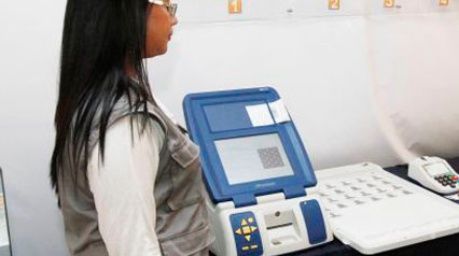
4. The voter then deposits this receipt in the corresponding ballot box.
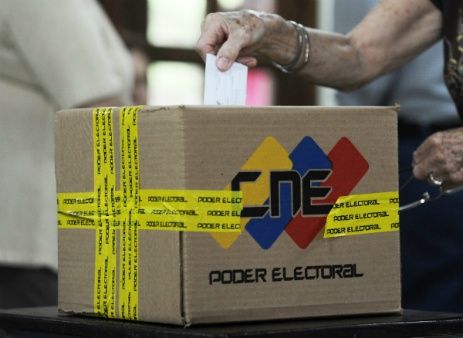
5. Finally, the voter signs and places their fingerprint in the elections roll to confirm that they have voted, and have a finger marked with indelible ink.

Poll Closing and Tally Scrutinization
Polls are closed at a polling station only after everyone in line to vote has voted.
Once tally scrutinization on the machine finishes, a random paper ballot audit announced where the machines to be audited are randomly selected drawing numbers, and the machine’s serial number is recorded. The paper ballot box corresponding to the machine is also selected and opened and the results for each candidate are openly counted.
This is compared and audited with the original tally printed from the electronic results, and any anomaly or discrepancy is recorded in the audit report.
The original audit report is signed by election poll staff and observers from each party present, then sealed and handed to the military for delivery to the CNE.
Copies of the report are handed over to the representatives of the two highest vote getters.
May 6, 2018
Posted by aletho |
Civil Liberties | Venezuela |
1 Comment
Introduction
Over the past half-century, I have been engaged in research, lectured and worked with social movements and leftist governments in Latin America. I interviewed US officials and think tanks in Washington and New York. I have written scores of books, hundreds of professional articles and presented numerous papers at professional meetings.
In the course, of my activity I have discovered that many academics frequently engage in what government officials dub ‘de-briefing’! Academics meet and discuss their field-work, data collection, research finding, observations and personal contacts over lunch at the Embassy with US government officials or in Washington with State Department officials.
US government officials look forward to these ‘debriefings’; the academic provided useful access to information which they otherwise could not obtain from paid, intelligence agents or local collaborators.
Not all academic informants are very well placed or competent investigators. However, many provide useful insights and information especially on leftist movements, parties and leaders who are real or potential anti-imperialist adversaries.
US empire builders whether engaged in political or military activities depend on information especially regarding who to back and who to subvert; who should receive diplomatic support and who to receive financial and to military resources.
De-briefed academics identify ‘moderate’ and ‘radical’ adversaries, as well as personal and political vulnerabilities. Officials frequently exploit health problems or family needs to ‘turn’ leftists into imperial stool pigeons.
US officials are especially interested in academic gate-keepers who exclude ‘anti-imperialist’ critics, activists , politicians and government officials.
At times, US State Department officials claim to be sympathetic ‘progressives’ who oppose ‘Neanderthals’ in their institution, in order to elicit inside information from leftist academic informants.
Debriefing is a widespread practice and involves numerous academics from major universities and research centers, as well as non-governmental ‘activists’ and editors of academic journals and publications.
Academic participates in debriefing frequently do not publicize their reporting to the government. Most likely they share their reports with other academic informers. All claim they are merely sharing research and diffusing information for ‘science’ and to further ‘humane values’.
Academic informers always justify their collaboration as providing a clear and more balanced picture to ‘our’ policymakers, ignoring the predictable destructive outcomes likely to ensue.
Academics in the Service of Empire
Academic informants never study, collect research and publicize reports on US covert, overt and clandestine policies in defense of multi-nationals and Latin American elite which collaborate with empire builders.
US officials have no interest in ‘debriefing’ academics conducting anti-imperialist research.
US officials are keen to know any and all reports on ‘movements from below’: who they are, how much influence they have, their susceptibility to bribes, blackmail and invitations to the State Department, Disneyland, or the Wilson Center in D.C.
US officials fund academic research on militant trade unions, agrarian social movements, feminist and ethnic minorities engaged in class struggle, and anti-imperialist activists and leaders, as they all serve as targets for imperial repression.
The officials are also keen on academic reports on so-called ‘moderate’ collaborators who can be funded, advised and recruited to defend the empire, undermine the class struggle and split movements.
Academic informants are especially useful in providing personal and political information on Latin American leftwing intellectuals, academics, journalists, writers and critics which allows US officials to isolate, slander and boycott anti-imperialists, as well as those intellectuals who can be recruited and seduced with foundation grants and invitations to the Kennedy Center at Harvard.
When US officials have a difficult time understanding the intricacies and consequences of ideological debates and factional divisions within leftist parties or regimes, ex-leftist academic informers, who collect documents and interviews, provide detailed explanations and provide officials with a political roadmap to exploit and exacerbate divisions and to guide repressive policies, which undermine adversaries engaged in anti-imperialist and class struggle.
The State Department works hand and glove with research centers and foundations in promoting journals which eschew all mention of imperialism and ruling class exploitation; they promote ‘special issues’ on ‘class-less’ identity politics, post-modern theorizing and ethnic-racial conflicts and conciliation.
In a study of the two leading political science and sociological journals over a period of fifty years they published less than .01% on class struggle and US imperialism
Academic informants have never reported on US government links to narco-political rulers.
Academic informants do not research widespread long term Israeli collaboration with death squads in Colombia, Guatemala, Argentina and El Salvador, in cases because of their loyalties to Tel Aviv and in most cases because the State Department is not interested in debriefings which expose their allies and their joint complicity.
Academic Informants: What do they want and what do they get?
Academic informers engage in debriefing for various reasons. A few do so simply because they share the politics and ideology of the empire builders and feel it is their ‘duty’ to serve.
The great majority are established academics with ties to research centers who inform because it fattens their CV– which helps secure grants, prestigious appointments and awards.
Progressive academics who collaborate have a Janus face approach; they speak at Leftist public conferences, especially to students and in private they report to the State Department.
Many academics believe they can influence and change government policy. They seek to impress self-identified ‘progressive’ officials with their inside knowledge on how to ‘turn’ Latin critics into moderate collaborators. They invent innocuous academic categories and concepts to attract graduate students to further collaboration with imperial colleagues.
The Consequence of Academic Debriefing
Former leftist academic informers are frequently cited by the mass media as reliable and knowledgeable ‘experts’ in order to slander anti-imperialist governments, academics and critics.
Ex-leftist academics pressure rising scholars with a critical perspective to adopt ‘moderate’ reasonable critiques, to denounce and avoid anti-imperialist ‘extremists’ and to disparage them as ‘polemical ideologues’!
Academic informants in Chile helped the US Embassy identify neighborhood militants who were handed over to the secret police (DINA) during the Pinochet dictatorship.
US academic informants in Peru and Brazil provided the Embassy with research projects which identified nationalist military officials and leftist students who were subsequently purged, arrested and tortured.
In Colombia, US academic informers were active in providing reports on rural insurgent movements which led to massive repression. Academic collaborators provided detailed reports to the [US] embassy in Venezuela on the grass roots movements and political divisions among Chavista government and military officials with command of troops.
The State Department financed academics working with NGOs who identified and recruited middle class youth as street fighters, drug gangsters and the destitute to engage in violent struggles to overthrow the elected government by paralyzing the economy.
Academic reports on regime ‘violence’ and ‘authoritarianism’ served as propaganda fodder for the State Department to impose economic sanctions, impoverishing people, to foment a coup. US academic collaboraters enlisted their Latin colleagues to sign petitions urging rightwing regimes in the region to boycott Venezuela.
When academic informers are confronted with the destructive consequences of imperial advances they argue that it was not their ‘intention’; that it was not their State Department contacts who carried out the regressive policies. The more cynical claim that the government was going to do their dirty work regardless of the debriefing.
Conclusion
What is clear in virtually all known experiences is that academic informers’ de-briefings strengthened the empire-builders and complemented the deadly work of the paid professional operatives of the CIA, DEA and the National Security Agency.
May 5, 2018
Posted by aletho |
Corruption, Deception, Progressive Hypocrite, Timeless or most popular | CIA, Latin America, United States, Venezuela |
1 Comment
A Reuters article (4/18/18) reports that the European Union “could impose further sanctions on Venezuela if it believes democracy is being undermined there.”
The line nicely illustrates the kind of journalistic shorthand Western media have developed, over years of repetition, for conveying distortions and whitewashing gross imperial hypocrisy about Venezuela. A passing remark can convey and conceal so much.
The EU’s sincerity in acting on what it “believes” about Venezuelan democracy is unquestioned by the London-based Reuters. Meanwhile Spain, an EU member, is pursuing the democratically elected president of Catalonia, Carles Puigdemont, for the crime of organizing an illegal independence referendum last year. Weeks ago, he was arrested in Germany at Spain’s request, and other elected representatives have been arrested in Catalonia, where Spain’s federal government deposed the elected regional government after the referendum.
In July 2017, a few months before the referendum in Catalonia, Venezuela’s opposition also organized an illegal referendum. One of the questions asked if the military should obey the opposition-controlled National Assembly, which was an extremely provocative question, given the opposition’s various efforts to overthrow the government by force since 2002. The referendum required an extremely high level of political expression, organization and participation. It allegedly involved 7 million voters. The Venezuelan government disregarded the results—as Spain disregarded the Catalan referendum results—but unlike Spain, did not jail people for organizing it, or send police to brutally repress voters. In fact, two weeks later, Venezuelan voters (overwhelmingly government supporters, since the opposition boycotted and did not field candidates) were violently attacked by opposition militants when they elected a constituent assembly. The attacks resulted in several deaths.
Venezuelan President Nicolás Maduro has hardly failed to call attention to the hypocrisy of both the EU and Spain, but the Reuters article made no mention of it.
Reuters also reported that “the country’s two most popular opposition leaders have been banned from competing” from Venezuela’s presidential election on May 20. Reuters didn’t name the two supposedly “most popular opposition leaders,” but in the past (e.g., 4/12/18, 2/28/18, 2/19/18) the wire service has identified them as Leopoldo Lopez and Henrique Capriles. As it happens, according to the opposition-aligned pollster Datanalisis, whose results have been uncritically reported by Western media like Reuters for years, opposition presidential candidate Henri Falcón has been significantly more popular than Capriles in recent months, and barely less so than Lopez.

Mark Weisbrot (in an opinion piece for US News, 3/3/18) broke the news that US government officials had been secretly pressuring Falcón not to run, so that the election could be discredited as including no viable opposition candidate. Two weeks later, Reuters (3/19/18) discreetly reported Weisbrot’s scoop.
However, by far the most important thing Reuters neglects telling readers about the “two most popular opposition leaders” is that had they done in the EU what they’ve done in Venezuela since April 2002, Lopez and Capriles would both be serving long jail terms.
Capriles and Lopez together led the kidnapping of a government minister during a briefly successful US-backed military coup in 2002 that ousted Venezuela’s democratically elected president, the late Hugo Chávez, for two days. Lopez boasted to local TV that the dictator installed by the coup (whom Lopez called “President Carmona”) was “updated” on the kidnapping.
Imagine what Carles Puigdemont’s predicament would be if, rather than organizing a peaceful referendum, he had participated in a foreign-backed, ultimately unsuccessful military coup against the Spanish government. Needless to say, running for public office would not be on the table. That would be the least of his worries.
In Venezuela, Capriles eventually served a few months in prison for participating in the coup, while Lopez avoided doing any time, thanks to a general amnesty granted by Chávez. Lopez was finally arrested in 2014 for leading another violent effort to overthrow the government.
I’ve reviewed before (teleSUR, 1/9/18) violent efforts to overthrow the government that Lopez, Capriles and other prominent opposition leaders have been involved with since the 2002 coup. I also described how Julio Borges and Henry Ramos (two other prominent opposition leaders) have openly sought to starve the Venezuelan government of foreign loans as it struggles with a severe economic crisis.
In August, Trump’s administration imposed sanctions on Venezuela’s entire economy that will cost Maduro’s government billions of dollars this year (FAIR.org, 3/22/18). It has threatened to go even further, brandishing an oil embargo or even a military attack. With sufficiently compliant media (and the collusion of big human rights NGOs like Amnesty International), such depravity becomes possible.
The Reuters article also says that Venezuela’s economic “collapse has driven an estimated 3 million people to flee the country.” No need to tell readers when the economic “collapse” began—2014—much less who made the estimates or if other sources contradict them. In fact, the UN’s 2017 population division numbers estimate Venezuela’s total expat population as of 2017 at about 650,000—only about 300,000 higher than it was when Chávez first took office in 1999. Even a group of fiercely anti-government Venezuelan academics estimated less than 1 million have left since the economic crisis began. (See FAIR.org, 2/18/18.)
Cherry-picked statistics aside, when Western powers want a democratically elected government overthrown, the approach is clear. Complete tolerance for violent foreign-backed subversion—which the powerful states and their allies would never be expected to tolerate—becomes the test for whether or not a state is a democracy. The targeted government fails the test, is depicted as a dictatorship, and all is permitted. Only the tactics required to bring it down need be debated.
Messages to Reuters can be sent here (or via Twitter: @Reuters). Please remember that respectful communication is the most effective.
April 24, 2018
Posted by aletho |
Deception, Fake News, Mainstream Media, Warmongering | European Union, Reuters, Spain, Venezuela |
1 Comment
Venezuela’s Foreign Minister Jorge Arreaza says his country will go ahead with the presidential elections scheduled for May, despite foreign interference and the threat of further sanctions.
Speaking at a press conference in Brussels, Belgium, Arreaza said: “The only ones who have to recognize the results in Venezuela are the Venezuelan people and the National Electoral Council (CNE).
“We are not worried about if (U.S. President) Trump recognizes it; if (Spanish Prime Minister Mariano) Rajoy recognizes it or if the European Union does not recognize it.
“It’s OK if they go beyond their capacity to dabble in new realms of political aggression against Venezuela. That’s not what we want to see; it wouldn’t be the best thing diplomatically, but if it happens, all we can do is govern for our people.”
Arreaza said the government had invited the High Representative of the European Union for Foreign Affairs and Security Policy Federica Mogherini to “observe the Venezuelan electoral process. The observation means coming two days before, but if they want to come two weeks before, come; and if they want to leave two weeks after… because in the end, it is to be present to observe the auditing process.
“Venezuela has a robust and secure electoral system. We don’t need anyone to moderate it; in fact, there are a lot that could learn something from Venezuela’s electoral system.”
Recalling the threats Venezuela has faced courtesy of the U.S. government and other Western powers, Arreaza said: “(Former U.S. President) Obama issued a decree in 2015 qualifying Venezuela as an unusual and extraordinary threat.
“I sincerely believe that the unusual and extraordinary attacks continue to happen against Venezuela in every field you could imagine.”
Despite the challenges, Arreaza said: “The Venezuelan people will prevail in spite of all the blockage… now President Trump is talking about an embargo, an oil embargo against Venezuela.
“We will work with our allies. There is Russia, there is China, there is Turkey, and even some European countries that want to help us as well, so we are not afraid and nothing will stop us.
“No political extortion, no extortion will stop the Venezuelan people, the Venezuelan Bolivarian government to do what we have to do.”
Venezuela’s presidential elections are scheduled to take place on May 20.
April 12, 2018
Posted by aletho |
Civil Liberties | European Union, United States, Venezuela |
3 Comments

Venezuelan authorities hit back at their counterparts in Panama and Switzerland this week after they approved new measures targeting Caracas.
Panama’s Economic and Finance Ministry announced this past March 27 that a warning was being issued to the Central American country’s banks advising them to limit and “diligently” supervise financial transactions involving 55 top Venezuelan officials as well as 16 private businesses allegedly associated with the Maduro government.
The list includes President Nicolas Maduro, National Electoral Council President Tibisay Lucena and rectors Tania D’Amelio and Socorro Hernandez, National Constituent Assembly members Diosdado Cabello and Hermann Escarra, Education Minister Elias Jaua, and Culture Minister Ernesto Villegas.
In an official statement, Panamanian authorities categorized the individuals and businesses as being “high risk in the area of money laundering, financing terrorism, and financing the proliferation of weapons of mass destruction.” No evidence was, however, presented to support the allegations.
Venezuela possesses no nuclear weapons and is a signatory of the Nuclear Non-Proliferation Treaty, as well as various other treaties banning the acquisition and development of nuclear, biological, and chemical weapons.
Similarly, many of those accused by Panama of allegedly financing terrorism belong to institutions which were themselves the objects of violent opposition attacks during last year’s anti-government protests – including the Supreme Court, the National Electoral Council, and regional government offices – which the Maduro administration has repeatedly described as “terrorism”.
Speaking Monday, Venezuelan Attorney General Tarek William Saab, who is included on Panama’s list, fired back, describing the accusations as “fake news” and calling on them to provide evidence.
“Show the accounts, my accounts for example, show where my name, my photo appears,” Saab challenged.
Penitentiary Affairs Minister Iris Varela, who also appears on the list, similarly denied the accusations and called on the Central American authorities to publish a “complete list” of all Venezuelan citizens who own assets in the country, placing special emphasis on those mentioned in the Panama Papers.
“Why don’t they do it [publish the complete list],” she questioned. “Simply because they have assets and fortunes that belong to the [Venezuelan] opposition.”
The recent measures follow close on the heels of an announcement last month that Panama will not recognise the results of Venezuela’s upcoming presidential election, mirroring steps taken by the Trump administration and other regional conservative governments in rejecting the May 20 vote.
Meanwhile, Switzerland also moved to apply sanctions against seven high-ranking Venezuelan functionaries last Wednesday, freezing their alleged assets in Swiss banks and applying travel bans.
In response, the Venezuelan government delivered an official letter of protest to the Swiss charge d’affaires Monday, calling the sanctions a violation of the UN Charter’s ban on unilateral coercive measures and charging Switzerland with “subordination” to Washington and Brussels’ hardline Venezuela policy.
“This erratic action… on the part of a historically neutral country like the Swiss Confederation does not create conditions for dialogue and strengthens extremist positions that seek violent solutions,” reads the text of the letter.
Venezuela’s Supreme Court also issued a declaration Monday rejecting the moves as “illegal”. Supreme Court President Maikel Moreno was named in both Swiss and Panamanian measures.
The latest international actions targeting Venezuela have, however, won praise from members the country’s right-wing opposition, including Popular Will party Political Coordinator Carlos Vecchio, who applauded the Panama measures as “the right path at this stage”.
Vecchio is currently in Paris meeting with center-right French President Emmanuel Macron as part of a European tour aimed at drumming up support for more sanctions against Caracas.
During the meeting Tuesday, Vecchio, together with First Justice party leader Julio Borges and ex-Caracas Mayor Antonio Ledezma – who is currently fleeing the Venezuelan justice system – called on Macron’s government to apply “more sanctions” against Venezuela and to “halt Petro, gold, and capital legitimation operations,” referring to the South American country’s new crypto-currency. They also urged the French president and other European leaders “not to dialogue” with Caracas.
Translation | We propose to the government of France to support Humanitarian Intervention, criminal court trial, more sanctions, stop operations with Petro, gold and legitimation of capital to get out of the dictatorship that oppresses our people. and Disregard electoral fraud. With a dictatorship there is no dialogue
Opposition presidential frontrunner Henri Falcon, who defied the main opposition in launching his candidacy and has opposed economic sanctions in the past, has yet to issue a public statement with regard to the latest measures from Panama and Switzerland.
So far, only the US and the UK have approved economic sanctions against Caracas, while Canada and the European Union have rolled out sanctions against top Venezuelan officials
International sanctions against Venezuela have been denounced by the UN Human Rights Council as well as by UN Independent Expert Alfred de Zayas, who labeled the US-led measures “crimes against humanity” and called for the International Court of Justice to investigate.
According to Datanalisis, 55.6 percent of Venezuelans oppose economic sanctions against their country, while just 42 percent support individual sanctions targeting top officials.
Edited and with additional reporting by Lucas Koerner from Caracas.
April 7, 2018
Posted by aletho |
Fake News, Mainstream Media, Warmongering | Latin America, Panama, Switzerland, UK, United States, Venezuela |
1 Comment
Venezuelan authorities hit back at their counterparts in Panama and Switzerland this week after they approved new measures targeting Caracas.
Panama’s Economic and Finance Ministry announced this past March 27 that a warning was being issued to the Central American country’s banks advising them to limit and “diligently” supervise financial transactions involving 55 top Venezuelan officials as well as 16 private businesses allegedly associated with the Maduro government.
The list includes President Nicolas Maduro, National Electoral Council President Tibisay Lucena and rectors Tania D’Amelio and Socorro Hernandez, National Constituent Assembly members Diosdado Cabello and Hermann Escarra, Education Minister Elias Jaua, and Culture Minister Ernesto Villegas.
In an official statement, Panamanian authorities categorized the individuals and businesses as being “high risk in the area of money laundering, financing terrorism, and financing the proliferation of weapons of mass destruction.” No evidence was, however, presented to support the allegations.
Venezuela possesses no nuclear weapons and is a signatory of the Nuclear Non-Proliferation Treaty, as well as various other treaties banning the acquisition and development of nuclear, biological, and chemical weapons.
Similarly, many of those accused by Panama of allegedly financing terrorism belong to institutions which were themselves the objects of violent opposition attacks during last year’s anti-government protests – including the Supreme Court, the National Electoral Council, and regional government offices – which the Maduro administration has repeatedly described as “terrorism”.
Speaking Monday, Venezuelan Attorney General Tarek William Saab, who is included on Panama’s list, fired back, describing the accusations as “fake news” and calling on them to provide evidence.
“Show the accounts, my accounts for example, show where my name, my photo appears,” Saab challenged.
Penitentiary Affairs Minister Iris Varela, who also appears on the list, similarly denied the accusations and called on the Central American authorities to publish a “complete list” of all Venezuelan citizens who own assets in the country, placing special emphasis on those mentioned in the Panama Papers.
“Why don’t they do it [publish the complete list],” she questioned. “Simply because they have assets and fortunes that belong to the [Venezuelan] opposition.”
The recent measures follow close on the heels of an announcement last month that Panama will not recognise the results of Venezuela’s upcoming presidential election, mirroring steps taken by the Trump administration and other regional conservative governments in rejecting the May 20 vote.
Meanwhile, Switzerland also moved to apply sanctions against seven high-ranking Venezuelan functionaries last Wednesday, freezing their alleged assets in Swiss banks and applying travel bans.
In response, the Venezuelan government delivered an official letter of protest to the Swiss charge d’affaires Monday, calling the sanctions a violation of the UN Charter’s ban on unilateral coercive measures and charging Switzerland with “subordination” to Washington and Brussels’ hardline Venezuela policy.
“This erratic action… on the part of a historically neutral country like the Swiss Confederation does not create conditions for dialogue and strengthens extremist positions that seek violent solutions,” reads the text of the letter.
Venezuela’s Supreme Court also issued a declaration Monday rejecting the moves as “illegal”. Supreme Court President Maikel Moreno was named in both Swiss and Panamanian measures.
The latest international actions targeting Venezuela have, however, won praise from members the country’s right-wing opposition, including Popular Will party Political Coordinator Carlos Vecchio, who applauded the Panama measures as “the right path at this stage”.
Vecchio is currently in Paris meeting with center-right French President Emmanuel Macron as part of a European tour aimed at drumming up support for more sanctions against Caracas.
During the meeting Tuesday, Vecchio, together with First Justice party leader Julio Borges and ex-Caracas Mayor Antonio Ledezma – who is currently fleeing the Venezuelan justice system – called on Macron’s government to apply “more sanctions” against Venezuela and to “halt Petro, gold, and capital legitimation operations,” referring to the South American country’s new crypto-currency. They also urged the French president and other European leaders “not to dialogue” with Caracas.
Opposition presidential frontrunner Henri Falcon, who defied the main opposition in launching his candidacy and has opposed economic sanctions in the past, has yet to issue a public statement with regard to the latest measures from Panama and Switzerland.
So far, only the US and the UK have approved economic sanctions against Caracas, while Canada and the European Union have rolled out sanctions against top Venezuelan officials
International sanctions against Venezuela have been denounced by the UN Human Rights Council as well as by UN Independent Expert Alfred de Zayas, who labeled the US-led measures “crimes against humanity” and called for the International Court of Justice to investigate.
According to Datanalisis, 55.6 percent of Venezuelans oppose economic sanctions against their country, while just 42 percent support individual sanctions targeting top officials.
Edited and with additional reporting by Lucas Koerner from Caracas.
April 4, 2018
Posted by aletho |
Deception | Canada, Latin America, Panama, Switzerland, United States, Venezuela |
Leave a comment
Is there no voice in Parliament willing to denounce Canadian interference in another country’s electoral process?
The Trudeau government is engaged in a wide-ranging campaign to weaken Venezuela’s elected government. In a bid to elicit “regime change,” Ottawa has worked to isolate Caracas, imposed sanctions, and supported the country’s opposition.
Recently, foreign minister Chrystia Freeland endorsed Peru’s decision to block Venezuelan President Nicolas Maduro from attending the mid-April Summit of the Americas in Lima. “As Venezuela slides deeper into dictatorship, and as Venezuelans continue to suffer, Maduro’s participation at a hemispheric leaders’ summit would have been farcical,” Freeland noted. But, Freeland has no problem with the presence of Brazilian President Michel Temer, who doesn’t have any pretence of electoral legitimacy. Nor has she opposed the participation of Honduran president Juan Orlando Hernandez who defied that country’s constitution in running for a second term and then ‘won’ a highly questionable election.
Since the summer Freeland has participated in five meetings of the Lima Group, a collection of foreign ministers opposed to Venezuela’s elected government. As part of this initiative she declared that Canada wouldn’t recognize the upcoming presidential election. Two months ago she tweeted out that “we reject this decision by the Gov of Venezuela to call these elections, as they do not give a reasonable amount of time to ensure free and fair elections” and then three weeks later Canada’s foreign minister “demand[ed] that presidential elections be called with sufficient advance notice.” When the opposition and government agreed to push back the presidential election from April 22 to May 20, Freeland responded by tweeting “Maduro regime’s decision to postpone Venezuela’s elections until May changes nothing.”
Another demand Freeland has made of the Venezuelan authorities is that international observers be allowed to monitor the election. Yet, the Venezuelan government’s vocal request for UN observers has been opposed by the country’s opposition alliance. Behind the scenes the US is undoubtedly lobbying the international body to reject Caracas’ request.
(Notwithstanding the partisan attacks, Venezuela has among the world’s most efficient, secure and transparent electoral systems. In 2012 former US President and head of the Carter Center Jimmy Carter stated, “as a matter of fact, of the 92 elections that we’ve monitored, I would say the election process in Venezuela is the best in the world.”)
The third condition Freeland has imposed for respecting the election is “that all Venezuelan political players be included in the election.” But, the Maduro government doesn’t have the power to release those found guilty of crimes and repatriate political figures who have fled the country to avoid criminal charges.
Alongside its impossible-to-meet conditions, Canadian officials have prodded Caribbean countries to join its anti-Venezuela campaign. At a Jamaica-Canada bilateral consultation three weeks ago Canadian officials brought up Venezuela and earlier in the year Freeland tweeted that “Canada welcomes signatures by Saint Lucia & Guyana to Lima Group declaration.” Last month Freeland met Costa Rica’s vice minister of foreign affairs to discuss Venezuela and Canadian representatives were part of a recent session dealing with that country on the sidelines of a Group of 20 finance ministers meeting. Canadian officials are set to join an upcoming discussion of Venezuela called by US Treasury Secretary Steven Mnuchin.
Following Washington’s lead, Ottawa imposed two rounds of sanctions on Venezuelan officials in the Fall. Last week the United Nations Human Rights Council passed a resolution condemning the economic sanctions the US, Canada and EU have adopted against Venezuela. It urged “states to refrain from imposing unilateral coercive measures (and) condemn(s) the continued unilateral application and enforcement by certain powers of such measures as tools of political or economic pressure.”
As I, Anthony Fenton, Neil A. Burron and others have detailed, Ottawa has supported opposition groups inside Venezuela. In August outgoing Canadian ambassador Ben Rowswell told the Ottawa Citizen: “We established quite a significant internet presence inside Venezuela, so that we could then engage tens of thousands of Venezuelan citizens in a conversation on human rights. We became one of the most vocal embassies in speaking out on human rights issues and encouraging Venezuelans to speak out.”
In line with its policy of amplifying oppositional voices, on March 7 the Canadian Embassy in Caracas gave a human rights prize to Francisco Valencia, director of the Coalición de Organizaciones por el Derecho a la Salud y la Vida (CODEVIDA). Numerous media outlets reported on the award given to an aggressive opponent of the Venezuelan government. “I believe that we are facing a criminal State”, Valencia told Crisis en Venezuela.
The Embassy’s human rights prize is co-sponsored with the Centro para la Paz y los Derechos Humanos. The director of that organization, Raúl Herrera, has repeatedly denounced the Venezuelan government. Six months ago Herrera said, “the Venezuelan State systematically and repeatedly violates the Human Rights of Venezuelans and political prisoners.”
Clearly Ottawa is guilty of interfering in the electoral process of Venezuela. When Russia has been accused of (a much more mild) form of intervention every party in Parliament is quick to condemn them.
Has the NDP become so tied into the American Empire that it cannot point out this obvious hypocrisy?
April 3, 2018
Posted by aletho |
Progressive Hypocrite | Canada, Latin America, Venezuela |
Leave a comment


 Aletho News