Revolving Door at SEC is in a Whirl as Hundreds Hired by Industry they Regulated
By Noel Brinkerhoff, Danny Biederman | AllGov | February 13, 2013
Charged with regulating Wall Street, the Securities and Exchange Commission (SEC) has become a launching pad for former agency employees—by the hundreds—to become part of the industry they once oversaw.
A new report from the watchdog group Project on Government Oversight (POGO) says that more than 400 ex-SEC staffers were working for the industry between 2001-2010.
The study also found numerous other concerns with the “revolving door” between the SEC and financial firms. These included agency workers trying to help corporations influence agency regulations, defending companies suspected of breaking the law, and helping them avoid tougher enforcement actions.
Perhaps the most high-profile concern in this arena is President Obama’s nomination of Mary Jo White to become the new SEC chief. During her most recent job at the firm of Debevoise & Plimpton, White’s clients included JPMorgan Chase, General Electric, Verizon Communications, former Bank of America chief executive Kenneth Lewis, and Rajat Gupta, the former Goldman Sachs board member convicted of insider trading.
“The revolving door is moving faster than ever,” Senator Charles Grassley (R-Iowa) said after reading POGO’s findings. “The SEC has to fix this problem once and for all. That involves more disclosure, more meaningful restrictions, and top-to-bottom application of the rules without waivers that make any restrictions meaningless.”
There is an alternative: what Venezuela can teach us about the banking sector
Revolution is eternal | February 16, 2012
The year is 2008. In the US the housing bubble has burst, leaving major financial institutions with a large mess on their hands. It will always be remembered as a time of failing banks, the ‘credit crunch’, plummeting stock markets and declining trade worldwide. The causes of the financial meltdown are a complex interplay of forces, but at the core of the issue is Wall Street’s greed and risk-taking, as well as a failure on the part of regulators and the financial market to prevent the situation from exploding. The end result on the world economy has been nothing short of disastrous. Since 2008 we have seen too many reports of famine, joblessness and uprisings (after all, these things tend to be related).
So what steps were taken to “rein in the excesses of Wall Street?” Well, governments and central banks handed out bailouts to poorly performing financial institutions of a magnitude never seen before.
We have come to normalise the reckless disregard for human life so characteristic of the banking sector. We could have walked down many different paths to deal with the financial crisis – so what else could we have done?
In Venezuela the government takes a very different approach to the banking sector. For example, there is a law in place that means that at least 10% of a bank’s lending should support development projects. President Chavez has recently threatened to nationalise the banks that are not delivering on this. The Venezuelan government wants to see more loans going to support small farmers rather than just going to big businesses. “Either you finance agricultural production or we will take measures. There is no alternative,” Chavez has said. And the irrefutable warning, “If you can’t do it, give me the banks.”
Chavez has made similar threats to the commerce sector, having angered the business community by imposing regulations that will guarantee a fixed maximum price on basic consumer goods. This is to avoid the price of goods being driven up by speculation, the catastrophic effects of which were seen in the Horn of Africa last year. Speculation on the world food market helped to fuel the widespread famine that endangered millions of people.
Venezuelan businesses have predictably complained about the new price fixing measures, calling them “unviable” for business as usual. But rather than balking at the first hurdle, Chavez has said he will seek investment from outside the country if the companies are not able to deliver within the new constraints. It seems that in Venezuela they are unwilling to let big business hold the country to ransom.
Lets take a case study in the UK for comparison – the Royal Bank of Scotland (RBS). Consider this worrying timeline:
2009: the UK government provides an unprecedented bailout to banks, and now officially owns 84% of RBS
2010: bonuses totaling almost £1 billion were paid to top executives of RBS, despite reporting losses of over £1 billion in the same financial year
2011: the massive drop in the price of RBS stocks meant that UK taxpayers lost £26 billion on the value of their investment
2012: there was much controversy over the £1 million bonus offered to the RBS Chief Executive.
Luckily for the UK taxpayer, the RBS Chief Exec turned down the £1 million bonus following intense pressure. But the government could have demanded this of him in the first place. Why didn’t they? The tired old argument of “we don’t want top people or businesses to leave the country” just doesn’t fly in the face of 2.7 million unemployed people in the UK and cuts to much needed welfare payments and disability allowances.
If Venezuela can teach us anything, let it be that:
It is possible to take a stand against ugly business practices
It is possible to expect our banking and commercial sectors to make a positive contribution to the world
There is no better time than right now
Related articles
- Venezuela’s Economy Grows by 5.5 Percent in 2012 (alethonews.wordpress.com)
Terrorists and criminals: Documents prove FBI monitored OWS
RT | December 24, 2012
Newly obtained documents confirm that the Federal Bureau of Investigation was monitoring peaceful protesters with the Occupy Wall Street movement before the first OWS demonstrations even began.
Files uncovered this week by the Partnership for Civil Justice Fund (PCJF) through a Freedom of Information Act request reveals that the FBI was actively keeping an eye on activists across the United States since Occupy Wall Street was still in its preliminary planning stages.
Documents, only published over the weekend, show inner-office communiqué that confirms investigators were considering Occupy demonstrators in some instances as criminals and domestic terrorists.
Mara Verheyden-Hilliard, the executive director of the PCJF, writes in a statement this week that the initial 100-plus pages obtained through the FOIA request are “just the tip of the iceberg” of what’s expected to be a substantial trove of data proving that the FBI was actively monitoring activists.
The list of documents, says Verheyden-Hilliard, “is a window into the nationwide scope of the FBI’s surveillance, monitoring, and reporting on peaceful protestors organizing with the Occupy movement.”
“These documents show that the FBI and the Department of Homeland Security are treating protests against the corporate and banking structure of America as potential criminal and terrorist activity,” she writes. “These documents also show these federal agencies functioning as a de facto intelligence arm of Wall Street and Corporate America.”
Canada’s Adbusters magazine first published a call-for-action in June 2011 addressing what would become known months later as Occupy Wall Street. On September 12 of that year, activists from around the United States began to descend on Zuccotti Square in Lower Manhattan, and soon the movement spread across the rest of the United States and the world. Even before the first occupiers erected tents and organized actions against corporate greed and criminal police activity, though, the FBI was well involved in investigating the group.
“As early as August 19, 2011, the FBI in New York was meeting with the New York Stock Exchange to discuss the Occupy Wall Street protests that wouldn’t start for another month,” the PCJF writes. “By September, prior to the start of the OWS, the FBI was notifying businesses that they might be the focus of an OWS protest.”
In another document, the Indianapolis, Indiana division of the FBI released a “Potential Criminal Activity Alert” about the protests two days before they even started in New York, let alone spread to the Midwest.
In other locales across the country, the FBI alerted authorities to potential criminal and terrorism activity from the protesters and asked them to monitor the movement of the group.
The trove of information received through the FOIA requests is perhaps the most substantial proof so far that the FBI was thoroughly vested in treating Occupy Wall Street as a form of terrorism. It isn’t, however, the first evidence used to prove that peaceful protesters aligned with OWS were on the FBI’s radar: in September, the American Civil Liberties Union received documents obtained through their own FOIA request showing that Occupy activists in Northern California were routinely targeted by federal agents.
“Why does a political protest amount to a national security threat?” ACLU attorney Linda Lye asked at the time.
Adam Davidson’s Journalistic Corruption: NPR Host Boosts for Wall Street, While Taking Undisclosed Banking Money
By Yasha Levine and Mark Ames • S.H.A.M.E. • August 8, 2012
“I feel like the voice of business journalism is sort of, it’s an authoritative voice of God.”
—Adam Davidson
Adam Davidson is the co-creator and host of the popular economic news radio program Planet Money. On air, Davidson plays the role of an earnest, brainy reporter who’s doing his best to make sense of the complicated, jargon-filled world of finance to report business news in a way that NPR listeners can understand. However, behind the dweeby, faux-naive facade Adam Davidson presents to his listeners, is a shrewd propagandist with a long, consistent history of shilling for powerful and destructive interests—and failing to disclose his financial ties to the companies and industries he reports on.
Over the years, Davidson has boosted for the Iraq War and whitewashed the occupation of Iraq, praised sweatshop labor and “experimenting on the poor,” attacked the idea of regulating Wall Street, parroted libertarian propaganda about the government’s inability to directly create jobs, argued for “squeezing the middle class,” and shamelessly fawned over Wall Street for allegedly blessing Americans with “just about anything that makes you happy.” (Read Adam Davidson’s full S.H.A.M.E. profile.)
While Adam Davidson has recently come under increasing scrutiny for using his NPR platform to promote the narrow interests of the super-wealthy in this country, little attention has thus far been given to Davidson’s corruption—his numerous financial conflicts of interest that seriously undermine his claims to being a journalist, and instead reveal Davidson as a glorified product spokesman for his Wall Street sponsors.

Adam Davidson gained national media recognition as an on-air personality in 2008, after co-producing an episode for This American Life called “The Giant Pool of Money” about the implosion of subprime lending. Although Davidson’s segment was praised for making the murky world of finance easier to understand, his framing of the subprime housing debacle served another purpose: It let Wall Street off the hook for its role in rampant criminal mortgage fraud and predatory lending.
“This was a crisis that was caused by willing participation of every single person. Nobody was coerced,” said Davidson’s co-producer and partner in Planet Money, Alex Blumberg. “And there was fraud. But that was not what caused the crisis. What caused the crisis was something bigger and more systemic that required the involvement of everybody at every step.”
This evasion-by-exaggerating-the-complexity strategy is one that Davidson and Planet Money have deployed often to whitewash and deflect the role of criminality in the housing crisis. Among the show’s fans was Treasury Secretary and former New York Federal Reserve Bank chief Timothy Geithner: “Yeah, they did a good job.”
As a piece of journalism, Davidson’s report on the subprime fraud was a failure bordering on journalistic malpractice. By absolving the role of rampant predatory criminality and spreading blame in a grand false equivalency, Davidson provided a narrative frame that comforted the American Establishment at a time when it badly needed comforting, and was duly rewarded for his services. The mainstream media joined Timothy Geithner in lavishing praise on Davidson’s subprime fraud whitewash, and awarded him and his partner with the prestigious “Peabody Award” while New York University’s Journalism Institute named the segment one of the “Top Ten Works of Journalism of the Decade.”
Thanks to this broad acceptance and praise of Davidson’s whitewash, he was given his own show, which launched just as the entire financial system began to meltdown.
The new show, called Planet Money, was a partnership between NPR and Chicago Public Media’s This American Life, and was molded on Davidson’s successful subprime episode. Not surprisingly, Planet Money was compromised almost from the very start.
In early 2009, just a few months after Planet Money was launched, NPR announced it had secured Ally Bank (formerly GMAC) as the show’s exclusive sponsor. It was an unusual setup for NPR, and unusual (and highly dubious) for anything that called itself journalism, because it meant that a major, troubled financial institution was the only source of money for a news program about finance. At the time that the unusual agreement was signed, Planet Money was the only NPR program underwritten by a single exclusive sponsor. The arrangement raised eyebrows and would have been unthinkable before the crisis—but even by post-crisis funding arrangements, Planet Money’s deal with Ally Bank stood out as such an obvious violation of basic journalism standards that even Ad Age, the advertising industry’s trade publication, was taken aback by the “close alignment of message and news program.”
To understand why Davidson’s arrangement with Ally Bank is so odious, a little background is needed. Ally Bank is a subsidiary of Ally Financial, a giant financial services company formerly known as GMAC. There’s a good reason why GMAC would have wanted to change its name to “Ally Financial” after the financial collapse: The bank is one of the biggest mortgage servicers in the country, and has been one of the very worst offenders in foreclosure fraud and in the very same subprime fraud that Davidson whitewashed as a “blameless” phenomenon. GMAC deserves far more blame—and jail time—than any of the subprime borrowers it fleeced and ruined. Since GMAC collapsed in late 2008, it has received more than $17 billion of taxpayer bailout funds in a series of bailouts. As of August 1, 2012, 74% of Ally Financial was still owned by the U.S. Government. [ 1 ]
At the time Ally signed its sponsorship agreement with Planet Money, the bank was being investigated across the country for foreclosure fraud, robo-signing fraud, and student loan fraud. Even as bad bailed-out banks go, GMAC/Ally is considered one of the worst, most tainted of them all.
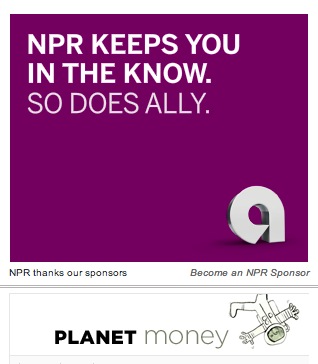
GMAC goes from thief to Ally…
Planet Money‘s relationship with Ally is a textbook example of “conflict of interest” of the sort every journalist is taught to shun. The bank had a clear and demonstrable interest in Planet Money‘s coverage of the financial industry, especially issues that affected the bank’s bottom line. As Planet Money‘s sole sponsor at a time when NPR funds were falling, Ally obviously wielded considerable power.
After Davidson sprang a vicious and bizarre smear-attack on Elizabeth Warren in 2009, some NPR listeners started to get wise to Planet Money‘s corruption problem, and made their concerns known. Following months of complaints from readers pointing to the conflict-of-interest and the way Planet Money‘s segments dovetailed with the banking lobby’s own propaganda—and with Ally’s interests—NPR’s Ombudsman was forced to issue a public statement on the Ally-Planet Money relationship. Perhaps not surprisingly, the NPR Ombudsman decided that listeners’ concerns over the conflict-of-interest were “cynical”—as if the problem lay in listeners’ psychology, rather than in Planet Money’s violation of basic journalism ethics. The NPR Ombudsman went further, arguing essentially that if listeners who complained about corruption weren’t cynical, then they were ignorant.
Despite Davidson’s long experience in sales and underwriting for public radio, he claimed he was out of the loop when it came to the deal his own show, Planet Money, cut with its sole sponsor, Ally Bank: “I have nothing to do with the underwriting stuff. We don’t pay any attention to the fact that they are a sponsor. We wouldn’t for a second give them any special treatment — positive or negative.”
And yet, the actual record proves that NPR readers were right to suspect and criticize the arrangement, and that Davidson was wrong in claiming that Planet Money has not consistently pushed a narrative so in synch with Ally Bank and the financial industry that it boggles the mind how he has gotten away with it. Planet Money coverage hasn’t just been friendly to banks and the finance industry in general—some of it has been suspiciously lined up and in synch with specific policy priorities of its exclusive sponsor, Ally Bank.
One example: In 2009, just as Planet Money inked its exclusive sponsorship deal with Ally Bank, Davidson began broadcasting a number of segments critical of the proposed Financial Consumer Protection Agency Act of 2009, questioning the need to regulate consumer financial products like mortgages and credit cards in order to protect people against bank fraud. “Will it work at all?” Davidson asked in one of his fake “gee-whiz” questions. “Is this just one more layer of regulation in a regulatory system that fundamentally broke down?”
In May 2009, in the heat of the banking industry’s massive pushback, Davidson essentially mugged Elizabeth Warren, the chief architect of the financial consumer protection bill, in an interview that took a sharp and bizarre hostile turn early on. Davidson surprised Warren and his own listeners with uncharacteristic personal smears, trying to portray her as a clueless, power-hungry ideologue. Davidson’s attack on Warren was so out-of-line and uncharacteristically hostile that it sparked a torrent of criticism from NPR listeners who couldn’t understand why Davidson or NPR would do such a thing. Keep in mind, this was in the spring of 2009, when unemployment was still shooting through the roof, the future of the economy was in doubt, and talk of a 1930s style Great Depression-2 was still front-and-center.
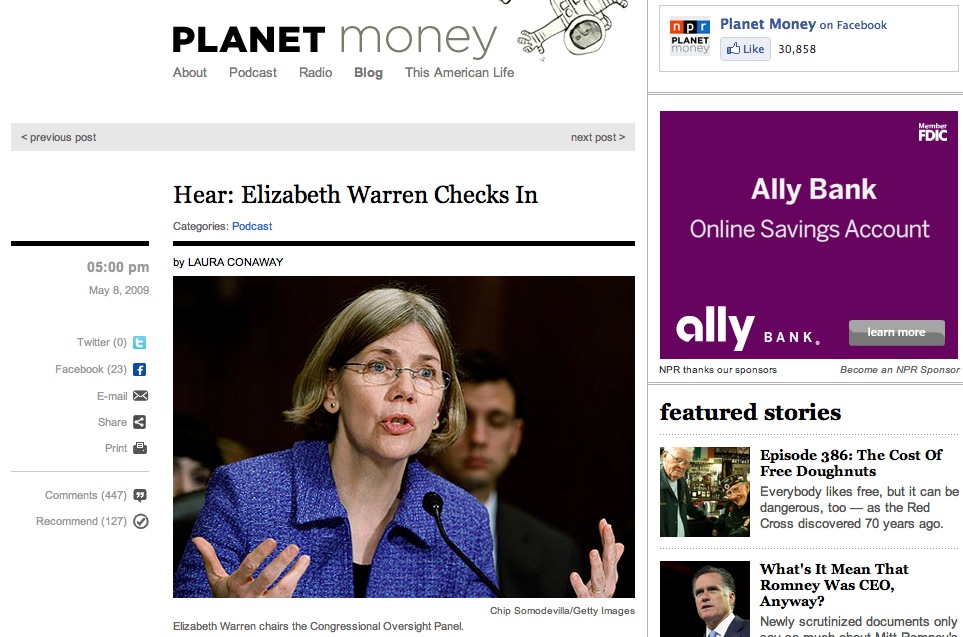
It’s worth going back and listening to the interview to get a sense of just how malevolent Davidson really was, and is. Here’s an excerpt, courtesy of Corrente:
ADAM DAVIDSON: What it feels to me is what you are missing is that — I think we put aside your pet issues. We put them aside. We put them aside until this crisis is over.
ELIZABETH WARREN: The cr– What you’re saying makes no sense. Now come on. [interpolate Davidson sputtering and attempting to interrupt throughout.] It makes no sense. On an emergency basis, on one day, one week, one month, there’s no doubt in my mind we’ve got to step in, we’ve got to make sure we have a functioning banking system. I think I’ve said that like nine times now. Of course we’ve got to have a functioning banking system.
DAVIDSON: Wait a minute. I want to make you go farther. I want to make you madder before I —
ELIZABETH WARREN: No no no. [Davidson snickers] We’re now at what — we’re now seven, eight months into this. And it’s the second part of what you said. We can’t do anything about the American family until this crisis is over? This crisis will not be over until the American family begins to recover. [More Davidson sputtering.] This crisis does not exist independently —
DAVIDSON: That’s your crisis.
ELIZABETH WARREN: No it is not my crisis! That is America’s crisis! If people cannnot pay their credit card bills [Davidson tries to interrupt] if they cannot pay their mortgages —
DAVIDSON: But you are not in the mainstream of views on this issue. You are not —
ELIZABETH WARREN: What, if they can’t pay their credit card bills the banks are gonna do fine? Who are you looking at?
DAVIDSON: The [sputters]–
ELIZABETH WARREN: Who says a bank a bank is going to survive — Who is not worried about the fact that the Bank of America’s default rate has now bumped over 10%? That’s at least the latest data I saw. So the idea that we’re going to somehow fix the banks and then next year or next decade we’re going to start worrying about the American family just doesn’t [Davidson talking over] make any sense.
DAVIDSON: The American families are not — These issues of crucial, the essential need for credit intermediation are as close to accepted principles among every serious thinker on this topic. The view that the American family, that you hold very powerfully, is fully under assault and that there is — and we can get into that — that is not accepted broad wisdom. I talk to a lot a lot a lot of left, right, center, neutral economists [and] you are the only person I’ve talked to in a year of covering this crisis who has a view that we have two equally acute crises: a financial crisis and a household debt crisis that is equally acute in the same kind of way. I literally don’t know who else I can talk to support that view. I literally don’t know anyone other than you who has that view, and you are the person [snicker] who went to Congress to oversee it and you are presenting a very, very narrow view to the American people.
The Columbia Journalism Review described the Planet Money interview as a “disaster” and “really cringeworthy stuff from Davidson,” who was so rude and unprofessional that NPR’s Ombudsman was forced to issue a public apology for his behavior. Davidson’s excuse: he had been traveling for a NPR fundraiser and was “very, very tired.”
What Adam Davidson did not disclose to the public was that at the same time he was smearing Elizabeth Warren and attacking legislation that would protect consumers against the sort of bank fraud that has devastated millions of Americans, Ally Bank, the sole sponsor underwriting Davidson’s Planet Money show and his salary, was simultaneously spending hundreds of thousands lobbying against the Financial the Consumer Protection Agency Act of 2009.
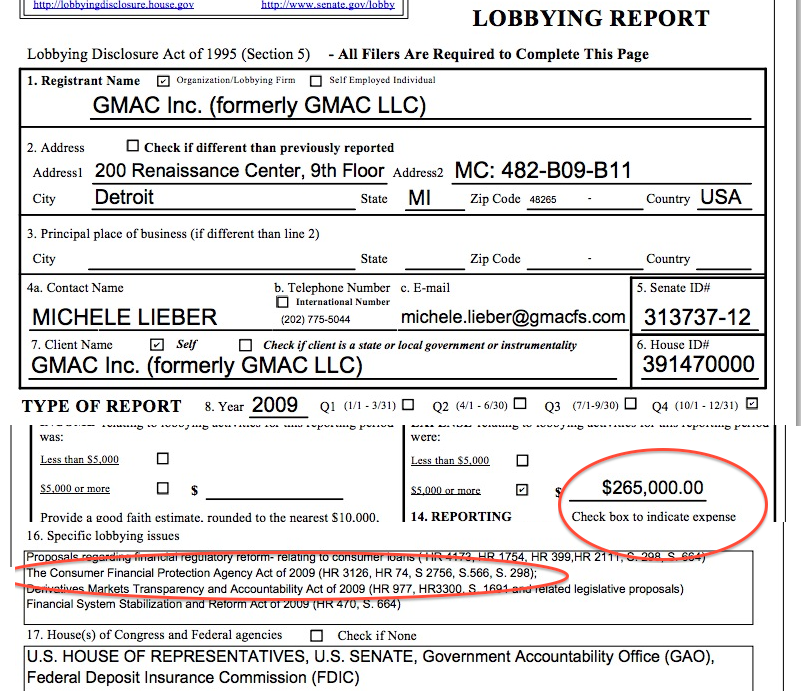
Evidence: Here’s just one of GMAC’s lobbying disclosure forms mentioning the Consumer Financial Protection Agency Act of 2009
Ally Bank is not the only financial company funding Adam Davidson’s career, and filling up his bank accounts.
On top of Ally Bank’s exclusive sponsorship of Planet Money, Davidson earns lucrative speaking fees from banks and financial companies, including J.P. Morgan, Well Fargo, Bank of America and Goldman Sachs—the same companies he covers as a journalist. Davidson is frequently the only journalist/reporter booked to speak at these events; other speakers usually work in finance.
Davidson has yet to disclose his corporate clients and how much they pay him, but here is a partial list of Davidson’s speaking gigs from the last two years compiled from various publicly available sources:
- In April 2011, Davidson was the headlining speaker at the 9th Annual “Women’s World Banking” Microfinance and the Capital Markets Conference. The conference was hosted by J.P. Morgan, but the organization itself is funded by the world’s biggest banks and corporations, including BP, Morgan Stanley, Pfizer, Barclays Capital, VISA, ExxonMobil—just to name a few.
- In 2011, Davidson spoke at another microfinance conference, this once was also funded by Morgan Stanley, Citi, Bank of America, Deutsche Bank and CapitalOne.
- In 2012, Davidson spoke at the 27th Annual Conference for the Treasury & Finance Professional. Sponsors of the event included Bank of America, BlackRock, BNY Mellon, Bloomberg, Citibank, Findelity Investments, Goldman Sachs, J.P. Morgan, Morgan Stanley, Well Fargo and about a dozen of the most powerful financial the largest financial companies in the world.
These speaking fees are a huge unaddressed problem in news media and academia. As explained by Charles Ferguson, director of Inside Job and author of Predator Nation, the problem with speaking fees is that they are “sometimes used to launder or disguise payments . . . for lobbying and policy advocacy.” That is why, for example, Obama’s former economy czar Larry Summers was roundly criticized for taking hundreds of thousands of dollars in speaking fees in 2008 from the same banks he was bailing out in 2009.
Chicago Public Media, which co-owns “Planet Money” through its ownership of “This American Life”, explicitly bars conflicts-of-interest: “WBEZ journalists must uphold the trust of the public by not overlapping individual interests with professional responsibilities. WBEZ journalists may not accept any form of compensation from the individuals, institutions or organizations they cover.”
Neither NPR nor This American Life would comment on S.H.A.M.E.’s investigation into Adam Davidson’s conflicts of interest. We will be seeking to get comment from Davidson’s other employer, The New York Times, about their policy on journalists having conflicts-of-interest.
Notes
See Naked Capitalism’s coverage of GMAC/Ally’s mortgage fraud.
Obama’s Justice Department Rushes to the Rescue of LIBOR Criminals
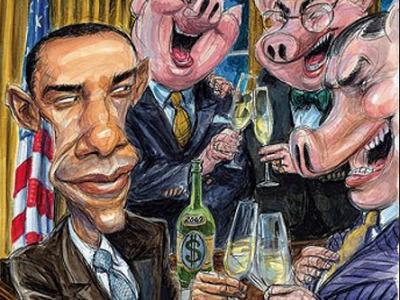
A Black Agenda Radio commentary by Glen Ford | July 18, 2012
The Obama Justice Department is in theater mode, again, pretending to threaten the bankster class with criminal penalties – prison time! – for their manipulation of the global economy’s benchmark interest rates. The Justice Department claims to be building criminal and civil cases in the LIBOR scandal, which in sheer scope is the biggest fraud by international capital in history. But that’s all a front, a farce. Barack Obama has spent his entire presidency protecting Wall Street, starting with his rescue of George Bush’s bank bailout bill after it’s initial defeat in Congress, in the last days of Obama’s candidacy. He packed his administration with banksters, passed his own bailout and, in collaboration with the Federal Reserve, channeled at least $16 trillion dollars into the accounts of U.S. and even European banks – by far the greatest transfer of capital in the history of the world. Obama has reminded the banksters that it was he who saved them from the “pitchforks” of an outraged public. He pushed through Congress so-called financial reform legislation that left derivatives – the deadly instruments of mass financial destruction that were at the heart of the meltdown – untouched.
Wall Street may or may not remain loyal to Obama, but Obama has been loyal to Wall Street, the guys who gave him the campaign cash to become a viable candidate. His Attorney General, Eric Holder, a corporate lawyer to the core, is busily staging a pre-emptive LIBOR prosecution of bankers in order to shield them from legal action by a host of other government agencies and, ultimately, from the global universe of parties that have been harmed by the bankster’s schemes– a list that stretches to infinity. Holder’s job is to monopolize the LIBOR case, to the extent legally and humanly possible, grabbing jurisdiction and consolidating the cases against the banks with the aim of reaching a settlement that does not further destabilize the financial system.
Holder and his boss already pulled that trick earlier this year with settlement of the bank “robo-signing” scandal – a scheme that would have ranked as the “crime of the century” until LIBOR came along. A small group of state attorney generals were holding up an administration-brokered settlement that effectively gave the banksters immunity from prosecution, in return for a measly $25 billion payout. Obama used every power of his office to pressure the state law officers into line. The last one capitulated with a promise from Obama that a “special unit of prosecutors” would expand the investigation into abusive mortgages practices. You haven’t heard a peep about it, since.
Now Obama and Holder are playing the same diversionary game, making tough noises about criminal investigations of the LIBOR conspirators. But the Justice Department has already given immunity to Barclay’s Bank, of Britain, and to the Swiss banking giant UBS. More immunities will follow. The reason Eric Holder is staging criminal investigations is because that’s the only way he can protect the bankers, through immunities and by gradually narrowing the scope of the case. In the end, there will be settlements all around, and the banksters will move on to even more fantastic heights of criminality – thanks to the loyal, protective hands of President Obama.
BAR executive editor Glen Ford can be contacted at Glen.Ford@BlackAgendaReport.com.
Related articles
- Richard (RJ) Eskow: Crooked Bankers Are Corrupting Government: The Real LIBOR Story (huffingtonpost.com)
Predator Nation: Obama and Corporate Crime
By RUSSELL MOKHIBER | CounterPunch | June 12, 2012
When Charles Ferguson accepted the Academy Award in 2010 for his documentary film Inside Job, he told 30 million people viewing the award ceremony that “three years after a horrific financial crisis caused by massive fraud, not a single senior financial executive has been prosecuted and that’s wrong.”
Two years later, still no prosecution.
So, now Ferguson is out with a book – Predator Nation: Corporate Criminals, Political Corruption, and the Hijacking of America (Random House, 2012.)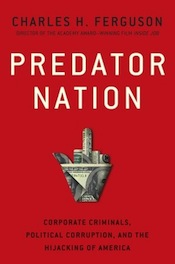
It reads like an indictment.
Check that.
It reads like a number of indictments.
And Ferguson is hoping that federal prosecutors will pick up the book and get some ideas.
And why exactly have there been no prosecutions of high level Wall Street investment bank executives?
Politics?
“Not exactly,” Ferguson says.
“It’s important to bear in mind the direct personal incentive structures of many of the people involved,” Ferguson told Corporate Crime Reporter last week. “The revolving door phenomenon now effects the Justice Department and federal prosecutors to a very substantial extent.”
“The previous federal prosecutor for the southern district of New York, Mary Jo White, now does white collar criminal defense and makes a great deal more money than she did as a federal prosecutor. I think that phenomenon is very well entrenched, very thoroughly entrenched.”
“Indeed Lanny Breuer, the Assistant Attorney General for the Criminal Division was head of the white collar criminal defense practice at Covington & Burling. They represent most of the major banks and investment banks in the United States.”
And his boss, Eric Holder, the Attorney General, came from the same firm.
“Exactly,” Ferguson said. “So, when you say politics, you sort of think of Republicans, Democrats, ideology, large scale political and policy debates. I don’t think that’s the only thing going on here. I think you have to consider incentives – individual, personal, financial and professional.”
When Rudy Giuliani was U.S. Attorney, he had no qualms about prosecuting Michael Milken. What has changed?
“One thing that has changed is that the amount of wealth and political power held by the financial sector has gone up by at least an order of magnitude,” Ferguson said.
“Another thing that’s changed is the amount of money that the financial sector spends on politics and acquiring political power and influence has also gone up by at least an order of magnitude.”
“And thirdly, the divergence, the difference between public sector salaries and incomes and private sector salaries and incomes has widened enormously.”
“So again, for those at the level of large scale political behavior and at the level of individual incentive, things have changed dramatically since the 1980s.”
As an undergrad, Ferguson studied mathematics at the University of California Berkeley and went on to study political science at MIT.
He then went on to organize an early software company – Vermeer Technologies – which was sold in 1996 to Microsoft for a reported $133 million.
He was an early fan of President Obama.
“I donated my legal maximum to his campaign in 2008,” Ferguson says.
But at a press conference in October 2011, Obama addressed the question of why no high level Wall Street executive has been prosecuted.
“So, you know, without commenting on particular prosecutions– obviously, that’s not my job, that’s the attorney general’s job – you know, I think part of people’s frustrations, part of my frustration, was a lot of practices that should not have been allowed weren’t necessarily against the law, but they had a huge destructive impact,” Obama said. […]
What was Ferguson’s reaction when he heard Obama say – the actions “weren’t necessarily against the law”?
“My reaction was very negative,” Ferguson said. “First of all the statement is thoroughly inaccurate and incorrect, but secondly it’s very difficult for me to believe that he doesn’t know that.”
“Given what we now know, it’s very difficult for me to believe that President Obama actually believes that there was no significant criminality in the housing bubble and the financial crisis.”
Russell Mokhiber edits the Corporate Crime Reporter.
Related articles
- Exposing Countrywide (alethonews.wordpress.com)
- Predator Nation: How Wall Street Crashed the Economy & Got Off Scott Free (ritholtz.com)
- Corporate criminals gone wild (salon.com)
Obama Signs a Phony – and Dangerous – “JOBS” Bill
A Black Agenda Radio commentary by Glen Ford | April 10, 2012
President Obama is ramping up his phony progressive campaign rhetoric, trying to once again masquerade as something other than a Wall Street servant. But this time around, he is weighted down by his actual record in office, which shows Obama to have been a savior to the bankers and money speculators. Now, the president has joined with Republicans to create a whole new class of con men and corporate criminals who will further fatten the fees of banksters by blowing up another multi-trillion dollar bubble of doomed and fraudulent hi-tech firms. To add insult to injury, Obama, his congressional Democrats and his Republican soul mates had the nerve to set the stage for this disaster by passing something they called a “JOBS” bill.
Of course, there are no jobs in the bill. The acronym stands for “Jumpstart Our Business Start- Ups Act,” and it’s an invitation to a con game.
The new law, passed by 73 senators with Obama’s enthusiastic endorsement, allows corporations with less than $1billion in revenues – that’s a billion, as in a thousand million – to avoid hiring a professional auditing firm for five years after the company begins selling stock to the public. That means five long years of taking other people’s money without having to tell the truth about how your business is really doing. The scheme is designed to encourage what the money guys call “crowd funding” on the Internet, with little oversight by regulators.
Make no mistake: this is not an opportunity for those of you who want to open up a restaurant or a bar or a bookstore. Companies making less than $75 million can already avoid being subjected to professional audits; this bill extends the privilege to corporations at the billion dollar mark, who can now ensnare investors in their webs for twenty consecutive quarters without backing up a word of their sales pitch.
Of course, the banksters that handle these transactions and the Wall Street gamblers who bet on them will get over like fat rats – for a while. And then it will all come tumbling down, just as President Bill Clinton’s Dot.com bubble did at the end of the roaring Nineties. The collapse destroyed $5 trillion in investments, and led to the first George Bush recession, from which Black folks did not have a chance to recover before being crushed again by the meltdown of 2008.
Where did this phony “JOBS” bill come from? From the bowels of the Obama administration, where the task of creating employment is the purview of the President’s Council on Jobs and Competitiveness, packed with corporate executives from General Electric, Intel, Citigroup, Xerox, Boeing and American Express. Organized labor was adamantly opposed, seeing no jobs in the bill. But Obama doesn’t listen to unions, because he knows they will take an infinity of abuse rather than fight with a Democratic president. And the Black misleadership class has made itself totally irrelevant.
The lesson here is: late stage capitalism, which is incapable of creating real jobs in the United States, is pinning its hopes on inflating another hi-tech bubble to keep the casino wheels spinning for a few years. When the bubble bursts, they are confident that a bailout will be made available, no matter which party is in office. And the public will pick up the pieces.
Glen Ford can be contacted at Glen.Ford@BlackAgendaReport.com.
Related articles
- Obama’s Corporate Tax Scam (alethonews.wordpress.com)
- Angela Davis Lost Her Mind Over Obama (alethonews.wordpress.com)
- Obama: “The Devil” Made Me Take the Super Pac Money (alethonews.wordpress.com)
A Toxic System
An Inside Glimpse Into the Nefarious Operations of Goldman Sachs
By DARWIN BOND-GRAHAM | CounterPunch | March 15, 2012
Goldman Sachs employee Greg Smith’s very public resignation, replete with a pointed letter published in the New York Times yesterday, has landed upon the investment bank like a bomb. Slamming a “toxic and destructive environment” within Goldman Sachs, Smith says the firm’s internal culture has devolved to the point where the entire staff not only tolerates, but expects workers at all levels, from senior partners to associates, to pursue nothing but ever-more sophisticated means of “ripping their clients off.”
Apologists for the financial sector —including the editors of the major business newspapers and television networks— predictably have shot back with a flurry columns and reports, mostly designed to discredit the former vice president by making fun of Smith and his concerns. If you strip away the ad hominem layers to these responses though, the core problems raised by Smith remain, and the reaction of the business press seems all the more absurd, for Goldman’s pesky turncoat isn’t saying anything that’s news to the public: Goldman Sachs is characterized by a toxic culture of greed? Stop the presses!
There is much more to be said about Goldman Sachs’ derivatives operation, however, and Smith’s provocative resignation provides an opportunity because he was working in the belly of it.
At the center of Smith’s critique are derivatives, the arcane financial instruments that transformed the world’s splintered national economies and regional banking systems into a single, if complicated, global system. Evangelists of derivatives claim they have made new heights of economic growth, trade, and prosperity possible. Critics have pointed out since the beginning of the derivatives boom in the 1980s how perfectly suited they are to fraud and systemic catastrophe via the greed of the few and the powerful.
Derivatives, many close observers have reminded us, were at the center the Enron meltdown, the demise of Long Term Capital Management, the Asian Financial Crisis, and most recently the Great Recession and its various flares, from the housing bubble that exploded from junked collateralized debt obligations, to the current Greek debt imbroglio and the credit default swaps haunting the background. In each case, and many less-known fiascos, derivatives traders in Wall Street’s leading banks played key roles either as the major villains, or enabling partners in vast crimes of information, leverage, and risk. Time and again we find derivatives at the center of scandalous greed. Now we have a high-profile banker denouncing not just some bad apples in his firm, but the firm’s entire culture.
There’s a deeper and more disturbing truth still further below the surface though. To get there it’s instructive to know a little more about Goldman’s derivatives operation, and the wider industry of which Goldman is a small part.
Who are the clients on the receiving end of Goldman’s “toxic and destructive” tendencies? Many times the victims have been other corporations, industrial firms with less sophisticated and perhaps naive financial officers. Quite often though the victims of Goldman’s derivatives operation have been cities, counties, and local government agencies. A key client category for derivatives has been large local governments and agencies that issue hefty sums of long-term debt.
Goldman, and the handful of other global banks that dominate the derivatives industry, sold local governments on the idea that a particular set of derivative products could provide wondrous solutions to hedge against the risks inherent in issuing long term debt. The banks claimed that interest rate swaps could shield counties, cities, and agencies from possible spikes in floating interest rates attached to their bonds. Thus many governments agreed to complex, multi-decade deals involving the swapping of payments on fictive amounts of money associated with real debt. In no time at all interest rate swaps became the single largest category of derivatives, dwarfing all others.
Today interest rate swaps make up 82% of the total market in derivatives, measured by total notional amounts. This is partly the result of governments all over the world entering into interest rate swaps, agreeing to tie cash flows to trillions of notional dollars. What’s key is that none of this has required duplicity or reckless greed on the part of bankers at Goldman Sachs or other firms. Let’s be clear; this is a structural transformation of capitalism on a global scale, and it has sucked up all corporate and government entities into the new logic of hedging and efficiency. That a few powerful financial corporations have placed themselves in strategic positions to benefit from this structural shift should come as no surprise.
In California’s Bay Area, multiple governments have come to find themselves on the paying end of Goldman’s derivatives department where apparently traders referred to clients as “muppets.” The most obvious example is the city of Oakland where a chronic budget crisis has led to the shuttering of schools and cuts to elder services, housing, and public safety. Oakland signed an interest rate swap with Goldman in 1997. The terms of the deal, revised once in 2003, were typical of interest rate swaps except that Oakland’s financial officers, based on this author’s research and impressions, seem to have agreed to a somewhat higher fixed rate obligation than most other cities that signed swap deals for similar amounts of debt with comparable ratings. Oakland partly did this, I am guessing, to receive upfront payments of roughly $5 and $10 million from Goldman Sachs, cash that the city wished to have on hand immediately. The bank seemed eager to do this because the original terms, and renegotiated terms in 2003, were much to its favor. It would earn the $15 million back, and then some over the twenty-four year life of the swap.
Across the Bay, Goldman Sachs signed an interest rate swap agreement with the San Francisco International Airport in 2007 to hedge $143 million in debt. Today this agreement has a negative value to the Airpot of about $22 million, even though its terms were much better than those Oakland agreed to. The Airport, like Oakland, must now pay millions each year to Goldman Sachs until the agreement expires, or until the floating LIBOR interest rate rises enough to offset the net balance of payments. Goldman sold derivatives up and down California and across the United States to cities, counties, and agencies, promising them a means of reducing debt payments over the long haul.
Business press pundits who are now slamming Smith say it’s absurd to expect that Goldman Sachs was doing anything less than trying to make money off these deals, and that counter-parties to the firm’s dealings knew well what they were signing up for. This mischaracterizes the entire problem, however, and threatens to steer the conversation into a narrow, and politically irrelevant one about whether Goldman Sachs is or isn’t a den of fraud.
When governments signed up for interest rate swap deals with Goldman Sachs they certainly did know that the bank would be making money off the agreement, first in the form of up-front fees, and then off of savings produced by the pairing of comparative advantages in debt markets that interest rate swaps are designed to achieve. If you don’t understand that last point, don’t worry. What it means simply is that Goldman Sachs sold interest rate swap products to governments by promising to both protect a government against interest rate volatility, and to also likely reduce the overall long-term cost of borrowing money. It was supposed to be a win-win game.
The truly impressive thing about the whole derivatives market is that it is supposed to ratchet up the efficiency of the entire global economy, making dollars go much further, protecting all parties from volatility, transcending previous market barriers and smoothing flows of cash… at least in theory. The theory seemed to be working in the 1990s and through most of the 2000s. Goldman didn’t have to convince anyone of this for the results were plain to see.
That it hasn’t panned out in practice, that the whole derivatives-based economy nearly collapsed in 2008 and continues to falter, isn’t so much the result of Goldman’s toxic culture of greed as it is the outcome of a much more troubling feature of our economic system. While I agree with Smith’s observation —which is important because it’s based on insider knowledge— that Goldman Sachs is an especially predatory corporation, I see a larger pattern of power relations embodied in the new economy, structured as it is by derivatives, that isn’t based on any specific firm’s internal culture or corruption, or the supposed naivety and stupidity of financial officers in government and less profitable sectors of the economy.
Consider the fact that Goldman Sachs isn’t even the biggest fish in the pond, nor is it profiting the most from the blizzard of derivative products that structure the capitalist economy today. Of the five financial corporations that “dominate in derivatives,” as the U.S. Office of the Comptroller of the Currency puts it, Goldman Sachs ranks fourth, behind by Bank of America, Citibank, and far behind the absolute king of derivatives, JP Morgan Chase.
In February JP Morgan Chase let slip that it cleared $1.4 billion in revenue on trading interest rate swaps in 2011, making these instruments one of the bank’s biggest sources of profit. According to some reports, JP Morgan Chase made billions more in 2008 and 2009 when the financial crisis and federal response combined to make floating-to-fixed interest rate swaps into extremely profitable assets for the banks on the floating side of the deal. Similar things can be said for Mogan Stanley, HSBC, Wells Fargo, Bank of America, Bank of New York, and the dozens of smaller interest rate swap peddlers currently profiting from direct transfers of public dollars.
Are all these banks poisoned by toxic cultures of greed? Surely there are similarities in the internal cultures of large banks, and greed and a little sociopathic ability to profit from another’s loss is a professional asset in these sorts of organizations. In contemporary corporate culture the euphemism for this is “competition.”
Toxic culture and greed, or “competitiveness” if you prefer, in the investment banks isn’t a sufficient answer to why derivatives have become the foundation of today’s global economy, however. The criminal activities of some bankers, driven by these more pervasive cultures, can’t explain the economic crisis and the vast injustices that are being perpetrated still in the name of “economic recovery.” The interest rate swap crisis stinging local governments and enriching the banks is a case in point.
The windfall of revenue accruing to JP Morgan, Goldman Sachs, and their peers from interest rate swap derivatives is due to nothing other than political decisions that have been made at the federal level to allow these deals to run their course, even while benchmark interest rates, influenced by the Federal Reserve’s rate setting, and determined by many of these same banks (the London Interbank Offered Rate, LIBOR) linger close to zero. These political decisions have determined that virtually all interest rate swaps between local and state governments and the largest banks have turned into perverse contracts whereby cities, counties, school districts, water agencies, airports, transit authorities, and hospitals pay millions yearly to the few elite banks that run the global financial system, for nothing meaningful in return. These perfectly legal cash flows measuring globally in the hundreds of billions, from the public to the banks, dwarf anything that is the result of fraud.
Back when the economy was in a “normal” stasis of growth, the early and mid-2000s, interest rate swaps and other derivatives promised security against risk, and a new vista for capitalism and public finance. Tellingly, when the crisis struck, swaps were allowed to become a one way flow of funds from the public to the banks. This shadow bailout for the banks has done considerable damage to already cash-strapped local governments suffering from declines in tax revenues and federal aid.
Whether Goldman Sachs is or isn’t an organization gripped by a toxic culture isn’t all that important when one considers the destructive impact that derivatives have had, and continue to have upon society. Capitalism as it functions today is completely dependent upon derivatives. Interest rate swaps are the single largest type of derivative, measured by notional amount, because they achieve an integration of different national, regional, and sectoral financial markets into one global financial system. It’s in the genetics of the project of financial globalization, fueled by derivatives, that the real problem lies, not in the internal culture of Goldman Sachs, or the illegal behaviors of some bankers across many firms. The real crime lies in perfectly legal and legitimated activities whereby a few powerful corporations design a system that puts the welfare of the world’s vast majority at grave risk. It’s the system that’s toxic. Goldman Sachs merely operates well within the toxicity.
Nevertheless, Greg Smith’s effort to pull back the curtain on one of the most nefarious and powerful corporations in history is most welcomed, especially for the deeper conversations it can stoke about the origins of the current crisis.
Darwin Bond-Graham is a sociologist and author who lives and works in Oakland, CA. He is a contributor to Hopeless: Barack Obama and the Politics of Illusion, forthcoming from AK Press.
Related articles
Obama Can Do More on Oil Prices
By Ralph Nader | March 6, 2012
Gasoline and heating oil prices are ratcheting up. In California, some motorists are paying over $5 per gallon. President Obama declared that “there is no quick fix” for this problem. Meanwhile, the hapless but howling Republicans are blaming him for the fuel surge as if he is a price control czar.
Indeed, President Obama has some proper power to cool off retail petroleum prices. David Stockman, President Ronald Reagan’s Budget Director, said it plainly on CNN last week, “Stop beating the war drums right now [against Iran], and Obama could do that, and he could say the neocons are history.” Having done his stint on Wall Street, Stockman knows that war talk by the war hawks inside and outside of our government is just what the speculators on the New York Mercantile Exchange want to hear as they bid up the price. Your gasoline prices are not charging up due to strains between supply and demand. Speculation, with those notorious derivatives and swaps, is what is poking larger holes in your fuel budget, according to Securities and Exchange Commission enforcement lawyers. The too-big-to-fail Wall Street gamblers – Goldman Sachs, JP Morgan Chase, Bank of America, Merrill Lynch, and Morgan Stanley – are at it again.
Dr. Mark Cooper of the Consumer Federation of America documented that speculation added $600 to the average family’s gasoline expenditures in 2011. Earlier, the head of Exxon/Mobil estimated that speculation was responsible for over $40 per barrel in price increase at a time when oil was more than $100 per barrel.
Last June, the Commodity Futures Trading Commission (CFTC) Chairman, Gary Gensler, declared in New York City that “huge inflows of speculative money create a self-fulfilling prophecy that drives up commodity prices.”
Mr. Gensler and the CFTC received more legislated authority to police these Wall Street gamblers, but key members of Congress refused to give him a budget to, in his words, “be a more effective cop on the beat,” at a time of sharply-increasing trading volume. Congressional campaign budgets are being swelled by campaign contributions from those very Wall Street gamblers. This is called “cash-register politics.” Meanwhile, you the people pay and pay at the pump and wonder why no one is doing anything about it.
But an inadequate budget only explains part of Mr. Gensler’s problems. He is continually undermined by other CFTC Commissioners who do not want real enforcement action. He also seems to be wearing down under the pressure.
Back in the 1970s, a sudden increase in gasoline prices – even a few cents – led to an uproar among consumers and demands for regulation, price controls and other government action. Now that the New York Mercantile Exchange, with its big banking and hedge fund speculators loading up on fat profits and bonuses is right here in the U.S., officials are throwing up their hands saying “there are no quick fixes.”
Yet by the constant Israeli-Obama-Hillary Clinton-Congressional-AIPAC belligerent talk about Iran developing a capability to produce nuclear weapons is provoking Tehran’s warnings about the Straits of Hormuz, and the oil price speculators are having a field day with your gas dollars.
Senator Bernie Sanders (I-Vt.) regularly demands that that Obama’s regulators impose limits on oil speculations. He asserts that the “skyrocketing price of gas and oil has nothing to do with the fundamentals of supply and demand.” Even Goldman Sachs analyst, David Greely, claimed Wall Street speculation in the futures market is driving up oil prices.
In response to such clamorings, President Obama announced in April 2011 a new inter-agency working group to combat fraud. Don’t hold your breath waiting for any action here.
So why doesn’t President Obama invite the various industries such as the trucking and airline companies that are hurt by spiraling oil prices, together with consumer groups, motorist organizations, such as AAA and Better World Society, and the relevant government agencies to generate the pressure on Congress and the recalcitrant members of the CFTC to stop fronting for the Wall Street casino giants?
Mr. Obama and Energy Secretary Chu keep saying that there is enough oil in world markets and that speculatively-driven higher oil prices are undermining the U.S. economic recovery. Yet Mr. Obama seems unwilling to fully use his administration’s existing authority to crack down on the surging speculation.
There is much more action possible under current statutory authority for the regulators to use and earn their salaries. They need to hear louder rumblings from the people. While the people need, whenever possible and safe, to walk short distances instead of drive there, if only to stiffen their determination to fight back in more than one way.
Featured Video

The 1964 Coup in Brazil
or go to
Aletho News Archives – Video-Images
Frlom the Archives
70 Neocons Petition Congress To Effectively Allow Israel To Say When The US Should Attack Iran
By Damian Lataan | January 10, 2014
Seventy senior Israeli-centric neoconservatives have written an open letter to Congress imploring them to do more to ensure Iran complies with the conditions of any agreement finally reached with the P5+1 over Iran’s nuclear program.
While the neocons are ostensibly asking Congress to ensure compliance, it is clear that their real aim is to convince members of Congress to support the bill currently passing through the Senate which calls for tighter sanctions against Iran in the event of any waywardness on Iran’s part.
The neocons are eager to see the bill currently passing through the Senate with enough support to make it veto-proof, not so much because they are concerned about Iran’s so-called nuclear weapons program – there’s still not a skerrick of hard evidence that Iran has a nuclear weapons program – but, rather, because embedded within the bill is this clause:
… if the Government of Israel is compelled to take military action in legitimate self-defense against Iran’s nuclear weapon program, the United States Government should stand with Israel and provide, in accordance with the law of the United States and the constitutional responsibility of Congress to authorize the use of military force, diplomatic, military, and economic support to the Government of Israel in its defense of its territory, people, and existence…
Essentially, the clause is an automatic trigger for the US to attack Iran at any time the Israelis choose to launch a first strike – regardless of whether President Obama is in favour or not.
Partial list… continue
Blog Roll
 Aletho News
- Trump Threatens to ‘Hit’ Iran ‘Twenty Times Harder’ Over Strait of Hormuz Oil Flows
- Spare the hypocrisy: Baghaei slams Ursula’s support for US
- Iran War Supporters Invent a New and Absurd Justification: It Is All About China
- Corporate Media Go All Out To Support The US-Israeli War on Iran
- Trump press conference reveals a man who wants out of war
- When Tel Aviv decides, Washington fights
- Top official: Iran ready for a long war with US, no more diplomacy
- How Iran’s Toxic Rain Reveals US-Israel Discord
- Trump Admits He Is Destroying Iran For Israel
- Iran’s latest move in the GCC countries was a stroke of genius
- If Americans Knew
- Lebanon: Israel’s White Phosphorous Use Risks Civilian Harm
- Corporate Media Go All Out To Support The US-Israeli War On Iran
- US-Israel war on Iran is creating a steady growing number of amputees
- Israel planned this war on Iran for 40 years. Everything else is a smoke screen
- The wrong question about the war in Iran
- ‘Your Tax Dollars Being Used to Raise Your Gas Prices’: US-Israel Bomb Major Iranian Oil Depots
- ‘Bogus Evidence’: Former Nuclear Watchdog Head Debunks US Justification for Iran War
- EXPLAINER – Dimona: What to know about Israel’s nuclear site
- Fires and toxic air in Iran (thanks, Israel) – Not a ceasefire Day 150
- At Israel’s hands, Iran is burning, Lebanon and Gaza are crumbling – Not a ceasefire Day 149
- No Tricks Zone
- Wake-up Call: Survey Shows Majority Of Germans Now Favor Postponing Climate Targets!
- Televised! Leading German Political Candidate Tells Schoolchildren CO2 Makes Sun Hotter!
- New Study: A Century Warming Of 1.1°C Is ‘Commonplace’ And ‘Not Unusual’ During This Interglacial
- New Study: ‘Internal Noise’ And Volcanic Forcing Can Trigger 10-15°C Warming Within Decades
- Glaciers Worldwide Are Suddendly Surging, Experts Blame Warming!
- Surprising Discovery: Sahara Is Greening…Billions Of Trees Where Once Thought To Be Barren
- New Research Reaffirms Clouds, Aerosols, And Surface Solar Radiation Are ‘Driving The Climate System’
- Germany: Electric Car Catches Fire At Charging Station, Sets Off Local “Inferno”, Widespread Damage
- New Study: Canada’s New Brunswick Was 1°C Warmer Than Today During The Medieval Warm Period
- Coal Power Back In Trend As Globe Tries To Keep Pace With Growing Demand For Power
 Aletho News