What an Anonymous U.S. Official Says About Iranians in Syria
By Peter Hart | FAIR | May 22, 2013
The Washington Post’s Anne Gearan reports today (5/22/13) that Iran is in the thick of the Syria war, according to an anonymous U.S. official:
Iran has sent soldiers to Syria to fight alongside forces loyal to President Bashar al-Assad and those of the Lebanon-based Hezbollah militia, a senior State Department official said Tuesday.
An unknown number of Iranians are fighting in Syria, the official said, citing accounts from members of the opposition Free Syrian Army, which is backed by the United States. The official spoke on the condition of anonymity to preview a strategy session that Secretary of State John F. Kerry is to hold Wednesday with key supporters of the Syrian opposition.
The rationale for granting anonymity–a privilege that outlets are supposed to extend only rarely–is curious; it’s not clear why the government would need to say things anonymously in order “to preview a strategy session” about Syria.
Even more curious, though, is whether or not the source in question actually said this. At EA Worldview (5/22/13), Scott Lucas took a look at the briefing that produced the story, and what the State Department official actually said was this:
It is the most visible effort we have seen of Hezbollah to engage directly in the fighting in Syria as a foreign force. We understand there are also Iranians up there. That is what the Free Syrian Army commanders are telling us. I think this is an important thing to note, the direct implication of foreigners fighting on Syrian soil now for the regime.
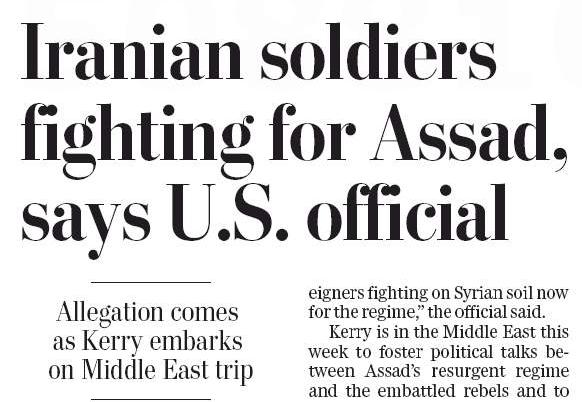 Suggesting that the Free Syrian Army believes Iranians are in Syria–which is probably true–is not the same thing as saying “Iran has sent soldiers to Syria” to fight on Assad’s behalf. And in answering followup questions, the anonymous State Department official admits that “to be very frank, I don’t have any estimates of numbers and I don’t know that they are directly involved in the fighting.” The source also says the Iranians “could be doing a little of both advising and fighting” and that “the reports that we’re getting… are not consistent.”
But Gearan’s question at the briefing would strongly suggest that she was pushing a stronger line about Iranian involvement than the anonymous source:
Are we now, based on your earlier comments about Iranian fighters being involved, looking at a proxy war? I mean, you’re talking about arming the rebels on one side, and the Iranians are clearly arming the others and fighting on behalf of the others on the other side. Are we now basically in a war with Iran?
The source doesn’t go as far out on this issue as Gearan’s question was pushing. But it didn’t really matter. As you can see in the pages of the Washington Post, an official Iranian role in the fighting was treated almost like a fact–which might be the point of having anonymous briefings like this.
Iran dismisses claims about military presence in Syria
Press TV – May 24, 2013
An Iranian deputy foreign minister has rejected claims about Tehran’s military presence in Syria, dismissing the allegations as a “blame game” orchestrated by the Syrian opposition groups.
“Iranian forces have never been, and are not present in Syria, and I deny this claim,” Iranian Deputy Foreign Minister for Asia-Pacific Affairs Abbas Araqchi said in Ankara on Thursday.
“The real enemies of Syria make such claims to provoke that country’s people [against Iran] and divert developments [in Syria] in the wrong direction,” said Araqchi, who is also Iran’s Foreign Ministry spokesman.
He emphasized that the crisis in Syria cannot be resolved through military means, adding that the unrest in the Arab country should be resolved politically. … Full article
NYT Runs Editorial Demanding Cuts in Social Security and Medicare in News Section
CEPR | May 14, 2013
The Washington Post long ago abandoned the separation between news and editorials, routinely running pieces advocating cuts in Social Security and Medicare in its news section. It now appears as though the New York Times is following the Post’s lead.
A news story on the budget made repeated assertions that Social Security and Medicare must be cut. At one point it referred to:
“the inevitable pain that comes from curbing those huge and popular programs [Social Security and Medicare].”
Of course there is nothing inevitable about curbing spending on Social Security and Medicare and there is certainly not inevitable pain. The most obvious route for curbing costs in these programs from an economic standpoint would be cutting Medicare payments to drug companies, medical equipment companies, doctors and other providers. This would not be especially painful for anyone who does not derive income from the program.
Clearly the paper was expressing its desire to see these programs cut.
It later added:
“The longer the delay, the sharper and more immediate the changes Washington must eventually make to ease the long-term fiscal squeeze.”
Again, this is an invention of the NYT. There is no evidence that the country is up against any “long-term fiscal squeeze” or that anything would be gained by making cuts now.
The NYT, unlike the Post, generally keeps these sorts of political views on the opinion page. It is unfortunate that it appears to have departed from its standard practice with this article.
Related article
- Thomas Friedman Again Demonstrates the Skills Shortage for NYT Pundits (alethonews.wordpress.com)
Mainstream Media in America and Britain Repeat the Same Mistakes in Covering Iran That They Made on Iraq
By Flynt Leverett and Hillary Mann Leverett | Going to Tehran | May 13, 2013

In an excellent report released last month, the University of Maryland’s Center for International and Security Studies at Maryland (CISSM) offered a thoroughly documented—and devastating—critique of mainstream media coverage of the Iranian nuclear issue. Authored by Jonas Siegel and Saranaz Barforoush, Media Coverage of Iran’s Nuclear Program: An Analysis of U.S. and U.K. Coverage, 2009-2012, see here, reviews coverage of Iran’s nuclear activities and the international controversy surrounding those activities in six major English-language newspapers: the New York Times, the Wall Street Journal, the Washington Post, the Financial Times, the Guardian, and the Independent.
To quote from the report’s executive summary (with emphasis added), the authors found that
“–Newspaper coverage focused on the ‘he said/she said’ aspects of the policy debate, without adequately explaining the fundamental issues that should have been informing assessments—such as Iran’s nuclear capabilities and intentions, the influence of U.S., European, Iranian, and Israeli security strategies, and the impact of the nuclear nonproliferation regime.
–When newspaper coverage did address Iranian nuclear intentions and capabilities, it did so in a manner that lacked precision, was inconsistent over time, and failed to provide adequate sourcing and context for claims. This led to an inaccurate picture of the choices facing policy makers.
–Government officials, particularly U.S. government officials, were the most frequently quoted or relied-on sources in coverage of Iran’s nuclear program. This tendency focused attention on a narrow set of policy options and deemphasized other potential approaches to the dispute.
–Newspaper coverage generally adopted the tendency of U.S., European, and Israeli officials to place on Iran the burden to resolve the dispute over its nuclear program, failing to acknowledge the roles of these other countries in the dispute…
–Coverage of Iran’s nuclear program reflected and reinforced the negative sentiments about Iran that are broadly shared by U.S., European, and Israeli publics. This contributed to misunderstandings about the interests involved and narrowed the range of acceptable outcomes.
In general, these characteristics led newspapers to frame their coverage of Iran’s nuclear program in a manner that emphasized official narratives of the dispute and a relatively narrow range of policy choices available to officials. By not consistently describing the complex web of international relationships, security concerns, and intervening political factors in sufficient detail, newspaper coverage further privileged official narratives and policy preferences. This makes it likely that the policies enacted and under consideration by policy makers—coercive diplomacy and war—remain the most likely outcome of the dispute. In this way, news coverage of Iran’s nuclear program is reminiscent of news coverage of the run-up to the 2003 U.S.-led invasion of Iraq. News coverage has the potential to play a significant, constructive role in finding a lasting resolution to the dispute over Iran’s nuclear program, but journalists and editors first need to address the tendencies present in their current coverage of the topic.”
We encourage all to read and ponder, hard, this important new report.
Related articles
The Incredible Tale of Gwenyth Todd and The “Naïve” Neocons
By Maidhc Ó Cathail | Washington Report on Middle East Affairs | May 2013
GIVEN THE proliferation of crimes, both foreign and domestic, known to have been committed by the U.S. government in the aftermath of the Sept. 11 attacks, there is an understandable willingness among large swathes of the public to believe almost anything told them by someone claiming to be blowing the whistle on an increasingly rogue “world’s policeman.” And, as a rule, the more persecution the whistleblower appears to suffer for exposing the global cop’s transgressions, the greater the desire to believe her story—no matter how far-fetched it might be.
Earlier this year, an effort was made to interest a number of prominent alternative media outlets in just such a “whistleblower” story. According to the professional-sounding pitch, an American contractor named Gwenyth Todd, while advising the Bahrain-based U.S. Navy’s Fifth Fleet, had single-handedly foiled a plot involving “a few select high-ranking members of the U.S. Navy” to provoke a war with Iran. “Fearing of the powers she had obstructed, and fearing for her own safety, Todd left Bahrain moving to Australia,” wrote the anonymous promoter. “For her honesty, bravery, and service, Todd has been sought after by the U.S. Justice Department for prosecution and pursued by the FBI. Nearly all in the corporate press have chosen to ignore her case.”
But not only has Gwenyth Todd’s case not been ignored by the corporate press, it has in fact been the subject of a five-page Washington Post special by “SpyTalk” blogger Jeff Stein. Moreover, Stein’s Aug. 21, 2012 piece entitled “Why was a Navy adviser stripped of her career?” uncritically touts Todd’s conspiratorial narrative solely on the basis of interviews with Todd herself and “a half-dozen Navy and other government officials who demanded anonymity because of the sensitivity of the matter, many parts of which remain classified.” Then, six months after having her story featured by one of America’s most influential pro-Israel daily newspapers, Todd was the unlikely focus of an even more credulous Iranian state television production. In February 2013, Press TV released “Untold Truths,” a half-hour-long program that introduced her as a “Middle East specialist” and “former U.S. government consultant.” The production began with a dramatic assertion: “In 2007, the U.S. tried to wage a war against IRAN. One person stopped it. This is her story.”
In the Washington Post and Press TV versions, the alleged conspiracy to start a war with Iran is said to have occurred in Bahrain in 2007. However, in a June 2012 article, Todd’s “senior editor” at the notoriously unreliable and ostensibly “anti-Semitic” Veterans Today (VT) website—with which Todd has “long worked” and currently serves on its motley editorial board of directors—sets the narrative two years earlier, and in a neighboring country. “Gwenyth Todd of the National Security Agency, close associate of Paul Wolfowitz and Condi Rice,” wrote Gordon Duff, “back in 2005, discovered a White House plot to stage an attack on American forces in Qatar.”
Confusing matters even more, another VT colleague and enthusiastic promoter of Todd’s story, Kevin Barrett, claims in a September 2012 piece first published by Press TV, “She stopped a 2006 neocon plot to stage a false flag attack in Bahrain intended to trigger war on Iran, and had to flee for her life to Australia.”
Although Todd presents herself as an “appalled” critic of the neoconservatives and the broader Israel lobby, there are good reasons to doubt her credibility on this point as well. In a Sept. 12, 2012 radio interview with Barrett, for example, she made the extraordinary claim that 9/11 was a “setback” for the neocons because it supposedly upset their plans for regime change in Iraq. According to Todd, their plan was to restore a pre-1958 type friendly regime, ruled by Ahmed Chalabi, with Iraq then serving as a base from which to launch regime change in Iran. In that same interview, she further claimed that the neoconservative agenda for Iraq had nothing to do with Israel. As if unaware of the fact that neocon Deputy Defense Secretary Wolfowitz had once been investigated for having passed a classified U.S. document to an Israeli government official, she proffered as evidence, “Didn’t Wolfowitz admit to having affairs with Palestinian students?”
It seems highly unlikely, however, that a former top Middle East analyst such as Todd claims to be would be unfamiliar with Oded Yinon’s seminal 1982 article, “A Strategy for Israel in the 1980s.” “Iraq, rich in oil on the one hand and internally torn on the other, is guaranteed as a candidate for Israel’s targets,” observed Yinon. “Its dissolution is even more important for us than that of Syria.” And it seems even less likely that she would be unaware of “A Clean Break: A New Strategy for Securing the Realm.” That influential 1996 report, prepared by a group of mainly American neocons for then-incoming Israeli Prime Minister Binyamin Netanyahu, recommended “removing Saddam Hussain from power in Iraq—an important Israeli strategic objective in its own right.”
Five years later, these right-wing Zionist policy advisers, many then members of the Bush administration, would seize the golden opportunity presented by the 9/11 attacks to turn this hawkish blueprint for Israeli expansionism into U.S. Middle East policy.
Todd’s seeming ignorance of Israel’s longstanding strategic designs for the breakup of Iraq is even harder to believe in light of her claim to have been “personally recruited” by the “Clean Break” study group leader. In the Sept. 12 radio interview with Barrett, she recounted a conversation with Richard Perle—who, like Chalabi’s other chief booster, Wolfowitz, has also been caught passing classified material to Israel—that supposedly took place at the end of George Bush’s pre-inaugural candlelight dinner in January 2001. “Paul’s going, Paul Wolfowitz is going to be the deputy secretary of defense,” she claimed Perle told her. “You know what we are going to do in Iraq, and we need like-minded people in the Pentagon so we can make it happen.”
When the interviewer expressed amazement that she had been approached directly by the so-called “Prince of Darkness” himself, Todd not very convincingly replied: “Yes, well, when I’d met him on a couple of… I’d been in conferences with him before.”
Presumably in an attempt to explain how the reputedly Machiavellian Perle could have been so naïve as to have tried to recruit someone he’d only met at a few conferences, Todd recounted a car journey with Perle in the 1990s during which he supposedly raved about the analytic prowess of her predecessor at the Pentagon’s Turkey desk—based solely on the analyst’s rumored ability to talk to cab drivers in Turkish. Claiming to have been shocked by Perle’s “total naïveté,” Todd went on to say that she subsequently heard the exact same story from fellow Iraq war architect Bernard Lewis at the Aspen Strategy Group in 1997, when she found herself seated between “Judy” Miller and the influential pro-Israel Orientalist, whom she said has dedicated his The Emergence of Modern Turkey to “some good friends” of hers.
Notwithstanding Todd’s claims to have been persecuted for thwarting a neocon-backed false flag designed to provoke war with Iran in December 2007—or was it in 2005? or 2006, perhaps?—she was asked in November 2010 to write a report on Turkey for Australia’s leading pro-Israel foreign policy think tank. Yet this past February, a mere week after she left little doubt in a social media conversation that she was fully aware of the founder and chairman Frank Lowy’s Israeli connection, Todd first feigned ignorance and then surprise in the comments section of The Passionate Attachment blog when this writer pointed out the Lowy Institute’s widely known close ties with Israel.
And as for the alleged unwarranted pursuit by U.S. law enforcement, it may have much less to do with her claimed success in preventing war with Iran than with a mysterious sum of money of uncertain origin and unclear purpose. When questioned by the FBI in 2007 about $30,000 she had received from her daughter’s father, Robert Cabelly—who would be indicted in 2009 for conspiring to act as an illegal agent of Sudan and to violate sanctions against the government of Omar al-Bashir—Todd said she told the federal agents that the money was for “emergency surgery” in Bahrain. By a strange coincidence, this just happened to be the exact same amount she told The New York Times in February 2011 that she had once spent out of her own pocket to buy gifts for the children of the poorest Shi’i families. Todd said she had been ordered by a commanding officer, fearful of upsetting the ruling Sunni Al-Khalifa royal family, to renege on a promise made on behalf of the Navy.
Indeed, the more one looks into the incredible tale spun by Gwenyth Todd, the more likely one is to agree with the former commander of U.S. Central Command, Admiral William J. Fallon—who in 2007 vetoed a move by the Bush administation to send a third carrier group to the Persian Gulf, vowing that an attack on Iran “will not happen on my watch.” Cast as an unlikely villain in Todd’s narrative, the retired four-star admiral was asked by The Washington Post’s Jeff Stein to comment on her conspiratorial allegations; Fallon’s terse e-mail response—“B.S.”
Washington Post Prints Iraq Lies, 2013 Edition
By Peter Hart | FAIR | March 22, 2013
How long can media keep printing lies about the Iraq War? Today’s Washington Post (3/22/13) provides one answer, since they printed an 0p-ed by former Bush national security adviser Stephen Hadley where he argued this:
After Hussein was deposed, we did not find the stockpiles of WMDs that all the world’s major intelligence services, the Clinton and Bush administrations and most members of Congress thought that he had. It was less an intelligence failure than a failure of imagination. Before the war, no one conceived what seems to have been the case: that Hussein had destroyed his WMD stocks but wanted to hide this from his enemy Iran. The U.S. team charged with searching for WMDs concluded that Hussein had the intention and the means to return to WMD production had he not been brought down. (With Iran pursuing nuclear weapons, it is a good bet that he would have.)
This is complete, utter nonsense; a serious newspaper would be ashamed to print it.
Long before the war, the government had intelligence from the most famous defector from Iraq, Saddam Hussein’s son-in-law Hussein Kamel. The government publicly claimed that what Kamel told them confirmed their threats about Iraq’s WMDs.
In fact, what Kamel actually told IAEA inspectors in 1995 was that the weapons stockpiles had been destroyed. This was reported right before the invasion by Newsweek magazine.
So it is 100 percent false to talk about “a failure of imagination.”
It is also false to talk about how “all the world’s major intelligence services” were in agreement on Iraq intelligence. Some remained quite skeptical about the analysis being promoted by the Bush administration. As a matter of fact, the Washington Post (3/18/03) printed an article to the effect right before the before the war started:
As the Bush administration prepares to attack Iraq this week, it is doing so on the basis of a number of allegations against Iraqi President Saddam Hussein that have been challenged—and in some cases disproved–by the United Nations, European governments and even U.S. intelligence reports.
So the Post is publishing something that flies in the face of what its own reporters documented at the time.
What about the idea that Iraq was hiding its absence of WMDs from Iran? If they were, they weren’t do a very good job of it. Before the war, Saddam Hussein went on CBS with Dan Rather (60 Minutes II, 2/26/03) and stated quite clearly that he had no such weapons: “I think America and the world also knows that Iraq no longer has the weapons,” he told Rather. You can watch the video here.
To top it all the off, the parenthetical at the end–which stands as a final justification for the war–is completely unsupported; there is no evidence to suggest that Iran is pursuing a nuclear weapon.
Does the Post factcheck op-eds? By the looks of it, they do not. But something tells me that if you submitted a column that made completely factual observations about Iraq–saying, for example, that there was clear evidence before the war that Iraq had destroyed its WMDs, and that Iraq had done its best to make clear that it didn’t possess any–you would have little chance of getting it published. And if, by some miracle, it did make through the early editing process, someone would demand that you substantiate these accurate claims.
No such burden would appear to have been placed on Stephen Hadley, who was part of the team that told the lies that took the country into war. Thanks to the Washington Post, he is still doing so.
Related articles
Two Sides to Every Drone Death
By Peter Hart | FAIR | March 18, 2013

A March 15 piece in the Washington Post tells us that the UN’s special human rights envoy found that the CIA’s drone strikes in Pakistan violate that country’s sovereignty. It also told readers that the drones had “resulted in far more civilian casualties than the U.S. government has recognized.”
Unfortunately, that message was muddled by reporter Richard Leiby‘s he said/she said approach to the question of civilian deaths:
Estimates of total militant deaths and civilian casualties vary widely. Independent confirmation is difficult in part because the strikes often occur in remote, dangerous tribal areas where Taliban insurgents and Al-Qaeda and its allied militants are active.
The Bureau of Investigative Journalism in London has estimated that at least 411 civilians–or as many as 884–were among some 2,536 to 3,577 people killed in the CIA strikes in Pakistan. But Sen. Dianne Feinstein (D), who chaired the Senate Select Committee on Intelligence hearings last month that confirmed new CIA Director John O. Brennan, put the number of civilian deaths considerably lower.
“The figures we have obtained from the executive branch, which we have done our utmost to verify, confirm that the number of civilian casualties that have resulted from such strikes each year has typically been in the single digits,” she said.
So, on the one hand, the Bureau has done extensive work documenting drone strikes. But then again you have a senator who heard from the government that it’s much lower.
There is, of course, a way to report the difference between Feinstein’s claim and other estimates. Conor Friesdorf did so in the Atlantic (2/11/13), contrasting the Bureau‘s totals with those of the New America Foundation and other researchers. None of these projects supports Feinstein’s claim. His conclusion:
There is no reason to treat Feinstein’s claim about civilians killed as if it is credible. All the publicly available evidence is arrayed against her position.
Yet she’s treated by the Post as one of two sides of the drone deaths debate.
Related article
- Dianne Feinstein’s shocking lies about the number of civilians killed by U.S. drone program (poorrichards-blog.blogspot.com)
The Pentagon’s Budget Crunch: No Dissenting Views
By Peter Hart | FAIR | February 13, 2013
We’ve noted many times that when it comes to corporate media coverage of the so-called budget “sequester”–the immediate cuts to military and social spending set to hit in a matter of weeks–what matters most is what will happen to the military. The Washington Post had a whole piece (2/13/13) devoted to yet another round of complaints from military leaders–without a single comment from anyone who might take the view that cutting military spending would not be such a disaster.
“Defense Officials Again Sound Alarm on Sequestration,” said the Post headline, signaling that readers were probably well aware by now that this perspective has been heard loud and clear. Steve Vogel was reporting on a Senate Armed Forces Committee hearing that featured a series of military leaders warning of the disaster to come– “the looming sequestration cuts represent a dire and unprecedented threat to the U.S. military.”
The quotes all reiterated that point: “The wolf is at the door,” we may return to “a hollow Army,” military forces would be “degraded and unready,” and on a scale of 1 to 10, “it sure feels like a 10.”
Apparently the Post’s idea of balance is quoting spokespeople from different branches of the military–the Army’s point of view, but also someone from the Marine Corps!
Near the end, Vogel writes:
The military panel met with a sympathetic audience Tuesday, as most members of the Senate panel expressed support for protecting the defense budget from automatic, across-the-board cuts.
The senators’ failure to challenge the military line is all the more reason to seek out a different perspective; say, someone who would point out that military spending skyrocketed since the 9/11 attacks, and the current round of reductions–both as part of the sequester and a separate set of budget cuts–still leave total military spending levels at around 2006 levels.
There are military analysts who could provide a different take on the supposed crisis in military spending. An article like this could use another point of view.
Related article
- Yes, Of Course We Should Cut Military Spending! (businessinsider.com)
Hugo Chavez: Why Does He Hate Us?
By Peter Hart | FAIR | January 11, 2013
If there’s one thing media want you to know about Venezuelan president Hugo Chavez, it’s that he doesn’t like the United States. On the PBS NewsHour (1/10/13), Ray Suarez told viewers that Chavez
antagonized Washington, it seemed, whenever he could, forging friendships with Iran’s Mahmoud Abbas (sic), Syria’s embattled Bashar al-Assad, and he formed an especially close bond with Cuban Presidents Fidel and Raul Castro.
 On the CBS Evening News (1/8/13), Scott Pelley said:
“Chavez has made a career out of bashing the United States and allied himself with Iran and Syria.”
While it’s hard to say Chavez has made a “career” out of U.S.-bashing–he does have, after all, a full-time job as president of Venezuela–you, too, might be excused for harboring some hard feelings towards a government that helped to try to overthrow your own. Which may be why U.S. reports rarely bring up the 2002 coup attempt–and when they do, treat Washington’s involvement in it as another nutty Chavez conspiracy theory.
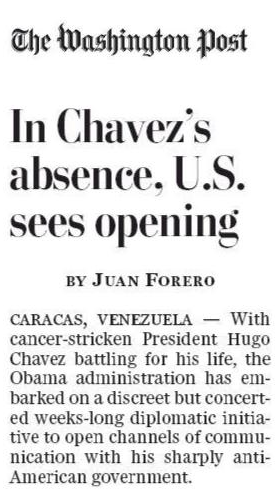
Here’s Juan Forero in the Washington Post (1/10/13):
A central ideological pillar of Chavez’s rule over 14 years has been to oppose Republican and Democratic administrations in Washington, which he accuses of trying to destabilize his government.
“I think they really believe it, that we are out there at some level to do them ill,” said Charles Shapiro, president of the Institute of the Americas, a think tank in San Diego.
As ambassador to Venezuela from 2002 to 2004, Shapiro met with Chavez and other high- ranking officials, including [Vice President Nicolas] Maduro. But the relationship began to fall apart, with Chavez accusing the United States of supporting a coup that briefly ousted him from power. U.S. officials have long denied the charge.
Shapiro recalled how Maduro made what he called unsubstantiated accusations about CIA activity in Venezuela, without ever approaching the embassy with a complaint. He said that as time went by, the United States became a useful foil for Chavez and most Venezuelan officials withdrew contact.
“A sure way to ruin your career, to become a backbencher, was to become too friendly with the U.S. Embassy,” Shapiro said.
So Venezuela has a strange political culture where being friendly with the U.S. government gets you in trouble.
The Post airs Chavez’s charge–and then the U.S. denial. But the United States had all sorts of contact with the coup plotters before they made their move against Chavez in 2002. According to the State Department (7/02):
It is clear that NED [National Endowment for Democracy], Department of Defense (DOD) and other U.S. assistance programs provided training, institution building and other support to individuals and organizations understood to be actively involved in the brief ouster of the Chavez government.
And the CIA, as was reported by Forero himself (New York Times, 12/3/04), knew of the coup plotting.
The Central Intelligence Agency was aware that dissident military officers and opposition figures in Venezuela were planning a coup against President Hugo Chávez in 2002, newly declassified intelligence documents show. But immediately after the overthrow, the Bush administration blamed Mr. Chávez, a left-leaning populist, for his own downfall and denied knowing about the threats.
Scott Wilson, who was the Washington Post foreign editor at the time, told Oliver Stone for his film South of the Border:
Yes, the United States was hosting people involved in the coup before it happened. There was involvement of U.S.-sponsored NGOs in training some of the people that were involved in the coup. And in the immediate aftermath of the coup, the United States government said that it was a resignation, not a coup, effectively recognizing the government that took office very briefly until President Chavez returned.
And we know that the United States made quick efforts to have the coup government recognized as legitimate. The Bush government, immediately after the coup, blamed it on Chavez. And some of the coup plotters met with officials at the U.S. embassy in Caracas before they acted.
But the important thing for readers to know, according to Wilson’s successors at the Washington Post, is that U.S. officials deny they supported anything.
Venezuelans Continue to Defy the Washington Post
By Peter Hart | FAIR | January 8, 2013
The Washington Post has never been fond of left-wing Venezuelan President Hugo Chavez. As serious questions mount about the state of Chavez’s health, the paper’s editorial page (1/5/13) found it a good time to take another swipe:
Venezuelans are bracing themselves for the death of the caudillo who has ruled them–and wrecked their once-prosperous country–over the past 13 years.
Economist Mark Weisbrot has a different take. In a “Room for Debate” discussion at the New York Times (1/4/13), he writes:
Since Hugo Chávez first took office, he and his party have won 13 of 14 national elections, mainly because they greatly improved the living standards of the majority of voters in Venezuela. Since 2004, after the economy recovered from the devastating opposition oil strike, poverty has been cut by half and extreme poverty by more than 70 percent.
Weisbrot goes on to show some of the other ways Venezuelans’ lives have improved in the Chavez years, adding:
These numbers are not really in dispute among economists or international statistical agencies. If you follow Venezuela and haven’t heard any of this, it’s because the news media is giving you the equivalent of a “tea party” view of the country.
So there’s maybe a chance that Venezuelans don’t think Chavez “wrecked” their country at all–unless you think reducing poverty and income inequality are bad things. To the Post, the fear seems to be that Venezuelans will remember this after Chavez’s passing:
Sadly, the economic pain caused by Mr. Chavez could, after his death, help create a political movement that will revere his memory.
Their point is that Chavez’s policies will force the next government to oversee harsh austerity policies to correct Chavez’s supposed mistakes. But Venezuelans might actually “revere” Chavez for the same reason they voted for him: His policies worked for the majority of the population. And that doesn’t sit well with the Washington Post.
Featured Video
Laith Marouf: Hezbollah’s position on US-Iran ceasefire
or go to
Aletho News Archives – Video-Images
From the Archives
The Dirty Little Secret behind the “Global Terrorism Index”
The Omission of Israeli Terrorism in the Occupied Palestinian Territories
By Karin Brothers | Global Research | December 6, 2014
… The Israeli settlements — all of which are illegal – have been identified as a major impediment to peace. The refusal of a major “global” terrorism report to name the Israeli settlers as one of the groups most responsible for terrorism not only misrepresents a major source of regional violence but exposes the Global Terrorism Index as a propaganda tool that supports a U.S. agenda.
In recent years, governments have been attempting to thwart terrorism by blocking supportive fund-raising. When it comes to Israeli settlements, however, the US and Canada actually encourage fund-raising by giving organizations (such as Christian Friends of Israeli Communities (CFOIC) and the Jewish National Fund) financial support in the form of donor tax-deductions.
Charities which provide funds for the Israeli settlements should be regarded as terror-financing organizations. They should not only lose their tax-deductible status, but they should be banned because they support the violation of international humanitarian law. The terror-financing laws that are being strictly enforced for Muslim charities should be applied to Christian and Jewish charities as well. … Read full article
Blog Roll
 Aletho News
- The ‘Opposition Party’ Has Done Nothing to Stop the Iran War and Much to Goad Trump Into Continuing It
- Moscow backs Tehran on status of Lebanon in US-Iran deal
- How UK Regulator Ofcom Quietly Bypassed International Law to Police American Speech
- The Black Cube Files: How Former Mossad Operatives Flipped a Nation
- Laith Marouf: Hezbollah’s position on US-Iran ceasefire: What you’re not being told
- Israel’s priority lies in destroying chances of peace between Iran, US: Ex-UN nuclear chief
- Ceasefire for all or for none: Iran shuts Hormuz over Lebanon attacks
- Strait of Hormuz is Iran’s ‘nuclear weapon’ that forced US retreat: Medvedev
- Energy crisis will last for months – Kremlin envoy
- Europe’s quiet role in the war on Iran
- If Americans Knew
- This is ceasefire? Israel’s biggest massacre yet in Lebanon, another journalist killed in Gaza – Daily Update
- Tucker Carlson on Israel: This Is the Behavior of an Ally? Really?
- Gazans face a triple crisis: severe shortages of water and bread, healthcare in tatters
- NY Times reports how Netanyahu took the US into Iran War
- A sigh of relief over Iran, but Gaza and Lebanon in dire straits – Daily Update
- Thousands dead and neighborhoods razed to the ground: Aid agencies fear southern Lebanon is becoming the new Gaza
- The war the US is fighting for Israel could cost trillions
- ‘Cigarette Burns, Nail Wounds’: Toddler Tortured in Gaza to Coerce Father
- Trump Says US Sent ‘a Lot of Guns’ to Protesters in Iran
- Israeli forces destroy 17 UN peacekeeper cameras in south Lebanon
- No Tricks Zone
- An Inconvenient Tree: Uncovered In Alps… Europe Much Warmer Than Today 6000 Years Ago
- New Study Reports A 60% Slowdown In Greenland’s Ice Loss Rate In The Last Decade
- Low Intensity Tornado Wrecks Major Solar Farm, Creating A Potential Toxic Dump
- New Study Finds Warming Saves Lives…Cold Temperatures 12 Times More Deadly Than Excess Heat
- German Science Blog Accuses PIK Climate Institute Of Hallucinating Climate Tipping Points
- Devastating Assessment Of Comirnaty Vaccine By Former Senior Pfizer Europe Toxicologist
- New Study: CO2 Is ‘Effectively Negligible’ As An Explanatory Climate Change Factor Since 2000
- Former Pfizer Toxicologist Dr. Helmut Sterz Tells Bundestag Hearing Pfizer Vaccine Should Have Never Been Approved
- Energy Expert: Germany’s Nuclear Phaseout Was A “500 Billion Euro Mistake”
- New Research: South Australia’s Mid-Holocene Sea Surface Temperatures Were 4°C Warmer Than Today
 Aletho News