Justin Trudeau’s opponent would ban ministers from attending WEF
Free West Media | July 10, 2022
Pierre Poilievre, who will be running for the leadership of the Conservative Party of Canada later this year, said at a meeting in Calgary that he would ban ministers from attending the World Economic Forum in Davos, Switzerland.
Canada’s Deputy Prime Minister and Minister of Finance Chrystia Freeland sits on the WEF’s Supervisory Board. Shadow Minister of Natural Resources Michelle Rempel Garner can also be found on the organisation’s website. She denied in an article that Canada was run by the WEF.
Earlier, WEF chief Klaus Schwab had boasted however that more than half of the Canadian cabinet was made up of Young Global Leaders of the WEF.
Poilievre thus indicated that he wanted to take Canada in a completely different direction. He is planning to take on Trudeau in the next election and defeat him.
“I have made it clear that I will ban my ministers in my cabinet from attending the World Economic Forum if I become prime minister,” he said at an earlier meeting. “Work for Canada. If you want to go to Davos, to that conference, buy a single ticket. You cannot be part of our government and pursue a policy agenda that is not in line with the interests of our people.”
Poilievre is running in the 2022 Conservative Party of Canada leadership election and is considered to be the frontrunner. He has supported those in the Canada convoy protest against vacccine mandates who were protesting peacefully and said the federal government had abused its power by invoking the Emergencies Act during the protest and proposed limiting its power and use to prevent it from being used similarly in the future.
Poilievre demonstrated his support for army reservist James Topp’s anti-mandate protest walk from Vancouver to their planned Canada Day freedom protest on Parliament Hill, by joining Topp, Paul Alexander, Tom Marazzo, a self-declared spokesperson for the Canada convoy protest and an ex-military officer, on June 30, 2022 in the final stage of Topp’s march to Ottawa.
Rockefeller Foundation ‘Reset the Table’ Report Predicted COVID-Related Food Crisis — 2 Years Before It Happened
By Michael Nevradakis, Ph.D. | The Defender | June 30, 2022
Just a few months into the COVID-19 pandemic — and almost two years before global health officials warned of a food shortage crisis — the Rockefeller Foundation issued a report predicting the crisis and offering up solutions, including “shifts to online enrollment, online purchasing of food.”
In a report published July 28, 2020, “Reset the Table: Meeting the Moment to Transform the U.S. Food System,” the foundation described “a hunger and nutrition crisis … unlike any this country has seen in generations.”
The authors blamed the crisis on COVID-19.
The report concluded the crisis would have to be addressed not by strengthening food security for the most vulnerable, but by revamping the entire food system and associated supply chain — in other words, we would need to “reset the table.”
The Rockefeller Foundation called for this food system “reset” less than two months after the World Economic Forum (WEF), on June 3, 2020, revealed its vision for the “Great Reset.”
Some of the contributors to the Rockefeller Foundation report are WEF members; a few of which, along with other proponents of “resetting the table,” also have ties to entities pushing vaccine passports and digital ID schemes.
Rockefeller Foundation: ‘changes to policies, practices, and norms’ are needed
The WEF describes the Rockefeller Foundation as a “science-driven” philanthropic organization that “seeks to inspire and foster large-scale human impact that promotes the well-being of humanity around the world” and which “advances the new frontiers of science, data, policy and innovation to solve global challenges related to health, food, power and economic mobility.”
In the foreword to its 2020 “Reset the Table” report, foundation President Dr. Rajiv J. Shah, who is a former administrator of the U.S. Agency for International Development (USAID), states:
“America faces a hunger and nutrition crisis unlike any this country has seen in generations.
“In many ways, Covid-19 has boiled over long-simmering problems plaguing America’s food system. What began as a public health crisis fueled an economic crisis, leaving 33 percent of families unable to afford the amount or quality of food they want.
“School closures put 30 million students at risk of losing the meals they need to learn and thrive.”
The report did not explain how the Rockefeller Foundation was able to know about this food crisis mere months after the pandemic took hold — especially as the report states it was developed out of “video-conference discussions in May and June 2020.”
The report also didn’t provide any insight into the role pandemic countermeasures such as lockdowns — which the foundation championed along with the WEF — played in contributing to the food crisis.
In its report, the Rockefeller Foundation proposes a series of solutions, derived from “dialogues with over 100 experts and practitioners.”
One recommendation calls for moving away from a “focus on maximizing shareholder returns” to “a more equitable system focused on fair returns and benefits to all stakeholders — building more equitable prosperity throughout the supply chain.”
This may sound like a good idea, until one considers “stakeholders” in this case refers to “stakeholder capitalism” — a concept heavily promoted by the very same large corporations that have been beneficiaries of the shareholder capitalist system.
The WEF also heavily promotes “stakeholder capitalism,” defining it as “a form of capitalism in which companies seek long-term value creation by taking into account the needs of all their stakeholders, and society at large.”
For some context, economic fascism, as personified by the regimes of Nazi Germany and fascist Italy, encompassed government-mandated “partnerships” between business, government and unions organized by a system of regional “economic chambers,” and a philosophy where “the common good comes before the private good.”
It is, of course, unclear how the “needs [of] society at large” are determined — or by who.
The Rockefeller Foundation report declares, “Success will require numerous changes to policies, practices, and norms.”
What does such “success” entail? The report names three main objectives:
- Data collection and digitization: The report calls for “shifts to online enrollment, online purchasing of food, direct farm-to-consumer purchasing, telemedicine, teleconsultations, as well as [broadband access that is essential to] education, finance, and employment.”
The report describes the lack of universal broadband access in this context as “a fundamental resiliency and equity gap.”
- “Stakeholders” working together with the goal of forming a “collaborative advocacy movement.”
- “Changes to policies, practices and norms,” which the report says would be “numerous.”
These objectives, dressed up in “inclusive” language, are further described in the report as being beneficial to human health, ensuring “healthy and protective diets” that “will allow Americans to thrive and bring down our nation’s suffocating health care costs.”
The report goes as far as to describe this as a “legacy” of COVID-19, even predicting that doctors will “prescribe” produce for patients.
According to the report:
“One of Covid-19’s legacies should be that it was the moment Americans realized the need to treat nutritious food as a part of health care, both for its role in prevention and in the treatment of diseases.
“By integrating healthy food into the health care system, doctors could prescribe produce as easily as pharmaceuticals and reduce utilization of expensive health services that are often required because of nutrition insecurity.”
But as Dr. Joseph Mercola pointed out, despite this purported emphasis on healthy, nutritious food, the words “organic,” “natural” and “grass fed” do not appear in the report.
What does appear is the phrase “alternative proteins,” in this case referring to proteins derived from the consumption of insects — another concept promoted by the WEF.
In 2021, for instance, the WEF published a report titled “Why we need to give insects the role they deserve in our food systems,” suggesting that “insect farming for food and animal feed could offer an environmentally friendly solution to the impending food crisis.”
Yet again, an “impending food crisis” is forecast, which may lead some to ask how entities such as the Rockefeller Foundation and the WEF even knew what was coming.
As stated by Mercola:
“COVID was declared a pandemic March 11, 2020, so by the time this Rockefeller report was published, the pandemic had only existed for four months, and while certain high-risk groups did experience food insecurity, such as children whose primary meal is a school lunch, widespread food shortages, in terms of empty shelves, were not widely prevalent or particularly severe in the U.S.
“It seems nothing escapes the prophetic minds of the self-proclaimed designers of the future. They accurately foresee ‘natural disasters’ and foretell coincidental ‘acts of God’. They know everything before it happens.
“Perhaps they truly are prophets. Or, perhaps they’re simply describing the inevitable outcomes of their own actions.”
Mercola suggests such crises are inevitable because they are part of “an intentional plan” by the very same actors.
The Rockefeller Foundation’s amazing ‘predictions’ of future crises, and its ties with Big Tech and Big Pharma
Lending credence to Mercola’s view, and as recently reported by The Defender, the Rockefeller Foundation, WEF and other entities accurately predicted a remarkable number of crises that then came to pass.
For instance, Event 201, held in October 2019 and co-organized by the Rockefeller Foundation, accurately “predicted” the global outbreak of a coronavirus.
Similarly, the Nuclear Threat Initiative (NTI), which co-organized a “tabletop simulation” predicting the global outbreak of monkeypox in March 2021, with an imaginary start date of May 2022, has received $1.25 million in grants from the Rockefeller Foundation since January 2021.
In turn, the other co-organizer of the monkeypox “tabletop simulation,” the Munich Security Conference, in May 2022 held a roundtable with the Rockefeller Foundation on “Transatlantic cooperation on food security.”
Among the suggestions arising from this roundtable include a “focus on transforming the global food system and making it more resilient to future shocks, with steps taken now and over the long term.”
The Rockefeller Foundation is also a partner and board member and donor to GAVI: The Vaccine Alliance — alongside the WEF, the Bill & Melinda Gates Foundation and the Johns Hopkins Bloomberg School of Public Health, which hosted Event 201.
As previously reported by The Defender, the GAVI Alliance proclaims a mission to “save lives and protect people’s health,” and states it “helps vaccinate almost half the world’s children against deadly and debilitating infectious diseases.”
GAVI is also a core partner of the World Health Organization (WHO).
The GAVI Alliance — and the Rockefeller Foundation — also work closely with the ID2020 Alliance. Founded in 2016, ID2020 claims to advocate in favor of “ethical, privacy-protecting approaches to digital ID,” adding that “doing digital ID right means protecting civil liberties.”
As reported previously by The Defender, ID2020’s founding partners include the Rockefeller Foundation, GAVI, UNICEF, Microsoft, the Bill & Melinda Gates Foundation and the World Bank, while general partners of ID2020 include Facebook and Mastercard.
For the past two years, the Rockefeller Foundation and entities such as ID2020 and the WEF have been closely involved with the push for digital “vaccine passports.”
For instance, on July 9, 2020, the Commons Project, itself founded by the Rockefeller Foundation, launched “a global effort to build a secure and verifiable way for travelers to share their COVID-19 status” — that is, a vaccine passport.
The Commons Project also was behind the development of the CommonPass, another vaccine passport initiative, developed in tandem with the WEF.
In turn, the Good Health Pass was launched by ID2020, as part of a collaboration between Mastercard, the International Chamber of Commerce and the WEF. It was endorsed by embattled former U.K. Prime Minister Tony Blair, now executive chairman of the Tony Blair Institute for Global Change.
Other members of the Good Health Pass Collaborative include Accenture, Deloitte and IBM — which developed New York’s “Excelsior Pass” vaccine passport system.
The Rockefeller Foundation, along with the Bill & Melinda Gates Foundation, also funded an August 27, 2021 document issued by the WHO titled, “Digital documentation of COVID-19 certificates: Vaccination status.”
The document is described as follows:
“This is a guidance document for countries and implementing partners on the technical requirements for developing digital information systems for issuing standards-based interoperable digital certificates for COVID-19 vaccination status, and considerations for implementation of such systems, for the purposes of continuity of care, and proof of vaccination.”
And in another remarkably prescient “prediction,” the Rockefeller Foundation, in 2010, published a report — “Scenarios for the Future of Technology and International Development” — which presented four future scenarios.
One of these hypothetical scenarios was “Lock Step” — described as “[a] world of tighter top-down government control and more authoritarian leadership, with limited innovation and growing citizen pushback.”
The description of this “Lock Step” scenario goes on to state:
“Technological innovation in ‘Lock Step’ is largely driven by government and is focused on issues of national security and health and safety.
“Most technological improvements are created by and for developed countries, shaped by governments’ dual desire to control and to monitor their citizens.”
This scenario also predicted “smarter” food packaging:
“In the aftermath of pandemic scares, smarter packaging for food and beverages is applied first by big companies and producers in a business-to-business environment, and then adopted for individual products and consumers.”
Moreover, the “Lock Step” scenario remarkably predicted China would fare better than most countries in a hypothetical pandemic, due to the heavy-handed measures it would implement:
“However, a few countries did fare better — China in particular.
“The Chinese government’s quick imposition and enforcement of mandatory quarantine for all citizens, as well as its instant and near-hermetic sealing off of all borders, saved millions of lives, stopping the spread of the virus far earlier than in other countries and enabling a swifter post-pandemic recovery.”
The Rockefeller Foundation’s involvement in public health is not new.
Going back more than a century, the foundation heavily promoted “scientific medicine” and formalized medical practice based on the European model on a global scale, at the expense of homeopathy and other traditional and natural remedies.
The foundation’s “philanthropic” activities have been described as “de facto colonialism in countries including China and the Philippines.”
Moreover, the foundation helped give rise to the first global public health entities, the International Health Commission (1913-16) and the International Health Board (1916-1927).
It also helped finance the earliest public health programs at universities such as Harvard and Johns Hopkins — today home to the Johns Hopkins Bloomberg School of Public Health.
Michael Nevradakis, Ph.D., is an independent journalist and researcher based in Athens, Greece.
© 2022 Children’s Health Defense, Inc. This work is reproduced and distributed with the permission of Children’s Health Defense, Inc. Want to learn more from Children’s Health Defense? Sign up for free news and updates from Robert F. Kennedy, Jr. and the Children’s Health Defense. Your donation will help to support us in our efforts.
Disquiet at Davos and the Unsaid Fear of Failure – The First Shoots of a U.S. Ukraine Shift

By Alastair Crooke | Strategic Culture Foundation | May 30, 2022
Klaus Schwab, passionate for Ukraine, essentially configured the World Economic Forum (WEF) to showcase Zelensky and to leverage the argument that Russia should be kicked out of the civilised world. Schwab’s target was the assembled crème de la crème of the world’s business leaders assembled there. Zelensky pitched big: “We want more sanctions and more weapons”; “All trade with the aggressor should be stopped”; “All foreign business should leave Russia so that your brands are not associated with war crimes”, he said. Sanctions must be all encompassing; values must matter.
Disquiet ran through the Davos set: The WEF is high-octane globalist, right? Yet this Schwab line suggests a de-coupling ‘on stilts’. It precisely reverses interconnectedness. Plus, the western generals in charge are saying that this conflict may last not just years, but decades. What will this signify for their markets in parts of the world that refuse action against Russia, the moneymen were wondering?
It is unlikely that this whiff of disorientation is what Schwab had intended. Perhaps the latter was more aligned with Soros’ later intervention that a quick victory over Russia was needed to save the ‘Open Society’ and civilisation itself – and that this was intended as the WEF 2022 message.
The Davos ‘greater disquiet’ emerged however, from an unexpected quarter. Just before the WEF began, the NY Times had run a piece from the editorial team urging Zelensky to negotiate with Russia. It argued that such engagement implied making painful territorial sacrifices. The piece attracted indignant and angry push-back in Europe and the West, possibly because – albeit couched as advice to Kiev – its target was evidently Washington and London (the arch belligerents).
Eric Cantor, a former whip in the U.S. House of Representatives (a legislator well versed on Iran sanctions), also at Davos, questioned whether the West would be able to maintain a united front in pursuit of such maximalist aims as Zelensky and his Military Intelligence Chief have demanded. “We may not get the next vote”, Cantor opined (in wake of the $40 bn vote ostensibly earmarked for Ukraine).
Cantor said excluding Russia entirely would require secondary sanctions against other countries. This would place the West into a head on clash with China, India, and the almost 60 states which had refused to back a UN resolution denouncing Russia’s invasion. He warned that the U.S. may be in danger of overplaying its hand.
Then spoke the redoubtable Henry Kissinger, also at Davos. He warned the West to stop trying to inflict a crushing defeat on Russian forces in Ukraine, saying that such would have disastrous consequences for the long-term stability of Europe. He said it would be fatal for the West to get swept along in the mood of the moment and forget the proper place of Russia in the European balance of power.
Dr Kissinger said the war must not be allowed to drag on and came close to calling on the West to instruct Ukraine to accept terms that fall very far short of its current war aims: “Negotiations need to begin in the next two months, before it creates upheavals and tensions that will not be easily overcome”.
What is going on here? In a nutshell, we are seeing the first inklings of fractures appearing in the U.S. stance on Ukraine. The fissures in Europe are already very plain, both on sanctions and mission aims. But Cantor’s comment that “we may not get the next vote” needs further unpacking.
In an earlier piece, I argued that Senator JD Vance’s win in the Ohio primaries for a Senate seat could be telling. His candidature was backed by Trump, who later issued an ‘End the war’ call. Now the key tell-tale is Republican Senator Josh Hawley – ambitious and known to have leadership aspirations.
Early in the Ukraine war, Senator Hawley was calling Zelensky, lauding him highly and egging him on. But then he pivoted. Hawley subsequently blasted the $40 billion in proposed aid to Ukraine, after voting ‘no’ on the procedural vote to move forward with the aid package “as not being in America’s interests”.
At first, as some may recall, there were 6 House votes against the bill – then 60. And in the Senate, first there were zero then there were 11 votes. The Bill was rushed through as vote managers were concerned that the vote could crumble further.
What is going on? Well, the Republican ‘populist’ current, never enamoured at foreign aid, was shocked at the $ 40 billion for Ukraine when the U.S. lacked baby milk, (and itself had to rely on foreign baby milk aid). This political current is becoming more significant and having more impact as a result of a structural shift. Political candidates, and now even some U.S. think-tanks are turning to crowd-funding as a principal source of finance – moving away from the ‘established’ donors. Thus, the broad ‘anti-foreign entanglement’ sentiment is gaining heft.
Of course, the $40 billion is not all going to Ukraine. Not at all. According to the details of the Bill, the bulk will go to the Pentagon (for equipment already supplied by the U.S. and its allies). And a big chunk will go to the State Department, to fund all sorts of ‘helpful’ non-state actors and NGOs – i.e. it is a deep state budget with Ukraine packaging. The six billion allocated directly for new arms to Ukraine in fact comprises both training and weapons, so much of that will end in the pockets of states such as UK and Germany, giving ‘out of theatre’ training to Ukrainians in their own, or in neighbouring countries’ territory.
Eric Cantor, and other Americans at WEF may frame their disquiet over western objectives in ‘polite company’ as simply articulating their uncertainties over America’s grand strategy – whether the U.S. is trying to punish Russia for its aggression, or whether the goal is a subtler use of policy that gives the Kremlin a ‘route out of sanctions’, were it to changes course. But behind the narrative lies a darker fear. The unsaid fear of failure.
What does this mean? It means that the West’s ultimate war aims in Ukraine have so far been able to stay opaque and undefined, the details swept aside in the mood of the moment.
Paradoxically, this opacity has been preserved despite the public failure of the West’s first statement of aims – which was that the seizure of Russia’ offshore foreign reserves; the Russian bank expulsions from SWIFT; the sanctioning of the Central Bank; and the broadside of sanctions would, in and of itself alone, turn the rouble to rubble; cause a run on the domestic banking system; collapse the Russian economy; and provoke a political crisis that Putin might not survive.
In short, ‘victory’ would be quick – if not immediate. We know this, because U.S. officials and the French Finance Minister, Bruno Le Maire bragged about it publicly.
So confident in a quick financial-war success were these western officials that there seemed little need to invest deep strategic reflection on the aims or the course of the secondary Ukrainian military thrust. After all, a Russia already economically collapsed, with its currency ruined and its morale broken, would likely put up little or no fight as the Ukrainian army swept across Donbas and into Crimea.
Well, the sanctions have proved a bust and Russia’s currency and oil revenues are bountiful.
And now, western politicians are being warned in the media, and by their own military, that Russia is ‘close to a major victory’ in Donbas.
This is the unspoken fear disquieting Davos attendees – fear of another débacle, following that of Afghanistan. One made all the worse as the ‘war’ on Russia boomerangs into an economic collapse in Europe, and with NATO’s eight-year investment in building-up a successful proxy-army to NATO standards turning to dust.
This is what Kissinger’s comments – decoded – urge: ‘Don’t procrastinate’; get a quick deal (even an unfavourable one), but one that can be dressed up, and somehow spun as a ‘win’. But don’t wait, and let events lead the U.S. into yet another unmistakeable, undeniable débacle.
This is still ‘under the kitchen table talk’ in the U.S. for now, as the power of a narrative, invested with so much emotion, and bolstered by unprecedented info-war peer-pressure has masked such thoughts from public expression. Fractures nonetheless are beginning to be apparent. Something stirs – and Europe inevitably will follow wherever America leads. But for now, the hawks remain firmly in ‘the chair’ (in the U.S., in London, Poland, the EU Commission and in Kiev).
The big question, however, is why Moscow would take such a ‘way out’ (even if it was offered it). A compromise deal would be seen there as simply Kiev given the chance to regroup, and to try again.
The Globalists’ Race Against Time
By Eamon McKinney | Strategic Culture Foundation | May 26, 2022
The green economy, de-industrialisation, digital health passports, Central Bank digital currencies, these are all core components of the Globalists’ plan for the Great reset. The WEF has painted a picture of their proposed future via Klaus Schwab and his acolytes. “We will have nothing, own nothing and be happy”. The main obstacle to this grand vision is that not surprisingly very few countries wish to go along with it. The Globalists know their game is coming to an end and the Great Reset is their way of ensuring that the same financial cabal that has brought the world to its current lamentable state will continue to rule over all in the next world order. The most prominent objectors to this insidious plan are of course Russia and China. Unlike their western counterparts both have strong leaders who enjoy popular support, have strong economies and are optimistic about future prospects for growth. Neither intends to sacrifice their countries so that Western elites can maintain their control over the Global economic system and impose their self-serving will on weaker nations. Which in its simplest terms is why both countries need to be destroyed, at least economically before the Great Reset can be imposed on the world. Time, however, is not on the Globalists’ side, recent events have demonstrated that they are aware of this and are accelerating their timelines.
The Great Reset and its stated objectives have been in the planning for several years, those plans however are now seriously behind schedule. The election of Trump in 2016 wasn’t supposed to happen. He was to Washington the ultimate “Black Swan” event. An outsider without the backing of a political party and with seemingly the entire mainstream media against him, his victory was considered all but impossible. Yet win he did, and it seemed he spent the entire four years of his presidency battling against the Globalist faction, both internationally and within America. Washington felt cheated, not only was Trump an “outsider” he was also a disrupter. Opinions on the divisive Trump aside, he was indisputably an “America First Nationalist”, he was anti-NATO. and a vocal anti-Globalist. There would be no Great Reset under Trump, he was an obstacle to the agenda and had to be removed. Which in 2020 in a blatantly fraudulent election he was. Should Trump run again in 2024 and all indications are that he will, he would likely win an honest election in a landslide. The return of Trump would provide another major obstacle to the Globalist agenda. Expect that all efforts will be expended to prevent another Trump presidency. With an angry populace and increased electoral scrutiny next time around, they may have to turn to other measures to foil a Trump return. Should Trump re-enter the White House in 2024, the notoriously vindictive Trump is expected to seek accountability against those who he believes robbed him of his rightful election. Nerves are frayed in Washington and they know the clock is ticking.
Trump set the agenda back four years and they are now playing against the clock to make up for lost time, all evidence suggests that they are getting increasingly desperate. The recent invitations issued to Sweden and Finland to “fast track” NATO membership is yet another provocation to Russia. Putin wants to end the Ukraine conflict on his own terms and withdraw, not get bogged down in a quagmire that would drag on for years. NATO wants exactly that. Wooing Sweden and Finland is their attempt to ensure years of conflict and tension. Putin understands this all too well. As they lurch from one bad idea to another, attention should be paid to the indecent haste in which they are moving. It appears they are making things up as they go along, all without any obvious sense of consequence.
The prospect of Trump 2.0 is not the only time sensitive issue facing the Globalists. The global economy is on the brink of implosion. Sri Lanka has recently defaulted on its international debts. This will immediately create at least a $500 billion hole in the global economy. Alarmingly, according to the World Bank more than 70 other countries are in a similarly perilous economic condition. For most their debts are un-payable, and the IMF solution of structural adjustment (austerity) privatisations, and cuts to government services, would consign these countries to generations of deprivation and social unrest. Or, they could repudiate the debt completely and abandon the Western banking model. Both China and Russia have alternatives to SWIFT and welcome countries who want to escape the neo-liberal financial plantation. Both offer investment for development, non-interference and respect for countries’ sovereignty. All things valued by every country, but unachievable under Western domination. Decisions will very soon be made by countries throughout the Global south about who they want to align their futures with.
A new proposal being put before the UN on May 22nd essentially requires all nations to surrender their sovereignty to the WHO in the event of another pandemic. That they would even think that post-Covid the WHO enjoys that level of confidence, is delusional. This transparent power grab is easily recognised for what it is, in the unlikely event that it gains enough traction, expect another pandemic to follow shortly after. The cabal still has the tools to cajole, bribe and threaten countries to submit, and doubtless it will try, but outside of the captured western countries, such a desperate move will garner scant support. Covid failed to usher in the Great Reset but it unleashed a wave of destruction on the global economy that may take generations to repair. Many questions on the criminal mismanagement of Covid remain unanswered. There are few nations that don’t harbour deep resentment towards the notoriously corrupt and inept WHO and its genocidal Sugar Daddy Bill Gates. The sheer audacity of the proposal stinks of desperation. The upcoming vote is likely to give the Globalists another stark reminder of its waning power and influence.
A Great Reset will happen, just not the one intended by the Globalists. They may have to settle for the Great Decoupling instead. As Western influence continues to diminish at a rapid pace the trend of countries flocking to the China/Russia orbit is bound to increase. The NWO that they have been lusting after for generations is likely to be restricted to Western Europe and North America, or about 15% of the World’s population. The effects of the disastrous Ukraine provocation and the failed sanctions will soon become undeniable. Food and energy shortages together with uncontrollable inflation, will make even this smaller NWO harder to control. The Emperor has no clothes, as all can now see, their game is old, tired and predictable, and they have no new ideas. The Globalists may not have to worry about a Trump return in 2024. It is highly likely that the clock will have run out on them by then. It could happen any day.
WEF wants kids to learn in the metaverse to curb climate change

By Didi Rankovic | Reclaim The Net | May 26, 2022
“Disconnecting” children from the physical world and “plugging them” into a virtual one is the way to go when it comes to the future of education, according to the World Economic Forum (WEF).
This is one of the “gems” that have come out of this year’s gathering in Davos, with a post on WEF’s website arguing that this direction is necessary, among other things, to combat climate change – rather, pressure to do so will drive the digitization of education. Other reasons would be better quality, accessibility, and affordability of education.
Children, now overly “reliant” on items like textbooks, notebooks, and pencils as learning tools, should in the future become immersed in virtual reality (VR), augmented reality (AR), and mixed reality environments, writes Dr. Ali Saeed Bin Harmal Al Dhaheri.
The pandemic is cited as a good example of how digital tools can be used for online education, but, according to the author, they are not enough, because students were merely being transferred knowledge instead of having practical and “in person” experience.
The post laments that while technological advancements are being widely used to transform administrative and services sectors, this is currently not enough to disrupt education.
“These advancements’ infiltration of education systems has become an increasing imperative,” says Al Dhaheri, who thinks VR will be a crucial element in future “experiential learning” that lets students see, hear, touch, and act in a virtual world.
VR and metaverse combined will be where students and teachers will be immersed in communication and sharing, “overcoming space and time limitations.”
The writeup pays lip service to risks and concerns regarding the removal of children from human interaction in the education process and increasing their isolation, by acknowledging that VR “somewhat” does that, but only if it is not properly monitored, and if its introduction lacks “a guided system.”
Nevertheless, Al Dhaheri believes that the benefits here outweigh the risk and that students will find the virtual environment more appealing while developing “much stronger skillsets.”
The article urges leaders, educators, and regulators to promote this agenda proactively, and mentions that this push is already beginning to happen in countries like the United Arab Emirates and Saudi Arabia.
Barbara Marx Hubbard: Godmother of Transhumanism and Synthetic Spirituality
The late Barbara Hubbard, a Rockefeller-funded New Age guru, was critical to the development of the ideas, beliefs and technology necessary to market transhumanism as spiritual enlightenment.

BY JOHN KLYCZEK |
UNLIMITED HANGOUT| MAY 19, 2022
In 2016, the Global Future Councils of the World Economic Forum (WEF) posted a video entitled “8 Predictions for the World in 2030,” which infamously forecasted a technocratic New World Order in which “[y]ou’ll own nothing. And you’ll be happy.” It doesn’t take a stretch of the imagination to ponder how WEF oligarchs plan to roll out “sustainable development” policies which will ration consumer goods in a global “sharing economy” that employs transient “gig” workers who will be rendered into propertyless serfs under a techno-communitarian rendition of neo-feudalism. But how will the globalist technocrats of the WEF sway the virtual peasant class to be happy with their permanent state of digitally indentured servitude?
Enter New Age guru Barbara Marx Hubbard and her endorsement of the HeartMath Institute’s Global Coherence Initiative [1][2], which is propagating transhumanist neurofeedback wearables across the planet in order to digitally synchronize humanity’s collective heart rhythms and brainwaves into electronically induced states of synthetic spiritual bliss. With Hubbard’s transhumanist blessings, HeartMath’s global neurotech network is primed to lull plebs and proles into happy compliance with the “New Normal” of the Fourth Industrial Revolution’s techno-feudal “stakeholder” economy.
In this first installment of my series on Hubbard’s legacy contributions to the post-humanist religion and techno-fascist economy of the neo-eugenic Fourth Industrial Revolution, I will historicize how Rockefeller philanthropies bankrolled Hubbard’s Foundation for Conscious Evolution in order to digitally engineer humankind into a new transhuman species baptized in the name of tech-Gnostic “Christ Consciousness” [3]. Furthermore, I will expose how Hubbard collaborated with globalists at the World Business Academy, corporatists at Singularity University, and Eupsychian human potential psychologists in connection with the Esalen Institute in order to establish a techno-communitarian spiritualism that worships transhumanist evolution controlled by Big Tech companies which dominate the stakeholder economy of the Fourth Industrial Revolution [4]. Finally, I will document how Hubbard advanced the globalization of HeartMath Institute’s transhumanist biofeedback wearables which can neuro-technologically mesmerize the precariat into virtual states of happy subservience to the “New Normal”.
In the coming installments of this series, I will reveal how Hubbard’s transhumanist mission to steer “conscious evolution” is steeped in Malthusian-eugenic population control. Additionally, I will unveil how Hubbard’s transhumanist allies from the World Future Society, the Human Potential Movement, and the Foundation for Conscious Evolution are entangled with networks of alleged pedophiles and sexual abuse cults. … continue
WEF back, learned nothing
By Alexander Adams | Bournbrook | May 24, 2022
The World Economic Forum (WEF) is back. After two years away, the elites reconvened in Davos, Switzerland, to resume plotting. Not, of course, that they would put it that way.
Open Forum Davos 2022 began on 23 May and runs until 26 May. It is a conference designed to increase international participation, “at a crucial turning point in history”. Every WEF statement reads part messianic prophecy, part threat, part vacant corporate babble. This year’s Open Forum promotion is no different.
Hand-picked stooges will promote WEF talking points and push pre-set agendas. There is no possibility of someone taking to the stage and suggesting more democratic accountability, nation independence and vitality through ideological diversity. “The activists will articulate how to turn words into action to fight the climate crisis. Gender equality will also feature prominently in the conversations.” The WEF knows that its multi-million-dollar programme of supporting environmentalist, gender-activist and pro-migrant groups will be amplified by globalist-friendly mass media outlets and clueless politicians in search of “relevance” and photo ops. The forum stresses youthfulness, promoting speakers such as “26-year-old Vanessa Nakate, author and climate advocate” and “Ievgeniia Bodnya, 27, who mobilized the Global Shaper Hub she leads in Kyiv to build the Support Ukraine Now”. Young, passionate women make perfect spokespersons. After all, should anyone male or older than them criticise their ideas, the opponents can be dismissed as relics of a failed era, ones who refuse to accept the coming wave of eco-awareness and migration justice.
The hypocrisy of the WEF is blatantly apparent in its support for Ukraine. It might seem to you paradoxical that a supra-national body which is dedicated to reducing the independence of nations has suddenly discovered its passionate commitment to the integrity of national borders, but WEF see no contradiction. The WEF writes:
“The Russian invasion into Ukraine was a tipping point for world security, the international economy and our global energy architecture. It is not possible to narrow down a war like this to one region while we live in a globalized world. We cannot keep radiation in one country’s geographical borders, or eliminate one country from the fragility of supply chains. This new type of hybrid war including its grave humanitarian crisis, the cyber attacks and economic hardships as well as disinformation and propaganda campaigns, geopolitical tensions about energy supply plus the threat of a nuclear war will have far-reaching effects.”
Every crisis is an opportunity for globalists to tighten their grip on control. Like the World Health Organisation, the WEF is committed to a totalising world view, so every problem will be solved by more globalisation, more migration, more universal regulation, more destruction of tradition. Like all totalising systems, its adherents use every circumstance as evidence of the system’s correctness; to succeed it simply needs more data, more co-ordination and better implementation of policies.
Open Forum Davos will include a panel on the mental health of young people. This is a savage irony, since it was WEF-trained national premiers (such as Justin Trudeau and Jacinda Ardern) who instituted the most draconian lockdowns and fear-propaganda campaigns that drove young people to despair. The WEF seeds its globalist totalising agenda through a Young Global Leaders programme.
In other words, the WEF has learned nothing from the last two years. The growing consensus that COVID lockdowns caused more suffering, disruption and inflation than targeted approaches to healthcare would have, suggests that unified global action made matters worse. If anything, the COVID-pandemic overreaction and reliance on international systems of food and energy supply have shown that independence, self-sufficiency and self-determination are vital for a resilient response to difficulties. Yet the WEF exists to advance the technocratic and scientism worldviews. Or perhaps we could call those worldviews temperaments, as they seem more rooted in emotion and moral psychology than any form of rationalism.
WEF doubles down, realises it was right all along.
Is the pandemic treaty a step towards World Government?
By Dr Deborah Ancell | TCW Defending Freedom | May 25, 2022
Dear Prime Minister,
It’s the Davos World Economic Forum (WEF) season and conspiracies about World Government abound. I have a new one for you.
You might recall my letter concerning the opaqueness of the first international tax, the United Nations Carbon Offsetting Reduction Scheme for International Aviation (CORSIA)
CORSIA offsets aircraft carbon dioxide emissions and it’s hidden in the environmental provisions of the UN’s International Civil Aviation Organisation. CORSIA empowered the UN to raise taxes – something which appears to have escaped notice in signatory sovereign nations.
My concerns were that firstly, CO2 is not a pollutant and secondly, CORSIA is a Trojan horse for similar UN taxes on other industries such as shipping and information technology.
Taxation is the tool of national governments. When nations surrender tax powers to an international body, they undermine their sovereignty. CORSIA enables independent, non-political, commercial funding of UN development projects in developing nations and reduces their reliance on UN member-government funding.
CORSIA also provides developing world reparations, since it offsets (unevidenced) claims that underdevelopment results from historical emissions incurred during developed world industrialisation. As the first international tax, it’s an example of UN overreach which undermines national sovereignty.
Now another UN arm – the World Health Organisation – might also be attempting overreach. WHO is proposing a new ‘pandemic treaty’ to encourage more information-sharing in the event of another global health crisis.
The treaty would apparently give WHO ‘unprecedented, undemocratic jurisdiction over its 194 member nations, including the UK’. There would be almost unlimited authority to ‘order mandatory vaccines, digital health IDs, lockdowns, isolation, testing regimes, no-jab-no-job rules, or anything else it decided as policy, irrespective of dissenting voices’.
The treaty will not be voted on until the World Health Assembly in 2023. If the UK agreed to this, health sovereignty could also be undermined.
Combine these two sovereignty concessions and you have the beginnings of an independently-funded and legislating World Government. This prospect was promoted by now-deceased luminaries as diverse as discredited socialist millionaire Maurice Strong and capitalist banker David Rockefeller.
Strong, a promoter of CO2 as a cause of environmental harm, profoundly believed that the UN had the potential to be the World Government. Any such World Government would undermine democracies.
Similarly, Rockefeller founded and led the Trilateral Commission with its aim of a ‘New World Order’ to control population and resources. He is reported as stating that ‘the supranational sovereignty of an intellectual elite and world bankers is surely preferable to the national auto-determination (democracy) practised in past centuries.’ Scary!
Conspiracy theorists believe that today’s WEF, with its agenda to counter natural and anthropogenic climate change and its call for a Great (economic) Reset has a similar, shadowy agenda to these precursor pursuits.
As conspiracy theories go, this one is far-fetched – but can you assure me I’m wrong? Do you think that World Government is on the agenda at Davos today?
Yours sincerely,
Deborah Ancell
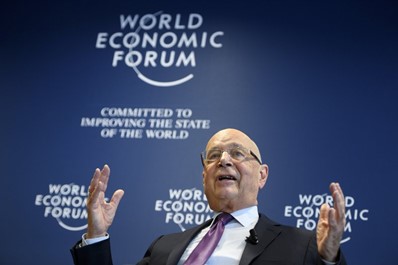
Klaus Schwab: Yes, the World Economic Forum Annual Meeting is about Elites Advancing a Conspiracy
By Adam Dick | Ron Paul Institute | May 24, 2022
That select group of elites from around the world who come together at the World Economic Forum (WEF) annual meeting in Davos, Switzerland really are conspiring to control the direction of society and politics worldwide. It is a conspiracy in practice, not just a conspiracy theory. That is the admission of WEF Founder and Executive Chairman Klaus Schwab in his Monday welcoming remarks for this year’s WEF annual meeting.
Here is the conspiracy admission from Schwab’s speech:
Let’s also be clear. The future is not just happening. The future is built by us — by a powerful community as you here in this room. We have the means to improve the state of the world, but two conditions are necessary. The first one is that we act all as stakeholders of larger communities, that we serve not our only self-interest but we serve the community. That’s what we call stakeholder responsibility. And, second, that we collaborate. This is the reason why you find many opportunities here during the meeting to engage into very action and impact oriented initiatives to make progress related to specific issues on the global agenda.
The WEF annual meeting is not just some people getting together to chat, socialize, and hear some speeches. It is about, as Schwab states, bringing together a “powerful community” that pushes initiatives that “make progress related to specific issues on the global agenda” and by whom “the future is built.”
By the way, don’t be too comforted by Schwab’s assurance that the conspirators do all this conspiring while acting as “stakeholders of larger communities.” It is unlikely that many people at the WEF annual meeting are looking out for you as part of their communities. As the comedian George Carlin famously said, “It’s a big club, and you ain’t in it.”
Copyright © 2022 by RonPaul Institute
Featured Video
Laith Marouf: Hezbollah’s position on US-Iran ceasefire
or go to
Aletho News Archives – Video-Images
From the Archives
The Dirty Little Secret behind the “Global Terrorism Index”
The Omission of Israeli Terrorism in the Occupied Palestinian Territories
By Karin Brothers | Global Research | December 6, 2014
… The Israeli settlements — all of which are illegal – have been identified as a major impediment to peace. The refusal of a major “global” terrorism report to name the Israeli settlers as one of the groups most responsible for terrorism not only misrepresents a major source of regional violence but exposes the Global Terrorism Index as a propaganda tool that supports a U.S. agenda.
In recent years, governments have been attempting to thwart terrorism by blocking supportive fund-raising. When it comes to Israeli settlements, however, the US and Canada actually encourage fund-raising by giving organizations (such as Christian Friends of Israeli Communities (CFOIC) and the Jewish National Fund) financial support in the form of donor tax-deductions.
Charities which provide funds for the Israeli settlements should be regarded as terror-financing organizations. They should not only lose their tax-deductible status, but they should be banned because they support the violation of international humanitarian law. The terror-financing laws that are being strictly enforced for Muslim charities should be applied to Christian and Jewish charities as well. … Read full article
Blog Roll
 Aletho News
- How UK Regulator Ofcom Quietly Bypassed International Law to Police American Speech
- The Black Cube Files: How Former Mossad Operatives Flipped a Nation
- Laith Marouf: Hezbollah’s position on US-Iran ceasefire: What you’re not being told
- Israel’s priority lies in destroying chances of peace between Iran, US: Ex-UN nuclear chief
- Ceasefire for all or for none: Iran shuts Hormuz over Lebanon attacks
- Strait of Hormuz is Iran’s ‘nuclear weapon’ that forced US retreat: Medvedev
- Energy crisis will last for months – Kremlin envoy
- Europe’s quiet role in the war on Iran
- Forty days that shook the Empire: How Iran turned the tables on US and prevailed
- Netanyahu unilaterally declares Lebanon outside of ceasefire deal
- If Americans Knew
- Gazans face a triple crisis: severe shortages of water and bread, healthcare in tatters
- NY Times reports how Netanyahu took the US into Iran War
- A sigh of relief over Iran, but Gaza and Lebanon in dire straits – Daily Update
- Thousands dead and neighborhoods razed to the ground: Aid agencies fear southern Lebanon is becoming the new Gaza
- The war the US is fighting for Israel could cost trillions
- ‘Cigarette Burns, Nail Wounds’: Toddler Tortured in Gaza to Coerce Father
- Trump Says US Sent ‘a Lot of Guns’ to Protesters in Iran
- Israeli forces destroy 17 UN peacekeeper cameras in south Lebanon
- US-Israeli strikes ‘completely destroy’ synagogue in Tehran
- Archbishop for US Military Says Iran War Is Unjust Under Catholic Teaching
- No Tricks Zone
- An Inconvenient Tree: Uncovered In Alps… Europe Much Warmer Than Today 6000 Years Ago
- New Study Reports A 60% Slowdown In Greenland’s Ice Loss Rate In The Last Decade
- Low Intensity Tornado Wrecks Major Solar Farm, Creating A Potential Toxic Dump
- New Study Finds Warming Saves Lives…Cold Temperatures 12 Times More Deadly Than Excess Heat
- German Science Blog Accuses PIK Climate Institute Of Hallucinating Climate Tipping Points
- Devastating Assessment Of Comirnaty Vaccine By Former Senior Pfizer Europe Toxicologist
- New Study: CO2 Is ‘Effectively Negligible’ As An Explanatory Climate Change Factor Since 2000
- Former Pfizer Toxicologist Dr. Helmut Sterz Tells Bundestag Hearing Pfizer Vaccine Should Have Never Been Approved
- Energy Expert: Germany’s Nuclear Phaseout Was A “500 Billion Euro Mistake”
- New Research: South Australia’s Mid-Holocene Sea Surface Temperatures Were 4°C Warmer Than Today
 Aletho News