St. Louis Palestine Solidarity Committee Statement on Pending City Contract with Veolia Water
STL-PSC Blog | December 17th, 2012
We are a diverse group of Palestinians, Israelis, Muslims, Jews, Christians, students, professors, artists, writers, environmental activists, union organizers, bakers, grandparents, and others in St. Louis united by a commitment to a lasting peace in Israel/Palestine based on freedom, justice, and equality, as part of a larger commitment to global justice.
We were shocked to learn about private city negotiations with Veolia Water on a contract to guide cost-cutting for the St. Louis Water Division. Veolia Water – North America is a subsidiary of Veolia Environnement (VE), a Paris-based multinational corporation and the largest water privatization business in the world. It is infamous for poor environmental standards, anti-labor practices, privatizing public resources, mismanagement, corruption, bribery, embezzlement, fraud, and illegal activities in Israel/Palestine. Worldwide, consumers report that Veolia consistently charges high rates, provides poor service, causes staff turnover, discourages water conservation, and fails to implement promised improvements. Its history reveals consistent prioritization of private profit at the expense of the environment and public welfare.
In Israel/Palestine, VE is involved in a myriad of ways with Israel’s illegal military occupation of Palestinian land and its systematic ethnic discrimination against the Palestinian people.
VE’s Israeli subsidiary, Veolia Water – Israel, operates a wastewater treatment plant located in an illegal Jewish-only settlement called Modiin Ilit, built on internationally-recognized Palestinian land in the West Bank. The Palestinian owners of the land on which this settlement was built have been violently driven out. Two unarmed Palestinians from Bil’in, a Palestinian village on which Modiin Ilit was built, have been killed by the Israeli army as they protested nonviolently against the ongoing confiscation of their land and resources. Leaders and people of conscience from around the world, including the South African anti-Apartheid leader Archbishop Desmond Tutu, have visited Bil’in to stand in solidarity with the dispossessed villagers, yet Veolia continues to service the settlement and others like it.
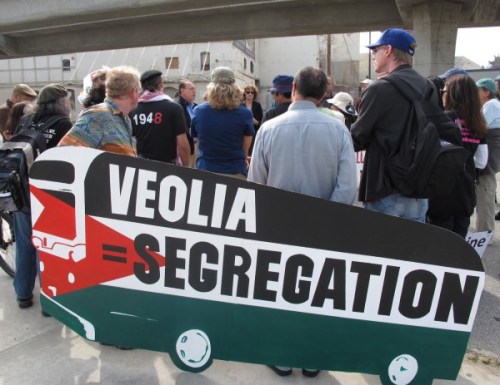
An Israeli subsidiary of Veolia Transdev, named Connex – Israel, operates settler buses on segregated roads through the occupied West Bank, including two bus lines that use road 443, which is built partially on confiscated land with portions closed entirely to Palestinians. A separate but unequal Palestinian road system is made up of low grade roads cut by checkpoints and physical barriers restricting Palestinian freedom of movement. Last year, a group of Palestinian Freedom Riders attempted to board buses operating on their own land and were violently removed and arrested. Veolia is not only profiting from segregation in Israel/Palestine; they are enforcing it.
Another VE Israeli subsidiary, Veolia Environmental Services – Israel, supervises, consults for, and operates the Tovlan Landfill in the occupied Jordan Valley, collecting refuse from illegal settlements. Israel renders it almost impossible for Palestinians in the Jordan Valley to gain permits to build homes, toilets, wells, animal pens, or other vital infrastructure for local communities, which has forced almost all Palestinian families out, with those remaining living in dire conditions. Some are left with no alternative but to work on settlements that have taken their families’ land, for pay far below the minimum wage, unable to take bathroom breaks, and denied any rights to unionize. Veolia takes captured Palestinian land and natural resources to service the settlements exploiting or driving out Palestinians.
Finally, VE has also been involved in the construction and operation of a tramway linking illegal settlements in East Jerusalem with Israel. The tramway not only institutionalizes the occupation, but it is a settlement in itself, given that it is settler infrastructure built on occupied land.
UN Special Rapporteur Richard Falk recently recommended that Veolia “should be boycotted, until they bring their operations into line with international human rights and humanitarian law and standards.” VE’s immoral practices and extensive profiting from Israel’s illegal discriminatory practices have provoked global outcry and made the company a target for boycott and divestment campaigns around the world — costing it $16 billion to date in lost contracts. Recently, the Friends Fiduciary Corporation, which handles investments for hundreds of U.S. Quaker institutions, divested from VE following advocacy from Palestine solidarity groups. Now, VE is bringing its risky and immoral business to our backyard.
Veolia Water is the U.S. arm of VE. As St. Louisans, we do not feel that our tax dollars and water payments should go toward supporting a company profiting from environmental destruction, unfair labor practices, and the bloodshed of and systematic ethnic discrimination against the Palestinian people.
The St. Louis Palestine Solidarity Committee stands in solidarity with public workers, water and environmental justice activists, and the Palestinian people threatened by this contract. We call on the Board of Estimate & Appointment not to approve this public contract with Veolia.
Click here for more information and documentation on Veolia’s activities in Palestine.
Related articles
- South Africa’s ruling ANC officially endorses Palestine’s boycott movement (alethonews.wordpress.com)
- St. Louis City Board Votes to Investigate Veolia Following Public Outcry! (bdsmovement.net)
- Veolia to end sponsorship of major UK photography exhibition (bdsmovement.net)
- Pro-Palestine campaigners celebrate Veolia’s loss of £40million contract in Canterbury (bdsmovement.net)
Despite US criticism, Israel continues with plan to construct 6,000 new settlement units
By Saed Bannoura | IMEMC News | December 20, 2012
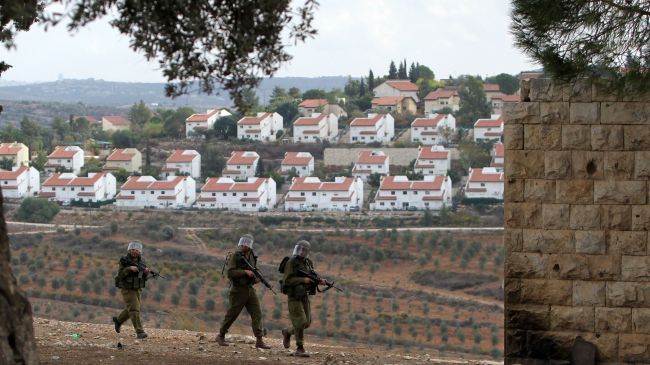
The US State Department issued a statement this week that included a rare criticism of Israeli policy, calling the ongoing construction of settlements on Palestinian land a “pattern of provocative action” that prevented the renewal of peace talks. Despite this critique, the Israeli government announced plans to move ahead with 6,000 new settlement units, mainly in the Jerusalem area.
After the Palestinian Authority pursued, and succeeded in obtaining, a vote for non-member statehood status at the United Nations last month, the Israeli government undertook a number of punitive measures against the Palestinians. These including illegally confiscating Palestinian Authority funds that would pay the salaries of teachers, doctors, pensioners and the disabled, as well as announcing a plan to increase settlement construction in the Israeli-occupied West Bank.
Israeli forces have militarily occupied the West Bank and Gaza Strip since 1967, and have illegally seized large swaths of Palestinian land in order to transfer Israeli civilians onto this land, in direct violation of its obligations as an Occupying power under the Fourth Geneva Convention.
Since a peace agreement known as the ‘Oslo Accords’ was signed in 1993, hundreds of thousands of Israeli settlers have poured into the West Bank and established colonies. In 2005, around 5,000 settlers were paid by the Israeli government to move out of settlements in the Gaza Strip, although many of them ended up moving to other settlements in the West Bank.
In this week’s statement to the press, US State Department spokeswoman Victoria Nuland told reporters, “Israel’s leaders continually say that they support a path towards a two-state solution yet these actions put that goal further at risk.”
Israeli Vice Prime Minister Moshe Ya’alon responded defiantly, “ We will continue to build in accordance with Israel’s strategic interests.”
1,500 units were approved on Monday by Israel’s Interior Ministry, and discussion is continuing throughout this week on the plans for 4,500 additional units, which are expected to receive final approval by the Israeli Interior Ministry early next week.
All Israeli settlements in the West Bank are considered to be violations of international law.
Canada’s Palestinian Aid Programme Serving Israel’s Interests
By Yves Engler | Dissident Voice | December 14th, 2012
Few aspects of Canadian foreign policy have been mentioned more times over the past two weeks than Ottawa’s 300 million dollar five year aid program to the Palestinians.
Ever since the Globe and Mail reported on November 26 that Prime Minister Stephen Harper threatened Mahmoud Abbas that “there will be consequences” if he followed through on his plan to ask the UN General Assembly to upgrade Palestine’s status there has been a great deal of speculation about whether Canadian “aid” would be cut off. A quick Google search brings up hundreds of articles mentioning the 300 million dollars in funding yet none of them mention the highly politicized character of this “aid”.
After Hamas won legislative elections in January 2006 the Conservatives made Canada the first country (after Israel) to cut off funding to the Palestinian Authority. When Hamas officials were ousted from the Palestinian unity government in June 2007, the Conservatives immediately contributed $8 million “in direct support to the new government.” Then in December 2007 the Conservatives announced a five-year $300 million aid program to the Palestinians, which was largely designed to serve Israel’s interests.
A Saint John Telegraph-Journal headline explained: “Canada’s aid to Palestine benefits Israel, foreign affairs minister says.” In January 2008 foreign minister Maxime Bernier said: “We are doing that [providing aid to the PA] because we want Israel to be able to live in peace and security with its neighbours.”
Most of the Canadian aid money has gone to building up a Palestinian security force overseen by a US general. The immediate impetus of the Canadian aid was to create a Palestinian security force “to ensure that the PA maintains control of the West Bank against Hamas,” as Canadian Ambassador to Israel Jon Allen was quoted as saying by the Canadian Jewish News. American General Keith Dayton, in charge of organizing a 10,000-member Palestinian security force, even admitted that he was strengthening Mahmoud Abbas’ Fatah against Hamas, telling a US audience in May 2009 his force was “working against illegal Hamas activities.” According to Al Jazeera, between 2007 and early 2011 PA security forces arrested some 10,000 suspected Hamas supporters in the West Bank.
The broader aim of the US-Canada-Britain initiated Palestinian security reform was to build a force to patrol Israel’s occupied territories. In a 2011 profile of Canadian Lieutenant-Colonel Ron Allison, “Dayton’s chief of liaison in the West Bank” for a year, his hometown newspaper reported: “The Dayton team was concerned with enhancing security on the West Bank of Palestine and was all geared towards looking after and ensuring the security of Israel, said Ron.”
“We don’t provide anything to the Palestinians,” noted Dayton, “unless it has been thoroughly coordinated with the state of Israel and they agree to it.” For instance, Israel’s internal intelligence agency, the Shin-Bet, vets all of the Palestinian recruits.
The Israelis supported Dayton’s force as a way to keep the West Bank population under control. Like all colonial authorities throughout history Israel looked to compliant locals to take up the occupation’s security burden. In a December 2011 article titled “[Ehud] Barak admires PA security forces for protecting [Israeli] settlers [in the West Bank]” a Palestinian news agency described an interview the Israeli defence minister gave to a Hebrew radio station.
Writing in a July 2011 issue of the London Review of Books Adam Shatz explained: “The PA already uses the American-trained National Security Force to undermine efforts by Palestinians to challenge the occupation. (Hamas, in Gaza, has cracked down on protest even more harshly.) ‘They are the police of the occupation,’ Myassar Atyani, a leader of the Popular Front for the Liberation of Palestine, told me. ‘Their leadership is not Palestinian, it is Israeli.’ On 15 May – the day Palestinians commemorate their Nakba [the 1948 destruction of Palestinian society] – more than a thousand Palestinians, mainly young men, marched to the Qalandia checkpoint between Ramallah and Jerusalem and clashed with Israeli soldiers; but when Atyani tried to lead a group of demonstrators to the Hawara checkpoint outside Nablus, PA security forces stopped them. The road from Ramallah to Qalandia is in Area C, which is not controlled by the PA; the road from Nablus to Hawara is in Area A, which is. And protesters who have attempted to march to settlements along PA-controlled roads have also found themselves turned back. It is an extraordinary arrangement: the security forces of a country under occupation are being subcontracted by third parties outside the region to prevent resistance to the occupying power, even as that power continues to grab more land. This is, not surprisingly, a source of considerable anger and shame in the West Bank.”
The Palestinian security force is largely trained in Jordan at the US- built International Police Training Center (created to train Iraqi security after the 2003 invasion). In October 2009 the Wall Street Journal reported: “[Palestinian] recruits are trained in Jordan by Jordanian police, under the supervision of American, Canadian, and British officers.” The number of military trainers in the West Bank varied slightly but in mid-2010 18 Canadian troops worked with six British and ten US soldiers under Dayton’s command. “The Canadian contribution is invaluable,” explained Dayton. Canadians are particularly useful because “US personnel have travel restrictions when operating in the West Bank. But, our British and Canadian members do not.” Calling them his “eyes and ears” Dayton said: “The Canadians … are organized in teams we call road warriors, and they move around the West Bank daily visiting Palestinian security leaders, gauging local conditions.”
Part of the US Security Coordinator office in Jerusalem, the Canadian military mission in the West Bank (dubbed Operation PROTEUS) includes RCMP officers as well as officials from Foreign Affairs, Justice Canada and the Canadian Border Services Agency. In a September 2010 interview with the Jerusalem Post then deputy foreign minister Peter Kent said Operation PROTEUS was Canada’s “second largest deployment after Afghanistan” and it receives “most of the money” from the five-year $300 million Canadian “aid” program to the Palestinians. During a visit to Israel in February, foreign minister John Baird told the Globe and Mail he was “incredibly thrilled” by the West Bank security situation, which he said benefited Israel.
In effect, Canada has helped to build a security apparatus to protect a corrupt PA led by Mahmoud Abbas, whose electoral mandate expired in January 2009, but whom the Israeli government prefers over Hamas.
Don’t expect the Conservative government to sever this “aid”.
Second group of journalists beaten in Hebron
Ma’an – December 15, 2012
BETHLEHEM – After Reuters cameramen were assaulted by Israeli forces in Hebron this week, a second group of journalists were beaten by troops in the West Bank city, a press freedom group said Saturday.
On Wednesday, Israeli soldiers punched two Reuters journalists and forced them to strip in the street, before letting off a tear gas canister in front of them, leaving one of them needing hospital treatment.
A freelance reporter and Al-Quds TV correspondent were also beaten during the incident in Hebron, the Palestinian Center for Development and Media Freedoms, MADA, said.
The journalists were covering the aftermath of the fatal shooting of 17-year-old Muhammad Salaymeh by an Israeli border guard in the city.
A day later, four journalists went to cover the ensuing clashes, and were blocked and threatened by an Israeli force near Hebron’s Tareq ben Zaid school, MADA said.
Associated Press photographer Hazem Bader was detained for 45 minutes by Israeli soldiers, the journalists told MADA.
“They tied my hands behind my back, beat me on my feet and my back, and cursing me all the time,” Bader said.
“One of the soldiers tried to fabricate a charge against me that I tried to assault him, but my colleagues of photographers documented the arrest.”
He was freed when a press office intervened, he said.
MADA condemned the “escalation of violations” against journalists in Hebron this week.
Related articles
- Israeli forces kill teenager on his 17th birthday in Hebron (alethonews.wordpress.com)
- Family denies Hebron teen killed by Israel was carrying toy gun (alethonews.wordpress.com)
- Reuters accuses Israeli soldiers of assaulting cameramen in Hebron (guardian.co.uk)
Reuters deplores Israeli mistreatment of journalists
Press TV – December 14, 2012
Israeli forces have assaulted two cameramen working for Reuters news agency in the occupied West bank, forcing them to strip on the street.
Yousri Al Jamal and Ma’amoun Wazwaz said on Thursday that an Israeli military patrol stopped them as they were on their way to a checkpoint in the West Bank city of al-Khalil, where a Palestinian youth had been earlier killed by Israeli forces.
The cameramen added that the Israeli troops punched and hit them with the butts of their guns after they made the cameramen get off their vehicle, which was marked as belonging to “TV.”
The two were also wearing blue flak jackets with the word “Press” printed on them.
The soldiers who attacked the Reuters employees accused them of working for B’Tselem, an Israeli human rights organization which documents human rights violations in the occupied West Bank.
However, the cameramen said the forces did not give them the chance to show their identification cards and made them strip and kneel down on the road.
Wazwaz was overcome by the fumes and taken to a hospital after the Israeli forces dropped a tear gas canister and ran away from the scene.
According to the cameramen, two other Palestinian journalists working for local news agencies were also arrested by Israeli soldiers at the same location.
Stephen J. Adler, chief editor of Reuters News said, “We deplore the mistreatment of our journalists and have registered our extreme dismay with the Israeli military authorities.”
The Israeli military has offered no explanation for the attack on the journalists and says it will investigate the issue.
On Thursday, Israeli troops shot dead a Palestinian teenager on his birthday after he allegedly threatened them with a toy gun in the occupied West Bank.
Israeli forces kill teenager on his 17th birthday in Hebron
International Solidarity Movement, West Bank | December 12, 2012
Palestinian youth Mohammad Ziad Awwad Salayme was shot dead on his 17th birthday in Hebron. Live ammunition was fired injuring another man and several journalists had to be hospitalised after being beaten on the street. Clashes between Palestinians and the Israeli Occupation forces erupted throughout the city and surrounding areas.
At around 7:30 pm on Wednesday 12 December 2012 a soldier of the Israeli army shot dead Mohammad Salayme, killing him with two bullets to the body and head in the Salayme neigbourhood of Hebron near to the Ibrahimi mosque. Mohammad had spent the day in school and was on his way to buy some cake for him and his family to celebrate his birthday, when suddenly his life was cut short. Another Palestinian man was shot with live ammunition and injured, he was taken to a hospital in the city. The Israeli military claimed Mohammad Salayme was carrying a fake gun, therefore shot him. Mohammad’s father who rushed to administer first aid to his son said he saw no fake gun on him. Sound bombs, tear gas and rubber bullets were fired at Palestinians who tried to help the dying teenager.
The Israeli military closed off all the streets around the area where Mohammed was killed to prevent any journalists from reaching the incident. A car carrying four journalists was hit with several rounds of live ammunition and the journalists were stopped and forced from their car. The journalists, two from Youth Against Settlements, one from Reuters and one from Palmedia were forced to strip to their underwear in the cold evening air. The soldiers took their cameras and physically beat up the journalists resulting in them needing hospital treatment. A filmmaker who works for the Israeli peace group Btselem who lives close to the shooting was surrounded by 12 soldiers, beaten up and arrested. Officers from the District Coordination Office For Military Affairs informed local activists the cameras would be returned to them tomorrow after being checked for evidence.
The Israeli military flooded the city with an enormous amount of soldiers who attempted to clear the streets in a very aggressive manner, throwing sound bombs into groups of remonstrating Palestinians, shooting tear gas and rubber coated steel bullets. This behaviour only antagonised the residents of Hebron turning the tense situation into outright confrontation as clashes erupted throughout the city. The areas of Salayme, Bab Al-Zawiya, Qtoun and Dar Al Binzaid all echoed to the sound of live ammunition, concussion grenades, tear gas and rubber coated steel bullets. Clashes were reported in the nearby city of Yatta and in Dura.
Tensions in Hebron are rising as the Israeli occupation forces are using increased levels of violence in the city ever since the recent Israeli assualt on Gaza. Hamdi Alfalah was killed on November 20th and many people have been injured. Hebron will see another funeral on Thursday 13th of December.
Palestinians aren’t getting “one cent,” says Israel
Al Akhbar | December 12, 2012
Israel says Palestinians will not get tax revenues before at least March, after having already confiscated the Palestinian Authority’s December funds. The decision comes as part of Palestine’s “punishment” for last month’s United Nations bid.
“The Palestinians can forget about getting even one cent in the coming four months, and in four months’ time we will decide how to proceed,” Foreign Minister Avigdor Lieberman said in a peremptory speech on Tuesday night.
Under the current peace deal, Israel collects US$100 million each month in duties on the PA’s behalf in occupied West Bank. These funds are generally used to pay public sector salaries.
Israel has responded viciously to the PA’s UN upgrade to non-member statehood, accusing the PA of sidestepping stalled negotiations, through a UN bid.
“Israel is not prepared to accept unilateral steps by the Palestinian side, and anyone who thinks they will achieve concessions and gains this way is wrong,” he said.
Before confiscating funds in December, Israel announced settlement plans in the E1 sensitive area that would destroy all possibility for a two-state solution, inciting international condemnation.
While making it clear that these steps are a form of retribution, an Israeli iron-fist response meant to instil fear in those that make decisions without permission – “unilateral steps” – Israelis mentioned that Palestinians have debts to pay off with Israel Electric Corporation and the Israel Water Authority.
The European Union criticized Israel Monday, saying, “Contractual obligations … regarding full, timely, predictable and transparent transfer of tax and custom revenues have to be respected.”
French Foreign Minister Laurent Fabius said Tuesday that Paris will host a donors’ conference early next year to raise funds for the government of Palestinian President Mahmoud Abbas.
(Al-Akhbar, Ma’an)
Israeli authorities ‘to demolish West Bank road’
Ma’an – 10/12/2012
SALFIT – Israeli authorities on Monday notified Palestinian farmers in a northern West Bank village that a road connecting them to their fields will be demolished, locals told Ma’an.
Residents of Qarawat Bani Hassan, near Salfit, said Israeli planning officers told them the al-Hurriya (Freedom) road will be demolished in two weeks.
Farmers were told to avoid agricultural work in the area.
The same street was dug up by Israeli bulldozers on March 24, 2011. The local municipality, with support from the Palestinian prime minister and donor organizations, later rehabilitated the road.
Palestinian Authority premier Salam Fayyad joined the road’s original inauguration two years ago.
Related articles
- Israeli military demolishes West Bank mosque (bikyamasr.com)
Jewish settlers commit vehicular assaults with impunity at peaceful roadblock protests in the West Bank
International Solidarity Movement | December 3, 2012
West Bank – On two different occasions while Palestinians, accompanied by international activists, peacefully blocked roads leading to illegal settlements to demonstrate against the occupation and settlements, settlers purposefully injured activists in hit and run incidents.
On November 14 while a group of protesters blocked a road leading to an illegal settlement, a settler tried to drive through the crowd, then accelerated, deliberately hitting an international activist, as the activist was trying to get out of the way. The activist hit the front of the car, then bounced off the windshield and hit the ground. The settler then drove away, careless about what he had just done. An ambulance was called, and the activist was treated for injuries to his head and arm.
A similar incident occurred on November 19, as a roadblock protest was held on another settler road. As a settler car approached the crowd, he accelerated into Palestinian popular struggle coordinator Abdallah Abu Rahmah, hitting him with his car, before fleeing the scene. Abdallah was treated in hospital but was released later that day. Israeli army soldiers were present at the scene, but didn’t do anything to prevent the settlers from acting in violent ways, and allowed them to flee the scene.
The settlers seem to be above the law. They continually get away with violence, destruction of property, and constant harassment against the Palestinians, while the soldiers usually protect them, because they have Israeli citizenship. Incidents similar to these happen constantly all throughout the West Bank, while soldiers and authorities turn a blind eye.
Featured Video

The Truth About the Trump Shootings with Ken Silva
or go to
Aletho News Archives – Video-Images
From the Archives
Trans ‘milk’ as good as the real thing – NHS
RT | February 18, 2024
The drug-induced nipple secretions of trans women are as good as mothers’ breast milk for babies, the University of Sussex Hospitals NHS Trust claimed in a letter to campaigners made public in a report by British think tank the Policy Exchange on Sunday.
The healthcare trust’s medical director, Rachel James, argued that the off-label prescription drug cocktail men transitioning to female take in order to produce milk was “similar to the natural hormones which encourage lactation to develop when the baby is newly born.”
“The evidence which is available demonstrates that the milk is comparable to that produced following the birth of a baby,” James wrote in the letter, sent to Children of Transitioners last August.
Biological men who wish to lactate must first take hormones to grow milk glands and then take high doses of either domperidone or metoclopramide to stimulate milk production. Neither drug is approved for this use, though they are occasionally prescribed off-label to biological women who have trouble lactating.
However, domperidone’s own manufacturer, Janssen, warns patients the drug “may cause unwanted side effects affecting the heart in a breastfed baby” and “should be used during breastfeeding only if your physician considers this clearly necessary.” … continue
Blog Roll
 Aletho News
- Seyed M. Marandi: U.S. Strike Imminent – Toward Total War in the Middle East
- Russia Voted Under Fire. Washington Is Loading the Tankers.
- 12 Things Your Oncologist Was Trained Not to Tell You
- Anthrax Attacks Paved Way for COVID-Era ‘Junk Drugs and Vaccines’
- How Real Is the Impact of Western Sanctions on Israel?
- France, You Are Guilty: How Paris Turned Western Sahara into the Maghreb’s Powder Keg
- 2025 Nature Paper Claiming Worsening Global Drought Gets RETRACTED …Heavily Flawed
- Your Milk Is Not the Problem
- The Truth About the Trump Shootings with Ken Silva
- ARE PATIENTS BEING PROPERLY INFORMED ABOUT OZEMPIC?
- If Americans Knew
- An error has occurred; the feed is probably down. Try again later.
- No Tricks Zone
- 2025 Nature Paper Claiming Worsening Global Drought Gets RETRACTED …Heavily Flawed
- New Study: ‘Global Drought Shows No Detectable Recent Acceleration Under Climate Warming’
- Economic Masterminds: German Socialists Suggest Taxing Productivity Gains Stemming From Using AI
- The South China Sea Has Not Been Cooperating With The Climate Change Narrative
- Energy Crisis: Germany Enters Heating Season With Historically Low Gas Reserve Fill Levels
- New Study: The Antarctic Ice Sheet Gained Mass From 2020-2024 Due To Staggering Snow And Ice Accumulation
- Study: Ocean Heating Rates From Thousands Of Years Ago ‘Dwarf’ Modern Ocean Heating Rates
- Climate Extremists Target, Attack Large-Scale Power Grid Infrastructure In Germany!
- New Study: Antarctic Ice Melt Has Contributed Less Than 1 Centimeter To Sea Level Rise In The Last 30 Years
- Fear Of Debate: Alarmist German Climate Scientist Calls On Mainstream Media To Discredit Skeptic Voices
 Aletho News