Israeli soldiers violently break into two houses in Nablus, Kidnapping one person
International Solidarity Movement | January 15, 2013
Occupied Palestine – Last night more than forty Israeli soldiers invaded the city of Nablus and raided two homes looking for two young men. One of them was arrested Emad’s Motherduring the raid and the other one avoided arrest as he was working at the time of the raid.
At 2.30 am, dozens of Israeli soldiers with several dogs broke into Mead Nijad’s house breaking the door with a hammer and violently interrupting the family’s sleep. As the soldiers entered the house, they ordered everyone to have their hands up; they asked for Emad, blindfolded, handcuffed and arrested him. Immediately after, they took the ID’s of all family members and locked them outside the house on a cold winters night. In the meantime, the soldiers ransacked the whole house causing widespread destruction. They also took with them the young boy’s working tools. As Emad’s mother explains, “if they come with dogs, why do they have to destroy everything? If there is something in the house, the dogs would find it”. Furthermore, no reasons for why they arrested Emad were given; the commander just said “your son has caused problems to the Israelis, if you want to know where your son is, come to Huwwara”. The family still does not know the fate of their son.
In the case of Moaz Darduk (19), dozens of only Hebrew speaking soldiers arrived in his house at 3 am while he was at work and woke his parents up. As they asked for him and his father told the soldiers he was not at home but working, they locked his mother in a room and took his father to his other son’s house just in the next building. The commander, who was the only one speaking Arabic, kept saying to his father “do you know who I am? I am Haroun and I came here to kill your son”. When the commander went back to Moaz’s house he told to his parents “I want you to remember who I am, I am Haroun and I am here to kill your son. If you do not bring your son to Huwwara tomorrow morning at 9.30, we will kill him and return him to you in a coffin”.
Night raids and home searching are common tools used by the Israeli Occupation Forces to arrest Palestinian youth for no reason and as a collective punishment to scare Palestinian families.
Related articles
- Israeli forces arrest cancer patient in Nablus, locals say (altahrir.wordpress.com)
- Soldiers Kidnap Nine Palestinians In The West Bank (imemc.org)
Israeli army kills Palestinian teenager
Al-Akhbar | January 15, 2013
A Palestinian teenager was shot and killed after Israeli soldiers stormed a high school in the West Bank, according to activists.
The victim, 17-year-old Samir Awad was from Budrus, a village close to the Israeli apartheid wall, Ma’an news agency reported.
According to the village council head Mohammad Morar, a clash erupted between Israeli forces and teenagers attending the Budrus high school.
Witnesses told Ma’an that Israeli troops stormed into the school, causing students to throw rocks at them. Israeli soldiers then fired five bullets at the students.
Awad was shot four times in the head, chest and legs. He was taken to Ramallah for medical treatment, but succumbed to his wounds there.
The spokesman’s office of the Israeli Armed Forces claimed that Awad had tried to breach the Budrus security fence, ignoring warning shots fired in the air, The Jerusalem Post reported.
Late on Monday, 21-year-old Palestinian Mustafa Abu Jarad died in Gaza after being shot in the head by Israeli forces. A military spokesman later denied that the incident was related to the Israeli army.
West Bank: Aid agencies tread gingerly in Area C
IRIN | January 11, 2013
As night descends in the Jordan Valley in the occupied Palestinian territory (oPt), a family in the village of Ras Al-Ahmar lights a small paraffin lamp in the tent they call home.
There is no electricity here and the nearby Palestinian villages are enveloped in darkness. The only visible cluster of light is from a nearby Israeli settlement.
Humanitarian agencies are well aware of the needs in this part of the West Bank but they face a challenge: play by the rules established by Israel or face the risk of having projects demolished.
Despite being outside the state of Israel, 90 percent of the Jordan Valley is under full Israeli civil and military control as part of Area C, a zone that covers 60 percent of the West Bank.
Palestinian communities here, among the poorest and most vulnerable in oPt, desperately need access to water, electricity, sanitation and other basic infrastructure.
But despite the needs, development organizations that try to improve living conditions in Area C say they find their ability to make any lasting impact hampered by Israeli restrictions and bureaucracy.
Like Palestinians, organizations that want to build basic service infrastructure such as houses, schools or water systems are required to submit an application for a permit to the Israeli authorities.
Often, these permits are not granted. According to the UN Office for the Coordination of Humanitarian Affairs (OCHA), between January 2000 and September 2007, over 94 percent of applications submitted by Palestinians to the Israeli authorities for building permits in Area C were denied.
“The permit regime is very confusing. There is no clarity about the status of an application, whether paperwork has been received, if it is complete,” Willow Heske, media lead for Oxfam in oPt, told IRIN. “Agencies have sometimes waited for two years only to get a rejection that comes without any explanation.”
“A few years ago we put in plans to build a water reservoir in Al-Jiftlik, to provide half of Al-Jiftlik with running water,” said Heske.
“The reservoir was considered a `building’ and we didn’t get the permit. So we moved to a plan B which still involved setting up a reservoir and piping system but above rather than below ground. This too was not accepted. So as a last resort we had to go back to distributing water tanks. And of course people were frustrated and disappointed.”
Challenging the Occupation
Some NGOs, among them Palestinian organizations like Ma’an Development Centre (MDC), believe that adhering to the permit regime helps legitimize the occupation, and choose to ignore the rules altogether.
“If you’re playing within the rules of the occupation then you are legitimizing it. We don’t seek permits from the Israelis. If we put in a permit request we would likely get denied,” MDC project manager Chris Keeler told IRIN. “And also because of a moral stance. We don’t think that a Palestinian NGO should be seeking permission from Israel to be building on Palestinian lands.”
For international organizations, it’s not only the possibility of having a permit denied that affects their work, but also the multiple ways in which the Israeli state bureaucracy hinders their work by issuing “stop work” orders to existing projects, refusing to issue work visas, or refusing to renew existing work permits for foreign staff.
Even MDC finds that it must sometimes work within existing framework restrictions.
“There are houses all over the Jordan Valley that need renovations,” said Keeler. “If we do a project in some of the communities in the north, it would likely get destroyed. So we work a lot in Al-Jiftlik and Al-Fasayil. We need permits in those places too, but because they are more established communities, there is less risk that they will get destroyed. A lot of donors want reassurance that structures we build will not be torn down.”
IRIN was unable to get a response from the Israeli government despite repeated attempts, but in the past the Israeli government spokesperson has said Israeli policy is shaped by security concerns.
EU Move
In May 2012, the European Union (EU) Council of Foreign Affairs called on Israel to meet its obligations to communities in Area C, “including by accelerated approval of Palestinian master plans, halting forced transfer of population and demolition of Palestinian housing and infrastructure… and addressing humanitarian needs.”
The Council stated that the “social and economic developments in Area C are of critical importance for the viability of a future Palestinian state.”
The Israeli Ministry of Foreign Affairs criticized the recommendations, saying they were “based on a partial, biased and one-sided depiction of realities on the ground” and that they “do not contribute to advancing the peace process”.
The Ministry said 119 projects were authorized in Area C in 2011 and that they ensured that “planned projects” were “coordinated and in conformity… with the law”.
Oxfam’s Heske believes the recent EU recommendations are bold and courageous, even though it is still not clear how they will play out on the ground. “These conclusions mean that there is now a full political commitment to work on development in Area C,” she said. “How it will play out, we don’t know, if it happens with or without permits. But we don’t want to see just one token water network here and there.”
Since 2011, the Palestinian Authority’s ministry for local government and local Palestinian councils have submitted 32 master plans for development in Area C to the Israeli Civil Administration (ICA). Each master plan includes infrastructure development, health care, primary education, water provision, electricity and the development of agricultural land, and requires approval by the ICA through a lengthy process of negotiation.
However, according to Azzam Hjouj, acting general director for urban and regional planning in the Palestinian ministry of local government, even if master plans are approved by the ICA, it is expected that the Israeli authorities may issue demolition and “stop work” orders for some plans, particularly in areas like Al-Jiftlik in the Jordan Valley, and that political pressure will be required to ensure implementation.
Bedouin Villages
As for the more isolated Bedouin villages in the valley, the new master plans will not cover their areas.
“It’s difficult to make a master plan for these herding communities, because they are dispersed over large areas. They move around a lot and we don’t want to urbanize these areas, it’s their way of life,” Hjouj said. “And even if we made master plans, it would just give the ICA an excuse to congregate the herding communities into one area and take the remaining land.”
The Israeli Coordination of Government Activity in the Territories (COGAT – a unit in the Israeli Ministry of Defense that engages in coordinating civilian issues between the government of Israel, the Israel Defense Forces, international organizations, diplomats, and the Palestinian Authority) said that many of the construction projects in Area C are “illegal and poorly planned”.
A report compiled by COGAT relating to projects in Area C states that “illegal construction projects that ignore master plans undermine the possibility for future expansions and create problems for electrical, sewage and water systems.”
More Advocacy?
As with the wider crisis, there are no easy solutions for humanitarian agencies seeking to provide aid in Area C, and finding the line between purely humanitarian work, and political engagement is tough.
For economist Shir Hever, author of The Political Economy of Israel’s Occupation, Western governments and NGOs need to be more active in opposing the occupation of West Bank areas.
“Instead, donors put 99 percent of their work in doing what is allowed and 1 percent in protesting conditions,” he said.
Related articles
- Israeli occupation authorities halt entry of West Bankers to 1948 occupied Palestine (alethonews.wordpress.com)
- More evictions for Israeli army training in the Jordan Valley (alethonews.wordpress.com)
- Israeli forces evict West Bank Palestinian outpost despite court ruling (rt.com)
Israeli occupation authorities halt entry of West Bankers to 1948 occupied Palestine
Palestine Information Center – 13/01/2013
AL-KHALIL — The Israeli occupation authorities have stopped issuing permits for Palestinian West Bankers to enter occupied Jerusalem or 1948 occupied Palestine, sources in the Palestinian liaison office said Saturday.
They noted that no permits were issued for more than a month except for patients, adding that the ban started after the UN accepted Palestine as a non-member observer state.
An official at the chamber of commerce and industry in Al-Khalil affirmed the news saying that 1800 permits were tabled with the Israeli civil administration but no response was made to any of them.
He said that the arbitrary measure obstructed economic and commercial life for the Palestinians, adding that officials at the Israeli administration told them that the reason was the admission of Palestine at the UN.
Related article
- IOF arrests 320 Palestinian workers within ten days (occupiedpalestine.wordpress.com)
Israeli Soldiers Attack, Evict, Bab Al-Shams, Arrest Dozens
By Saed Bannoura | IMEMC News | January 13, 2013
On Saturday at dawn thousands of Israeli soldiers and policemen attacked the Bab Al-Shams Palestinian village, installed east of in occupied East Jerusalem, and forcibly removed dozens of activists loading them into buses.
The soldiers dragged several activists onto the ground, attacked reporters and journalists and declared the area a closed military zone, several injuries were reported.
The Israeli decision to evacuate the village came, on Saturday, through a direct order issued by Israeli Prime Minister, Benjamin Netanyahu, and his right-wing fundamentalist cabinet.
Israeli daily, Haaretz, reported that by midnight Saturday, the order was signed by Osnat Mandel, head of the Israeli High Court division of the Justice Ministry, under the claim that “the people and the tents must be removed due to security considerations”.
The Israeli Police said that the eviction order, issued by the court, prohibits the army from removing the tents, but orders the removal of the people staying there.
Also, the so-called Israeli Civil Administration Office, run by the occupation in the West bank, claimed that the Palestinian tent village “was installed on state land”.
But four Bedouin families living in the area confirmed that they own the land, and even showed deeds proving ownership.
Dr. Mustafa Barghouthi, secretary-general of the Palestinian National Initiative, who was also at the Palestinian village, stated that hundreds of Israeli soldiers invaded the village after surrounding it, and attacked the nonviolent activists camped there, and started kidnapping them.
The soldiers violently attacked the residents, including journalists, elderly and women, and dragged several residents onto the ground.
The soldiers repeatedly interrupted the work of local reporters, flashing their lights onto the camera, and pushing the reporters away, and dragged dozens of activists into buses that were brought by the army to the area.
On Saturday evening, Israeli Prime Minister, Benjamin Netanyahu, ordered the army “to remove the Palestinians and their supporters from the Palestinian outpost” that was installed on privately-owned Palestinian lands to send a message to Israel and the entire world that this land is the land of Palestine, and the Palestinian people have the right to inhabit it.
The army installed dozens of roadblocks around the area to prevent Palestinian traffic and surrounded the Bab Al-Shams camp where around 200 activists installed around 20 tents declaring the Bab Al-Shams Palestinian village, in the area where Israel illegally declared it intends to build thousands of homes for Jewish settlers, east of occupied east Jerusalem.
The Israeli decision to build the illegal settlements in the occupied state of Palestine came after the Palestinians managed to obtain an observer state status at the UN – General Assembly.
The Israeli decision was met with international condemnation, but the settler-led government of Benjamin Netanyahu, approved the illegal settlement project.
The so-called E1 settlement project aims at linking the Maale Adumim illegal settlement, where 35,000 reside, with occupied East Jerusalem, thus illegally confiscating Palestinian lands and blocking geographical continuity in the occupied West Bank.
This illegal Israeli project would divide the West Bank into two parts, and would completely isolate it from occupied East Jerusalem, an issue that would prevent the establishment of a viable Palestinian state.
Abdullah Abu Rahma, a Palestinian nonviolent activist from the West Bank village on Bil’in, who was also detained when the army attacked and evicted Bab Al-Shams, stated that this village is on private Palestinian land, and that the Palestinians are not invading anybody’s property, as they are establishing a village in the land of Palestine.
“We tied our hands, chained ourselves with each other to prevent the soldiers from removing us”, Abu Rahma said, “The Soldiers violently attacked us, beat us, and injured at least 10”
He added that there will be more nonviolent activities, and that the struggle for Bab Al-Shams, the nonviolent struggle for the liberation of Palestine will continue as the Palestinians are practicing their internationally-guaranteed right.
It is worth mentioning that the Palestine TV was live streaming from Bab Al-Shams, and the army repeatedly tried to interrupt the stream, pushing the reporters, and using large flashlight, pointing them against the camera to disrupt the images.

Wounded Journalist Hafeth Ibrahim
Related articles
- Palestinians Establish a new Village, Bab Alshams, in Area E1 (alethonews.wordpress.com)
Israel Prepares To Evict “Bab Al-Shams” Palestinian Village
By Saed Bannoura | IMEMC News | January 12, 2013
 Dozens of Israeli soldiers and policemen are surrounding the new Palestinian village, Bab Al-Shams, preparing to evict and remove the newly installed Palestinian outpost, set-up on Palestinian lands east of occupied East Jerusalem.
The army declared the area as a “closed military zone”, and prevented dozens of activists and residents from reaching it, before handing the Palestinians at the outpost a military order demanding them to remove their outpost and leave the area.
Abdullah Abu Rahma, an activist of the Popular Committee Against the Wall and Settlements in Bil’in village near the central West bank city of Ramallah, stated that the soldiers said that they will use force should the activists refuse to leave the area.
Abu Rahma added that dozens of Israeli soldiers and policemen were deployed in the area, and appear to be preparing to remove it.
“We have nothing but our will and determination, it will not be easy to remove us, we will use our expertise and abilities to remain steadfast”, Abu Rahma said, “It will take at least 800 soldiers to remove the 200 activists currently camping here”.
The activist spent a cold night in the new village, but remained there despite the lack of sheets and warm covers, while several activists burnt some wood to provide as much heat as possible.
One of the activists told the Maan News Agency that despite the cold, “the general atmosphere is pleasant due to the presence of committed activists and friends”.
“We are here enjoying the magnificent view of hills and mountains, close to Jerusalem”, the activist said, “It’s cold, the tents can’t prevent the cold, but we are here to stay”.
Related article
Palestinians Establish a new Village, Bab Alshams, in Area E1
PSCC | January 11th, 2013
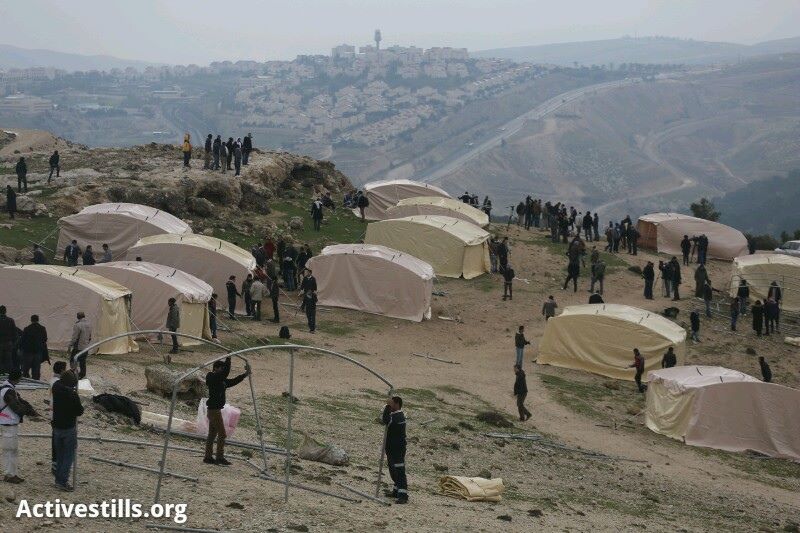
Bab Alshams, Occupied Palestine – 250 men and women from across Palestine establish this morning a new Palestinian village named “Bab Alshams” (Gate of the Sun). Tents were built in what Israel refers to as area E1 and equipment for long-term living was brought.
The group released the following statement:
We, the sons and daughters of Palestine from all throughout the land, announce the establishment of Bab Alshams Village (Gate of the Sun). We the people, without permits from the occupation, without permission from anyone, sit here today because this is our land and it is our right to inhabit it.
A few months ago the Israeli government announced its intention to build about 4000 settlement housing units in the area Israel refers to as E1. E1 block is an area of about 13 prayer in Bab AlShamssquare km that falls on confiscated Palestinian land East of Jerusalem between Ma’ale Adumim settlement, which lies on occupied West Bank Palestinian land, and Jerusalem. We will not remain silent as settlement expansion and confiscation of our land continues. Therefore we hereby establish the village of Bab Alshams to proclaim our faith in direct action and popular resistance. We declare that the village will stand steadfast until the owners of this land will get their right to build on their land.
The village’s name is taken from the novel, “Bab Alshams,” by Lebanese writer Elias Khoury. The book depicts the history of Palestine through a love story between a Palestinian man, Younis, and his wife Nahila. Younis leaves his wife to join the Palestinian resistance in Lebanon while Nahila remains steadfast in what remains of their village in the Galilee. Throughout the 1950s and 1960s, Younis smuggles through Lebanon and back to the Galilee to meet his wife in the “Bab Alshams” cave, where she gives birth to their children. Younis returns to the resistance in Lebanon as his wife remains in Bab Al Shams.
Bab Alshams is the gate to our freedom and steadfastness. Bab Alshams is our gate to Jerusalem. Bab Alshams is the gate to our to our return.
For decades, Israel has established facts on the ground as the International community remained silent in response to these violations. The time has come now to change the rules of the game, for us to establish facts on the ground – our own land. This action involving women and men from the north to the south is a form of popular resistance. In the coming days we will hold various discussion groups, educational and artistic presentations, as well as film screenings on the lands of this village. The residents of Bab Al Shams invite all the sons and daughters of our people to participate and join the village in supporting our resilience.
Israeli army dogs attack elderly Palestinian, two-year-old child injured in the head in Jewish settlers’ attack
Al Akhbar | January 3, 2013
Israeli army dogs attacked a 93-year-old Palestinian woman as an undercover unit raided the West Bank city of Jenin on Thursday morning, according to Ma’an news agency.
The agents were dressed as Palestinians and backed up by the army when they staged an incursion into the city’s industrial zone.
The raid is the latest in a string of Israeli attacks on Palestinian towns in the West Bank. On Tuesday, Israeli soldiers disguised as vegetable vendors invaded the northern West Bank town of Tamoun and fired ammunition at residents.
Amneh Hisnawi was alone in her house when soldiers stormed her home and dogs belonging to security personnel attacked her. She was sent to an Israeli hospital for treatment.
An army spokesman said the raid on Jenin was conducted to arrest a Palestinian suspected of ‘terror activity’, but that the suspect was not at home.
Around 500 Palestinians hurled rocks, firebombs, and burned tires, according to the spokesman.
Fadi Ijawi, 23, was wounded in the leg by a a live bullet and taken to a Palestinian hospital, a Ma’an reporter said. Dozens also suffered from tear gas inhalation, the reporter added.
Israeli settlers hit two-year-old Palestinian on the head
Several Palestinians, including one toddler, were injured when dozens of illegal Israeli settlers attacked a northern West Bank village on Wednesday, according to Palestine’s Ma’an news agency.
Two-year-old Farah Nanseem was hit on the head during the assault on Jalud village, south of Nablus. Israelis from the Esh Kodesh settlement had staged a sit-in in Jalud earlier in the day to prevent Palestinians from working in the fields.
Several villagers were sent to hospitals to treat light to moderate wounds; houses and a car were also damaged, settlement monitoring official Ghassan Daghlas said.
Another Nablus village, Qusra, was attacked by settlers two days ago. More than 150 olive trees were uprooted.
The assailants were only briefly detained by village security guards.
Israeli settlers, who are considered illegal by international law, routinely assault Palestinians in the West Bank, damaging property and livelihoods, and often targeting the elderly and children.
They face little to no punishment from Israeli authorities for their crimes.
(Ma’an, Al-Akhbar)
Related articles
- Settlers raid Nablus village homes and a tractor. Uproot 190 olive trees and burn Hebron car (occupiedpalestine.wordpress.com)
- Israeli settler attacks on the rise in West Bank (bikyamasr.com)
- Three Palestinians Injured By Israeli Settlers Near Nablus (imemc.org)
Israeli Offer to Palestinian Families: Take $500,000 and Leave West Bank
Al-Manar | January 2, 2013
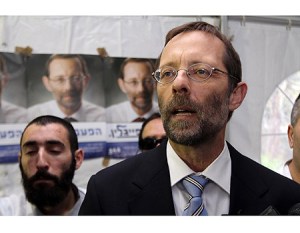 A Zionist Likud hardliner suggested paying Palestinian families $500,000 each to emigrate from the West Bank to the West.
Moshe Feiglin, who earlier on Tuesday was detained by Israeli police after trying to pray at the so-called Temple Mount, proposed paying Palestinians to leave West Bank.
“The State of Israel is paying 10% of its GNP every year for the two-state solution and the Oslo Accords. It’s paying for separation fences, Iron Domes and a guard at every café. Soon we’ll have to place Iron Domes in every school in Tel Aviv.
“With this budget we can give every Arab family in Judea and Samaria $500,000 to encourage it to immigrate to a place with a better future.
“You may say, ‘But no one will have them.’ That’s not true because the Western nations are shrinking due to low birth rates. The question is whether the world will have Sudanese migrants who can’t build or migrants from Judea and Samaria who do know how to build.”
Related articles
- Israel forces Jordan Valley Palestinians from homes ahead of war drill (alethonews.wordpress.com)
Local activist detained in Hebron
International Solidarity Movement | January 2, 2013
West Bank – Israeli soldiers in Hebron tied up and blindfolded a Palestinian activist this afternoon because he walked on the ‘Jewish side’ of the road.
Issa Amro, coordinator for Youth Against Settlements, was detained on Shuhada Street, sections of which are segregated with the majority reserved for the illegal Israeli settlers and Israeli military, leaving only a tiny portion open for Palestinian use.
Issa claimed he wasn’t walking in the Israeli only section of the road and that the soldier became infuriated when he told him to check the rules with a commanding officer. The soldier then told Issa he would be detained for 2 hours, however, he was released after 20 minutes. Issa believes that one of the illegal settlers had instructed the soldier to harass him.
Locals, members of the press and international activists turned up and the soldiers refused to answer questions about why he was being detained, or let anyone bring him water. One soldier then forced the crowd to stay 25 metres away.
Palestinians, Israeli soldiers and illegal settlers are always in close proximity in Shuhada Street and as a result it is an extremely volatile area of the city. On Sunday, Israeli soldiers extended a section of the apartheid road near the Ibrahimi Mosque. The newly constructed barrier runs past a Palestinian home due to be rebuilt meaning that when it is finished, Palestinians will have only half a metre to walk on.
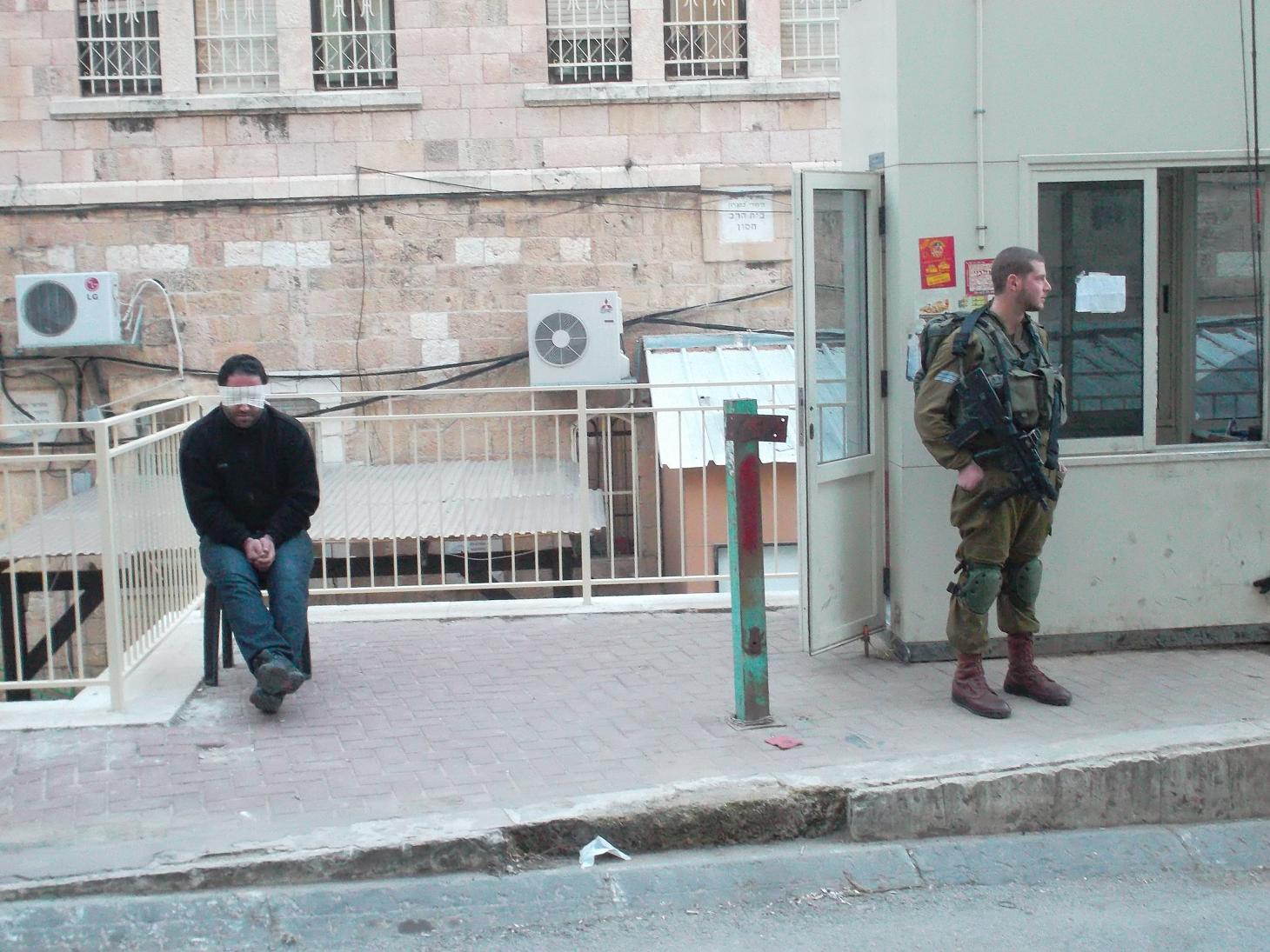
Local activist Issa Amro detained in Shuhada Street in Hebron
Related articles
- Israeli forces kill teenager on his 17th birthday in Hebron (alethonews.wordpress.com)
- Army Kidnaps Four Palestinians In Hebron (imemc.org)
- Israeli military conducts illegal operations in Tel Rumeida, Hebron (palsolidarity.org)
- Second group of journalists beaten in Hebron (alethonews.wordpress.com)
- Settlers raid Nablus village homes and a tractor. Uproot 190 olive trees and burn Hebron car (occupiedpalestine.wordpress.com)
Israeli Army Fails To Evict Illegal Outpost Near Ramallah
By Saed Bannoura | IMEMC & Agencies | December 29, 2012
Israeli soldiers tried to evict an illegal settlement outpost, erected by extremist Israeli settlers near the Bet EI illegal settlement, north of the central West Bank city of Ramallah; the settlers attacked the soldiers who left the scene without evicting the structures.
Israeli sources reported that five Israeli policemen were injured during the clashes with the settlers, and were treated by field medics.
Political sources in Tel Aviv claimed that the army decided to stop the eviction and leave the area due to pressures practiced by a number of government officials.
It is worth mentioning that the government of Benjamin Netanyahu has several coalition members who are settlers, including Foreign Minister, Avigdor Lieberman, head of the extreme right-wing “Israel Our Home” party.
Israeli Yedioth Aharonoth reported that hundreds of settlers clashed with the army and the police, and hurled stones at them after the army ordered them to disperse.
The army later apprehended several settlers but left the scene without evicting the illegal outpost.
Related articles
Featured Video

The Truth About the Trump Shootings with Ken Silva
or go to
Aletho News Archives – Video-Images
From the Archives
Trans ‘milk’ as good as the real thing – NHS
RT | February 18, 2024
The drug-induced nipple secretions of trans women are as good as mothers’ breast milk for babies, the University of Sussex Hospitals NHS Trust claimed in a letter to campaigners made public in a report by British think tank the Policy Exchange on Sunday.
The healthcare trust’s medical director, Rachel James, argued that the off-label prescription drug cocktail men transitioning to female take in order to produce milk was “similar to the natural hormones which encourage lactation to develop when the baby is newly born.”
“The evidence which is available demonstrates that the milk is comparable to that produced following the birth of a baby,” James wrote in the letter, sent to Children of Transitioners last August.
Biological men who wish to lactate must first take hormones to grow milk glands and then take high doses of either domperidone or metoclopramide to stimulate milk production. Neither drug is approved for this use, though they are occasionally prescribed off-label to biological women who have trouble lactating.
However, domperidone’s own manufacturer, Janssen, warns patients the drug “may cause unwanted side effects affecting the heart in a breastfed baby” and “should be used during breastfeeding only if your physician considers this clearly necessary.” … continue
Blog Roll
 Aletho News
- Seyed M. Marandi: U.S. Strike Imminent – Toward Total War in the Middle East
- Russia Voted Under Fire. Washington Is Loading the Tankers.
- 12 Things Your Oncologist Was Trained Not to Tell You
- Anthrax Attacks Paved Way for COVID-Era ‘Junk Drugs and Vaccines’
- How Real Is the Impact of Western Sanctions on Israel?
- France, You Are Guilty: How Paris Turned Western Sahara into the Maghreb’s Powder Keg
- 2025 Nature Paper Claiming Worsening Global Drought Gets RETRACTED …Heavily Flawed
- Your Milk Is Not the Problem
- The Truth About the Trump Shootings with Ken Silva
- ARE PATIENTS BEING PROPERLY INFORMED ABOUT OZEMPIC?
- If Americans Knew
- Salah Sarsour’s Legal Team Says DHS Has Not Met Its Burden to Prove He Is Deportable
- An analysis of tax forms by The Intercept show Kraft’s charity and LLC have donated to Friends of the IDF and AIPAC’s super PAC.
- Israeli attacks kill four Palestinians in Gaza – Daily Update
- Inside Gaza’s death trap of collapsing, bombed-out buildings
- The everyday items Israel bans from Gaza every day
- Inside the siege, the ruined buildings of Gaza – Daily Update
- Debunking The Claim That Macklemore Has A “History Of Antisemitism”
- CPJ demands release of arrested Palestinian-US journalist near Bethlehem
- Robert Kraft: The Billionaire Friend of Netanyahu Pulling The Strings Behind the Macklemore/Ed Sheeran Blow Up
- Columbia Administered Fund Gives Big Money to Pro-Israel Groups
- No Tricks Zone
- 2025 Nature Paper Claiming Worsening Global Drought Gets RETRACTED …Heavily Flawed
- New Study: ‘Global Drought Shows No Detectable Recent Acceleration Under Climate Warming’
- Economic Masterminds: German Socialists Suggest Taxing Productivity Gains Stemming From Using AI
- The South China Sea Has Not Been Cooperating With The Climate Change Narrative
- Energy Crisis: Germany Enters Heating Season With Historically Low Gas Reserve Fill Levels
- New Study: The Antarctic Ice Sheet Gained Mass From 2020-2024 Due To Staggering Snow And Ice Accumulation
- Study: Ocean Heating Rates From Thousands Of Years Ago ‘Dwarf’ Modern Ocean Heating Rates
- Climate Extremists Target, Attack Large-Scale Power Grid Infrastructure In Germany!
- New Study: Antarctic Ice Melt Has Contributed Less Than 1 Centimeter To Sea Level Rise In The Last 30 Years
- Fear Of Debate: Alarmist German Climate Scientist Calls On Mainstream Media To Discredit Skeptic Voices
 Aletho News