Israeli occupation forces kill 7 Palestinians, arrest 300 others during January
Palestine Information Center – 01/02/2013
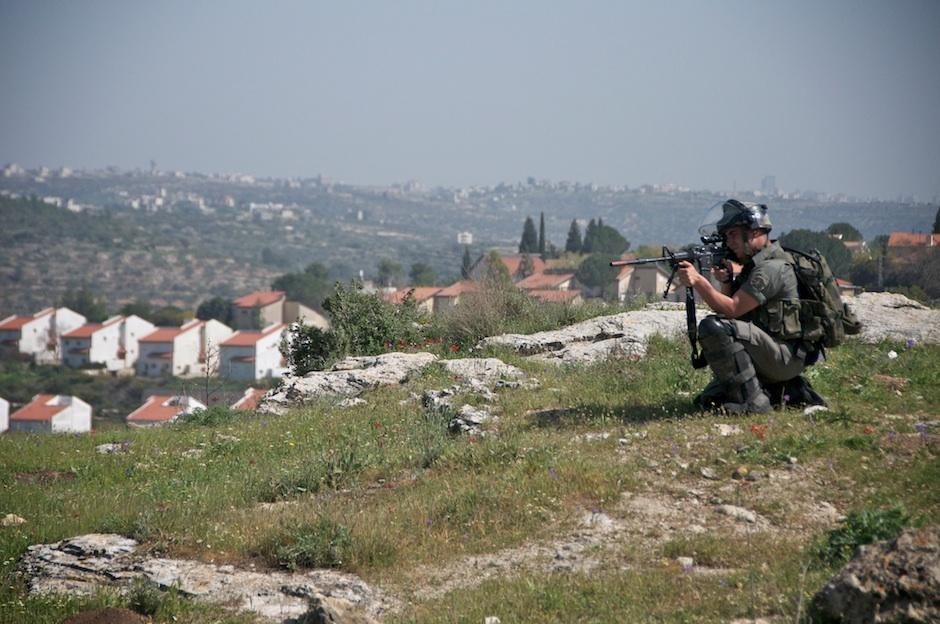
RAMALLAH — A Palestinian human rights report confirmed that the Israeli occupation forces (IOF) killed 7 Palestinians, and arrested more than 300 others during the month of January 2013.
Tadamun Foundation for Human Rights stated, in its monthly report released on Thursday, that four Palestinians, including two children and a woman were killed by Israeli fire in the occupied West Bank, while 3 other citizens were killed in the Gaza Strip, including a child.
Regarding arrests, the report pointed out that the occupation forces arrested more than 300 Palestinians across the West Bank and Gaza, including more than 60 children and 5 women.
The report noted that the arrest number does not include those detained during the clashes that erupted during the storming of Bab al-Shams village, built on Palestinian land slated for confiscation, near the city of Jerusalem.
The report added that the highest number of detention cases were in al-Khalil city, in the southern occupied West Bank, 80 arrests, and in occupied Jerusalem, 70 arrests.
The Foundation explained that a number of liberated prisoners, who have spent several years in Israeli jails, were among those arrested, such as Sheikh Jamal Tawil, Bajes al-Nakhla, and Fadi Sadak from Ramallah.
Related articles
- This Week in Palestine, January 25th, 2013 (indybay.org)
Israeli Foreign Ministry Produces A Film Replacing Al-Aqsa Mosque With Jewish Temple
By Saed Bannoura | IMEMC & Agencies | January 30, 2013
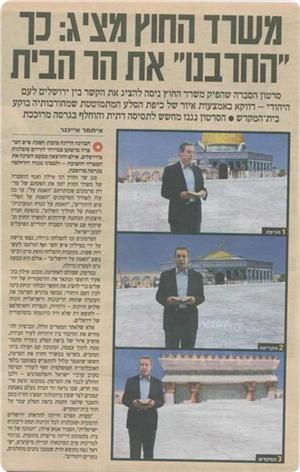 In a film that was produced by the Israeli Foreign Ministry, and was banned from being officially published, Israeli Deputy Foreign Minister, Danny Ayalon, is seen standing and speaking in various areas of Jerusalem, including in front of the Dome Of The Rock, where in the film, it disappears and is replaced by Jewish temple.
The film, “The Fact About Jerusalem”, is meant, from an Israeli point view, to encourage tourism and portray harmony, but at the same time is meant to show the sole Jewish history of the holy city, while Ayalon also claims that the film “is about freedom of religion of the three faiths – Judaism, Christianity and Islam.
The Israeli source, Yedioth Aharonoth, said that the film includes provocative content and was not published due to fear of causing anger among the Muslims, not only in Palestine, but around the world.
Ayalon “stars” in the movie by appearing at different areas of occupied Jerusalem, showing its history, advanced technology, public transportation systems, and also appears standing in front of the Dome of the Rock before it disappears and is digitally transformed into a temple.
Yet, he talks about “diversity” and “harmony” in the Holy City, “in a Jerusalem that is shared not divided”.
The Foreign Ministry said that the film is about “facts”, different “facts” from its point of view about Jerusalem, the West Bank and the peace process.
The film was also translated to various languages attracting attention of millions of viewers around the world.
Despite the fact that the film was banned from being officially published, Ayalon uploaded it onto his own YouTube Channel.
Ayalon said that the film is about history and about what he called religious freedom, describing it as being produced to show what he described as the “freedom of religion to followers of the three faiths in the region”.
Palestinians denounced the film dubbing it as part of the ongoing Israeli attempts to void the Arab and Islamic history, culture and archeology.
Despite his claims of diversity and sharing the city of “the united not divided” Jerusalem, Israel prevents millions of Arab Muslims and Christians, from entering the city to pray at their holy sites or to tour the city.
Related article
- Knesset candidate calls for bombing Aqsa Mosque’s Dome of the Rock (alethonews.wordpress.com)
Israel boycotts UN forum, first state in history to ignore human rights review
RT | January, 2013
Israel has boycotted the UN human rights forum over fears of scrutiny of its treatment of residents of the occupied territories. Israel is now the first state in history to win a deferment of the periodical review of its human rights record.
Tel Aviv has refused to send a delegation on Tuesday to the United Nations Human Rights Council in Geneva for the Universal Periodic Review procedure where UN member states have their human rights record evaluated every four years.
Israel’s cooperation with the council stopped last March after the UN set up a committee to inspect the effects of the Israeli settlements on Palestinians.
Israel which earlier accused the United Nations of anti-Israel bias reiterated its stance, recalling that the council has passed more resolutions against Israel than all other countries combined.
“After a series of votes and statements and incidents we have decided to suspend our working relations with that body,” Yigal Palmor, Israeli foreign ministry spokesman, told the Financial Times. “I can confirm that there is no change in that policy.”
“There have been more resolutions condemning Israel than the rest of the world put together,” an Israeli government official said on Tuesday. “It’s not a fair game – it’s not even a game.”
Following the Israeli decision, the council has decided to postpone its review until no later than November.
The Council president has also called on the body to adopt a draft response to an unprecedented move by Israel.
Egypt’s representative meanwhile has warned that a “soft” approach would create a dangerous precedent and leave “a wide-open door for more cases of non-cooperation,” the AFP quoted.
Activist groups have lashed out against Israel’s disregard for international law.
“By not participating in its own review, Israel is setting a dangerous precedent,” Eilis Ni Chaithnia, an advocacy officer with al-Haq, a human rights organisation based in Ramallah has told the FT. “This is the first time any country has made a determined effort not to attend.”
Others thought that the council’s decision to delay gives Tel Aviv the opportunity to make amends. Eight Israeli human rights organizations issued a statement saying, “Israel now has a golden opportunity to reverse its decision not to participate,” adding “it is legitimate for Israel to express criticism of the work of the Council and its recommendations, but Israel should do so through engagement with the Universal Periodic Review, as it has done in previous sessions,” JTA quotes.
The investigation into Israel’s Human Rights record began in 2007, but last year the UN started to pay particular attention to Israel’s activities in the West Bank.
The probe at the time prompted an angry response from the country’s leader.
“This is a hypocritical council with an automatic majority against Israel,” Prime Minister Benjamin Netanyahu said.
Senior Israeli officials announced last month that Israel does not intend to cancel plans to accelerate settlement construction.
Netanyahu himself said in an interview with Israeli Channel 2 last month that the … area “is not occupied territory” and that he “does not care” what the UN thinks about it.
Around 500,000 Israelis and 2.4 million Palestinians live in the West Bank and in East Jerusalem, areas that, along with Gaza, the Palestinians want for a future state.
The United Nations regards all Israeli settlements in the West Bank as illegal. Tel Aviv last attended the human rights review in 2008. Israel is not a member of the Council, which is comprised of 47 UN member states.
Related article
- Israel plans boycott of UN human rights review (alethonews.wordpress.com)
Mahmoud Sarsak – Palestinian International Footballer
Free Gaza Scotland | January 29, 2013
On Wednesday 23rd of January I with other members of our group had the pleasure and honour to meet Mahmoud Sarsak in our appartment. He is a slight, quietly spoken young man, with a gentle manner and his good humour and patience with our questioning betray none of the pain he has suffered over the last 3 and a half years. When he begins to speak about his experience of imprisonment he tells his story with a matter of fact, quiet sincerity that is striking and makes the horror of his experience all the more shocking.
 Mahmoud was 21 years old, at the start of a playing career which had already seen him being recognised as one of the best young prospects in Palestine, already a regular for the Palestinian National side. He had an invitation to play for a football team in Nablus in the West Bank. This meant that he had to ask for permission from the Israelis to cross from Gaza through Erez crossing into Israel in order to travel on to the West Bank. This did not worry him as it was a trip he had already done twice before and when he recieved his permission he went to the crossing looking forward to the opportunity of playing in Nablus. However when he got to Erez at 9am on the 22nd July 2009 his whole world changed, instead of being allowed to cross he was arrested and taken to a Police Station, from here his family were called and informed that he was being taken to Ashkelon Jail.
He was made to take off his clothes and change into overalls, an ‘under investigation uniform’. He describes how for the first 18 days he was tied to a chair with his eyes covered, the only times he was untied was when he was given food and they untied his hands or when he was allowed to go to the toilet when his legs were untied. He explains that during this time he was kept awake, not fed properly and questioned daily, every 4 days he was taken to a court where a judge gave permission for him to be held for a further 4 days. This treatment he says ‘wasn’t so bad’ in comparison with what was to come although I think that most people would call it torture.
At the end of that 18 days he was taken to a Military Jail in the South where he was kept for 6 days and his treatment became much worse. He was beaten regularly and was put in what he described as a fridge, he also had very hot and very cold water put under his feet. During all of this time in both places he was questioned, his interrogators were wanting him to say that he had been involved in ‘activities against Israel’. He didn’t understand what they meant by this, he was a footballer, he had not been involved in anything else and so refused to make things up to make his interrogators happy. He had no idea why he had been arrested.
At the end of these 6 days he was taken back to a civilian jail for another 11 days where suddenly things got much better. He was fed and allowed to sleep properly, his captors became very friendly offering him his freedom, a new house, a salary, a car, access to proper training facilities to help his playing career and foreign travel. All he had to do was become a collaborator. He refused, which provoked many serious threats from his Israeli interrogators. They told him that they would burn his family home down, attack his family and kill his brothers. Despite the pressures upon him and his ordeal so far, he continued to refuse to collaborate.
Except for short visits to court when his lawyer was present, during this initial 35 days of incarceration he had absolutely no contact with anyone but his jailors and interrogators. His lawyer told him that he was going to be all right, the court had said he was going to be released. Instead he was told by a Military Officer that he was now being held under ‘The Law of An Illegal Fighter’ and that they no longer needed to go to court to ask permission to keep him. He was then taken to Kitseot Jail near Bersheva where at least he could see other prisoners and his time of interrogation was over. He asked the other prisoners what this ‘Law of an Illegal Fighter’ meant but none of them had ever heard of it. When he was finally allowed access to his lawyer and was able to ask him he was told that it was a law that the Israeli authorities use when they have nothing against you but they want to hold onto you. He then asked his lawyer what rights he had under this law and was told that he had none, he could now be held in jail for as long as the Israeli Military wanted to keep him.
Mahmoud was the first Palestinian who had been held under this law, the only other people he knows of who had previously been held under it were 2 Hizbollah members from Lebanon who were arrested in 1982. He thinks that because he had no rights he was put in a cell which was 2m x 1m for his time in Kitseot, this cell had only a matress and toilet in it and he developed chest, skin and back problems while there. He was not taken to a hospital while there, and was only seen briefly by a prison doctor for these problems. He was allowed out of his cell for 1 hour a day for exercise with his fellow prisoners when he played football with them.
On the 22nd of February 2010 Mahmoud was taken to Tel Aviv for a court hearing to extend his imprisonment and then to another court hearing for the decision in Jerusalem two weeks later. The journey to court and between jails is in what the prisoners call a ‘post bus’ which is metal bus with steel compartments in which you are jostled and hit off the steel walls. He knew before he was taken to the second hearing that he was going to be held for another six months. After this hearing he was also barred from playing football with his fellow prisoners for that precious hour in the mornings and was told that this was due to his back being too bad. At this time they also started to move him between prisons every 2 months and he was still taken to court every 6 months in order to have his stay in prison extended.
On the 23rd of August 2011 he was told that he was going to be released, he was happy and said goodbye to the other prisoners. He was taken by ‘post bus’ to Erez, his hands and legs were not tied as they usually were, the window was open and when he got there they opened the door of the prison van and the guards moved away talking among themselves. He stayed where he was as he didn’t know what was happening and he didn’t want to be shot if they thought he was trying to escape. He called to the guards to ask what was happening and they told him they were taking him back to jail, he wasn’t being released. He was taken to a different jail for 2 weeks with only the clothes he had on when they took him to Erez. He said that he was later told about another prisoner who had been taken to Erez and left in an open ‘post bus’ with his legs untied in the same way. He had gone to the door to look out and been instantly shot in the leg and accused of trying to escape. After this 2 week period he was taken back to the jail he had originally been in when first imprisoned, here his other clothes and small number of belongings were finally brought to him.
When he was taken to this jail he was given another 6 months but his lawyer was promised that he would be released when this time ended on the 23rd of February 2012. The 23rd of February came and went, 10 days after this he was taken back to court, he had decided that this time if he wasn’t released he would go on hunger strike and stay on hunger strike until they promised in writing that he would be released. So when he was told that he was going to be imprisoned for another 6 months he prepared himself for 10 days, eating less each day and gradually reducing his physical activity. On the 15th of March 2012 he started his hunger strike. He only took water and sometimes a little salt in order to prevent his stomach from beginning to rot.
7 days after he started they began to move him from jail to jail before putting him in Nafha Jail which meant he was put in with the Israeli criminal population. Then he was put into isolation for a spell followed by hospital in Bersheva for 2 days tied to his bed then back to Nafha. From here he was sent to Eshel jail where he was put in isolation again and became very sick. This time they wouldn’t take him to hospital but would only allow him to see the Doctor in Eshel. After 35 days of this the Doctor in Eshel refused to continue to be responsible for him and he was taken to the Prison hospital in Ramle jail where he was with another 5 Palestinian prisoners who were also on hunger strike. He refused treatment here and was put back into isolation, this time his isolation cell had no windows so he was in darkness. After 47 days on hunger strike he bagan to have serious problems with his stomach, he couldn’t even drink water without vomiting. First white then black then brown vomit. They took him back to Ramle Prison hospital then and gave him antibiotics.
Along with the other hunger strikers he was asked regularly to break his hunger strike, on the 15th of May he was told that if he would break his hunger strike he would be released on the 23rd of August and the other hunger strikers were also told that they would have their demands met if they broke theirs. 3 of them accepted but along with 1 of the others Akram Al Rihawy he refused, he had heard promises of release before and he insisted that he have the promise in writing signed by a senior Judge and a Minister from the Israeli Ministry of the Interior. He was also told that he would not be allowed to return to Gaza, he had to choose between Germany, France or Norway which he also refused to accept. At this time he finally began to get International Committee of the Red Cross visits twice a week and he was asked daily to break his hunger strike, he continued to refuse until he got it in writing that he would be released back to Gaza and that he would be properly monitored by a committee of doctors when he started eating again.
Eventually on the 18th of June 2012 on the 96th day of his hunger strike a Minister from the Israeli Ministry of the Interior came to see him with the signed paper that he had been asking for stating in writing that he would be released on the 20th of July 2012. The Minister asked him if he would now please give up his hunger strike and he agreed. The Minister asked him to drink a glass of milk in front of him so that he could confirm and report that he had indeed broken his hunger strike which he did alathough he immediately vomited this back up. His stomach couldn’t cope even with milk after such a long time with no more than water going into it. He said that even though his stomach rejected this cup of milk his whole body felt as though it had drunk and felt relieved.
For 14 days he had to build up to eating again with first intravenous vitamins and nutrition, followed by nutritional drinks, before finally eating his first bit of bread after this 14 day period, which he still vomited back up. During the time of his hunger strike he was only allowed 2 visits from his lawyer, on the 40th day and on the last day. I asked if he was allowed any visits from his family during his time in jail. He replied that because he was given no rights under the ‘Law of An Illegal fighter’ he was not only denied visits from family but was not even allowed the 6 monthly letters delivered to his fellow prisoners by the Red Cross. He wasn’t able to write to them either, not even one short note.
At no time during Mahmoud’s entire incarceration was he actually accused of anything other than being asked to admit to the vague term ‘activities against Israel’ and he was never charged with anything. He was very clear that he had no idea why he was arrested. He was a footballer. The court appearances he attended were simply formalities under Military Law which say that every 6 months any detention order must be renewed.
All Palestinians from the West Bank and Gaza who are arrested by Israel are dealt with under Military Law not Israeli Criminal Law and therefore it is not necessary for Israel to ever bring charges against them. Many who are prosecuted are those who have signed false confessions under torture and are not able to retract them afterwards. Mahmoud’s case was slightly worse than normal Military law, under which there are a few rights which at least give some protection in prison. Mahmoud had none of these rights under this so called ‘Law of an Illegal Fighter’ by which he was held.
I asked Mahmoud if he was back in training for football and if he thought that it would be possible for him to return to his playing career. He said that finally he had managed to attend 3 training sessions and was hoping to be able to return to the team at some point in the future once he was back to full fitness. I sincerely wish him luck with this and hope that he will reach that stage very soon.
This has to be one of the clearest examples of why the BDS (Boycott Divestment and Sanctions) campaign should be supported by everyone and why Israel should be barred from participating in International Sporting events. Currently the 2013 UEFA U-21 Championship is scheduled to be played in Israel. How can this be allowed when they can treat a Palestinian International Player like this? Not to mention that they bombed the only 2 football pitches in Gaza during Operation Pillar of Cloud as well as destroying many local playing areas in the West Bank over the years. I saw several during my visit there in 2004 including one in Ramallah which had been bulldozed.
Mahmoud told us that the other prisoner who had stayed on hunger strike with him, Akram Al Rihawy, had spent his whole sentence in hospital due to his medical problems. His reason for being on hunger strike was not for release but for proper medical treatment. He stopped his hunger strike after being told that he was going to be released on Wednesday the 23rd of January 2013. Yesterday, on the 25th of January 2013 we were told that he was not released as promised and that he is now back on hunger strike.
To join the campaign against Israel hosting the 2013 UEFA U-21 Championship go to the following link and get involved: http://redcardapartheid.weebly.com/
Related articles
- Former mayor put in administrative detention (alethonews.wordpress.com)
- Genocide by Proxy: Palestinian patient Salah Salluha dies at Erez due to prolonged security measures (occupiedpalestine.wordpress.com)
- Hundreds of Palestinians detained without evidence (occupiedpalestine.wordpress.com)
- Palestine: Documenting the torture of a boy in occupation jails, two wounded by shooting & East of Gaza flooded by Israelis (realisticbird.wordpress.com)
The most violent settlement in the West Bank encroaches on Asira al Qibliya
International Solidarity Movement | January 27, 2013
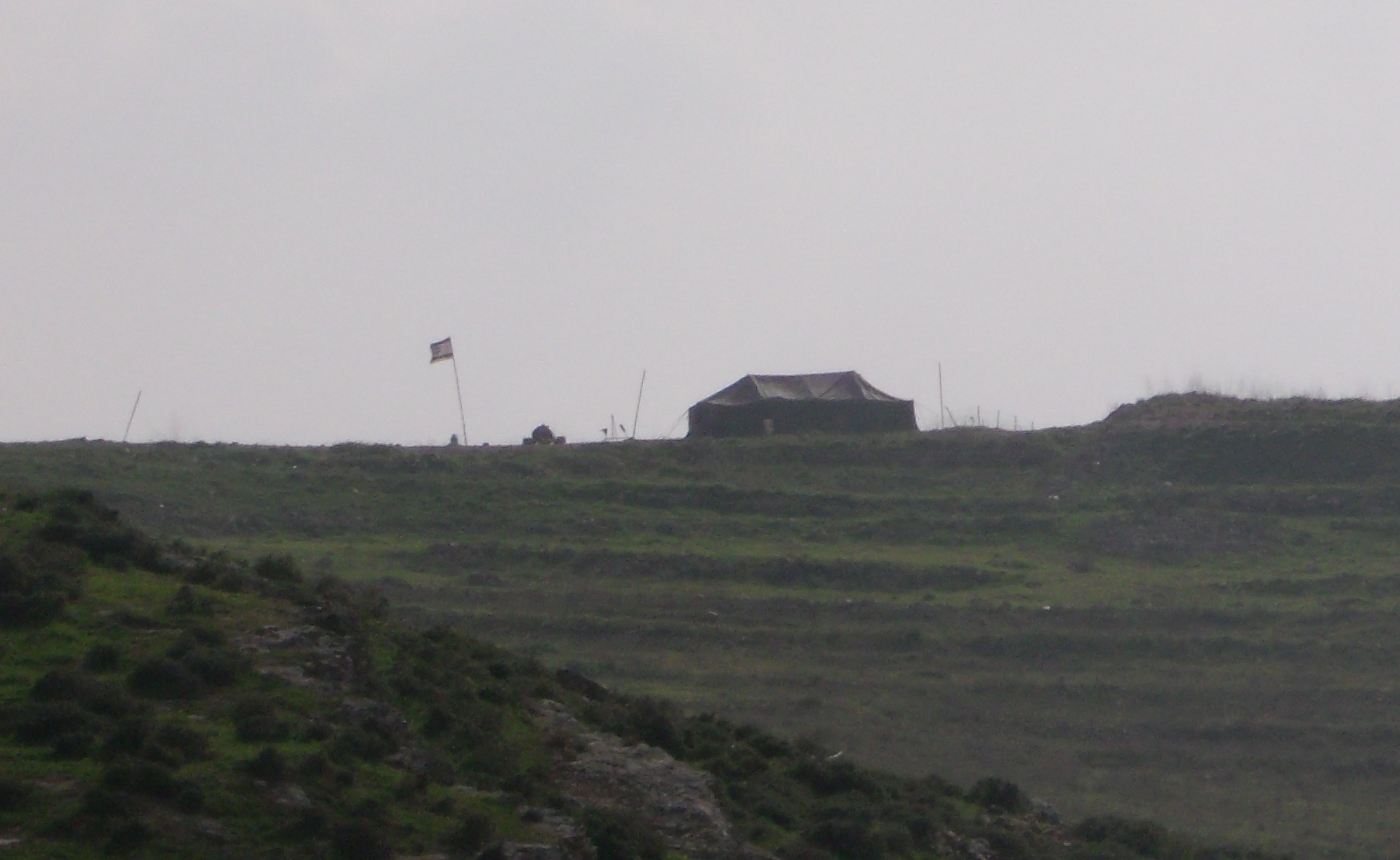
Asira al Qibliya, Occupied Palestine – According to OCHA statistics Yizhar is the most violent settlement in the whole of the West Bank with 70 recorded incidents in 2011 alone. Every week there is at least one attack by Yizhar settlers in the six affected villages.
Four months ago, settlers from Yizhar built a temporary outpost on top of a hill belonging to villagers from Urif. This continued until earlier in the week when Israeli authorities delivered maps to the village which showed that Yizhar had laid claim to 2 dunums of land. This was a massive understatement; they had in-fact seized the entire hill.
The land grab of this hillside seems to be all but complete; a shepherd who was working the land around the Yizhar outpost was recently beaten whilst tending to his sheep: the injuries he sustained were serious but not critical. In another incident, as the Palestinian owners of the land were walking along the road towards the hill this week, they were fired on by Israeli soldiers. Villagers want to challenge this latest land grab, however the law in this country is anything but just. The villagers are all too aware that if they resist they have only stones in the face of tear gas, stun grenades and the very real threat of being fired upon with live ammunition.
Harassment of the residents has also been on the rise. Currently at least once a week soldiers have been invading Asira in the middle of the night. They have been banging on villagers doors with the butts of their assault rifles, making sure people are disturbed in much the same way as has been reported in Urif as well as in Burin.
Yizhar a relatively small but very aggressive settlement in the north of the occupied West Bank. It is situated on a hill surrounded by six Palestinian villages which are all made to live in a state of constant fear.
Related articles
- Continued harrassment of the Nasser family in Madama (palsolidarity.org)
- Israeli Soldiers Attack, Evict, Bab Al-Shams, Arrest Dozens (alethonews.wordpress.com)
- PHOTOS | Settlers attack Urif and Qusra with guns, knives and stones (occupiedpalestine.wordpress.com)
Continued harrassment of the Nasser family in Madama
International Solidarity Movement | January 27, 2013
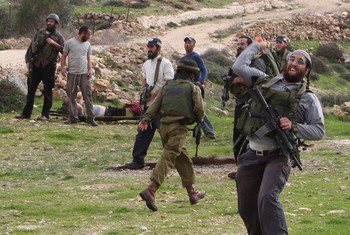
Madama, Occupied Palestine – A month after unprovoked settler and army attacks, the victim of severe violence Mamun Nasser remains in Israeli prison. The arrest of yet another member of the Nasser family shows Israeli army’s continued harassment in Madama.
On December 18th the notorious security guard charged with the protection of the illegal settlement of Yizhar, Jacob, attacked Mamun Nasser while he was tending to his flock of sheep in a hill outside the settlement. Mamun was handcuffed and beaten in front of his entire family, who desperately tried to intervene.
The Israeli army arrived on the scene, who responded by firing live ammunition on the Nasser family and others who tried to help, quickly ending their attempt to stop the vicious assault. One round passed through Mamun’s sisters clothing narrowly missing her while another one hit his brother, Amir, in the leg. His mother told us “They wanted to kill him [Amir]. I heard the officer giving that order. He was lucky that he was only shot in his leg.” Severely beaten, Mamun was then arrested and taken away by the Israeli military into custody. One month later he remains detained in Majdou Prison.
On January 23rd at 4 pm, the Israeli army followed up the harassment by raiding the Nasser family home in Madama, arresting Mamun’s brother Amir who was still recovering from the gunshot wound he received only a month prior. This is another episode in the continued harassment of villagers surrounding Yizhar which is described as the West Bank’s most violent settlement by the United Nations.
Video taken by settlers during the incident on December 18th
Related articles
- Palestinian facing charges after settler violence in Madama (palsolidarity.org)
- Madama attack – Harrowing account from the Nassar family (palsolidarity.org)
- Qusra settler attack, two hospitalised (alethonews.wordpress.com)
- Jewish settlers commit vehicular assaults with impunity at peaceful roadblock protests in the West Bank (alethonews.wordpress.com)
- This Week in Palestine, January 25th, 2013 (indybay.org)
Witness: Israeli soldier killed woman ‘in cold blood’
Ma’an – 25/01/2013

Suad Jaara was shot in the hand by an Israeli soldier who killed her
friend Lubna al-Hanash near Hebron on Jan. 23. (MaanImages)
HEBRON – “I saw an Israeli soldier on the main road firing gunshots haphazardly, so I put my left hand on Lubna’s back, and grabbed her to try and run backward. A gunshot hit my hand, and I shouted as I ran.
“I thought Lubna was running behind me until I reached the security guards of Al-Arrub College who took me to a clinic in the camp before an ambulance arrived and took me to hospital.”
This, says Suad Jaara, 28, is what she witnessed Wednesday afternoon when Israeli officers near al-Arrub refugee camp shot her and her friend Lubna al-Hanash. Lubna, 22, died hours later.
Speaking to Ma’an, Jaara said Thursday that she and Lubna were walking on the campus of Al-Arrub College about 100 meters from the main road when they came under fire.
“An Israeli soldier was shooting from his rifle while a white car was parked on the roadside. There was nobody in the area except Lubna and I. He was a criminal … yes, a criminal who opened fired at us in cold blood killing Lubna and injuring me.”
Jaara’s testimony contradicts claims by the Israeli army’s chief of central command on Channel 10 Wednesday evening that the woman was trying to hurl a Molotov cocktail at an Israeli vehicle.
An army spokeswoman also told Ma’an on Wednesday that “soldiers were attacked by Palestinians who hurled multiple firebombs at them while they were traveling near al-Arrub. Soldiers returned fire and the circumstances of the incident are currently being reviewed.”
But Jaara says she and her late friend were the only ones in the area, walking around and enjoying the scenery.
“Lubna arrived two days ago to visit her sister, who is married to my brother. She had heard about Al-Arrub College and she wanted to visit it. I accompanied her to campus and she admired the area because it’s in a charming natural landscape. When we decided to leave campus, a criminal fired at us and Lubna died a martyr.”
Jaara is an employee at the Ministry of Prisoners Affairs. Her brother Jihad was a gunman in Fatah’s al-Aqsa Brigades in the Bethlehem area. He was deported to Ireland after the Nativity Church siege in 2002.
Israeli Authorities Change Route Of Wall To Fully Annex Jerusalem For Israel
By Saed Bannoura | IMEMC & Agencies | January 21, 2013
The Israeli Defense Ministry announced on Sunday that they will re-route a section of the Wall east of Jerusalem in order to close off an existing gap and fully annex the city of Jerusalem into Israel. The new route means the complete encirclement of the Palestinian village of Al-Zaim, with the Wall to the West and a security fence to the east.
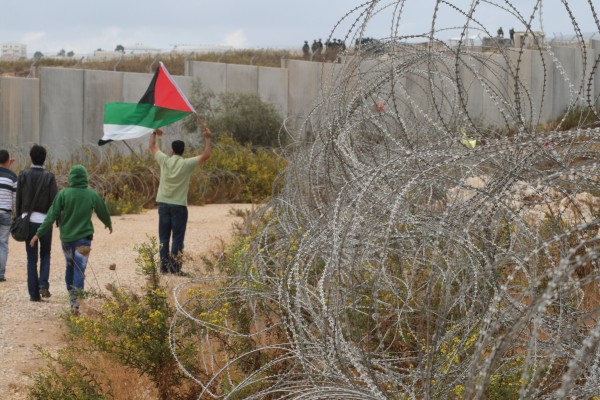 Other Palestinian towns are also completely isolated and encircled into ghettoes, including the town of Sheikh Sa’ed and the city of Qalqilya. Israeli authorities isolated these towns in order to create Palestinian-free zones and routes throughout the West Bank to allow Israeli settlers to travel unencumbered without either having to stop at checkpoints or to drive on the same roads as Palestinians. But in order to do that, Israeli forces have had to maintain over 600 checkpoints throughout the West Bank, and to force Palestinians off their own roads and onto dirt roads or trails.
The new route of the Wall will put the settlement of Ma’ale Adumim on the Palestinian side of the Wall, along with dozens of other Israeli settlements constructed in violation of international law all over the West Bank. But Israeli officials have assured the residents of these settlements that they will construct other Walls and fences to allow them to access Jerusalem without having to go through Palestinian areas.
These additional fences and barriers will, like the Annexation Wall itself, be constructed on land seized from Palestinian owners by Israeli authorities who claim that they have the right to take the land ‘for security reasons’. All Israeli settlements on Palestinian land are considered illegal under international law and the Fourth Geneva Convention, which forbids an occupying military power from settling its civilian population on land occupied by military force.
The announcement is seen as a response to the Palestinian encampment Bab Al Shams, which was established on the land in question, known to Israeli officials as ‘E1’, last weekend, then demolished by Israeli forces. The Palestinian non-violent activists who established the encampment entered the area through the village of Al-Zaim.
Israeli Prime Minister Binyamin Netanyahu has openly declared his intention to build a settlement on the ‘E1’ land, and completely enclose the eastern edge of Jerusalem, thus effectively annexing the city of Jerusalem to the state of Israel. This renders any peace agreement with the Palestinian Authority impossible, since one of the Palestinian Authority’s base demands is sharing the city of Jerusalem. The base demands, which Palestinians have asked Israel to recognize time and again to no avail, are: the recognition of a Palestinian state with east Jerusalem as its capital, the right of return of Palestinian refugees and the release of the thousands of Palestinian political prisoners being held in Israeli prison camps.
Related articles
- The long road to Bab al-Karama (alethonews.wordpress.com)
- Israeli politician: Palestinian ghettos were always the plan (sott.net)
Former mayor put in administrative detention
Ma’an – 20/01/2013
 NABLUS – A former Palestinian mayor detained by Israeli forces this week will be held in administrative detention for six months, a prisoners group said Sunday.
Sheikh Jamal Tawil, who had held the mayoral post in al-Bireh, a neighborhood of Ramallah in the central West Bank, was detained on Tuesday.
The Solidarity Foundation for Human Rights said Ofer military court gave the former mayor six months in detention without charge.
Tawil was arrested by Israeli forces during the first intifada and held for several months under administrative detention at the time.
As of December, 178 Palestinians were being held without charge in Israeli jails, including seven elected members of the Palestinian parliament, according to prisoners rights group Addameer.
Related articles
- Prisoner Omar Barghouti: A Story of a Life Behind Bars (occupiedpalestine.wordpress.com)
- Detainees In Eshil Go On Hunger Strike (altahrir.wordpress.com)
‘Gate of Dignity’ built on lands of Beit Iksa north of Jerusalem
IMEMC News | January 18, 2013
The Palestinian village of Beit Iksa overlooking Jerusalem just built a new village they called Bab Al-Karama (Gate of Dignity) on their land behind the apartheid wall that Israel has built on their land and call on Palestinians and Internationals to join them in their popular struggle to hold on to their lands.
The wall Israel is building on the village land would leave 96% of the village land inaccessible and behind the segregation wall.
Over the past 24 hours, the villagers built a mosque and set up 5 tents for dwelling on their land behind the wall.
 The head of the Beit Iksa village council Mr. Kamal Hababa stated that idea of building this village extension is to protect their legally owned lands and to be the second such village built to protect from growing efforts at transforming Arab Jerusalem.
Already the threatened village land behind the wall is 7,411 dunums which amounts to half the total threatened lands of the eight Palestinian villages northwest of Jerusalem and 96% of the village land of Beit Iksa. Colonial Jewish only settlements built on Palestinian lands beyond the Green line in this area include Ramot, Neve Shmuel, Har Shmuel, and Givat Ze’ev.
The erection of Bab Al-Karama village comes shortly after Palestinian activists erected a village they called Bab Ashams to counter Israeli settlement construction in the area known as E1, located between Jerusalem and Jericho, which signals a new model in popular struggle against the ongoing expansion of the Israeli settlements in the West Bank.
Protestors return to Bab-Alshams
Popular Struggle Co-ordination Committee | January 15, 2013
Bab-Alshams, Occupied Palestine – Following the violent eviction of Bab-Alshams (gateway of the sun) on Sunday around a hundred Protestors returned to the land which the Israeli Occupation Forces call E1. After the acceptance of Palestine as a non-member state to the UN, Israel announced the approval of a plan to expand by building some 4,000 residential units in this area. Such construction would effectively bisect the West Bank, effectively cutting it off from Jerusalem.
The protestors arrived before 15:00 to the surprise of Israeli Police stationed in the area; two groups approached Bab-Alshams from different directions. As protestors moved up the hill Israeli Occupation Forces began to attack the demonstration initially with stun grenades.
Activist’s remained steadfast and refused to leave the land which is privately owned by Palestinians. Israeli police began to outnumber protestors and then began detaining Palestinians violently. Slowly Israeli forces managed to push activists down the hill.
Activists regrouped at the bottom of the hill, sat down and began to sing. The violence of the Israeli authorities then again increased, one women was beaten and suffered a head wound which required medical attention. At least two others were injured one male was bleeding heavily from the wrist, while others were being treated for shock.
At-least 10 people were arrested most of which have now been released. Some remain in detention including an ISM founder Neta Golan.
Related articles
- Palestinians Establish a new Village, Bab Alshams, in Area E1 (alethonews.wordpress.com)
- Palestinian Village of Bab Alshams Remains Steadfast (palsolidarity.org)
- Israeli Soldiers Attack, Evict, Bab Al-Shams, Arrest Dozens (alethonews.wordpress.com)
Featured Video

The Truth About the Trump Shootings with Ken Silva
or go to
Aletho News Archives – Video-Images
From the Archives
Trans ‘milk’ as good as the real thing – NHS
RT | February 18, 2024
The drug-induced nipple secretions of trans women are as good as mothers’ breast milk for babies, the University of Sussex Hospitals NHS Trust claimed in a letter to campaigners made public in a report by British think tank the Policy Exchange on Sunday.
The healthcare trust’s medical director, Rachel James, argued that the off-label prescription drug cocktail men transitioning to female take in order to produce milk was “similar to the natural hormones which encourage lactation to develop when the baby is newly born.”
“The evidence which is available demonstrates that the milk is comparable to that produced following the birth of a baby,” James wrote in the letter, sent to Children of Transitioners last August.
Biological men who wish to lactate must first take hormones to grow milk glands and then take high doses of either domperidone or metoclopramide to stimulate milk production. Neither drug is approved for this use, though they are occasionally prescribed off-label to biological women who have trouble lactating.
However, domperidone’s own manufacturer, Janssen, warns patients the drug “may cause unwanted side effects affecting the heart in a breastfed baby” and “should be used during breastfeeding only if your physician considers this clearly necessary.” … continue
Blog Roll
 Aletho News
- Seyed M. Marandi: U.S. Strike Imminent – Toward Total War in the Middle East
- Russia Voted Under Fire. Washington Is Loading the Tankers.
- 12 Things Your Oncologist Was Trained Not to Tell You
- Anthrax Attacks Paved Way for COVID-Era ‘Junk Drugs and Vaccines’
- How Real Is the Impact of Western Sanctions on Israel?
- France, You Are Guilty: How Paris Turned Western Sahara into the Maghreb’s Powder Keg
- 2025 Nature Paper Claiming Worsening Global Drought Gets RETRACTED …Heavily Flawed
- Your Milk Is Not the Problem
- The Truth About the Trump Shootings with Ken Silva
- ARE PATIENTS BEING PROPERLY INFORMED ABOUT OZEMPIC?
- If Americans Knew
- Salah Sarsour’s Legal Team Says DHS Has Not Met Its Burden to Prove He Is Deportable
- An analysis of tax forms by The Intercept show Kraft’s charity and LLC have donated to Friends of the IDF and AIPAC’s super PAC.
- Israeli attacks kill four Palestinians in Gaza – Daily Update
- Inside Gaza’s death trap of collapsing, bombed-out buildings
- The everyday items Israel bans from Gaza every day
- Inside the siege, the ruined buildings of Gaza – Daily Update
- Debunking The Claim That Macklemore Has A “History Of Antisemitism”
- CPJ demands release of arrested Palestinian-US journalist near Bethlehem
- Robert Kraft: The Billionaire Friend of Netanyahu Pulling The Strings Behind the Macklemore/Ed Sheeran Blow Up
- Columbia Administered Fund Gives Big Money to Pro-Israel Groups
- No Tricks Zone
- 2025 Nature Paper Claiming Worsening Global Drought Gets RETRACTED …Heavily Flawed
- New Study: ‘Global Drought Shows No Detectable Recent Acceleration Under Climate Warming’
- Economic Masterminds: German Socialists Suggest Taxing Productivity Gains Stemming From Using AI
- The South China Sea Has Not Been Cooperating With The Climate Change Narrative
- Energy Crisis: Germany Enters Heating Season With Historically Low Gas Reserve Fill Levels
- New Study: The Antarctic Ice Sheet Gained Mass From 2020-2024 Due To Staggering Snow And Ice Accumulation
- Study: Ocean Heating Rates From Thousands Of Years Ago ‘Dwarf’ Modern Ocean Heating Rates
- Climate Extremists Target, Attack Large-Scale Power Grid Infrastructure In Germany!
- New Study: Antarctic Ice Melt Has Contributed Less Than 1 Centimeter To Sea Level Rise In The Last 30 Years
- Fear Of Debate: Alarmist German Climate Scientist Calls On Mainstream Media To Discredit Skeptic Voices
 Aletho News