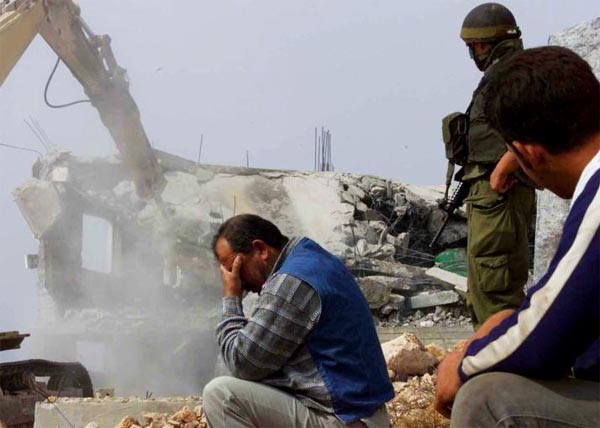
One-third of Palestinian homes in Jerusalem are threatened with demolition
MEMO | September 26, 2013
An international human rights organisation has revealed that one-third of the Palestinian-owned houses in Jerusalem face demolition under the pretext that applications for building permits were incomplete. This, claims Euro-Mid Observer for Human Rights, is a way for the Israeli authorities to continue their demographic war against Palestinians in the Holy City. Israel gives Jerusalemite Palestinians the right to use just 13 per cent of the area of occupied East Jerusalem to meet the needs of their growing population.
A report from Euro-Mid shed some light on the widespread Israeli settlement programme in Jerusalem. It mentioned that the financial committee of the Israeli-controlled Jerusalem municipality decided to support 1,500 new settlement units in the city at the end of August. The human rights group also pointed out that Israel’s bulldozers are still razing Palestinian homes in Al-Tour neighbourhood because the authorities plan to set up the “National Israeli Park”.
According to the UN, poverty is getting worse among Palestinians in Jerusalem. Euro-Mid noted that the unemployment rate rose to 78 per cent in 2012 compared with 64 per cent in 2006. More than 40 per cent of Palestinian Jerusalemites now live below the official poverty line; one of the reasons is the disparity in wage rates between Israeli and Palestinian labourers.
Euro-Mid has called upon Israel to stop its frenzy of settlement construction in the occupied territories and to protect Palestinian sovereignty over East Jerusalem, as the potential capital of a Palestinian state.
Related articles
- Israel levels 7 Palestinian homes in East Jerusalem (worldbulletin.net)
- Jewish settlers occupy Palestinian land in Al-Quds (worldbulletin.net)
- Dozens Injured In Jerusalem, Two Kidnapped (imemc.org)
- Palestinians Attacked By Soldiers In Jerusalem’s Old City (imemc.org)
Netanyahu Orders Court To Allow Settlers Back Into Hebron Home
By Saed Bannoura | IMEMC & Agencies | September 23, 2013
Following the deadly shooting of an Israeli soldier in Hebron city, in the southern part of the occupied West Bank, Israeli Prime Minister, Benjamin Netanyahu, vowed to boost settlement activities, and ordered the Civil Administration, to take all needed measures to allow the return of Israeli settlers into a Palestinian home they previously occupied in Hebron.
The Israeli Civil Administration Office is run by the Israeli military in the occupied West Bank.
Back in April of 2012, a group of settlers was removed from the home, near the Ibrahimi Mosque in Hebron. They allegedly purchased the property but the purchase was deemed invalid, especially since such deals must be first approved by a commander of the Israeli occupation army.
The settlers were removed after the then-Israeli Defense Minister, Ehud Barak, issued an order in this regard following a court ruling.
The decision to allow the settlers to return to the property was made on Sunday night; Netanyahu said that the settlers “must be allowed into the home without any delay”.
After being removed from the property, the settlers filed several court appeals, demanding a recognition of the alleged transaction, while Israeli Defense Minister, Moshe Ya’alon, also vowed to do whatever he can to authorize their “return to the home”.
Netanyahu made his decision hours after a Palestinian sniper shot and killed an Israeli soldier in Hebron, following ongoing tension that led to clashes between the soldiers and dozens of local youths who hurled stones at them.
It is also related to the death of an Israeli soldier who was killed two days ago in the Qalqilia district, in the northern part of the occupied West Bank.
“Anyone who attempts to remove us from Hebron, from the city of our patriarchs, will just achieve the exact opposite”, Netanyahu said according to the Israeli daily Haaretz, “We will boost our settlement activities”.
Netanyahu said that the “return of the settlers to the Hebron home would still have to go through legal means”; yet, he ordered all related government facilities, to do whatever they can to ensure their fast return.
His decision comes despite the fact than an appeals committee, looking into the purchase did not recognize the documents presented by the settlers, but criticized the way this purchase was denied.
Haaretz added that, should the process be finalized, Netanyahu and his Defense Minister could sign off the deal, and authorize the settlers back.
In related news, Israeli Economics Minister, Neftali Bennet, demanded that Netanyahu stop the release of Palestinian political prisoners, as part of peace talks with the Palestinians, and said that the Palestinians “must be punished for the killing of the two Israeli soldiers.”
Bennet, of the Jewish Home Party, who also serves at the Ministerial Council, said that “the release of Palestinian prisoners is based on progress of talks, and our duty should be a war on murderers…” according to the official.
Israel’s Transportation Minister, Yisrael Katz, said that he previously voted against the release of any detainee, and that the release of what he called “terrorists” encourages others to attack Israel.
Following the fatal shooting of the Israeli soldier in Hebron, the army initiated a large campaign and broke into and searched hundreds of homes close to the Ibrahimi Mosque area where the soldier was shot.
Hundreds of Palestinians were kidnapped, and where rounded up in the southern area of the occupied city of Hebron.
The soldiers also occupied rooftops of several homes, using them as monitoring towers, while the army operated in the area.
The military declared Hebron a closed military zone, preventing the Palestinians from entering or leaving it.
Last week, Israeli soldiers shot and killed one Palestinian, and injured four, including three children, in different attacks carried out in the occupied Palestinian territories.
The army carried out 49 invasions into Palestinian communities, and kidnapped at least 41, including 9 children.
Two Palestinians have been killed, dozens have been injured, and hundreds were detained, by Israeli forces since the beginning of the month.
Related articles
EU calls for explanations from Israel over diplomat scuffle
RT | September 22, 2013
European diplomats are holding Israel accountable over an incident where IDF servicemen attacked a EU humanitarian convoy in the West Bank on Friday. So far Tel Aviv has left the scandal in limbo, offering no official explanation for the incident.
Diplomats from several EU countries have spoken out against the shocking incident of harassing a person with diplomatic immunity, clearly awaiting some sort of official reaction from the state of Israel.
After disturbing photos of the French diplomat, Marion Fesneau-Castaing, spread on the ground with IDF soldiers standing around her hit international news, the scandal over hijacked EU aid to homeless Bedouins from demolished villages in the West Bank has gained momentum.
“EU representatives have already contacted the Israeli authorities to demand an explanation and expressed their concern at the incident,” says a statement issued by the spokesmen for EU foreign policy, Catherine Ashton and Humanitarian Aid Commissioner, Kristalina Georgieva.
An EU official described the Israeli actions as “shocking and outrageous”, the BBC reported.
The British Consulate General in Jerusalem is “concerned at reports that the Israeli military authorities have prevented the affected community from receiving humanitarian assistance,” the consulate’s spokesman said.
“We have repeatedly made clear to the Israeli authorities our concerns over such demolitions, which we view as causing unnecessary suffering to ordinary Palestinians, as harmful to the peace process and contrary to international humanitarian law,” the spokesman added.
The Israeli authorities should “live up to their obligations as occupying power to protect those communities under their responsibility,” the UN Humanitarian Coordinator James Rawley said.
‘Illegal diplomatic activity’
The Israeli Foreign Ministry’s spokesperson, Paul Hirschson, has threatened to lodge a complaint over Marion Fesneau-Castaing’s actions, Agence France-Presse reported.
“If she did participate then a formal complaint will be filed because that is not the way diplomats behave,” he said.
On Saturday the EU ambassador in Israel called the Foreign Ministry Deputy Director-General for Europe, Rafi Shutz, demanding explanations regarding the IDF in the West Bank on Friday.
“What was done there by the European diplomats was a provocation,” said Shutz as quoted by the Haaretz.
Mr Shutz claimed that force against the female French diplomat was used because she slapped one of the soldiers. He also announced that the state of Israel is looking into allegations that foreign diplomats “abused their diplomatic privileges”.
Because Palestinian construction at the site of former Khirbet Al-Makhul village was ruled illegal by an Israeli court, the European diplomats were engaging in illegal activity, Shutz stated. He also pointed out that humanitarian aid to Palestinians should be delivered through the proper channels, coordinated with Israel.
The IDF explained the use of stun grenades during the incident, claiming that stones were thrown at security forces. Stun grenades were thrown directly into a group of European diplomats, aid workers and locals who were trying to deliver emergency aid to the residents of a demolished Palestinian village, Reuters reported.
On Friday a truck with EU humanitarian aid for the villagers of the demolished Khirbet Al-Makhul settlement was attacked by IDF personnel, who confiscated the truck and the payload. French diplomat Marion Fesneau-Castaing, who attempted to prevent confiscation of the aid, was pulled out of the truck and forced to the ground. The incident received wide international coverage.
Houses, stables and a kindergarten at Khirbet Al-Makhul village were demolished on Monday after a decision by Israel’s High Court, which ruled that villagers had illegal building permits. The villagers refused to leave the ruins saying they have been living on that land for generations.
The seizure incident of a truck carrying humanitarian aid has become yet another page in the row between Brussels and Tel Aviv. In July the EU announced it is going to stop all financial assistance to Israeli organizations operating in the occupied territories, starting from 2014.
The government of Prime Minister Benjamin Netanyahu reacted angrily, denouncing the move as interference in Israel-Palestine relations and retaliated by blocking EU humanitarian aid to tens of thousands of Palestinians in the West Bank.
Israel and the Palestinian Autonomy remain in fruitless peace talks, with the major stumbling block being the ongoing construction of Jewish settlements in the West Bank and East Jerusalem, occupied since the 1967 Middle East war.
Related article
Israeli soldiers rough up EU diplomat, confiscate aid supplies for Palestinians
Al-Akhbar | September 20, 2013
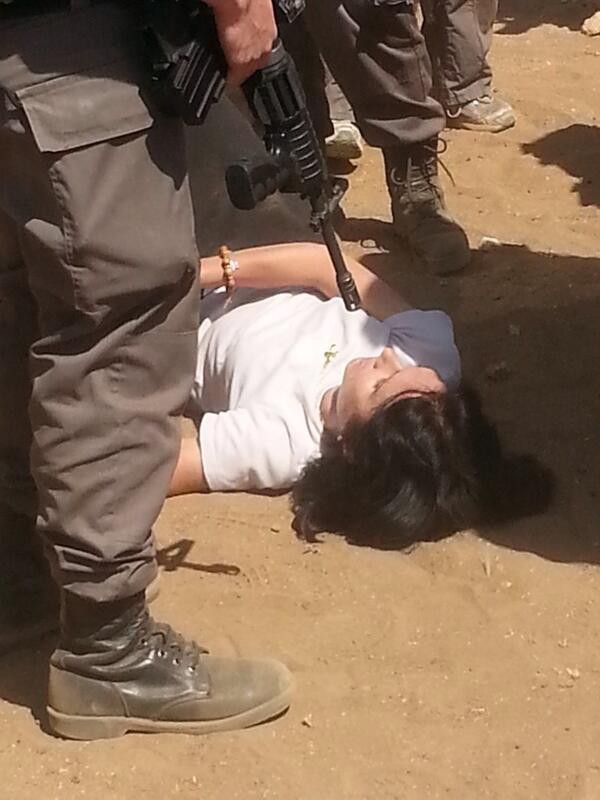 Israeli soldiers manhandled European diplomats on Friday and seized a truck full of tents and emergency aid they had been trying to deliver to Palestinians whose homes were demolished this week.
A Reuters reporter saw soldiers throw sound grenades at a group of diplomats, aid workers and locals in the occupied West Bank, and yank a French diplomat out of the truck before driving away with its contents.
“They dragged me out of the truck and forced me to the ground with no regard for my diplomatic immunity,” French diplomat Marion Castaing said.
“This is how international law is being respected here,” she said, covered with dust.
The Israeli army and police declined to comment.
Locals said Khirbet al-Makhul was home to about 120 people. The army demolished their houses, stables and a kindergarten on Monday after Israel’s high court ruled that they did not have proper building permits.
Despite losing their property, the inhabitants have refused to leave the land, where they say their families have lived for generations along with their flocks of sheep.
Israeli soldiers stopped the International Committee of the Red Cross (ICRC) delivering emergency aid on Tuesday and on Wednesday IRCS staff managed to put up some tents but the army forced them to take the shelters down.
Diplomats from France, Britain, Spain, Ireland, Australia and the European Union’s political office, turned up on Friday with more supplies. As soon as they arrived, about a dozen Israeli army jeeps converged on them, and soldiers told them not to unload their truck.
“It’s shocking and outrageous. We will report these actions to our governments,” said one EU diplomat, who declined to be named because he did not have authorization to talk to the media.
“(Our presence here) is a clear matter of international humanitarian law. By the Geneva Convention, an occupying power needs to see to the needs of people under occupation. These people aren’t being protected,” he said.
In scuffles between soldiers and locals, several villagers were detained and an elderly Palestinian man fainted and was taken for medical treatment.
The UN Office for the Coordination of Humanitarian Affairs (OCHA) said in a statement that Makhul was the third Bedouin community to be demolished by the Israelis in the West Bank and adjacent Jerusalem municipality since August.
Palestinians have accused the Israeli authorities of progressively taking their historical grazing lands, either earmarking it for military use or handing it over to the Israelis whose settlements dot the West Bank.
Israeli forces regularly demolish Palestinian homes, claiming they do not have the proper construction permits. However, the Israeli government regularly announces the expansion of settlements, which are considered illegal under international law.
Israelis and Palestinians resumed direct peace talks last month after a three-year hiatus. Palestinian officials have expressed serious doubts about the prospects of a breakthrough.
“What the Israelis are doing is not helpful to the negotiations. Under any circumstances, talks or not, they’re obligated to respect international law,” the unnamed EU diplomat said.
(Reuters, Al-Akhbar)
Military Training Amid Villages in South Hebron Hills
CPTnet | September 19, 2013
During their most recent weekly visit to villages in the South Hebron Hills, CPTers witnessed a large group of Israeli soldiers in the area and heard an artillery training activity. Every week, Christian Peacemaker Teams, along with other internationals, provides a presence in an area, home to twelve villages, that the Israeli military has designated as Firing Zone 918—a closed military zone for training maneuvers.
On Sunday, 15 September, CPTers witnessed soldiers and a military vehicle near the village of Halaweh and two helicopter flyovers as children studied and played at the school in Al Fakheit. They heard several other helicopters flying nearby during the night. On the morning of 16 September, CPTers heard what seemed to be bomb detonation and machine gun fire. Later in the morning, when they visited the village of Jinba, residents confirmed that the Israeli military had conducted infantry training exercises nearby from about 6:00 to 8:00 a.m. that morning.
During their visit to Jinba village, CPTers learned that the Israeli authorities had stopped employees of World Vision as they were driving from Jinba to Al Fakheit and confiscated their car on 11 September. According to a United Nations employee, soldiers said they would not return the car for at least sixty days.
The area has been relatively quiet since May – with no training activities seen or heard, though helicopter flyovers continued even during this “quiet” time and settler violence and a military raid occurred in July. Here is a video of an Israeli military helicopter harrassing the village of Al Fakheit:
On their way into the area, CPTers also witnessed the digging of a new cistern. The Israeli government issued a stop work order on the cistern saying it is in a “nature reserve” (as well as the firing zone.) Nevertheless, the work continues.
The area is currently the subject of a court case in the Israeli Supreme Court. Eight of the twelve villages, where about 1,000 people live, are under eviction orders. Many structures within those villages also have demolition orders. When the case came to court on 2 September, the judicial panel proposed mediation. The case will again come before the court on 2 October. The military exercises CPTers witnessed were the first since the 2 September court date.
The U.N.’s 2012 Humanitarian Impact of Israeli-declared “Firing Zone” in the West Bank Factsheet reports that in addition to restriction on grazing livestock (the livelihood of many inhabitants of the area),
residents of firing zones face a range of other difficulties including the confiscation of property, settler violence, harassment by soldiers, access and movement restrictions and/or water scarcity. Combined, these conditions contribute to a coercive environment that creates pressure on Palestinian communities to leave these areas… International law also prohibits the destruction or confiscation of private or public property, unless for reasons of military necessity, as well as the forced displacement or transfer of civilians.”
Related articles
- Soldiers Demolish Northern Plains Village (imemc.org)
- Israeli forces seize tents in demolished village (altahrir.wordpress.com)
Palestinian teen ‘executed’ by Israeli forces in Jenin
By Saed Bannoura | IMEMC & Agencies | September 17, 2013
Palestinian medical sources have reported that a Palestinian youth was shot and killed by Israeli soldiers invading his home in the Jenin refugee camp, in the northern West Bank city of Jenin on Tuesday. Dozens of residents have been injured during ensuing clashes, and one was kidnapped.
The Maan News Agency has reported that a large Israeli military force invaded that camp, during late night hours, and that the soldiers broke into and violently searched dozens of homes.
The invasion led to clashes with local youths who hurled stones and empty bottles at the invading forces.
Medical sources said that resident Islam Husam Toubasy, 19, was shot by rounds of live ammunition fired at him by the invasion soldiers who broke into his home after detonating its door.
His family told Maan that, immediately after invading their property, the soldiers headed to the rooftop where Islam sleeps in his room, and shot him in the foot before dragging him onto the ground, taking him out of his home while he was heavily bleeding.
His brother, Kamal, stated that after the soldiers shot and injured Islam, and dragged him out of the home, undercover soldiers of the Israeli army shot him again, the Palestinian News & Info Agency (WAFA) has reported.
The army then moved him to the Al Khodeira hospital, inside the 1948 territories, where he died due to the massive bleeding he suffered as a result of his injury.
The family said that the soldiers forced them in one room, and that they saw Islam bleeding and unconscious before the soldiers took him away. The soldiers did not allow the family to help their son.
Army then withdrew from the camp, but re-invaded it, and the city of Jenin, in the morning, leading to clashes with dozens of local youths.
Eyewitnesses said that at least twenty armored Israeli military vehicles, and a military ambulance, invaded the area, leading to clashes with dozens of students heading to their school.
The soldiers fired more rounds of live ammunition, gas bombs and concussion grenades at the residents leading to several injuries.
One of the wounded, Nael Ghazzawy, 13, was shot by a live round in his leg while standing at the balcony of his home.
Soldiers also kidnapped a resident identified as Mohammad Bassam Al-Fayed, 21, and took him to an unknown destination.
It is worth mentioning that, in 2006, undercover soldiers of the Israeli army, shot and killed Ahmad, the brother of Islam, and demolished his home. Their brother Sa’id, is a political prisoner held by Israel after being sentenced to 32 years imprisonment by a military court.
Earlier on Tuesday, Israeli soldiers invaded various Palestinian communities in different parts of the occupied West Bank, and kidnapped at least nine Palestinians.
On Monday, Israeli soldiers kidnapped at least fifteen Palestinians, including a legislator, in different parts of the occupied West Bank.
The invasions are part of daily violations carried out by the army against the Palestinians and their property in different parts of occupied Palestine.
Related article
The settlers
By Melanie Ward | September 12, 2013
“They consider us as the enemy. These are extreme settlers.”
Hishem, a Palestinian, sits with us in the shade of an olive tree in front of his home in Wadi al Hussein, Hebron. His children are playing on the hill behind us, and directly behind them stands the vast Israeli settlement of Kiryat Arba. There, a man – a settler – is standing on his balcony watching us.

Hishem’s children play in the shadow of Israeli settlement Kiryat Arba
It is hard to know where to start when trying to explain the settlers of Hebron. They are at the heart of the problems here. One of my first encounters with them was on my second proper day of work, when I was walking down Shuhada Street and found myself on the wrong end of an egg thrown by a little settler boy of 7 or 8 years old. One of the local shopkeepers, Munir, has now nicknamed me ‘Umm Baydah’ or ‘Mother Egg’, for being the first of my group to be hit by one. He said “now you are a Palestinian”, and told me to start a tally count.
You might think, what kind of parents give their children things to throw at people walking down the street? But eggs are the least of it. Hishem’s extended family has been attacked, had their windows smashed, their homes set on fire and even been shot by their settler neighbours.
The settlers of Hebron are a religiously motivated group of Israeli Jews who occupy four areas, known as settlements, in the centre of H2 (Israel-controlled), Hebron, and two settlements in the Wadi where Hishem lives. They are known for their willingness to use violence, harassment and intimidation against those they perceive to be standing in the way of them achieving their goals, which are primarily to rid the city of Palestinians. The settlers never refer to Palestinians, always to Arabs because they deny that there was ever such a place as Palestine or such a people as the Palestinians. They say that the Palestinians should leave and go to one of “their own” Arab countries.

Graffiti on the outside wall of Cordoba School in H2 says “Gas the Arabs”
All settlements, including those in East Jerusalem, are illegal under international law. Every country in the world recognises this except Israel. From some of my stories so far, it might seem like there is one set of rules for Israelis and one for Palestinians. That’s because there actually is. In the West Bank the Israeli authorities enforce Israeli civil law on settlers, but military law on Palestinians.
The settlers believe in Eretz Israel – greater Israel – that Israel should permanently encompass the Palestinian territory of East Jerusalem, the Gaza Strip and the West Bank. These are the areas currently occupied and/ or controlled by the Israeli army. Some settlers believe that Israel’s borders should stretch even further afield than this into other countries. Their beliefs contradict all international understandings of where Israel’s borders should be.
These are the nuts and bolts of the daily battle being played out in H2. Everything is about who owns what, who can walk or drive where, even who can stand where. Hebron is the only city in the West Bank to have Israeli settlers living in its centre. The city is of religious significance because it is where Abraham and his sons and their wives lived, and are buried. It is the second holiest site for Jews, the fourth holiest site for Muslims, and is also of significance to Christians.
The settlers believe that they are doing God’s work in ridding Hebron of Palestinians, and dream of turning it into a Jewish city. But I don’t know of any God that would approve of their behaviour. Ironically, there tends to be most trouble on Friday nights and Saturdays – the Jewish Sabbath. One of my jobs is to be present whilst hundreds of settlers walk from Kiryat Arba through a Palestinian neighbourhood to pray at the synagogue on a Friday night. Dozens of extra soldiers are bussed in to protect them but some of the settlers carry their own rifles too. I find it quite bizarre, and certainly one of the least holy sights I have ever seen.

Armed settlers flanked by the Israeli army go to pray in Hebron on the Jewish Sabbath
On the Sabbath last week, a colleague from another international organisation saw a group of teenage settler girls spitting at a group of Palestinian girls on Shuhada Street. Again, not so holy. I met Nadar, Noocha and their family, who showed me their windows which were smashed by settlers. They live next to the synagogue in Hebron. A Palestinian I meet called Hani tells me he does not believe that the settlers follow the true Jewish faith.

Me with Meyar, Nadar and Noocha’s 4 year old daughter. Their windows have been smashed by settlers
The settlers seem to be willing to do almost anything to achieve their aims. This short film clip, from Israeli human rights organisation BT’Selem, first shows one of the settlers explaining things for herself, and then some of her actions. At least watch the first 2 minutes if you can – I’m pretty sure you’ll be shocked.
You might have noticed the solider standing by whilst the settler abuses her neighbour and then the solider pushing the Palestinian woman, rather than dealing with the settler children attacking her home. Palestinians often report that soldiers do nothing whilst settlers are on the attack. I have already seen for myself the close relations between many settlers and soldiers, with settlers bringing food and drinks to soldiers throughout the day, and even settler children playing in military watch points whilst soldiers are on duty there.
In March this year, the United Nations High Commissioner for Human Rights said,
“settler violence continues to be perpetrated with impunity… Israel needs to hold perpetrators accountable. While investigations are not opened into most incidents of settler violence, between 2005 and 2011, only 9 per cent of the investigations opened resulted in an indictment.”
Hani, Reema and their family live just past the caged house in that BT’Selem film clip, by the settlement of Tel Rumeida. They have to walk past the settlement and through the yard of an Israeli army base to get to their house. They can’t take a car to their house. They have been harassed and attacked by their neighbours many times. The settlers have even tried to burn down their home, and have come in the night to smash it up. About a month ago, they tried to burn down the family’s 300 olive trees for the ninth time, scorching the land, and making some of it impossible to harvest this year. Burning and chopping down olive trees is a common tactic of settlers across the West Bank.

Hani and Reema’s scorched olive trees, burnt by settlers a few weeks ago for the ninth time
“Aren’t you frightened?” I ask Reema and she replies, “At the start we were frightened but now we are used to it.”
One of our duties on the Sabbath is to spend time sitting on the roof of the Abu Shamsiya family’s home in H2. The flat roof of the family’s home backs onto Shuhada Street, and has a small Israeli army watchtower on it which does not appear to be used at present. From the roof you can look out across the city of Hebron, and down onto the family’s terrace below. The terrace has a cage around it to try and stop the family being struck by objects thrown by settlers on the roof. In the past, these objects have included eggs (they seem to be a favourite) and stones, and settlers have even urinated on them.

The Abu Shamsiya family’s terrace from their roof, where settlers come and attack them
So the reason for our presence is to deter settlers from coming onto the roof. The first time I sat there, we prevented three settler groups from coming onto the roof. A teenage boy in one of them had a rifle slung across his person. On Tuesday, we were unable to prevent one settler coming onto the family’s roof when we were there. He pointed at the view of the Palestinian city, “This is Israel” he said. ”It’s Palestine” I said. “Lo” (no) he said. Another group that my colleague saw gestured at the view of the Palestinian city and said “All of this will be Jewish”.
Virtually every Palestinian home in H2 has a kind of cage across the windows to try to guard against settler attacks. It is hard to get used to seeing children waving and shouting hello to us from behind these cages.

Children in H2 wave to us from behind the cage placed there to protect them from settlers
On Monday last week when I was doing the lunchtime school run (accompanying Palestinian children to Cordoba School down Shuhada Street) about 150 settlers, most of them teenagers, arrived apparently on some kind of tour. Remember – they can go anywhere in H2 but the Palestinians are very restricted as to where they can even walk. The settlers were congregating at the bottom of the school steps. When it came time for the kids to go home from school, many of them were scared to go down the stairs because of the settlers. I walked up and down the steps with them, to try to make them feel more secure, and it seemed to give them confidence to be able to get home. Although the truth is that I had no way of knowing whether the settlers would cause trouble. Luckily, the worst they did was to stare at us all, and shout and throw things at the feet of my male colleague who arrived to help me.
Not all Israeli settlers are religious extremists like those in Hebron. Some, who live in settlements in Palestinian East Jerusalem for example, are economically motivated. They are attracted by the housing subsidies that the Israeli government provides in many settlements.
Wherever they are located though, there is no doubt that the settlers and settlement expansion, are a major barrier to peace between Israel and Palestine.
Hani and his son have both spent time in prison for retaliating when settlers have attacked them. But Hani tells me that he now believes in non-violent resistance because it gets more positive results. He says it helps him to separate hatred for a policy from hatred for a people, and believes that it can help those in other countries, especially Jews, to see what is happening here.

Non-violent resistance at the Youth Against Settlements project: “They can pull out our trees but we will always plant more”
You might ask, how do the Palestinians put up with this? Why don’t they give up? How can they carry on living where they do, facing such violence and harassment on a daily basis? I asked a few of the people I met whether they would ever think of leaving,
“At the end of the day, it’s our right to our land,” says Hani.
“We are here, and we will stay here. This is our land.” says Hishem.
“We will stay here in a tent if we have to, we will not leave,” says another.
Many of them could not afford to go elsewhere, and where would they go anyway? Over 60% of the West Bank is directly under Israeli control. And many of them, like Hishem’s family, have already been refugees once from the time that the State of Israel was created. And why should they leave? As international law confirms, this IS their land.
But there is another reason, one which is about the Palestinians as a people.
The truth is that they must not leave if the dream of having a Palestinian state is ever to be realised. The settlers and the soldiers must not succeed in cleansing Hebron – or anywhere else in the West Bank – of Palestinians.
I hope that my presence here, and that of my EAPPI colleagues, somehow helps to make it a tiny bit easier for them to stay. One man tells me, “When settlers see people like you they are less likely to cause problems, especially on a Friday and Saturday.” And Hani says, “Before, we were alone as Palestinians with the Israelis but because of the internationals – people like you – we have witnesses to the violence of the settlers. This makes things a bit better for us.”
Just knowing that makes being here worthwhile.
Related articles
- Four young boys arrested and beaten in Hebron (alethonews.wordpress.com)
- Soldiers assault a twelve-year-old Palestinian while settlers invade family rooftop in Hebron (alethonews.wordpress.com)
- “Shabbat shalom” – no peace for Palestinians in Hebron this Saturday (alethonews.wordpress.com)
- Yom Kippur – Illegal Israeli settlers attack Palestinian farmer attempting to harvest almonds (alethonews.wordpress.com)
- Israeli settlers torch Hebron family’s property for eighth time (alethonews.wordpress.com)
Yom Kippur – Illegal Israeli settlers attack Palestinian farmer attempting to harvest almonds
International Solidarity Movement | September 15, 2013
Kafr Qalil, Occupied West Bank – Late Friday night we received a call to accompany a farmer to harvest almonds early the following morning in Kafr Qalil, a village south of Nablus. This is a completely normal activity, harvesting crops when they are ripe and ready-to-pick; however, in Palestine, simply trying to tend to one’s land can be a life-risking event.
At times, international activists and observers accompany Palestinian farmers whose lands are close to settlements and who are at great risk for attack. For some settlers, though a limited minority, international presence can act as a deterrent against violence. For the settlement of Bracha, widely known for its unfettered brutality against Palestinians, there seems to be little that can influence the scope and scale of their attacks.

Photo of Bracha settlers taken after running for our lives (Photo by ISM)
As soon as we received the call, our team began to scramble a bit- rereading our fellow activists’ reports from a few weeks ago in which the same farmer and his family were violently assaulted by the settlers from Bracha, his almond harvest and donkey stolen. We discussed our plan should the settlers attack again and reassured ourselves that the majority would likely be in synagogue all day, as it was the holiday of Yom Kippur, the Jewish day of atonement.
The following morning we arrived to Kafr Qalil around 6:30 to meet the farmer and international observers from EAPPI. After a few quick rounds of tea, we set off for the almond and olive groves in the south of the village. The farmer’s young son led our convoy, riding a donkey and carrying the tools and bags necessary for the harvest. As we walked and chatted about the general situation in the area, the farmer kept close watch over his son, calling him back anytime he rode too far in advance.
We walked the long, windy hills until we reached the groves where we split into two groups, two of us taking the higher hill and four, including the farmer and his son, taking the lower. As my partner climbed the highest hill to look for trees ready to pick, I waited down below, inspecting those badly damaged by fires set two months before by the settlers. The leaves crumbled in my hands to dust.
No more than five minutes later, in a flash of white, the settlers attacked. Without warning, around 15 men and teenage boys began running through the trees, shouting abuses and hurling massive stones toward the farmer, his son and the members of EAPPI. As I called to my partner to warn him, the settlers also began charging toward me, also throwing stones and screaming. Needless to say, and not at all an overstatement, we all ran for our lives. From the corner of my eye, I managed to spot the farmer ahead of me, struggling to run quickly as he walks with a cane. His son and the donkey were even farther ahead. One of the EAPPI volunteers was hit in the back with a stone. The settlers continued chasing us through the trees until we reached an area closer to the village, out of breath, panicked and exhausted. Eventually, when they tired of shouting at us to leave, they settled under a tree, dashing any chance of returning to harvest.
Nearly 20 minutes after the assault, the farmer got in touch with the army commander of the area, who just happened to be sitting in a military jeep on the settler road below the olive grove. The commander insisted that we walk down the steep, rocky terrain to talk to him and explain the situation. After a brief discussion, one of the soldiers arrogantly declared that they “kicked the settlers’ asses back to the settlement,” (conveniently) well after the attack and botched harvest. They assured us that they would stay in the area so that the farmer would be able to work. The volunteer from EAPPI asked where she could make a complaint about the assault, an inquiry which was met by some laughter from the soldiers who told her she was welcome to make a complaint at the Ariel police department (a futile journey, indeed).

Settlers shouting across the olive and almonds groves (Photo by ISM)
Slowly, we marched back up the hill, listening to the farmers advice to stay quiet and keep our eyes on the horizon, should the settlers return. Unsurprisingly, the army remained quite far away, seemingly unconcerned about the potential for another assault. As we sat under the tree to make a new plan, the farmer told us about all the attacks before, the stolen equipment and donkeys, the many fires that had burned most of the trees that surrounded us. It was hard to understand how a man could remain so calm and kind after a mob of religious nationalist extremists attacked him and his family yet another time.
It felt like a failed day, as not even a single almond was picked. Only the farmer managed to keep a positive attitude. He said that the almonds that we would have harvested are not the most important thing. He came to show both the settlers and the army that this is his land, just as it belonged to his father and his grandfather before him. This is his land and he will continue to plant it and to harvest his crops. This is his land and no violence by the settlers, no violence supported by the army, will ever drive him away.
I feel really uncertain as to what would have happened if the settlers had managed to catch any of us, particularly the farmer and his son. I keep going over the event in my mind, trying to piece together an attack that happened so quickly, but was so extreme in its violence and intensity. In the end, I feel sure that if we ran a bit slower, if the farmer or his son had been caught, the day would have ended quite differently, with someone badly hurt or even killed. It is not uncommon here in Palestine, where farming one’s land must be considered a brave and courageous act.
Related articles
- Jewish settlers seize Palestinian lands in Bethlehem (alethonews.wordpress.com)
- Journal: The day of the stolen donkey (palsolidarity.org)
- Join ISM for the 2013 Olive Harvest Campaign (alethonews.wordpress.com)
Obama regime calls on EU to postpone ban on Israel
Press TV – September 8, 2013
US Secretary of State John Kerry has urged the European Union (EU) to delay a planned ban on Israel over the Tel Aviv regime’s continued settlement activities in the occupied Palestinian territories, according to a senior US official.
On July 19, the EU published new guidelines in its Official Journal, banning its 28 members from funding projects in the illegal Israeli settlements in al-Quds (Jerusalem), the West Bank or Golan Heights, which the Tel Aviv regime occupied during the 1967 war.
The ban sparked anger among the Israeli officials, with Israeli Prime Minister Benjamin Netanyahu and President Shimon Peres threatening that the new directive would undermine attempts by Kerry to relaunch talks between Israel and the Palestinian Authority.
A senior US State Department official, whose name was not mentioned in the reports, said that, in a meeting with EU foreign ministers in the Lithuanian capital, Vilnius, on Saturday, Kerry called on the Europeans to consider postponing the implementation of the EU guidelines.
Kerry also asked EU diplomats to support the talks between the Israeli regime and the Palestinian Authority, which resumed in July after a three-year hiatus.
Meanwhile, the EU is to send a team to Israel on Monday to move forward on the guidelines against Israeli organizations in the occupied Palestinian territories.
Israel has announced plans to construct more than 3,000 housing units in al-Quds and the occupied West Bank since the resumption of the talks with the Palestinian Authority in July.
On August 11, Israel’s Housing Minister Uri Ariel gave final approval for the construction of 793 settlement units in the occupied east al-Quds (Jerusalem) and 394 others in the West Bank.
A day later, the EU described as “illegal” the Israeli regime’s decision to approve the building of settlement units.
Yasser Abed Rabbo, a top aide to Mahmoud Abbas, the acting Palestinian Authority (PA) chief, said on September 4 that continued Israeli settlement construction had undermined the talks with Israel.
Palestinians demand that Israel withdraw from the occupied Palestinian territories.
Related article
Featured Video

The Truth About the Trump Shootings with Ken Silva
or go to
Aletho News Archives – Video-Images
From the Archives
Trans ‘milk’ as good as the real thing – NHS
RT | February 18, 2024
The drug-induced nipple secretions of trans women are as good as mothers’ breast milk for babies, the University of Sussex Hospitals NHS Trust claimed in a letter to campaigners made public in a report by British think tank the Policy Exchange on Sunday.
The healthcare trust’s medical director, Rachel James, argued that the off-label prescription drug cocktail men transitioning to female take in order to produce milk was “similar to the natural hormones which encourage lactation to develop when the baby is newly born.”
“The evidence which is available demonstrates that the milk is comparable to that produced following the birth of a baby,” James wrote in the letter, sent to Children of Transitioners last August.
Biological men who wish to lactate must first take hormones to grow milk glands and then take high doses of either domperidone or metoclopramide to stimulate milk production. Neither drug is approved for this use, though they are occasionally prescribed off-label to biological women who have trouble lactating.
However, domperidone’s own manufacturer, Janssen, warns patients the drug “may cause unwanted side effects affecting the heart in a breastfed baby” and “should be used during breastfeeding only if your physician considers this clearly necessary.” … continue
Blog Roll
 Aletho News
- Seyed M. Marandi: U.S. Strike Imminent – Toward Total War in the Middle East
- Russia Voted Under Fire. Washington Is Loading the Tankers.
- 12 Things Your Oncologist Was Trained Not to Tell You
- Anthrax Attacks Paved Way for COVID-Era ‘Junk Drugs and Vaccines’
- How Real Is the Impact of Western Sanctions on Israel?
- France, You Are Guilty: How Paris Turned Western Sahara into the Maghreb’s Powder Keg
- 2025 Nature Paper Claiming Worsening Global Drought Gets RETRACTED …Heavily Flawed
- Your Milk Is Not the Problem
- The Truth About the Trump Shootings with Ken Silva
- ARE PATIENTS BEING PROPERLY INFORMED ABOUT OZEMPIC?
- If Americans Knew
- Salah Sarsour’s Legal Team Says DHS Has Not Met Its Burden to Prove He Is Deportable
- An analysis of tax forms by The Intercept show Kraft’s charity and LLC have donated to Friends of the IDF and AIPAC’s super PAC.
- Israeli attacks kill four Palestinians in Gaza – Daily Update
- Inside Gaza’s death trap of collapsing, bombed-out buildings
- The everyday items Israel bans from Gaza every day
- Inside the siege, the ruined buildings of Gaza – Daily Update
- Debunking The Claim That Macklemore Has A “History Of Antisemitism”
- CPJ demands release of arrested Palestinian-US journalist near Bethlehem
- Robert Kraft: The Billionaire Friend of Netanyahu Pulling The Strings Behind the Macklemore/Ed Sheeran Blow Up
- Columbia Administered Fund Gives Big Money to Pro-Israel Groups
- No Tricks Zone
- 2025 Nature Paper Claiming Worsening Global Drought Gets RETRACTED …Heavily Flawed
- New Study: ‘Global Drought Shows No Detectable Recent Acceleration Under Climate Warming’
- Economic Masterminds: German Socialists Suggest Taxing Productivity Gains Stemming From Using AI
- The South China Sea Has Not Been Cooperating With The Climate Change Narrative
- Energy Crisis: Germany Enters Heating Season With Historically Low Gas Reserve Fill Levels
- New Study: The Antarctic Ice Sheet Gained Mass From 2020-2024 Due To Staggering Snow And Ice Accumulation
- Study: Ocean Heating Rates From Thousands Of Years Ago ‘Dwarf’ Modern Ocean Heating Rates
- Climate Extremists Target, Attack Large-Scale Power Grid Infrastructure In Germany!
- New Study: Antarctic Ice Melt Has Contributed Less Than 1 Centimeter To Sea Level Rise In The Last 30 Years
- Fear Of Debate: Alarmist German Climate Scientist Calls On Mainstream Media To Discredit Skeptic Voices
 Aletho News