Jewish settlers attack West Bank village with Israeli army support
Al-Akhbar | May 5, 2013
Jewish settlers raided a West Bank village near Ramallah on Saturday night, attacking several houses and prompting clashes between residents and Israeli forces, Ma’an news agency reported.
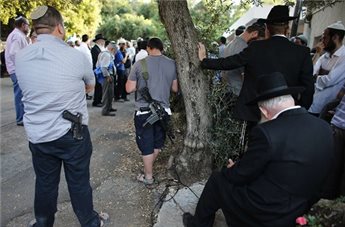 Israeli forces were standing guard as hundreds of settlers stormed the village of Ras Karkar, reportedly barring ambulances from entering the village before allowing an ambulance to take only two people to the hospital.
Eight residents of Ras Karkar were wounded as Israeli troops fired tear gas and rubber bullets at them. Live bullets were also fired into the air to scare the residents and prevent them from defending their property.
Rubber-coated bullets hit one Palestinian in the eye, one in the head and another in the chest. Four others sustained bruises and fractures from the attack by settlers and Israeli troops, locals said.
According to local sources, three houses in Ras Karkar were attacked and set on fire, as well as a number of olive trees.
One settler was wounded after being hit by a stone.
Settlers were also gearing up to attack another village near Ramallah on Sunday, Ma’an reported.
According to a witness, dozens of settlers were being escorted by Israeli troops and police officers near the village of al-Janiya in northwest Ramallah.
Residents of al-Janiya were trying to close the road to the village with rocks, only to be met with stun grenades and tear gas. Activists used the village mosque’s loudspeakers to urge residents to defend their village.
Settlers routinely attack Palestinians and their property in the occupied West Bank, as Israeli forces regularly turn a blind eye or even assist settler crimes.
According to figures compiled by Israeli group Yesh Din, nine out of 10 police investigations about settler crimes fail to lead to a prosecution.
(Ma’an, Al-Akhbar, Photo Credit – Ma’an)
Palestinian stabs West Bank settler
Al-Akhbar | April 30, 2013
A Palestinian man stabbed dead an Israeli settler in the occupied West Bank on Tuesday, the Israeli ambulance service and police said, in what may have been a response to a violent settler attack on a nearby village one day earlier that left two elderly Palestinians hospitalized.
“The Palestinian suspect stabbed an Israeli sitting at a bus stop. He died,” police spokeswoman Luba Samri told AFP, adding that the incident took place near a major junction which lies south of the city of Nablus.
It was the first time an Israeli has been killed by a Palestinian in the West Bank since 2011.
Israeli media said the attacker was standing at a bus stop used by settlers, Israeli soldiers and Palestinians when he stabbed the Israeli, a man in his 20’s.
The suspect then seized a gun carried by the settler. He began shooting at security services who arrived on the scene, Israeli police spokesman Mickey Rosenfeld said, adding that the man was in custody.
The Palestinian, a resident of the northern town of Tulkarem, was injured and admitted to an Israeli hospital.
The incident may have been motivated by a settler attack Monday in Nablus that left two elderly Palestinian men with severe head injuries.
Ghassan Daghlas, who monitors settlement activity in the northern West Bank, told Ma’an that three settlers from the Itamar outpost raided Beit Furik and attacked residents with “sharp tools.”
Fawzi Nasasra, 60, and Abdul Rahman Khatatba, 50, were taken to hospital to be treated.
Settler attacks against Palestinians and their property is routine in the occupied West Bank and rarely punished by Israeli authorities.
Annual figures compiled by Israeli rights group Yesh Din have repeatedly shown that nine out of 10 police investigations about settler crimes fail to lead to a prosecution.
The Israeli internal security service, Shin Beit, has said that during 2012 no Israelis were killed in the West Bank. In March 2011 two settlers and three of their young children were stabbed to death in their home.
Nine Palestinians have been killed by Israeli forces in the West Bank since the beginning of the year in various attacks, mainly in clashes that have risen sharply in recent months.
According to B’Tselem, an Israeli Information Center, an estimated 520,456 settlers live in illegal settlements in the West Bank and East Jerusalem.
There are over 121 settlements and around 100 “settlement outposts.” There are around 12 settlements in Jerusalem in areas annexed from Palestinian neighborhoods. Settlements in the West Bank are connected by Jewish-only highways.
Israel has come under widespread international criticism for ramping up its construction of settlements in the Palestinian territories, notably in occupied east Jerusalem.
All Israeli settlements on Palestinian land beyond the so-called 1949 Green Line are considered illegal under international law.
(Reuters, AFP, Al-Akhbar, Ma’an)
Related articles
- Settlers plant trees in Palestinian fields near Nablus (altahrir.wordpress.com)
- Israel demolishes West Bank homes, water wells (alethonews.wordpress.com)
Israel demolishes West Bank homes, water wells
Al-Akhbar | April 29, 2013
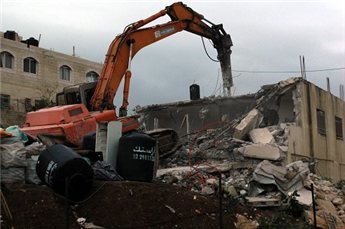
Israeli forces on Monday demolished Palestinian homes and water wells in East Jerusalem and the West Bank, as settlers confiscated land near Hebron to build a new outpost, local media reported.
In occupied East Jerusalem, Israeli forces razed two apartments in the Tur neighborhood after several attempts by the owners to reverse the demolition order failed.
The authorities evicted 24 members of the Ghaith family, including five children and an elderly woman, from the two apartments ahead of the demolition, Rushi Ghaith, one of the owners, told Palestinian news agency Ma’an.
The apartments were scheduled for demolition in December but the family secured a court-ordered injunction to stop it from going ahead, Ghaith said.
The Ghaith family lawyer said they had successfully stalled attempts to raze the apartments since September 2004, when Israeli authorities handed down the demolition notice because the home was built without a licensing permit. The family’s case to reverse the demolition order is ongoing.
Ghaith said the family has been fined 80,000 Israeli shekels (about $22,000) since the case began.
Meanwhile Israeli soldiers demolished water wells south of Hebron in al-Fawar refugee camp, as settlers from the nearby Ma’oun settlement seized land west of Yatta in preparation for the establishment of new outposts.
Abdul Hadi Hantash, an expert on settlement policies in the southern West Bank, said that the Ma’oun settlers seized land of one of the hills southwest of their original outpost.
Hantash told reporters that the wells the soldiers destroyed were used for agricultural purposes and irrigation.
He added that the continued confiscation of land and demolition of Palestinian structures, including the bulldozing of homes and uprooting of trees, are part of the Israeli government’s illegal settlement expansion program.
Israeli demolitions of Palestinian homes and other structures in the occupied West Bank occur almost daily under the pretext of building without a permit.
According to the United Nations, 33 percent of all Palestinian homes in East Jerusalem lack Israeli-issued building permits, which are difficult to obtain, potentially placing at least 93,100 residents at risk of displacement.
Roughly 94 percent of Palestinian applications for building permits are rejected, according to the Israeli Committee Against House Demolitions.
The group estimates that Israeli authorities have demolished about 27,000 Palestinian structures in the West Bank since 1967.
(Ma’an, Wafa, Al-Akhbar)
Related articles
- Palestinian monastery loses court battle over apartheid wall (alethonews.wordpress.com)
- We want to live in dignity (alethonews.wordpress.com)
- Israeli settlers use six times more water than Palestinians – new report (realisticbird.wordpress.com)
Ni’lin continues to resist after 5 years of Israeli occupation and systematic land theft
 A young demonstrator at Ni`ilin

International Solidarity Movement | April 27, 2013
Silwad, Occupied Palestine – Around 50 Palestinians supported by around 20 international activists, demonstrated against the apartheid wall yesterday in Ni’lin, which is a village close to Ramallah. The residents attempted to dismantle the wall and were met with violence. Around 20 were treated for tear gas inhalation and one demonstrator was injured when he was shot in the chest with a tear gas canister.
The demonstration started when around 100 people from the community gathered for the Friday prayer in an olive field. After prayers the demonstrators approached the apartheid wall, chanting peace slogans in Arabic and Hebrew. In a speech, a member of the Popular Committee expressed the injustices that Ni’lin has faced in the past and continues to face today because of the actions of the Israeli military.
Residents tried to open the metal door that separates them from most of their land that has been appropriated illegally by the establishment of settlements and the construction of the wall. Soldiers fired tear gas at the demonstrators. One demonstrator, who had climbed the wall using a ladder, was speaking to the soldiers through a megaphone before they shot him directly in the chest with a tear gas canister. The impact caused him to fall off the ladder and require medical treatment. More tear gas was fired at other demonstrators, photographers and internationals. The demonstration lasted about one hour, weakening the wall and showing the resilience of the population of Ni’lin.
Ni’lin’s history is characterised by land theft, starting with the first Israeli occupation of Palestine in 1948. Before 1948 the village of Ni’lin owned 58’000 dunams of land, from which 40’000 were stolen with the creation of Israel. The 1967 occupation lead to the construction of illegal settlements on Ni’lin’s land, stealing a further 8’000 dunams. The illegitimate establishment of the wall, which began in 2008, has stolen a further 2’500 dunams. Furthermore, the entrance of the village was closed in order to build a tunnel exclusively for settlers that lead to a further land theft of 200 dunams, highlighting the apartheid nature of Israeli policy. Nearly 90% of Ni’lin’s original land has been lost due to this systematic theft from war, settlements and the wall.
The non-violent demonstrations since 2008 have lead to the killings of five Palestinians. 10 year old Ahmed Moussa, 17 year old Yousef Amera, 22 year old Arafat Khawaja, 20 year old Mohammed Khawaja and 36 year old Yousef ‘Akil’ Srour. The residents of Ni’lin still struggle for peace and justice, and will not give up hope in spite of Israel’s use of extreme force and oppression.
Related articles
- Palestine, 8 wounded, 52 abducted by Israeli forces in 1 week (nsnbc.me)
- PCHR Weekly Report: 8 wounded, 52 abducted by Israeli forces this week (occupiedpalestine.wordpress.com)
Palestinian monastery loses court battle over apartheid wall

Al-Akhbar | April 26, 2013
A Catholic monastery and convent in a secluded valley outside Bethlehem lost a seven-year legal battle against the building of Israel’s apartheid wall on its land on Friday, according to its lawyers.
The Society of Saint Yves, a Catholic human rights group which argued the case on the monastery’s behalf, said an Israeli appeals court had endorsed a plan to expand the barrier it had built in the area.
The apartheid wall would surround the convent on three sides and cut it off from most of its land, Saint Yves said in a statement.
Salesian monks and nuns tend lush vineyards and olive trees on terraced hillsides under the gaze of Israeli settlements there. A convent school teaches 400 local children.
Israel started building the barrier, a mix of metal fencing, barbed wire and concrete walls, in 2002. It claims the apartheid barrier keeps its citizens safe from militants.
Saint Yves said “that the plan would violate international law and conventions protecting religious minorities and the right to education and freedom of religion”, said Anica Heinlein, its advocacy officer.
Around 50,000 Palestinian Christians, including 17,000 Catholics, live among 4 million Muslims in the Israeli-occupied West Bank and in Gaza.
They say Israel’s checkpoints and apartheid barrier cut them off from their neighbors and holy places in Jerusalem.
Some 90 percent of Palestinian Christians live in a 20-km stretch from Ramallah and East Jerusalem to Bethlehem – an area locked in a labyrinth of Jewish settlements, Israeli-only roads and a drab concrete walls.
Built mostly within occupied land and not on the “Green Line”, which was the de facto border before the 1967 War, the apartheid barrier inside the West Bank is deemed illegal by the UN’s International Court of Justice.
The Palestinian Authority says the Christian population in the West Bank has shrunk over the last three decades due to emigration, but it lacks accurate figures.
“The occupation hurts Christians and Muslims both, but affects the Christian community more because it’s a smaller percentage of the population,” said Xavier Abu Eid, a diplomat in the Palestine Liberation Organization (PLO).
“This is a matter of their survival, as this is one of the last pieces of land the community owns,” he said.
Israeli President Shimon Peres will meet the newly elected pope next week during a visit to Italy.
The two men are due to discuss ties between Israel and the Vatican and improving relations between Christians and Jews. It was not immediately clear if the new pontiff would raise the issue of the monastery.
(Reuters, Al-Akhbar)
Israel detains Hamas leader’s sons in raid
Ma’an – April 22, 2013
JENIN – Israeli security forces detained the sons of a local Hamas leader overnight in the northern West Bank city of Jenin, locals said.
Locals told Ma’an that Israeli troops raided Gamal al-Haija’s home and detained sons Abed al-Salam, Asem and Hamzeh. Their whereabouts are unknown, residents added.
Teacher Khaled Mohammad al-Haj was also detained after Israeli forces raided his home to the east of the city, a source told Ma’an. Summons were also handed down to three Palestinians in the district, requiring them to meet with Israeli security agents.
Residents also told Ma’an that Israeli forces raided the nearby Jalqamus and al-Yamoun villages, setting up checkpoints at the villages’ entrance and stationing near Yaba’s eastern border.
An Israeli military spokeswoman confirmed three of the four detentions. At least five Palestinians were detained by Israeli forces across the West Bank on Monday.
Three Palestinians were detained in the Aida refugee camp in Bethlehem. A local source identified them as Murad Karaja, 20, Ahmad Hajajra 21, and Ahmad Amer, 21. A resident said Hajajra’s mother was taken to hospital after collapsing during the raid.
Israeli forces also raided a home in the area and handed down summoning notices to brothers Muhammad, Khaled and Aboud al-Azza, the local added.
Troops also raided the refugee camp’s youth center, the resident said.
A source said Israeli forces raided the Azza refugee camp, also in Bethlehem, detaining Jihad Abu Shira and injuring his brother. The brother was taken to the al-Arabiya Hospital in Beit Jala for treatment, the source added.
Meanwhile, Ahmad Ali Musa and Amid Ahmad al-Azza, both 20, were detained by Israeli forces from the village of al-Khader in Bethlehem.
Israel’s army confirmed the detentions in Aida refugee camp but did not return requests for comment on the summons and raids.
Related articles
- Israeli police arrest Palestinians at al-Aqsa mosque (alethonews.wordpress.com)
- Israeli security forces detain 5 Hamas leaders (worldbulletin.net)
Israeli Journalist Accuses Army Of Executing Two Palestinians
By Saed Bannoura | IMEMC & Agencies | April 15, 2013
A report written by Israeli Journalist, Gideon Levi, and published by Haaretz Hebrew Language daily, accuses the Israeli military of deliberately executing two Palestinians, who were recently shot by the army at the Ennab roadblock, east of Anabta near the northern West Bank city of Tulkarem.
The two Palestinians, identified as Naji Al-Balbisi, 18, and Amer Ibrahim Nassar, 17, were shot by several rounds of live ammunition from a close range. At least four Palestinians have been injured.
Levy said that “on the eve on Wednesday April 3rd, and under the military monitoring tower, near the entrance of Tulkarem, an execution took place…. There can be no other words to describe what happened there, when four Palestinians walked towards the roadblock and the soldiers kept monitoring them, until they were nearly 2 kilometers away”.
“The soldiers monitored the Palestinians approaching, and repeatedly trying to light their Molotov cocktails, but they [the soldiers] did not do anything to stop them, the Palestinians then hurled their cocktails at the concrete wall of the military tower,” they were participating in clashes that took place after detainee Maisara Abu Hamdiyya died on April 2nd an advanced stage of cancer resulting from the lack of medical attention in Israeli prisons. Abu Hamdiyya is from the West Bank city of Hebron.
Levy added that two soldiers then fired rounds of live ammunition killing Amer Nassar, while Dia’ Nassar was kidnapped. Another Palestinian, identified as Fadi Abu Asal, was injured and was kidnapped a few days later.
“The soldiers then started chasing Naji Al-Balbeesy, who ran to the yard of a nearby leather factory. Soldiers approached him, opened fire at him from a very close range, and executed him”, Levy said, “This happened despite the fact that the soldiers, fortifying themselves in the monitoring tower, were never in any real danger”.
The Israeli journalist said that the slain Palestinians did not deserve to die, especially since they ran away, “but a soldier, or two, decided to teach Al-Balbeesy a lesson, by executing him”. The Milad News Agency reported.
Following the death of Abu Hamdiyya, dozens of Palestinians, including children, have been shot and wounded by Israeli military fire during clashes that took place with the army, while several Palestinians have been killed and dozens, including several children, have been kidnapped.
Related article
- Palestinian Amer Nassar, Aged Seventeen: A Last Poem (alethonews.wordpress.com)
AL-KHALIL (HEBRON): New report documents the loss of childhood
CPTnet | April 11, 2013
A newly released report compiled by internationals working in the West Bank city of Hebron documents an alarming rate of abuse of the rights of children. Human rights workers in H2, the portion of the city under Israeli military control, have witnessed 47 detentions or arrests of children age fifteen and under by soldiers since the start of February. Other violations documented in the report include conducting war training when children are present, delaying children and teachers as they pass checkpoints to access schools, detaining children in adult facilities, questioning children without the presence of an adult, and blindfolding children in detention.
Occupied Childhoods: Impact of the actions of Israeli soldiers on Palestinian children in H2 (Occupied Hebron) during February, March and April 2013 documents the alarming regularity of soldiers violating the rights of children to access education, to play, to have a parent, guardian or lawyer present when detained, and to move freely on their streets.
Documentation in the report was collected by three human rights organizations working in Hebron. Christian Peacemaker Teams, International Solidarity Movement, and Ecumenical Accompaniment Programme in Israel and Palestine all maintain teams in Hebron in order to provide protective presence and documentation in civilian neighborhoods.
The arrest on March 20, 2013, of 27 children outside a Hebron Elementary school has drawn attention to the extreme vulnerability of children living in occupied Hebron. Human rights workers in the city point out, however, that the mass arrest is far from an isolated event. All of the children in the neighborhoods in and around Hebron’s Old City must pass through military checkpoints to reach school, clinics and markets.
The report calls upon duty bearers to assure the human rights of children are respected. As Occupying Power the State of Israel is responsible for abiding by international law and for protecting the specific rights of children. Rights workers in Hebron call upon relevant UN agencies and non-governmental organizations to carry out their mandate by providing protection for children, and to pressure the State of Israel to change its policy vis-à-vis children in the Old City and H2.
In releasing the report, human rights workers in Hebron call upon consulates, churches and human rights organizations to formally protest the human rights crisis faced by children in Hebron and demand that the rights of children be protected.
Full report: http://cptpalestine.files.wordpress.com/2013/04/occupied-childhoods-impact-of-the-actions-of-israeli-soldiers-on-palestinian-children-in-h2-during-february-march-and-april-20131.pdf
Photos: http://www.flickr.com/photos/94802096@N05/sets/72157633209785476/show/
Video links:
- https://www.facebook.com/photo.php?v=490965807623666&set=vb.271582992877955&type=2&theater
- www.youtube.com/watch?feature=player_embedded&v=ng_xqfs3YZM
Twitter: https://twitter.com/btselem/status/314395213185572864
Related articles
- Israeli soldier shoots disabled man in Hebron (alethonews.wordpress.com)
- Mass arrest of schoolchildren (alethonews.wordpress.com)
- Zionists attempt to intimidate International Solidarity Movement (alethonews.wordpress.com)
- Journalists detained in Hebron, leading to two arrests and threats to restrict Palestinian movement (alethonews.wordpress.com)
- Israeli forces kill woman near Hebron (maannews.net)
Israeli soldier shoots disabled man in Hebron
Ma’an – 11/04/2013
HEBRON – Israeli forces on Thursday shot and injured a disabled Palestinian man in the southern West Bank city of Hebron in an act the Israeli army described as defensive.
Motaz Faraj Ibedo, who was already confined to a wheelchair after a shooting two years earlier, was critically injured and transferred to an Israeli hospital for treatment, the Palestinian Prisoners Society said in a statement.
An Israeli army spokeswoman confirmed that a Palestinian man was hospitalized after being shot during an arrest operation. She said a soldier fired at the man when he tried to steal a weapon.
She said he threw objects including a gas can at soldiers. Two were injured, she said.
Amjad al-Najjar, the director of the PPS office in Hebron, denounced the arrest raid targeting a man who is already unable to walk without assistance.
Al-Najjar said that the Israeli authorities were responsible for Ibedo’s life. He called on the Israeli side to allow the man’s family and lawyer to visit him in custody.
An army spokeswoman denied Ibedo was under arrest and said he was still undergoing treatment in hospital.
Ibedo has been unable to walk on his own since he was shot in 2011 with a so-called dum dum bullet to the abdomen, which ruptured several internal organs and left him permanently disabled.
Since that incident, which Ibedo said happened while he was already in custody, he has not been able to walk due to a paralyzed left leg.
Related articles
- Israeli forces kill woman near Hebron (maannews.net)
- Army Kidnaps Three Palestinians In Hebron (imemc.org)
Palestinian Cameraman Shot In The Face In Bethlehem
By Saed Bannoura | IMEMC & Agencies | April 08, 2013
 Bethlehem, Monday April 8, 2013, Palestinian medical sources reported that a Palestinian cameraman was shot in the face, on Monday evening, by a rubber-coated metal bullet, in the Aida refugee camp in the West Bank city of Bethlehem.
The Palestine News Network (PNN) has reported that Mohammad Waleed Al-Azza was shot during clashes that took place between Israeli soldiers invading the camp and local youths who hurled stones at them.
PNN added that Al-Azza, who works at the Refugee Media Center in addition to freelancing for PNN and other agencies, was deliberately shot in the face by the soldiers who tried to stop him from documenting the invasion.
The soldiers tried to push him away, and when he refused to leave, one of the soldiers pointed his gun at him and shot him from a relatively close range.
Al-Azza’s medical condition was described as moderate; he was moved to the Bethlehem Arab Society for Rehabilitation, in Bethlehem, where he will undergo surgery.
The camp has been witnessing an extended wave of escalation since several months now, due to repeated Israeli invasions and attacks against the residents, PNN said.
Several reporters have been injured in recent clashes between the soldiers and the Palestinians in different parts of the occupied West Bank, and occupied East Jerusalem.
Featured Video

The Truth About the Trump Shootings with Ken Silva
or go to
Aletho News Archives – Video-Images
From the Archives
Trans ‘milk’ as good as the real thing – NHS
RT | February 18, 2024
The drug-induced nipple secretions of trans women are as good as mothers’ breast milk for babies, the University of Sussex Hospitals NHS Trust claimed in a letter to campaigners made public in a report by British think tank the Policy Exchange on Sunday.
The healthcare trust’s medical director, Rachel James, argued that the off-label prescription drug cocktail men transitioning to female take in order to produce milk was “similar to the natural hormones which encourage lactation to develop when the baby is newly born.”
“The evidence which is available demonstrates that the milk is comparable to that produced following the birth of a baby,” James wrote in the letter, sent to Children of Transitioners last August.
Biological men who wish to lactate must first take hormones to grow milk glands and then take high doses of either domperidone or metoclopramide to stimulate milk production. Neither drug is approved for this use, though they are occasionally prescribed off-label to biological women who have trouble lactating.
However, domperidone’s own manufacturer, Janssen, warns patients the drug “may cause unwanted side effects affecting the heart in a breastfed baby” and “should be used during breastfeeding only if your physician considers this clearly necessary.” … continue
Blog Roll
 Aletho News
- Seyed M. Marandi: U.S. Strike Imminent – Toward Total War in the Middle East
- Russia Voted Under Fire. Washington Is Loading the Tankers.
- 12 Things Your Oncologist Was Trained Not to Tell You
- Anthrax Attacks Paved Way for COVID-Era ‘Junk Drugs and Vaccines’
- How Real Is the Impact of Western Sanctions on Israel?
- France, You Are Guilty: How Paris Turned Western Sahara into the Maghreb’s Powder Keg
- 2025 Nature Paper Claiming Worsening Global Drought Gets RETRACTED …Heavily Flawed
- Your Milk Is Not the Problem
- The Truth About the Trump Shootings with Ken Silva
- ARE PATIENTS BEING PROPERLY INFORMED ABOUT OZEMPIC?
- If Americans Knew
- Salah Sarsour’s Legal Team Says DHS Has Not Met Its Burden to Prove He Is Deportable
- An analysis of tax forms by The Intercept show Kraft’s charity and LLC have donated to Friends of the IDF and AIPAC’s super PAC.
- Israeli attacks kill four Palestinians in Gaza – Daily Update
- Inside Gaza’s death trap of collapsing, bombed-out buildings
- The everyday items Israel bans from Gaza every day
- Inside the siege, the ruined buildings of Gaza – Daily Update
- Debunking The Claim That Macklemore Has A “History Of Antisemitism”
- CPJ demands release of arrested Palestinian-US journalist near Bethlehem
- Robert Kraft: The Billionaire Friend of Netanyahu Pulling The Strings Behind the Macklemore/Ed Sheeran Blow Up
- Columbia Administered Fund Gives Big Money to Pro-Israel Groups
- No Tricks Zone
- 2025 Nature Paper Claiming Worsening Global Drought Gets RETRACTED …Heavily Flawed
- New Study: ‘Global Drought Shows No Detectable Recent Acceleration Under Climate Warming’
- Economic Masterminds: German Socialists Suggest Taxing Productivity Gains Stemming From Using AI
- The South China Sea Has Not Been Cooperating With The Climate Change Narrative
- Energy Crisis: Germany Enters Heating Season With Historically Low Gas Reserve Fill Levels
- New Study: The Antarctic Ice Sheet Gained Mass From 2020-2024 Due To Staggering Snow And Ice Accumulation
- Study: Ocean Heating Rates From Thousands Of Years Ago ‘Dwarf’ Modern Ocean Heating Rates
- Climate Extremists Target, Attack Large-Scale Power Grid Infrastructure In Germany!
- New Study: Antarctic Ice Melt Has Contributed Less Than 1 Centimeter To Sea Level Rise In The Last 30 Years
- Fear Of Debate: Alarmist German Climate Scientist Calls On Mainstream Media To Discredit Skeptic Voices
 Aletho News