Report Censures Israel For Demolishing Palestinian and EU Property’
By Bernhard Schell | In Depth News | May 28, 2013
Brussels – Hundreds of Palestinian homes and structures have been bulldozed and approvals for illegal settlements have increased despite the 27-nation European Union (EU) asking Israel to stop settlement expansion, forced displacement, and demolition of Palestinian property in an unprecedented statement one year ago, says a new report.
EU foreign ministers adopted on May 14, 2012 some of the most extensive and far-reaching recommendations on the issue of the Israeli policies in the occupied Palestinian territory (OPT). In particular, the EU ministers approved specific recommendations for developing Area C which constitutes 60 percent of the West Bank and falls under full Israeli military and civil control. An estimated 150,000 Palestinians live there among 325,000 Israelis living in settlements that are illegal under international law.
EU foreign ministers called for improvement of Israel’s policies that are currently damaging to the development of Palestinian livelihoods and for the future viability of a Palestinian state. It also called on the Government of Israel to end impunity on settler violence, as well as allow the EU to pursue development projects in Palestinian communities without risks of Israeli demolitions. In addition, for the first time, the EU declared: “Ending the conflict was a European interest.”
 In a report released on May 27, 2013, the Association of International Development Agencies (AIDA), a coordinating body representing over 80 international aid and development agencies working in the occupied Palestinian territory, have urged the EU to “match their strong words with action in order to effectively challenge Israeli government policies”.
These policies, says the report – Failing to Make the Grade: How the EU can pass its own test and work to improve the lives of Palestinians in Area C – are creating “unbearable conditions” in Area C, which is home to some of the most vulnerable Palestinian communities who are isolated from services provided by the Palestinian Authority in other parts of the West Bank. Palestinians living in that area rely heavily on humanitarian and development assistance.
According to AIDA, “chances for a just and durable solution that allows Palestinians and Israelis to live with peace and security were slipping away as the situation on the ground continues to deteriorate”.
The report points out that more than 600 houses have been built in the past year in the illegal Israeli settlements while 535 Palestinian-owned homes and structures have been destroyed, leaving 784 people homeless or displaced.
Around 30 European-funded structures have been demolished during this same time and dozens more, including basic tents, water cisterns and animal pens are under threat of demolition.
“Europe has made clear its objections to Israel’s continued settlement expansion and demolition of Palestinian and European property. Yet, its response has mostly come in words only, with action remaining on an ad hoc and uncoordinated basis,” says the report. “If this continues, living conditions for Palestinians are set to worsen, and vital European tax-payers’ investments will be wasted,” it adds.
“Just a year ago, EU governments injected fresh hope that they would collectively use their political weight to improve the living conditions of Palestinians and halt Israeli violations of international law, but looking back, we can say they are at serious risk of failing both Palestinians and Europeans,” said Charles Silva, Country Director for Action Against Hunger (ACF) and AIDA Chair.
‘Honor Pledges’
The report explains what they can and must do to put their words into action that results in positive changes on the ground. It emphasizes the need for Europe to “honor its pledges to increase much-needed development aid for Area C and to push the government of Israel to remove restrictions that leave Palestinians vulnerable to demolition and prevent them from building proper homes, schools, roads, water infrastructure and electrical grids”.
The report illustrates how some European countries have been working to protect communities in Area C from demolition by investing in village plans. “While the Israeli authorities are in the process of considering applications, none of the 32 European-funded village plans to date have been fully approved. This is in sharp contrast to the endering of at least 1,967 new settlement housing units in the year since the EU statement, a four-fold increase from 2011,” says the report.
It points out that Israeli government demolition of Palestinian structures typically takes place because they lack building permits, which are hard to obtain, with 94 percent of Palestinian applications for building permits denied in recent years.
“Last year EU governments said for the first time it was also in their own interest to bring an end to the conflict in Israel and Palestine – if they are serious, they can and must work together to address harmful policies of the Israeli government and support the most vulnerable Palestinians in the West Bank,” said Nishant Pandey Oxfam Country Director.
Tony Laurance, CEO from Medical Aid for Palestinians added: “Israel is morally and legally responsible for the wellbeing of Palestinian men, women and children in the occupied Palestinian territory. EU countries have an obligation to address violations of International Law and collectively to put pressure on Israel to end policies impeding Palestinian development.”
Related article
- Jewish settlers setting up tent and planning road on Palestinian owned land in Al Khalil (alethonews.wordpress.com)
AL-KHALIL (HEBRON) REFLECTION: Trapping children
CPTnet | May 27, 2013
Because of the dire economic situation in the Old City in Hebron every day children go to the Ibrahimi Mosque soup-kitchen to get food. Walking out through the mosque checkpoint shortly after noon on Sunday 26 May, I was surprised by the number of people standing at the other end of the checkpoint.
Upon passing out through the checkpoint I realized that the turnstile to enter the mosque area was closed and nobody was being allowed through. A dozen young boys held plastic tubs of soup they had collected at the soup kitchen. They told us they had been waiting for around half an hour. As the queue of people wanting to get through increased, so did the boys’ frustration. They started ramming the turnstile and shouting to be let through. The Border Police ignored them. Women with babies lengthened the queue.
A man said the turnstiles had lost electricity. This seemed highly unlikely to me, though, as the lights were still on in the tunnel above the turnstile and I am sure there must be a backup in case of fire or other emergency. My suspicion was confirmed when Border Police allowed some of the young boys through only to turn the turnstiles off again and trap the boys in the middle between the two turnstiles. The Border Police repeated this twice, trapping young boys and women in a fenced corridor between the two turnstiles.
For me this highlights how vulnerable people are here. The Border Police won’t let members of Christian Peacemaker Teams through the checkpoint unless we take off our CPT hats. I find this very frustrating, but imagine visiting a soup kitchen and being stopped on your way back home by a young Border Policeman who doesn’t want to let you through the turnstile. A day can quickly turn from positive to negative. Nothing happened today, but one day it might. Imagine day after day being stopped and reminded how susceptible you are to the whims of another person literally preventing you from returning home.
The power imbalance between the children trying to get through the checkpoint and the Border Police stopping them is huge. The Border Policeman has the whole weight of the occupation behind him. Border Police officers do not make mistakes. If they shoot a youth they are praised, such as when the female Border Police officer shot 17-year-old Mohammed Salayme in Hebron in December 2012. If they arrest children and break international law, no one will penalize them.
As Gordon Levy explained in a 23 May Haaretz opinion piece, Border Police learn to behave rudely and to solve problems with weapons, and they are rewarded for doing so. But if Palestinian children get too rowdy at the checkpoint or respond in any way, they could easily end up in Israeli prisons, after enduring hours of interrogation with no lawyer, parent or guardian present.
Related articles
- AL-KHALIL (HEBRON): New report documents the loss of childhood (alethonews.wordpress.com)
- Another 7-year old girl injured in Jewish settler hit and run vehicular assault (alethonews.wordpress.com)
- VIDEO: 13 year old boy arrested in Hebron (palsolidarity.org)
- Military presence at Hebron schools – regular updates (palsolidarity.org)
- Child arrests continue in Hebron (palsolidarity.org)
Free Sireen Sawafteh – Arrested by Israel on the 14th May 2013
International Solidarity Movement | May 27, 2013
 Tubas, Occupied Palestine – Last Tuesday Sireen Sawafteh, a 24 year old woman from Tubas, was detained by Israeli forces. She is currently being held in Al Jalameh, an Israeli prison. Her family and friends fear for her safety. She has been denied access to a lawyer and she has not been allowed to make any contact with her loved ones since her arrest.
At around 3pm last Tuesday Sireen’s car was stopped at a temporary checkpoint on the road between Nablus and Tubas in the West Bank. After brief questioning by Israeli forces she was detained. The second person in the car was also detained.
In the early hours on Wednesday, Israeli forces raided Sireen’s family home whilst her father Khalid Sawafteh, her mother, three brothers, sisters in law and their two young children were sleeping. Twenty-five army jeeps entered the town of Tubas. Twenty officers entered the home and over one hundred remained in the street cornering off the house. The family and young children were all taken into one room whilst their home was ransacked. Israeli soldiers took all the computers in the house leaving Sireen’s relatives in shock.
Tubas is located in Area A as designated under the Oslo Accords, an agreement drawn up between the Palestinian Authority and the Israeli government. ‘Legally’ it is under total Palestinian civil and military control. Israeli civilians and military are prohibited to enter Area A and any incursion into this area is considered a breach of this agreement. Despite this, Israeli forces have continue to carry out ‘operations’ in Area A.
The illegal incursion on Wednesday morning sparked protests in Tubas. Israeli forces fired tear gas and sound grenades at local residents as they gathered. Omar Abed al-Razaq, a 20 year old local university student from Nablus, was injured. He is in a serious but stable condition in Nablus Hospital. He has lost some of his fingers and is currently unable to communicate with his visitors. The full extent of his injuries are not yet known. The head of the Palestinian Prisoners Society in Tubas, Mahmud Sawafteh, denounced Israel’s continuous raids, which he says causes ‘fear and panic among residents (1).’
Since her detention, Sireen has been forcibly transferred out of the Occupied Palestinian Territories to an Israeli prison in Haifa located in the north of Israel, a practice illegal under international law.
Article 49 of the Fourth Geneva Convention states that individual or mass forcible transfers, as well as deportations of protected persons from occupied territory to the territory of the cccupying power or to that of any other country, occupied or not, are prohibited, regardless of their motive”. While Article 76 states clearly that ‘protected persons accused of offenses shall be detained in the occupied country, and if convicted they shall serve their sentences therein”.
Last Thursday, lawyers acting for Sireen tried to visit the prison inside Israel where she is being held. They were refused entry. She appeared in court on Monday with her hands and legs shackled. The spurious charge was internet activism, creating a Facebook page which is considered a ‘threat’ to the ‘security’ of the region.
Sireen is active in the non violent campaign for human rights in Palestine. She studied computer science at the Open University in Tubas. During her studies she was actively involved in a twinning project between Tubas and the University of Sussex, England. She took part in a delegation of students which visited the UK from Palestine to strengthen links and foster friendships.
Rashed Kahled, Sireen’s older brother said; ‘We in the family are very concerned for Sireen and we would love her to be returned to us soon. My mother is very sad and fears for Sireen, she cannot sleep. How can we be at peace? We do not know what is happening and we are not allowed to see her.’
Many Palestinian women prisoners suffer abuse during their detention. Palestinian women prisoners are often kept in the same cells as Israeli female convicts. This practice often leads to female Palestinian prisoners being humiliated, suffering from threats and assault perpetrated with impunity by the Israel prisoners.
Adameer, a Palestinian Prisoner Support and Human Rights Organisation reports that Palestinian women prisoners ‘are subjected to some form of psychological torture and ill-treatment throughout the process of their arrest and detention, including various forms of sexual violence that occur such as beatings, insults, threats, body searches, and sexually explicit harassment. Upon arrest, women detainees are not informed where they are being taken and are rarely explained their rights during interrogation. These techniques of torture and ill-treatment are used not only as means to intimidate Palestinian women detainees, but also as tools to humiliate Palestinian women and coerce them into giving confessions (2).’
Sireen was in court for the second time this Wednesday. The judge extended her detention for a further 6 days. She will appear again on Monday, when it is possible her detention will be further extended.
Support all Palestinian Political prisoners!
Take action for Sireen
Send messages of solidarity and support here https://www.facebook.com/Welcome.toOo.Palestine
Write to your MP and ask them to make representations to the Israeli government calling for Sireen’s release
(1) http://www.maannews.net/eng/ViewDetails.aspx?ID=596155.
(2) http://www.addameer.org/etemplate.php?id=295
Related articles
- Israel renews administrative detention of 11 Palestinians (alethonews.wordpress.com)
- Inhuman: Israeli abuse of Palestinian children in prison ‘systematic’ says UN report (sott.net)
Another 7-year old girl injured in Jewish settler hit and run vehicular assault
IMEMC & Agencies | May 26, 2013
Sunday May 26 2013; Palestinian medical sources in Hebron, in the southern part of the occupied West Bank, have reported that a 7-year old child was injured after being rammed by a settler’s vehicle in the city.
The sources said that Bayan Kamel Shatat, 7, suffered moderate injuries and was moved to the Hebron governmental hospital.
Rateb Jabour, coordinator of the Popular Committee Against the Wall and Settlements in Hebron, said that the child is a first grade student, and that she was returning home from school. The settler fled the scene after the incident.
On Wednesday May 22, a 9-year-old child was seriously injured after being rammed by a settler’s car in the As-Salayma neighborhood, east of the Ibrahimi Mosque, in Hebron city.
On the same day, a 16-year-old child identified as Marwan Zakariyya ‘As’ous, suffered serious injuries and was moved to the Rafidia Hospital, after being rammed by a settler’s car at the Beta Junction, south of Nablus.
On May 14, Hanin Bassem Al-Ja’bary, 7, was injured after a settler rammed her with his vehicle close to the Ibrahimi Mosque, in the Old City of Hebron. The settler fled the scene.
There have been numerous similar incidents in Hebron and other parts of the West Bank, and despite repeated claims filed to the Israeli Police, no actual and effective measure were taken against the assailants.
Related articles
- Jewish settlers injure children in two separate vehicular assaults (alethonews.wordpress.com)
- Three Palestinian children arrested after attack by Jewish settler children – Swedish activist also arrested (alethonews.wordpress.com)
- Witnesses: Settlers open fire at Palestinian homes in Hebron village (altahrir.wordpress.com)
- Jewish terror state Kidnapped 28 Children In The first Half Of May, Dozens Injured (uprootedpalestinians.blogspot.com)
A million Israeli landmines planted in occupied Palestinian West Bank
MEMO | May 23, 2013
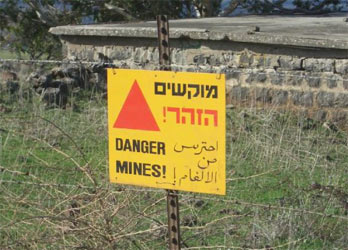
The 1997 Ottawa Treaty bans the use of mines, but countries like the US and Israel have opted to not sign the treaty
About a million landmines have been planted by the Israeli occupation in occupied Palestinian West Bank, official Palestinian data has shown.
The Commissioner General of the Palestinian Liberation Organisation in Washington, Maan Erekat, said: “The number of Israeli landmines planted is between 800,000 to a million.”
During his meeting with UN and NGO officials in New York on Wednesday, Erekat said: “This significant number of landmines poses great direct danger to the safety and security of Palestinian citizens.” He discussed efforts with the officials he met to remove these landmines.
Erekat reiterated the importance of “continuing the efforts being exerted by the UN and NGO in cooperation with Palestinian parties to remove the landmines planted around the occupied West Bank.”
The Israeli occupation has planted landmines in the Palestinian territories since it occupied the West Bank and the Gaza Strip in 1967 under “security” pretexts.
There are about 51 landmine fields scattered around the West Bank and the Gaza Strip, especially in the Jordan valley, the north and west of the West Bank, near the ‘Green Line,’ around Israeli settlements and around large empty spaces where Israeli soldiers practice their military drills.
Related article
Jewish settlers injure children in two separate vehicular assaults
By Saed Bannoura | IMEMC & Agencies | May 23, 2013
Palestinian medical sources have reported that two Palestinian children have been seriously injured, on Wednesday, in two separate incidents after being rammed by settlers’ vehicles in the West Bank districts of Hebron and Nablus.
The sources said that a 9-year-old child was seriously injured after being rammed by a settlers’ car east in As-Salayma neighborhood, east of the Ibrahimi Mosque, in Hebron city. She was moved to a local hospital; the settler fled the scene.
Furthermore, a 16-year-old Palestinian child, identified as Marwan Zakariyya ‘As’ous, suffered serious injuries and was moved to the Rafidia Hospital, after being rammed by a settler’s car at the Beta Junction, south of Nablus.
Usama Malhees, head of the Rafidia Hospital, stated that the ‘As’ous suffered various fractures and is currently on life support at the Intensive Care Unit.
On May 14, Hanin Bassem Al-Ja’bary, 7, was injured after a settler rammed her with his vehicle close to the Ibrahimi Mosque, in the Old City of Hebron. The settler fled the scene.
Dozens of claims have been filed with the Israeli police and the military in the occupied territories regarding hit and run ramming incidents carried out by Israeli settlers, but no actual measures were taken on the ground.
Related articles
- Three Palestinian children arrested after attack by Jewish settler children – Swedish activist also arrested (alethonews.wordpress.com)
- Settlers Attack Palestinian Property, Graves, Near Nablus (imemc.org)
- Jewish terror state Kidnapped 28 Children In The first Half Of May, Dozens Injured (uprootedpalestinians.blogspot.com)
- Settlers Attack, Injure A Palestinian Near Nablus (imemc.org)
- New road connects Israeli settlement with the Ibrahimi Mosque (ramyabdeljabbar.wordpress.com)
- Settlers Attack Schoolchildren Near Nablus – International Middle East Media Center (ramyabdeljabbar.wordpress.com)
Israel considering looser regulations for soldiers in West Bank
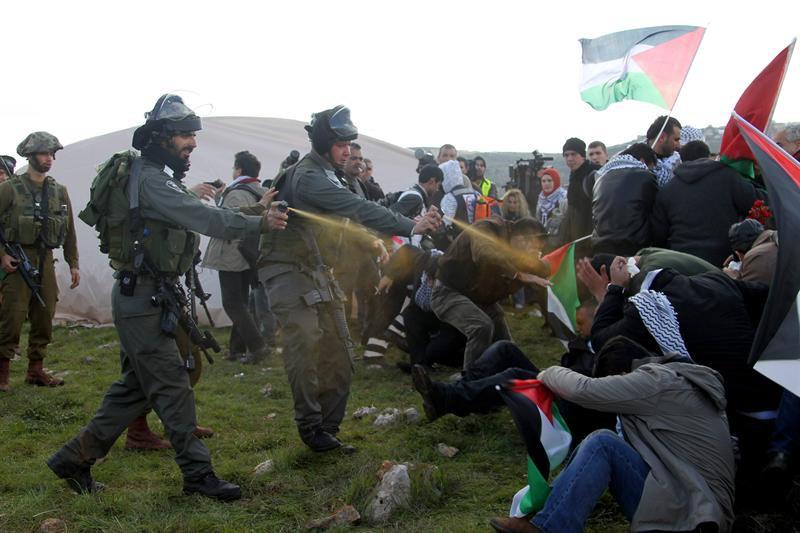
Al-Akhbar | May 23, 2013
Israeli military commanders and parliament members argued Wednesday in favor of changing regulations for soldiers operating in the West Bank in front of a Knesset committee, claiming that the rules governing their actions against Palestinians were too restrictive.
According to the Israeli daily Maariv, three reserve commanders – Amram Mitzna, Danny Yatom and Uzi Dayan – spoke during a Knesset security committee meeting, saying that Israel should address a situation deemed dangerous by Israeli soldiers and field commanders.
Knesset member Moshe Feiglin said Israeli forces felt “impotent” when facing Palestinian demonstrations because of regulations restricting their possible response, Maariv reported.
Deputy Defense Minister Danny Danon spoke of increasing incidents of soldier injuries, adding that the Israeli army needed to do everything it could to reverse the trend.
Nissim Zeev, a Knesset member and member of the ultra-Orthodox political party Shas, said that “there is nowhere else in the world where soldiers in a situation of confronting the enemy are powerless.”
Zeev described the situation in the West Bank as one of “asymmetrical warfare” in which he claimed the well-armed Israeli troops were disadvantaged when faced against Palestinian protesters.
Israeli occupation forces routinely use an arsenal of live bullets, rubber-coated steel bullets, tear gas and skunk water against Palestinians, even during peaceful demonstrations. Palestinians protesters typically respond by throwing rocks and occasional molotov cocktails.
Wednesday’s session was attended by the chief of Israeli forces’ central command, along with heads of West Bank Jewish settlement councils and chief security officers.
According to Maariv, the security committee will hold a closed-door meeting to be attended by the Israeli minister of defense, Moshe Yaalon. The participants will address possible means to “restore Israeli forces’ deterrence and dignity in the West Bank” and give Israeli soldiers more leeway in their dealings with Palestinians.
Since January 2009, Israeli forces have killed 59 Palestinians – including 14 youths aged 18 and under – in the occupied West Bank, while Israeli settlers have killed five, according to Israeli human rights NGO B’Tselem.
In January, 15-year-old Salih al-Amarin from the Azza refugee camp near Bethlehem, was shot in the head and killed during a protest, and a week earlier, Samir Ahmed Abdul-Rahim,17, was shot four times and killed by Israeli soldiers in Budrus, near Ramallah.
In April, Amer Nassar, 17, and Naji al-Balbisi,19, were shot and killed by Israeli soldiers during clashes in Tulkarem.
On Tuesday, Israeli soldiers shot 12-year old Atta Sharadeh in the chest while he was walking with school friends near Ramallah. Sharadeh was in sent to the hospital in critical condition.
(Al-Akhbar, Ma’an)
Related articles
Israel’s ‘illegal’ military entry permit bars selected visitors from West Bank – report
RT | May 19, 2013
Many tourists hoping to visit the West Bank are finding it impossible to do so – because Israel requires certain visitors to have an entry permit. Obtaining permission is anything but easy, because Tel Aviv doesn’t explain the process, Haaretz reported.
The requirement for military entry permits reportedly began at the beginning of 2013. However, not everyone is required to obtain the special pass – and no information has been published surrounding the selection process.
Clerics from the US reportedly had to sign a declaration at Ben-Gurion International Airport recently, promising not to enter Area A without permits from the Coordinator of Government Activities in the Territories (COGAT). Area A includes all Palestinian cities and their surrounding areas, with no Israeli settlements. The area is fully controlled by the Palestinian Authority.
COGAT is a military office which coordinates civilian issues between the Israeli government, the Israel Defense Forces, international organizations, diplomats, and the Palestinian Authority.
“I understand that in the event that I enter any area under the control of the Palestinian Authority without the appropriate authorization all relevant legal actions will be taken against me, including deportation and denial of entry into Israel for a period of up to ten years,” the English-language version of the declaration reads.
The clerics signed the document, but were not told how they could obtain the special permission.
The clerics told Haaretz that they had been sent from their church to work with Christian communities in East Jerusalem and the West Bank. But their mission ended before it ever began because they were not told how to obtain the military entry permit.
One of the clerics sought help from the US Consulate in Jerusalem – but none of the employees were aware of the restictions. The spokesman for the US consulate declined to answer whether Israel had informed the American authorities about the obligation to sign a statement, and did not explain the viewpoint of the US Department of State.
According to Sabine Haddad, a spokeswoman for Israel’s Population, Immigration and Borders Authority, the Entry into Israel Law authorizes the interior minister to decide on the entry of foreigners to the State of Israel. In the case of Judea and Samaria, the Israel Defense Forces chief of general staff makes the determination with a permit from the coordinator’s office.
“When a tourist or foreign national arrives at the international border crossings and it is believed that he wants to enter Judea and Samaria, he should be informed [of the procedure] and asked for his promise to receive a permit from the coordinator’s office before his entry – a permit that constitutes an essential condition [of entry to the Palestinian Authority controlled areas],” she said.
But there is no mention of the existence of such a procedure on COGAT’s English website. The spokesman for the coordinator’s office said the matter of the procedure and the form is being examined.
Meanwhile, lawyers are questioning the legality of the declaration. According to the Oslo Accords, citizens of countries which have diplomatic ties with Israel need only an entry permit for Israel and a valid passport to enter Palestinian Authority territories, Attorney Adi Lustigman said.
The declaration “is not legal because it was formulated for an improper purpose – isolating the occupied territories – and in an improper manner. It makes the assumption that people who arrive in Israel as tourists, as clerics and for other purposes want to act in contradiction to the law, which may not have been explained to them clearly,” Lustigman said.
“If there really is such a procedure, it should be publicized in a simple, clear and accessible manner…it seems there is no operative procedure, nor any procedure for submitting a request. We are left only with a prohibition, which, as we have mentioned, is invalid,” she added.
The practice of requiring tourists to sign such declarations was first reported seven years ago, but was reportedly discontinued and renewed only at the beginning of this year.
Several years ago, the Interior Ministry also began to limit the freedom of movement of tourists with work and family ties in the West Bank, in order to prevent their entry into Israel by means of a permit with the stamp “For the territories of Judea and Samaria only.”
A life of uncertainty under occupation
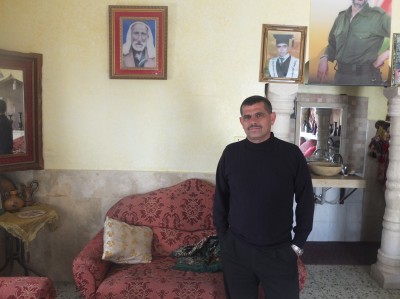
Nasri Sabarna
International Solidarity Movement | May 13, 2013
Beit Ummar, Occupied Palestine – At 3am on 13th May, Nasri Sabarna of Beit Ummar woke up to the sound of Israeli soldiers kicking down his front door. The sound of them shooting tear gas, rubber bullets and sound bombs at people passing his house on their way to the Mosque for morning prayer also woke up his 3 year old granddaughter, whose crying in turn woke up the rest of the Sabarna household.
The 6 jeeps full of soldiers had come to arrest his 21 year old son Achmed – for the fifth time. Achmed is a 21 year old student who has yet to be charged with any crime. As Achmed was not home at the time the soldiers invaded his home, the whole family were ordered to go to the police station in the illegal settlement of Gush Etzyon the following morning at 9am. It was here that Achmed was taken into interrogation. Despite not being guilty of committing any crime, his father does not expect to see him anytime soon. Achmed has already been forced to miss two years of university because of similar incidents, which have cost his family a lot of money – Achmed was arrested for the first time when he was 13 years old.
His father, Nasri is no stranger to the Israeli culture of injustice practiced against Palestinians. At the age of 13, he himself was arrested by Israeli soldiers without charge and imprisoned for 10 months. His whole life has been shaped by the occupation around him. He remembers seeing Israeli bulldozers demolish three historic homes in his village of Beit Ummar at the age of 10 – such events inspired him to become politically active. In 1978 he established the first student council in Palestine, going on later to become mayor of his home village of Beit Ummar. In Israel’s bid to crush any Palestinian political organisation, Nasri was imprisoned for 6 years between 1988 and 1994 for the sole reason of being a member of the political party Fatah.
Nasri’s main concern now is the effect that Israel’s systematic use of administrative detention, harrassment and abuse will have on the younger generations of Palestinians born under occupation. When he was mayor, 40 soldiers broke into his house and destroyed most of their belongings. They wore balaclavas as they did so and terrified his youngest son Abdullah.
Over the following weeks Abdullah’s teachers told his father that his mood had changed, he had become aggressive, argumentative and unusually violent. Nasri sought the help of psychologists from Medicenes Sans Frontiers who worked with Abdullah regularly. He told the psychologists of times where soldiers had lined him and his classmates up when walking home from school and made them jump over their guns before beating them.
The psychological treatment helped Abdullah, who is now ten, to deal with such issues and his behaviour is now back to normal. But Nasri worries for those hundreds of thousands of Palestinian children who are not so lucky to receive treatment. A combination of abuse and detentions coupled with the daily destruction of homes, land, resources and opportunities for young people in the West Bank diminishes any hope they may have for the future and ultimately leads them to seek out revenge through violence.
Nasri emphasised that this is not a struggle between religions, nor are different religious groups inherently incapable of coexisting in harmony. Colonialism and Zionism are the driving forces behind the brutality of the occupation and only granting Palestinians their freedom can bring around real peace. To summarise, Nasri said “No nation can just get rid of another nation.”
Related articles
- Israeli settlers’ attacks continue: Vineyards poisoned in Beit Ummar (occupiedpalestine.wordpress.com)
- Israel’s occupation forces targets medic and injures 17 in clashes in Beit Ummar (occupiedpalestine.wordpress.com)
Israel approves nearly 300 new settlements to coincide with Kerry-Livni meeting
MEMO | May 9, 2013
As Israeli justice minister, Tzipi Livni, met with US Secretary of State John Kerry in Rome on Wednesday, the Israel Civil Administration approved a plan to build 296 housing units in the West Bank settlement of Beit El; an Israeli newspaper reported.
 The newspaper, Yedioth Ahronoth, today described the decision as “A move which could be interpreted as an attempt to Judaize the West Bank.”
Israeli Defence Minister Moshe Ya’alon approved the construction of the new housing units in line with a promise the government had made to settlers. A previous Israeli government had promised to build 90 new housing units in the settlements in an attempt to prevent clashes during the eviction of the Ulpana settlement.
Israeli Prime Minister Benjamin Netanyahu had previously made undertakings to stop further settlement construction until next June when he met with Kerry, angering heads of settler groups.
According to the newspaper, Ya’alon met with heads of Jewish settlers on Tuesday and told them that construction would indeed continue. Netanyahu confirmed that there were delays in issuing construction bids due to errors, but that they would be issued soon.
Settlers hoped that the approval of new housing units would mean the beginning of further settlement plans in the West Bank and Jerusalem.
In Rome, Livni hoped that “enthusiastic and determined” Kerry would move the peace process forward after four years of stalemate.
“We believe that re-launching the negotiations and achieving an agreement between Israel and the Palestinians is in the Israeli interest, but yet there is a need for Secretary John Kerry’s efforts to create something new after four years of stagnation,” Livni said.
Kerry has been holding talks with Israeli, Palestinian and other Arab officials for months. The Israeli newspaper said that he is expected to meet Netanyahu and Abbas separately later in May.
The US Secretary of State said, “I think it is fair to say that we are working through threshold questions and we are doing it with a seriousness of purpose, which I think Minister Livni would agree with, has not been present for a while.”
Stressing the importance of achieving something as soon as possible Livni said, “We all believe that we are working with a short time span. We understand the imperative to try to have some sense of direction as rapidly as we can.”
Kerry has been mobilizing Arab support for Palestinian president Mahmoud Abbas in case he is obliged to offer concessions to Israelis in order to reach a peace deal. Kerry also hopes to set up foundations for a wider peace with the Arab states.
Recently, he achieved a diplomatic victory when the Arab league delegation in Washington announced an agreement to accept that a land swap deal could be reached between Palestinians and Israelis based on the 1967 borders.
Israeli Army Demolishes Shops Near Jenin
By Saed Bannoura | IMEMC & Agencies | May 09, 2013
Israeli soldiers invaded, on Thursday morning, the Barta’a village, near the northern West Bank city of Jenin, declared the village a closed military zone, and demolished 12 shops.
Ghassan Qabha, head of the Barta’a village council, reported that the army invaded the village after sealing all of its entrances, declared it a closed military zone and demolished the twelve structures.
Qabha added that 120 Palestinians work in the demolished buildings, and that most of them are the sole breadwinners in their families.
Furthermore, soldiers handed military orders to eight shop owners informing them the army will be demolishing their shops under the pretext that they were built without construction permits.
Qabha strongly denounced the Israeli attack, and said that the ongoing violations and assaults against the villagers aim at forcing them out of their village that became isolated and surrounded by Israel’s Annexation Wall and its illegal settlements.
Related articles
- Army Demolishes Three Homes In Occupied Jerusalem (imemc.org)
- Israeli occupation forces raid different areas of Jenin while settlers uproot olive trees (occupiedpalestine.wordpress.com)
- Army Kidnaps 13 Palestinians In Bethlehem, 2 In Jenin (imemc.org)
- Israel detains Hamas leader’s sons in raid (alethonews.wordpress.com)
Featured Video

The Truth About the Trump Shootings with Ken Silva
or go to
Aletho News Archives – Video-Images
From the Archives
Trans ‘milk’ as good as the real thing – NHS
RT | February 18, 2024
The drug-induced nipple secretions of trans women are as good as mothers’ breast milk for babies, the University of Sussex Hospitals NHS Trust claimed in a letter to campaigners made public in a report by British think tank the Policy Exchange on Sunday.
The healthcare trust’s medical director, Rachel James, argued that the off-label prescription drug cocktail men transitioning to female take in order to produce milk was “similar to the natural hormones which encourage lactation to develop when the baby is newly born.”
“The evidence which is available demonstrates that the milk is comparable to that produced following the birth of a baby,” James wrote in the letter, sent to Children of Transitioners last August.
Biological men who wish to lactate must first take hormones to grow milk glands and then take high doses of either domperidone or metoclopramide to stimulate milk production. Neither drug is approved for this use, though they are occasionally prescribed off-label to biological women who have trouble lactating.
However, domperidone’s own manufacturer, Janssen, warns patients the drug “may cause unwanted side effects affecting the heart in a breastfed baby” and “should be used during breastfeeding only if your physician considers this clearly necessary.” … continue
Blog Roll
 Aletho News
- Seyed M. Marandi: U.S. Strike Imminent – Toward Total War in the Middle East
- Russia Voted Under Fire. Washington Is Loading the Tankers.
- 12 Things Your Oncologist Was Trained Not to Tell You
- Anthrax Attacks Paved Way for COVID-Era ‘Junk Drugs and Vaccines’
- How Real Is the Impact of Western Sanctions on Israel?
- France, You Are Guilty: How Paris Turned Western Sahara into the Maghreb’s Powder Keg
- 2025 Nature Paper Claiming Worsening Global Drought Gets RETRACTED …Heavily Flawed
- Your Milk Is Not the Problem
- The Truth About the Trump Shootings with Ken Silva
- ARE PATIENTS BEING PROPERLY INFORMED ABOUT OZEMPIC?
- If Americans Knew
- An error has occurred; the feed is probably down. Try again later.
- No Tricks Zone
- 2025 Nature Paper Claiming Worsening Global Drought Gets RETRACTED …Heavily Flawed
- New Study: ‘Global Drought Shows No Detectable Recent Acceleration Under Climate Warming’
- Economic Masterminds: German Socialists Suggest Taxing Productivity Gains Stemming From Using AI
- The South China Sea Has Not Been Cooperating With The Climate Change Narrative
- Energy Crisis: Germany Enters Heating Season With Historically Low Gas Reserve Fill Levels
- New Study: The Antarctic Ice Sheet Gained Mass From 2020-2024 Due To Staggering Snow And Ice Accumulation
- Study: Ocean Heating Rates From Thousands Of Years Ago ‘Dwarf’ Modern Ocean Heating Rates
- Climate Extremists Target, Attack Large-Scale Power Grid Infrastructure In Germany!
- New Study: Antarctic Ice Melt Has Contributed Less Than 1 Centimeter To Sea Level Rise In The Last 30 Years
- Fear Of Debate: Alarmist German Climate Scientist Calls On Mainstream Media To Discredit Skeptic Voices
 Aletho News