A Tale of Two Cities: Kiev and Washington
By Daniel McAdams | Ron Paul Institute | February 7, 2014

In Kiev:
Violent protestors last month occupied three cabinet ministry buildings as they sought to overthrow the Ukrainian government. Protestors physically blocked the speaker of the Ukrainian parliament from taking his seat at the speaker’s podium for weeks. Then they blockaded the speaker of parliament in his own office, forcing him to escape out the window.
As the Ukrainian authorities attempted to restore order and evict protestors from government buildings, the US government threatened sanctions and more if the legally-elected government of Ukraine moved against those occupying government buildings.
Senator John McCain last week threatened unspecified “concrete” US action against Ukraine if there is any “brutal repression of the demonstrations.” In other words, if police forcibly remove those who have taken control of cabinet ministry buildings and blocked the main square of the capitol, McCain implies that “all options are on the table.”
Meanwhile in Washington:
A man attempted to climb the fence surrounding the White House today and was immediately apprehended. The White House complex was placed in full lockdown mode. According to press reports, “the area around the White House was shut down and reporters were not allowed to leave through one of the gates because of the incident.”
Last October, a distraught woman traveling with her one year old daughter bumped into a barricade in front of the White House before driving quickly and erratically toward Capitol Hill. She did not attempt to occupy any government buildings, but once she stopped her car, police shot her dead.
Related article


MIT study of Ghouta chemical attack challenges US intelligence
RT | January 16, 2014
A new MIT report is challenging the US claim that Assad forces used chemical weapons in an attack last August, highlighting that the range of the improvised rocket was way too short to have been launched from government controlled areas.
In the report titled “Possible Implications of Faulty US Technical Intelligence,” Richard Lloyd, a former UN weapons inspector, and Theodore Postol, a professor at the Massachusetts Institute of Technology (MIT), examined the delivery rocket’s design and calculated possible trajectories based on the payload of the cargo.
The authors concluded that sarin gas “could not possibly have been fired at East Ghouta from the ‘heart’, or from the Eastern edge, of the Syrian government controlled area shown in the intelligence map published by the White House on August 30, 2013.”
Based on mathematical calculations, Lloyd and Postol estimate the rocket with such aerodynamics could not travel more than 2 kilometers. To illustrate their conclusion, the authors included the original White House map that depicted areas under Assad control and those held by the opposition. Based on the firing range and troop locations on August 21, the authors conclude that all possible launching points within the 2 km radius were in rebel-held areas.
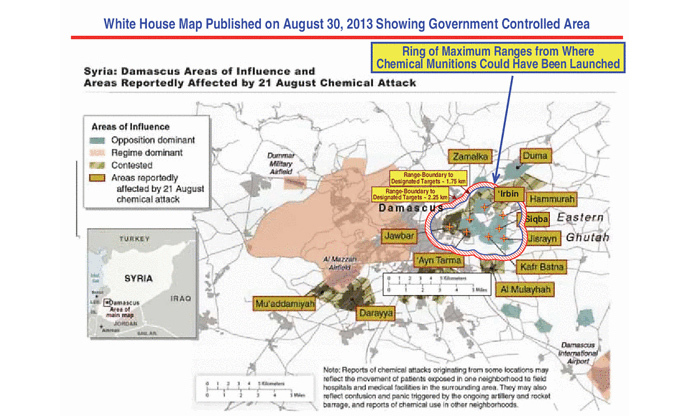
“This mistaken intelligence could have led to an unjustified US military action based on false intelligence. A proper vetting of the fact that the munition was of such short range would have led to a completely different assessment of the situation from the gathered data,” the report states.
The authors emphasize that the UN independent assessment of the range of the chemical munition is in “exact agreement” with their findings.
The report goes on to challenge the US Secretary of State’s key assessments of the chemical attack that he presented to the American people on August 30th and to the Foreign Relations Committee on September 3rd in an effort to muster a military attack on Syria.
“My view when I started this process was that it couldn’t be anything but the Syrian government behind the attack. But now I’m not sure of anything. The administration narrative was not even close to reality. Our intelligence cannot possibly be correct,” Postol told McClatchy news.

“The Syrian rebels most definitely have the ability to make these weapons,” he said. “I think they might have more ability than the Syrian government.”
It also remains a mystery why the particular type of rocket that was used in the attack was not declared by the Syrian government as part of its chemical weapons arsenal when it agreed to destroy its chemical weapons and their delivery methods. OPCW inspectors charged with implementing the agreement also did not discover such a rocket in possession of government forces.
Syria agreed to the destruction of its chemical weapons through a deal brokered by Russia and the US after a sarin gas attack on August 21. Western nations blamed the deadly attack on President Bashar Assad’s forces, while Damascus accused the rebels for the incident. The UN fact-finding mission had no mandate to find out who carried out the attack.
Under the UN-backed plan, all of the country’s declared 1,290 tons of toxic agents should be destroyed by June 30. Initially, the first batch of the most dangerous materials was to be moved out of Syria on December 31.
However, the deadline was missed because of the ongoing war in Syria and technical issues. It was only on January 7 that “priority chemical materials” left the Syrian port of Latakia on a Danish ship for international waters.
Related article

The Government Can’t Even Figure Out How To Shut Down Its Websites In A Reasonable Way
By Mike Masnick | Techdirt | October 2, 2013
With the government shutdown, you have may have come across a variety of oddities involving various government agency websites that were completely taken offline. This seems strange. Yes, the government is shut down, but does that really mean they need to turn off their web servers as well, even the purely informational ones? I could see them just leaving them static without updating them, but to completely block them just seems… odd. Even odder is that not all websites are down and some, such as the FTC’s website appears to be fully up, including fully loading a page… only to then redirect you to a page that says it’s down. Julian Sanchez, over at Cato, explores the various oddities of government domains that are either up or down — or something in between.
For agencies that directly run their own Web sites on in-house servers, shutting down might make sense if the agency’s “essential” and “inessential” systems are suitably segregated. Running the site in those cases eats up electricity and bandwidth that the agency is paying for, not to mention the IT and security personnel who need to monitor the site for attacks and other problems. Fair enough in those cases. But those functions are, at least in the private sector, often outsourced and paid for up front: if you’ve contracted with an outside firm to host your site, shutting it down for a few days or weeks may not save any money at all. And that might indeed explain why some government sites remain operational, even though they don’t exactly seem “essential,” while others have been pulled down.
That doesn’t seem to account for some of the weird patterns we see, however. The main page at NASA.gov redirects to a page saying the site is unavailable, but lots of subdomains that, however cool, seem “inessential” remain up and running: the “Solar System Exploration” page at solarsystem.nasa.gov; the Climate Kids website at climatekids.nasa.gov; and the large photo archive at images.jsc.nasa.gov, to name a few. There are any number of good reasons some of those subdomains might be hosted separately, and therefore unaffected by the shutdown—but it seems odd they can keep all of these running without additional expenditures, yet aren’t able to redirect to a co-located mirror of the landing page.
He also takes on the issue of the FTC redirect, in which he notes that the redirect after loading the full page shows that they’re not saving any money at all this way, meaning it makes absolutely no sense at all.
Still weirder is the status of the Federal Trade Commission’s site. Browse to any of their pages and you’ll see, for a split second, the full content of the page you want—only to be redirected to a shutdown notice page also hosted at FTC.gov. But that means… their servers are still up and running and actually serving all the same content. In fact they’re serving more content: first the real page, then the shutdown notice page. If you’re using Firefox or Chrome and don’t mind browsing in HTML-cluttered text, you can even use this link to navigate to the FTC site map and navigate from page to page in source-code view without triggering the redirect. Again, it’s entirely possible I’m missing something, but if the full site is actually still running, it’s hard to see how a redirect after the real page is served could be avoiding any expenditures.
Sanchez tries to piece together why this might be happening, and points to a White House memo which explicitly says that agencies should shut stuff down even if it’s cheaper to keep them online:
The determination of which services continue during an appropriations lapse is not affected by whether the costs of shutdown exceed the costs of maintaining services…
It’s difficult to see how this helps anyone at all. But it does yet a good job (yet again) of demonstrating that logic and bureaucracy don’t often go well together.
Court rules White House visitor logs can remain secret
By Julian Hattem – The Hill – 08/30/13
A federal appeals court has ruled that the White House can keep secret some records of visitors who enter the building.
In a unanimous decision on Friday, a three-judge panel of the U.S. Court of Appeals for the D.C. Circuit ruled that visitor logs for the Office of the President, at the center of the White House, are not subject to disclosure under the Freedom of Information Act (FOIA).
Anti-secrecy organizations criticized the ruling as a barrier to public oversight.
“Decisions like this turn FOIA from a transparency law into a secrecy law,” Tom Fitton, president of the right-leaning Judicial Watch, told The Hill. He added that the decision was “unprecedented.”
Records for other offices on the White House complex, however, such as the Office of Management and Budget and the Council on Environmental Quality, are subject to public disclosure requests, the court ruled.
The appeals court ruling overturns a district court case brought by Judicial Watch, which sued the Secret Service in 2009 for not releasing seven months’ worth of visitor logs.
The dispute centered on whether the visitor logs amounted to “agency records,” which FOIA requires to be accessible to public requests, except in certain circumstances.
Judge Merrick Garland wrote in the court’s opinion that classifying White House visitor logs as “agency records” could “substantially affect the President’s ability to meet confidentially with foreign leaders, agency officials, or members of the public. And that could render FOIA a potentially serious congressional intrusion into the conduct of the President’s daily operations.”
He added, “Congress did make clear that it intended to place documents like the President’s appointment calendar beyond the reach of FOIA.”
Transparency advocates worried about the precedent that would be set by the decision.
“White House visitor records have proven of enormous value to the public in exposing the outside influences brought to bear on presidential decisions and policies,” said Melanie Sloan, executive director of Citizens for Responsibility and Ethics in Washington, which joined the case. “With this ruling, that window on the White House is now shut.”
The Obama administration has voluntary released its logs of White House visitors, but even those have been a point of contention. The records lack additional identifying details beyond a visitor’s name, can often include typos and may include names of people cleared to enter the building who never actually showed up.
Fitton said that Judicial Watch was “strongly considering” appealing the ruling.
“The option of doing nothing is unlikely,” he said.
Follow us: @thehill on Twitter | TheHill on Facebook
Related article
- Judicial Watch Sues State Department for Documents about Possible Clinton Conflicts of Interest (greenmountainscribes.wordpress.com)
Boy’s Death in Drone Strike Tests Obama’s Transparency Pledge
By Cora Currier | ProPublica | July 1, 2013
On June 9, a U.S. drone fired on a vehicle in a remote province of Yemen and killed several militants, according to media reports.
It soon emerged that among those who died was a boy – 10-year-old Abdulaziz, whose elder brother, Saleh Hassan Huraydan, was believed to be the target of the strike. A McClatchy reporter recently confirmed the child’s death with locals. (Update: The London-based Bureau of Investigative Journalism today reported that there was “strong evidence” it was a U.S. drone strike, but it could not confirm the fact.)
It’s the first prominent allegation of a civilian death since President Obama pledged in a major speech in May “to facilitate transparency and debate” about the U.S. war on al Qaida-linked militants beyond Afghanistan. He also said “there must be near-certainty that no civilians will be killed or injured” in a strike.
So what does the administration have to say in response to evidence that a child was killed?
Nothing.
National security spokeswoman Caitlin Hayden would not comment on the June 9 strike or more generally on the White House position on acknowledging civilian deaths. She referred further questions to the CIA, which also declined to comment.
The president’s speech was the capstone on a shift in drone war policy that would reportedly bring the program largely under control of the military (as opposed to the CIA) and impose stricter criteria on who could be targeted. In theory, it could also bring some of the classified program into the open. As part of its transparency effort, the administration released the names of four U.S. citizens who had been killed in drone strikes.
An official White House fact sheet on targeted killing released along with the speech repeated the “near-certainty” standard for avoiding civilian casualties. Secretary of State John Kerry reiterated it a few days later, when he told an audience in Ethiopia: “We do not fire when we know there are children or collateral — we just don’t do it.”
But White House press secretary Jay Carney said in late May that “this commitment to transparency…does not mean that we would be able to discuss the details of every counterterrorism operation.”
The new White House statements don’t address what happens after a strike, even in general terms.
CIA Director John Brennan offered one of the few public explanations of how casualties are assessed during his nomination hearing in February. Before his confirmation, Brennan was the White House counterterrorism adviser, and is considered to be the architect of Obama’s drone war policy.
He told senators that, “analysts draw on a large body of information — human intelligence, signals intelligence, media reports, and surveillance footage — to help us make an informed determination about whether civilians were in fact killed or injured.”
Brennan also said the U.S. could work with local governments to offer condolence payments. As we’ve reported, there’s little visible evidence of that happening.
At the hearing, Sen. Ron Wyden, D-Ore., asked Brennan if the U.S. should acknowledge when it “makes a mistake and kills the wrong person.”
“We need to acknowledge it publicly,” Brennan responded. Brennan also proposed that the government make public “the overall numbers of civilian deaths resulting from U.S. strikes.”
Neither overall numbers nor a policy of acknowledging casualties made it into Obama’s speech, or into the fact sheet. Hayden, the White House spokeswoman, would not say why.
The government sharply disputes that there have been large numbers of civilian deaths but has never released its own figures. Independent counts, largely compiled from news reports, range from about 200 to around 1,000 for Pakistan, Yemen and Somalia combined over the past decade.
Researchers agree that the number of drone strikes and civilian deaths have dropped during the past year. (Before Obama’s speech, an administration official attributed this partly to the new heightened standards.) The London-based Bureau of Investigative Journalism, which generally has the highest tally of civilian dead, has found there were between three and 16 civilians reportedly killed in about 30 drone or other airstrikes in Yemen and Pakistan so far this year. No strikes have been reported in Somalia.
“Official” statistics might not be much help without knowing more about how they were compiled, said Sarah Holewinski, head of the advocacy group Center for Civilians in Conflict.
That’s because it’s still not clear how the U.S. distinguishes between civilians and “militants,” or “combatants.”
In so-called signature strikes, operators sometimes fire on groups of people who appear to be engaged in militant activity without necessarily knowing their identities. The newly instituted drone rules reportedly roll back the military’s ability to use signature strikes, but the CIA can keep firing in Pakistan under the old rules at least through the end of the year.
An administration official told ProPublica last year that when a strike is made, “if a group of fighting-age males are in a home where we know they are constructing explosives or plotting an attack, it’s assumed that all of them are in on that effort.”
The new White House fact sheet contradicts that, stating: “It is not the case that all military-aged males in the vicinity of a target are deemed to be combatants.”
From the outside, in a strike like the recent one in Yemen, it’s impossible to know how these things were determined. McClatchy reported that the target, Saleh Hassan Huraydan, had “largely unquestioned” ties to al Qaida. Yemeni officials said he arranged to bring money and fighters from Saudi Arabia to Yemen.
As for Huraydan’s young brother, “They may not have realized who was in the car. Or they may have realized it and decided collateral damage was okay,” Holewinski says.
The same questions dog the death of another boy that the administration has acknowledged: the 16-year-old son of Anwar al-Awlaki, a U.S.-born cleric tied to terror attacks. Awlaki and his son were killed in separate strikes in Yemen in the fall of 2011. The boy, Attorney General Eric Holder has said, was “not specifically targeted.”
Related article
- For Obama civilian deaths are O.K. because the enemy kill civilians also (alethonews.wordpress.com)
Homeland Security’s Napolitano invokes 9/11 to push for CISPA 2.0
RT | January 25, 2013
In an attempt to scare the public with a looming cyber attack on US infrastructure, US Homeland Security Secretary Janet Napolitano is once again pushing Congress to pass legislation allowing the government to have greater control over the Internet.
Napolitano issued the warnings Thursday, claiming that inaction could result in a “cyber 9/11” attack that could knock out water, electricity and gas, causing destruction similar to that left behind by Hurricane Sandy.
Napolitano said that in order to prevent such an attack, Congress must pass legislation that gives the US government greater access to the Internet and cybersecurity information from the private sector. Such a bill, known as CISPA or Cyber Intelligence Sharing and Protection Act, was already introduced last year, but failed to pass in Congress due to concerns expressed by businesses and privacy advocates.
“We shouldn’t wait until there is a 9/11 in the cyber world. There are things we can and should be doing right now that, if not prevent, would mitigate the extent of the damage,” Napolitano said in a speech at the Wilson Center, a Washington, DC think tank.
Defense Secretary Leon Panetta has also been a strong advocate for increased governmental grip on the web and in October warned that the US is facing a possible “cyber-Pearl Harbor” by foreign hackers.
“A cyber attack perpetuated by nation states or violent extremist groups could be as destructive as the terrorist attack of 9/11,” he said during a speech. “Such a destructive cyber terrorist attack could paralyze the nation.”
Last September, Napolitano reiterated disappointment with Congress for failing to pass the cybersecurity legislation in August.
“Attacks are coming all the time,” she said in a speech at the Social Good Summit. “They are coming from different sources, they take different forms. But they are increasing in seriousness and sophistication.”
Despite Homeland Security’s constant warnings that hackers could shut down critical US infrastructure, the Cybersecurity Act of 2012 was shot down by the Senate in August, even though the Obama administration had pushed for the bill in numerous hearings and briefings.
Privacy advocates had expressed concern that the US government would be able to read Americans’ personal e-mails, online chat conversations, and other personal information that only private companies and servers might have access to. The head of the National Security Agency promised it wouldn’t abuse its power, but critics have remained skeptical.
A coalition of Democrats this year pledged to make this legislation a priority.
“Given all that relies on a safe and secure Internet, it is vital that we do what’s necessary to protect ourselves from hackers, cyber thieves, and terrorists,” said Sen. Tom Carper (D-Del.), the new chairman of the Homeland Security Committee.
The White House is also working on an executive order that would encourage companies to meet government cybersecurity standards.
A Cabinet of Peaceniks?
By Peter Hart | FAIR | January 9, 2013
I guess it goes to show you how limited the debate over warmaking is when politicians whose records are mostly pro-war can be portrayed as war skeptics.
That’s what is happening with Barack Obama’s new cabinet picks: Sen. John Kerry for secretary of State and former Sen. Chuck Hagel as Defense secretary. In today’s New York Times (1/9/12), Elisabeth Bumiller has a piece headlined, “For Two Nominees, Vietnam Bred Doubts on War,” where she claims:
Between them, Senator John Kerry and Chuck Hagel have five Purple Hearts for wounds suffered in Vietnam, shared a harrowing combat experience in the Mekong Delta and responded in different ways to the conflict that tore their generation apart.
But in nominating one as secretary of State and the other as Defense secretary, President Obama hopes to bring to his administration two veterans with the same sensibility about the futilities of war.
Bumiller goes on to report that Hagel and Kerry supporters say their Vietnam experiences means they “question the price of American involvement overseas.” That would make a certain kind of sense. But their actual records do very little to support this claim.
After quoting Hagel’s criticism of the ongoing Afghan War, Bumiller writes:
Like Mr. Kerry, Mr. Hagel voted for the resolution authorizing the invasion of Iraq but became an early opponent of the Bush administration’s execution of the war.
So both of them voted to authorize the Iraq War, and supported the invasion of Afghanistan. Kerry supported the Panama invasion and NATO’s war in Serbia. And during his presidential campaign in 2004 he talked about possibly increasing the number of troops in Iraq.
Hagel’s record, as I noted already, has been more supportive of U.S. warmaking than not. If anything, their records suggest they are willing to criticize U.S. wars after they’ve voted to support them. This might be in line with the White House’s thinking, but it shouldn’t be confused with an overall skepticism towards U.S. wars and their “futilities.”
Elsewhere in the paper, David Sanger argues that Kerry and Hagel would be part of a “new national security team deeply suspicious of the wisdom of American military interventions around the world.” They “bear the scars of a war that ended when the president was a teenager,” and–along with Obama’s CIA pick John Brennan–”have sounded dismissive of attempts to send thousands of troops to rewire foreign nations as wasteful and ill-conceived.”
True–except when they haven’t.
Related articles
Brennan
Kenny’s Sideshow | January 7, 2013

John O. Brennan (Photo credit: Wikipedia)
Here’s Johnny!
Since Dick Cheney wasn’t available, Obama is picking the next best thing to run the CIA, John Brennan.
Here’s what some of the qualification checklist may have looked like.
I’ve never understood the need to cloak the titles of government positions in Orwellian nonsense. Brennan’s title of counterterrorism adviser should actually have been something like ‘Head of US Terrorism.’ At least then we could have given the administration a ✔ for transparency.
Stop Congress’ New Pro-War Resolution
NIAC – March 7, 2012
This was a major week in the debate over war with Iran versus diplomacy.
The hawkish AIPAC lobby organized its annual conference in Washington, Israeli Prime Minister Netanyahu met with Obama at the White House, and the pro-war crowd had one goal in mind: to pressure the President to draw a new “red line” for military action to try to block diplomacy with Iran and make Iran war inevitable.
But with your help, thirty-seven Members of Congress called on the President to support diplomacy.
Top former military and intelligence officials urged the President to stand firm against pressure for war in a full-page ad sponsored by NIAC. New diplomacy with Iran is now in the process of being scheduled.
And the momentum has shifted. The President refused to give in to pressure. He refused to draw a new “red line,” stood firm against “loose talk of war,” and said that there is time for diplomacy to work.
Diplomacy is the only way to prevent war, prevent an Iranian nuclear weapon, and put mechanisms in place to effectively address human rights abuses in Iran and create space for Iran’s pro-democracy movement.
But, having failed to pressure the President, AIPAC is now lobbying your elected officials in Congress to support a resolution drawing a new “red line” aimed at blocking diplomacy and making war with Iran inevitable.
The movement against war and in support of diplomacy is growing, and we can stop the war push if we stand strong. Please send a letter to your elected officials in the House and Senate and then call them TODAY using a special toll free number, 1-855-68 NO WAR (1-855-686-6927), to urge them to oppose this resolution.
Here is a quick script you can use:
• My name is _______ and I’m calling from [your city].
• I am very concerned about the prospect of another war in the Middle East with Iran. I’m asking that you oppose a dangerous pro-Iran war resolution [Senate Resolution 380 / House Resolution 568], because it aims to block diplomacy and make war with Iran inevitable. Please have the courage to speak out publicly against the push for war with Iran and in support of a diplomatic resolution to the nuclear standoff.
• Thank you.
You can find more information on this pro-war resolution here.
Related articles
- Say NO to AIPAC’s “Nuclear Weapons Capability” Scheme! by justforeignpolicy.org (socialactions.net)
Featured Video

No Threat Can Force Iran’s Surrender /Trita Parsi & Lt Cl Daniel Davis
or go to
Aletho News Archives – Video-Images
From the Archives
An Expert Military Analysis of War with China
Actually, None is Necessary
By Fred Reed • Unz Review • December 13, 2020
The Correlation of Armed Forces: U.S. goods and services trade with China totaled an estimated $634.8 billion in 2019. Exports were $163.0 billion; imports were $471.8 billion. The U.S. goods and services trade deficit with China was $308.8 billion in 2019. Trade in services with China (exports and imports) totaled an estimated $76.7 billion in 2019. Services exports were $56.5 billion; services imports were $20.1 billion. The U.S. services trade surplus with China was $36.4 billion in 2019.
There is talk within the Washingtoniat of a possible war with China. Steve Bannon, who apparently was dropped on his head as a child, actually favors such a war. We hear the usual shoo-the-boobs alarm about how the Chinese are doing something terrible and we must gird our loins and American values and show them what for, bow wow, woof. The danger is that the current game of who-blinks-first in Asian waters might actually provoke a shooting war. You know the kind of thing: One warship refuses to get out of the way of another, a collision ensues, some retard lieutenant who signed up on waivers opens fire, and we’re off and running. It is not a good idea to let children play with matches.
The said war is discussed either in emotional terms by idiots or in purely naval terms by those familiar with such things, so we hear of the First Island Chain and the Second Island Chain and whose missiles against the other’s missiles and so on. This would be appropriate if we were fighting World War Two again. Which we aren’t. Let’s take a quick-and-dirty look at how such a war might go.
To begin the war, America would overestimate itself and underestimate China. This is doctrine in the Pentagon. … continue
Blog Roll
 Aletho News
- Iran To Target Military Industrial-Tech Complex That Facilitated Gaza Genocide
- Collapsing Empire: The Resistance Disarms ‘Israel’
- Suicide Should Not Be a Government Service
- Rethinking America’s greatest threat: Iran vs. Israel-Firsters
- Iran accuses adversaries of false flags to strain Turkey ties
- Poland rules out sending Patriot missiles to US/Israel amid war on Iran
- Tehran approves new Hormuz plan with major restrictions
- No Threat Can Force Iran’s Surrender /Trita Parsi & Lt Cl Daniel Davis
- UK’s New Pandemic Plan Would Turn Big Tech Into a Mass Location Tracking Network
- Growing insecurity, soaring prices fuel protests in north as regime bans evacuation: Sources
- If Americans Knew
- Joe Kent Urges Americans To Call White House and Congress To Object To Sending Troops Into Iran
- DNC Resolution to Reject AIPAC Funding Puts Democratic Leaders in the Hot Seat
- Swedish foundation to build 400 schools as over 650,000 Gaza children remain without education for 2 years
- Israeli army admits photshopping image of slain Lebanese journalist
- This is how Israel is systematically killing health workers under the cover of war in Lebanon
- Carrying life under fire: Israeli invasion of Lebanon leaves pregnant women facing deadly risks
- Champagne all around for the new death penalty (for Palestinians) law – Not a ceasefire Day 172
- Why are Palestinian books struggling to be seen on Amazon?
- The Line Between Affinity and Conspiracy
- As Iran targets US military bases, will they be relocated to Israel? Not a ceasefire Day 171
- No Tricks Zone
- New Study Finds Warming Saves Lives…Cold Temperatures 12 Times More Deadly Than Excess Heat
- German Science Blog Accuses PIK Climate Institute Of Hallucinating Climate Tipping Points
- Devastating Assessment Of Comirnaty Vaccine By Former Senior Pfizer Europe Toxicologist
- New Study: CO2 Is ‘Effectively Negligible’ As An Explanatory Climate Change Factor Since 2000
- Former Pfizer Toxicologist Dr. Helmut Sterz Tells Bundestag Hearing Pfizer Vaccine Should Have Never Been Approved
- Energy Expert: Germany’s Nuclear Phaseout Was A “500 Billion Euro Mistake”
- New Research: South Australia’s Mid-Holocene Sea Surface Temperatures Were 4°C Warmer Than Today
- Storing Green Energy To Last Germany 10 Days Would Require A 60-Million Tonne Battery
- New Studies: UK Sea Levels Were 4 Meters Higher Than Today During The Mid-Holocene
- Destructive Green New Deal: German Energy And Metal Group Warns Of Drastic Crisis
 Aletho News