UK hiding Mideast arms sales with secret deals: Report
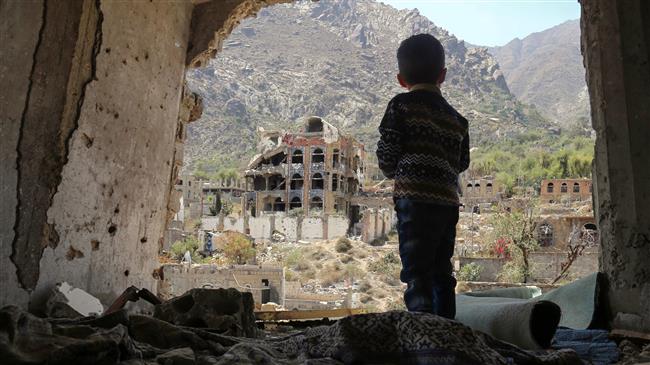
A Yemeni child looking out at buildings damaged in a Saudi airstrike in the southern Yemeni city of Ta’izz, March 18, 2018. (Photo by AFP)
Press TV – March 25, 2018
A recent report has revealed that the United Kingdom is using secretive licenses to hide the scale of its arms exports to countries with dire human rights records in the Middle East.
The Middle East Eye online news portal said figures compiled by the Campaign Against Arms Trade (CAAT) showed that the use of opaque “open licenses” to approve arms sales to states in the Middle East and North Africa by the UK government has increased by 22 percent.
According to the report, Britain has used the secretive export rules to avoid public scrutiny and hide the value of arms and their quantities.
Arms exports are worth $8.3 billion a year to the UK economy.
The MEE said defense firms have used standard open licenses to approve arms sales to the Middle East, valued at more than $4.2 billion since pledges were made by senior ministers to increase UK arms exports after the Brexit vote in June 2016.
The figures showed that the number of open arms export licenses increased from 189 to 230 from 2013 to 2017, while the number of individual items approved under these licensees rose to 4,315 from 1,201.
Saudi Arabia is by far the largest buyer of UK arms under the opaque open licensing system.
Last month, the online news portal revealed an increase of 75 percent in the use of approvals for arms exports, including vital parts for warplanes used in the Saudi aggression on Yemen.
About 14,000 people have been killed since the onset of Saudi Arabia’s military campaign against Yemen in March 2015. Much of the Arabian Peninsula country’s infrastructure, including hospitals, schools and factories, has been reduced to rubble due to the war.
Campaigners further said Britain used open licenses to approve arms sales to the United Arab Emirates, Turkey, Oman, Kuwait, Qatar, Israel, Egypt, Jordan, Bahrain, Algeria and Iraq.
The report said the UK used the secretive open licenses to export assault rifles to Turkey in 2016 as Ankara intensified its crackdown, as well as acoustic riot control devices to Egypt in 2015.
CAAT voiced concerns over the rise in the use of open licenses, which are difficult to track and not subject to public scrutiny or parliamentary oversight.
“The increase in open licenses should concern everybody. It tells us that the government wants to make a shady industry even more closed and secretive,” said Andrew Smith, spokesperson for Campaign Against Arms Trade.
“UK arms are doing terrible damage in Yemen, so it’s more important than ever that parliament and civil society are given as much information as possible so that the government can be held to account,” he added.
Fabian Hamilton, Labor’s shadow minister for peace, said, “The increases in arms exports to countries with questionable human rights records in the Middle East and North Africa must be urgently reviewed. Britain must lead by example, and confront human rights abuses head on.”
“Current government policy on this is fundamentally contradictory,” Hamilton added.
“Why 55 U.S. Senators Voted for Genocide in Yemen”
By Michael S. Rozeff | LewRockwell.com | March 24, 2108
That’s the headline of a blog. It’s a good question. There are six factors involved: Iran, sales of arms, Israel, the CIA, indifferent cruelty, and the system of empire. These are all bad reasons that shouldn’t persuade right-thinking and honorable U.S. senators, but votes for genocide do not come from right-thinking and honorable senators.
Iran. The idea is that Saudi Arabia is thwarting Iran in Yemen. The evidence for this is very, very thin, but even if the Saudis want to thwart Iran somehow in Yemen, that doesn’t justify either a war initiated by Saudi Arabia, a war of the type and scale being waged by the U.S. and Saudi Arabia, and a U.S. presence in that war.
Sales of arms. Huge sales to the Saudis are being made by U.S. companies who influence senators.
Israel. Israel is anti-Iran and in league with Saudi Arabia. Senators are influenced by the Israel lobby.
Notice that in none of these factors or those to follow does the American public play a part. The Senate is only remotely under the control of Americans on this issue, and why would it be? Americans are little affected by what their government does in Yemen, and the U.S. role is kept quite hidden. The visible and well-heeled Israel lobby is more influential than the invisible “pro-American public” lobby.
The CIA. The CIA operates an anti-al Qaeda operation inside Yemen. The war has allowed al-Qaeda to expand. This justifies an expanded CIA presence there. This benefits the CIA.
Indifferent cruelty. The lives of Yemenis count for little to those who vote for genocide. This is a characteristic of fallen man that is sometimes ameliorated by moral teachings and the threat of punishments or worse blowback, but only now and then. The institutional customs and mechanisms to control this trait are not strong enough to stop genocides.
The system of empire. Habitual cruelty is a feature of the U.S. empire. Empires enforce “order”, actually control and dominance, over broad domains that they seek to extend. They use killing to accomplish their expansion in most cases. Their victims are not counted as costs.
Trump assailed for phoning Putin, but feting blood-soaked Saudi dictator is OK
By Finian Cunningham | RT | March 22, 2018
Donald Trump sparked outrage this week in the US over his congratulatory phone call to Russian leader Vladimir Putin on his re-election. But his obscene indulgence of a Saudi despot in the White House hardly ruffled any concern.
How disconnected from reality can you get?
There was furious reaction across US media to news that Trump phoned Russia’s President Putin to congratulate him on his landslide election victory last weekend. Republicans and Democrats were up in arms about what is just basic protocol of one leader calling another to express customary election compliments.
After all, former president Barack Obama did the same when Putin won the previous 2012 presidential election.
This time, however, US-Russian relations have become toxic after a raft of unproven allegations against Moscow, including alleged meddling in the American presidential vote in November 2016 in which Trump was elected, and the latest row over the poisoning of a former Russian double agent in England.
All these anti-Russian claims are unsubstantiated, if not outlandish, but they are repeated often enough to cast a permanent cloud over international relations. Republican Senator John McCain was widely quoted by way of expressing the bipartisan outrage over Trump’s phone call. “An American president does not lead the free world by congratulating dictators,” he said.
American critics of Russia’s Putin can quibble all they like about the merits of his re-election. They contend the vote was a foregone conclusion, rigged in his favor. But such sniping seems churlish against the overwhelming fact that Putin was supported by a huge majority of voters – nearly 77 percent.
In any case, another way of looking at this outpouring of American bile is to enquire just how credible are the detractors?
Their consternation with regard to Putin and Trump’s customary phone call seems way out of proportion, and strangely at odds with their relative silence over the visit in the same week to the White House by Saudi Crown Prince Mohammad bin Salman (MBS).
Bin Salman is the de facto leader of the desert kingdom in place of his ailing father, King Salman. The 32-year-old crown prince consolidated his autocratic power last year in a purge against other members of the House of Saud, in which hundreds of rivals where rounded up, detained, reportedly tortured, and shaken down for billions of dollars.
MBS was feted by Trump in the White House mainly because of the giant weapons purchases he has made since the American president visited the oil kingdom last year – which was Trump’s first official overseas visit.
In a bizarre photo-op, Trump held up gaudy cardboard posters proclaiming various multi-million-dollar arms sales to the Saudi regime. One such deal was depicted as being worth $525 million, to which the president quipped to his Saudi guest, “That’s peanuts to you.”
It was a grubby spectacle of just how sordid the decades-old relationship is between the US and its Arab client regime. All in the seeming salubrious setting of the Oval Office.
If the outrage over Trump’s perfunctory call to Putin had any principle over the matter of elections and autocratic rule, then the critics in Washington would have more than ample cause to fulminate against the Saudi Crown Prince being greeted in the White House. But there was barely any protest.
Admittedly, there was an attempt this week by some senators to pass a resolution limiting American military support for the Saudi war in Yemen. In the end though, the resolution was rejected by a majority of lawmakers.
However, aside from that minor show of dissent, in the scale of things the disconnect with reality in Washington and the US corporate media shows a grotesque distortion of moral priorities.
MBS was visiting Washington in the same week, marking three relentless years of US-backed Saudi slaughter in Yemen. Crown Prince Mohammad bin Salman, who also holds the position of defense minister, is the architect of the Saudi war in Yemen.
The United Nations has called the conflict in the Arab region’s poorest country “the worst humanitarian crisis in decades.”
Some eight million people – a third of the population – are facing starvation, largely because the Saudi-led war has blockaded the country from receiving food imports, medicines, and other humanitarian aid.
Thousands of civilians have been killed in airstrikes by Saudi warplanes that are supplied and refueled by the Americans, British and French. The Americans also share intelligence to direct the Saudi bombing campaign, which even pro-Western human rights groups have reported as being indiscriminate in striking civilian centers. In other words, the US and its NATO allies are fully complicit in this ongoing barbarity.
Saudi claims of fighting against Houthi rebels because the latter are orchestrated by Iran to destabilize the region are not credible. The war is all about trying to re-install a puppet leader, Abdrabbuh Mansour Hadi, who was kicked out by rebel fighters in January 2015. The Saudis launched their war with Washington’s approval in March 2015, partly out of spite over the international nuclear accord that was being negotiated at the time. The Iran nuclear deal was finalized in July 2015. Trump wants to axe it to further placate his Saudi clients.
What is going on in Yemen is nothing short of a bloodbath. Arguably, it is a genocide, given the collective punishment imposed on the entire nation by the Saudi military coalition supported by Washington.
Trump’s hosting of the Saudi crown prince this week in the White House is an obscenity. Celebrating the sale of warplanes, tanks, missiles and other munitions was a macabre drooling over the slaughter of thousands of innocents.
Of course, Trump participated in the charade that the war in Yemen is a “just cause” to counter Iranian malign influence. Iran denies any involvement, as do the Yemeni rebels. There is no evidence to support the US-Saudi claim. Besides, how could Iran supply weapons to a country that is blockaded by land, air and sea?
What is truly disturbing is how little concern the US-enabled carnage in Yemen provokes in official Washington circles and among the corporate media. Millions of Yemeni children are dying from bombardments, hunger, and diseases. The horror is real and unalloyed, unlike the situation in Syria, where the Western media have distorted Syrian Army and Russian liberation of towns besieged by NATO-backed terrorists.
For Yemen, the official silence in Washington is astounding. The very personification of the Yemeni horror – a blood-soaked Saudi despot – is welcomed and cheered, with barely a murmur of protest in Washington or the mainstream news media.
Such people have no moral compass or integrity when all they seem concerned about is their president making a phone call to an elected Russian leader.
Thus, anything they have to say regarding Putin, Russia, its elections and foreign policy is best ignored. People with such a glaring disconnect from reality are impossible to reason with. They are beneath contempt.
Read more:
Pentagon chief calls on Saudi crown prince to cease Yemen aggression
Press TV – March 22, 2018
US Defense Secretary Jim Mattis has called upon Saudi Crown Prince Mohammed bin Salman to find an “urgent” political solution to the devastating three-year-old conflict in neighboring Yemen, which has claimed the lives of thousands of people and left the impoverished nation’s infrastructure in ruins.
Mattis and bin Salman met at the Pentagon on Thursday as the de facto ruler of the Arab kingdom is on a tour of the United States, which began earlier this week with a White House visit.
“As you discussed with President (Donald) Trump on Tuesday, we must also reinvigorate urgent efforts to seek a peaceful resolution to the civil war in Yemen and we support you in this regard,” the US defense secretary told his Saudi counterpart.
“We are going to end this war; that is the bottom line. And we are going to end it on positive terms for the people of Yemen but also security for the nations in the peninsula,” Mattis added.
The Saudi crown prince, speaking through a translator, told Mattis that cooperation between the Pentagon and Saudi Arabia has “improved tremendously” of late.
The remarks came only two days after the US Senate killed a bipartisan bid seeking to end US support for Saudi Arabia’s aerial bombardment campaign in Yemen.
Mattis had lobbied Congress to reject the bill, claiming that restrictions could increase civilian casualties in Yemen, jeopardize the so-called counter-terrorism cooperation between Washington and Riyadh, and “reduce” Washington’s “influence with the Saudis.”
About 14,000 people have been killed since the onset of Saudi Arabia’s military campaign against Yemen in March 2015. Much of the Arabian Peninsula country’s infrastructure, including hospitals, schools and factories, has been reduced to rubble due to the war.
The United Nations says a record 22.2 million people are in need of food aid, including 8.4 million threatened by severe hunger.
A high-ranking UN aid official recently warned against the “catastrophic” living conditions in Yemen, stating that there is a growing risk of famine and cholera there.
“After three years of conflict, conditions in Yemen are catastrophic,” John Ging, UN director of aid operations, told the UN Security Council on February 27.
He added, “People’s lives have continued unraveling. Conflict has escalated since November driving an estimated 100,000 people from their homes.”
Ging further noted that cholera has infected 1.1 million people in Yemen since last April, and a new outbreak of diphtheria has occurred in the war-ravaged Arab country since 1982.
US OKs $1bn in Saudi military deals
Meanwhile, the US State Department said in a statement it had approved military contracts with Saudi Arabia worth over $1 billion.
According to the State Department, 6,600 TOW 2B anti-tank missiles are to be supplied under the biggest contract, which is worth $670 million.
A $106 million deal for helicopter maintenance and another contract for ground vehicle parts worth $300 million were also approved on Thursday.
The State Department said it had notified the US Congress of the possible military equipment contracts.
“This proposed sale will support US foreign policy and national security objectives by improving the security of a friendly country which has been, and continues to be, an important force for political stability and economic growth in the Middle East,” the statement said.
The three contracts are highly expected to be approved by Congress in the wake of the Senate’s Tuesday rejection of the bill to end US support for the Saudi war.
A report by the Stockholm International Peace Research Institute (SIPRI) revealed earlier this month that the US has increased its arms sales by 25 percent over the past five years.
According to the SIPRI report, Saudi Arabia increased its arms purchases by 225 percent over the past five years, importing 98 percent of its weapons from the US and EU countries.
Iran official warns Europe against playing US-Israeli game
Press TV – March 17, 2018
A senior Iranian official has warned European countries against playing into the hands of the United States and the Israeli regime as European signatories to the 2015 Iran nuclear deal propose fresh sanctions against Tehran under the pressure of Washington.
“Defense capabilities, particularly the missile program, of the Islamic Republic of Iran, which have a deterrent nature, will firmly be continued based on national security necessities,” Secretary of Iran’s Supreme National Security Council (SNSC) Ali Shamkhani said in a meeting with Oman’s Foreign Minister Yusuf bin Alawi in Tehran on Saturday.
“Political and media propaganda will have no impact on their development,” he added.
Britain, France and Germany have proposed new EU sanctions on Iran over its missile program and its regional role, a confidential document said on Friday.
The joint paper was sent to the EU capitals to sound out support for such sanctions as they would need the backing of all 28 member states of the bloc, Reuters quoted two people familiar with the matter as saying.
The proposal is allegedly part of an EU strategy to appease US President Donald Trump and preserve the Iran nuclear deal, officially known as the Joint Comprehensive Plan of Action (JCPOA), signed between Tehran and the P5+1 group of countries in 2015 amid constant US threats to withdraw from it.
Shamkhani said US failure to fulfill its obligations and its illegal approach to the JCPOA as well as Europe’s passivity with regard to Washington’s approaches clearly show that regional countries need to focus on finding a solution to the ongoing issues and crises in the region by themselves.
“The Islamic Republic of Iran will give a proper and due response to the US constant violations of its commitments under the JCPOA and will accept no change, interpretation or new measure that would limit the JCPOA,” the SNSC secretary said.
His comments came a day after Iranian Foreign Minister Mohammad Javad Zarif warned the US against the “painful mistake” of pulling out of the Iran nuclear agreement.
“Considering what has been envisaged in the JCPOA in the field of research and development and the Islamic Republic of Iran’s continued measures to develop its peaceful nuclear capability, if the US makes the mistake of exiting the JCPOA, it will definitely be a painful mistake for the Americans,” Zarif told reporters.
Elsewhere in his comments, Shamkhani said growing deep relations between Iran and Oman had led to consensus on regional issues.
“The development of constructive and all-out relations with neighbors based on common interests is the top priority of the Islamic Republic of Iran’s foreign policy,” he added.
The senior Iranian official lashed out at certain regional countries for adopting “a hasty and arrogant attitude and statements” which have posed serious challenges to the handling of regional crises.
He expressed his concern about the killing of Yemeni women and children in airstrikes by Saudi Arabia and the United Arab Emirates as well as the catastrophic conditions of the oppressed Yemeni people.
“The shared view of Iran and Oman on the Yemeni crisis is based on putting an immediate end to war, establishing ceasefire, lifting the blockade, dispatching humanitarian aid and holding Yemeni-Yemeni dialogue to form new political structures based on the Yemeni people’s demands and vote,” Shamkhani pointed out.
He emphasized that the Yemeni crisis cannot be settled through military approaches and urged a political initiative in this regard.
About 14,000 people have been killed since the onset of Saudi Arabia’s military campaign against Yemen in March 2015. Much of the Arabian Peninsula country’s infrastructure, including hospitals, schools and factories, has been reduced to rubble due to the war.
The United Nations says a record 22.2 million people are in need of food aid, including 8.4 million threatened by severe hunger.
The UN Security Council on March 15 warned about the worsening humanitarian situation in war-battered Yemen, stating the status quo is having a “devastating” impact on the lives of civilians in the impoverished Arab country.
“The Security Council expresses its grave concern at the continued deterioration of the humanitarian situation in Yemen, and the devastating humanitarian impact of the conflict on civilians,” it said in a statement.
Oman urges dialogue instead of military approaches
The Omani foreign minister, for his part, criticized military approaches to regional issues and urged the path of dialogue and understanding instead.
He added that Oman regards Iran as a trustworthy neighboring country and commended the Islamic Republic’s role in establishing stability and security in the region.
Bin Alawi arrived in Tehran Friday night on a two-day visit to hold talks with senior Iranian officials about mutual and regional issues.
Iran rejects speculations about bin Alawi’s visit
Iranian Foreign Ministry Spokesman Bahram Qassemi on Saturday rejected speculation about a link between the Omani minister’s visit to Tehran and US Defense Secretary James Mattis’s recent travel to Muscat and said bin Alawi’s trip was taking place with the purpose of strengthening mutual relations.
“Although Oman has very good relations with many countries in the world, Mr. Yusuf bin Alawi’s trip to Tehran has nothing to do with Mattis’s visit to this country,” Qassemi said.
He strongly rejected any link between bin Alawi’s visit to Tehran and US policies on the JCPOA.
The Iranian spokesperson said, “Iran and Oman are cooperating with each other on a wide range of issues and the two sides seek to use the two countries’ existing capacities to further deepen economic, commercial, banking and financial cooperation.”
Saudi Arabia leads flood of arms imports to Middle East: Study
Press TV – March 12, 2018
A study shows weapons imports to the Middle East and Asia have soared over the past five years, with Saudi Arabia leading the steep rise amid its bloody war on Yemen.
According to the Stockholm International Peace Research Institute (SIPRI), arms imports to the Middle East between 2013 and 2017 jumped by 103 percent compared with the previous five-year period.
Saudi Arabia is now the world’s second largest importer of arms after India. The kingdom registered a 225-percent rise in military purchases – almost all from the US and Europe – during the period, the study released on Monday said.
American weapons constitute 61 percent of arms imports to Saudi Arabia and British weapons 23 percent. During the period, the Saudis received 78 combat aircraft, 72 combat helicopters, 328 tanks and 4,000 vehicles, the SIPRI noted.
The same period, it said, saw Israel increasing its arms exports by 55 percent.
“The US and European states remain the main arms exporters to the region and supplied over 98 percent of weapons imported by Saudi Arabia,” it said.
On Friday, Saudi Arabia signed a preliminary deal to buy 48 Typhoon jets worth as much as $10 billion.
Saudi Arabia already operates more than 70 Typhoon jets. They have been used extensively in the Yemen war, and the deal is likely to spark outrage among rights groups and campaigners.
Arms remain the main component of UK-Saudi trade and the UK government has approved the export of $6.4 billion in weapons since the start of the war in Yemen, despite allegations that Saudi-led forces have committed war crimes.
The United Kingdom has increased its weapons sales by around 500 percent since March 2015, The Independent reported last November.
Last May, US President Donald Trump visited Saudi Arabia in his first foreign visit, signing a $110-billion deal to sell weapons to the kingdom.
“Widespread violent conflict in the Middle East and concerns about human rights have led to political debate in Western Europe and North America about restricting arms sales,” said senior SIPRI researcher Pieter Wezeman.
“Yet the US and European states remain the main arms exporters to the region and supplied over 98 percent of weapons imported by Saudi Arabia.”
More than 13,600 people have died since the Saudi-led invasion began, and Yemen has turned into the scene of the world’s worst humanitarian crisis.
MSNBC Ignores Catastrophic US-Backed War in Yemen, Finds Russia 5000% more newsworthy
By Ben Norton | FAIR | January 8, 2018
For the popular US cable news network MSNBC, the largest humanitarian catastrophe in the world is apparently not worth much attention—even as the US government has played a key role in creating and maintaining that unparalleled crisis.
An analysis by FAIR has found that the leading liberal cable network did not run a single segment devoted specifically to Yemen in the second half of 2017.
And in these latter roughly six months of the year, MSNBC ran nearly 5,000 percent more segments that mentioned Russia than segments that mentioned Yemen.
Moreover, in all of 2017, MSNBC only aired one broadcast on the US-backed Saudi airstrikes that have killed thousands of Yemeni civilians. And it never mentioned the impoverished nation’s colossal cholera epidemic, which infected more than 1 million Yemenis in the largest outbreak in recorded history.
All of this is despite the fact that the US government has played a leading role in the 33-month war that has devastated Yemen, selling many billions of dollars of weapons to Saudi Arabia, refueling Saudi warplanes as they relentlessly bomb civilian areas and providing intelligence and military assistance to the Saudi air force.
With little corporate media coverage from MSNBC or elsewhere, the US—under both presidents Barack Obama and Donald Trump—has staunchly supported Saudi Arabia as it imposes a suffocating blockade on Yemen, diplomatically shielding the draconian Gulf dictatorship from any form of punishment as it has plunged millions of Yemeni civilians into mass hunger and pushed the poorest country in the Middle East onto the brink of famine.
1 Mention of Saudi Airstrikes; No Mention of Cholera

A favorite theme of MSNBC coverage
FAIR conducted a thorough analysis of MSNBC‘s broadcasts archived on the Nexis news database. (The figures in this report are derived from Nexis.)
In 2017, MSNBC ran 1,385 broadcasts that mentioned “Russia,” “Russian” or “Russians.” Yet only 82 broadcasts used the words “Yemen,” “Yemeni” or “Yemenis” in the entire year.
Moreover, the majority of the 82 MSNBC broadcasts that mentioned Yemen did so only once and in passing, often simply as one nation in a longer list of nations targeted by President Trump’s travel ban.
Of these 82 broadcasts in 2017, there was only a single MSNBC news segment devoted specifically to the US-backed Saudi war in Yemen.
On July 2, the network ran a segment on Ari Melber’s The Point (7/2/17) entitled “Saudi arms deal could worsen Yemen crisis.” The three-minute broadcast covered many of the important points about US support for the catastrophic Saudi war in Yemen.
Yet this informative segment stood alone in the entire year. A search of the Nexis database and the Yemen tag on MSNBC‘s website shows that, in the approximately six months after this July 2 broadcast, the network did not devote another segment specifically to the war in Yemen.
A search of MSNBC broadcasts also shows that, while the network would sometimes within the same broadcast mention both Yemen and airstrikes, it did not—aside from Ari Melber’s lone segment—acknowledge the existence of US/Saudi coalition airstrikes on Yemen.

MSNBC only notices airstrikes in Yemen when aimed at Al Qaeda
The closest the network otherwise came was in a March 31, 2017 segment on the Last Word With Lawrence O’Donnell, in which Joy Reid said, “And as the New York Times reports, the United States launched more attacks in Yemen this month than during all of last year.” But Reid was referencing a New York Times report (3/29/17) on US airstrikes on Al Qaeda in the Arabian Peninsula (which numbered in the dozens), not US/Saudi coalition airstrikes on Houthi-controlled territory in Yemen (which numbered in the thousands).
While ignoring the US/Saudi coalition airstrikes and the thousands of civilians they killed, however, MSNBC did report on Houthi attacks on Saudi warships of the coast of Yemen. In his show MTP Daily (2/1/17), Chuck Todd favorably covered the anti-Iran posturing of Trump and National Security advisor Michael Flynn. He misleadingly spoke of the Houthis as Iranian proxies and gave former US diplomat Nicholas Burns a platform to claim, “Iran is a violent troublemaker in the Middle East.” On February 1 and 2, Chris Hayes also reported on the Houthi attack.
MSNBC was eager to highlight attacks by US official enemies, yet the tens of thousands of air sorties Saudi Arabia has launched in Yemen—with weapons, fuel and intelligence from the US and UK—were made almost entirely invisible by the network.
Years of US/Saudi coalition bombing and blockade of Yemen likewise decimated the poor country’s health system, plunging it into a cholera epidemic that has killed thousands of people and broken all previous records. MSNBC did not once acknowledge this catastrophe either, according to a search on Nexis and MSNBC‘s website. Cholera was only mentioned on MSBNC in 2017 in the context of Haiti, not Yemen.
Only Interested When Americans Die
While MSNBC did not bother to mention Yemen’s cholera epidemic, it did express lots of interest in a disastrous Navy SEAL raid President Donald Trump approved in the country, which left an American dead. Particularly early in the year, the network devoted substantial coverage to the January 29 raid, which killed dozens of Yemeni civilians and one US soldier.
A search of the Nexis database shows that MSNBC mentioned the Trump-approved US raid in Yemen in 36 distinct segments in 2017. All of the network’s major shows produced segments that focused on the raid: MTP Daily on January 31 and March 1; All In on February 2, February 8 and March 1; For the Record on February 6; The Last Word on February 6, 8 and 27; Hardball on March 1; and the Rachel Maddow Show on February 2, February 3, February 23 and March 6.
But after this raid left the news cycle, so too did Yemen. A search of Nexis and the Yemen tag on the MSNBC website shows that, excluding Ari Melber’s lone July segment, the latest segment MSNBC devoted specifically to Yemen in 2017 was the Rachel Maddow Show‘s March 6 report on the SEAL raid.
The message conveyed is clear: to the leading liberal US cable news network, Yemen is relevant when it is Americans who die—not when thousands of Yemenis are killed, bombed daily by Saudi Arabia, with US weapons, fuel and intelligence; not when millions of Yemenis are on the verge of starving to death while the US/Saudi coalition uses hunger as a weapon.
The conclusion that only Americans’ lives are newsworthy is confirmed by the fact that Trump launched another disastrous raid in Yemen on May 23, in which several Yemeni civilians were once again killed. But American soldiers did not die in this raid, so MSNBC had no interest. The network did not devote coverage to this second botched Yemen raid.
Constant Attention to Russia
According to a Nexis search of the network’s broadcasts from January 1 to July 2, 2017, “Yemen,” “Yemeni” or “Yemenis” were mentioned in 68 MSNBC segments—nearly all of which were related to the SEAL raid or the list of countries targeted by Trump’s Muslim ban.
In the approximately six months from July 3 through the end of December, the words “Yemen,” “Yemeni” or “Yemenis” were only uttered in 14 segments. In most of these segments, Yemen was mentioned just once in passing.

Thousands of MSNBC segments last year mentioned Russia
In this same 181-day period in which MSNBC had no segments devoted specifically to Yemen, the terms “Russia,” “Russian” or “Russians” were mentioned in a staggering 693 broadcasts.
This is to say, in the latter half of 2017, MSNBC aired 49.5 times more—or 4,950 percent more—segments that spoke of Russia than segments that spoke of Yemen.
In fact, in the four days from December 26 to December 29 alone, MSNBC said “Russia,” “Russian” or “Russians” nearly 400 times in 23 separate broadcasts, on all of the network’s major shows, including Hardball, All In, Rachel Maddow, The Last Word, Meet the Press Daily and The Beat.
The day after Christmas featured an onslaught of Russia coverage. On December 26, the words “Russia,” “Russian” or “Russians” were uttered a staggering 156 times in the broadcasts from 5 pm EST to 11 pm. The following is the breakdown of the number of mentions of Russia:
- 33 times on MTP Daily at 5 pm
- 6 times on The Beat at 6 pm
- 30 times on Hardball at 7 pm
- 38 times on All In at 8 pm
- 40 times Rachel Maddow at 9 pm
- 9 times on The Last Word (with Ari Melber filling in for O’Donnell) at 10 pm
On this one day, MSNBC mentioned Russia almost twice as many times in six hours of coverage than it mentioned Yemen in all of 2017.
Passing References
While MSNBC did not have a segment devoted specifically to the war in Yemen other than Ari Melber’s lone July broadcast, the country was sporadically mentioned in passing.
Chris Hayes briefly acknowledged Yemen a few times, although he did not devote a segment to it. In the May 23 broadcast of All In, the host did point out, “We have been arming and supporting the Saudis as they pursue a proxy war in Yemen against Shia rebels, the Houthis.” Aside from the fact that the supposed Saudi/Iran proxy war in Yemen to which Hayes apparently alludes is a misleading talking point that has been fueled by the US government and intelligence agencies and obediently echoed by corporate media (FAIR.org, 7/25/17), Hayes still did not recognize the US/Saudi coalition airstrikes that have killed thousands of civilians.
In a June 29 interview on All In, Palestinian-American activist Linda Sarsour additionally spoke out on behalf of “Yemeni refugees who are victims of a proxy war that we’re funding.” Hayes added, “Who are starving to death, because we’re essentially funding the Saudis to hold them under siege.” This was the rare moment in which MSBNC acknowledged the Saudi blockade of Yemen—but, again, no mention was made of the US-backed Saudi airstrikes that have killed thousands of Yemenis.
On July 5, Chris Hayes spoke using extreme euphemisms, stating, “Since taking office, the president has been swayed to take Saudi Arabia’s side in its dispute with Yemen.” Looking beyond the fact that “dispute” is an outrageous understatement for a brutal war that has led to the deaths of tens of thousands, Hayes failed to point out that former president Barack Obama, like Trump, staunchly supported Saudi Arabia as it bombed and besieged Yemen.
Rachel Maddow also again briefly mentioned the botched January US raid in Yemen in her broadcasts on April 7 and 24. So too did Hayes on October 16.
On MTP Daily on December 6, Chuck Todd similarly spoke of Yemen in passing, observing:
It is interesting, Tom, that the president seems to have these Gulf State allies. He is giving them basically carte blanche a little bit on what they’re doing in Yemen, is sort of looking the other way.
But that is it. Aside from Ari Melber’s one-off July segment, in 2017 MSNBC had no other coverage of the US-backed war that has created the largest humanitarian catastrophe in the world.
What is striking is that MSNBC is clearly extremely critical of Donald Trump, yet it has passed on one of the best opportunities to condemn his policies. Instead of covering some of Trump’s worst, most violent actions—his acts of war that have left many thousands of civilians dead—MSNBC has ignored Trump’s Yemeni victims.
Perhaps this is because it was a Democratic president—Barack Obama, a favorite of MSNBC—who first oversaw the war in Yemen for nearly two years before Trump entered office. But MSNBC‘s right-wing rival, Fox News, has shown again and again that it has no problem attacking Democrats for doing what Republicans did before them.
You can send a message to Rachel Maddow at Rachel@msnbc.com (or via Twitter: @Maddow). Chris Hayes can be reached via Twitter: @ChrisLHayes. Please remember that respectful communication is the most effective.
The spin machine behind Saudi Arabia’s ‘humanitarian aid plan’ for Yemen
By Dan Glazebrook | Middle East Eye | March 2, 2018
On 22 January, the Saudi-led coalition in Yemen unveiled a new plan to deliver “unprecedented relief to the people of Yemen”.
The Yemen Comprehensive Humanitarian Operations (YCHO) is a new “aid” programme with the ostensible aim of “addressing immediate aid shortfalls while simultaneously building capacity for long-term improvement of humanitarian aid and commercial goods imports to Yemen”.
This will primarily be done through increasing the “capacities of Yemeni ports to receive humanitarian as well as commercial imports” – and all sealed with a whopping $1.5bn in aid contributions. What could possibly be wrong with that?
Starvation politics
The problem here is not only that the funding required to meet the needs created by the Saudi-led coalition is estimated by the UN to be twice that amount. The real problem is that the plan will not, in fact, increase the imports on which Yemen is utterly dependent, but reduce them still further.
This is because the much-vaunted “improvements in port capacity” will apply solely to “coalition-controlled ports”, excluding the ports outside their control – Hodeidah and Saleef – which, between them, handle about 80 percent of Yemen’s imports.
For these, absolutely critical, ports, the plan explicitly states that it wants a reduction in the flow of cargo they handle: by around 200 metric tons per month, compared to mid-2017 levels. Yes, you heard correctly: cargo levels in mid-2017 – when 130 children were dying each day from malnutrition and other preventable diseases largely caused by the limits on imports already in place – are now deemed in need of further, major, reductions.
This plan is nothing less than a systematisation of the starvation politics of which the Saudis were accused by the UN Panel of Experts on Yemen in relation to their closure of Hodeidah and Saleef in November.
Back then, noted the panel’s final report, all Yemen’s ports had been closed following a Houthi missile attack on Riyadh airport. But while coalition-controlled ports were quickly reopened, Hodeidah and Saleef remained closed for weeks.
“This had the effect,” said the panel, “of using the threat of starvation as an instrument of war.” Today, the “Comprehensive Operations” plan envisages making permanent the juxtaposition of wilful starvation of Houthi-controlled territory (in which the vast majority of Yemenis live) and “generous” aid deliveries into coalition-controlled territories.
Spin masters
These are the same “methods of barbarism” as were employed by the British in the Boer war – when Boer-controlled territories were subjected to scorched earth policies of torching farms and destroying livestock – and then revived for Britain’s colonial wars in Malaya, Kenya and, indeed, Yemen in the 1950s-60s. Small wonder Britain is so deeply involved today.
But such a strategy will surely be hard to sell in this day and age. Certainly, the Saudis seem to think so, which is presumably why they have employed a plethora of PR agencies to help them do so.
An exceptional investigation by the IRIN news agency reported that “the press release journalists received announcing the [YCHO] plan came neither from the coalition itself nor from Saudi aid officials”.
It came, along with an invitation to visit Yemen, straight from a British PR agency. The investigation also revealed that the PowerPoint presentation used to introduce the YCHO to high-level UN officials was authored by Nicholas Nahas, of Booz Allen Hamilton, a US management consultancy with long-established links to the US government (including involvement in the illegal SWIFT and PRISM mass surveillance programmes). The consultancy currently has, says IRIN, “35 job listings in Riyadh on its website, including ‘military planner'”.
This role requires the applicant to: “Provide military and planning advice and expertise to support the coordination of joint counter threat operations executed by coalition member nations and facilitate resourcing to enable operations.”
Another PR company involved in “selling” the YCHO, long on the Saudi payroll, is Washington DC-based Qorvis MSLGroup. According to IRIN’s report, the company “booked US revenue of more than $6m from the Saudi Arabian embassy [in the US] over a 12-month period up to September 2017”.
These masters of spin have certainly been busy: their work on the plan has been delivered to “the offices of major INGOs in the UK as well as to members of the UK parliament”, and YCHO accounts have been set up on Facebook, Twitter, Instagram, Youtube and Gmail.
The YCHO Twitter account has around 10,000 followers; but, says the IRIN investigation, “almost half of YCHO’s followers have less than 10 followers themselves, while some 1,000 followers were accounts created on the same day in 2016 – signs that a significant number of bots or fakes are inflating YCHO’s popularity”.
“All of this,” concludes IRIN, “has fed suspicions that rather than a genuine attempt to help the people of Yemen, the plan is really intended more to gloss over the Hodeidah issue and improve Saudi Arabia’s battered image, or at least a bit of both.”
You would think a strategy aimed at starving the world’s most starved population still further would be a hard sell. But, then, money not only talks, it silences. And $1.5bn is a lot of money.
The UN response
The UN’s own Humanitarian Response Plan for Yemen, issued just two days before the YCHO, on 20 January, had noted that: “Al Hudaydah port, which accounts for 70-80 per cent of commercial imports in Yemen, remains a critical lifeline, despite operating at reduced capacity after being hit by an air strike in August 2015.”
The UN statement added that “the extended blockade imposed on Al Hudaydah and Salif ports on 6 November 2017 significantly threatened this lifeline of Yemenis” and that “only a sustained flow of imports of essential basic goods can avert further catastrophe”.
Yet the cash-strapped UN, facing dramatic budget cuts from the Trump administration, and presumably nervous of saying anything that might jeopardise Saudi-Emirati money as well, officially welcomed the announcement, despite its clear commitment to essentially tightening the very blockade of Hodeidah and Saleef ports which the UN had denounced just days earlier.
Politicising humanitarian aid
Thankfully, the aid agencies do not seem to have been fooled. A joint statement on the YCHO by a number of international NGOs, including Oxfam and Save the Children, stated that:
“We remain concerned that the blockade on Red Sea ports has still not been fully lifted and about the insufficient volume of fuel reaching these, which has led to an increase in the price of basic goods across the country.
“As a result, we are seeing families pushed into preventable disease and starvation because they cannot afford to buy food and clean water. Hodeidah port handles the majority of the country’s imports and cannot be substituted. It is vital that the warring parties commit to keep Hodeidah port fully open and functioning, including unfettered access for both humanitarian and commercial supplies.”
Save the Children’s Caroline Anning explained that the plan “is a misconception – in the publicity around this new plan they say the blockade around Hodeida port has been fully lifted but actually what we’re seeing is that fuel is still being blocked coming into that port which is having a really horrendous knock-on effect around the country.”
And the International Rescue Committee (IRC)’s scathing response – issued with the title “Yemen: Saudi ‘aid’ plan is war tactic” – is worth quoting at length:
“The Yemen Comprehensive Humanitarian Operations (YCHO), announced on January 22, 2018, is neither comprehensive, nor reflective of clear, shared humanitarian priorities… The YCHO politicizes aid by attempting to consolidate control over access and transit points. Rather than endorsing a parallel plan, which was created without broad input from humanitarian actors, the Saudi Led Coalition (SLC) and its supporters, notably the US and UK, should work to ensure the full implementation of the existing UN humanitarian response plan.
“A meaningful response to the world’s largest humanitarian crisis requires more access – not less. At best, this plan would shrink access and introduce new inefficiencies that would slow the response and keep aid from the neediest Yemenis, including the over eight million on the brink of starvation,” said Catanzano.
“At worst, it would dangerously politicize humanitarian aid by placing far too much control over the response in the hands of an active party to the conflict.”
Essentially, this is a plan to tighten the blockade while monopolising access to aid in the hands of the aggressors, presented as a great humanitarian effort, and unveiled just as the coalition begins an attack on the country’s “vital lifeline” which will lead to “a complete horror show” and “near-certain famine”.
Tighten the blockade
On 9 February, the UN announced that 85,000 people had been displaced in 10 weeks due to “surging violence”, particularly on the Red Sea coast, where the coalition have mounted a new campaign to capture the country’s strategically important Hodeidah port.
With the Hodeidah campaign now entering a new phase, this war on the Yemeni population is set to escalate still further. Since it launched in early December, the coalition and its Yemeni assets have taken several towns and villages in Hodeidah province, and are now poised to take the battle to the city itself.
On 20 February, Emirati newspaper The National reported that, in the coming days, “more forces will be committed to Hodeidah as a new front is to be opened in the next few days by Maj Gen Tariq Mohammed Abdullah,” nephew of the deceased former president Ali Abdullah Saleh.
This attack would put the almost completely import dependent country’s most essential port out of action for months, leaving millions unable to survive. “If this attack goes ahead,” Oxfam chief executive, Mark Goldring, told the press when a similar attack was proposed earlier last year, “this will be a deliberate act that will disrupt vital supplies – the Saudi-led coalition will not only breach International Humanitarian Law, they will be complicit in near certain famine.”
His colleague Suze Vanmeegan added that “any attack on Hodeidah has the potential to blast an already alarming crisis into a complete horror show – and I’m not using hyperbole.”
The Yemen Quartet
There is no doubt the war’s British and American overseers have given their blessing to this escalation. In late 2016, the “Yemen Quartet” was formed by the US, the UK, Saudi Arabia and the UAE to co-ordinate strategy between the the war’s four main aggressors.
Throughout 2017, they met sporadically, but since the end of the year their meetings have become more frequent and higher-level.
At the end of November, just before the launch of operations in Hodeidah province, British Foreign minister Boris Johnson hosted a meeting of the Quartet in London as British Prime Minister Theresa May simultaneously met with King Salman in Riyadh, presumably to give the go-ahead to this new round of devastation for Yemen’s beleaguered population.
They met again two weeks later, and then too on 23 January, also at Johnson’s instigation, where the meeting was attended, for the first time, by US Secretary of State Rex Tillerson. The “economic quartet” – also attended by officials from the IMF and World Bank – convened on 2 February in Saudi Arabia, while Johnson and Tillerson once again met with their Saudi and Emirati counterparts to discuss Yemen in Bonn on 15 February.
Of course, these meetings do not carry out the nitty-gritty of strategic war planning – civil servants in the military and intelligence services do that. The purpose of such high level forums is rather for each side to demonstrate to the other that any strategic developments carry the blessing of each respective government at the highest level.
That the “quartet” met just days before an announcement that the long-planned attack on Hodeidah port was imminent, then, speaks volumes about US-UK complicity in this coming new premeditated war crime.
In the twisted minds of men like Saudi Crown Prince Mohammed bin Salman, Rex Tillerson and Boris Johnson – for whom even the liquidation of an entire people is apparently a noble cause in the pursuit of containing Iran – this is what passes for humanitarianism today.

– Dan Glazebrook is a political writer and editor of stopstarvingyemen.org. He is author of Divide and Ruin: The West’s Imperial Strategy in an Age of Crisis and blogs at danglazebrook.com.
This article is available in French on Middle East Eye French edition.
READ MORE:
Culture of concealment: The UK government’s brazen duplicity in Yemen
Who Loves Ya, Saudi?
Just the UK’s Theresa May and her deluded Foreign Office, and the callous death merchants of Washington and Tel Aviv
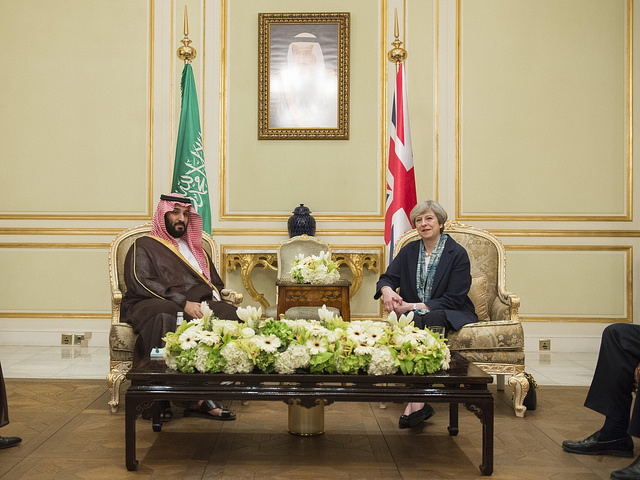
Prime Minister Theresa May met with Deputy Crown Prince Mohammad bin Salman Al Saud on her visit to Saudi Arabia. Image credit: Number 10/ flickr
By Stuart Littlewood | American Herald Tribune | March 3, 2018
It’s amazing what unprincipled people will admit to when goaded. A petition has been posted on the parliamentary website calling on prime minister Theresa May to withdraw her invitation to the Crown Prince of Saudi Arabia, Mohammad bin Salman, to visit the UK. It reads:
“The Saudi Arabian regime has one of the worst human rights records in the world. Torture and arbitrary detention are widely documented. In 2017 alone, over 100 people were executed.
“The Crown Prince has directed the bombardment of Yemen. Tens of thousands have been killed or injured. There is widespread famine and cholera, creating the worst humanitarian crisis in the world. Yet, the UK still sells arms to Saudi Arabia.
“The Saudi regime has supported repression in Bahrain, where its military intervened to end peaceful protests in 2011.”
An Early Day Motion (EDM865) has been tabled in Parliament also asking for the visit to be cancelled. It notes that the Saudi regime actually executed 142 people last year.
Bin Salman arrives in London on 7 March. He’ll be met by angry protesters.
The petition has well over 11,000 signatures so far. Of course, their request will be ignored. The UK Government is a great admirer of terror regimes such as Saudi Arabia and Israel, which are now bosom-pals. They share many ambitions, such as the de-stabilising and overthrow of countries they don’t happen to like with the help of their useful idiots in Washington and Westminster. Prime targets are Iran and Syria. And they are itching to annihilate resistance groups like Hezbollah and Hamas, and any others that get in their way.
They also share utter contempt for human rights and international norms of behaviour.
Successive British governments have gone to extreme lengths to invent preposterous reasons why they adore and support the criminals who run Israel, slaughter the Palestinians and menace the region (and indeed the rest of the world) with their undeclared and unsafeguarded nuclear arsenal. Now Westminster ties itself in knots trying to explain why we continue to snuggle up to the Saudis who are eager to join the US-UK-Israeli axis.
Wouldn’t it be nice if our mainstream media, instead of wringing their hands and broadcasting disinformation about the Middle East, investigated and named the evil warmongers who recruit, bankroll and arm the corrupt regimes, rebel militia, mercenaries and assorted hoodlums who started and now perpetuate the horror and devastation in Syria and Yemen?
Saudi Arabia a partner for “tackling international terror and extremism”? Seriously?
Responding to the petition, the ever-inventive Foreign Office says our strong relationship with Saudi Arabia “is important for mutual security and prosperity” and includes meaningful discussion on reform and human rights. The statement says it has helped make both of our countries safer and more prosperous. “We have vital national security and economic interests in maintaining and developing our strong relationship, including how we can work together to tackle international challenges such as terrorism and extremism.”
And Saudi intelligence “has saved potentially hundreds of lives in the UK”, according to Mrs May.
What’s more, the Crown Prince has embarked on a series of reforms to modernise society and the economy such as allowing women to drive and attend football matches, reopening cinemas and a commitment that women will make up one third of the Saudi workforce by 2030. “The visit will usher in a new era in bilateral relations focused on a partnership that delivers wide-ranging benefits for both the United Kingdom and the Kingdom of Saudi Arabia.”
As for the apalling state of affairs in Yemen, the Government says the UK “is committed to securing a political solution that ends the humanitarian disaster” and will continue to play a leading role in “supporting the UN to find a peaceful solution through close engagement with our regional and international partners”.
We’ve heard this claptrap many times before, especially in relation to never-ending crimes against the Palestinians.
What else does our upstanding Government say? “The UK supports the Saudi-led Coalition military intervention [in Yemen]…. We regularly raise the importance of compliance with International Humanitarian Law with the Saudi Arabian Government and other members of the military Coalition. Saudi Arabia has publicly stated that it is investigating reports of alleged violations of IHL, and that lessons will be acted upon.”
So why not wait for real evidence of that before rolling out the red carpet and infuriating decent people by allowing the Crown Prince of this obnoxious regime to pose on the steps of Downing Street for the world’s media and be filmed poncing around with our Royal Family? From his track record Bin Salman understands only too well the value of PR, which he exploits for all its worth, while precious little changes beneath the elaborate ‘modernising’ veneer.
Guilty as hell of complicity
Since Bin Salman’s bombing campaign in Yemen started three years ago the UK, instead of condemning such murderous aggression, has showered Saudi Arabia with £billions worth of aircraft and other weaponry to help deliver death and destruction. All principles are jettisoned, it seems, and all concerns for human suffering forgotten so that greedy business can milk the obscene wealth of that part of the world.
Last summer the Campaign Against Arms Trade (CAAT) brought a legal action against the Secretary of State for International Trade for continuing to grant export licences for arms to Saudi Arabia, arguing that this was a breach of UK policy which states that the Government must refuse such licences if there’s a clear risk that the arms might be used to commit serious violations of International Humanitarian Law.
It was, by then, undeniable that Saudi forces had used UK-supplied weaponry to violate International Humanitarian Law in their war on Yemen. According to the United Nations, well over 10,000 people had been killed up to that point, the majority by the Saudi-led bombing raids that had also destroyed vital infrastructure such as schools and hospitals and contributed to the cholera crisis. 3 million Yemenis had been displaced from their homes and 7 million were on the brink of dying from famine. UNICEF were reporting that a child died in Yemen every ten minutes from preventable causes including starvation and malnourishment.
A crippling naval blockade aided and supported by the US had been a key cause of the humanitarian crisis. The European Parliament and numerous humanitarian NGOs had condemned the Saudi air strikes as unlawful. And 18 months earlier a UN Panel of Experts had accused Saudi forces of widespread and systematic targeting of civilians.
The UK Government at that time had licensed £3.3 billion worth of arms such as aircraft, helicopters, drones, missiles, grenades, bombs and armoured vehicles to the Saudi regime and refused to suspend this lucrative trade even when the horrors stared them in the face. It was claimed that the Government ignored warnings by senior civil servants and its own arms control experts, and that some records of expressed concern had gone missing.
Despite the glaring facts, the High Court decided to allow the UK Government to carry on exporting arms to Saudi Arabia for use against Yemenis.
The CAAT website today reports that the UK has licensed over £4.6 billion worth of arms to Saudi Arabia since the bombing began in March 2015:
£2.7 billion worth of ML10 licences (Aircraft, helicopters, drones)
£1.9 billion worth of ML4 licences (Grenades, bombs, missiles, countermeasures)
£572,000 worth of ML6 licences (Armoured vehicles, tanks)
And the UK government admits that Saudi Arabia has used UK weapons in its attacks on Yemen. Typhoon and Tornado aircraft, manufactured by BAE Systems, have been central to the attacks. The Government confirms that they have been deployed on combat missions in Yemen and further Typhoons have been delivered. Meanwhile, BAE and the UK government are pushing for a new contract, so who knows what triumphant announcement compounding these crimes against humanity will be made during the Crown Prince’s visit?
The Government has also admitted that UK-supplied precision-guided weapons have been used in Yemen and that it “accelerated delivery of Paveway precision-guided bombs” in response to Saudi requests.
At the start of the conflict in March 2015 former Foreign Secretary Philip Hammond said:
“If we are requested to provide them with enhanced support – spare parts, maintenance, technical advice, and resupply – we will seek to do so. We’ll support the Saudis in every practical way short of engaging in combat.” [emphasis added]
In September 2016 the House of Commons Business, Innovation & Skills and International Development Committees commented:
“Given that the UK has a long history of defence exports to Saudi Arabia and its coalition partners, and considering the evidence we have heard, it seems inevitable that any violations of international humanitarian and human rights law by the coalition have involved arms supplied from the UK.” [emphasis added]
And in December 2016, the UK government finally admitted that UK-made cluster bombs had also been deployed in the conflict.
How sick is that?
Yemen: Peace On The Horizon
By Andrew KORYBKO – Oriental Review – 02/03/2018
The Houthis and the former President of South Yemen introduced somewhat similar peace proposals for ending the War on Yemen.
The first move in this direction was made during last week’s Valdai Conference on Russia’s role in the Mideast, when Ali Naser Mohamad, who presided over the People’s Democratic Republic of Yemen from 1980-1986, issued an 8-point plan for resolving the conflict in which his most unique suggestion was to “initiate a dialogue between all the political forces on the establishment of a two-region federal state.” This was clearly in reference to the Southern Transitional Council’s (STC) seizure of Aden, their former capital, from Hadi’s government at the end of January after the internationally recognized leader refused to reform his Cabinet and reportedly ordered that force be used against the protesting Southerners.
Federalization has long been thought of as a “compromise” between wartime allies Saudi Arabia and the UAE, the first of which began the war in order to reinstall Hadi as Yemen’s President while the latter is thought of having a favorable approach towards the Southern separatists.
As for the Houthis’ proposal, it interestingly mirrored most of what the former South Yemeni leader proposed, albeit with its own nuances. Both sides want an end to the war, new elections, and UNSC support, though they seem to differ over some technicalities. Whereas the South wants a federal solution, the Houthis importantly suggest that all contested issues be decided by a referendum, with the implication being that it would be a nationwide one where the more populous North would have the electoral power to reject any regional-centric proposal put forth by the South. The issues of South Yemen’s autonomy and the country’s corresponding constitutional reform to legalize this desired status seem to be the primary difference between each party’s peace proposals.
In the stalemated military situation that defines the present day, neither side is able to enforce their will on the other, but the most important observation is that the political will for peace invariably exists in the territories that used to comprise the independent countries of North and South Yemen.
Extrapolating from this, it can be deduced that each of their populations are completely exasperated by this war, especially the majority of the country that resides in the North and has been forced to endure the insufferable humanitarian consequences of the coalition’s war against the Houthis for over three years now. Likewise, presuming that the former South Yemeni President was speaking in a semi-official capacity and “testing the waters” at Valdai, the conclusion can be reached that the STC is “moderating” its independence aspirations and willing to settle for federalization, at least at this stage, which of course appeals to the Saudis and the Houthis for different reasons and makes it easier to begin a dialogue on ending the war.
In the coming future, all sides will likely readjust their positions somewhat as they politically jockey with one another in preparing for inevitable peace talks, and it’s here where Russia could play a strategic role in facilitating this by mediating or possibly even hosting this dialogue whenever it ultimately happens.
Featured Video
Max Blumenthal: ‘Israel First’ in Iran War Sparks MAGA Civil War
or go to
Aletho News Archives – Video-Images
From the Archives
Wartime internment camps in Australia
National Archives of Australia
World War I
During World War I, for security reasons the Australian Government pursued a comprehensive internment policy against enemy aliens living in Australia.
Initially only those born in countries at war with Australia were classed as enemy aliens, but later this was expanded to include people of enemy nations who were naturalised British subjects, Australian-born descendants of migrants born in enemy nations and others who were thought to pose a threat to Australia’s security.
Australia interned almost 7,000 people during World War I, of whom about 4,500 were enemy aliens and British nationals of German ancestry already resident in Australia.
Records of World War I internment camps
World War II
During World War II, Australian authorities established internment camps for three reasons – to prevent residents from assisting Australia’s enemies, to appease public opinion and to house overseas internees sent to Australia for the duration of the war.
Unlike World War I, the initial aim of internment during the later conflict was to identify and intern those who posed a particular threat to the safety or defence of the country. As the war progressed, however, this policy changed and Japanese residents were interned en masse. In the later years of the war, Germans and Italians were also interned on the basis of nationality, particularly those living in the north of Australia. In all, just over 20 per cent of all Italians resident in Australia were interned. … continue
Blog Roll
 Aletho News
- Diplomats slam US negotiators’ performance in Iran talks
- Trump Refuses Exit Ramp, War with Iran will Continue
- Trump Says US Naval Blockade in Strait of Hormuz Will Begin Shortly
- US, Iran end 21-hour talks without agreement
- US IRAN TALKS: Who Are the Crazy Ones Here? /Lt Col Daniel Davis
- Talks with the US end without a deal over excessive US demands: Iran
- Feeling Better, Getting Worse: How Psychiatric Drugs Create the Illusion They Cure
- ‘Nobody Told Me’: Former Mental Health Patient Calls Out Dangerous Side Effects of Psychiatric Drugs
- Dr. Abu-Sitta: Beirut ‘felt like a day in Shifa Hospital’
- Iran Has Won the War, It Will Be Up to the US to Secure the Peace: Mohammad Marandi
- If Americans Knew
- US-Iran ceasefire negotiations make zero progress – Daily Update
- Pro-Israel ‘Thinktanks’ and Individuals who Influence U.S. Foreign Policy
- Mearsheimer reveals how Israel dictates US policies on Iran, Gaza – video
- After killing 350+, Israel still has a “score to settle” with Lebanon before ceasefire – Daily Update
- Military aid to Israel emerges as the latest political litmus test for Democrats
- The only Palestinian children’s rights organization closes following years-long Israeli campaign against it
- ‘I Can’t Forget the Smell’: Lebanese Reel After Israel Kills Over 300 in Single Day
- DNC Shoots Down Resolutions Calling Out AIPAC and Limiting Arms to Israel
- TCN: Is Israel Blackmailing President Trump?
- Israel killed at least 303 Lebanese yesterday – who were they? Daily Update
- No Tricks Zone
- German Expert: Heat Dome Led To Record Temps In Western USA…Warmer In 1934, 1936
- New Study: No Linear Warming Or Glacier Retreat Along Northern Antarctic Peninsula Since 1980s
- An Inconvenient Tree: Uncovered In Alps… Europe Much Warmer Than Today 6000 Years Ago
- New Study Reports A 60% Slowdown In Greenland’s Ice Loss Rate In The Last Decade
- Low Intensity Tornado Wrecks Major Solar Farm, Creating A Potential Toxic Dump
- New Study Finds Warming Saves Lives…Cold Temperatures 12 Times More Deadly Than Excess Heat
- German Science Blog Accuses PIK Climate Institute Of Hallucinating Climate Tipping Points
- Devastating Assessment Of Comirnaty Vaccine By Former Senior Pfizer Europe Toxicologist
- New Study: CO2 Is ‘Effectively Negligible’ As An Explanatory Climate Change Factor Since 2000
- Former Pfizer Toxicologist Dr. Helmut Sterz Tells Bundestag Hearing Pfizer Vaccine Should Have Never Been Approved
 Aletho News