Suspected cholera cases in Yemen reach 1 million: ICRC
Press TV – December 21, 2017
The International Committee of the Red Cross (ICRC) says the number of suspected cholera cases in war-torn Yemen has hit one million amid the ongoing Saudi military campaign against the impoverished nation.
The ICRC also said Thursday that more than 80 percent of the Yemeni population lacks food, fuel, clean water and access to healthcare.
The World Health Organization (WHO) has recorded 2,219 deaths since the cholera epidemic began in April, with children accounting for nearly a third of infections.
On Wednesday, the Oxfam charity group warned that more than 8.4 million Yemenis are now at acute risk of famine due to Saudi Arabia’s crippling blockade of Yemen’s key ports, which is causing a halt to the delivery of food, fuel, and medicine.
Food prices have shot up by 28 percent since early November, when the Saudi-led coalition tightened the siege. That has made it unaffordable for poor families–already hit by the collapse of the economy –to buy food.
Clean water supplies in towns and cities have been cut due to fuel shortages.
Yemen is also suffering from diphtheria epidemic, with aid groups warning that the spread of the disease is inevitable in Yemen due to low vaccination rates, lack of access to medical care and so many people moving around and coming in contact with those infected.
At least a million children are at risk of contracting the disease.
Saudi Arabia and a group of its allies have been bombing Yemen since 2015 to put its former Riyadh-friendly government back in the saddle. More than 12,000 have died since the war began.
Now, more than eight million Yemenis are on the verge of starvation, making the country the scene of, what the UN calls, the world’s worst humanitarian crisis.
US drone strikes double in Somalia, triple in Yemen under Trump administration: Report
Press TV – December 21, 2017
There has been a sharp rise in the number of US drone strikes in Yemen and Somalia since US President Donald Trump took office, says a report.
In March, Trump gave the US military authority to carry out airstrikes without notifying the government in regions designated as areas with “active hostilities.”
“In Yemen, 30 strikes hit within a month of the declaration being reported – nearly as many as the whole of 2016. Most of the 125 strikes in 2017 hit in central Yemen, where the US military’s Central Command vigorously pursued fighters from al-Qaeda in the Arabian Peninsula (AQAP),” said the Bureau of Investigative Journalism.
Yemen has come under regular US drone strikes, with Washington claiming to be targeting al-Qaeda militants while local sources say civilians have been the main victims.
The London-based NGO noted that the number of strikes doubled in Somalia and tripled in Yemen since Trump began his term in January 2017.
“In Somalia, the Obama administration had officially designated the al-Shabab group as an al-Qaeda affiliate at the end of November 2016, essentially widening who could be targeted. But there was no increase in strikes until July 2017, with all but two of this year’s 32 strikes carried out since then,” it added.
The Pentagon has been carrying out airstrikes and ground raids in Somalia for a decade, initially using helicopters and AC-130 gunships.
In June 2011, American forces began using drones to carry out the strikes, in a mission which has so far failed to uproot militancy in the country.
Saudi blockade of Yemen violates US law: Trump nominee
Press TV – December 20, 2017
President Donald Trump’s nominee for the top legal adviser at the State Department has acknowledged that Saudi Arabia’s blockade of Yemen violates US and international law, according to a report.
In written statements to the Senate Foreign Relations Committee before her confirmation Tuesday, Jennifer Newstead signaled a stricter interpretation of statutes that ban US foreign assistance to countries blocking or hindering the flow of humanitarian aid, the Foreign Policy magazine reported.
Newstead said warnings from international aid organizations “raise a substantial question” on whether the Saudi-led coalition has deliberately impeded the transport of aid to civilians in Yemen.
The United Nations has warned that millions of people will die in Yemen due to famine unless the Saudi-led coalition ends its devastating blockade on the southwestern port of Hudaydah, through which about 80 percent of food imports arrive.
A shortage of fuel has shut down many water treatment and pumping stations, aggravating an already deadly outbreak of cholera. The UN warned earlier this month that 8.4 million people were one step away from starvation.
International aid officials have described the situation in Yemen as the world’s worst humanitarian crisis.
Newstead promised to provide firm answers to Congress on the issue within 30 to 45 days after being sworn in. Newstead’s responses indicate that the White House might be willing to take a tougher line with Saudi Arabia over the military aggression in Yemen.
The answers also cleared the way for Newstead’s confirmation on Tuesday, which had been blocked by Senator Todd Young, Republican of Indiana, and two of his colleagues over concerns about the humanitarian situation in Yemen.
Young and others have condemned Saudi Arabia’s military campaign in Yemen, particularly its blockade on vital shipments of humanitarian aid by air and sea to ports controlled by Houthis.
They accuse Riyadh of violating the Geneva Conventions and the US Foreign Assistance Act, which prohibits US aid for countries that impede the flow of humanitarian aid. The US president, however, can still make an exception and provide assistance to a country that hinders aid.
The US has been providing logistical support for the Saudi coalition as well as precision-guided munitions.
Tuesday marked the 1,000th day of the Saudi war in Yemen. Thousands of Yemenis took to the streets, condemning the deadly airstrikes and calling on Arab states to stop contributing to the Saudi-led coalition.
Claim of Iran military aid to Yemen sheer lie: Larijani
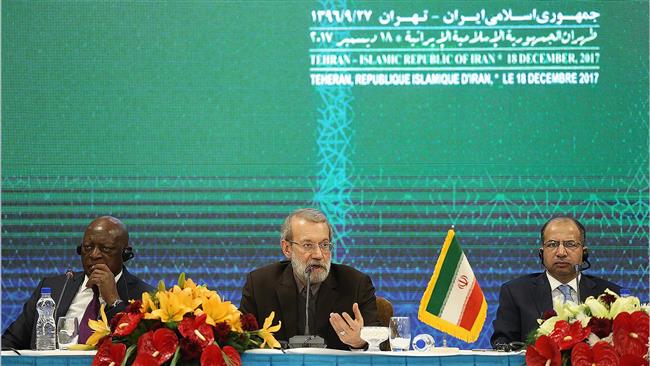
Iran’s Parliament Speaker Ali Larijani (C) speaks to reporters following the Meeting of the PUIC Presidential Troika in the Iranian capital Tehran on December 18, 2017. (Photo by ICANA)
Press TV – December 18, 2017
Iran’s Parliament Speaker Ali Larijani says the Islamic Republic is not providing military assistance to Yemen and all claims to this effect are false.
Larijani made the remarks while addressing the extraordinary meeting of the Palestinian Committee of the Parliamentary Union of the Organization of Islamic Cooperation Member States (PUOICM) in the Iranian capital Tehran on Monday.
“We are not a country that would deny providing military assistance to anybody,” Larijani said.
He added that Iran was providing military assistance to Palestine, but had not helped Yemeni fighters in their war with Saudi Arabia in military terms, dismissing any claim to this effect as a lie.
“The Yemenis’ missiles belong to themselves and some countries cannot achieve their goals by making such claims,” the top Iranian parliamentarian said.
On Thursday, US Ambassador to the United Nations Nikki Haley appeared in a staged show in front of a large and charred tube that she claimed was “concrete evidence” that Iran was providing missiles to Yemeni forces fighting against Saudi Arabia’s war of aggression on their country.
A Saudi Arabian-led coalition launched a war against Yemen in 2015 and has ever since been indiscriminately hitting targets in the country. Yemeni Houthi fighters have been firing missiles in retaliatory attacks against Saudi targets every now and then.
On November 4, a missile fired from Yemen targeted King Khalid International Airport near Riyadh, reaching the Saudi capital for the first time.
Elsewhere in his remarks, Larijani said terrorism has tremendously grown in recent years both in quantitative and qualitative terms, emphasizing that such growth would not have been possible without the support of the US and some countries in the region.
Israel and terrorism are the two sides of the same coin and pursue similar goals, he said.
Larijani also emphasized that US-backed terrorists sought to create chaos in the Middle East and pointed to the recent announcement by the Israeli regime that it enjoyed the best conditions since Muslim countries were grappling with terrorism.
Ali Akbar Velayati, a senior advisor to Leader of the Islamic Revolution Ayatollah Seyyed Ali Khamenei on international affairs, on Sunday dismissed as “baseless and ridiculous” the recent US claim about Iran providing missiles to Yemen’s Houthi Ansarullah movement, saying that even international experts had mocked the accusation.
“The Islamic Republic of Iran has never given missiles to Yemen,” he said.
Iranian Foreign Minister Mohammad Javad Zarif said on Friday that the United States was complicit in Saudi war crimes in Yemen.
He added that the US had sold weapons to its allies enabling them to “kill civilians and impose famine,” in reference to Washington’s arms deal with Riyadh in its aggression against Yemen.
Al-Houthi Hits back at US Claims on Iran Missile Supply

Head of Yemen’s Revolutionary Council, Mohammad Ali Al-Houthi
Al-Manar | December 15, 2017
Head of Yemen’s revolutionary Committee, Mohammad Ali Al-Houthi hit back at US claims that Iran had been supplying Yemeni revolutionaries with missiles.
“Had we imported Iranian missiles, then we would have boosted our air-defense system,” Al-Houthi said on his Twitter account.
“What’s ironic is that the US is the side who is supplying the Saudi-led aggression with banned weapons that have been killing the Yemeni people,” Al-Houthi said, stressing that the US has failed in Yemen.
Yemen has been since March 2015 under a brutal aggression by Saudi-led coalition, in a bid to restore power to fugitive former president Abdrabbuh Mansour Hadi.
Tens of thousands of Yemenis have been injured and martyred in Saudi-led strikes, with the vast majority of them are civilians.
However, the allied forces of the Yemeni army and popular committees established by Ansarullah revolutionaries have been heroically confronting the aggression with all means, inflicting huge losses upon Saudi-led forces.
The Saudi-led coalition – which also includes UAE, Bahrain, Egypt, Morocco, Jordan, Sudan and Kuwait – has been also imposing a blockade on the impoverished country’s ports and airports as a part of the aggression.
Food and medicine can’t get past the Saudi blockade on Yemen, but Nikki Haley thinks missiles can
Nikki Haley once again pushing for war against Iran–this time making an argument that is not only flawed but nonsensical
By Adam Garrie | The Duran | December 15, 2017
Nikki Haley, Donald Trump’s Ambassador to the United Nations, has given an extraordinary “press conference”, even by her habitually outrageous standards.
First all, it was hardly a “press conference” as Haley did not answer any of the questions posed to her. Instead, she merely assured journalists that she has evidence to back her up position, although it is not clear what this evidence might look like.
Haley’s position is that since the outbreak of the current crisis in Yemen, beginning in March of 2015, Iran has been supplying Yemen’s Ansar Allah Movement, more commonly known [in western media] as the Houthis, with the missiles they have sporadically used to target Saudi Arabia and allegedly the UAE.
There is a fatal flaw in this line of thinking however. Saudi Arabia has, since the beginning of the conflict, controlled all air and sea traffic coming into Yemen, while monitoring the region with the latest US made technology.
Yemen has subsequently been surrounded by a Saudi Naval blockade, Saudi borders through which nothing can pass and Omani borders through which there is no evidence of anything passing and which in any case, border areas which do not belong to Ansar Allah fighters, but instead have fluctuated between the Hadi government based in Aden, al-Qaeda terrorists and ISIS terrorists.
Not only has the Saudi blockade caused a man made famine which itself has resulted in a mass outbreak of the disease Cholera, but even the UN has found it difficult to convince the Saudis to allow basic medicine, bottled water and dried foods into the always poor and now starving nation.
But for Nikki Haley, who gave her press conference standing in front of what appeared to be a rusty missile casing–it all makes perfect sense. In Haley’s parallel universe, an aid ship with UN flags cannot bring bottles of water and jars of medical pills to Yemenis, but somehow Iranian ships bearing humongous missiles have easily passed through the Saudi blockade undetected.
There is simply no logic to the argument, no matter how it is interpreted.
Even a journalist at Haley’s “press conference” asked how the US can verify the provenance of the missiles and in particular when they were sent to Yemen. She had no answer apart from effectively saying ‘trust us–we know’.
The fact, as the Ansar Allah themselves have always maintained, is that the missiles which they occasionally launch are taken from Yemeni military bases which Ansar Allah have controlled for approximately two years. Video footage of the missile strikes is consistent with these statements.
Iran’s Foreign Minister Javad Zarif has Tweeted the following photo, comparing Haley’s accusations against Iran to Colin Powell’s infamous accusations against Iraq, saying that Saddam Hussein had weapons of mass destruction which he did not possess.
In reality, Haley’s statement is even more ludicrous as there is physically no way for Iran to transport missiles or anything else for that matter, to Yemen without being seen and almost certainly stopped by the Saudi blockade, a blockade which started in March of 2015, nearly four months before the JCPOA even came into effect.
This last point is crucial as Haley’s allegations rest on the fact that in delivering missiles to the Ansar Allah, Iran is in violation of the terms of the JCPOA, a longstanding US allegation that has been rejected by the EU as a whole, as well as individual parties to the agreement: Germany, France, Britain, China, Russia and the United Nations.
Haley of course repeated what for most American neo-cons is a standard line that Iran sponsors terrorism and is “behaving badly” in Iraq, Syria and Lebanon. If fighting groups like ISIS(Daesh) and al-Qaeda is bad behaviour, the mind simply boggles. The closest Iran is to terrorism is fighting terrorism on the field of battle and advising Iraqi and Syrian partners on how better to do such.
Nikki Haley has proved once again that her aptitude is low, her ethics are non existent and her intelligence is a void.
The fact that she is an Ambassador to the UN but acts increasingly like a hybrid of a Secretary of State combined with a Defense Secretary, is a deeply worrying prospect for all those concerned with global peace and stability.
US allegations on Yemen missile ‘provocative’, ‘destructive’: Iran
Press TV – December 14, 2017
Iran’s UN mission has categorically dismissed as “unfounded” US Ambassador Nikki Haley’s claim that a missile fired at Saudi Arabia from Yemen last month was supplied by the Islamic Republic.
In a statement released on Thursday, the mission denounced the US allegations as “irresponsible, provocative and destructive,” saying “this purported evidence … is as much fabricated as the one presented on some other occasions earlier.”
“These accusations seek also to cover up for the Saudi war crimes in Yemen, with the US complicity, and divert international and regional attention from the stalemate war of aggression against the Yemenis that has so far killed more than 10,000 civilians, displaced three million, crippled Yemen’s infrastructure and health system and pushed the country to the brink of the largest famine the world has seen for decades, as the UN has warned,” the statement read.
It went on to accuse the US government of being “constantly at work to deceive the public into believing the cases they put together” to advance its agenda.
“While Iran has not supplied Yemen with missiles, these hyperboles are also to serve other US agendas in the Middle East, including covering up for its adventurist acts in the region and its unbridled support for the Israeli regime,” the statement read.
It also stressed “the Yemenis’ right to self-defense” and reiterated that the conflict in the impoverished country had no military solution.
Iran’s Foreign Minister Mohammad Javad Zarif also took to twitter to compare Haley’s allegations against Iran to those of former US secretary of defense, Colin Powell, who alleged in 2003 that former Iraqi dictator, Saddam Hussein, was hiding weapons of mass destruction in order to make a case for attacking the country.
The anti-Iran accusations come at a time that the US and Saudi Arabia themselves are under fire for secretly providing weapons to the militants fighting the Syrian government.
Conflict Armament Research (CAR), a UK-based organization that monitors the movement of conventional weapons, warned on Thursday that the sophisticated arms given to the so-called Syria militants fell into the hands of the Daesh terrorist group.
The weapons included anti-tank rockets purchased by the US military that ended up in possession of Daesh within two months of leaving the factory, according to the study, which was funded by the European Union and German government.
This came after the UN Secretary-General Antonio Guterres said in a confidential report obtained by AFP on Monday, December 11, that the world body’s team, which visited Riyadh last month to scrutinize the alleged evidence, had not yet established a link between them and the Islamic Republic.
On November 4, a missile fired from Yemen targeted the King Khalid International Airport near Riyadh, reaching the Saudi capital for the first time.
The Houthi movement, which has been fighting back a Saudi aggression, said it had fired the missile but the Riyadh regime was quick to point the finger at Iran.
Tehran rejected the allegations as “provocative and baseless,” saying the Yemenis had shown an “independent” reaction to the Saudi bombing campaign on their country.
Speaking at a press conference at a military base in Washington on Thursday, Haley presented what she claimed to be “undeniable” evidence, including the allegedly recovered pieces of the missile, saying it proved that Iran was violating international law by giving missiles to the Houthis.
“It was made in Iran then sent to Houthi militants in Yemen,” she added.
However, a panel appointed by the United Nations Security Council said last month that it had seen no evidence to support Saudi Arabia’s claims that missiles had been transferred to Yemen’s Houthi fighters by external sources.
The Security Council-appointed panel said in its confidential assessment that it had seen no evidence to back up the Saudi claims that short-range ballistic missiles (SRBMs) had been transferred to Yemeni fighters in violation of the Resolution 2216.
It said the tightening of the blockade by the Saudi-led coalition and its invoking of Resolution 2216 had been an attempt to merely “obstruct” the delivery of civilian aid.
“The panel finds that imposition of access restrictions is another attempt by the Saudi Arabia-led coalition to use paragraph 14 of resolution 2216 as justification for obstructing the delivery of commodities that are essentially civilian in nature,” the assessment read.
The Saudi war since 2015, accompanied by the land, naval, and aerial blockade on Yemen, has killed over 12,000 people so far and led to a humanitarian crisis as well as a deadly cholera epidemic.
Saudi Arabia and its allies launched the war in a bid to crush the Houthi movement and reinstate the former Riyadh-friendly regime, but the kingdom has achieved neither of its goals.
The UN has listed Yemen as the world’s number one humanitarian crisis, with 17 million Yemenis in need of food and gripping the country.
The US, which has long been a staunch Saudi ally, signed a deal to sell the kingdom $110 billion in weapons in May.
Yemen, Afghanistan in focus as landmine casualties spike
Press TV – December 14, 2017
Landmines killed 8,605 people in several countries in 2016, despite an international ban on the deadly device, a monitoring group says.
According to the annual report released Thursday by Landmine Monitor, about three-quarters of the known casualties were civilians, including more than 1,000 children who were injured and nearly 500 who were killed.
The number of the casualties — which were mostly recorded in Afghanistan, Libya, Ukraine and Yemen — showed a 30% surge compared to 2015.
“A few intense conflicts, where utter disregard for civilian safety persists, have resulted in very high numbers of mine casualties for the second year in a row,” Loren Persi, an editor of the Landmine Monitor said.
Persi described the spike as “alarming”, adding that the true number of the victims would be significantly higher if the data gathering were complete.
The surge comes after a 18-year decline in landmine casualties since the Mine Ban Treaty first came into force in 1999.
The treaty bans the use of landmines and other explosive devices placed on or under the ground, designed to blow up when somebody unintentionally steps on them.
These weapons can be continuously deadly weapons for many years, long after the war has ended. About 80% of landmine victims are civilians.
The Mine Ban Treaty, which has been signed by 163 countries, also bans production, stockpiling and transfer of the deadly landmines.
Yemen: Saudi Airstrikes Kill Dozens
teleSUR | December 13, 2017
Renewed Saudi airstrikes against Yemen, mainly in the capital city of Sana’a, have resulted in the deaths of dozens of people.
At least 39 people died and 90 others were left injured, Reuters reported. Yemen’s al-Masirah TV reported that at least 51 people died and 80 were left injured.
The airstrikes reportedly targeted Yemen’s military police headquarters in Sana’a’s Shu’ab district. Some of the casualties included prisoners detained at the facility awaiting investigation.
In a separate series of attacks, Saudi planes levelled Yemen’s northwestern district of Sahar. Four civilians were wounded, one of whom later died from injuries. Eleven people were also killed during airstrikes in Maqbanah District of the southwestern province of Ta’izz.
Since the bombing campaign against Yemen began in 2015, the United Kingdom has licensed roughly US$4.2 billion dollars in weapons to Saudi Arabia, according to PressTV.
In early June, the U.S. Department of Defense also confirmed a US$750 million military sale to Saudi Arabia. It included U.S. made missiles, bombs, armored personnel carriers, warships, munitions and a “blanket order training program” for Saudi security forces receiving the military equipment both inside and outside the kingdom, Reuters reported.
Amid the bombing and devastation, which has killed tens of thousands of people and forced more than a million to flee their homes, Yemen also faces a severe cholera outbreak that has claimed the lives of at least 2,119 people, according to Alexandre Faite, head of the International Committee of the Red Cross. Another eight million are on the verge of starvation.
Wolfgang Jamann, head of the Cooperative for Assistance and Relief non-governmental humanitarian agency, described the ongoing crisis in Yemen as being an absolute “shame on humanity.” The United Nations referred to it as “the world’s worst humanitarian crisis.”
UN experts do not confirm Iran link to Yemen missiles: Report
Press TV – December 12, 2017
UN experts, who examined the debris from missiles fired from Yemen at Saudi Arabia earlier in the year, have not confirmed that the projectiles were “Iranian-made” as claimed by the Riyadh regime and the US.
The missiles were fired by Yemeni Houthi fighters at the Saudi capital on July 22 and November 4 in retaliation for Riyadh’s deadly raids against the country.
United Nations Secretary-General Antonio Guterres said in a confidential report obtained by AFP on Monday that the world body’s team, which visited Riyadh last month to scrutinize the alleged evidence, had not yet established a link between them and the Islamic Republic.
Saudi Arabia, which accuses Iran of arming Yemen’s Houthi Ansarullah movement against the kingdom, claims the missiles, which it says were fired at its capital city, had been supplied to Yemeni forces by Iran.
Following the first missile launch, Riyadh also angered the international community and human rights groups by tightening the already crippling siege against Yemen.
Tehran has invariably dismissed having ever armed the movement and any accusation of regional interference for that matter.
On Monday, Iran’s Foreign Ministry Spokesman Bahram Qassemi said, “Whatever happens inside Yemen concerns the Yemeni people and resistance and does not concern the Islamic Republic.”
The Houthis have been defending Yemen against a Saudi-led military offensive, which seeks to restore the former Riyadh-allied government. The war has killed some 12,000 people and reduced the country’s infrastructure to smithereens since its start in early 2015.
Guterres wrote that UN officials were “still analyzing the information collected and will report back to the [UN] Security Council.”
The investigators also examined two drones allegedly recovered in Yemen, but did not confirm a Saudi claim that one of them was “Iranian-made.”
Saudi Coalition Crumbles In Yemen: Sudanese Mercenaries On Front Lines, Foreign Officers, Proxies In Revolt
By Tyler Durden | Zero Hedge | November 26, 2017
Most Americans might be forgiven for having no clue what the war in Yemen actually looks like, especially as Western media has spent at least the first two years of the conflict completely ignoring the mass atrocities taking place while white-washing the Saudi coalition’s crimes. Unlike wars in Iraq, Libya, and Syria, which received near daily coverage as they were at their most intense, and in which many Americans could at least visualize the battlefield and the actors involved through endless photographs and video from on the ground, Yemen’s war has largely been a faceless and nameless conflict as far as major media is concerned.
Aside from mainstream media endlessly demonstrating its collective ignorance of Middle East dynamics, it is also no secret that the oil and gas monarchies allied to the West are rarely subject to media scrutiny or criticism, something lately demonstrated on an obscene and frighteningly absurd level with Thomas Friedman’s fawning and hagiographic interview with Saudi crown prince MBS published in the New York Times.

Saudi Arabia’s hired help in Yemen: Sudanese fighters headed to the front lines. Image souce: al-Arabiya
But any level of meticulous review of how the Saudi coalition (which heavily involves US assistance) is executing the war in Yemen would reveal a military and strategic disaster in the making. As Middle East Eye editor-in-chief David Hearst puts it, “All in all, the first military venture to be launched by the 32-year-old Saudi prince as defense minister is a tactical and strategic shambles.”
And if current battlefield trends continue, the likely outcome will be a protracted and humiliating Saudi coalition withdrawal with the spoils divided among Houthi and Saudi allied warlords, as well as others vying for power in Yemen’s tenuous political future. But what unsurprisingly unites most Yemenis at this point is shared hatred for the Saudi coalition bombs which rain down on civilian centers below. For this reason, Hearst concludes further of MBS’ war: “The prince, praised in Western circles as a young reformer who will spearhead the push back against Iran, has succeeded in uniting Yemenis against him, a rare feat in a polarized world. He has indeed shot himself, repeatedly, in the foot.”
So how has this come about, and how is the war going from a military and strategic perspective?
First, to quickly review, Saudi airstrikes on already impoverished Yemen, which have killed and maimed tens of thousands of civilians (thousands among those are children according to the UN) and displaced hundreds of thousands, have been enabled by both US intelligence and military hardware. Cholera has recently exploded amidst the appalling war-time conditions, and civilian infrastructure such as hospitals and schools have been bombed by the Saudis. After Shia Houthi rebels overran Yemen’s north in 2014, embattled President Abd-Rabbu Mansour Hadi vowed to “extract Yemen from the claws of Iran” something which he’s repeatedly affirmed, having been given international backing from allies in the West, and a major bombing campaign began on March 2015 under the name “Operation Decisive Storm” (in a cheap mirroring of prior US wars in Iraq, the first of which was “Desert Storm”).
Saudi Arabia and its backers fear what they perceive as growing Iranian influence in the region, something grossly exaggerated, and seek to defend at all costs Yemeni forces loyal to President Hadi. The coalition includes Bahrain, Kuwait, UAE, Egypt, Sudan, and the US and UK, and the Saudi initiated war has also lately received behind the scenes political support from Israel, something recently confirmed by Israeli officials. Concerning the supposed Iran threat in Yemen, an emergency session of the Arab League recently doubled down on its shared commitment to wage war against Iranian interests after it blamed Tehran for a November 4 ballistic missile attack from Shia Houthi rebels against the Saudi capital, which Iran denies playing a role in.
But the Saudi coalition is now in shambles according to a new Middle East Eye investigation. The report highlights some surprising facts long ignored in mainstream media and which give insight into how the Saudi military campaign is likely to end in total failure as “more than two years into a disastrous war, the coalition of ground forces assembled by the Saudis is showing signs of crumbling.”

Below are 5 key takeaways from the full report.
1) Saudi coalition ground forces have a huge contingent of foreign fighters, namely Sudanese troops with UAE officers, suffering the brunt of the battle on the front lines.
Sudanese forces, which constitute the bulk of the 10,000 foreign fighters in the Saudi-led coalition, are suffering high casualty rates. A senior source close to the presidency in Khartoum told Middle East Eye that over 500 of their troops had now been killed in Yemen.
Only two months ago, the commander of the Sudanese Army’s rapid support force, Lieutenant General Mohammed Hamdan Hamidati, quoted a figure of 412 troops killed, including 14 officers to the Sudanese newspaper Al Akhbar. “There is huge pressure to withdraw from this on-going fight,” the Sudanese source told MEE. A force of up to 8,000 Sudanese troops are partly led by Emirati officers. They are deployed in southern Yemen as well as to the south and west of Taiz in al Makha.
2) Sudan’s President Omar al-Bashir has been dubbed “president of the mercenaries” for accepting over $2.2 billion from Saudi Arabia and Qatar in order to provide canon fodder for the Saudi ground war in Yemen in the form of thousands of young Sudanese troops, but he’s threatening revolt. To escape his untenable position, he is reportedly seeking help from Putin.
At home, Sudan’s President Omar al-Bashir is also having second thoughts. He remembers the lifeline he got when Riyadh deposited $1bn in Sudan’s Central Bank two years ago, followed by Qatar’s $1.22bn. But he hardly enjoys being known as “president of the mercenaries,” and he has other relationships to consider.
On Thursday, Bashir became the latest of a procession of Arab leaders to beat a path to Vladimir Putin’s door. He told the Russian president he needed protection from the US, was against confrontation with Iran, and supported the policy of keeping Syrian President Bashar al-Assad in power. This follows an incident at home, which was variously described as espionage and a coup attempt. Taha Osman Ahmed al-Hussein was dismissed as the director of the Office of the Sudanese President after he was discovered carrying a Saudi passport and a residency permit for the UAE. He was caught maintaining secret contact with both.
3) Saudi-backed Yemeni fighters are increasingly mutinying and fear local mass push back from Yemen’s civilian population due to the unpopular bombing campaign.
Mutiny is also stirring in the ranks of Yemenis who two and a half years ago cheered the Saudi pushback against the Houthis who were trying to take over the entire country.
The Saudi relationship with Islah, the largest group of Yemeni fighters in the ground force employed by the coalition, has at best been ambivalent. The Crown Prince Mohammed bin Salman’s closest partner in Yemen, Mohammed bin Zayed, Crown Prince of Abu Dhabi, is openly hostile to the Muslim Brotherhood-affiliated Yemeni party… They [Islahi leadership] are feeling the political price they are paying for supporting a campaign that turned in Yemeni eyes from liberation to occupation… Enough is enough. The regional Islahi leadership are now talking of starting direct negotiations with the Houthis, a senior Islah source told MEE.
4) Saudi proxy fighters are at war with each other: an Emirati-backed militia fighting under the Saudi coalition is assassinating other members of the Saudi coalition in what’s increasingly an internal coalition civil war.
They are also paying a physical price. A number of Islahi sheikhs and scholars as well as Salafis who rejected Emirati leadership have been killed or targeted by assassination attempts. The list is growing: there have been assassinations of Khaled Ali al-Armani, a leader in the Islah Party, on 7 December 2016; Sheikh Abdullah Bin Amir Bin Ali Bin Abdaat al-Kathri, on 23 November 2017 in Hadhramaut; Abdelmajeed Batees (related to Saleh Batees) a leader in the Islah Party on 5 January 2017 in Hadhramaut; Mohammed Bin Lashgam, Deputy Director of Civil Status, on 17 January 2017; Khaled Ali al-Armani, a leader in the Islah Party, on 7 December 2016…
“The Emiratis do not conceal their hostility to Islah. Islahi sheikhs and scholars are being assassinated, and this is being co-ordinated by the pro-Emirati militia. In addition, the UAE is clearly enforcing the blockade of Taiz, and withholding support for our fighters in the city,” the source said.
5) Oman is entering the fray, which will further fragment the Saudi coalition as rivalries for territorial control develop.
As if the balance of competing outside forces in Yemen is not complicated enough, enter Oman. Oman, too, regards southern Yemen as its backyard. It is particularly worried about the takeover of a series of strategic ports and islands off Yemen by the Emiratis. A Qatari diplomatic source described this as the Emiratis’ “seaborn empire,” but the Omanis are upset by this too.
The Omanis are understood to be quietly contacting local Yemeni tribal leaders in south Yemen, some of them separatist forces, to organize a more “orchestrated response” to the militias paid for and controlled by Abu Dhabi.
Like the proxy war in Syria, it appears that Gulf/US plans have backfired, and we are perhaps in for a long Saudi coalition death spiral fueled by delusion and denial. Sadly, it is primarily Yemeni civilians and common people in the region that will continue to bear the brunt of suffering wrought by such evil and delusional stupidity.
Featured Video

Max Blumenthal: ‘Israel First’ in Iran War Sparks MAGA Civil War
or go to
Aletho News Archives – Video-Images
From the Archives
Wartime internment camps in Australia
National Archives of Australia
World War I
During World War I, for security reasons the Australian Government pursued a comprehensive internment policy against enemy aliens living in Australia.
Initially only those born in countries at war with Australia were classed as enemy aliens, but later this was expanded to include people of enemy nations who were naturalised British subjects, Australian-born descendants of migrants born in enemy nations and others who were thought to pose a threat to Australia’s security.
Australia interned almost 7,000 people during World War I, of whom about 4,500 were enemy aliens and British nationals of German ancestry already resident in Australia.
Records of World War I internment camps
World War II
During World War II, Australian authorities established internment camps for three reasons – to prevent residents from assisting Australia’s enemies, to appease public opinion and to house overseas internees sent to Australia for the duration of the war.
Unlike World War I, the initial aim of internment during the later conflict was to identify and intern those who posed a particular threat to the safety or defence of the country. As the war progressed, however, this policy changed and Japanese residents were interned en masse. In the later years of the war, Germans and Italians were also interned on the basis of nationality, particularly those living in the north of Australia. In all, just over 20 per cent of all Italians resident in Australia were interned. … continue
Blog Roll
 Aletho News
- ‘Israel’ attacks civilians to hide its embarrassing military failures & out of pure sadism
- Any Foreign Military Vessel Approaching Hormuz Under Any Pretext ‘Will Be Dealt With Severely’: IRGC
- Diplomats slam US negotiators’ performance in Iran talks
- Trump Refuses Exit Ramp, War with Iran will Continue
- Trump Says US Naval Blockade in Strait of Hormuz Will Begin Shortly
- US, Iran end 21-hour talks without agreement
- US IRAN TALKS: Who Are the Crazy Ones Here? /Lt Col Daniel Davis
- Talks with the US end without a deal over excessive US demands: Iran
- Feeling Better, Getting Worse: How Psychiatric Drugs Create the Illusion They Cure
- ‘Nobody Told Me’: Former Mental Health Patient Calls Out Dangerous Side Effects of Psychiatric Drugs
- If Americans Knew
- US-Iran ceasefire negotiations make zero progress – Daily Update
- Pro-Israel ‘Thinktanks’ and Individuals who Influence U.S. Foreign Policy
- Mearsheimer reveals how Israel dictates US policies on Iran, Gaza – video
- After killing 350+, Israel still has a “score to settle” with Lebanon before ceasefire – Daily Update
- Military aid to Israel emerges as the latest political litmus test for Democrats
- The only Palestinian children’s rights organization closes following years-long Israeli campaign against it
- ‘I Can’t Forget the Smell’: Lebanese Reel After Israel Kills Over 300 in Single Day
- DNC Shoots Down Resolutions Calling Out AIPAC and Limiting Arms to Israel
- TCN: Is Israel Blackmailing President Trump?
- Israel killed at least 303 Lebanese yesterday – who were they? Daily Update
- No Tricks Zone
- German Expert: Heat Dome Led To Record Temps In Western USA…Warmer In 1934, 1936
- New Study: No Linear Warming Or Glacier Retreat Along Northern Antarctic Peninsula Since 1980s
- An Inconvenient Tree: Uncovered In Alps… Europe Much Warmer Than Today 6000 Years Ago
- New Study Reports A 60% Slowdown In Greenland’s Ice Loss Rate In The Last Decade
- Low Intensity Tornado Wrecks Major Solar Farm, Creating A Potential Toxic Dump
- New Study Finds Warming Saves Lives…Cold Temperatures 12 Times More Deadly Than Excess Heat
- German Science Blog Accuses PIK Climate Institute Of Hallucinating Climate Tipping Points
- Devastating Assessment Of Comirnaty Vaccine By Former Senior Pfizer Europe Toxicologist
- New Study: CO2 Is ‘Effectively Negligible’ As An Explanatory Climate Change Factor Since 2000
- Former Pfizer Toxicologist Dr. Helmut Sterz Tells Bundestag Hearing Pfizer Vaccine Should Have Never Been Approved
 Aletho News