Most Britons oppose UK arms sales to Saudi Arabia: Poll
Press TV – July 16, 2017
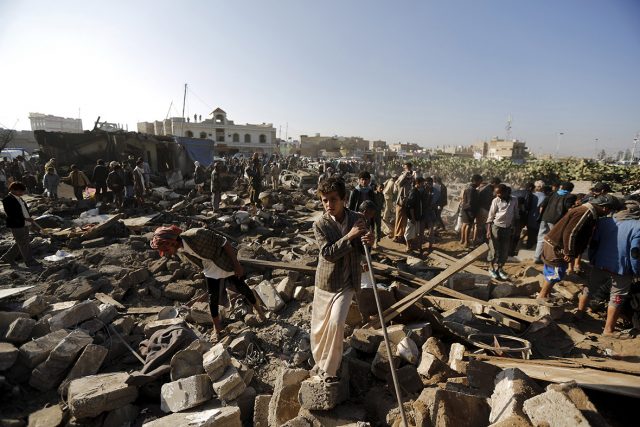
A majority of the British public believes the UK must end arms sales to Saudi Arabia over its large-scale slaughter of civilians in Yemen, according to a new poll.
An exclusive poll conducted by BMG Research for The Independent has found that 58 percent of people say it is wrong for Britain to supply billions of pounds of weapons to Saudi Arabia.
The poll also shows that 64 percent of the public want the government of Prime Minister Theresa May to release a suppressed report into Saudi Arabia’s funding of extremism in Britain, even if it damages relations with Riyadh.
On Wednesday, UK Home Secretary Amber Rudd cited national security reasons for not publishing a report commissioned by former Prime Minister David Cameron that shows the majority of foreign funding for extremism in the UK came from Saudi Arabia.
The survey underscores the public’s deep concern about the UK’s close relationship with an autocracy embroiled in a devastating war in Yemen.
The UK has licensed 3.3 billion pounds worth of weapons since the beginning of Saudi Arabia’s war on Yemen in March 2015.
The United Nations and other international organizations have accused the Saudi-led coalition of bombing hospitals, schools and wedding parties in Yemen.
The UN has declared Yemen a “humanitarian catastrophe,” with sanitation systems destroyed and at least 300,000 people infected with cholera.
The opposition to weapons sales has extended into the government, with key Conservative lawmakers thought to be debating privately for arms sales to be halted.
“This just shows how fast the Conservatives are moving away from public opinion,” said Tom Brake, a Liberal Democrat lawmaker. “Instead of giving the Saudis a stern talking to, ministers are flogging them arms.”
Last week, the UK High Court ruled that London’s weapons sales to Riyadh are not against the law.
The ruling came despite the judges conclusion that there was “a substantial body of evidence suggesting that the [Saudi-led] coalition committed serious breaches of international humanitarian law in the course of its engagement in the Yemen conflict”.
Saudi Arabia has been bombing Yemen since March 2015 in a bid to restore Yemen’s former President Abd Rabbuh Mansur Hadi, a Riyadh ally, to power. Yemen’s crisis began after Hadi stepped down as president and refused to negotiate power-sharing with the country’s Houthi Ansarullah movement.
Message from the High Court: Carry on Arming The Saudis (And Never Mind the Slaughter in Yemen)

Campaigners are furious with a High Court decision in London allowing the UK Government to carry on exporting arms to Saudi Arabia for use against Yemenis
By Stuart Littlewood | American Herald Tribune | July 13, 2017
The Campaign Against Arms Trade (CAAT) brought the legal action against the Secretary of State for International Trade for continuing to grant export licences for arms to Saudi Arabia, arguing that this was against UK policy, which states that the government must refuse such licences if there’s a clear risk that the arms might be used to commit serious violations of International Humanitarian Law.
It is undeniable that Saudi forces have used UK-supplied weaponry to violate International Humanitarian Law in their war on Yemen. According to the United Nations, well over 10,000 people have been killed, the majority by the Saudi-led bombing campaign which has also destroyed vital infrastructure such as schools and hospitals and contributed to the cholera crisis. 3 million Yemenis have been displaced from their homes and 7 million are on the brink of dying from famine. UNICEF reports that a child is dying in Yemen every ten minutes from preventable causes including starvation and malnourishment.
A crippling naval blockade of the country by the US has been key to the cruel onslaught. The European Parliament and numerous humanitarian NGOs have condemned the Saudi air strikes as unlawful. And 18 months ago a UN Panel of Experts accused Saudi forces of “widespread and systematic” targeting of civilians.
Yet the UK has licensed £3.3 billions worth of arms such as aircraft, helicopters, drones, missiles, grenades, bombs and armoured vehicles to the Saudi regime and refused to suspend the supply of weaponry for use in Yemen in the face of the horrors perpetrated. It is claimed that the Government has even ignored warnings by senior civil servants and its own arms control experts, and that some records of expressed concern have gone missing.
So who is the UK’s helping hand behind that vile regime’s murderous adventure in the Yemen? Why, it’s none other that senior Israel stooge Dr Liam Fox, now Secretary of State for International Trade and the lead on trade and investment in the defence and security sector. He of course oversees export licensing. He also has ‘form’ when it comes to thinking silly thoughts and doing stupid things in the foreign affairs arena, and he’s known as a crazed flag-waver for Israel and a sworn enemy of Iran.
While Secretary of State for Defence, Fox told us: “Israel’s enemies are our enemies and this is a battle in which we all stand together or we will all fall divided.”
Fox was forced to resign as Defence Secretary in 2011 following the scandal involving him, his ‘close friend’ Adam Werritty, the UK ambassador to Israel, and Israeli intelligence figures allegedly involved in plotting sanctions against Iran.
The reason for the British government’s hostility towards Iran was spelled out by David Cameron in a speech to the Knesset in 2014: “A nuclear armed Iran is a threat to the whole world not just Israel. And with Israel and all our allies, Britain will ensure that it is never allowed to happen.” That position carries forward into the present day.
And in June 2015 Fox declared: “It is logical to assume that Iran’s intentions are to develop a nuclear weapons capability and any claims that its intentions are exclusively peaceful should not be regarded as credible… Iran’s nuclear intentions cannot be seen outside the context of its support for terror proxies, arguably the defining feature of its foreign policy. The risks are clear.”
What he omitted to say was that Iran’s intentions must also be seen in the context of Israel’s foreign policy, its refusal to sign the Nuclear Non-Proliferation Treaty and the grave threat posed by the Zionist regime’s 200 (or is it 400?) nuclear warheads. Israel hasn’t signed the Biological and Toxin Weapons Convention either, and has signed but not ratified the Comprehensive Nuclear Test-Ban Treaty, likewise the Chemical Weapons Convention. Iran and all the other nations in the region have every right to feel nervous.
As is well known, Israel and Saudi Arabia have formed a cosy alliance. No entities deserve each other more. And Britain will do anything, it seems, to get at Iran through these repulsive ‘friends’.
Instead of dangling from a lamp-post on Tower Bridge, Fox was quickly rehabilitated and re-promoted to senior office by fellow stooges like Theresa May. Just lately prime minister May has accused Iran of working with Hezbollah, interfering in Iraq, sending fighters to Syria to help Assad, and supporting the Houthis in the conflict in Yemen. The British Government, of course, can meddle where it pleases and do dirty weapons deals with the Saudis which, Mrs May assures us, are for the sake of long-term security in the Gulf. “Gulf security is our security,” she says, arguing that the same extremists who plot terror in the Gulf states are also targeting the streets of Europe.
Toxic relationship with Saudi Arabia exposed
So how did Fox manage to defeat the campaigners in court? After all, as Rosa Curling of Leigh Day (acting for CAAT) said, “The law is clear: where there is a clear risk that UK arms might be used in the commission of serious violations of international law, arm sales cannot go ahead.
“Nothing in the open evidence presented by the UK government to the court suggests this risk does not exist in relation to arms to Saudi Arabia. Indeed, all the evidence we have seen from Yemen suggests the opposite: the risk is very real…. Our government should not be allowing itself to be complicit in the grave violations of law taking place by the Saudi coalition in Yemen.”
Andrew Smith of CAAT said: “If this verdict is upheld then it will be seen as a green light for government to continue arming and supporting brutal dictatorships and human rights abusers like Saudi Arabia that have shown a blatant disregard for international humanitarian law….
“This case has seen an increased scrutiny of the government’s toxic relationship with Saudi Arabia. It is a relationship that more than ever needs to be examined and exposed. For decades the UK has been complicit in the oppression of Saudi people, and now it is complicit in the destruction of Yemen.”
Rachel Sylvester in The Times noted that the judges concluded there was “a substantial body of evidence suggesting that the [Saudi-led] coalition committed serious breaches of international humanitarian law in the course of its engagement in the Yemen conflict”, but the ruling was based on a narrow legal point about whether ministers had followed proper procedures and acted rationally in assessing the risks.
“Whatever the result of the legal process,” she wrote, “it’s time for the government to reconsider Britain’s poisonous relationship with Saudi Arabia, starting with the suspension of arms sales to a country that stands accused of appalling human rights abuses within its own borders as well as the funding of extremism abroad. What is UK foreign policy for if not the promotion of this country’s values around the world?”
And, as she points out, last year the UK committed £85 million to the aid effort in Yemen, making the Department for International Development the fourth largest donor to the crisis.
So, just as we pour £millions of aid into the Palestinian Territories to subsidise the illegal Israeli occupation while at the same time supplying the regime in Tel Aviv with arms to sustain its occupation, we are spending all this taxpayers’ money in Yemen to clean up the mess we’re helping the Saudis to make.
Secret evidence favours the evil
Fox succeeded thanks to ‘closed sessions’. This meant that CAAT and their legal team weren’t allowed to see much of what was presented by the Government, which could only be examined by a security-cleared “special advocate”.
The secret evidence is said to have included Saudi Arabia’s “fast-jet operational reporting data”, “high-resolution MoD-sourced imagery” and “UK defence intelligence reports and battle damage assessments”. The MoD and Foreign Office analysis had “all the hallmarks of a rigorous and robust, multi-layered process of analysis” while the evidence presented by the campaigners was “only part of the picture”. The Court said the secret evidence could not be referred to in open court for reasons of “national security”.
But what has all the MoD’s high-faluting technical tosh to do with justice? Or the basic concept of right and wrong? An especially International Humanitarian Law?
And our national security? Yeah, yeah, yeah. So the slaughter must go on in that distant land…
Labour’s shadow international trade secretary Barry Gardenier suggested in the House of Commons that the “secret” evidence should be made available to MPs for scrutiny “on privy council terms” or handed to the Intelligence and Security Select Committee. Sounds reasonable enough.
But Fox is reported saying: “This idea that somehow, if we have closed sessions, that makes the judgment less valid, I simply don’t accept. Because I don’t accept this idea that we simply can’t have closed sessions that protect our national security or the personnel involved in our national security. Our sources need to be protected.”
Yeah, and so do Yemeni civilians…. from us.
He admitted that “Yemen is indeed a humanitarian disaster” but said it was right to keep selling arms to Saudi Arabia. He may have won the legal point – for now. But he has clearly lost his moral compass, if he ever had one.
As Rachel Sylvester remarks, “So craven is the Whitehall establishment that the government has refused to publish a report on the foreign funding of terrorism, for fear of annoying its Saudi friends.”
*(London, UK. 11th July, 2016. Human rights campaigners dressed as Grim Reapers protest against the Farnborough International arms fair, and in particular against arms sales to Saudi Arabia used in human rights abuses in Yemen, at Waterloo station. Image credit: Campaign Against Arms Trade/ flickr).
Court rules Britain’s arms sales to Saudi Arabia are ‘lawful’, despite destruction of Yemen
RT | July 10, 2017
London’s High Court has ruled that UK arms sales to the Saudi Arabian regime are “lawful” in response to a judicial review brought by the Campaign Against the Arms Trade (CAAT).
The case hinged on the question of whether the UK failed to suspend sales in line with legal obligations, given the Saudi’s current war in neighboring Yemen, which has been waged in part using British manufactured military equipment.
Documents cited in court showed that civil servants had, in fact, recommended that sales should no longer go ahead, but ministers had ignored the advice.
“This is a very disappointing verdict, and we are pursuing an appeal,” Andrew Smith of Campaign Against Arms Trade said.
“If this verdict is upheld then it will be seen as a green light for government to continue arming and supporting brutal dictatorships and human rights abusers like Saudi Arabia that have shown a blatant disregard for international humanitarian law.”
CAAT’s lawyer, Rosa Curling, said: “Nothing in the open evidence, presented by the UK government to the court, suggests this risk does not exist in relation to arms to Saudi Arabia.
“Indeed, all the evidence we have seen from Yemen suggests the opposite: the risk is very real. You need only look at the devastating reality of the situation there.”
CAAT, who have said they will appeal, had argued that the UK’s continued sales are a breach of international law while the EU’s common council also insists that sales to nations where violations of the law might occur must be halted.
In the last two years, the UK has licensed the sales of £3 billion (US$3.86 billion) worth of arms to the Saudi government, with which Britain is a longstanding ally.
Arm sales have included Typhoon and Tornado jets and the UK has had military personnel embedded in Saudi headquarters throughout the Yemen conflict, which has raged since 2015.
The British government maintains that the personnel are there to support adherence to international law and advice on rules of engagement.
Both Royal Air Force (RAF) and Royal Artillery (RA) personnel have been deployed to train the Saudi military during the war.
The conflict – which has been accompanied with a blockade of major ports – has drastically worsened the humanitarian situation in the already-impoverished gulf nation.
The UN says 17 million people in Yemen are at imminent risk of famine, while dwindling medical supplies and lack of trained medical personnel have led to epidemics.
Leading humanitarian organizations, including the Red Cross, have named the aerial bombing campaign and blockade as the main causes behind the ongoing cholera epidemic in the capital, Sanaa, that has already claimed some 200 lives, while over 11,000 cases of the disease have been registered.
US court dismisses Yemen drone strike wrongful death suit
RT | July 1, 2017
A US appeals court has upheld a decision dismissing a lawsuit brought by a Yemeni man whose family was killed by a US drone strike. The plaintiff alleges that his family members were innocent bystanders when they were struck by the missile.
The US Court of Appeals for the DC Circuit, which consisted of a three-judge panel, came to an agreement with lower courts that stated they, too, did not have the authority to judge government military actions. An August 2012 drone strike in Yemen, which killed, among others, Salem bin Ali Jaber and Waleed bin Ali Jaber, is what this case is based upon.
Faisal bin Ali Jaber is a Yemeni engineer. He and his family sued the US government for the deaths of Salem, his brother-in-law, and Waleed, his nephew. Jaber made the claim that the deadly strike was in violation of the Torture Victim Protection Act and the Alien Tort Statute.
Jaber’s family members were killed by a “signature strike,” which target individuals through information and data obtained from electronic devices such as mobile phones.
In 2015, the families of the two deceased men brought a case against the US government, then-President Barack Obama and other US officials, for “wrongful deaths.”
Judge Janice Rogers Brown wrote a rare separate opinion, although she also wrote the decision in the case as the three-judge panel was unanimous.
“Of course this begs the question, if judges will not check this outsized power, then who will?”
The outcome that Jaber and his family wanted for the case was a declaratory judgement, which would make the court admit that the US violated international law governing the use of force when killing his family members with the drone strike.
Court documents from 2015 say the family made the claim that the hellfire missile attack by a US drone, which was deployed in the Yemeni village of Khashamir, which killed their family members, was unlawful.
Judge Brown didn’t hesitate to question some of the US government’s practices in the case.
“Of course this begs the question, if judges will not check this outsized power, then who will?” She continued, “the spread of drones cannot be stopped, but the US can still influence how they are used in the global community – including, someday, seeking recourse should our enemies turn these powerful weapons 180 degrees to target our homeland. The Executive and Congress must establish a clear policy for drone strikes and precise avenues for accountability,” Brown said in her opinion of the case.
Brown also stated that US congressional oversight is a “joke” and that “our democracy is broken.”
The other two judges on the panel did not join in Brown’s separate opinion, Reuters reported.
Read more:
A warrior prince rises in Arabia as the monarch of all he surveys
By M K Bhadrakumar | Indian Punchline | June 22, 2017
The royal decree of June 21 by Saudi Arabia’s King Salman appointing his son Mohammed bin Salman as the Crown Prince and next in line to the throne is a watershed event in Middle East politics. Such a development has been expected for some time, but when it actually happened, it still looks momentous and somewhat awesome.
For a start, 31-year old MbS, whom many tend to deride as the “warrior prince”, has earned a reputation for being rash in the use of force. The extremely brutal war in Yemen is his signature foreign-policy project. Saudi Arabia, famous for its caution and its glacial pace of decision-making, has changed remarkably since MbS trooped in alongside King Salman to the centre stage of the Saudi regime in January 2015.
Considering King Salman’s age and health condition, MbS is being positioned in advance so that there will be no succession struggle. MbS has been steadily tightening his grip on the key instruments of power through the past 2-year period – national security apparatus and intelligence, armed forces and oil industry – in a grim power struggle with the Crown Prince Mohammed bin Nayef, who has now lost the game and is retiring from the arena.
With the vast powers of patronage vested in MbS as the Crown Prince, make no mistake, the winner takes it all. In short, the Persian Gulf’s – nay, Middle East’s – power house is about to get a new ruler who is only 31 and he may lead Saudi Arabia for decades.
The timing of the shift in the power fulcrum cannot but be noted. It is exactly one month since US President Donald Trump visited Saudi Arabia. Trump’s visit revived the Saudi-American alliance, which was adrift during the second term of President Barack Obama. MbS has emerged as the Trump administration’s number one interlocutor in the Saudi regime, superseding Nayef who used to be the favorite of the Obama administration.
MbS has forged links at personal level with Trump’s son-in-law Jared Kushner. In a rare gesture, the Prince invited Kushner and wife Ivanka Trump to his residence for a private meal during father-in-law Trump’s visit to Riyadh. So, Saudi-US relations from now onward will be a cozy, exclusive, secretive family affair imbued with a “win-win” spirit – as it used to be in the halcyon days when the Bush family was holding power in the US.
Trump’s visit to Riyadh signalled that Saudi Arabia has regained its stature as the US’ number one partner in the Muslim Middle East. Trump has publicly endorsed the Saudi stance in their standoff with Qatar, which, incidentally, is widely attributed to MbS.
MbS is widely regarded as the mastermind of the tough policy policy to isolate Qatar to make it submissive and has personally identified with the virulently anti-Iran thrust in the Saudi regional strategies. Therefore, MbS’ ascendancy impacts Middle East politics along the following fault lines:
· The war in Yemen;
· The standoff with Qatar;
· The Saudi-Iranian tensions;
· The nascent Saudi-Israeli regional axis;
· Situation in Syria and Gaza and/or Lebanon; and,
· The crackdown in Bahrain.
It remains to be seen whether the unity of the Gulf Cooperation Council (GCC) can be preserved. MbS enjoys personal rapport with Sheikh Mohammed bin Zayed, the crown prince of Abu Dhabi in the United Arab Emirates. But other GCC states — Kuwait, Oman and Qatar — will have a profound sense of unease about the “warrior prince” and this may lead to some major realignments in the Persian Gulf.
On the one hand, MbS may advance a normalization of relations between Saudi Arabia and Israel. If that happens, Israel breaks out of isolation and the Arab-Israeli conflict can never be the same again. Again, it is conceivable that MbS may throw the Palestinians under the bus. On the other hand, Iran too may finally succeed in breaching the GCC cordon that Saudi Arabia had erected, which in turn, may somewhat blur the sectarian divide in the Muslim Middle East and bring about a convergence of interests with Qatar and Turkey as regards perceived Saudi hegemony.
MbS is a man in a hurry. He has radical ideas to transform Saudi society and its economy under the rubric of Vision 2030. He has brought in western-educated technocrats into the governmental apparatus, replacing the Old Guard. How the conservative religious establishment views these winds of change remains the big ‘unknown unknown’ — especially MbS’ management style such as his openness to out-of-the-box thinking, his uniquely public profile in a deeply conservative country, his risk-taking character and his willingness to break conventions.
There is indeed a lot of pent-up disaffection within Saudi Arabia, which makes the period of reform and transition very tricky. The example of Shah’s Iran readily comes to mind. In the ultimate analysis, therefore, the big question is Who is the real MbS?
Clearly, his conduct so far cannot be the yardstick to fathom his personality, since it was primarily a swift, decisive action plan to elbow out the incumbent Crown Prince and take his job. Now that MbS’ actual hold over the levers of power is going to be unchallenged, his priorities can also change. Indeed, there are intriguing sides to his personality – his personal role in forging Saudi Arabia’s working relationships with Moscow, his determination to reduce the economy’s dependence on oil, his appeal to the Saudi youth as the harbinger of “change” and so on. The bottom line is that social and political stability in the country is vital for the success of Vision 2030, in which MbS has staked his prestige, envisaging wide-ranging structural reforms, geo-economic restructuring and the infusion of massive investments.
King Salman’s recent visit to China underscored that MbS understands the potential linkage between his Vision 2030 and China’s Belt and Road Initiative. Of course, China is highly receptive to the idea, too. Deals worth $65 billion were signed in Beijing during King Salman’s visit. Similarly, MbS has been a frequent visitor to the Kremlin and enjoys some degree of personal rapport with President Vladimir Putin. The OPEC decision on cut in oil production has been a joint enterprise in which Putin had a “hands-on” role. Rosneft has signalled interest in acquiring shares in Aramco when its “privatisation” begins next year, and at the recent meet of the St. Petersburg International Economic Forum, the two countries agreed to set up a joint energy investment fund.
MbS, who is Saudi Defence Minister, has also intensified his country’s military cooperation with Russia and China. A notable project will be the Chinese drone factory to be set up in Saudi Arabia. Again, Russia is in talks currently for the sale of T-80 battle tanks to Saudi Arabia, among other weaponry.
Suffice to say, MbS is quite aware of the seamless possibilities that the multipolar world setting offers. It is useful to remember that MbS is a unique Saudi prince who never attended a western university. He is far from a greenhorn in the world of politics either, having begun as fulltime advisor to the council of ministers in 2007.
Indeed, his trademark is his assertiveness in foreign policies that stands in sharp contrast with the traditional Saudi style, and, which, therefore, looks aggressive. But then, it needs to be factored in that the war in Yemen and the strident anti-Iran outlook are immensely popular in the domestic opinion in terms of the surge of Saudi nationalism. The big question, therefore, will be how he deploys the surge of nationalism — amongst the youth, in particular — in his hugely ambitious plan to reform and modernise the country. Traditionally, Saudi rulers used to derive legitimacy from the approval of the Wahhabist religious establishment. (Read an Al Jazeera write-up on MbS’s profile here.)
UNSC liable for consequences of Saudi war on Yemen: Ansarullah
Press TV – June 17, 2017
Yemen’s Houthi Ansarullah movement has held the United Nations Security Council (UNSC) accountable for the consequences of the deadly Saudi aggression, stressing that the nation reserves the right to defend itself.
Mohammed Abdulsalam, the movement’s spokesman, said on Saturday that the UNSC issues statements that encourage the invader to continue its attacks and sieges, increasing the suffering of millions of Yemenis and dashing hope for a political resolution of the conflict, the al-Masirah television network reported.
The Yemeni army and allied popular forces would use all means to respond to Saudi assaults as Yemen, like other nations, reserves the right to defend itself against any invasion, Abdulsalam said.
The UNSC, which is in charge of preserving global peace, should know that the Saudi war supported by the US arms and financial aid, threatens international security, he added.
The Houthi official also stressed that the deterioration of the health situation in Yemen with the outbreak of Cholera is “a source of shame” for the body that claims to be promoting human rights.
He further held Saudi Arabia responsible for the stalemate in talks between Yemen’s warring sides, the siege on Yemen and Sana’a Airport activities.
In a lengthy statement on Thursday, the UNSC called on the Houthis and allies to cease all attacks at Saudi Arabia.
It also urged Yemen’s warring sides to reach a UN brokered deal on management of the strategic port city of Hudaydah at a time that the country slides closer to famine.
Saudi Arabia has been leading a brutal military campaign against Yemen for more than two years to eliminate the Houthi movement and reinstall a Riyadh-friendly former president, Abd Rabbuh Mansur Hadi.
The military campaign, however, has failed to achieve its goals and left over 12,000 Yemenis dead.
The country is also grappling with a Cholera epidemic.
Earlier this week, Save the Children charity said at least 942 people have been killed since the outbreak began in Yemen in April.
It further warned that the rate of infection is increasing and that one child is contracting the disease every 35 seconds.
“Disease, starvation and war are causing a perfect storm of disaster for Yemen’s people. The region’s poorest country is on the verge of total collapse, and children are dying because they’re not able to access basic healthcare,” said Grant Pritchard, Save the Children’s Yemen director.
Cholera is an acute diarrheal infection that is spread through contaminated food or water. It can be effectively treated with the immediate replacement of lost fluids and salts, but without treatment it can be fatal.
UAE-tied militants kidnap, torture hundreds in Yemen: Probe
Press TV – June 10, 2017
Militants backed by the United Arab Emirates (UAE) have reportedly kidnapped and tortured hundreds of people in southern Yemen.
On Friday, the American news and analysis website The Daily Beast published an investigation bankrolled by the Bureau of Investigative Journalism NGO, which pointed to the findings.
The probe said the militants, who would fight under the banner of the Elite Forces, had spirited the men away from their homes and brought them to a secret prison compound in southern Yemen, where they were tortured.
Earlier in the year, the United Nations had likewise reported an increase in forced disappearances in southern Yemen.
The UAE has served as an ally of Saudi Arabia in the latter’s 2015-present campaign in Yemen to restore the impoverished country’s former Riyadh-allied government. The Elite Forces have been fighting in Yemen since the same year to assist the Saudi-led campaign.
The investigators interviewed local rights activists and families of those abducted, who said the situation at the al-Riyyan airport, which has been used as a place of incarceration for the abductees, compared to that in the notorious US-run prisons such as Guantanamo Bay in Cuba and Abu Ghraib in Iraq.
The kidnapping spree took place under the pretext of clearing out suspected al-Qaeda-linked elements. Activists, however, told the Bureau that many of those abducted had normal jobs while al-Qaeda was in control in the area, and were not tied to the group.
According to various reports, Abu Dhabi holds notable sway in southern Yemen and looks to be trying to expand its leverage there by lending its support to southern separatists.
The separatists are led by two pro-Emirati officials of Yemen’s former president Abd Rabbuh Mansur Hadi, who have been sacked by him over suspicions of serving the Emirates.
The men, Hadi’s governor for Yemen’s port city of Aden, Maj. Gen. Aidarous al-Zubaidi, and his state minister Hani bin Breik, reacted to the sacking by breaking ranks with Hadi and forming an autonomous regional body in southern Yemen.
Saudi Arabia then “invited” the separatists to the kingdom, in what was seen as an effort at seeking explanation from them for parting ways with Riyadh-allied Hadi.
Observers say the Emirates increased activities could drag Doha into a political struggle against Saudi Arabia.
Earlier in the month, Yemeni sources reported that militants backed by Saudi Arabia and the United Arab Emirates had engaged in infighting in the southern port city of Aden, with UAE-backed militia seizing a facility there.
‘The BBC Has Betrayed Its Own Rules Of Impartiality’: Yemen, Saudi Arabia And The General Election
Media Lens – June 5, 2017
A key function of BBC propaganda is to present the perspective of ‘the West’ on the wars and conflicts of the world. Thus, in a recent online report, BBC News once again gave prominence to the Pentagon propaganda version of yet more US killings in Yemen. The headline stated:
US forces kill seven al-Qaeda militants in Yemen, says Pentagon
Seven ‘militants’ killed is the stark message. A veneer of ‘impartiality’ is provided by the weasel words, ‘says Pentagon’. BBC News then notes blandly, and without quotation marks:
The primary objective of the operation was to gather intelligence.
Nowhere in the short article was there any attempt to provide an alternative view of who had been killed and why. Were they really all ‘militants’? How is a ‘militant’ distinguished from a ‘civilian’, or from a soldier defending his country against foreign invaders? There was not even a cautious statement to the effect that the Pentagon’s claims could not be verified, as one might expect of responsible journalism.
Instead, we have to turn to Reprieve, an international human rights organisation founded in 1999 by the British lawyer Clive Stafford Smith. The group reports that five of the ‘militants’ were civilians, including a partially blind 70-year-old man who was shot when he tried to greet the US Navy Seals, mistaking them for guests arriving in his village.
But their civilians are mere ‘collateral damage’ in war. Since January 2017, the US has launched 90 or more drone strikes in Yemen, killing around 100 people, according to the Bureau of Investigative Journalism. This death toll includes 25 civilians, among whom were 10 children, killed in the village of al Ghayil in the Yemeni highlands during a US raid that was described by President Trump as ‘highly successful’.
Mentions of such atrocities were notable by their absence in ‘mainstream’ media coverage of Trump’s recent trip to Saudi Arabia where he signed trade deals worth around $350 billion. This included an arms deal of $110 billion which the White House described as ‘the single biggest in US history.’ It would not do for the corporate media, including BBC News, to dwell on the implications for Yemen where at least 10,000 people have been killed since the start of the Saudi-led bombing campaign in 2015. 14 million Yemenis, more than half the population, are facing hunger with the Saudis deliberately targeting food production.
The World Health Organisation recently warned of the rising numbers of deaths in Yemen due to cholera, saying that it was ‘unprecedented’. Save the Children says that at the current rate, more than 65,000 cases of cholera are expected by the end of June. The cholera outbreak could well become ‘a full blown-epidemic’. Moreover:
The upsurge comes as the health system, sanitation facilities and civil infrastructure have reached breaking point because of the ongoing war.
As US investigative journalist Gareth Porter observes via Twitter:
World leaders are silent as #Yemen faces horrible cholera epidemic linked to #Saudi War & famine. Politics as usual.
Iona Craig, formerly a Yemen-based correspondent for The Times, notes that ‘more than 58 hospitals now have been bombed by the coalition airstrikes, and people just do not have access to medical care in a way that they did before the war.’ As if the bombing was not already brutal, Saudi Arabia has imposed a cruel blockade on Yemen that is delaying, or even preventing, vital commodities from getting into the country. Grant Pritchard, interim country director for Save the Children in Yemen, says:
These delays are killing children. Our teams are dealing with outbreaks of cholera, and children suffering from diarrhoea, measles, malaria and malnutrition.
With the right medicines these are all completely treatable — but the Saudi-led coalition is stopping them getting in. They are turning aid and commercial supplies into weapons of war.
As one doctor at the Republic teaching hospital in Sanaa commented:
We are unable to get medical supplies. Anaesthetics. Medicines for kidneys. There are babies dying in incubators because we can’t get supplies to treat them.
The doctor estimated that 25 people were dying every day at the hospital because of the blockade. He continued:
They call it natural death. But it’s not. If we had the medicines they wouldn’t be dead.
I consider them killed as if they were killed by an air strike, because if we had the medicines they would still be alive.
None of this grim reality was deemed relevant to Trump’s signing of the massive new arms deal with Saudi Arabia. BBC News focused instead on inanities such as Trump ‘to soften his rhetoric’, ‘joins Saudi sword dance’ and ‘no scarf for Melania’. But then, it is standard practice for the BBC to absolve the West of any blame for the Yemen war and humanitarian disaster.
British historian Mark Curtis poses a vital question that journalists fear to raise, not least those at the BBC: is there, in effect, collusion between the BBC and UK arms manufacturer BAE Systems not to report on UK support for the Saudi bombing of Yemen, and not to make it an election issue? Curtis also notes that the BBC has not published any online article about UK arms being sold to the Saudis for use in Yemen since as far back as January. This, he says, is ‘misinforming the public, a disgrace’. He also rightly points out that the BAE Systems Chairman, Sir Roger Carr, was also Vice-Chair of the BBC Trust until April 2017 (when the Trust was wound up at the end of its 10-year tenure). The BBC Trust’s role was to ensure the BBC lived up to its statutory obligations to the public, including news ‘balance’ and ‘impartiality’. How could Sir Roger’s dual role not suggest a major potential conflict of interest?
On the wider issue of ‘mainstream’ media coverage of foreign policy, the political journalist Peter Oborne notes that:
Needless to say, the British media (and in particular the BBC, which has a constitutional duty to ensure fair play during general elections) has practically ignored Corbyn’s foreign policy manifesto.
Oborne writes that the manifesto:
is radical and morally courageous.
He explains that, pre-Corbyn:
Foreign policy on both sides was literally identical. The leadership of both Labour and the Conservatives backed the wars in Iraq, Libya and Afghanistan, the alliance with Saudi Arabia and the Sunni states in the Gulf.
London did what it was told by Washington. […] This cross-party consensus has been smashed, thanks to Jeremy Corbyn, the current Labour leader. Whatever one thinks of Corbyn’s political views (and I disagree with many of them), British democracy owes him a colossal debt of gratitude for restoring genuine political debate to Britain.
And of course his extremely brave and radical decision to break with the foreign policy analysis of Blair and his successors explains why he is viewed with such hatred and contempt across so much of the media and within the Westminster political establishment.
But, as Oborne notes, this important change has not been fairly represented in media coverage. In particular, on Yemen and Saudi Arabia:
It is deeply upsetting that the BBC has betrayed its own rules of impartiality and ignored Corbyn’s brave stand on this issue.
We challenged Andrew Roy, the BBC News Foreign Editor, to respond to Oborne’s observations. He ignored us (here and here). Roy’s silence is especially noteworthy given that he had once promised:
If there is a considered detailed complaint to something we’ve done, I will always respond to it personally.
Perhaps Oborne’s challenge to the BBC was not deemed sufficiently ‘considered’ or ‘detailed’ by the senior BBC News editor. Likewise, our own challenges over many years in numerous media alerts addressing BBC foreign coverage have been ignored or, at best, brushed away.
It was noteworthy that Corbyn’s considered response to the most recent terrorist attack in London was selectively reported, arguably censored, by BBC News. Corbyn said:
We need to have some difficult conversations, starting with Saudi Arabia and other Gulf states that have funded and fuelled extremist ideology.
It is no good Theresa May suppressing a report into the foreign funding of terrorist groups. We have to get serious about cutting off the funding to these terror networks, including Isis here and in the Middle East.
Sky News broadcast Corbyn’s comments, but they do not appear to have been covered by BBC News. Certainly, as far as we can see, there is no mention of them in their ‘Live’ blog on the London attack or in Laura Kuenssberg’s analysis, ‘Election 2017: Impact of London terror attack on campaign’. And nothing about the Saudi link with terrorism appears in the BBC’s online report on Corbyn’s speech, focusing instead on the issue of May’s cuts to police numbers while Home Secretary. Even this issue alone, if properly and fully addressed by the media, should be a resigning matter for May as Prime Minister. Responding to the London attacks, Peter Kirkham, a former Senior Investigating Officer with the Metropolitan police, accused the government of lying over police numbers on UK streets. And a serving firearms officer says that:
The Government is wrong to claim police cuts have nothing to do with recent attacks.
Despite her denials, Theresa May’s cuts to police numbers have made attacks like London and Manchester much more likely.
Kuenssberg’s piece included passing mention of ‘the Tories’ record on squeezing money for the police’. But she gave no figures showing a reduction in the number of armed police; crucial statistics which she could have easily found from the Home Office.
Mark Curtis gives a damning assessment of BBC reporting on foreign affairs, particularly during the general election campaign. Noting first that:
One aspect of a free and fair election is “nonpartisan” coverage by state media.
He continues:
Yet BBC reporting on Britain’s foreign policy is simply amplifying state priorities and burying its complicity in human rights abuses. The BBC is unable to report even that Britain is at war – in Yemen, where the UK is arming the Saudis to conduct mass bombing, having supplied them with aircraft and £1 billion worth of bombs, while training their pilots.
Curtis then provides some telling statistics:
From 4 April to 15 May, the BBC website carried only 10 articles on Yemen but 97 on Syria: focusing on the crimes of an official enemy rather than our own. Almost no BBC articles on Yemen mention British arms exports. Theresa May’s government is complicit in mass civilian deaths in Yemen and pushing millions of people to the brink of starvation; that this is not an election issue is a stupendous propaganda achievement.
Indeed, our newspaper database searches reveal that, since the election was called on April 18, there has been no significant journalistic scrutiny of May’s support of Saudi Arabia’s bombing campaign in Yemen. The subject was even deemed radioactive during a public meeting in Rye, Sussex, when Amber Rudd, standing for re-election, appeared to shut down discussion of arms sales to Saudi Arabia. Electoral candidate Nicholas Wilson explains what happened:
At a hustings in Rye on 3 June, where I am standing as an independent anti-corruption parliamentary candidate, a question was asked about law & order. Home Secretary Amber Rudd, in answering it referred to the Manchester terrorist attack. I took up the theme and referred to UK arms sales to Saudi Arabia & HSBC business there. She spoke to and handed a note to the chairman who removed the mic from me.
The footage of this shameful censorship deserves to be widely seen. If a similar event had happened in Russia or North Korea, it would have received intensive media scrutiny here. Once again, we note the arms connection with the BBC through BAE Systems Chairman, Sir Roger Carr. Wilson has also pointed out a potential conflict of interest between HSBC and the BBC through Rona Fairhead who was a non-executive director of HSBC while serving as Chair of the BBC Trust.
These links, and Theresa May’s support for the Saudi regime, have gone essentially unexamined by the BBC. And yet, when BBC political editor Laura Kuenssberg responded to Corbyn’s manifesto launch, her subtle use of insidious language betrayed an inherent bias against Corbyn and his policies on foreign affairs. She wrote: ‘rather than scramble to cover up his past views for fear they would be unpopular’, he would ‘double down… proudly’. Kuenssberg’s use of pejorative language – ‘scramble’, ‘cover up’, ‘unpopular’ – delivered a powerful negative spin against Corbyn policies that, in fact, as Oborne argues, are hugely to his credit.
When has Kuenssberg ever pressed May over her appalling voting record on Afghanistan, Iraq, Libya, Syria and Yemen? In fact, there is no need for May to ‘scramble’ to ‘cover up’ her past views. Why not? Because the ‘mainstream’ media rarely, if ever, seriously challenge her about being consistently and disastrously wrong in her foreign policy choices; not least, on decisions to go to war.
Featured Video
Seyed M. Marandi: Negotiations Collapsed – Return to War
or go to
Aletho News Archives – Video-Images
From the Archives
Wartime internment camps in Australia
National Archives of Australia
World War I
During World War I, for security reasons the Australian Government pursued a comprehensive internment policy against enemy aliens living in Australia.
Initially only those born in countries at war with Australia were classed as enemy aliens, but later this was expanded to include people of enemy nations who were naturalised British subjects, Australian-born descendants of migrants born in enemy nations and others who were thought to pose a threat to Australia’s security.
Australia interned almost 7,000 people during World War I, of whom about 4,500 were enemy aliens and British nationals of German ancestry already resident in Australia.
Records of World War I internment camps
World War II
During World War II, Australian authorities established internment camps for three reasons – to prevent residents from assisting Australia’s enemies, to appease public opinion and to house overseas internees sent to Australia for the duration of the war.
Unlike World War I, the initial aim of internment during the later conflict was to identify and intern those who posed a particular threat to the safety or defence of the country. As the war progressed, however, this policy changed and Japanese residents were interned en masse. In the later years of the war, Germans and Italians were also interned on the basis of nationality, particularly those living in the north of Australia. In all, just over 20 per cent of all Italians resident in Australia were interned. … continue
Blog Roll
 Aletho News
- Seyed M. Marandi: Negotiations Collapsed – Return to War
- Tomorrow’s naval blockade showdown
- ‘Israel’ attacks civilians to hide its embarrassing military failures & out of pure sadism
- Any Foreign Military Vessel Approaching Hormuz Under Any Pretext ‘Will Be Dealt With Severely’: IRGC
- Diplomats slam US negotiators’ performance in Iran talks
- Trump Refuses Exit Ramp, War with Iran will Continue
- Trump Says US Naval Blockade in Strait of Hormuz Will Begin Shortly
- US, Iran end 21-hour talks without agreement
- US IRAN TALKS: Who Are the Crazy Ones Here? /Lt Col Daniel Davis
- Talks with the US end without a deal over excessive US demands: Iran
- If Americans Knew
- US-Iran ceasefire negotiations make zero progress – Daily Update
- Pro-Israel ‘Thinktanks’ and Individuals who Influence U.S. Foreign Policy
- Mearsheimer reveals how Israel dictates US policies on Iran, Gaza – video
- After killing 350+, Israel still has a “score to settle” with Lebanon before ceasefire – Daily Update
- Military aid to Israel emerges as the latest political litmus test for Democrats
- The only Palestinian children’s rights organization closes following years-long Israeli campaign against it
- ‘I Can’t Forget the Smell’: Lebanese Reel After Israel Kills Over 300 in Single Day
- DNC Shoots Down Resolutions Calling Out AIPAC and Limiting Arms to Israel
- TCN: Is Israel Blackmailing President Trump?
- Israel killed at least 303 Lebanese yesterday – who were they? Daily Update
- No Tricks Zone
- German Expert: Heat Dome Led To Record Temps In Western USA…Warmer In 1934, 1936
- New Study: No Linear Warming Or Glacier Retreat Along Northern Antarctic Peninsula Since 1980s
- An Inconvenient Tree: Uncovered In Alps… Europe Much Warmer Than Today 6000 Years Ago
- New Study Reports A 60% Slowdown In Greenland’s Ice Loss Rate In The Last Decade
- Low Intensity Tornado Wrecks Major Solar Farm, Creating A Potential Toxic Dump
- New Study Finds Warming Saves Lives…Cold Temperatures 12 Times More Deadly Than Excess Heat
- German Science Blog Accuses PIK Climate Institute Of Hallucinating Climate Tipping Points
- Devastating Assessment Of Comirnaty Vaccine By Former Senior Pfizer Europe Toxicologist
- New Study: CO2 Is ‘Effectively Negligible’ As An Explanatory Climate Change Factor Since 2000
- Former Pfizer Toxicologist Dr. Helmut Sterz Tells Bundestag Hearing Pfizer Vaccine Should Have Never Been Approved
 Aletho News