Barak blasts Netanyahu: ‘Stop lying – you can’t destroy Iran’s nuclear, missile capabilities’
Press TV – March 23, 2026
Former Israeli prime minister Ehud Barak on Monday launched a blistering attack at the regime’s incumbent political and military leadership, slamming them for peddling “blatant” lies over the war against Iran and noting that the regime has no strategy to end the war.
In an interview with Channel 13, Barak, who also previously acted as the regime’s military chief and military affairs minister, delivered a stark assessment of the Israeli wars on Gaza, Lebanon and the Islamic Republic of Iran.
“We cannot open the Strait of Hormuz, nor destroy Iran’s nuclear and missile capabilities, so don’t lie to us too much,” Barak said, directly challenging the regime’s claims regarding its capacity to confront the Islamic Republic.
His remarks came as the Israeli-American war against Iran entered its 24th day with no end in sight. The war, which started with the assassination of the Leader of the Islamic Revolution, Ayatollah Seyyed Ali Khamenei, and some top-ranking officials and military commanders, has failed to achieve the “regime change” agenda or to decapitate the Iranian government.
On the contrary, as experts acknowledge, Iranian armed forces have decimated Israeli military and intelligence infrastructure across the occupied territories as well as US military bases in some Persian Gulf countries as part of Operation True Promise 4.
So far, 74 waves of missile and drone operations have been successfully carried out against enemy targets, which have effectively destroyed the air defense systems.
Barak, who acted as the regime’s premier from 1999 to 2001, launched a stinging attack at the regime’s war cabinet, stressing that the political echelon lacks both the knowledge and the will to end the fighting that has failed to achieve any objectives.
“Israel at the political level doesn’t know – doesn’t know or doesn’t want – to bring the war to an end,” he said. “They don’t know how to end wars.”
He also pointed to unfulfilled promises made repeatedly by the Benjamin Netanyahu regime vis-à-vis the genocidal wars against Gaza and Lebanon.
“We are two and a half years in; Hamas is still there after they promised us six times that we were a step away from ‘total victory.’ Hezbollah is still there after they told us we threw them back decades,” he stated.
Barak also took aim at Netanyahu’s long-standing emphasis on the so-called “Iranian threat,” noting that the regime’s claims of neutralizing the danger do not align with reality.
“Iranian nuclear program and missiles are still there after they clarified to us that he [Netanyahu] removed the existential threat,” he said, shaken by the direct Iranian missile impacts across the occupied territories in the ongoing war.
The former prime minister described a systemic breakdown in trust between the regime and settlers, exacerbated by what he called deliberate withholding of information.
“Now, what is the problem? When there is no truth and no trust. We also don’t know all the details, including those of us who were deep inside these matters,” Barak said. “We don’t know what the truth is. But they shouldn’t tell us ‘the truth’ – they just shouldn’t lie to our faces in such a blatant way so that we can participate in the discussion more seriously.”
Seyed M. Marandi: Total War – Attacking Nuclear Plants, Desalination & Infrastructure
Glenn Diesen | March 22, 2026
Seyed Mohammad Marandi discusses the targeting of nuclear plants, desalination plants, critical infrastructure, and the civilian population. Trump has given Iran 48 hours to open the Strait of Hormuz (capitulation), otherwise the US will destroy Iran’s energy facilities. Then there will be no limits on Iran’s response, and the consequences will be global. The future of global stability will be decided over the next few days. Marandi is a professor at Tehran University and a former advisor to Iran’s Nuclear Negotiation Team.
Follow Prof. Glenn Diesen:
- Substack: https://glenndiesen.substack.com/
- X/Twitter: https://x.com/Glenn_Diesen
- Patreon: https://www.patreon.com/glenndiesen
Support the research by Prof. Glenn Diesen:
- PayPal: https://www.paypal.com/paypalme/glenndiesen
- Buy me a Coffee: buymeacoffee.com/gdieseng
- Go Fund Me: https://gofund.me/09ea012f
Israel systematically torturing Palestinians in custody: UN special rapporteur Albanese
Press TV | March 22, 2026
A UN expert says that the Israeli regime systematically tortures Palestinians on a scale “that suggests collective vengeance and destructive intent.”
In a report released on Friday, Francesca Albanese, the UN’s special rapporteur on the rights situation in the Palestinian territories occupied since 1967, said that since October 7, 2023, when the Israeli regime began a genocidal war on Gaza, Palestinians in custody “have been subjected to exceptionally ruthless physical and psychological abuse.”
Entitled “Torture and genocide”, the report “examines Israel’s systematic use of torture against Palestinians from the occupied Palestinian territory since October 7, 2023.”
“Torture in detention has been used on an unprecedented scale as punitive collective vengeance,” the report said.
Brutal beatings, sexual violence, rape, lethal mistreatment, starvation, and the systematic deprivation of the most basic human conditions have inflicted profound and lasting scars on the bodies and minds of tens of thousands of Palestinians and their loved ones,” the report stated.
Torture has become integral to the domination of and punishment inflicted on men, women and children, both through custodial abuse and through a relentless campaign of forced displacement, mass killings, deprivation and destruction of all means of life to inflict long-term collective pain and suffering, it warned.
Since October 2023, abduction of Palestinians in the occupied territory had “escalated dramatically,” with more than 18,500 people arrested, including at least 1,500 children, the report added.
About 9,000 Palestinians were still in detention, while more than 4,000 have been subjected to enforced disappearance, it said.
Israel’s detention system “has descended into a regime of systemic and widespread humiliation, coercion, and terror,” according to the report.
Albanese demanded Israel “immediately cease all acts of torture and ill-treatment of the Palestinian people as part of its ongoing genocide” and urged all countries “to do everything in their power to stop the destruction of what remains of Palestine” as every delay “worsens irreversible harm and further entrenches a system of cruelty.”
She urged the prosecutor of the International Criminal Court (ICC) to request arrest warrants for hawkish Israeli ministers Israel Katz, Itamar Ben-Gvir and Bezalel Smotrich.
She said she had gathered written submissions about these atrocities, including at least 300 testimonies, and is due to present her report to the UN Human Rights Council (HRC) on Monday.
Since October 7, 2023, the Israeli regime has killed at least 72,000 Palestinians in Gaza and wounded more than 172,000 others, most of them women and children.
How the US-Israeli aggression against Iran is affecting the war in Ukraine
By Dmitri Kovalevich | Al Mayadeen | March 22, 2026
In the second half of March, the US and Israeli aggression against Iran is taking its toll on Ukraine. Retail stores are updating their prices daily, while the government is unable to keep gasoline prices in check through threats against sellers, as operators simply hide their product, creating artificial shortages.
Following the rapid deindustrialization that accompanied ‘independent’ Ukraine’s secession from the Soviet Union in the early 1990s, the only remaining productive industry in the country is agriculture, specifically, the production of grain and corn for export. Ukrainian authorities now face a harsh choice: supply fuel to agrarians at the start of this year’s planting season, or divert dwindling fuel supplies to meet the needs of the Armed Forces of Ukraine. According to Defense Minister Denys Shmyhal, supplying the Armed Forces of Ukraine remains the priority, in order that the proxy war by Western powers against the Russian Federation may continue.
He stated on March 1: “The war in Iran has triggered a global fuel crisis. Our key task is to supply the army. Sowing is the second priority. After that come businesses and people.”
European fuel suppliers have reduced their supplies to Ukraine in order to meet demand in their own markets. Fuel shipments from Poland have been suspended for one week, while Romania and Moldova have also temporarily halted fuel exports. Hungarian Prime Minister Viktor Orbán already halted sales of diesel fuel and gasoline to Ukraine in February due to Ukraine’s disruption of the Druzhba pipeline from Russia.
As a result, Ukraine may be forced to seek fuel in more distant markets… and pay much higher prices for it. It is becoming increasingly clear that the Western imperialist powers cannot sustain two wars at once—one against Russia, the other against Iran.
Danylo Getmantsev, head of Ukraine’s legislative committee on tax policy, says that Ukraine could face serious fuel shortages as early as April if the war with Iran drags on. “According to analysts of the Ukrainian fuel market, the situation with a shortage of fuel and lubricants may arise in our country in April,” he said in early March. To counter this, Getmantsev proposes exploring opportunities to establish a strategic reserve of petroleum products in partner countries.
Andriy Gerus, head of the energy committee of the Ukrainian legislature, noted earlier in March that due to Russia’s shelling of oil depots, Ukraine has no remaining strategic fuel reserves. “Everything is operating on a just-in-time basis; there are no remaining stocks of cheaper resources, so any price change in Europe quickly translates into a price change in Ukraine.” He explains that fuel in Ukraine will always be more expensive than in Europe.
Legislator Oleksandr Dubinsky, currently in jail accused of treason, believes that due to the war against Iran, the economic situation in Ukraine has become critical, much like it was in February 2022 at the start of the war. “Society and the army are exhausted. Exchange rates, energy costs, and prices have risen. The budget deficit is widening. At the same time, uncertainty is growing,” Dubinsky explains.
Nevertheless, according to Dubinsky, officials in Kiev believe that Ukraine is seen as too important in the global game to be allowed to fail, so money for its survival as a Western vassal will be found regardless of the widespread corruption that has further overwhelmed the Ukrainian economy beginning in 2022.
Legislator Yuriy Boyko says that if oil reaches $200 per barrel, everyone will feel the impact. “In that case, the planting season will be at risk, and prices for goods will rise sharply. Ukrainians aren’t well-off to begin with, so we can’t let that happen,” the lawmaker says.
Another legislator, Mykhailo Tsymbaliuk, has stated that high gasoline prices are already affecting the country’s military capabilities. According to him, the fuel being allocated by the Ministry of Defense is insufficient for the armed forces, causing grave problems. Even evacuations of wounded soldiers are being compromised. “The skyrocketing price of gasoline has become a serious warning sign for the Armed Forces of Ukraine,” the lawmaker warns.
Ukraine’s European supporters will continue for some time to divert fuel resources away from their own needs in order to supply the Ukrainian Armed Forces with gasoline, even at the expense of their own citizens. However, with every passing week and month that the war with Iran continues, the cost of such assistance will rise sharply for them.
In March, Ukrainian lawmakers told Ukrainian media that European governments are urging them to assure Ukraine keeps fighting Russia for another year-and-a-half to two years. “The Europeans have told us ‘Keep fighting for another year and a half to two years; we’ll provide the money you need’”, reports the publication Zerkalo Nedeli on March 12.
Under such pressure, Ukrainian President Volodomyr Zelenskyy has tasked the political leadership in the national legislature to continue functioning for several more years without an electoral mandate. The last national election Ukraine took place in April 2019, with a five-year mandate. It featured the banning of political parties deemed to be sympathetic to dialogue and good relations with Russia, a feature of the system that took power in February 2014 following a violent coup spearheaded by neo-Nazi paramilitaries.
To so many Ukrainians, the urgings and hidden threats by the leaders of ‘civilized Europe’ mean they will continue to be abducted from their own streets for two more years by the recruiters of Kiev’s compulsory military service.
None of the possible scenarios cited by Ukrainian military experts envisage a Russian defeat or the recapture of territories lost by Ukraine. In other words, the sole result of scenarios for continued war being urged is continued destruction of the Ukrainian population, all politely funded by European/NATO-member governments.
This approach speaks volumes about the overall strategy of Kiev and its Western allies. Theirs is a ‘strategy’ of holding out for a while longer without any long-term expectation of peace, hoping for some ‘black swan’ event (‘extremely rare and unpredictable’) that will drastically change the geopolitical situation. In other words, Western imperialism and its Ukrainian stooges are pinning their hopes on a miracle that might save them all.
Ukraine’s European ‘allies’, in truth, currently lack the funds to continue the war in Ukraine. They are negotiating a €90 billion loan for the country, but as mentioned above, European Union member Hungary is currently blocking this proposal.
Meanwhile, on March 18, Ukrainian media, citing a US State Department report, reported that USAID auditors have uncovered irregularities in the oversight of the more than $30 billion in direct budget support to Kiev since February 2022. There are a great many corruption scandals festering in Ukraine, but none have acted as grounds for refusing further loans and financial aid, despite the evidence that much of that could be embezzled.
Zelenskyy told the BBC during a visit to Britain on March 17 (which included a warm welcome by the British monarchy) that the war in Iran raises ominous forebodings about Ukraine’s future. Yet as Ukrainian media has noted, Zelensky is a firm supporter of that war.
In a speech to the annual Munich Security Conference on February 14, Zelensky called for measures to “immediately stop” Iran, without any delay. “Regimes like the one in Iran must not be given time. When they have time, they only kill more. They must be stopped immediately.”
Then, on February 27, he told an interview with Sky News that he supported an operation to depose the Iranian leadership.
Ukraine’s European allies are currently concerned with how to win back Donald Trump’s favor and persuade him to continue funding the Zelensky-led government in Kiev. Finnish President Alexander Stubb fears that negotiations on Ukraine are approaching a “moment of truth” that could force Kiev to formally cede territory in the Donbass region to Moscow. (Populations there voted in 2022 and before that to secede from coup Ukraine and join the Russian Federation.)
Europe, Stubb says, finds itself in a difficult position due to reductions in direct US aid to Ukraine. He proposes an odd trade-off to resolve this dilemma, namely, an ‘exchange’ of military assistance by Ukraine to the US and “Israel” in the Strait of Hormuz in exchange for continued assistance to Kiev’s war. That includes a proposal that the European Union agree to provide the US with military assistance to unblock the Strait of Hormuz in exchange for increases in direct US supplies to Ukraine.
But this is wishful thinking. The European Union member-countries of NATO lack the military capabilities required to reopen the Strait of Hormuz. They do have experience (gained during the Ukrainian crisis) in buying time and ‘bogging down’ the crisis in the Middle East through numerous rounds of fruitless negotiations with Iran. The essence of the EU approach would see the Iranian side fulfilling certain conditions in the here and now, while the West and its allies promise to ‘do something’ to normalize relations, but at a later time.
During the war in Ukraine, we witnessed endless negotiations in this vein under the ‘Minsk-1’ and ‘Minsk-2’ agreements in 2014 and early 2015. Then there was the ‘grain deal’ of July 2022, whereby the Russian navy would allow Ukraine to export grain from Black Sea ports. In all these cases, Ukraine and the West failed to fulfill their part of the commitments.
Oleg Yasinsky, a Ukrainian political analyst now living in Chile, commented on March 19 about the resistance of the Iranian people to aggression and the tradition of deception to which the West has consistently resorted during negotiations following military failures. “Once upon a time, the ancestors of today’s democratic world leaders negotiated with Indigenous peoples as they plundered and conquered them. At peace-signing ceremonies with the indigenous peoples of Patagonia, poison-laced whale carcasses were served at the table, while in the cold mountains of North America, smallpox-infected blankets and clothing were given as gifts to original peoples.
“Today, from Minsk for Russia to Geneva for Iran, the peacemaking traditions of the ‘civilized world’ have not changed one bit in all this time. Therefore and unfortunately,” he concludes, “missiles are the only real negotiators today.”
Zelensky is now desperately traveling around the world seeking to regain attention for his government as Iran becomes the main topic of global media. He is ‘jumping on the bandwagon’ of war against Iran in efforts to render some valuable service to Western imperialism and prove his continued usefulness. He has offered Ukrainian troops to guard “Israel” and Western military bases in the Gulf and in Cyprus. Alas for him, Trump has dismissed his obsequious ‘servant,’ going so far as to say that “Zelensky is the last person from whom we would need help.”
According to Odessa-based anarchist Vyacheslav Azarov, Ukraine is scrambling to align itself with the dominant theme in international politics and position itself as a useful part of the crisis exploding in the Middle East. Demands for additional support to Kiev are being delivered from this new vantage point. However, in the end, Kiev may simply end up with “additional airstrikes accompanied by the friendly shrieking of minor allies who have no real influence” and a large, new adversary in the form of Iran.”
Zelensky’s humiliating traveling and messaging does not go unnoticed in Ukraine. But the pompous president, who sees himself as a sage colonialist in the style of Winston Churchill and is continuously applauded by the governments of European countries, turns out to be a frightened servant, fearing that his ‘masters’ may abandon him. The war waged by Western imperialism against the Iranian people has once again underscored the weakness and dubious value of Zelensky’s government, whose image the West has artificially inflated for years through its media.
Report: White House Making ‘Detailed Preparations’ for Invasion of Iran
By Kyle Anzalone | The Libertarian Institute | March 22, 2026
Sources speaking with CBS News said that military commands submitted specific requests to prepare for a ground invasion of Iran.
The US deployed a second Marine Expeditionary Unit (MEU) to the Middle East last week, the sources explained. The USS Boxer will join the USS Tripoli in the region for a potential ground invasion of Iran. The Department of War is also preparing to deploy portions of the 82nd Airborne.
Axios reported on Friday, speaking with sources who said President Donald Trump is considering an occupation or blockage of Iran’s Kharg Island. The oil facilities on the island, which is located 15 minutes from the mainland in the Persian Gulf, handle 90% of Iran’s oil exports.
“He wants Hormuz open. If he has to take Kharg Island to make it happen, that’s going to happen. If he decides to have a coastal invasion, that’s going to happen. But that decision hasn’t been made,” a senior administration official told the outlet.
Trump is also threatening to escalate attacks on Iran’s power plants if Tehran does not reopen the Strait of Hormuz. The Islamic Republic said it will respond with strikes on civilian infrastructure across the region and the complete closure of the Strait of Hormuz.
Israel’s military chief Eyal Zamir said that the war was at its “halfway point.” On Saturday, an Iranian missile hit Dimona, the city where Israel bases its secret nuclear weapons program. Following the attack, Israeli Defense Minister Israel Katz said the US and Israel would “intensify” and “significantly increase” their strikes on Iran in the coming week.
Eight Iraqi resistance attacks hit US Victoria base near Baghdad airport
The Cradle | March 22, 2026
Iraqi resistance factions targeted the US Victoria Base near Baghdad airport in at least eight separate rocket and drone strikes, just days after video footage showed the site engulfed in flames as a result of non-stop attacks.
“Eight separate attacks, carried out until dawn with rockets and drones, targeted the US center,” a senior Iraqi security source told AFP on 22 March.
The Islamic Resistance in Iraq coalition announced on Sunday morning that its fighters carried out 21 operations over the past 24 hours, “using dozens of drones and missiles to target US occupation bases in Iraq and across the region.”
The US Victoria base – located near Baghdad airport – has come under continuous attacks by the Iraqi resistance since the start of Washington and Tel Aviv’s brutal war against Iran. The site serves as a US military logistical center.
Footage from after an Iraqi resistance operation on Friday showed the US Victoria base engulfed in large flames.
Other targets which have come under heavy attack by the Iraqi resistance include Washington’s Harir base and the US embassy compound in Baghdad.
After several heavy strikes on the embassy building since the start of the month, leading Iraqi resistance faction Kataib Hezbollah said on 19 March that it “issued orders to suspend operations targeting the US Embassy in Baghdad for a period of five days,” warning that “the response will be immediate” if its terms are violated.
The terms demand that Israel “cease the destruction and bombardment of the southern suburbs in Beirut,” and include calls for “a commitment to not bomb residential areas in Baghdad and the provinces,” as well as “the withdrawal of CIA elements from their positions and keeping them inside the embassy.”
Two days earlier, a top Kataib Hezbollah official was assassinated in a US-Israeli airstrike.
Deadly air raids against Iraq have been ongoing since the Iraqi resistance intervened in the war and began striking US targets in response to the brutal US-Israeli campaign against Iran.
Iran’s Dimona Strike Shatters Myth of ‘Impenetrable’ THAAD, Patriot & Arrow Air Defenses – Analyst
Sputnik – 22.03.2026
Iran’s huge leap in missile capability allowed it to punch through Israel’s vaunted multi-layered air defense shield, says political science and international relations expert Dr. Simon Tsipis. That explains why several warheads in Iran’s retaliatory strike on Dimona, home to Israel’s nuclear research facility shielded by Israeli and US defenses, reached their target area, Dr. Simon Tsipis tells Sputnik.
According to the analyst:
- Attack exposed weaknesses of Israel’s Iron Dome, built to intercept short-range rockets and mortars – not Iran’s intermediate-range ballistic missiles
- Iran’s military capabilities now allow it to launch ballistic missiles at ranges exceeding 2,000 km — including Diego Garcia joint US-UK military base
- Iran employs saturation tactics, launching swarms of decoys like drones and low-caliber missiles to overwhelm defensive systems before the main missile strikes
“Until now, it had been assumed that Iranian missiles would lose momentum and speed at the limits of their range. It is now evident that they retain significant power and velocity during the terminal phase of flight,” says the pundit.
The geopolitics expert breaks down the brutal US/Israel reputational damage:
- While Iran has just burnished its credentials as a serious military power, arms buyers everywhere are taking note of Arrow, Patriot, and THAAD failures
- Iran’s claimed airspace dominance puts US bases on notice worldwide, while bringing much of Europe within Iran’s missile range
The sheer reach of Iran’s new arsenal deals a humiliating blow to Israeli intelligence, which had long insisted it knew every detail of Iran’s capabilities
“Clearly, hidden breakthroughs went undetected,” he says.
In Dr.Tsipis’ opinion, Iran likely chose not to score a direct hit on Dimona’s nuclear reactor to avoid escalation. But it has sent a clear message: “Israel’s most heavily guarded site lies within striking range of Iranian systems.”
Bahrain admits US Patriot missile hit residential area, injured dozens
Al Mayadeen | March 21, 2026
Bahrain’s government has admitted that a US Patriot air defense system was involved in the March 9 interception over the Sitra residential area that left dozens of civilians injured, Reuters reported.
This admission directly refutes the account offered by US Central Command, which had attributed the casualties to an Iranian drone strike.
In a statement to Reuters, a Bahraini government spokesperson said the Patriot system intercepted an Iranian drone, insisting that the operation “prevented a drone strike and saved lives.”
CENTCOM had previously maintained that an Iranian drone directly struck a residential neighbourhood. Bahrain’s admission that a Patriot missile was involved now places both accounts in open contradiction with the footage and with each other.
Video published by Drop Site News shows an air-defense interceptor descending following a failed interception attempt, with an impact occurring off-camera shortly afterward. The images strongly suggest it was the interceptor, not an Iranian drone, that struck the residential area, injuring 32 civilians, including children, with four reported in critical condition.
Whose lives were being saved?
The Iranian missiles and drones at issue were directed at US military bases in Bahrain, installations that a significant portion of the Bahraini population regards as an occupying presence, which secures the authoritarian order and is complicit in the genocide in Gaza and the war waged on Iran and Lebanon.
Had those bases not existed on Bahraini soil, no Iranian missile would have targeted Bahrain, and no Bahraini civilian in Sitra would have been injured. The only lives the Patriot system could plausibly claim to have saved were those inside the bases themselves, the very presence most Bahrainis have long demanded be ended.
Death penalty for documenting the damage
Rather than launching an independent inquiry into how a US missile system came to strike a residential neighbourhood, Bahraini authorities have moved to prosecute those who documented the aftermath.
The kingdom’s Public Prosecution is seeking the death penalty for several citizens charged with photographing locations where photography is allegedly prohibited, in what prosecutors framed as “high betrayal”.
During court proceedings, they described the situation as “brutal Iranian aggression” and called for “maximum penalties, without the slightest mercy,” specifying that this meant capital punishment.
162 arrested, crackdown still ongoing
According to the Prisoners Affairs Authority in Bahrain, 162 citizens, including men and women, have been detained since the onset of the US-Israeli war on Iran, with only five released as of March 18.
Detentions have targeted citizens who filmed Iranian strikes on US military bases in the region, individuals who publicly expressed solidarity with those operations, as well as citizens who participated in peaceful protests denouncing the war and the assassination of martyred Iranian Leader Sayyed Ali Khamenei.
The Prisoners’ Affairs Authority warned that the documented figure almost certainly undercounts the actual number of arrests, as raids and detention operations were still ongoing at the time of reporting.
Iran retaliation shakes helium, global tech supply chains
Al Mayadeen | March 22, 2026
The Associated Press on Sunday reported that Iranian strikes on US-linked gas infrastructure in Qatar is now threatening to disrupt not only global energy markets, but also key technology supply chains, due to the role Qatar plays in helium production.
The strikes come in direct response to the earlier targeting of Iran’s own energy sector, particularly the attack on the South Pars gas field, the country’s largest and most strategic source of natural gas. Iranian officials had warned that any attempt to hit its economic infrastructure would be met with reciprocal measures across the region, signaling a shift toward targeting energy assets tied to the broader war effort.
Qatar, which shares the same gas reservoir with Iran, became part of this escalation, with strikes on Ras Laffan reflecting a deliberate mirroring of earlier attacks on Iranian facilities.
Helium shock
The Gulf state supplies roughly a third of the world’s helium, a gas that, despite its everyday image, is essential for advanced industries, including semiconductor manufacturing, medical imaging, and space launches.
Production was halted earlier this month at the US-linked Ras Laffan facility after attacks on energy infrastructure, with further strikes this week causing what officials described as extensive damage. Qatar’s state-owned energy company has since warned that helium exports will be reduced by around 14 percent.
“It makes the story worse,” Phil Kornbluth, president of Kornbluth Helium Consulting, told AP. “Your best-case scenario would be you’re back producing some helium in six weeks or something like that. As it looks right now, that’s highly unlikely.”
Prices surge
Prices have already begun to rise, with spot rates doubling since the crisis began. While most helium is sold through long-term contracts, analysts say sustained disruption could push those prices higher as well.
“There’s lots of room for price increase if this is an extended outage,” Kornbluth said.
The impact has not yet fully reached global markets, largely because shipments sent before the escalation are still arriving. But that buffer is expected to run out within weeks.
“Nobody’s run out of helium yet. But it’s a few weeks out when the shortage really hits,” he added.
Chips under pressure
The implications are particularly serious for the semiconductor sector. Helium is used during chip production to regulate temperature, especially in the etching phase, where maintaining consistent cooling is critical.
“You really want to maintain a constant temperature over the wafer. And in order to do that, you need to be able to draw heat away from the wafer that’s being processed,” said Jacob Feldgoise, an analyst at Georgetown University’s Center for Security and Emerging Technology. “Helium is an excellent thermal conductor. And so chip fabs will blow helium over the back of the wafer in order to speed heat removal and keep heat removal consistent.”
There is currently no viable substitute for helium in this process.
Beyond chipmaking, helium is also used to cool MRI machines and in rocket fuel systems, making it a key resource across both medical and aerospace sectors.
Supply chain strain
The situation is further complicated by transport constraints. Liquid helium must be stored in specialized containers that can only hold it for a limited time before it begins to escape. Around 200 of these containers are currently stuck in the region, slowing efforts to stabilize supply.
“It’s going to take a fair amount of time to get these containers out of Qatar and to get them somewhere else where they might be able to be filled with helium,” Kornbluth said. “So this initial period when you lose Qatar supply and have to rejig the supply chain and reposition containers, that’s going to be the worst part of the shortage most likely.”
With few alternative producers and Russian exports restricted by sanctions, options for replacing Qatar’s supply remain limited. Asian manufacturers, particularly in South Korea, are seen as especially exposed due to their reliance on Qatari helium.
“Even disruptions affecting just a handful of materials could destabilize the entire semiconductor manufacturing process as each stage of production depends on the previous one,” said Jong-hwan Lee, a professor at Sangmyung University.
Still, analysts say a complete supply collapse is unlikely. In the event of shortages, helium is typically redirected toward critical sectors such as healthcare and chip production, where demand is hardest to replace.
But the situation points to how quickly a regional escalation can ripple through global industries, exposing vulnerabilities far beyond the immediate battlefield.
Iran’s strike on Dimona – Israel’s nuclear weapons research center – shows Israeli air defences are weakened
The Dissident | March 21, 2026
The War In Iran has seriously escalated in recent days with Israeli strikes on Iranian nuclear enrichment facilities, and a retaliatory Iranian strike on Dimona, the Israeli city housing its secret Nuclear Weapons development centre .
Israel struck a nuclear enrichment site in Natanz, Iran, and in response, Iran struck, Dimona, in what was apparently a strike targeting the Shimon Peres Negev Nuclear Research Center located just outside of the city.
For Iran, the fact that an Iranian missile was able to get through such an important strategic area means that Israel is effectively “defenseless”.
After the strike, one Iranian speaker of the parliament said:
If the Israeli regime fails to intercept the missiles in the highly protected Dimona area, it is operationally a sign of entering a new phase of the battle:
Israel’s skies are defenseless.
As a result, it seems the time has come to implement the next pre-designed plans.
Happy Nowruz to the Iranian nation.
Journalist Glenn Greenwald noted that , “Dimona is one of the most strategically important places in Israel” adding that, “If Israel can’t even intercept Iranian missiles aimed there, that is an obvious sign of the serious weakening of their air defenses”.
Indeed, Dimona is no doubt seen as a deeply strategically important place to Israel, given that it, as Middle East Eye noted , “sits near one of the most sensitive locations in Israel: the Shimon Peres Negev Nuclear Research Center, long linked to Israel’s undeclared nuclear weapons programme.”
Journalist Seymour Hersh in his 1991 book, “The Samson Option: Israel’s Nuclear Arsenal and American Foreign Policy”, detailed the history of Israel’s secret Nuclear program at the Shimon Peres Negev Nuclear Research Center and the efforts Israel went to in order to hide the facility from then U.S. president JFK, including by creating a “false control room … at Dimona, complete with false control panels and computer-driven measuring devices that seemed to be gauging the thermal output of a twenty-four-megawatt reactor (as Israel claimed Dimona to be) in full operation” in order to “convince the (American) inspectors that no chemical reprocessing plant existed or was possible.”
Hersh added that, “One former Israeli official recalled that his job was to interpret for the American team. ‘I was part of the cover-up team. One of the engineers would start talking too much’ in front of the Americans, the official said, and he would tell him, in seemingly conversational Hebrew, ‘Listen, you mother-fucker, don’t answer that question.’ The Americans would think I was translating.’”
Hersh went on to report that, “Sometime early in 1968, Dimona finally was ordered into full-scale production and began turning out four or five warheads a year — there were more than twenty-five bombs in the arsenal by the Yom Kippur War in September 1973”.
The Israeli nuclear program was used to advance the Israeli “Samson Option” doctrine, which as journalist Kit Klarenberg described, is “if the (Israeli) entity feels sufficiently threatened, it reserves the right to carry out preemptive nuclear strikes not merely on regional adversaries, but its Western sponsors into the bargain.”
Israeli military theorist Martin van Creveld, talking about the Samson option in 2003, said, “We possess several hundred atomic warheads and rockets and can launch them at targets in all directions, perhaps even at Rome. Most European capitals are targets for our air force” adding, “We have the capability to take the world down with us. And I can assure you that that will happen before Israel goes under.”
Today, “the Stockholm International Peace Research Institute included Israel in its list of nuclear-armed states in June 2025 and assessed that Israel possesses more than 80 nuclear warheads.”
Given Dimona city’s proximity to the Shimon Peres Negev Nuclear Research Centre, and its importance to Israel’s Samson option doctrine, there is no doubt that it is viewed as a strategically important area for Israel, and the fact that an Iranian missile went through shows that Israel’s air defence has been severely weakened.
Featured Video
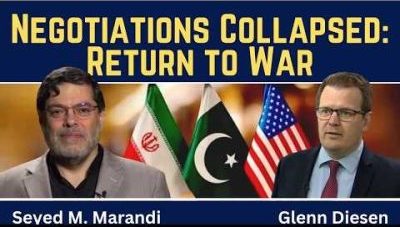
Seyed M. Marandi: Negotiations Collapsed – Return to War
or go to
Aletho News Archives – Video-Images
From the Archives
The US-Iran Scenario That Most Scares Israel
By Ali Haydar | Al-Akhbar | October 9, 2013
Israeli Prime Minister Benjamin Netanyahu issued a series of threats toward Iran and its interlocutors in the West, including the US, as serious negotiations on Iran’s nuclear program seem more plausible.
As a possible rapprochement looms between the US and Iran, Netanyahu has attempted to impose impossible Israeli conditions on the negotiators, such as the full dismantling of Iran’s nuclear program, not to mention threatening military force.
Whatever the deal that could materialize between Iran and the West, Israel is going to find itself before an open-ended path. One can foresee three possible scenarios… continue
Blog Roll
 Aletho News
- EU Defense Agency head says compulsory military service could be necessary
- France To Vote On Bill That Would Criminalize Criticism Of Israel
- There are No Ceasefires with Israel, Only Opportunities for Later Attacks
- China to Ignore Trump’s Blockade: The Strait Remains Open to Us
- Trump’s desperate bombasts amount to war crimes
- Most Israelis oppose Iran ceasefire, reject talks: Poll
- Iran to charge ships from ‘hostile’ nations to cross Hormuz – security chief
- UK, Spain reject Trump’s new scheme to blockade Hormuz Strait
- Russian frigate ‘resurfaces’, chases off NATO pirates days after Kiev ‘sank’ it
- Ukraine Targets Russian Merchant Fleet With NATO Intel Support – Presidential Aide
- If Americans Knew
- Emergency waivers move arms for Israel, UAE to speed lane
- Caitlin Johnstone: Nobody’s “Obsessed” With Israel — It’s Just A Uniquely Horrible Country
- Israel’s Ben Gvir says he feels like the ‘owner’ of Al-Aqsa Mosque
- History of flotilla campaigns to end Israel’s siege of Gaza
- Humanitarian Scorecard: Six Months In, Gaza Ceasefire is Failing
- Mark Levin Seems Upset We Haven’t Nuked Iran
- Israeli prison authorities are blocking hundreds of solidarity postcards being sent to female Palestinian prisoners
- ‘I wished for death’: Sexual violence in Israel’s prisons is an ‘organized state policy’
- Israeli army shoots, kills 9-year-old girl in her Gaza classroom
- Israel is attacking Lebanon to sabotage the Iran ceasefire, but the media is hiding its true motivation
- No Tricks Zone
- Cave Discovery Reveals Today’s Desert Climates Were Recently Far Warmer, Wetter, Teeming With Life
- German Expert: Heat Dome Led To Record Temps In Western USA…Warmer In 1934, 1936
- New Study: No Linear Warming Or Glacier Retreat Along Northern Antarctic Peninsula Since 1980s
- An Inconvenient Tree: Uncovered In Alps… Europe Much Warmer Than Today 6000 Years Ago
- New Study Reports A 60% Slowdown In Greenland’s Ice Loss Rate In The Last Decade
- Low Intensity Tornado Wrecks Major Solar Farm, Creating A Potential Toxic Dump
- New Study Finds Warming Saves Lives…Cold Temperatures 12 Times More Deadly Than Excess Heat
- German Science Blog Accuses PIK Climate Institute Of Hallucinating Climate Tipping Points
- Devastating Assessment Of Comirnaty Vaccine By Former Senior Pfizer Europe Toxicologist
- New Study: CO2 Is ‘Effectively Negligible’ As An Explanatory Climate Change Factor Since 2000
 Aletho News