Mike Huckabee Is at It Again…
Tucker Carlson Network | August 21, 2026
MEMO | August 25, 2026
Israeli warplanes struck and destroyed a water desalination plant in the Sheikh Radwan neighbourhood of northern Gaza City on Monday, injuring several civilians, according to Palestinian local sources.
The facility provided potable water to thousands of families and displaced Palestinians in Sheikh Radwan and surrounding areas. Local sources said its destruction would further exacerbate water shortages affecting residents of the Gaza Strip.
The strike comes despite a ceasefire agreement that has been in effect since October 10, 2025, amid continuing Israeli military operations in the territory.
According to Gaza’s Government Media Office, Israeli forces have committed 4,379 violations of the ceasefire since it took effect. The office said those actions have killed 1,286 Palestinians, wounded 4,257 and resulted in the arrest of 180 others. The figures could not be independently verified.
Palestinian authorities have repeatedly warned that damage to water and sanitation infrastructure, combined with restrictions on fuel and essential supplies, has severely reduced access to safe drinking water across Gaza.
The latest strike comes amid continuing disputes over implementation of subsequent phases of the ceasefire agreement, including Israeli military withdrawal, the disarmament of Hamas, reconstruction and humanitarian access.
Palestinian authorities say Israeli restrictions continue to limit the quantities of food, medicine, medical equipment and shelter materials entering Gaza, while continuing airstrikes and other military operations have caused further casualties.
By Larry C. Johnson | SONAR21 | August 24, 2026
There was one sentence in Scott Bessent’s Monday sanctions announcement that gave the whole game away. Anyone who launders money for the Iranian regime, the Treasury Secretary warned, “will be removed from the US dollar system.” He meant it as a threat of annihilation. It is, instead, a confession of the policy’s central weakness. The entire architecture of what Bessent has branded “Operation Economic Outcast” rests on a single assumption — that Iran and its trading partners need the U.S. dollar. They increasingly do not. And a threat to bar someone from the dollar system means nothing to a trade that has already walked out of it and into the Chinese yuan.
What Bessent actually announced
Strip away the “economic D-Day” theatrics and the substance is a secondary-sanctions framework: the United States threatens to punish any country or entity that refuses to sever economic ties with Iran, expands the categories of activity exposed to those secondary sanctions into five new fields — digital assets, technology, gold, aviation, and shipping — and designates roughly sixty individuals, entities, and vessels tied to nuclear and missile procurement, cyber operations, and oil smuggling. The mechanism of pain, in every case, is the same: exclusion from the dollar-based financial system that Washington polices through its control of dollar clearing, SWIFT messaging, and correspondent banking.
That is a devastating weapon against anyone who lives inside the dollar system. It is close to irrelevant against those who have deliberately built their most important trade outside it. And Iran’s lifeline — the oil trade with China — is now largely outside it.
The trade that runs on yuan
Follow the barrels. China is now the buyer of over 80 percent of Iran’s seaborne crude exports. Iran is shipping somewhere around 1.65 to 1.8 million barrels a day, almost all of it to the independent “teapot” refiners of Shandong, moved by a shadow fleet of more than 350 tankers using ship-to-ship transfers off Malaysia, Singapore, and the Sea of Oman, the cargoes routinely rebranded as Malaysian or Omani. And critically, the money for it increasingly does not move in dollars. Payment flows in yuan, routed through small Chinese banks and Hong Kong trading shells, settled in a growing volume of renminbi that bypasses the dollar clearing system entirely.
The plumbing for this is China’s Cross-Border Interbank Payment System, CIPS — the settlement network the People’s Bank of China launched in 2015 precisely to clear cross-border yuan transactions without touching the Western financial architecture. Its use has surged in lockstep with the war. CIPS processed on the order of $214 billion in March 2026, hit a single-day record of 1.22 trillion yuan — roughly $178 billion — across nearly 42,000 transactions, and saw its average daily value jump about 50 percent from February to March, a spike analysts tied directly to the Iran conflict and rising yuan demand in oil trade. More than five thousand institutions are now connected. These channels allow settlement without any intermediary US bank in the chain — which is the entire point.
Nor is this confined to China. Even Indian refiners buying rare cargoes of Iranian oil have settled the payments in yuan, routed through the Shanghai branch of an Indian bank, because Iran wants a currency that sidesteps the dollar sanctions channel. Iran’s Revolutionary Guard has reportedly begun demanding yuan or cryptocurrency for oil transactions outright. When Bessent adds “digital assets” and “gold” to his sanctions categories, he is chasing evasion routes Iran is already using by design, through a shadow system purpose-built to be untraceable.
You cannot freeze a yuan payment out of a dollar system it never enters. That is not a loophole in Bessent’s plan. It is the plan’s foundation, missing.
The market already delivered its verdict
The most eloquent judgment on these sanctions came not from a pundit but from the oil market itself. If traders believed Bessent’s “economic onslaught” would actually choke off Iranian barrels, crude would have spiked on the announcement. It did the opposite. Brent fell about 2.3 percent on August 24, sliding below $92, as investors concluded the measures were unlikely to remove Iranian oil from the market. A sanctions package advertised as an economic D-Day was met by the market marking the price of oil down. The traders who move real money on real supply read the announcement for exactly what it was: sound and fury aimed at a target the dollar can no longer reach.
The one tooth Bessent won’t bare
There is precisely one measure that could actually bite the yuan trade: sanctioning the major Chinese banks and the CIPS architecture that clear it — cutting large Chinese financial institutions out of the dollar system and forcing Beijing to choose. And that is the step Bessent, once again, announced but did not take. He warned that at least one major financial institution could face sanctions this week, and said China would not be exempt. A threat, not an action — the same threat that has hovered over this campaign for months and never descends, because executing it means a financial rupture with Beijing on the eve of a planned Trump-Xi meeting, and an oil-price shock Washington cannot afford heading into the midterms.
And even if he pulled that trigger, the trade is engineered to survive it. The yuan payments already move through small Chinese banks and Hong Kong front companies precisely so that the large, dollar-exposed institutions stay clean and the flow continues if a big bank is hit. The system was designed by people who assumed Washington would eventually come for it. Bessent is threatening to breach a wall its builders reinforced years ago.
Ten years of sanctions, and a larger economy
Step back from Monday’s announcement and ask the longer question: what has a decade of sanctions actually done to the size of Iran’s economy? Measured properly, it has grown.
The measure matters, because there are two ways to size an economy and here they tell opposite stories. In nominal dollars — the plane on which sanctions operate — Iran looks devastated: its dollar GDP is around $300 billion in 2026, and dollar income per head has been falling fast, because the rial has been pulverized and everything Iranian looks cheap when priced in a currency Iranians increasingly cannot obtain. But nominal-dollar GDP largely measures the exchange rate, not the economy. Measured by purchasing power parity — which values what Iran actually produces at the prices Iranians actually pay, stripping out the collapsed currency — Iran’s GDP has risen from roughly $1.4 trillion in 2015, when the JCPOA-era sanctions architecture was in force, to about $2.18 trillion in 2026, by the IMF’s reckoning the world’s twenty-third-largest economy. That is an expansion of more than fifty percent over the same decade of “maximum pressure” that was supposed to break it.
The caveat belongs in plain sight, not buried: part of that gain is simply more Iranians — the population has grown by roughly a sixth since 2015 — so per-capita output has risen far more modestly, and none of it means Iranian households feel richer, with inflation running near forty percent and the currency in ruins. Growth of the economy is not prosperity for the family. But that is a different claim from the one that matters for sanctions policy. A pressure campaign that can wreck a currency and still not shrink real output is a campaign that produces hardship without submission. Iran has now demonstrated exactly that across two sanctions architectures — the JCPOA snapback and its “maximum pressure” successors — and ten years of data. Bessent is adding a chapter to a book whose ending is already written.
The honest limits
This is a dollar bypass, not the death of the dollar. The greenback still makes up around 57 percent of global foreign-exchange reserves against roughly 2 percent for the yuan, and only a low single-digit share of cross-border trade settles in renminbi; CIPS remains far smaller than the SWIFT-and-CHIPS system it shadows. The claim here is narrow and it is enough: a determined seller like Iran, with a willing Chinese counterparty, can route its oil revenue around the dollar — not that the world has.
Nor are the sanctions literally costless to Tehran. The friction of operating in the shadows is real: Iran sells its crude at discounts of $14 to $17 a barrel below Brent, up from $8 in 2023, precisely because sanctions raise the risk and complexity of buying it; its fiscal break-even sits far above the price it actually realizes, and the rial has lost most of its value. Bessent’s measures will add a little more friction at the margin — another turn of the screw on the discount, another few front companies to replace.
But friction is not a chokehold, and a poorer Iran is not a compliant one. The sanctions make Iran’s oil cheaper and its economy more strained; they do not, and cannot, sever the yuan-denominated artery to China that keeps the oil flowing and the regime funded. That artery is the thing Bessent promised to cut, and it is the one thing his announcement does not touch.
Bessent has threatened to expel Iran and its partners from a financial system Iran has spent years leaving. The dollar guillotine is real, and it still falls with terrible force on anyone standing beneath it — but Iran’s oil trade stepped off the block and into the yuan, and every fresh round of dollar-weaponization only sharpens the incentive for others to follow. The measures announced Monday will generate headlines, a few dozen designations, and a marginal widening of the discount China already enjoys on Iranian crude. What they will not do is the thing they were sold to do: collapse Iran’s options and force it to heel. You cannot sever a lifeline that no longer runs through your hands. Bessent is standing guard at a door Iran walked out of a long time ago, threatening to lock it.
RT | August 24, 2026
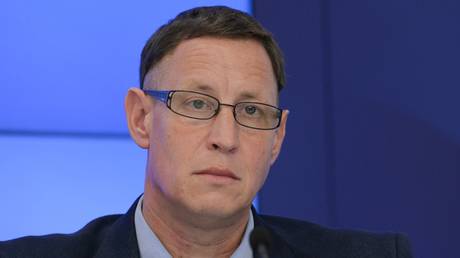
Russian-Israeli historian Artyom Kirpichenok has been subjected to brutal treatment while in Shin Bet custody, including interrogations lasting up to 24 hours, sleep deprivation, prolonged handcuffing, and threats, according to his lawyer.
Kirpichenok, 51, disappeared on August 2 shortly after arriving at Ben Gurion Airport from Yerevan. His whereabouts remained unknown for nearly three weeks before his supporters revealed that he was being held at a detention facility in Petah Tikva.
His lawyer, Inna Lebedinskaya-Katz, was finally allowed to meet with him for around an hour on Sunday after repeatedly seeking access, according to Nika Dubrovsky, a Russian-born artist and writer campaigning for his release.
Citing Lebedinskaya-Katz, Dubrovsky said Kirpichenok has faced interrogation sessions lasting 18 to 24 hours while deprived of sleep. He is allegedly being kept handcuffed and hunched over on an iron stool fixed to the floor, with three or four interrogators standing behind him “shouting, threatening, and applying constant pressure.” He has also allegedly been threatened with life imprisonment.
Kirpichenok is in “tolerable physical condition” and has no immediate health complaints, but is “exhausted, tormented and deeply depressed,” Dubrovsky wrote on X on Monday.
”He understands that his friends have not abandoned him. He is holding on and sends his greetings to everyone,” she wrote. Kirpichenok also asked that no one come to Israel.
The allegations have not been independently verified. However, international human rights groups previously documented sleep deprivation and painful restraint during Shin Bet interrogations. Israel’s Supreme Court has ruled against deliberately using prolonged sleep deprivation to break suspects.
Kirpichenok is being held underground with the lights on around the clock and denied books and writing materials, Dubrovsky cited his lawyer as saying. A gag order remains in force, and the defense has yet to receive the case files or details of the accusations.
Kirpichenok, a dual Russian-Israeli citizen and Middle East expert, is known for criticizing Israel’s policies toward Iran and Palestine. Moscow sought information from the Israeli authorities following his disappearance and said it is closely monitoring the case.
Kirpichenok recently worked with media outlets and civic organizations in Türkiye and Iran and frequently traveled to Iran. Israeli citizens are generally prohibited from traveling to countries they are at war with. Dubrovsky, however, said the trips now appear to be of little interest to investigators.
Born in Russia, Kirpichenok moved to Israel in the 1990s, studied at the Hebrew University of Jerusalem and served in the Israel Defense Forces before returning to Russia. He later became a vocal critic of the Israeli government and its military campaign in Gaza, describing Israel as a Western “colonial project” in his recent book ‘Israel: The Road to Catastrophe’.
The Israeli authorities have yet to publicly disclose any charges against him.
MEMO | August 24, 2026
Two Swedish members of the European Parliament say they were prevented from travelling to Israel on Sunday, despite holding entry permits and supporting documentation, Anadolu reports.
Left-wing MEPs Jonas Sjostedt and Hanna Gedin were stopped as they were preparing to board a flight from Athens to Tel Aviv.
They had planned to travel on to the occupied West Bank and East Jerusalem, where they were due to meet representatives of the NGO Save the Children, visit refugee camps, and speak to Israeli and Palestinian human rights groups.
The two MEPs said they wanted to hear testimonies about what they described as deteriorating conditions and apartheid in the West Bank.
Sjostedt, of Sweden’s Left Party, said they had been barred for political reasons because of their criticism of Israel and their calls for Israeli government ministers to be brought before the International Criminal Court.
“Israel is increasingly preventing people from entering the country, even members of parliament,” he said in a statement.
Gedin said it is unacceptable for Israel to prevent elected European officials from seeing conditions on the ground and meeting people affected by them while Israeli politicians continued to travel freely in Europe.
The Left group in the European Parliament said it had informed the EP President’s Office about the incident.
It described the refusal of entry as an attack on the institutions of the EU.
The incident comes as the Left group says ethnic cleansing in Palestine is continuing and amid concerns over negotiations by the European Commission on the sharing of biometric and personal data with Israeli security services.
Israel continues to block agreed quantities of food, medicine, medical supplies, shelter materials, and prefabricated homes from entering Gaza, where around 2.4 million Palestinians live, including 2.15 million displaced people, under catastrophic conditions.
Ongoing Israeli violations of the ceasefire have killed 1,286 Palestinians and injured 4,257 others as of Sunday, according to Gaza’s Health Ministry.
The ministry also said the overall toll from Israel’s war on Gaza since October 2023 had risen to 73,420 killed and 174,369 injured.
Palestinian Information Center – August 24, 2026
WEST BANK – Israeli occupation authorities have escalated settlement activity in the West Bank by issuing military orders to seize hundreds of dunums of Palestinian land, alongside settler sieges and forced displacement carried out under army protection.
The measures reflect clear coordination between the army and settler militias to empty large areas for settlement expansion.
Last Tuesday, Israeli forces issued a military order to seize around 1,152 dunums of land belonging to the towns of Sinjil, Al-Lubban Al-Sharqiya and Qaryut, north of Ramallah.
The order aims to expand the Karmi Oz settlement and strengthen geographic links between settlements and outposts located between Nablus and Ramallah.
According to a report on settlement activity, the targeted land is spread across several areas in the three towns. The decision comes as part of Israeli government measures issued since 2023 to legalize settlement outposts, most notably Givat Harel and Givat Haroeh.
At the same time, settler attacks continue across West Bank villages, accompanied by sieges, restrictions and forced displacement under the protection of Israeli occupation forces.
The attacks have been concentrated in Jalud and Qusra, south of Nablus, Turmus Ayya, north of Ramallah, and Khallat Al-Hummus in Masafer Yatta.
In Jalud, Mahmoud Al-Tubasi and his family were forced to evacuate their home after a two-month siege that included blocking the road and cutting off water and electricity. Armed settlers later stormed the home and threatened to kill or burn the family.
In Qusra, families in the Ras Al-Ain area have faced siege and attacks since the beginning of the year amid attempts to establish a new settlement outpost.
The escalation peaked on August 9, when settlers reinstalled their tents, blocked roads with stones and cut off electricity and water to the families.
Israeli forces then turned the area into a closed military zone, forced families to evacuate their homes and converted around 16 houses in Jabal Ras Al-Ain into military barracks and observation posts.
Israeli forces also imposed a curfew, closed shops and prevented Palestinian and international activists from reaching the besieged families with aid.
The report said these measures are taking place amid international silence, while the Israeli government continues to use claims of “military purposes” and the “legalization of outposts” as cover to seize more land and connect settlements to one another.
Experts opined that the ultimate goal is to fragment the West Bank and undermine any possibility of establishing a geographically contiguous Palestinian state by turning villages into besieged enclaves that can be controlled and emptied of their residents.
MEMO | August 24, 2026
Palestinians who say they escaped areas controlled by Israeli- backed armed militias east of the so-called Yellow Line in the Gaza Strip have recounted severe abuses, including extrajudicial killings, physical mistreatment, drug distribution and exploitation of civilians, according to testimonies collected by Quds Press.
The accounts describe tightly controlled areas where residents faced restrictions on movement and could leave only with authorization from militia members. Quds Press described the groups as receiving backing from the Israeli military.
One survivor, identified only as Ahmed, 31, said he escaped with his two brothers after eight months in an area controlled by a militia allegedly headed by Shawqi Abu Nassira.
Ahmed said that narcotics, including hashish and a substance he identified as “Rotana,” were widely distributed. He also said that people attempting to escape or refusing orders faced summary execution and accused militia members of abusing and exploiting children and girls.
Another survivor, identified as Abu Ramzi, said he was drawn into the area after responding to a social media advertisement offering street-cleaning work purportedly connected to international organizations.
According to his account, he and others were collected near Al-Samar roundabout, at the entrance to Gaza City’s Shuja’iyya neighbourhood, and transported east, where masked men took them to an interrogation facility he said was operated by the Israeli military.
Abu Ramzi alleged that interrogators sought detailed information about detainees’ relatives and people employed by Gaza’s governing authorities. He further added that detainees who hesitated to answer were subjected to physical abuse, including being struck on their fingers with a hammer.
He said that during a subsequent Israeli military movement toward the Yellow Line, militia members withdrew and Israeli forces ordered the detainees to assemble. According to his testimony, they were handcuffed and instructed to walk westward without looking back.
Separately, Al-Hares, a platform affiliated with Hamas-run security authorities in Gaza, has warned residents that armed groups operating in these areas allegedly use offers of food, cigarettes and employment to attract civilians. It accused the groups of seeking to use civilians to facilitate their movements and urged Palestinians to avoid them.
By Justin K.P. | The Dissident | August 23, 2026
As the U.S. and Israel continue to wage war on Iran, the Guardian published an open letter signed by a number of academics- mostly U.S. and UK-based- condemning Iran’s internal policies.
The letter accused Iran of engaging in “deepening criminalization of the working class and unemployed, the targeting of Kurds, Arabs, and Baloch, and the scapegoating of Afghan migrants: all desperate attempts to kill the spirit of people they cannot contain” called to “reject the false binary of imperialism and hollow anti-imperialism” and even called on anti-imperialists in the West to focus their energy on critiquing Iran’s internal issues as Western governments wage war on Iran, writing, “We invite global civil society and anti-imperialist activists and organizations to extend their unconditional support and solidarity to all incarcerated kin fighting for our collective liberation, to build relationships with Iranian political prisoners and uplift their voices, to put pressure on the Islamic Republic by challenging its narrative, and to call upon that government to immediately stop all the executions and free all political prisoners.”
Iran, like most countries, no doubt has internal issues that need to be solved, but asking Western academics to focus on those issues as the West wages a brutal war on Iranian civilization at the behest of Israel seems badly timed, to put it mildly.
Furthermore, the letter made no mention of the open meddling that Israel and the United States has done in Iran’s internal politics and disputes, including the U.S. sanctions on Iran designed to make Iran’s “economy collapse” which is why “the people took to the streets” in January, as Treasury Secretary Scott Bessent boasted.
The letter did not mention the fact that Israeli media has boasted that the Mosssad was “arming the protesters in Iran with live firearms, which is the reason for the hundreds of regime personnel killed” and that Israel “set up its own poison machine” in Iran to infiltrate the protests, nor did it mention the fact that Trump boasted that “The United States sent guns to the Iranian protestors … we sent them a lot of guns, we sent them through the Kurds and … the Kurds kept them, ‘we sent guns to the protests, a lot of them”.
The intentions behind the letter seem more suspicious given that it was published in the Guardian, a pro-war propaganda outlet which has manufactured consent for the war on Iran from day one.
The Guardian’s “rights and freedom” section, sponsored by the CIA-linked billionaire Pierre Omidyar, published endless atrocity propaganda claims in the lead-up to the Iran war, including the widely debunked claim that Iran killed tens of thousands of peaceful protestors in a matter of days in January.
More recently, the Guardian ran a smear piece on the journalist Bushra Shaikh for her reporting on the U.S. Israeli war on Iran on the ground, including by linking to a petition set up by pro-war Zionists calling for the British security state to investigate Shaikh for her reporting.
What makes the letter in the Guardian even more questionable is the fact that it appears that many of the signatories were tricked into signing it.
The historian Robin D. G. Kelley, whose name originally appeared on the letter, took his name off, saying that “the circumstances in which we were asked to sign the letter were a bit shady” and that “what appeared in print wasn’t exactly what I had initially seen”, implying that the letter was changed after getting signatures.
Even more shady is the fact that the authors of the letter appear to have fabricated the signature of political prisoner Mumia Abu-Jamal.
Journalist Vijay Prashad obtained a message written from prison on a paper plate where Mumia Abu-Jamal writes, “Iran is showing the world (especially the 3rd world) how to fight against the Empire. Their drones are rewriting the rules of war. And countries across the Global South are studying this phase of the war for that use! They remind me of Vietnam, a poor country that whipped the most powerful army on earth… That’s where we are today”.
Given that this is his actual view, it makes it highly unlikely that Abu-Jamal would sign a letter which accuses Iran of “hollow anti-imperialism”.
Who is behind this shady letter is yet to be seen, but it certainly has many hallmarks of a pro-war psy-op.
Tucker Carlson Network | August 22, 2026
Tucker Carlson Network | August 21, 2026
By Robert Inlakesh | The Palestine Chronicle | August 22, 2026
What has been happening in Syria should come as a wake-up call for the Turkish leadership: as long as Israel is a major player in the region, you cannot simply compete with them without engaging in violent conflict.
Earlier this week, Israel began bombing Syrian military positions for the first time in around four months, specifically targeting an air base where Turkish military personnel are known to be present – this is not random violence; it is instead part of a concerted pressure campaign that is pushing boundaries that even the United States is not fully prepared to go along with.
Israeli air raids targeted and destroyed air strips and hangars at the Abu al-Duhur Air Base in the Idlib province of Syria, inflicting significant damage and intentionally attempting to curb efforts by Turkiye to revive the largest destroyed Syrian air force and air defense systems.
While Tehran and Moscow were the chief supporters of the former Syrian military, the country now depends on both Washington and Ankara. NATO member Turkiye has therefore taken it upon itself to try and get a military foothold inside Syrian territory, attempting to extract the maximum it can from its relationship with its neighbor.
Like Iran, Turkiye has different interests from its other major partner inside the country, but unlike the Iranians, the Turkish State is not backing resistance to Israel and instead has maintained strong economic ties with the occupying regime. However, the Israeli government does not care that Turkiye presents no military threat to it, nor are there any signs it will; it is only fixated on regional dominance and views Syria as competition.
Turkiye and Israel are both US allies, meaning that the American government will not throw its weight fully behind either side and instead play a balancing game. Yet, the Israelis evidently have much more sway over Washington and seek to crush Turkish regional influence, as they endeavor to achieve their dreams of a “Greater Israel”.
Israeli bombing attacks against military positions – with the exception of a few occasional strikes – largely halted after March, when a series of strikes were carried out. The reason behind most of the attacks carried out against positions affiliated with Damascus-aligned forces has been to send a message. This is precisely why the old Ministry of Defense was even blown to pieces and why Israel launched strikes in the vicinity of the Presidential Palace – they are demonstrating who the boss is and warning the Syrian leadership of the consequences should it step out of line.
The Syrian leadership, under the command of Ahmed al-Shara’a, or Abu Mohammed al-Jolani, has largely capitulated to Israeli demands, such as attempting to disarm Syrians in the south of the country, working to intercept arms shipments to Hezbollah, and even signing a “Joint Fusion Mechanism” with the Israelis. As part of this mechanism, it was clearly written that Syria would even pursue economic projects with the Zionist regime that continues to expand its occupation of southern Syrian lands.
The relationship between Syria, Turkiye, and Israel today is one of a tug of war. The Turkish State is attempting to help Syria revive its air force and hopes to introduce a functioning air defense system to the country, but the Israelis want Syria weak.
It is also clear why Tel Aviv is so paranoid. They know that the future of the Syrian State is not certain and they see the sentiments expressed by the fighters who have formed the new Syrian Army. They are also aware that everyone in Syria is armed and that with a different leadership, or an escalation that spins out of control, they could be in serious trouble.
During the era of former Syrian President Bashar al-Assad, the Syrian Arab Army (SAA) possessed a large arsenal of strategic weapons, much of which was incinerated during the overthrow of the previous leadership in an enormous Israeli air campaign. However, what Tel Aviv feared just as much was the strength of Syria’s air defense network – regarded as one of the most sophisticated in the region.
Not only did Israel destroy the air defenses of Syria during the regime change transition in December of 2024, but what impacted the nation’s ability to defend its skies even more was the disappearance of the old air defense teams. When it comes to these sophisticated weapons, the humans operating them are just as important as the systems themselves, and it takes a long time to properly train new operators. Under the new Syrian Army, there are no experienced operators who are on hand, meaning that it will take help from their Turkish allies if they are ever going to have a functioning air defense option.
Israel is competing with Turkiye as of now, with the situation not deteriorating into direct confrontation. Although we are far from the point of anything that could resemble war between the two, the Israelis will kill Turkish soldiers and may even explore options using intelligence operatives inside Turkish territory in the future.
Ankara is clearly not willing to respond to Tel Aviv with the use of force, or even using armed factions to carry out operations in the south, despite Turkish soldiers having been killed by Israeli airstrikes in the past. At some point, Turkiye will likely be forced to make a decision to defend its interests that will involve confronting Israel.
Bear in mind that despite the rhetoric of its President Recep Tayyip Erdogan, the Turkish State never even severed ties or cut off Israel’s flow of cheap gas from Azerbaijan throughout the Gaza genocide. The Israelis have interpreted the behavior of the Turkish leadership as weakness, meaning that they are going to push things to the limit, testing just how far they can go before the regional power decides to finally take concrete measures against it.
Ankara is seeking to become an international trade hub, sitting at the crossroads between Asia and Europe, benefiting immensely from the expansion of the Middle Corridor. Yet, Tel Aviv has been busy forming alliances to ensure it is a thorn in Turkiye’s side, including expanding tripartite relations with Greece and Cyprus.
What has been happening in Syria should come as a wake-up call for the Turkish leadership: as long as Israel is a major player in the region, you cannot simply compete with them without engaging in violent conflict. If Ankara seeks to truly assert its power, it must pursue confrontation and make the Israelis suffer in Syria; if it backs down and refuses to do this, it will end up feeling the consequences of its strategic mistake.
– Robert Inlakesh is a journalist, writer, and documentary filmmaker. He focuses on the Middle East, specializing in Palestine. He contributed this article to The Palestine Chronicle.
Kosher nationalist movements are merely stalking horses for Zionist geopolitical endeavors
José Niño Unfiltered | August 22, 2026
As the historic American population begins to awaken to its own dispossession, the establishment has deployed a new strategy of promoting “kosher nationalism.” By co-opting the language of sovereignty and tradition, these figures infiltrate the populist ranks to ensure that dissent remains impotent, performative, and above all else, harmless to the interests of the Jewish networks that have long dictated the terms of our political discourse since the end of World War II.
The most devious operator in this theater of managed opposition is Yoram Hazony, a man who has masterfully curated the boundaries of acceptable nationalism by purging anyone who dares to prioritize the actual survival of the American people over his own ethnic interests. Sitting across from Tucker Carlson in January 2026, Peter Brimelow—the British-born founder of VDARE, the immigration restriction website that New York State authorities forced into closure in 2024 through a prolonged legal campaign—recounted how Hazony had barred him from the National Conservatism conference. “He disinvited us from his National Conservative Conference because he was trying to gatekeep,” Brimelow told Carlson, adding that the two men then traded “a series of bitter exchanges in VDARE.com.”
The original 2019 exclusion was not an isolated act. When the first NatCon conference was held in Washington in July 2019, BuzzFeed News reported that Brimelow, American Renaissance founder Jared Taylor, and Identity Evropa leader Patrick Casey had all applied and been rejected, with Hazony addressing White nationalism directly in his opening remarks. Brimelow and Hazony subsequently exchanged pointed public criticism, with Brimelow characterizing the NatCon operation as an “extreme Zionist Gatekeepers Ball.”
John Derbyshire made a similar point back in 2019, identifying Hazony as the “sparring partner” of VDARE editor Peter Brimelow, a label that stuck because the friction between the two camps was never really about tone or manners. It was ultimately about substance. Brimelow’s entire project has centered on restricting immigration and restoring America’s White demographic core, a position that a genuine nationalist movement would be expected to enthusiastically champion. Hazony rejected him anyway, and that rejection is the thread that unravels the whole National Conservatism project once you pull on it.
To understand how a movement ostensibly built on the premise of “National Conservatism” became a vehicle for such systematic exclusion, one must look past the slogans and examine the architect of the project, whose entire career has been a singular exercise in advancing Zionist interests under the guise of American political theory.
Yoram Hazony was born in Rehovot in 1964 and raised in Princeton after his father, a former Princeton engineering professor, brought the family to New Jersey. He earned a BA in East Asian studies from Princeton in 1986 and a PhD in political theory from Rutgers, co-founding the conservative magazine The Princeton Tory as an undergraduate in 1984. By his own account, he was left “mesmerized” by an encounter as a Princeton undergraduate with Rabbi Meir Kahane—the Jewish supremacist advocate whose party, Kach, was later banned from Israeli elections for promoting racism against Arabs. After completing his doctorate, rather than pursue an academic career, Hazony joined the editorial staff of The Jerusalem Post and wrote speeches for the rising political star Benjamin Netanyahu.
He then co-founded the Shalem Center in Jerusalem in 1994 with funding from Ronald Lauder and Sheldon Adelson, where he served as president and then provost until 2012. He subsequently founded the Herzl Institute in Jerusalem, dedicated explicitly to Jewish political thought and Zionist theory, and in 2019 he teamed with David Brog—the former executive director of Christians United for Israel—to launch the Edmund Burke Foundation, which now runs the National Conservatism Conference.
He describes himself as “a Jewish nationalist, a Zionist, all my life.” Observers at Jewish Currents have documented how Hazony helped pioneer an alliance between the Israeli settler movement, the Kahanist camp, and Netanyahu’s Likud party, while championing Israel’s 2018 Nation State Law, which declared Jewish national self-determination as belonging exclusively to Jews within Israel. Every institution he has built traces back to this same Zionist core, which means the American movement he exports is never quite separable from the Jewish interests he was raised to defend.
That biography matters because Hazony has spent a decade dressing a Zionist project in the language of American populism. His book “The Virtue of Nationalism” argues for a world of independent nation states instead of supranational bodies like the European Union or the United Nations. This perhaps stems from a deep-seated Jewish apprehension that institutions such as the EU or the UN could crystallize into centralized, antagonistic entities capable of constraining Jewish geopolitical projects. Consequently, Hazony and his peers advocate for a world of atomized nation-states, viewing a landscape of quarreling, enfeebled powers as the optimal safeguard for their interests. By prioritizing a fractured international system, they ensure a climate of instability that favors the established Jewish influence networks, which have long mastered the technique of dividing populations—big and small—to consolidate their own power.
In a similar token, Hazony’s Conservatism: A Rediscovery provides an interesting nationalist dimension to his political agenda. In the book, he portrayed political loyalty as something inherited through family, tribe, and nation rather than chosen through liberal consent, and warned repeatedly against the “consuming fire of cultural revolution” that erodes marriage, borders, and religious tradition. On paper, this reads like a full-throated endorsement of the populism that figures like Pat Buchanan have argued for since the 1990s.
However, this nationalist rhetoric undergoes a convenient transformation when applied to the Jewish state, where the nuanced defense of sovereignty is swiftly supplanted by a rigid, unrelenting hawkishness against the enemies of the Jewish state. In sum, Hazony’s theoretical framework proves to be little more than a vehicle for his true objective: the tireless advancement of Israeli interests under the guise of Western nationalist arguments.
When Israel struck Iran’s nuclear facilities in June 2025, Hazony appeared on UnHerd alongside John Mearsheimer in a filmed debate hosted by Freddie Sayers. Hazony passionately defended Israel’s imperative to block Iran’s nuclear program as essential for national survival while debating the benefits and risks of U.S. involvement. He acknowledged the growing split among his own allies on the nationalist right, noting that “the nationalist conservatives have always had internal disagreements on issues like appropriate foreign policy” and specifically addressed the divergence with Tucker Carlson and Steve Bannon, who were “absolutely dead against the US getting involved in this at all.”
Hazony’s counter-argument was that U.S. support for Israel as a regional security partner ultimately served American interests, allowing the United States to focus on vital concerns elsewhere. Mearsheimer argued the opposite, noting that Israel lacked the capability to permanently eliminate Iran’s nuclear program and that U.S. involvement would be catastrophic and would strengthen Russia and China’s geopolitical positions.
On February 28, 2026, when the United States and Israel launched Operation Epic Fury, Hazony was among the intellectual voices who had spent months publicly building the case for exactly this kind of operation. In addition to arguing on UnHerd that Israel had to eliminate Iran’s nuclear capacity with or without U.S. support, Hazony defended the June 2025 Midnight Hammer strikes in The Free Press.
The fundamental problem in Hazony’s nationalist program lies in its practical application, which serves primarily to curate and sanitize the parameters of acceptable discourse. Rather than welcoming authentic solutions to the existential crises facing the West, Hazony and his lieutenants act as gatekeepers, systematically deplatforming gentile voices who prioritize the preservation of their own cultural and ancestral identity. In both rhetoric and practice, he remains fundamentally hostile to any ethnonationalist framework that elevates the bonds of blood and soil as the bedrock of political life. More importantly, the result of these political programs mainly consist of wars for Israel and other pro-Jewish ventures, while nationalists receive virtually nothing in return—for example, long-lasting immigration restriction. Keep in mind, this is a feature not a bug of this type of Faustian pact.
Nationalists must recognize that Yoram Hazony’s project is another containment strategy designed to undermine genuine nationalist movements in the West. It invites you to the table only to ensure that the menu never includes the actual preservation of the European state-building people of the United States. If we are to survive as a civilization, we must reject these managed movements and build an authentic nationalism that prioritizes our own sovereign survival over the pseudo-nationalist movements whose real agenda is the advancement of the organized Jewish community’s geopolitical interests.
Al Mayadeen | August 22, 2026
US journalist Ethan Levins said he was questioned by the Department of Homeland Security after returning to the United States from Lebanon, revealing that authorities asked him about his criticism of Israeli Minister Itamar Ben-Gvir.
In a post on X, Levins said the questioning took place the previous day and that authorities focused on why he had posted negative comments about Ben Gvir.
“I am a born American who lives in the United States, and they stopped me at the airport for an Israeli politician,” Levins wrote.
He added, “I’m serious.”
Ethan Levins says ‘Israel’ is attacking him personally
In a separate post, Levins said “Israel” was personally targeting him, warning his followers that any sudden halt in his social media activity would mean he had been forced to stop.
Levins said he regularly publishes across his accounts and provides hourly updates on Telegram, emphasizing that he is never inactive. He asked followers to notify others if something happened to him.
“If something happens to me, please let everyone know. I post daily across my accounts, and hourly updates on Telegram. I am NEVER inactive. If I suddenly stop, then it means I’ve been forced,” he wrote in a post on X.
“I am an American Christian, and Israel is attacking me personally,” he stressed.
Ethan Levins says he fears for his safety after detention
In yet another post on X, Levins said he was genuinely afraid for his safety after speaking out against an Israeli minister and being detained by the US government. He questioned why he was being punished by Israeli authorities despite being an American citizen.
“I’m genuinely afraid for my safety. I spoke against an Israeli Minister, and was detained by my own government. I’m an American, yet I’m punished by the Israelis. Why?,” he wrote on X.
In a further statement on X, Ethan Levins said he was detained by the US Department of Homeland Security for three hours and questioned exclusively about “Israel” and Israeli Police Minister Itamar Ben-Gvir.
“I was detained by the Department of Homeland Security for 3 hours. They didn’t ask a SINGLE QUESTION about the United States. They ONLY asked me about Israel and Ben Gvir,” he wrote.
“I’m an American, why does the DHS care so much about protecting Ben Gvir?,” he questioned.
Levins links DHS questioning to Ben Gvir in X post
Levins later referred to Ben-Gvir as the same person about whom, he said, Department of Homeland Security officials questioned him during his detention the previous day.
“This is the same guy the DHS detained and questioned me about yesterday. Apparently the Department of Homeland Security works for Ben Gvir, not the United States.”
Levins shared a post by Ben-Gvir dated June 19, in which the Israeli minister called for Lebanon to suffer in response to the deaths of Israeli mothers.
“For every tear of an Israeli mother, a thousand Lebanese mothers must weep. All of Lebanon must burn! With all due respect to the Americans, Israel must make it clear to the entire world that the blood of our sons and the security of our citizens,” Ben-Gvir wrote.
Levins accuses Trump of abandoning Americans for ‘Israel’ and Epstein files
Taking to X again, Levins launched a sharp attack on US President Donald Trump, accusing him of abandoning concerns over rising gas, housing and food prices, as well as the lives of US service members.
Levins stressed that Trump’s priorities had instead shifted to concealing the Epstein files and waging wars in support of “Israel”, portraying the president’s approach as a betrayal of the “MAGA” movement.
“The ONLY thing he cared about was hiding the Epstein files and fighting wars for Israel. This is NOT ‘MAGA’, this is betrayal,” he stressed.
Levins’ case reflects growing concerns among Americans who say criticism of “Israel” and the Trump administration’s unwavering support for it can carry consequences, particularly as opposition mounts to Israeli influence over US policy and Washington’s role in the war on Iran.
An Israeli rhetoric with grave human rights implications
Levins’ criticism of Ben-Gvir came as the Israeli minister’s rhetoric continued to draw scrutiny, particularly over his remarks regarding Lebanon and Gaza.
Ben-Gvir has openly advocated killings, executions, and the permanent settlement of Gaza while describing Palestinians as people who “don’t deserve to live.”
Such statements raise grave concerns under international human rights and humanitarian law, which protect the right to life and prohibit arbitrary killing, collective punishment, and the forced displacement of civilians.
The United Nations has identified killings of civilians, collective punishment, incitement to violence, and the denial of essential resources as matters requiring investigation under international law.
The remarks went beyond inflammatory language, raising serious concerns about the lives of Palestinians under Israeli occupation and the extent to which such rhetoric can normalize the targeting, killing, and forced displacement of civilians.
or go to
Aletho News Archives – Video-Images
By Donald Neff | Washington Report On Middle East Affairs | January 1996
On January 4, 1948, Jewish terrorists drove a truck loaded with explosives into the center of the all Arab city of Jaffa and detonated it, killing 26 and wounding around 100 Palestinian men, women and children.[1] The attack was the work of the Irgun Zvai Leumi – the “National Military Organization,” also known by the Hebrew letters Etzel – the largest Jewish terrorist group in Palestine. The Irgun was headed by Revisionist Zionist Menachem Begin and had been killing and maiming Arabs, Britons and even Jews for the previous ten years in its efforts to establish a Jewish state.
This terror campaign meant that at the core of Revisionist Zionism there existed a philosophical embrace of violence. … continue
 Aletho News If Americans Knew No Tricks Zone
