Prevent the Great War
By Israel Shamir • Unz Review • July 24, 2026
A couple of weeks ago, in Ankara, the capital of Turkey, there was a NATO conference that sought yet more rearmament and militarization, steps that must inevitably lead to a new Great War. As an answer to this NATO conference, 200 ministers, members of parliament, ambassadors, politicians, activists, journalists, retired generals, academics, diplomats, military personnel and experts from many countries gathered in Ankara last weekend to prevent NATO’s new Great War. Among them were a few of our fellows, Unz Review writers, notably Larry Johnson and Scott Ritter.
The Alliance to Prevent the Great War concluded that the threats that could lead to a Great War originate from the United States, the EU and Israel. The US and Israeli attacks on Iran, NATO’s build-up of military power in Ukraine and the deployment of proxy forces against Russia, Israel’s genocide in Gaza and the attacks on Lebanon — these are regional wars that carry the risk of triggering a Great War.
NATO, as an instrument of US hegemony, poses a threat to world peace. The countries targeted by NATO, foremost among them Russia, do not pose a threat to Europe. The militarisation of Europe should be stopped. The course towards confrontation between NATO and Russia must be reversed. The escalation of the conflict poses a direct threat of nuclear war. Western leaders must not cross Russia’s ‘red lines’, provoke or ‘test’ the strength of the Russian people and their president. Conference participants stated that arms supply to Ukraine must cease. Further arms supply to Kiev will sooner or later lead to an expansion of military operations in Europe.
In short, the Alliance to Prevent the Great War calls for the strategic union of four states: Russia, China, Iran and Turkey, against the US, EU, and Israel. Never before has Israel been considered such an enemy – not by Russia, neither by Turkey. Putin in his first visits to Israel tried to befriend the Jewish state, saying that there are more than a million ex-Soviet citizens in Israel, speaking Russian and maintaining family ties with Russians in Russia. However, recently Israel has become a stage for anti-Russian emigres with a strong sympathy for an independent Ukrainian state. These are mainly Soviet Jews who were born in the Ukraine, or their ancestors were from the Ukraine, and it turned them towards the Ukrainian statelet of Mr Zelensky.
Many Soviet Jews were extremely pro-American. A Russian writer Viktor Pelevin wrote once that a modern cultural Jew—whether living in Moscow or New York—often faces a subconscious dilemma, unable to definitively answer whether they are primarily a patriot of Israel or a patriot of the United States. The support of Ukraine by Israel spoiled its relations with Russia, though Israel tried to hide its pro-Ukrainian stance. A Russian-Israeli journalist Artem Kirpichonok wrote (tongue in cheek) of Israel’s contributions to the Ukraine war:
1. Israeli anti-tank weapons have been transferred to Ukraine via NATO countries. With their help, a column of Russian troops near Kharkiv has already been destroyed.
2. ‘Volunteers’ – veterans of Israeli special forces – have been deployed to Ukraine. As MP Gerashchenko stated: ‘The best of the best. They, too, want to take part in the struggle of light against darkness. Shabbat Shalom!’
3. Doctors and hospitals have been deployed to assist the Ukrainian army and the civilian population.
4. 76 per cent of Israelis support Ukraine (i.e. everyone except the Arab minority)
5. The renowned Israeli thinker Yuval Noah Hariri noted in a television interview that Putin believes Ukrainians are Russians, and that only a handful of Jews who have taken over Ukraine are preventing them from pelting Russian tanks with flowers. Thus, Putin is a psychopath and an anti-Semite.
9. Religious circles emphasise the fact that Putin launched a war against the Jew Zelensky on the eve of Purim and will therefore inevitably suffer the same fate as Haman and Stalin.
Turkey was once rather friendly to Israel, but Israel’s attack on the Mavi Marmara boat that carried Turkish volunteers to Gaza spoiled it. Israel’s genocide of Gaza turned the people of Turkey against Israel, while Israeli objections to the US sale of jets to Turkey added to the enmity. And finally, Israeli officials claiming that “Turkey is the next Iran” firmly shut this door forever. Thus has Israel been doing its part to get Russia, China, Iran and Turkey together into a strategic union. Still Turkey remains a member of NATO, and President Trump calls President Erdogan “his best friend”.
Russian relations with Iran are very good, and could be described as “strategic”. The Alliance to Prevent the Great War stated: “One of the factors that undoubtedly prevented the United States and Israel from using nuclear weapons in their attacks against Iran was the nuclear umbrella provided by Iran’s partnership with Russia and China. Had a strategic alliance between Turkey, Russia, China and Iran already been established, this would have made an American-Israeli attack on Iran impossible from the outset.”
What should be done with NATO? The Alliance to Prevent the Great War ruled:
It is not the reorganisation of NATO, but its abolition, that would serve global security. European countries would thereby also be freed from the new and onerous burden imposed by the United States on NATO members.
Among interesting speakers there was Prof Dr Ulrike Guérot of Germany. A renowned political scientist, Prof Guérot presented a radical vision for the future of Europe. Arguing that NATO has completed its historical mission, Prof Guérot stated that Europe must break free from American hegemony, transition to a neutral stance, and build its future with Eurasia, particularly with Turkey. Giving extensive space to the war in the Ukraine in her speech, Prof Guérot claimed that this conflict is a proxy war that has been prepared for a long time. Criticizing NATO’s eastward expansion policies, the political scientist argued that NATO has ceased to be a security alliance and has become an element of tension, stating: “We did not tear down the Berlin Wall; we merely moved it a thousand kilometres to the East, to Kiev. We are building a rigid NATO line and dividing the European continent.”
Prof Guérot proposed a concrete model of cooperation to reduce Europe’s dependence on the United States. She argued that a strong tripartite cooperation mechanism established between Paris, Moscow, and Istanbul could build a lasting order of peace and independence on the continent.
Responding sharply to Israel’s policies toward Gaza, Prof Guérot described the silent collaboration and ongoing arms support of the European Union as a “deep shame.” Probably Israel VS Palestine is the deepest bifurcation point between the US and the rest of mankind. While the world supports Palestine, President Trump stands for Israel, and he does not care about genocide. I think it will be his undoing.
Our Scott Ritter said: “To be honest, what happened in Ankara (the NATO conference) was an affront to Turkey’s sovereignty. We must never forget that the countries gathered in Ankara are not Turkey’s friends. Not a single one of them. Neither the United States, nor France, nor Germany, nor the United Kingdom, nor other NATO members, nor Greece.”
What took place there was nothing more than a grand political spectacle. It was a large-scale political charade staged to drag Turkey into NATO’s adventure in Ukraine and to exploit Turkey’s strategic position – painstakingly built up by President Erdogan over the last decade – in Europe’s interests and to Turkey’s detriment.
People need to understand this: everything NATO does – frankly, everything the United States does – runs counter to Turkey’s interests. Because Turkey has never been a priority. Neither for the United States nor for NATO.
NATO has used Turkey for its own interests from the very first day of its accession to the alliance. Turkey was drawn into the alliance to ensure the security of NATO’s southern flank. But that task effectively came to an end with the collapse of the Soviet Union. Now they are trying to drag Turkey into an even greater quagmire: Ukraine. They want Turkey to become an active participant in a war that has dragged on for far too long, has resulted in far too many casualties, and seems unlikely to end as NATO intends – namely, with a strategic defeat for Russia.
So why did President Erdogan allow NATO’s conference to be hosted in Ankara?
I think the answer lies in the Turkish economy. I think President Erdogan was hoping to create an atmosphere of goodwill by hosting Western countries in Ankara, which could have yielded positive results for Turkey. However, I believe he will be disappointed in this regard.
On the contrary, I believe that in the coming period Turkey will continue to develop relations with Russia, China and, increasingly, Iran. This is because Turkey will realise that working together with these countries, which oppose American global hegemony and NATO’s subservient role within that hegemony, is the right path for its own future.
Larry C. Johnson said: “The Ukraine war is not simply a war between Ukraine and Russia. The West is waging a ‘NATO proxy war’, using Ukraine against Russia.”
European leaders are facing a crisis of confidence in their own countries. Examples of this include Germany’s deindustrialisation, the Volkswagen crisis and the economic downturn.
NATO’s stockpiles are depleted; factories cannot cope with the workload.
The war in Ukraine is currently ‘the most dangerous flashpoint in the world’. NATO’s preparations for direct war are increasing the risk of nuclear escalation, and Russia has reached the point where it could deploy tactical nuclear weapons.
Germany was also represented by Admiral Kay-Achim Schönbach, the man who commanded the German Navy and retired to avoid fighting Russians. He said:
My name is Kay-Achim Schönbach. I am a retired Vice-Admiral of the German Navy, and until 2022 I served as Commander-in-Chief of the German Navy.
As a citizen of a European country and as a German, I can only express my deepest concern on this matter. Not since the dark and dangerous days of the Cuban Missile Crisis have we been so close to an escalation that could lead to a major war in Europe. And I do not believe I am the only one to have reached this conclusion.
The war in Donbas, in particular, has shown us that ignoring the historical context and failing to undertake a more in-depth and, above all, impartial examination of the causes of the conflict has been one of the fundamental factors that made this armed conflict possible.
The wars in Eastern Europe could have been avoided. We know this. We all know this.
Drawing on my own experience, I can say with confidence today that diplomacy based on mutual respect and conducted on an equal footing provided all the necessary means to prevent this smouldering conflict from escalating into a full-scale war. And I do not think I am the only one who shares this view. However, we must all acknowledge that the influential players in the international system had ample opportunities to resolve this conflict. Perhaps there was no complete agreement on every detail, but they managed to prevent the conflict from spiralling out of control.
The Admiral explained this behaviour of his superiors by “moralising and misguided idealism”, in my view this is too optimistic an explanation.
The Greek journalist Dimitris Konstantakopoulos chaired one of the sessions. Konstantinopoulos stated that Europe’s sanctions against Russia are not sustainable. Issuing a warning, the Greek expert assessed the situation as follows: “Both in Ukraine and in Western Asia, we are heading towards a very dangerous situation which, if it escalates, could even lead to nuclear war. That is precisely why we must de-escalate tensions, and I fear that very few political forces in Europe realise this. This makes the situation extremely dangerous.”
The Greek expert noted that the sanctions imposed by Europe have not worked. Konstantinopoulos said: “The sanctions have proved ineffective. However, if you wish to achieve the United States’ long-term strategic objective, they have proved effective: namely, to separate Europe from Russia (and the former Soviet Union in the past) and make Europe entirely dependent on the United States. If that was the aim of the sanctions, then they have achieved it. Incidentally, I believe that the entire operation in Ukraine — by which I mean the 2014 coup, because the Ukrainian issue did not begin with Russia’s intervention in 2022 but many years earlier — all this Western aggression in the territories of the former USSR was planned. It was a pre-emptive policy aimed at preventing a potential alliance between Europe and Russia, or, as the former French Prime Minister de Villepin put it, between Europe, Russia and China.”
It takes more than a conference to stop the coming Great War. Still, the Alliance to Prevent the Great War was a very useful discussion of the possible ways to do it. And surely much better than NATO’s own conference of trial balloons for their future war crimes.
The Iran war may go down as the US’ worst ever defeat
By Robert Inlakesh | Al Mayadeen | July 24, 2026
While the US president continues to lie to his people about imagined victories over Iran in West Asia, the arguments fall flat amongst the vast majority of Americans who see through his tired rhetoric. Unlike past military blunders, Washington has not and will not be able to pull the wool over its people’s eyes.
Some analysts have attempted to compare Donald Trump’s failure to effectively combat Iran with defeats and strategic mistakes that ruined the reputations of past presidents; this one is very different.
To go through all US wars of aggression is simply too steep a task to take on in a single article, but there are a few different comparisons that are going around which deserve to be analyzed: they are the Iraq War, the Vietnam War, and even Operation Eagle Claw.
All the above-noted comparisons are very much different in their nature from the large-scale air campaign, turned stop-start battles that the Trump administration has engaged in. If we first look at the Vietnam War comparison, this is often said as a figure of speech – “it is so and so’s Vietnam” – which is the way in which some analysts have chosen to apply Vietnam to what we see today.
Although there is something to be said about how the US is being bogged down in the Iran War, it is a totally different ball game to what occurred in Vietnam. At the beginning stages of the escalation, in October of 1965, a Gallup poll recorded a 64% public approval rating of US intervention in Vietnam, which by 1970 had shifted to around 55% of the US public stating that they sought a return of the troops.
At the time, the US had sold its population the need to fight Communism and that the Vietnam War was necessary, as the fall of South Vietnam to a Communist government would lead to a slippery slope whereby governments across Asia would fall to the ideology. The Communist boogeyman captured the imaginations of those living in the West, who opposed the Soviet Union and Chairman Mao’s China.
In Trump’s case, the approval rating for the Iran war was never there. Ipsos polling data from the beginning of the war suggested that 58% of Americans opposed a war with Iran, with only 38% expressing approval. Two weeks into the conflict, Pew Research polling data then revealed that 61% of the country disapproved of the war. Now, even Trump’s own cult-like fan base is turning on the war, with Politico polling data suggesting that little more than a third of MAGA supporters believe the economic costs of the Iran war have been worth it.
In the Vietnam War case, public opinion at its worst was more favourable than it was at the beginning of the war on Iran. When it came to the disastrous 2003 Iraq invasion, a Gallup News poll recorded a 72% approval rating for the war, with only 25% of Americans opposing it.
Then there is the comparison with Operation Eagle Claw, which refers to the disastrous mission that was ordered by former US President Jimmy Carter – aimed at seizing back American citizens held by the Islamic Republic at the time. The reference is now being made to Jimmy Carter and his failed operation, resulting in the deaths of 8 US service members, because of President Trump’s own comments about the Carter administration.
In the event of a ground invasion that seeks to seize Iranian territory – Kharg Island being the most publicly discussed target to occupy – the US president will almost inevitably be in a position where a number of American soldiers could be captured.
All of the above-noted cases have a shared difference that separates them from what the Trump administration is doing today, that being that they were not operations launched solely for a foreign country’s interests.
Although the Israelis certainly played a role in pushing the US toward launching the Iraq War, it was a conflict that did assert Washington’s dominance over the region, further bringing the Arab Gulf States under their control, and was evidently winnable. The consequences of the invasion were not immediate; the American public believed in the new “Islamic enemy” that had replaced the Red Scare narrative sold to populations across the collective West during the Cold War.
The Vietnam War also had the Gulf of Tonkin incident false flag that helped justify the war, while Iraq had the September 11 attacks. The Iran War didn’t even bother to use any incident as an excuse; it was rushed and sloppy.
This time, Iran has managed to use the closure of the Strait of Hormuz as leverage against the US, while Yemen’s Ansar Allah is now tightening the noose by imposing a counter-blockade on Saudi Arabia in the Red Sea. If the Yemeni Armed Forces choose to do so, they can totally block the Bab al-Mandab Strait also, choking off two of the world’s most important trade routes. Iran has demonstrated its ability to continuously pound US military bases and embarrass the US Navy’s attempts to coordinate the passage of ships out of the Gulf.
The US’ military industrial complex is also getting slapped around, as Iran has managed to shoot down at least one F-15 fighter jet, even locking on and striking an F-35 that was forced to do an emergency landing.
US allies in the Gulf, which have pledged to invest trillions in the American economy, are taking an economic beating, with the possibility that some could even be rendered uninhabitable if the war escalates. From power projection to the sale of weapons, seizure of resources, and an image of victory, there is nothing to gain.
Only the Israelis are set to gain anything from this deeply unpopular war. They seek to use the United States military to do their dirty work of degrading Iranian infrastructure and dealing an economic blow to the Islamic Republic. This is because Tel Aviv understands that the job cannot be performed by them alone and that as long as they can take the punishment dished out against them, they are willing to continue using the Trump administration to do their bidding.
Never before has a war of this nature been fought by the United States, where it loses in every category, with the conflict being fought solely for the purpose of fulfilling the expansionist desires of a foreign rogue regime. Donald Trump is not Jimmy Carter or George Bush Jr.; he will be remembered as the president who launched an offensive war of aggression on behalf of a genocidal regime that couldn’t care less how the US and the rest of the world are impacted, as long as they continue to get propped up to forward their goals of creating a regional empire premised on a supremacist ideology.
Iran: UK decision to aid US strikes amounts to ‘act of aggression’
Press TV – July 23, 2026
Iran’s foreign ministry has strongly condemned the British government’s decision to allow the US to use UK military bases and facilities to prepare and facilitate military strikes against Iran, declaring the move a violation of the UN Charter and international law.
“British policymakers, fully aware that US military strikes against Iran – which began with the participation of the Zionist regime and are still ongoing – constitute a clear act of aggression and a gross violation of the fundamental principles of the UN Charter and peremptory norms of international law, have decided to join these actions,” the ministry said in a statement Thursday.
The decision, the ministry said, is “clearly contrary to the fundamental principles and rules of the Charter of the United Nations and international law” and, under paragraph (f) of Article 3 of UN General Assembly Resolution 3314 on the Definition of Aggression, “constitutes an act of aggression against the Islamic Republic of Iran”.
The foreign ministry sharply criticized Britain’s role as a permanent member of the UN Security Council.
“The UK government, both as a state and as a permanent member of the UN Security Council, instead of fulfilling its legal and moral responsibilities to condemn the military aggression and war crimes of the United States and the Zionist regime against Iran, has stepped onto the path of aligning with the aggressors and has degraded its position to that of an accomplice in their war against the Iranian nation.”
“This decision,” the ministry added, “further undermines London’s claims about supporting the rule of law, human rights, and international peace and security.”
The statement drew explicit parallels with Britain’s long history of intervention in Iranian affairs.
It listed “the coup of August 19, 1953; full-scale support for Saddam Hussein’s regime during the imposed war; the imposition of illegal sanctions under the pretext of the nuclear issue; complicity with the United States in the so-called ‘snapback’ mechanism; and the designation of the Islamic Revolution Guards Corps (IRGC).”
“The Islamic Republic of Iran is determined to defend its national sovereignty, territorial integrity, national interests, and national security against any aggression,” the ministry emphasized.
“Any party that in any way participates in the military aggression against Iran will be responsible for the consequences and repercussions of its own decision.”
According to a report from Bloomberg, the new British prime minister has agreed to allow the United States to use UK territory to continue its aggressive strikes against Iran.
The report said Andy Burnham has permitted the US to use British military bases for “defensive strikes” against Iran – meaning that UK bases such as RAF Fairford and the Diego Garcia naval base in the Indian Ocean will likely be used in the current round of US aggressive strikes.
The report added that former prime minister Keir Starmer, in his final hours at 10 Downing Street, chaired a government meeting on Britain’s policy following seven days of renewed US bombardment of Iran.
Sources revealed that ministers at the meeting decided to continue the existing policy of using UK bases to counter missiles from Iran and facilities used to target the Strait of Hormuz.
Burnham was briefed on the decision and appears to have agreed to it, despite the risk of angering anti-war Labour Party supporters, the report said.
Some Labour MPs, as well as members of the Green Party and Liberal Democrats, have argued that US use of the bases makes Britain complicit in war crimes.
Iran will destroy multiple energy facilities for every bridge, power plant struck by US: Report
Press TV – July 22, 2026
A senior Iranian military source has warned that any attack by the United States on Iranian bridges or power plants will face a devastating response targeting multiple infrastructure and energy facilities across the region where America has interests.
The warning came after US President Donald Trump threatened to destroy one Iranian bridge or power plant for each Iranian attack on a ship in the Strait of Hormuz.
“From this point forward, any time the Islamic Republic of Iran shoots at a ship in the Strait of Hormuz, whether it be by Missile, Rocket, Drone, or any other device or weapon, the United States will bomb and destroy ONE BRIDGE OR POWER PLANT,” Trump wrote on social media.
In response, the Iranian military source told Tasnim News Agency that Tehran has an “iron will” in exercising its sovereignty over the strategic waterway and will never allow the Strait to once again become a threat against Iran.
The military source said vessels transiting the Strait of Hormuz will only be safe if they coordinate with Iran and operate under Iran’s arrangements.
“If the Americans target a bridge or power plant in Iran, Iran will in turn strike infrastructure and bridges in the region, including energy facilities in which America has interests.”
The source said the Americans should have become fully convinced over the past ten days that Iran can strike wherever it deems necessary, warning that any gamble by Trump would once again lead to his humiliation.
Trump escalates threats as war costs mount
Trump’s latest threat came as the war enters its fifth month, with the Pentagon confirming that the conflict has already cost Washington $37.5 billion.
The United States has launched 11 consecutive nights of strikes against Iran, targeting military sites to “further degrade Iran’s ability to threaten commercial shipping in the Strait of Hormuz.”
Fighting over the Strait has led to the collapse of a preliminary deal between the United States and Iran, and Tehran has re-imposed its blockade on the strategic waterway for oil and gas shipments, firing on vessels that seek to transit without coordination.
The blockade has rattled markets and sent oil prices climbing, adding to the pressure on Trump to find an off-ramp to a war that has hit Americans’ pocketbooks heading into closely-fought midterm elections.
Brent Crude, the global benchmark, briefly topped $95 a barrel for the first time in six weeks on Wednesday.
Despite the pressure, Trump has so far resisted calls for a swift end to the war.
“We’re not finished at all… we’re not leaving right now,” he said on Tuesday.
The threats came as Tehran continued offensive operations against American assets in the US-allied Persian Gulf states.
The Iranian military said it targeted assets in Kuwait and Bahrain, including air defence systems, radar installations and administrative buildings. Iran’s IRGC also said it had targeted US bases in Jordan.
Trump’s bombing campaign in Iran just sinks U.S. into a deeper quagmire
By Martin Jay | Strategic Culture Foundation | July 22, 2026
The coming days and weeks will see Trump lower himself in the acid bath of what analysts call the ‘escalation trap’. Many analysts comment that he has already fallen on his sword in the Iran war, as his fantasy of bringing Tehran to its knees – served up by Israel’s PM Netanyahu – has proved to be the greatest deception in U.S.-Israeli relations since the birth of the entity in 1948. He has, to many, lost the war, which was really the essence of him signing the MOU on June 17th, agreeing in principle to all of the points of unconditional surrender, making Iran a bigger, bolder regional power which now controls the Straits of Hormuz and is revered by the GCC elites like never before.
Yet his own lack of diplomatic verve both with Western leaders, NATO and above all Benjamin Netanyahu made his signature worthless, and his only recourse was to continue the war, to at least make it look like he is still relevant.
But this gambit, which is foolish on so many levels – not least of all because the U.S. is very low on military hardware used up between February 28th and April 7th – is more reckless than he understands and will soon destroy him.
Just recently, GCC countries’ elites frantically called him to tell him to stop bombing Iran’s civilian infrastructure, as, unbeknown to him, the capability of Iran to completely wipe off the surface of the map the same infrastructure in the Gulf countries is within arms’ reach. It is one thing to have your U.S. air base bombed, but quite another for your schools, hospitals, bridges, power plants and water facilities to be blown up with a handful of hypersonic missiles. And it is hard to imagine how those elites would rebuild their countries if Iran chose to retaliate in such a fashion.
The call seems to have done the job. But Trump is a mercurial man-child who understands little and only cares about nursing his ego, and so there is no telling what he might do in the future if pushed, or if he simply fails to take the warning seriously.
And yet, whichever route he chooses, it all ends badly for him, and the Iranians are taking the time to remove entirely the U.S. presence in the region. If Trump persists in hitting their infrastructure, one move which Iran is mulling is destroying the oil shipments presently coming out of the UAE and Saudi Arabia outside of the Persian Gulf – in other words, oil which the Saudis send via pipeline to the Red Sea and oil which is sent to Fujairah port, currently being expanded. The 7 million barrels of oil each day which together these two countries export could easily be stopped by Iran, and so it is hard to see what strategy Trump thinks he has with his bombing, other than he believes that this will soften the Iranians up for coming back to the MOU.
What Trump doesn’t understand is that the hardliners in the Iranian government never believed he was serious about the MOU and saw it as a ruse to buy time before continuing with a bombing campaign. Now that they have been proved right, any return to an MOU will be much harder on Trump, as the demands from Tehran will be higher than the first time around.
Top of that list will be Lebanon, and this is where Trump’s problems start, as the position that he will be in if an MOU 2.0 is put together will be very weak, while Netanyahu’s will be very strong. Bibi is never going to pull Israel’s troops out of Lebanon, and so a peace deal will be impossible, leading Trump to only one recourse: the mother of all maddest ideas, which is the land invasion of Iran – which he might be thinking about around November when the weather is cooler. But the U.S. doesn’t have either the number of men required, the stockpile of weapons, or even, frankly, the competence to carry out such a remarkably risky venture. The casualties would be incredibly high, and Trump would go down in history as the egghead U.S. president who fell into Israel’s trap and got the ultimate lesson from Iran. The humiliation Jimmy Carter had to endure after a failed rescue mission of U.S. embassy workers in Iran in 1980 will pale into insignificance in comparison to what the Iranians have lined up for Trump.
Trump’s problem is credibility. No world leaders respect him nor trust him, and this is a major factor now with the Iranians, who simply consider Trump to be a clown at best or a dangerous, insecure child at worst – ready to burn the family house down just to get the attention that he craves. Nothing he says is taken seriously, as Tehran knows all along that Trump is always creating distractions while he is listening to his generals’ latest crackpot ideas about invasion. While Trump panics, Iran moves at a painfully slow, measured pace – confident about itself, its history and its destiny. Iran thinks long term and about how the world will judge it, also keeping in mind negotiating with the next U.S. administration. As an ancient civilisation, they are used to thinking in terms of decades and centuries. Trump only thinks about this week’s coverage in the Wall Street Journal or New York Times. His gate-crashing of the World Cup and having the president of FIFA actually manhandle him out of the Spanish team’s photo shoot must have been very embarrassing for many Americans.
US Threats Against Iran’s Nuclear Facilities Violate International Law – Iranian Foreign Ministry
Sputnik – 22.07.2026
Statements from the US that it might bomb Iran’s nuclear facilities violate international law, Iranian Foreign Ministry spokesman Esmail Baghaei said on Wednesday.
“The repeated US attacks and threats against Iran’s peaceful nuclear facilities not only constitute a flagrant violation of the core principles of the UN Charter, international law, and the relevant resolutions of the IAEA Board of Governors, General Conference, and UN Security Council, but also reveal the United States’ deep-rooted enmity toward Iran’s scientific progress and technological development,” Baghaei wrote on X.
Iran does not conduct any nuclear activities in the area of the Kuh-e Kolang Gaz La Mountain, otherwise known as “Pickaxe,” which the United States wants to strike, the diplomat said, adding that the relevant remarks are just an excuse for more aggression.
On July 21, US President Donald Trump threatened to attack Iran’s Pickaxe Mountain, where, per Israeli intelligence assessments, a fortified nuclear enrichment facility is located.
The US has been conducting strikes against Iran since July 8, in violation of the provisions of the memorandum of understanding signed on June 17.
Press Freedom Threatened as U.S. Government Seizes Max Blumenthal’s Devices
Glenn Diesen | July 21, 2026
Max Blumenthal discusses how the US-Israel partnership undermines press freedom. Blumenthal is the editor-in-chief of The Grayzone, an award-winning journalist and the author of several books, including best-selling Republican Gomorrah, Goliath, The Fifty One Day War, and The Management of Savagery. He has produced print articles for an array of publications, many video reports, and several documentaries, including Killing Gaza. The Grayzone: https://thegrayzone.com/
Buy Diesen merchandise: https://diesen-shop.fourthwall.com/en-nok
Follow Prof. Glenn Diesen:
- Substack: https://glenndiesen.substack.com/
- X/Twitter: https://x.com/Glenn_Diesen
- Patreon: https://www.patreon.com/glenndiesen
Support the research by Prof. Glenn Diesen:
- PayPal: https://www.paypal.com/paypalme/glenndiesen
- Buy me a Coffee: buymeacoffee.com/gdieseng
- Go Fund Me: https://gofund.me/09ea012f
Israel’s Lawlessness Will Be Its Undoing
By Kevin Barrett | American Free Press | July 20, 2026
Israel has been the world’s worst international outlaw since 1948. That year, the Zionists used terrorism—mass rape and the slaughter of thousands of men, women, and children—to murder or expel 750,000 Palestinians from their homeland. When Palestine’s outraged neighbors tried to protect the Palestinian genocide victims, the Zionists attacked them and blamed them for the violence!
On December 11, 1948, the United Nations passed Resolution 194 ordering Israel to allow surviving genocide victims to return and reclaim their homes and be compensated for their suffering. Israel thumbed its nose at the law, murdering Palestinians who tried to return. Since then it has continued violating Resolution 194 along with dozens of other UN resolutions.
Every year, more and more Palestinian property is stolen by greedy Jewish squatters. Murder and terrorism are their instruments. And woe to anyone who tries to interfere! Rachel Corrie, the brave young American who lay down in front of a Zionist bulldozer in Rafah in 2003, was blithely crushed to death by Israelis who know that in today’s Holocaust-narrative-brainwashed world, Zionist criminals enjoy near-complete impunity. The bulldozer driver was never punished. To this day, Israelis continue to celebrate the murder of Rachel Corrie in myriad ways, including feasting on pancakes bearing her name.
Israel is a fundamentally lawless state. It refuses to even declare official borders, because it is stealing more land and property every single day.
As a world leader in organ trafficking, child trafficking, cybercrimes, false flag terrorism, assassination, blackmail, and other illicit pursuits—and a haven for wanted pedophiles from other nations—Israel is so lawless that many see it as an organized crime hub masquerading as a state. But that kind of extreme lawlessness does not bode well for Israel’s future.
In early July, Netanyahu’s ultra-extremist cabinet announced that it would no longer obey the Israeli Supreme Court. A group of high-tech entrepreneurs critical of Netanyahu had been trying to buy out a media outlet, Channel 13, and the cabinet had blocked the sale. The Supreme Court ordered them to let the sale go through. The Netanyahu regime refused, announcing that it would henceforth flout Supreme Court rulings it disagreed with. The Israeli media is calling it a full-blown “Constitutional crisis.” Is civil war looming?
The Zionist regime’s flagrant disregard for the rule of law was also on full display in its ongoing violations of “ceasefires” in Gaza, Lebanon, and Iran. Every day, Israel exterminates more Palestinian civilians, despite the Trump-brokered “ceasefire” that went into effect last October. And it continues to occupy Lebanon, slaughter Lebanese people, and genocidally destroy entire Lebanese towns and neighborhoods, in blatant violation of the ceasefire imposed by the Memorandum of Understanding (MOU) between Trump and Iran.
The MOU’s very first provision states:
“1. The Islamic Republic of Iran and the United States of America, and their allies in the current war, by signing this MoU, declare the immediate and permanent termination of military operations on all fronts, including in Lebanon, and undertake from now on not to initiate any war or any military operation against each other, and to refrain from the threat or use of force against each other, and ensuring the territorial integrity and sovereignty of Lebanon. The final Deal will confirm the permanent termination of the war on all fronts, including in Lebanon, and other provisions of this paragraph.”
Lebanon is explicitly mentioned three times in that opening paragraph. Ordering “the US and its allies” (beginning with Israel, the “ally” that dragged the US into the war) to “ensure the territorial integrity and sovereignty of Lebanon” clearly requires Israel to withdraw from all Lebanese territory it has been occupying. But Israel has been flouting the MOU, insisting it won’t withdraw while continuing to murder Lebanese people as it genocidally demolishes their towns and neighborhoods.
Israel’s lawlessness has torpedoed the MOU and reignited the war on Iran. The whole world is being dragged into a catastrophic depression because Israel refuses to play by the rules.
This won’t end well for Israel or the Jews it claims to represent. Over countless millennia, humanity has evolved ways of removing disruptive psychopaths from its midst. The psychopathic Bushman would be poisoned. The psychopathic Eskimo would be pushed off the ice. In modern times, a more expensive alternative—a life sentence in a high security prison—is preferred.
Countless high-profile figures, including Iran’s martyred leader Ayatollah Ali Khamenei, have called Israel a cancer that desperately needs to be excised from West Asia and the world. And just as cancer cells that violate the “cellular law of the greater good” must be removed before they kill the whole organism, Israel’s outrageous flouting of the rule of law will likely force humanity to terminate the bloody Zionist experiment.
Subscribe to American Free Press, America’s last real newspaper, to get early access to articles like this (and much more).
Yemen imposes naval blockade against Saudi Arabia in tit-for-tat move
Press TV – July 20, 2026
Yemen has declared a naval blockade against Saudi Arabia, with the country’s military spokesman stressing that it will come into effect immediately.
In a statement on Monday, Yemeni armed forces spokesperson Brigadier General Yahya Saree announced “a maritime embargo against the criminal Saudi enemy, based on the equation of ‘siege for siege,’” adding that “it will come into force from the moment this statement is issued.”
According to the statement, the blockade was imposed in response to Saudi Arabia’s continued “unjust and oppressive siege on our dear people for nearly 12 years, plundering our resources and imposing a comprehensive blockade on [the country’s] ports and airports by land, sea, and air” as well as the recent attacks on the Sana’a International Airport.
The spokesman affirmed the Yemeni armed forces’ “complete readiness for all options,” warning that “any foolish act” by Riyadh will be met with a “harsh” response.
The statement hailed the steadfastness of the Yemeni nation and its participation in million-strong demonstrations in support of the Sana’a government, saying “we assure them that we will spare no effort in restoring their plundered rights and ending the unjust siege against them, regardless of the results and repercussions.”
Tensions flared earlier this month when Saudi Arabia tried to prevent the return of an Iranian plane carrying a delegation of Yemeni officials, who had traveled to Tehran for the funeral of Iran’s martyred Leader Ayatollah Seyyed Ali Khamenei. The plane was diverted after the Sana’a airport was bombed and landed safely in the city of Hudaydah.
Yemen prepared to enter all-out war: Official
Meanwhile, Hizam al-Assad, a senior member of Ansarullah’s political bureau, warned that Yemen is prepared to escalate to all-out war if the 11-year siege of Yemen is not lifted.
He said it is unacceptable for Riyadh to continue exporting oil and purchasing weapons to bomb and blockade Yemen while the Yemeni people remain silent.
“We are today facing a difficult dilemma: either we die of starvation, or we reclaim our right by resorting to force,” al-Assad said in remarks cited by Al-Mayadeen.
Al-Assad warned that Yemen’s armed forces are ready to target Saudi oil facilities, refineries, and export ports with missiles and drones if the blockade continues.
He said that Saudi Arabia bears responsibility for the environmental consequences of burning oil wells, pipelines, and petrochemical plants.
On Sunday, Abdullah al-Nu’ami, another member of Ansarullah’s political bureau, said Saudi Arabia is full of “valuable targets” within reach of Yemen’s armed forces. He added that the region is on the brink of explosion and Saudi Arabia is aware of that fact.
Ansarullah official says aggression against Iran and the blockade on Yemen is pushing the region toward a major blast.
The official said Ansarullah is studying its options and is prepared to pay the highest price to lift the blockade. He warned that if the United States joins Saudi Arabia in a war against Yemen, it will find itself in a predicament.
“We are ready to pay the highest price to lift the blockade, and the region is on the brink of explosion, and Saudi Arabia is aware of this,” al-Nu’ami told Al-Mayadeen.
Saudi Arabia and its Arab allies launched the blockade on Yemen as part of a full-scale war on March 26, 2015, with military, political, and logistical support from the United States and other Western states.
The war has killed tens of thousands of Yemenis, while consistently falling short of its main objective of restoring power to Yemen’s former Riyadh-friendly regime.
The government had fled the country amid a power struggle, prompting Ansarullah, Yemen’s popular resistance movement, to start running state affairs.
Following a fragile UN-brokered ceasefire in 2022, the United States, Britain, and the Israeli regime waged many rounds of wholesale aggression against Yemen.
The attacks sought to cripple Sana’a’s capability to stage solidarity strikes against Israeli targets in response to Tel Aviv’s war of genocide on the Gaza Strip.
Complicit: How the West is Helping Israel Seize the West Bank
Al Jazeera Investigates | July 16, 2026
An undercover investigation by Al Jazeera reveals how western donors evade charity law to provide aid to illegal Israeli settlements.
Since October 7, 2023, Israel has killed more than 1,000 Palestinians in the West Bank. More than 230 of them are children. Attacks by settlers on rural Palestinian communities have increased, destroying property and capturing livestock, driving families from their homes. At the same time, the Israeli military has launched a large-scale assault on the densely populated Jenin refugee camp.
This film provides a comprehensive picture of the tactics the Israeli government uses to support the settlers and then, through infrastructure and building programmes, annex Palestinian land.
Western governments claim to oppose Israel’s occupation of the West Bank and uphold international law. However, undercover reporters from Al Jazeera expose how donors based in some Western countries fund the expansion of illegal settlements.
Al Jazeera journalists secretly film meetings with pro-settler organisations in Israel, claiming to be donors based in the UK looking to make large contributions to their projects. They’re told how funds can be paid as tax-deductible donations to charities in the UK and Canada who then pay the money on to their organisations. It is unlawful for charities in the UK and Canada to use donations to support the illegal settlement of the West Bank.
The Israeli organisations tell our undercover reporters how donations can be used to campaign for the demolition of Palestinian homes and provide military-grade security equipment such as drones and night vision cameras to settlers. We are also told that funds can be used to buy guns for settlers in occupied East Jerusalem and equipment for soldiers serving in the Israeli army.
The Israeli organisations are aware that their activities are considered unlawful in Canada and the UK and suggest ways to disguise the intended purpose of the donations, routing the funds through affiliated third parties and, in some cases, misreporting the true nature of their spending.
Charities in the UK and Canada are required to do extensive due diligence on how funds paid overseas are spent and to ensure they comply with the law. Al Jazeera’s evidence points to serious failings in this process.
They Are Coming to Take Us Away
The White House discovers more “commies” and terrorists

By Philip Giraldi • Unz Review • July 19, 2026
In Donald Trump’s America it is always possible to wake up in the morning and peruse online the overnight headlines to discover something new and exciting. Over the past week it has been a medley of going to war (again) with Iran coupled with a complicated performance on other issues as President Trump apparently takes aim at his enemies in the US and elsewhere. America’s Secretary of War Pete Hegseth is fully on board with a surge in worldwide mayhem. He is looking forward to an increase in US initiated violence, ordering that male soldiers, airmen, sailors and marines be tested for their testosterone levels. “Hegseth argues the effort, to become part of the military’s periodic health assessment for troops over 30, will ensure the optimal performance and long-term health of warfighters… the move plays into Hegseth’s focus on appearances and masculinity, which one Democrat said this week borders on ‘homoeroticism’.” Those who fail to have sufficient of the “male characteristics” hormone in their systems will be determined to be not fit for combat, where lethal instincts as encouraged under Hegseth require a satisfactory level of anger. Some soldiers might be offered therapy to increase their hormone levels.
And perhaps not so strangely, it often seems that much of the daily news relates to America’s “best friend and closest ally” Israel. One of the great ironies of the Israel against the rest of the world competition is how the “Torah” Old Testament is regularly being cited by Washington and the national media to justify anything the Jewish state does. That occurs in spite of the fact that Biblical Judea has little in common with the real Israel of today apart from providing an enduring mythology interwoven with the “holocaust” fantasy to sustain the myth of “chosen-ness.” In reality, Judea ceased to exist as an actual nation in 70 AD when the Romans destroyed to include the Second Temple in Jerusalem, of which absolutely nothing physical remains, and forced the Jews to depart. After that, what is now described as Palestine was ruled in various fashions by Rome, Byzantium, Muslim Arabs, Christian Europeans, Mamelukes, Turks, and the British until the politically driven re-creation of a Jewish state in 1948. That means for nearly 1900 straight years there was no such thing as an “Israel” or a Jewish nation and any Jewish presence was marginal in the region where the religion was born. Clearly there was no historical mandate to move a group of foreigners, whose only tie was to a religion that many of them did not actually practice, into a land that those foreigners then began to depopulate of its indigenous inhabitants who had lived in that place under both Christian and Muslim foreign rule for two millennia.
Recent American presidents have certainly tried to make the brutal Israeli suppression and occupation of what was supposed to be a neighbor state called Palestine somehow seem to be something quite acceptable. This is particularly due to the nonsense regurgitated by a group of American fundamentalists that many refer to as Christian Zionists (CZ), best exemplified by the delusional US Ambassador to Israel Mike Huckabee. These are folks that revere the Jewish Bible, as one might describe it, as “explained” by the nineteenth century Scofield Bible. Huckabee insanely even claims that “Without Israel, without the Jewish foundation, there would not be America.”
Unfortunately for the rest of us, the CZ exist in large numbers in southern and some midwestern so-called Bible Belt states and they vote reliably for congressmen and even presidents who are Israel Firsters. So we get monsters like Texan Ted Cruz, Arkansan Tom Cotton and the recently deceased South Carolinian Lindsey Graham calling the shots on foreign policy. And we get presidents like Joe Biden and Donald Trump, both of whose exceptional loyalty to Israel should have been challenged when they ran for office!
The latest bid by Congress to allow Israel to be even more intolerant of the Christians and Muslims that it is supposed to share the former Palestine with is a recently passed amendment calling for equal Jewish prayer rights on Jerusalem’s Temple Mount. The Mount currently houses the Al-Aqsa Mosque, one of three most holy religious sites for Muslim believers, reputedly the location where Mohammed himself was spirited up to heaven by Allah. When Israel was created in 1948 Jerusalem was categorized by the UN as an international city inclusive of all faiths. The Mount was regarded as special for Muslims and believers in other faiths had only limited access to it. More recently, there has been constant agitation from extremist Jewish politicians in Israel to open up the site and there have even been calls to build a Jewish Third Temple on it as well even more radical demands to demolish al-Aqsa completely as part of the process. This has been accompanied by increased persecution and even closure of churches and mosques located elsewhere in the city with the clear intention of making Jerusalem more exclusively Jewish. Trump and company have, of course, not raised any objections to the Jewish activism even when Christians are being actively persecuted and denied access to their churches and holy sites.
Israel aside, the views of Americans who value the First Amendment Freedom of Speech right should be particularly concerned by the authoritarian direction the federal government is moving in. One must pay attention to last week’s denunciations by Trump and National Security Adviser and Secretary of State Marco Rubio of “communists” and “terrorists” among the predominantly progressives who apparently are in the forefront of those who are opposing the enlightened policies being promoted by the White House. It is apparently the belief that labeling opponents in that fashion will guarantee victory in the upcoming November midterm elections where Democrats will inter alia be labeled as anti-Israel and it will also make it easier to root some such folks out for deportation or imprisonment to silence them as has already been happening with foreign students at American universities.
Regarding what is developing, Trump’s activation of the little known “alien terrorist” deportation court presumably will conveniently provide the president and his fanatics with a new tool to cleanse the country of anyone who might object to killing people without any constitutional or legal process as has been taking place in the Caribbean, Iran and Sudan. Not that Trump needed a new court since he is no friend of “rule of law” and has been repeatedly acting in one of his rages whenever he sees fit to punish both American citizens and foreigners. One might cite the recent arrest of an American citizen who was traveling in Spain. As reported by The Guardian, “Spanish authorities, operating on a US extradition request, arrested the 41-year-old James Chambers, a US citizen and wealthy donor to leftwing and humanitarian projects worldwide, last Friday in Ibiza. He has been transferred to a prison in Madrid. The Trump administration’s Department of Justice is seeking his extradition for alleged financial support of Hamas, according to a spokesperson for the Spanish high court. This is the first known case of the US seeking extradition of a citizen over alleged support for Hamas… It is unfolding as Marco Rubio, the US secretary of state, convened 66 countries this week – including Spain – as part of a broader effort to discredit leftwing activity as terrorism…”
In reality, of course, Hamas is a legitimate resistance movement and the ones who should be arrested on terrorism charges are Israelis, starting with Prime Minister Benjamin Netanyahu if he dares to visit the UN in New York in August, but that fine point is not about to bother Donald Trump and Marco Rubio. One can only assume that the Trump Administration will be moving sharply to the right over the next three months, labeling all critics as threats to the security of the United States of America. The initial focus will be on foreigners living in the United States, but the mechanism will easily be expanded to include all critics or supporters of resistance groups, like is happening to American citizen James Chambers in Spain. It is easy to go to Congress or have the White House declare some entity “terrorist” and people who support them in their resistance to US policy will begin to be on the receiving end of punishment. That is what is coming unless we the people unite to put an end to it right now!
Philip M. Giraldi, Ph.D., is Executive Director of the Council for the National Interest, a 501(c)3 tax deductible educational foundation (Federal ID Number #52-1739023) that seeks a more interests-based U.S. foreign policy in the Middle East. Website is https://councilforthenationalinterest.org address is P.O. Box 2157, Purcellville VA 20134 and its email is inform@cnionline.org.
Featured Video
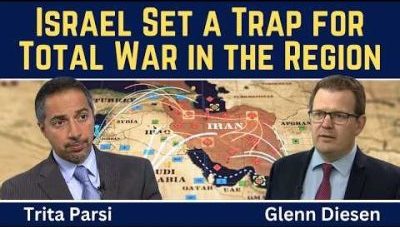
Trita Parsi: Israel Set a Trap for Total War in the Region
or go to
Aletho News Archives – Video-Images
From the Archive
Zionism’s Violent Legacy
By Donald Neff | Washington Report On Middle East Affairs | January 1996
On January 4, 1948, Jewish terrorists drove a truck loaded with explosives into the center of the all Arab city of Jaffa and detonated it, killing 26 and wounding around 100 Palestinian men, women and children.[1] The attack was the work of the Irgun Zvai Leumi – the “National Military Organization,” also known by the Hebrew letters Etzel – the largest Jewish terrorist group in Palestine. The Irgun was headed by Revisionist Zionist Menachem Begin and had been killing and maiming Arabs, Britons and even Jews for the previous ten years in its efforts to establish a Jewish state.
This terror campaign meant that at the core of Revisionist Zionism there existed a philosophical embrace of violence. … continue
Blog Roll
 Aletho News
- Trita Parsi: Israel Set a Trap for Total War in the Region
- Trump’s Iran war is on an Israeli leash
- Saudi oil boss issues global supply warning
- Riyadh Says Its Oil System Is Intact. The Numbers Say Otherwise.
- Trump and Netanyahu Want to “Finish the Job” on Iran
- US ‘one-sided dictation’ not Iran’s beliefs makes rational talks impossible: Baghaei
- Iran’s Next Strike May Not Explode. It Could Shut You Down /Col Doug Macgregor
- Iran: US political targets legitimate if assassinations return
- Iraq shuts key border crossing with Iran under US pressure: Report
- Undersea Internet cables could be targeted in retaliation for attacks on Iran: IRGC deputy chief
- If Americans Knew
- The Israel Lobby’s Changing Fortunes
- AIPAC has become such a political liability that it’s shifting to a more “nimble” approach to buying politicians
- At least 160 Israeli settler attacks in 2 weeks
- Will Gaza’s Ancient Christian Community Disappear Forever?
- Israel’s vision of regional security rests on keeping Arab states weak
- Heidi Levine recounts how Palestinian youths helped save her in settler attack
- DAILY UPDATE: Latest essential news on Palestine, Israel, & region
- Trump’s Intensifying Sabotage of the ICC, for Israel’s Sake
- Israeli military detain US and UK volunteers in West Bank including Democratic NY politician Brad Lander
- Americans at National Conservatism Conference held in Israel this year criticize Israel
- No Tricks Zone
- E-Cars Reduce CO2 Emissions By Only 41% Compared To Internal Combustion Engine Vehicles
- Predictions Made By Renowned Climate Professor Over Past Decades Have Been Proven To Be Poor
- New Study Suggests Large Regions Of The Pacific Ocean Have Been Cooling For The Last 80 Years
- Germany’s Green Energy Debacle: High Energy Costs Force Kahla Porzellan to Close After 182 Years!
- New Study: 50 Years Of The Most Aggressive ‘Net Zero’ Policies Can Only Affect The Global Climate By 0.03°C
- US September “Heat” Was No Record…Many Records Set Decades Ago
- Latest European Green Energy Debacle; Portugal’s Largest Flagship Solar Park Insolvent!
- Green Energy Debacle: German Expert Professor Fritz Vahrenholt Warns Of Severe Economic And Social Consequences
- Two More Paleo Reconstructions Affirm Meters-Higher Sea Levels Across Ireland, Brazil 7000-6000 Years Ago
- New Study: Earth And Venus Surface Warmth Largely Explained By Convection And Lapse Rate, Not CO2 Or Radiation

