Israel says will evacuate Palestinians from parts of West Bank as bloody raids continue
Press TV – August 28, 2024
Israel’s foreign minister says Palestinians will be ordered to evacuate parts of the northern occupied West Bank, amid unprecedented bloody raids in the area as similar measures have been taken by the regime’s military in the Gaza Strip, which is subjected to a genocidal war since October.
In a post on social media platform X on Wednesday, Israel Katz said the Israeli military is working “intensively” to thwart what he alleged to be “terrorist infrastructures” in the Jenin and Tulkarm refugee camps, claiming that “an eastern terrorist front” is being established against Israel in the West Bank.
Katz noted that the raids see “temporary evacuation of Palestinian residents” in areas in the northern West Bank in measures akin to those imposed in Gaza.
Earlier on Wednesday, the Israeli army launched raids in the cities of Jenin, Tulkarem and Tubas in the northern West Bank, killing at least 11 Palestinians.
Since the start of Israel’s aggression on the besieged Gaza Strip in October, the West Bank has also seen a rise in violence from Israeli forces and settlers that has claimed the lives of hundreds of Palestinians.
According to the Palestinian Health Ministry, at least 662 Palestinians were killed and about 5,400 others injured by Israeli fire since October 7, considering the new deaths.
Israel launched the war on Gaza on October 7 after the Palestinian resistance movement Hamas waged the surprise Operation Al-Aqsa Storm against the occupying entity in response to the Israeli regime’s decades-long campaign of bloodletting and devastation against Palestinians.
The regime’s bloody onslaught on Gaza has so far killed at least 40,534 Palestinians, mostly women and children, and injured 93,778 others. Thousands more are also missing and presumed dead under rubble.
In a landmark ruling, the United Nations’ top court said last month Israel’s presence in the 1967- occupied Palestinian territories is “unlawful” and must end.
In a 1967 war, Israel occupied the Gaza Strip and the West Bank, including East al-Quds, which it subsequently annexed.
The 83-page advisory opinion by the International Court of Justice also outlined a wide list of policies that it said violated international law, including the building and expansion of Israeli settlements in the West Bank and east al-Quds.
France’s chief rabbi urges Israel to ‘finish the job’ in Gaza
The Cradle | August 28, 2024
France’s chief rabbi, Haim Korsia, justified Israel’s brutal war on the Gaza Strip in a television interview on 26 August, urging the Israeli army to “finish the job.”
Korsia told French network BFM TV that he supports Prime Minister Benjamin Netanyahu.
The rabbi described Israel’s indiscriminate strikes on the besieged enclave as “acts of war” and said all of Israel’s actions in the strip are necessary to “protect its nationals.”
“It’s an act of war that no country in the world would conduct like Israel is doing, and I have absolutely nothing to be ashamed of in how Israel is conducting the fighting,” Korsia said in response to a question on the civilian casualties.
When asked if he was critical of Netanyahu’s policy in Gaza, he said, “I’m never uncomfortable with a policy that consists of defending one’s citizens.”
In response to a question on whether he condemns Israeli massacres against civilians as he condemned Israeli deaths on 7 October, the rabbi said, “They are not of the same order.”
A member of the French parliament, Aymeric Caron, blasted the rabbi’s comments, calling them an “apology for war crimes and crimes against humanity.”
“Chief Rabbi Haim Korsia calmly declares that he supports the ongoing genocide in Gaza, that it is deserved, and makes clear his hatred of the Palestinians,” Caron added.
“These are crimes punishable by law … And here I thought religious men were supposed to defend moral values and the sanctity of life,” the MP went on to say.
The toll of confirmed deaths in the Gaza Strip has risen to 40,534, a majority of them women and children. Another 93,778 Palestinians have been wounded as a result of the war.
The Israeli army has repeatedly targeted schools and UN facilities housing displaced Palestinians.
Disease has spread across the besieged enclave due to the war. UN experts, the EU, and Human Rights Watch (HRW) have all said Israel is using starvation as a weapon against the people of Gaza.
The International Criminal Court (ICC) announced in May that it has decided to seek arrest warrants for Israeli Prime Minister Benjamin Netanyahu and his Defense Minister Yoav Gallant, a move backed by the French government. The ICC decision also includes warrants for Hamas leaders Yahya Sinwar and Mohammad Deif.
Israel is also being accused of committing genocide at the International Court of Justice (ICJ).
Do We Finally Have a Peace Ticket?
By Ron Paul | August 26, 2024
Just as the Harris/Walz campaign was looking for a boost from the content-free Democratic National Convention last week, real drama broke out that pulled the country’s attention back toward Republican candidate Donald Trump. Rumors had been swirling for days that Robert F. Kennedy, Jr. might suspend his independent run for the White House and endorse Donald Trump and on Friday he did just that.
In his powerful speech explaining the decision, RFK, Jr. made it clear that suspending his run was difficult, as was leaving a Democratic Party that has been almost synonymous with the name “Kennedy” for many decades. On both issues RFK, Jr. explained that he was guided by principles and values over party orientation and the fluff that has increasingly come to characterize American electoral politics.
It seems the more “polarized” much of American society becomes over which political party they support, the more the rest of us continue to see less and less difference between the two when it comes to actual policy. Both parties support the warfare/welfare state. Both pursue policies leading to poverty and war instead of peace and prosperity. Both are deluded into believing that the Federal Reserve can effectively manage the economy while we amass unimaginable levels of debt.
Americans are seeking authenticity and politicians who put principles above political parties and that is exactly what RFK, Jr. did last Friday. In his speech at the Trump rally, RFK served up severe criticisms of the Democrats for their embrace of endless war.
He said: “Judging by the bellicose, belligerent speech last night in Chicago, we can assume that President Harris will be an enthusiastic advocate for this and other neocon military adventures. President Trump says he will reopen negotiations with President Putin and end the war overnight as soon as he becomes President. This alone would justify my support for his campaign.”
It was a well-aimed blow at the Biden/Harris Administration, which pretends to be seeking peace while pouring gasoline on the numerous conflicts overseas.
Alexandria Ocasio-Cortez claimed in her speech to the DNC that Vice President Harris is “working tirelessly” toward a ceasefire in Gaza literally as the Biden/Harris Administration announced another huge shipment of bombs to be used by the Israeli military to kill more Palestinians.
What can we hope for in RFK, Jr.’s bold move? For one, we should hope that coming out in favor of principles instead of hollow party identification can reduce the power of political parties altogether. Already in the Republican Party we are seeing a “new guard” emerge that is ready to break with the tired neocon stranglehold on the party.
So does RFK Jr.’s endorsement of Trump on principles rather than parties mean that we finally have a “peace ticket” to support? The short answer is “no,” we don’t have a peace ticket. Many of us who hoped that the first Trump presidency would be that peace ticket were disappointed to see the likes of John Bolton and Mike Pompeo litter the Administration. There is always the chance of a repeat of these mistakes. And neither Trump nor RFK seem reliably in favor of an end to the slaughter in Gaza.
So no, this is not a “peace ticket.” But at least with what we have seen this past week with RFK and Trump, we get the feeling that peace is on the menu. It’s a start.
25 shelters, 4 wells in Deir al-Balah went out of service due to forced displacement
Palestinian Information Center – August 26, 2024
DEIR AL-BALAH – The Municipality of Deir al-Balah announced that 25 shelters and four water wells went out of service, following the Israeli evacuation of new neighborhoods in Deir al-Balah over the past 72 hours.
The municipality said in a press statement on Monday, “25 shelter centers went out of service after forced displacement of 250,000 citizens within the past 72 hours, including the only government hospital which was still operating in the southern Gaza Strip.”
The municipality further explained that the closure of the four water wells brings the number of disabled wells to 14, noting that the disabled wells were supplying nearly 70% of the people in the city, and their closure would exacerbate the water and food crisis.
The recent Israeli evacuation order in the vicinity of the al-Aqsa Martyrs Hospital threatened the only remaining main water tank in the city, according to official sources.
Deir al-Balah municipality called on the international community to urgently intervene to enable the humanitarian service crews, including municipalities, hospitals and relief associations, to carry out their humanitarian duty to provide service to the displaced and citizens.
On Sunday evening, the Israeli occupation army issued a decision to evacuate new neighborhoods northeast of Deir al-Balah, and some neighborhoods west of Salah al-Din Street.
Israel expands Netzarim corridor to include ‘permanent outposts’
The Cradle | August 26, 2024
Israeli forces have expanded the Netzarim corridor in the Gaza Strip to include four large “outposts” designed to permanently house troops, according to satellite imagery reviewed by Hebrew news site Ynet.
“The IDF has been working to expand the corridor … Four large outposts were established in the corridor, for the permanent stay of hundreds of fighters,” the Israeli outlet reported on 26 August.
Ynet explains that Israel recently launched an operation in Gaza City’s Zaytoun neighborhood, where Israeli troops have operated several times since the start of the war, failing to root out Hamas’ Qassam Brigades.
Four reservist soldiers have been killed in the operation, including one on Sunday by an explosive device planted by the Palestinian resistance. The ongoing operation in Zaytoun was launched specifically “to expand” the Netzarim corridor, which lies in close proximity to the Gaza City neighborhood, the report said.
“In the raid, the forces were required to locate tunnels, terrorist infrastructures and weapons of Hamas. The brigade raid continues, and includes hitting the terrorists and destroying munitions stocks that threaten the forces in Netzarim.”
The Netzarim corridor was established by Israeli forces during the early months of the war on Gaza. The corridor, which runs through the former grounds of the old Netzarim settlement, splits the strip in two and prevents the return of displaced Palestinians to northern Gaza.
“The corridor was established … to prevent the return of armed terrorists to the north of the Gaza Strip, and to generally prevent the return of Palestinians to the north of the Gaza Strip. Palestinians can move south – but not in the opposite direction,” Ynet explains, reinforcing the Israeli narrative that displaced Gazans returning to the north as part of any agreement are actually militants.
Israeli forces have set up a “newly constructed operational route … and a drainage point” along the corridor to prevent displaced Palestinians in southern Gaza from returning to their homes in the north, Ynet goes on to say.
The report further confirms Israel’s plan for a permanent presence in the Gaza Strip. Israeli defense officials who spoke with the Wall Street Journal in February said the corridor is part of Tel Aviv’s “plans to maintain security control over the enclave for some time.”
Israeli forces stationed at Netzarim have come under numerous attacks by Palestinian resistance factions since the corridor was established.
Satellite imagery analyzed by the Forensic Architecture research group last week revealed that Israeli forces are also working on a new east-to-west land corridor near Gaza City’s Beit Hanoun. Over the past several months, Israeli troops have destroyed Palestinian homes and farmlands to establish this new corridor, according to Forensic Architecture.
A photo that circulated on social media on 25 August shows that Israeli forces have built an asphalt road on the Philadelphi corridor on the Gaza–Egypt border in the southern strip.
The Netzarim corridor, as well as the Philadelphi corridor and Rafah crossing on the Gaza–Egypt border, are two of the main topics that have complicated ceasefire talks. Prime Minister Benjamin Netanyahu is insisting on keeping troops in these areas despite Hamas’ demands for a full withdrawal of Israeli forces from Gaza.
Netanyahu insists on a screening and inspection mechanism at the Netzarim corridor to inspect Gazans returning to the north as part of any agreement.
The premier also insists that any captive exchange be followed by a continuation of the war. As a result, ceasefire talks have yielded no results.
The IDF Uses Palestinian Civilians As Human Shields to Inspect Gaza’s Tunnels
Richard Medhurst | August 24, 2024
Support the show on Patreon: patreon.com/richardmedhurst
Donate on PayPal: https://paypal.me/papichulomin
Donate on GoFundMe: http://tiny.cc/GoFundMe-Richard Bitcoin address: bc1qnelpedy2q6qu67485w4wnmcya5am873zwxxvvp
Subscribe to Richard Medhurst on other platforms here: Rumble: https://rumble.com/richardmedhurst
Rokfin: https://rokfin.com/richardmedhurst
Odysee: https://odysee.com/@richardmedhurst
Substack: https://richardmedhurst.substack.com/
Richard Thomas Medhurst (1992) is an independent journalist, political commentator, and analyst from the United Kingdom with a focus on international affairs, US politics, and the Middle East.
Medhurst is known for his coverage of the Julian Assange extradition case in London, as one of the only journalists to report on the trial of the WikiLeaks founder from inside the court.
He has also covered the Iran nuclear deal talks on the ground in Vienna. Medhurst was born in Damascus, Syria.
His father is English and mother is Syrian. Both his parents served in United Nations Peacekeeping and Observer missions and were among the UN Peacekeepers awarded the Nobel Peace Prize in 1988. Owing to his parents’ professional mobility, he has lived in Syria, Pakistan, Switzerland, and Austria.
He speaks four languages fluently: English, Arabic, French, and German. As an independent journalist, Medhurst regularly hosts live broadcasts and video reports on his YouTube channel.
Previous guests include the Foreign Minister of Venezuela, the Dep Foreign Minister of Iran; the Palestinian, Russian and Cuban ambassadors to the United Nations in Vienna; the former British Ambassador to Syria; and various UN officials, journalists, and more.
Medhurst’s reports and analysis on Yemen, Ukraine, Syria, Niger, Lebanon, Iran, the Israeli occupation in Palestine and its genocide in Gaza have gone viral countless times, racking up millions of views.
Richard Medhurst has a combined following of roughly one million people online, and appears regularly on international news outlets including Al Jazeera, WikiLeaks, Black Agenda Report, Al Mayadeen, The Times, LBC, and others.
Richard Medhurst on Twitter:  / richimedhurst
Richard Medhurst on Instagram:  / richardtmedhurst
Richard Medhurst on Substack: https://richardmedhurst.substack.com/
Hezbollah carries out ‘first phase’ of retaliation, Israel imposes strict censorship
The Cradle | August 25, 2024
Hezbollah launched a major drone and rocket attack at over 10 Israeli targets early on 25 August in what it called the “first phase” of its response to the assassination of top military commander Fuad Shukr in Beirut’s southern suburb on 30 July.
An undisclosed “vital military target,” was the main objective of this operation, according to the Lebanese resistance.
“All the attack drones were launched at the times specified for them and from all their [predetermined] positions and crossed the Lebanese-Palestinian borders towards the desired target and from multiple paths, and thus our military operation for today has been completed and accomplished, praise be to Allah Almighty,” a statement issued by the Lebanese resistance movement said.
The movement said it fired over 320 rockets at sites in the Galilee, which served as a diversion to prevent Israel’s Iron Dome system from shooting down the attack drones.
Meanwhile, the Israeli military claimed it carried out pre-emptive strikes that successfully thwarted a massive attack by Hezbollah after identifying overnight preparations for a major attack.
“Approximately 100 IAF fighter jets struck and destroyed thousands of Hezbollah rocket launcher barrels, aimed for fire toward northern and central Israel.”
The Lebanese resistance movement addressed Israel’s announcements in one of its statements, calling them “empty claims” that “contradict the facts on the ground and will be refuted in a speech” by Secretary-General Hassan Nasrallah.
Following the operation, Israeli media reported that Prime Minister Benjamin Netanyahu issued an order banning press interviews with Likud ministers until further notice.
Additionally, BBC journalist Nafiseh Kohnavard reported on X that the Israeli government “issued a series of new censorship regulations for media that includes the damage caused by rocket attacks to ‘strategic national infrastructure or to military bases.’”
The Israeli military said some 210 rockets and some 20 drones were launched from Lebanon at northern Israel in Hezbollah’s attack this morning.
Some of the projectiles were intercepted, while others impacted, causing damage and injuries. Many rockets also struck open areas, the military said.
Palestinian journalist Qassem Qassem noted that “The Hebrew media is currently exaggerating the size of the enemy army’s ‘preventive’ strike, and the talk about destroying 1,000 missiles directed at Tel Aviv is ridiculous.”
Al-Mayadeen noted that “Hezbollah hit its targets despite the occupation’s reliance on significant American intelligence and operational support. The resistance’s response to the assassination of martyr Fouad Shukr succeeded despite Israel’s full state of alert for over a month.”
Israel’s allies have been scrambling to prevent Iran and Hezbollah from retaliating to the Israeli attacks on their capitals last month. The assassination of top Hezbollah commander Fuad Shukr in Beirut on 30 July killed several civilians, including children.
Washington has expressed hope that reaching an agreement to end the war in Gaza could stymie an incoming response and avoid a larger-scale regional war. Yet ceasefire talks continue to yield no results.
Hezbollah has repeatedly vowed that it will not stop operations until the war in Gaza ends and promised a harsh retaliation to Shukr’s assassination in the Lebanese capital. It has also refused any discussion on Lebanon’s border situation until an end to the war is achieved.
“Our borders with Lebanon will change and will not return to what they were before the war,” an Israeli military source told Sky News Arabia on 21 August, echoing months of Israeli threats to launch an expanded war on Lebanon.
UAE’s support of Israeli economy and militarism
Press TV – August 24, 2024
The UAE has allocated $10 billion for direct investment in the Zionist entity in compliance with its obligations under the US-guided Abraham Accords.
The UAE’s deep involvement in Zionist militarism is barely noticed in the shadow of the Gaza genocide.
A deal was signed in 2021 between state-owned UAE arms firm, Edge Group, and weapons manufacturer, Israel Aerospace Industries, to design unmanned surface vessels with a range of military applications.
The UAE has also initiated a partnership between G42 and the Zionist entity-owned arms firm, Rafael Advanced Defense Systems. G42 is run by Tahnoun bin Zayed Al Nahyan, the UAE’s National Security Advisor who is the controlling shareholder and chairs the company.
Dorian Barak, co-president of the UAE-Israel Business Councilو expects to see about 1000 Israeli-owned companies operating in the Persian Gulf state very soon.
One such example could be Elbit Systems, which has set up a subsidiary in the UAE known as Elbit Systems Emirates. The branch produces weapons for both the UAE military and Israel.
The UAE state-owned firm, Mubadala, has an 11% participating interest in the Tamar and Dalit leases, which includes the bountiful Tamar gas field.
Mubadala has also invested in the Israeli venture capital firm, Pintango Venture Partners. Originally named Polaris Venture Capital, it was founded in 1993 by Chemi Perez, the son of the late Israeli president, Shimon Peres.
The UAE has also invested in the tech firm Synaptech, which is closely linked to the Israeli military. The chairman of Synaptech is the former war minister and the military chief of staff, Moshe Ya’alon.
The UAE is deeply integrated, economically, with the Zionist entity.
Israeli Forces Kill Three Palestinians in Tulkarem Camp
IMEMC | August 22, 2024
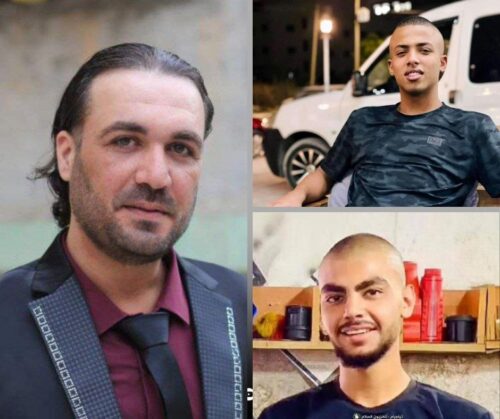
Israeli forces killed three Palestinian citizens, before dawn on Thursday, after soldiers bombed a home in the Tulkarem refugee camp in the northwestern part of the West Bank.
Media sources identified the three slain young men as Muawiyah Khaled Hajj Ahmad, 19, Wassim Saber Sobhi Anbar, 20, and Emad Taiser Yousef Shreim, 38.
Sources added that the army invaded the city of Tulkarem and besieged the Tulkarem refugee camp, before dawn on Thursday, accompanied by military bulldozers, sparking protests.
The army positioned sharpshooters on rooftops of citizen’s homes, while armed resistance fighters exchanged fire with the attacking army, before reinforcements arrived.
Soldiers fired light bombs into the sky, while reconnaissance drones circled the sky above and the sound of explosions were heard.
Military bulldozers caused destruction to streets, infrastructure and private property in the camp.
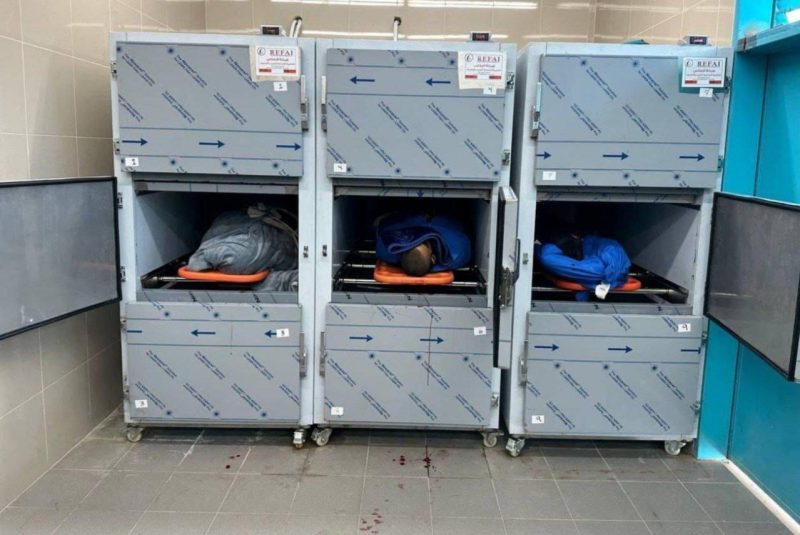
Later media sources said that occupation forces stormed the Iktaba suburb, east of the city, besieged a home, and fired an “Energa” anti-tank grenade at the home, causing severe destruction to the home and a vehicle; no injuries were reported.
Israeli forces have now killed 640 Palestinians, including 147 children, and injured 5,400 in the occupied West Bank since the beginning of the military onslaught against the Gaza Strip on October 7, 2023.
In the Gaza Strip, the Israeli military has killed 40,223 Palestinians, the majority of whom are women and children, and injured 92,981 since the beginning of its military onslaught on October 7, 2023, while thousands remain under the rubble.
Over 40 Palestinians released from Israel prisons with signs of torture, skin diseases
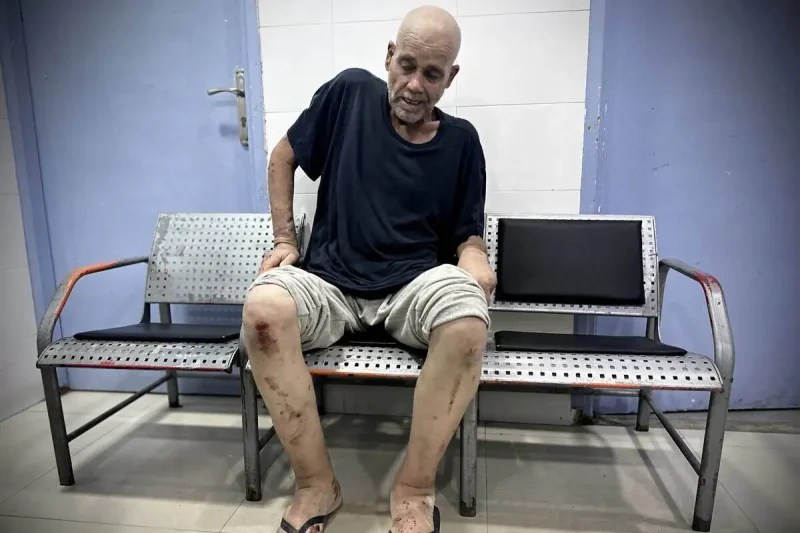
23 Palestinians detained by Israel are taken to the Nasser Hospital for medical treatment after release at Karm Abu Salem border crossing in Gaza on August 20, 2024. [Doaa Albaz – Anadolu Agency]
MEMO | August 23, 2024
Noa Argamani blasts Israeli media: ‘Hamas did not injure me, an airstrike did’

(Photo credit: Richard A. Brooks/AFP via Getty Images)
The Cradle | August 23, 2024
Noa Argamani, the Israeli captive freed by an army operation that killed hundreds of Palestinian civilians, has lashed out at the media for misreporting comments she made about her time in captivity.
“I can’t ignore what happened in the media in the last 24 hours. Things were taken out of context,” Argamani stated in an Instagram story posted to her account on 23 August.
“I was not beaten and my hair was not cut. I was in a building that was bombed by the Air Force. The exact quote is: ‘This past weekend, after the shooting, as I said, I had cuts all over my head and was injured all over my body.’ I emphasize that I was not beaten, but injured all over my body by the collapse of a building on me,” Argamani added.
She went on to say that as a “victim of 7 October I will not allow myself to be victimized once again.”
Israeli media had falsely quoted the former Israeli captive as saying that Hamas beat her all over her body and cut her hair while she was in captivity during a meeting with G7 embassy representatives in Tokyo.
Before being updated, an article in the Jerusalem Post describing Argamani’s experience in captivity was published with the title: “Hamas beat me all over my body.”
In early June, Israel launched a rescue operation in the Nuseirat refugee camp in central Gaza to retrieve Argamani and three other captives. Nearly 300 Palestinians were massacred in the process.
Argamani was notably paraded by Prime Minister Benjamin Netanyahu during his speech to the US Congress in July.
Her testimony on Friday echoes that of other Israeli captives who have, since being released, described their experience with Hamas as much less frightening than the Israeli airstrikes that constantly rained overhead.
“We were in tunnels, terrified that it would not be Hamas, but Israel, that would kill us, and then they would say Hamas killed you,” a freed captive said during a tense meeting with Netanyahu in December.
Israeli forces have killed many of their captives being held by the Palestinian resistance in the Gaza Strip, both through airstrikes and ground operations.
The bodies of six Israeli captives were returned to Israel this week following an overnight army operation.
According to Hebrew news site Ynet, the captives had died months ago, suffocating to death after a nearby Israeli airstrike flooded the tunnel they were in with toxic gases.
Argamani’s social media post comes less than two weeks after Hamas’ Qassam Brigades announced the accidental killing of an Israeli captive.
“After investigating the killing of an enemy captive by his guard, it became clear that the soldier in charge of the guard acted in a vengeful manner, contrary to instructions, after receiving news of the martyrdom of his two children in one of the enemy’s massacres,” Qassam Brigades spokesman Abu Obeida said in a statement on 15 August.
“We stress that the incident does not represent our ethics and religious teachings in dealing with captives, and we will tighten the instructions after the incident was repeated in two cases so far,” he added.
“We hold the enemy fully responsible for all the suffering and dangers that its captives are exposed to as a result of its violation of all the rules of humane and humanitarian treatment and its practice of brutal genocide against our people.”
Featured Video

The American Retreat from Vietnam
or go to
Aletho News Archives – Video-Images
From the Archives
Secret document reveals plans for civil war in Lebanon, Israeli false flags, and invasion
By Randi Nord | Geopolitics Alert | April 5, 2019
Beirut – During his visit with US Secretary of State, Mike Pompeo, Lebanese President Michael Aoun reportedly received a US-Israeli document detailing plans for creating a civil war in Lebanon with covert false flag operations and possible Israeli invasion.
Although the source of the document is Israeli and created in partnership with Washington, no one knows who presented it to Aoun. The Lebanese TV station, Al-Jadeed, initially reported the document on Lebanese TV and a video on its website. Geopolitics Alert translated the report for this article. … continue
Blog Roll
 Aletho News
- ‘Distance yourselves from Israel’: IRGC urges US population to question govt policies
- America’s Greenland deal has a radioactive backstory
- The RAF Fairford ‘terror plot’: Unpacking escalation in the UK echo-chamber
- EU Council Advances Chat Control 2.0 Scanning Proposal
- Ex-Greek MEP files complaint against Israeli spyware firm over alleged Pegasus surveillance
- Troubling ideas throughout the Torah, Talmud, Mishneh Torah and Tanya
- ‘Grave, alarming’: Iran mission on Trump’s UNGA ‘annihilation’ threats
- Najaf airport to reopen to Iranian flights within 24 hours: Ambassador
- From ‘How Will This End For Iran’ to ‘When America Walks Away’: A tale of two Economist covers
- Tehran blasts ‘baseless’ speculation linking Iran to alleged bomb plot at UK air base
- If Americans Knew
- US arms sales to Israel worth $21.6 billion in 20 months
- Three Palestinians Killed in Israeli Attacks on Gaza
- Revealed: German “Anti-Semitism Expert” Driving Crackdown on Palestine Solidarity is Former Israeli Spy
- Egypt’s Warning to Israel Before Oct 7
- Israel’s siege signals another cruel winter for 1.8 million Gazans – Daily Update
- Netanyahu Asked UAE Leader to Deny Report on Oct. 7 Warning in Secret Visit, Sources Say
- CNN Chief Int’l Correspondent Clarissa Ward on Journalists in Gaza
- Democratic Party Consultants Surround Troy Jackson with Pro-Israel Donors
- Christian Leader Responds To Netanyahu’s Claims Regarding Palestinian Christians
- In Gaza, ‘Whoever Survives the Bombing Won’t Survive the Rubble’
- No Tricks Zone
- New Study: Earth And Venus Surface Warmth Largely Explained By Convection And Lapse Rate, Not CO2 Or Radiation
- 2025 Nature Paper Claiming Worsening Global Drought Gets RETRACTED …Heavily Flawed
- New Study: ‘Global Drought Shows No Detectable Recent Acceleration Under Climate Warming’
- Economic Masterminds: German Socialists Suggest Taxing Productivity Gains Stemming From Using AI
- The South China Sea Has Not Been Cooperating With The Climate Change Narrative
- Energy Crisis: Germany Enters Heating Season With Historically Low Gas Reserve Fill Levels
- New Study: The Antarctic Ice Sheet Gained Mass From 2020-2024 Due To Staggering Snow And Ice Accumulation
- Study: Ocean Heating Rates From Thousands Of Years Ago ‘Dwarf’ Modern Ocean Heating Rates
- Climate Extremists Target, Attack Large-Scale Power Grid Infrastructure In Germany!
- New Study: Antarctic Ice Melt Has Contributed Less Than 1 Centimeter To Sea Level Rise In The Last 30 Years

