Palestinian steadfastness and Hamas tactics have thwarted Israel’s goals
By Nidal Adaileh | MEMO | July 15, 2024
There is no dispute about Hamas’ ability to survive, despite more than nine months of fighting against Israel. The occupation state has to admit that it has not achieved any of its goals.
More than 38,000 Palestinians have been killed, and almost 100,000 more have been wounded. Nevertheless, Hamas and the factions fighting alongside it remain steadfast, and even take the war to the so-called invincible army occasionally.
It has become clear that Benjamin Netanyahu’s stated objective of eliminating Hamas is pure vanity. Now we see statements from Israeli officials which are clearly intended to prepare the general public that this objective may not really be possible, even as Hamas and its allies have adopted a new strategy targeting Israeli forces inside Gaza, instead of launching rockets towards Israel.
The Israeli prime minister is trying to limit the threats of the Palestinian resistance factions through the ongoing military offensive against the Palestinians in Gaza. However, he faces major challenges in achieving his two main goals of “eradicating” the Islamic Resistance Movement and returning the Israelis held as prisoners in the enclave.
Time is no longer on Israel’s side.
International pressure is increasing for it to “limit its operations”. The longer that Hamas holds out, the more difficult it becomes for Israel to achieve its goals.
Nine months into its war, Israel has failed to destroy Hamas as a military and political force, and even if it has succeeded in killing key leaders who planned the 7 October cross-border incursion, battle-hardened replacements are emerging in their stead.
The resilience of the resistance groups reflects their effective use of guerrilla tactics, the extent of their arsenal and the regrouping of their fighters. Led by the Hamas military wing, Al-Qassam Brigades, the factions are engaged in confrontations that reflect a high level of preparation and implementation, despite the technological imbalance favouring the Israeli army. The objective of the resistance groups is to inflict losses on the Israeli war machine so that it pays the price for its brutal offensive which has targeted and killed so many innocent civilians and destroyed essential infrastructure in Gaza. If and when Israel realises the extent of its failures, it may open the way for an end to the war.
Hamas has had to cope with 18 years of siege imposed on the Gaza Strip, but has nevertheless been able to develop militarily. Its fighting capabilities have grown, with locally-produced weapons and munitions produced using technology provided by supporters. The movement’s strategic, operational and tactical options are hugely varied compared with those of its early days.
The steadfastness of the Palestinians in Gaza in the face of the bloody massacres of the Zionist entity, meanwhile, has attracted global attention and admiration. It is a mistake to think that the Palestinians can be defeated through military means; they may be bloodied, but they are unbowed. On many occasions throughout the 20th century societies retreated in the face of brutal crimes and terrorism, even though they knew themselves to be in the right, but what we are witnessing in Gaza is the steadfastness of an entire people.
It may not be clear who are the victors and who are the defeated, but what is clear is that Israel has not achieved its goals: Hamas still very much exists, and Israelis are still held as prisoners in Gaza.
The Gaza Strip has now become a thorn in the side of the Israeli occupation army. It is at a loss about what it can do. I am sure that the Gaza experience will — if it has not already — become a special case study for military academies around the world.
Palestinian steadfastness in Gaza and, increasingly, in the occupied West Bank and Jerusalem, is the password in the current phase of the struggle to end the Israeli occupation and establish an independent, sovereign Palestinian state in which Palestinians can live in safety.
Israel using US-provided internationally prohibited weapons: Hamas
Press TV – July 15, 2024
The Palestinian resistance movement Hamas says Israel is using the US-provided internationally prohibited weapons against people in Gaza.
Hamas said in a statement on Monday that more than 320 martyrs and injured have reached hospitals in the past 48 hours with their bodies burned due to the use of internationally prohibited weapons by Israeli occupation forces.
The weapons used by the Israeli occupation forces have caused third-degree burns which thermal or chemical arms cause, Hamas said.
The group added that these “are unconventional, internationally banned weapons, mostly of American manufacture.”
“These weapons cause a chemical reaction with the skin, leading to the direct chemical erosion of tissues in the bodies of martyrs and the injured,” it added.
“They cause severe pain and deep physical damage, resulting in fatal burns within 27 hours or less. We have indeed lost many martyrs in this tragic manner,” the statement added.
Hamas said they strongly condemn the crimes against humanity committed by the Israeli occupation against civilians, children, and women.
“We call on all countries of the world to denounce these incendiary crimes against civilians and to pursue and prosecute the occupation in international courts,” it added.
Hamas said it holds the US administration “fully responsible, both legally and morally, for supplying the Israeli occupation with these various types of internationally prohibited weapons.”
“We also hold the Israeli occupation responsible for the crimes and massacres it commits against civilians and displaced persons,” the resistance movement said.
“We call on the international community, all international and UN organizations, and all free countries of the world to pursue the Israeli occupation and pressure it to stop the genocide that the occupation army is committing to kill and destroy our Palestinian people,” it concluded.
Gaza Civil Defense Service has in several statements pointed to the “dissolution of victims corpses and their conversion into ashes.”
A Euro-Med Monitor report highlights that the Hague Conventions of 1899 and 1907, the Geneva Conventions of 1949, and international humanitarian law all forbid the use of thermal bombs against civilians in populated civilian areas.
“The Rome Statute of the International Criminal Court also classifies the use of thermal bombs as a war crime.”
Two weeks into the war, Gaza’s Health Ministry warned in a statement that “medical staff monitored the usage of unusual weapons that caused severe burns to the bodies of the martyrs and wounded.”
Analysts believe that the Gaza war is the latest laboratory for Israel’s arms industry as the regime is known to test its weapons on Palestinians in its offensives against the occupied nation.
At least 90 Palestinians mostly women and children were killed and almost 300 others were injured in the July 13 Israeli aerial assault on the densely-populated camp near Khan Younis.
Israel launched the war on Gaza on October 7 after Palestinian resistance groups carried out a surprise retaliatory operation into the occupied territories.
Concomitantly with the war, the regime has been enforcing a near-total siege on the coastal territory, which has reduced the flow of foodstuffs, medicine, electricity, and water into the Palestinian territory into a trickle.
So far during the military onslaught, the regime has killed at least 38,664 Gazans, most of them women, children, and adolescents. Another 89,097 Palestinians have sustained injuries as well.
Colombia Professor Faces Firing After Pro-Israel Social Media Pile-On
By John Miles – Sputnik – 14.07.2024
Pro-Israel lawmakers and Zionist accounts on social media caused a firestorm after law professor Katherine Franke questioned the conduct of ex-IDF members on Columbia’s New York City campus.
A tenured professor at New York’s Columbia University faces firing after a pro-Israel online campaign criticizing comments the academic made on behalf of pro-Palestine demonstrators at the Ivy League school.
“There’s a very good chance that they will fire me,” said law professor Katherine Franke after being subjected to questioning she characterized as hostile as a part of Columbia’s investigation into the incident.
The controversy stems from an interview Franke granted to Democracy Now! on January 25. The professor sharply criticized Columbia’s response to an incident in which pro-Palestine protesters were sprayed with an unknown chemical substance by two alleged veterans of the Israel Defense Forces (IDF).
University administrators initially blamed the students for conducting an “unsanctioned” protest before finally banning the perpetrators from campus while police conducted an investigation of the incident.
“Columbia has a program, It’s a graduate relationship with older students from other countries, including Israel,” Franke noted on the radio program. “It’s something that many of us were concerned about because so many of those Israeli students who then come to the Columbia campus are coming right out of their military service. And they’ve been known to harass Palestinian and other students on our campus, and it’s something the university has not taken seriously in the past.”
“The university waited three or four days to actually even say anything about it,” she added. “They have not reached out to the students who were sick… some of whom are still in the hospital.”
The comment was subsequently mischaracterized by pro-Israel accounts on social media, who alleged that Franke advocated banning Israeli citizens from the Columbia campus.
“This @Columbia professor has a problem with former IDF soldiers being on campus,” read one post typical of the outrage, shared by Columbia Business School professor Shai Davidai, who identifies on the X platform as “Jewish Israeli” and “Zionist.”
“She doesn’t have a problem with ex-soldiers from any other place,” he complained. “Her only problem is with Israelis. @ProfKFranke – I served in the IDF. Do you think I also shouldn’t be allowed on campus?”
Davidai publicly criticized a wave of pro-Palestine protest on US college campuses earlier this year, calling the students “Nazis” and “terrorists” and calling for the National Guard to be deployed to break up the demonstrations. The demand implies a deadly threat against protesters in the United States, where National Guard troops shot and killed several antiwar demonstrators at Ohio’s Kent State University in 1970.
The business professor’s comments have been shared by official Israeli government accounts online as the country has invested significant effort in defending its cause on social media. It emerged last month that Israel has set up fake accounts online to lobby US lawmakers to continue supporting its military operation in the besieged Gaza Strip, which a study recently claimed could kill as many as 186,000. In 2013 it was revealed the country pays students to defend it on Facebook and Twitter.
Columbia administration released a statement defending Israeli students in response to the firestorm, which was championed by the Israeli newspaper Haaretz. The following month Franke was informed a complaint had been lodged against her by two Columbia law professors for “discrimination,” and in April Republican Congresswoman Elise Stefanik called for disciplinary action against her during a House hearing with controversial Columbia University President Minouche Shafik.
A number of college professors and other faculty have been fired or faced disciplinary action in the United States for expressing pro-Palestine sentiments. Dr. Ameer Loggins is filing a defamation suit against California’s Stanford University after being fired for giving a lecture that discussed Israel in the context of historical acts of settler colonialism.
“What’s of greatest concern is not really my 20-year-plus career at Columbia, but what this says about peaceful protest on our campuses around the lives and dignity of Palestinians,” Franke said about the investigation into her comments, which remains ongoing. “What’s happening to me is happening to our students, it’s happened to people on many other campuses.” … Full article
Hezbollah-affiliated group launches 1st operation against Israel since Al-Aqsa Flood
MEMO | July 14, 2024
The Lebanese Resistance Brigades, a paramilitary group linked to Hezbollah, claimed responsibility yesterday for a military operation against Israel in southern Lebanon. This announcement marks the group’s first since the launch of Al-Aqsa Flood last year.
Founded by Hezbollah in 1997, the Brigades include volunteer fighters from various Lebanese sects. On Friday, they reported launching rockets at the Israeli ‘Rweisat al-Qarn’ site in the occupied Lebanese Shebaa Farms, achieving a “direct hit.” Hezbollah and Israel have engaged in near-daily exchanges of fire since the war on Gaza began.
Hezbollah which supports Hamas has vowed to cease attacks only with a Gaza ceasefire. The Lebanese government and Hezbollah rejected the occupation state’s demand to evacuate the border area of Hezbollah fighters. Nabih Berri’s parliamentary bloc welcomed international efforts to end Israel’s aggression against Gaza and opposed establishing buffer zones in Lebanon.
In October, the Lebanese Resistance Brigades lost two of its fighters, Ali Kamal Abdel Aal “Jihad” and Hussein Hassan Abdel Aal “Bilal”, from the town of Helta in southern Lebanon, who were martyred while performing their national duty, reports Al Mayadeen.
Cross-border fire continues, with a Lebanese army vehicle recently hit by Israeli gunfire. The personnel escaped unharmed. The Brigades affirmed their mission to resist Israeli occupation and liberate Lebanese territories.
JFK Jr. and the Jewish Curse on the Kennedys

BY LAURENT GUYÉNOT • UNZ REVIEW • JULY 12, 2024
John Fitzgerald Kennedy, Jr. died 25 years ago, with his wife and his sister-in-law.
He was assassinated. I’ll summarize the evidence below.
He was assassinated because he was JFK’s son, and had political ambitions driven by a strong filial piety. He had to die for the same reason his uncle RFK had to die in 1968: no Kennedy should ever approach the White House again — unless, Rabbi Jeffrey Salkin suggests, he is also a Schlossberg. And JFK Jr. could have reached the White House in eight years (he would have been 48 in November 2008; his father became president at 43).
“The Kennedy family is a clan, a tribe, a sovereignty, and a dynasty,” once wrote Arthur Krock, who knew them well.[1] None of the Kennedys can be understood as mere individuals. And so, in a deeper sense, the reason JFK Jr. had to die is that he was the grandson of the founding patriarch, Joe Kennedy. The point was candidly made by John Podhoretz in an op-ed piece for the New York Post, published on the very day when JFK Jr.’s body was recovered from the ocean floor, together with the bodies of his wife and sister-in-law. In that most disgusting piece of fiction, Podhoretz imagines that the Devil is telling Joe in Hell: “every time you think your family is on its way back to glory, I just have to do something. Like I did this weekend, with your grandson John.” According to Podhoretz, speaking in the name of the Devil to Joe, JFK Jr. died in retribution for what his grandfather did to the Jews, “when you were America’s ambassador to England, saying all those nice things about Hitler, doing everything you could to prevent Jewish emigration from Nazi Germany. Thousands of Jews died because of you.”
Note that, logically, the Jewish god Yahweh, not the Devil, should want to punish Joe by killing his grandson. Unless, of course, Yahweh is the Devil. Podhoretz took no time to ponder this question; he could not wait one day to voice his delight, while all Americans were mourning the prince of Camelot.
John Podhoretz is the son of Norman Podhoretz (his colleagues at the Washington Times used to call him “John P. Normanson” because he had been introduced to them as “John Podhoretz, Norman’s son”). Norman will be remembered as the man who wanted so much to launch World War IV. The Podhoretz love world wars because world wars are always good for Israel. Which is also why they have an eternal hatred for Joe Kennedy, the man who almost succeeded in averting World War II. As I explained in “Joseph P. Kennedy, the Cursed Peacemaker,” Joe Kennedy was not a friend of Hitler, but a friend of peace, just like Neville Chamberlain. “I am pro-peace, I pray, hope, and work for peace,” he declared on his first return from London in December 1938.[2]
For trying to prevent the Jews from drawing America into the war, Joe Kennedy was deemed a holocaustic arch-anti-Semite. It is quite astonishing, actually, that his sons could do so well in American politics, despite their father’s reputation as a Hitler-appeaser. It is, in part, a tribute to Joe’s political shrewdness. Here is a funny story told by John Hughes-Wilson:
Joseph Kennedy solved the problem in 1956 by secretly asking a prominent media and entertainment business mogul called Joe Hooker to orchestrate a right-wing press campaign against his son, by accusing the then Senator Jack Kennedy of being a “Jewish puppet”, secretly in hock to Jewish interests and influences. Hooker and his neo-Fascist contacts duly smeared JFK in the Press. “Kikes for Kennedy” ran one headline. The American Nazi party denounced him as a “Jew lover”. The Jewish lobby was impressed and so, when the request for campaign funds duly appeared, Jewish political financiers decided to back Kennedy.[3]
I doubt if the trick impressed the group of financiers gathered by Abraham Feinberg after the 1960s primaries. “Jack,” they said to JFK, “everybody knows the reputation of your father concerning Jews and Hitler. And everybody knows that the apple doesn’t fall far from the tree.” They gave him $500,000 as campaign fund nonetheless, according to Seymour Hersh[4].
They thought they had bought Kennedy’s foreign policy, but they would soon feel cheated: as promised, Kennedy did name Mike Feldman as his advisor on the Middle East, but he treated him as the Israeli agent that he was, and went on befriending Nasser.
The Zionists thought Joe Kennedy’s background could provide them with some leverage on his son. Their preferred Democratic candidate had been Lyndon Johnson, who during the primaries had attacked John as being the son of a “Chamberlain umbrella man” who “thought Hitler was right” (the black umbrella had become a symbol of Chamberlain and the 1938 Munich Conference).[5] When LBJ lost to JFK, JFK was blackmailed, through Philip Graham and Joseph Alsop of the Washington Post, into picking Johnson as vice-president. No one knows for sure what the blackmail was about. Kennedy’s long-time secretary Evelyn Lincoln thought it was “about womanizing, and things in Joe Kennedy’s background.”[6] Since the sex life of politicians was not the type of things that the press reported back then — and the Washington Post was no exception — my guess is that it was more about “Joe Kennedy’s background”. Like Feinberg’s Jewish friends, Graham and Alsop must have reminded JFK of “the reputation of your father concerning Jews and Hitler.”
President Kennedy became a huge problem for Israel, not only for wanting to deprive Israel of the holy nuke, but also for trying to end the Cold War: a rapprochement between Kennedy and Khrushchev, both supporting Nasser’s secular nationalism and pan-Arabism, was Ben-Gurion’s worst nightmare. The Soviet minister of Foreign Affairs Andrei Gromyko recalled in his memoirs a revealing conversation he had with President Kennedy in the White House, October 3, 1963 — a conversation which, he writes, “left a deep impression in my mind.”
As I entered his study, I found him smiling and as usual in a good mood. He said, ‘Why don’t we go out on to the terrace and talk one to one without interpreters?’
Naturally I agreed, and we left the room.
He immediately began to talk about the internal situation in the USA: ‘The fact is, there are two groups of the American population which are not always pleased when relations between our two countries are eased. One group consists of people who are always opposed to improvement for ideological reasons. They are quite a stable contingent. The other group are people “of a particular nationality’” — he meant the Jewish lobby — who think that always and under all circumstances, the Kremlin will support the Arabs and be an enemy of Israel. This group has effective means for making improvement between our countries very difficult.’ He ended briefly: ‘That is the reality. But I think it is still possible to improve relations, and I want Moscow to know that.’
… At the end of our conversation, Kennedy said, ‘I just wanted you to know some of the difficulties the President of the United States has to face when dealing with questions of Soviet-US relations.’
… I don’t know why, but when I first heard the Tass report of Kennedy’s murder it was that talk on the White House terrace that came into my mind — what he had said about there being opponents to his policy.[7]
From Israel’s point of view, JFK was definitely an appeaser like his father. Israel had needed WWII, and Israel now needed WWIII (as neocon Norman Podhoretz insists on calling the Cold War). “What’s wrong with the Kennedys? Why do they always want to prevent or end the wars that Israel needs? A curse on their house!”
The Kennedy curse is a kabbalistic concept that has been thrown to the public in such books as The Sins of the Father (Ronald Kessler) and The Kennedy Curse (Edward Klein). The title of the first book, written in 1997, is a reference to Exodus 20:5: “I, Yahweh, am a jealous God, punishing the children for the sin of the fathers to the third and fourth generation of those who hate me.” The second book, published in 2004, includes in its introduction a story “told in mystical Jewish circles”, of a rabbi who was “fleeing the Nazis” “shortly before the outbreak of World War II, and “put a curse on Kennedy, damning him and all his male offspring to tragic fates.”[8] It easy to see what the “Kennedy curse” has in common with John Podhoretz’s op-ed: blame it on Satan, but know it’s about messing with the Jews.
Implicit in Klein’s story is that the curse entered into action with the death of Joe Kennedy Jr., the eldest of the brothers, who was killed in action on August 12, 1944, as a patrol bomber pilot. He would have been President Kennedy. The destiny passed to the second son.
The Kennedy Curse fell again on November 22, 1963. In my article “The Umbrella Man, the Sins of the Father, and the Kennedy Curse,” I highlighted the significance of the 39-year-old man named Louie Steven Witt who had decided to open a black umbrella at the precise spot and time of President Kennedy’s execution. In 1978, he explained to the House Select Committee on Assassinations that he intended to “kind of do a little heckling” to JFK about his father’s support for Chamberlain’s appeasement policy. But the coincidence between the heckling and the killing was … well, pure coincidence, he said, and the HSCA asked him no more questions.
I had failed to pay attention to the fact that Witt was not alone in doing his “little heckling”. On the Zapruder film and on several photos, we can see, on his front right, a man saluting JFK. This “dark complected man,” as he is sometimes referred to by JFK researchers, has never been identified. This is odd, because he was obviously with Witt. Minutes after the shots that killed Kennedy, they were sitting beside each other. This suggests that their actions were a coordinated symbolic act. And this in turn suggests that the salute of Witt’s fellow was meant as a Nazi salute. The black umbrella by itself might not have been a clear enough message, so the nazi salute made the message much clearer.
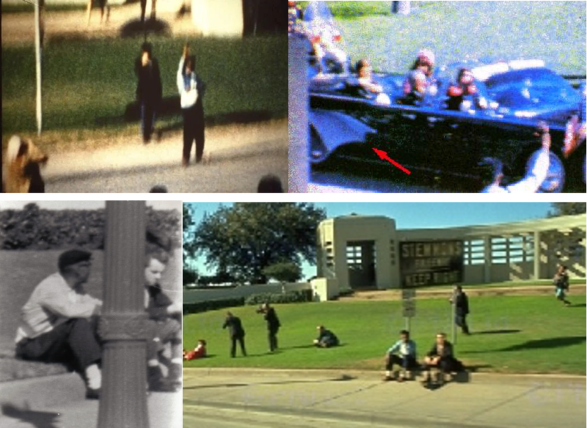
Were they cognizant Zionist agents? I don’t think so. Their sitting together after seeing JFK’s head blown before their eyes suggests that they were stunned and wondering what the hell they had been doing. I suppose they had been sent to do their “little heckling” without being told that it would spice up the killing. Who would be so crazy as to put himself in that position knowingly, standing almost in the line of the Grassy Knoll sniper? Perhaps they had been convinced to do it for money, or as a wager, or as a service to Witt’s Jewish boss at the Rio Grande National Life insurance Co where he worked.
Whatever the case may be, if there was still any doubt that Israel was the prime mover in the assassination of John Kennedy (the evidence is in my book The Unspoken Kennedy Truth), Umbrella Man and Nazi-Salute Man are the ultimate signature. But to see this, you need some spiritual insight into Jewishness and Kennedyness.
Jewishness is the evil soul of the U.S., best embodied today by the neocons (of whom Norman Podhoretz, editor-in-chief of Commentary for 35 years, is the founding father). Kennedyness was the good soul of America. Above anything else, the Kennedys stood for strong family values and service to country to the point of sacrifice. “Joseph P. Kennedy,” writes Laurence Leamer, “created one great thing in his life, and that was his family. . . . Joe taught that blood ruled and that they must trust each other and venture out into a dangerous world full of betrayals and uncertainty, always returning to the sanctuary of family.”[9] Joe also taught his children that they had to pay back to America what America had given them. The Kennedy family symbolized the America that Americans and the world loved.
This is why John F. Kennedy, Jr. was the “charismatic crown prince of America’s royal family,” as the New York Daily News wrote the day after his death.[10] He was Prince Hamlet haunted by the ghost of his murdered father, destined to avenge him and save the kingdom from the usurpers. The Kennedy tragedy is the most Shakespearian, the most paradigmatic, the most archetypal story in all American history. And America has not a worthy monument in their honor. So many Holocaust museums to honor the Jews’ dead, and not one chapel to pray for the Kennedys!
As a matter of fact, only Israel has a Kennedy memorial of any significance. It was explicitly designed to look like “the stump of a felled tree,” and it does. Do you get the idea? It symbolizes Israel’s plan for the Kennedy dynasty. You can trust Jews to choose their symbols carefully. And don’t imagine people can see any statue or even a single photo of Kennedy inside; it is as hollow as a dead stump. It is a memorial to erase the memory of Kennedy. It reminds me of the paradoxical command: “remember to erase Amalek’s memory” (Deuteronomy 25:19 and Exodus 17:14).

The Zionists’ hatred for the Kennedys runs deep, despite their histrionic “crocodile tears” after JFK’s death. When meeting the new president on May 30, 1961 in New York, Ben-Gurion could not help but see in him the son of a Hitler-appeaser. Abraham Feinberg (who arranged the meeting) recalls that “Ben-Gurion could be vicious, and he had such a hatred of the old man [Joe Kennedy].”[11] Ben-Gurion had no illusion about the fact that John was very much his father’s son. Had he not, in his 1956 Pulitzer-Prize-winning book Profiles in Courage, vindicated Senator Robert Taft for denouncing the Nuremberg Trials as a parody of justice, and the hanging of German officials as “a blot on the American record which we shall long regret”?[12] It certainly didn’t escape the Zionists that, on May 11, 1962, President Kennedy invited Charles Lindbergh and his wife at a grand reception at the White House, sitting them at the presidential table and hosting them overnight. Lindbergh had been the most prominent voice for the America First Committee in 1940, publicly accusing the Jews of pushing America into the war. Since then, he had been living in reclusion.
Moreover, Ben-Gurion believed that JFK was paving the way for a new Holocaust by preventing Israel from acquiring the indispensable nuclear deterrence against the Arabs. This is what Ben-Gurion meant when describing Nasser as a new Hitler and the Arabs as the new Nazis, in one of his last letters to Kennedy, May 12, 1963, in response to Kennedy’s demand for immediate inspections of Dimona: “Knowing them I am convinced that they are capable of following the Nazi example. … Mr. President, my people have a right to exist … and this existence is in danger.” Monika Wiesak has noted that, in that very letter, the father of the Jewish State made a cryptic digression about Jordanian King Hussein, writing: “there is always a danger that one single bullet might put an end to his life and regime.”[13]
Salvator Astucia has, I think, well captured the essence of the Kennedy problem for Israel:
The Israelis distrusted President Kennedy because of his father. It is widely known that Joseph Kennedy Sr. developed a strong loathing of Jews from his business dealings with them in finance, Hollywood, and politics. And the elder Kennedy had groomed four sons for the White House, but his oldest — Joe, Jr — had been killed in World War II. President Kennedy’s inauguration in January 1961 marked the beginning of a dynasty that would likely continue until 1985 (after the three surviving sons had each completed two terms). With this background information, it becomes clear that there was one primary motive for the assassination: to destroy the Kennedy Dynasty.[14]
Under a Kennedy presidency, there would be no Six-Day War, the Palestinian refugees would recover their land, AIPAC would be registered as a foreign agent, and the Holocaust would certainly not become a State cult enforced by ADL inquisition. And of course, Israel would never have become a nuclear State.
Destroying the Kennedy dynasty was probably a sacred oath taken by all B’nai B’rith top officials (Dallas was full of them). JFK Jr. was a marked man, if not from the moment he saluted his father’s coffin on his third birthday, at least from the moment it became clear that he had the ambition and the potential to reach the White House. Killing his political future was not enough, and probably not possible.
I wrote a long article in January 2019, titled “The Broken Presidential Destiny of JFK, Jr.”, reviewing the evidence that JFK Jr. was assassinated. I will now summarize it.
Evidence of assassination
It was Friday July 16, 1999, at 9:39 pm, when JFK Jr.’s voice was last heard by Martha’s Vineyard air traffic controller Buddy Wyatt, asking, in a calm voice, instruction for landing. (This was reported the next day by U.S. Coast Guard Petty Officer Todd Burgun in a live phone interview with anchor Susan Wornick of Boston WCVB-TV.)
About two minutes later, John’s plane suddenly plummeted into the ocean at the radar-recorded speed of 4,700 feet per minute. Victor Pribanic, an attorney from Pennsylvania who was fishing for striped bass that night and had noticed the aircraft flying toward the island, reported to the The Martha’s Vineyard Times (cited in the New York Daily News, July 21, 1999): “I heard an explosion over my right shoulder. It sounded like an explosion. There was no shock wave, but it was a large bang.”
Based on these facts, the only rational explanation is that the plane suffered a sudden structural damage by explosive, making it impossible to maintain in the air; blowing off a part of a wing or the tail would have been enough, and would have required only a very small device magnetically affixed to the plane.
These facts, however, were quickly removed from public awareness. Pribanic’s testimony never made it to the national news. And Kennedy’s 9:39 call to Martha’s Vineyard airport was quickly denied and erased from the narrative. Instead, on July 18, the Federal Aviation Administration (FAA) produced some “newly found” radar “evidence” which supposedly showed Kennedy’s flight exhibiting signs of difficulties and irregularities long before it disappeared from the radar.
The official narrative was a mix of two ingredients, bad weather and pilot recklessness, coated by a heavy layer of “the Kennedy curse”. Not a word of the possibility of foul play.
When the National Transportation Safety Board (NTSB) concluded its investigation eleven months later, it issued a news release that attributed the plane crash to “the pilot’s failure to maintain control of the airplane during a descent over water at night, which was a result of spatial disorientation. Factors in the accident were haze and the dark night.” That is all the corporate news retained. However, a close reading of the full report reveals many unanswered questions and even contradictions with its conclusion. For example, the NTSB final report quotes Martha’s Vineyard air traffic controller Buddy Wyatt as stating that the visibility was good: “I remember aircraft on visual approaches saying they had the airport in sight between 10 and 12 miles out. I do recall being able to see those aircraft and I do remember seeing the stars out that night.”
Also, the sudden drop of altitude from 2,200 feet to 1,100 feet in 14 seconds, stated in the full report, is hard to reconcile with the news release statement. Disorientation implies that the pilot was not aware that he was flying straight into the ocean. But that is impossible, as the NTSB Investigator-in-Charge, Robert Pearce, had admitted as early as July 20, 1999: “They were aware they were going down. With that kind of descent rate, it is going to be noisier than hell in the cockpit.”
In contrast to what the news media kept hammering, the NTSB report reckoned that JFK Jr. had a flight experience of “about 310 hours, of which 55 hours were at night.” During the last fifteen months, he had made 35 flights between Fairfield airport, N.J., and Martha’s Vineyard, including five at night. Three certified flight instructors (CFI) quoted in the report describe John as an “excellent”, “methodical” and “very cautious” pilot.
No matter how we twist or downplay all other data, the very conditions of the plane’s sudden dive, which is an undisputed fact, should raise a strong suspicion of a major and sudden mechanical failure. As Anthony Hilder put it:
A finely-tuned, well-kept first-class airplane doesn’t just drop out of the sky and head straight down into the ocean unless it’s blown out of the sky or the pilot deliberately sends it into a dive to kill himself and his passengers.
Evidence of cover-up
Some testimonies used in support of the theory of JFK Jr.’s incompetence and recklessness are highly suspicious. A case in point is Kyle Bailey, “the last man to see Kennedy alive at the Fairfield airport,” who claimed to have had bad a premonition on seeing him take off: “I told my family, ‘I can’t believe he’s going up in this weather’,” he said on July 18. Bailey went on becoming an aviation analyst specialized in plane crashes, and regularly working for major network such as Fox News, CBS, ABC, NBC, and BBC. Bailey appeared in the documentary Curse on the Kennedys? and then in the ABC documentary The Last Days of JFK Jr., aired in January 2019, in which he repeated his story. Kyle Bailey is to JFK Jr.’s death what Mark Walsh is to 9/11.
The search for the plane and the bodies was entirely controlled by the military, although JFK Jr. had never been in the army. A 17-nautical mile no-fly zone and no-entry zone was established around the crash site. No civilians or media crew were allowed in this area. On July 20, 1999, as we read in the NTSB report, “the airplane wreckage was located by U.S. Navy divers from the recovery ship, USS Grasp.” Why was the Navy, rather than civilian rescue craft, tasked with the retrieval of JFK Jr.’s crashed airplane? More disturbing still, why did the Pentagon take exclusive control of news reporting from July 18?
There are issues also with the botched autopsies, as Joanna Weiss and Matthew Brelis of the Boston Globe wrote on July 23, 1999 in an article titled “JFK Autopsy Rushed.”
But the most suspicious thing of all is the way the bodies were disposed of: they were cremated, then their ashes were taken aboard a Navy destroyer, and scattered into the sea, near the place where they had met their death. “The burial for the 35th president’s son was reportedly carried out in keeping with his expressed wishes,” noted journalist Paula Maxwell. What? At age 39, JFK Jr. had expressed his will not to be buried with his father and mother at Arlington cemetery and instead to be cremated and his ashes spread above the ocean? Who can believe such a thing? The Boston Globe reported on July 22 , “Kennedy’s family requested a burial at sea, and the Pentagon granted that request.” But, the next day, the same newspaper expressed surprise:
The cremated remains of John F. Kennedy Jr., his wife, and her sister were cast from a warship to the ocean currents in a manner not favored by the Catholic Church and in a ceremony that occurred only after the intercession of Pentagon brass. The Roman Catholic Church prefers the presence of a body at its funeral rites. And the Defense Department rarely accords the honor of burial at sea to civilians.
No other Kennedy had ever been cremated. The reasons given for cremating JFK Jr. body do not make any sense and are contradictory. The New York Times wrote:
“Kennedy family members, citing his wishes and hoping to avoid having a spectacle made of Mr. Kennedy’s final resting place, have decided to have his body cremated and his ashes scattered at sea in a Navy ceremony, a family adviser said.”
That is utterly unbelievable. The bodies must have been cremated and scattered for another reason: to prevent any possibility of ever finding traces of explosives in the bodies.
But the idea of wanting to deprive JFK Jr. of a final resting place that could possibly encourage a popular Kennedy cult has also a strong biblical and B’nai B’rith smell. Who, among “Kennedy family members”, could possibly have wanted this? It happens that, according to information found in RFK Jr.’s diary, published by the New York Post, Ann Freeman, Carolyn and Lauren Bessette’s mother, “began asking that her two daughters be buried near her home in Greenwich, Connecticut.” It was Edwin Schlossberg, Caroline Kennedy’s Jewish husband, who convinced her to have her two daughters cremated and their ashes spread in the ocean. “He bullied, bullied, bullied the shattered grieving mother,” writes RFK Jr.
The heir and the Avenger
JFK Jr. had grown up with a sense of destiny. According to biographer Christopher Andersen (The Good Son): “Jackie made sure that John was constantly exposed to the people who knew John [President Kennedy] best.” In her last letter to her son before dying to lymphoma in 1994, she wrote: “You, especially, have a place in history.” John told Lloyd Howard in 1997: “She expected me to follow in my father’s footsteps, and of course I will. But I don’t think the time is right just yet.” Just like his father before him, John Jr. first pursued a career in journalism: in 1995, he founded the magazine George, which engaged in controversial issues of deep politics. His longtime friend Robert Littell wrote, in The Men We Became: My Friendship with John F. Kennedy Jr. (St. Martin’s Press, 2004): “George was also an opportunity for John to build a platform from which he might possibly move into political life.” George was also a means for John to interact with political actors and thinkers.
Brought up in the worship of his father, John had taken a keen interest in “conspiracy theories” about his death at least since his late teens. His knowledge deepened in his thirties, and motivated him to publish in a special “conspiracy issue” of his magazine George, eight months before his death, a cover article by Oliver Stone, director of the groundbreaking film JFK, titled “Our Counterfeit History”.
At age 39, John had made up his mind to launch his political career by seeking an electoral mandate in New York State, and he was about to announce it publicly. According to his friend Billy Noonan (Forever Young: My Friendship with John F. Kennedy, Jr., Viking Press, 2006), he was about to enter the race for the New York Senate seat left vacant by Daniel Patrick Moynihan, which Hillary Clinton also coveted (and ultimately got). John was a New Yorker, and Clinton would have stood no chance against him.
JFK Jr. had also voiced privately his ambition to ultimately reach for the presidency. Given his personality and his popularity, he had high chances to make it in less than 20 years. Pierre Salinger, one of the men Jackie had asked to educate John about his father, had become very close to him, and declared on French radio Europe 1, on July 19, 1999: “I felt that in the coming year John Junior would also become a politician. It’s my point of view. And with other people, we thought he was going to be a Democratic candidate for the next presidential election.” Others, such as John’s assistant at George, RoseMarie Terenzio, thought “he would’ve run for president … in 2008.”
In 1968, John Kennedy’s brother ran for President with the intention, not just to save the Kennedy legacy, but to reopen the investigation on his brother’s death (as David Talbot has demonstrated in his book Brothers). He was assassinated. In 1999, Robert Kennedy’s nephew was about to announce his entry into politics, with the clear intention to go all the way to the White House. There is no question that one of his goals in life was to expose the murderers of his father. His old high school girlfriend Meg Azzoni, in her self-published book, 11 Letters and a Poem (2007), writes that as a teenager, “his heartfelt quest was to expose and bring to trial who killed his father, and covered it up.”
I rephrase my conclusion from my longer 2019 article:
So, was JFK Jr. himself assassinated? Here is man whose road to the presidency seemed traced. No other man of his age had better chances to reach the White House one day. And no other man in the world had more reasons to want the 1963 Kennedy assassination reinvestigated. He was already trying to educate the public through his magazine, at the risk of exposing his own beliefs, something no other Kennedy had ever done (even RFK had kept his doubt on the Warren report private, and his plan to reopen the case secret). And this man, his friend Billy Noonan believes, was just about to announce his candidacy for a New York Senate seat, which everyone would have understood as the first step toward the White House. Pierre Salinger and others even believe he would have run for president in 2000. What are the odds that he would die at this precise moment by accident? … If it was an accident, then the Devil caused it. Or was it Yahweh?
One more thing: JFK Jr. died two years before 9/11. Who knows what influence he would have had on the American public, either as a senator or as the editor of a magazine with a strong interest in conspiracies? He may very well have stood in the way of the War on Terror, the WWIV that Norman Podhoretz was calling for. You never know, with those Kennedy peacemakers!
Israel believes in preemptive assassinations, as demonstrated by Ronen Bergman in Rise and Kill First: The Secret History of Israel’s Targeted Assassinations.
Israel killed JFK Jr.
A curse on Israel!

Notes

[1] Arthur Krock, Memoirs: Sixty Years on the Firing Line, Funk & Wagnalls, 1968, p. 328.
[2] Michael R. Beschloss, Kennedy and Roosevelt: The Uneasy Alliance, Open Road, 1979, p.187.
[3] John Hughes-Wilson, JFK: an American coup d’état, John Blake, 2013, pp. 88-89.
[4] Seymour Hersh, The Samson Option: Israel’s Nuclear Arsenal and American Foreign Policy, Random House, 1991 , p. 96.
[5] Robert Caro, The Years of Lyndon Johnson, vol. IV: The Passage of Power, Alfred Knopf, 2012, p. 104. Also in Krock, Memoirs, op. cit., p. 362.
[6] Seymour Hersh, The Dark Side of Camelot, Little, Brown & CO, 1997, p. 129.
[7] Andrei Gromyko, Memoirs, Doubleday, 1989, pp. 181-182.
[8] Edward Klein, The Kennedy Curse: Why Tragedy Has Haunted America’s First Family for 150 Years, Saint Martin’s Press, 2004.
[9] Laurence Leamer, Sons of Camelot: The Fate of an American Dynasty, HarperCollins, 2005, kindle l. 262-267.
[10] Dave Saltonstall, Austin Fenner, Helen Kennedy and Greg B. Smith, “John F. Kennedy Jr. went missing after taking a flight with his wife and her sister in 1999,” New York Daily News, July 18, 1999, on nydailynews.com
[11] Hersh, The Samson Option, op. cit., p. 103.
[12] Robert Taft, October 6, 1946, quoted in John F. Kennedy, Profiles in Courage, 1956, Harper Perennial, 2003 , p. 199.
[13] Monika Wiesak, America’s Last President, 2022, p. 214.
[14] Salvador Astucia, Opium Lords: Israel, the Golden Triangle, and the Kennedy Assassination, 2002, p. 5, on www.whale.to/b/astucia.pdf.
Supporting Israel Is Big Business in the United States
Government and elite institutions work together to protect and empower the Jewish state
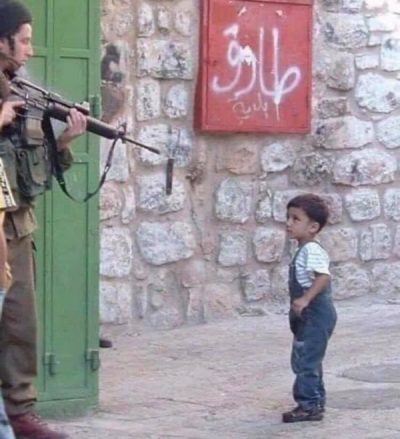
BY PHILIP GIRALDI • UNZ REVIEW • JULY 12, 2024
In a recent article discussing how US Treasury Department tax breaks are exploited by groups that raise money in America in support of the Israeli so-called Defense Forces (IDF), I concluded that it does not require any particular brilliance on the part of even a casual observer to realize that both politically and economically Israel and Israelis are not treated like everyone else by governments at various levels in the United States, quite the contrary in many cases. Nevertheless, some key questions must be asked even at risk of being repetitive about Israel’s clearly privileged status. One must consider how is it possible that organizations that are committed to financially supporting war crimes and even genocide by a foreign nation are allowed to have tax breaks that enable them to collect more money which in turn helps them to corrupt the system that feeds them while also empowering those foreign militaries? How is it possible that the foreign army carrying out the war crimes is also allowed to benefit directly from the US laws that have created exemption from taxation? In short, is there no sense of responsibility and/or consequences on the part of American government when it comes to the behavior of the pariah apartheid Jewish state?
In the event, comments and insights from some readers both on my posting and privately in emails and on Facebook have convinced me that I have greatly understated the case. Those who argue, perhaps somewhat in jest, the Congress is the Knesset West and that both Donald Trump and Joe Biden are in fact Israeli puppets are very close to being on the mark, making Israel and its all-powerful billionaire funded lobby indisputably in control of many key aspects of American government beyond the obviously targeted foreign policy. Combine that with control over the media and entertainment industries that shape the Israeli preferred narrative at all times, and you have a situation where when Prime Minister Benjamin Netanyahu says “jump” 95% of Congress and everyone in the White House begin hopping. We will no doubt see that in play when the monstrous Netanyahu arrives in Washington to address a joint session of Congress on July 24th. The performing monkeys who will appear on television leaping up and down while cheering Bibi will definitely be something to see, though one hopes that at the same time there will also be a million demonstrators surrounding Capitol Hill calling for the head of the world’s leading war criminal.
One thing that should be completely clear is that the United States gets absolutely nothing out of the relationship with Israel, which all flows in only one direction to the tune of what probably amounts to more than a billion dollars a month if all the extras and the inevitable fraud are taken into account. And that does not even include special donations like the $14 billion recently granted by Congress and President Joe Biden to fund Israel’s never-ending war of extermination against the Palestinians. In my recent piece, I took particular aim at 501(c)(3) non-profits set up in New York City and in Massachusetts which exist to provide funds to the Israeli army. Friends of the Israel Defense Forces (FIDF), based in New York but with twenty branches in the US, boasts on its website that it has provided tens of millions of dollars to the Israeli military. The money contributed is federal income tax exempt and most of the donors are able to write the contributions off on their own federal taxes as an inducement to give. Such non-profits are generally granted that special status through demonstrating that they are religious, charitable or educational. Sending money to the Israeli army satisfies none of those requirements.
Not only does Israel take advantage of a tax break on money coming from groups that are ostensibly US-based, one of my correspondents advised me that the corruption goes far deeper than that, consisting of the fact that 501(c)(3) organizations must be registered through what is referred to as a “domicile.” Most are in the United States but domiciles in Canada and Mexico are also accepted given the economic realities of the North American market. Only one other country has an acceptable domicile and that is, of course, and, inevitably, Israel. In other words, an allowable exemption and the related deductible contribution for US tax purposes, might uniquely consist of US taxpayer money that goes to a charity registered in Israel. As Israeli charities have no reporting requirements vis-à-vis the US Treasury and no mechanism exists to validate their function and activity, they only answer to the government of the state of Israel.
And of course the pandering to Israel includes much more in the way of manipulating the political process to provide benefits to the Jewish state. It has long been a cliché in Washington that any long bill like defense appropriations that passes through the Congress will inevitably have some goodies for Israel inserted in it. Recent and current legislation reflects the perceived need by Congressmen to show the flag, which would be the Star of David rather than the Stars and Stripes, given the Israeli engagement in the military extermination of Palestinians that has no sign of ending as it is entering into its tenth month. The United States is not only funding and arming the Israelis, it is also providing political cover by vetoing nearly every United Nations proposal that would have led to a cease fire accompanied by some kind of exchange of hostages and prisoners. Along the way, no excess by Israel is considered to be too outrageous to require an objection coming from Congress and/or the White House, including Israel’s National Security Minister Itamar Ben-Gvir’s proposal that he would relieve the overcrowding in the prisons with Palestinians who are being held without charges by taking them out and killing them, one pistol shot to the head each. Former defense minister Avigdor Liberman has gone one step farther, calling on his country to use its nuclear weapons to obliterate Iran, presumably with full US approval. Israel has also been charged with killing journalists, humanitarian workers, medical workers including doctors, and torturing and starving Palestinian prisoners, but hey, that all constitutes minor stuff when one is best friends with the “Chosen” in Israel.
And there is much more. The International Criminal Court ruling that Israel’s Prime Minister and Defense Minister should be on the receiving end of arrest warrants over war crimes and possible genocide in Gaza was responded to by US Congress with a letter threatening the jurors and their families if the court were to proceed. The US also cut off all funding and even cooperation with the United Nations’ UNWRA which, Israel has declared to be a terrorist organization, but which has been the major source of what food and medicine was actually getting through to Gaza in spite of Israeli efforts to block it. Congress also has moved to ignore any reports coming from the remaining Gazan authorities revealing the casualties resulting from the Israeli bombing and other killing, as if hiding the death toll will make it go away. The respected British medical journal The Lancet is now reporting that as many as 186,000 Gazans might be dead, mostly among the rubble of their homes, uncounted because the Gazan officials who would have performed that task are dead and whole families are wiped out so no one is reported missing. It is a far larger number than the ca. 37,000 that keeps appearing in the western media in an attempt to mitigate what Israel is up to.
And there is also the really petty stuff that surfaces regularly from the pro-Israel message control network. Three Columbia University senior officials have been removed from their positions because of comments and private emails they have written deriding the claims of “surging” antisemitism at colleges. Among the “evidence” was an intercepted message suggesting that a panelist could have used recent campus protests as a fundraising opportunity and another that appeared critical of a campus rabbi’s essay about antisemitism. The university will also launch a “vigorous” antisemitism and antidiscrimination training program.” Meanwhile a leading New York law firm Sullivan & Cromwell, headed by an Orthodox Jew, is setting up an index that will identify law students who have been demonstrating against Israel, creating a “do not hire” list of the names so they will not be offered employment after graduation. “The firm is scrutinizing students’ behavior with the help of a background check company, looking at their involvement with pro-Palestinian student groups, scouring social media and reviewing news reports and footage from protests. It is looking for explicit instances of antisemitism as well as statements and slogans it has deemed to be ‘triggering’ to Jews.” And then there is Donald Trump using the word “Palestinian” as a slur in his debate with Joe Biden and efforts by politicians like Governor Ron DeSantis to reject the arrival of any refugee Palestinians as immigrants to Florida as they are all “terrorists.” You know, little stuff like that and the efforts at criminalization of free speech if it comes to criticizing either Israeli or Jewish group behavior. You know, minor stuff. Pretty soon we Americans will all be terrorized into dancing to the same tune that Congress and the White House dance to. Then it will be too late.
Philip M. Giraldi, Ph.D., is Executive Director of the Council for the National Interest, a 501(c)3 tax deductible educational foundation (Federal ID Number #52-1739023) that seeks a more interests-based U.S. foreign policy in the Middle East. Website is councilforthenationalinterest.org, address is P.O. Box 2157, Purcellville VA 20134 and its email is inform@cnionline.org.
Dozens killed as Israel strikes Al-Mawasi ‘safe zone’ in Gaza
The Cradle | July 13, 2024
Israeli forces killed at least 71 civilians and injured 289 more in a series of massive airstrikes on the Al-Mawasi region on the southern Gaza coast, Al Jazeera reported on 13 July.
An official at Nasser Hospital in Khan Younis told Al Jazeera that more than 20 bodies and dozens of wounded people have been brought to the hospital.
He said civil defense teams continue to recover from the rubble, but the hospital cannot receive any more wounded patients.
An eyewitness told the BBC that the strike site looked like an “earthquake” had hit. The British state broadcaster reported that “videos from the area show smoldering wreckage and bloodied casualties being loaded onto stretchers. People can be seen trying desperately to pick through the rubble of a large crater with their hands.”
Abu Zuhri, a senior Hamas official, denied a claim by Israeli Army Radio that the strikes targeted the head of Hamas’ armed wing, Mohammed al-Deif.
“All the martyrs are civilians and what happened was a grave escalation of the war of genocide, backed by the American support and world silence,” Abu Zuhri said.
Zuhri also said that the attack showed Israel was not interested in reaching a ceasefire agreement.
Al-Mawasi, a Bedouin town west of Khan Younis, is filled with hundreds of thousands of displaced Palestinians living in tents.
Israel designated the area a “safe zone” shortly after the war began in October and demanded Palestinians flee there to escape massive Israeli bombardments and ground assaults throughout the strip. A new wave of displaced families fled to the area after the start of Israel’s offensive in nearby Rafah in early May.
But Israel has bombed Al-Mawasi multiple times.
In late June, Israeli forces killed 22 Palestinians when they shelled the office of the International Committee of the Red Cross (ICRC) in Al-Mawasi. The ICRC office was surrounded by hundreds of displaced Palestinians living in tents.
Witnesses told AP that some people were killed as they went to help others who panicked after an initial bombardment.
Israel has killed over 38,000 Palestinians, the majority women and children, since the beginning of the war in October.
Thousands more are feared dead, trapped under the rubble and in streets inaccessible to rescue and ambulance crews.
UNRWA: UNRWA staff tortured in Israeli jails
Palestinian Information Center – July 12, 2024
GAZA – The United Nations Relief and Works Agency for Palestine Refugees (UNRWA) said on Friday that its staff who were detained by Israeli forces were subjected to “ill-treatment and torture.”
This came in a press conference held by the Agency’s Commissioner-General, Philippe Lazzarini, during a pledging conference at the United Nations headquarters in New York.
Today, UNRWA is staggering under the weight of relentless attack, Lazzarini said.
“In Gaza, it has paid a terrible price, 195 of our colleagues were killed and nearly 190 installations were damaged or destroyed, killing over 500 people seeking United Nations protection.”
It comes at a critical time as UNRWA undergoes unprecedented attacks and systematic attempts to dismantle it, he added.
“It is a tribute to our staff working across the region, including on the humanitarian front lines in Gaza.”
“We are committed to continuing to deliver assistance and basic services, including education to Palestinian boys and girls.”
Antonio Guterres, the UN secretary-general, also spoke at the UNWRA pledging conference at the UN headquarters in New York.
Guterres appealed to everyone to protect UNRWA and its employees, saying that “there is no alternative to it.”
Iran’s Pezeshkian discusses foreign policy, principles in first op-ed
Al Mayadeen | July 13, 2024
Iran’s newly-elected president stated that his administration is dedicated to maintaining Iran’s national dignity and global standing “under all circumstances.” Additionally, it will advocate for creating a “strong region” instead of one dominated by a single country’s pursuit of hegemony and dominance.
In an op-ed published by the Tehran Times, President Masoud Pezeshkian outlined his government’s outlook and policy, emphasizing it will focus on opportunities to maintain balanced relations with all nations in line with Iran’s economic and national interests, in addition to the needs of regional and global peace and security, saying he “will welcome sincere efforts to alleviate tensions and will reciprocate good-faith with good-faith.”
Moreover, he emphasized his opposition to neighboring countries depleting their resources through engaging in unnecessary competition, arms races, or “containment” efforts against each other. “Instead, we will aim to create an environment where our resources can be devoted to the progress and development of the region for the benefit of all.”
Pezeshkian mentioned that, following the victory of the Islamic Revolution in 1979, Iran “severed ties with two apartheid regimes, Israel and South Africa,” a decision “motivated by respect for international law and fundamental human rights.”
While “Israel” remains an “apartheid” regime to this day, Pezeshkian said it added genocide to “a record already marred by occupation, war crimes, ethnic cleansing, settlement-building, nuclear weapons possession, illegal annexation, and aggression against its neighbors.”
Don’t reward ‘Israel’ through normalization
The Iranian president-elect further said that “as a first measure” in strengthening ties with neighboring states, his government will “urge” Arab countries to collaborate diplomatically for a permanent ceasefire in Gaza to halt the ongoing massacre and prevent an expanded escalation.
“By leveraging our normative influence, we can play a crucial role in the emerging post-polar global order by promoting peace, creating a calm environment conducive to sustainable development, fostering dialogue, and dispelling Islamophobia. Iran is prepared to play its fair share in this regard.”
He underlined that all members of the 1948 Genocide Convention are obligated to take action to prevent genocide, “not to reward it through normalization of relations with the perpetrators.”
“We must then diligently work to end the prolonged occupation that has devastated the lives of four generations of Palestinians,” he continued.
Pezeshkian continued that he “looks forward” to collaborating with “Turkey, Saudi Arabia, Oman, Iraq, Bahrain, Qatar, Kuwait, the United Arab Emirates,” in addition to regional organizations, to deepen economic and trade relations. He added that coordination would also be focused on “tackling common challenges” and working on creating “a regional framework for dialogue, confidence building and development.”
Allegations of antisemitism an insult to Iran’s culture
“Cooperation for regional development and prosperity will be the guiding principle of our foreign policy,” he said, adding that, “as nations endowed with abundant resources and shared traditions rooted in peaceful Islamic teachings, we must unite and rely on the power of logic rather than the logic of power.”
Elsewhere in his piece, he pointed out the increased awareness among Western youth of “the validity” of Iran’s “decades-long” position on the Israeli occupation entity.
Addressing this “brave generation,” Pezeshkian said that the Islamic Republic considers allegations against it of “antisemitism” due to its “principled stance” on the Palestinian case are “false” and an “insult to our culture, beliefs and core values.”
Pro-Israel Group Censoring Social Media Led by Former Israeli Intelligence Officers
By Lee Fang and Jack Poulson | July 11, 2024
CyberWell, an Israeli nonprofit with deep ties to the intelligence arm of an Israeli government propaganda effort, has been influential in shaping social media content since October 7. The group, which purports to be independent, has lobbied Meta, X, and TikTok to remove social media posts under the banner of fighting hate and antisemitism.
The group claimed a major victory regarding Meta’s decision on Tuesday to expand its definition of antisemitic hate speech to include many criticisms of “Zionists” – those who call for an independent state in the Middle East that privileges Jews over other ethnic groups. “CyberWell intends to leverage its technological tools and analysis efforts to ensure this policy is implemented efficiently and fully, and that Meta’s moderation tools are trained to effectively bar this content,” the organization claimed in a press release.
The success is the latest string of victories to shape permissible speech when it comes to Israel and its actions.
In January, CyberWell reported that it had pushed to censor accounts that disputed the false allegation that Hamas had slaughtered dozens of babies during the October 7th attack. Any accounts disputing claims around babies killed during the attack, CyberWell argued, are akin to “content denying or distorting the Holocaust.” President Joe Biden and leading Israeli figures have falsely claimed that Hamas beheaded or burned forty babies during the assault into Israel.
That claim has been widely debunked. Despite repeated false assertions to the contrary, only one baby was killed during the Hamas assault: a 10-month-old infant named Mila Cohen, who was killed at Kibbutz Be’eri. In more recent months, CyberWell has lobbied TikTok and Meta to censor social media posts with the phrase “From the river to the sea, Palestine will be free,” claiming that the slogan constitutes hate speech.
CyberWell is one of many agenda-driven nonprofits now censoring social media discourse, including benign or true information, under the cover of fighting hate and misinformation. The pharmaceutical industry, for instance, funded a nonprofit that worked to censor tweets critical of pandemic-related policies. The U.S. government funds several think tanks that work to moderate social media content critical of NATO’s policies impacting Ukraine.
We briefly mentioned the organization in our recent exclusive on the rebirth of an Israeli government influence effort to counter critics in the United States. After ignoring our detailed request for comment by email, CyberWell recently contacted The Guardian, our publishing partner, and falsely claimed that we never contacted the group for comment.
CyberWell has not received “government funding whatsoever from any country,” wrote Stan Steinreich of Steinreich Communications in a statement to The Guardian, which included a request for a correction. “CyberWell’s leadership is neither affiliated with nor compensated by Voices for Israel,” he continued, in reference to the joint venture created by Israel’s Ministry of Strategic Affairs roughly eight years ago under the name Kela Shlomo before renaming to Concert in 2018 and adopting its current name in 2022. In response to Hamas’s October 7 attack, the organization formally rebooted to focus on winning the online war of narratives surrounding Israel’s ongoing invasion of Gaza, which has so far killed roughly 13,000 women and children.
But CyberWell’s attempts to portray itself as independent obscures its deep ties to Israeli intelligence officials and the government-backed influence operation we wrote about.
CyberWell, as we originally reported, maintains close ties to the Israeli government ministries involved in covert advocacy in the U.S. and to the Voices for Israel group now at the center of a sprawling influence campaign. Since reaching out for comment for our investigation, CyberWell has scrubbed the biographies of its executives and advisors, such as former Israeli military intelligence chief Amos Yadlin and a current spokesperson for the Israeli Defense Forces.
When CyberWell was reached for comment regarding why the biographies of its staff and advisors were removed, they stated: “Highlighting the danger of generating false and misleading information, we were forced to remove the ‘Our Team’ page for safety reasons. Following the publication of your story, our analysts were attacked and identified by name on X. Users shared your article and our employees’ names with a wider network and we became concerned for our staff’s safety.”
Despite CyberWell’s denial of ties to Voices of Israel, the organization’s 2022 annual report listed its Chief Financial Officer as Sagi Balasha, the first CEO of the organization now known as Voices of Israel. The list of CyberWell advisors in the report also included Israel Defense Forces spokesperson Lt. Col. Peter Lerner, who Israeli corporate records reveal to be a director of the research and intelligence arm of Voices, known as Keshet David, which is Hebrew for “David’s Rainbow.” Keshet David was initially headed by Yossi Kuperwasser, the former head of research in the IDF Military Intelligence Directorate, widely known as Aman, and an ex-director general of the Ministry of Strategic Affairs. Another advisor to CyberWell, Amos Yadlin, previously led Aman.
“Proud to support @CyberWell_org,” Mr. Lerner posted on X on Wednesday, in response to CyberWell’s celebration of Meta’s new policy on criticisms of Zionism.
Voices of Israel chairman Micah Avni explained the history of Keshet’s aliases in a December 2018 interview, including the previous name of Israel Cyber Shield and the official English name Innovative Collaboration Strategies. “Concert [Voices of Israel] funds Keshet David and we get all the information. That’s one leg of what we’re doing,” said Avni. But, unlike Voices, Keshet David Research and Information Ltd., its legal Israeli entity, maintains no directly attributed public website.
Peter Lerner, an Israeli Defense Forces spokesperson and advisor to CyberWell, as well as former head of international relations at the Israeli labor federation Histadrut, is listed as both a shareholder and director of Keshet David. (As reported by Calcalist, the Histadrut was apparently a customer of the online campaigning firm STOIC, which Haaretz reported to have beat out Voices of Israel for a contract with Israel’s Ministry of Diaspora Affairs to covertly influence U.S. lawmakers.)
Formed in 2021 under the name Global Antisemitism Research Center (Global ARC), CyberWell shared a $30,000 donation that year with Keshet David through a foundation run by the wife of CyberWell board member Adam Milstein, who co-founded the influential Israeli-American Council (IAC) in 2007 under the direction of Israel’s then-consul general in Los Angeles, Ehud Danoch, before pleading guilty to two felony counts of tax evasion. Keshet David received an earlier donation through IAC in 2016 under its previous name of Israel Cyber Shield, just as future CyberWell CFO Sagi Balasha transitioned from chief executive of IAC to chief executive of Voices.

The chief executive of Keshet David since 2018, former Israeli police officer Eran Vasker, disclosed on his LinkedIn profile that he has simultaneously led the private intelligence firm Argyle Consulting Group since April 2017. The head of CyberWell, Tal-Or Cohen Montemayor, similarly noted in a January podcast interview and on LinkedIn that her immediate previous job was working at Argyle as head of business development circa January to October 2021, the same year as the joint donation to Keshet David and CyberWell. Tal-Or’s manager at the time was Argyle Chief Operating Officer Zohar Gorgel, who became a founding board member of CyberWell. Gorgel co-founded a solar power company in early 2021 with Arik Becker, a member of CyberWell’s audit committee who was, according to Becker’s LinkedIn profile, head of strategic operations at Argyle circa 2018 to 2020.
In other words, the chief executive of CyberWell and two of its board members previously worked at the same private intelligence spin-off from Voices of Israel, a director of the spin-off is an advisor to CyberWell, and the CEO of Voices became the CFO of CyberWell.
Israeli corporate records further show that CyberWell shares the same accountant as Keshet David and Voices of Israel, Yakov Pal (פאל יעקב) of Yakov Pal & Co. Certified Public Accountants. (CyberWell and Voices have also shared the same fiscal sponsor, Central Fund of Israel, which reportedly donated $700,000 to Voices in 2017.)

Letterhead of Yakov Pal CPA from the 2017 financial statements of Voices of Israel, then known as Kela Shlomo, as revealed by the Israeli independent investigative site The Seventh Eye.
A recently-deleted page on CyberWell’s website noted that it was founded as a result of Tal-Or’s time working in private intelligence at an unnamed firm (Argyle), as a result of “her then-manager and IDF intelligence veteran, Zohar Gorgel, [suggesting] that Tal-Or use her open-source expertise and deep understanding of social media” to combat online antisemitism.
Tal-Or’s biography in her podcast interview also noted that she had “provided analysis” to Israel’s Ministry of Strategic Affairs, the agency that founded Voices of Israel. CyberWell’s 2022 annual report further disclosed that the nonprofit partnered with Act-IL, a failed online propaganda effort partly run by IAC and closely affiliated with the Ministry of Strategic Affairs, noting that “CyberWell served as the data provider to Act-IL’s community for their end of year call to action on the state of online antisemitism.”
According to 2018 reporting from the Israeli newspaper Haaretz, Israel Cyber Shield (Keshet David) surveilled the prominent Palestinian-American activist Linda Sarsour as part of compiling a dossier for Act-IL.
CyberWell CEO Tal-Or Cohen and founding board member Zohar Gorgel did not respond to repeated questions regarding their previous positions at the private intelligence firm Argyle Consulting Group or on Argyle’s relationship to Keshet David. Instead, CyberWell blocked one of our accounts on X.
Argyle and Keshet David CEO Eran Vasker similarly did not respond to a request for comment through Argyle. Neither CyberWell nor Adam Milstein and his wife, Gila, responded to requests for comment on MERONA Leadership Foundation’s receipt of a joint donation for Keshet David and CyberWell.
***
CyberWell’s primary focus has been to pressure social media companies to adopt the International Holocaust Remembrance Alliance (IHRA) redefinition of antisemitism, which has been described by one of its core contributors as designed to combat growing international human rights criticisms of Israel as an apartheid state, beginning with the United Nations’ 2001 Durban declaration. In reference to the now-defunct advocacy organization known as the Adopt IHRA Coalition, CyberWell’s 2022 annual report noted that “On the heels of Elon Musk’s acquisition of Twitter,” CyberWell “served as the [Adopt IHRA Coalition] data provider, demonstrating our value through collecting, vetting, and leveraging a dataset of over 1,200 recent antisemitic Tweets.”
The IHRA definition has come under fire as an attempt to criminalize and suppress First Amendment-protected speech critical of Israel and its occupation of Palestine. Pro-Israel lobbyists have pushed to encode the IHRA definition into hate crime statutes and official speech codes for hundreds of institutions and have succeeded in advancing legislation on the state and federal level. The IHRA definition of antisemitism includes “denying the Jewish people their right to self-determination, e.g., by claiming that the existence of a State of Israel is a racist endeavor.” If enacted, such a definition would mean that an American can call any government, including his own, racist, except for Israel.
CyberWell’s high-level influence on social media policy arose during a meeting of the Israeli legislature’s immigration committee on June 21 of last year, which included representatives of Facebook, TikTok, and Twitter.
Matthew Krieger, a representative of Twitter and Elon Musk at the hearing, bluntly refused to answer questions from the committee chairman about a report from the Israeli advocacy organization Fighting Online Antisemitism (FOA), which accused Twitter of only removing 14% of antisemitic content, in contrast to TikTok allegedly removing 100%. Immediately after, Facebook policy manager Yehuda Ben Yaakov noted his relationship with FOA, CyberWell, and Tal Or-Cohen, stating: “The activity of non-profit organizations in this context is important and non-profit organizations like FOA and CyberWell, just last week Tal-Or [Cohen] and I met and had the ability to exchange things.” “Tal-Or told us about a new way of linking the theory of Freemasons and the theory of anti-Semitism,” Ben Yaakov added.
During the same hearing, Ella Saban, an official in Israel’s Ministry of Aliyah and Absorption, noted that “We work with ADL [Anti-Defamation League], we work with civil society organizations, CyberWell and [FOA] are based here, we also have a good relationship with the social networks in Israel.”

Images from a pair of posts on X on June 17 and on June 25 by CyberWell.
“VICTORY: TikTok is the first social media platform to publicly recognize denial of sexual violence on October 7 as prohibited content,” CyberWell boasted on June 17 through a post on X, which further implied that the decision was a result of CyberWell’s status as a trusted partner of TikTok.
A subsequent post claimed that: “Thanks to CyberWell’s data, TikTok is leading the way in recognizing and actioning this new form of antisemitism, and we urge all other social media platforms to follow suit.”
The image coupled with the post praising TikTok accused X user @HadiNasrallah of “Encouraging Violence” and “Denying that well-documented violent events took place” for claiming that “Hamas did not rape anyone on October 7th and Israel killed their own people with tanks and helicopter shelling.”
The degree to which Hamas committed sexual violence during its attack, and the scale of Israeli usage of the so-called Hannibal Directive preference of killing its own troops and citizens rather than let them be taken hostage, are perhaps the central narrative battles surrounding October 7.
More than 50 tenured journalism professors signed a letter in April asking The New York Times to investigate the reporting process behind its flagship publication on alleged sexual violence on October 7, “Screams Without Words,” and the Associated Press argued the next month that two “debunked” allegations had created a fog over credible evidence presented by organizations such as the United Nations.
Following a late October article from the independent American news site The Grayzone, Times journalist Ronen Bergman reported in the Israeli newspaper Yedioth Ahronoth in January that the country’s military had invoked the Hannibal Directive, indeed firing on any vehicle approaching Gaza, including those that may have carried hostages. Haaretz provided further detail on Sunday, reporting the usage of the Hannibal Directive by the Gaza Division of the Israeli military’s Southern Command in three army facilities. The number of potential casualties remains a matter of ongoing controversy in Israeli papers.
Whether controversial debates relating to the Israeli military should be refereed by a de facto spin-out of a covert Israeli government intelligence effort is perhaps an easier question.
In a series of posts on the social media platform X crediting CyberWell with Meta’s recent decision to classify many criticisms of “Zionists” as hate speech, CyberWell board member Adam Milstein bragged that: “all content targeting Zionists with claims about running the world or controlling the media, plus more, WILL BE REMOVED!” “Will @elonmusk and @X follow suit?” Milstein then asked.
But Meta’s policy update on Tuesday noted that it has not yet decided on how to handle critical speech such as “Zionists are war criminals” and has forwarded the question to its oversight board. Meta argued that “the term ‘Zionists’ can be used to refer to people on the basis of their nationality (i.e., Israeli people), [and] commentary about ‘Zionists’ may also refer to government or military actions.” “We look forward to any guidance the [Oversight] Board may provide,” Meta added. “
Microsoft shuts Palestinian accounts used to contact relatives in Gaza
MEMO | July 12, 2024
Microsoft has been accused of shutting down email accounts belonging to Palestinians using Skype to call Gaza, according to a BBC investigation.
The report found that several Palestinians living abroad had their Microsoft-owned voice and video chat accounts terminated without warning, “destroying their digital lives.”
Salah Elsadi, a Palestinian living in the US, told the BBC: “I’ve had this Hotmail account for 15 years. They banned me for no reason, saying I violated their terms — what terms? Tell me.”
The investigation revealed at least 20 cases where Palestinians had their accounts suspended without any explanation. Those impacted explained that a paid Skype subscription allowed them to make affordable mobile calls to Gaza, providing a vital service for many Palestinians during Internet outages.
In some cases, these email accounts were over 15 years old, leaving users unable to access emails, contacts, or memories. Moreover, some reported that their email accounts were connected to their work.
Eiad Hametto, who has been calling his family from Saudi Arabia, said: “We are civilians with no political background who just wanted to check on our families.”
“They’ve suspended my email account that I’ve had for nearly 20 years. It was connected to all my work. They killed my life online,” he added.
Another Palestinian, Khalid Obaied, told the BBC that he no longer trusted Microsoft. “I paid for a package to make phone calls, and then, after 10 days, they banned me for no reason,” he said. “It has to be because I’m a Palestinian calling Gaza.”
A Microsoft spokesperson clarified that the company does not block calls or ban users based on the calling region or destination. Adding: “Blocking in Skype can occur in response to suspected fraudulent activity.”
Christians in occupied Jerusalem see marked surge in Israeli settler attacks
The Cradle | July 12, 2024
Settler attacks on the Christian community in occupied Jerusalem have surged since the start of the Israeli war on Gaza, according to Hebrew reports.
Hebrew news outlet Channel 13 reported on 12 July that over the past three months, there have been at least 36 recorded incidents of violence or abuse against Christians.
This includes 17 incidents of Israeli settlers spitting on Christian worshippers, nine acts of vandalism, five assaults, and five cases of verbal abuse – all under police protection.
The government of Prime Minister Benjamin Netanyahu has also been imposing taxes on Churches and Church property. The Israeli government claims the taxes are routine financial matters, yet the Christian community has accused Tel Aviv of a “coordinated attack on the Christian presence in the Holy Land” and a violation of a centuries-old status quo.
“In this time, when the whole world, and the Christian world in particular, are constantly following the events in Israel, we find ourselves, once again, dealing with an attempt by authorities to drive the Christian presence out of the Holy Land,” wrote the heads of the major Christian denominations in a joint letter to Netanyahu late last month.
Earlier in June, a report released by Israeli NGO Rossing Center for Education and Dialogue reported a significant increase in Israelis attacking Christians throughout 2023.
“The ongoing shift towards the far-right, a growing sense of nationalism, and the emphasis on Israel primarily as a state for the Jewish population have collectively undermined both the legal and perceived sense of equality for any minority within the country,” the report read.
Attacks and restrictions against Christian worshippers by Israeli police are also common in the holy city.
While Christians face an uptick in abuse and oppression under Netanyahu’s far-right government, they have always suffered under occupation in the West Bank and Jerusalem.
In 2019, the head of the Sebastia Diocese of the Greek Orthodox Church in Jerusalem, Archbishop Atallah Hanna, accused Israeli forces of trying to kill him after he was hospitalized with poisoning following an Israeli tear gas attack on his church.
Featured Video
Dan Dicks with James Corbett on Solutions Watch
or go to
Aletho News Archives – Video-Images
From the Archives
$1.5bn up in smoke: US THAAD missile stockpile dries up defending Israel against Iran
By Ivan Kesic | Press TV | July 2, 2025
According to American media, defense news outlets, and independent analysts, the 12-day Israeli military aggression against Iran significantly depleted the US stockpile of THAAD (Terminal High Altitude Area Defense) interceptor missiles.
Citing official sources, American magazine Newsweek reported on Friday that the US transferred a substantial portion of its advanced missile defense capabilities to support the Israeli regime, an effort with questionable results and a critical impact on US strategic reserves.
THAAD, developed by Lockheed Martin arms manufacturing company, is a key component of Israel’s multi-layered air defense architecture. It is designed to intercept medium-range ballistic missiles, including those launched from Iran and Yemen.
The US-made system is capable of targeting short-, medium-, and intermediate-range ballistic missiles during their terminal phase, whether inside or outside Earth’s atmosphere.
THAAD uses a “hit-to-kill” method, relying on kinetic energy rather than explosive warheads to destroy incoming threats, intercepting at altitudes of up to 150 km and ranges between 150-200 km.
Operated exclusively by American personnel, the US military maintains eight THAAD batteries with an estimated 350–400 interceptors in total. The eighth battery was activated during the June 20 Israeli aggression against Iran and is capable of intercepting hypersonic missiles. … continue
Blog Roll
 Aletho News
- Zionist Bought Senate Blocks Information About American Citizens Killed By Israel
- While Gaza dominates the UN, these are the people keeping it alive
- New Report: “Scholasticide and Genocide in Gaza: Assessment, Testimonies and Legal Analysis”
- ‘THAAD Delusion’: Iran war exposes US missile shield limits – The Atlantic
- Moscow issues warning to NATO over Russian exclave
- Yes, the Iran war has destroyed Trump’s presidency
- The fallacy of US delusions about Iran’s economic collapse
- Hezbollah denies Syria cell link, warns of Israeli plan to sow discord
- The legacy of US sanctions, war, and occupation in Iraq
- Iraqi resistance group rejects disarmament, vows to maintain support for Lebanon
- If Americans Knew
- Mamdani releases plan to combat antisemitism and hate crimes in New York City
- Iran’s Revolutionary Guards Publish Letter to the American People
- DMFI launches $1 million ad campaign supporting Virginia’s Elaine Luria
- US Senate blocks resolution seeking report on Americans killed by Israel
- Israeli Attacks Kill Ten Palestinians in Gaza
- Massacre at Minab: The School That Became a Grave
- Israeli media: The IDF Shows It Doesn’t Turn a Blind Eye; It Actively Emboldens Settler Havoc
- As settlers ravage West Bank, Israeli forces kill 10 in Gaza – Daily Update
- New Report: “Scholasticide and Genocide in Gaza: Assessment, Testimonies and Legal Analysis”
- Ex-Biden officials are desperate for a Gaza scapegoat
- No Tricks Zone
- Green Energy Debacle: German Expert Professor Fritz Vahrenholt Warns Of Severe Economic And Social Consequences
- Two More Paleo Reconstructions Affirm Meters-Higher Sea Levels Across Ireland, Brazil 7000-6000 Years Ago
- New Study: Earth And Venus Surface Warmth Largely Explained By Convection And Lapse Rate, Not CO2 Or Radiation
- 2025 Nature Paper Claiming Worsening Global Drought Gets RETRACTED …Heavily Flawed
- New Study: ‘Global Drought Shows No Detectable Recent Acceleration Under Climate Warming’
- Economic Masterminds: German Socialists Suggest Taxing Productivity Gains Stemming From Using AI
- The South China Sea Has Not Been Cooperating With The Climate Change Narrative
- Energy Crisis: Germany Enters Heating Season With Historically Low Gas Reserve Fill Levels
- New Study: The Antarctic Ice Sheet Gained Mass From 2020-2024 Due To Staggering Snow And Ice Accumulation
- Study: Ocean Heating Rates From Thousands Of Years Ago ‘Dwarf’ Modern Ocean Heating Rates

