Glenn Greenwald interviews Briahna Joy Gray about her firing by the Hill
System Update | June 11, 2024
From System Update with Glenn Greenwald, June 7, 2024. Greenwald is a journalist, constitutional lawyer, and author of four New York Times bestselling books on politics and law. He has won numerous journalism awards. (https://theintercept.com/staff/glenn-…)
More information on Gray’s firing is at https://israelpalestinenews.org/most-…
Shorter clips are at https://youtu.be/KjbEsA7rVqk?si=Yb91r… and https://youtu.be/Ly9F_45OZi0?si=Ph95S…
Full show at : https://rumble.com/v5091bc-system-upd… –
Gaza: child survivors of Nuseirat massacre say Israeli soldiers targeted them deliberately
MEMO | June 11, 2024
Abdallah Aljamal (1987-2024) – Well-Known Journalist Murdered in Gaza

Palestinian journalist Abdallah Aljamal
Palestine Chronicle | June 9, 2024
The Palestine Chronicle is saddened to learn that Abdallah Aljamal, one of its contributors in the Gaza Strip, has been killed in the latest Israeli massacre in the Nuseirat refugee camp.
Particularly tragic is that Aljamal’s last contribution to the Palestine Chronicle covered a previous massacre, which killed over 40 Palestinian civilians in an UNRWA school in the refugee camp.
Israeli media is linking Aljamal’s family to the Israeli captives, claiming that Abdallah’s father, Dr. Ahmed, and other members of the family, were executed in the process of the bloody rescue mission.
Those claims have been refuted by respected commentators and journalists online, who pointed in the inconsistencies in the official Israeli narrative.
“The building where Abdallah lived was one of 7 homes reportedly raided by the IDF on June 8. Hostages were held in only 2 of these buildings, not yet clear which,” Gazan writer and analyst Muhammad Shehada wrote on X.
The tragic news of Aljamal’s family execution was conveyed through EuroMed Monitor, a Geneva-based rights organization.
“In a preliminary investigation into the field executions by the Israeli army at the Nusseirat refugee camp yesterday, @EuroMedHR stated that soldiers used a ladder to break through the residence of Dr. Ahmed Al-Jamal,” the statement said.
“Upon encountering 36-year-old Fatima Al-Jamal on the staircase, they immediately shot her dead. The troops then stormed the house and executed her husband, 36-year-old journalist Abdullah Al-Jamal, and his father, 74-year-old Dr. Ahmed Al-Jamal, in front of his grandchildren. Additionally, their 27-year-old daughter, Zainab, was shot and seriously injured,” it added.
The Israeli mission, which according to Axios and other news outlets, involved direct and indirect US and British support, resulted in the killing of 274 Palestinians and the wounding of hundreds more.
“Abdallah Aljamal’s reports have focused entirely on the humanitarian situation in Gaza, especially in the central part of the Strip, starting shortly after the war,” The Palestine Chronicle said in a statement.
“His contributions became frequent when Israel deliberately began killing journalists, making it nearly impossible for the Palestinian voice to break away from the Gaza siege,” it added.
Aljamal’s relationship with the Palestine Chronicle was that of a freelance contributor. He was neither a staff writer nor a contractor. Aljamal has contributed his services to the Palestine Chronicle on a voluntary basis.
However, the value of his work was very important as one of the few journalists who kept the focus entirely on displaced Palestinian refugees, families of victims of the Israeli genocide, and other stories that were not being told by other journalists or media outlets.
Abdallah’s daily reports were originally written and published in Arabic. The Palestine Chronicle translated and republished a selected number of these reports throughout the war.
The Palestine Chronicle conveys its condolences to the people of Nuseirat and all the families of journalists murdered in Gaza throughout this genocidal war.
For more information about Abdallah Aljama’s translated and republished articles, click here.
Hezbollah’s drones pose ‘real challenge’ to Israel air defences

Military drones at the Hezbollah memorial landmark in the hilltop bastion of Mleeta on May 22, 2020 [JOSEPH EID/AFP via Getty Images]
MEMO | June 11, 2024
Suicide drones launched by Lebanon’s Hezbollah group represent a daily threat for the Israeli air defence system, which has failed to intercept a majority of them since 8 October.
The Israeli army admitted yesterday that the drones used by Hezbollah constitute “a threat that has no magic solutions”, adding that “the response to this threat is far from being precise,” meaning the success rates of intercepting Hezbollah’s drones are far from “high”, according to a report by Israeli Army Radio.
Intercepting Hezbollah drones is more difficult than intercepting rockets and missiles, the army explained.
On Monday the Israeli army failed to intercept four drones launched by Hezbollah, which successfully reached their targets in northern Israel, exploded and caused fires.
Army Radio reported that the difficulty of intercepting Hezbollah drones is affected by several factors, most notably: the drones’ size, its travel time before reaching its target, and the terrain of the targeted sites.
The army has been working to draw lessons from drone attacks carried out in Ukraine and Saudi Arabia in order to develop additional technological means, it added.
Intel halts construction of multibillion chip plant in Israel
The Cradle | June 11, 2024
The US-based chip giant Intel Corp is halting a $25 billion chip manufacturing project in Israel, Calcalist reported on 10 June.
The Israeli news agency writes that Inte,sl decision to stop building of the multibillion-dollar factory came after “Intel’s suppliers received in recent days notice of the cancellation of contracts for the supply of equipment and materials required for the establishment of the company’s new factory.”
The plant was announced in December of last year and was expected to be built in Kiryat Gat, just shy of 60 kilometers from Tel Aviv.
The Calcalist report states Intel said in response that Israel continues to be one of the technology company’s “key global manufacturing and [research and development] sites, and we remain committed to the region.
“As mentioned previously, the scope and rate of expansion of Intel’s production at the company’s sites around the world depend on a number of changing factors,” Intel’s response read. “Managing a project of this magnitude, especially in our industry, usually involves schedule adjustments. Our decisions are based on business conditions, market dynamics, and responsible capital management.”
Since the beginning of the war in October of last year, Israel has suffered economic consequences at the hands of the Palestinian resistance.
Venture capitalist investments in Israel peaked in 2021 at $29 billion, but as of 2024, foreign investment has sunk to around $5 billion.
Chief of Israel’s central bank, Amir Yaron, said in May that Israel’s current war costs amount to $70 billion of the Israeli 2025 budget.
“There is no doubt that more expenses will be needed since the economy needs security, and security needs the economy. However, it is important to emphasize – you cannot give an open check on the issue of security spending, you must find the right balance between things,” Yaron said.
Foreign investment by way of defense contracts has been slashed due to Israel’s actions in Gaza.
Earlier this year, Samsung Next decided to close its operations in Israel and focus on other projects abroad. The innovation branch of Samsung has over 70 investments in Israel.
In February, The Japanese Itochu corporation’s aviation unit cut strategic contracts signed with Israel’s Elbit Systems Ltd.
Also in February, Belgium’s Walloon Region suspended two ammunition export licenses to Israel following pressure from rights groups. Later that same month, The Netherlands decided to halt deliveries of F-35 fighter jet parts to Israel, citing the same reasons.
Biden to Offer Saudi Arabia Treaty In Exchange for Official Ties with Israel
By Kyle Anzalone | The Libertarian Institute | June 9, 2024
The White House is prepared to roll out a plan that will make Saudi Arabia a Japan-style ally in exchange for Ryiadh developing official ties with Tel Aviv. While the Biden administration has invested substantial effort to get the deal inked, it is likely dead on arrival because Saudi Arabia refuses to normalize with Israel unless Tel Aviv agrees to the creation of the Palestinian state.
According to American, Israeli, and Saudi officials speaking with the Wall Street Journal, Washington is prepared to sign an agreement to defend Saudi Arabia if Riyadh establishes regular ties with Tel Aviv. However, it would not be a peace agreement as the two countries are not at war.
Several hurdles must be cleared before the deal can be finalized, and it is unlikely that will happen. As Biden is seeking to make Saudi Arabia a treaty ally, it would need the approval of two-thirds of the Senate. Additionally, the deal would require Tel Aviv to end the onslaught in Gaza and take permanent steps toward a Palestinian state. Israeli Prime Minister Benjamin Netanyahu has refused to take either step.
Despite the obvious obstacles to the agreement, the Joe Biden administration has pressed forward with negotiations. National Security Adviser Jake Sullivan explained last month, “We should not miss a historic opportunity to achieve the vision of a secure Israel, flanked by strong regional partners, presenting a powerful front to deter aggression and uphold regional stability.” He added, “We are pursuing this vision every day.”
If it went through, it would make Riyadh Washington’s only treaty ally in the Arab world, a status that even Tel Aviv does not have. The deal would also give the US access to Saudi airspace. The treaty is also part of negotiations of a larger deal that would also see the US transfer nuclear technology to Saudi Arabia.
For President Biden, the deal could be politically problematic. As a candidate, Biden promised that he would treat Saudi Arabia as a pariah state for the killing of Washington Post journalist Jamal Khashoggi.
To add to the potential domestic resistance to the agreement, there are widespread protests in the US against Biden’s support for Israel amid its war on Gaza. As the treaty is a bribe to Riyadh to accept official relations with Tel Aviv, Americans may object to becoming an ally with Saudi Arabia to secure Israel’s regional interests.
Blind and deaf: how Israel lost the north

By Indrajit Samarajiva | indi.ca | June 5, 2024
It’s fascinatingly boring how Hezbollah has decimated Israel’s “eyes and ears.” For months, the Lebanese resistance’s videos have been methodically mundane, blowing up this communication tower, that building, that listening station.
It seemed like a bunch of nothing, but it adds up. Hezbollah had a list of Israel’s intelligence gathering posts in the north and has spent months methodically eye poking them, like Odysseus and the Cyclops. Now – however big the Israeli military might be – they’re effectively blinded.
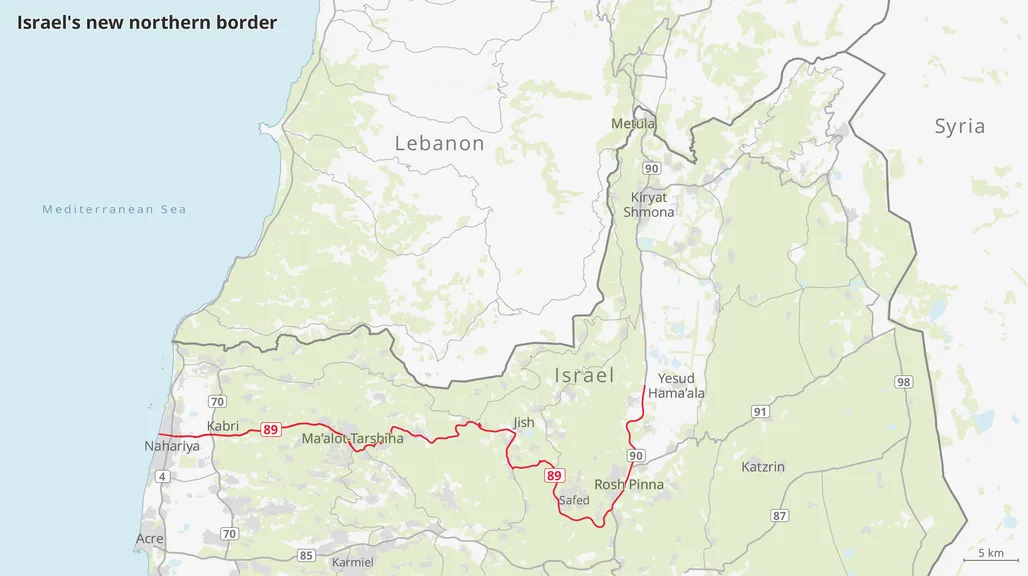
Map shows the new buffer zone in the north, as reported by Haaretz
As Hezbollah opens bigger and bigger gaps in the occupation state’s air defenses, they can fire larger missiles with more frequency into Israel, with better and deeper penetration. For Israel, this attrition is a compounding problem. Their air defenses are a connected system and the network is increasingly returning 404. Take for example, the destruction of the $230 million dollar SKYDEW blimp/spy balloon.
This balloon is designed to detect low-flying drones and missiles, especially important as this is the vector most used by the Resistance. SKYDEW can stay up much longer – and is relatively cheaper – than planes, and can ‘see’ much further than ground-based systems. It was also placed in a highly strategic area that allowed them to cover attacks from Syria, Iraq and, to a lesser degree, from Hezbollah, specifically on the port of Haifa. But now the party’s over. Look at the balloon now:

SKYDEW is now shriveled and useless – a big loss, which also signals a big breakdown. As the SKYDEW ‘Target Card‘ (from Hezbollah intelligence) says, it was “protected by an electronic monitoring and jamming system against drones and UAVs,” and “secured by three layers of missile interception systems: Iron Dome, David’s Sling, and Hetz [Arrow].” That all got sliced through like the layers of an onion, leaving Israeli defenses naked.
The northern front is porous now, as Israeli settlers know better than anybody. To quote Moshe Davidovitz, head of the Asher regional council:
“Ten rockets fell in the center of the country and the media is in an uproar — the country is in turmoil,” he wrote. “But every day dozens of rockets are fired towards the confrontation line settlements and the Galilee, including anti-tank missiles and suicide drones, and the country remains silent. Once again, it’s proof that the north is not being counted.”
Hezbollah of course, has counted the north. They have a list of Israeli military targets and they go through them one by one. Take, for example, the Mount Meron Air Surveillance Base, one of the two main bases in the occupation state. This is what a senior Israeli air force official says about the base, in a 2016 article by Maariv:
“The air control system is crucial for the operational capability of the Air Force. Its main duty is to protect the occupied airspace. Through the control system, we activate all capabilities to protect the sky, including helicopters, aircraft, missiles, and other classified systems.”
And this is what Hezbollah intelligence released, as they were bombing it:
Firstly, the Meron Air Surveillance Base is located on the summit of Mount Jarmaq [“Mount Meron”] in northern occupied Palestine, the highest peak in occupied Palestine. Meron Base is the sole center for administration, surveillance, and air control in the northern part of the usurping entity and there is no major alternative to it. It is one of two main bases in the entire usurping entity: “Meron” in the north, and the second being “Mitzpe Ramon” in the south.
The Meron Base is responsible for organizing, coordinating, and managing all air operations towards Syria, Lebanon, Turkey, Cyprus, and the northern part of the eastern basin of the Mediterranean Sea. Additionally, this base is a main center for electronic jamming operations in the aforementioned directions and is staffed by a large number of elite officers and soldiers of the zionist forces.
Secondly, the fighters of the Islamic Resistance at 07:50 AM on Saturday, January 6, 2024, as a part of the preliminary response to the crime of assassinating the great leader Sheikh Saleh Al-Arouri and his martyr brothers in the southern suburb [Dahiyeh] of Beirut, targeted the Meron Air Surveillance Base with 62 missiles of various types, inflicting direct and confirmed hits.
Hezbollah has aired its attacks on Meron Air Base in countless videos now, and they have been relentless. It can get boring because the whole thing never fireballs, but each small hit adds up. Every time a hole in Israeli air defenses opens, the hole widens, because Hezbollah is damaging complex, interconnected systems.
Today, the Meron base can barely defend itself, let alone the region. Tel Aviv has responded by assassinating Hezbollah and allied leaders, but the resistance just name missiles after those martyrs and send more.
This is a battle of attrition and Hezbollah is paying attention while Israel is mindlessly lashing out. Completely distracted by its brutal military assault on civilians in Gaza, in the south, Israel has lost the battle for the north.
After months of this boring de-administrative work, Hezbollah has finally arrived at the good stuff. The occupation state’s northern air defenses today are like a ragged old mosquito net that the dog chased the cat through. It’s full of holes, and big ones. Hezbollah can increasingly fire at will, with increasingly accurate weapons. For example, here is Hezbollah taking down a SKYSTAR 330 by drone-striking its Battalion 869 operator.

In this case, Hezbollah targeted not the spy balloon itself, but the balloon controllers, in three locations at the same time. With the operators eliminated, the balloon drifted out of control, landing in Lebanon where some kids recovered it. This is the state of Israel’s eyes and ears in the north. They’re on the ground.
Iron ‘Done’
Israel has nothing worth calling an air-defense in the north anymore. The Iron Dome is done. Hezbollah can fire at will, and has for every single day for seven months now. Iraqi Resistance missiles are flying right over them, towards Haifa. Iran can overwhelm the entire national system whenever it wants. Israel can still offend the conscience, but they’re missile defenseless now. Even Hamas is hitting them, from within traumatized Gaza. It’s open season, and the settlers know it.
Israeli settlers openly bemoan their unsettled state all over the Hebrew press. Some were so pyrrhicly incensed they threatened to secede from the entire state and form the new State of Galilee. As The Jerusalem Post has said:
The straw that broke the camel’s back was the prime minister’s answer at the cabinet meeting to a question by Benny Gantz, as reported by N12. Gantz wondered if the residents would return to their homes on September 1, for the start of the school year, and Netanyahu replied, “What’s the worst that will happen if they return a few months after September 1?”
This is of course the worst that can happen. The entire premise of Israel’s decades of grooming international actors to accept and expect bad behavior from Tel Aviv is that they can do whatever they want. If the Iron Dome doesn’t work, Israel doesn’t work, and now the Iron Dome doesn’t work. It’s the Iron Sieve now. Holy warriors have poked it full of holes.

An Iron Dome battery targeted by Hezbollah
This is a huge problem because the Iron Dome is not just Israel’s physical defense mechanism, it’s their psychological defense mechanism. It’s what makes the whole colonial project believable, that they can bully everyone in the region and suffer no consequences. Belief in the ‘Iron Dome’ is belief in ‘Israel’ and neither is believable anymore. Thus the northern Jewish settlements have emptied out and they’re not coming back anytime soon. As the Resistance News Network (RNN) said (on May 29th):
930 settler houses in northern occupied Palestine have been damaged by Hezbollah rockets in 86 settlements since October 7th, according to the zionist Ministry of War.
In Al-Manara for example, 130 out of 155 houses were destroyed. Metulla has just 34 residents left in the settlement, at most. Kiryat Shmona, one of the largest (northern) settlements, has seen its population plummet from 24,000 to under 4,000, and 124 houses have been damaged within it.
This comes as over 200,000 settlers in the north are displaced by the resistance, having built their own refugee camp. Some want to secede from “Israel” and build their own state, while others, such as the settlement of “Margaliot” have severed their ties with the entity as of yesterday.
Perplexingly, the IOF reportedly plans to significantly cut down the number of soldiers it has on the northern border and nearby settlements, citing funding reasons, or perhaps to lessen the number of targets available to Hezbollah.
Let’s look at one example of Hezbollah eliminating one target, an Iron Dome battery. They systematically do this over and over. This report describes how Hezbollah first gets the battery to reveal itself by firing rubbish at it, then hits it with drones.
The exclusive footage reveals the monitoring and reconnaissance operations that enabled Hezbollah to uncover the positions of “Iron Dome” batteries stations near the settlement of “Kfar Blum” using a tactic called “fire luring.”
The footage shows Hezbollah launching munitions toward the sites and documenting the interception process carried out by the Iron Dome, which enabled Hezbollah to execute a high-precision qualitative operation.
The scenes at 4:25 show a successful targeting of the Iron Dome batteries, without them being able to detect, track, or thwart the attack. Published photos also reveal Hezbollah’s intelligence penetration of the Israeli soldiers in these newly established sites, and their ability to document the geographical details and size of the fortifications used.
Hezbollah has done this over and over, methodically hunting and seeking Iron Dome batteries one by one. Given that the rest of their surveillance equipment is decimated and they can’t see what’s coming, Israel is forced to then draw its military assets even further from the border. Otherwise this is what happens:

This is the moment Hezbollah hits the garrison unit of Barkat Risha with an Iranian Almas top-attack ATGM [Anti-Tank Guided Missile]. ‘Unlike Hezbollah and Hamas, Israel has not spent the past 20 years tunneling underground, so their troops are all exposed without the Iron Dome. Take also, for example, the IOF’s 769th Brigade Headquarters, or what’s left of it.
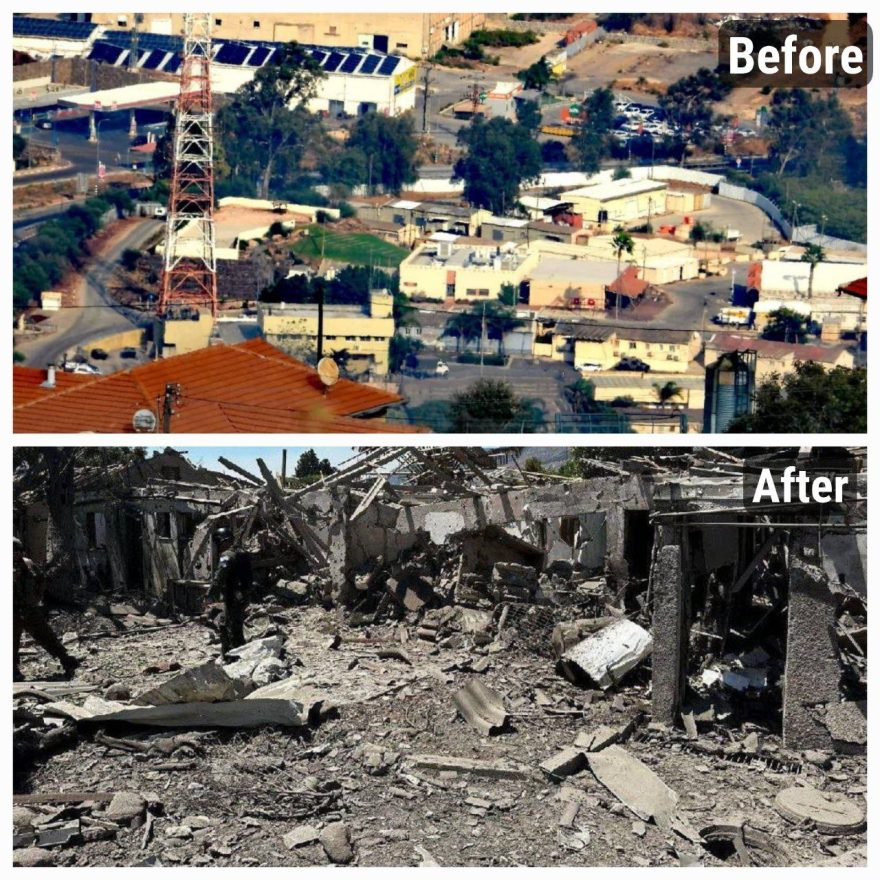
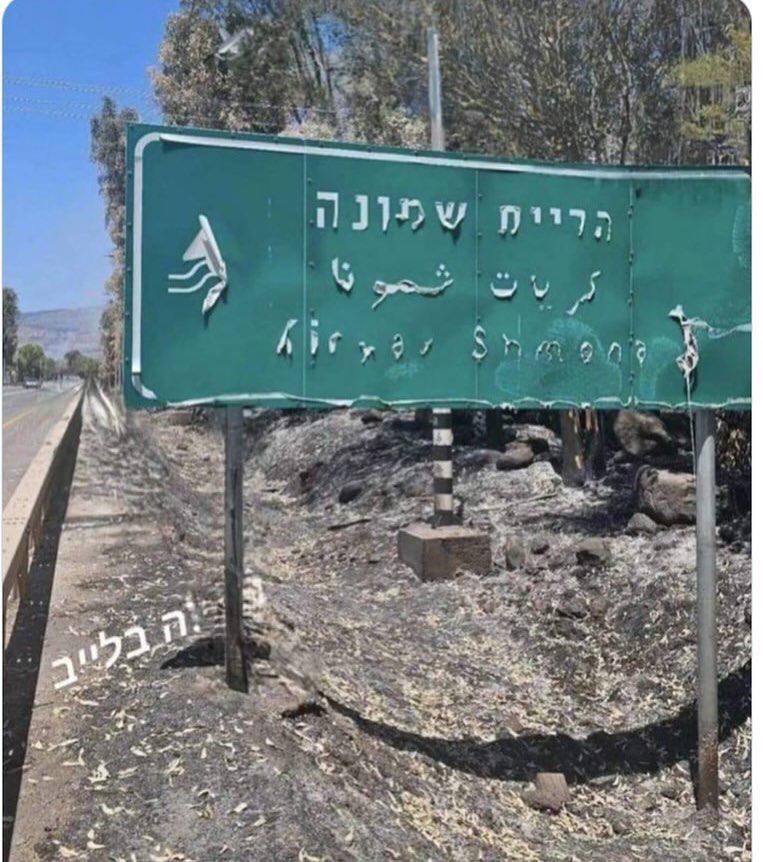
The colonial project will shrink rapidly without air defenses. When the soldiers leave, the settlers have to leave. This is not a strategic retreat, it’s strategic defeat. This is not a solution, just dissolution. But it’s all Israel can do. It hasn’t simply lost control of the north, it has lost control of the tempo of this war. Hezbollah can keep turning the heat up until Israel is cooked. Behold Kiryat Shmona (occupied al-Khalisa), which was literally in flames a few days ago:

This is directly because the Iron Dome is not intercepting drones and Hezbollah has fire control of the whole region. Hence it burns. Settlers now see a “welcome” board that has literally melted.
As Israel retreats further and further from its border with Lebanon, the collapse of the northern front also opens up the occupation state to attacks from Syria and Iraq, which can fly straight through. This is all causing massive psychological damage to Israel because the Iron Dome was their primary safety blanket.
Hezbollah has reported destroying over 1,650 pieces of intelligence, surveillance and target acquisition (ISR) equipment since 8 October, 2023. The Lebanese resistance had an actual strategy while Israel was wildly bombing ambulances and homes with no military value. Now Israel has lost northern Palestine and it’s not coming back.
‘Until genocide stops’: Colombia to suspend coal exports to Israel
Press TV | June 8, 2024
Colombia has said it would stop its coal exports to the Israeli regime as long as the latter sustained its months-long genocidal war against the Gaza Strip.
“We are going to suspend coal exports to Israel until the genocide stops,” Colombian President Gustavo Petro said in a post on X on Saturday.
He also posted a draft decree, which said that coal exports would only resume if the regime complied with a recent order by the International Court of Justice that mandated that Tel Aviv withdraw its troops from the Gaza strip.
Data provided by Colombia’s National Statistics Department shows that the exports were worth more than $320 million in the first eight months of the last year.
According to the Colombian government, the export ban will enter into force five days after the decree was published in the official gazette.
On May 1, the Colombian head of state said the country had decided to cut its diplomatic relations with the Israeli regime over the war.
“And we here in front of you, the government of change, the president of the republic informs that tomorrow diplomatic relations” with the Israeli regime “will be cut,” he said at the time, adding, “[We cut diplomatic ties] because of them having…a genocidal president.”
More than 36,801 Palestinians, most of them women and children, have been killed in the war that began after Al-Aqsa Storm, a retaliatory operation staged by Gaza’s resistance groups.
Israel Can’t Win All Out War Against Lebanon’s Hezbollah: Here’s Why
By Ilya Tsukanov – Sputnik – 08.06.2024
Israel’s embattled prime minister has dropped hints that he doesn’t feel he has enough on his plate with the faltering war in Gaza and protests inside his own country demanding his resignation, threatening to expand the Gaza conflict into Lebanon against Hezbollah. A leading Lebanese political observer tells Sputnik why that’s a very bad idea.
Israel is “prepared for an extremely powerful action in the north” against Hezbollah, Prime Minister Benjamin Netanyahu warned Wednesday, citing the recent dramatic escalation of cross-border skirmishes, which have included Hezbollah drone attacks inside Israel and the shootdown of a heavy Israeli drone over Lebanese airspace last week.
“Anyone who thinks that they can harm us and that we will sit on our hands is sorely mistaken,” Netanyahu warned, speaking to media in the northern Israeli city of Kiryat Shmona, which has been evacuated of most of its civilian population amid the fighting.
“Iran is trying to choke us and encircle us and we are fighting back directly and with its proxies. We can’t accept the continuation of the situation in the north, it won’t continue. We will return the residents to their homes and bring back security,” Netanyahu assured, referencing the Iran-led Axis of Resistance alliance, which includes Hezbollah in Lebanon, Syria, Iraqi Shia militias, and Yemen’s Houthi fighters.
Israeli Army Radio reported this week that the government had approved the call-up of an additional 50,000 reservists in preparation of a possible escalation with Hezbollah. US and Middle Eastern media have braced for a full-scale all-out conflict between Israel and the Lebanese militia.
But whatever superficial similarities may appear to exist between Hezbollah and Palestinian militant group Hamas, which has managed to bog down Israel’s army using a Spartan combination of rifles, man-portable anti-tank missiles and simple rockets assembled in underground garages, political and military observers the world over agree that the Lebanese group is far, far stronger.
Hardened by years of running battles against the Israeli military and with US-sponsored terrorist proxies in Syria beginning in 2012, Hezbollah, unlike Hamas, also has access to an array of sophisticated missiles and rockets, which observers in Washington estimate to number up to 200,000 – enough to overwhelm Israel’s powerful air and missile defense network.
“Israel has threatened to start a military operation on the border with Lebanon because Hezbollah has been demonstrating growing sophistication and surprising capacities, driving Israel increasingly at unease and confusion about expectations on the northern front,” Dr. Imad Salamey, an associate professor of political science and international affairs at the Lebanese American University, told Sputnik, commenting on the rising tensions between Israel and the militia.
Israel can attack many Hezbollah targets at once and cause significant damage, but cannot remove or even dramatically reduce the militia’s capabilities, “which are widespread and mobile,” the observer noted.
“If Israel aims to seriously undermine Hezbollah, it would involve many years of operations to destroy infrastructure and weapons, push fighters out of the south, and cut off supply routes from Syria. Israel will not be able to achieve this fully,” Salamey stressed.
On top of that, the academic warned that “the threat of spillover is quite high, potentially implicating much of the Quds Brigade in Syria and Iraq, resulting in Israel fighting on multiple and wide fronts.”
That’s not the outcome Tel Aviv would hope for, according to Salamey, with Israeli officials and military leaders typically looking “for a quick military achievement with ambitious goals,” which, if that fails, prompts the IDF to resort to “collective punishment targeting civilians, which is the most likely scenario in this case.”
“The potential conflict will result in major losses on both sides without a decisive victory. However, Iran will likely emerge as a major winner, asserting its regional role in any future political settlements,” Dr. Salamey believes.
Hezbollah and Israel fought their last major war in July-August 2006, during which the IDF leveled much of Beirut’s infrastructure and caused up to $5 billion in direct war damage and lost output and income. Hezbollah emerged largely unscathed, however, with about 1,000 of its fighters facing off against between 10,000-30,000 Israeli troops in southern Lebanon, losing about 250 men while killing 121 Israeli servicemen and injuring over 1,200 others.
That conflict has been described even by Western mainstream observers as a loss for Israel, with Israel’s armed forces said to have been given a “bloody nose” and suffering reputational costs which Tel Aviv has proven unable to recover from to this day.
Biden claims Israel ‘has not invaded Rafah’ as jets, tanks raze city

The Cradle | June 7, 2024
US President Joe Biden told ABC News on 6 June that the Israeli government has listened to his “concerns” about a major military offensive in Gaza’s southernmost city of Rafah.
“They were going to go into Russia – into Rafah – full bore, invade all of Rafah, go into the city, take it out, move, move with full force. They haven’t done that. And what they’ve done is they’ve agreed to a significant agreement,” the US president said as Israeli warplanes continued their months-long blitz of residential areas and displacement camps in the city.
Residents of Rafah who spoke with Reuters on Friday morning described the latest raids as “one of the worst nights,” adding that “some people were wounded inside their homes before being evacuated this morning.”
Residents also said that Israeli tanks that have taken control along the border with Egypt made several raids towards the west and the center of the southern city.
“I think he’s listening to me,” Biden added when asked by ABC News if Israeli Prime Minister Benjamin Netanyahu heeded his warnings.
Elsewhere in the interview, Biden claimed Netanyahu will stick by his own ceasefire proposal. “He’s publicly said he is. Our European friends are in on it. We have to get a ceasefire.”
“What [Israel has] done is they’ve agreed to a significant agreement that if in fact Hamas accepts it,” the US president said before adding that the offer is backed by much of the Arab world.
“We’ll see. This is a very difficult time,” Biden said.
On Thursday, senior Hamas officials revealed that the Israeli ceasefire proposal “does not mention stopping the aggression or the withdrawal [of troops from Gaza].”
“The Israeli documents speak of open-ended negotiation with no deadline, and it speaks of a stage during which the occupation regains its captives and resumes the war. We had told the mediators that this proposal is unacceptable,” Hamas official Sami Abu Zuhri told Reuters on Thursday.
The Cradle columnist Khalil Harb earlier this week described the proposal presented by Biden as a “repackaging of last month’s Hamas-approved agreement, which he is now repositioning as an Israeli-sanctioned deal.
Featured Video
No Vote, No Representation, No State: Democracy, Israeli Style
or go to
Aletho News Archives – Video-Images
From the Archives
Sanctions, War and the Policy of Dual Containment
By SASAN FAYAZMANESH | March 17, 2008
It is now nearly three decades since the Unites States adopted the policy of dual containment of Iran and Iraq. While much has been written about the containment of Iraq, there has been very little in-depth analysis of this policy when it comes to Iran. In a book that is going to be released on March 31, 2008, entitled The United States and Iran: Sanctions, Wars and the Policy of Dual Containment (Routledge), I attempt to address this shortcoming by investigating when and why the US policy of containment of Iran came about, how it evolved, and where it stands today.[1] To the extent that Israel has been involved in US policy making, the study will also include the role that Israel has played in the containment of Iran. Also, since the fate of Iran has been inextricably linked to that of Iraq, occasionally the investigation will overlap with the containment of Iraq.
The policy of dual containment of Iran and Iraq originated during the Carter Administration, but it was not until the Clinton Administration that the expression “dual containment” became popular. … continue
Blog Roll
 Aletho News
- No Vote, No Representation, No State: Democracy, Israeli Style
- Zionist Bought Senate Blocks Information About American Citizens Killed By Israel
- While Gaza dominates the UN, these are the people keeping it alive
- New Report: “Scholasticide and Genocide in Gaza: Assessment, Testimonies and Legal Analysis”
- ‘THAAD Delusion’: Iran war exposes US missile shield limits – The Atlantic
- Moscow issues warning to NATO over Russian exclave
- Yes, the Iran war has destroyed Trump’s presidency
- The fallacy of US delusions about Iran’s economic collapse
- Hezbollah denies Syria cell link, warns of Israeli plan to sow discord
- The legacy of US sanctions, war, and occupation in Iraq
- If Americans Knew
- Mamdani releases plan to combat antisemitism and hate crimes in New York City
- Iran’s Revolutionary Guards Publish Letter to the American People
- DMFI launches $1 million ad campaign supporting Virginia’s Elaine Luria
- US Senate blocks resolution seeking report on Americans killed by Israel
- Israeli Attacks Kill Ten Palestinians in Gaza
- Massacre at Minab: The School That Became a Grave
- Israeli media: The IDF Shows It Doesn’t Turn a Blind Eye; It Actively Emboldens Settler Havoc
- As settlers ravage West Bank, Israeli forces kill 10 in Gaza – Daily Update
- New Report: “Scholasticide and Genocide in Gaza: Assessment, Testimonies and Legal Analysis”
- Ex-Biden officials are desperate for a Gaza scapegoat
- No Tricks Zone
- Green Energy Debacle: German Expert Professor Fritz Vahrenholt Warns Of Severe Economic And Social Consequences
- Two More Paleo Reconstructions Affirm Meters-Higher Sea Levels Across Ireland, Brazil 7000-6000 Years Ago
- New Study: Earth And Venus Surface Warmth Largely Explained By Convection And Lapse Rate, Not CO2 Or Radiation
- 2025 Nature Paper Claiming Worsening Global Drought Gets RETRACTED …Heavily Flawed
- New Study: ‘Global Drought Shows No Detectable Recent Acceleration Under Climate Warming’
- Economic Masterminds: German Socialists Suggest Taxing Productivity Gains Stemming From Using AI
- The South China Sea Has Not Been Cooperating With The Climate Change Narrative
- Energy Crisis: Germany Enters Heating Season With Historically Low Gas Reserve Fill Levels
- New Study: The Antarctic Ice Sheet Gained Mass From 2020-2024 Due To Staggering Snow And Ice Accumulation
- Study: Ocean Heating Rates From Thousands Of Years Ago ‘Dwarf’ Modern Ocean Heating Rates

