UK APPROVED ARMS FOR ISRAEL DAYS AFTER IT KILLED BRITISH AID WORKERS
BY JOHN MCEVOY | DECLASSIFIED UK | APRIL 23, 2024
On 1 April, Israeli forces launched a series of airstrikes on a convoy of aid workers in Gaza, killing three Britons, a Polish national, a Palestinian, an American-Canadian dual citizen, and an Australian.
The Israeli Air Force carried out the bombing with a Hermes 450 drone. According to Campaign Against the Arms Trade, this drone may be powered by a R902(W) Wankel engine produced in Britain by UAV Engines Limited (UEL).
New court documents show that the UK government decided to continue arms exports to Israel on 8 April, one week after the strike on the aid workers who were employed by the charity World Central Kitchen (WCK).
The revelation will put additional pressure on the Foreign Office to justify its decision not to suspend arms sales to Israel.
‘Killed with British weapons’
Global Legal Action Network (GLAN) and Palestinian human rights group Al-Haq challenged the UK government today in court over arms sales to Israel.
Documents provided to the court show that the UK government has conducted five legal assessments of the situation in Gaza since 18 December.
One of those assessments, which covered the period 18 December to 29 February, was delivered to UK foreign secretary David Cameron on 28 March.
On 3 April, two days after the Israeli airstrike on the aid workers, Cameron used this assessment to recommend that the UK continue arms sales to Israel.
Five days later, UK trade secretary Kemi Badenoch authorised the continuation of extant licences and new licences to Israel, according to GLAN’s press statement.
The court documents further show that the UK government is capable of making “out of cycle assessments… where circumstances require” on Israel’s compliance with international humanitarian law.
However, such an assessment was apparently not conducted following Israel’s attack on the WCK staff.
Charlotte Andrews-Briscoe, a lawyer at GLAN, said: “The world has watched as 34,000 people have been killed, and more are being killed every day… Has the Government no regard for the immense loss of human life thus far, some of whom will have been killed with British weapons?”
Hermes 450 drone
The UK government is also refusing to rule out whether British machinery was used in the killing of the aid workers.
On 12 April, Kenny MacAskill MP asked in parliament whether the government had made an assessment of whether UEL engines or engine parts had been used in the strike. Trade minister Alan Mak said his department could not comment “on specific licences”.
On 17 April, Andy McDonald MP also asked whether the three British aid workers “were killed by weapons manufactured in Britain”. Foreign Office minister David Rutley responded simply that “we have strong export controls”.
UEL designs and manufactures engines for drones, specialising in Wankel technology which delivers an “outstanding power-to-size and weight ratio… ideal for tactical unmanned aircrafts”.
The company was established in Staffordshire in 1992, before being acquired by Israeli arms firm Elbit Systems.
Over recent decades, concerns have been raised that UEL produces engines and engine parts for Israel’s drone fleet, which is frequently used to support bombing campaigns over Gaza.
Made in Britain
In 2009, it was reported that the engines for Israel’s Hermes 450 drone had been manufactured by UEL. These claims were supported by information on Elbit’s own website.
British arms control officials subsequently admitted that they had licensed engines to Israel for onward export, but could not confirm that the engines had not instead been fitted to the Hermes 450 drone.
Since then, the UK government has continued to issue licences to UEL for exports to Israel. The most recent licence was seemingly granted in 2021, allowing UEL to export parts for military engines to Israel.
Campaign Against the Arms Trade’s Sam Perlo Freeman told Middle East Eye: “The evidence seems to stack up that it is a UK engine and, if it’s not, then Elbit need to clarify that… Definitely it seems to be based on a UK design at the very least”.
An Elbit Systems spokesperson told Declassified: “Elbit Systems UK, its subsidiaries and joint ventures, including UAV Engines Limited and U-Tacs, are not involved in the Hermes 450 programme”.
The company’s spokesperson, however, would not respond to a further question on whether Israel’s Hermes 450 drones use engines or engine parts produced by UEL in the UK. They said: “We have nothing further to add to the [previous] statement”.
A UK-based subsidiary of Elbit Systems and Thales also produces the Watchkeeper drone, which is modelled on Elbit’s Hermes 450 and used by the British army.
“The British government is, in effect, buying technology that has been ‘field tested’ on Palestinians”, noted campaign group War on Want.
‘A full, transparent explanation’
The day after the Israeli airstrikes on the aid convoy, UK foreign secretary David Cameron announced that he had “called on Israel to immediately investigate and provide a full, transparent explanation of what happened”.
On 5 April, the IDF published the conclusions of its investigation, claiming that Israeli forces had identified gunmen near the trucks and “mistakenly assumed that the gunmen were located inside the accompanying vehicles and that these were Hamas terrorists”.
The report continued: “Those who approved the strike were convinced that they were targeting armed Hamas operatives and not WCK employees”. The IDF chief of the general staff subsequently dismissed the Israeli brigade’s commander and chief of staff.
Israel’s self-exonerating investigation was led by Yoav Har-Even, the former head of the IDF operations directorate, and now the president and CEO of Rafael Advanced Defense Systems.
Rafael is one of Israel’s biggest arms firms. It is owned and controlled by the Israeli state, and its largest client is the IDF. The investigation into the killing of the aid workers was therefore led by the CEO of a company which supplies many of the bombs that Israel is using to destroy Gaza.
The UK government has not commented on whether this satisfies its demand for a “full, transparent explanation”, and the extent to which the Foreign Office is pressing Israel on the matter remains unclear.
Mak recently told parliament: “We are carefully reviewing initial findings of Israel’s investigations into the killing”. He continued: “The findings of the inquiry must be published in full and followed up with a wholly independent review to ensure the utmost transparency and accountability”.
Prior to the attack on the WCK staff, at least 357 humanitarian-run sites in Gaza had reportedly been attacked.
John McEvoy is an independent journalist who has written for International History Review, The Canary, Tribune Magazine, Jacobin and Brasil Wire.
UN expert calls for arms, oil embargo against Israel
Press TV – April 25, 2024
UN Special Rapporteur on the Occupied Palestinian Territory Francesca Albanese has called on the international community to immediately impose oil sanctions and an arms embargo against Israel.
“At this point, Israel has reneged on its international obligations to a degree that warrants an imperative implementation of immediate and unconditional sanctions which should entail first and foremost an arms and oil embargo,” Francesca Albanese said during a press conference on Thursday.
Albanese accused the United States and certain other Western states of being accomplice to Israel’s crimes by sending military aid and weapons.
“Complicity with genocide is a crime on its own under the Genocide Convention, so definitely interested in investigating to what extent, the aid – political and military aid that has been granted to Israel by a number of countries primarily the United States, might amount to complicity. What I can tell you for sure is that this support is in clear violation, is in clear breach with the International Court of Justice interim order that ordered the suspension, among others, of the cessation of acts that might amount to genocide and unhindered access for the Palestinians to humanitarian aid.”
In January, the United Nations’ top court ordered the Israeli regime to take all measures within its power to prevent genocide in Gaza.
Albanese further said the European Union should impose sanctions on Israel, not merely on extremist settlers. “Settlers operate as part of Israel’s expansionism over what remains of historic Palestine,” Albanese said. “So it is Israel, not settlers per se, [that has] to be targeted by sanctions.”
Elsewhere in her remarks, the UN expert further said countries must do everything in their power to prevent ethnic cleansing of Palestinians.
“Israeli policies expanding the occupied Palestinian territory are unquestionably endangering Palestinian existence on their land, or what remains of their land. The focus of the international community must zero in on the most likely implication of the ethnic cleansing of Palestinians and states must do everything in their power to prevent it.”
Last month, Albanese told the UN rights body in Geneva that she believed that Israel’s military campaign in Gaza since October 7 amounts to genocide.
Palestinians on Thursday mourned people killed in the Israeli bombardment of Rafah, the crowded city in the southern Gaza Strip, where Israel says it is advancing plans for a ground invasion.
At the city’s Najjar Hospital, among the mourners were two men crouching, grief-stricken, in front of a white body bag.
Those killed in an Israeli strike on Rafah included Abdallah Nabhan, 33, who worked for Belgium’s Enabel development agency.
Brussels said it would summon Israel’s ambassador to explain the death.
Palestinian journalist Mohammad Bassam al-Jamal was killed along with his family members in an attack on their house in the city of Rafah. His death brings to 139 the number of journalists killed in the Gaza war.
Palestinians ‘buried alive’ by Israeli army in Nasser Hospital mass graves
The Cradle | April 25, 2024
Officials from Gaza’s Civil Defense Department announced on 25 April that 392 bodies have been unearthed from three mass graves discovered at the Nasser Medical Complex in the city of Khan Yunis, with some showing signs of having been buried alive.
“We need forensic examination for approximately 20 bodies for people who we think were buried alive in the Nasser Medical Complex,” Palestinian Civil Defence member Mohammed Mughier told reporters on Thursday, adding that some were the bodies of children.
“Why do we have children in mass graves?” he added, stressing that the evidence shows the Israeli army committed “crimes against humanity.”
Ten of the bodies unearthed had their hands bound, while others still had medical tubes attached to them.
“There are indications of carrying out field executions against some of the victims, while the bodies of other victims carried signs of torture and others were buried alive,” officials from Gaza’s Civil Defense Department said during a press conference.
“Several victims were buried in plastic bags and placed at a depth of three meters, which accelerated their decomposition,” the officials added.
The mass graves were discovered after the Israeli army withdrew from Khan Yunis on 7 April following a four-month raid of the city that decimated most infrastructure and left thousands dead.
Gaza officials have previously stressed that the Israeli army uses forced disappearance as a systematic policy against the people of the strip, highlighting that thousands of Palestinians are still missing.
“Some of the bodies found have evaporated and turned to ash. International institutions must identify the type of weapons used [by Israel],” the Civil Defense Department said earlier this week. “We found in the Nasser Complex corpses without heads and bodies without skins, and some of them had their organs stolen,” Gaza’s Government Media Office office also revealed.
Hundreds of bodies were recently recovered in the northern Gaza Strip, particularly in and around Al-Shifa Hospital, where Israeli troops launched a bloody and destructive military operation lasting from 18 March until 1 April.
On Wednesday, UN Secretary-General Spokesman Stéphane Dujarric called on a “clear, transparent and credible investigation” into the mass graves found in the Gaza Strip.
US Pays Lip Service to Palestinians’ Plight While Arming Israel

Sputnik – 25.04.2024
US President Joe Biden authorized providing some $15 billion worth of military supplies to Israel this week.
While the United States has repeatedly voiced concerns about the massive civilian casualties caused by the ongoing Israeli invasion of the Gaza Strip, it does not deter Washington from sending military supplies to Tel Aviv, essentially helping Israel wage this campaign.
The latest multibillion-dollar package for Israel comes as the Israeli military leadership appears intent to attack Rafah, a city in the southern Gaza Strip that is currently densely packed with refugees who fled from other parts of the Palestinian enclave ravaged by the Israeli invasion.
Although Biden reportedly warned Israeli Prime Minister Benjamin Netanyahu last month that an assault on Rafah would be a mistake, the White House does not seem keen to actually prevent Tel Aviv from carrying out this attack – which is likely to result in a large number of civilian casualties.
Earlier this month, CNN reported that the Biden administration authorized the transfer of some 1,000 MK82 bombs and an equal number of small-diameter bombs, apparently undaunted by the fact that the Israeli military seems rather keen to flatten buildings across the Gaza Strip via airstrikes.
The US leadership also seems unperturbed – or at least unperturbed enough to halt the military supplies to Israel or, heaven forbid, impose sanctions on Tel Aviv – by occurrences such as the Israeli airstrike on a humanitarian convoy in the Gaza Strip, which killed seven aid workers from the World Central Kitchen food relief NGO.
Booed at Columbia University, Johnson warns to bring National Guard to quell pro-Palestine protests

Speaker of the US House of Representatives Mike Johnson at Columbia University, in New York City on April 24, 2024. (Photo by Reuters)
Press TV – April 25, 2024
House Speaker Mike Johnson has threatened to use National Guard against students’ pro-Palestinian protests at US universities as he got booed and heckled at Columbia University.
Following a meeting with Columbia University President Minouche Shafik, the Republican speaker of the US House of Representatives along with a group of Republican House members urged Shafik to step down if she fails to control Gaza war demonstrations on campus during a press briefing at Low Library on Wednesday.
Johnson was joined by GOP Reps. Mike Lawler, Nicole Malliotakis and Anthony D’Esposito, all from New York, and Virginia Foxx of North Carolina.
“We just can’t allow this kind of hatred and anti-Semitism to flourish on our campuses. And it must be stopped in its tracks. Those who are perpetrating this violence should be arrested,” he said, accusing protesters of chasing down Jewish students and harassing them.
Students chanted “Free Palestine” and heckled and loudly booed Johnson and demanded his return to Washington DC, with the noise of protesters almost overpowering his speech.
Johnson, who also met with Jewish students before his remarks, said that he plans to urge US President Joe Biden to take executive action against the protests if necessary, adding, “If this is not contained quickly, and if these threats and intimidation are not stopped, there is an appropriate time for the National Guard.”
Protesters shouted “stop the genocide” as other Republican leaders spoke. The Republicans accused protesters of being part of the problem and supporting the resistance movements of Hamas and Hezbollah.
New York Democrats criticize Johnson for “politicizing” the ongoing pro-Palestinian protests in Columbia, with Gov. Kathy Hochul stating that the presence of an entourage is exacerbating the division.
Johnson said in an interview after his speech that he respects the right to protest, but that he thought the students on campus had crossed into harassment.
Pro-Palestinian academic activism has grown significantly across the US since the onset of the Israeli regime’s US-backed war of genocide against the Gaza Strip.
Starting from the Colombia University in New York, protest encampments with a unified demand that their schools cut financial ties to Israel have been spread across the country. Demonstrations have been held in many universities such as Harvard, MIT, UT and other universities in Michigan, Minnesota and Colombia.
They are calling for universities to distance themselves from any companies that are advancing Israel’s savage military campaign in the besieged Gaza Strip.
Johnson’s speech came hours after Biden officially signed into law a long-awaited foreign aid bill for Israel, Ukraine and Taiwan that had faced considerable delays in the House due to political gridlock.
The new package will provide $26 billion for the Israeli regime, which has been engaged in a genocidal war against the Gaza Strip since last October.
Israeli prime minister Benjamin Netanyahu welcomed the billions of dollars in US assistance, writing on X that it “demonstrates strong bipartisan support for Israel.”
Hamas holds dozens of high-ranking Israeli officers in Gaza: Report

The Cradle | April 24, 2024
A source within Palestinian resistance movement Hamas told Al-Araby Al-Jadeed on 24 April that the group holds around 30 Israeli army generals and officers from the Shin Bet security service as prisoners in the Gaza Strip.
“The movement alone has about 30 generals and Shin Bet officers, who were captured on October 7, from military units and some highly sensitive military sites,” the source said.
The source added that “these people in particular are in highly secured places, far from the hands of the occupation, and it is impossible to reach them under any circumstances,” and that Israeli Prime Minister Benjamin Netanyahu and his government have been hiding information from their people regarding “the identities of some of the prisoners.”
This concealment comes as part of efforts “to avoid provoking anger among the ranks of the combat forces.” He added that the military representative on Israel’s prisoner negotiation team, Nitzan Alon, is frustrated with Netanyahu’s “laxity” toward the issue.
The Israeli government has said that 129 Israeli prisoners remain captive in Gaza.
According to the source, Israel does not really know the exact number of prisoners left in Gaza after the prisoner exchanges in late November. He adds that Tel Aviv has not specified the number of imprisoned military officials, as part of a strategy “to classify some of the soldiers or officers … as civilians, in order to reduce the price of negotiating for them during the talks.”
The source also denied Hebrew media reports that only 20 prisoners are alive and that Hamas only proposed releasing 20, as opposed to 40, during the latest rounds of truce talks in Cairo.
Truce negotiations remain stalemated by Israel’s repeated rejection of Hamas’ main terms, which the resistance group continues to hold fast. These terms include an end to the war and a permanent ceasefire, a withdrawal of all troops from Gaza, a return of the displaced to their homes, and reconstruction of the strip.
“The only way [for Israel] to liberate the occupation prisoners is through serious negotiations followed by a full commitment to a ceasefire and reconstruction,” he said.
He also confirmed that the resistance remains in fighting form, and has not been defeated.
“The resistance is still fine, and is still in control in a disciplined manner within integrated structures in the field of operations.” Israel has repeatedly claimed that the southernmost city of Rafah is Hamas’ final stronghold, and is planning an operation against the desperately overcrowded city, posing the threat of a severe humanitarian catastrophe.
The source also confirmed that top Hamas leader Yahya Sinwar is “not isolated from reality” or hiding within the tunnels of Gaza, as some have claimed. According to the source, Sinwar has met with some of the fighters of Hamas’ military wing, the Qassam Brigades, has “inspected” some of the areas where clashes took place, and “is carrying out his work as a leader of the movement in the field.”
UK suspends legal assessments on Israel’s compliance with international law
MEMO | April 24, 2024
In a shocking revelation during a hearing at the High Court, it has come to light that the UK government has suspended legal assessments over whether Israel is breaching International Humanitarian Law (IHL). The hearing was part of legal proceedings initiated in December by Palestinian human rights organisation Al-Haq and UK-based Global Legal Action Network (GLAN) against the UK after repeated written requests to suspend arms sales to Israel due to grave breaches of international law and UK rules.
According to the Campaign Against Arms Trade (CAAT), Trade Government lawyer James Eadie admitted to a “hiatus” in legal assessments of Israel’s compliance with IHL for reasons he “couldn’t go into,” stating that “decisions of some importance have been delayed for some time.” Eadie also mentioned that these delayed decisions were due “imminently” – likely in mid to late May.
The hearing also disclosed that the Secretary of State for Business and Trade last reviewed and approved arms sales to Israel on 8 April, three months after the International Court of Justice (ICJ) opened an instigation into possible genocide carried out by the apartheid state. However, according to information provided in court, this review only covered IHL violations committed up to 28 January, as the judge stated that the legal case into this review would only cover violations up to this date.
Notably, a determination that Israel is in violation of International Humanitarian Law would require the UK to suspend any arms sales to Israel. Details revealed during the hearing indicate that the UK government has sold weapons to Israel without a thorough review of the many breaches of international law documented by rights groups.
CAAT has strongly criticised the government’s actions. “This government likes to claim we have a robust arms export licensing system. This claim is now in tatters,” CAAT’s Media Coordinator, Emily Apple, said. “Israel is committing horrific war crimes with the aid of UK weapons and yet our government has suspended legal assessments of its compliance with international law, and delayed vital decisions.”
“It is outrageous that it has taken a court case for these revelations to come to light. David Cameron and other foreign office ministers have repeatedly avoided scrutiny on this issue. They are making a mockery of international law and a mockery of parliamentary scrutiny.”
While the case brought by GLAN and Al-Haq has been given permission to proceed, with a full hearing scheduled for October, CAAT emphasises the urgency of the situation. “We cannot wait until October for an arms embargo. Our government and the UK arms trade is complicit in genocide and they know it. We all need to keep up the pressure and demand that they stop prioritising the profits of arms dealers over Palestinian lives,” stated Apple.
The revelations from the High Court hearing have raised serious questions about the UK government’s commitment to upholding international law and its role in enabling the ongoing violence in Israel and Palestine through the continued sale of arms to Israel.
British Foreign Secretary, David Cameron, has repeatedly dodged questions about the legality of UK arms sales to Israel. Leaked reports show that the British government has received advice from its own lawyers stating that Israel has breached international humanitarian law in Gaza but has failed to make it public.
The comments, made by the Conservative Chair of the House of Commons Select Committee on Foreign Affairs, Alicia Kearns, at a Tory fundraising event on 13 March are at odds with repeated ministerial denials and evasion on the issue.
“I remain convinced the government has completed its updated assessment on whether Israel is demonstrating a commitment to international humanitarian law, and that it has concluded that Israel is not demonstrating this commitment, which is the legal determination it has to make,” Kearns said in March. “Transparency at this point is paramount, not least to uphold the international rules-based order.”
Pakistan under risk of sanctions over trade deal with Iran: Washington
The Cradle | April 24, 2024
Washington threatened Pakistan with sanctions on 23 April over a trade agreement recently signed with Iran.
“We advise anyone considering business deals with Iran to be aware of the potential risk of sanctions. Ultimately, the Government of Pakistan can speak to their own foreign policy pursuits,” State Department spokesman Vedant Patel said on 23 April.
The warning came after Iranian President Ebrahim Raisi arrived in Pakistan on 22 April and met with top officials, including Pakistani Prime Minister Shehbaz Sharif.
“Both sides agreed to increase the volume of bilateral trade to 10 billion US dollars in the next five years,” Sharif’s office said in a statement.
Raisi and Sharif also discussed during the visit the importance of energy cooperation between Tehran and Islamabad.
A gas pipeline project between the two, dating back over a decade and aimed at allowing the flow of Iranian gas into Pakistan, has been consistently held up by the US.
A US official revealed last month that Washington has set a “goal” to prevent the construction of the Iran–Pakistan gas pipeline. The project has been delayed by nearly a decade in large part due to US economic pressure.
“I fully support the efforts by the US government to prevent this pipeline from happening,” US Assistant Secretary Bureau of South and Central Asian Affairs, Donald Lu, said during a congressional hearing on 19 March. “We are working toward that goal,” he stressed.
On Wednesday, Iran and Pakistan issued a joint statement calling on the UN Security Council “to prevent Israel’s regime from its adventurism in the region and its illegal acts attacking its neighbors and targeting foreign diplomatic facilities.”
The statement also called “for an immediate and unconditional ceasefire, unimpeded humanitarian access to the besieged people of Gaza, return of the displaced Palestinians, as well as ensuring accountability of the crimes being committed by the Israeli regime. They reiterated their support for a just, comprehensive, and durable solution based on the aspirations of the people of Palestine,” according to the Pakistani Ministry of Foreign Affairs.
Revealed: Israel’s hidden history of attacks on Iran
By Robert Inlakesh | MintPress News | April 17, 2024
Iran’s retaliatory attack on Israel was framed in the West as a reckless attempt to spark a major regional war, but in reality, Israel has been attacking Iran for decades.
As is routinely the case with Western-backed wars, the corporate media’s timeline begins at the moment that suits their narrative. We have seen this play out recently, with the attempt to rob the Gaza war of all contexts before October 7, 2023. Similarly, when it comes to Israel’s conflict with Iran, the two have been embroiled in what is referred to as a “shadow war,” the details of which are pretty shocking.
While the international media’s attention was riveted on Iran’s retaliatory strikes against Israel, drawing great focus to some 300 drones and missiles used in the attack, no major deal was made of Israel’s strike on April 1 against the consular segment of Iran’s embassy in Damascus, Syria, that killed a dozen people, including seven Iranian officials of the Islamic Revolutionary Guard Corps (IRGC). In this unprecedented act of aggression against Iranian soil, breaking international diplomatic norms, the Israelis were shielded by the U.S. government at the United Nations Security Council, blocking any condemnation of this act.
Despite an admission from British Foreign Secretary David Cameron that had the UK embassy been attacked similarly, they too would retaliate, the double-standard argument that Iran shouldn’t respond continues to dominate the airways.
This is as Iran’s IRGC has received condemnation for seizing a container ship in the Persian Gulf associated with the Zodiac Maritime shipping company of Israel billionaire Eyal Ofer and his family. In 2021, the Mercer Street oil tanker, which Zodiac Maritime also operated, was struck by Iranian drones, prompting similar condemnation. Yet, little was to be said regarding the Israeli-owned company’s role in collaborating with the Israeli military and intelligence establishment to ferry arms and operatives around the region and carry out assassinations or reconnaissance missions.
However, the Israel-Iran “Shadow War” did not begin with recent events. Israel has been carrying out brutal assassinations of civilian scientists on Iranian soil since 2010 while also carrying out acts of espionage that have endangered innocent civilians in the country.
As early as in the years 2010, 2011 and 2012, Israeli Mossad agents have been planting viruses designed to cause malfunctions in Iranian oil and nuclear power facilities. Another kind of provocative action occurred in 2018, when it was reported that an Israeli Mossad team had raided an archive facility in Tehran, stealing documents that pertained to its nuclear power program.
In 2020, the New York Times and Washington Post reported that Israel planted bombs inside Iran’s Natanz Nuclear facility, which almost caused an environmental and humanitarian catastrophe. Later that year, the Israeli Mossad assassinated Iran’s top nuclear scientist, Mohsen Fakhrizadeh, in Tehran. Then, in April of 2021, another explosion occurred at the Natanz facility, which the New York Times reported was Israel’s doing.
The Israelis have also trained members of the MEK terrorist group to carry out attacks on civilian targets inside Iran. The list of Mossad-linked cells that have been arrested by the Iranian authorities or carried out acts of espionage and sabotage is simply too numerous to cover at length. Early last year, U.S. officials even told Reuters that a suicide drone attack targeting a factory in the city of Isfahan was an Israeli attack.
More recently, in late December, Israel launched airstrikes on Damascus and assassinated IRGC official Seyed Razi Mousavi. And in January, Israel launched airstrikes in Damascus, murdering five Iranian military personnel members and Syrian citizens. Then, in early February, Israel was accused of blowing up gas pipelines in Iran. None of these actions, which would likely illicit a response by most nations, provoked Iran to launch a direct strike on Israel.
In addition to all of this, Israel has been the world’s top cheerleader for the West’s crushing sanctions that have significantly impacted Iran’s civilian population, specifically access to lifesaving medical supplies. AIPAC, the powerful Israeli Lobby group in the United States, worked hard to prevent the 2015 Iran Nuclear Deal from passing, then pushed for the Trump administration to unilaterally withdraw before pressuring the Biden administration to refrain from reviving the deal despite this being a campaign promise. Israel even played a role in the Trump administration’s assassination of Iran’s top general tasked with battling ISIS, Qassem Soleimani.
Yet, despite Israel’s long history of documented attacks against Iran and around 30 years of false predictions as to when Iran is supposedly going to develop a nuclear weapon, which is the premise for Western sanctions, the corporate media is still trying to sell the public on the lie that Israel is an innocent victim and that there was no justifiable reason for Iran to retaliate.
Ukraine, Israel Aid Bill ‘Abomination’ That Will Prolong Suffering – Former US Diplomat
Sputnik – 23.04.2024
WASHINGTON – The $95 billion aid bill that Congress passed on Friday is an “abomination” that will only prolong the suffering caused by the Ukraine war and the Israeli onslaught in the Gaza Strip, former US diplomat and State Department consultant James Carden said on Monday.
“Seems to me the spending bill will only prolong the suffering in Ukraine and Gaza,” Carden said. “The parts of the bill having to do with funding Israel are an abomination and make us even more complicit in their crimes.”
The bill is expected to quickly be approved by the US Senate starting on Tuesday. The measure will provide funds to send Ukrainian President Volodymyr Zelenskyy’s regime $60.84 billion, including $23 billion for new US weapons and ammunition; $26 billion to Israel; and another $8.12 billion to the Indo-Pacific region.
“Some of the bill was probably necessary in the sense that the United States needed to ‘restock’ after having wasted so much over the past couple of years,” Carden said.
Close to $30 billion in its provisions will go directly to refill US weapons and ammunition inventories which have been largely emptied over the past two years to primarily arm Ukrainian forces, Carden added.
The bill was approved earlier by 311 votes to 112 in the House of Representatives. No Demcorats voted against the bill and most of them waved Ukrainian flags inside Congress.
New $17Bln Aid to Israel ‘Last Nail in Coffin of US Credibility’ – ex-US Envoy to Riyadh
Sputnik – 23.04.2024
WASHINGTON – The US House of Representatives approval of $17 billion in additional military aid to Israel amid the ongoing war on Gaza demonstrates US disregard for international law and human decency, delivering the final blow to its reputation, former US Ambassador to Riyadh Chas Freeman told Sputnik.
On Saturday, the US House passed legislation to provide $26.38 billion in supplemental appropriation for Israel and Gaza. It includes $17 billion in military aid for Israel and $9 billion for worldwide humanitarian aid, including for civilians in Gaza.
“This puts the last nail in the coffin of US credibility around the world. It makes it clear to everyone beyond a reasonable doubt that the United States has joined Israel in contempt of both international law and human decency,” Freeman, who also served as assistant secretary of defense for international security affairs in the Clinton administration, said.
The “obscenely massive aid” will enable Israel to continue to carry out “the very genocide in Gaza and the occupied West Bank that the United States hypocritically claims to oppose,” Freeman said.
“Neither Israel nor the United States is likely soon to overcome the international opprobrium generated by their partnership in depravity,” he predicted.
Saturday’s aid package approved more than double the amount of funds also for the Volodymyr Zelensky regime in Ukraine. But it would not avert Kiev’s looming defeat there at the hands of Russia, Freeman cautioned.
“Ukraine’s morale will be boosted by the renewal of financial support from the United States but this will not remedy its problems on the battlefield. It will not create more Ukrainian men with military training. Nor will it supply more artillery shells,” he said.
Along with Israel aid, the US national security supplemental package authorized $60.84 billion for Ukraine, including $23 billion to restore US arsenals of weapons and ammunition, and $8.12 billion for the Indo-Pacific, including Taiwan. The package is expected to quickly pass the Senate this week.
Pro-Palestine rallies spread on US campuses despite heavy repression
The Cradle | April 23, 2024
Pro-Palestinian protests at major US universities continued to grow on 22 April despite arrests by police, suspensions by university administrators, and sabotage by pro-Israel lobby groups.
Columbia, a prestigious university in New York City, has been the epicenter of the student protests opposing Israel’s genocide in Gaza. The protests have now spread to other universities, including Harvard, New York University, Yale, Arizona State, and California State Polytechnic University at Humboldt.
Police have arrested dozens at Columbia and Yale for refusing to leave protest encampments after administrators demanded it.
Columbia student and protester Grant Miner told the New Statesman that the protesters’ demands include “amnesty for students who had been suspended by the administration over earlier campus protests [he being one of them]; divestment from Israeli bonds and equity; financial transparency around how the university invests its $14 billion endowment.”
The protests made headlines in the US on Monday as new mass graves were discovered outside Nasser Hospital in Gaza with over 200 civilian bodies, including doctors and nurses still wearing scrubs, as well as women, men, and children, all killed by the Israeli army.
On Monday night, police cleared a protest encampment centered at New York University’s Gould Plaza at the university’s request. Faculty and students were arrested.
The Washington Post reported that videos on social media showed “dozens of officers in tense confrontations with protesters. Some officers tossed tents, and others grappled with demonstrators. Videos also showed police loading people, whose hands were zip-tied behind their backs, onto correctional buses.”
The confrontations began after university police blocked access to the plaza Monday morning, where about 50 protesters were demonstrating “without authorization,” NYU spokesman John Beckman said.
The barriers were breached early in the afternoon by additional protesters, “many of whom we believe were not affiliated with NYU,” who exhibited “disorderly, disruptive, and antagonizing behavior” and refused to leave when told the protests would be disbanded, he said. The university then requested assistance from the [New York Police Department] NYPD, he said, adding there were “several antisemitic incidents reported.”
Last week, over 100 students at Columbia were arrested amid accusations of violence and antisemitism among protesters. NYPD Commissioner Edward Caban said: “The students that were arrested were peaceful, offered no resistance whatsoever, and were saying what they wanted to say.”
According to Grant Miner, a Jewish Columbia student, allegations of antisemitism are unfounded.
“I’m not sure what people would be referring to,” Miner said. “I myself am Jewish. The narrative is that … we’re a violent mob, and there’s been no violence here. The only anti-Jewish sentiments I’ve received are from hard-core Zionist Jews calling me a fake Jew. In fact, I got a fun email to my work email calling me, just a subject line, ‘Judenrat.’”
Journalist Max Blumenthal reported that pro-Israel lobby groups are offering “cash compensation” to young Zionists “willing to wear keffiyehs and walk in these demonstrations” as provocateurs to spread antisemitic slogans and issue threats against Jews.
On Monday, Republican Senators Tom Cotton and Josh Hawley used alleged concerns about the safety of Jewish students to demand that President Joe Biden call in the National Guard to suppress the protests at Columbia.
Featured Video
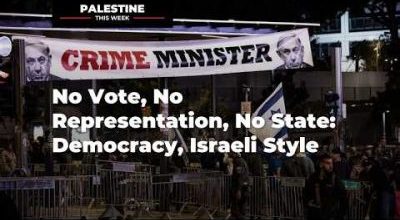
No Vote, No Representation, No State: Democracy, Israeli Style
or go to
Aletho News Archives – Video-Images
From the Archives
Sanctions, War and the Policy of Dual Containment
By SASAN FAYAZMANESH | March 17, 2008
It is now nearly three decades since the Unites States adopted the policy of dual containment of Iran and Iraq. While much has been written about the containment of Iraq, there has been very little in-depth analysis of this policy when it comes to Iran. In a book that is going to be released on March 31, 2008, entitled The United States and Iran: Sanctions, Wars and the Policy of Dual Containment (Routledge), I attempt to address this shortcoming by investigating when and why the US policy of containment of Iran came about, how it evolved, and where it stands today.[1] To the extent that Israel has been involved in US policy making, the study will also include the role that Israel has played in the containment of Iran. Also, since the fate of Iran has been inextricably linked to that of Iraq, occasionally the investigation will overlap with the containment of Iraq.
The policy of dual containment of Iran and Iraq originated during the Carter Administration, but it was not until the Clinton Administration that the expression “dual containment” became popular. … continue
Blog Roll
 Aletho News
- How Israel destabilizes the Middle East: Denying sovereignty and the right to exist
- Europe’s Establishment Is Embracing War – and Losing Voters
- NATO chief advocates war of aggression
- No Vote, No Representation, No State: Democracy, Israeli Style
- Zionist Bought Senate Blocks Information About American Citizens Killed By Israel
- While Gaza dominates the UN, these are the people keeping it alive
- New Report: “Scholasticide and Genocide in Gaza: Assessment, Testimonies and Legal Analysis”
- ‘THAAD Delusion’: Iran war exposes US missile shield limits – The Atlantic
- Moscow issues warning to NATO over Russian exclave
- Yes, the Iran war has destroyed Trump’s presidency
- If Americans Knew
- Israel map in LA Times ad includes all land from the river to the sea
- Inside Lebanon’s 200-page dossier on Israeli war crimes
- Flydubai, genocide, settler violence, Trump abuse of power to deport – Daily Update
- Counting Antisemitic Incidents: What the ADL Audit Reveals — and Obscures
- Mamdani releases plan to combat antisemitism and hate crimes in New York City
- Iran’s Revolutionary Guards Publish Letter to the American People
- DMFI launches $1 million ad campaign supporting Virginia’s Elaine Luria
- US Senate blocks resolution seeking report on Americans killed by Israel
- Israeli Attacks Kill Ten Palestinians in Gaza
- Massacre at Minab: The School That Became a Grave
- No Tricks Zone
- Green Energy Debacle: German Expert Professor Fritz Vahrenholt Warns Of Severe Economic And Social Consequences
- Two More Paleo Reconstructions Affirm Meters-Higher Sea Levels Across Ireland, Brazil 7000-6000 Years Ago
- New Study: Earth And Venus Surface Warmth Largely Explained By Convection And Lapse Rate, Not CO2 Or Radiation
- 2025 Nature Paper Claiming Worsening Global Drought Gets RETRACTED …Heavily Flawed
- New Study: ‘Global Drought Shows No Detectable Recent Acceleration Under Climate Warming’
- Economic Masterminds: German Socialists Suggest Taxing Productivity Gains Stemming From Using AI
- The South China Sea Has Not Been Cooperating With The Climate Change Narrative
- Energy Crisis: Germany Enters Heating Season With Historically Low Gas Reserve Fill Levels
- New Study: The Antarctic Ice Sheet Gained Mass From 2020-2024 Due To Staggering Snow And Ice Accumulation
- Study: Ocean Heating Rates From Thousands Of Years Ago ‘Dwarf’ Modern Ocean Heating Rates

