More than 390 educational institutes destroyed in Gaza
Press TV – January 18, 2024
The Palestinian resistance movement Hamas announced the destruction of more than 390 schools, universities, and educational institutions in over 100 days of brutal bombardment of the besieged strip by the Israeli regime.
In a press note issued on Thursday, the resistance movement said, “More than 390 schools, universities, and educational institutions have been destroyed in 100 days, the most recent of which was the bombing of Al-Isra University and the re-bombing of the Islamic University today.”
Hamas said that the destruction of school and university buildings in the Gaza Strip “is a war crime and criminal behavior aimed at destroying all components of human life…” The resistance group stated that Israel is deliberately targeting the education system to erode the national identity of Palestinians.
Calling on the United Nations and other human rights organizations to document and prosecute the regime for its crimes, Hamas said, “We affirm that our people, through their steadfastness, sacrifices, and resistance, will thwart these despicable plans to undermine the educational system and obliterate the deep-rooted national identity of our Palestinian people.”
Gaza’s Ministry of Education announced on Tuesday that 4,368 students have been killed while almost 8000 have been injured since the start of Israeli aggression on the Gaza Strip on October 7.
The number of teachers killed is 231 teachers with 756 injured.
Israel’s relentless bombardment has also targeted 65 schools affiliated with the United Nations Relief and Works Agency for Refugees (UNRWA).
As per the figures given by the Palestinian Health Ministry on Wednesday, the death toll from Israeli attacks on the Gaza Strip has surged to 24,448.
Israeli army blows up university in Gaza after 70 days of converting it into a military barracks

Palestine Information Center – January 18, 2024
GAZA – The Israeli occupation forces (IOF) blew up the building of Al-Isra University in Gaza after 70 days of occupying it and converting it into a military barracks and a detention center.
The university administration said in a statement on Thursday, “The IOF occupied the university building for seventy days, turning it into a military base and a center for sniping isolated civilians in the areas of Rashid Street, Al-Mughraqa, and Al-Zahra, as well as a temporary detention center for interrogating Palestinians, before detonating it.”
Israeli media outlets published a video documenting the moment the occupation forces detonated the main headquarters of Al-Isra University in the city of Al-Zahra, south of Gaza City, yesterday.
Israeli reserve soldiers refuse to fight in Gaza
The Cradle | January 18, 2024
About half the soldiers of an Israeli reserve battalion refused to fight in the Gaza Strip and were released from duty by their commander, Al-Arabi Al-Jadeed reported on 17 January.
The Qatari outlet cited Israel’s Kan Reshet Bet radio as reporting that reserve soldiers were called up to form a new brigade in the Israeli army to carry out protection tasks in the areas surrounding Gaza and the occupied West Bank. However, the soldiers received permission to leave the battalion after the army tried to send them to fight and carry out combat missions within Gaza for which they were not qualified or adequately equipped.
The soldiers were called up in late December, but the new brigade was poorly organized, did not have a deputy brigade commander, and was short on weapons and officers.
During the training period, soldiers complained of serious gaps in equipment, professionalism, and a lack of human resources.
The soldiers were then further angered to learn their mission had changed, and they would be sent to Gaza for combat missions.
The radio quoted one soldier as saying: “We received the conscription order, and we responded to that. They told us that our specialty would be to protect the towns, and after about a week of training that took place in a horrific manner, without ammunition, and without officers, we were suddenly told that there was an order that the Israeli army needed us to enter the Gaza Strip to clear homes.”
The soldier added, “We were shocked. We are all combat soldiers. I personally was in the Nahal Brigade, and the rest of the soldiers are from former infantry brigades, but we had not carried out reserve missions for years. We were given an M16 weapon, which fell apart in our hands, and there was no ammunition for training. We collected bullets off the ground so that we have something we can fire.”
The radio station quoted another soldier as saying, “There are people who trained without military uniforms. There are soldiers who were not given shirts or slippers at first. The means that were available were not suitable for training. The brigade, which was supposed to include four battalions, barely reached one and a half battalions. It is not understandable how they wanted to introduce such a completely unqualified force into the Gaza Strip.”
The report comes amid the announcement that the 36th division, which comprises armored, engineering, and infantry companies, withdrew from the Gaza Strip after 80 days of fighting.
The Israeli government says this is part of a planned transition away from the “intensive manoeuvring stage” of its Gaza military campaign to a more targeted phase to last until the end of this year.
At the same time, some speculate that Israel has been forced to withdraw some of its forces due to heavy losses inflicted by fighters from Hamas’ military wing, the Ezzedine al-Qassam Brigades.
Israel is also facing economic difficulties, with the government having to pay salaries for hundreds of thousands of reserve soldiers called away from their civilian jobs.
Israel also has large numbers of soldiers on the northern border to support operations against Hezbollah in Lebanon.
Israel’s army chief said Wednesday the likelihood of a full-scale war with the Lebanese resistance group has become “much higher.”
“I don’t know when the war in the north is, I can tell you that the likelihood of it happening in the coming months is much higher than it was in the past,” Israeli army chief Herzi Halevi said in a statement during a visit to northern Israel.
Gaza Testimony
Al-Haq | January 17, 2024
Journalist Dia Al Kahlout was arbitrarily arrested by the #Israeli Occupying Forces from his home in Beit Lahia & detained for 33 days.
Upon his release, family members of others arbitrarily detained desperately try to get information about their loved ones
Australia: ABC staff threaten strike after Arab journalist sacked

Award-winning journalist and author Antoinette Lattouf
MEMO | January 17, 2024
ABC journalists in the broadcaster’s Sydney offices yesterday threatened to strike unless management addresses concerns over the unlawful dismissal of radio host Antoinette Lattouf, Anadolu news agency reported.
The award-winning journalist and author, who is of Lebanese heritage, was sacked by ABC last month for sharing on Instagram a report by Human Rights Watch (HRW) on the besieged Gaza Strip.
The internationally-recognised rights watchdog released a report on how starvation was being used as “a weapon of war” by the Israeli government in Gaza. ABC also published a news item on the report.
On Tuesday, the Sydney Morning Herald revealed a leaked chain of WhatsApp messages from a group called Lawyers for Israel who had lobbied for Lattouf to be sacked.
“The ABC sacked broadcaster Antoinette Lattouf after a high-level and coordinated letter-writing campaign from pro-Israel lobbyists that directly targeted the corporation’s chair, Ita Buttrose, and managing director David Anderson,” the news daily said.
The report reveals that the Israeli lobby “repeatedly wrote to the ABC demanding Lattouf be sacked, and threatened legal action if she was not.”
Yesterday, about 80 ABC staff members demanded a meeting with Anderson, who is currently on leave.
They threatened to stage a walkout if their concerns were not addressed.
Lattouf has legally challenged her termination, saying she was sacked on the grounds of “political opinion or a reason that included political opinion” and later expanded the claim to include race, due to her Lebanese heritage.
While ABC has denied Anderson was behind Lattouf’s sacking, the broadcaster has told a court that the journalist was removed “because she ignored a direction from managers and shared a controversial social media post from Human Rights Watch.”
Lattouf demands a clear public apology, financial compensation and the offer of a proportionate position.
Hearings are scheduled to begin later this week.
In a statement to the Sydney Morning Herald, Lattouf’s lawyer, Josh Bornstein, said that after “October 7 and the ensuing conflict in the Middle East, it has become common knowledge in the media industry that Arab and Muslim journalists are being subjected to intimidation, censorship and expulsion.”
Republicans threaten to fire US federal workers if they oppose Israel genocide
MEMO | January 17, 2024
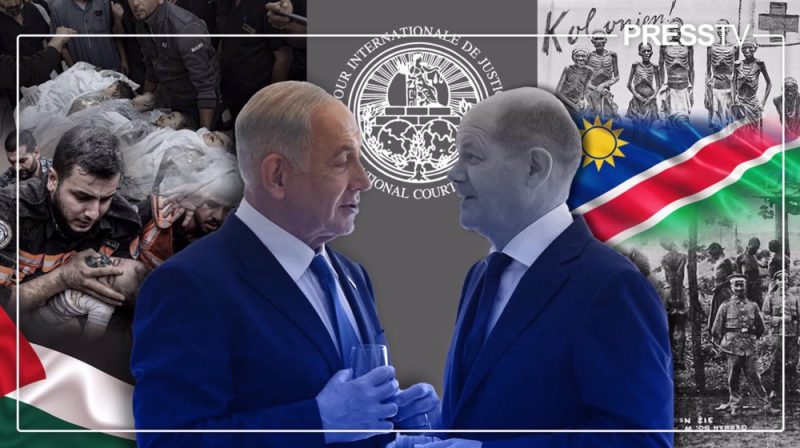
Germany considers delivery of tank ammunition to Israel amid genocidal Gaza war
Press TV – January 17, 2024
Germany’s government is considering the delivery of tank ammunition to Israel amid genocidal war against Gaza, the German magazine Der Spiegel has reported, as Western governments keep on backing the Tel Aviv regime for its ongoing massacre.
Israel requested Germany in November to approve the delivery of around 10,000 rounds of 120-millimeter precision ammunition manufactured by Rheinmetall, the report said.
The departments involved have already fundamentally agreed behind the scenes to fulfill a request from the Israeli government.
The Israeli ambassador to Germany, Ron Prosor thanked the German government for its unrelenting support it has shown.
“Since October 7, Germany has unmistakably stood by Israel and expressed its unreserved support,” Prosor told Der Spiegel. “Israel thanks Germany for this,” he added.
The German Chancellor Olaf Scholz emphasized that arms deliveries were also possible.
According to the report, in order to promptly address the request, there is consideration being given to releasing ammunition from the stocks of the German army as the industry is unable to provide the desired precision ammunition immediately.
In November apart from Germany, Israel had also asked other partners for military aid because of its heavy use of ammunition against the Gazans.
US President Joe Biden approved the delivery of 14,000 rounds of tank ammunition for almost $106 million at the beginning of December, after he bypassed Congress.
The Western-backed Israeli genocide in Gaza has been escalating because of the continuous support of Western governments, as they have been persistently arming Israel and supporting the regime with large amounts of funds.
Israeli war on Gaza was a high-risk gamble that proved a failure: Analyst
By Alireza Hashemi | Press TV | January 16, 2024
The Israeli genocidal war on Gaza was a high-risk gamble that eventually proved a failure, and the rising direct and indirect costs of the war make it difficult for the regime to sustain it, says an analyst.
Mohammad Sadeq Koushki, a Tehran-based political and foreign affairs commentator, in a conversation with the Press TV website, said the Israeli regime has encountered staggering losses with its onslaught on Gaza, which makes it hard for Israeli officials to keep fanning its flames.
“This war is unequal in many aspects. The biggest difference is that the Palestinian side has nothing to lose, and nowhere to go. They have no option but to defend themselves and to continue the war for as long as it takes,” he said, referring to the Palestinian resistance’s upper hand over the occupation.
“But on the other hand, the Zionists have a lot to lose. Those still living in the Israeli-occupied territories went there in the hope that they would have a better life there. Now that doesn’t exist and people are losing their motivation to remain in the occupied lands and have decided to leave.”
Koushki said the indirect costs of the war are also taking a heavy toll on the regime’s economy.
“It’s not just ordinary people leaving. Investors are also leaving. The skilled workforce who went there from Europe and the US are also leaving. Tourists are also afraid of visiting the region,” he noted.
“Reservists, who were summoned by the regime, have also left their jobs. For the first time, a huge population has been displaced, and the regime has to pay for their living expenses.”
Staggering cost of war
He said the Benjamin Netanyahu-led regime has been spending 200 to 250 million dollars per day on the war while continuing to lose their troops and tanks and military vehicles.
“It was a high-risk gamble from the beginning and it has failed. It’s the Zionist settlers who have to pay for this failure. Netanyahu is doing this at their expense. And the costs are rising fast,” Koushki said.
This week, the genocidal war launched by the Israeli regime on Gaza on October 7 completed 100 days, leaving almost 24,000 Palestinians dead, the majority of them children and women.
Despite the high casualty toll in Gaza, the Palestinian resistance groups backed by the people of Palestine have refused to retreat or surrender, or even leave the besieged territory.
According to political pundits, the regime failed to achieve any of its stated objectives of the war.
Of late, the Israeli military claimed that it has shifted to “a new phase” of the war, which it says is focused on the southern part of the blockaded territory.
There have also been reports of Israeli military regiments abandoning northern Gaza without managing to eliminate the Hamas resistance group or destroy its infrastructure.
Israel can’t crush resistance
Israeli premier Benjamin Netanyahu has repeatedly rejected international calls for a humanitarian ceasefire in Gaza, vowing that “no one will stop us” from eliminating the Hamas movement.
Israeli officials say the regime will keep going for months or even years until it achieves its stated goals.
Koushki said Hamas is a manifestation of Palestinian resistance and Israel has never been able to eliminate this resistance throughout the past 75 years of its occupation.
“Hamas is nothing to be destroyed. From the 1990s onwards, hundreds of Hamas commanders were assassinated. The most important leaders. What happened to Hamas,” he asked.
“Even if Israel gets all of Hamas members in Palestine and executes every single one of them, the next generation of Palestinians will be the new Hamas. They can’t eliminate the resistance.”
On calls by various Israeli regime officials for Gazans to be “encouraged” to leave the region, Koushki asserted that Israel’s forced displacement plan is not feasible.
‘Zionists feel cornered’
On recent Israeli attacks inside Syria and Lebanon, which led to the martyrdom of several commanders of the resistance front, including Iran’s Sayyed Razi Mousavi, Koushki said it won’t help the regime.
“Even if Israelis attack Syria or Lebanon 10 times a day, or assassinate five resistance commanders each day, it doesn’t change anything on the ground in Gaza and doesn’t make up for Israel’s huge losses.”
When asked about the effectiveness of attacks by Lebanese, Iraqi, and Yemeni resistance groups against Israeli interests, Koushki highlighted the significant psychological impact of these strikes.
“Those living in the occupied territories feel they’re cornered and this places a huge pressure on them. They feel they’re being attacked from all directions. This is the first time that all occupied territories are insecure. From Eilat in the south to Galilee in the north to even central regions. People feel they don’t belong to this region,” the Iranian analyst told the Press TV website.
Asked whether the US and its allies can deter further anti-Israel operations by the Yemeni military, the analyst said the recent attacks on Yemen have not degraded their capability to attack Israel.
“The point is that Yemenis have imposed a semi-blockade on Israel. Did these attacks stop Yemen from targeting Israel-linked ships? Yemenis have conducted attacks against those ships even after the recent US-UK attacks. So they couldn’t stop Yemen and it’s very hard to believe they can do that shortly.”
South Africa’s genocide case
On South Africa’s genocide case against Israel, he said the regime is unlikely to abide by any ICJ verdict but it would significantly boost the pro-Palestine movement worldwide.
“Israel defied numerous UN resolutions and disregarded the 2004 ICJ ruling on the separation wall. This genocide case would be no exception. But Israel’s flouting of laws will only solidify its status as a pariah in the eyes of its backers in the West and further mobilize global public opinion against the regime.”
How far will complicity reach in Israel’s genocidal offensive in Gaza?
By Ramona Wadi | MEMO | January 16, 2024
If we were to listen to Israeli Prime Minister Benjamin Netanyahu, the definition of genocide would be altered, because Israel’s definition of its genocidal intent and actions were summed up by him as “a moral and just war” waged by the settler-colonial enterprise and the Israeli military. “This international defamation campaign will not weaken our hands or weaken our determination to fight to the end,” Netanyahu asserted. Until what end? The complete ethnic cleansing of Gaza?
At the International Court of Justice (ICJ) last week, Israel played its fabricated security narrative to the full, and unsurprisingly blamed Hamas for the thousands of Palestinians injured and killed by Israeli air strikes. The apartheid state also played the humanitarian card, despite starvation being one of the tactics used to annihilate the Palestinian population. Humanitarian corridors have been bombed, food aid has been prevented from entering Gaza and, on occasions where delivery was possible, the provisions were meagre in comparison with the scale of deprivation as a result of Israel’s dealing of death and destruction. Not to mention Israeli soldiers firing upon Palestinian civilians as they crowded around to get aid. Or children collecting flour that had been spilled on the ground. Genocide is not a fabrication — or a “defamation campaign” as Netanyahu would have us believe – and Israel, of course, has perfected its methods.
However, not even Israel believes its own lies, let alone the rest of the international community.
Alliances and complicity are what Israel relies on, though. It is allowed to retain control over its security narrative because ties run deep and dependence upon Israel’s military technology is the major weakness of too many governments. So much so, in fact, that the Jerusalem Post is marketing Israel’s weaponry which it has used in Gaza. As if to inaugurate the “100 days of the Israel-Hamas war” – Israel’s euphemism for genocide – a recent article lists Israel’s new weaponry and medical supplies for the military. With emphasis on precision targeting and mortars with “improved accuracy… for use against terrorists in crowded areas”, perhaps Israel can explain why precision targeting increases the death toll of Palestinian civilians, unless Israel is precisely targeting civilians. This is beside Israel’s assertion that it also used unguided bombs, “the goal being more attacks in fewer flights”. The Jerusalem Post notes that, “Israel is the first country to use them in operational activity.” Whatever Israel uses, precision strikes or unguided bombs, civilians have been targeted in a strip of land in which nowhere is safe and the only way out is forced transfer, a preference which Israeli leaders only stopped touting as the ICJ hearing loomed closer.
There is no defamation campaign against Israel. The settler-colonial state has boasted of its intent to annihilate Palestinians in Gaza and carried out genocidal actions that prove the intent. What is more, it has already boasted of its own impunity at the ICJ when it stated that a court order granting the requested provisional measures to stop the genocide would “ensure that Israel will be in breach of it as soon as it is made.” The underlying tone is that Israel will not be stopped from committing genocide because Israel deems itself above international laws and conventions. If the international community fails to stop this rogue state, a new level will be ushered in with regard to impunity and complicity in genocide.
Bypassing the UK parliament; the royal prerogative; and bombing Yemen
By Binoy Kampmark | MEMO | January 16, 2024
There is something distinctly revolting and authoritarian about the royal prerogative. It reeks of clandestine assumption, unwarranted self-confidence and, most of all, a blithe indifference to accountability before elected representatives. That prerogative, in other words, is the last reminder of divine right, the fiction that a ruler can have powers vested by an unsubstantiated deity, the invisible God, and a punishing force beyond the reach of human control. And that such powers can in turn be vested in the government of the day. It is anathema to democracy, a stain on republican models of government, a joke on any political system that has some claim on representing what might be called the broader citizenry.
The UK government, in league with the US and with support from a number of other countries, attacked Houthi positions in Yemen on 11 January. The decision was made without recourse to parliament and was justified by reference to Article 51 of the UN Charter as “limited, necessary and proportionate in self-defence”.
In his statement on the attacks, Prime Minister Rishi Sunak pointed to the Houthi’s role in staging “a series of dangerous and destabilising attacks against commercial shipping in the Red Sea, threatening UK and other international ships, causing major disruption to a vital trade route and driving up commodity prices.” He made no mention of the Houthis’ own justification for the attacks as necessary measures to disrupt Israeli shipping and interests in response to their systematic, bloodcurdling razing of the Gaza Strip.
Lip service has been paid by the executive within Westminster to parliament’s importance in deciding whether the country commits to military action or not.
The stark problem is that the action is always decided upon in advance, and no dissent among parliamentarians will necessarily sway the issue. Motions can be proposed and rejected but remain non-binding on the executive emboldened by the royal prerogative.
The British decision to commit to the egregious invasion of Iraq in 2003 was already a foregone conclusion, despite preliminary debates in the House of Commons and huge public protests against the measure. On 18 March, 2011, the then British Prime Minister David Cameron informed the Commons of his intention to attack Libya, leading to a government motion on 21 March that the chamber “supports Her Majesty’s Government… in the taking of all necessary measures to protect civilians and civilian-protected measures.”
That same year, the then Conservative-Liberal Democrat coalition government in the UK acknowledged that a convention had crystallised in parliament that the House of Commons should be availed of “an opportunity to debate the matter [of committing troops] and said that it proposed to observe that convention except when there was an emergency and such action would not be appropriate.”
The broadly worded nature of the caveats – in cases of emergency or when it would not be appropriate – have made something of a nonsense of the convention. In April 2016, Defence Secretary Michael Fallon made much of the “exception”, arguing that it was “important to ensure that this and future Governments can use their judgment about how best to protect the security and interests of the UK.”
Parliament, in short, should be put in its place when necessary. Governments, it is reasoned, know best when it comes to matters of national security; parliamentarians less so. “In observing the Convention,” Fallon goes on to explain, “we must ensure that the ability of our Armed Forces is to act quickly and decisively, and to maintain the security of their operations, is not compromised.” In such cases, matters could be dealt with retrospectively, with the government of the day subsequently informing parliament after the fact.
An example of this absurd policy was played out in the decision by the UK government in April 2018 to target the Assad regime’s chemical weapons facilities in Syria. Hiding behind the weasel claim of humanitarianism, the explanation for avoiding parliament was shoddy and leaden. “It was necessary,” came the explanation from the PM’s office, “to strike with speed so we could allow our Armed Forces to act decisively, maintain the vital security of their operations, and protect the security and interests of the UK.”
The Yemen strikes eschew humanitarianism (the humanitarian justifications advanced by the Houthis in protecting Palestinian civilians has been rejected), but, in any case, shipping interests take priority. Armed Forces Minister James Heappey, apparently, was satisfied that an exception to the convention to consult parliament had presented itself. “The prime minister,” the minister parroted, “needs to make decisions such as these based on the military, strategic and operational requirements. That led to the timing.”
With the horse having bolted merrily out of the stable, Heappey remarked with all due condescension that parliament would, in time, be able to respond to the decision to strike Yemen. An “opportunity” would be made available “when parliament returns for these things to be fully discussed and debated.” The sheer redundancy of parliament’s role in matters of state, and that of MPs, could thereby be affirmed.
Much agitated by this state of affairs, former Shadow Chancellor John McDonnell opined that no military action should take place without parliament’s approval. “If we have learnt anything in recent years it’s that military intervention in the Middle East always has dangerous and often unforeseen consequences,” said McDonnell. “There is a risk of setting the region alight.”
Liberal Democrat Foreign Affairs spokesperson Layla Moran was of the view that parliament should not be bypassed in matters of war, yet opted for the rather fatuous formula arising out of the 2011 convention. “Rishi Sunak must announce a retrospective vote in the House of Commons on these strikes, and recall parliament this weekend,” she said.
The use of the royal prerogative in authorising military action remains one of those British perversions that makes for good common room conversation but offends the sensibilities of the democratically minded elector. A far better practice would be to make the PM of the day accountable to that most essential body of all: parliament. That same principle would be extended to other constitutional monarchies, which are similarly weighed down by the all too liberal use of the prerogative when shedding blood. If a country’s citizens are to go to war to kill and be killed, surely their elected representatives should have a say in that most vital of decisions?
Reviving ISIS: A US weapon against the Resistance Axis
The Cradle | January 16, 2024
Iraqi security sources are warning of an ISIS revival in the country, which coincides all too neatly with the spike in Iraqi resistance operations against US bases in Iraq and Syria, and with widening regional instability caused by Israel’s military assault on Gaza.
More than six years after declaring victory over the terrorist organization, Iraqi intelligence reports now indicate that thousands of ISIS fighters are emerging unscathed, under the protection of US forces in two regions of western Iraq.
The missing piece of the puzzle
According to intelligence reports reviewed by The Cradle, at its height, ISIS consisted of more than 35,000 fighters in Iraq – 25,000 of these were killed, while more than 10,000 simply “disappeared.”
As an officer of one Iraqi intelligence agency recounts to The Cradle :
“Hundreds of ISIS fighters fled to Turkey and Syria at the end of 2017. After the appointment of Abdullah Qardash as the leader of ISIS in 2019, following the death of Caliph Abu Bakr al-Baghdadi, the new Caliph began to restructure the organization, and ordered his followers to return to Iraq. The organization exploited the long border with Syria, the security disturbances, and the diversity of forces on both sides of the border to infiltrate the Iraqi territory again.”
Imprisoned ISIS officials admit that infiltrating that border is not an easy task, because of the strict control imposed by the Iraqi Border Guards and the use of modern technologies, such as thermal cameras.
It therefore became necessary for the terror group to identify intermediaries capable of breaking through or bypassing these fortifications to transport its fighters across borders.
An Iraqi security source, insisting on anonymity, tells The Cradle that the US plays a vital role in enabling these border violations:
“[There are] several incidents that confirm the American assistance in securing the crossing route for ISIS members – mainly, by shelling Iraqi units on the border, especially the Popular Mobilization Units (PMUs), to create gaps that allow ISIS fighters to cross the border.”
The Iraqi security source adds that there are confirmed reports of US Chinook helicopters transporting fighters from eastern Syria to the Anbar desert in western Iraq and Jebel Hamreen, in the country’s east.
Munir Adib, a researcher specializing in Islamist movements, extremist organizations, and international terrorism, confirms the possibility of the return of ISIS after the organization’s “dozens of attacks in Syria and Iraq in the past few weeks,” which led to the death of tens of civilians and soldiers.
According to Adib, “the international community’s preoccupation with the Gaza and Russia-Ukraine wars gave ISIS an opportunity to reorganize its ranks, while continuing to receive internal and external logistical support.”
Manufacturing and harboring terrorism
Houran Valley is the largest of its kind in Iraq, extending 369 kilometers from the Iraqi-Saudi border to the Euphrates River near the city of Haditha in Anbar Governorate. Its topography is marked by soaring cliffs ranging in height between 150 to 200 meters, and includes the hills surrounding the valley and the sub-valleys that extend into its surroundings.
The valley was and still is one of the most dangerous security environments in the state. Terrorist groups use it as a safe haven because of its desert terrain, and distance from congested urban areas. The valley and its environs have witnessed numerous security incidents, most notably in December 2013, when ISIS killed the commander of the Iraqi army’s Seventh Division, his assistant, the director of intelligence in Anbar Governorate, eight officers, and thirteen soldiers.
Iraqi MP Hassan Salem has called for launching a military operation to clear Houran Valley of terrorist fighters. He confirmed to The Cradle that “there are thousands of ISIS members in the valley receiving training in private camps, under American protection,” noting that US forces have “transferred to this area hundreds of ISIS members of different nationalities.”
US foreign policy, of course, is rife with historical evidence of the creation of proxy armed militias in West Asia and Latin America, often utilizing these organizations to overthrow governments in target countries. We know Washington has no aversion to allying with Islamist extremists largely because of its direct involvement with arming and financing the Afghan Mujahideen, from which the Taliban and Al Qaeda emerged.
An early US-ISIS connection exists quite clearly: the terrorist group’s founding and second rank leaders were among the inmates of Camp Bucca prison in southern Iraq, an internment facility run by the US military. The roster of high-value terrorists captured, then set free by the Americans is quite extraordinary: ISIS leader Abu Bakr al-Baghdadi, his successor Abu Ibrahim al-Hashimi al-Qurashi, Abu Mohammed al-Adnani, Abu Muslim al-Turkmani, Haji Bakr, Abu Abdulrahman al-Bilawi, Abu Ayman al-Iraqi, among others.
Camp Bucca, known for abuses against its detainees, brought together extremist elements, slow-boiled this combustive formula for six years (2003-2009), then let the now well-networked extremists go free.
The religious officials of ISIS even say they used their time at the prison to obtain vows from prisoners to join the terrorist group after their release.
US intelligence also protected the terrorist organization indirectly, by allowing ISIS convoys to move between the cities that were under its control. Other forms of protection, according to Iraqi security experts, include refusing to implement death sentences issued by Iraqi courts against detained ISIS members, and establishing safe havens for the organization’s members in western and eastern Iraq.
ISIS: US foot soldiers in the regional war
In a speech on 5 January, Hezbollah Secretary General Hassan Nasrallah warned that the US was supporting an ISIS revival in the region.
The Cradle obtained security information monitoring the new activity of extremists in Lebanon, communications between these elements and their counterparts in Iraq and Syria, and suspicious money transfer activities among them.
Lebanese Army Intelligence also recently arrested a group of Lebanese and Syrians who were preparing to carry out security operations.
Importantly, this surge in terror activities comes at a time when the Lebanese resistance is engaged in a security and military battle with Israel, which may expand at any moment into open war. It is also notable that renewed ISIS activity is concentrated in Lebanon, Syria, Iraq, and Iran; that is, in the countries that support the Palestinian resistance politically, militarily, and logistically.
On 4 January, ISIS officially claimed responsibility for two bombings in the Iranian city of Kerman that targeted memorial processions on the anniversary of the assassination of Quds Force Commander Qassem Soleimani by US forces. The dual explosions killed around 90 people and injured dozens, in an unprecedented attack targeting the biggest US-Israeli adversary in West Asia – just one day after Tel Aviv killed top Hamas leader Saleh al-Arouri in Beirut.
Before that, on 5 October 2023, ISIS drone-attacked an officers graduation ceremony at the Military College in the Syrian city of Homs, killing about 100 people. These attacks, and others in Iraq, Syria, Iran, Pakistan, Afghanistan, and Africa, indicate that fresh blood, money, and weapons are being pumped into the ISIS organization’s arteries again.
A high-ranking PMU officer, who asked to remain unnamed, tells The Cradle that US forces are preventing Iraqi forces from approaching Houran Valley by attacking any security forces approaching the area. “This happened when American aircraft targeted units of the PMU that were attacking ISIS in the region,” he reveals, citing intelligence reports confirming the presence of dozens of ISIS members and other extremist organizations in the valley, where they receive training and equipment from US forces.
Security sources in the Anbar Operations Command confirm this information:
“Noticeable activity by the organization had been recorded a few weeks ago in the west of the country. Near the Rutba desert, ISIS fighters were spotted digging underground hideouts. Information indicates that the organization is in the process of carrying out terrorist operations in many locations,” they tell The Cradle.
Concurrently, ISIS is expanding its operations in the east of Iraq, within the geographical triangle that includes eastern Salah al-Din Governorate, north-eastern Diyala, and southern Kirkuk, particularly in the geographically challenging Makhoul, Hamrin, Ghurra, Wadi al-Shay, and Zaghitoun areas.
It should be noted that US forces are deployed in Iraq under the umbrella of the International Coalition to Combat ISIS. Last week, four years after the Iraqi parliament first voted to expel foreign forces, Iraqi Prime Minister Mohammad Shia al-Sudani weighed in on the “destabilizing” impact of US troops and demanded a “quick and orderly” exit of those combat units.
Washington not only countered by saying it has “no plans” to withdraw from Iraq, but announced on 14 January that it would be sending an additional 1,500 troops to Iraq and Syria illegally, and without the consent of either nation.
One irony here is that ISIS appears to regain momentum each and every time Baghdad raises the issue of US military withdrawal from Iraq.
It can also no longer be seen as a coincidence that the terror group is now re-assembling its forces to target Washington and Tel Aviv’s most capable regional foes – the Axis of Resistance – just when the US and Israel are struggling to handle a region-wide, multi-front assault from the Axis.
The extraordinary synergies between the Americans and the world’s foremost terror group can no longer be ignored: their targets are one and the same, and ISIS is only now entering the fray, just as Washington begins to lose its hold on West Asia.
China Slams US, Issues Statement With Arab League Calling for Gaza Ceasefire
Sputnik – 16.01.2024
“The US, which is pouring fuel on the fire in the Israel-Palestine conflict, also wants to play the role of fireman,” read an article in Chinese media criticizing America’s “unconditional support for Israel.”
China released a joint statement with Arab League nations Sunday urging a ceasefire in Gaza and advocating a two-state solution to resolve the long running Palestine-Israel conflict.
The resolution emerged after Chinese Foreign Minister Wang Yi met Arab League Secretary-General Ahmed Aboul-Gheit in Cairo, Egypt.
The statement called for dialogue with Palestinian groups and a global peace conference to move towards implementing a two-state solution, advocating a “government of Palestine for the Palestinians.” The leaders urged the full implementation of resolutions passed by the United Nations which have long criticized the Israeli occupation of internationally-recognized Palestinian territory. The United States typically uses its influence and position on the UN Security Council to block and undermine resolutions criticizing Israel’s conduct.
The leaders also promoted the resumption of direct peace talks between the Israeli and Palestinian sides.
The statement then touched on recent US and UK-backed airstrikes against the Houthi movement in Yemen, which Chinese media criticized as an “escalation” of the situation and an attempt to distract from the broader conflict. Chinese media called for the respect of the “sovereignty and territorial integrity of Yemen,” a critique of the airstrikes that it noted lacked authorization by the UN.
Finally, China called for the sending of humanitarian aid to Palestinians, which it labeled an “imperative moral responsibility.” China insisted that the only way to ultimately safeguard commercial interests in the Red Sea is to achieve “a just settlement of the Palestinian issue.”
“We have a common responsibility to ensure the security of the Red Sea, and we will not be deceived by the US to fuel such tensions,” said Li Weijian, a researcher at the Shanghai Institutes for International Studies.
China and Arab League countries also vowed to move forward on economic cooperation via China’s Belt and Road initiative during the meeting.
Featured Video
10K More U.S. Troops Deploy as Trump Weighs New Iran Strikes
or go to
Aletho News Archives – Video-Images
From the Archives
Genetic baloney in thick slices
MAYBE COULD BE INC.
By Jon Rappoport | No More Fake News | July 8, 2021
Gene research companies tend to come and go. They start out banging and popping like fireworks in the sky, and then they fade out—selling themselves to larger outfits who’ve hired better liars…
Once upon a time, it sounded easy. Start with a disease, find the gene responsible for the disease, and correct the problem.
Then, researchers wondered, was disease the result of one gene or a group of genes acting together?
Either way, the proof would be in devising cures for diseases using gene therapy. “Not yet, but soon…”
And regardless, the major need was: money. Lots and lots of money.
This need required good PR people. “We have to pump up the idea that we’re on the edge of tremendous breakthroughs. We’re always on that edge…”
This hype also needed to obscure the fact that there wasn’t (and isn’t) ANY gene cure for ANY disease. … continue
Blog Roll
 Aletho News
- US military withdrawal from Iraq and the collapse of US-Israeli hegemonic project in West Asia
- What does Europe want – a war with Russia?
- She Followed the Actual Data on COVID Vaccines and Masks — Her Career Took a Huge Hit
- Florida AG Sues Pfizer, Bourla Over Deceptive Marketing of COVID Vaccines
- Von der Leyen gifts her spin doctor a job for life
- 10K More U.S. Troops Deploy as Trump Weighs New Iran Strikes /Suliaman Ahmed
- Iranian crew declared Dena training vessel ‘unarmed’ to US warship before deadly torpedo strike: Report
- Iran’s NPT debate moves beyond parliament
- Houthis condemn Saudi claims of attack on Medina
- Fatuous False Flags
- If Americans Knew
- Israel is squeezing the life out of Palestinians – Daily Update
- The Israeli Right Portrays Islam as Murderous. It Serves a Political Purpose
- Jordan Has Had Enough: King Abdullah’s Scathing Warning to Israel
- Israeli Colonizers (i.e. Settlers) Kill Palestinian Man Near Salfit
- New Google Maps images reveal massive scale of devastation in Gaza
- Jewish supremacy, anti-Palestinian bigotry on display in Israel – Daily Update
- Israeli Soldiers Abduct At Least 22 Across Occupied West Bank
- Eight Palestinians Killed in Israeli Attacks on Gaza
- Israeli former leaders and security chiefs threaten legal action over ‘Jewish terrorism’
- Israel map in LA Times ad includes all land from the river to the sea
- No Tricks Zone
- Green Energy Debacle: German Expert Professor Fritz Vahrenholt Warns Of Severe Economic And Social Consequences
- Two More Paleo Reconstructions Affirm Meters-Higher Sea Levels Across Ireland, Brazil 7000-6000 Years Ago
- New Study: Earth And Venus Surface Warmth Largely Explained By Convection And Lapse Rate, Not CO2 Or Radiation
- 2025 Nature Paper Claiming Worsening Global Drought Gets RETRACTED …Heavily Flawed
- New Study: ‘Global Drought Shows No Detectable Recent Acceleration Under Climate Warming’
- Economic Masterminds: German Socialists Suggest Taxing Productivity Gains Stemming From Using AI
- The South China Sea Has Not Been Cooperating With The Climate Change Narrative
- Energy Crisis: Germany Enters Heating Season With Historically Low Gas Reserve Fill Levels
- New Study: The Antarctic Ice Sheet Gained Mass From 2020-2024 Due To Staggering Snow And Ice Accumulation
- Study: Ocean Heating Rates From Thousands Of Years Ago ‘Dwarf’ Modern Ocean Heating Rates

