Col Douglas Macgregor: Pressure to REMOVE TRUMP FROM OFFICE Growing
Daniel Davis / Deep Dive – June 23, 2026
Mario Nawfal | June 23, 2026
Daniel Davis / Deep Dive – June 23, 2026
Daniel Davis / Deep Dive – June 23, 2026

The Cradle | June 23, 2026
A report issued by the UN Independent International Commission of Inquiry on the Occupied Palestinian Territory on 23 June found that Israeli troops are deliberately targeting Palestinian children in Gaza and the occupied West Bank as a central element of their ethnic cleansing campaign.
“The evidence shows that Palestinian children have been deliberately targeted and killed by the Israeli security forces,” said Srinivasan Muralidhar, chair of the commission.
He added, “Even after the October 2025 ceasefire, children continue to be killed and seriously injured, with continued disregard by Israel for the ceasefire and for the protection owed to Palestinian children under international law.”
The independent commission noted that the systematic targeting of Palestinian children by Israeli forces has inflicted profound, irreversible devastation.
These deliberate atrocities are characterized by mass trauma, physical disability, starvation, and the deliberate destruction of healthcare, education, and maternity services, including the dismantling of orphanages.
Beyond the immediate violence, children face arbitrary detention, torture, and sexual violence, all of which are utilized to erode the foundational structure of Palestinian society.
This intergenerational assault aims to dismantle the demographic vitality of the Palestinian people, creating an “occupied psyche” that strips children of their safety, development, and hope for a future.
Doctors from various international backgrounds have provided detailed accounts of treating Palestinian children who were deliberately targeted by Israeli snipers, describing a “steady stream” of non-combatants with single, high-caliber gunshot wounds specifically to the head or chest.
The inquiry found that children accounted for roughly 30 percent of all those killed during the genocide in Gaza.
The figure, however, likely underestimates the actual toll, as thousands remain buried under an estimated 61 million tons of debris.
While the Gaza Health Ministry has officially recorded approximately 72,000 deaths, experts believe between 10,000 and 14,000 additional bodies are trapped beneath the ruins of homes, schools, and hospitals.
Independent research teams suggest the total death toll, when accounting for the indirect effects of infrastructure collapse, malnutrition, and disease, may exceed 600,000.
Recovery efforts in Gaza are being systematically obstructed by a blockade on essential heavy machinery and forensic supplies.
Evidence of explicit “shoot to kill” military directives suggests that the high civilian death toll is a result of calculated and indiscriminate lethal force.
Israeli soldiers have testified to receiving orders to kill any male encountered, regardless of age or whether the individual was armed, and in some instances shot while waving white flags and shirtless.
MEMO | June 23, 2026
Israel is not part of the negotiations between the US and Iran and will continue its offensive on Lebanon until Hezbollah is “fully dismantled,” not just disarmed, Israeli Finance Minister Bezalel Smotrich said.
Smotrich, a far-right extremist member of Israel’s security cabinet, made the remarks Tuesday morning in an interview with Israeli Army Radio.
“Israel is not part of the negotiating talks with Iran by choice,” he said, adding: “We will not hold talks with the devil.”
“We are not a party to the negotiations between the United States and Iran, and they do not concern us at all,” Smotrich said.
“We will continue operating in Lebanon fully,” he added.
“The Israeli army will not withdraw from the security zone in Lebanon, including the Beaufort Castle, as long as Hezbollah exists,” he said.
“We will not withdraw not only until Hezbollah gives up its weapons, but until it is fully dismantled,” he continued.
“We do not only want Hezbollah to be stripped of its weapons, but to be fully dismantled, not be part of the government in Lebanon, and not have any military force that threatens Israel,” he said.
The remarks come amid growing disputes within Israeli political and security circles over a memorandum of understanding between the US and Iran and their possible implications for ending the war on the Lebanese front.
On Monday, Israeli Prime Minister Benjamin Netanyahu, Defense Minister Israel Katz and army chief Eyal Zamir vowed in a joint statement to continue controlling the “security zone” in southern Lebanon, despite the memorandum of understanding signed between the US and Iran, which calls for respecting Lebanon’s unity and territorial integrity.
“The [army] will continue to act decisively to thwart threats to our soldiers and civilians, destroy terror infrastructure, and continue maintaining the security zone in southern Lebanon,” according to the statement.
“The security of Israel’s civilians and IDF troops will continue to remain before their eyes without compromise,” it added.
Israel received a message from the US in recent weeks that “the previous authorization for unrestricted action in Lebanon had expired,” Israel’s Channel 13 quoted an unnamed senior Israeli official Monday.
The Hebrew newspaper Maariv also reported Monday that there are differences between the US and Israel over the Lebanon file.
It also reported growing differences between the US and Israel over the Lebanese file, saying Washington views southern Lebanon within a broader regional framework linked to the Strait of Hormuz, energy prices, the Iranian nuclear issue and the Trump administration’s pursuit of a diplomatic achievement.
In contrast, Israel believes that any early withdrawal from southern Lebanon could be interpreted as a sign of weakness and a reward for the Hezbollah group.
Israel and Lebanon are set to hold a fifth round of direct negotiations in Washington on Tuesday. The upcoming talks follow four previous rounds between the two sides that began in April as part of a track aimed at ending the Israeli war in Lebanon.
The US-mediated negotiations come as criticism grows inside Israel over Washington handling of talks with Iran and Hezbollah.
Israeli news site i24NEWS, citing Israeli officials, said Tel Aviv fears that an agreement between the US and Iran could strengthen Tehran and its allies in the region.
Israeli attacks in Lebanon have killed more than 4,100 people and injured over 12,000 others since March 2, according to official Lebanese figures.
Israel continues to occupy areas in southern Lebanon, some held for decades and others seized during the 2023–2024 war.
Al Mayadeen | June 23, 2026
Two people were killed and a third was injured on Tuesday by gunfire from Israeli forces in southern Lebanon, according to the official National News Agency (NNA).
In detail, the NNA reported that two young men were martyred and a third was wounded when Israeli army soldiers opened machine-gun fire toward them near a bulldozer working to open a road in the Deir neighborhood of the town of al-Nabatieh al-Fawqa.
This marks the first Israeli violation of the ceasefire that results in casualties since it was announced on Sunday, amid the memorandum of understanding between Iran and the US, with Article 1 explicitly stipulating an end to Israeli attacks on Lebanon and the full withdrawal of Israeli troops.
Separately, Israeli occupation forces carried out a drone strike on the town of Kfar Tibnit in the Nabatieh district, while also dropping sound bombs over the town, according to local sources.
In the Bint Jbeil district, an Israeli drone dropped two sound bombs in the towns of Baraachit and Ayta al-Jabal, while in the town of Hadatha, Israeli forces set fires at its outskirts before withdrawing toward the town square.
Ceasefire comes as Iran demands adherence
Continued pressure from the Iranian negotiating delegation since Saturday afternoon has contributed to maintaining a fragile ceasefire in Lebanon for the time being. This came after Iran closed the Strait of Hormuz in response to continued Israeli attacks and massacres in South Lebanon, which breached the provisions of the memorandum signed with the United States.
Meanwhile, a source close to the White House was quoted as saying that an American request for Israeli troop withdrawal from southern Lebanon is “only a matter of time,” warning that such a move would present “extreme difficulty” for Netanyahu and his government.
Currently, the Israeli occupation is considering announcing limited withdrawals from parts of Lebanese territory it occupies, a source familiar with the discussions told CNN.
The reported proposal would involve what the source described as “symbolic” redeployments from minor positions beyond the so-called “Yellow Line”, an area of land within Lebanese territory that “Israel” occupied after the November 2024 ceasefire with Lebanon, and which “Israel” has repeatedly refused to surrender.
According to CNN, the proposal has been discussed ahead of three days of US-sponsored talks between Lebanese and Israeli representatives. However, the move comes as Iran has rejected moving forward with the MoU with the US unless a ceasefire is achieved in Lebanon.
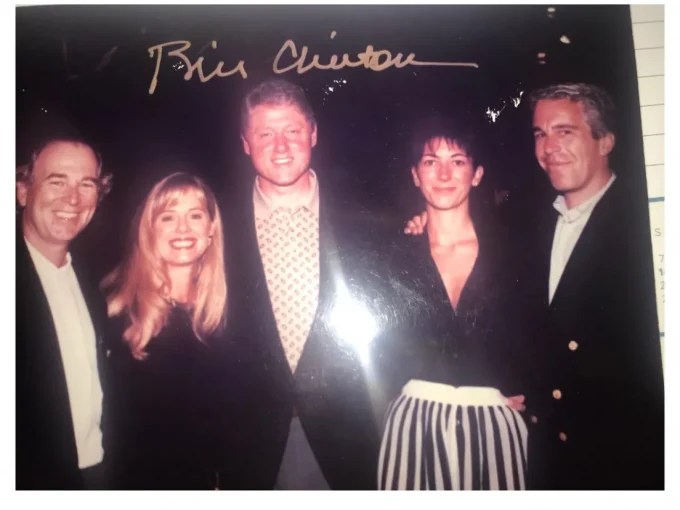
By Justin K.P. | The Dissident | June 22, 2026
The former Israeli intelligence official turned whistleblower, Ari Ben-Menashe made some explosive claims to journalist Afshin Rattansi in the latest episode of his Going Underground TV Show, alleging that then president Bill Clinton made a deal with then Iranian president Mohammad Khatami, but then Israeli Prime Minister Ehud Barak, a known close associate of Jeffery Epstein, used blackmail about Clinton’s known connection with Jeffery Epstein and his trafficking operation of underage girls, to end the deal.
Ben-Menashe alleges that in 2000 Bill Clinton “met President Khatami in Mirabel Airport north of Montreal and they worked out the deal between them”.
Ben-Menashe noted that “on March 17, 2000, Madeleine Albright made a speech at the American Iranian Council apologizing to the Iranian people for America overthrowing an elected government in 1952 in Iran and bringing the Shah back”
Indeed, on March 17, then Secretary of State Madeleine Albright made a speech apologizing for the overthrow of Iran’s popular elected president Mohammed Massadegh in 1953, saying:
In 1953 the United States played a significant role in orchestrating the overthrow of Iran’s popular Prime Minister, Mohammed Massadegh. The Eisenhower Administration believed its actions were justified for strategic reasons; but the coup was clearly a setback for Iran’s political development. And it is easy to see now why many Iranians continue to resent this intervention by America in their internal affairs.
Moreover, during the next quarter century, the United States and the West gave sustained backing to the Shah’s regime. Although it did much to develop the country economically, the Shah’s government also brutally repressed political dissent.
As President Clinton has said, the United States must bear its fair share of responsibility for the problems that have arisen in U.S.-Iranian relations. Even in more recent years, aspects of U.S. policy towards Iraq, during its conflict with Iran appear now to have been regrettably shortsighted, especially in light our subsequent experiences with Saddam Hussein.
This certainly suggested that the Clinton administration was trying to reset the U.S. and Iranian relationship, acknowledging Iran’s long list of legitimate grievances against the United States.
But according to Ari Ben-Menashe, the deal never went through because Israeli Prime Minister Ehud Barak “sabotaged” the deal using Epstein blackmail.
Ben-Menashe said, “But Ehud Barak and company sabotaged that deal by using Epstein and company against Mr. Clinton”.
Because Clinton had already gone through the Monica Lewinsky scandal, this was enough for him to abandon diplomacy, according to Ben-Menashe.
After Being Defeated In Iran, Israel Targets Türkiye.
By Justin K.P. – The Dissident – June 22, 2026
The idea of Israel going to war with Türkiye- a NATO member- potentially triggering World War III seems insane.
And yet Israel is using their war rhetoric towards Türkiye.
The Israeli Foreign Ministry put out a post seemingly laying the groundwork for an Israeli war, claiming that “Hamas terrorists based in Turkey are directing attacks against Israelis, funding terrorism, and recruiting operatives. The network is exposed. The facts are clear.”
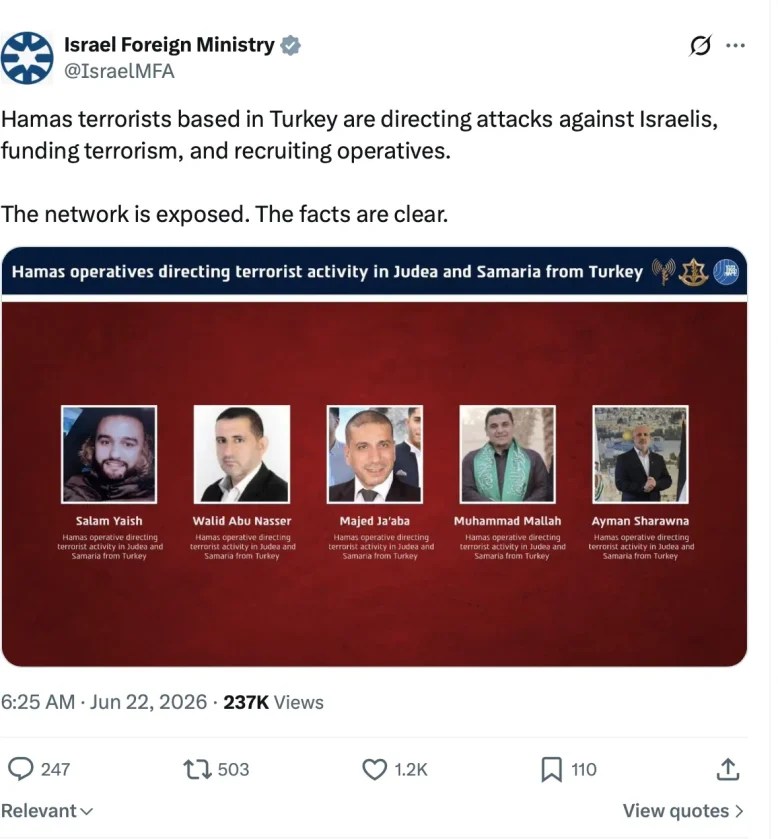
This is far from the first time Israel has used war rhetoric towards Türkiye.
Israel’s Minister of Diaspora Affairs Amichai Chikli recently said that Israel “will be at war with Syria sooner or later” in part because he called Syria “a Turkish protectorate”.
He also fabricated a new “radical Sunni axis of evil” which supposedly includes Pakistan, Turkey and Qatar.
Middle East Eye reported:
“What we are witnessing before our eyes is the rise of a new axis,” Chikli told 103FM radio on Wednesday, referring to Turkey, Qatar and Pakistan. He described this so-called alliance as “a radical Sunni axis of evil, more dangerous than anything we have seen before”.
While Chikli mentioned both Qatar and Pakistan in his interviews, he mainly focused on Turkey, branding Turkish President Recep Tayyip Erdogan’s vision “an extremely dangerous combination for us”.
Other members of the ruling Israeli Likud party have similarly been declaring Türkiye “an enemy state”.
Middle East Eye noted, “Last week, Israeli lawmaker Ariel Kellner, also of Likud, called Turkey an ‘enemy state’, while Culture and Sports Minister Miki Zohar said last month that Israel’“must begin to treat Turkey as an enemy state,’ suggesting that Turkey would suffer heavy blows in a possible conflict with Israel.”
It added that “In February, former prime minister Naftali Bennett indicated that he sees Turkey as an enemy, with the opposition figure stating: ‘Turkey is the new Iran.’”
Perhaps the most concerning development is the fact that the Foundation for The Defence of Democracies (FDD), an Israeli lobby cutout that played a large role in the U.S. war on Iran, has begun publishing articles using similar rhetoric towards Türkiye.
FDD put out an article titled , “Turkey the new Iran? Ankara’s growing challenge to Western interests”.
The article attempted to label Türkiye as the “new Iran”, writing:
As Iran and its proxies take a beating from American and Israeli forces, observers are questioning whether Turkey is waiting in the wings to emerge as the region’s next “bogeyman.” The answer is likely yes, albeit in its own form.
Turkey is not Iran, but depicting Turkey as a nuisance or simply “complicated” only emboldens a maturing adversarial regime with an established track record of undermining its Western allies.
The article attempted to ratchet up hostilities between Türkiye and the United States, writing, “The real question is whether Turkey is actively undermining US, NATO, and regional security interests. There is little doubt that Ankara is doing just that, and doing so more brazenly with the passage of time.”
It also lamented that Türkiye is too supportive of the Palestinian resistance, writing “Hamas, as an Iranian proxy, has served Ankara’s interests in undermining Israel’s security interests, something which Turkey would like to see intact after the end of the current war.”
FDD has similarly put out articles pushing for the U.S. to put sanctions on Türkiye, saying that “Washington should pursue Global Magnitsky sanctions against targets in Turkey” and that “the United States should utilize Global Magnitsky authorities to target Turkish individuals responsible for human rights violations”.
It also called for the U.S. to designate “government officials” in Türkiye as “terrorist organizations” and wrote that “The United States should protect the international financial sector by recommending added scrutiny and screening to transactions involving Turkish financial institutions” and that “Washington should coordinate with the G7 to return Turkey to the Financial Action Task Force (FATF) ‘grey list’ until further improvements are seen in combating terrorism financing.”
The Carnegie Endowment for Peace documented that “FDD was the brainchild of a New York Times journalist-turned-Republican operative, Clifford May,” adding that “it arose out of an organization committed to burnishing Israel’s reputation in the United States. On April 24, 2001, three major pro-Israel donors incorporated an organization called EMET (Hebrew for ‘truth’). In an application to the Internal Revenue Service for tax-exempt status, May explained that the group ‘was to provide education to enhance Israel’s image in North America and the public’s understanding of issues affecting Israeli-Arab relations.’ But in the wake of the Sept. 11 attacks, May broadened the group’s mission and changed its name to the Foundation for Defense of Democracies. As he explained in a supplement to the IRS, the group’s board of directors decided to focus on ‘develop[ing] educational materials on the eradication of terrorism everywhere in the world.’”
It added that, “FDD’s chief funders have been drawn almost entirely from American Jews who have a long history of funding pro-Israel organizations. They include Bernard Marcus, the co-founder of Home Depot, whiskey heirs Samuel and Edgar Bronfman, gambling mogul Sheldon Adelson, heiress Lynn Schusterman, Wall Street speculators Michael Steinhardt and Paul Singer, and Leonard Abramson, founder of U.S. Healthcare.”
Sima Vaknin-Gil, a former Israeli military intelligence officer, in the Al Jazeera documentary The Lobby, admitted that “We have FDD” and that “the foundation is ‘working on’ projects for Israel, including ‘data gathering, information analysis, working on activist organizations, money trail. This is something that only a country, with its resources, can do the best”.
FDD played a huge role in shaping American policy towards Iran at the behest of Israel.
Now, as Israel calls Türkiye an “enemy state”- the FDD has begun pushing Washington to place sanctions on the country and designate government officials as terrorists, laying the groundwork for a new Israeli war.
By Junaid S. Ahmad | MEMO | June 22, 2026
In Switzerland, amid the alpine calm where empires go to perfume panic as diplomacy, Iran delivered another masterclass in the ancient art of refusing to kneel.
The Americans arrived with the usual imperial luggage: threats, ultimatums, sanctions theology, and that peculiar Washington habit of mistaking obedience for “peace.” Iran arrived with something far less fashionable and far more effective: leverage. Not the decorative leverage of think-tank seminars and cable-news generals, but the real kind — the kind that closes straits, terrifies markets, freezes war rooms, and forces the self-appointed masters of the universe to rediscover geography.
The spectacle would be hilarious if it were not so historically obscene.
For decades, Washington imagined Iran could be sanctioned into hunger, bombed into prudence, insulted into submission, and finally dragged into a room to sign its own humiliation.
Instead, the empire found itself bargaining with a country it had failed to break. The result was not Iranian capitulation. It was American improvisation — and improvisation by a declining empire always sounds the same: threats in public, panic in private, and a desperate attempt to rename retreat as strategy.
This is the deeper meaning of Switzerland. It is not merely a diplomatic episode. It is a theatre of reversal. The United States entered the crisis assuming Iran would negotiate like a wounded state. Iran is negotiating like a victorious one. It did not ask for mercy. It is demanding implementation. It did not plead for relief. It is presenting conditions. It did not enter the room as an accused party awaiting sentencing. It is entering as a power whose red lines have acquired consequences.
That is why the Strait of Hormuz matters. In the fantasy literature of American empire, waterways are lines on maps guarded by aircraft carriers and narrated by admirals. In reality, they are political arteries. When Iran demonstrated that it could interrupt the world’s most sensitive energy passage, it did more than create a shipping problem. It shattered a mythology. The empire discovered, rather late in its education, that the sea has neighbors — and that those neighbors have memories.
Washington’s response was pure imperial farce. Trump threatened, blustered, contradicted himself, and performed his usual routine: half Caesar, half casino promoter, with the emotional discipline of a man losing an argument to a mirror. One moment he wanted a deal; the next he wanted tribute.
One moment he spoke of peace; the next he threatened annihilation. This was not statecraft. It was strategic delirium dressed up as presidential resolve.
Yet beneath the orange thunder was the essential fact: America needed the strait open, the markets calm, the war contained, and the humiliation disguised. Iran understood this. More importantly, Iran acted on it.
Netanyahu, meanwhile, performed the role history has assigned him: arsonist in a fireman’s helmet. His political survival depends on permanent emergency. War is not merely his instrument; it is his oxygen. Defeat must be repackaged as deterrence, slaughter as security, occupation as necessity, and humiliation as a “strategic achievement.”
Israel’s problem is not that it miscalculates occasionally. Its problem is that it has built an entire political theology around impunity — and then acted shocked when impunity met resistance.
But this time the room for Israeli theatrics narrowed. Iran’s pressure, Hezbollah’s endurance, the strain on global markets, and Washington’s fear of economic catastrophe produced a rare collision between Israeli maximalism and American self-preservation. For once, unconditional support for Israel began to look expensive even to its underwriters. Let us not become sentimental: this was not morality awakening in Washington. It was arithmetic. But in imperial politics, arithmetic sometimes does what conscience is too cowardly to attempt.
Here lies the exquisite irony. The United States spent decades trying to teach Iran the meaning of pressure. Iran returned the lesson, corrected the grammar, and underlined the thesis. Pressure is not a press release. It is not a Lindsey Graham war fantasy delivered between television segments. It is not Netanyahu’s sweaty monologues about victory while the region watches his project rot from within. Pressure is the ability to alter the enemy’s choices. In Switzerland, Iran is proving it can do precisely that.
The Americans may still posture. Trump may still rage into the digital void. Netanyahu may still deliver speeches polished with self-pity and fraud. The professional warmongers may continue promising wars they will never fight, depressions they will never suffer, and corpses they will never count. But beneath the noise sits the brutal reality: Iran survived the siege, absorbed the blows, retained escalation dominance, defended its allies, protected its sovereignty, and forced the conversation onto terrain of its choosing.
That is the defeat Washington cannot confess and Israel cannot metabolize. Not merely that Iran endured, but that Iran emerged demanding compliance. Not merely that coercion failed, but that the coerced state exposed the coercer’s dependence. Not merely that the empire blinked, but that everyone saw it blink.
Switzerland, then, is not a peace summit in the ordinary sense. It is a mirror held up to American power. What stares back is not omnipotence, but exhaustion dressed as menace.
Iran’s message could not be clearer: no surrender, no submission, no confession of guilt to satisfy an empire addicted to obedience. If Washington wants de-escalation, it must pay in substance. If it wants open waterways, it must respect red lines. If it wants agreements, it must implement them. And if it insists on calling this diplomacy, it should begin with the only honest admission available: coercion failed, Iran stood, and the age of bullying Tehran into submission is over.
By Ron Paul | June 22, 2026
Against the odds, the Memorandum of Understanding signed by the US and Iran appears to be holding, after threats and counter-threats. It may collapse, but it has survived a first round of talks between the two sides in Switzerland over the weekend.
President Trump started a war on Iran against all sober guidance and in violation of the US Constitution’s requirement that only Congress can declare war. There must be a reckoning for our elected leaders who violate their oath of office, the Constitution, and simple common sense.
However, what is more telling is the reaction when President Trump finally took the correct move and attempted to end the war. The neocons who had hailed him as a great leader – Levin, Bolton, Pompeo, etc. – suddenly turned against him when he turned against further escalation of the war.
Even Trump’s top funder, Miriam Adelson, attacked Trump in her newspaper Israel Hayom. “You could have been the greatest president of all, but you failed,” the newspaper wrote in an editorial.
Not much gratitude from the Israel-first crowd, even if the war was started to benefit Israel.
And more telling even than this was the reaction of the “opposition” party in Congress, the Democrats. They attacked him harder for ending – or at least pausing – the war more than for starting the war in the first place! Sen. Adam Schiff (D-CA) called the MOU a “capitulation.” Sen Chris Murphy (D-CT) called the MOU an “embarrassing document.” Sen. Amy Klobuchar falsely claimed that President Trump was paying Iran $300 billion to re-open Hormuz.
This is more evidence – as if any is needed – that our foreign policy is run by the “uniparty.” When it comes to wars, there is no Republican Party nor is there a Democratic Party. There is only the “yes!” party.
Congress remains silent in the run-up to war. Congress remains silent when the President launches a war. Congress even remains silent when the war begins going badly. It is only on those rare occasions that a president takes steps to correct his mistake that Congress finds its voice.
Yes, there is plenty to criticize. After weekend talks, the US side, led by Vice President JD Vance, is celebrating as a “breakthrough” that the Strait of Hormuz is open again and that Iran has reportedly agreed to the return of UN inspectors. But the Strait was open before this war and UN inspectors were in Iran before President Trump unilaterally pulled out of the JCPOA “Iran Deal” in his first term.
The only difference now is that we burned through likely several hundred billion dollars, we lost dozens of aircraft and other military equipment, and we likely lost more service members than the Pentagon is admitting.
It is a reminder of why the Founders intended to make sure that any war must be declared by the people’s Representatives before the first bullet is shot: it should be very hard to launch wars.
Nevertheless, those who are truly against the wars should, in my opinion, hold their fire for the time being in hope that a lasting resolution can be found. The President Is being attacked from all sides by the war party. Now may not be the best time for the peace party to join in.
Al Mayadeen | June 22, 2026
Following the conclusion of the first round of the Iran-US talks in Switzerland on Monday, the media committee of the Iranian negotiating delegation issued a statement outlining the main points and understandings reached during the talks.
The Bürgenstock talks outline a phased framework linking security arrangements, financial measures, and sanctions relief to conditional implementation steps.
Key developments include a Lebanon ceasefire monitoring mechanism, structured communication over the Strait of Hormuz, coordinated asset release arrangements, and temporary sanctions relief measures tied to energy exports.
Lebanon ceasefire monitoring mechanism
According to the statement, continued pressure from the Iranian negotiating delegation since Saturday afternoon contributed to maintaining a fragile ceasefire in Lebanon for the time being.
To support stabilization efforts, the parties agreed to establish a monitoring framework titled the “Conflict Control Unit.” Iran is expected to participate in this mechanism, which will oversee developments related to the ceasefire.
The statement further noted that this arrangement would formally integrate the Islamic Republic of Iran into Lebanon’s security-related discussions, despite US efforts in recent months to exclude Iran from Lebanese affairs. It also stated that “Israel” will have no role in this mechanism.
Strait of Hormuz communication channel
Regarding discussions on the Strait of Hormuz, the statement said an understanding was reached to establish a communication channel aimed at addressing potential implementation issues.
Through this channel, relevant parties would be able to directly contact Iran and present concerns related to maritime coordination and regional navigation.
It characterized this arrangement as part of broader discussions on the management and gradual reopening of the Strait of Hormuz.
Conditional launch of nuclear and sanctions working groups
The agreement also includes the formation of three working groups focused on nuclear issues, sanctions, and monitoring mechanisms.
These groups are set to begin their work only after the implementation of Article 13 of the memorandum of understanding, which outlines several key steps, including:
Iran will not enter the final phase of negotiations before these conditions are fulfilled.
Iran–Qatar agreement on frozen assets
During the same round of talks, Iran and Qatar signed a memorandum of understanding concerning the release of Iranian frozen assets. The agreement is presented as part of ongoing financial and diplomatic coordination between the two sides regarding outstanding economic issues.
US OFAC 60-day sanctions suspension
The statement also referenced documents issued by the US Treasury Department’s Office of Foreign Assets Control (OFAC) during the negotiations.
According to the statement, these documents provide for a 60-day suspension of sanctions targeting oil, petrochemical, and related sectors. This arrangement would allow Iran to resume oil sales to its customers and receive payments through formal mechanisms managed by the Central Bank, the statement explained.
Bilateral and trilateral meetings at Bürgenstock resort
Al Mayadeen’s Geneva Bureau chief reported on Sunday that various bilateral and trilateral meetings have begun at the Bürgenstock resort ahead of the first official session of Iran-US talks. The opening session took place at 2:30 PM al-Quds time.
The first file discussed after the inaugural session was the implementation of the first clause, which relates to ending the war, particularly on Lebanon.
Al Mayadeen’s Geneva bureau chief later reported that the Iranian delegation held talks with the Qatari delegation in Geneva to discuss the ceasefire in Lebanon. He also reported that, following a meeting with the Iranian delegation, the Pakistani Prime Minister and Chief of Army Staff held talks with the US delegation, headed by Vice President JD Vance.
According to an Iranian official, speaking to CNN on Saturday, before departing for Switzerland, Vance said that one of the top concerns included in the talks would be to make progress towards a ceasefire in Lebanon. “I think we’re going to hopefully make progress on the nuclear issue, make progress on the Lebanon ceasefire issue. Those are the two big things that I think we’re going to be focused on,” the US vice president told reporters, noting that he expected to participate in the talks for only “a day or two”.
Mario Nawfal | June 21, 2026

The Cradle | June 21, 2026
Al-Jazeera Media Network condemned on 20 June Israel’s “deliberate killing” of one of its journalists in Gaza, Ahmad Washah, while calling on the international community to punish Israeli officials for this and other crimes against its media workers.
Ahmad Washah, a cameraman for Al-Jazeera Mubasher, was killed by an Israeli drone strike on a house in Al-Bureij refugee camp in central Gaza on Saturday.
He is the 12th Al-Jazeera media worker to be killed in Gaza since Israel began its genocide of Palestinians in October 2023.
The network called on “the international community and legal institutions to take urgent, practical measures to hold the Israeli officials involved in these appalling crimes accountable,” the statement added.
Washah’s brother, Mohammad, was killed in an Israeli strike just two months earlier, in April, also while working as a correspondent for Al-Jazeera Mubasher. Before Mohammed’s death, the brothers worked together as a team, with Ahmad filming for Mohammad.
“Together, they formed a media duo that documented the suffering of the Palestinian people and the unfolding events of the war,” Al-Jazeera stated.
After Mohammad’s death, Ahmad also took care of his late brother’s children.
On Saturday, the network denounced “the continuation of the crimes committed by the Israeli occupation forces against its correspondents and staff in Gaza.”
Al-Jazeera said it was determined to take all legal measures to prosecute the killers of its journalists. The Qatar-based channel stressed it will continue to cover Israel’s crimes against Palestinians in Gaza despite the Israeli army’s attempts to silence the voices of its correspondents in the enclave.
Israel has killed at least 262 journalists and media workers since the start of Israel’s genocide, according to the Gaza Government Media Office.
In August 2025, Israel killed Al-Jazeera journalist Anas al-Sharif and four of his colleagues in an airstrike in Gaza. Before his killing, Sharif became one of the most recognizable media voices from the front lines of northern Gaza.
In December 2023, his 90-year-old father was killed when an Israeli airstrike struck their family home in Jabalia. Sharif said the killing of his father came after Israeli officials threatened him by phone to cease his coverage.
Since October 2023, the ongoing war in Gaza has claimed the lives of countless other Palestinian journalists, including Al Jazeera staff members such as correspondent Ismail al-Ghoul, cameraman Samer Abu Daqqa, and correspondent Hossam Shabat, who were killed while reporting on the ground.
In May 2022, Israeli occupation forces shot dead another Al-Jazeera journalist, Shireen Abu Akleh, a US-Palestinian citizen, while she was covering an Israeli military operation in the West Bank city of Jenin.
Israel claimed she was killed by unintentional fire by its forces. However, multiple independent probes concluded that an Israeli military sniper killed her.
Israel has detained another 50 journalists since October 2023, holding them in detention facilities and prisons where torture and rape is common. Another three Palestinian journalists remain missing.
More than 420 journalists have been injured covering the genocide, which has killed 73,000 Palestinians by the most conservative estimates. Independent estimates reach into the hundreds of thousands of dead, in large part due to the direct effects of war.
Some of the wounded journalists have suffered serious injuries, leading to amputations and permanent disabilities.
Israel is waging the war in a bid to destroy Gaza and forcibly expel its roughly 2 million Palestinians. Israeli political and religious leaders wish to annex the strip to build Jewish settlements on the ruins of Palestinian cities and villages.
or go to
Aletho News Archives – Video-Images
By Donald Neff | Washington Report On Middle East Affairs | January 1996
On January 4, 1948, Jewish terrorists drove a truck loaded with explosives into the center of the all Arab city of Jaffa and detonated it, killing 26 and wounding around 100 Palestinian men, women and children.[1] The attack was the work of the Irgun Zvai Leumi – the “National Military Organization,” also known by the Hebrew letters Etzel – the largest Jewish terrorist group in Palestine. The Irgun was headed by Revisionist Zionist Menachem Begin and had been killing and maiming Arabs, Britons and even Jews for the previous ten years in its efforts to establish a Jewish state.
This terror campaign meant that at the core of Revisionist Zionism there existed a philosophical embrace of violence. … continue
 Aletho News If Americans Knew No Tricks Zone
