Iran delegation protests Trump’s threat at Switzerland talks, weighs ‘proper’ response: Source

Press TV – June 21, 2026
The Iranian delegation to talks with the United States has raised objections directly with the American side over President Donald Trump’s latest threat of further military strikes, and is now weighing its next steps, a source told Press TV.
“The Iranian delegation has raised its objections to the American side and is currently assessing the conditions to give a proper response to Trump’s verbal threats,” the source said on Sunday.
Trump on Sunday threatened to restart war with Iran, warning Tehran to rein in its allies in Lebanon or face renewed and more powerful US military strikes.
“Iran must immediately stop their highly paid PROXIES in Lebanon from causing trouble. If they don’t, we’ll hit Iran very hard again, just like we did last week, only harder!!!” Trump wrote in a post on his Truth Social platform, referring to US war against the Islamic Republic, which started late February.
The threat was made as Iranian and American delegations were engaged in critical negotiations, mediated by Pakistan and Qatar, at the Bürgenstock resort in central Switzerland, where they are working to implement a 14-point memorandum of understanding.
The talks were the first to be held under the terms of the Islamabad MoU agreed a week ago.
Trump’s threat of further military action against Iran is a direct contravention of US commitments under the interim deal, whose clause 1 commits both parties “not to initiate any war or any military operation against each other, and to refrain from the threat or use of force against each other.”
A source close to Iran’s negotiating team later told Tasnim news agency that the Iranian delegation left the venue of talks with the United States in protest over Trump’s latest threat.
Securing Peace with Iran Compels Trump to Divorce Israel
Israel’s goals of territorial expansion conflict with the goals of the US president
By Harrison Berger | The American Conservative | June 19, 2026
After President Donald Trump signed a preliminary Iran peace deal on Wednesday, Israel’s occupation and bombing of Lebanon presents the central obstacle to a final agreement and lasting peace. Securing and upholding the final peace deal will require the kind of confrontation with Israel that Trump has avoided for most of his presidency, given Iran’s leverage over the Strait of Hormuz and global energy flows.
Iran has insisted that the ceasefire and now the framework peace deal cover the entire regional war and thus require that Israel end its occupation of southern Lebanon. Iran’s Supreme National Security Council declared Monday that under the framework deal, called a memorandum of understanding, “war and military operations on all fronts—including immediately ending the Lebanon front tonight and permanently—will conclude.”
That demand stems directly from the “long-term security guarantees” Tehran has invoked across its public statements since the beginning of the conflict. For those guarantees to mean anything, Tehran needs Trump to rein in Prime Minister Benjamin Netanyahu and ensure that Israel does not launch another surprise attack against Iran. The only way Washington can demonstrate that commitment is to pressure Israel now, in Lebanon. As Trita Parsi of the Quincy Institute has argued, binding Israel to a ceasefire is a “test of America’s willingness, and its ability, to restrain its closest regional ally.”
Iran is right to doubt that Washington will exert that kind of pressure over Israel. After Israel’s latest bombing of Beirut’s southern suburbs, Iran’s Speaker of Parliament Mohammad Ghalibaf wrote that the incursion into Dahiyeh “has once again shown that America either lacks the will to fulfill its commitments or the ability to do so.” Recognizing that Israel’s violent quest to grab territory in Lebanon could only be accomplished with U.S. approval, Iran’s leading negotiator declared that “the game of bad cop and good cop is outdated.”
Up until that point, the White House had seemed to use Axios and other friendly outlets to give Iran the impression that it was pressuring Israel, even as it kept giving its protectorate in the Middle East the green light to occupy its northern neighbor. Indeed, while American audiences heard from the Axios reporter Barak Ravid that Washington was “furious” over the Lebanon strikes, Israeli audiences heard the opposite.
Miriam Adelson’s Israel Hayom newspaper reported that the United States and Israel were in fact “fully coordinated, both on the strikes in Dahiyeh in Beirut and on the Israeli response to the missile fire from Iran,” and that Secretary of State Marco Rubio in particular played a “significant role” in getting Trump to back Israel’s retaliatory strikes. The Israeli operation, the paper said, was “fully coordinated with CENTCOM, even though the Americans did not strike themselves.” The munitions used by the Israelis in Lebanon are further proof of U.S. involvement, with Courtney Bonneau, the American-Dutch journalist reporting from southern Lebanon, recently telling The American Conservative that the waste left by Israel’s demolition and bombing campaign is recognizably U.S.-made.
Trump wants to have it both ways. The political costs of the war are piling up and he wants an exit, but an exit requires confronting Israel and the lobby over Lebanon, and that is a political conflict he has avoided fighting directly even as he has criticized Netanyahu in recent weeks.
Israel is betting he will continue to avoid it. Shortly after a deal was announced, Israel’s Defense Minister Israel Katz said that Israel’s occupation of southern Lebanon would continue, and that it planned to stay “indefinitely” in Lebanon, Syria, and Gaza. Israel’s Finance Minister Bezalel Smotrich likewise announced on Tuesday that “there will be no withdrawal from Lebanon, neither by Friday nor afterward. We will remain in south Lebanon and strengthen our presence there,” while National Security Minister Itamar Ben-Gvir said Monday that Israel is not bound by any agreement.
Though Israeli leaders insist they are carefully fighting “Hezbollah,” the death toll of at least 3,826 Lebanese civilians killed by Israeli attacks reveals that to be merely a pretext. Trump, though he has not skipped any payment when it comes to funding the conflict, admitted as much on Tuesday at the G7 Summit, telling reporters that Israel “does not have to knock down an apartment house every time [it’s] looking for somebody. There are a lot of people in those apartment houses and they’re not all Hezbollah.”
And though Israel invokes Hezbollah as its excuse for military action, there is little reason to believe the IDF’s occupation would end even if Hezbollah laid down its arms. In their public statements, Israeli officials have expressed interest in territorial expansion for its own sake and, increasingly, in the Judaification of Lebanese land through settlements—an idea Jewish Currents describes as “once fringe” but now backed by “an organized movement with broad governmental and public support.” Twenty members of Israel’s Knesset wrote to the cabinet in April urging “occupation and full control” of southern Lebanon alongside the “complete displacement” of its population, while a poll conducted by Direct Polls for i24NEWS found that 62 percent of Israelis favor occupying everything south of the Litani River.
Israeli occupation of Lebanon, like its ethnic cleansing campaigns in Gaza and the West Bank, works directly against American interests, in this case stopping a war that has wrecked the global economy. Washington has all the necessary tools to put a stop to this, yet has simply declined to use them. As Joe Kent, the administration’s former head of the National Counterterrorism Center and one of the most prominent America First critics of the war argued on X, “We can strengthen our chances of this deal holding by cutting all military/intel assistance to Israel,” who “took every opportunity to tank this deal & will likely do so again unless we take action,” adding that in order for a deal to hold, we must “take away every factor that we can control that could force us back into the war on Israel or Iran’s terms. Set all conditions that we can control in our favor.”
Though once unthinkable, Trump in recent days has shifted closer toward this America First position and away from the Israel First mindset that led to war with Iran. With Iran insisting any peace deal must cover “all fronts,” including Lebanon, and with the Israelis fully committed to the Greater Israel project, cutting off Israel is now the minimum price of the complete exit from the conflict that Trump says he wants.
Harrison Berger is a correspondent at The American Conservative. He has contributed to Drop Site News, The Nation, and Responsible Statecraft. Previously, he was a researcher and producer for System Update with Glenn Greenwald. His work focuses on civil liberties and U.S. foreign policy. He studied Political Science and Russian Studies at Union College (NY).
Strait of Hormuz closed over Israeli aggression on Lebanon
Al Mayadeen | June 20, 2026
The Strait of Hormuz is shut down in response to ongoing Israeli aggression on southern Lebanon, Khatam al-Anbiya Central Headquarters announced, deeming Israeli actions a violation of Iran’s agreement with the US.
In a statement carried by Iranian state television, the Khatam HQ accused the United States of breaching its obligations under a memorandum of understanding related to ending the war, and also cited continued Israeli military actions in southern Lebanon, including ceasefire violations, killings, forced displacement of civilians, and failure to withdraw from Lebanese territory. It added that the measure reflects a response to the deterioration of compliance by the opposing parties and the persistence of hostilities on the ground.
“In light of the United States’ blatant violation of its commitments and breach of the provisions of Article One of the memorandum of understanding to end the war and in response to the ongoing and continuous violation of the ceasefire by the Israeli entity in southern Lebanon, the continued brutal killing and forcible displacement of the Lebanese people, and its failure to withdraw from southern Lebanon, it is hereby announced that the Strait of Hormuz will be closed to maritime navigation,” the statement read.
More steps to follow
The statement from Iran’s Khatam al-Anbiya Central Headquarters concluded by emphasizing that the measure was presented as an initial response to what it described as the enemy’s breach of commitments, warning that any continued escalation would prompt additional actions aimed at compelling compliance with its stated obligations.
“It is noted that this first step is a response to the enemy’s breach of promise, and if the aggression continues, further steps will be planned and taken to force the enemy to comply with its obligations,” it asserted.
37+ martyrs in continued Israeli attacks on southern, eastern Lebanon
Israeli occupation forces (IOF) carried out a fresh wave of attacks across southern Lebanon and western Bekaa on Saturday morning, killing at least 37 people and extending a pattern of aggression that has persisted despite an alleged ceasefire in place since April 17, 2026.
In the Nabatieh area alone, at least 25 people were martyred and another 35 were injured in an initial toll, as reported by the Civil Defense Operations Room of the Islamic Health Authority’s Jabal Amel II region. Rescue and ambulance teams are still clearing rubble and searching for missing people. Among those martyred in the Nabatieh area is a Lebanese Army soldier killed in an Israeli drone strike in Kfar Rumman.
Meanwhile, an Israeli attack on a residential building in the town of Qennarit in the Saida district killed 7 and injured 13 others, among them 5 children and 5 women, as per the Lebanese Ministry of Public Health.
In western Bekaa, Al Mayadeen’s correspondent reported that four people were killed in an Israeli attack on a house in the town of Sohmor, in addition to a person killed earlier in a separate drone attack that targeted a motorcycle in the same town, bringing the death toll in Sohmor to five. Lebanon’s National News Agency reports that a child remains under the rubble in Sohmor, with rescue teams working to save him.
Dozens of towns bombed
Local media reports that the IOF carried out at least 80 attacks on southern Lebanon and the western Bekaa since early morning on Saturday, comprising 65 airstrikes and 15 drone strikes, in addition to artillery shelling and sweeping fire.
The hardest hit areas are al-Nabatieh al-Fawqa (8 times) and al-Rihan heights (6 times). Kfar Tebnit and its surroundings, Jabal al-Rafi’, Shoukin, and Nabatieh city were each bombed four times, while Kfaroumman, Aramta, the al-Aroush quarry, Harouf, and Habboush were each bombed three times.
Sojod, the area between Toul and Kfour, Kfar Joz, Zebdine and its surroundings, and Shhour were each attacked twice, while Nmairiyeh, Arabsalim, al-Mahmoudiyeh, Borj Qalaway, Qabrikha, Barish, al-Qatrani, and Qennarit were each bombed once.
Drone attacks, artillery shelling
Israeli drones, meanwhile, attacked Nabatieh city four times and Arabsalim twice, with single drone attacks hitting Deir al-Zahrani, Doueir, Deir Qanoun Ras al-Ain, Kawthariyet al-Riz, Sohmor, Harouf, Jibchit, and al-Nafakhiyeh.
Israeli artillery also shelled Majdal Zoun, Habboush, Harouf, and Ali al-Taher, while occupation forces carried out sweeping-fire operations in Buyout al-Sayyad.
Friday’s escalation
Saturday’s strikes followed a sharp escalation on Friday, when the IOF expanded its attacks to include several southern villages, the outskirts and northern entrance of Baalbek, and the Litani Riverbed near the town of Zellaya in the western Bekaa, attacks that resulted in massacres of civilians.
The bombardment continued even as Reuters reported that a ceasefire agreement between “Israel” and Hezbollah had taken effect at 4 pm that day. Within moments of the so-called ceasefire taking hold, Israeli occupation warplanes launched more than 16 attacks on areas across the South, according to Al Mayadeen’s correspondent.
The Lebanese Ministry of Public Health confirmed that the intensified aggression carried out from midnight through Friday afternoon martyred 47 people and injured 97 others, an updated toll showed. The Ministry put the cumulative toll of Israeli attacks between March 2 and June 19 at 3,980 martyred and 12,001 injured.
‘Biased censorship’: Iran deputy FM slams X for stripping him of blue tick
Press TV – June 19, 2026
Iran’s Deputy Foreign Minister for Legal and International Affairs Kazem Gharibabadi has decried a recent “biased” move by the social media platform X to remove the blue checkmark from his account.
In an X post on Friday, Gharibabadi said that the online social network has removed the blue tick from his account after doing the same with the accounts of Iran’s Ministry of Foreign Affairs, Minister Abbas Araghchi, and spokesman Esmaeil Baghaei.
“This biased and politically-motivated measure is the continuation of the pattern of censorship aimed at silencing the truth and the official voice of governments, as well as instrumentalizing digital credibility,” he added.
Since Elon Musk’s acquisition of X, formerly known as Twitter, in 2022, the platform has faced criticism for arbitrarily removing verification badges and deleting accounts perceived as politically inconvenient.
Since February, X has stripped many Iranian officials of their blue checkmarks and deleted without explanation hundreds of accounts supportive of Iran’s brave resistance against the US-Israeli war of aggression.
Hezbollah lawmaker says Israel has 60 days to withdraw from Lebanon
MEMO | June 19, 2026
Mohammad Raad, head of Hezbollah’s parliamentary bloc, said Israel has 60 days to complete its withdrawal from Lebanese territory, urging Lebanese authorities to study the understanding signed between the United States and Iran “carefully and objectively”.
In a statement issued on Thursday, Raad made the remarks as Israel continues its military actions and maintains its presence in areas it occupies in southern Lebanon.
He noted that the first clause of the agreement signed between Tehran and Washington calls, in part, for the “immediate and permanent cessation of military operations on all fronts, including Lebanon”.
The agreement also includes a commitment to “guarantee Lebanon’s territorial integrity and sovereignty” and confirms a “permanent end to the war on all fronts” in its final form.
On Wednesday evening, US President Donald Trump and Iranian President Masoud Pezeshkian electronically signed the “Islamabad Memorandum of Understanding”, which aims to end the war launched by the United States and Israel against Iran on 28th February.
A Pakistani mediator later announced that the memorandum had entered into force. Under the arrangement, Iran is expected to begin reopening the Strait of Hormuz to shipping, while the United States starts lifting its naval blockade on Tehran.
Raad called on Lebanese authorities to “read the text of the memorandum carefully and objectively and draw conclusions about the realities and prospects that will have a significant impact on the region and the world, including Lebanon”.
He also warned against “underestimating Iran’s ability to fulfil its commitment to deter the Zionist enemy should it insist on violating the terms of the memorandum”, according to the statement.
Iran rules out IAEA inspections of war-damaged nuclear sites
Press TV – June 19, 2026
Iran’s Foreign Ministry spokesman has dismissed reports claiming that the Islamic Republic will invite the International Atomic Energy Agency (IAEA) to inspect its nuclear sites damaged in two rounds of US-Israeli aggression.
Referring to the memorandum of understanding (MoU) signed by Iran and the US with the aim of ending the war on Thursday, Esmaeil Baghaei told reporters on Friday that the document’s clause 8 stipulates that negotiations on the nuclear issue will be held within a period of 60 days.
“Of course, this will require the fulfillment of the prerequisites for starting negotiations in accordance with clause 13,” he emphasized.
Baghaei stressed that, according to clause 9 of the MoU, the current status of Iran’s nuclear program will be maintained during the 60-day period, and accordingly, inspections of facilities such as Bushehr, which have been conducted so far, will continue.
He added that inspections of facilities to which the IAEA’s access was suspended due to the US-Israeli aggression hinge on the process of negotiations and their outcome.
His remarks come as US President Donald Trump’s special envoy, Steve Witkoff, claimed that Iran will invite the IAEA to inspect its nuclear facilities and begin work on identifying and disclosing the locations of enriched materials possessed by Tehran.
This came during a special briefing by Witkoff to congressional leaders and members of the committees concerned with national security.
The MoU, signed remotely by Iranian President Masoud Pezeshkian and US President Donald Trump, calls for a permanent end to hostilities across all fronts, the removal of the US naval blockade, the restoration of commercial traffic through the Strait of Hormuz within 30 days, a reconstruction plan worth at least $300 billion, and the lifting of US sanctions.
Under the MoU, the two sides have entered a 60-day negotiation period, with the goal of reaching a comprehensive final agreement.
The agreement followed an unprovoked US-Israeli war of terrorism against Iran that began in late February.
Israeli regime’s only interest is ‘permanent war,’ Iran’s FM Araghchi says

Press TV – June 19, 2026
Iranian Foreign Minister Abbas Araghchi has condemned provocative statements by senior Israeli ministers advocating intensified attacks on Lebanon, warning that the only interest of the genocidal Israeli regime is permanent war.
In a post on X on Friday, Araghchi denounced comments made by Israel’s far-right minister Itamar Ben-Gvir following the deaths of four Israeli soldiers in southern Lebanon.
Ben-Gvir wrote on X that “all of Lebanon must burn,” and that “for every tear of an Israeli mother, a thousand Lebanese mothers must weep.”
“This is not a rant by a random genocidal lunatic,” Araghchi wrote. “It’s a public post by the national security minister of the Israeli regime.”
“The genocidal death cult headquartered in Tel Aviv is a threat to all of humanity. It threatens all humans,” he added.
Araghchi said that Tel Aviv’s “only interest is permanent war.”
Israeli finance minister Bezalel Smotrich also called for a harsher military aggression against Lebanon, writing on the social media platform that it was “time to speak with fire” and “open the gates of hell.”
Iranian officials have repeatedly warned that halting Israeli attacks in Lebanon is a key component of the memorandum of understanding (MoU) signed by the presidents of Iran and the United States on Thursday.
Israeli warplanes bombed residential areas in southern and eastern Lebanon before dawn Friday.
At least 31 Lebanese have been killed as Israel keeps attacking the country despite the US-Iran deal coming into force.
Lebanon’s National News Agency reported that strikes targeted inhabited homes in the towns of al-Sharqiyah, Harouf and Kfar Sir in the Nabatieh district.
In an earlier statement, Iran’s Foreign Ministry spokesman Esmaeil Baghaei underscored Washington’s direct responsibility under the current circumstances.
He said the Islamic Republic of Iran “will take all necessary measures to safeguard its interests, security and rights, as well as those of its allies.”
According to official Lebanese figures, the death toll from Israel’s military campaign in Lebanon has risen to 3,912.
More than 11,870 people have been wounded and over one million displaced, according to official figures.
Meanwhile, Reuters reported that a ceasefire has taken effect between Hezbollah and the Israeli regime as of 4 PM local time. However, Lebanese media outlet Al Mayadeen has reported Israeli strikes following the start of the reported ceasefire.
Syria, Lebanon, and the limits of power
By Bassam Abu Abdallah | The Cradle | June 19, 2026
Remarks by US President Donald Trump in an interview with NBC News earlier this month, in which he said he would like to see “a more precise surgical attack on Hezbollah” and suggested that Syria’s Ahmad al-Sharaa (formerly known as Abu Mohammad al-Julani) could play a role in reaching an agreement over the conflict in Lebanon, have revived a familiar question across the region.
Trump later escalated his rhetoric, saying that if Israel “can’t do the job without killing everyone else, Syria should do the job.” Describing the war on Lebanon as a secondary front, he suggested that Syria, in coordination with the US, could take on Hezbollah if Israeli Prime Minister Benjamin Netanyahu could not be reined in.
Whenever the region enters a period of major change, the same issue resurfaces. Can Syria once again play a direct security or military role in Lebanon, as it did in 1976?
The comparison is tempting on the surface. It invites parallels between the current leadership in Damascus and the late president Hafez al-Assad, who sent Syrian forces into Lebanon during the civil war. Yet even a brief look at the surrounding conditions suggests that the resemblance is largely superficial.
Trump himself did not clarify what form of assistance he had in mind. The possibilities range from border control and curbing smuggling routes to a broader attempt to pressure Hezbollah.
An old question returns
Similar ideas have surfaced before. In a July 2025 interview with The National, US envoy Tom Barrack warned that Lebanon faced an “existential threat” if it failed to address Hezbollah’s weapons, adding that “if Lebanon doesn’t move, it’s going to be Bilad Al Sham [Greater Syria] again.”
In March, Reuters reported that Washington had encouraged Syria to consider sending forces into eastern Lebanon to help disarm Hezbollah, a claim later denied by Barrack. The episode nevertheless fueled speculation about a possible Syrian role in Lebanon.
The responses from Sharaa’s government, however, have remained cautious and indirect. Sharaa has expressed support for Lebanese President Joseph Aoun’s efforts to consolidate arms under state authority, while recent exchanges with Lebanese Prime Minister Nawaf Salam have emphasized coordination between military and security institutions in both countries.
Syria’s self-appointed president and former Al-Qaeda chief Ahmad al-Sharaa dismissed reports that Syrian forces could enter Lebanon as “rumors.”
At the same time, periodic announcements from Syrian authorities about dismantling alleged Hezbollah-linked cells have been interpreted by some observers as signals aimed at Washington, suggesting readiness to engage if political backing is secured. Whether this reflects a concrete agreement or simply an attempt to keep options open remains unclear.
What is clear is that the renewed discussion comes at a moment when broader regional balances are in flux, particularly after the collapse of the previous Syrian order. The question is not whether Syria once intervened in Lebanon, but whether the conditions that made that intervention possible still exist.
1976 and the architecture of intervention
By the time Syrian forces entered Lebanon in 1976, the civil war had pushed the state to the brink. Importantly, the intervention took shape within a web of regional bargains and international understandings, rather than a unilateral move by Damascus.
The move was carried out at the request of the Lebanese president at the time, Suleiman Frangieh, and was supported by influential Lebanese actors who feared a decisive shift in the internal balance of power. It also aligned with broader concerns shared by regional and international players who were wary of Lebanon descending into total disorder.
Accounts in both western and Arab sources point to quiet understandings between the US, Saudi Arabia, and France that gave Syria space to act as a stabilizing force. The objective was about containing a crisis that risked spilling beyond Lebanon and unsettling the wider region.
The intervention was later formalized through the Arab Deterrent Forces (ADF), which provided a measure of regional legitimacy under the umbrella of the Arab League. This layer of political cover mattered as much as the military dimension.
Equally important was the nature of the Syrian state itself at the time. Syria in 1976 was a cohesive political entity with functioning institutions and a professional army that ranked among the largest in the region. Assad’s leadership carried both domestic and international recognition, reinforced by the aftermath of the 1973 war.
From Assad’s perspective, Lebanon was not a distant arena but an extension of its own security environment. The prospect of a hostile force dominating Lebanon was treated as a direct threat to Syrian national security.
Even so, the intervention was not without tension. The Soviet Union, Syria’s principal ally, expressed reservations, reflecting its own alignment with other forces inside Lebanon. Assad nevertheless proceeded, guided by his assessment of Syria’s strategic interests.
The ability to make such a decision rested on a combination of factors: a stable state, a centralized leadership, a disciplined army, regional acceptance, and working relationships with key Arab actors. Together, these elements created a framework that made intervention both possible and, for a time, sustainable.
A different Syria
None of these conditions applies in the same way today. The current leadership in Damascus operates from a transitional position, still seeking to consolidate authority within a country deeply affected by years of conflict.
There is no broad national consensus over the future political order, and the institutional framework remains incomplete. Legislative bodies and representative structures that might anchor political legitimacy are either absent or still in formation. External backing, whether from the US, Turkiye, Qatar, or others, does not substitute for internal acceptance.
Experience suggests that states cannot rely on external recognition alone to secure stability. Durable governance depends on a social contract that reflects a degree of consensus among citizens. In Syria’s case, that process is ongoing and far from settled.
The challenges facing the current authority are primarily internal. Rebuilding state institutions, addressing economic collapse, and managing the social consequences of prolonged conflict all demand sustained attention. Large segments of the population continue to face economic hardship, while public services and infrastructure remain under strain.
The divisions forged during the war have not receded. Political, social, and sectarian fault lines still cut across the country. In this context, the priority remains consolidation at home, not projection abroad.
A leadership still working to establish its authority is unlikely to commit to a regional role that would require resources, cohesion, and legitimacy it has yet to secure.
The question of the military
The structure and character of the military institution further complicate the picture. The Syrian army that entered Lebanon in 1976 was a regular force with a defined command structure and a coherent doctrine.
Today’s military formations are the product of a long, fragmented war. At their core are factions that once operated as distinct armed groups – among them elements that emerged from or overlapped with networks such as the Nusra Front and other Salafi extremist currents, alongside local militias and foreign fighters folded in over time. Efforts to weld these strands into a single national army remain partial and uneven.
Questions also persist regarding leadership structures, external affiliations, and the presence of foreign fighters within certain units. These factors have drawn scrutiny from international actors and have been reflected in sanctions targeting individuals linked to these formations.
Reports of violations during operations along Syria’s coast and in Suwayda have kept questions of accountability and discipline alive. That record complicates attempts to present these formations as a cohesive national army capable of assuming a wider regional role.
Without a unified command structure and broad public confidence, the military lacks the foundation required for sustained operations beyond Syria’s borders.
Lebanon without an invitation
The Lebanese context has also changed in fundamental ways. In 1976, Syria’s intervention was facilitated by internal Lebanese dynamics, including a formal request from the presidency and support from key political forces.
Today, there is no comparable call for Syrian involvement. Across the political spectrum, Lebanese actors tend to view the period of Syrian tutelage as a chapter they do not wish to revisit, regardless of their differing positions on Hezbollah or regional alignments.
The absence of a domestic Lebanese consensus is matched by a lack of regional endorsement. No major Arab state is advocating for a renewed Syrian military role in Lebanon, and the political environment offers little space for such a move.
Regional risks and the Turkish factor
Another variable that did not exist in 1976 is the extent of Turkish involvement in Syria. Ankara’s presence adds a layer of complexity to any potential Syrian move beyond its borders.
Any Syrian move into Lebanon would run straight into Turkish red lines, Iranian interests, and Hezbollah’s own calculations. What begins as a limited step risks quickly widening, pulling in actors who are already embedded across the same theater.
The prospect of Syrian forces entering Lebanon could also deepen sectarian tensions, extending beyond Lebanon into Syria and Iraq. In an already volatile environment, such a development would be difficult to contain.
If the equation shifts
The equation has already begun to shift. Washington and Tehran have signed an interim memorandum that freezes the conflict and opens the door to wider negotiations. Whether that process produces a lasting settlement or merely a temporary pause remains unclear, but the assumptions that governed the region before the agreement are already being tested.
Such a shift would likely alter priorities across multiple arenas, including Syria, Lebanon, and Iraq. The emphasis could move from confrontation to managing balances of influence, reducing the relevance of some of the initiatives that emerged during periods of heightened tension.
In that context, the role of actors such as Hezbollah would be recalibrated within a different strategic environment, one where stability takes precedence over escalation.
Limits of power
Comparisons between 1976 and the present miss how far the ground has shifted. That intervention rested on a particular convergence of internal strength, regional acceptance, and international cover.
Syria today sits in a different position. Questions of legitimacy, institutional reconstruction, economic recovery, and social cohesion remain unresolved. The regional environment has also changed, with little appetite for a renewed Syrian role in Lebanon.
The question of intervention is not about intent alone. It turns on power, resources, and the condition of the state itself.
From that perspective, the more pressing question is not whether Damascus can re-enter Lebanon, but whether it has fully reconstituted itself at home.
As the familiar political saying goes, those who have yet to put their own house in order are unlikely to reorganize the neighborhood around them.
The debate, in the end, returns to a simple constraint: power is bounded by geography.
How Multipolarity Forced Trump to Capitulate… For Now
By Eric Striker • Unz Review • June 19, 2026
When describing Donald Trump’s new Memorandum of Understanding with Iran, Foreign Policy magazine summarized the seeming end to the war as a “bigger defeat than Vietnam.”
This negation of American militarism has been felt strongest in Israel, where the Jewish state’s executors in Jerusalem and Washington/New York are throwing a fit. JD Vance, thrown in front of the cameras to own the administration’s retreat before their masters, is now openly telling the furious Jewish-American press “Trump is your [Israel] only ally left in the world.”
Has the White House had enough of Jewish domination of its policies? Is the pause in fighting Iran, which through Persian and Shia tenacity has significantly risen the bar for any continuation of hostilities, permanent?
Not so fast.
Passengers pulling the emergency break on the runaway train should not be seen as a change of guard, but rather a hard check placed on the Jewish domination of Washington DC by the combined forces of several major regional actors the American empire relies on to project power on behalf of Israel.
Forcing America to halt a war it was clearly losing and go to the negotiating table took Turkey (NATO’s second largest army), Pakistan (a nuclear power), the Gulf States (hosts of US CENTCOM with $2 trillion dollars parked in American foreign direct investment) and Egypt to pool their immense lobbying and diplomatic resources together. They offered an ultimatum: America must pause to reconsider its pursuit of Israel’s maximalist objective of conquering Iran and breaking it up into multiple rump states or they will form a new power bloc of their own to deal with this problem. As the American empire declines, multipolarity — which is bringing about the genesis of regional power blocs beyond the familiar Chinese, Iranian and Russian alliance — flexed its bicep.
Even as the administration realized it had no choice but to cave under the pressure exerted by the united front of its growing list of disgruntled associates, Trump audaciously demanded they first sign the Abraham Accords embracing Israel before any Iran negotiations began. The exasperated Muslim states responded with a resounding “No!”
This reaction, equal parts panicked and assertive, is a consequence of Iran’s unorthodox decision to focus its strategy on taxing the collaborationist Gulf regimes. The war has so far cost Gulf Cooperation Council states $200 billion dollars worth of economic damage, prompting public threats from Arab monarchs being pummeled to pull their trillions of dollars currently helping keep American tech, real estate, and bonds afloat.
In other words, the Saudis, Qataris and Emiratis pay the American empire to protect them, in addition to offering their soil for US bases and playing nice with Israel.
Yet at the height of the conflict, Iran and its allies quickly destroyed the expensive and difficult to replace THAAD network integral to the air defenses of both the Gulf and Israel. During the commotion, America’s Middle East protectorates endured blow after blow from Iranian missiles and drones, and Washington’s response was to anger another one of its client states — South Korea — by hastily moving its THAAD defense systems from East Asia to Jordan in order to better protect Israel, an act of brazen Jewish favoritism.
Working with America used to make one untouchable, but today it paints a bullseye on your country. The United Arab Emirates thought it could hedge against potential Iranian retaliation by allowing Russian billionaires to use Dubai to skirt sanctions, only to be taken aback by the revelation that Putin doesn’t care what the oligarchs think, preferring to help the IRGC in acquiring Gulf targets, including hotels in its fragile and decadent cities where US soldiers thought they were hiding.
The US’ catastrophic failure to keep up its end of the bargain is forcing Gulf planners to begin considering concessions to Iran, such as paying Tehran not to spare them. The GCC has hitched itself to the US-Israeli wagon as a realist acknowledgement that neither Israel or America can be militarily or economically defeated. The Iranians, who have limitless ability to sustain damage and are constantly innovating in the realm of warfare, have now demonstrated that this assumption is false, which will inevitably force a change in calculation from cowardly and cynical regional actors down the road.
With now a year and a half worth of Barak Ravid’s fairy tales alleging that Trump has had enough of Israel and Netanyahu indexed at Axios, nobody believes it anymore. For this reason, the administration is now forced to make a public spectacle of condemning Israel. This is geared at making America’s Muslim friends and foes — who currently have all the leverage — think Washington has the whip hand, when the reality is that Israel and the Jewish-American elite do. This was proven for the umpteenth time when Trump’s recent command for Netanyahu to “stop!” was immediately met by Israeli strikes on Iran and Lebanon.
As expected, Iran has already made good on its side of the bargain. The Strait of Hormuz has been reopened and a global economic depression has been averted. On the other hand, the major concessions from America to Iran highlighted by commentators in the MOU have stipulations deferring them pending further negotiations, like a hundred-dollar bill being pulled by a fishing line. One of the MOU’s major promises, that Israel’s war in South Lebanon is to immediately cease, continues to be flagrantly violated even at the expense of enormous IDF casualties in recent days.
As for planned talks in Switzerland to actualize the terms of the agreement, they are already failing.
It is unclear whether Benjamin Netanyahu, whose post October 7th wars have largely failed to achieve any strategic objectives, will survive electorally, but favorites to replace him like former IDF chief Eisenkot are just as bloodthirsty.
As for Trump, Witkoff and Kushner’s latest “time out” on Iran, they have so far been lulls to recalibrate with the intent of continuing. There’s no reason to believe this time is any different.
Switzerland confirms US-Iran talks planned for Friday are cancelled
Al Mayadeen | June 19, 2026
Talks that had been planned for Friday between the United States and Iran at the Burgenstock mountaintop resort in Switzerland will not take place, according to a Swiss foreign ministry statement.
The announcement came after a White House spokesperson said overnight that US Vice President JD Vance had pulled out of a planned trip to meet Iranian negotiators in Switzerland on Friday to begin talks to implement an agreement struck between Tehran and Washington to end the war.
Vance had been expected to travel to Geneva on Friday to begin technical negotiations on implementing the 14-point agreement reached between Tehran and Washington. However, a White House spokesperson said the visit was called off because arrangements for the talks had not been finalized.
A White House statement detailed that Vance and the US delegation were prepared to depart once arrangements had been finalized. “But the logistics of these negotiations have never been simple or predictable,” the statement added.
Iran seeks implementation before new negotiations
The Iranian negotiating delegation had earlier postponed its trip to Switzerland due to the ongoing Israeli aggression on southern Lebanon, an informed source told Al Mayadeen on Thursday.
According to the source, the delegation had already been preparing to depart Iran and launch the first round of negotiations, scheduled to span 60 days, before the decision to suspend the trip was made.
Tehran had previously informed both Washington and the mediators that the Lebanon file remains a central component of the negotiations and will directly influence whether the talks proceed, the source stated, citing Iranian warnings that continued Israeli aggression extending up to 10 kilometers deep inside Lebanese territory constitutes a clear violation of the first clause of the Memorandum of Understanding and the framework agreement.
What does the MoU include?
Iran revealed on Thursday the full text of the Memorandum of Understanding, which declares the immediate and permanent termination of military operations on all fronts, including in Lebanon, with a final deal to be concluded within 60 days following continued talks.
The US agreed to remove its naval blockade within 30 days, end all sanctions on an agreed schedule, and issue waivers for Iranian oil exports and associated services.
The US also undertakes to release frozen Iranian funds and work with regional partners on a reconstruction plan worth at least $300 billion for Iran.
Iran reaffirmed it shall not procure or develop nuclear weapons, with stockpiled enriched material to be resolved via a mutually agreed mechanism under IAEA supervision, while enrichment and other nuclear issues were expected to be discussed in final negotiations.
Israeli aggression continues against Lebanon despite MoU
Despite the agreement, the Israeli occupation has continued its aggression against southern Lebanon, while Hezbollah resistance fighters continue to engage Israeli forces in the town of Kfar Tibnit.
Today at dawn, Israeli bombing on residential areas in southern Lebanon killed and wounded civilians, with casualties reported across several villages in the Nabatieh district.
According to preliminary reports, Israeli airstrikes targeted inhabited homes in the towns of Harouf, Kfar Sir, and al-Sharqiyeh, resulting in several martyrs, injuries, and several missing persons trapped beneath the rubble.
In a separate attack, two civilians were martyred and two others wounded after an Israeli strike targeted the southern town of Qatrani.
The latest attacks come as Israeli occupation forces continue targeting civilians, medical crews, and residential areas across southern Lebanon despite the ceasefire agreement and ongoing diplomatic efforts aimed at ending hostilities on all fronts.
Resistance confronts Israeli advance toward Kfar Tibnit
For its part, the Lebanese Resistance confronted an attempted advance by Israeli occupation forces toward the town of Kfar Tibnit overnight Thursday.
Resistance fighters targeted Israeli military vehicles attempting to move toward the town using anti-tank guided missiles and previously prepared ambushes. Several Israeli vehicles were struck during the confrontation, with flames seen rising from some of the targeted vehicles on the outskirts of Kfar Tibnit.
The Resistance affirmed that the Kfar Tibnit–Ali al-Taher area would remain impervious to Israeli incursions and vowed to continue defending Lebanon and its people.
Featured Video
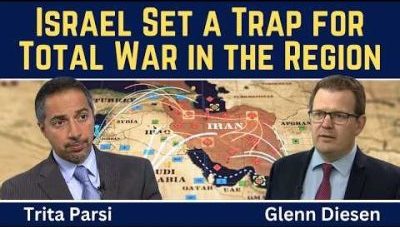
Trita Parsi: Israel Set a Trap for Total War in the Region
or go to
Aletho News Archives – Video-Images
From the Archive
Zionism’s Violent Legacy
By Donald Neff | Washington Report On Middle East Affairs | January 1996
On January 4, 1948, Jewish terrorists drove a truck loaded with explosives into the center of the all Arab city of Jaffa and detonated it, killing 26 and wounding around 100 Palestinian men, women and children.[1] The attack was the work of the Irgun Zvai Leumi – the “National Military Organization,” also known by the Hebrew letters Etzel – the largest Jewish terrorist group in Palestine. The Irgun was headed by Revisionist Zionist Menachem Begin and had been killing and maiming Arabs, Britons and even Jews for the previous ten years in its efforts to establish a Jewish state.
This terror campaign meant that at the core of Revisionist Zionism there existed a philosophical embrace of violence. … continue
Blog Roll
 Aletho News
- Trita Parsi: Israel Set a Trap for Total War in the Region
- Trump’s Iran war is on an Israeli leash
- Saudi oil boss issues global supply warning
- Riyadh Says Its Oil System Is Intact. The Numbers Say Otherwise.
- Trump and Netanyahu Want to “Finish the Job” on Iran
- US ‘one-sided dictation’ not Iran’s beliefs makes rational talks impossible: Baghaei
- Iran’s Next Strike May Not Explode. It Could Shut You Down /Col Doug Macgregor
- Iran: US political targets legitimate if assassinations return
- Iraq shuts key border crossing with Iran under US pressure: Report
- Undersea Internet cables could be targeted in retaliation for attacks on Iran: IRGC deputy chief
- If Americans Knew
- The Israel Lobby’s Changing Fortunes
- AIPAC has become such a political liability that it’s shifting to a more “nimble” approach to buying politicians
- At least 160 Israeli settler attacks in 2 weeks
- Will Gaza’s Ancient Christian Community Disappear Forever?
- Israel’s vision of regional security rests on keeping Arab states weak
- Heidi Levine recounts how Palestinian youths helped save her in settler attack
- DAILY UPDATE: Latest essential news on Palestine, Israel, & region
- Trump’s Intensifying Sabotage of the ICC, for Israel’s Sake
- Israeli military detain US and UK volunteers in West Bank including Democratic NY politician Brad Lander
- Americans at National Conservatism Conference held in Israel this year criticize Israel
- No Tricks Zone
- E-Cars Reduce CO2 Emissions By Only 41% Compared To Internal Combustion Engine Vehicles
- Predictions Made By Renowned Climate Professor Over Past Decades Have Been Proven To Be Poor
- New Study Suggests Large Regions Of The Pacific Ocean Have Been Cooling For The Last 80 Years
- Germany’s Green Energy Debacle: High Energy Costs Force Kahla Porzellan to Close After 182 Years!
- New Study: 50 Years Of The Most Aggressive ‘Net Zero’ Policies Can Only Affect The Global Climate By 0.03°C
- US September “Heat” Was No Record…Many Records Set Decades Ago
- Latest European Green Energy Debacle; Portugal’s Largest Flagship Solar Park Insolvent!
- Green Energy Debacle: German Expert Professor Fritz Vahrenholt Warns Of Severe Economic And Social Consequences
- Two More Paleo Reconstructions Affirm Meters-Higher Sea Levels Across Ireland, Brazil 7000-6000 Years Ago
- New Study: Earth And Venus Surface Warmth Largely Explained By Convection And Lapse Rate, Not CO2 Or Radiation

