Iran Beat Back The Greater Israel Project
By Justin K.P. | The Dissident | June 18, 2026
Donald Trump has officially signed the memorandum of understanding with Iran in the Palace of Versailles in France, and Israel and its American lobbyists are having a meltdown.
This is because the war with Iran, according to Israel and its neoconservative allies in the U.S., was indeed to be the linchpin for the Greater Israel Project, and the final phase of the Clean Break plan drawn up by Israel and the Bush administration.
For context, professor Jeffery Sachs explained :
In 1996, Netanyahu and his American advisors devised a “Clean Break” strategy. They advocated that Israel would not withdraw from the Palestinian lands captured in the 1967 war in exchange for regional peace. Instead, Israel would reshape the Middle East to its liking. Crucially, the strategy envisioned the US as the main force to achieve these aims—waging wars in the region to dismantle governments opposed to Israel’s dominance over Palestine. The US was called upon to fight wars on Israel’s behalf.
The Clean Break strategy was effectively carried out by the US and Israel after 9/11. As NATO Supreme Commander General Wesley Clark revealed, soon after 9/11, the US planned to “attack and destroy the governments in seven countries in five years—starting with Iraq, then Syria, Lebanon, Libya, Somalia, Sudan, and Iran.”
The first of the wars, in early 2003, was to topple the Iraqi government. Plans for further wars were delayed as the US became mired in Iraq. Still, the US supported Sudan’s split in 2005, Israel’s invasion of Lebanon in 2006, and Ethiopia’s incursion into Somalia that same year. In 2011, the Obama administration launched CIA operation Timber Sycamore against Syria and, with the UK and France, overthrew Libya’s government through a 2011 bombing campaign. Today, these countries lie in ruins, and many are now embroiled in civil wars.
Netanyahu was a cheerleader of these wars of choice–either in public or behind the scenes–together with his neocon allies in the U.S. Government including Paul Wolfowitz, Douglas Feith, Victoria Nuland, Hillary Clinton, Joe Biden, Richard Perle, Elliott Abrams, and others.
As he explained, war with Iran was intended to be the final phase of this roadmap to Greater Israel. “In September 2023, Netanyahu presented at the UN General Assembly a map of the ‘New Middle East’ completely erasing a Palestinian state. In September 2024, he elaborated on this plan by showing two maps: one part of the Middle East a ‘blessing,’ and the other–including Lebanon, Syria, Iraq, and Iran–a curse, as he advocated regime change in the latter countries. Israel’s war on Iran is the final move in a decades-old strategy. We are witnessing the culmination of decades of extremist Zionist manipulation of US foreign policy.”
The Zionists and Neo-Cons believed that by destroying Iran, it would cut off support to resistance groups such as Hamas, Hezbollah and Ansar Allah, destroy the axis of resistance and create an American/Israeli dominated Middle East, and Israeli expansion into Gaza, the West Bank, Syria and Lebanon.
Daniel Levy, former Israeli negotiator explaining why Benjamin Netanyahu so desperately wanted a U.S. war with Iran, explained, “Israel sees us in an era of what I would call a Pax Greater Israel. This is about how far Israel can extend its dominion, how much of a hard-power, dominant hegemon it can be in the region, seizing parts of Syria or of Lebanon, trying to finish an eradicationist approach to the Palestinians. And crucially, to do that, you have to weaken Iran militarily, to remove some kind of deterrent. You can only do that with the U.S., so you need to pull the U.S. into this war. If that means further accelerating American decline and even accelerating Israel’s loss of support in America, then it’s a price to pay. It’s kind of ‘use it or lose it,’ because those things are happening anyway.”
He added, “that’s what Netanyahu is trying to achieve, to achieve Greater Israel, domination in the region, including the weakening of the Gulf, which is intentional, at the expense of America bleeding further reputational, political, economic assets in this war”.
This was outright admitted by Lindsay Graham, the neoconservative South Carolina senator who was a key architect of the war, who reportedly “spoke with Israeli Prime Minister Benjamin Netanyahu, coaching him on how to lobby the president for action” in Iran.
The real goal of the Iran war was laid out by Graham at the Zionist Tzedek conference, who said referring to war with Iran, “If we can pull this off, it would be the biggest change in the Mid East in a thousand years: Hamas, Hezbollah gone, the Houthis gone, the Iranian people an ally not an enemy, the Arab world moving towards Israel without fear, Saudi-Israel normalize, no more October the 7th”.
In other words, the Zionists and Neo-cons believed that if Iran was destroyed, it would therefore destroy Hamas, Hezbollah and Ansar Allah (Houthis) and pave the way for Arab states to normalise with Israel, isolating the Palestinians and paving the way for unopposed Israeli expansion.
But contrary to the hopes of Israel and its allies in the U.S. like Lindsay Graham, the U.S. did not “pull this off”, failing to destroy Iran or do regime change, eventually being forced to sign a deal after Iranian victory.
But for Israel and its American lobbyists, this is a nightmare; the lynchpin of their Greater Israel Project has now become a fantasy.
Along with pushing back the Greater Israel Project, Iran has successfully created a rift between Israel and its main patron, the United States.
Responding to reports that Israel was , angry with the Trump administration over signing the deal, Vice President JD Vance said, Trump was, “the only head of state in the entire world who is sympathetic to the nation of Israel at this moment in time” adding, “The problem for Israel is not Donald J. Trump and anybody in Israel who thinks their biggest problem is the President of the United States needs to wake up and smell the reality of the situation that the country is in”.
Trump similarly lashed out at Israel before signing the deal, saying, “If it weren’t for the United States of America, with me… Israel would not exist right now. Israel would have been blown off the face of the earth, one hundred percent — and every smart person in Israel knows that.”
Iran has forced the Trump administration to acknowledge that Israel’s plans are delusional, that it is despised by the world and that the only entity in the world propping it up is the Trump administration.
By forcing the U.S. to agree to the MOU, Iran not only defeated the plan to destroy Iran for Greater Israel, but for the first time, created an actual rift between a Trump administration desperate to end the losing war, and Israel, desperate to have their Greater Israel Project plan completed.
Israel’s censor silenced 5,700 reports in 2025

Israeli forces detain a photojournalist in Hebron, West Bank on October 3, 2024. [Wisam Hashlamoun – Anadolu Agency]
MEMO | June 18, 2026
Israel’s military censor blocked or altered more than 5,700 news reports in 2025, an average of 15 items per day, making it the second-highest year for media censorship in Israel since records began 15 years ago, according to new data published by +972 Magazine.
The figures, obtained through a freedom of information request submitted by +972 and the Movement for Freedom of Information, show that the censor demanded redactions in 4,974 news items in 2025, while completely barring 753 further items from publication. Both totals remain far above the previous annual average of around 2,300 redactions and 320 full bans recorded between 2011 and 2023. The year 2024, the height of Israel’s genocide on Gaza, still holds the record for the highest number of interventions.
The censor, a unit embedded within Israel’s Military Intelligence Directorate, received 17,176 article submissions from media outlets in 2025, compared to a pre-2024 annual average of just under 12,000. Israeli law requires media organisations to submit material touching on “security” issues for censor approval before publication, under emergency regulations enacted at the time of Israel’s founding that remain in force today.
According to +972, censorship was most intensive during Israel’s war with Iran. Police, municipal inspectors, and at times civilians enforced severe restrictions on reporting the locations of Iranian missile strikes on Israeli cities, with Arab and foreign journalists disproportionately subjected to obstruction in the field. Television studios regularly hosted a representative of the censorship authority to monitor live broadcasts in real time.
Media outlets are legally barred from informing their audiences that the censor interfered in a published article. The censor is also authorised to intervene retroactively, ordering the removal of articles published without prior approval as it did last year when it demanded the deletion of a column in Haaretz that disclosed the locations of Iranian missile strikes in Tel Aviv.
The censor holds sweeping powers of enforcement, including the authority to indict journalists and to fine, suspend, shut down, or file criminal charges against media organisations that fail to comply with its orders.
The data raises questions about the political direction of the censorship apparatus. The two men who led the censor over the past two years — Kobi Mandelblit, who served as chief censor until April 2025, and Netanel Kula, who replaced him — are both relatives of senior legal figures from Israel’s religious-Zionist movement.
Three months after Kula assumed the role, reports emerged that he had suppressed coverage of Prime Minister Benjamin Netanyahu’s son purchasing an undisclosed property abroad. The story eventually reached the public through other channels.
The data also points to a striking double standard in enforcement. The far-right Channel 14, a broadcaster aligned with Israel’s ultranationalist camp, repeatedly published sensitive combat plans and military intelligence tools that security officials determined had caused “actual harm” to national security. Despite this, the channel was not penalised on any occasion.
“It is particularly important during times of emergency to receive reliable information about changes regarding the censor’s activities,” said Or Sadan, an attorney from the Movement for Freedom of Information. “Although there has been a slight decrease from last year, it is hard not to notice the alarming rise in the number of news reports being hidden from the public. Democracy is based on the transfer of information from the government to the public, and any infringement upon this is a direct infringement upon democracy.”
+972 notes that military censorship, while severe, is not the most acute form of press freedom violation committed by the Israeli military. Since 7 October 2023, more than 250 journalists have been killed across Gaza, Lebanon, Yemen, and Iran — some of them in strikes that investigators have concluded were direct and deliberate, including so-called “double-tap” attacks targeting rescue workers who arrived at the scene of a first strike.
When the Iran War is over: Why the West Bank may be Netanyahu’s next front
By Ramzy Baroud | MEMO | June 17, 2026
Israeli Prime Minister Benjamin Netanyahu is facing perhaps the most precarious moment of his political career. He knows it. His allies know it. And his rivals—both within his coalition and across Israel’s political spectrum—are preparing to capitalize on his growing weakness.
Former Israeli Justice Minister Haim Ramon, who also served as deputy prime minister between 2007 and 2009, is among the latest Israeli political figures to join a growing chorus of criticism directed at Netanyahu.
“In the final result,” Ramon said in an interview with Radio Galey, cited by the Israeli outlet Srugim, “we did not win.” He then broke down that failure in blunt terms: “We did not win in Lebanon, we did not win in Iran, and we did not win against Hamas.”
Another prominent critic is former Israeli army chief Gadi Eisenkot, who joined Netanyahu’s emergency war government following the events of October 7, 2023, before resigning with Benny Gantz in June 2024.
Beyond accusing Netanyahu of failing to protect Israel on October 7, Eisenkot argues that the prime minister has effectively surrendered Israel’s political decision-making to US President Donald Trump, thereby strategically weakening Israel.
Ironically, Netanyahu’s coalition partners have often been even more opportunistic than the opposition.
Since the formation of the current coalition government on December 29, 2022—widely regarded as the most right-wing government in Israel’s history—figures such as National Security Minister Itamar Ben-Gvir and Finance Minister Bezalel Smotrich have repeatedly used Netanyahu’s political vulnerability to expand their own influence. Whenever Netanyahu needed political support to remain in power, they demanded concessions in return.
For Israel’s far-right extremists, Netanyahu’s inability to secure decisive strategic victories has often translated into opportunities to advance their own agendas. Every setback on the battlefield became an opening for greater settlement expansion, harsher measures against Palestinians, and deeper entrenchment of extremist policies.
Unable to deliver ‘victory’, Netanyahu turned perpetual war into a political strategy in its own right. The result has been a genocidal war in Gaza, widespread devastation in Lebanon, and a dangerous confrontation with Iran that has repeatedly brought the region to the brink of a wider catastrophe.
For a time, this formula proved politically sustainable. Netanyahu successfully enlisted unwavering US support to keep the fires of war burning.
At the same time, the failure of Europe and much of the international community to hold a wanted war criminal accountable provided him with the political space necessary to continue his bloody calculations.
Yet that formula may be nearing its limits. While this possibility may appear encouraging, it comes with a serious warning. If Netanyahu can no longer sustain the wars that have prolonged his political life for nearly three years, he may escalate where resistance is weakest: the occupied West Bank.
Regarding Iran, there is growing recognition that the current confrontation is unsustainable indefinitely and that some form of arrangement will eventually emerge. Likewise, regardless of whether Lebanon is formally included in any future agreement, Israel’s ambition of permanently occupying parts of Lebanese territory remains untenable.
Historically, when Israel fails to secure a strategic breakthrough on one front, it seeks compensation on another—typically where Palestinians are most vulnerable and where international scrutiny is weakest.
As Israeli elections approach, it is therefore reasonable to fear a further escalation of the genocide in Gaza, pushing both the death toll and the level of destruction to new heights. According to Gaza health authorities, nearly 1,000 Palestinians have been killed since the ceasefire agreement was announced in October, bringing the overall death toll of Israel’s genocide in Gaza to 73,000 Palestinians.
Though Israel’s war has already failed to break Palestinian steadfastness, the broader objective remains unchanged: the ethnic cleansing of Palestinians from Gaza and the transformation of the Strip into a space that can no longer sustain Palestinian life.
The West Bank, however, presents a different challenge.
There, Israel faces a fragmented political landscape and a Palestinian Authority that refuses to develop an effective strategy for confronting accelerating Israeli violence, ethnic cleansing, home demolitions, land confiscation, and the relentless expansion of illegal settlements.
This vulnerability has enabled Israel to move from discussing annexation to implementing it in practice. The strategy rests on two interconnected pillars: extreme violence and displacement on the one hand, and rapid settlement expansion on the other.
According to an Oxfam International study published on June 12, Israel has killed 1,244 Palestinians, including 268 children, in the occupied West Bank since 2023—more than the total number killed during the previous seventeen years combined.
This bloodshed has been accompanied by large-scale displacement that has already uprooted nearly 46,000 Palestinians, many of them from refugee camps and vulnerable communities across the northern West Bank.
An Amnesty International report published on June 10 documented the full or partial displacement of at least 117 Palestinian Bedouin and herding communities between January 2023 and April 2026.
Expectedly, the violence, displacement, settlement expansion, and land seizures are not isolated developments but components of a coherent political project. In September 2025, Smotrich openly proposed the annexation of 82 percent of the occupied West Bank. What was once presented as a political vision is now steadily being translated into facts on the ground.
The era of Netanyahu may be nearing its end, but before this bloody political chapter closes, countless more Palestinians may be forced to bear the cost.
Arab and Muslim countries, along with their allies in the international community, must not wait for Israel to launch a much larger assault on the West Bank before responding.
The matter demands urgent attention and immediate action.
Israeli forces launch fresh ground incursions into Syria’s Quneitra, interrogate locals
Press TV – June 18, 2026
While Israeli military incursions and activities in southern Syria, along with harassment of local citizens under the inaction of the ruling Hay’at Tahrir al-Sham (HTS) regime, have become recurrent over the past year, Syrian sources have detailed a recent ground incursion.
The sources stated that Israeli forces, onboard nine military vehicles, raided the village of al-Asbah on the outskirts of Syria’s southwestern province of Quneitra near the occupied strategic Golan Heights early on Thursday.
Israeli forces on Wednesday carried out a series of raids on residential homes in the southern countryside of Quneitra, including the interrogation of a local journalist.
Local sources said the incursion targeted ten homes in the town of Saida in southern Quneitra countryside.
Among the properties searched was the home of Sanad al-Hindawi, a journalist and employee of the Quneitra Media Directorate. Sources said Israeli soldiers questioned Hindawi inside his residence during the raid.
No arrests were reported during the incursion.
The raids came two days after Israeli forces broke into the village of Saida al-Golan in southern Quneitra countryside, and established a temporary checkpoint at the village junction, where pedestrians and passing vehicles were subjected to inspections.
Following the fall of former Syrian President Bashar al-Assad’s government in early December 2024, the Israeli military has been conducting airstrikes targeting military installations, facilities, and arsenals previously operated by the Syrian army.
Israel has faced widespread criticism for ending the 1974 ceasefire agreement with Syria and taking advantage of the chaos in the war-torn nation to seize territory.
The UN, along with several Arab nations, condemned Israel’s actions as breaches of international law and violations of Syria’s sovereignty.
Despite the HTS’s pledges of cooperation with Tel Aviv, Israel has remained unwilling to withdraw from Syria.
The two sides have been engaged in on-and-off talks to reach a “security agreement”, but no deal or concrete progress has been announced.
Israeli prime minister Benjamin Netanyahu has ordered his forces to push deeper into Syrian territory beyond the 1967-occupied Golan Heights and seize several strategic locations.
The bulk of the Israeli attacks have been concentrated in the southern Syrian governorates of Quneitra, Dara’a, and Damascus, which account for nearly 80 percent of all recorded Israeli attacks.
Syria ‘unwilling, unprepared’ to attack Lebanon despite US pressure: Report
Damascus is reportedly prepared to reconsider its position if Tel Aviv were to withdraw its occupation troops from Syria
The Cradle | June 17, 2026
Syrian President and former Al-Qaeda chief Ahmad al-Sharaa is “unprepared and unwilling” to launch a military offensive against Lebanon despite growing US pressure, Israel’s Broadcasting Corporation (KAN) reported on 16 June.
KAN cited an informed Syrian source who said that Sharaa is “concerned” that an attack by Damascus against Hezbollah will be seen across the region as “serving” Israel’s interests.
This could negatively impact Damascus’s “legitimacy.”
For now, the self-appointed Syrian president is ruling out an attack against Lebanon and its resistance forces unless Israel decides to pull its forces out of Syria, the report states.
Israel has rejected withdrawal from both Syria and Lebanon.
KAN also said that Turkiye – a longtime backer of Sharaa since his days as Abu Muhammad al-Julani, founder and leader of Al-Qaeda’s Nusra Front – has urged Damascus against such an incursion.
Ankara is reportedly concerned that a Syrian assault on Lebanon would “embolden” Tel Aviv and “strengthen” its position.
“Trump proposed a framework in which the Syrian military would play a central role in a future effort to disarm Hezbollah,” i24 reported on Wednesday.
Lebanese authorities reportedly felt uneasy about the idea during recent US-backed direct talks with Israeli officials, which have taken place despite Lebanon’s legal restrictions.
Additionally, Israeli authorities are reportedly concerned about the effectiveness of a Syrian attack on Hezbollah.
“Some of the arrangements currently under discussion could ultimately strengthen Hezbollah politically and militarily rather than diminish its influence,” i24 reported.
Sharaa said earlier this week that talk of a Syrian incursion into Lebanon was a “rumor.” “Syria’s approach aims to end the war in Lebanon, not to expand it or get involved,” he stressed.
US President Donald Trump has repeatedly called on Syria to attack Hezbollah.
Iraqi resistance groups allied with Hezbollah have cautioned the Syrian government and its forces that they will act if Damascus initiates an attack on Lebanon.
Syria experienced a significant geopolitical change following the fall of former President Bashar al-Assad in December 2024, as Sharaa’s government aligned with Washington and engaged in discussions with Israel.
The US has largely lifted sanctions on Syria and called Damascus a “partner” in the global fight against ISIS — overlooking Sharaa’s past as an Al-Qaeda leader and earlier as deputy to ISIS founder Abu Bakr al-Baghdadi.
Hezbollah fought in Syria for years with the former government, helping recapture areas from extremist groups like Al-Qaeda’s Nusra Front, Ahrar al-Sham, and others considered by the west as the “Syrian opposition.”
The Nusra Front, led by Sharaa, was rebranded into Hayat Tahrir al-Sham (HTS) and ended up toppling Assad’s government in 2024.
HTS and other extremist factions with links to ISIS currently dominate what has become the new Syrian Defense Ministry and military.
Tom Barrack, US special envoy to Syria and Iraq, threatened Lebanon last year with a Syrian incursion, and said Damascus would “actively assist us in confronting and dismantling … Hezbollah.”
He also said Syria viewed Lebanon as its “beach resort” and would carry out an assault against the country unless Hezbollah is disarmed.
Hezbollah thwarts Israeli advances into Kfar Tebnit-Ali al-Taher
Al Mayadeen | June 18, 2026
The Islamic Resistance in Lebanon – Hezbollah released a detailed statement regarding confrontations along the Kfar Tebnit-Ali al-Taher axis in South Lebanon, after four days of failed Israeli attempts to advance toward the area via multiple axes under the cover of aerial surveillance, heavy artillery, and smoke screens.
The Operations Room stated that its fighters have consistently engaged all Israeli advance attempts by targeting troop movements and concentrations with rockets, drones, and FPVs, inflicting significant losses in personnel and equipment among Israeli officers, soldiers, and armored vehicles.
It added that, as a result of these engagements, Israeli occupation forces were compelled to withdraw and conduct nighttime helicopter evacuations under smoke cover and artillery fire to recover casualties.
According to the statement, on Wednesday, June 17, at 8:00 pm, following the detection of an Israeli infantry unit attempting to establish positions on the northeastern outskirts of Kfar Tebnit, Resistance fighters engaged the force using a swarm of drones and Ababil FPV drones, confirming casualties among its members, including killed and wounded. The operation was subsequently followed by rocket salvos and artillery fire directed at the same area.
Several hours later, at approximately 01:50 am on Thursday, June 18, amid enemy attempts to regroup in a crossing area, Hezbollah fighters targeted a Merkava tank with the appropriate weapons, achieving a direct hit and forcing the withdrawal of the Israeli force from the sector.
The Resistance confirmed that Israeli occupation forces remain present on the southern outskirts of Kfar Tebnit toward Arnoun, vowing that the Kfar Tebnit–Ali al-Taher axis will remain inaccessible to enemy advances.
The operations come as Hezbollah defends Lebanese territories from ongoing Israeli violations of the April 17 ceasefire and the memorandum of understanding reached between the United States and Iran, which clearly stipulates “Israel’s” withdrawal and cessation of attacks in Lebanon.
The final war or final deal: Why the MoU?
By Robert Inlakesh | Al Mayadeen | June 18, 2026
The Israeli-US plot to inflict “regime change” upon Iran has been turned into a strategic failure of historic proportions – in the end, Washington and Tel Aviv were forced to confront the reality. The newly signed Memorandum of Understanding is either a gateway to a final deal or simply another strategy to buy time.
Forty days of all-out war, followed by two months of dead-end negotiations, led to two final options: Submit to a deal that works heavily in Iran’s favour or keep on fighting until the end. What ultimately comes of this equation will completely reshape West Asia and perhaps geopolitics globally.
US President Donald Trump had tried every single avenue to pressure the Islamic Republic of Iran into surrender. He suddenly found himself in a new phase where the walls were closing in and decided to make a diplomatic move. The Iranians managed to reunite their allied fronts across the region, taking de facto ownership of the Strait of Hormuz, while proving they can fight the world’s top military superpower to a standstill.
If you were to listen to the rhetoric coming from the White House, it was like hearing a radio broadcast from a parallel universe. According to Trump, Iran was defeated all the way back in March, its military is destroyed, nobody knows who is running the country, it has no air defenses, no missiles left, no navy, and is on the verge of collapse. But quite frankly, nobody bought his nonsensical ramblings.
Beneath the egotistical exterior is a system that was running out of gas and whose operator was in panic.
In order to accurately assess the situation, we have to factor in precisely why the US leader is managing this war so incredibly poorly. The Trump administration is not composed of competent and experienced individuals; it’s a who’s who of Israeli Lobby shills and hardline ideological fanatics – a tech billionaire’s dream administration. While the Israeli Lobby and other lobby groups have for long had sway over American presidents and foreign policy, it has never been this severe.
Donald Trump exemplifies this through his total incompetence and constant inability to say no to the Israelis when it matters the most. There is, after all, a reason why no other US president agreed to go to war with the Islamic Republic upon the request of Israeli Prime Minister Benjamin Netanyahu, even when Iran was far less prepared for it militarily.
Finding out the hard way, the US president found himself caught in a quagmire– if he escalated the war, then the entire region would go up in flames, but if he backed out, he would face the wrath of the same billionaire class that put him in power to begin with.
The Zionist regime can’t defeat the Iranians alone, nor does it believe that the US will defeat Tehran conventionally. Yet, the Israeli leadership does not want to give up, for if they fail, then the Iranians will become the dominant regional power and the “Greater Israel Project” will not be able to succeed.
Therefore, they are only really left with two actual options, both involving the United States: The first is a fight to the death that could go so far that nuclear weapons become involved; the second is a large-scale attack on Iranian infrastructure.
The second option is more likely to be favoured by the Israelis than the first, and its goal will be to continue battering Iranian civilian infrastructure until the Israelis can’t take the punishment coming back its way any longer. For the US, this would represent a catastrophe, because the Iranians have long pledged to wipe out the entire region’s oil and gas infrastructure, even going after water desalination and power plants if it comes down to it.
For Washington, this means their Gulf allies will be destroyed. Keep in mind that the Trump administration previously bragged about the alleged Trillion that the Gulf Arab States had pledged to invest in the United States. All of that is gone overnight, and a global economic meltdown would be underway. Trump personally has a lot of investments in the Gulf, which means sacrificing this too.
The Israelis, on the other hand, want the Arab Gulf States weakened. This is for the very same reason they threaten Turkiye constantly – they do not want any potential competitors. Tel Aviv doesn’t even like other regional nations, who are their allies, to get the latest US fighter jets. So, the hypothetical annihilation of rich Gulf States doesn’t likely bother them at all.
As long as the primary goal is achieved, they will be happy. They want a weakened and battered Iran, an Islamic Republic that is susceptible to future color revolutions, one that can no longer impose deterrence equations. But the Americans were facing an economic tidal wave and had no good options in front of them.
If a deal is signed on the terms of the Iranians as a result of the MoU, the Israelis have been strategically defeated. The war that began on October 7, 2023, would have been completely lost for them, and they will only have two options available to them: try to linger on and delay the inevitable implosion of their expansionist project, or sign a deal with the Palestinians in order to allow for a State of Palestine to come into existence. Realistically, the so-called “Two-State solution” is their only hope of long-term survival. All of this assumes they won’t simply blow the deal up before it can come to fruition.
Iran declares victory over US
RT | June 18, 2026
Iranian officials have portrayed the newly signed memorandum of understanding with the US as a diplomatic victory achieved through strength and as evidence that Washington failed to achieve any of its objectives militarily.
The 14-point document was signed remotely by President Donald Trump and his Iranian counterpart, Masoud Pezeshkian, late Wednesday and immediately entered force, according to the Pakistani mediators.
The US side has been unusually muted in its public response. The White House has also yet to publish the final text of the memorandum, although an unnamed senior US official read out the 14-point document to journalists after days of criticism over the secrecy surrounding the deal.
Meanwhile, Iran’s parliament speaker and chief negotiator in the talks, Mohammad Ghalibaf, described the memorandum as proof of US surrender.
“The agreement is a record of US failure,” Ghalibaf said in a televised interview on Wednesday. “People will see it and judge.”
Tehran has argued that the document reflects a series of concessions by Washington, including the lifting of the US naval blockade, sanctions waivers for Iranian oil exports, access to frozen Iranian funds, and a US-backed economic reconstruction plan worth at least $300 billion. Washington has also agreed not to impose new sanctions or deploy additional forces in the region while the sides negotiate a final agreement.
In response, Iran “will make arrangements” to restore freedom of navigation through the Strait of Hormuz – something that had not been an issue before the US-Israeli attack. However, Tehran has signaled that the key waterway will not simply return to prewar conditions.
“I emphasize again that the Strait of Hormuz will never return to the previous conditions,” Ghalibaf said. “Iran has the right to sovereignty over the Strait of Hormuz, and of course, we will receive a fee for services.”
Iranian Foreign Ministry spokesman Esmaeil Baghaei added that a framework was being developed to manage the key waterway, with consultations already held with Oman, as outlined in the MOU.
Tehran has also highlighted the memorandum’s language on Lebanon. “If the Israeli regime’s attacks on Lebanon continue, it will be considered a violation of the other party’s commitments under the memorandum of understanding,” Baghaei said.
The memorandum is not a final peace agreement, but launches a 60-day negotiation period during which Washington and Tehran are expected to discuss Iran’s nuclear program, sanctions relief, frozen assets, the future administration of the Strait of Hormuz, and a final settlement to be endorsed by the UN Security Council.
The nuclear language in the document states that Iran “reaffirms that it shall not procure or develop nuclear weapons” – something Tehran has been stating for years, including during both previous US-Israeli attacks. The MOU adds that the sides will work out a mechanism for the disposition of stockpiled enriched material, with the minimum methodology being down-blending on site under IAEA supervision.
Trump made multiple unrelated posts on Truth Social hours after signing but said nothing about the deal. Earlier in the day, he defended the memorandum, threatening to “bomb the hell out of” Iran if it failed to comply.
Trump leverages illegally frozen Palestinian funds to force normalization, halt legal cases against Israel
The Cradle | June 17, 2026
US President Donald Trump is seeking to leverage severe Palestinian financial hardship to coerce a “normalization” agreement that would require the Palestinian Authority (PA) to drop all international legal challenges against Israel, the Times of Israel reported on 17 June.
This proposed memorandum of understanding (MoU), negotiated by US officials Aryeh Lightstone and Scott Leith, demands the Palestinian Authority (PA) “halt efforts to internationalize the conflict with Israel.”
In exchange for these concessions, Washington has offered the hollow possibility of reopening the Palestine Liberation Organization (PLO) mission in Washington and lifting sanctions, but only after the PA completes a series of “Saudi-chaperoned reforms.”
The PA has further requested language in the MoU calling for a cessation of Israeli settlement expansion and a crackdown on “rampant settler violence” in the occupied West Bank.
Central to these talks is the fate of over $5 billion in Palestinian tax revenues, which Israel has been illegally withholding for over a year in violation of the Oslo Accords.
The US seeks to redirect these funds to the “Board of Peace” and its National Committee for the Administration of Gaza (NCAG) to finance a post-war governance plan that bypasses the PA until it meets Washington’s benchmarks – including the dissolution of the PA’s welfare program for the families of Palestinians killed or imprisoned by Israeli occupation forces.
While the PA has agreed in principle to this diversion to secure a fraction of its own money, Israeli Finance Minister Bezalel Smotrich has blocked the transfer, openly advocating for the “collapse of the PA” and rejecting even debt-settlement transfers in a deliberate effort to ensure the total financial strangulation of Palestinian governance.
Despite external audits confirming the PA has successfully reformed its welfare system to end payments based on attacks, a US Department report, relying on Israeli data, claimed the PA still provides “compensation in support of terrorism.”
As the US explores legally thin options to unilaterally seize Palestinian funds, officials admit the administration views the West Bank as an “afterthought” while prioritizing the expansion of the Abraham Accords.
The art of the recycled deal: Trump and the outcome Israel cannot tolerate
By Jamal Kanj | MEMO | June 17, 2026
There are many lessons to be learned from the latest made-for-Israel war on Iran. The first and most damning is that the war resolved the very crisis it created. Donald Trump celebrated the reopening of the Strait of Hormuz and the lifting of the blockade against Iran. Two conditions that were fully in place before Benjamin Netanyahu dog walked Trump into this war. The agreement that concluded the war took us back to exactly where we stood before America spent $200 billion, and where Americans continue to pay Israeli surcharge tax at the pump and grocery stores.
As for Iran’s nuclear program, the arithmetic does not lie. The 400 kilograms of 60-percent enriched uranium that Iran possessed were zero before Trump — pressured by his largest Israel-first donors — tore up the Joint Comprehensive Plan of Action (JCPOA) in May 2018.
According to the International Atomic Energy Agency, Iran had fully complied not only with the IAEA non-proliferation agreement, which Israel has never signed nor accepted, but with the additional protocols governing verification and monitoring of its civilian nuclear program.
Trump canceled the deal anyway, not because it failed America, but because it did not satisfy Israel’s veto.
The deepest irony is that Iran’s nuclear knowledge and capabilities are more advanced today than when Trump discarded the JCPOA. Any new agreement — even one stricter in structure than the original — is therefore being negotiated from a fundamentally weaker position than the one that existed in 2018. No treaty can unlearn what Iran already knows.
On Monday, June 15, Trump heralded the end of war bragging that Iran agreed not to develop nuclear weapons. In a leaked copy of the supposed Memorandum of Understanding (MoU), item 8 states: “The Islamic Republic of Iran reiterates that it will never produce nuclear weapons ...” The word reiterates is not incidental. It is a direct reference to Article III of the 2015 JCPOA, which Trump most likely never read, where Iran had already affirmed: “… that under no circumstances will Iran ever seek, develop or acquire any nuclear weapons.” Same commitment. Same language. Different signatures. Twelve weeks of a war that went nowhere to get here.
From “There will be no deal with Iran except UNCONDITIONAL SURRENDER!” to celebrate an MoU to reopen a Strait that was open before $200 billion and countless American and Iranian lives were squandered. Trump’s triumph is much ado about nothing.
He canceled an existing deal that took years to negotiate, inflicted economic hardship on ordinary Iranians, and allowed Iran’s nuclear advancement to leap forward. It is, in the most literal sense, like redefining water as H2O. The molecule did not change. Only the dressing did. Israel’s war took Trump back to the starting point, at twice the cost to American taxpayers.
The same special-interest group that pushed Trump to cancel the JCPOA, lobbied him long before the 2024 election. Israel-first donors poured hundreds of million into his campaign as a down payment for this war. Netanyahu visited Trump seven times in thirteen months, manipulating, and scheming for another made-for-Israel war.
This war should also carry a lesson for the Arab Gulf states that long believed American military bases were a guarantee of their security. Instead, they found themselves sidelined and never consulted on a war waged, directly or indirectly, from their own soil, ultimately in service of an Israeli agenda. Foreign military presence does not deliver security. It delivers dependency. Lasting regional stability is built through regional cooperation, on terms beneficial to the region.
More importantly, the region must now reckon with a pattern it can no longer afford to ignore: wherever Israel goes, instability follows. The so-called Abraham Accords brought Israel into the Gulf. What followed was bombs, drones and economic ruins never seen since the Second World War.
I have lived in the Gulf. The only pop people could hear was the backfire of an aging car exhaust. In the last three months, friends shared recordings of ballistic missiles splitting the sky and drones buzzing overhead. Israel did not bring a defense shield; it brought a target. Its presence is a magnet for unrest. It is a carcass attracting wasps.
In fact, Israel is an agent of disorder and a parasite nurtured by chaos. It wraps itself in the language of partnership, mutual benefit, and shared values, deceiving others into believing the arrangement is reciprocal when it is entirely one-directional.
Israel’s record speaks for itself: a genocide in Gaza, ethnic cleansing across the West Bank, 1.3 million internal refugees in Lebanon, the occupation of Syrian land following Assad’s fall, destabilization operations in northern Iraq and Sudan.
In Iraq, the American invasion and regime change did not satisfy Israel’s insatiable lust for total chaos. It targeted Iraqi scientists and waged war against knowledge itself. The blueprint, in this view, has not changed for Iran. Israel’s dissatisfaction over the MoU with Tehran is not that it fails to produce a non-nuclear Iran, but that it fails to wipe out knowledge. Its broader objective is the suppression of scientific and technological development across the region. Israel seeks neighbors unable to think independently, consume, not produce, import rather than innovate. It wants to maintain a monopoly over nuclear capabilities and control over regional scientific advancement.
Israel brought ruins to the U.S., too. The made-for-Israel Iraq war helped detonate the financial crisis of 2008, saddling future American generations with trillions in accumulated debt that has never been fully reckoned with. A war that Trump condemned, criticizing Democratic leadership for failing to impeach George W. Bush who “got us into the war with lies.”
The cost of current Trump’s made-for-Israel war on Iran requires no economist to explain. It arrives uninvited in every American home, at the meat counter, in every grocery bill, every gas receipt, every price that keeps rising without explanation. They may not realize its extent, yet. By the time they do, the damage to the U.S. economy, as in 2008, will be too deep to reverse.
To undermine potential peace with Iran, the ungrateful Israel-first loyalists like Ben Shapiro, Mark Levin are already panicking and challenging Trump’s MoU. Israel will activate the constellation of media outlets controlled by Israel-first billionaires to shape what Americans see, read, and are permitted to question. The once-respected 60 Minutes, under a new Israel-first boss, Bari Weiss, allows Netanyahu to handpick his own interviewer. Who knows, maybe he submits his own questions, too.
Now, Netanyahu and American Zionists have sixty days to sabotage a final deal with Iran. Israel will mobilize its donors, lobby Congress, and if that fails, resort to what it has perfected. A false flag operation against American forces in the region, or another assassination in Lebanon.
A conflagration ensues, and once again, it will be fought with American money and American lives. Because a Middle East free of American military entanglement is the one outcome Israel cannot tolerate — a prospect more threatening than any Iranian nuclear centrifuge.
Featured Video
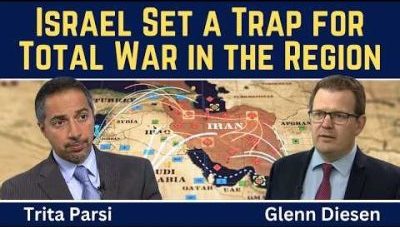
Trita Parsi: Israel Set a Trap for Total War in the Region
or go to
Aletho News Archives – Video-Images
From the Archive
Zionism’s Violent Legacy
By Donald Neff | Washington Report On Middle East Affairs | January 1996
On January 4, 1948, Jewish terrorists drove a truck loaded with explosives into the center of the all Arab city of Jaffa and detonated it, killing 26 and wounding around 100 Palestinian men, women and children.[1] The attack was the work of the Irgun Zvai Leumi – the “National Military Organization,” also known by the Hebrew letters Etzel – the largest Jewish terrorist group in Palestine. The Irgun was headed by Revisionist Zionist Menachem Begin and had been killing and maiming Arabs, Britons and even Jews for the previous ten years in its efforts to establish a Jewish state.
This terror campaign meant that at the core of Revisionist Zionism there existed a philosophical embrace of violence. … continue
Blog Roll
 Aletho News
- Trita Parsi: Israel Set a Trap for Total War in the Region
- Trump’s Iran war is on an Israeli leash
- Saudi oil boss issues global supply warning
- Riyadh Says Its Oil System Is Intact. The Numbers Say Otherwise.
- Trump and Netanyahu Want to “Finish the Job” on Iran
- US ‘one-sided dictation’ not Iran’s beliefs makes rational talks impossible: Baghaei
- Iran’s Next Strike May Not Explode. It Could Shut You Down /Col Doug Macgregor
- Iran: US political targets legitimate if assassinations return
- Iraq shuts key border crossing with Iran under US pressure: Report
- Undersea Internet cables could be targeted in retaliation for attacks on Iran: IRGC deputy chief
- If Americans Knew
- The Israel Lobby’s Changing Fortunes
- AIPAC has become such a political liability that it’s shifting to a more “nimble” approach to buying politicians
- At least 160 Israeli settler attacks in 2 weeks
- Will Gaza’s Ancient Christian Community Disappear Forever?
- Israel’s vision of regional security rests on keeping Arab states weak
- Heidi Levine recounts how Palestinian youths helped save her in settler attack
- DAILY UPDATE: Latest essential news on Palestine, Israel, & region
- Trump’s Intensifying Sabotage of the ICC, for Israel’s Sake
- Israeli military detain US and UK volunteers in West Bank including Democratic NY politician Brad Lander
- Americans at National Conservatism Conference held in Israel this year criticize Israel
- No Tricks Zone
- E-Cars Reduce CO2 Emissions By Only 41% Compared To Internal Combustion Engine Vehicles
- Predictions Made By Renowned Climate Professor Over Past Decades Have Been Proven To Be Poor
- New Study Suggests Large Regions Of The Pacific Ocean Have Been Cooling For The Last 80 Years
- Germany’s Green Energy Debacle: High Energy Costs Force Kahla Porzellan to Close After 182 Years!
- New Study: 50 Years Of The Most Aggressive ‘Net Zero’ Policies Can Only Affect The Global Climate By 0.03°C
- US September “Heat” Was No Record…Many Records Set Decades Ago
- Latest European Green Energy Debacle; Portugal’s Largest Flagship Solar Park Insolvent!
- Green Energy Debacle: German Expert Professor Fritz Vahrenholt Warns Of Severe Economic And Social Consequences
- Two More Paleo Reconstructions Affirm Meters-Higher Sea Levels Across Ireland, Brazil 7000-6000 Years Ago
- New Study: Earth And Venus Surface Warmth Largely Explained By Convection And Lapse Rate, Not CO2 Or Radiation

